Sample Category Title
USD/JPY Mid-Day Outlook
Daily Pivots: (S1) 115.26; (P) 115.36; (R1) 115.48; More...
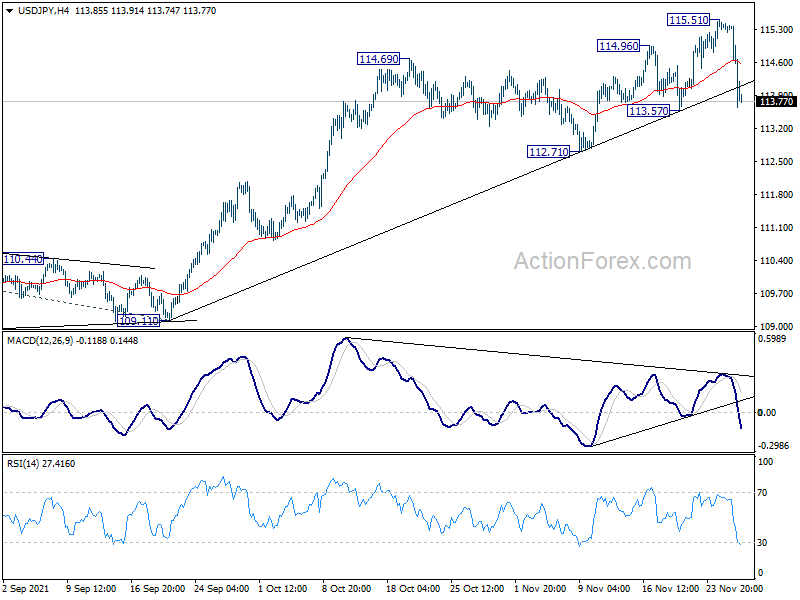
Focus is immediately on 113.58 support with today's sharp decline. Firm break there will suggest that fall from 115.51 is correcting the rise from 109.11 at least. Deeper fall would be seen to 112.71 support and below. On the upside, though, break of 115.51 will resume larger up trend from 102.58.
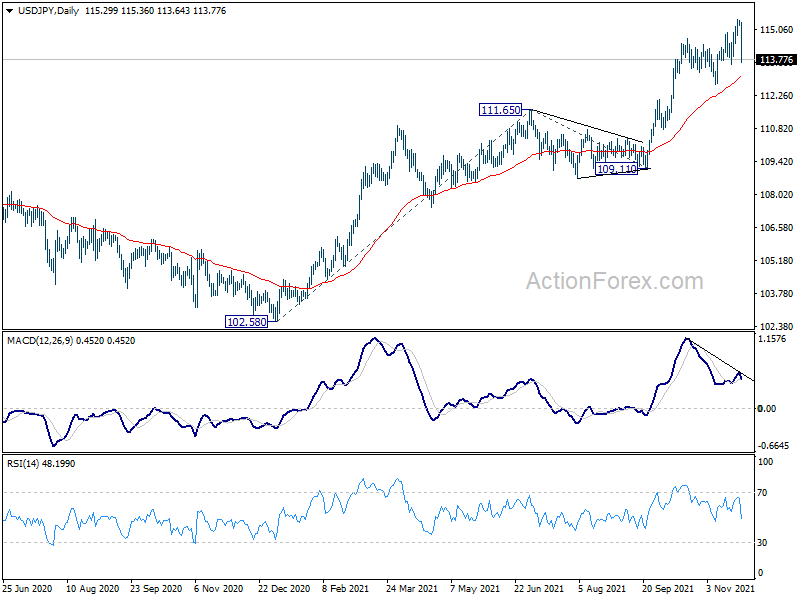
In the bigger picture, corrective decline from 118.65 (2016 high) should have completed at 101.18 already. Rise from the 102.58 is seen as the third leg of the up trend from 101.18. Next target is 118.65 high. This will now be the preferred case as long as 111.65 resistance turned support holds, even in case of deep pull back.
USD/CAD Mid-Day Outlook
Daily Pivots: (S1) 1.2634; (P) 1.2655; (R1) 1.2670; More...
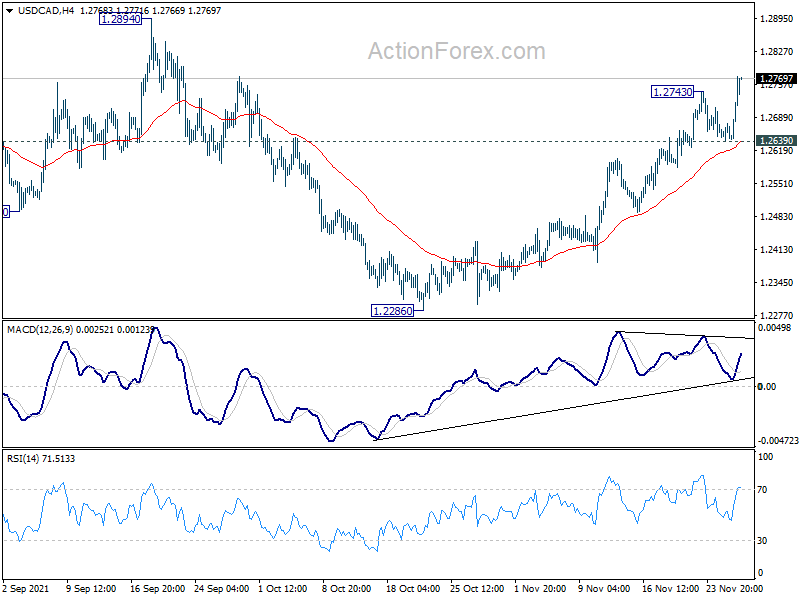
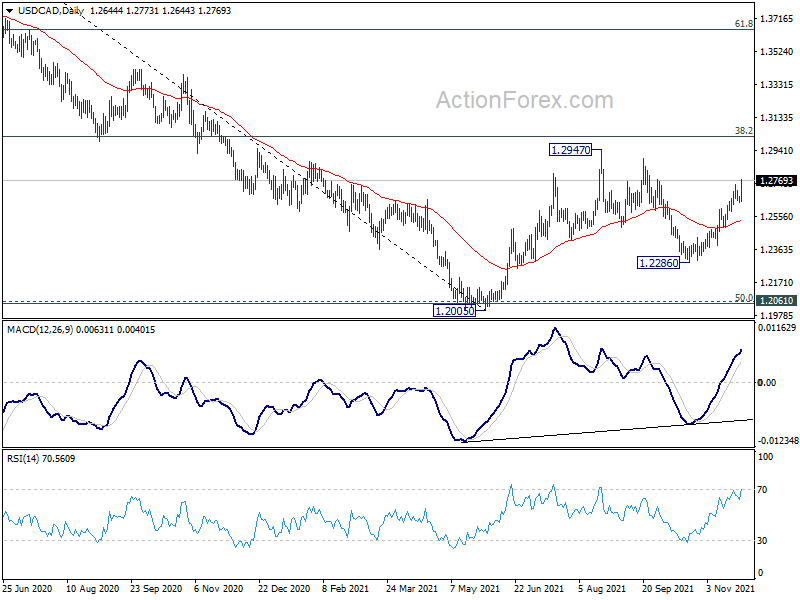
USD/CAD's rise from 1.2286 resumed by breaking through 1.2743 temporary top today. Intraday bias is back on the upside for retesting 1.2894/2947 resistance zone. On the downside, break of 1.2639 support is needed to indicate short term topping. Otherwise, outlook will remain bullish in case of retreat.
In the bigger picture, medium term outlook is neutral for now. The pair drew support from 1.2061 cluster and rebounded. Yet, upside was limited below 38.2% retracement of 1.4667 to 1.2005 at 1.3022. On the upside, firm break of 1.3022 should affirm the case of medium term bullish reversal. However, break of 1.2286 will turn focus back to 1.2005 low again.
GBP/JPY Mid-Day Outlook
Daily Pivots: (S1) 153.38; (P) 153.73; (R1) 154.03; More...
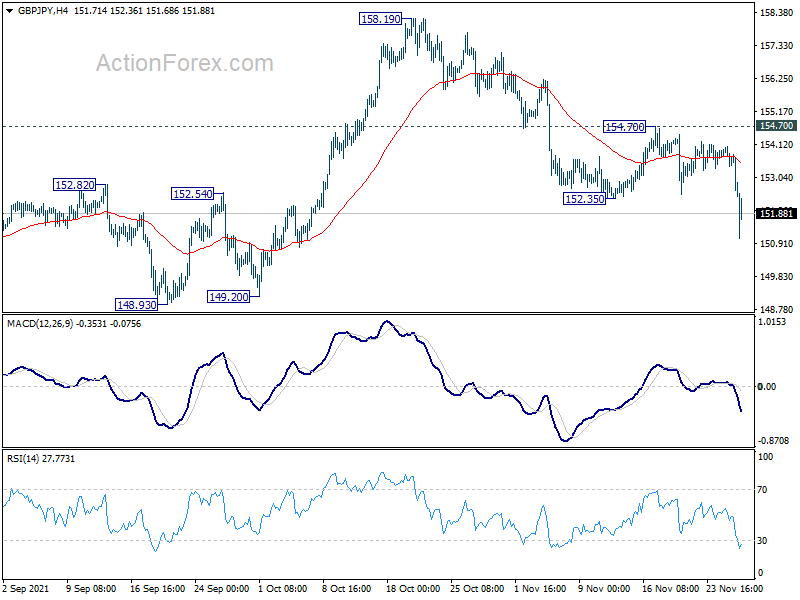
GBP/JPY's fall from 158.19 resumes by breaking 152.35 support and intraday bias is back on the downside. Deeper fall would be seen back to 148.93 key support. On the upside, break of 154.70 resistance is needed to indicate short term bottoming. Otherwise, near term outlook will stay bearish in case of recovery.
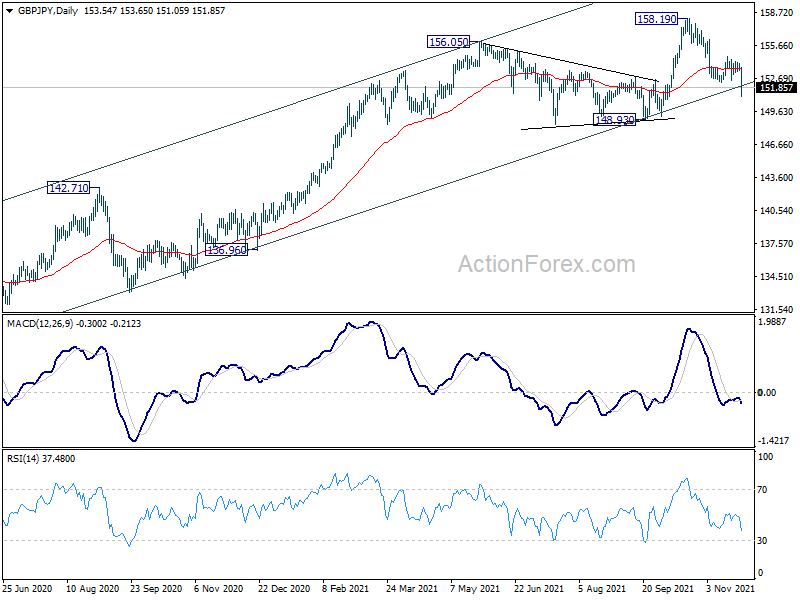
In the bigger picture, rise from 123.94 is seen as the third leg of the pattern from 122.75 (2016 low). Further rally is still expected as long as 148.93 support holds. However, firm break of 148.93 will argue that the medium term trend has reversed and bring deeper fall back to 142.71 resistance turned support first.
Yen and Swiss Franc in Strong Momentum as Risk Aversion Dominates
The new coronavirus variant is the main them in the markets today, sending global stocks and benchmark treasury yields sharply lower. Yen and Swiss Franc are trading sharply higher, followed by Euro. Commodity currencies tumble sharply on risk aversion but Sterling and Dollar are also pressured. For the week, Swiss Franc is now the strongest one, while Kiwi is the worst performing. We'll see how the picture changes before weekly close.
In Europe, at the time of writing, FTSE is down -2.96%. DAX is down -3.07%. CAC is down -3.82%. Germany 10-year yield is down -0.0654 at -0.314. Earlier in Asia, Nikkei dropped -2.53%. Hong Kong HSI dropped -2.67%. China Shanghai SSE dropped -0.56%. Singapore Strait Times dropped -1.72%. Japan 10-year JGB yield dropped -0.0082 to 0.077.
BoE Pill: Ground has now been prepared for policy action
In a speech, BoE chief economist Huw Pill said "the ground has now been prepared for policy action" with QE reaching its "natural end" next month. Incoming data supports the conclusion that "recovery is continuing" supply disruptions "create inflationary pressures", and "labour market is tight".
These developments were "sufficient" for Pill to support the MPC's November steer, "should the incoming data continue to be consistent with the projections published in the committee's latest Monetary Policy Report, it will be necessary over coming months to increase Bank Rate for the inflation target is to be achieved in a sustainable manner."
Swiss GDP grew 1.7% qoq in Q3, more than 1% above pre-crisis level
Swiss GDP grew 1.7% qoq in Q3, following 1.8% qoq rise in Q2. Looking at some details, private consumption rose 2.7%. Government consumption dropped -1.5%. Equipment and software investment dropped 1.3%. Construction investment rose 0.1%. Exports of goods excluding valuables rose 2.3%. Exports of services dropped -2.2%. Import of goods rose 3.2%. Imports of services rose 2.9%.
The FSO said, "Value added grew markedly in the affected service sectors as a result of the further relaxation GDP was more than 1% higher in the third quarter than the pre-crisis level seen in the fourth quarter of 2019.
RBNZ Hawkesby: We need to continue this process of removing stimulus
RBNZ Assistant Governor Christian Hawkesby said in a Bloomberg TV interview, "in New Zealand we've had a very resilient economy, we've got core inflation running near the top of our 1-3% target range, we've got an employment market that's through what we think it maximum sustainable employment."
He said, "so we're getting pretty clear signals that we need to continue this process of removing stimulus and getting interest rates back up towards neutral."
"Inflation expectations are going to be absolutely key for us. There are things that could make us go faster, and I think inflation expectations is one, he said. "Five- to 10-year inflation expectations are very well anchored. Short-term inflation expectations have lifted with headline, but lifted in a way that we would anticipate, so I think that's a really key thing to watch."
"On the upside, the risks are that we've had a very strong economy, a big change in the starting point, inflation expectations, there's a risk that they lift," he said. "But on the other side, interest rates have moved a long way here in New Zealand, mortgage rates are nearly 2% up from their lows in January, and ahead of us we're going to have to navigate having Covid in our community."
Australia retail sales rose 3.9% mom in Oct, still short of pre-delta level
Australia retail sales rose 4.9% mom in October, above expectation of 2.5% mom. That's the strongest rise since Victoria's first lockdown bounce back in November 2020, with retail turnover rising to its highest level since June 2021.
"Retail performance continues to be tied to state lockdowns as this month's recovery was driven by the end of lockdowns in New South Wales, Victoria and the Australian Capital Territory," Ben James, Director of Quarterly Economy Wide Statistics said.
"With lockdown ending on October 11, New South Wales sales rose 13.3 per cent returning to the levels seen in the months immediately prior to the Delta outbreak, while Victoria and the Australian Capital Territory remain below pre-Delta levels."
"Although sales have bounced back strongly following the end of lockdowns, it is important to note that overall retail turnover has not yet reached the level of May 2021, the month prior to the Delta outbreak."
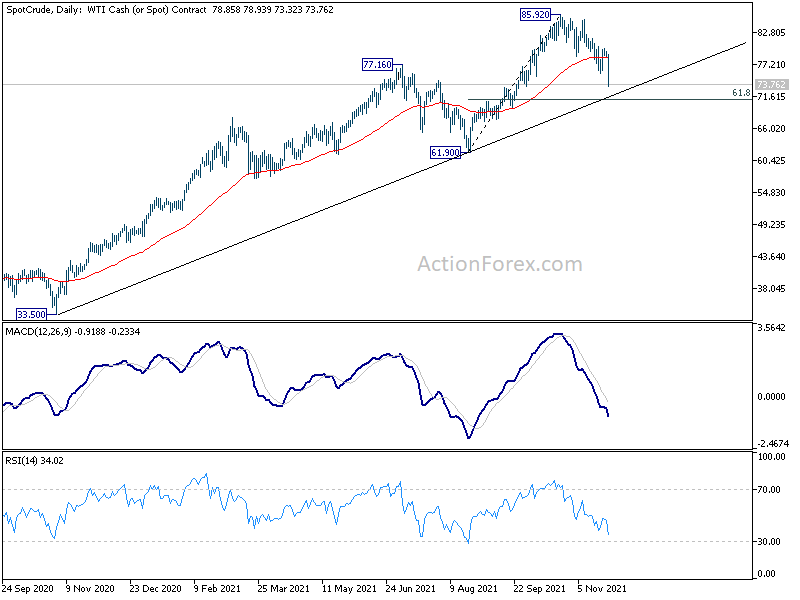
WTI oil in free fall, can 71 fibo support hold?
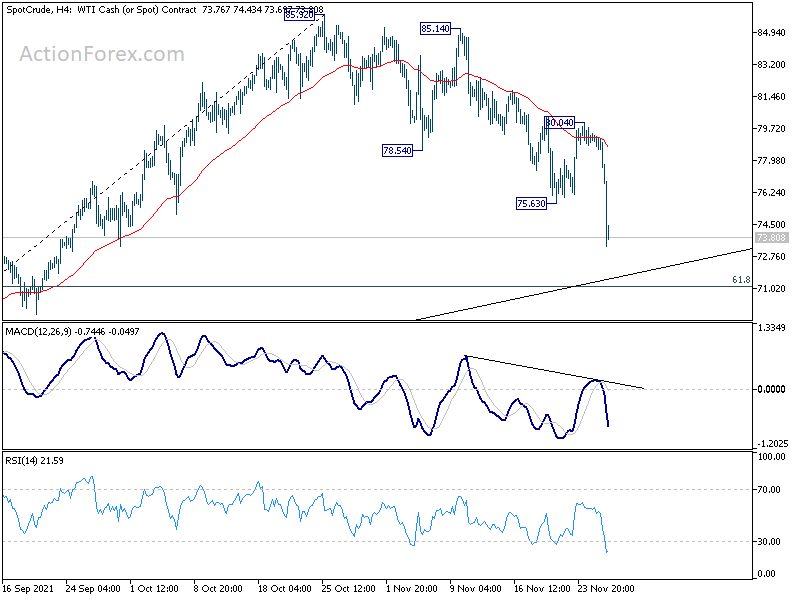
WTI crude oil is in free fall today, together with other risk markets. At this point, the decline from 85.92 is seen as a correction to rise from 61.90 only. Hence, we'd start to look for bottoming signal around 61.8% retracement of 61.90 to 85.92 at 71.07. This is slightly lower than medium term trend line at around 71.5.
However, in any case, break of 80.04 resistance is needed to indicate completion of the decline. Otherwise, further fall will remain in favor. Indeed, sustained break of 71.07 fibonacci level will argue that WTI is already correcting the long term up trend. In such case, even deeper fall would be seen towards 61.90 key structural support.
GBP/JPY Mid-Day Outlook
Daily Pivots: (S1) 153.38; (P) 153.73; (R1) 154.03; More...
GBP/JPY's fall from 158.19 resumes by breaking 152.35 support and intraday bias is back on the downside. Deeper fall would be seen back to 148.93 key support. On the upside, break of 154.70 resistance is needed to indicate short term bottoming. Otherwise, near term outlook will stay bearish in case of recovery.
In the bigger picture, rise from 123.94 is seen as the third leg of the pattern from 122.75 (2016 low). Further rally is still expected as long as 148.93 support holds. However, firm break of 148.93 will argue that the medium term trend has reversed and bring deeper fall back to 142.71 resistance turned support first.
Economic Indicators Update
| GMT | Ccy | Events | Actual | Forecast | Previous | Revised |
|---|---|---|---|---|---|---|
| 23:30 | JPY | Tokyo CPI Core Y/Y Nov | 0.30% | 0.40% | 0.10% | |
| 0:30 | AUD | Retail Sales M/M Oct | 4.90% | 2.50% | 1.30% | |
| 8:00 | CHF | GDP Q/Q Q3 | 1.70% | 1.80% | 1.80% | |
| 9:00 | EUR | Eurozone M3 Money Supply Y/Y Oct | 7.70% | 7.40% | 7.40% | 7.50% |
New Zealand Dollar Slide Continues
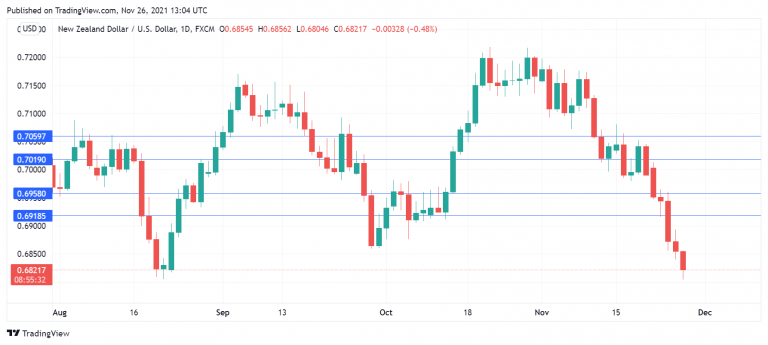
The New Zealand dollar has extended its losses on Friday, after five straight losing sessions. NZD/USD is currently trading at 0.6823, down 0.45% on the day.
Covid variant weighs on NZ dollar
Risk apprehension is sharply lower in the markets today, as a Covid variant which has spread in South Africa is causing concern around the world. Two cases of the variant were detected in Hong Kong today and it’s a safe bet that it has spread to other regions as well. Investors have responded by dumping risky assets and snapping up safe-havens like the US dollar. This has weighed on the slumping New Zealand dollar, which is down 2.36% this week.
The New Zealand dollar didn’t get any help from the RBNZ, which raised rates by 0.25%, to 0.75%. The central bank has now raised rates for two consecutive months and has signalled that it will continue to raise rates. Nevertheless, there was some disappointment that the bank didn’t show a more aggressive hand and hike rates by 0.50%. The New Zealand dollar tumbled after the decision and lost 1.0% on Wednesday.
Fed likely to increase taper
The Federal Reserve is expected to accelerate the tapering of its pandemic bond purchase programme. The FOMC minutes showed that policy makers are concerned about inflation and stated that if inflation continues to rise, they are willing to consider adjusting bond purchases and raising interest rates.
Goldman Sachs said in a note on Thursday that it expects to Fed to double its taper trim from USD 15 billion to USD 30 billion each month, starting in January. This means that the programme will be wound up by March instead of June. An earlier end to the bond purchase scheme means that the Fed can look at raising rates sooner, which is bullish for the US dollar.
NZD/USD Technical
- There is resistance at 0.6958 and 0.7059
- NZD/USD is down sharply and continues to break below support levels. There is support at 0.6857, which has held since late August. Below, 0.6747 is a monthly support level
BoE Pill: Ground has now been prepared for policy action
In a speech, BoE chief economist Huw Pill said "the ground has now been prepared for policy action" with QE reaching its "natural end" next month. Incoming data supports the conclusion that "recovery is continuing" supply disruptions "create inflationary pressures", and "labour market is tight".
These developments were "sufficient" for Pill to support the MPC's November steer, "should the incoming data continue to be consistent with the projections published in the committee's latest Monetary Policy Report, it will be necessary over coming months to increase Bank Rate for the inflation target is to be achieved in a sustainable manner."
Euro Jumps On Corona Fears
The euro has reversed directions on Friday and has posted considerable gains. EUR/USD is trading at 1.1289 in Europe, up 0.75%. The euro is benefitting from fears of a Covid variant that has spread across South Africa and is was detected in Hong Kong today.
Despite today’s positive performance, the technical outlook for the euro remains bearish. It has been a rough November for the euro, which is down 2.44% this month. Europe is in the midst of a fourth wave of Covid, and the massive spike in cases in Germany and elsewhere could derail the EU’s tenuous recovery. Things were looking rosy until now, with the EU forecasting a strong 5% growth rate for 2021, but that projection is in jeopardy as lockdowns are looking more likely around the Christmas shopping season.
The pessimistic outlook due to the South African Covid variant has led to the markets reducing the likelihood of a rate hike next year. The markets still remain more hawkish than the ECB, as Governor Christine Lagarde has ruled out a rate hike before 2022.
FOMC likely to accelerate taper
The Federal Reserve is expected to accelerate the tapering of its pandemic bond purchase programme. The FOMC minutes showed that policy makers are concerned about inflation, and went so far as to say that they would consider raising rates sooner than “currently anticipated”. Goldman Sachs said in a note on Thursday that it expects to Fed to double its taper trim from USD 15 billion to USD 30 billion each month, starting in January. This means that the programme will be wound up by March instead of June. An earlier end to the bond purchase scheme means that the Fed can look at raising rates sooner, which is bullish for the US dollar.
EUR/USD Technical
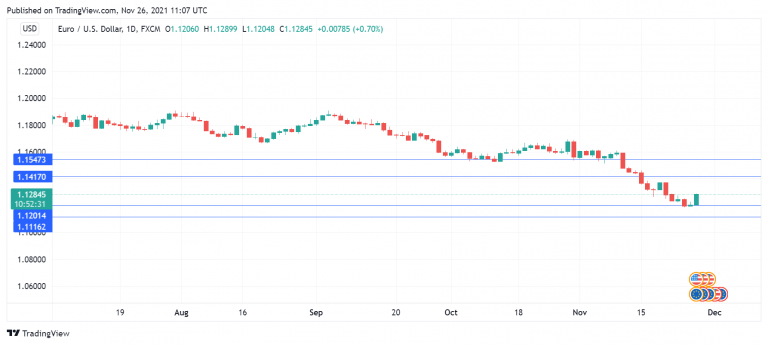
- 1.1201 has strengthened in support as EUR/USD has climbed higher. This is followed by support at 1.1118
- There is resistance at 1.1415 and 1.1546
Oil Is On Track For The Biggest Daily Drop This Year As Fears On New Virus Variant Further Dent...
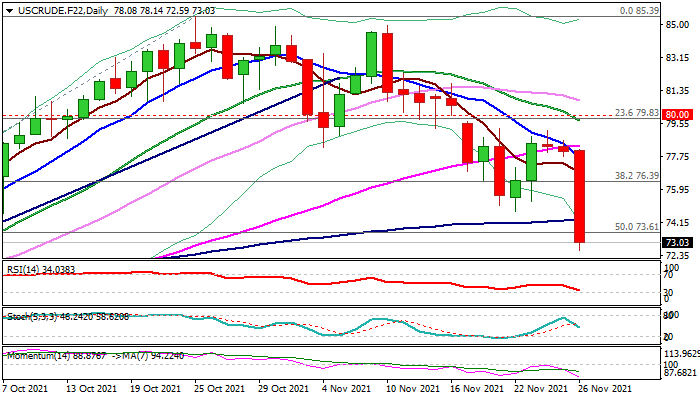
WTI oil fell over 6% since opening on Friday, in the steepest daily drop this year.
News that new variant of coronavirus, which could be more contagious and possibly resistant to the current vaccines was detected, raised fears that new wave of infections could hurt economic growth and subsequently energy demand.
Lower demand would cause a supply surplus to extend into the first quarter 2022 that would keep oil prices under increased pressure for a prolonged period.
Oil price hit two-month low on Friday and generated strong bearish signal on surge through key Fibo supports at $76.39 and $73.61 (38.2% and 50% retracement of $61.81/$85.39), with weekly close below $73.61 to confirm the signal and increase risk of testing next key levels at $70.00/$69.89 (psychological / 200DMA).
Broken 100DMA ($74.24) and former low of Nov 22 ($74.75) reverted to solid resistances which should ideally keep the upside protected.
Res: 73.61, 74.24, 74.75, 76.39
Sup: 72.59, 71.59, 70.83, 70.00
US 30 Fails To Rebound
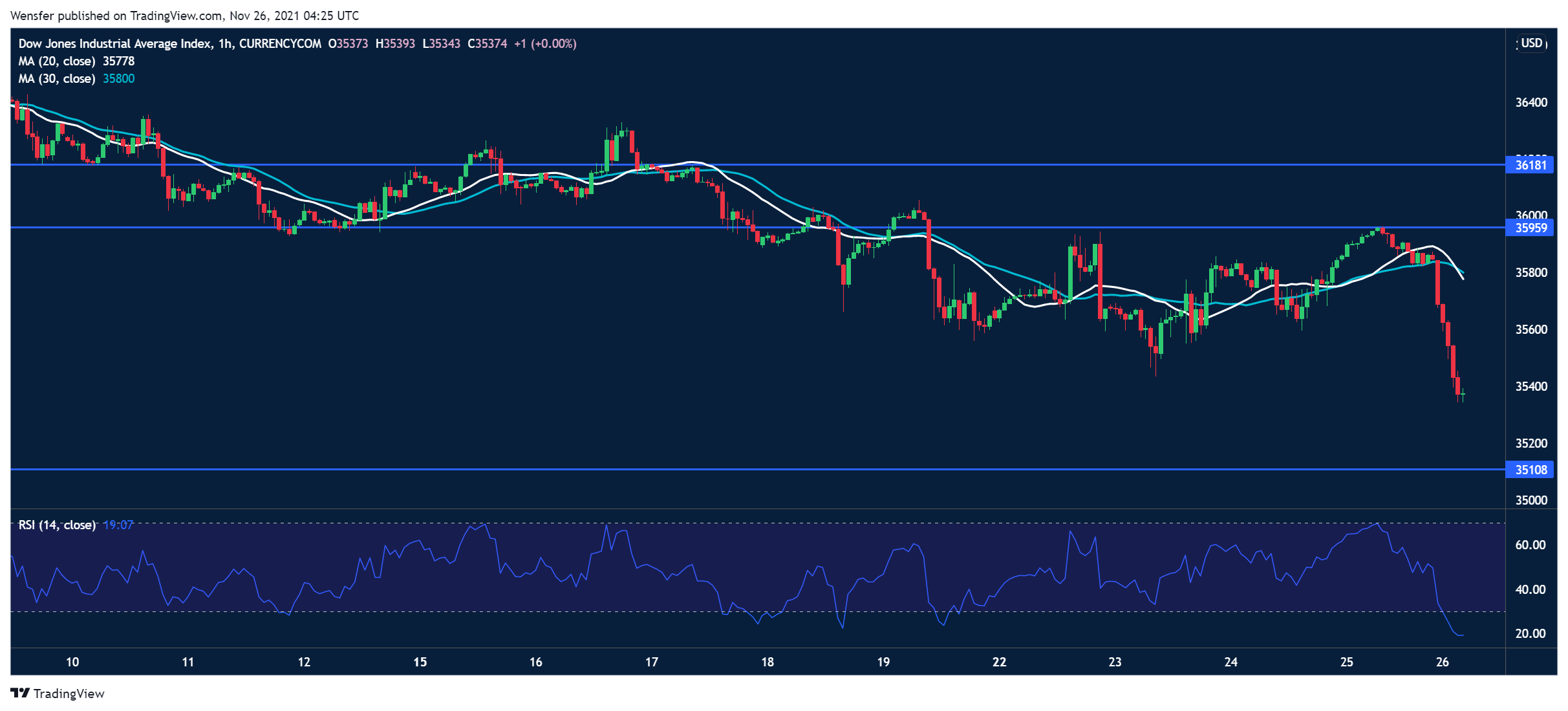
The Dow Jones 30 fell sharply amid fears of a new Covid variant. On the daily chart, a fall below the 30-day moving average suggests increasing pressure on the downside. The index has struggled to stay above the support at 35500, previously a resistance from last September’s high, a sign that short-term selling interest has prevailed. The sell-off is heading towards the demand zone around the psychological level of 35000 and 35100. Its breach could trigger an extended drop to 34400. 35960 is now a key resistance ahead.
XAGUSD Tests Major Support
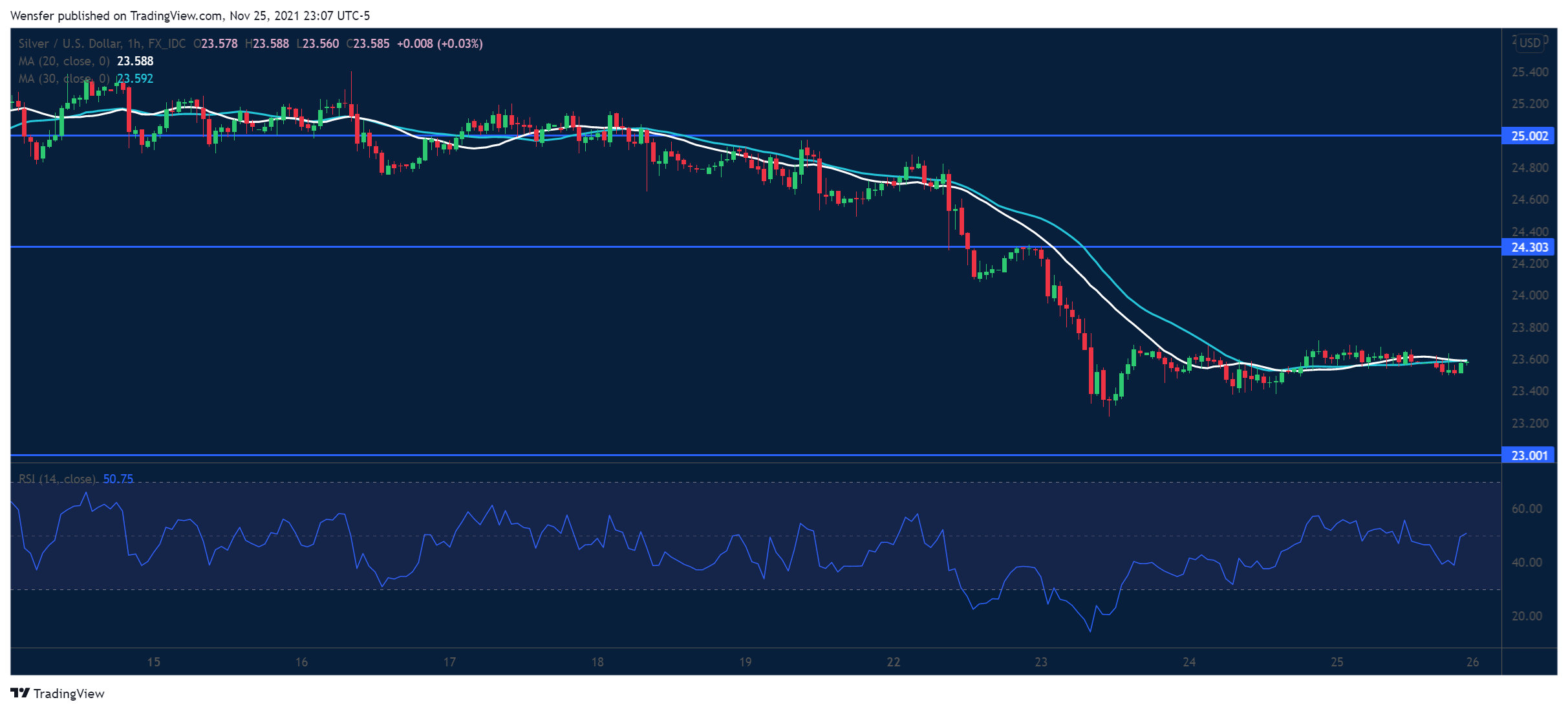
Silver remains under pressure as the dollar index nears a 16-month high. Price action is hovering above the key floor at 23.00 which is also a daily support after November’s breakout above 24.80.
This is a test of buyers’ commitment to keeping the rebound relevant. An oversold RSI may attract bargain hunters in this congestion area.
The bulls will need to reclaim 24.30 before they could expect the bounce to gain traction. A bearish breakout would dent the optimism and extend losses towards 22.00.