

Sample Category Title
USD/CAD Daily Outlook
Daily Pivots: (S1) 1.2694; (P) 1.2747; (R1) 1.2845; More...
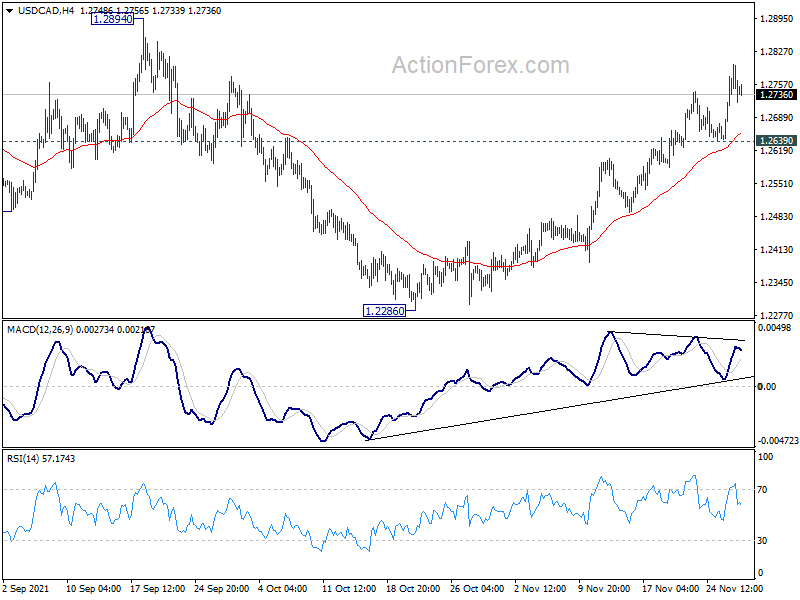
Intraday bias in USD/CAD remains on the upside for the moment. Current rise from 1.2286 should target 1.2894/2947 resistance zone. Break there will target 1.3022 long term fibonacci level next. On the downside, break of 1.2639 support is needed to indicate short term topping. Otherwise, outlook will remain bullish in case of retreat.
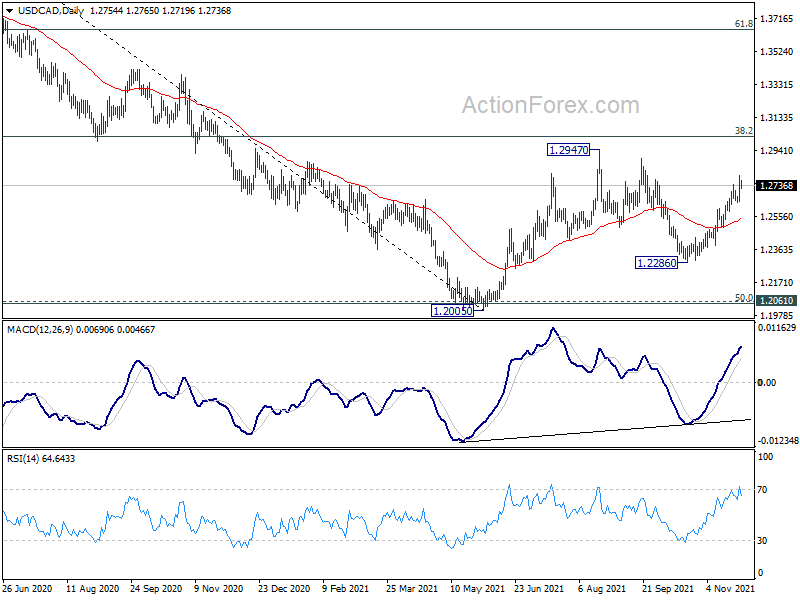
In the bigger picture, medium term outlook is neutral for now. The pair drew support from 1.2061 cluster and rebounded. Yet, upside was limited below 38.2% retracement of 1.4667 to 1.2005 at 1.3022. On the upside, firm break of 1.3022 should affirm the case of medium term bullish reversal. However, break of 1.2286 will turn focus back to 1.2005 low again.
Say Hi To Omicron
Omicron wreaked havoc in the markets on Friday, sending European indices near 5% lower into Friday’s close. The selloff in the US was a bit less severe, but this is obviously not the performance we were expecting on Black Friday.
Now, of course, the kneejerk selloff we saw was also amplified with the fact that it was the Thanksgiving week; some traders were off, and that led to thinner market volumes, hence a bit more volatility. The selloff was certainly also amplified with the fact that it was Friday, where some traders may have simply reduced exposure to weekend news.
And weekend news were mixed
Of course, the governments are quite experienced by now, so none was keen to wait and see we what would happen next. The reaction came fast, and included the well-known travel restriction measures, halting flights, restoring the entry measures, the tests, the isolation and so. The latter is bad news for the economic activity.
But the good news is, the WHO said that the symptoms of the new omicron were rather ‘mild’ so far. Therefore, the financial implications could be less worse than what everyone first though.
Marje action on Monday is not as bad as Friday. Most Asian indices traded in the red, but in most places, losses were less than a percent. In Japan we saw Nikkei give back another 1.30%, but the European and US index futures rebounded. Nasdaq is up by a percent at the time of writing.
Thanksgiving overshadowed
It's Cyber Monday, but omicron has overshadowed the year’s biggest shopping event, and I don’t see any news giving a persistent white smile to investors at this point, though good news on the retailer front could help recovering a part of Friday losses.
Of course, given that we have a lot of uncertainty about the new virus, the mood could easily and rapidly change in both ways. This week, there will be clinical studies to see how well the antibodies and the vaccines respond to omicron, and how severe the symptoms are for all ages group.
Best for investors would be to avoid panic selloffs, and keep in mind that the lockdown measures have rather been deflationary in the past. In addition, oil tanked to the $70 per barrel, which could also help easing the inflationary pressures if we see the price of a barrel consolidate near the current levels. The latter deflationary factors could buy the central banks some time before they hit the brakes on the monetary stimulus measures. So less hawkish central bank expectations could give support to the equity markets, and to the risk sentiment.
OPEC?
OPEC will delay today’s technical meetings to Wednesday to gather more information about omicron, but the broader OPEC+ decision is still expected on Thursday. Oil has been up and down last week on uncertainties of how OPEC would response to the release of strategic reserves from US and other big oil consumers.
OPEC is obviously not fully happy with the decision. They first announced they could react by reviewing their supply increases, then came the news that they may not respond and keep their line.
Of course, the new virus strain could give them an excuse to restrict supply, without reviving the dispute with the US and the others. Price-wise, it’s possible that the kneejerk reaction to omicron is overdone, and if the news doesn’t get worse, we should see a recovery toward the $74 mark, the 100-DMA. If, however the news gets worse, we shall see a further slide below the $70 mark, but the downside should be limited as the worsening omicron news would also revive the expectation of tighter OPEC supply.
WHO Says It Is Too Early To Make Firm Conclusions On Omicron
Market movers today
- We kick off the week today with HICP figures out of Spain and Germany as a warm-up for tomorrow's euro area data.
- Overnight we expect another weak NBS PMI print from China.
- Later in the week we have more interesting releases particularly from the US. Markets will focus on the jobs report and ISM figures.
- We will also keep a close eye on potential new COVID-related restrictions in Europe and news on the newly observed COVID variant dubbed Omicron. Risk is improving this morning with oil prices and yields moving higher.
- In Sweden, we receive final Q3 GDP data today. Additionally, the Social Democrats Magdalena Andersson get another shot as being voted as the new Swedish PM.
The 60 second overview
Omicron: On Friday, we published our initial take on the new B.1.1.529 variant, now called Omicron, Since then, WHO has said that the variant is of concern, see press release. We also know that the variant is spreading in many countries (confirmed or suspected cases in the UK, Belgium, Italy, Germany, the Netherlands, Australia, Hong Kong and Israel - to mention some) so it may become the dominating variant globally, just like we saw with Alpha and Delta. It is still early days so there are many things we do not know yet and it is too early to make any firm conclusions, as the WHO writes here. We still need to find out whether the variant is more infectious, more dangerous and/or better able to evade immunity. Some are arguing, however, that the variant seems less dangerous, see e.g. a comment from an expert in Israel in Haaretz. Anthony Fauci told President Joe Biden that it will take around two weeks to get more information on transmissibility, Vaccine producers are now studying what impact the new variant has on immunity and we should get the results within two weeks. BioNTech says they can update the Pfizer vaccine within six weeks and ship the first batches within 100 days if needed, Moderna says an updated version may be ready in early 2022.
New global macro forecasts: This morning we published our latest The Big Picture: Slower growth and rising inflation uncertainties, 29 November 2021, which presents our macro forecasts for the next couple of years for the biggest economies in the world. As the title eludes we are seeing economic growth moderating near-term as the spread of COVID-19 prompts new restrictions and monetary policies are tightened in both advanced and emerging market economies - we are seeing below-consensus growth rates in notably China and US next year, although economic activity should pick up in late spring as Covid restrictions are lifted and supply challenges ease. Meanwhile inflation has proven more persistent - and although we still expect inflation to moderate next year, an inflation surprise triggering more abrupt tightening by the big global central banks is a key downside risk to our forecast. Another key risk is new mutations like Omicron that may be immune to vaccines.
Equities: Friday's markets were bloody, with synchronized risk-off across equities, bonds and commodities, as Covid fears gripped markets. It was a classic risk off session, with cyclicals clearly underperforming and VIX spiking at 30. Energy, autos and banks were hit the worst, with sharp declines in the -4% to -5% range. Stay at home-winners, such as online retailers, were the only companies higher as investors braced themselves for new lockdowns. Regionally, Europe was hit the worst while S&P 500 closed down -2.2%, Dow -2.5%, Nasdaq -2.2% and Russell 2000 a massive -3.6%. US futures are rebounding this morning but Asian markets remain muted (in the -0.5% range).
FI: The financial markets came under pressure on Friday on the back of the new mutation of the corona virus, which seems to be more infectious than previous variants and potentially more resistant to the vaccines. 10Y US Treasury declined 13bp and Bunds declined 9bp. The German curve flattened between 2Y and 10Y, and 5y5y EUR inflation swap declined 10bp and 10Y BTPS-Bund spread remained at 130bp and the Bund ASW-spread moved above 50bp.
FX: Risk sentiment sets the tone for FX. With the wash-out in all asset classes, the markets will (historically) start to contemplate when this sell-off has been enough.
Credit: Credit was under severe pressure on Friday. iTraxx Xover widened 22bp and closed in 290bp (the highest level since November last year). Main widened 4.4bp, closing in 57.8bp (also the highest level since November 2020). Cash bonds did not do better, with HY widening 22bp and IG 8bp.
Nordic macro
In Sweden, we receive final GDP data for Q3 today. The best "indication" we have is Statistics Sweden's so-called GDP indicator, which printed +1.8% s.a. Additionally, ccording to this indicator, household consumption and the producing sector have lifted quarterly growth whereas net exports have moved in the opposite direction. However, this indicator has proven far from perfect historically, and actual real GDP paints a different picture compared to the indicator, which suggest that there is significant uncertainty as today's print is concerned.
Additionally, the Social Democrats Magdalena Andersson gets another shot as being voted the new Swedish PM, after having been forced to step down after only 7 hours at the post last week. Most likely, she will pass the vote, and once again be named as the next Swedish PM.
Omicron Remains In Focus As Borders Shutdown Again
General trend
- Omicron variant expected to weigh on the market after down day Friday in the US, travel restricts go back in place, potentially weighing on the global recovery and Moderna CMO warns current vaccines may not work against it; but expects new version of vaccine ready for early 2022.
- S&P and NASDAQ futures open higher in early Asia trade and continued to trade higher during the session, while Brent traded up by 5% after Friday’s losses.
- USD remained generally stronger across the majors as, safe haven flows continue to reign, while sentiment stabilizes.
- Aussie business inventories notably lower than expected in Q3, potential downside pressure on growth outlook. Japan retail sales in line, auto component weakest with supply shortages continuing. Looking ahead to tomorrow’s data, China official PMIs.
- Macau gambling names all trade lower by nearly 8% or more at the open after SunCity CEO and 11 others were detained over illegal gambling platforms they set up outside of Macau.
- RBNZ notes Omicron would have to be a “game changer” in order to adjust rate path, including a pause at next meeting in Feb.
- Japan and New Zealand both confirm no cases of variant yet, Japan PM confirms shutdown of borders until more information is know.
Headlines/Economic Data
Australia/New Zealand
- ASX 200 opened -0.5%.
- (AU) AUSTRALIA Q3 CORP OP PROFIT Q/Q: 4.0% V 2.3%E; INVENTORIES Q/Q: -1.9% V 0.0%E.
- (NZ) Reserve bank of New Zealand (RBNZ) Chief Economist Yuong Ha: impact of new COVID variant would need to be dramatic to change cash rate outlook, could pause tightening at next meeting in Feb if Omicron is a game changer.
- (AU) China has allowed a small amount of coal from Australia to clear in October, unclear if this is a sign year+ long restrictions may be eased.
- (NZ) New Zealand lays out border reopening: Australian's that are fully vaccinated will be able to come Apr 30th, 2022 and quarantine, citizens can return if vaccinated with no quarantine starting Jan 17th 2022.
- (AU) Reserve Bank of Australia (RBA) Offers to buy A$1.60B in Govt bonds v A$1.60B prior.
- (NZ) New Zealand PM Ardern: No confirmed cases of Omicron in New Zealand so far; New Variant is a reminder of border risks.
Japan
- Nikkei 225 opened -1.4%.
- (JP) JAPAN OCT RETAIL SALES M/M: 1.1% V 1.0%E; Y/Y: 0.9% V 1.1%E.
- (JP) Japan PM Kishida: Considering additional border restrictions; watching omicron variant situation with sense of urgency.
- (JP) Japan bans all entry to foreigners, effective Nov 30th.
- 7201.JP CEO: Planning to introduce solid state battery by 2028, build factory in 2024; To invest >¥2.0T into electrification of vehicles over next 5 years (over the 1.0T speculated through 2030); To introduce 23 new EVs by 2030 – Ambition 2030 plan.
Korea
- Kospi opened -1.0%.
- (KR) South Korea Vice Fin Min Lee: To take preemptive measures on markets if needed; Monitoring possible impact of omicron variant on markets.
China/Hong Kong
- Hang Seng opened -0.7%; Shanghai Composite opened -1.0%.
- 1383.HK CEO has been detained in a probe along with 11 others after a group admitted to some gambling allegations including illegal cross border gambling, but have refused to cooperate with authorities.
- (HK) Speculation that Hong Kong IPOs could remain weak into early 2022 with more difficult cyber security and overseas listing rules - press.
- (CN) China Oct Industrial Profits Y/Y: 24.6% v 16.3% prior.
- (CN) China expected to adopt a more proactive economic policy next year to meet the challenges from an uneven recovery of the global economy and instability in control and prevention of the pandemic - China Securities Times.
- 9898.HK To price 11M share Hong Kong IPO around HK$388/shr, first day of trade Dec 8th.
- (CN) China PBOC sets Yuan reference rate: 6.3872 v 6.3936 prior.
- (CN) China PBOC Open Market Operation (OMO): Sells CNY100B in 7-day reverse repos v CNY100B prior; Net inject CNY50B v Net inject CNY50B prior.
- (CN) Jiangsu Bioperfectus (688399.CN), Shanghai ZJ Bio Tech (688317.CN), and Zhejiang Orient (688298.CN) reported that their coronavirus test kits can detect the Omicron Variant of the coronavirus - Press.
Other
- World Health Organization's (WHO) issues statement on Omicron variant: not yet clear whether infection with Omicron causes more severe disease compared to infections with other variants, including Delta, but preliminary evidence suggests there may be an increased risk of reinfection with Omicron.
- (PH) Philippines Central Bank (BSP) cuts term deposit offer to PHP480B and cuts 15-day TDF PHP20B; both effective Dec 1st.
North America
- MRNA Chief Medical Officer: think Omicron may elude current vaccines; new vaccine for Omicron variant may be ready in early 2022.
- (US) Oct ports 1,621K loaded inbound TEUs +3% m/m, +1% y/y.
Europe
- (EU) ECB chief Lagarde: Eurozone is now better equipped for potential new wave of COVID-19 infections of Omicron variant; Reiterates ECB council stance that inflation spike is tied to temporary factors.
- (IT) ECB's Panetta (Italy; dove): ECB does not need to intervene on inflation for now, it is temporary, do not need to follow US Fed monetary policy choices.
Levels as of 00:15ET
- Hang Seng -0.9%; Shanghai Composite -0.1%; Kospi -0.5%; Nikkei225 -1.4%; ASX 200 -0.4%.
- Equity Futures: S&P500 +0.8%; Nasdaq100 +1.1%, Dax +1.8%; FTSE100 +1.3%.
- EUR 1.1316-1.1272; JPY 113.88-113.36; AUD 0.7147-0.7115; NZD 0.6837-0.6812.
- Commodity Futures: Gold +0.4% at $1,794/oz; Crude Oil +4.4% at $71.13/brl; Copper +0.4% at $4.34/lb.
AUD/USD Daily Report
Daily Pivots: (S1) 0.7092; (P) 0.7143; (R1) 0.7174; More...
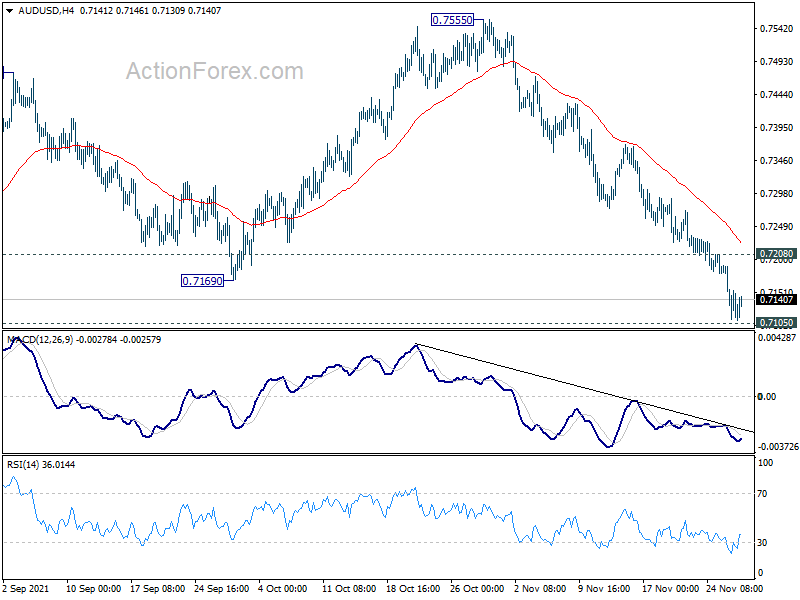
Intraday bias in AUD/USD remains on the downside for the moment. Break of 0.7105 support will confirm resumption of whole decline form 0.8006. Next target should be 0.6991 key structural support. On the upside, break of 0.7208 minor resistance will delay the bearish case and turn intraday bias neutral first.
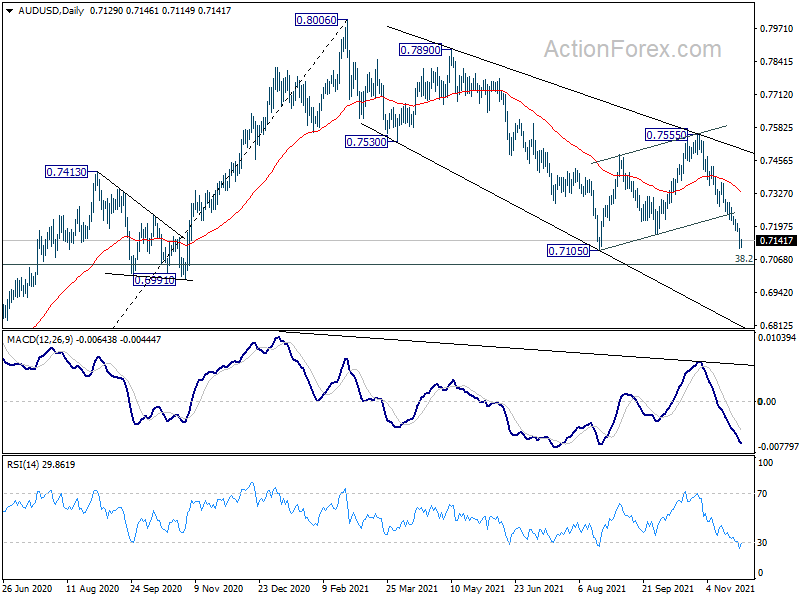
In the bigger picture, with 0.6991 cluster support (38.2% retracement of 0.5506 to 0.8006 at 0.7051) intact, we're seeing price action from 0.8006 as a correction only. That is, up trend from 0.5506 low would resume after the correction completes. However, sustained break of 0.6991 will argue that the whole medium term trend has probably reversed. Deeper fall would be seen to 61.8% retracement at 0.6461.
Markets Staying Heavy on Omicron Worries
Worries about Omicron remains a main theme in the markets. Nikkei takes a dive after Japan announced to close its borders to all foreigners as Prime Minister Fumio Kishida said he's taking measures with a "strong sense of crisis". The forex markets are relatively quiet for now, with Yen and Swiss Franc digesting some of last week's gains. Commodity currencies are also recovering slightly. But overall, the range in currency pairs is tight.
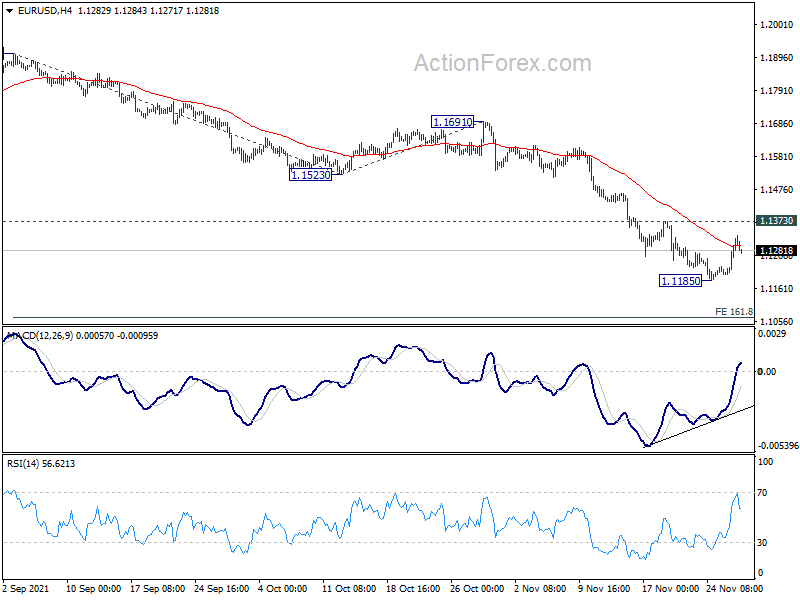
Technically, the rallies in Swiss Franc and Yen are just taking a breather and we'd expect them to resume sooner or later. The question for the week is whether risk-off sentiment would boost Dollar or Euro more. EUR/USD's weak recovery from 1.1185 doesn't warrant a stronger rebound yet. But break of 1.1373 minor resistance will indicate that the tide has turned for the near term.
In Asia, at the time of writing, Nikkei is down -1.78%. Hong Kong HSI is down -1.22%. China Shanghai SSE is down -0.52%. Singapore Strait Times is down -1.17%. Japan 10-year JGB yield is down -0.0074 at 0.070.
ECB Lagarde: We are all better equipped to respond to Omicron
ECB President Christine Lagarde said over the weekend that there is an "obvious concern" about the Eurozone economic recovery with the new Omicron variant. But she added, "I believe we have learnt a lot".
"We now know our enemy and what measures to take. We are all better equipped to respond to a risk of a fifth wave or the Omicron variant", she said to Italian broadcaster RAI.
"The crisis taught us this virus knows no boundaries. Therefore we will not be protected until we are all vaccinated", Lagarde said.
ECB Panetta: Intervening on inflation now creates more damage than benefit
ECB Executive Board member Fabio Panetta said the current inflation in Eurozone is bad but also temporary. It's driven by supply chain disruptions and energy prices which are "bound to be overcome". He would be among the first in favor to intervene if inflation are becoming more permanent.
But he added, "the central bank is not intervening because if it did, it would create more damage than benefit. It's like an illness, not all medicines are good for all illnesses."
RBNZ Ha: Omicron doesn't change economic outlook, just reinforces downside risks
In a WSJ interview, RBNZ chief economic Yuong Ha said the central bank would have raised interest rate even if Omicron was know before the meeting last week.
He said New Zealand is now "transitioning into a new Covid protection framework" and people are "getting used to the idea of living with Covid". Hence, Omicron doesn't change the outlook. "It probably just reinforces the downside risks we saw in the projections," he said.
RBNZ will be in a better place to assess Omicron's economic impact at next meeting in February. "If Omicron turns out to be a massive game changer, that might be kind of like August where we just took a pause," Ha said.
A busy week full of key data
A number of important economic data will be released this week. US consumer confidence, ISM indexes and non-farm payroll will catch most attention. Eurozone will release CPI flash, PPI, unemployment rate, retail sales. Focuses will also be on Canada employment, Australia GDP, and China PMIs.
But, the economic would be overshadowed by news regarding Omicron variant and the impact on risk sentiment.
Here are some highlights for the week:
- Monday: Japan retail sales; Germany CPI flash; UK mortgage approvals, M4 money supply; Canada current account, IPPI and RMPI; US pending home sales.
- Tuesday: Japan unemployment rate, industrial production, housing starts; Australia building approvals, current account; China official PMIs; France GDP; Swiss KOF economic barometer; Germany unemployment; Eurozone CPI flash; Canada GDP; US house price index, Chicago PMI, consumer confidence.
- Wednesday: Australia AiG manufacturing, GDP; New Zealand building permits; Japan capital spending, PMI manufacturing final; China Caixin PMI manufacturing; Germany retail sales; Swiss CPI, PMI manufacturing; Eurozone PMI manufacturing final; UK PMI manufacturing final; US ADP employment, ISM manufacturing, construction spending, Fed's Beige Book; Canada PMI manufacturing.
- Thursday: Australia retail sales, trade balance, Japan consumer confidence; Swiss retail sales; Eurozone PPI, unemployment rate; US Challenger job cuts, jobless claims.
- Friday: Australia AiG construction; China Caixin PMI services; France industrial production; Eurozone PMI services, retail sales; UK PMI services' Canada employment; US non-farm payrolls, ISM services, factory orders.
AUD/USD Daily Report
Daily Pivots: (S1) 0.7092; (P) 0.7143; (R1) 0.7174; More...
Intraday bias in AUD/USD remains on the downside for the moment. Break of 0.7105 support will confirm resumption of whole decline form 0.8006. Next target should be 0.6991 key structural support. On the upside, break of 0.7208 minor resistance will delay the bearish case and turn intraday bias neutral first.
In the bigger picture, with 0.6991 cluster support (38.2% retracement of 0.5506 to 0.8006 at 0.7051) intact, we're seeing price action from 0.8006 as a correction only. That is, up trend from 0.5506 low would resume after the correction completes. However, sustained break of 0.6991 will argue that the whole medium term trend has probably reversed. Deeper fall would be seen to 61.8% retracement at 0.6461.
Economic Indicators Update
| GMT | Ccy | Events | Actual | Forecast | Previous | Revised |
|---|---|---|---|---|---|---|
| 23:50 | JPY | Retail Trade Y/Y Sep | 0.90% | 1.10% | -0.50% | |
| 0:30 | AUD | Company Gross Operating Profits Q/Q Q3 | 4.00% | 3.00% | 7.10% | |
| 9:30 | GBP | Mortgage Approvals Oct | 71.250K | 72.645K | ||
| 9:30 | GBP | M4 Money Supply M/M Oct | 0.50% | 0.60% | ||
| 10:00 | EUR | Eurozone Economic Sentiment Indicator Nov | 117.5 | 118.6 | ||
| 10:00 | EUR | Eurozone Industrial Confidence Nov | 13.9 | 14.2 | ||
| 10:00 | EUR | Eurozone Services Sentiment Nov | 16.3 | 18.2 | ||
| 10:00 | EUR | Eurozone Consumer Confidence Nov F | -6.8 | -6.8 | ||
| 13:00 | EUR | Germany CPI M/M Nov P | -0.50% | 0.50% | ||
| 13:00 | EUR | Germany CPI Y/Y Nov P | 5.00% | 4.50% | ||
| 13:30 | CAD | Industrial Product Price M/M Oct | 1.00% | |||
| 13:30 | CAD | Raw Material Price Index Oct | 2.50% | |||
| 13:30 | CAD | Current Account (CAD) Q3 | 4.4B | 3.6B | ||
| 15:00 | USD | Pending Home Sales M/M Oct | 1.00% | -2.30% |
RBNZ Ha: Omicron doesn’t change economic outlook, just reinforces downside risks
In a WSJ interview, RBNZ chief economic Yuong Ha said the central bank would have raised interest rate even if Omicron was know before the meeting last week.
He said New Zealand is now "transitioning into a new Covid protection framework" and people are "getting used to the idea of living with Covid". Hence, Omicron doesn't change the outlook. "It probably just reinforces the downside risks we saw in the projections," he said.
RBNZ will be in a better place to assess Omicron's economic impact at next meeting in February. "If Omicron turns out to be a massive game changer, that might be kind of like August where we just took a pause," Ha said.
ECB Panetta: Intervening on inflation now creates more damage than benefit
ECB Executive Board member Fabio Panetta said the current inflation in Eurozone is bad but also temporary. It's driven by supply chain disruptions and energy prices which are "bound to be overcome". He would be among the first in favor to intervene if inflation are becoming more permanent.
But he added, "the central bank is not intervening because if it did, it would create more damage than benefit. It's like an illness, not all medicines are good for all illnesses."
ECB Lagarde: We are all better equipped to respond to Omicron
ECB President Christine Lagarde said over the weekend that there is an "obvious concern" about the Eurozone economic recovery with the new Omicron variant. But she added, "I believe we have learnt a lot".
"We now know our enemy and what measures to take. We are all better equipped to respond to a risk of a fifth wave or the Omicron variant", she said to Italian broadcaster RAI.
"The crisis taught us this virus knows no boundaries. Therefore we will not be protected until we are all vaccinated", Lagarde said.
EUR/USD Starts Recovery, But Faces Key Hurdle
Key Highlights
- EUR/USD found support near 1.1186 and started a decent recovery.
- It broke a major bearish trend line at 1.1200 on the 4-hours chart.
- GBP/USD is facing an increase in selling below 1.3400.
- Crude oil price declined over $10.00 and traded below $70.00.
EUR/USD Technical Analysis
The Euro found support near 1.1180 against the US Dollar. EUR/USD formed a base and recently started a recovery wave above the 1.1220 resistance zone.
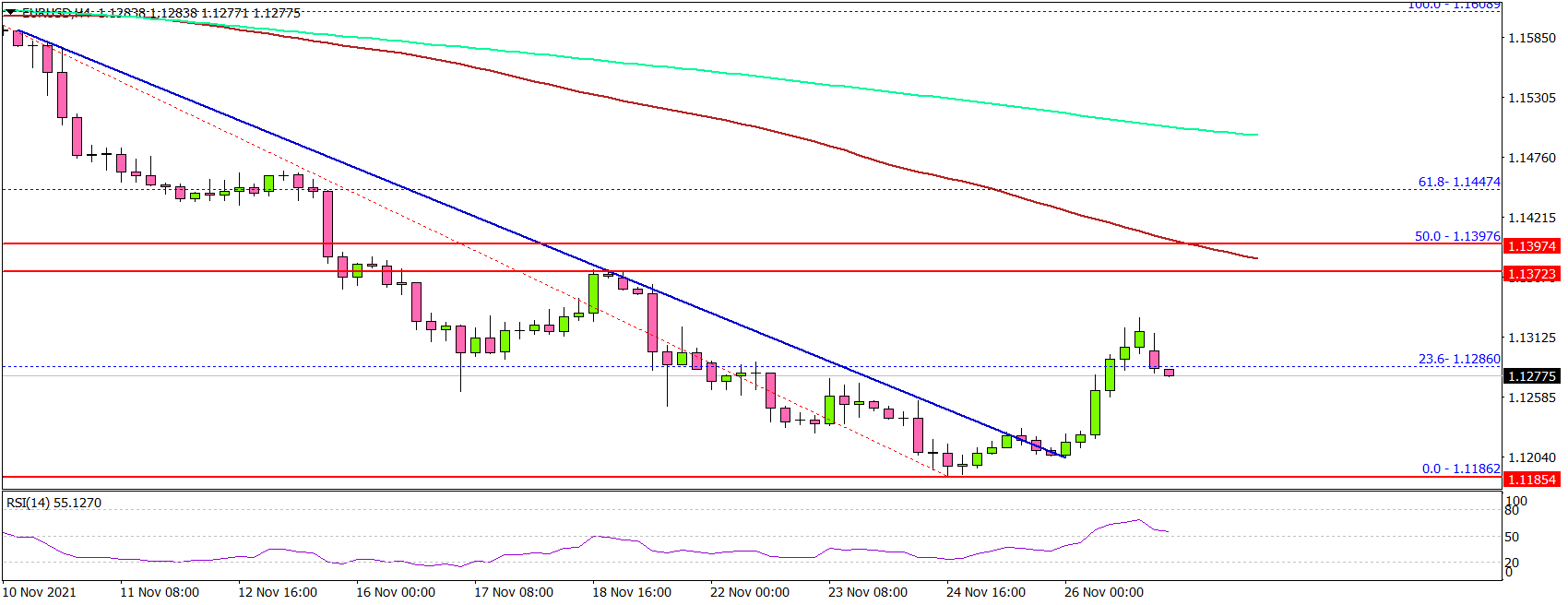
Looking at the 4-hours chart, the pair was able to recover above the 1.1280 resistance zone. Besides, it surpassed a major bearish trend line with resistance at 1.1200.
It opened the doors for more gains above 1.1300, but the pair is still well below the 100 simple moving average (red, 4-hours) and the 200 simple moving average (green, 4-hours).
The pair traded above the 23.6% Fib retracement level of the downward move from the 1.1608 swing high to 1.1186 low. On the upside, the pair is facing hurdles near 1.1350. The next major resistance is near 1.1400.
The 50% Fib retracement level of the downward move from the 1.1608 swing high to 1.1186 low is also near the 1.1400 zone along with the 100 simple moving average (red, 4-hours).
A close above the 1.1400 level could open the doors for a larger increase. If not, EUR/USD could start a fresh decline below the 1.1280 support. The next major support is near 1.1250, below which the pair could even revisit 1.1200.
Besides, GBP/USD must settle above the 1.3400 resistance zone to start a steady recovery. On the other hand, crude oil price saw a major decline below the $75.00 and $70.00 support levels.
Economic Releases
- Euro Zone Consumer Confidence for Nov 2021 – Forecast -6.8, versus -6.8 previous.
- German Consumer Price Index for Nov 2021 (YoY) (Prelim) – Forecast +5.0%, versus +4.5% previous.
- German Consumer Price Index for Nov 2021 (MoM) (Prelim) – Forecast -0.5%, versus +0.5% previous.
- US Pending Home Sales for Oct 2021 (MoM) - Forecast +1.0%, versus -2.3% previous.