Sample Category Title
Weekly Focus – Focus Turns to Fed after ECB Fails to Convince the Markets
Despite weaker growth momentum, central banks across the globe seem to be opting to tighten monetary policy sooner rather than later. As widely expected, the ECB meeting on Thursday resulted in no new decisions (see our Flash: ECB Review - Confirmed: Today's meeting was a prelude to December, 28 October). Markets, however, reacted strongly to a lack of coherence in Lagarde's comments regarding current market pricing. We do not expect the ECB to hike rates in the foreseeable future given their transitory inflation narrative. However, should inflation prove more persistent, Thursday's comments definitely leave more room for the ECB to turn hawkish. Also this week, the BOC took yet another shift in a more hawkish direction by ending its QE purchases and changing its forward guidance, indicating the first hike potentially as early as next April.
Equity markets kept holding up this week despite stagflation fears receiving a fresh boost from data. The closely watched German Ifo dropped to a 6-month low as global supply disruptions continue to weigh on the manufacturing sector. At the same time, the German inflation rose to 4.6% in October from 4.1% in September. US GDP growth in Q3 was also weaker than expected, (2.0% q/q AR vs 2.6% expected).
Market-based inflation expectations stabilised this week despite sustained high oil and gas prices. The ongoing energy crisis hits emerging and frontier markets at a challenging time, further undermining the external vulnerabilities of net importers. In our piece Surging commodity prices adds to emerging market vulnerabilities we note that Turkey and India could be particularly exposed as their external positions are weak to begin with.
Next week is packed with central bank meetings. The Reserve Bank of Australia kicks it off on Tuesday. We expect no changes in monetary policy, although some sort of a hawkish shift is almost given. Considering aggressive market pricing for RBA, focus will be on forward guidance. One of the highlights will be the FOMC meeting on Wednesday, where we expect the Fed to announce QE tapering, starting immediately with a pace of USD15bn per month. Risks are tilted towards a faster pace of USD20bn per month. Bank of England will meet on Wednesday with the markets pricing in a 50-60% probability of a rate hike this year. Economists are divided, but we expect no changes yet. For Norges Bank, it's an interim meeting, hence, we believe the central bank will stick to their message of the next hike coming in December. The Polish central bank will also meet on Wednesday. We expect a 25bp hike in line with consensus but risks are tilted towards a larger hike.
EUR/USD traded range-bound most of the week before Lagarde's apparent failure to talk down market pricing sent the pair higher on Thursday. We are still in favour of a stronger USD given increased monetary policy divergence and slower global growth.
We have a busy data calendar for next week. During the week, we will get the latest signals on the health of the Chinese economy in the form of both official and Caixin PMIs. As the global industrial cycle is turning, we pay special attention to the manufacturing sector sentiment, also the US ISM on Monday. Oil markets will keep a close eye on OPEC+ meeting next Thursday. The US October job report will crown the week on Friday. Despite supply side problems, we are slightly more optimistic about jobs growth than consensus, expecting new jobs in the range of 400-500k. Also, watch out for the G20 meeting over the weekend for any comments on how to speed up the global rollout of COVID-19 vaccines.
Sunset Market Commentary
Markets
Investors are pondering the balance between inflation and its potential impact on growth. Admittedly, markets these days often see hard data a bit as outdated. Even so, with the EMU Q3 growth estimate and the October CPI, investors today received a high profile update on both variables. In the past, Europe often lacked strong (real as well as nominal) growth. At least for now is no big issue anymore. EMU Q3 GDP growth printed at 2.2% Q/Q and 3.7% Y/Y, slightly stronger than expected. Only few details on the composition are available. Austria (3.3% Q/Q), France (3.0%), Portugal (2.9%) and Italy (2.6%) outperformed. Still, inflation data grabbed most attention. EMU October inflation jumped 0.8% M/M to be up 4.1% y/y (from 3.4%). Energy prices evidently were a major driver, but core inflation (2.1% Y/Y) also surpassed the 2.0% barrier. ECB’s Lagarde yesterday reiterated that the conditions of the ECB’s forward guidance on inflation are not fulfilled. However, with this kind of data, the ECB’s assessment probably will be ever more difficult to explain both to citizens and markets. From a growth point view, the question also arises whether de EMU economy still needs current ultra-accommodative monetary policy. The BoE, the Bank of Canada and others recently concluded this isn’t the case anymore. EMU data seldom trigger abrupt moves, but yesterday’s post-ECB trends continue unabatedly. German/EMU yields recaptured the steep uptrend that was lost temporarily earlier this week. German yields rose between 1.4 bp (2-y) and 7.0 bp (10-y). The very long end again was the exception (30-y: -0.5 bp). The decomposition between real rates and inflation expectations was astonishing! The move is driven by an impressive rise in real yields. The 10-y EMU inflation swap nosedived 12 bp!!! This rise in real yields probably also explains the further widening in peripheral spreads. Greek and Italian 10-y spreads vs Germany widened 20 bps and 8 bps respectively. Such moves don’t make it easier for the ECB to maintain favourable financing conditions across the euro zone. Moves in US bond markets are similar, but a bit less outspoken with the 5-y yield rising 4 bp, the 10-y 2.5 bps and the 30-y easing 1 bp.
In FX, the USD outperforms. DXY rebound to the 93.70/75. The yen suffers from the rise in core real yields with USD/JPY returning close to the 114 handle. The euro fails to extend yesterday’s rebound. A mild risk off and maybe the widening of intra-EMU spreads maybe spoiled yesterday’s improved sentiment on the single currency. In this context, we also mention persistent gains in the Swiss franc. The franc apparently still has a safe have role to play as intra-EMU spreads widen.
News Headlines
Czech GDP grew 1.4% q/q in Q3. That’s faster than in Q2 (1% q/q) but slower than expected (1.8% q/q). Compared with the same period one year ago, GDP has risen 2.8% (3.2% expected). The Czech Statistical Office (CZSO) reported a positive contribution from domestic demand, both from household consumption and gross capital formation. It noted government consumption rose too but exports decreased. A drop in external demand has influenced GDP growth negatively “in a considerable way”. Sectorwise, CZSO saw the gross value added coming from trade, transportation, accommodation and food service activities while manufacturing (probably the result of shortages and supply bottlenecks) negatively impacted GVA. The Czech krone strengthened marginally to EUR/CZK 25.67.
Polish inflation rose at the fastest pace in two decades in October. Headline inflation jumped from 5.9% y/y to 6.8% due to strong monthly dynamics of 1% m/m. Both exceeded market expectations of 6.4% and 0.6% m/m. Especially energy costs (10.2% y/y) and fuel (33.9% y/y) were heavily contributing. Price pressures are now so high and above the National Bank of Poland’s 2.5% (+/-1 ppt) target, that another rate hike at next week’s policy meeting seems inevitable even though Glapinski played down the prospect of a tightening cycle after the NBP’s unexpected 40 bps rate hike last earlier this month. The jury’s still out whether it will be a 25 or 50 bps increase. The Polish zloty is hesitating to frontrun the very dovish Polish MPC. EUR/PLN eases only slightly to 4.62.
Canadian Economy Makes Gains in August
The Canadian economy expanded by 0.4% month-on-month in August, below the consensus call for 0.7%. This left GDP around 1.5% below its pre-pandemic (February 2020) level.
In addition to August GDP, Statistics Canada released a flash estimate for September, which showed no change in output for the month.
By industry, services-producing industries once again led the way, growing 0.6%. Meanwhile, goods-producing sectors saw output decline by 0.1% in August. Reopening of the economy helped drive gains in the accommodation and food services industry (+7.0%). Likewise, loosening constraints on capacity fueled growth in the arts, entertainment and recreation sector (+6.4%). Air travel (+24.2%) also saw huge gains as many Canadians ventured out for the first time in months.
On the goods side, extreme weather continued to weigh on production in the agriculture, forestry, finish and hunting sector (-5.7%). On the flipside, manufacturing output rose 0.5% after suffering a steep contraction in July. Non-durable goods manufacturing (+1.0%) drove the improvement, while durable goods production was nearly flat (+0.1%). Supply shortages continued to weaken transportation equipment manufacturing (-1.7%).
Key Implications
It was a solid August for the Canadian economy. With public health restrictions less stringent and COVID-19 better contained in most parts of the country, economic activity ramped up during the month. Particularly, consumers continued to unleash pent-up demand for dining at restaurants, travel, and other recreation and entertainment activities. GDP is inching closer to pre-pandemic levels.
This last leg of the recovery could prove to be the most challenging. Global supply-chain disruptions and labour market imbalances could crimp output across sectors. Already, auto production is taking a hit due to semiconductor shortages, and some retail businesses are operating at reduced hours due to inadequate staffing levels. These reasons are likely the driving forces behind Statistics Canada's disappointing September flash GDP estimate.
Including the advance figure for September, GDP is on track to only rise by around 2.0% annualized in the third quarter. With supply constraints expected to continue to weigh on the economy through the fourth quarter, output may fall well short of the Bank of Canada's projection as laid out in the October Monetary Policy Report released earlier this week. Indeed, with today's release, the Bank may need to, once again, adjust its narrative on the Canadian economy.
Aussie Slips Despite Strong Numbers
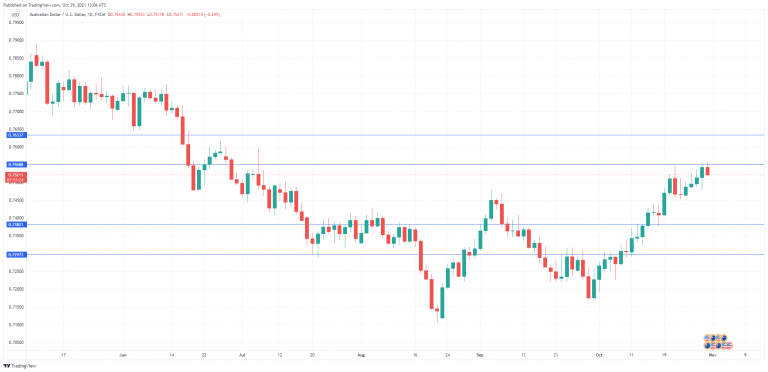
The Australian dollar has slipped on Friday. AUD/USD is currently trading at 0.7519, down 0.31% on the day. Still, the currency is poised to register a fifth straight winning week. The Australian dollar has sparkled in October, gaining 4.25%.
The week wrapped up with solid Australian data on Friday, but it wasn’t enough to extend the Aussie’s gains. Retail sales for September surprised on the upside, with a gain of 1.3% vs expectations of 0.3%. On an annualized basis, Retail Sales jumped 1.3% (YoY), but this gain was exaggerated by base effects, as there was a severe lockdown in place in September 2020. On the inflation front, PPI accelerated in the third quarter, with a gain of 1.1% (QoQ), ahead of 0.7% in Q2. On an annualized basis, PPI climbed 2.9%, vs. 2.2% in Q2.
The markets are still buzzing after the RBA took a pass and failed to defend its bond-yield target earlier this week. The non-move was highly significant since the bond-yield target is a key component of the bank’s QE programme. The April 2024 CGB yield has jumped to 0.75% on Friday, vs the RBA’s target level of just 0.10%. The RBA holds a policy meeting next week, and there is a growing possibility that the bank could decide to terminate its yield target at the meeting.
This development has raised expectations that the RBA will bring forward its rate guidance from 2024 to 2023, or even to H2 of 2022. Next week’s policy meeting will be interesting, and the Australian dollar could be the big winner if RBA policy makers accelerate the timeline for a rate hike. Core inflation has pushed into the RBA’s target range of 2-3% for the first time since 2015. Higher inflation levels are also putting pressure on the RBA to shift away from its accommodative policy and all eyes are on the November 2nd meeting.
AUD/USD Technical
- There is resistance at 0.7550, followed by resistance at 0.7624
- There are support levels at 0.7382 and 0.7297
Stocks Slip as Tech Disappoints and Yields Rise
Financial markets are ending the week on a negative note as earnings from Apple and Amazon failed to offset concerns over rising inflation and interest rates.
Earnings season has been a dream for investors in recent weeks, coming just as we were seeing a wobble in the markets as mounting risks cast doubt over the economic outlook. Some fears were realised throughout earnings season, most notably supply issues weighing on the bottom line and ad revenues being negatively impacted by Apple's data changes and the supply drag.
But until now, that has been more than offset by stronger results of the top and bottom line which has driven equity markets higher in recent weeks. But a combination of disappointing tech results and higher rates are testing investors nerves just as indices move back into uncharted territory.
Results from Amazon and Apple were the latest to surprise, and not in a good way, with supply and labour challenges forcing the former to invest heavily to avoid festive disruptions and the chip shortage heavily impacting the latter to the tune of $6 billion. And the fourth quarter is not going to be any easier for either company which explains the drop in after-hours trading.
That said, while some expenses may be more permanent, like higher cost labour, most of the challenges facing both companies are temporary and they will bounce back strongly. Apple is continuing to report strong growth and the fourth quarter is expected to be the best ever in terms of revenue. Amazon is investing serious amounts of cash which is never a bad thing for a company with its record.
Facebook reported earlier in the week and faces numerous challenges of its own, both in terms of ad revenues and on the political front. Changing its name to Meta will not solve its problems but it may help stop the non-Facebook components of the business from being tarred with the same brush. It also clearly emphasizes the focus for the company in the years ahead as it invests heavily in the metaverse that CEO Mark Zuckerberg believes is the future.
Can Powell succeed where Lagarde failed?
Disappointing tech earnings have also come in a week when rates have been rising which naturally weighs on sentiment at a time when growth is slowing and inflation becoming an increasing concern. Traders were quick to dismiss Christine Lagarde's assurances after the ECB meeting, clearly taking the view that the central bank's forecasts for inflation can't be trusted and they'll eventually be forced to hike a lot earlier than they anticipate as price pressures persist.
We've seen some big moves in euro area yields since the meeting which is continuing into the end of the week. But it's not just Europe that's seeing yields rising, the US is being caught up in it too. Tapering being announced next week has been priced in for some time, investors are now factoring in multiple rate hikes as well by the end of next year which may be a concern for policymakers at the Fed.
Until now, they've been keen to stress that tapering and rate hikes aren't linked and, while that may be true, markets are still now pricing in an immediate transition from the end of net asset purchases to rate hikes. At least two are now expected by the end of next year, with the first coming in the summer as tapering draws to a close. We'll see whether Jerome Powell has any more luck than Lagarde, whose views on the matter fell on deaf ears. A repeat next week poses massive challenges for central banks who may be dragged into tightening whether they like it or not.
Evergrande avoids default late in the day
On a more positive note, Evergrande made another offshore coupon payment late in the day but crucially just before the end of its 30-day grace period. The company has avoided default for now but it's simply buying time and until a permanent solution is found, there'll continue to be nerves on approach to coupon and repayment deadlines, as well as steep discounts on those holdings.
Oil could correct further despite Thursday's dip-buying
Oil prices recovered strongly on Thursday after trading more than 2% down on the day for a second successive session. They're a little lower so far today which may suggest that, despite early dip-buying, crude prices could still face a deeper correction after such a prolonged and substantial rally over the last couple of months.
Of course, the fundamentals remain very bullish for oil prices with the world in the midst of an energy crisis as winter approaches in the northern hemisphere. And OPEC+ appear entirely unwilling to do anything to alleviate these price pressures, which makes it highly unlikely that the group will raise monthly production increases from 400,000 barrels per day when they meet next week. With producers struggling to hit targets as it is, it may not just be a lack of will, although they do appear pleased with prices at these levels.
Reports that talks will resume over the Iranian nuclear deal next month may be weighing a little on prices, given the prospect for a large amount of oil to come back into the market, but an agreement is probably not close so it's not going to alleviate current pressures. That said, it's come at a good time just as the rally was looking very overcrowded so it may aid the correction.
Gold breaks lower as yields continue to rise
US yields are rising and the dollar is being lifted up in the process, potentially aided by some risk aversion we're seeing in the markets on Friday. Higher yields and a stronger dollar is a terrible combination for gold, which is almost 1% down and on course to once again fall short of closing the week above the $1,800 handle.
While the yellow metal has arguably shown strong resilience this week in the face of higher yields, not typically something associated with gold performing well, it has generally been supported by softness in the dollar as yields outside the US have rallied aggressively.
The rise in yields is also associated with high inflation and interest rate expectations, but not a hot economy, rather than a combination of all three which we would typically see. Perhaps this is lending itself to gold remaining well supported. That said, it has broken a rising trend line that's accompanied the rally this month, as well as recent support, which may point to near-term weakness with the next test of support coming around $1,770.
Further downside in store for Bitcoin?
Bitcoin recovered strongly on Thursday after breaking below $60,000 the day before in a move that could have triggered a much steeper decline. While the recovery may have been encouraging as it moved back above here, it failed at $62,500 which was the first major test to the upside and would have produced a very bullish technical setup.
As it is, it's rotated off that resistance level and is now falling back towards $60,000 which may suggest near-term pressures remain to the downside. A correction wouldn't be the end of the world for bitcoin and I'm sure plenty of interest would appear again should it fall back towards $54,000 which would be roughly a 20% correction off the high. It could also see some support around $58,000 and $56,000 prior to this.
WTI Oil Futures Avoid Bearish Breakout; Negative Risks Still in Play
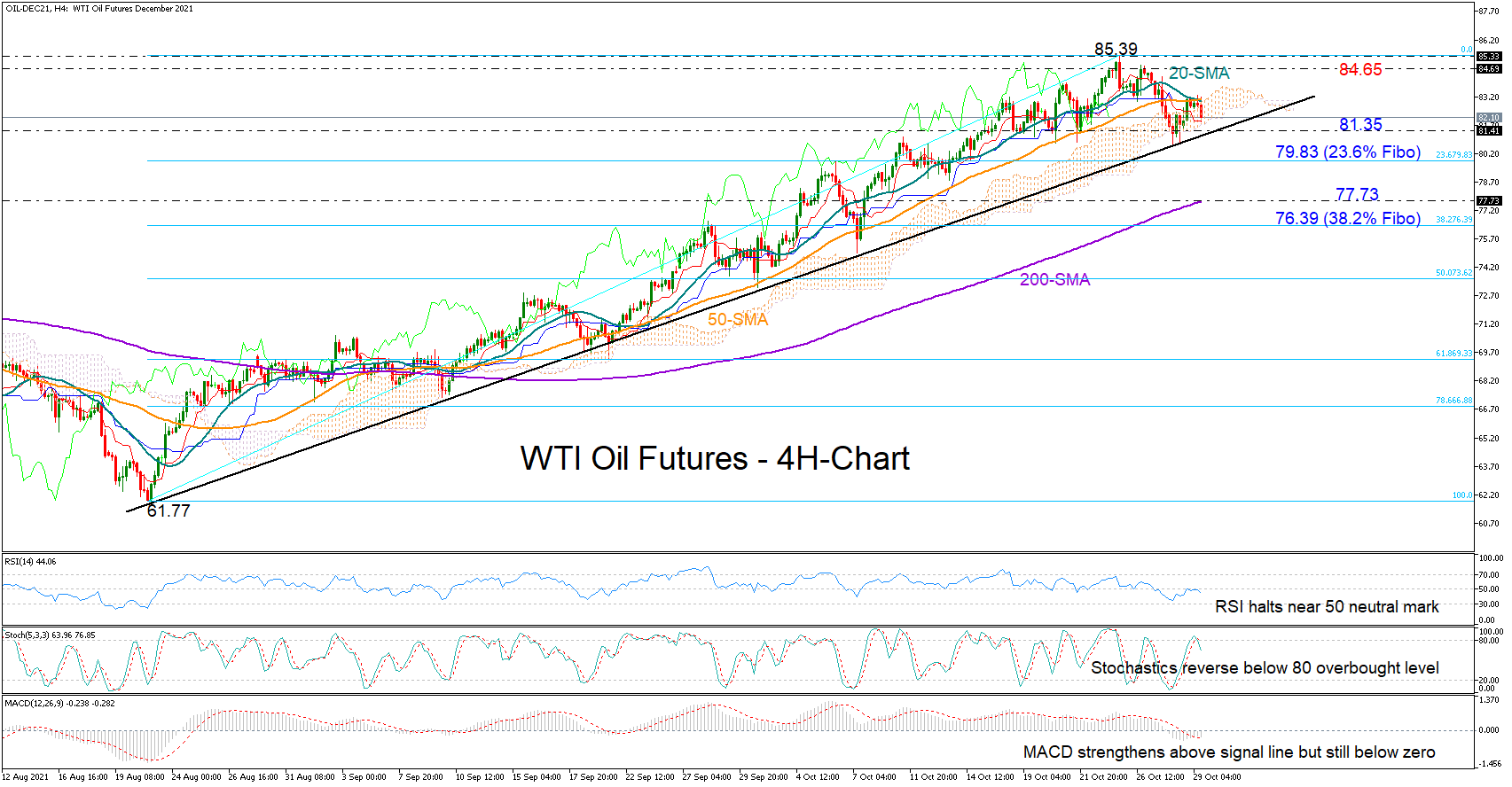
WTI oil futures (December delivery) charted a new lower low at 80.62 in the four-hour chart on Thursday but the tough ascending trendline, which has been strictly supporting the market since the bullish trend reversal in August came to the rescue once again, helping the price to crawl up to an intra-day high of 83.27 on Friday.
Negative risks, however, have not entirely evaporated yet as the RSI is stuck around its 50 neutral mark despite its latest upturn, the Stochastics are already flirting with overbought levels and the Ichimoku lines remain negatively aligned. The MACD has made some progress, advancing above its red signal line, but as long as the indicator continues to fluctuate within the negative area, downside corrections in the price are likely.
Technically, for the bulls to gain the upper hand in the very short-term picture, the price will need to close above the 20-period simple moving average (SMA) currently capping upside movements at 83.00. An extension above this line could see the price testing its previous highs registered within the 84.65 – 85.00 region. Any sustainable move higher would open the door for the 90.00 level.
On the downside, a decisive close below the trendline at 81.35 may press the price towards 79.83, this being the 23.6% Fibonacci retracement of the 61.66 – 85.39 upleg. The 200-day SMA could be the next barricade at 77.66 before the spotlight falls to the 38.2% Fibonacci of 76.39.
In brief, WTI oil futures have avoided a trend deterioration below a key ascending trendline, but the bears have not abandoned the battle yet. Failure to hold above 81.35 could confirm additional negative corrections.
EUR/USD Mid-Day Outlook
Daily Pivots: (S1) 1.1614; (P) 1.1653; (R1) 1.1724; More...
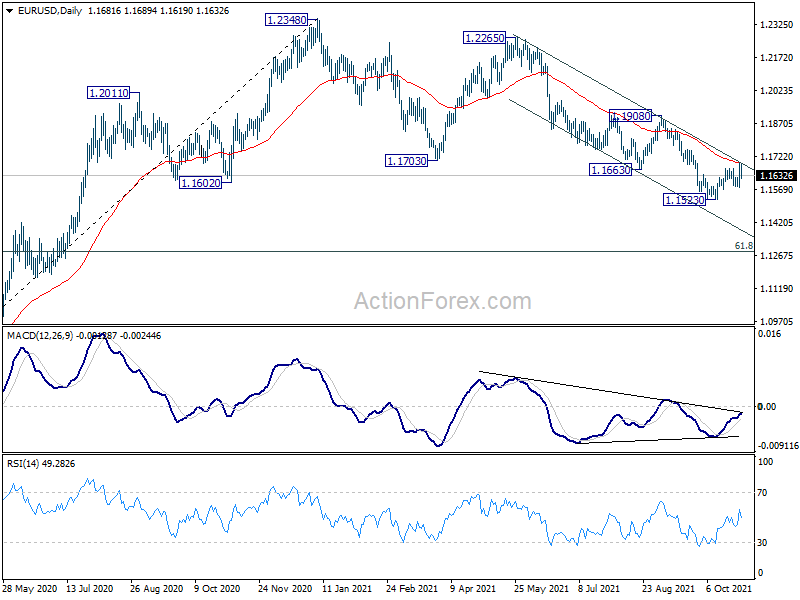
While EUR/USD retreats sharply today, further rise is still in favor as long as 1.1581 minor support holds. Sustained break of 55 day EMA (now at 1.1690) will be a sign that larger correction from 1.2348 has completed. Stronger rally would be seen to 1.1908 resistance for confirmation. On the downside, though, break of 1.1581 minor support will turn bias back to the downside for 1.1523 low instead.
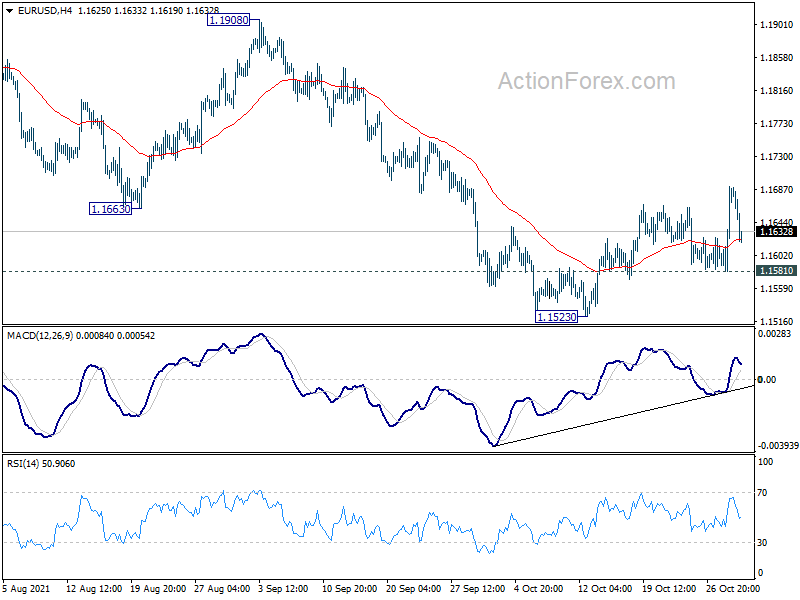
In the bigger picture, price actions from 1.2348 should at least be a correction to rise from 1.0635 (2020 low). As long as 1.1908 resistance holds, deeper fall would be seen to 61.8% retracement of 1.0635 to 1.2348 at 1.1289. Nevertheless break of 1.1908 resistance will revive medium term bullishness and turn focus back to 1.2348 high.
GBP/USD Mid-Day Outlook
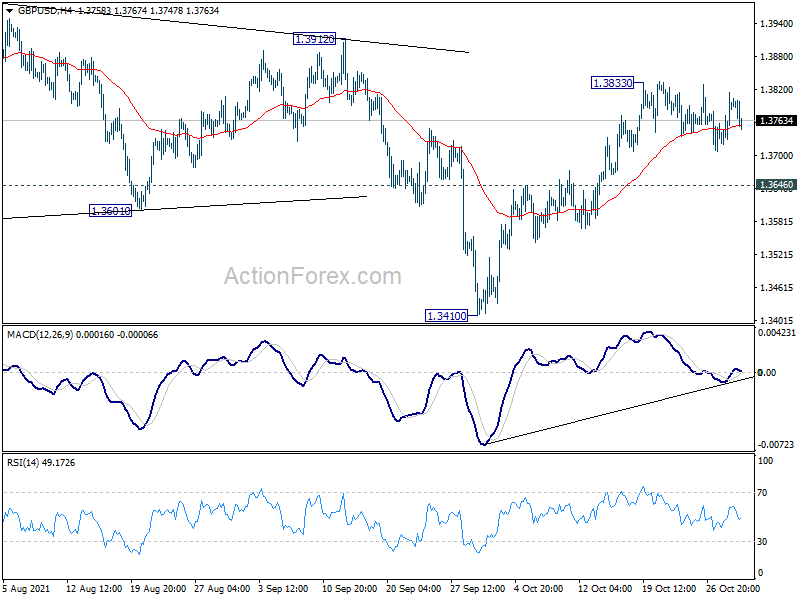
Daily Pivots: (S1) 1.3707; (P) 1.3744; (R1) 1.3778; More...
Intraday bias in GBP/USD remains neutral first, and with 1.3646 support intact, further rally is expected. On the upside, above 1.3833 will target 1.3912 key structural resistance. Firm break there will indicate that the correction from 1.4248 is complete with three waves down to 1.3410. Further rally would then be seen to retest 1.4248 high. However, break of 1.3646 will turn bias to the downside for retesting 1.3410 low.
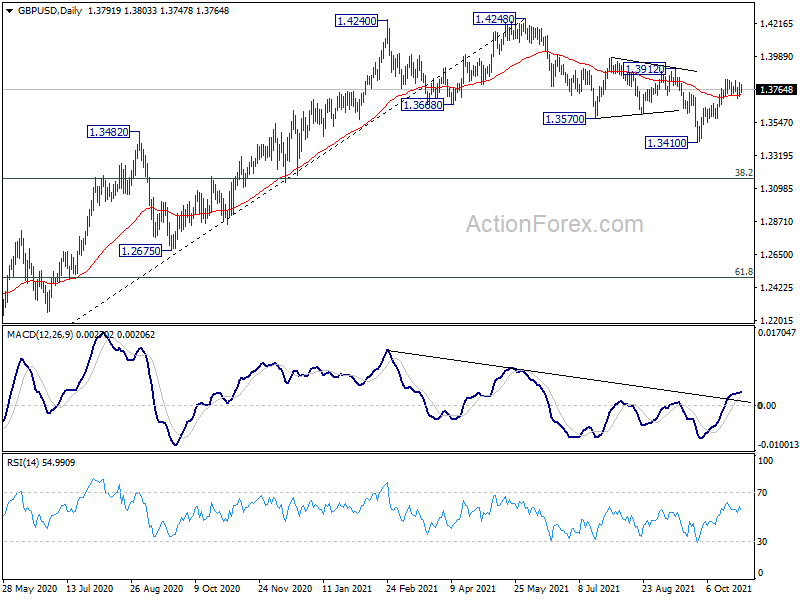
In the bigger picture, the structure of the fall from 1.4248 suggests that it's a correction to the up trend from 1.1409 (2020 low) only. While deeper fall cannot be ruled out yet, downside should be contained by 38.2% retracement of 1.1409 to 1.4248 at 1.3164, at least on first attempt, to bring rebound. On the upside, firm break of 1.4376 key resistance (2018 high) will add to the case of long term bullish reversal. However, sustained trading below 1.3164 will revive some medium term bearishness and target 61.8% retracement at 1.2493.
USD/CHF Mid-Day Outlook
Daily Pivots: (S1) 0.9091; (P) 0.9143; (R1) 0.9171; More....
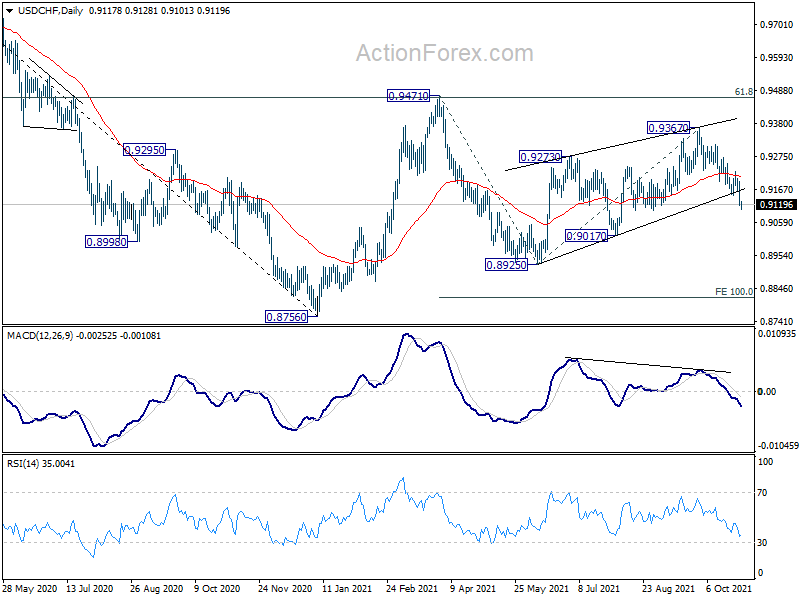
Intraday bias in USD/CHF remains on the downside at this point. Fall from 0.9367 should target 0.9017 support first, and then 0.8925 support next. For now, outlook will stay bearish as long as 0.9225 minor resistance holds, in case of recovery.
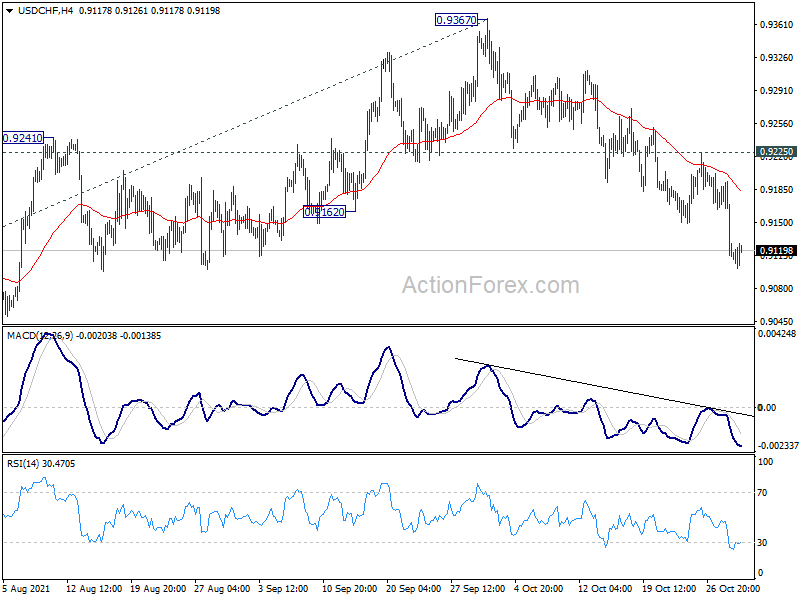
In the bigger picture, the corrective structure of the rebound from 0.8925 argues that fall from 0.9471 is not completed yet. It could either be the second leg of pattern from 0.8756 (2021 low), or resuming larger down trend from 1.0237 (2018 high). We'd pay attention to the downside momentum and assess the odds later. But for now, medium term outlook will be neutral at best as long as 0.9471 resistance holds.
USD/JPY Mid-Day Outlook
Daily Pivots: (S1) 113.25; (P) 113.56; (R1) 113.86; More...
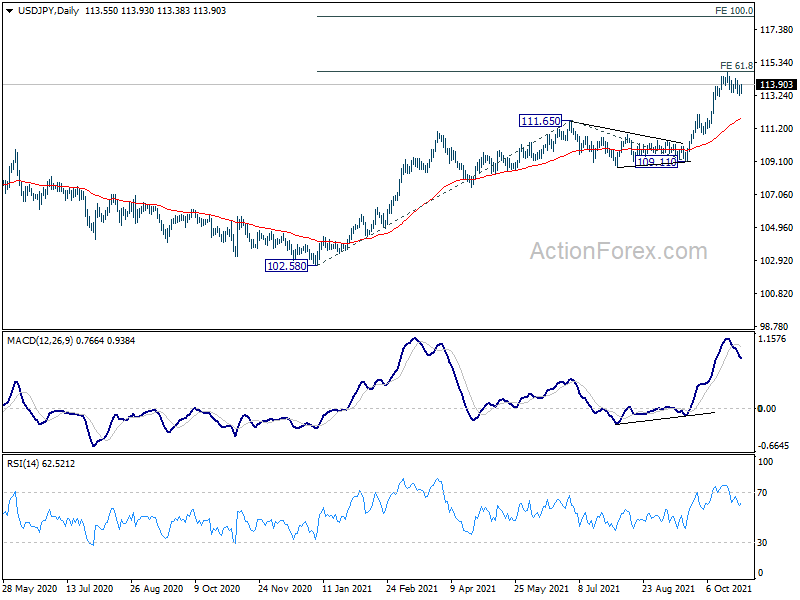
Intraday bias in USD/JPY is turned neutral again with current recovery. Corrective pattern from 114.69 might extend, but downside should be contained above 112.07 resistance turned support to bring rebound. On the upside, firm break of 114.69 will resume the larger up trend to 100% projection of 102.58 to 111.65 from 109.11 at 118.18 next.
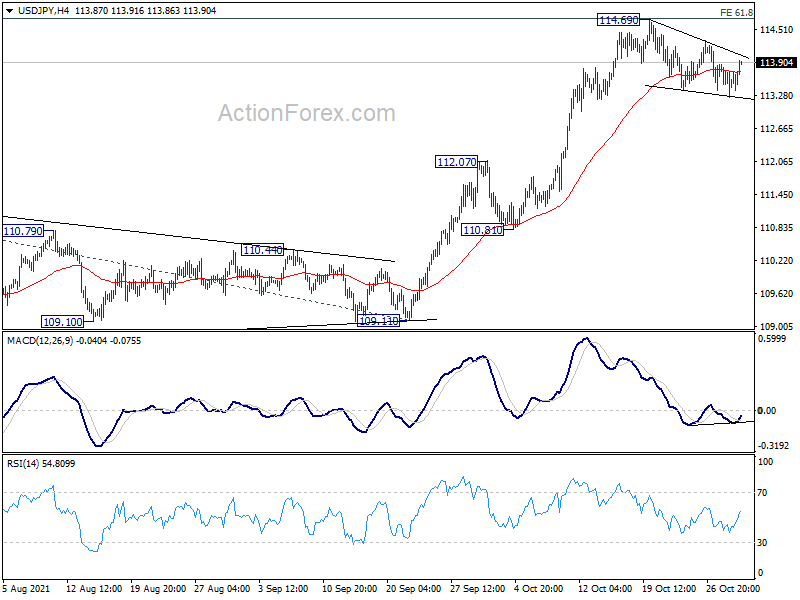
In the bigger picture, corrective decline from 118.65 (2016 high) should have completed at 101.18 already. Rise from the 102.58 is seen as the third leg of the up trend from 101.18. Next target is 114.54 resistance and then 118.65 high. This will now be the preferred case as long as 109.11 support hold, even in case of deep pull back.