Sample Category Title
EUR/USD Outlook: Euro Loses Traction After Strong Post-ECB Rally, But Bulls Are Still In Play
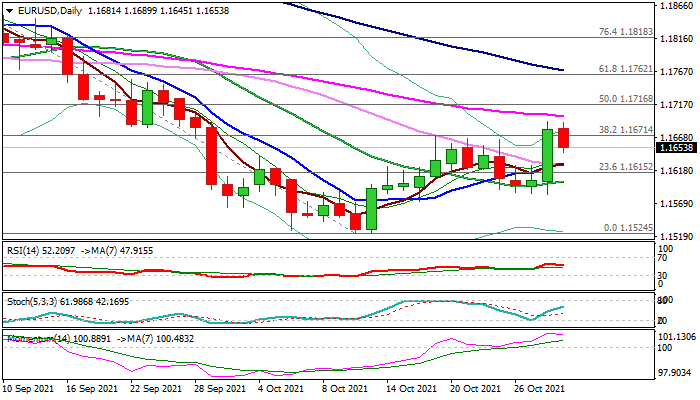
The Euro eases from new one-month high, posted after Thursday’s post-ECB 0.7% advance (the biggest one-day rally since May 5).
Traders reacted on ECB Lagarde’s less dovish than expected speech , while US GDP data miss added to positive sentiment.
Thursday’s close above pivotal Fibo barrier at 1.1671 (38.2% of 1.1909/1.1524) which repeatedly capped the action last week, was strong bullish signal, which requires confirmation on weekly close above this level, with daily Tenkan-sen crossing above Kijun-sen and underpinning the action.
On the other side, GDP data from EU and Germany showed that economies slowed significantly in the third quarter, although mainly in line with expectations, while EU inflation shot past expectations and rose to the highest in 13 years that may weigh on the single currency.
Technical studies on daily chart remain bullishly aligned with limited dips seen as buying opportunities.
Tenkan-sen / Kijun-sen bull-cross (1.1637) marks pivotal support which needs to hold extended dips and keep alive hopes for fresh push higher, however, today’s close below broken Fibo barrier at 1.1671 would soften the sentiment.
Caution on break and close below 1.1637 that would signal false break and confirm double-top (1.1692/90).
Res: 1.1671, 1.1700, 1.1716, 1.1755.
Sup: 1.1637, 1.1615, 1.1602, 1.1582.
Oil Steady, Gold Rises On US Dollar Woes
Oil steady in Asia
The oil sell-off that continued in Asia yesterday hit a brick wall and abruptly reversed as soon as Europe walked into the office. Although I expected a rapid recovery, the pace caught me by surprise and really speaks volumes about the pent-up demand lying in wait in the physical oil market now. A lower US dollar in the New York session gave oil a gentle nudge and both Brent crude and WTI recorded small gains for the day. Brent crude finishing 0.40% higher at USD 84.50, and WTI climbing an impressive 1.10% to USD 83.05 a barrel. Asia has decided to sit on its hands today after getting it so wrong yesterday, with both contracts steady near their New York close.
The potential restart of nuclear talks with Iran, and the potential return of Iranian crude to markets legally, seem to have run their course with US traders more concerned about the large rundown in available stocks at the Cushing distribution hub. Nevertheless, oil still faces some downside risk over the weekend and into next week’s OPEC+ meeting on 4 November. Energy Intelligence is running a story suggesting that OPEC+ may be comfortable raising production by more than its present targets. With compliance at 115%, I am not sure how that would happen, but if OPEC+ does spring a surprise, oil could once again see an abrupt correction lower. And this time, it may linger for longer.
Brent crude has regained the trendline support at, today at USD 84.40 a barrel, although it has not managed to move clear of it. It has traced out at double bottom after yesterday’s sell-off at USD 82.25 a barrel and price action remain constructive unless this is broken on a closing basis. Resistance is distant at USD 86.00 a barrel. WTI held its trendline support at USD 80.75 a barrel and has traced out a triple bottom at that level. Only failure signals deeper losses now. A rise above USD 83.20 a barrel signals a retest of USD 84.00 a barrel. Notably, the relative strength indexes (RSIs) on both contracts have fallen into neutral territory, removing another technical signal that would limit gains.
Lower dollar boosts gold
Gold prices rose again overnight despite US 10-year yields rising across the US yield curve. Gold has a general sell-off of the US dollar to thank and that lifted it to a 0.10% gain to USD 1799.00 an ounce overnight. In Asia, a rising US dollar has seen gold retrace slightly, falling by 0.25% to USD 1794.00 an ounce. Ominously, gold’s rally extended to USD 1810.50 intra-day overnight, but for the fourth time in one week, it failed in that area and gave back most of its gains. That is in keeping with my predicted USD 1780.00 to USD 1820.00 pre-FOMC range next week.
In the near-term, if the trendline support, today at USD 1790.00, as well as USD 1780.00 an ounce hold, gold’s price action remains constructive. Gold has a well-defined resistance area in the USD 1810.00 region, followed by the formidable resistance zone between USD 1832.00 and USD 1835.00 an ounce.
A move above USD 1835.00 would be a powerful bullish technical signal though, but my base case is that gold’s retreat resumes into next week after the FOMC. Failure of USD 1780.00 therefore, likely signals deeper losses targeting USD 1750.00 in the first instance. Conversely, if gold overcomes formidable resistance into USD 1835.00, it will signal further gains to USD 1900.00 and possibly USD 2000.00 in the coming weeks, as the break would trigger an inverse head-and-shoulders formation.
The US Dollar Crushed Under ECB Stampede
Euro jumps on rate hike fever
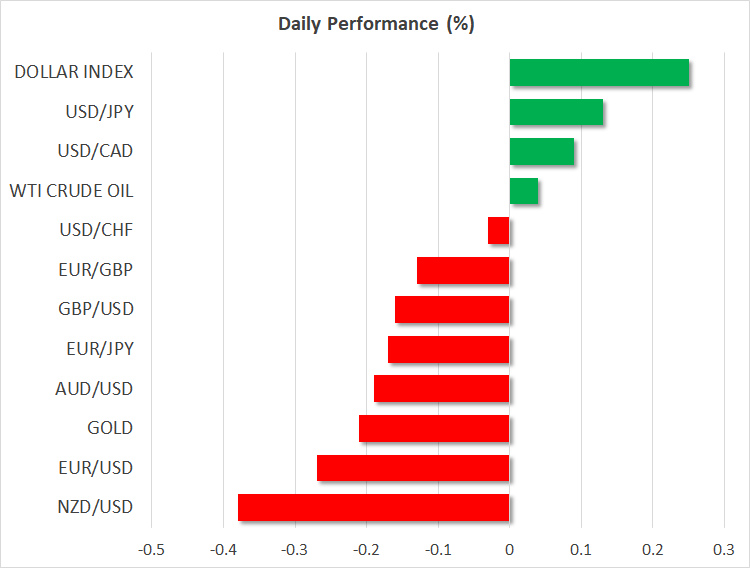
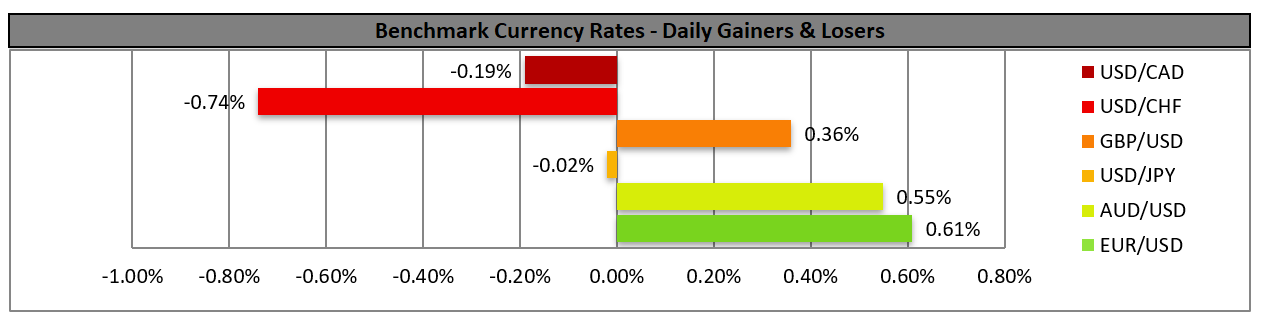
The US dollar was in full retreat overnight as the ECB did not do enough to dampen hiking expectations at its overnight policy meeting. That led to a powerful rally by EUR/USD which spilt over into the other G-7s and the wider currency space despite US yields rising across the curve once again. The dollar index fell by 0.53% to 93.36 before edging higher to 93.39 in moribund Asian trading. The dollar index has smashed through support at 93.50 which becomes resistance and could well target 93.00 if sentiment remains the same when Europe arrives this afternoon.
EUR/USD has risen by 0.75% to 1.1680, breaking resistance at 1.1670 leaving its next upside target at 1.1750. GBP/USD has risen 0.35% to 1.3795 but must break strong resistance ahead of 1.3835 to decisively swing the picture back to bullish with a BOE hike next week seemingly fully priced in. USD/JPY has eased 0.20% to 113.60 with support at 113.25. USD/JPY is likely near its lows at these levels as US yields continue to move higher, widening the US/Japan rate differential. An election in Japan this weekend will also temper yen gains today.
The US dollar fall overnight boosted the commodity currency space although USD/CAD and NZD/USD are still locked in range-trading mode. The spike in Australian 3-year rates is an additional supportive factor along with greenback weakness. AUD/USD has risen 0.35% to resistance at 0.7550, and a close above that tonight signals further gains above 0.7600. All eyes will be on the RBA on Monday morning and could lead to some large intra-day volatility.
Asian currencies booked only patchy gains versus the US dollar overnight, suggesting that China growth and US yields remain a concern across the region. The Korean won and Chinese yuan held steady. The PBOC once again set another neutral USD/CNY fixing, limited Asian FX gain versus the US dollar. The central bank has a clear preference for now to maintain currency strength while adding liquidity directly to the domestic system instead, likely with one eye on its imported energy bill.
Euro Spikes Higher As ECB Fails To Convince Markets
- ECB strikes a dovish tone but investors just don’t buy it
- Bond market pricing in slowdown, US spending deal done
- Tech earnings disappoint, Japanese elections on the menu
Teflon euro
The European Central Bank said all the right things yesterday. President Lagarde highlighted that market expectations for a rate increase next year are not realistic and stressed this inflation episode remains transitory, but the euro still stormed higher alongside European yields.
Investors are just not buying what the ECB is saying. With inflation expectations going ballistic, markets are betting the central bank will be forced to take its foot off the gas sooner, first by slashing asset purchases and then with tiny rate increases.
Admittedly though, this may be a bridge too far for the Eurozone. Asset purchases will most likely be gutted soon but raising rates is an entirely different beast, especially when the economy isn’t firing on all cylinders, the labor market is still fragile, and the central bank is traumatized by the last time it raised rates in error.
As for euro/dollar, the risks remain skewed to the downside. The ECB is now priced for perfection, leaving plenty of scope for disappointment in case growth continues to underwhelm. In contrast, the US economy will weather the energy storm much better and the upcoming spending injections from Congress could juice up growth, allowing the Fed to bring forward its own rate increases.
Bond market on red alert
The bond market is feeling the blues lately, ringing alarm bells about a slowdown in economic growth as central banks overreact to this inflation scare. The yield on the 30-year US Treasury note has fallen below the 20-year one, signaling that the powerful policy tightening being priced in for the next few years will ultimately backfire and hamstring both growth and inflation.
This is something to keep a close eye on. Even though the bond market has been heavily distorted by years of central bank intervention, it still manages to smell out macroeconomic shifts and recessions well ahead of the commodity and stock markets.
Speaking of macro shifts, President Joe Biden announced that the Democrats have finally reached a framework agreement on his social spending agenda. The price tag of the package has been pushed down to $1.75 trillion, which still sounds massive but is not when you consider it will be spread out over a decade.
It would be paid for by introducing a minimum tax of 15% on corporate profits, raising income taxes on the very wealthy, and levying an additional 1% on stock buybacks. The news had no visible impact on the stock market, although US futures are pointing to a lower open on Friday after both Amazon and Apple reported disappointing earnings.
It is quite incredible that the S&P 500 is about to close the month almost 7% higher despite higher yields, energy markets going bananas, crippled supply chains, slowdown risks, and minimum taxes coming to bite the biggest corporations.
Busy day, huge week ahead
A barrage of European economic data has just been released and even though both inflation and growth metrics beat expectations, the euro has been unable to capitalize.
The focus now turns to the American data that will be released later on. US economic growth for Q3 disappointed yesterday, but the good news is that most of this came down to falling car sales as chip shortages raged. Demand is still booming but some sectors have hit a supply wall.
A massive week lies ahead. Japan will hold its general election during the weekend, there are central bank meetings in Australia, America, and the United Kingdom, before volatility reaches a crescendo with Friday’s nonfarm payrolls report.
GBPJPY Falters Around 158 Level But Upside Still Intact
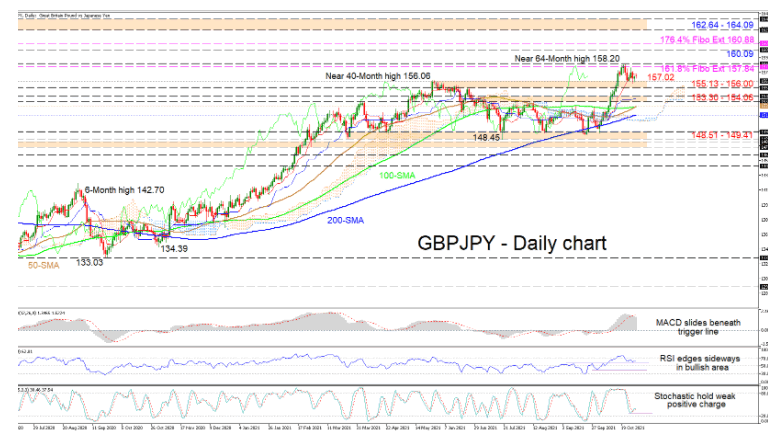
GBPJPY is consolidating across the 156.00 mark that is the upper part of a support barrier moulded by the highs reached at the end of May until the later part of June. The simple moving averages are sponsoring the positive structure, while a further extension of the 50-day SMA above the 100-day SMA could boost advances in the pair.
The Ichimoku lines are reflecting the minor pullback in the pair but are also showing that positive momentum may just be taking a breather. The short-term oscillators are demonstrating that buying interest has not fully subsided. The MACD has glided underneath its red trigger line but remains deep in the positive zone, while the RSI is hovering in bullish territory. The stochastic oscillator is exhibiting a weak positive charge but is not conveying a strong price preference in the pair.
Managing to push the price above the red Tenkan-sen line at 157.02, buyers could target the 157.84-158.20 resistance band, the former being the 161.8% Fibonacci extension of the down leg from 144.94 until 124.00. Conquering the latter, which is a more than 5-year high, the bulls could jump for the key high of 160.09 from back in June 2016. If upside impetus persists and thrusts the price past the 176.4% Fibo extension of 160.88, buyers may then challenge the 162.64-164.09 resistance boundary linked to the highs plotted over the 2016 period of March until May.
If downward forces grow, initial support could stem from the immediate 155.13-156.00 zone. Next, the 153.30-154.06 obstruction could come into focus before the section from the 50-day SMA at 152.76 until the 200-day SMA at 151.60 tries to dismiss the decline from gaining pace. From here, a price drop below the Ichimoku cloud around 150.86 could feed negative powers to test the foundation of 148.51-149.41.
Summarizing, although elevating forces have softened somewhat, GBPJPY’s bullish bearing remains in force above the 155.13-156.00 barrier. That said, a price dip below the SMAs could see negative concerns increase.
Asian Equities Do The North/South Split
Asian equities a mixed bag
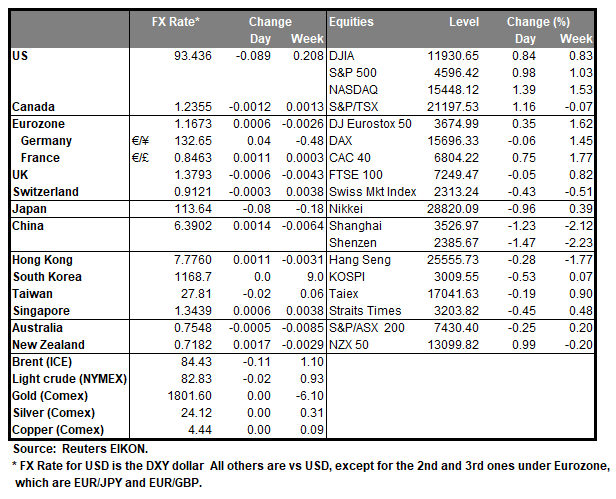
Wall Street enjoyed a positive session overnight, led by big-tech in anticipation of strong Apple and Amazon earnings. The S&P 500 rallied 0.98% higher, with the Nasdaq leaping 1.39% higher, and the Dow Jones booking a 0.68% gain. Disappointing results from both titans after the close slammed the door on the rally with Nasdaq futures tumbling by 0.70%, S&P 500 futures falling 0.35%, while Dow futures have edged just 0.05% lower. The initial reaction is rather less bad than I would have expected, and the perpetual bulls of Wall Street may be looking for a potential rebound in Q4 already.
In Asia, it is the North Asia heavyweights that are taking the heat, and in price action we have seen rather often of late, those sellers appear to be rotating into ASEAN markets defensively rather than exiting altogether. It is no coincidence that markets heavy with Apple suppliers are falling the most. Taipei is down 0.60% and South Korea’s Kospi is 0.70% lower. Japan was sold heavily initially but has since recovered to be only 0.10% lower. Gains should be limited from here as Japan heads into Lower House elections on Sunday.
With the state planner talking down coal prices and Evergrande making its offshore coupon payment just ahead of today’s final deadline, sentiment is more positive in China. That was assisted by another giant CNY 100 billion liquidity injection by the PBOC via the repo market today. The Shanghai Composite is 0.05% higher with the narrower Shanghai 50, heavy with banks, rinsing by 0.35%. The CSI 300 is up 0.20% while Hong Kong can’t quite shake off the tech-funk, falling 0.55%.
In ASEAN, the picture is more solid as investors rotate south. Singapore is 0.70% higher while Jakarta is up 0.75% and Kuala Lumpur is unchanged. Bangkok has risen by 0.15% but Manila have fallen by 0.90% today.
Australian markets have taken fright at the huge jump of the 3-year CGB yields to 0.75% this morning, and the absence of the RBA whose target is just 0.10%. Markets are pricing in a change of monetary stance from the RBA who are now looking at a rapidly developing credibility issue. That has left the ASX 200 lower by 0.80%, while the All Ordinaries has fallen by 0.60%.
The fallout from the Apple and Amazon results has been relatively muted in the bigger picture. Supply change blockages and shortages also appear to be being accepted as a fact of life by markets. With the ECB out of the way as well, there should be no reason for European stocks not to rally modestly this afternoon. The picture in US markets is rather cloudier, but once again, it would not surprise me if they took the Apple and Amazon results in their stride and rallied, especially if the OPEC+ story gains credence and we see a concrete breakthrough on democrat spending plans.
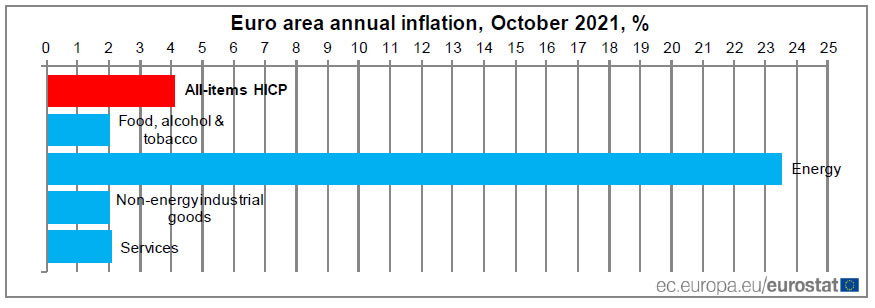
Eurozone CPI surged to 4.1% yoy in Oct, highest since 2008
Eurozone CPI surged to 4.1% yoy in October, up from 3.4% yoy, above expectation of 3.7% yoy. That's also the fastest pace since July 2008. CPI core rose to 2.1% yoy, up from 1.9% yoy, above expectation of 1.9% yoy.
Looking at the main components, energy is expected to have the highest annual rate in October (23.5%, compared with 17.6% in September), followed by services (2.1%, compared with 1.7% in September), non-energy industrial goods (2.0%, compared with 2.1% in September) and food, alcohol & tobacco (2.0%, stable compared with September).
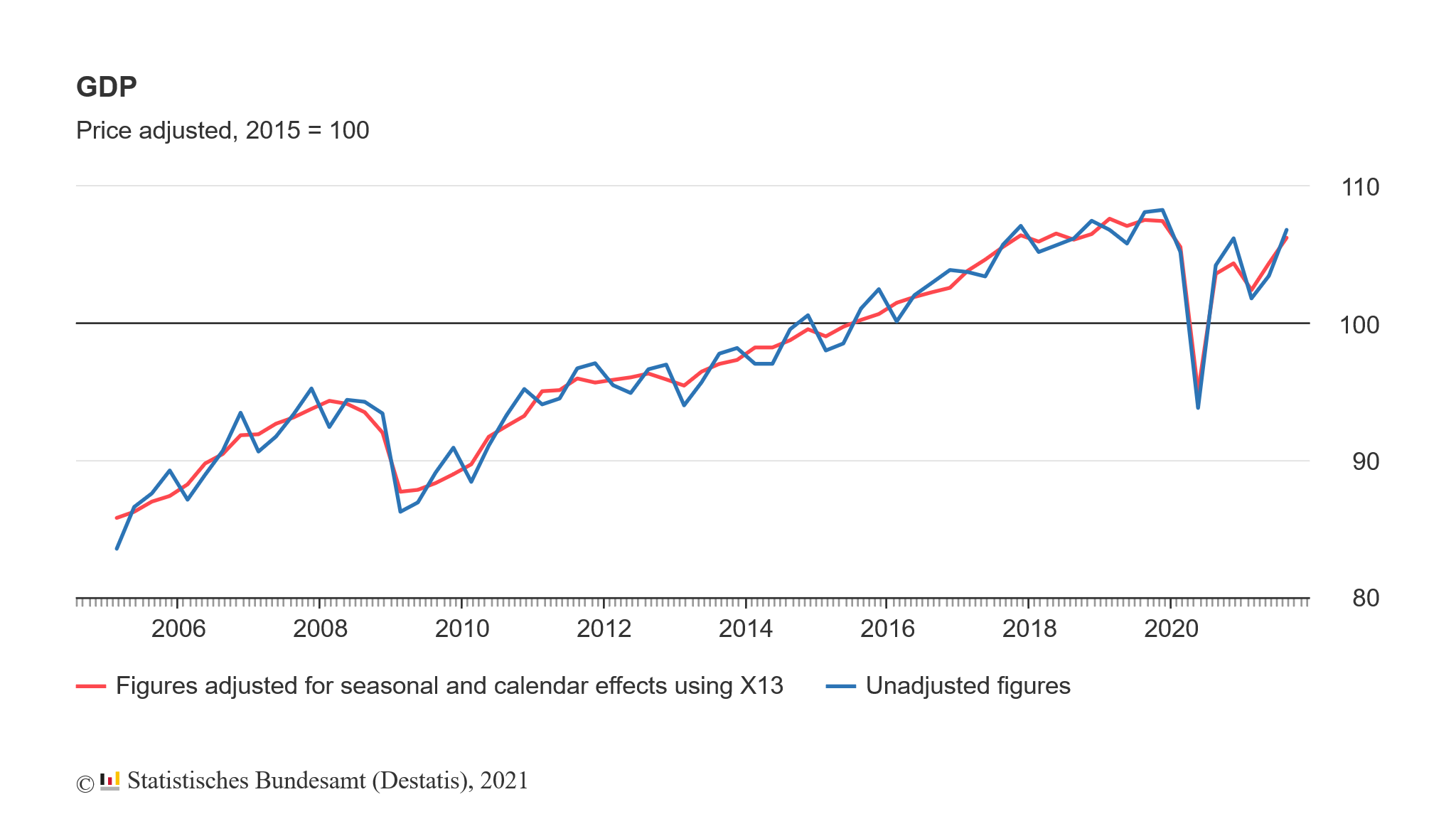
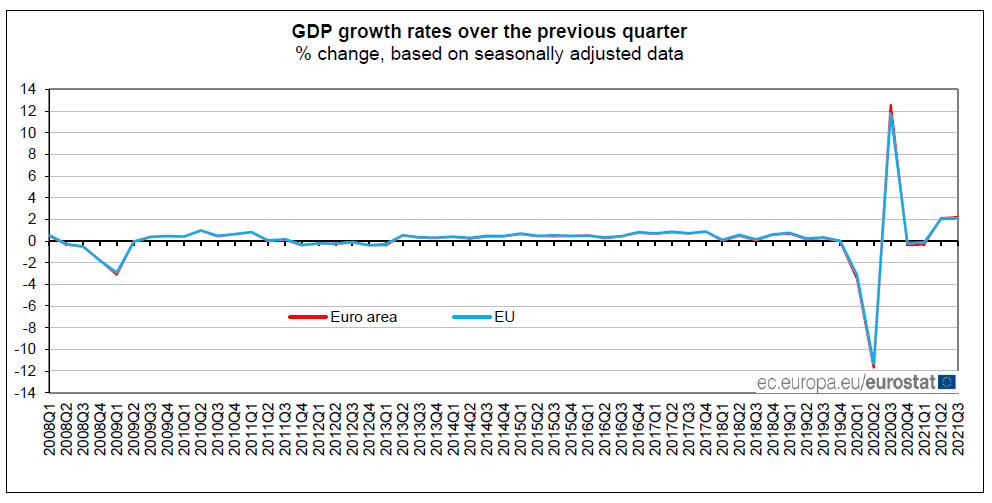
Eurozone GDP grew 2.2% qoq in Q3, EU up 2.1% qoq
Eurozone GDP grew 2.2% qoq in Q3, slightly above expectation of 2.1% qoq. EU GDP grew 2.1% qoq. Among the EU Member States for which data are available, Austria (+3.3%) recorded the highest increase compared to the previous quarter, followed by France (+3.0%) and Portugal (+2.9%). The lowest growth was recorded in Latvia (+0.3%) and GDP was stable in Lithuania (0.0%). The year on year growth rates were positive for all countries.
Mixed Data Weigh On USD, Optimism Lifts Stockmarkets
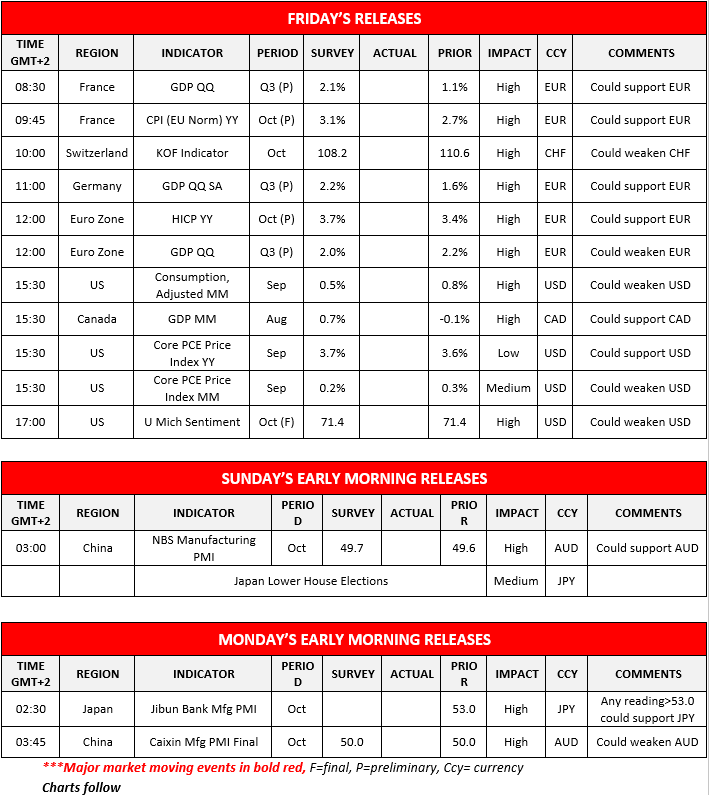
The USD dropped considerably against a number of its counterparts yesterday as mixed USD financial data released yesterday tended to weigh substantially on the greenback. The US GDP rate (Advanced) for Q3 decelerated more than expected reaching 2.0% qoq on an annualized basis implying a slowdown in the growth of the US economy while the weekly initial jobless claims figure also retreated implying a tightening of the US employment market. On the other hand, US stockmarkets remained in green territories with Nasdaq and S&P 500 reaching new record high levels as market optimism was boosted by the release of earnings reports. However, it should be noted that Apple missed analysts’ expectations for its revenue figure as supply chain shortages tormented the company and Apple CEO Tim Cook is reported to have said that the impact is to be even worse for the current holiday season, which could weigh on the share’s price. On other news, Mark Zuckerberg revealed that the new name for Facebook is to be “Meta” as the company concentrates on its new project, Metaverse and tries to become something larger than just a social media company. Today we note the release of the US consumption rate as well as the core PCE Price index both being for September, while for the US stockmarkets we note the release of the earnings reports for of Alibaba (#BABA), Chevron (#CVX), Exxon Mobil (#XOM), and Colgate Palmolive among others.
US 100 cash was on the rise yesterday reaching new record highs before retreating just below the 15715 (R1) resistance line. The index is currently teasing the upward trendline guiding it since the 25th of October and should it clearly break it we would initially switch our bullish outlook in favor of a bias for a sideways movement. If the bulls take over, we may see the index clearly breaking the 15715 (R1) resistance line with its next possible target being the 16000 (R2) round number. If the bears are in charge its direction, we may see Nasdaq breaking the prementioned upward trendline and take aim for the 15365 (S1) support level.
EUR gets a lift from ECB’s interest rate decision
The common currency got a lift against the USD,GBP and JPY yesterday and is about to end the week in the greens as buying traction was created by ECB’s interest rate decision. The bank remained on hold keeping the refinancing rate at 0.0% and the deposit rate at -0.50% as was widely expected and kept its QE program and PEPP target also unchanged. The bank reiterated its view about the transitory nature of the current inflationary pressures which are to accelerate even further, and ECB President made no effort to conceal the bank’s worries about the issue. On a fundamental level, we maintain our worries for the energy crunch of Europe as well as the supply shortages, especially about semiconductor chips despite some positive signals coming from the ECB, which could slow down the economic recovery of the area. Also it should be noted that Germany’s preliminary HICP Rate for October accelerated slightly more than expected increasing the bullish sentiment for EUR while today we highlight the preliminary HICP rates for France and the Eurozone as well as the preliminary GDP rates for Q3 for Germany, France and the Eurozone as a whole.
EUR/USD got a lift breaking the 1.1615 (S1) resistance line, now turned to support and is currently testing the 1.1695 (R1) level. We tend to maintain a bullish bias for the pair currently, yet today’s financial releases could alter its direction. Should the buying interest be extended we may see the pair breaking the 1.1695 (R1) resistance line and take aim for the 1.1780 (R2) level. Should sellers dictate the pair’s direction, we may see it aiming if not breaking the 1.1615 (S1) support line.
Today’s events and expectations
Besides the financial releases already mentioned we would like to note the release of China’s manufacturing NBS and Caixin PMI figures for October on Sunday and Monday’s Asian session.
US 100 Cash H4 Chart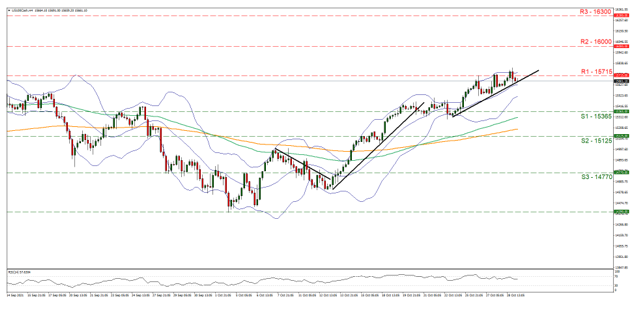
Support: 15365 (S1), 15125 (S2), 14770 (S3)
Resistance: 15715 (R1), 16000 (R2), 16300 (R3)
EUR/USD H4 Chart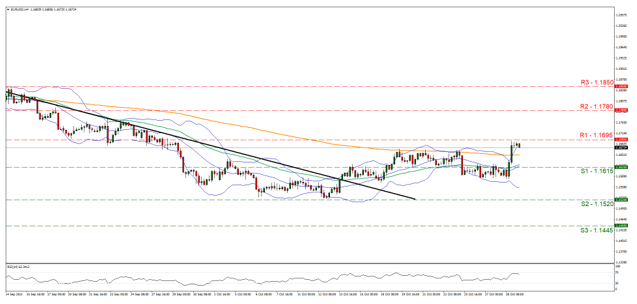
Support: 1.1615 (S1), 1.1520 (S2), 1.1445 (S3)
Resistance: 1.1695 (R1), 1.1780 (R2), 1.1850 (R3)
Germany GDP grew 1.8% qoq in Q3, below expectations
Germany GDP grew only 1.8% qoq in Q3, below expectation of 2.2% qoq. Overall GDP was still -1.1% lower (price-, seasonally and calendar-adjusted) than in the fourth quarter of 2019, the quarter before the coronavirus crisis began.