

Sample Category Title
Dollar Rebounding after Strong PCE Inflation Data
Dollar is trying to rebound broadly in early US session, partly on strong inflation data, and partly on month end flow. But overall, the greenback is just mixed for the week. For week Aussie and Swiss Franc are the strongest ones, with the latter lifted by strong buying against Euro. Yen is now the weakest one and will likely remain so. Euro and Canadian Dollar are both weak too as respective central bank meeting didn't produce sustainable buying in them.
In Europe, at the time of writing, FTSE is down -0.32%. DAC is down -0.53%. CAC is down -0.24%. Germany 10-year yield is up 0.0512 at -0.080. Earlier in Asia, Nikkei rose 0.25%. Hong Kong HSI dropped -0.70%. China Shanghai SSE rose 0.82%. Singapore Strait Times dropped -0.18%. Japan 10-year JGB yield rose 0.0114 to 0.100.
US personal income dropped -1.0% mom in Sep, spending rose 0.6% mom
US personal income dropped -1.0% mom or USD 216.2B in September, much worse than expectation of 0.1% mom rise. Personal spending rose 0.6% mom or USD 93.4B, matched expectations. Headline PCE inflation accelerated to 4.4% yoy, below expectation of 4.7% yoy. Core PCE price index was unchanged at 3.6% yoy, below expectation of 3.7% yoy.
Canada GDP grew 0.4% mom in Aug, to be flat in Sep
Canada GDP rose 0.4% mom in August, below expectation of 0.7% mom. Overall 15 of 20 industrial sectors were up. Services-producing industries rose 0.6%. Goods-producing industries dropped -0.1% Preliminary information suggests that real GDP was essentially unchanged in September. Advance estimate points to an approximate 0.5% rise in real GDP in Q3.
Eurozone CPI surged to 4.1% yoy in Oct, highest since 2008
Eurozone CPI surged to 4.1% yoy in October, up from 3.4% yoy, above expectation of 3.7% yoy. That's also the fastest pace since July 2008. CPI core rose to 2.1% yoy, up from 1.9% yoy, above expectation of 1.9% yoy.
Looking at the main components, energy is expected to have the highest annual rate in October (23.5%, compared with 17.6% in September), followed by services (2.1%, compared with 1.7% in September), non-energy industrial goods (2.0%, compared with 2.1% in September) and food, alcohol & tobacco (2.0%, stable compared with September).
Eurozone GDP grew 2.2% qoq in Q3, EU up 2.1% qoq
Eurozone GDP grew 2.2% qoq in Q3, slightly above expectation of 2.1% qoq. EU GDP grew 2.1% qoq. Among the EU Member States for which data are available, Austria (+3.3%) recorded the highest increase compared to the previous quarter, followed by France (+3.0%) and Portugal (+2.9%). The lowest growth was recorded in Latvia (+0.3%) and GDP was stable in Lithuania (0.0%). The year on year growth rates were positive for all countries.
Germany GDP grew only 1.8% qoq in Q2, below expectation of 2.2% qoq. Overall GDP was still -1.1% lower (price-, seasonally and calendar-adjusted) than in the fourth quarter of 2019, the quarter before the coronavirus crisis began.
France GDP rose 3.0% qoq in Q3, above expectation of 2.4% qoq. GDP has almost returned to pre-crisis level, just -0.1% below Q4 2019 level.
Italy GDP grew 2.6% qoq, below expectation of 2.0% qoq.
Swiss KOF dropped slightly to 110.7, almost unchanged overall movement
Swiss KOF Economic Barometer dropped slightly from 111.0 to 110.7 in October, better than expectation of 108.0. KOF said: "Indicator bundles of the food and beverage industry have improved clearly and are contrasted by declines in indicator bundles of manufacturing, the economic sector other services, foreign demand and the financial and insurance services, resulting in an almost unchanged overall movement."
Japan industrial production dropped -5.4% mom in Sep, but expected to bounce back strongly ahead
Japan industrial production dropped sharply by -5.4% mom in September, much worse than expectation of -2.4% mom. The seasonally adjusted index of production at factories and mines dropped for the third straight month to 89.5, against the 2015 100 base of 100.
But looking ahead, the Ministry of Economy, Trade and Industry said output would bounce back by 6.4% in October, and then 5.7% in November, based on a poll of manufacturers. An official said, "output may have hit bottom in September since economic activities have been returning to normal in countries such as Vietnam and Malaysia since late September, and a recovery is expected, mainly in the auto industry."
Also released, unemployment was unchanged at 2.8% in September, matched expectations. Housing starts rose 4.3% yoy, versus expectation of 7.5% yoy. Consumer confidence dropped to 39.2, below expectation of 40.4. In October, Tokyo CPI core was unchanged at 0.10% yoy, below expectation of 0.3% yoy.
Australia retail sales rose 1.3% mom in Sep, vary by state
Australia retail sales rose 1.3% mom in September, much better than expectation of 0.2% mom. That's the first monthly growth since May. For the 12-month, sales rose 1.7% yoy.
"Retail turnover continues to vary by state, based on whether restrictions were imposed, removed or extended. Queensland sales rose to their highest level ever, up 5.2 per cent, with no lockdowns in September," Ben James, Director of Quarterly Economy Wide Statistics said.
"New South Wales also experienced a rise of 2.3 per cent despite having lockdowns, as some restrictions were eased or lifted. However, turnover for New South Wales remains 11.9 per cent lower than May 2021, the month before the most recent lockdown began."
Also released, PPI came in at 1.1% qoq, 2.9% qoq in Q3, versus expectation of 0.6% qoq, 3.2% yoy. Price sector credit rose 0.6% mom in September, matched expectations.
USD/JPY Mid-Day Outlook
Daily Pivots: (S1) 113.25; (P) 113.56; (R1) 113.86; More...
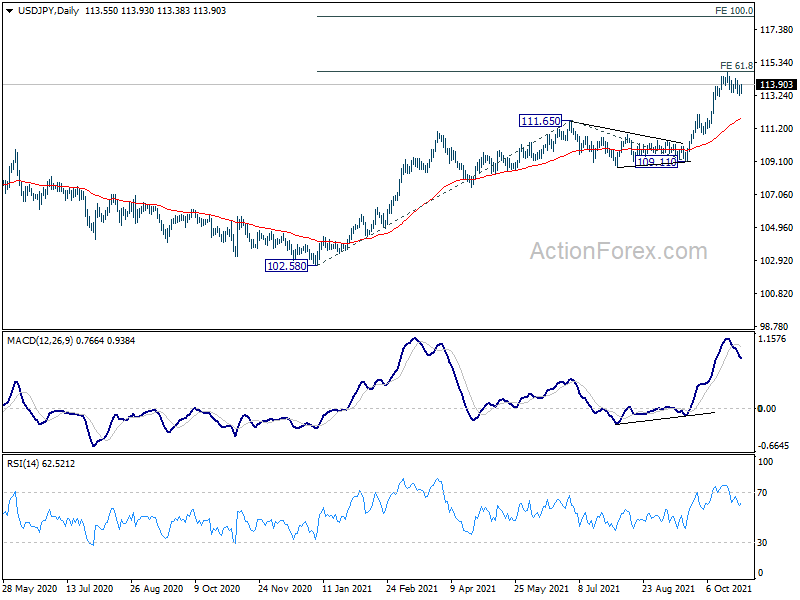
Intraday bias in USD/JPY is turned neutral again with current recovery. Corrective pattern from 114.69 might extend, but downside should be contained above 112.07 resistance turned support to bring rebound. On the upside, firm break of 114.69 will resume the larger up trend to 100% projection of 102.58 to 111.65 from 109.11 at 118.18 next.
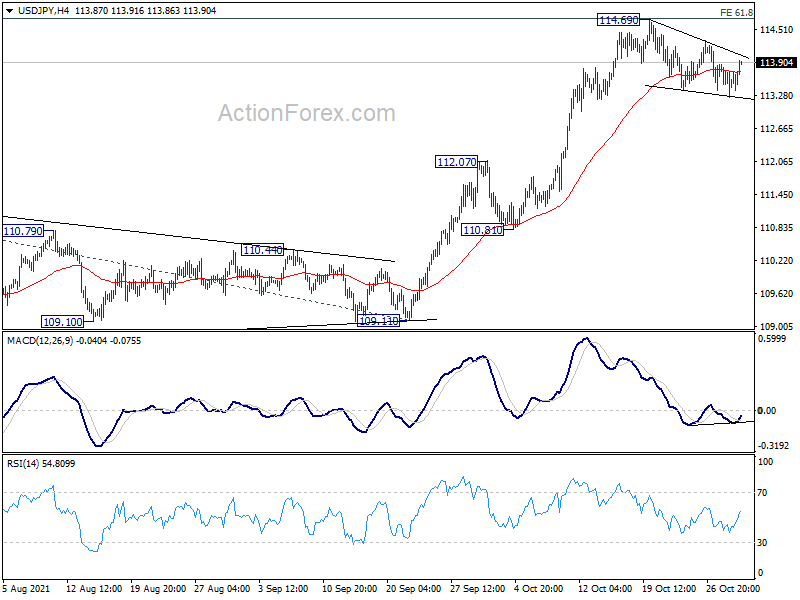
In the bigger picture, corrective decline from 118.65 (2016 high) should have completed at 101.18 already. Rise from the 102.58 is seen as the third leg of the up trend from 101.18. Next target is 114.54 resistance and then 118.65 high. This will now be the preferred case as long as 109.11 support hold, even in case of deep pull back.
Economic Indicators Update
| GMT | Ccy | Events | Actual | Forecast | Previous | Revised |
|---|---|---|---|---|---|---|
| 23:30 | JPY | Tokyo CPI Core Y/Y Oct | 0.10% | 0.30% | 0.10% | |
| 23:30 | JPY | Unemployment Rate Sep | 2.80% | 2.80% | 2.80% | |
| 23:50 | JPY | Industrial Production M/M Sep P | -5.40% | -2.40% | -3.60% | |
| 00:30 | AUD | Private Sector Credit M/M Sep | 0.60% | 0.60% | 0.60% | |
| 00:30 | AUD | Retail Sales M/M Sep | 1.30% | 0.20% | -1.70% | |
| 00:30 | AUD | PPI Q/Q Q3 | 1.10% | 0.60% | 0.70% | |
| 00:30 | AUD | PPI Y/Y Q3 | 2.90% | 3.20% | 2.20% | |
| 05:00 | JPY | Housing Starts Y/Y Sep | 4.30% | 7.50% | 7.50% | |
| 05:30 | EUR | France Consumer Spending M/M Sep | -0.20% | 0.50% | 1.00% | 0.70% |
| 05:30 | EUR | France GDP Q/Q Q3 P | 3.00% | 2.40% | 1.10% | |
| 07:00 | CHF | KOF Leading Indicator Oct | 110.7 | 108 | 110.6 | 111 |
| 08:00 | EUR | Italy GDP Q/Q Q3 P | 2.60% | 2.00% | 2.70% | |
| 08:00 | EUR | Germany GDP Q/Q Q3 P | 1.80% | 2.20% | 1.60% | |
| 08:30 | GBP | Mortgage Approvals Sep | 73K | 73K | 74K | |
| 08:30 | GBP | M4 Money Supply M/M Sep | 0.60% | 0.50% | 0.50% | |
| 10:00 | EUR | Eurozone GDP Q/Q Q3 P | 2.20% | 2.10% | 2.20% | |
| 10:00 | EUR | Eurozone CPI Y/Y Oct P | 4.10% | 3.70% | 3.40% | |
| 10:00 | EUR | Eurozone CPI Core Y/Y Oct P | 2.10% | 1.90% | 1.90% | |
| 12:30 | CAD | GDP M/M Aug | 0.40% | 0.70% | -0.10% | |
| 12:30 | CAD | Industrial Product Price M/M Sep | 1.00% | 1.00% | -0.30% | |
| 12:30 | CAD | Raw Material Price Index Sep | 2.50% | 2.50% | -2.40% | |
| 12:30 | USD | Personal Income M/M Sep | -1.00% | 0.10% | 0.20% | |
| 12:30 | USD | Personal Spending M/M Sep | 0.60% | 0.60% | 0.80% | |
| 12:30 | USD | PCE Price Index M/M Sep | 0.30% | 0.30% | 0.40% | 0.30% |
| 12:30 | USD | PCE Price Index Y/Y Sep | 4.40% | 4.70% | 4.30% | 4.20% |
| 12:30 | USD | Core PCE Price Index M/M Sep | 0.20% | 0.20% | 0.30% | |
| 12:30 | USD | Core PCE Price Index Y/Y Sep | 3.60% | 3.70% | 3.60% | |
| 12:30 | USD | Employment Cost Index Q3 | 1.30% | 0.90% | 0.70% | |
| 13:45 | USD | Chicago PMI Oct | 63 | 64.7 | ||
| 14:00 | USD | Michigan Consumer Sentiment Index Oct F | 71.4 | 71.4 |
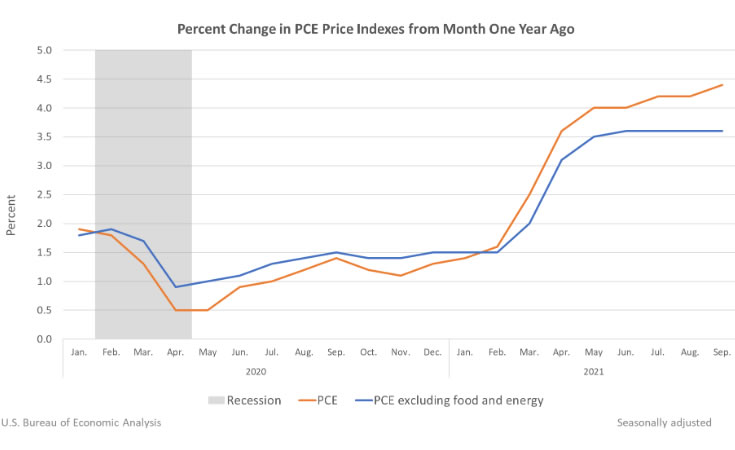
US personal income dropped -1.0% mom in Sep, spending rose 0.6% mom
US personal income dropped -1.0% mom or USD 216.2B in September, much worse than expectation of 0.1% mom rise. Personal spending rose 0.6% mom or USD 93.4B, matched expectations. Headline PCE inflation accelerated to 4.4% yoy, below expectation of 4.7% yoy. Core PCE price index was unchanged at 3.6% yoy, below expectation of 3.7% yoy.
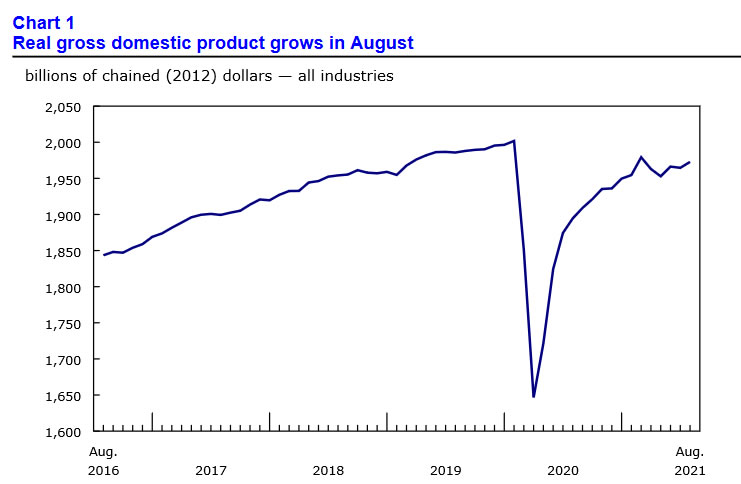
Canada GDP grew 0.4% mom in Aug, to be flat in Sep
Canada GDP rose 0.4% mom in August, below expectation of 0.7% mom. Overall 15 of 20 industrial sectors were up. Services-producing industries rose 0.6%. Goods-producing industries dropped -0.1% Preliminary information suggests that real GDP was essentially unchanged in September. Advance estimate points to an approximate 0.5% rise in real GDP in Q3.
Aussie Vulnerable as RBA Could Fight Markets
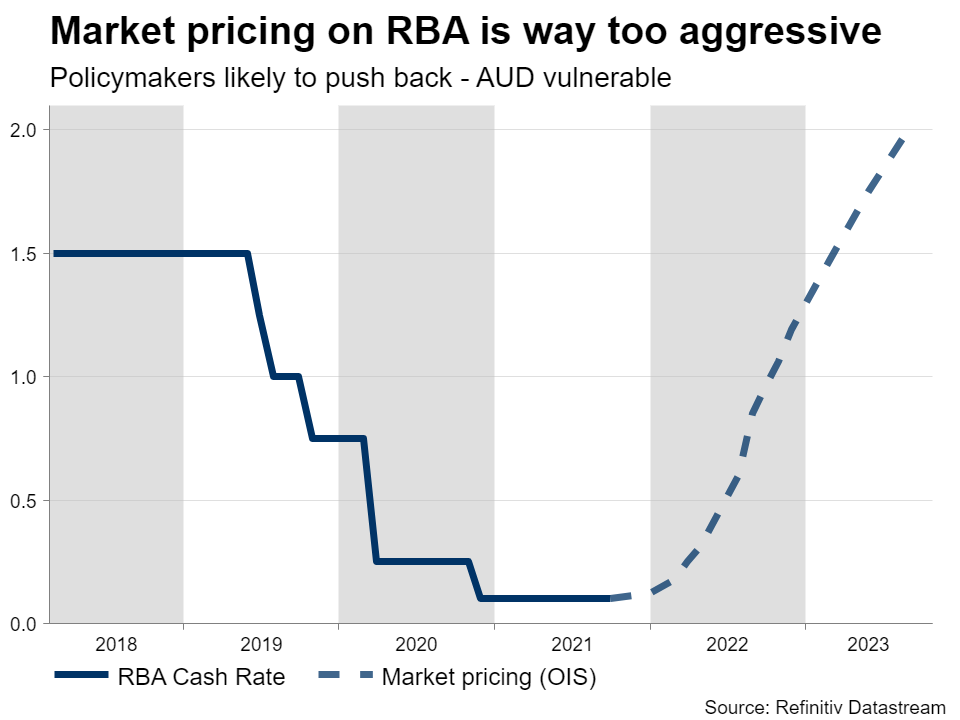
The Reserve Bank of Australia (RBA) will complete its latest meeting at 03:30 GMT Tuesday. It will be quite explosive as there is a massive discrepancy between the central bank’s own guidance and market pricing for rate increases. The RBA insists it won’t raise rates until 2024 but money markets expect four rate increases next year alone. It seems investors have gone too far, which leaves the aussie vulnerable to a correction.
Game of chicken
The RBA has a difficult balancing act to execute. Even though the Bank has stressed it doesn’t expect to lift the cash rate until 2024, investors are defying that guidance, pricing in the first rate hike in the second quarter of 2022. The bet is that the RBA will have to blink and abandon this commitment in the face of persistent inflation.
It probably will. The central bank did not defend its yield curve control target this week, allowing short-dated yields to spike much higher. This is a clear signal it intends to abandon yield curve control soon and possibly open the door for earlier rate increases.
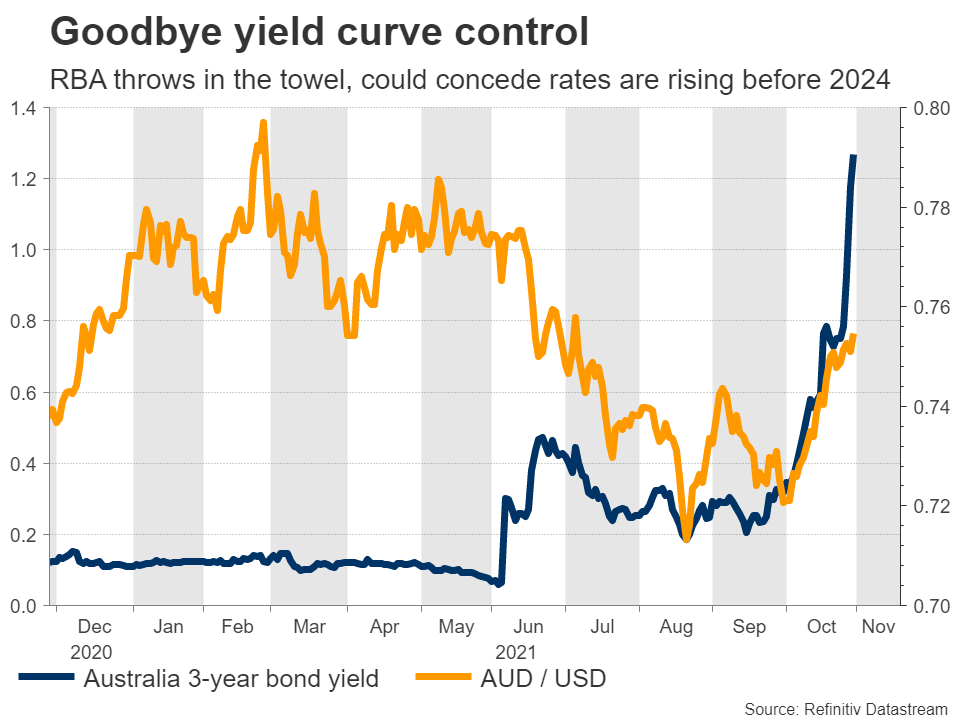
Even though most of the country has just exited a strict lockdown, the economy doesn’t seem to have suffered too much. The labor market escaped without any massive injuries, PMI business surveys have already rebounded, and core inflation fired up in Q3.
Hence, the economy has been resilient, but markets have also gone too far in pricing in such aggressive rate increases. While inflation is likely to accelerate further as the economy reopens properly, most of that boils down to supply disruptions and energy costs. It’s not the demand-driven inflation the central bank wants to see before hitting the brakes.
Pushback
Bearing everything in mind, the RBA will likely tone down market expectations. Even though it could abandon yield curve control and signal that rates may be raised before 2024, raising them four times next year as the markets currently suggest is also a bridge too far.
Policymakers could simply indicate they don’t expect to raise rates anytime soon or that market pricing is completely unrealistic. This message would be even more powerful if the updated economic forecasts reaffirm that any spike in inflation will be transitory. Those are published three days later on Friday.
For the RBA, inflation will remain transitory as long as the outlook for wages is subdued. If wages don’t fire up, consumers won’t have the pockets to sustain inflation. There’s also the risk of a slowdown in China, something that could inflict collateral damage on the Australian economy that relies on China to absorb its commodity exports.
Market reaction
It’s a tricky one for the aussie. On the one hand, the RBA will have to break its word and concede that rates are unlikely to stay at current levels until 2024. That is almost certain after it decided not to defend its yield target.
Yet the central bank also needs to nudge the market back into obedience somehow. Allowing yields to stay so elevated could hold back the recovery and exacerbate debt burdens for consumers.
As such, the risks surrounding the Australian dollar from this meeting seem tilted to the downside. If the RBA clarifies its position correctly, Australian yields are likely to retreat, even if the yield target is officially abandoned.
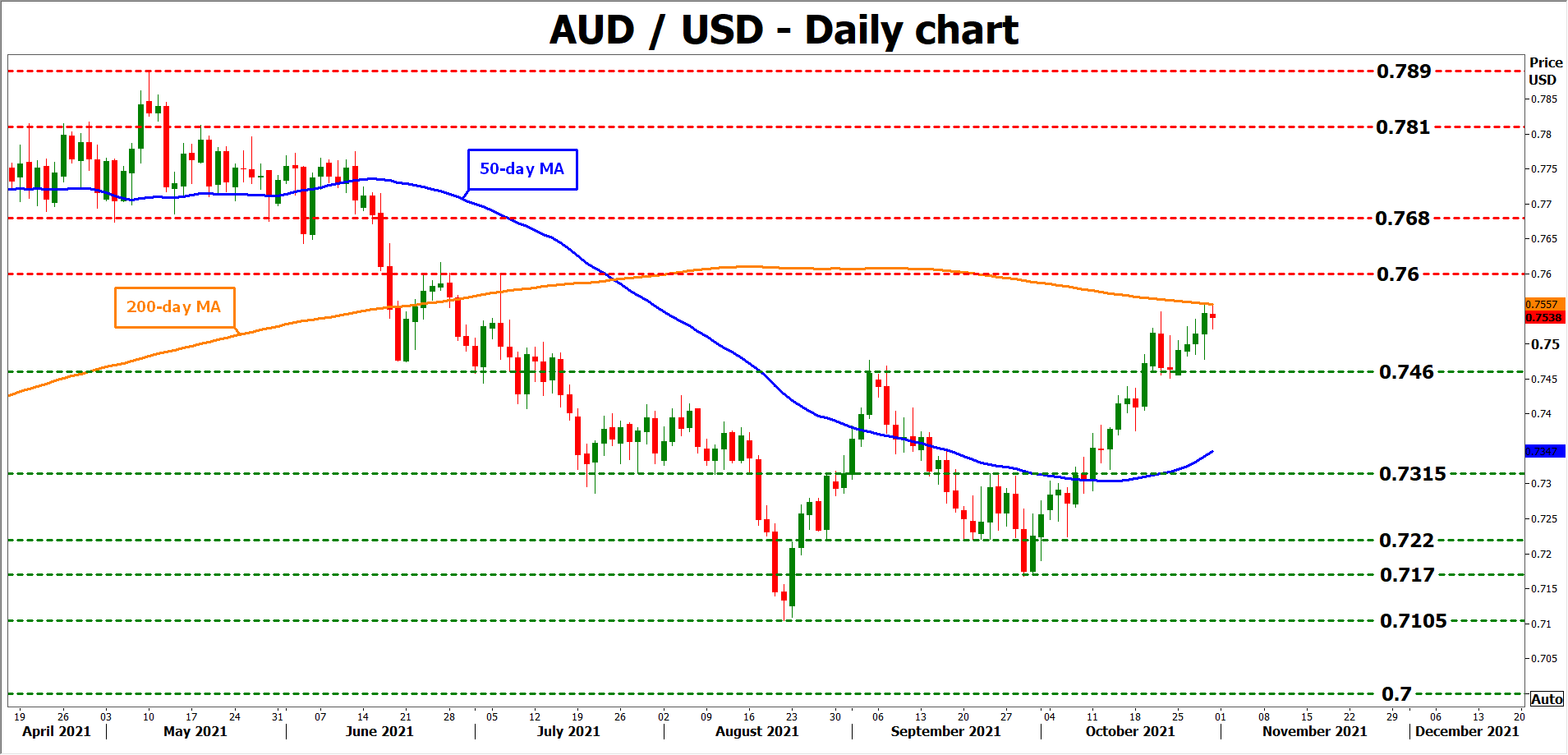
Taking a technical look at aussie/dollar, a retreat could encounter initial support near the 0.7460 zone.
On the upside, if the RBA doesn’t manage to convince markets, the pair could shoot higher for a test of the 0.7600 region.
Canada GDP Expected To Rebound
The Canadian dollar has had an uneventful week, even though there was plenty of buzz in the financial markets over the BoC decision to end its stimulus programme. USD/CAD is currently trading at 1.2337, down 0.07%.
Canada wraps up the week with GDP for September. After a soft reading of -0.1% (MoM) in August, GDP is expected to rebound with a gain of 0.7%. The economy is projected to expand by 5.0% in 2021, which indicates robust growth.
The highlight of the week was the surprise announcement by the Bank of Canada that it was terminating its stimulus programme (QE). The stimulus was extended during the Covid pandemic, but the bank has been scaling back QE as the Covid has slowly been contained. The dramatic move caught the markets off guard, as the investors were widely expecting that the bank would scale back QE to CAD 1 billion, down from CAD 2 billion. The BoC’s move was more hawkish than anticipated, but the Canadian dollar managed only limited gains.
The BoC went one step further as BoC Governor Tiff Macklem said after the meeting that, “we will be considering raising interest rates sooner than we previously thought”. In his rate statement, Macklem reiterated that the bank would not raise rates before the recovery was complete, which was projected to occur in the “middle quarters” of 2022. Prior to this week’s meeting, the BoC had signalled that it expected to raise rates in the H2 of 2022.
In the US, GDP was softer than expected, adding to the dollar’s woes. Advance GDP for the third quarter disappointed with a gain of 2.0% (QoQ), shy of the consensus of 2.7% and much weaker than the Q2 reading of 6.7%. Still, the slowdown in the US economy is unlikely to cause a change of heart for the FOMC, which is widely expected to announce a taper at the policy meeting on November 2nd.
USD/CAD Technical
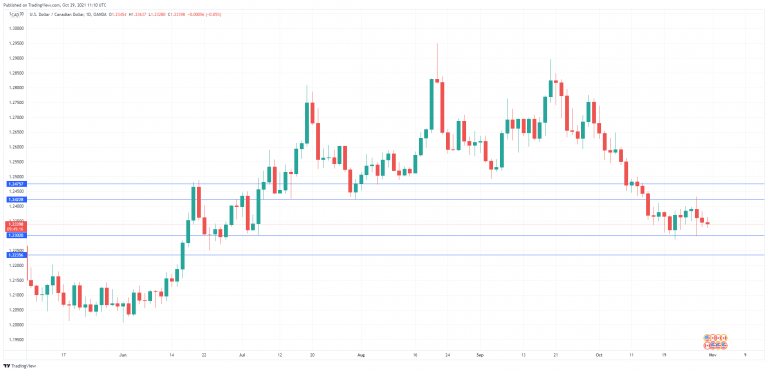
- There is support at 1.2302. Below, there is support at 1.2235
- There is resistance at 1.2422, followed by 1.2475
EUR/USD Retreats After Jump
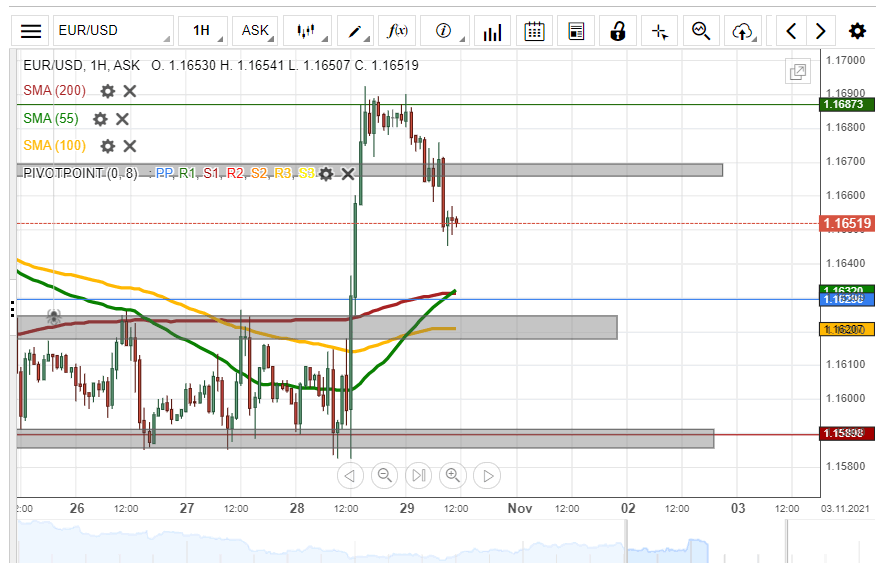
The EUR/USD ended trading sideways in the range between the 1.1585/1.1590 and 1.1618/1.1625 zones. The rate ended it due to the release of the worse than forecast US Advance GDP data. The GDP caused a 110 pip jump up to the 1.1693 level. During the fundamental surge not only technical levels, but also the previous October high levels were passed.
During Friday's trading hours, the pair was declining back down. By the middle of the day's European trading hours, the EUR/USD had reached below 1.1650.
In the case that the pair continues to decline, it might look for support in the combination of the 55 and 200-hour simple moving averages and the weekly simple pivot point at 1.1630. Below this level, the 1.1618/1.1625 zone and the 100-hour SMA could provide support.
Meanwhile, a potential recovery might aim at the resistance of the 1.1687 level, where the weekly R1 simple pivot point was located at. Above the pivot point, the 1.1700 mark might serve as a resistance level.
GBP/USD Reaches Above 1.3800
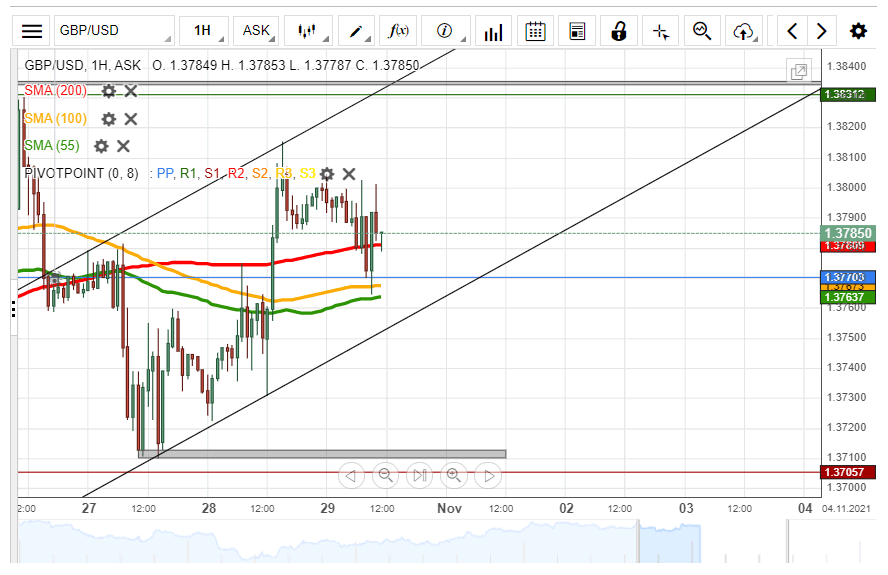
The worse than forecast US Advance GDP data on Thursday caused a surge of the GBP/USD currency exchange rate. Due to the surge, the rate reached 1.3815, as it surged 85 pips. In the aftermath of the jump of the pair, the GBP/USD has been declining. At mid-day on Friday, the rate was finding support in technical levels in the 1.3763/1.3770 zone.
If the support of the 55 and 100-hour simple moving averages manage to push the rate up, it could eventually reach the resistance of the weekly R1 simple pivot point at 1.3831. In addition, the October high level at 1.3835 could serve as a resistance level.
On the other hand, a decline below the SMAs might look for support in the ascending trend line, which connects the recent low levels. Below the trend line, the October 27 low level at 1.3710 could provide support.
USD/JPY Remains Above 113.40
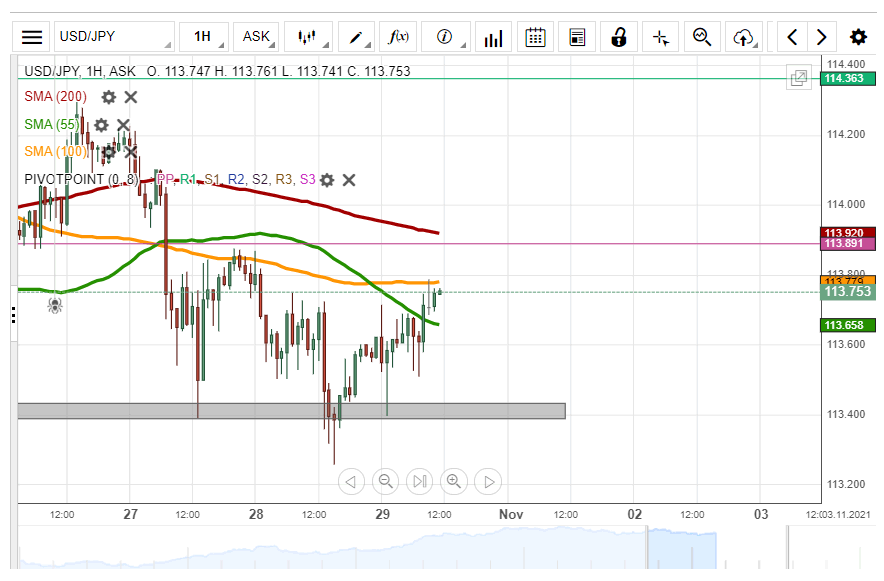
Despite piercing the support of the 113.40 level on Thursday, the USD/JPY did not extend the decline. Instead, the pair found support at 113.25 and recovered. At mid-day on Friday, the rate had retraced to the 100-hour simple moving average at 113.79.
A potential continuation of the surge might reach for the combined resistance of the weekly simple pivot point at 113.89 and the 200-hour simple moving average at 113.92. Above these levels, the weekly R1 at 114.36 might provide additional resistance.
However, a decline of the USD/JPY might look for support in the 55-hour SMA at 113.66 and the 113.40 level.
GOLD Respects Resistance Of 1,810.00 Level
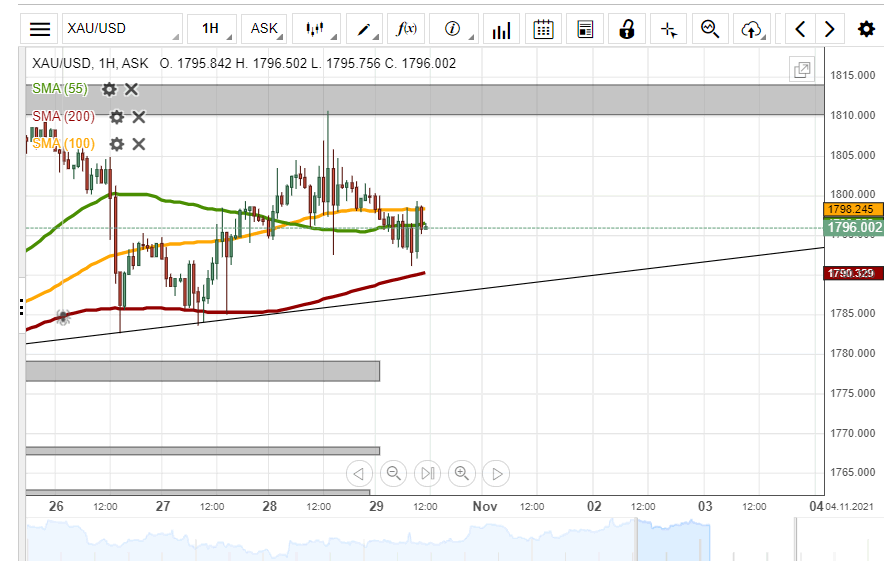
On Thursday, volatility was caused by the release of the US Advance GDP. During the volatility, the price for gold once again confirmed the 1,810.00 level as a resistance level. The following decline passed the 55 and 100-hour simple moving averages. By mid-Friday, the price had almost reached the 200-hour SMA at 1,790.20.
A surge of the metal's price could once again test the resistance of the 1,810.00 level, before aiming at the resistance of the summer high level at 1,830.00.
On the other hand, the price for gold might look for support in the 200-hour SMA. Below the SMA, a trend line, which connects this week's low levels could provide support.
Euro Hits 1-Month High On ECB
The euro has reversed directions on Friday, giving up some of the sharp gains from a day earlier. Currently, EUR/USD is trading at 1.1650, down 0.28%.
Lagarde comments trigger rate hike expectations
The ECB meeting was widely expected to be a non-event, with investors looking ahead to the December meeting for a possible shift in policy. The central bank did not make any changes in policy, but the euro took off, posting its best one-day performance since May and coming close to the 1.17 line. What happened?
The euro surge against the greenback caught the markets by surprise, and I would venture a guess that nobody was more shocked than Madame Langarde. The ECB head seemed to press all the right buttons at her press conference, dampening expectations of a rate hike in 2023 and going so far as to state that comparisons to other central banks that were tapering stimulus were “odious”. Lagarde added that inflation would last longer than expected, but she expected it to decline over 2023.
Lagarde’s message was intended to keep the markets calm, but it had the opposite effect. Her acknowledgement that inflation would persist for longer raised speculation of a rate hike and sent the euro flying high. The US dollar took a tumble after Lagarde’s comments, although US yields showed gains. If this trend continues, it should help the dollar recover from yesterday’s rough outing.
In the US, weak numbers on Thursday added to the dollar’s woes. Advance GDP for the third quarter disappointed with a gain of 2.0% (QoQ), shy of the consensus of 2.7% and much weaker than the Q2 reading of 6.7%. Still, the slower growth of the US economy is unlikely to change minds at the FOMC, which will likely announce a taper at next week’s policy meeting.
EUR/USD Technical
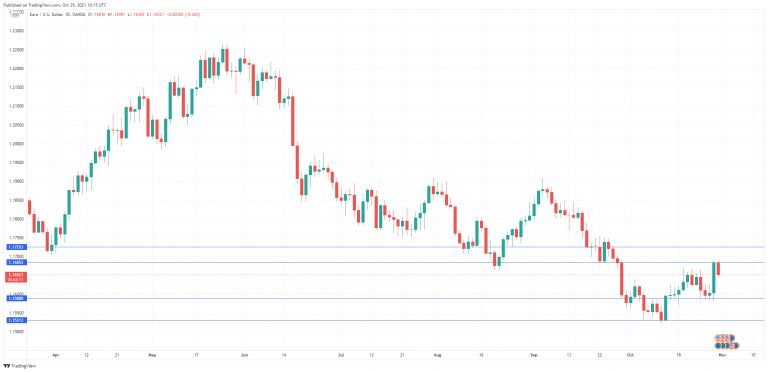
- 1.1685 is under pressure in resistance. This is followed by resistance at 1.1725
- There are support levels at 1.1588 and 1.1531