

Sample Category Title
EUR/AUD Weekly Outlook
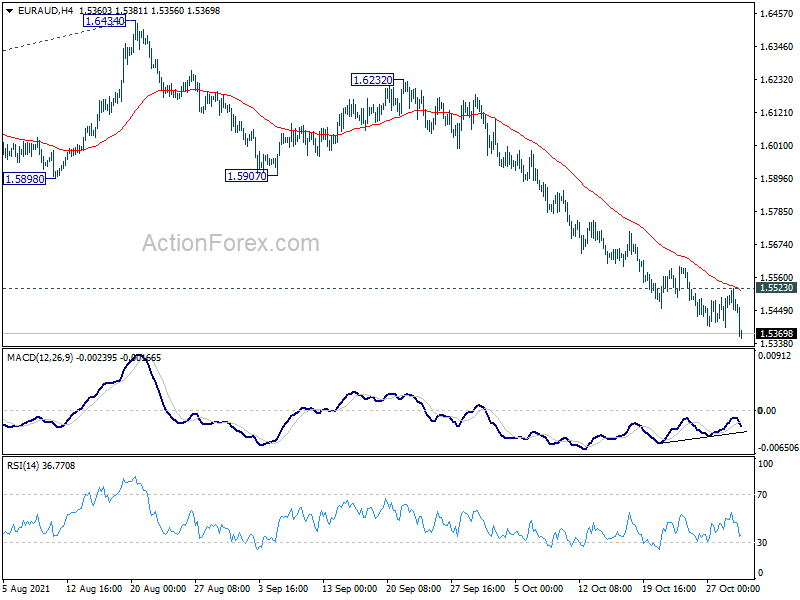
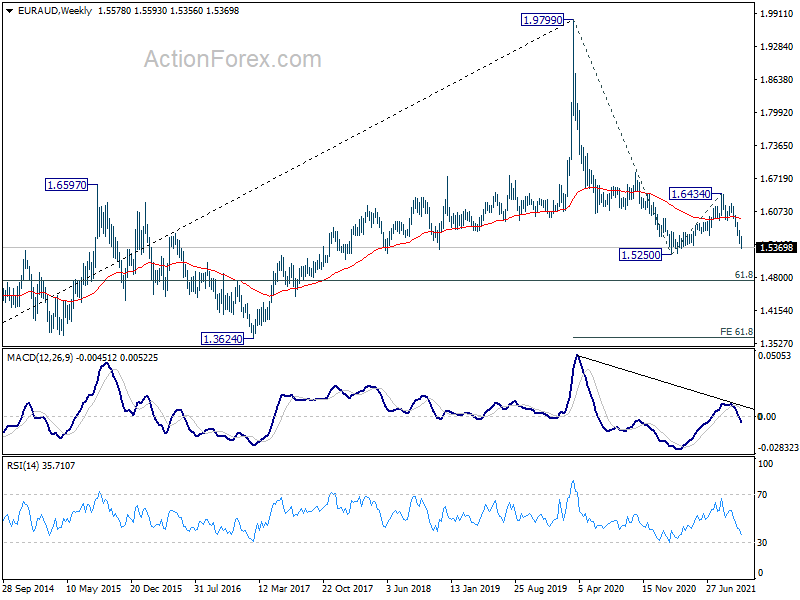
EUR/AUD's fall from 1.6434 continued last week and reached as high as 1.5356. Initial bias stays on the downside this week for 1.5250 low. Sustained break there will confirm resumption of larger down trend. Next target is 1.4733 long term fibonacci support. On the upside, break of 1.5523 minor resistance will turn bias back to the upside for stronger rebound first.
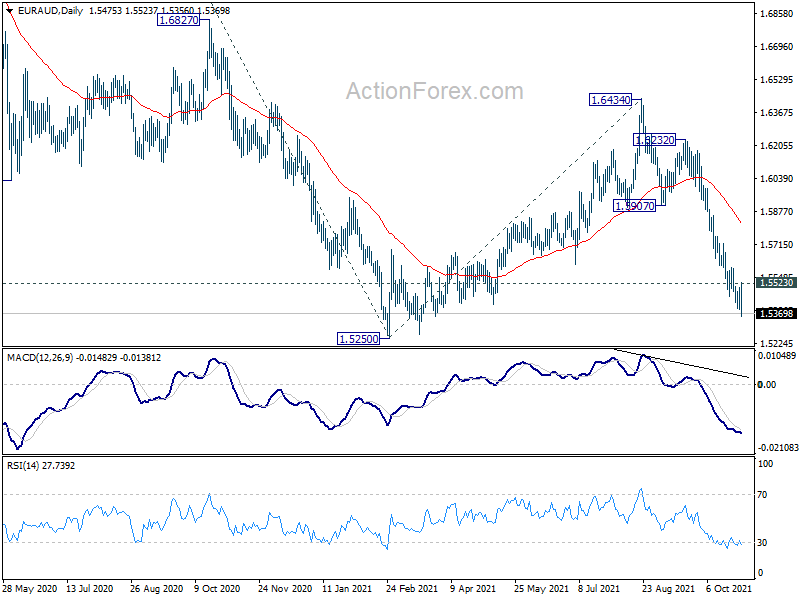
In the bigger picture, the down trend from 1.9799 (2020 high) is in progress. Firm break of 1.5250 low will confirm resumption nand target 61.8% retracement of 1.1602 (2012 low) to 1.9799 at 1.4733. Sustained break there could bring more downside acceleration to 61.8% projection of 1.9799 to 1.5250 from 1.6434 at 1.3623. In any case, break of 1.6434 resistance is needed to signal medium term bottoming, or outlook will stay bearish.
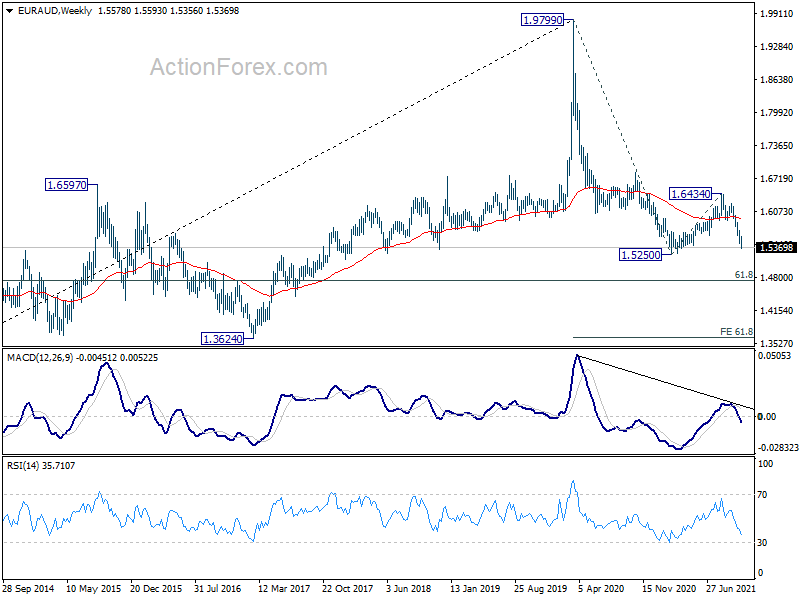
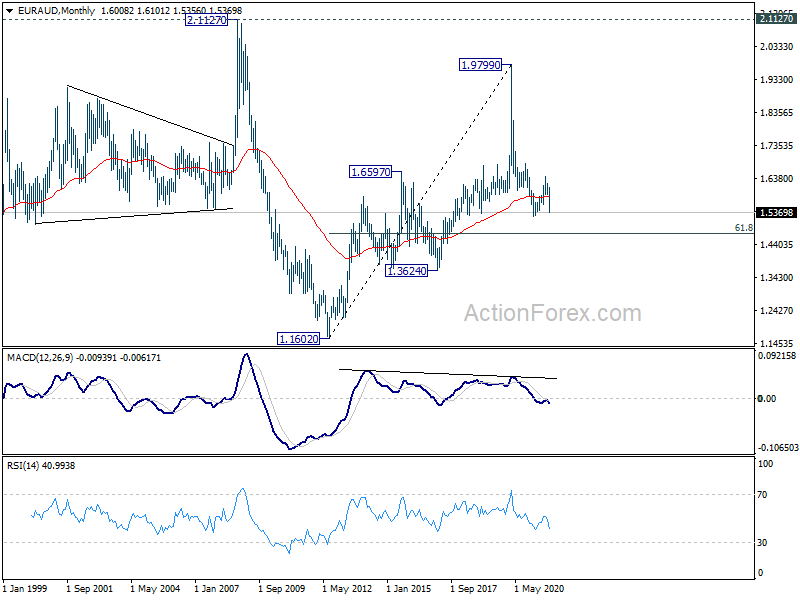
In the longer term picture, fall from 1.9799 (2020 high) is seen as a long term down trend. Sustained break of 61.8 retracement of 1.1602 to 1.9799 at 1.4733 will extend the decline to 1.3624 long term support and possibly below.
EUR/CHF Weekly Outlook
EUR/CHF's down trend continued last week and accelerated to as low as 1.0567. Initial bias stays on the downside this week for 100% projection of 1.1149 to 1.0694 from 1.0936 at 1.0481. On the upside, break of 1.0694 support turned resistance is needed to indicate short term bottoming. Otherwise, outlook will stay bearish in case of recovery.
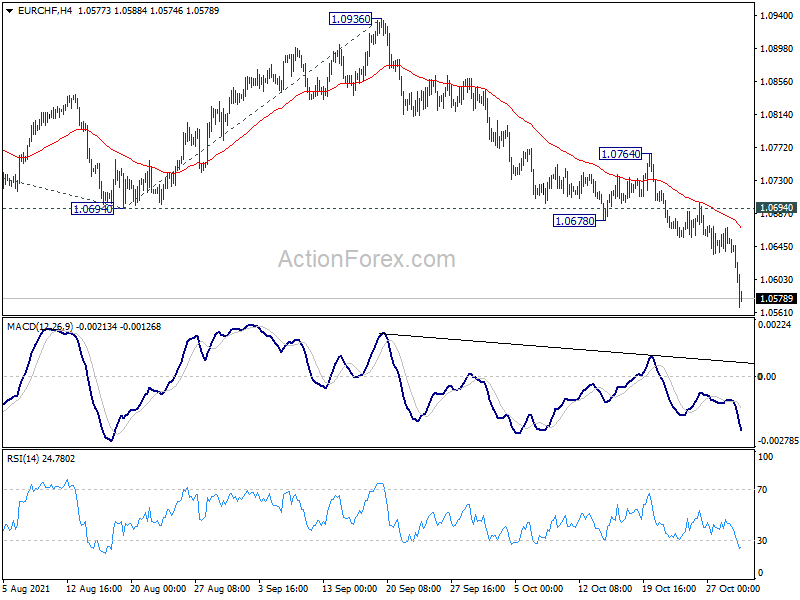
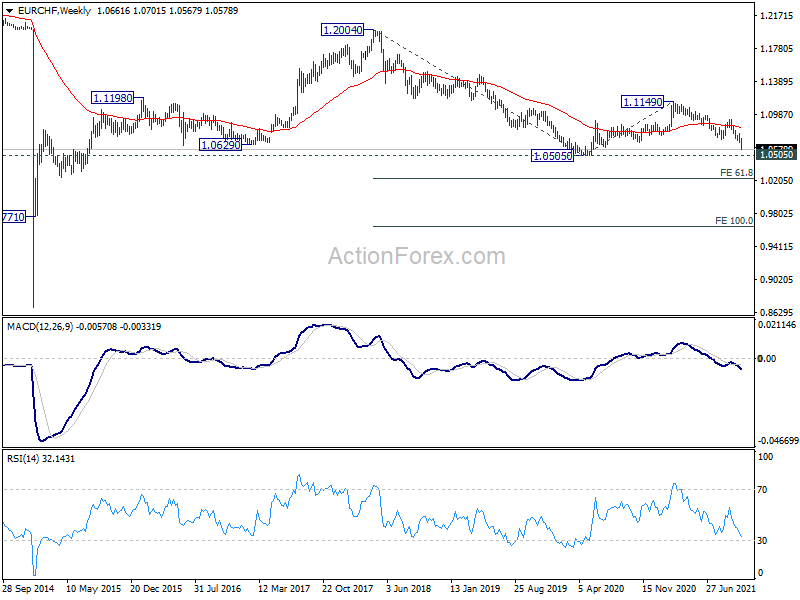
In the bigger picture, current downside momentum argues that fall from 1.1149 is probably resuming the downside from 1.2004 (2018 high). Next focus is 1.0505 (2020 low). Decisive break there will confirm this bearish case and target 61.8% projection of 1.2004 to 1.0505 to 1.1149 at 1.0223 next. Strong support from 1.0505 will bring rebound first. But outlook will stay bearish as long as 1.0936 resistance holds.
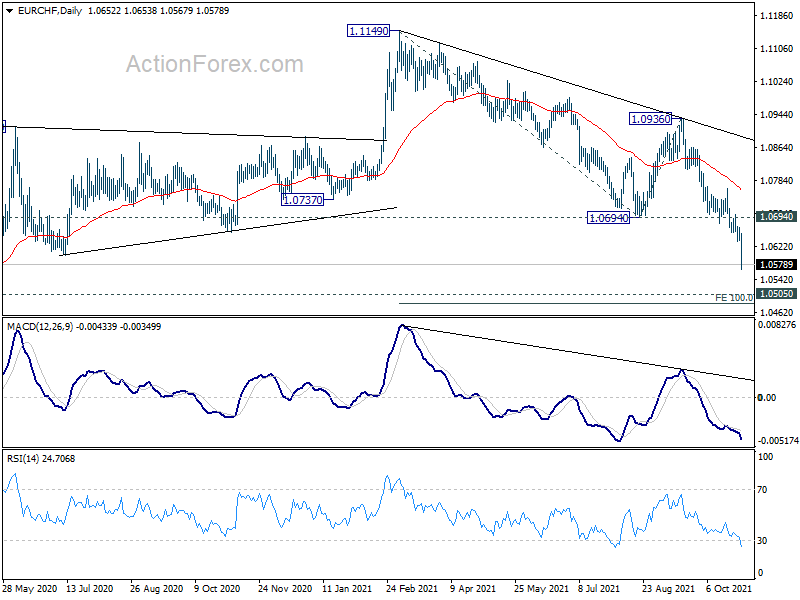
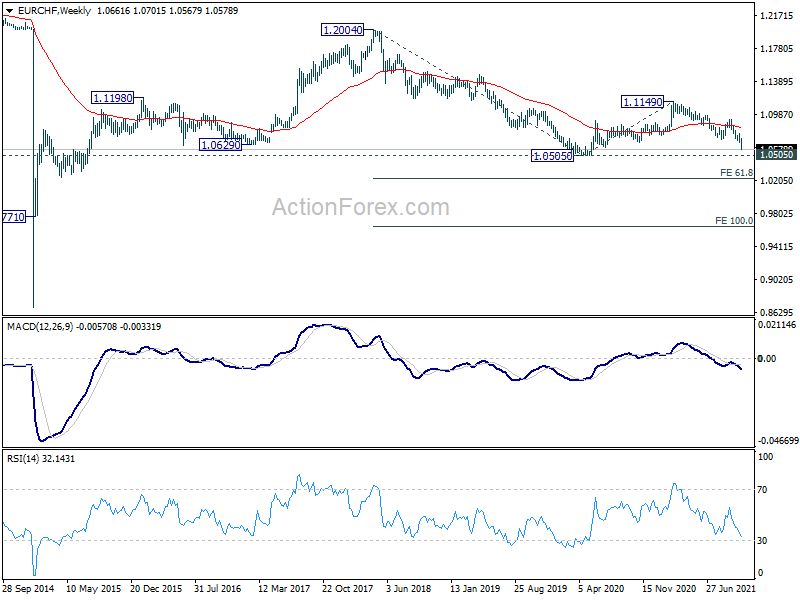
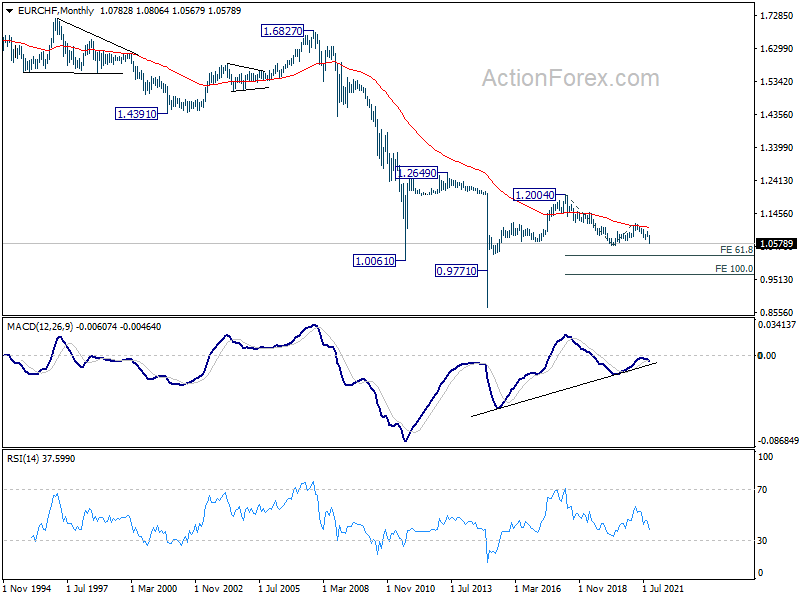
In the long term picture, rejection by 55 month EMA (now at 1.1037) maintains long term bearishness. Break of 1.0505 low will resume the down trend from 1.2004 to 61.8% projection of 1.2004 to 1.0505 to 1.1149 at 1.0223. Firm break there will target 100% projection at 0.9650.
Euro Selloff to Continue, At Least in Some Crosses
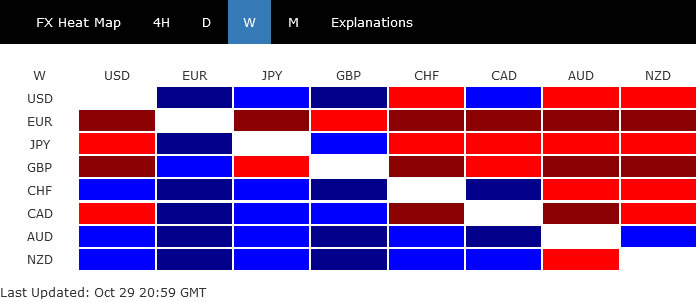
Euro ended as the worst performing one after the post ECB rally faded quickly. It's clear that ECB would lag behind other major central banks in stopping to add stimulus, not to mention raising interest rate. The selloff in Euro also dragged down Sterling, as both were sold off against Swiss Franc. Australian Dollar ended as the strongest after RBA gave up defending the yield curve control. New Zealand Dollar followed as next strongest on expectations of further RBNZ rate hikes. Canadian Dollar was also firm after hawkish BoC, but was capped by mild retreat in oil price.
Looking ahead, the broad outlook in Dollar and Yen would probably turn mix. On the one hand, there is prospect for Yen pairs to gyrate lower, in corrective way, if benchmark US yield reverses from current level. On the other hand, risk-on sentiment is set to continue with DOW, S&P 500 and NASDAQ making new record highs. That could also cap rallies in Dollar and Yen. The theme for the near term would likely be selloff in Euro, in particular against commodity currencies.
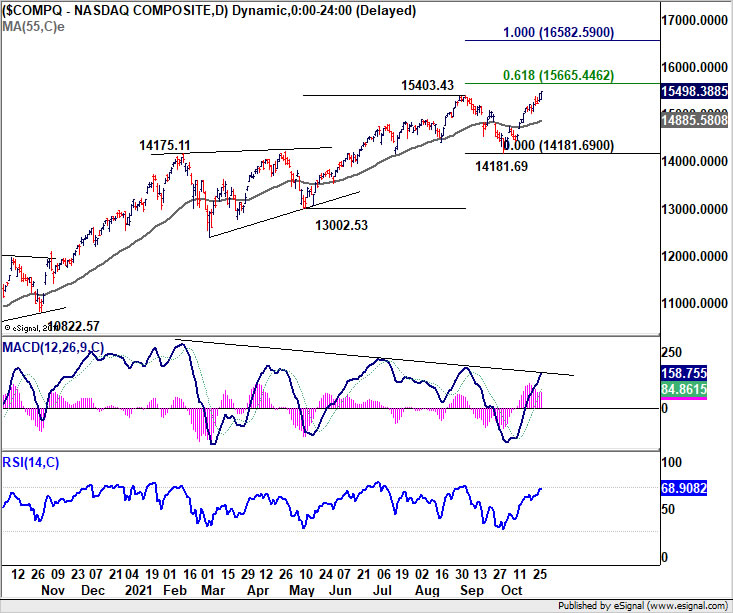
NASDAQ to target 15665 projection level first as record run resumed
In the US, all DOW, S&P 500 and NASDAQ finished October at new record highs, as buying stayed solid towards the end of the week. Near term outlook in NASDAQ will now stay bullish as long as last week's low at 15070.74 holds. The index should target 61.8% projection of 13002.53 to 15403.43 from 14181.69 at 15665.44 next. Sustained break there should indicate upside acceleration, which sets up a Santa Claus rally till the end of the year. NASDAQ should then target 100% projection at 16582.59.
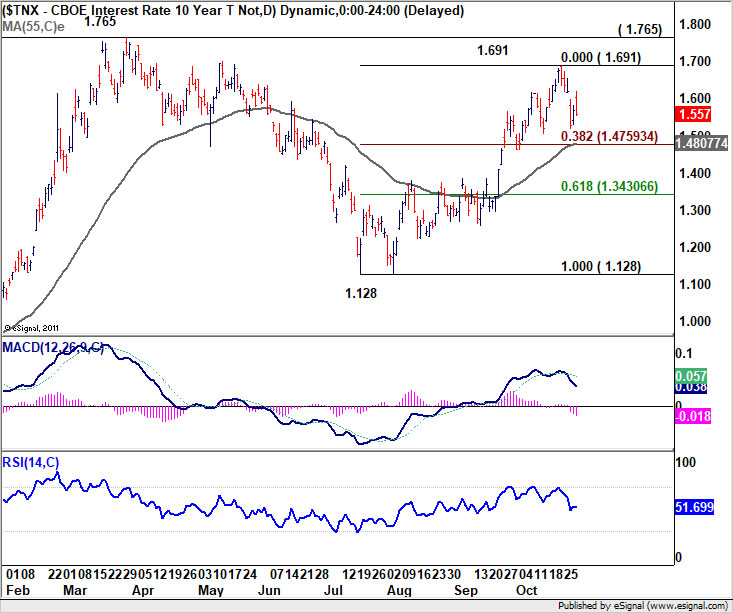
10-year yield lost momentum ahead of 1.7 handle
10-year yield has lost much upside momentum as seen in daily MACD, after hitting 1.691. A short term top is likely in place but consolidation should be relatively brief as long as 55 day EMA (now at 1.480) holds. But we're also not expecting a break of 1.765 high soon. On the other hand, break of 1.480 could bring deeper retreat to 61.8% retracement of 1.128 to 1.691 at 1.343 to completion the falling leg from 1.691.
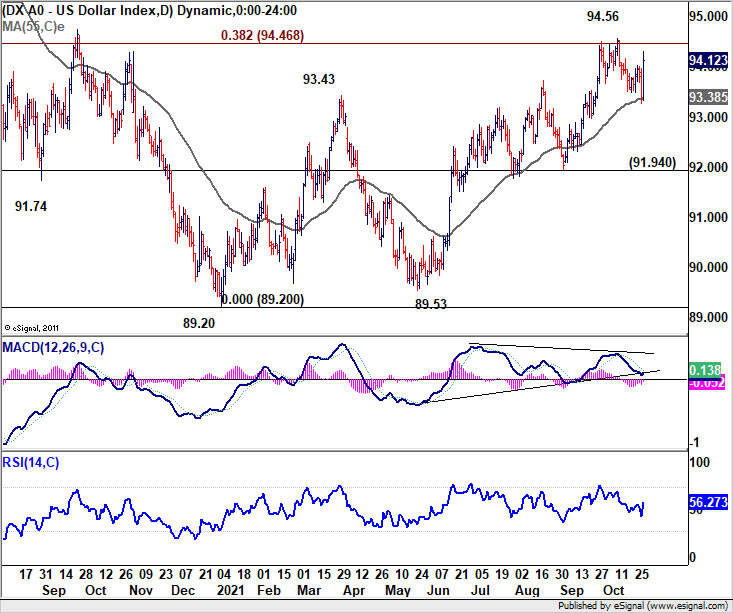
Dollar index stays near term bullish, drawing support from 55 day EMA
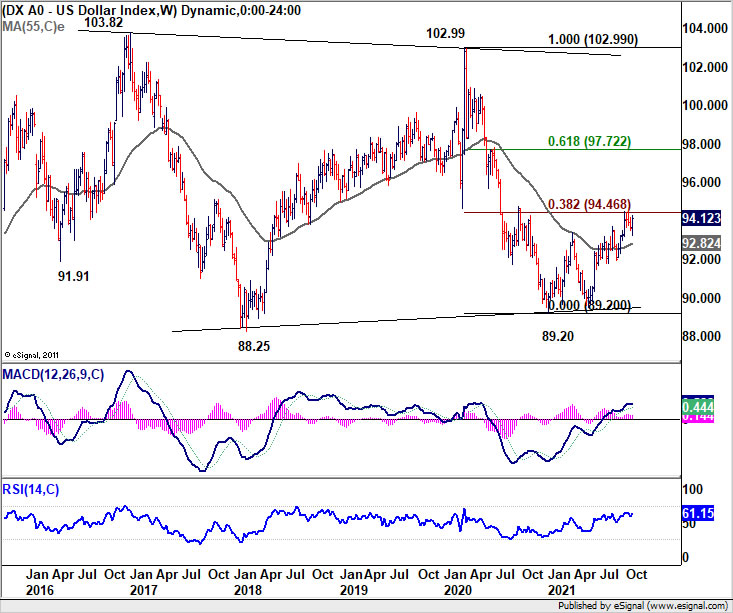
Dollar index stayed strong rebound after drawing support from 55 day EMA (now at 93.38). Such development keeps near term outlook bullish. Yet, it still needs to break through key medium term fibonacci level of 38.2% retracement of 102.99 to 89.20 at 94.46 to confirm buying momentum. Otherwise, consolidations would extend for while. Also, if DXY breaks to the upside without accompanying movement in 10-year yield, it's probably more due to selloff in Euro rather than buying in Dollar.
Euro looking rather bearish in some crosses
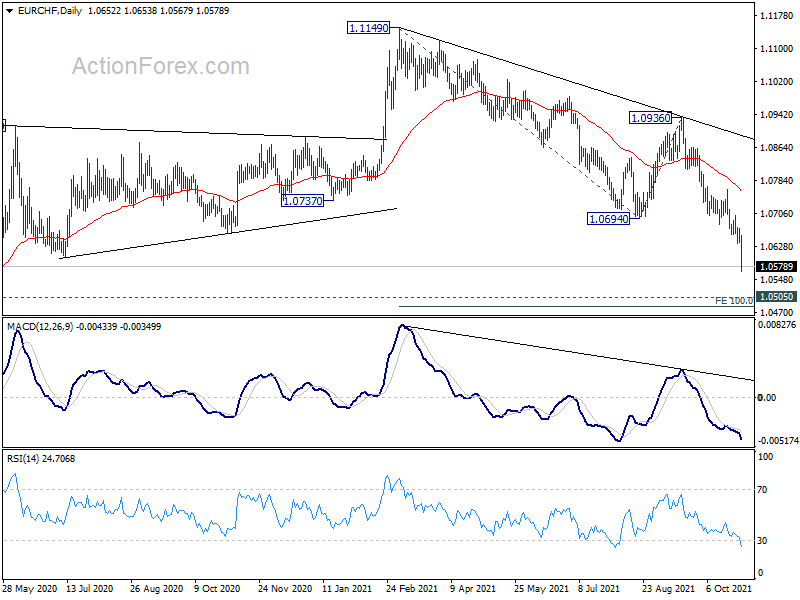
EUR/CHF dived to as low as 1.0567 last week as down trend from 1.1149 accelerated. Near term outlook will stay bearish as long as 1.0694 support turned resistance holds. Next target is 100% projection of 1.1149 to 1.0694 from 1.0936 at 1.0481. Based on current momentum, 1.0505 low looks rather vulnerable. Firm break there will resume long term down trend from 1.2004 and target 61.8% projection of 1.2004 to 1.0505 to 1.1149 at 1.0223.
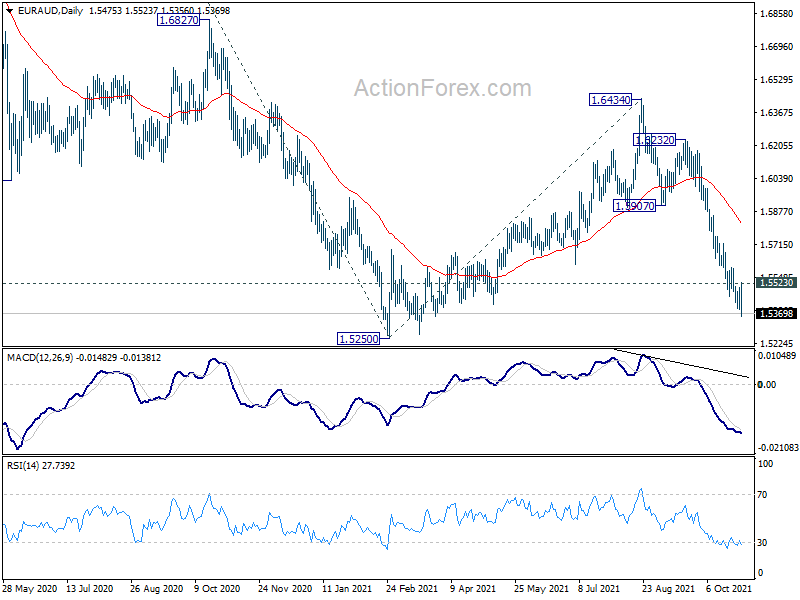
EUR/AUD's fall also continued to as low as 1.5356. Near term outlook will stays bearish as long as 1.5523 resistance holds. Retest of 1.5250 low should be seen next. Firm break there will resume larger down trend from 1.9799 to long term fibonacci level at 61.8% retracement of 1.1602 (2012 low) to 1.9799 at 1.4733. It's a bit to early to judge. But sustained break of 1.4733 could set the stage for medium-to long term fall to 61.8% projection of 1.9799 to 1.5250 from 1.6434 at 1.3623.
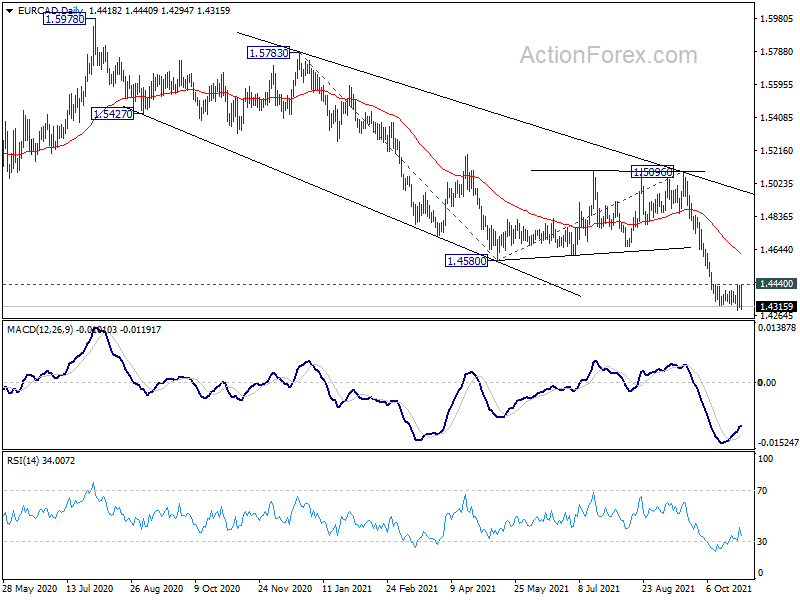
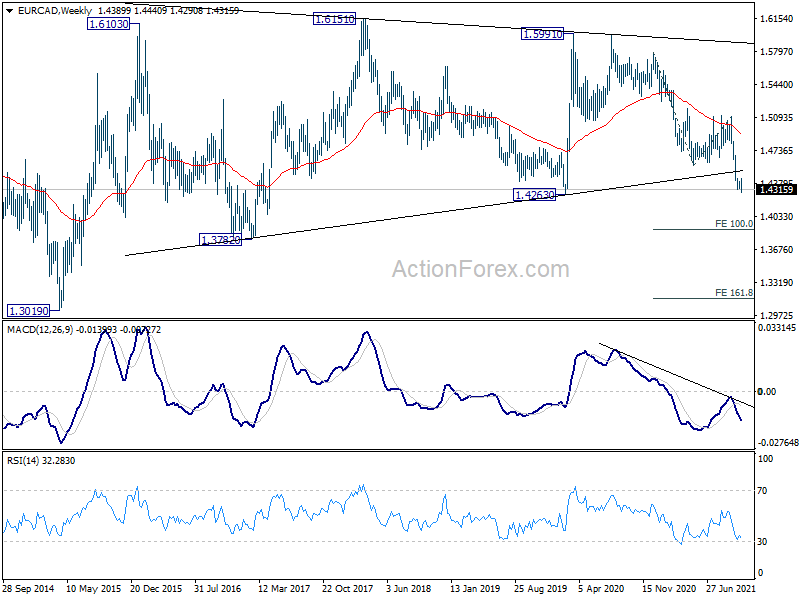
Outlook in EUR/CAD is not much better. Further fall is expected as long as 1.4440 resistance holds. Firm break of 1.4263 long term support level would be a rather bearish sign. That should set the stage to extend the down trend to 100% projection of 1.5783 to 1.4580 from 1.5096 at 1.3893 next.
EUR/USD Weekly Outlook
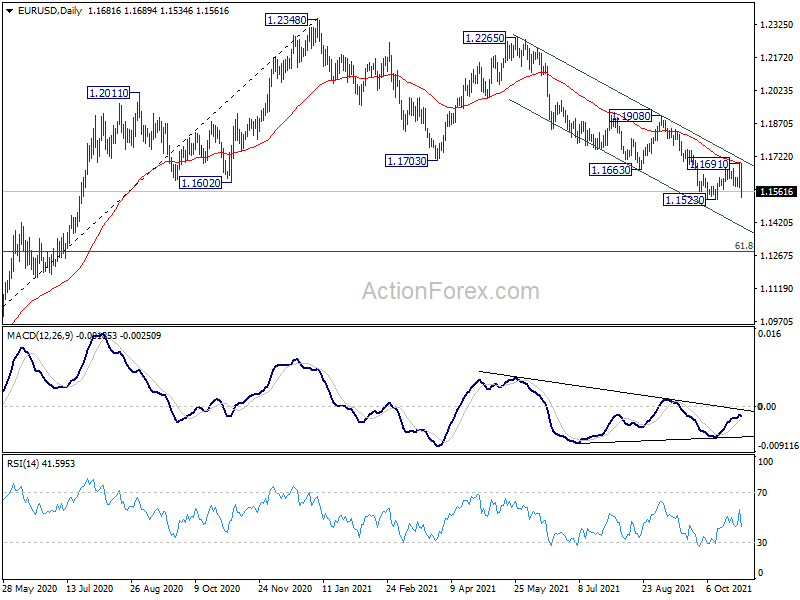
EUR/USD rebounded to 1.1691 last week, but was rejected by 55 day EMA and fell sharply from there. It's also kept inside near term falling channel. Thus outlook in the pair stays bearish. Initial bias is now on the downside this week for 1.1523 support. Break there will resume the fall from 1.2265, and that from 1.2348 too, for long term fibonacci level at 1.1289 next. For now, further decline is expected as long as 1.1691 resistance holds, in case of recovery.
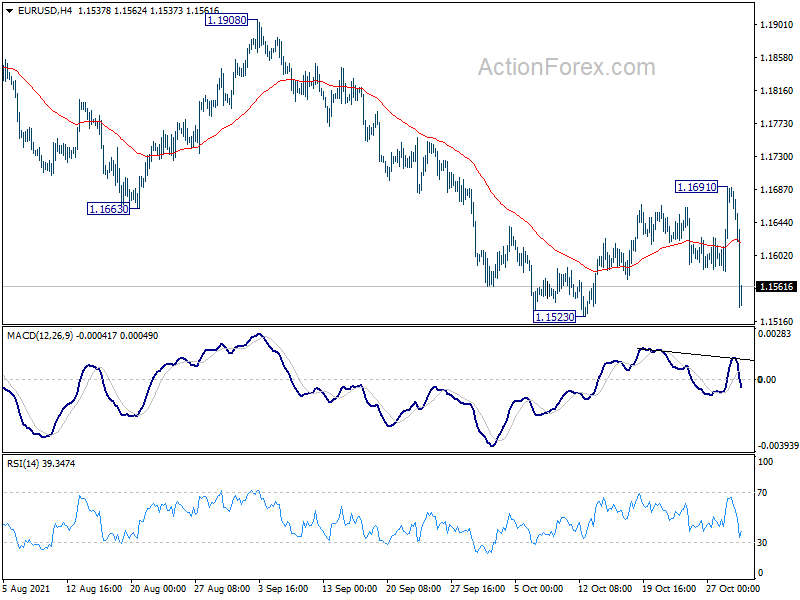
In the bigger picture, price actions from 1.2348 should at least be a correction to rise from 1.0635 (2020 low). As long as 1.1908 resistance holds, deeper fall would be seen to 61.8% retracement of 1.0635 to 1.2348 at 1.1289. Nevertheless break of 1.1908 resistance will revive medium term bullishness and turn focus back to 1.2348 high.
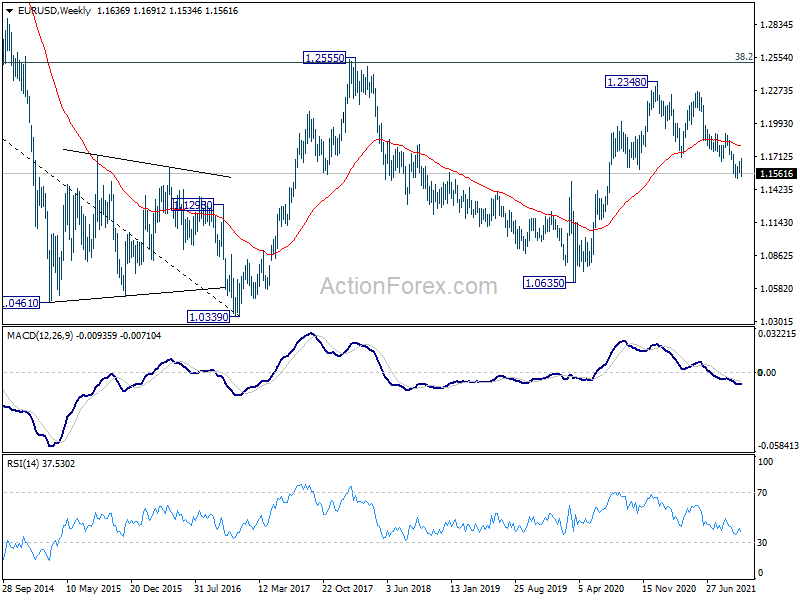
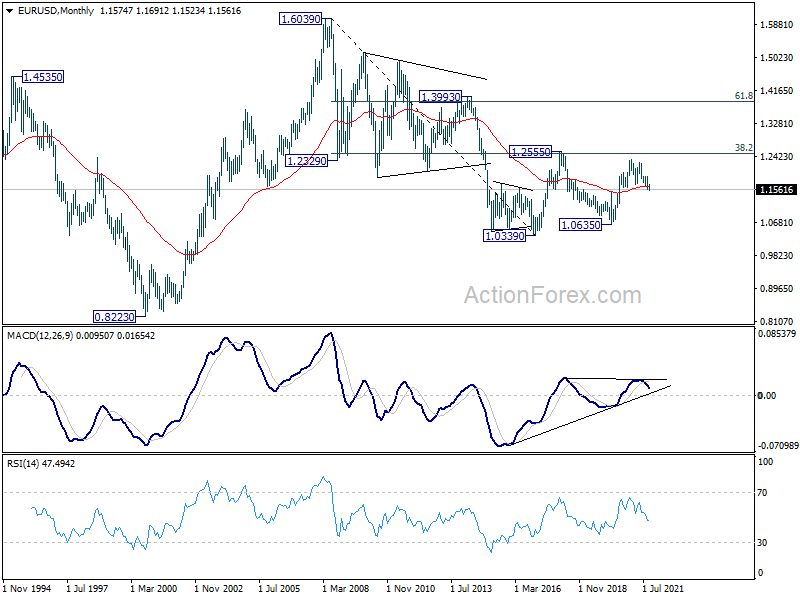
In the long term picture, EUR/USD has possibly failed 1.2555 cluster resistance (38.2% retracement of 1.6039 to 1.0339 at 1.2516) already. Long term outlook will remain neutral as sideway pattern from 1.0339 (2017 low) is extending with another medium term fall. For now, we'd hold back from assessing the chance of downside breakout, and monitor the momentum of the decline from 1.2348 first.
Summary 11/1 – 11/5
Monday, Nov 1, 2021
[php_everywhere instance="1"]
Tuesday, Nov 2, 2021
[php_everywhere instance="2"]
Wednesday, Nov 3, 2021
[php_everywhere instance="3"]
Thursday, Nov 4, 2021
[php_everywhere instance="4"]
Friday, Nov 5, 2021
[php_everywhere instance="5"]
Weekly Economic & Financial Commentary: Taper the Paper
Summary
United States: Supply and Demand Tug of War Is at the Forefront After a Mixed Week of Data
- Lingering supply chain issues, rising prices and still-strong consumer demand continues to make its way into economic data. The week began on a positive note, including strong new home sales growth, the first gain in consumer confidence in three months, and robust personal spending data. On Thursday, however, third quarter GDP growth was only 2.0%, as the growing trade deficit proved to be a drag on growth. Goods spending fell 9.2% in the third quarter as the PCE deflator rose to its 4.4% year-over-year, its highest rate in over 30 years.
- Next week: ISM Manufacturing (Monday), ISM Services (Wednesday), Employment (Friday)
International: Hawkish Undertones for BoC, BCB and ECB
- The Bank of Canada (BoC) struck a more hawkish tone than expected at its October meeting, ending its quantitative easing program and signaling rate hikes could come sooner than previously expected. The Central Bank of Brazil (BCB) raised its Selic rate 150 bps to 7.75%. The European Central Bank (ECB) kept monetary policy unchanged at its October meeting, with comments from President Lagarde reasonably balanced, but with a mildly hawkish bent.
- Next week: China PMIs (Sunday), Bank of England (Thursday), Canada Employment (Friday)
Interest Rate Watch: Taper the Paper
- Next Wednesday, the FOMC will conclude its regularly scheduled two-day meeting, and we expect the central bank to use this opportunity to announce a tapering of its asset purchases. More specifically, we think the Fed will begin reducing its Treasury security and mortgage-backed security (MBS) purchases by $10B and $5B per month, respectively, starting in December.
Topic of the Week: World Series: Atlanta vs. Houston
- The 117th edition of Major League Baseball's World Series got under way this week. The best-of-seven annual championship series between the Atlanta Braves and Houston Astros began on October 26. Both Atlanta and Houston have rapidly expanding metro areas. While Atlanta is a key logistics hub for the Southeast as well as a vital node in the global supply chain, Houston is a global hub of the energy sector.
The Weekly Bottom Line: Things Are Slowly Getting Back to Normal
U.S. Highlights
- GDP growth slowed to 2.0% quarter-over-quarter (annualized) in the third quarter of this year, down from 6.7% in the second quarter.
- The shift in the composition of consumer spending away from goods and into services signals some long-awaited relief for congested supply chains.
- While third quarter economic growth disappointed, early October data point to a healthy start to the fourth quarter of the year.
Canadian Highlights
- The marquee event this week was the Bank of Canada rate announcement. The Bank struck a hawkish tone, ending its quantitative easing program and pulling forward the timing of when it expects the output gap to close.
- An earlier closing of the output gap combined with higher inflation opens the door to an earlier liftoff in the policy rate. We expect the Bank to raise rates three times next year, starting in the second quarter.
- GDP growth in August was healthy at 0.4% month-over-month, but the flash estimate for September showed no growth in the month. This puts GDP on track to rise by 2.0% annualized in Q3.
U.S. - Things Are Slowly Getting Back to Normal
As expected, GDP growth dipped in the third quarter of the year. Granted, the slip to 2.0% quarter-over-quarter (q/q, annualized) from the 6.7% pace in the second quarter was steeper than the market consensus expected. Though a small surprise to the downside, the slowdown aligns with the notion that the headwinds from strained supply chains and a surge in Delta variant cases were enough to meaningfully hold back growth.
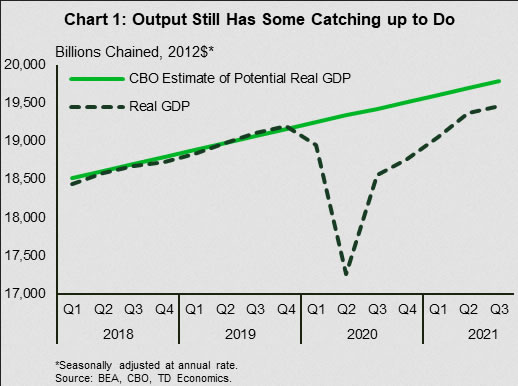
An interesting piece of information was the pull-back in goods imports. For the first time since the second quarter of 2020 goods imports growth registered a negative print, albeit at a small one at -0.1% q/q rate. This falls in line with ports data for the quarter (Chart 2). Using monthly data from the four busiest ports in the United States, inbound container volumes are 17.4% lower in August than they were in March (on a seasonally adjusted basis). This is part of a broader trend, as loaded inbound volumes for the three months through August were 10% lower than the prior three-month period.

Relief on supply chains was expected as consumer spending started shifting back to services. For the quarter, the ratio of services to goods spending ticked up 3.6%, the biggest move since the pandemic started. Even stripping out the troubled automotive sector, services spending growth still won out. Circumstances are still a long way from normal but, combined with the easing of port volumes, the rebalancing in expenditures is a sign that some of the supply chain pressures may be set to ease. This was perhaps most evident in the prices of imported goods whose increases slowed to 5.8% q/q (annualized) from the over 14% pace registered in each of the prior two quarters. Import prices are still growing well beyond what would be considered a normal range, but at least moving in the right direction.
In another sign of spending normalization, September’s income and spending data showed that while disposable income contracted for the second month in a row, consumer spending continued to advance as households devoted less to saving. The personal savings rate is now back in line with where it was in December 2019 (7.5%). It will likely go lower still as households begin spending the savings accumulated over the course of the pandemic.
Other data released this week were mixed. The September Chicago Fed National Activity Index dipped its toe below the cutoff line for trend growth, dragged down by the production and income component. The pending home sales index also pulled back 2.3% from August. On the plus side, September home sales popped 14% (annualized) and the October reading of the Conference Board’s Consumer Confidence Index rose for the first time since June.
An improvement in the consumer outlook for October squares with the IHS’s Flash PMI release from last week that ticked up to a three-month high. Combined with initial jobless claims that have declined for four consecutive weeks, this paints a picture of the recovery picking up speed into the fourth quarter. Growth in the third quarter may have disappointed, but the economy is putting its best foot forward heading into the end of the year.
Canada - The Bank of Canada Signals Earlier Rate Hike
The marquee event this week was the much-anticipated Bank of Canada rate announcement. With inflation running hot and indications that supply chain disruptions will prove longer lasting, markets have shifted expectations for policy rate hikes forward in recent months, placing an even greater focus on this week's communication.
In the event, the Bank struck a hawkish tone. It ended its quantitative easing program, moving into a reinvestment phase, and pulled forward the timing of when it expects the output gap to close. From a previous expectation of the second half of 2022, it now expects economic slack to be absorbed "sometime in the middle quarters of 2022." Relative to the Bank's July's projection, supply disruptions were deemed to weigh more heavily on the economy's productive capacity, resulting in an earlier closure of the output gap possible despite lower expectations for economic growth in 2021 and 2022.
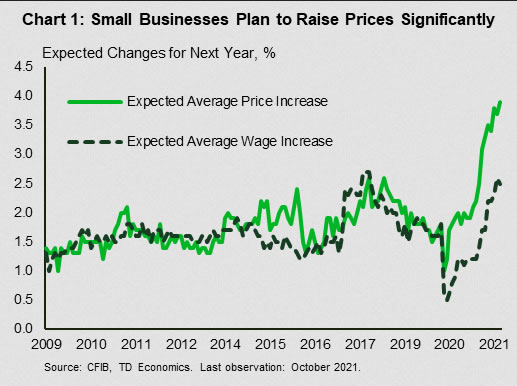
Those changes were accompanied with the significant upgrade to the inflation outlook, with prices now expected to grow by 3.4% in 2021 and 2022 (up from 3.0% and 3.4% pace in July). Inflation has surprised on the upside in recent months, and surveys of inflation expectations suggest that consumers and businesses alike are expecting higher inflation in the near-term. This week's CFIB Business Barometer survey echoed this. Small businesses planned to increase their prices by 3.9% in the next twelve months, marking an all-time high for the survey (Chart 1). Encouragingly, longer-term inflation expectations so far remain anchored and wage growth is still modest. Nonetheless, the Bank is keeping its eyes on "inflation expectations and labour costs to ensure that the temporary forces pushing up prices do not become embedded in ongoing inflation."
An earlier closing of the output gap combined with a higher inflation profile opens the door to an earlier liftoff in the policy rate. We expect the Bank of Canada to raise rates three times next year, starting in the second quarter, taking the overnight rate to 1% by the end of 2022. Removing monetary stimulus as the economy continues to recover makes sense. Still, the last leg of the recovery could be challenging. As the Bank acknowledges, there is significant uncertainly when excess slack will be fully absorbed.
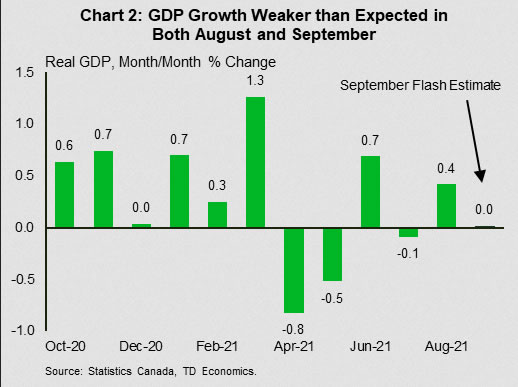
Indeed, this week's monthly GDP report implies a wider starting point for the output gap than the Bank had assumed. Growth in August was healthy at 0.4% month-over-month, but the flash estimate for September showed no growth in the month (Chart 2). Taken together, this puts GDP on track to rise by just 2.0% annualized in Q3, well below the 5.5% forecasted gain in this week's Monetary Policy Report. Activity could well be made up in the fourth quarter and early next year as economic reopening continues. As long the recovery continues, interest rates will continue to head higher.
Week Ahead – Interest Rates Are Rising
Fed and BoE to fight back against high inflation
Central banks have provided unprecedented amounts of stimulus over the last decade and took that to another level during the pandemic as the world went into lockdown. Now the pandemic has entered a different phase that policymakers hoped wouldn’t happen and have spent months telling us wouldn’t last. Inflation has arrived and it’s making central banks very nervous.
While most broadly agree that price pressures are primarily being driven by supply-side disruptions that will ease over time, they are also becoming increasingly uncomfortable with their magnitude and duration. The longer high inflation persists, the more likely it is to become ingrained, at which point central banks have a real problem on their hands.
Some central banks have already pushed ahead with tightening monetary policy and the Fed and BoE aren’t far behind. The US central bank is expected to announce a tapering of its asset purchases on Wednesday, paving the way for a rate hike later next year, while the BoE may take the leap on Thursday, with markets pricing in many more next year. Rock bottom interest rates are a thing of the past.
US
The Fed will announce ‘mission accomplished’ on reaching “substantial further progress” on both inflation and employment mandates. Wall Street widely expects the Fed to formally announce it is ready to start tapering its asset purchases and now the debate shifts to how soon it will signal it is ready to raise interest rates. Financial markets are pricing in two rate hikes by the Fed next year, largely because inflation pressures are not easing up anytime soon.
Another key event for the week will be the October nonfarm payroll report. The US economy is expected to get back on track as 425,000 jobs are filled, and the unemployment rate ticks lower to 4.7%. For the Fed’s blessing on interest rate hikes, the unemployment rate needs to be lower than 4.3% and inflation will need to remain high.
EU
Despite Christine Lagarde’s best efforts, the markets were not buying what she had to sell which could be extremely problematic for the central bank going forward. Yields have been rising since the meeting on Thursday and that pressure could intensify in the coming weeks.
It’s not often that markets will totally disregard the views of central bank heads and that will be a concern for the ECB. As well as laying the groundwork for alternative asset purchases to replace the PEPP program from March at the next meeting in December, we should also prepare for policymakers stepping up their PR offensive as they try to get investors back on board.
That may be easier said than done in this environment. It doesn’t seem to be that investors don’t believe the central bank, rather they fundamentally disagree with their views on inflation. Unfortunately for Lagarde and her colleagues – and most other central banks – they’ve been very wrong in recent months so there is reason to disagree again. Next weeks data is mostly low to medium impact including final PMIs, unemployment and retail sales.
UK
The Bank of England looks likely to begin its post-pandemic tightening cycle next week as it attempts to quickly get to grips with the inflation problem in the country that Chancellor Rishi Sunak alluded to during the budget this week. Inflation is expected to peak above 5% and persist throughout next year averaging around 4%.
Markets appear to be pricing in a 15 basis point hike at the moment so there is scope for some upside surprise if the Bank leads with 25 basis point rises in the early months of the cycle. Markets are pricing in at least a full percentage point of hikes by the end of next year so whether it does 15 or 25 probably doesn’t make much difference in the longer run.
The quarterly monetary policy report will be released alongside the announcement which should provide further insight on inflation expectations at the BoE and what that means for interest rates. Given how the markets responded to the ECB this week, it will be interesting to see how seriously they take this.
Russia
The Central Bank of Russia will release its monetary policy report on Monday, coming only a couple of weeks after it raised rates more than expected in order to combat higher inflation and warning more could follow this year. Inflation is expected to remain close to double its target this year which will require further action.
South Africa
Local government elections take place on Monday, with a number of ANC seats reportedly at risk.
Turkey
The sell-off in the lira has slowed over the last week or so but remains at risk of significant further downside. It stabilised just shy of 10 to the dollar and if that’s overcome, the move could accelerate. CBRT Governor claimed that a weak lira as a result of the central bank’s policies could fix the current account deficit problem and stabilise naturally, suggesting they must seize the opportunity presented by the pandemic. Not the words of someone that’s going to backtrack any time soon.
Inflation data next week could make for interesting reading. Then again, the central bank is clearly not concerning itself with that anymore so perhaps not.
China
Evergrande has paid its latest offshore bond coupon, once again, one date before the end of the grace period. That has calmed Mainland markets into the end of this week, as has the continued taking down of coal prices by China’s state planner. USD/CNY remains steady with no sign of a weakening bias by the PBOC, which instead, has been doing large liquidity injections into the local markets.
Next week sees Caixin Manufacturing and Services PMIs released with Manufacturing of most interest. A fall back under 50.0 will see China slowdown nerves increase again and will be bearish for equities. That said, authorities are unlikely to allow stock markets or property sector woes to get out of hand before the Central Committee meeting starting the 8th.
India
India will have a shortened week with the Diwali holidays falling on Thursday and Friday. A slow week for data with the highlight being Markit Services and Manufacturing PMIs which should show the economy continues to recover after the last delta wave. India’s Balance of Trade could show stress on the import side as the cost of imported energy skyrockets and Northern India struggles with power blackouts. A rally in oil next week will be a headwind for local equites.
The INR recovery continues, but the story is more a weak US Dollar one than a strong Rupee one. Its fate will be decided by the market reaction to the latest FOMC meeting in the mid-week.
Australia & New Zealand
Australian markets are in for a stormy start with the RBA’s credibility and yield control in serious trouble. Hawkish noises are increasing and the benchmark 3-year CGB yield has shot up to 0.75% in the past two days, well above the RBA 0.10% target. If the RBA does not show up on Monday to aggressively buy bonds, markets will price in a change of monetary stance and the sell-off in Australian equities will deepen. The RBA will release its latest policy decision on Tuesday with markets on a knife edge for a change of stance. Either way, the RBA has a big job on its hands now and will likely have to intervene in bond markets repeatedly next week. All of this should be good for the AUD though. It is likely to overshadow the Retail Sales and trade data at the back end of the week.
RBNZ Governor Orr has said that global interest rates have now bottomed, including in New Zealand. Kiwi should be a lot higher, but delta cases have now appeared in the South Island as well as the greater Auckland area. A deterioration over the weekend will weigh on Kiwi and local equity markets. The effects should be temporary though as markets are laser focused on a 0.50% RBNZ hike this month. NZ Employment and Labour Costs on Wednesday will go a long way to confirming that outcome.
Japan
Japanese markets could be choppy on Monday morning after the elections to be held this Sunday. Only a defeat of the ruling LDP, highly unlikely, is likely to have a material impact on Japanese markets. Jibun Services PMI and Household spending at the end of the week will be of onl passing interest.
USD/JPY has fallen this week, but that is because of a weaker US Dollar story elsewhere that the cross has coattailed. USD/JPY remains at the mercy of the US and Japan 10-year rate differential. If the FOMC, as expected, announces the start of QE tapering, USD/JPY should resume its rally with renewed momentum.
Key Economic Events
Saturday, Oct. 30
- G-20 Summit begins
Sunday, Oct. 31
Economic Data/Events
- China Oct manufacturing PMI: 49.7e v 49.6 prior; non-manufacturing PMI: 53.0e v 53.2 prior
- Japan general election for its 465-seat lower house of parliament
- COP26 starts in Glasgow.
Monday, Nov. 1
Economic Data/Events
- US Oct ISM Manufacturing: 60.3e v 61.1 prior, construction spending
- Eurozone manufacturing PMI
- Germany manufacturing PMI
- UK manufacturing PMI
- Australia manufacturing PMI, CoreLogic house prices, inflation gauge, home loans value
- India manufacturing PMI
- Thailand manufacturing PMI, business sentiment index
- New Zealand CoreLogic house prices
- China Caixin manufacturing PMI
- Japan vehicle sales, PMI
Tuesday, Nov. 2
Economic Data/Events
- RBA rate decision: Expected to keep both Cash Rate Target and 3-year yield target unchanged at 0.10%
- Australia consumer confidence
- ECB Enria to speak at Finnish Financial Supervisory Authority seminar on EU financial markets
- New Zealand building permits
- Switzerland CPI
- Singapore PMI, electronics sector index
- Japan monetary base
- Hong Kong retail sales
- US light vehicle sales
- South Africa manufacturing PMI
Wednesday, Nov. 3
Economic Data/Events
- FOMC Rate Decision: expected to announce it will begin tapering its asset purchases
- US factory orders, US durable goods
- Poland Rate decision: Expected to raise base rate by 25bps to 0.75%
- Australia building approvals, Markit PMI services and composite, private sector houses
- Singapore PMI
- South Africa PMI
- Japan composite and services PMI
- India Markit PMI composite and services
- Eurozone Markit services PMI, unemployment
- New Zealand Unemployment
- China Caixin composite and services PMI
- Russia CPI
- Spain unemployment
- UK Nationwide house prices
- EIA Crude Oil Inventory Report
Thursday, Nov. 4
- ECB President Lagarde speaks at the Women in Economics conference.
- ECB’s Governing Council member Holzmann speaks at a conference in Vienna.
- Fed’s Quarles, BOE Deputy Governor Cunliffe speak on a panel at a conference organized by Portuguese securities regulator CMVM.
Economic Data/Events
- BOE Rate Decision: Could raise bank rate for the first time since pandemic. Analysts are leaning towards no change, but several are calling for a 15bps increase.
- Norges Rate Decision: Expected to keep deposit rate unchanged at 0.25%
- Czech Rate Decision: Expected to raise repurchase rate by 50 bps to 2.00%
- US trade, initial jobless claims
- Eurozone PPI
- Germany factory orders
- New Zealand ANZ commodity prices
- Australia trade
- Thailand consumer confidence
- OPEC+ meeting on output
Friday, Nov. 5
- China International Import Expo (CIIE) begins six-day event
- BOE’s Ramsden and Pill deliver a Monetary Policy Report National Agency briefing.
- BOE’s Tenreyro appears as a panelist at the IMF 2021 Jacques Polak Annual Research Conference.
Economic Data/Events
- US October Change in nonfarm payrolls: 400Ke v 194K prior; Unemployment Rate: 4.7%e v 4.8% prior
- Canada unemployment
- Eurozone retail sales
- Germany Industrial production
- Japan household spending
- Thailand CPI, foreign reserves, forward contracts
- China BoP
- Singapore retail sales
- Australia RBA statement on monetary policy, foreign reserves
- Spain industrial production
- South Africa gross and net reserves
Sovereign Rating Updates
- France (Fitch)
- Denmark (Moody’s)
- Italy (Moody’s)
- Saudi Arabia (Moody’s)
Forward Guidance: Canada’s Labour Market Data in Focus after BoC Shift
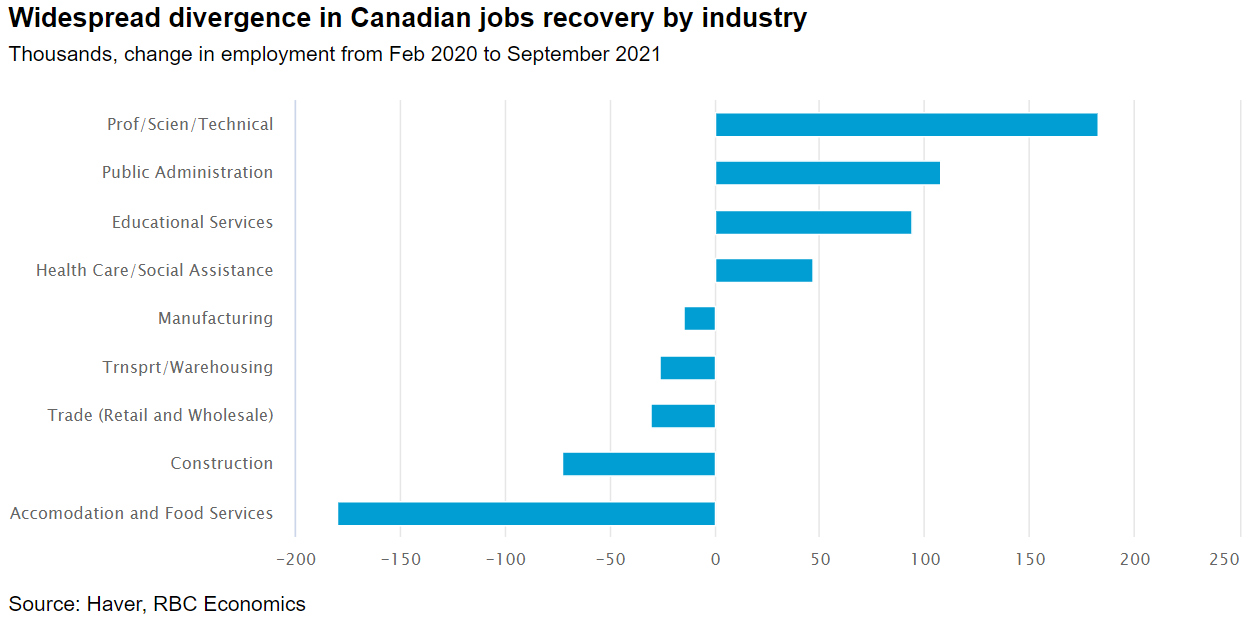
The Canadian jobs recovery is expected to continue in October, with a 50k increase expected to build on the 157k jump in September. The number of workers receiving regular employment insurance payments has fallen sharply, by about 600k by our count since the September survey reference period as recipients began rolling off extended pandemic related support programs. Strong demand for workers as indicated by widely reported labour shortages and the high level of job postings means that part of that shift will have been from unemployment to job growth in October. The spread of the delta variant was also easing in October in much of Canada, and our own tracking of consumer spending showed a pickup in purchases of high-contact services where the shortfall in jobs relative to pre-pandemic levels remains very large – and it is those sectors, for example accommodation and food services, where we expect to see larger employment growth.
Another increase would take employment further above pre-pandemic levels and extend the outperformance of labour market data relative to economic output (GDP) in recent months. Hours worked increased almost 7% at an annualized rate in the third quarter, well-above preliminary estimates that output rose closer to 2%. Indeed, compared to GDP (where output was running 1.4% below pre-pandemic levels as of September) labour markets are looking increasingly tight. The Bank of Canada was clearly looking through those softer GDP reports in a hawkish shift in their communications this week, and likely will continue to do so as long as labour market data continues to outperform.
Week ahead data watch:
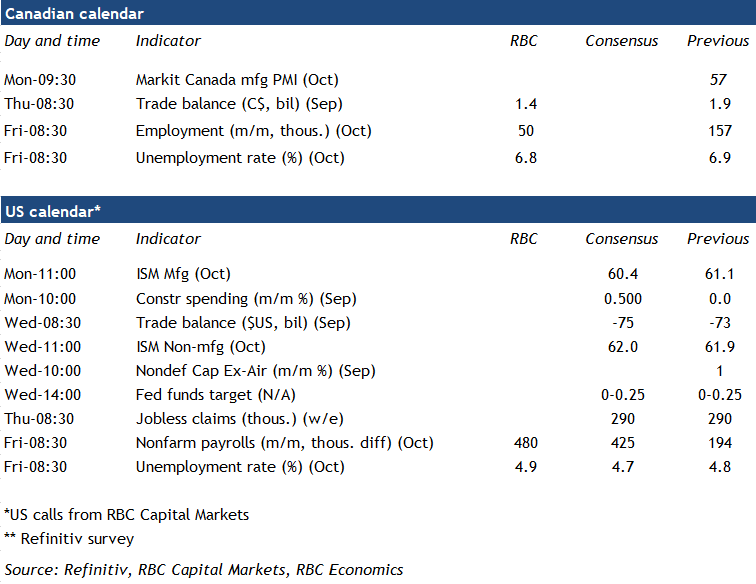
- The FOMC next week is expected to announce it will taper its bond buying program to $10b in Treasuries and $5b in mortgage backed securities, and commit to wind down net purchases around midyear 2022.
- US job growth is expected to pick-up in October following September’s lackluster gain. Employment remains far below pre-pandemic levels, but the unemployment rate has declined substantially and company reports of labour shortages are widespread.
- We expect Canadian employment increased by 50k in October with the unemployment rate ticking down to 6.8% from 6.9% in September.
- The Canadian merchandise trade balance is expected to drop $500 million, to a $1.4 billion surplus. Supply chain disruptions continue to weigh on motor vehicle production/sales, and a poor crop yield in western Canada may begin to show up more significantly in lower exports.
Fed Research Preview: Tapering, Yes, But How Fast?
Key takeaways
- We expect the Fed will announce QE tapering at next week's meeting. We expect the Fed to start tapering immediately in November with a tapering pace of USD15bn per month (completed in June). Risk is tilted towards a higher tapering pace of USD20bn per month.
- Fed Chair Jerome Powell sounded more concerned about high inflation on Friday, which we expect him to repeat on Wednesday. We expect Powell to repeat that the tapering decision is not related to a future decision on rate hikes. Still, we expect the rhetoric to be more hawkish than in September.
- Please note that the Fed policy announcement is 19:00 CET (as the EU switches to winter time on Saturday). The press conference starts 19:30 CET.
- We still expect two rate hikes next year (one in September and one in December).
- FX: We continue to forecast EUR/USD to 1.10 in 12M (with downside risks).
- Fixed Income: We still see upside for 10Y UST yields. We currently have a 2% target.
Week Ahead – Dollar Braces for Fed and NFP But Will BoE Steal the Limelight?
The Fed’s long awaited tapering announcement will headline the coming week, with the October jobs report adding to the excitement. The Reserve Bank of Australia also has scheduled a regular meeting. However, it is the Bank of England that could roil markets the most as it ponders whether to raise rates early to fight burgeoning inflation. Employment data in Canada and New Zealand will be the other highlights on the data front, while OPEC’s monthly get-together is unlikely to yield any change in plans to normalize production.
RBA: a dovish bluff?
The Reserve Bank of Australia has been pretty vocal in signalling the markets that it has absolutely no intention of raising interest rates before 2024. However, with lockdowns in Australia gradually being lifted as vaccination rates catch up with Europe and America, the economy looks set to make a big comeback in the next few months. In the meantime, inflation is on the rise, specifically, underlying price gauges have started to creep higher.
Although it may take some time before wages also start to head north in a sustainable fashion – a key criteria for the RBA – investors think this is only a matter of time and are predicting that rates will need to go up much sooner. Interest rate futures currently imply four rate hikes next year. Policymakers will probably try to push back against such expectations, but not entirely. The RBA has allowed the three-year yield on Australian Government Bonds (AGB) to surge past its target of 0.10% in recent days, raising speculation that it may soon abandon its yield curve control policy.
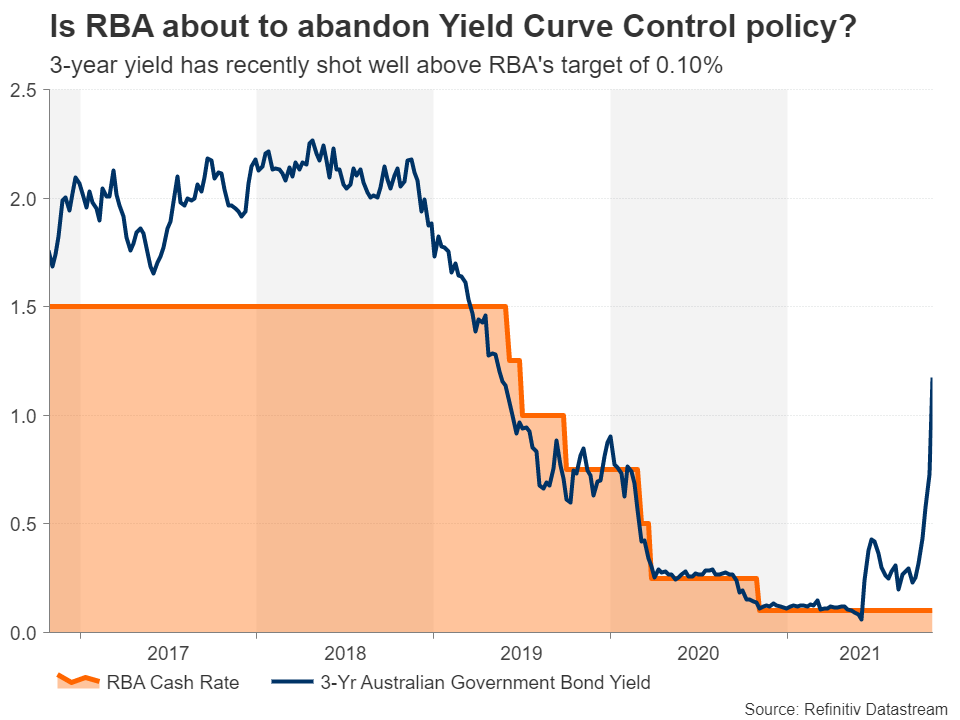
It’s not certain whether that would happen as early as the next meeting on Tuesday, but another option that cannot be ruled out is the further tapering of asset purchases. Such a move would be a major U-turn, with the decision having previously been postponed to February in response to the prolonged lockdowns. Although the virus backdrop hasn’t changed since the decision was delayed, the inflation picture has.
So at the very least, the RBA will likely flag some form of an earlier withdrawal of stimulus, which could power up already turbocharged AGB yields, boosting the Australian dollar. Aussie traders will also be keeping an eye on September building approvals on Wednesday, trade and retail sales numbers on Thursday, as well as the RBA’s Monetary Policy Statement on Friday, which contains the latest forecasts.
New Zealand jobs data eyed by the kiwi
Staying in the vicinity, quarterly employment figures are released in New Zealand on Wednesday, while manufacturing PMI data out of China could stir up the risk currents on Monday, ruffling both the aussie and kiwi.
The third quarter prints on the unemployment rate, jobs growth and labour cost will be important for the New Zealand dollar, as they could swing the odds in favour of an aggressive 50 basis point rate hike by the RBNZ when it meets in late November if they are stronger than expected. However, given the markets’ ability to constantly brush aside negative news, any disappointment from China’s official and Caixin/Markit manufacturing PMI readings would likely only temporarily weigh on risk sentiment.
Fed to start tapering, but bypass rate hike talk
The Federal Reserve is widely anticipated to announce that it will begin to wind down its massive monthly purchases of bonds and securities on Wednesday. Tapering could commence days after the meeting. But the decision has been so well telegraphed that investors will almost certainly be focusing their attention on Chair Powell’s press conference.
Bond markets have been confused lately, with short-term yields spiking sharply but long-term yields unable to keep up, leading to a flattening of the yield curve. The only way to interpret this is that investors think policymakers will be forced to act sooner on rates, but fragile economies will prevent them from hiking too steeply.
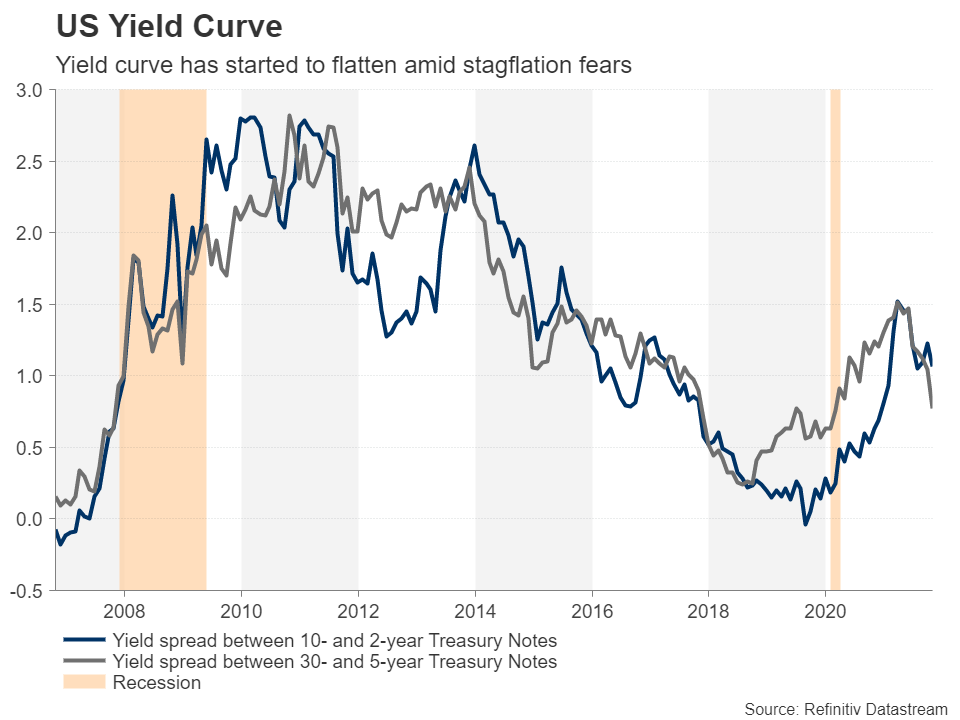
Although Powell will very likely want to steer clear of rate hike talk in his press briefing and emphasize the progress in the recovery while maintaining some caution, there might be clues on the timing of liftoff in what he says about inflation. Should Powell suggest that he is no longer so sure about higher inflation being transitory, this would add fuel to market bets that the Fed could begin to raise rates soon after tapering ends, which is expected to be in the middle of 2022.
But in all likelihood, the FOMC meeting might turn out to be uneventful and it is Friday’s payrolls report that jolts markets. The US economy is expected to have added 425k jobs in October – that would be an improvement on the prior 194k figure. After the recent surprises, another large miss or beat in the headline number is possible. Thus, the US dollar may only come alive at the end of the week, drifting sideways in the meantime.
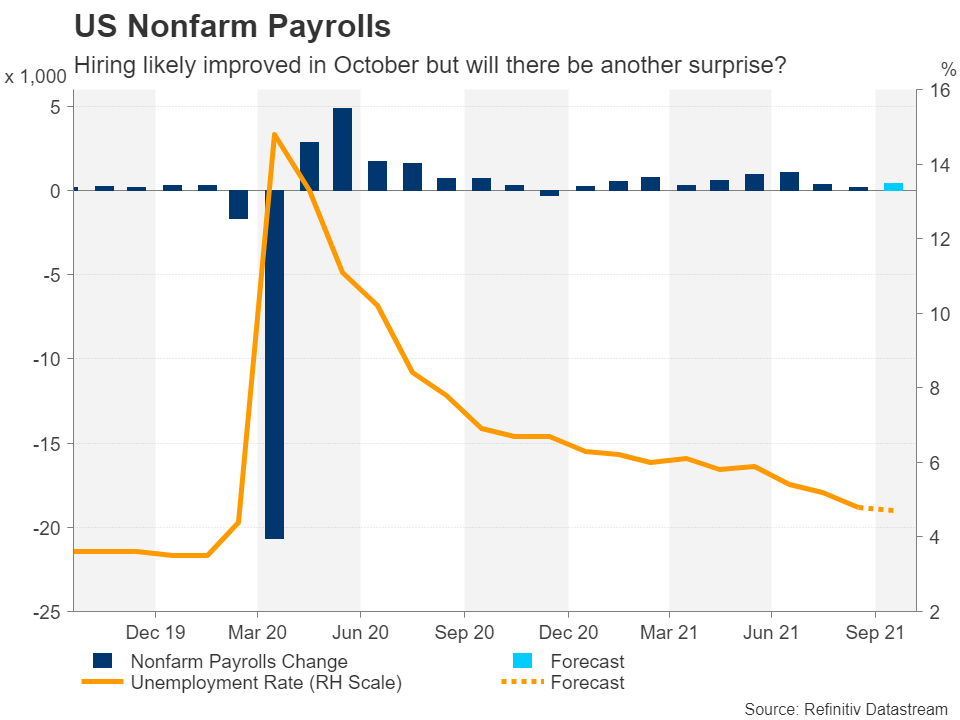
Other data worth watching out of the United States include Monday’s ISM manufacturing PMI, followed by the ISM’s non-manufacturing composite on Wednesday, as well as September factory orders.
Bank of England: will they or won’t they?
Since the last meeting in September, the Bank of England has been unmistakably guiding market pricing for rate hikes higher. The repeated hints that a rate rise might become “appropriate” before bond purchases have ended – an unusual step in the world of QE – have pushed up the market probability of a 15 bps rate increase in November to more than 60%, with a hike by February fully priced in.
However, some MPC members do not yet appear to be on board for premature tightening action and the BoE doesn’t have the best track record for clear communication. So there is some risk that the hawkish bets have been overdone.
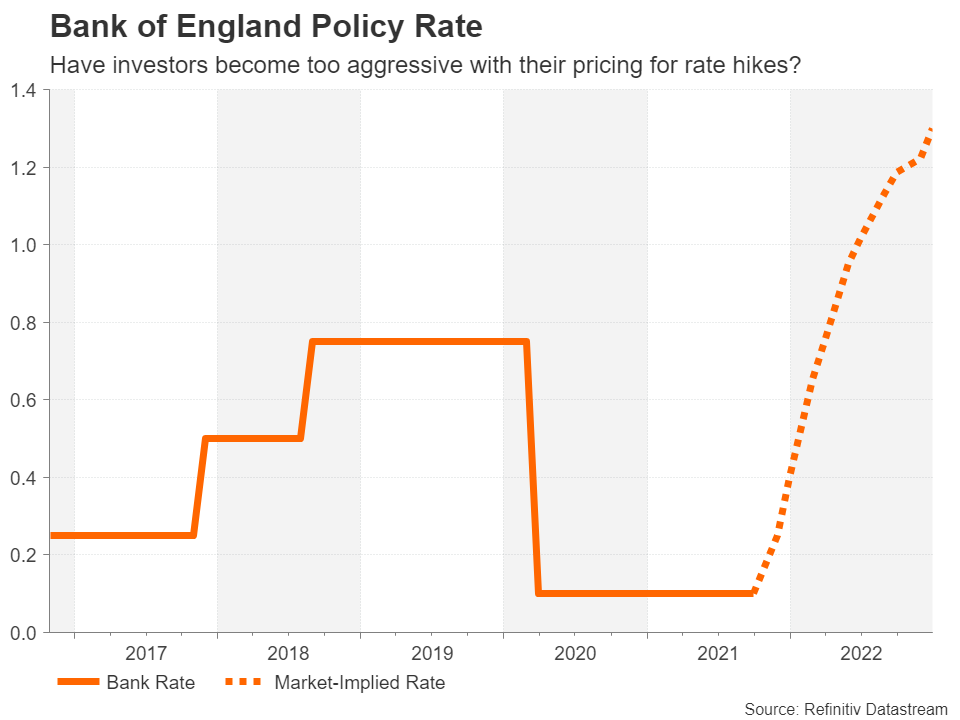
Economists are also unconvinced and don’t think that a change in the Bank Rate on Thursday is on the cards. But even if that turns out to be the case, sterling might not necessarily suffer a significant selloff. Concerns that supply constraints, worker shortages and soaring energy costs will be bigger headwinds for the UK economy than its peers have capped the pound’s gains from rate hike speculation.
A more dovish-than-expected meeting could even be positive for the currency as it would ease worries of tighter policy impeding growth. Either way, investors will be placing as much importance on the BoE’s updated economic forecasts, which should reveal how closely aligned the Bank’s projected rate hike path is with the markets’.
Euro to take a backseat
Across the Channel, it will be relatively quieter in the euro area, with Thursday’s producer price index and the final estimate for the October composite PMI potentially garnering some interest for the single currency. German industrial orders on Thursday and industrial production on Friday, both for September, will also be watched.
However, after the European Central Bank dampened expectations of higher interest rates anytime soon, the upcoming data probably won’t change much for the euro
Oil slips ahead of OPEC meeting, weighs on loonie
One central bank that hasn’t shied away from taking hawkish turns is the Bank of Canada. Having unexpectedly ended their QE programme early at the October meeting, policymakers now have to decide how soon interest rates should start to rise. Friday’s jobs report could help them do that. If there’s another strong jump in employment in October, it would underscore market expectations of a rate increase in early 2022, which remain ahead of the BoC’s own recently brought forward forecast of Q2/Q3.
However, despite the hawkish surprise, the Canadian dollar’s gains post the meeting have been marginal as a pullback in oil prices has countered the BoC-led advances. OPEC and its allies meet on Thursday to decide whether to stick to the pre-planned quotas and raise output by 400,000 barrels a day, or by a higher amount. The major oil producers are under pressure from the United States to ease supply curbs more quickly following the sharp rally in oil prices since late August.
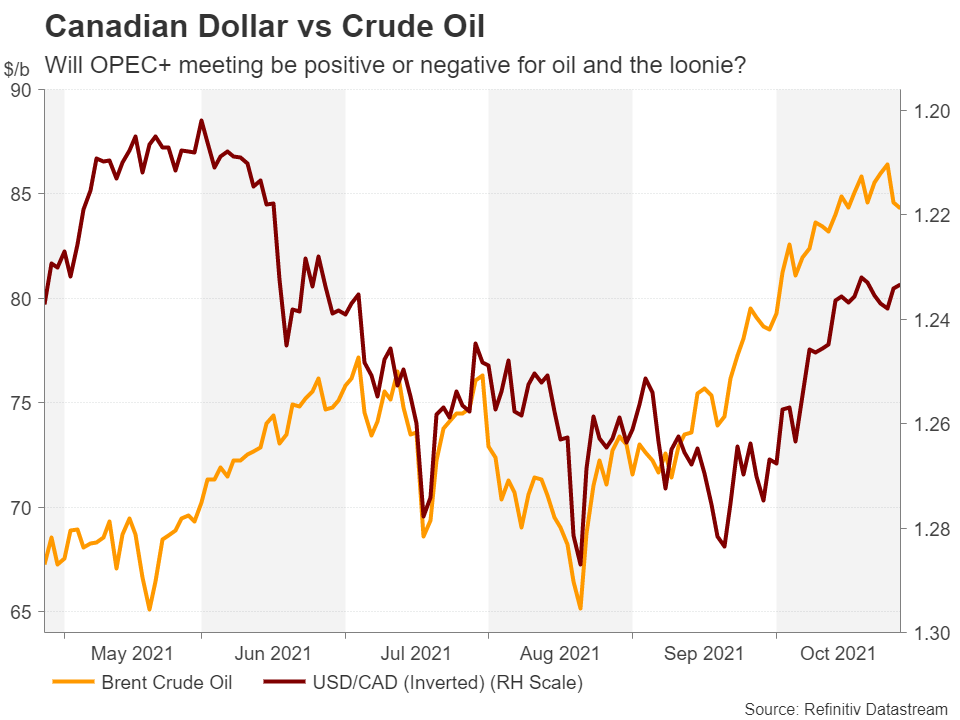
The OPEC+ alliance has so far resisted calls to pump more oil, with some members even struggling to meet existing targets. However, OPEC has a tendency to shock so a bigger-than-expected boost in output is a possibility, especially if Saudi Arabia has a change of heart. Another option for OPEC is to increase production by 800,000 bpd in November to ease the immediate fuel shortages but keep them unchanged in December.
Any surprise decision to raise output more than the predicted amount could spark a steeper correction in oil prices than the mild retreat seen in the last few days.