Sample Category Title
Canadian CPI Should Solidify A BOC Taper Next Week
Canadian headline YoY CPI rose to 4.4% in September vs 4.3% expected and 4.1% in August. This is the highest reading since February 2003! In addition, the YoY Core CPI, which strips out food and energy, rose to 3.7% vs 3.6% expected and 3.5% in August. Last week, Canada released its preliminary PPI data for September at 15% vs 14.7% in August. Inflation continues to rise in Canada, just as it is in most of the world.
Other impressive data from Canada for September include the Employment Change, +157,100 vs +65,000 expected and +90,200 in August and well as the Ivey PMI with a print of 70.4 vs 64.2 expected and 66 in August. With all this impressive data and the BOC in the process of tapering, the inflation data should clear the way for the central bank to taper by another C$1 billion per week. This almost completes their bond purchasing program, bringing bond buying down from C$2 billion per week to C$1 billion per week.
USD/CAD continues to hang around the 61.8% Fibonacci retracement level from the June 1st lows to the August 20th highs, near 1.2366. (See our Super Inflation Wednesday article for more on the charts of USD/CAD).
As the Canadian Dollar was strengthening against the US Dollar, it was falling vs its commodity siblings, Aussie and Kiwi. AUD/CAD formed a low on October 11th near 0.9105, testing the same lows from August 24th. If price breaks above the September 8th highs of 0.9375, it will confirm a double bottom and target near 0.9670!
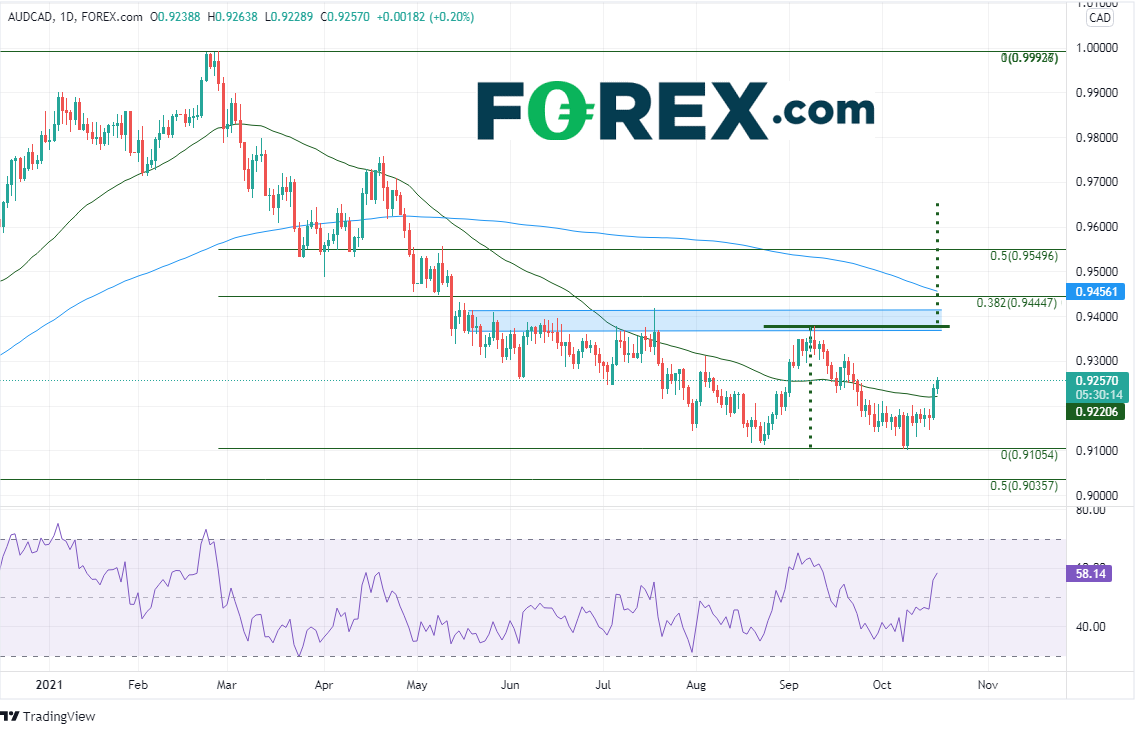
Resistance above the neckline of the double bottom is at the 38.2% Fibonacci retracement level from the February 25th highs to the October 11th lows, near 0.9445, which confluences with the 200-Day Moving Average at 0.9456. There is close support just below current levels at the 50-Day Moving Average of 0.9220, then the October 11th lows at 0.9150. If price falls below the recent lows, the 50% retracement from the March 2020 lows to the February 24th highs at 0.9036 offers strong support as well.
As mentioned above, NZD/CAD has been on a rise of its own over the last week. The pair came within 19 pips of reaching the low on June 18th. Given the large range of the high in between the 2 lows, some would consider this to be close enough to a double bottom. If price breaks above 0.9042 (currently much higher) than the double bottom will be confirmed, and price will target all the way up at 0.9490!
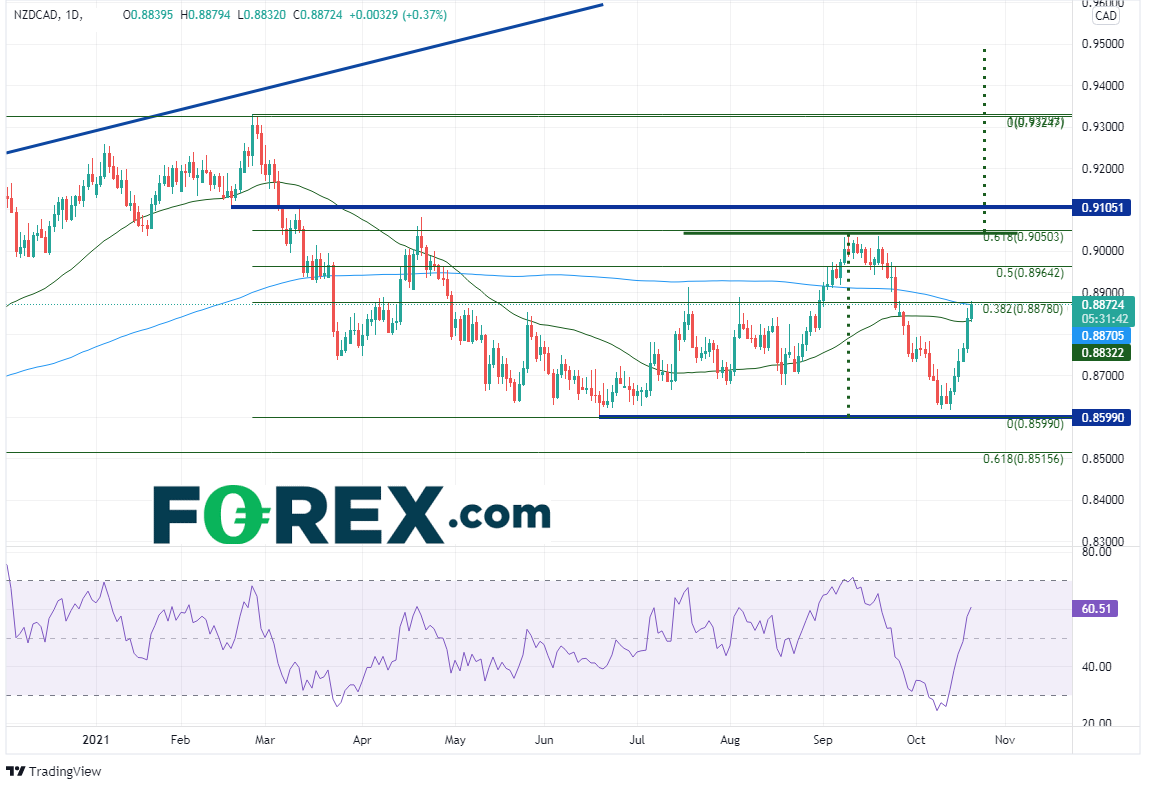
NZD/CAD is currently trading near the 200-Day Moving Average and the 38.2% Fibonacci retracement from the February 24th highs to the June 18th lows, near 0.8878. If price is to reach the neckline of the double bottom, it must close above current resistance and the 50% retracement level from the same time period at 0.8964. Support is at today’s low of 0.8832, which is also the 50-Day Moving Average. However, below that level prices can fall back down to 0.8600! If price falls below the recent lows, the 61.8% Fibonacci retracement from the March 2020 lows to the February 24th highs at 0.8516 offers strong support as well.
With the BOC ready to continue tapering, possibly as soon as next week, it’s no surprise that the Canadian Dollar is stronger vs the US Dollar. However, when compared to other commodity currencies such as Aussie and Kiwi, the Canadian Dollar is actually the weakest of the bunch! Watch to see if Loonie reverses vs these pairs if the BOC tapers!
Eco Data 10/21/21
[php_everywhere instance="1"]
Crude Oil Inventory Surprisingly Dropped, Supporting Price
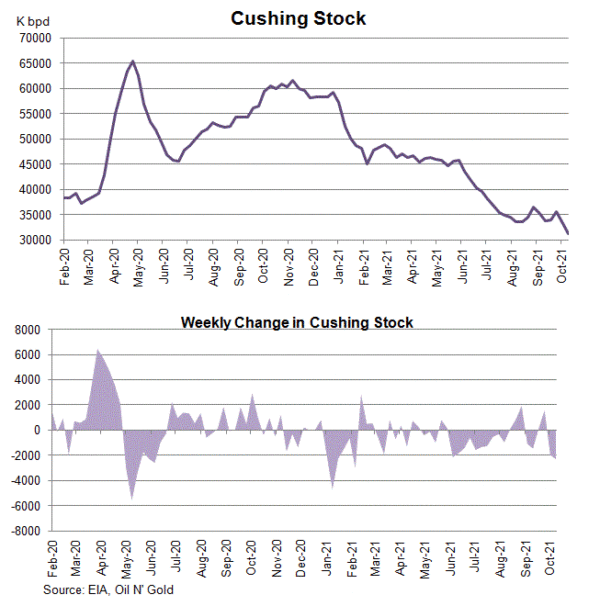
The report from the US Energy Information Administration (EIA) shows that total crude oil and petroleum products (ex. SPR) stocks slumped -9.81 mmb to 1228.91 mmb in the week ended October 15. Crude oil inventory slipped -0.43 mmb to 426.54 mmb, compared with consensus of a +1.86 mmb increase. Inventory slipped in 3 out of 5 PADDs. PADD2 (Midwest) alone saw -2.22 mmb decline during the week. Cushing stock declined -2.32 mmb to 31.23. Utilization rate slipped -2 percentage points to 84.7% while crude production dipped -0.1 mmb to 10.3M bpd for the week. Crude oil imports decreased -0.17M bpd to 5.83M bpd in the week.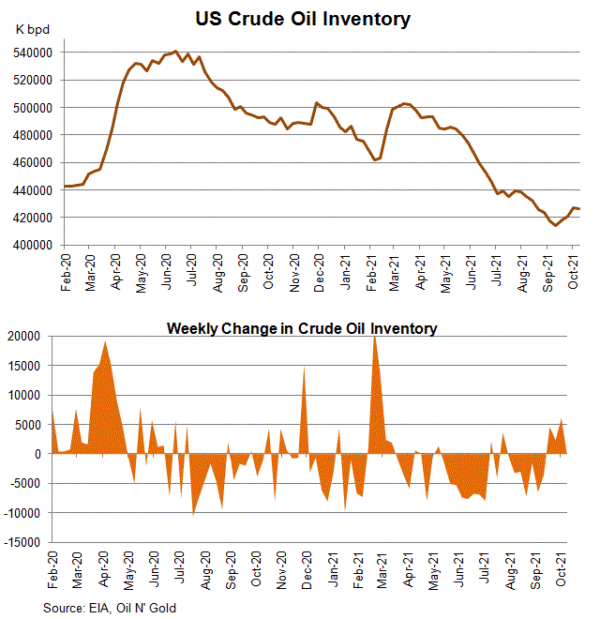
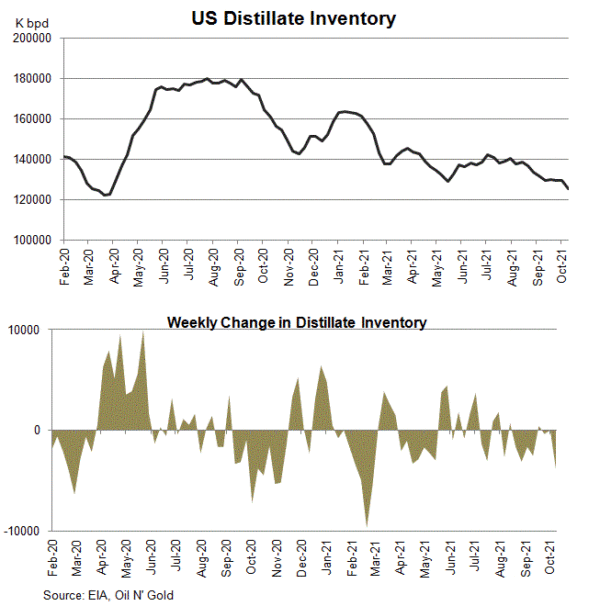
 Concerning refined oil product inventories, gasoline inventory sank -5.37 mmb to 217.74 mmb while demand rose +4.88% to 9.63M bpd. The market had anticipated a -1.27 mmb fall in stockpile. Production jumped +10.42% to 10.61M bpd while imports soared +11.6% to 0.606M bpd during the week. Distillate stockpile declined -3.31 mmb to 125.39 mmb. The market had anticipated a -0.7 mmb decrease. Demand gained +8.8% to 4.28M bpd. Imports gained +6.32% to 0.2 mmb while production dropped -6.14% to 4.42M bpd during the week.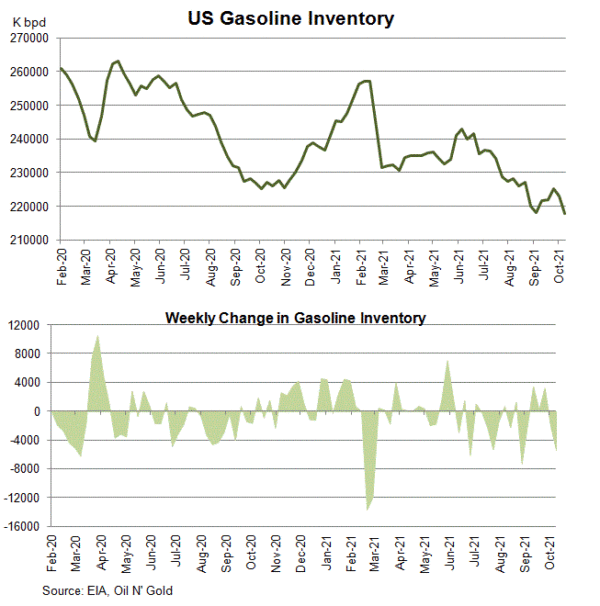
A day earlier, the industry-sponsored API estimated that crude oil inventory rose +3.29 mmb. Gasoline stockpile dropped -3.5 mmb, while that for distillate was down -3 mmb.
EURCHF’s Upside Looks Bleak as Seller’s Lead
EURCHF has plunged back below the simple moving averages (SMAs) after positive price action was halted around the 1.0763-1.0771 resistance band. The bearish bearing of the SMAs is backing the pair’s negative trajectory.
The short-term oscillators are also signalling that downside pressures are growing. The MACD, in the positive section, is dipping and has neared the red trigger line, while the RSI is diving in bearish territory. The strong negative charge in the stochastic oscillator is endorsing the control sellers have acquired.
As things stand, the pair could face an immediate support band from 1.0710 until the 1.0700 handle. Should the bears manage to steer the price beneath the 1.0700 hurdle, support could transpire from the 1.0691 low ahead of the 1.0679 critical trough. Sinking underneath the 11-month trough, the price may target the 1.0659 lows from November 2020.
Otherwise, if buyers push back, initial upside friction could stem from the 50-period SMA at 1.0721. If positive impetus grows, the price may meet the 100-period SMA at 1.0750 before challenging the resistance boundary of 1.0763-1.0771. Conquering this could catapult the price towards the zone between the 1.0800 barrier and the 200-period SMA at 1.0807.
Summarizing, EURCHF is exhibiting a neutral-to-bearish tone. An unfolding bullish bias seems doubtful as sellers are dictating volatility in the pair.

BoE: T-Minus 15 Basis Points and Counting
Summary
- U.K. inflation eased slightly in September, although that will likely prove to be a temporary lull given the recent rise in energy prices and signs that underlying wage growth is firming. Expect a further quickening of CPI inflation in months ahead. In contrast, economic growth has been somewhat uneven and could remain so for the time being.
- By themselves, growth and inflation trends don't offer an open-and-shut case for an imminent rate hike. However, in the context of increasingly hawkish comments from Bank of England (BoE) policymakers, we think today's CPI will be enough for a November interest rate lift-off, and a gradual pace of rate hikes thereafter. We expect a 15 bps hike November, followed by a 25 bps hike in May 2022 and a further 25 bps hike in November 2022.
- Our forecast is for BoE monetary tightening is more gradual than currently anticipated by market participants. As a result the pound could face some downside for now, and there may also be some mild downside risk to our forecast of GBP/USD appreciation over the medium-term.
Houston, We Have An Inflation Problem
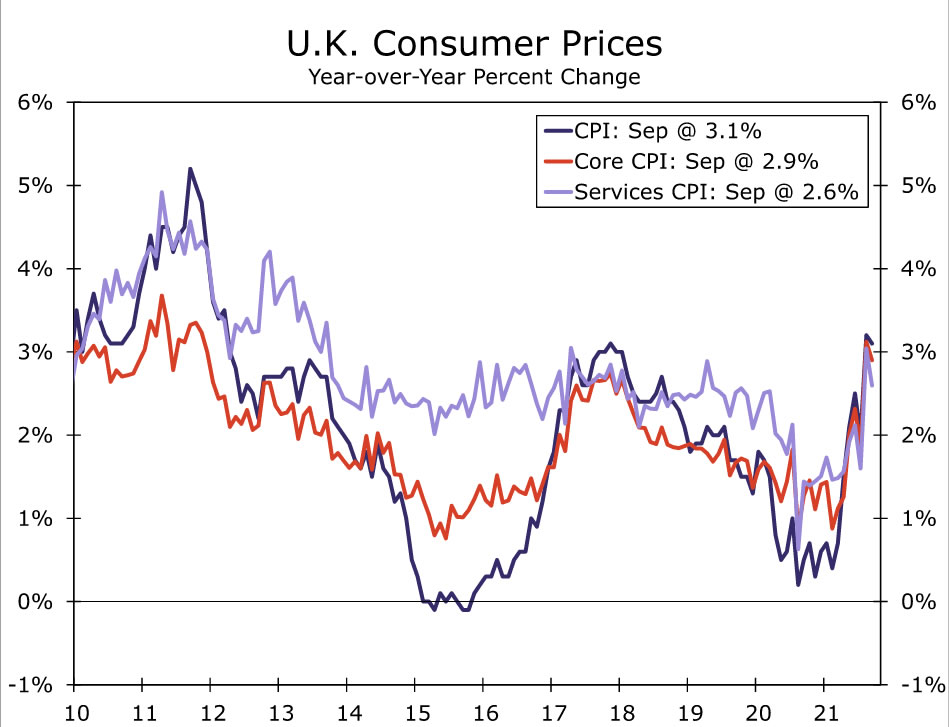
The release of the U.K. September CPI revealed a slight lull in what has nonetheless been a growing inflation problem for U.K. policymakers. Headline inflation eased to 3.1% year-over-year (still above the upper end of the central bank's inflation target range), while core CPI inflation slowed to 2.9% and services inflation slowed to 2.6%. The slowdown, however, was in part due to base effects stemming from restaurant & cafe inflation, which made a smaller contribution to overall price inflation. Restaurant & cafe prices rose in September 2020 as the U.K. government ended its "Eat Out to Help Out" program, a price increase that was not repeated in September 2021. However, the lull of inflation will likely be brief. The recent rise in energy prices, specifically stemming from higher natural gas prices, should be reflected in October, while underlying wage growth appears to be firming. CPI inflation still appears on track to peak at or above the Bank of England's (BoE) forecast of around 4%.
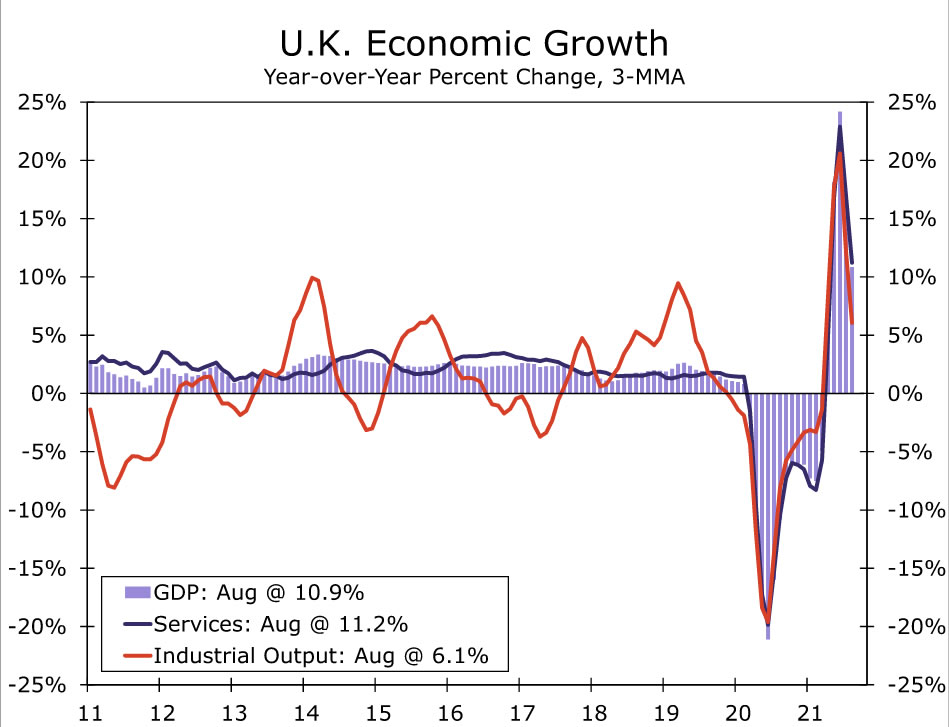
While inflation still appears to be on a fairly clear upswing, the pace of economic growth appears to be moderating. The latest news on that front was August GDP data which showed a GDP increase of 0.4% month-over-month, a bit less than expected, while July GDP was revised to show a slight decline from the previously reported slight increase. For August, services activity rose 0.3%, only half as much as expected, while industrial output rose 0.8%. September GDP growth seems likely to be similarly subdued given recent energy dispruptions, while a recent renewed rise in COVID cases also adds a complication to the outlook.
Straight Shot From BoE Governor Bailey
While U.K. growth and inflation trends don't by themselves offer and open-and-shut case for an imminent rate hike, they also come in the context of increasingly hawkish recent comments from Bank of England policymakers. Most notably, governor Bailey recently said "rising energy prices mean will last longer and it will of course get into the annual numbers for longer as a consequence." He added that:
"That raises for central banks the fear and concern of embedded expectations. That’s why we, at the Bank of England have signaled, and this is another signal, that we will have to act."
That points to an underlying inclination from the Bank of England to start raising interest rates soon, and today's CPI reading was very likely high enough for the central bank to proceed. Between now and the November 4 monetary policy announcement the only U.K. data of any real consequence are September retail sales and the October PMI surveys, neither of which we believe will dissuade policymakers from tightening. As a result, and in part because the initial rate hike should be modest, we now expect the Bank of England to raise its policy rate by 15 bps at its November announcement. If the BoE was instead looking to deliver a more typical 25 bps increase, we believe it might hold off on an initial rate hike for up to a few more months.
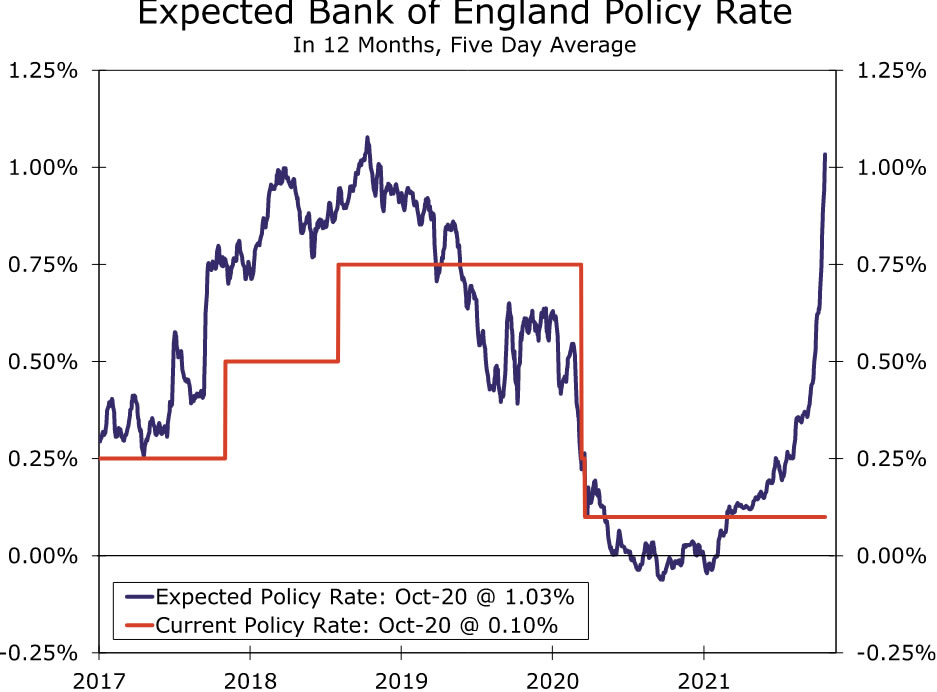
Indeed, looking beyond November we expect a relatively gradual pace of rate increases. We believe economic growth could remain somewhat choppy which could limit the speed at which policymakers move, while CPI inflation should also ease back gradually as 2022 progress. Following the initial November hike, we expect another 25 bps increase in May 2022 and a further 25 bps in November 2022, meaning we see the Bank of England's policy rate ending next year at 0.75%—a bit less than currently priced into interest rate markets. As a result the pound could face some downside for now, and there may also be some mild downside risk to our forecast of GBP/USD appreciation over the medium-term.
Sunset Market Commentary
Markets
Interest rate markets again experience a roller-coaster ride this week as investors pondered conflicting economic developments and a highly uncertainty central bank reaction function. On Monday, investors’ faith in pre-emptive CB action (Bailey comments) caused an impressive flattening of the yield curve. Yesterday, inflation fears likewise justified a re-steeping move. Today, the pendulum again moved to the other side. US yields are ceding 1-2 bps with the 5y outperforming (-2.25 bps).The German curve shows a similar move with yield declines ranging from 1 bp (30y), over 2 bps (10y and 2y) to 3 bps (5-y). As was the case yesterday, there was again little in the way of economic story to ‘explain’ the price action. The dominant headline on, especially European markets, was Jens Weidmann’s announcement to depart as Chief of the German Bundesbank (also see infra). In a letter to the Bundesbank staff, Weidman stressed the importance of a stability oriented monetary policy that the BuBa is representing. Reading in between the lines, the ECB ever more drifting away from its ‘narrow’ mandate apparently became source of growing discomfort for the Buba president and a reason to finish his term only 2 years after he was reappointed for a 8-year term. Weidmann joins the ever growing list of compatriots (Axel Weber, Juergen Stark, Sabine Lautenschlaeger….) leaving the ECB or the Buba on disagreement with ECB’s shift to a more unconventional policy. We didn’t see much direct impact of Weidmann’s announcement on (interest rate) markets. After yesterday’s risk rebound, equity markets took a breather as investors try to assess how individual companies reporting results cope with rising prices and supply shortages. Oil also eases off recent peak levels with Brent currently trading near $83.25/b.
The dollar remains in the defensive even as moves are limited. The trade-weighted index is still testing the 93.70 area. USD/JPY in an early spike almost touched the June 2017 top (114.73), but the attack didn’t succeed with the pair currently again trading in the 114.25 area. EUR/USD is holding a tentative upward bias (1.1640 area) but a sustained break of 1.1664 resistance remains a step too far. Sterling initially touched a soft patch as UK October inflation printed marginally softer than expected (3.1% headline from 3.2%). UK yields decline up to 5 bps for shorter maturities. EUR/GBP tried to regain the 0.8450 level, but move lacked any strong momentum (EUR/GBP 0.8445).
News Headlines
Buba chief Jens Weidmann is resigning. He will step down at the end of the year thus emptying his seat at the ECB’s board of governors too. Weidmann has been chairing the Bundesbank for a decade and was (one of) the most hawkish member(s) in the ECB board, sometimes openly criticizing the ultra-easy monetary policy. His resignation comes ahead of a crucial ECB meeting in December – which he’ll still attend – when the central bank is due to decide on the course of PEPP (or an alternative bond buying scheme) after the March 2022 shelf date. The range of possible successors is wide, spanning from the Buba’s deputy governor Buch to its chief economist Ulbrich over member of the ECB’s Executive Board Schabel or an external economist. Weidmann’s successor in any case is likely to be less of an inflation hawk.
Canadian inflation came in at 0.2% m/m in September, a tad faster than the 0.1% consensus. This brings the yearly measure on a higher-than-expected 4.4%, up from 4.1% in August. That’s the fastest pace since 2003. The average of core gauges rose to 2.67% from 2.6% last month. The Bank of Canada, like many other central banks, is of the view that most of the current inflation spike is transitory though keeps a close eye at its persistence and magnitude. The central bank meets next Wednesday with consensus expecting the BoC to cut QE’s pace down to C$1bn per week. On rate hikes, it long said it will probably not raise policy rates before 2H22. Markets beg to differ: the recent repositioning has also affected BoC expectations with money markets discounting a first full rate hike early Q2 2022. USD/CAD recently slipped sub 1.24 and is staying there after today’s CPI release.
Canada: Inflation Moves Higher in September (Again)
Consumer price inflation accelerated to 4.4% year-on-year in September, up from 4.1% in August and slightly ahead of consensus expectations for 4.3%. Gasoline prices were up 32.8% relative to a year ago, but the pickup in inflation was due to other factors. Excluding gasoline, prices were up 3.5%, accelerating from 3.2% in August.
Prices were up for all major categories in September, with clothing and footwear flipping from a negative (-0.5%) to positive (+1.4%) in the month. Food prices saw a notable acceleration in September, up 3.9%, from 2.7% in August. Shelter price inflation remained at a 13 year high of 4.8% year-on-year.
Seasonally adjusted, month-on-month price were up 0.4% in the month, continuing a string of strong monthly growth. Food led the gains, up 0.9%, transportation prices rose 0.8% pulled up by rising new vehicle prices.
Two of three of the Bank of Canada's core inflation metrics moved higher in the month. The CPI-trim rose to 3.4% (from 3.3%) and CPI-Median to 2.8% (from 2.7%), and the CPI-common measure was unchanged at 1.8%. Taken together, the three measures averaged 2.7%, the highest level since December 2008.
Key Implications
If its not one thing, its another. Energy prices remain a major contributor to inflation, but consumers are also feeling the pinch at the grocery store, car dealership and at home.
As the source of price pressures broadens, it also appears more persistent. Inflation is likely to maintain a four handle for the remainder of this year, long enough to attract consumers attention. Indeed, consumers have raised their expectation for the rate of price growth over the near-term according to Bank of Canada surveys.
Expectations for the Bank of Canada to react to the recovering economy and hot inflation with rate hikes have also increased in recent days. We will be watching their communication next week with rapt attention, especially with respect to the persistence of price pressures. Lift off may not come as early as markets are currently pricing, but the risks are certainly moving to sooner rather than later.
Stocks Oscillate Near Record Highs; Commodity Currencies Hold Firm
Stocks consolidate gains as earnings surprise
Stock markets have been relatively flat marginally below their summer record highs during early US trading hours on Thursday, with the pan-European STOXX 600 consolidating last week’s impressive rebound and US stock indices switching between gains and losses.
While investors were almost convinced that higher input costs, labor shortages and lack of raw materials would raise serious concerns among companies, the earnings season has surprisingly been a tailwind to equity markets so far, showing profits remaining solid and stronger than analysts expected despite the pandemic nasty supply effects.
Netflix managed to beat subscription estimates on Tuesday, and Tesla’s Q3 earnings will probably add more fuel to the stock rally today after the market close given its record car deliveries in model 3 and model Y during the three months to September.
Bond yields could be a threat to stocks
However, if bond yields keep trending up on the back of inflation and monetary tightening fears, equities could become less attractive to investors, especially those with rich valuations. Perhaps that moment has not come yet as central banks are still largely stuck to the view that the current price pressures will prove transitory, as ECB member Francois Villeroy de Galhau attempted to reiterate today.
Yet, it’s obvious that many policymakers have already started to switch sides, including Fed board member Christopher Waller, who was the last to call for higher interest rates on Tuesday. It would be interesting to see if more Fed policymakers join the hawkish club today. Kashkari, Bostic, Quarles and Bullard will all be speaking today between 16:00 – 17:45 GMT, while at 18:00 GMT, the Fed's Beige book will shed more light on the US economic conditions.
Canadian inflation crawls up, commodity currencies stand firm
In Canada, consumer prices saw another pickup in October, justifying the BoC’s bond tapering actions. The headline CPI index inched to 4.4% y/y from 4.1% previously, beating the forecast of 4.3% as well, but the loonie could not obstruct any gains against the dollar, remaining stable around 1.2355.
The 1.60% decline in oil prices has probably stolen some shine from the loonie today, though with crude prices maintaining a broad positive trajectory, and the Fed lagging the BoC in terms of monetary tightening, the loonie may have more winning battles ahead.
Note EIA oil inventories are on the agenda today.
In other commodity-dependent currencies, the Australian and New Zealand have also been benefiting from surging prices in raw materials. The improving risk sentiment has provided an extra boost to the aussie and the kiwi, especially against the safe-haven Japanese yen.
Meanwhile, the pullback in Treasury yields pressed dollar/yen lower after the peak at a fresh three-year high of 114.64. Euro/dollar was flat at 1.1640, while pound/dollar was marginally lower at 1.3739.
In metals, gold is pushing for its second daily gain, though a major resistance is still laying ahead at $1,795.
USD/JPY Mid-Day Outlook
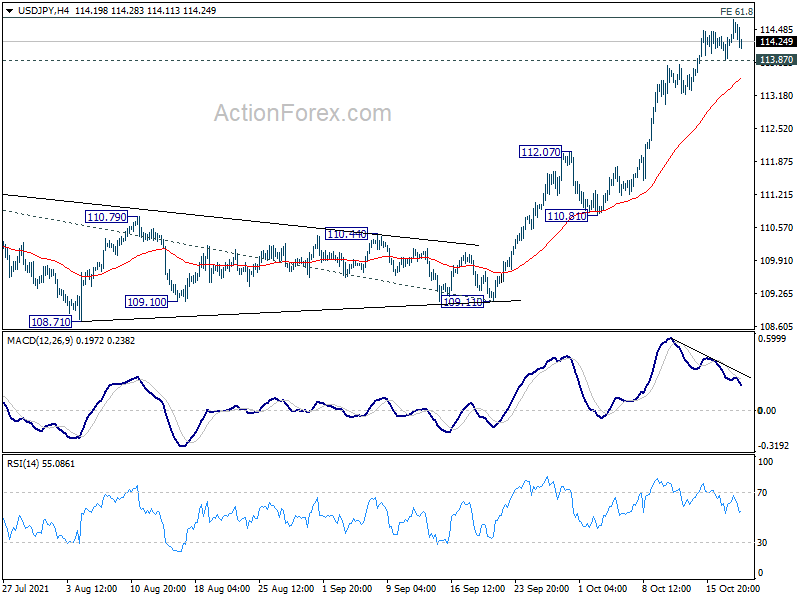
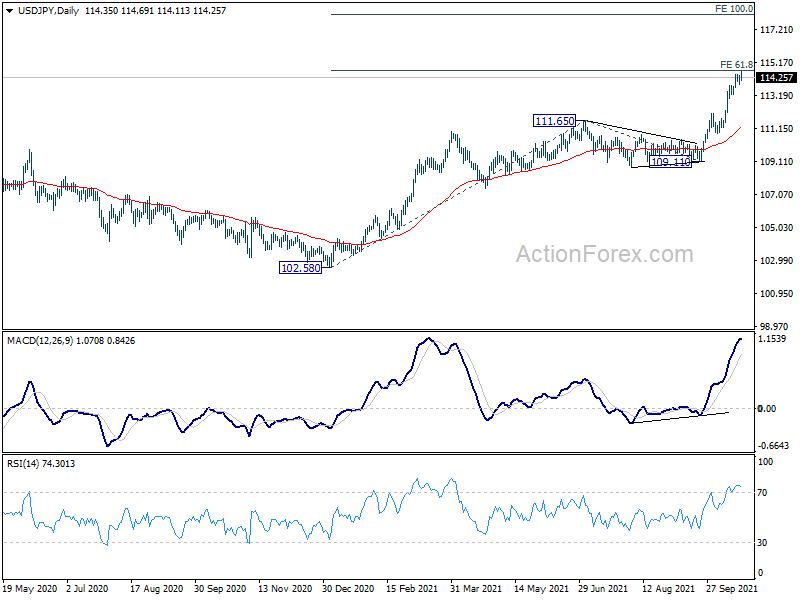
Daily Pivots: (S1) 114.05; (P) 114.23; (R1) 114.56; More...
With 113.87 minor support intact, further rise is still expected in USD/JPY. Firm break of 61.8% projection of 102.58 to 111.65 from 109.11 at 114.71 will pave the way to 100% projection at 118.18 next. However considering bearish divergence condition in 4 hour MACD, break of 113.87 minor support should indicate short term topping, and turn bias to the downside for deeper pull back, to 4 hour 55 EMA (now at 113.49) and below.
In the bigger picture, corrective decline from 118.65 (2016 high) should have completed at 101.18 already. Rise from the 102.58 is seen as the third leg of the up trend from 101.18. Next target is 114.54 resistance and then 118.65 high. This will now be the preferred case as long as 109.11 support hold, even in case of deep pull back.
USD/CHF Mid-Day Outlook
Daily Pivots: (S1) 0.9197; (P) 0.9218; (R1) 0.9252; More....
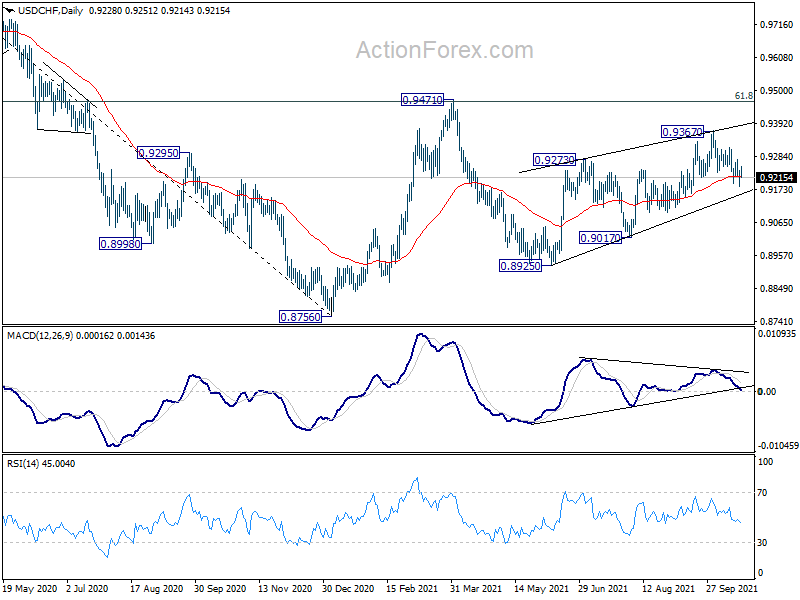
Intraday bias in USD/CHF remains neutral first, but further fall is still in favor with 0.9272 resistance holds. Considering bearish divergence condition in daily MACD, firm break of 0.9162 will argue that whole rise from 0.8925 has completed and target this support. On the upside, break of 0.9272 minor resistance will turn bias back to the upside for retesting 0.9367 instead.
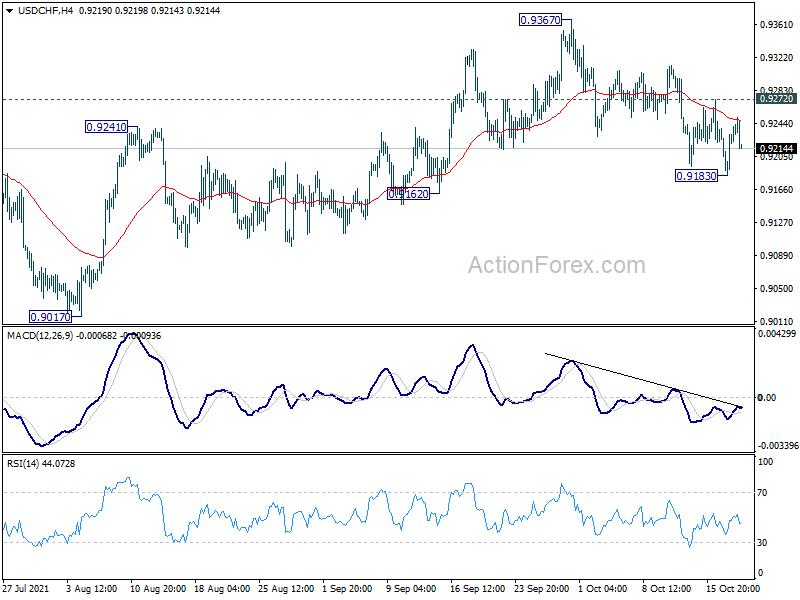
In the bigger picture, the corrective structure of the rebound from 0.8925 argues that fall from 0.9471 is not completed yet. It could either be the second leg of pattern from 0.8756 (2021 low), or resuming larger down trend from 1.0237 (2018 high). We'd pay attention to the downside momentum of assess the odds later. But for now, medium term outlook will be neutral at best as long as 0.9471 resistance holds.