Sample Category Title
RBA Minutes Show Little Change in Policy Approach
The Minutes of the Reserve Bank’s October Board Meeting show little change from previous discussions. The emphasis is on Australia’s slow wages. There is no specific discussion on the direct impact of supply shortages; energy costs; or strong demand on inflation but the Board does consider the prospect of inflation building more quickly than currently envisaged.
The Reserve Bank Board’s Minutes for the October meeting revealed very little evidence of any potential change in policy.
The key conclusion that has been used in recent Minutes was repeated, “It will not increase the cash rate until actual inflation is sustainably within the 2 to 3 per cent range. The central scenario for the economy is that this condition will not be met before 2024. Meeting this condition will require the labour market to be tight enough to generate materially higher wages growth than at the time of the meeting.”
Central banks will always err towards allowing some flexibility on their targets and the labour market targets in the conclusion – “full employment” and “materially higher wages growth” allow that flexibility.
But in a recent speech the Governor made his inflation intentions quite clear and rigid. “It won’t be enough for inflation to just sneak across the 2 per cent line for a quarter or two. We want to see inflation around the middle of the target range and have reasonable confidence that inflation will not fall below the 2-3 per cent band again.”
That suggests that the Governor is committed to achieving at least one if not two consecutive annual prints of core inflation at 2.5% or above before he decides to raise rates.
The Bank’s current forecasts (August Statement on Monetary Policy) for core inflation are 1.75% by end 2022; and 2.25% by end 2023.
With those forecasts as the central case, we can see why the Bank sticks with the 2024 call.
At the next Board meeting on November 2 the Board will be given the revised forecasts which are released to the market on November 5 in the November Statement on Monetary Policy.
There is some evidence in the Minutes that the Board is at least considering the inflation implications of current developments. In previous Minutes we did not see much discussion on the inflation outlook. One liners featuring the words “moderate” and “gradual” were common.
In these Minutes the Board noted, “while it was possible that underlying inflationary pressures in Australia could build more quickly than currently envisaged the central forecast scenario was still that domestic inflation would pick up only gradually over the medium term.”
Upward pressure on inflation overseas is recognised but Australia is acknowledged as different due to the much more moderate lift in wages growth.
“Underlying inflation pressures in Australia were more moderate than in other advanced economies… This reflected a range of factors, including the relatively slow rate of wages growth in Australia.”
Surprisingly, given the intense concentration on “strong demand for goods globally, supply bottlenecks and rising energy prices “in the overseas section there was no discussion on this important development in the Australian context.
The Board did note a number of promising points to justify an ongoing relaxed assessment of the outlook for wages growth – “firms’ expectations for wages remained moderate”; “even in industries that had experienced strong labour demand, wages growth remained subdued.”
In summary “Overall there were few indications from disaggregated wages data or from the Bank’s liaison program to suggest that aggregate wages growth was likely to accelerate sharply in the period ahead.”
The other area of interest in the Minutes related to the Board’s summary points on the Financial Stability Review. Although we have already seen the full report it is always interesting to see the Board’s summary of what it considers to be the important points.
Prospects for future use of Macro Prudential Policies (MPP) were clearly set out. “Other options that could be used to improve borrowers’ buffers would be portfolio restrictions on individual lenders’ shares of lending at high debt to income ratios and/ or high loan to valuation ratios. “with APRA reported to be publishing a MPP framework paper later in the year it appears that any further policy adjustments will await the new year.
It is interesting from my perspective that the summary piece did not differentiate between owner occupiers and investors given that previous MPP (2015; 2017/18) had been directly targeted at investors.
Conclusion
Markets have been moving forward their timing of the first rate hike in the next cycle to well before Westpac’s timing of the March quarter 2023. We have held that view since June 18.
We are mindful that the Bank has tied itself to achieving that “sustainable” 2.5% print on annual core inflation. There is more flexibility around wages growth and full employment (Board has never tied it to a specific number).
There is evidence in the Minutes that the Board has discussed the possibility that inflation could lift more quickly than their central forecast.
Our unemployment and inflation forecasts are consistent with the Board achieving its objectives much earlier (Q1 2023) than the 2024 central case.
Of considerable interest will be whether the Bank adjusts its current inflation forecasts in the November Statement on Monetary Policy to reflect some of these recent global developments.
The print on headline and core inflation for the September quarter, which is due on October 27 will also be important.
While we see clear evidence of rising headline inflation (0.8%) we expect that the core print will remain around the benign 0.5% although higher numbers can be expected in 2022.
BoC Business Outlook Survey – Businesses Sentiment Improves Further in 2021 Q3
The Bank of Canada Business Outlook Survey (BOS) showed a further improvement in business sentiment in the third quarter of 2021. The BOS indicator, a statistical summary of survey results, increased from 3.96 to 4.73 in 2021Q3. Businesses expect domestic and foreign demand to continue strengthening, and, as a result, they plan on investing more in labour and capital over the next year. The survey results also noted that "heightened capacity constraints, including labour shortages" also contributed to the elevated level of the BOS indicator.
Firms are seeing a broad-based improvement in demand relative to a year ago. Businesses that were most impacted by the pandemic had the strongest positive outlook as provinces lifted many public health measures through the summer. The Delta variant, however, was a source of uncertainty. Firms operating in the housing and consumer goods industry continued to have a positive outlook, but those with record sales over the last year expected some deceleration.
Businesses are concerned that supply issues, such as supply chain disruptions and labour shortages, will limit domestic and export sales. Firms mentioned that shipping delays and the impact of COVID-19 in trading partners were making it difficult to obtain raw materials and goods for sales. Supply chains disruptions are expected to continue until the second half of 2022, longer than what firms had previously thought. On labour shortages, businesses saw three main reasons for this issue: one, pandemic-induced factors (i.e. travel restrictions and government income support), two, structural factors that existed before the pandemic (i.e. demographic/technological shifts), and three, cyclical factors (i.e. strong demand for labour).
Firms are responding to capacity pressures through a combination of strategies, which include focusing on key clients or reducing the hours they are open to consumers. They are also adjusting internal work processes and supply chains. A significant number of firms also said they would be adjusting workers' compensation.
Compared to the previous two surveys, more firms said they would invest more in machinery and equipment in the third quarter release. The survey results showed that investment intentions broadened across sectors with digital technologies remaining a key plan in investment plans. On the employment end, hiring intentions remained at record-highs, supported by stronger sales expectations. For some businesses, these plans have been constrained by labour availability.
Given labour shortages, more firms reported that they planned to increase wages to attract and retain workers. They also said they planned to raise selling prices due to increased labour costs. On the whole, "businesses continue to anticipate elevated growth in input and output prices in the next year". Beyond the next 12 months, firms said they expected to return to pre-pandemic pricing behavior. Notably, inflation expectations among businesses increased in this survey. Almost half of businesses expected inflation to be above 3 percent over the next two years as a result of supply chain issues, fiscal and monetary stimulus, and recent increases in food and energy prices.
Key Implications
Businesses grew more optimistic in the third quarter as provinces lifted many public health measures over the summer. With demand improving, firms expected strong gains in sales especially those that were worst impacted by the pandemic.
But businesses are increasingly concerned that they may not be able to service the solid bounce back in demand due to capacity constraints. Supply chain disruptions are limiting production and the restocking of inventories, while labour shortages are leading to a reduction in operating hours for some businesses. If not resolved, these factors could weaken the pace of Canada's economic recovery.
Businesses are not expecting supply chain issues to fade anytime soon. Labour shortages could also last for some time, due to mismatches between labour supply and demand. This is likely to lead to higher prices, and firms are recognizing that. Today's survey results showed almost half of surveyed firms expected inflation to be above 3% over the next two years. This was a 10 percentage point increase from the survey in the second quarter. The Bank of Canada will have to pay close attention to these developments as it gears up for the next week's monetary policy decision.
Pound Rally Eases ahead of UK CPI and PMI Data as BoE again Flags Rate Hike
It’s a busy week for UK data releases as some crucial indicators on inflation, consumption and overall economic activity are due ahead of the Bank of England’s policy meeting in the first week of November. The latest read on the consumer price index is out on Wednesday (06:00 GMT) and will be followed by retail sales (06:00 GMT) and flash PMI (08:30 GMT) data on Friday. Intensifying speculation that the BoE is getting ready to raise interest rates for the first time in three years have revived the pound, which had fallen to 9-month lows versus the US dollar at the end of September.
From crisis to crisis
Although the UK economy has rebounded strongly this year and is expected to fully recover from the virus crisis by the end of the year, the post-pandemic and post-Brexit realities are biting hard. Britain is facing a chronic scarcity of workers across several industries, with the shortage of truck drivers likely being the biggest threat to the economy as it impacts everything from fuel distribution to petrol stations to food delivery to supermarkets.
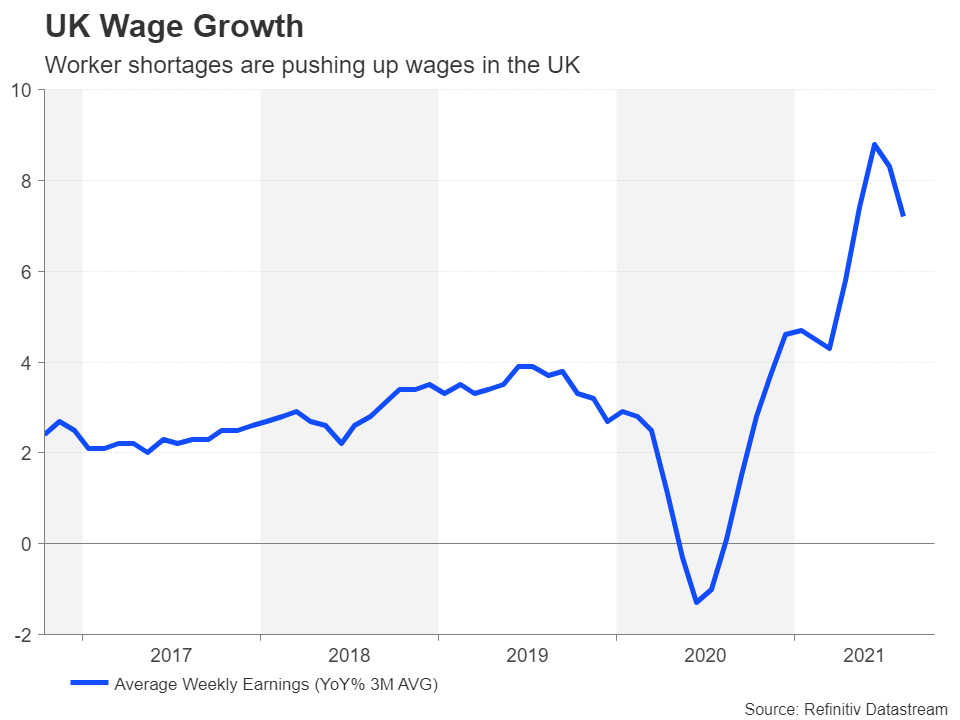
Wage growth has already started to heat up as businesses struggle to find the staff they need. Average weekly earnings hit 8.8% y/y in the three months to June – an all-time high for the current data series. They’ve since eased to 7.2% y/y, but judging from the continued robust gains in employment, the surge in wages could only be the start.
Wage acceleration is here to stay
The government has launched temporary visa schemes to tackle the worker shortages in the worst hit industries. However, some ministers, including Boris Johnson, have suggested that higher wages are a good thing, an intended consequence of Brexit and all part of plans to level up Britain. This suggests the government isn’t about to relax immigration rules and businesses will probably have to significantly increase their salary offers to attract the right workers, not just in the short term, but over several years.
The trouble is, rising wage costs are not the only thing firms are having to deal with at the moment. Broadening supply shortages and soaring input costs are causing a lot of pain and have already toppled several UK energy providers. But there is another big headache awaiting businesses – higher interest rates.
BoE edging closer to lifting rates
The Bank of England is worried that rising price pressures are not as transitory as central bankers around the world had initially predicted. Governor Andrew Bailey recently joined the hawkish camp in the Monetary Policy Committee (MPC) and warned on Sunday that the Bank would have to act if there are signs that higher inflation is becoming sticky.
Both market- and consumer-based measures of inflation expectations have spiked higher lately and this week’s data could further cement bets that the Bank could move as early as the November 4 meeting.
Mixed data may not provide clear signals
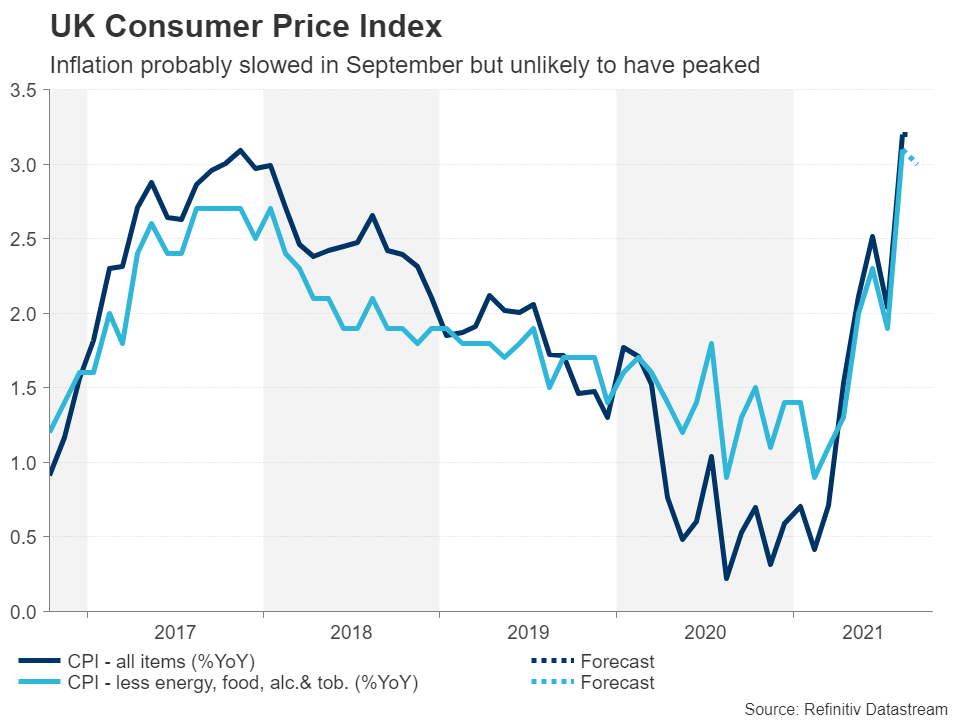
UK inflation shot up to a nine-year high of 3.2% y/y in August and although it is projected to have held steady in September, it likely hasn’t peaked yet and looks set to climb further in the coming months. Core CPI, which excludes volatile items such as food and energy, is expected to have dropped marginally from 3.1% to 3.0% y/y.
Retail sales figures could also have the power to sway MPC members that are on the fence in a particular direction as sales have been sluggish since May amid some disappointment that the reopening effect faded quickly for UK consumers. Forecasts are for retail sales to have bounced back by 0.5% month-on-month in September, though this would still leave sales 0.4% lower over the year.
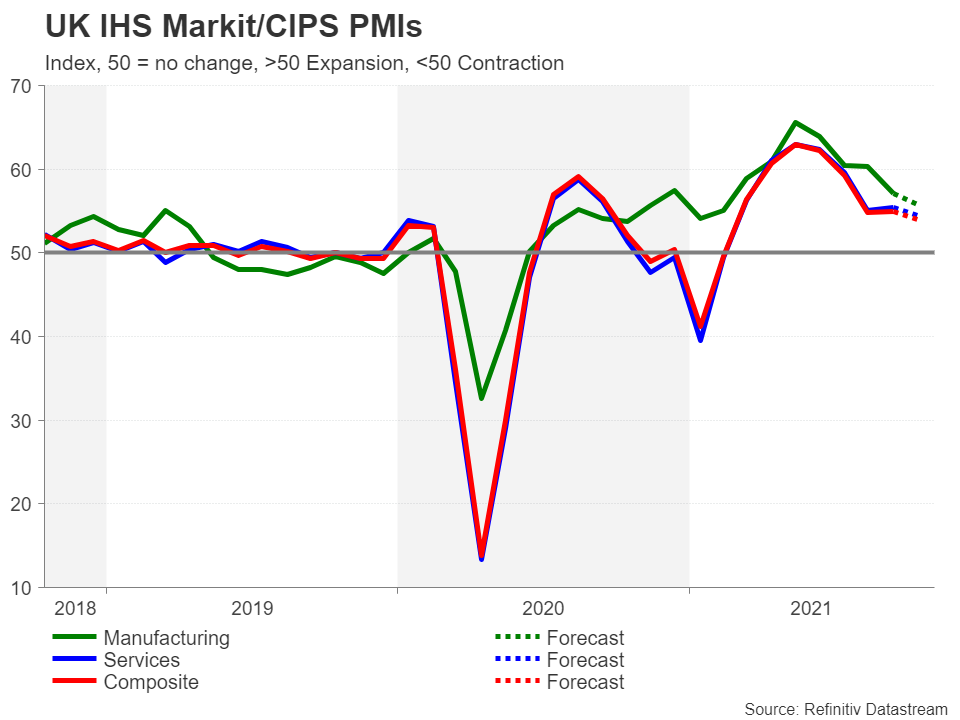
As for the flash PMI readings, the composite PMI is expected to decline from 54.9 to 54.0 in October, which would be the lowest since February when the country was in lockdown. The manufacturing and services components are both forecast to have fallen back.
Pound’s latest gains may not be sustained
With growing alarm by policymakers at the persistent strength of inflation, hotter-than-expected CPI numbers would likely offset any negative surprises in the retail sales and PMI figures. The question is, can increasing market odds that the BoE will hike rates this year stretch the pound’s rebound?
Market pundits think there’s about an 85.0% probability of higher rates by November. Yet, sterling has not managed to break above its descending trendline despite the sharp rebound from the September trough. Should it succeed in doing so, the 50% Fibonacci retracement of the June-September downtrend at $1.3829 could become the next critical resistance area as the 200-day moving average has flatlined just above it.
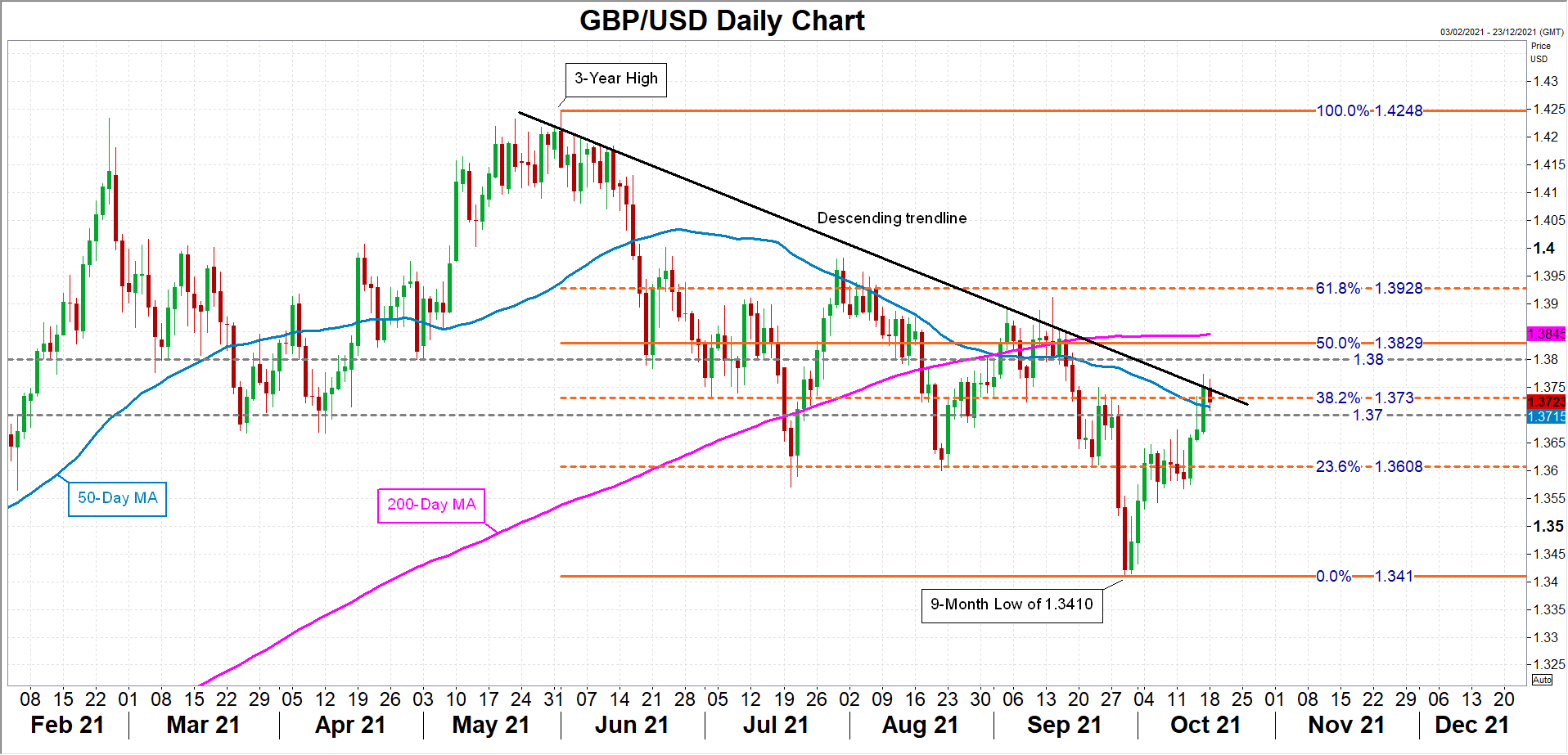
If, though, this week’s releases dampen rate hike expectations, pound/dollar could slip below the immediate support of its 50-day moving average to head towards the 23.6% Fibonacci of 1.3608.
While a stronger greenback has as much to do with cable’s downtrend as the darkening clouds gathering over the UK economy, the failure of a breakout in the next couple of weeks or so would not bode well for sterling’s short-to-medium term outlook.
EUR/USD Daily Outlook
Daily Pivots: (S1) 1.1581; (P) 1.1602; (R1) 1.1632; More...
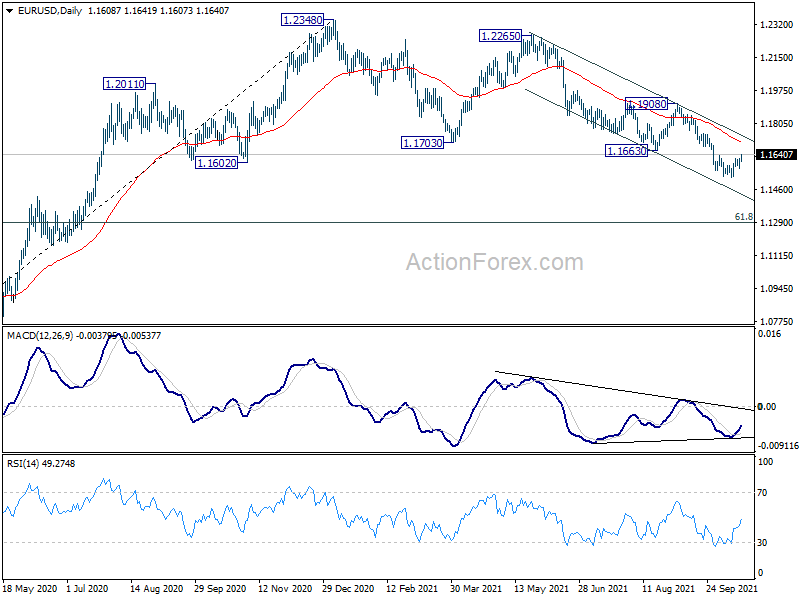
Focus is now on 1.1639 resistance in EUR/USD as rebound from 1.1523 extends today. Sustained break there will confirm short term bottoming at 1.1523. Intraday bias will be turned back to the upside for stronger rebound, to 55 day EMA (now at 1.1712). Break there will pave the way to 1.1908 resistance. On the downside however, break of 1.1523 will resume larger decline from 1.2265 to 1.1289 medium term fibonacci level.
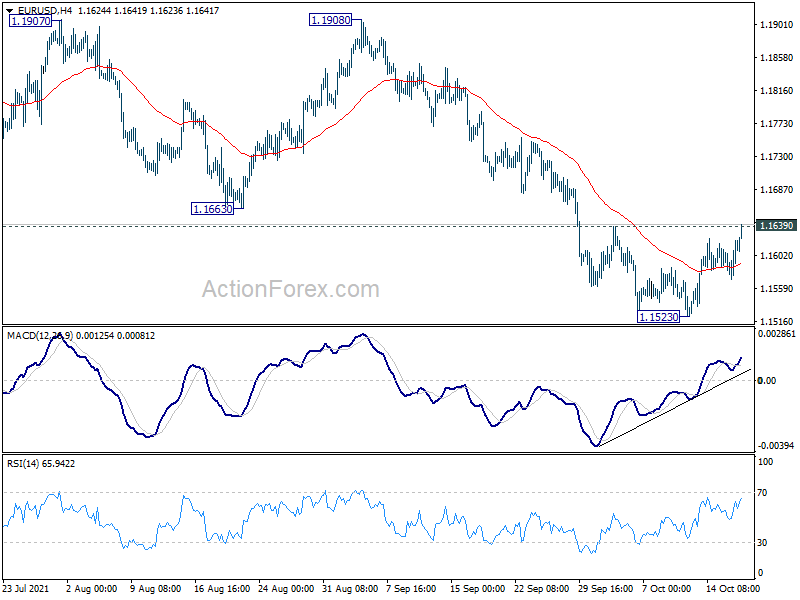
In the bigger picture, price actions from 1.2348 should at least be a correction to rise from 1.0635 (2020 low). As long as 1.1908 resistance holds, deeper fall would be seen to 61.8% retracement of 1.0635 to 1.2348 at 1.1289. Nevertheless break of 1.1908 resistance will revive medium term bullishness and turn focus back to 1.2348 high.
Dollar Selloff Resumes, EUR/USD Breaking Near Term Resistance
Dollar's selloff resumes in Asian session today, while Yen is also trading lower. Risk-on markets in Asia lift New Zealand and Australian Dollar. European majors are mixed for the moment, with Euro trying to recover against Sterling and Swiss Franc. The economic calendar is rather light today, and focuses will mainly be on the development in overall market sentiments, as well as comments from Fed officials later in the day.
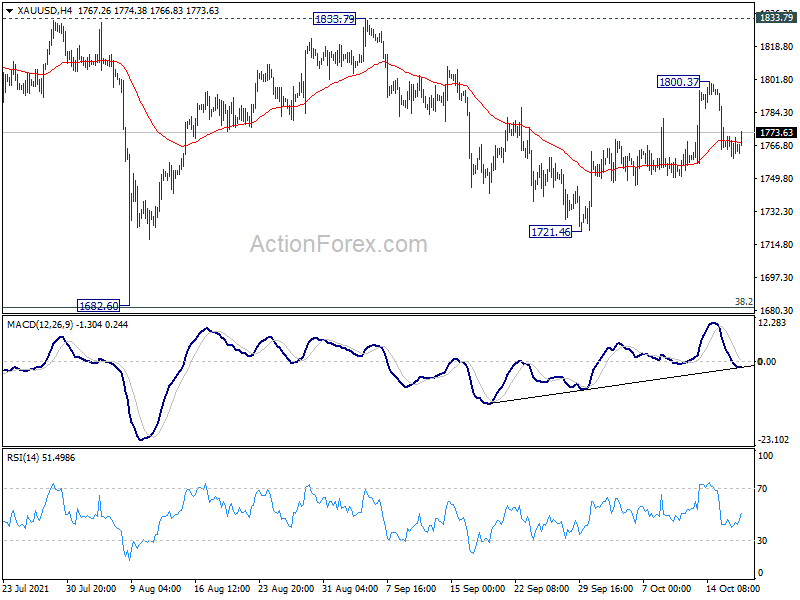
Technically, EUR/USD's breach of 1.1639 minor resistance suggests short term bottoming at 1.1523 already, which suggests more downside in Dollar in general. We'd now keep an eye on Gold too. While the retreat from 1800.37 might have disappointed some Gold bulls, it's resiliently holding on to 4 hour 55 EMA, which maintains the chance of further rally. Break of 1800.37 will resume the rebound from 1721.46 towards 1833.79 key near term resistance. Such development would at least confirm Dollar's weakness for the near term.
In Asia, at the time of writing, Nikkei is up 0.65%. Hong Kong HSI is up 1.49%. China Shanghai SSE is up 0.63%. Singapore Strait Times is up 0.50%. Japan 10-year JGB yield is down -0.0050 at 0.091. Overnight, DOW dropped -0.10%. S&P 500 rose 0.34%. NASDAQ rose 0.84%. 10-year yield rose 0.008 to 1.584, after reversing much of earlier gains to 1.627.
RBA: Global supply chain disruptions had limited effect on inflation
In the minutes of October 5 meeting, RBA reiterated that economic recovery was interrupted by the outbreak of Delta. Economy is expected to return to growth in Q4, after contraction in Q3, and then back to pre-Delta path in H2 of 2022. Economy recovery was "likely to be slower than in late 2020/early 2021" and "much would depend on health outcomes and the nature and timing of the easing of restrictions on activity."
RBA also noted, "while disruptions to global supply chains were affecting the prices of some goods, the effect of this on the overall rate of inflation in Australia was limited". Wages growth and underlying inflation were "expected to pick up only gradually as the economy recovers.
It acknowledged that house prices and credit growth had continued to rise strongly. "while less accommodative monetary policy would, all else equal, see lower housing prices and credit growth, it would result in fewer jobs and lower wages growth, which would in turn create further distance from the goals of monetary policy – namely, full employment and inflation sustainably within the target range."
Overall, the conditions for rate hike "will not be met before 2020". "Meeting this condition will require the labour market to be tight enough to generate materially higher wages growth than at the time of the meeting."
NZD/USD extending rally to 0.7169 resistance first
New Zealand Dollar is leading commodity currencies higher again this today. It's additionally backed by expectation of more RBNZ rate hike ahead, after report of decade high consumption inflation earlier this week.
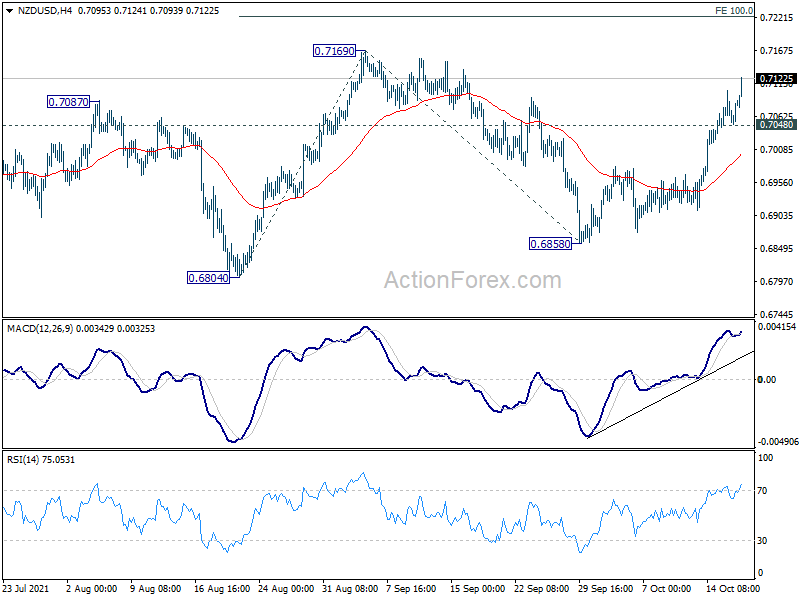
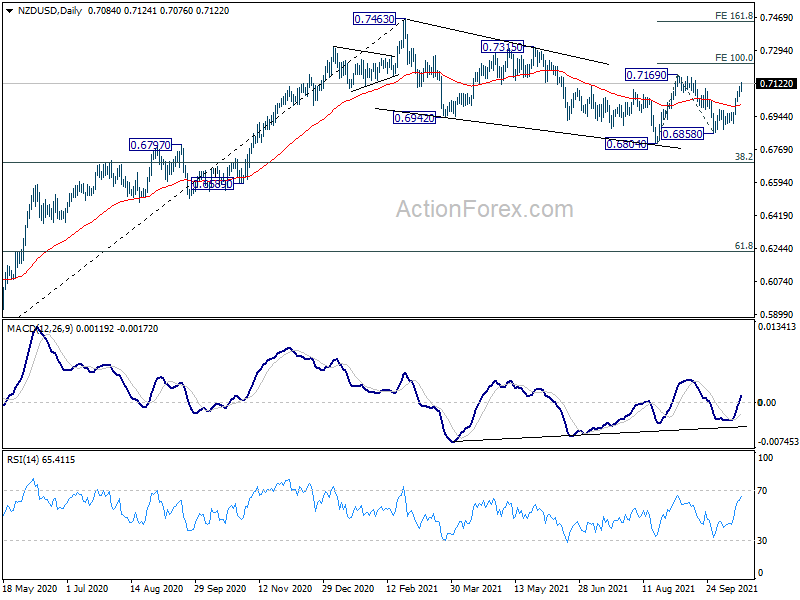
NZD/USD is extending the rebound from 0.6858 and further rise should be seen to 0.7169 resistance. Decisive break there will resume the rise from 0.6804 and target 100% projection of 0.6804 to 0.7169 from 0.6858 at 0.7223. Sustained break there would firstly indicate upside acceleration. Secondly, it will reaffirm the case that correction form 0.7463 has completed with three waves down to 0.6804. Stronger rally would then be seen to 161.8% projection at 0.7449, which is close to 0.7463 high. This will be the favored case as long as 0.7048 minor support holds.
Looking ahead
Swiss will release trade balance in European session. US will release housing starts and building permits later in the day. Main focuses will be more on comments from a batch of Fed officials, including Daly, Bowman, Bostic and Waller.
EUR/USD Daily Outlook
Daily Pivots: (S1) 1.1581; (P) 1.1602; (R1) 1.1632; More...
Focus is now on 1.1639 resistance in EUR/USD as rebound from 1.1523 extends today. Sustained break there will confirm short term bottoming at 1.1523. Intraday bias will be turned back to the upside for stronger rebound, to 55 day EMA (now at 1.1712). Break there will pave the way to 1.1908 resistance. On the downside however, break of 1.1523 will resume larger decline from 1.2265 to 1.1289 medium term fibonacci level.
In the bigger picture, price actions from 1.2348 should at least be a correction to rise from 1.0635 (2020 low). As long as 1.1908 resistance holds, deeper fall would be seen to 61.8% retracement of 1.0635 to 1.2348 at 1.1289. Nevertheless break of 1.1908 resistance will revive medium term bullishness and turn focus back to 1.2348 high.
Economic Indicators Update
| GMT | Ccy | Events | Actual | Forecast | Previous | Revised |
|---|---|---|---|---|---|---|
| 00:30 | AUD | RBA Minutes | ||||
| 06:00 | CHF | Trade Balance (CHF) Sep | 6.23B | 5.06B | ||
| 12:30 | USD | Housing Starts Sep | 1.61M | 1.62M | ||
| 12:30 | USD | Building Permits Sep | 1.67M | 1.72M |
NZD/USD extending rally to 0.7169 resistance first
New Zealand Dollar is leading commodity currencies higher again this today. It's additionally backed by expectation of more RBNZ rate hike ahead, after report of decade high consumption inflation earlier this week.
NZD/USD is extending the rebound from 0.6858 and further rise should be seen to 0.7169 resistance. Decisive break there will resume the rise from 0.6804 and target 100% projection of 0.6804 to 0.7169 from 0.6858 at 0.7223. Sustained break there would firstly indicate upside acceleration. Secondly, it will reaffirm the case that correction form 0.7463 has completed with three waves down to 0.6804. Stronger rally would then be seen to 161.8% projection at 0.7449, which is close to 0.7463 high. This will be the favored case as long as 0.7048 minor support holds.
RBA: Global supply chain disruptions had limited effect on inflation
In the minutes of October 5 meeting, RBA reiterated that economic recovery was interrupted by the outbreak of Delta. Economy is expected to return to growth in Q4, after contraction in Q3, and then back to pre-Delta path in H2 of 2022. Economy recovery was "likely to be slower than in late 2020/early 2021" and "much would depend on health outcomes and the nature and timing of the easing of restrictions on activity."
RBA also noted, "while disruptions to global supply chains were affecting the prices of some goods, the effect of this on the overall rate of inflation in Australia was limited". Wages growth and underlying inflation were "expected to pick up only gradually as the economy recovers.
It acknowledged that house prices and credit growth had continued to rise strongly. "while less accommodative monetary policy would, all else equal, see lower housing prices and credit growth, it would result in fewer jobs and lower wages growth, which would in turn create further distance from the goals of monetary policy – namely, full employment and inflation sustainably within the target range."
Overall, the conditions for rate hike "will not be met before 2020". "Meeting this condition will require the labour market to be tight enough to generate materially higher wages growth than at the time of the meeting."
(RBA) Minutes of the Monetary Policy Meeting of the Reserve Bank Board
Videoconference – 5 October 2021
Members present
Philip Lowe (Governor and Chair), Guy Debelle (Deputy Governor), Mark Barnaba AM, Wendy Craik AM, Ian Harper AO, Carolyn Hewson AO, Steven Kennedy PSM, Carol Schwartz AO, Alison Watkins
Others participating
Michele Bullock (Assistant Governor, Financial System), Luci Ellis (Assistant Governor, Economic), Christopher Kent (Assistant Governor, Financial Markets)
Anthony Dickman (Secretary), Penelope Smith (Deputy Secretary), Alexandra Heath (Head, International Department), Bradley Jones (Head, Economic Analysis Department), Jonathan Kearns (Head, Financial Stability Department), Marion Kohler (Head, Domestic Markets Department)
International economic developments
Members commenced their discussion of international economic developments by noting that the recovery in economic activity in advanced economies had continued in recent months. High vaccination rates had allowed restrictions on activity to be eased, which was supporting business conditions and, in turn, the demand for labour. Labour shortages were being reported in some countries, constraining hiring and boosting wages growth in certain industries, including in customer-facing areas such as hospitality. Labour force participation was still well below pre-pandemic levels in a number of large advanced economies, including the United States, the euro area and the United Kingdom. With students physically returning to school and health concerns abating, members thought it would become clearer in coming months whether workers had left the labour force temporarily or permanently.
Members noted that patterns in wages growth differed across advanced economies. Some economies that were experiencing a pick-up in wages growth, such as the United States and the United Kingdom, were also those that had experienced relatively fast wages growth and higher inflation prior to the pandemic. Employment was still well below pre-pandemic levels in these countries. In New Zealand, wages growth had also picked up in prior months, which was consistent with the Reserve Bank of New Zealand's assessment that spare capacity had largely been absorbed. The more modest wages growth in Canada and the euro area was consistent with ongoing spare capacity in labour markets in these economies.
Members noted that the combination of strong demand for goods globally, supply bottlenecks and rising energy prices had caused measures of producer price inflation to increase to their fastest rate in many years. The prices of energy‐related commodities, including liquefied natural gas (LNG) and thermal coal, were well above the levels prevailing at the start of the year; this reflected low inventories and strong demand, including from a weather-related boost to electricity production in the northern hemisphere and strong global goods production. Coal and LNG prices had also been supported by supply disruptions in Europe and Asia.
The pass-through of higher producer price inflation to underlying consumer price inflation had varied across countries. Increases in consumer price inflation had been most apparent in some large emerging market economies. Headline consumer price inflation in advanced economies remained high, though underlying measures of inflation had not risen to the same extent. Most central banks in advanced economies had continued to characterise pandemic-related price increases as either temporary or one-off price level changes that would have only a transitory effect on inflation.
Members discussed the slowing in economic activity in China over recent months, including the role of policies to reduce overall debt levels and emissions, as well as the effects of the pandemic. The previously announced caps on Chinese steel production and concerns about excess leverage in China's property sector had put further downward pressure on iron ore prices. However, onshore coal prices had surged as a result of strong demand, low inventories and domestic supply disruptions. More generally, members noted that renewed focus in China on achieving 'common prosperity', combined with a range of regulatory actions, had created more uncertainty about the medium-term outlook for policy settings and the economy in China. Some observers had interpreted these developments as an attempt to curtail the influence of the private sector, while others saw it more as the next stage of long-running strategies to reduce poverty and corruption and to promote social fairness.
Elsewhere in east Asia, economic conditions had been adversely affected by surges in COVID-19 cases and the reintroduction of containment measures through July and August. However, rising vaccination rates and declining case numbers in recent weeks had allowed for restrictions to be eased. Growth in goods exports continued to be very strong among the more export-oriented economies, with surveyed manufacturing conditions remaining strong in all the advanced Asian economies.
Domestic economic developments
Turning to the domestic economy and the outlook, members noted that the rapid increase in vaccinations, particularly in states with outbreaks of the Delta variant of COVID-19, would see restrictions on activity eased sooner than previously expected. The international border was also set to begin reopening earlier than had been assumed. In addition, the publication of roadmaps by some states had provided more clarity over the sequencing and pace of economic reopening. Information from the Bank's liaison program indicated that many firms were preparing for the lifting of restrictions, and timely indicators of household spending and hiring intentions suggested the recovery in activity and employment would be well under way by the end of the year. Members noted that surveys of business and consumer sentiment had been fairly resilient during the recent lockdowns. In the central scenario, the economy was expected to have returned to its pre-Delta path by the second half of 2022. Nonetheless, members acknowledged that the recovery was likely to be uneven across the economy and that uncertainty would be a feature of the outlook for some time yet.
Timely data on mobility and spending indicated that consumption had stabilised in the latter part of the September quarter, following the sharp contraction beginning in June. The household saving ratio was expected to have increased sharply in the quarter, with lockdowns limiting households' ability to purchase many goods and services (particularly discretionary services). At the same time, pandemic assistance payments by the Australian Government and state and territory governments had supported the incomes of households that had experienced job losses or whose members were working reduced hours. The lifting of restrictions in New South Wales and Victoria was expected to lead to a solid recovery in household consumption in the December 2021 and March 2022 quarters. This would be supported by high accumulated savings, strong increases in household wealth and a rebound in employment. Even so, households' consumption of discretionary services was not expected to return to pre-pandemic levels until 2022.
Members observed that national housing market conditions remained very strong, with established housing prices continuing to rise rapidly. In Sydney, where private property inspections had been permitted, the volume of transactions remained relatively high. Meanwhile, in Melbourne, new listings and transaction volumes had declined significantly following the imposition of tighter restrictions on in-person inspections. Approvals for new dwellings, as well as for alterations and additions, had remained high across the country despite the end of the HomeBuilder application period. This was supporting the large pipeline of residential construction activity, which was expected to support dwelling investment over the following year despite some delays from disruptions in the September quarter. Approvals for private non-residential buildings had also increased in prior months, led by the office and industrial sectors, which was expected to support construction activity in the period ahead.
Members noted that restrictions on activity continued to have a significant effect on the labour market. Total hours worked had declined further in August to be 4 per cent below their June level. In New South Wales, hours worked had fallen by 13 per cent since June. The decline in employment had been more moderate, indicating that many employees had worked reduced hours but had not lost their jobs during the recent lockdowns. This included a large number of people who had been stood down on zero hours. The participation rate had declined further in August (reflecting a very large decline in New South Wales) as many of the people who had ceased being employed were classified as having left the labour force rather than as unemployed. As a result, the unemployment rate had been little changed at 4.5 per cent. Broader measures of labour underutilisation, which captured people working zero or reduced hours and net flows out of the labour force, had increased sharply since the middle of the year.
Forward-looking indicators of labour demand had been much more resilient than they had been during the lockdowns in 2020. The overall level of job advertisements remained high. There were indications that some firms in New South Wales were preparing to step up hiring ahead of the easing of restrictions in October. In addition, information from the liaison program continued to suggest that firms affected by the lockdowns had been reluctant to lay off staff given their experiences with labour shortages and strong labour demand prior to the Delta outbreak. Members noted that the central forecast scenario envisaged the level of employment, unemployment and participation to have broadly recovered to pre-Delta levels by around the end of the year, although there was considerable uncertainty around this projection.
In discussing the ongoing modest wages growth in Australia, members noted that the recent lockdowns and earlier reports of labour shortages had not appeared to affect most firms' expectations for wages growth, which were generally returning to around pre-pandemic norms. While reduced labour force participation had seen some countries experience wage pressures before employment had returned to pre-pandemic levels, this was not the case in Australia. Even in industries that had experienced strong labour demand, wages growth remained subdued. In reviewing wages growth across different types of wage-setting arrangements, members noted that a small share of people on individual agreements had received larger wage increases over recent quarters, in part reflecting earlier wage cuts that had been reversed. Overall, there were few indications from disaggregated wages data or from the Bank's liaison program to suggest that aggregate wages growth was likely to accelerate sharply in the period ahead.
Members concluded their discussion of domestic economic developments by observing that underlying inflation pressures in Australia were more moderate than in other advanced economies. This reflected a range of factors, including the relatively slow rate of wages growth in Australia. Members noted that, while it was possible that underlying inflationary pressures in Australia could build more quickly than currently envisaged, the central forecast scenario was still that domestic inflation would pick up only gradually over the medium term.
International financial markets
Members commenced their review of developments in international financial markets with a discussion of Evergrande, a large private Chinese property developer. Recent developments in Evergrande's financial position had led to a decline in risk sentiment across global financial markets in September. While Evergrande is small relative to the financial system in China, members noted a financial stability risk from spillovers to other developers and financiers if the resolution of Evergrande's problems were to be disorderly. Some other property developers had also experienced restrictions on their ability to borrow under China's 'three red lines' policy because they had some combination of high leverage, high gearing or low liquidity ratios. Members noted that a deterioration in confidence in developers could see a sharp withdrawal of credit provided to the sector and a decline in pre-sales, placing them under further stress. However, sharp price movements had so far been limited to Evergrande's own bond and equity prices, along with those of some other Chinese property developers and the equity prices of a small number of banks with large exposures to Evergrande. Broader financial conditions in China had been stable, aided by liquidity injections from the central bank. Chinese authorities had also taken a number of steps to support credit growth to smaller private enterprises, which had slowed in recent months. The renminbi exchange rate had remained around its highest level in recent years.
Central banks in advanced economies had continued to provide significant policy stimulus. Some central banks had begun to reduce the extent of their policy stimulus, or were expected to do so over the coming year as the economic recovery progressed. Members noted that central banks' policy decisions had been informed by how close they were to achieving their policy goals. Although inflation had been above central banks' targets in most advanced economies and energy prices had risen noticeably in preceding months, inflationary pressures were generally expected to ease over time as supply constraints were resolved. Even so, inflationary pressures had been more persistent than previously expected in some countries, including the United States and the United Kingdom, and the rate of wages growth had picked up noticeably in some countries. This had led to an increase in long-term government bond yields and upward revisions in the path for policy rates implied by market pricing.
The Bank of Korea and Norges Bank had already increased their policy rates, and market pricing implied that the Reserve Bank of New Zealand was expected to increase its policy rate in the coming days. Market participants expected the Bank of England and the Bank of Canada to cease net purchases of government bonds by the end of 2021. Persistent inflationary pressures related to rising energy prices and labour shortages had brought forward the timing of the Bank of England's first policy rate increase implied by market pricing to early 2022. The US Federal Reserve (Fed) had indicated that it was likely to begin moderating the pace of its asset purchases in November, with an intention to cease net purchases by mid 2022. Market pricing implied that the Fed could start raising its policy rate in late 2022 or early 2023, consistent with the 'dot plot', which summarises Federal Open Market Committee participants' outlook for the federal funds rate.
Financing conditions for businesses in advanced economies had remained very favourable. Equity markets had remained close to recent highs, despite declines over the preceding month in response to concerns about the Chinese property sector and the rise in sovereign bond yields in advanced economies. Corporate bond spreads had remained low.
The Australian dollar had depreciated since mid 2021, to be around 3 per cent lower on a trade-weighted basis than at the start of the year. The depreciation from the middle of the year had been consistent with the decline in yields on Australian government bonds compared with those of other major advanced economies and, more recently, concerns around slowing momentum of the Chinese economy.
Members discussed the shift in Australia's balance of payments, including the large current account surplus. They noted the decline in private investment as a share of GDP following the mining investment boom and the large increase in private savings during the pandemic.
Domestic financial markets
The Bank's policy measures continued to underpin very low domestic interest rates. Members noted that, following the Board's decision in the previous month to proceed with the reduction in the pace of bond purchases to $4 billion per week, and to maintain this pace until at least mid February 2022, bond yields had declined slightly and the Australian dollar exchange rate had depreciated a little. Subsequently, yields had risen, broadly in line with those in the United States. Market pricing implied that the first increase in the cash rate was expected around the end of 2022.
Banks' funding costs and outstanding lending rates had continued to drift down to new lows. New loans were being taken out at historically low rates, and existing borrowers were benefiting from refinancing at lower available rates. Loan commitments had remained high in August and growth in housing credit had picked up further in six-month-ended terms. Growth in business debt had picked up over recent months to the fastest pace since prior to the global financial crisis. This growth had been driven by large businesses, with debt of small businesses little changed in recent months. While banks had been open to providing loan payment deferrals to borrowers affected by lockdowns, take-up by households and small and medium-sized businesses had been very modest, in stark contrast to the experience of 2020.
Financing conditions in bond markets remained very favourable. Members observed that bank bond issuance had picked up a little in prior months, after having been subdued while banks drew down on the three-year funding provided by the Term Funding Facility. Issuance of residential mortgage-backed securities had also been strong, with the highest quarterly amount issued since the financial crisis. Corporate bond spreads remained very low, and corporate debt issuance had been robust.
Australian equity prices had declined over the preceding month, but remained close to recent highs. Prices of mining stocks had declined noticeably, following the sharp drop in iron ore prices, while stocks of companies exposed to travel had picked up as plans for the reopening of borders became clearer.
Financial stability
Members were briefed on the Bank's regular half-yearly assessment of financial stability risks.
Banks in advanced economies continued to be well capitalised, with ample liquid assets, and remained able to support the economic recovery. Profitability of large banks had increased, in part because new provisions for loan losses had fallen sharply and some banks had reduced their existing provisions for loan losses. Banks' capital ratios had increased with the higher profitability; Common Equity Tier 1 ratios were around 60 to 140 basis points higher than a year earlier, in part reflecting restrictions on capital distributions imposed by regulators during 2020. Given the improvement in economic conditions in advanced economies, regulators had begun to remove these restrictions on capital distributions and reduce regulatory relief. Many large banks had announced share buyback plans and increased dividends.
In China, authorities had continued to balance addressing increased financial system vulnerabilities with avoiding a realisation of those vulnerabilities that would sharply lower economic growth. This trade-off had been a feature of the significant focus on the liquidity crisis facing Evergrande. More generally, the number of adjustments to policy occurring simultaneously had increased the potential for unintended outcomes.
In some emerging market economies, output remained below pre-pandemic levels, reflecting pre-existing macroeconomic and financial imbalances as well as lower vaccination rates and increases in COVID-19 cases, which had curtailed economic activity. These economies could face capital outflow and exchange rate depreciation if their interest rates did not increase alongside the increases expected in advanced economies; however, higher interest rates in emerging market economies would risk further delaying the economic recovery. Either sharp capital outflow and exchange rate depreciation or a sharp fall in output could trigger financial instability in these economies.
Low long-term sovereign interest rates and optimism about business incomes had contributed to high prices of financial assets and increased risk-taking. Some asset prices did not appear to reflect the risk to economic activity still presented by the pandemic. There could be widespread asset price falls if there were sharp increases in risk premiums or risk-free interest rates from unexpected inflation.
In many economies, there had been further significant rises in housing prices over the preceding six months. Low interest rates, in combination with strong household balance sheets as a result of limited consumption opportunities and government transfers, had contributed to these price rises. Regulators in some countries had indicated that housing prices had risen beyond the level suggested by their fundamental determinants, although in many countries growth in housing prices appeared to have peaked. Housing credit had grown faster than incomes in a number of countries and housing credit growth was around post-2008 highs in Canada, New Zealand, the United Kingdom and the United States. Some regulators had highlighted high household indebtedness and/or a rise in risky lending as a vulnerability, and macroprudential policies had been tightened in Canada, South Korea and New Zealand.
In Australia, households' balance sheets had strengthened over the first half of 2021, prior to the lockdowns brought on by the outbreak of the Delta variant of COVID-19. Households had been using accumulated higher savings to make excess home loan repayments into redraw and offset facilities. But there had also been a substantial rise in other deposits. Growth in household borrowing had increased, with aggregate household debt growing faster than income.
Housing loan commitments had increased strongly in the first half of 2021, but had declined slightly since mid year. Recent levels of loan commitments suggested that housing credit growth could reach a six-month-ended annualised rate of around 10 per cent by early 2022. Lending standards had remained sound, although the share of lending at high debt-to-income ratios had increased.
Given the build-up of risks associated with high and rising household indebtedness, the Australian Prudential Regulation Authority (APRA) had been in close consultation with the Bank and other agencies of the Council of Financial Regulators about an appropriate macroprudential policy response. Analysis suggested that these risks would be best addressed with a serviceability-based macroprudential measure, which would ensure that borrowers would have more income left over after home loan repayments and other expenses. Other options that could be used to improve borrowers' buffers would be portfolio restrictions on individual lenders' shares of lending at high debt-to-income ratios and/or high loan-to-valuation ratios. APRA was scheduled to publish a macroprudential policy framework paper later in the year, which would outline the objectives for macroprudential policy, as well as the broad range of tools available to address different risks and how they could be implemented. The Bank would also shortly publish a special chapter on macroprudential policy in the October Financial Stability Review.
Business balance sheets were generally in a good position prior to the outbreak of the Delta variant. Most businesses had increased their liquidity buffers over 2020, with low interest rates providing support. Government payments and other measures, such as loan deferrals and rent moratoria, had also boosted cash flows for firms adversely affected by lockdowns. In aggregate, profits had increased in the first half of 2021 as the economy rebounded strongly; however, some firms were vulnerable as the ongoing restrictions had constrained their activity and, as a result, insolvencies were likely to rise.
The Australian financial system remained resilient. The loan-to-valuation ratios on most outstanding home loans meant that banks would be well protected against even large housing downturns. Expectations of heightened losses across all loans, which were formed early in the pandemic, were now unlikely to be realised. As a result, banks had started to release provisions, although at a gradual rate because of the uncertainty around the effects of the recent lockdowns. These factors had contributed to an increase in profits over the first half of 2021, which had returned to pre-pandemic levels. An increase in net interest margins had also contributed. Australian banks' capital ratios were well above regulatory requirements and were expected to remain above those requirements even after increased dividends and share buybacks.
Other risks to the Australian financial system continued to require ongoing vigilance. In particular, risks from IT systems remained acute and, in recognition of this, financial regulators had been working with financial institutions to bolster their cyber resilience. Financial institutions and regulators were also continuing to work on managing financial risks from climate change.
Considerations for monetary policy
In considering the policy decision, members observed that the outbreak of the Delta variant of COVID-19 had interrupted the recovery of the Australian economy and the available data pointed to a material decline in GDP in the September quarter. However, the setback was expected to be only temporary, with the economy anticipated to bounce back as vaccination rates continue to rise and restrictions are eased. In the central scenario, the economy would return to growth in the December quarter and to its pre-Delta path in the second half of 2022. Members also observed that the economic recovery was likely to be slower than in late 2020/early 2021. Much would depend on health outcomes and the nature and timing of the easing of restrictions on activity.
Wage and price pressures in Australia remain subdued. Members noted that while disruptions to global supply chains were affecting the prices of some goods, the effect of this on the overall rate of inflation in Australia was limited. Wages growth and underlying inflation were expected to pick up only gradually as the economy recovers.
The Bank's package of policies – including record low interest rates, the bond purchase program, the yield target and the funding provided under the Term Funding Facility – was providing substantial and ongoing support to the Australian economy. Borrowing rates were at record lows, sovereign bond yields were at very low levels and the exchange rate had depreciated over prior months. The fiscal responses by the Australian Government and the state and territory governments had also been providing welcome assistance to household and business balance sheets.
Housing prices and credit growth had continued to rise strongly at a time of historically low interest rates, with strong demand for credit by both owner-occupiers and investors. Given the environment of rising housing prices and low interest rates, members continued to emphasise the importance of maintaining lending standards and agreed that loan serviceability buffers were appropriate. Members also agreed that, while less accommodative monetary policy would, all else equal, see lower housing prices and credit growth, it would result in fewer jobs and lower wages growth, which would in turn create further distance from the goals of monetary policy – namely, full employment and inflation sustainably within the target range.
The Board remained committed to maintaining highly supportive monetary conditions to achieve a return to full employment in Australia and inflation consistent with the target. It will not increase the cash rate until actual inflation is sustainably within the 2 to 3 per cent target range. The central scenario for the economy is that this condition will not be met before 2024. Meeting this condition will require the labour market to be tight enough to generate materially higher wages growth than at the time of the meeting.
The decision
The Board decided upon the following policy settings:
- maintain the cash rate target at 10 basis points and the interest rate on Exchange Settlement balances of zero per cent
- maintain the target of 10 basis points for the April 2024 Australian Government bond
- continue to purchase government securities at the rate of $4 billion a week until at least mid February 2022.
Eco Data 10/19/21
[php_everywhere instance="1"]
NZD Hits 4-Week High on Hot Inflation
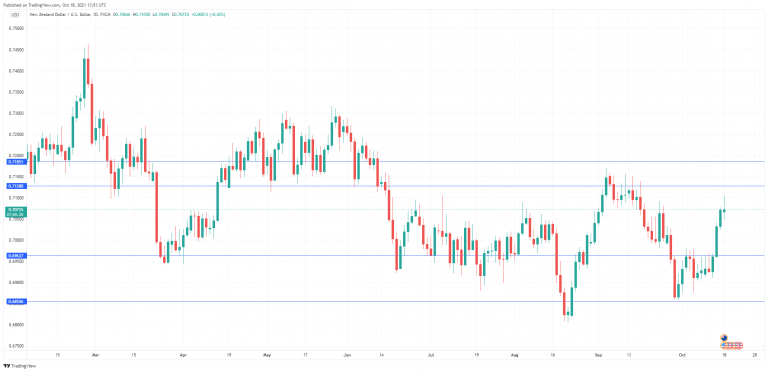
The New Zealand dollar is drifting on Monday, after briefly breaking above the 71 level. Overnite, NZD/USD rose to 0.7105, its highest level since September 16. The currency climbed 2.07% last week, its best week since late August.
New Zealand inflation climbs to 10-year high
Inflation continues to rise in the major economies. The relaxation of health restrictions and the reopening of economies have led to an unleashing of pent-up demand as well as supply-chain disruptions. New Zealand reported that third-quarter inflation surged to 4.9% (YoY), up from 3.3% in Q2 and above the consensus of 4.2%. This was the highest inflation rate in 10 years. Consumer prices rose 2.2% (q/q), compared to 1.3% in Q2 and ahead of the forecast of 1.5%.
Major central banks such as the Fed, the ECB and the BoE have argued that the surge in inflation is a temporary phenomenon, but markets are becoming more sceptical of this stance as there are no signs that inflation will ease anytime soon. In New Zealand, inflation has exceeded the RBNZ 1-3% target band, and ASB Bank is projecting that inflation will top 5% by the end of the year. Inflation continues to rise despite the prolonged lockdown of Auckland, the country’s largest city, which has dampened economic growth.
The RBNZ has embarked on a series of rate hikes and raised rates by 0.25% earlier this month, with another 0.25% hike fully priced in for the November meeting. This may not be enough to contain inflation, and the market has priced in a 50% chance that the bank will raise rates by 50 basis points at next month’s meeting.
The US dollar index continues to range-trade and is currently at 0.9405, up 0.10% on the day. If the index has a daily close below 93.50, that could change the bullish sentiment towards the US dollar. Conversely, if the index breaks above resistance at 94.50, it has room to move higher.
NZD/USD Technical
- NZD/USD faces resistance at 0.6855 and 0.6963
- There are support lines at 0.7128 and 0.7185