Sample Category Title
Pound Pauses after Strong Week
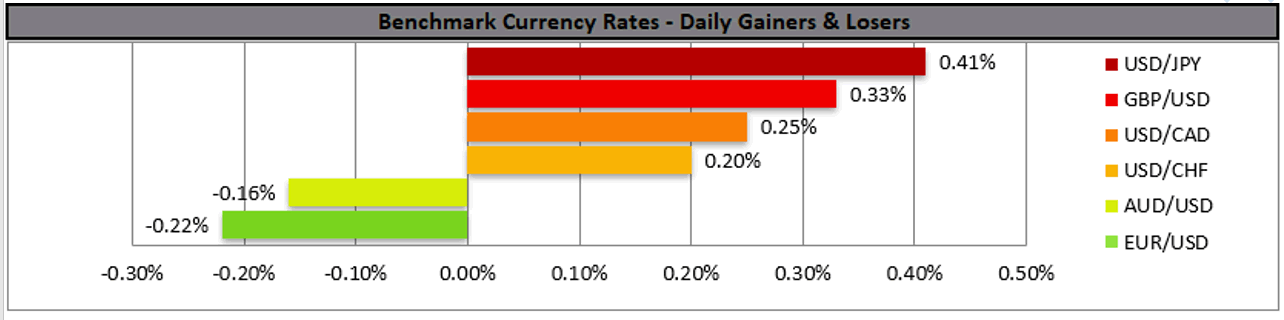
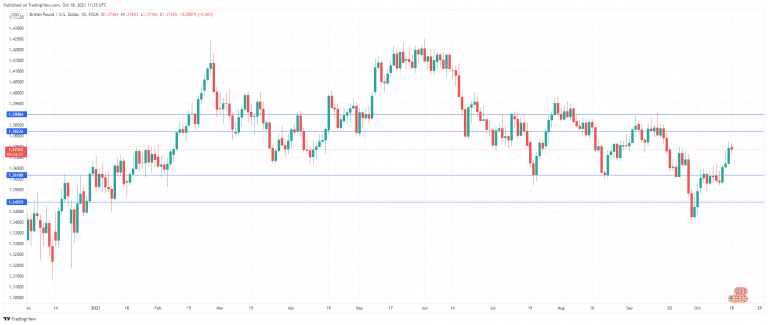
The British pound is slightly lower in the Monday session. GBP/USD is currently trading at 1.3724, down 0.15% on the day. The currency rose 0.98% last week, its best weekly performance since late August.
BoE’s Bailey hints at rate hike
The BoE continues to signal that it is preparing to raise interest rates shortly. The Bank has been sending a stream of hawkish messages to the markets, with Governor Bailey and other policymakers hinting that a rate hike is on its way shortly. On Sunday, Bailey said that inflation would rise higher and last longer due to the surge in energy prices, and that the central bank “will have to act” via monetary policy in order to deal with the risk of high inflation. The BoE has projected that inflation will climb over 4%, which is more than twice its target. In order to curb inflation, the BoE may respond with a series of rate hikes, which could kick off as early as November.
This would be a highly significant move, as the BoE would become the first major central bank to raise rates since the start of the Covid pandemic in early 2020. With the Bank holding its next policy meeting on November 4th, any additional hawkish comments from BoE policymakers will raise expectations that the November meeting will be a live one.
Rate fever is also rising across the pond. Last week, the FOMC minutes indicated that the Fed expects to taper its bond purchases in November or December. The minutes noted that the Fed would reduce the USD 120 billion/ month gradually, until the programme was completely terminated by July 2022. The markets have brought forward the pricing of a rate hike from December 2022 to September 2022, projecting a rate hike shortly after the tapering is complete.
GBP/USD Technical Analysis
- 1.3822 is the next resistance line, followed by the round number of 1.3900
- There is support at 1.3618. Below, there is support at 1.3492
China’s Government is to Blame for Disappointing Growth. Fourth Quarter Not Likely Better as Power and Regulatory Problems Deepen
China's economy falters. GDP expanded +4.9% y/y in 3Q21, weaker than consensus of +5% and +7.9% in the prior quarter. From a quarter ago, the economy climbed only an annualized +0.8%. Power shortage, policy change, uncertainty about the pandemic were to blame for the disappointment. Without quick fixes to these constraints, we expect the worst the yet to come.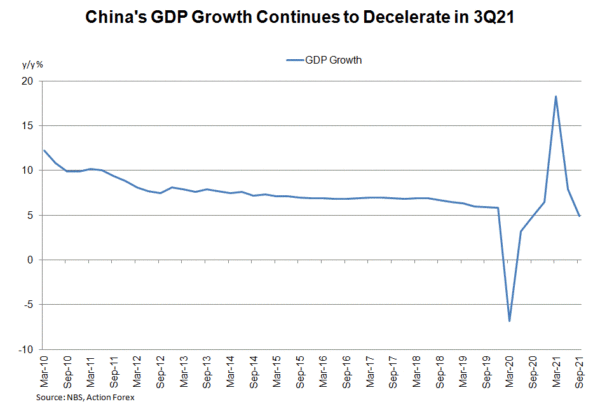
Industrial production grew +3.1% y/y in September, missing consensus of +3.8% and significantly less than August’s +5.3%. The downside surprise was mainly attributed to power shortage and supply chain disruption. The government has already urged for higher coal production and approved increase in electricity price, in order to alleviate power shortage. We doubt if this could be of much help as electricity consumption should accelerate rapidly during winter season. Some ports remained closed due to the pandemic, prolonging the problem of chip shortages. China’s heavy reliance on chip imports (90%) could eventually defeat its industrial sector, in particular equipment, automobiles and telecommunication devices, in the long-term.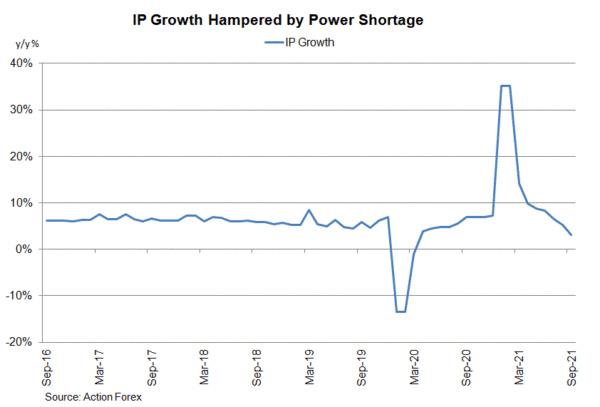
Urban fixed asset investment (FAI) expanded +7.3% y/y in the first 9 months of the year, also weaker than +7.8% in first 8 months. FAI contracted -1.7% y/y in the month of September, following mild growth of +0.7% in the prior month. Looking into details, manufacturing investment expanded +10.2% y/y in September, accelerating from +6.2% in August. Property investments, however, dropped -3.5% y/y, following mild increase if +0.6% in August. This also marks the first contraction since February 2020. Infrastructure investment declined further, down -3% y/y in September, after a -3.4% fall a month ago.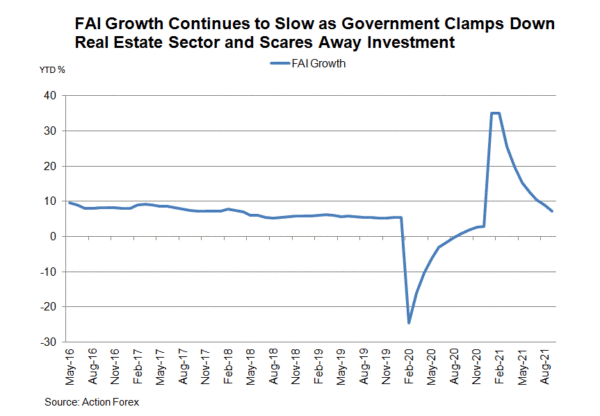
The only good news came from retail sales, which rose +4.4% y/y, beating consensus of +3.5% and +2.5% in August. On a monthly basis, retail sales rebounded +5.6% m/m in September, following a -3.3% contraction in the prior month. The strength can be attributed to relaxation of pandemic-related restrictive measures in late-August. Note that catering sales increased +3.1% y/y in September, after contracting -4.5% a month ago. Meanwhile, online goods sales remained firm, with growth accelerating to +10.1% y/y, from +5.1% in August.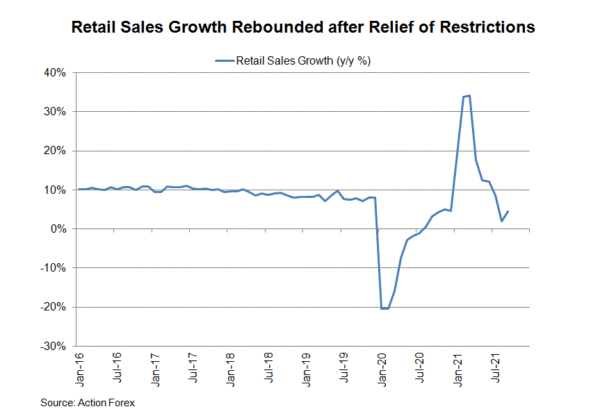
China’s GDP growth is in deceleration. We are not too optimistic about the growth in 4Q21 as factors constraining third quarter growth remain in play. A colder-than-usual winter will increase residents’ electricity consumption. Xi’s populist approach to consolidate his political influence suggests that residents’ demand is likely prioritized above industrial activities’ demand for electricity. Given that the overall electricity supply will remain tight in the months ahead, it is likely for industries/factories to continue to suffer from power disruption.
It is just the beginning of CCP’s reform on various sectors, in particular the real estate sector and technology sector. As the government attempts to deleverage the real estate sector, it is difficult for the PBOC to ease its monetary policy to stimulate growth. Indeed, we now expect a RRR reduction is less likely than before. Meanwhile, the government’s erratic moves lack transparency, greatly demotivating private investment both domestically and abroad. Worse still, Evergrande’s debt problem is just the tip of the iceberg. We are concerned about the spillover effect from Evergrande although the PBOC has assured the risk is limited.
US Futures Slip As Chinese Growth Disappoints
Asian stocks started on the back foot this week with US and European markets set for a soft open. Bond yields were trading slightly up and the dollar continues to hold near one-year highs.
Disappointing Chinese economic data and surging oil prices are the current sources of anxiety for investors. All data releases out of China today, except for retail sales, printed below analyst estimates. Third-quarter gross domestic product grew three tenths below expectations at 4.9%, September's industrial production rose by 3.1% year-on-year versus an anticipated 4.5% increase, and fixed asset investments grew 7.3% for the same period, missing economist forecasts of 7.9%.
Power shortages, supply bottlenecks, tight credit conditions and the struggling real estate market are the main factors dragging on China's growth. Elevated energy prices are not helping either with Brent crude trading near $86, the highest level since October 2018. Expect these factors to continue weighing on growth momentum for the next several months. That means policymakers in the world’s second largest economy need to take fast action to prevent further damage. However, any regulatory, fiscal or monetary support will take at least until the first quarter of 2022 to come to fruition.
Later this week, we will also get a snapshot of how supply bottlenecks and higher inflation are impacting developed countries' economic activities. PMI readings for the eurozone, UK and the US will be released on Friday. It wouldn't be surprising if the figures head south given the deteriorating sentiment around economic conditions.
Investors may need to prepare for wilder swings in markets if the combination of deteriorating economic data along with higher inflation and bond yields continue to hold. But the good news is that earnings of US companies remained robust heading into the third quarter. So far, 8% of S&P 500 companies have announced results for the third quarter with 80% beating EPS estimates. According to Factset, the estimated earnings growth rate is expected to be around 30%, marking the third highest year-on-year rate since the third quarter of 2010.
Given the many variables now impacting asset prices, investors need to be careful when it comes to stock picking. In such an environment of elevated inflation, companies that have the power to pass costs onto consumers while maintaining high profit margins tend to outperform the overall market. Therefore, it's time to become more selective in one’s investment approach.
EUR/USD: Bearish Waterfall And The Downtrend Continues
EUR/USD technical analysis
- EUR/USD is dropping from the highs.
- The market is in a strong bearish trend.
- The break of the blue level is cueing for a continuation.
- The doors towards 1.1390 is open.
Daily chart EUR/USD
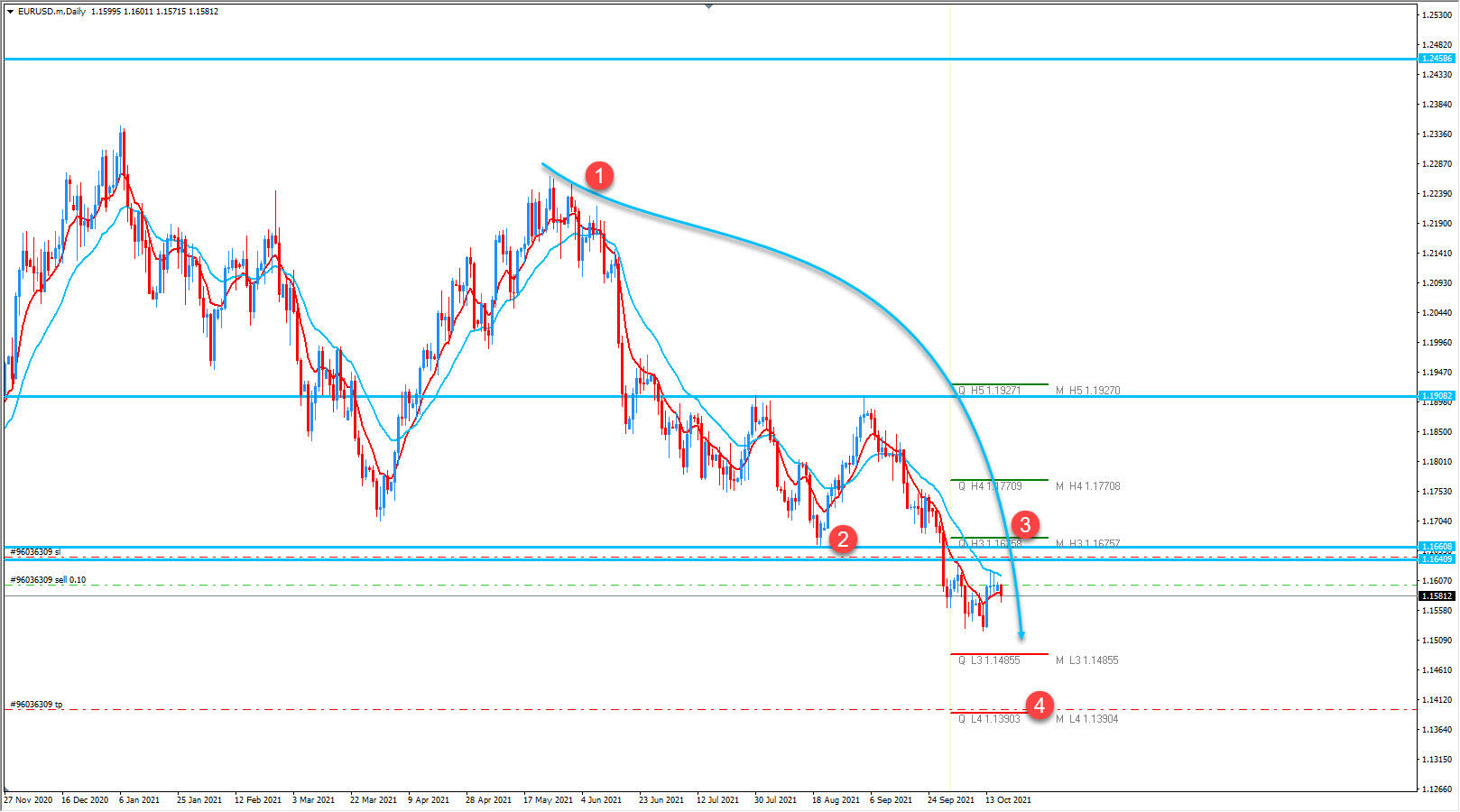
- The high of the waterfall pattern.
- A drop close to the blue zone.
- Bearish entry zone.
- Possible target.
The EUR/USD on the daily timeframe is very bearish. The waterfall pattern suggests a strong bearish impulse and we should see the price moving don below the blue zone and towards the Q L3 camarilla pivot. At this point we could see a strong bearish impulse leading further down as we have back-to-back parallel bearish candlesticks. Targets are Q L3 camarilla pivot and M L4. 1.1485 and 1.1390.
Rates Ruckus – Markets And Central Bankers Differ Whether Inflation Spike Is Transitory
Notes/Observations
- Markets remains focused on supply-chain issues and energy shortages (commodities, crude prices rose more than 1% to test 2018 highs); sentiment driving interest rates higher.
- Central banks trying to note market expectations are not that consistent with guidance.
- China Q3 GDP slows and concerns that Q4 could slow even more due to govt crackdown on the property sector and power shortage.
- Corporate earnings reports to pick up pace this week.
Asia
- (CN) China Q3 GDP Q/Q: 0.2% v 0.4%e; Y/Y: 4.9% v 5.0%e.
- (CN) China Sept Retail Sales Y/Y: 4.4% v 3.5%e.
- (CN) China Sept Industrial Production Y/Y: 3.1% v 3.8%e.
- New Zealand Q3 CPI data registered its 2nd consecutive reading above target, fastest in 10 years (Q/Q: 2.2% v 1.5%e; Y/Y 4.9% v 4.2%e.
- China PBOC Gov Yi Gang stated that the domestic economy was "doing well", but faced challenges such as default risks for certain firms due to "mismanagement"; authorities were keeping a close eye "so they did not become systematic risks".
- China National Bureau of Stats (NBS) stated it sought to ensure achieving annual economic targets, Reiterated govt stance that domestic recovery was unsolid and unbalanced , saw major economic data in reasonable range for Q1 to Q3.
- China has tested its first hypersonic missile with nuclear capabilities in August.
- Japan PM Kishida stated that had no plans to change consumption tax, could deliver cash handouts in a quick manner. Increasing corporate tax rate must be carefully considered.
Europe
- BOE Gov Bailey stated that had already signaled that we would have to act to fight inflation; Action to come in our monetary policy meetings.
- ECB chief Lagarde reiterated stance ECB would continue supporting the economy in order to durably stabilize inflation at 2% inflation target over the medium term. Reiterated Council view that current spike in inflation seen as transitory and unlikely to last. ECB was paying very close attention to wage negotiations and other potential 2nd round effects that could push prices permanently higher.
- ECB said to be looking at possibilities of raising its limit on purchases of EU-issued bonds. Move would be seen as enhancing flexibility in asset-buying schemes and boost the status of the bloc’s joint debt program launched this year.
- ECB's Knot (Netherlands) reiterated ECB stance that current rise in inflation was seen as mostly transitory but need to determine whether inflation spike was temporary and whether it became a risk that has secondary effects. He also noted that he saw interest rates edge up once central banks begin unwinding their stimulus programs during H1 2022.
- UK Treasury said to be speeding up preparations for a new e-commerce tax, still considering details and final decision on implementation, final decision not expected to spring.
Speakers/Fixed income/FX/Commodities/Erratum
Equities
- Indices [Stoxx600 -0.40% at 467.52, FTSE -0.18% at 7,220.86, DAX -0.49% at 15,510.40, CAC-40 -0.76% at 6,676.63, IBEX-35 -0.09% at 8,988.50, FTSE MIB -0.68% at 26,309.00, SMI +0.04% at 11,966.43, S&P 500 Futures -0.37%].
- Market Focal Points/Key Themes: European indices open lower across the board but retraced some of the losses as the session progressed; sectors among those trending higher include energy and materials; while laggard sectors include consumer discretionary and real estate; Gazit-Globe to acquire Atrium European Real Estate; Siemens to spin off it's large drive applicators division; Playtech recieves takeover offer from Aristocrat; AstraZeneca recoments against “mini-tender” from TRC; reportedly Richemont looking to sell Yoox-Net-A-Porter; earnings expected during the upcoming US session include State Street, Apple and Steel Dynamics.
Equities
- Consumer discretionary: Stellantis [STLA.IT] -1% (JV on lithium).
- Healthcare: Valneva [VLA.FR] +32% (positive vaccine data) , Benchmark Holdings [BMK.UK] +14% (trading update), Koninklijke Philips [PHIA.NL] -1% (earnings).
- Materials: Umicore [UMI.BE] -5% (cuts outlook).
- Technology: Playtech [PLAY.UK] +58% (to be acquired).
- Utilities: National Grid [NG.UK] +1% (trading update).
Speakers
- ECB's Visco (Italy) stated that certainty were price pressures at this time coming from bottlenecks and energy but reiterated ECB view that rise seen as transitory but would take time. Reiterated ECB Council view that 2nd round effects were not seen as relevant at this time. Reiterated ECB policy to remain accommodative. ECB could end up raising limits for international bonds but not currently being discussed. Noted that market expectations were not that consistent with ECB guidance (**Note: markets currently pricing 10bps hike by ECB in Nov 2022).
- ECB Vasle (Slovenia): Reiterates ECB council stance that high inflation results from temporary factors.
- France Fin Min Le Maire commented that higher energy prices could affect growth and tax revenues.
- Austria Debt Agency (AFFA) cuts planned 2021 issuance from €45B to €40B.
- EU Foreign Policy Chief Borrell stated that no confirmation of talks with Iran on Thursday, Oct 21st but was optimistic on preparatory meetings in the days ahead.
- EU’s financial services chief McGuinness said to have pledged to avoid market instability or a “cliff edge” over a decision on European banks’ ability to access UK clearing houses.
- Russia Fin Min Siluanov stated that fiscal normalization would ease inflation pressures.
Currencies/Fixed Income
- Yields continued to be the focus in FX with the debate raging whether or not the recent surge was temporary.
- GBP/USD was former and holding above 1.37 after BOE Gov Bailey stated over the weekend that the central bank would "have to act" to curb price pressures despite the uptick in inflation likely being temporary. UK 2-year govt bond yield higher by over 15bps towards 0.75% area (biggest surge since 2010) while the 10-year Gilt yields higher by over 5bps to approach 1.16%. Focus on UK CPI data to be released mid-week (Wed).
- EUR/USD edging back towards the 1.16 level as various ECB members try to play down the pick-up in the recent inflation data. Money markets pricing in a 10bps ECB hike in Sept 2022. ECB’s Visco noted that market expectations were not that consistent with ECB guidance.
Economic data
- (CZ) Czech Sept PPI Industrial M/M: 0.7% v 0.7%e; Y/Y: 9.9% v 9.9%e (highest annual pace since Mar 1993).
- (CH) Swiss weekly Total Sight Deposits (CHF): 714.3B v 714.1B prior; Domestic Sight Deposits: 640.2B v 638.4B prior.
Fixed income
- (NO) Norway sold NOK2.0B vs. NOK2.0B indicated in 6-month Bills; Avg Yield: 0.37% v 0.21% prior; Bid-to-cover: 2.13x v 3.01x prior.
Looking ahead
- (SK) Slovakia Debt Agency (Ardal) to sell 2024, 2030, and 2036 bonds.
- 05:25 (EU) Daily ECB Liquidity Stats.
- 05:30 (DE) Germany to sell combined 6.0B in 6-month and 12-month BuBills.
- 05:30 (NL) Netherlands Debt Agency (DSTA) to sell €3.0-5.0B in 3-month and 6-month bills.
- 05:30 (ZA) South Africa announces details of upcoming I/L bond sale (held on Fridays).
- 06:00 (IL) Israel to sell combined ILS1.2B in 2024, 2026, 2032, and 2051 bonds.
- 06:45 (US) Daily Libor Fixing.
- 06:00 (RO) Romania to sell 2029 and 2030 bonds.
- 07:00 (TR) Turkey to sell Zero 2022 Bonds.
- 07:25 (BR) Brazil Central Bank Weekly Economists Survey.
- 08:00 (PL) Poland Sept CPI Core M/M: 0.6%e v 0.2% prior; Y/Y: 4.1%e v 3.9% prior.
- 08:00 (UK) Daily Baltic Dry Bulk Index.
- 08:00 (IN) India announces details of upcoming bond sale (held on Fridays).
- 08:00 (ES) Spain Debt Agency (Tesoro) size announcement on upcoming issuance.
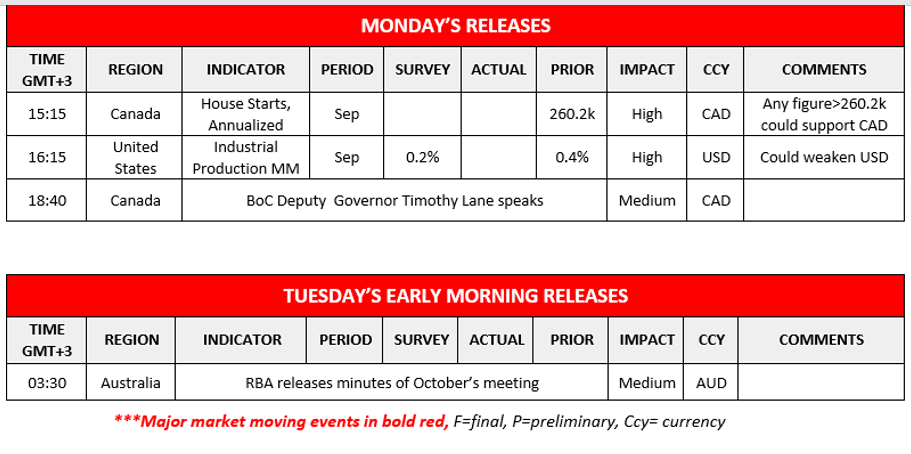
- 08:15 (CA) Canada Sept Annualized Housing Starts: 256.5Ke v 260.2K prior.
- 08:30 (CA) Canada Aug Int'l Securities Transactions (CAD): No est v 14.2B prior.
- 09:00 (FR) France Debt Agency (AFT) to sell €5.6-6.8B in 3-month, 6-month and 12-month bills.
- 09:15 (US) Sept Industrial Production M/M: 0.2%e v 0.4% prior; Capacity Utilization: 76.5%e v 76.4% prior; Manufacturing Production: 0.1%e v 0.2% prior.
- 09:45 (UK) BOE to buy £1.147B in APF Gilt purchase operation (3-7 years).
- 10:00 (US) Oct NAHB Housing Market Index: 75e v 76 prior.
- 10:30 (CA) Bank of Canada (BoC) Q3 Overall Business Outlook Survey: No est v 4.2 prior; Business Outlook Future Sales: No est v 47 prior.
- 10:30 (UK) BOE Cunliffe.
- 11:30 (US) Treasury to sell 13-Week and 26-Week Bills.
- 14:15 (US) Fed’s Kashkari.
- 15:00 (AR) Argentina Aug Capacity Utilization: No est v 64.1% prior.
- 16:00 (US) Aug Total Net TIC Flows: No est v $126.0B prior; Net Long-term TIC Flows: No est v $2.0B prior.
- 16:00 (US) Weekly Crop Progress Report.
- 18:30 (AU) Australia ANZ Roy Morgan Weekly Consumer Confidence Index: No est v 105.6 prior.
- 20:30 (AU) RBA Oct Minutes.
- 23:00 (TH) Thailand Central Bank to sell THB50B in 3-month Bills.
- 23:30 (HK) Hong Kong to sell 3-month and 6-month Bills.
- 23:30 (JP) Japan to sell 12-Month Bills.
- 23:30 (JP) Japan to sell 20-year JGB bonds.
Oil Rises On Coal, Gold Under Pressure
Coal lifts oil in Asia
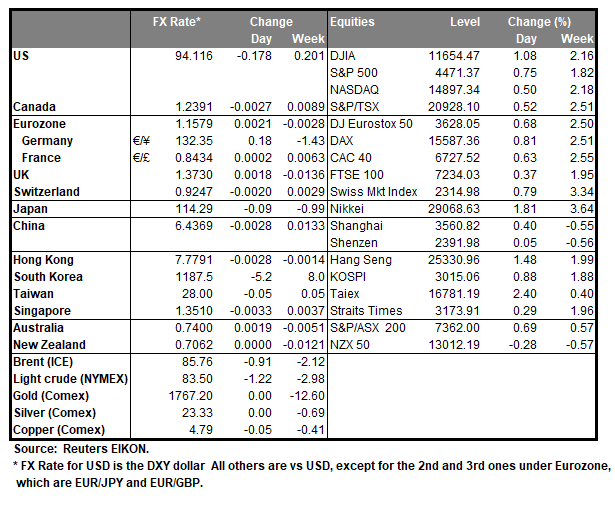
Hong Kong coal futures have leapt 9.0% higher this morning, meaning that the China energy crunch has made its way back to the front of investors minds. That has lifted oil prices in Asia as well, with Brent crude surging 0.80% higher, and WTI leaping by 1.0%.
On Friday, oil prices continued to grind higher, with no sign of any inclination to open the pumps by OPEC+ or announcements by the US government on SPR releases. Brent crude finished 0.90% higher at USD 84.90, and WTI finished 1.25% higher at USD 82.50 a barrel. In Asia, Brent crude has risen to USD 85.65, and WTI has risen to USD 83.40 a barrel as coal futures rocket into space.
With no signs of the China energy crunch alleviating soon, and with the rest of northern Asia and Europe competing for scarce energy supplies, particularly gas, the price environment for oil remains constructive. Even a US or China SPR release is only likely to provide temporary relief. A rapidly reopening aviation sector, with a slew of reopening announcements from ASEAN last week, will be another price pressure point.
Brent crude should now target the October 2019 high at USD 86.80 and onto USD 90.00 barrel, with support at USD 84.25 and USD 82.00 a barrel. WTI now has meaningful resistance until the USD 89.00 regions although I expect some sellers to appear above USD 86.00 a barrel initially. Only a fall through USD 82.00 a barrel changes the bullish outlook.
If Brent crude moves to USD 90.00 a barrel, I expect the pressure on OPEC+ to step up quite a few notches from the US White House. The huge weight of speculative long positioning in oil futures means a sudden USD 5-8 a barrel drop could still occur on a headline shock. However, with the underlying fundamentals for oil so strong, any large dip will reverse just as quickly.
Nervous specs cut long gold positions
Although the US dollar finished roughly neutral on Friday, higher yields across the US curve were enough to spook speculative longs in gold. That saw the predicted rush for the exit door, and gold fell rapidly by 1.60% to close at USD 1767.50 an ounce. In early Asia, gold has recouped some losses, rising 0.25% to USD 1771.50 an ounce.
The price action on Friday speaks volumes about the gold market now. US dollar weakness earlier last week soured gold buying and drew in fast-money speculative longs. The equally rapid unwinding of most of those gains on Friday reinforces that much of gold’s rally was built on speculative hot air and that those longs have little to no appetite to wear any pain on those long positions. In the bigger picture, the lack of staying power from gold longs suggests that it will struggle to maintain any upward momentum, even if gold reaches USD 1800.00 an ounce. Up via the stairs, down via the sixth-floor window.
Firmer US yields, should they endure this week, will be a headwind for gold rallies, especially if it leads to US dollar strength. Gold has nearby support at USD 1765.00 followed by USD 1745.00 an ounce with failure reopening a test of USD 1720.00. Gold failed for the third day in a row at the 100 and 200-day moving averages (DMAs), today at USD 1795.40 and USD 1796.60 an ounce, formidable resistance.
In the bigger picture, only a rise through USD 1835.00 an ounce would trigger a multi-month inverse head-and-shoulders technical pattern and swing gold’s outlook back to positive. The risks remain firmly to the downside.
The US Dollar Treads Water
Dollar trading sideways
The US dollar continued to tread water versus the major currencies on Friday. The dollar index maintaining a 94.00 close for the third day in a row. EUR/USD remains unchanged at 1.1590, while sterling strength was offset by yen weakness in the index. Early selling pressure on the US dollar was alleviated as US yields firmed across the curve after the strong Retail Sales data on Friday.
While EUR/USD trades sideways at 1.1590, the sterling continues to rally versus both the greenback and the euro. GBP/USD rose by 0.56% to 1.3750 on Friday before easing to 1.3740 in Asia, despite hawkish rhetoric over the weekend by the BoE Governor. Sterling’s strength is based on ever-rising hiking expectations and a rally through 1.3775 opens a retest of 1.3900. Only a fall through 1.3700 changes the bullish outlook. USD/JPY rose 0.56% to 114.20 on Friday after resistance at 113.80 gave way. With US yields firming across the curve the only way was up for USD/JPY. In the absence of any haven buying of yen from domestic investors, USD/JPY remains at the mercy of the US/Japan rate differential and a test of 115.00 is likely this week.
Elsewhere, the improvement in investor sentiment on Friday after the Retail Sales data saw the US dollar mostly retreat. AUD/USD remained firm at 0.7410, but NZD/USD rose 0.55% to 0.7070 on RBNZ hiking expectations. Today’s New Zealand inflation print boosted the kiwi to a high of 0.7105, as that noise increased. However, all those gains have now gone as spiralling Covid-19 cases in Auckland have led to speculation that the Auckland region (New Zealand’s largest population centre) could re-enter level 4 lockdown this afternoon. A government announcement is expected at 1600 NZT. With a lot of speculative longs out there, NZD/USD could fall quickly to 0.7000 if a tightening of restrictions is announced.
Regional Asian currencies also enjoyed a positive back end of last week thanks to a weakening US dollar and some judicious intervention by a few regional central banks. The Malaysian ringgit and Indonesian rupiah have outperformed thanks to high energy and commodity prices as well firmer investor risk sentiment. This week looks rather less clear though as despite US equities rallying on Friday, US yields also firmed across the curve. If that status quo remains, or yields move higher, the pressure will once again come on ASEAN currencies as well as the yen and the won.
In the bigger picture, we are starting to see a pattern emerging in the developed market space of currency outperformance from those on a nearer-term hiking path. The key remains the Fed taper and the list of Fed speakers this week will probably give more clarity in this respect. Ever rising energy prices are also supportive of the US dollar. I am still expecting prolonged US dollar strength in Q4, although this week, may see more sideways action as speculation long US dollar open interest is culled.
Asian Equities Off To A Mixed Start
Asian markets mixed at start of week
New York turned in a strong performance on Friday after US retail Sales unexpectedly rose by 0.70% for September, well above the 0.20% expected. US yields firmed across the curve but were ignored by equity markets as the S&P 500 rose 0.75%, the Nasdaq gained 0.50%, and the Dow Jones jumped by 1.10%. US futures are quiet in Asia thus far, easing slightly on long-covering from Friday’s close.
Asia appears to be on hold ahead of the China data dump this morning with early markets showing a mixed performance. The 0.25% fall by the Nasdaq futures this morning sees the Nikkei 225 easing by 0.40%, while the Kospi is 0.30% lower. Mainland markets finished almost unchanged last week. The PBOC comments on the risks in China’s property market being contained may give some comfort initially, but the data releases, good or bad, will dominate proceedings. Hong Kong has fallen 0.70% in early trade after soft guidance from Ali Baba, hinting that the mainland may have a soft open.
Singapore is unchanged, but Kuala Lumpur has risen by 0.55% as reopening plans gain traction and commodities, especially energy, remain firm. Jakarta, riding the same wave, is 0.15% higher as the government projects a lower than expected deficit. Taipei has risen by just 0.10% with Manila climbing 0.40%. Australian markets have also edged higher after a strong finish in New York. The ASX 200 and All Ordinaries have risen by 0.25%. With New Zealand deciding on whether to revert to level 4 restrictions in Auckland today, the NZX has fallen by 0.10%.
The China data dump at 1000SGT will dictate most of the region’s direction today although indications seem to suggest we are seeing another rotation day from North Asia to ASEAN markets, seemingly a short-term defensive play for local investors at the moment. European markets have shown little inclination to take their direction from Asia of late. Thus, no matter how Asia’s session turns out today, Europe is likely to open firmer based on the positive finish from New York and a lack of market-moving headlines over the weekend.
Inflation Nerves Alive And Well
Inflation nerves are alive and well with robust US Retail Sales lifting US yields on Friday and underpinning the US dollar. Over the weekend, Bank of England Governor Bailey warned the bank would “have to act” to curb inflationary pressures. Mr Bailey sees plenty of transitory inflation, but his all-seeing monetary policy eye is also spotting underlying medium-term pressures as well. Lastly, New Zealand inflation, released this morning, rocketed to 4.90% YoY for Q3, well above the RBNZ 1-3% target. The New Zealand data was made all the worse by the fact that its largest population centre, Auckland, has been under Covid-19 restrictions for a good part of that time.
BoE, RBNZ, expected to raise rates
Markets are locking and loading a hike before year-end from the Band of England, while talk has shifted to a potential 0.50% hike from the Reserve Bank of New Zealand in November. Both sterling and the New Zealand dollar have outperformed in the last week on rate hike expectations. The only thing capping the kiwi at the moment is that the spiralling Covid-19 cases in Auckland may prompt the government to announce a level 4 “circuit-breaker” lockdown later today.
Meanwhile, Singapore’s Non-Oil exports YoY in September, rising by 12.30%. The MAS pre-emptively tightened policy slightly at its 6-monthly policy review last week. Assuming Singapore holds its nerve and continues to reopen, the NODEX should maintain its upward trajectory and hit high-speed if the Singapore-Malaysia border loosens to allow greater labour movement.
Asian markets will be predominantly focused on China data today. China releases Q3 GDP YoY (5.2% exp), Fixed Asset Investment YoY September (4.5% exp), Retail Sales YoY Sep (3.3% exp), Industrial Production YoY Sep (4.5% exp), and Unemployment. Of those, GDP, Retail Sales, and Industrial Production will carry the most weight. There is downside risk in all three thanks to holidays, weather, the energy crunch, the government crackdowns along with rising material costs and supply chain disruption. The National Bureau of Statistics press conference afterwards will be worth following for signals on the path forward for China’s economy for the rest of the year and into 2022.
China markets are likely to find some solace initially from weekend comments from the PBOC, dampening down nerves that Evergrande and its fellow property developers pose a systematic risk to the financial system. But the data dump will provide a binary outcome for regional markets today. Weak data equals equities down, strong data equals equities higher. A weak data print though will lift expectations of an imminent PBOC RRR rate cut which should be supportive of domestic markets once the post-release noise dies down.
A divergence in monetary policy between Asia (still soft) and much of the rest of the developed world (tentative tightening), will provide challenges for the region as Q4 progresses. The Fed taper is the elephant in the room, and if the PBOC remains accommodative and allows the yuan to modestly weaken, currencies around the region will once again face selling pressure. The indirect tightening of monetary policy that causes could cause angst amongst the region’s central banks and likely sees intervention measures stepped up. Some of that pressure may be relieved by the slew of reopening announcements by ASEAN countries last week, particularly in the tourism space. ASEAN is probably the only part of the world pining for a cold northern hemisphere winter to flush those winter sun tourists out of hiding.
Cryptos have had a busy few days after rumours flew on Friday that the US SEC might approve two bitcoin futures ETFs this week. Why you would want to buy a bitcoin futures ETF instead of bitcoin itself escapes me. But if you are an investor that is mandated to only have exposure to regulated markets, then this could be your chance to get involved, despite getting long at near-record highs. The increased drone of the “crypto is becoming mainstream” buzz in my ears is more irritating than tinnitus. Still, as long as vast swathes of the investment community are looking to get rich quick by believing it has any real value, I will respect the tradeable versus investible price action. Bitcoin jumped 7.50% on Friday to USD 61,650.00, held those gains over the weekend and has risen again by 1.50% to USD 62,500.00 this morning. I believe Jack Dorsey might have said something. Anyway, the all-time high of around USD 65,000.00 is in sight, and a daily close above that level tilts the technical picture to further gains targeting USD 80,000.00 going forward. And you all thought I was a crypto-cynic?
Putting down my copy of the now very well read Emperor’s New Clothes with a “will they never learn” shake of the head, we circle back to this week’s data calendar. Asia isn’t very exciting after today’s China data dump. Indonesia will leave rates unchanged tomorrow, while Japan’s trade balance may have some marginal interest. Its stock markets are hitched to Wall Street and the impending 594757635385th extra budget since 1995, and the yen is trading purely on the US/Japan rate differential. Wednesday sees China announce its latest one and five-year Loan Prime Rate decisions. Unless today’s data is an absolute shocker, they will remain unchanged at 3.85% and 4.65%.
In Europe and the US, the pickings are relatively slim as well. US Industrial Production tonight and the Fed Beige Book on Wednesday will be of marginal interest. While Thursday’s Initial Jobless Claims could weigh on equities if it gives back last week’s positive gains. UK CPI on Wednesday will increase the rate hike noise to deafening levels and lift sterling if the YoY prints over 3.50%. Friday brings Markit Manufacturing, Services and Composite PMI releases from the European heavyweights, and the US. The UK releases Retail Sales and Manufacturing PMIs. Arguably they could have the largest impact on the week data-wise if only because they may give greater credence to the inflationary pressures, or, if the data is soft, temporarily alleviate tightening concerns.
US quarterly earnings swing from the large banks last week, to a broader mix of technology, FMCG and manufacturing companies. Goldman Sachs reported strong earnings on Friday to left US markets. With the masters of the universe filling their coffers for another quarter, the picture across the real economy may look rather more mixed, especially if you are exposed to rising, interest rates, material costs or supply chain disruptions. Their 2022 outlooks will be of more importance than their actual results and this week could see heightened two-way volatility in stocks.
USD Tends To Gain, Yet Has Not Escaped Its Sideways Motion
The USD remained relatively stable on Friday yet had some gains during today's Asian session against some of its counterparts, as inflation rates tend to be on the rise on a global scale and the market has priced in the possibility of Fed rate hikes by next September. It should be noted that US yields tend to remain at rather high levels for the time being and should they gain more ground, we may see the greenback getting further support. Besides fundamentals USD traders are expected to keep an eye out also for the release of the US industrial production for September due out later today in the American session. Looking at the global markets, it should be noted that China's GDP for Q3, dropped below the psychological barrier of 5% yoy and has reached a one year low. The power crunch in combination with supply shortages tend to bite and its characteristic of growth issues which the global economy faces as it tries to rebound. On the commodity currencies front, the CAD has strengthened against the USD on Friday as oil prices continue to climb while Loonie traders focus on Canada's Housing starts for September. Characteristically WTI prices maintained their upward motion reaching new multiyear record highs and are currently aiming for $83 per barrel, as expectations for increased demand and tight supply seem to guide the market. On a more exotic note, TRY reaches new record lows against the USD as concerns for a possible rate cut on Wednesday from the Central Bank of Turkey continue to be present and have an adverse effect on the Lira's value. As for the US equities, we note the gains marked by the major three US Stockmarkets on Friday as the market's focus turns towards earnings releases this week and we note among many Netflix on Tuesday, Tesla on Wednesday, Unilever on Thursday, American Express on Friday and the dividends of Caterpillar on the same day.
The USD index is currently testing the 94.10 (R1) resistance line, threatening to escape its past sideways motion to the upside. For our sideways bias to be abolished, we would though require for the index to clearly break above the 94.10 (R1) resistance line and aim higher. Should the bulls take over, we may see the index breaking the 94.10 (R1) resistance line and aim for the 94.60 (R2) level. Should the bears take over, we could see the index reversing course taking aim if not breaching the 93.70 (S1) support line.
USD/CAD seemed to correct higher after failing to substantially threaten the 1.2160 (S1) support line. The pair's price action is currently testing the downward trendline guiding it since the 29th of September and should the downward trendline be broken we would switch our bearish outlook for the pair technically, initially for a sideways bias. If the buyers are in charge USD/CAD could break clearly the prementioned downward trendline, the 1.2425 (R1) line and aim for the 1.2500 (R2) level. If the pair succumbs to the trendline's orders, we may see it breaking the 1.2330 (S1) line and aim for the 1.2250 (S2) level.
Today's events and expectations
Today we get from the US the industrial output and from Canada the Housing starts both for September.
As for the rest of the week
On Tuesday, we highlight the release of RBA's October meeting minutes. On Wednesday we get Japan's trade data, UK's CPI rates and Eurozone's final HICP rates as well as Canada's CPI rates all being for September. On Thursday, we get UK's CBI industrial trends for orders for October, from Turkey CBRT's interest rate decision, from the US the Philly Fed Business index for October and the weekly initial jobless claims figure, while from the Eurozone the preliminary consumer sentiment for October. On Friday we get Japan's CPI rates for September, UK's retail sales for September, Canada's retail sales for August and most importantly the preliminary PMI readings of October for Japan, France, Germany, Eurozone, UK and the US.
USD Index H4 Chart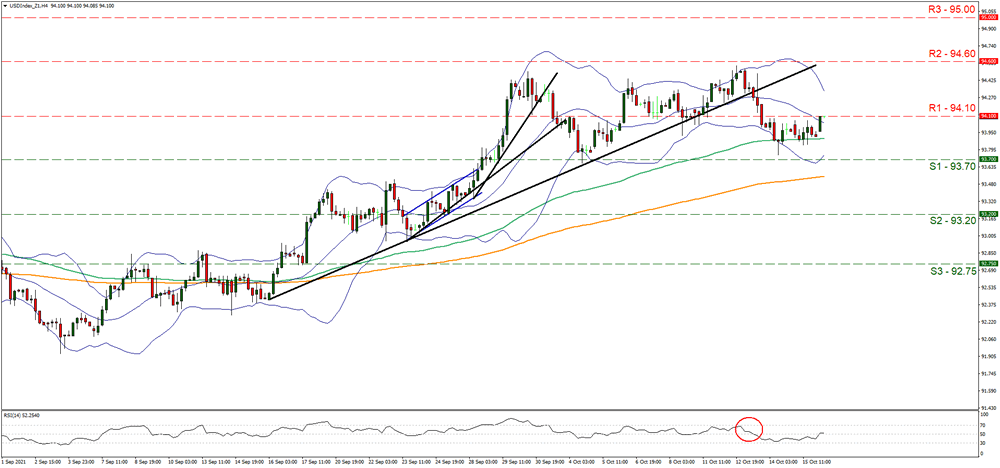
Support: 93.70 (S1), 93.20 (S2), 92.75 (S3)
Resistance: 94.10 (R1), 94.60 (R2), 95.00 (R3)
USD/CAD H4 Chart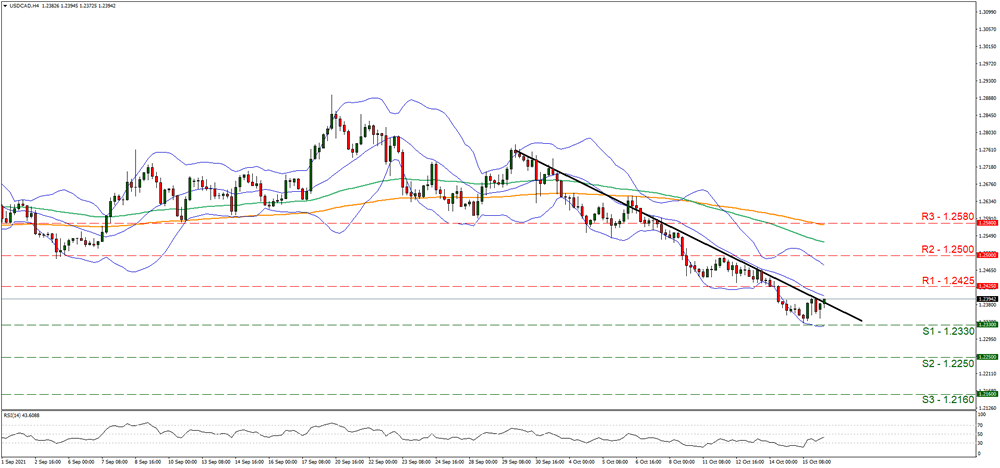
Support: 1.2330 (S1), 1.2250 (S2), 1.2160 (S3)
Resistance: 1.2425 (R1), 1.2500 (R2), 1.2580 (R3)