

Sample Category Title
WTI Rises for the Seventh Straight Week on Energy Crunch, Fears of Supply Shortage
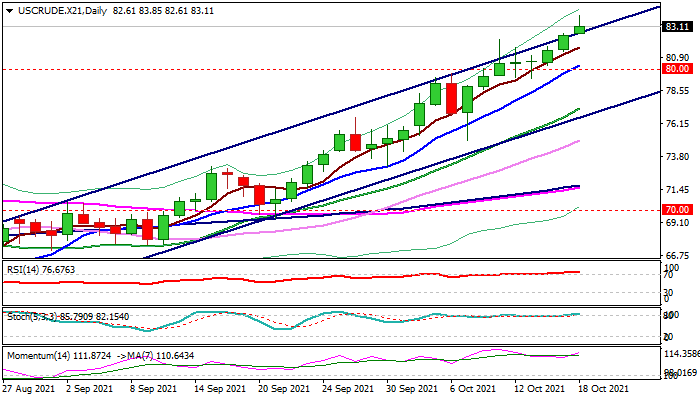
The WTI oil price extends advance into seventh straight week, hitting new highest since October 2014 on Monday, extension of last week’s 3.6% advance.
Strong recovery in global oil demand on easing Covid restrictions and increased consumption on energy crunch that prompted a massive gas to oil switch for power generation, as gas prices skyrocketed.
Strong demand on colder weather in the north hemisphere would contribute to oil supply deficit that could further lift oil prices, as many market observers already talk about $100 per barrel in the short period.
Strong bullish structure on daily chart was additionally supported by break above the upper borderline of bull-channel from $61.80 (Aug 23 trough), but overbought conditions on daily and weekly chart, warn that bulls may lose steam in the coming sessions and consolidate before resuming larger uptrend.
Strong positive sentiment suggests shallow consolidation, with extended dips expected to find ground above strong $80 support zone and provide better levels to re-join larger uptrend.
Bulls eye initial target at $85.24 (FE 200% of the third wave of five wave sequence from $61.80) which guards $89.25 (Fibo 76.4% of $114.80/$/6.52 fall) and psychological $90 level.
Res: 83.85; 85.24; 85.90; 88.61.
Sup: 82.61; 81.86; 80.35; 80.00.
Sunset Market Commentary
Markets
Back in August, markets aligned with the Bank of England’s new forward guidance which called for some modest tightening over the policy horizon in order for inflation to return to the 2% inflation target. Sterling futures discounted a 25 bps rate hike/year path over the next three years. Unexpectedly accelerating UK inflation and some hawkish BoE comments later, short term UK money markets discount 100 bps rate hikes over a 12 month horizon. The latest hawkish repositioning occurred after Bank of England governor Bailey plain and simple stated that the BoE will have to act on inflation. Risks are now clearly tilted to a faster and more aggressive start to the tightening campaign. The November Monetary Policy Rate (Nov 4) marks an ideal opportunity for a >=15 bps rate hike. The UK gilt curve bear flattens today with yield changes ranging between +15 bps (2-yr) to -0.3 bps (30-yr). The UK 2-yr yield rises to 0.75%, the highest level since mid-2019 and compared with 0.05% ahead of the August BoE change in forward guidance. Sterling remarkably failed to profit from this huge kind of (short term) interest rate support. The lack of enthusiasm especially counts for EUR/GBP which closed last week below the bottom of the longstanding sideways trading range between 0.8450 and 0.8421. EUR/GBP at the time of writing even tries to recapture this level. GBP/USD changes hands at 1.3725, down from an 1.3756 open.
German Bunds and US Treasuries followed the Gilt sell-off. US yields added up to 4.2 bps with the belly of the curve underperforming the wings. German yields add 2.5 bps to 8.1 bps on the 2-10yr segment (belly underperforming) with an outperformance of the very long end of the curve (30-yr: -2.9 bps). The sell-off also translates in more aggressive Fed and ECB rate hike bets. Markets nearly discount 50 bps rate hikes in 2022 by the US central bank and a 10 bps move by the ECB by September next year. 10-yr yield spreads vs Germany widen by 2-3 bps for the likes of Greece, Portugal, Italy and Spain. Apart from the rise in core yields, this morning’s FT article might play a role as well. It suggested a shift from national to EU debt after PEPP ends. Hawkish repositioning in all jurisdictions kept the balance on FX markets stable. EUR/USD currently changes hands just above 1.16. Stocks lose up to 1% in Europe while US indices opened with smaller losses.
News Headlines
OPEC+ again pumped less oil than what was planned for in September. It is still withholding several hundreds of thousands barrels a day to support oil prices in the wake of the pandemic. It promised to raise output with 400 000 barrels/day every month from July onwards to at least November. But since that pledge, OPEC has delivered 9% less than scheduled in July, 16% in August and another 15% in September, Bloomberg reported, citing delegates with knowledge of the matter. According to the financial news agency, OPEC could have pumped an extra 747 000 barrels a day in September and still remain with the agreed production limit. Part of the explanation is that some members, including Angola, Nigeria and Azerbaijan were unable to raise output due to a lack of investment and exploration. It does draw criticism however, with oil prices showing little signs of easing. Brent oil today adds 0.6% and is on track to close above $85 for the first time in 2 years.
A tight US job market triggers strikes for more pay, Reuters reported today, running the story after a last-minute deal over the weekend prevented 60 000 behind-the-scene workers on movies and TV shows to go on a largescale strike. In general, Reuters says union leaders are feeling more comfortable to go on the streets and demand a better deal, after speaking to several of them. According to Cornell University’s Labor Action Tracker, already 254 strikes were launched this year so far. Support among Americans for unions has risen strongly, too, with a poll in August showing 68% approving them – the highest proportion since 1965. JOLTS data in August revealed a new record 2.9% of voluntary job quitters, in another sign of growing employee confidence.
Inflation Risks and the Rate Conundrum, Dollar Hangs in There
Risk evaporates and US Industrial production disappoints
Market sentiment has softened and the dollar remains subdued. Expectations that the Fed is preparing to taper is keeping the reserve currency afloat as well as the push up in the 10-year yield close to 1.62%. Inflation risks seem to be pushing central banks to take action, as markets are pricing in interest rate hikes in the later parts of 2022.
US industrial production in September was much weaker, coming in at -1.3% against a forecast of 0.3%, while the Capacity Utilization rate also ticked lower to 75.2%, down from 76.4%. It appears rising energy costs have left their mark.
The dollar index is consolidating around the 94.00 handle while the euro is struggling just beneath the $1.1600 barrier. The yen is static at 114.30 per dollar.
Governor Bailey signalled that the BOE is gearing up to raise interest rates to tackle growing inflation risks. Although inflation was viewed as transitory, elevated energy prices are boosting inflation and prolonging its effects. He reiterated that the BOE will need to act if risks to medium-term inflation and expectations change. Forecasts of more than double the BOE’s target rate of 2%, is on the table, especially as the energy crisis persists and supply shortages endure. Moreover, inflation is also viewed in the record high house prices, which were reflected in Britain’s HPI index of 1.8% for October, jumping from the previous month at 0.3%. Surprisingly, the pound appears paralyzed around the $1.3730, not capitalising on the news.
Inflation worries and commodity currencies
New Zealand’s Q3 headline inflation figures shot to 2.2%, beating expectations of 1.5%, which caused the kiwi to drop to 0.7050. With an environment close to full employment, growing house prices and supply chain issues persisting, the cost of living has rocketed and rumours have it that the Reserve Bank of New Zealand will have to reassess its stance towards interest rate hikes. So the growing uncertainty may be hurting the currency.
China’s growth lagged in the Q3 as the country dealt with setbacks from the property sector and an energy crisis. The gross domestic product, which is a gauge of the health of the economy, expanded by 4.9% from last year, missing the forecast and was down from the previous quarter of 7.9%. Its unemployment rate improved, dropping to 4.9%, from 5.1%, while September retail sales beat last year’s figure, coming in at 4.4%. If these risks drag out, the effects could start to weigh on commodity heavy currencies. The aussie has retreated to 0.7386 and Australia’s Monetary Policy meeting minutes are due at 00:30 GMT. So we may see slight volatility in the aussie just after midnight.
WTI oil futures remain buoyant around $83.20 per barrel after seven weeks of gains due to the energy crisis around coal and natural gas prices, while gold is holding around the $1,764/oz mark. The black liquid is soaring as an energy crisis produces painfully rising costs across the globe. The loonie edged marginally lower on a miss in new housing projects that came in at 251K, as opposed to the expectations of 265K. The USD/CAD pair is currently at C$1.2380.
Monetary Policy Committee (MPC) Member Cunliffe is speaking at 14:30 GMT, while the Bank of Canada’s business outlook report is also planned at that time, which could shed some light on the robustness of the Canadian economy, whose currency is heavily affected by oil.
Governing Council Member Lane is speaking at 15:40 GMT and investors may be listening out for clues around future monetary policy.
At 00:30 GMT, Australia’s monetary policy meeting minutes will be released.
Oil Continues Rising
Early in another week of October, the oil market continues growing steadily and updating its highs. Brent is trading at $85.80 and doesn’t seem to slow down.
The key factor that supports this active and extreme rally in the oil sector is the demand for energies, which is maintained not only by the global economic recovery and its need for raw materials but also by the start of a heating season and switch to more available and affordable heating agents, for example, fuel oil. In contrast with the surge in natural gas and coal prices, the above-mentioned agent is getting more and more trending.
As a result, the demand for oil in the fourth quarter of 2021 may add 500K barrels per day to the current volume. At the same time, OPEC+ hasn’t revised the oil output parameters yet, thus creating some “vacuum” in the demand, which makes oil prices go up.
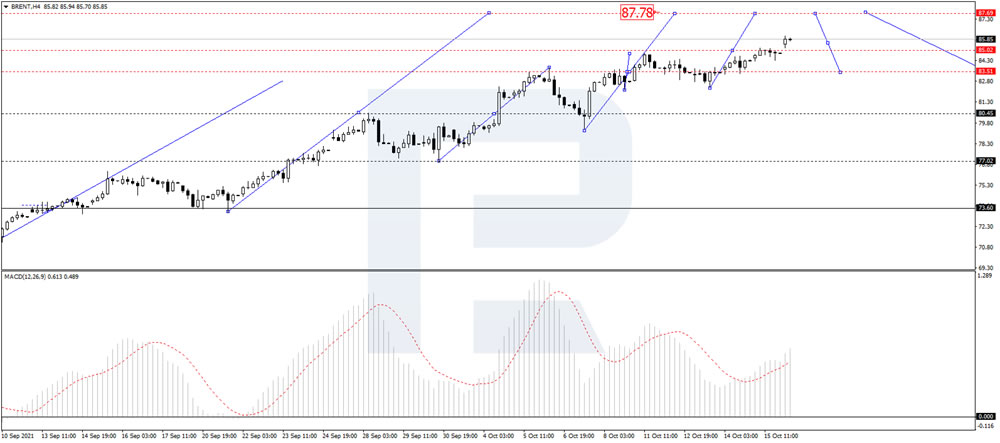
In the H4 chart, after breaking 85.20 to the upside, Brent is expected to continue growing with the short-term target at 87.78. Later, the market may correct to test 85.00 from above and then one more ascending towards 90.00. From the technical point of view, this scenario is confirmed by MACD Oscillator: its signal line is moving above 0 within the histogram area and may continue growing towards new highs.
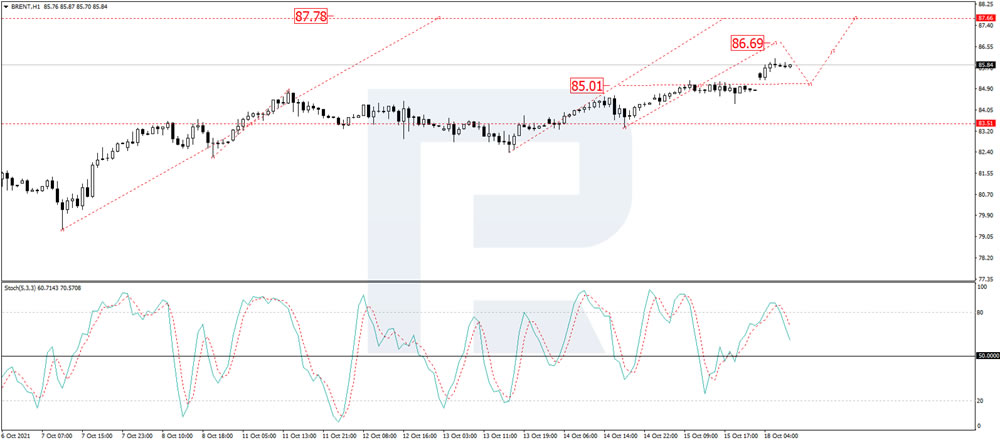
As we can see in the H1 chart, after forming a new consolidation range below 85.00 and breaking it to the upside, Brent is expected to trade upwards with the short-term target at 86.69. After that, the asset may start a new correction towards 85.00 and then resume growing to reach 87.78. From the technical point of view, this idea is confirmed by the Stochastic Oscillator: its signal line is moving below 80 and may fall a little bit to reach 50. After that, the line may rebound from the latter level and start another growth towards new highs.
USD/JPY Mid-Day Outlook
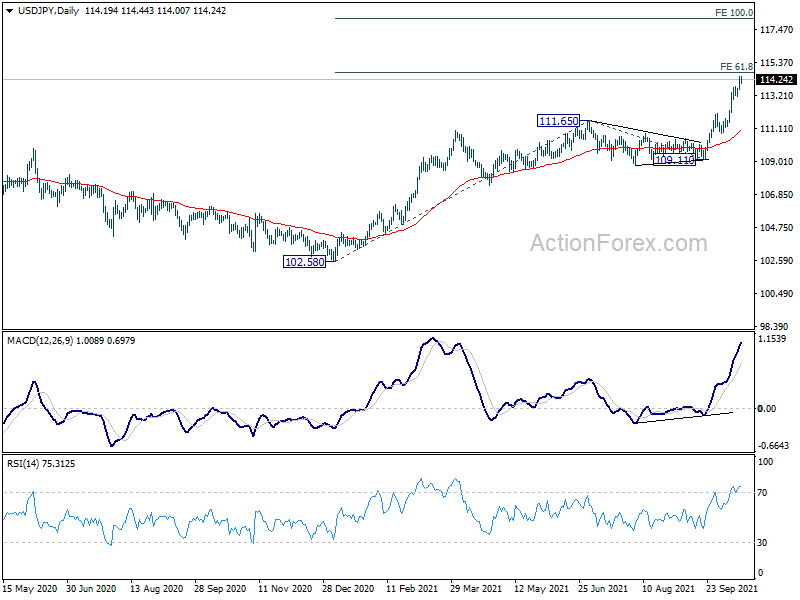
Daily Pivots: (S1) 113.80; (P) 114.13; (R1) 114.59; More...
Intraday bias in USD/JPY remains on the upside despite some loss of upside momentum. Further rise would be seen to 61.8% projection of 102.58 to 111.65 from 109.11 at 114.71. Firm break there will target 100% projection at 118.18 next. On the downside, break of 113.20 minor support will turn intraday bias neutral and bring consolidations again, before staging another rally.
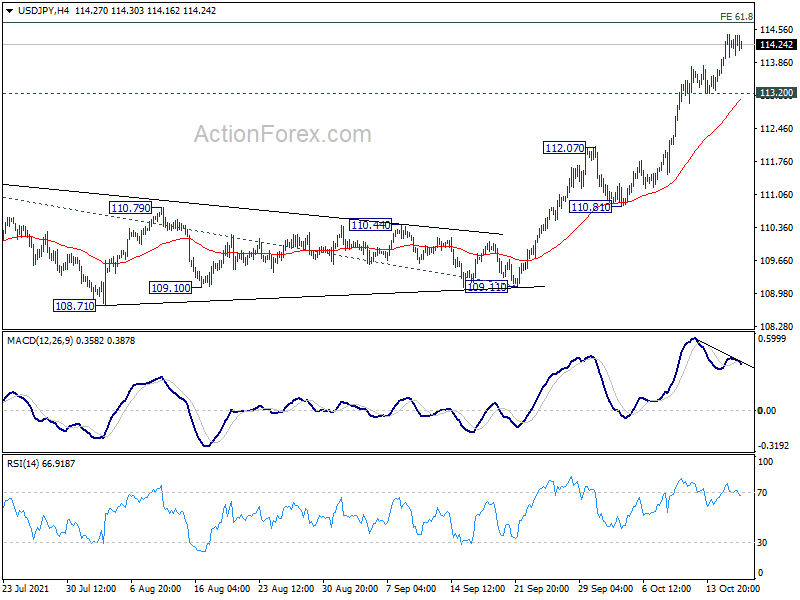
In the bigger picture, corrective decline from 118.65 (2016 high) should have completed at 101.18 already. Rise from the 102.58 is seen as the third leg of the up trend from 101.18. Next target is 114.54 resistance and then 118.65 high. This will now be the preferred case as long as 109.11 support hold, even in case of deep pull back.
USD/CHF Mid-Day Outlook
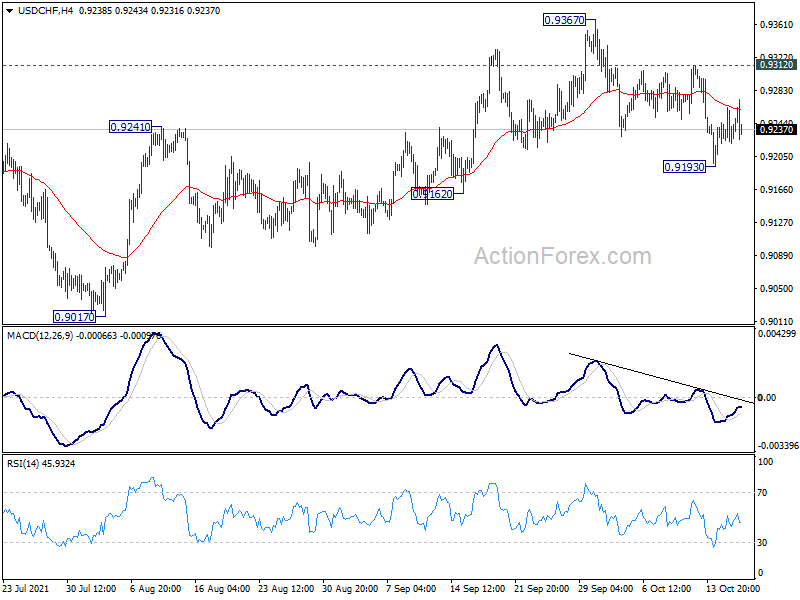
Daily Pivots: (S1) 0.9216; (P) 0.9240; (R1) 0.9258; More....
Intraday bias in USD/CHF stays neutral and outlook is unchanged. On the downside, break of 0.9193 will resume the fall from 0.9367 to 0.9162 support first. Considering bearish divergence condition in daily MACD, firm break of 0.9162 will argue that whole rise from 0.8925 has completed and target this support. On the upside, break of 0.9312 support will bring retest of 0.9367 resistance instead.
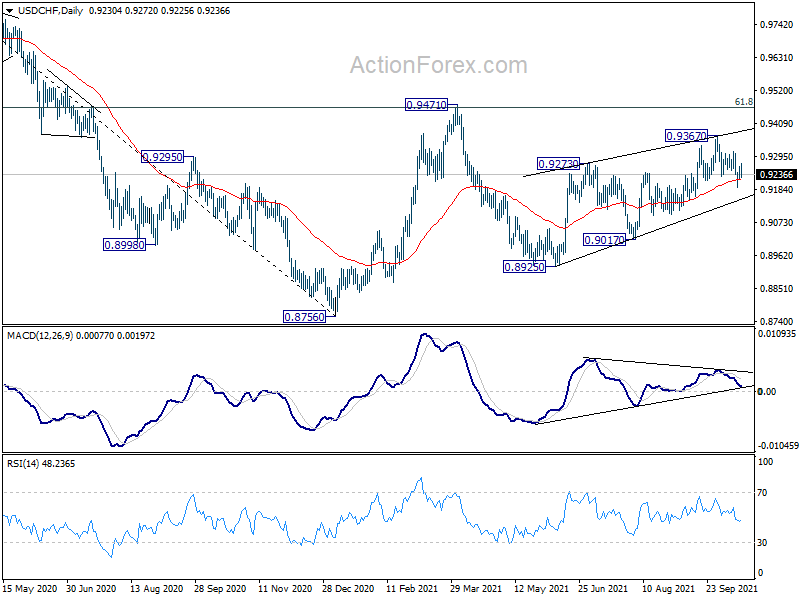
In the bigger picture, the corrective structure of the rebound from 0.8925 argues that fall from 0.9471 is not completed yet. It could either be the second leg of pattern from 0.8756 (2021 low), or resuming larger down trend from 1.0237 (2018 high). We'd pay attention to the downside momentum of assess the odds later. But for now, medium term outlook will be neutral at best as long as 0.9471 resistance holds.
GBP/USD Mid-Day Outlook
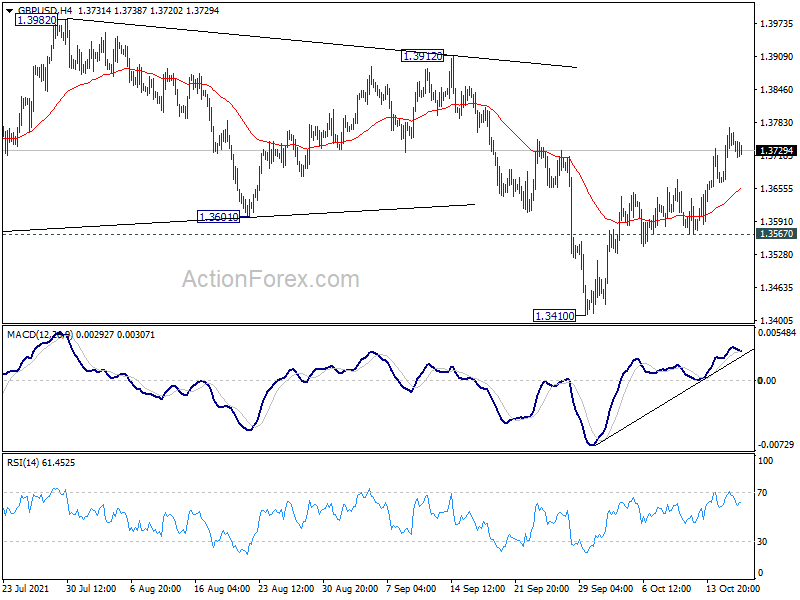
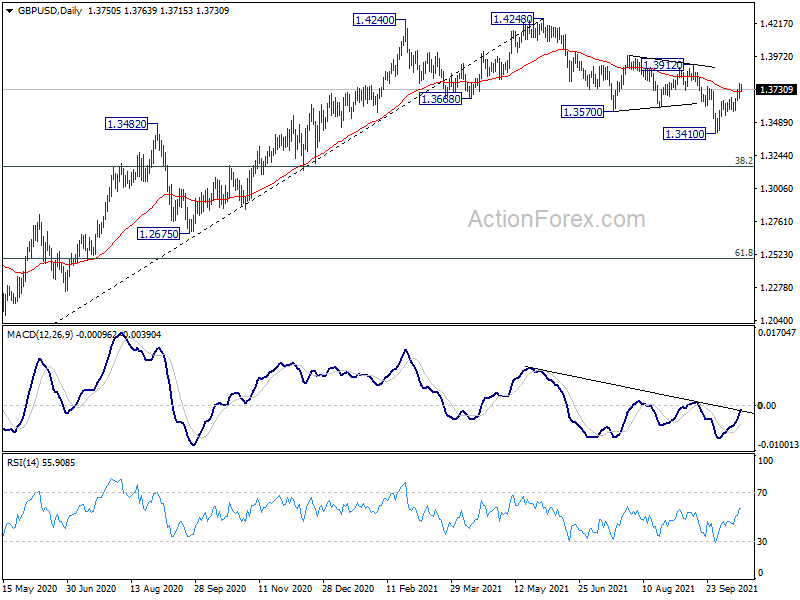
Daily Pivots: (S1) 1.3684; (P) 1.3729; (R1) 1.3789; More...
No change in GBP/USD's outlook and intraday bias stays on the upside. Further rise should be seen to 1.3912 key structural resistance. Firm break there will indicate that the correction from 1.4248 is complete with three waves down to 1.3410. Further rally would then be seen to retest 1.4248 high. On the downside, however, break of 1.3567 support will turn bias back to the downside for 1.3410 low instead.
In the bigger picture, the structure of the fall from 1.4248 suggests that it's a correction to the up trend from 1.1409 (2020 low) only. While deeper fall cannot be ruled out yet, downside should be contained by 38.2% retracement of 1.1409 to 1.4248 at 1.3164, at least on first attempt, to bring rebound. ON the upside, firm break of 1.4376 key resistance (2018 high) will add to the case of long term bullish reversal. However, sustained trading below 1.3164 will revive some medium term bearishness and target 61.8% retracement at 1.2493.
EUR/USD Mid-Day Outlook
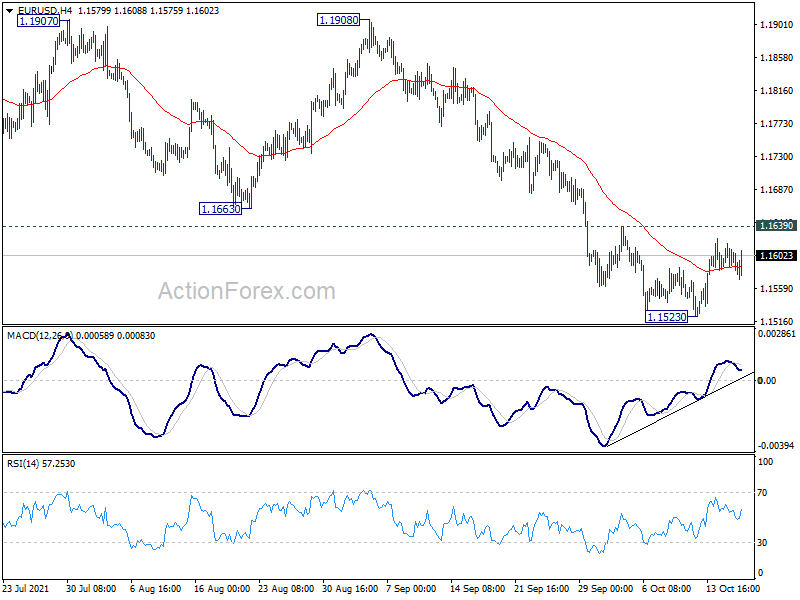
Daily Pivots: (S1) 1.1585; (P) 1.1602; (R1) 1.1616; More...
EUR/USD is still staying in consolidation from 1.1523 and intraday bias remains neutral. Further decline is still in favor as long as 1.1639 minor resistance holds. Break of 1.1523 will resume larger decline towards 1.1289 medium term fibonacci level. On the upside, break of 1.1639 resistance, however, will indicate short term bottoming. intraday bias will be turned back to the upside for stronger rebound, to 55 day EMA (now at 1.1712).
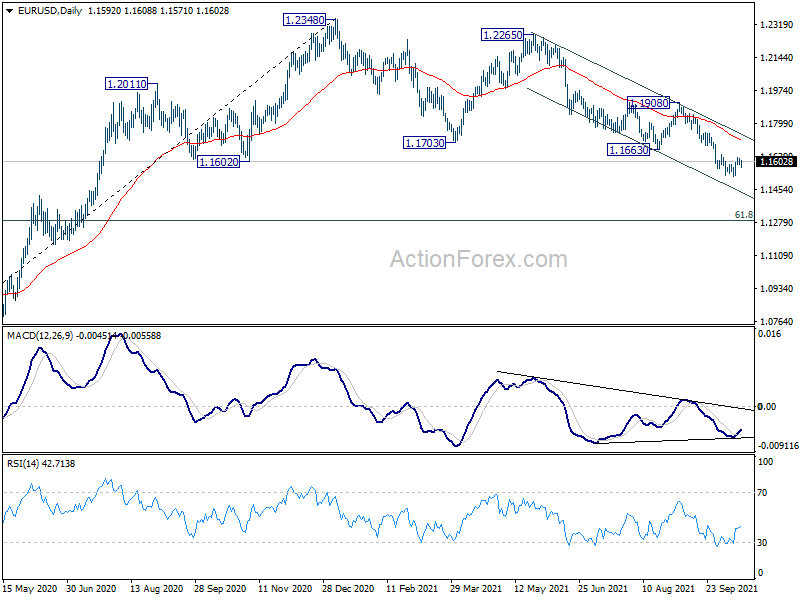
In the bigger picture, price actions from 1.2348 should at least be a correction to rise from 1.0635 (2020 low). As long as 1.1908 resistance holds, deeper fall would be seen to 61.8% retracement of 1.0635 to 1.2348 at 1.1289. Nevertheless break of 1.1908 resistance will revive medium term bullishness and turn focus back to 1.2348 high.
Euro Trading Mildly Higher in Consolidative Markets
The forex markets are generally staying in consolidative mode today, with Euro and Swiss Franc trading mildly higher. Meanwhile, Aussie is leading other commodity currencies for retreats. Dollar is also trying to firm up with 10-year yield breaking above 1.62 handle. Yen, is also mildly higher with help from some pull back in stocks. Overall, the markets could need some more time to digest recent moves, before resuming.
Technically, we'd continue to focus on whether EUR/USD would break through 1.1639 resistance to confirm short term bottoming at 1.1523. Or, it will resume larger fall from 1.2265 through 1.1523. That could provide hint on Dollar's next move elsewhere. At the same time, we'd also see if EUR/CHF would break through 1.0750 minor resistance, or 1.0678 temporary low. Synchronized rallies in the two pairs will indicate it's Euro that's moving instead.
In Europe, at the time of writing, FTSE is down -0.50%. DAX is down -0.80%. CAC is down -0.98%. Germany 10-year yield is up 0.039 at -0.125. Earlier in Asia, Nikkei dropped -0.15%. Hong Kong HSI rose 0.31%. China Shanghai SSE dropped -0.12%. Singapore Strait Times closed flat. Japan 10-year JGB yield rose 0.0154 to 0.096.
ECB Visco: Some flexibility should remain in asset purchases to help against unexpected shocks
Governing Council member Ignazio Visco said even if the inflation pressures in Eurozone "may last for some months and well during the next year", it's still "largely transitory". He added that market expectations for rate hike in late 2022 were "not that consistent" with ECB's forward guidance.
Visco also said "flexibility should remain" after the emergency PEPP program as. "We certainly have to discuss how to adjust our purchase programs," he said. "It will help against unexpected shocks, and it will help to avoid fragmentation that may rise again."
New Zealand CPI rose 2.2% qoq, 4.9% in Q3, highest in over a decade
New Zealand CPI rose 2.2% qoq in Q3, well above expectation of 1.4% qoq. That's the largest quarterly increase in over a decade since 2010. For the 12-month period, CPI accelerated to 4.9% yoy, up from Q2's 3.3% yoy, well above expectation of 4.1% yoy too. The annual rise is also the highest since 2011. The strong inflation reading prompted more expectations of more RBNZ rate hikes ahead, following the 25bps increase earlier this month.
China GDP growth slowed to 0.2% qoq, 4.9% yoy in Q3
China GDP grew 4.9% yoy in Q3, below expectation of 5.2% yoy. On a quarterly basis, GDP grew only 0.2% qoq, slowed from Q2's 1.2% qoq, and missed expectation of 0.5% qoq. In September, retail sales rose 4.4% yoy, above expectation of 3.3% yoy. Industrial production rose 3.1% yoy, below expectation of 4.5% yoy. Fixed asset investment rose 7.3% ytd yoy, below expectation of 7.9%.
"The overall national economy maintained the recovery momentum in the first three quarters … however, we must note that the current uncertainties in the international environment are mounting and the domestic economic recovery is still unstable and uneven," said NBS spokesman Fu Linghui.
EUR/USD Mid-Day Outlook
Daily Pivots: (S1) 1.1585; (P) 1.1602; (R1) 1.1616; More...
EUR/USD is still staying in consolidation from 1.1523 and intraday bias remains neutral. Further decline is still in favor as long as 1.1639 minor resistance holds. Break of 1.1523 will resume larger decline towards 1.1289 medium term fibonacci level. On the upside, break of 1.1639 resistance, however, will indicate short term bottoming. intraday bias will be turned back to the upside for stronger rebound, to 55 day EMA (now at 1.1712).
In the bigger picture, price actions from 1.2348 should at least be a correction to rise from 1.0635 (2020 low). As long as 1.1908 resistance holds, deeper fall would be seen to 61.8% retracement of 1.0635 to 1.2348 at 1.1289. Nevertheless break of 1.1908 resistance will revive medium term bullishness and turn focus back to 1.2348 high.
Economic Indicators Update
| GMT | Ccy | Events | Actual | Forecast | Previous | Revised |
|---|---|---|---|---|---|---|
| 21:45 | NZD | CPI Q/Q Q3 | 2.20% | 1.40% | 1.30% | |
| 21:45 | NZD | CPI Y/Y Q3 | 4.90% | 4.10% | 3.30% | |
| 23:01 | GBP | Rightmove House Price Index M/M Oct | 1.80% | 0.30% | ||
| 02:00 | CNY | GDP Y/Y Q3 | 4.90% | 5.20% | 7.90% | |
| 02:00 | CNY | Retail Sales Y/Y Sep | 4.40% | 3.30% | 2.50% | |
| 02:00 | CNY | Industrial Production Y/Y Sep | 3.10% | 4.50% | 5.30% | |
| 02:00 | CNY | Fixed Asset Investment YTD Y/Y Sep | 7.30% | 7.90% | 8.90% | |
| 12:15 | CAD | Housing Starts Y/Y Sep | 251K | 265K | 260K | 263K |
| 12:30 | CAD | Foreign Securities Purchases (CAD) Aug | 26.30B | 14.19B | 14.06B | |
| 13:15 | USD | Industrial Production M/M Sep | 0.20% | 0.40% | ||
| 13:15 | USD | Capacity Utilization Sep | 76.50% | 76.40% | ||
| 14:00 | USD | NAHB Housing Market Index Oct | 75 | 76 | ||
| 14:30 | CAD | BoC Business Outlook Survey |
AUD/USD Started a Steady Increase from 0.7320 Support
The Aussie Dollar started a steady increase from the 0.7320 support zone against the US Dollar. The AUD/USD pair broke the 0.7400 resistance zone and the 50 hourly simple moving average.
A high was formed near 0.7439 before there was a downside correction. There was a break below a key bullish trend line with support near 0.7410 on the hourly chart.
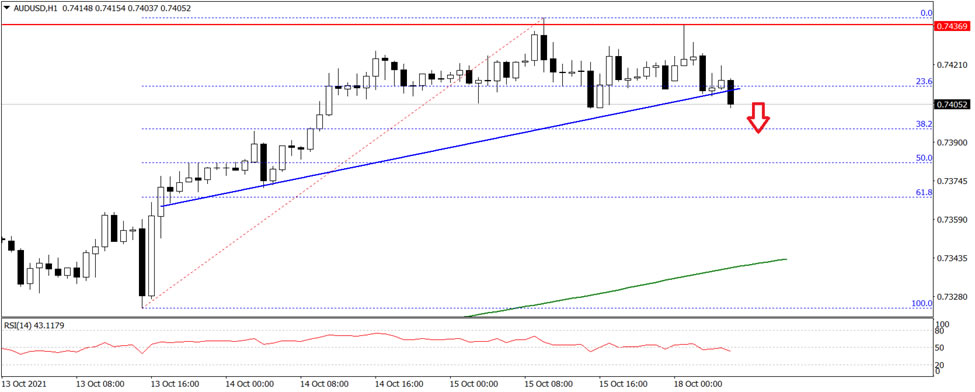
An immediate support on the downside is near the 0.7400 level. The next key support is near the 0.7380 level. A clear break below the 0.7380 support could lead the pair towards the 0.7350 support. Any more losses may possibly open the doors for a move towards the 0.7320 level.
On the upside, the pair is facing hurdles near 0.7435 on FXOpen. The next major resistance is near the 0.7450 level, above which the pair could rise steadily towards the 0.7500 level in the near term.