

Sample Category Title
EUR/CHF Weekly Outlook
EUR/CHF dropped to as low as 1.0678 last week and the break of 1.0694 support indicates resumption of fall from 1.1149. But as a temporary low was formed, initial bias is neutral for some consolidations first. On the downside, break of 1.0678 will turn bias back to the downside for 61.8% projection of 1.1149 to 1.0694 from 1.0936 at 1.0655. Sustained break there will pave the way towards 100% projection at 1.0481. On the upside, break of 1.0750 will indicate short term bottoming and bring stronger rebound first.
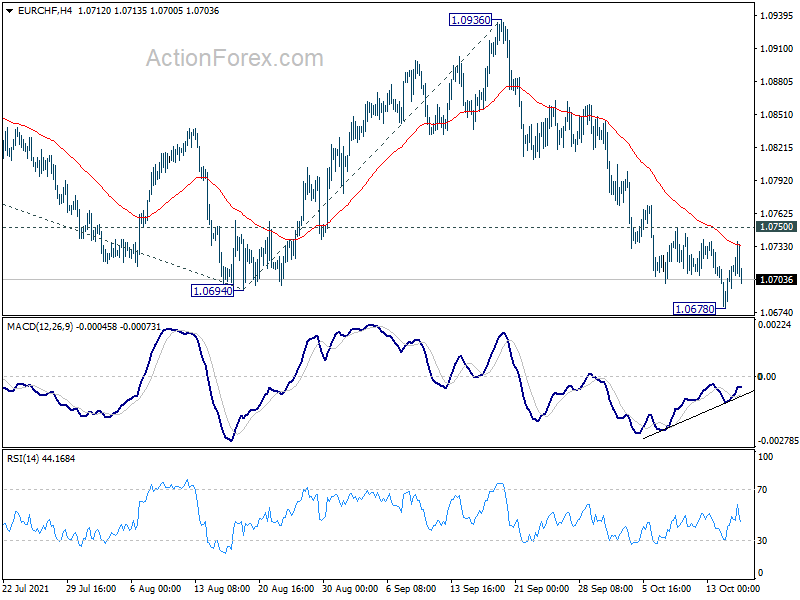
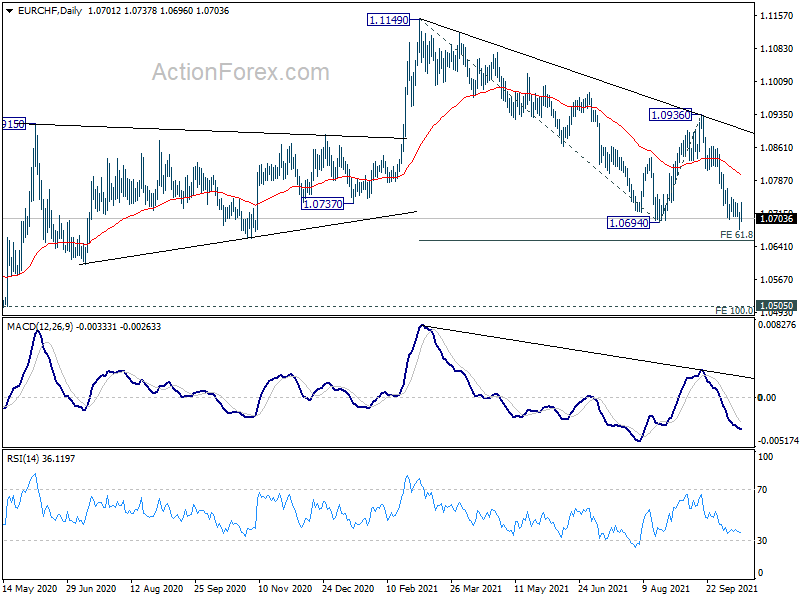
In the bigger picture, the rejection by 55 week EMA maintains medium term bearishness. Fall from 1.1149 (2021 high) is currently seen as the second leg of the patter from 1.0505 (2020 low) first. Hence, in case of deeper fall, we'd look for strong support from 1.0505 to bring rebound. However, sustained break of 1.0505 will resume the long term down trend from 1.2004 (2018 high). Also, medium term outlook will now be neutral at best as long as 1.0936 resistance holds.
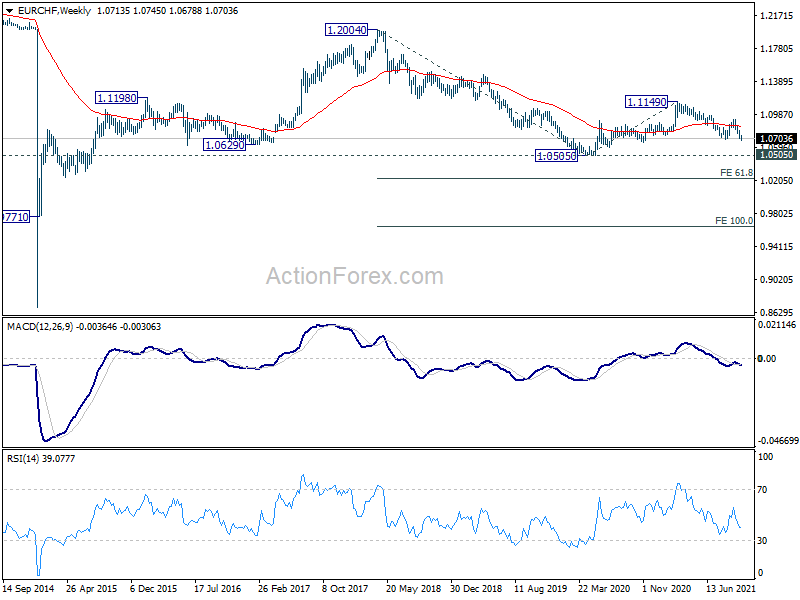
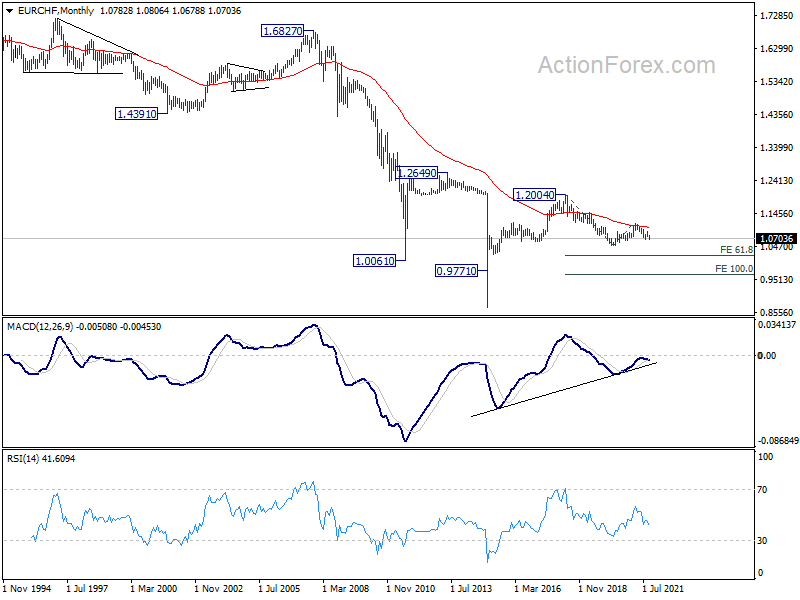
In the long term picture, rejection by 55 month EMA (now at 1.1037) maintains long term bearishness. Break of 1.0505 low will resume down trend to 61.8% projection of 1.2004 to 1.0505 to 1.1149 at 1.0223.
Summary 10/18 – 10/22
Monday, Oct 18, 2021
[php_everywhere instance="1"]
Tuesday, Oct 19, 2021
[php_everywhere instance="2"]
Wednesday, Oct 20, 2021
[php_everywhere instance="3"]
Thursday, Oct 21, 2021
[php_everywhere instance="4"]
Friday, Oct 22, 2021
[php_everywhere instance="5"]
Weekly Economic & Financial Commentary: Growing Pains Still Plaguing U.S. Economy
Summary
United States: Growing Pains Still Plaguing U.S. Economy
- Consumer prices, retail sales and U.S. workers quitting their jobs all topped expectations in September. This week's economic data provided additional evidence that the economy is struggling to find an equilibrium 18 months into the global pandemic.
- Next week: Industrial Production (Monday), Housing Starts (Tuesday), Existing Home Sales (Thursday)
International: U.K. Data: Take the Good with the Bad
- It was another mixed week of news on the U.K. economy. August GDP growth was subdued with a gain of just 0.4% month over month, while supply disruption potentially suggests another modest month for activity in September. Labor market news was more upbeat, and employment in the three months to August rose at the fastest pace since late 2015.
- Next week: China GDP (Monday), U.K. CPI (Wednesday), Eurozone PMIs (Friday)
Interest Rate Watch: Outlook for Fed Rate Hikes: Watch Inflation Expectations
- The inflation rate is clearly above 2% at present, but most Fed policymakers suspect that it will recede next year. As discussed in our most recent U.S. Economic Outlook, we, too, forecast that inflation will recede in 2022, although not as much as most FOMC members expect. But it is the "maximum employment" part of the FOMC's objectives that we think will delay Fed rate hikes until 2023.
Topic of the Week: COLAs Fizz Up for 2022
- On Wednesday, the Social Security Administration announced that benefits for 2022 would increase 5.9%, the largest boost since 1982, for roughly 70 million Social Security recipients. The increase is a result of the annual cost-of-living adjustment (COLA), which aims to ensure that benefits keep pace with inflation.
The Weekly Bottom Line: Inflation Pressures Remain Elevated
U.S. Highlights
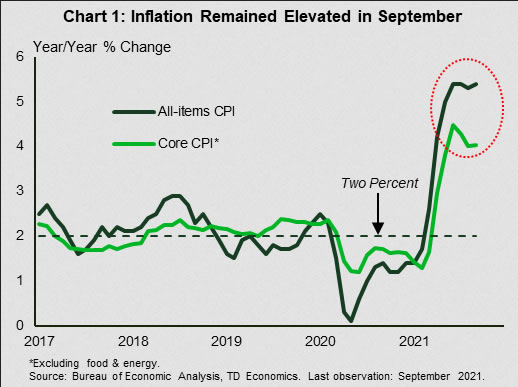
- The consumer price index rose 0.4% in September, sending year-on-year inflation to 5.4%. Core prices (excluding food and energy) rose 0.2% on the month and held steady at 4.0% y/y. A 0.4% increase in the heavily-weighted shelter component provided considerable lift to the core measure.
- Retail sales defied expectations for a pullback in September, rising by 0.7% on the month. Gains were broad based.
- Minutes from the FOMC’s September meeting showed increasing concern among members over the persistence of inflation and a move toward tapering asset purchases. A formal announcement is likely to come at the next Fed meeting.
Canadian Highlights
- It’s hard not to be upbeat on the Canadian economy The latest string of data releases has been encouraging, pointing to a solid bounce back in economic activity in the third quarter.
- This advance would not have been possible without most provinces achieving some success in stemming the spread of the Delta variant. Due to low case counts, Ontario is set to further ease restrictions next week.
- Fewer restrictions will provide a boost to the economy in the fourth quarter, but they could also exacerbate inflationary pressures, especially in the current context of supply chain disruptions.
U.S. - Inflation Pressures Remain Elevated
With the debt ceiling lifted and the U.S. government able to fund itself through December, attention gravitated back to economic data this week. Inflation continued to take center stage for much of the week, but the strong showing in the September retail sales report out Friday morning (+0.7% on the month) was a welcome surprise. The report suggests that consumer demand is proving resilient to the latest infection wave and the winding down of more generous pandemic unemployment benefits.
The September consumer price index (CPI) report showed that the monthly pace of price increases has cooled from the hot pace recorded earlier this year, but that inflation remained well above the Fed’s comfort zone (Chart 1). Overall inflation rose 0.4% on the month, a touch higher than August, and was up 5.4% year-on-year (y/y). Food and energy were major contributors to the headline gain. Removing these two components, core inflation was up a more modest 0.2% on the month (+4.0% y/y).
Underneath the surface, the pandemic continued to drive big price swings in both directions. Travel-related prices that were hot in the spring are now trending down, with airline fares falling 6.4% on the month. Price pressures picked up in other areas, however, such as new vehicles, household furnishing and shelter. The latter, a heavily weighed inflation category, rose 0.4% m/m, with rents up 0.5% (the largest monthly increase in over two decades) and owners’ equivalent rent up 0.4% (the largest increase in over five years).
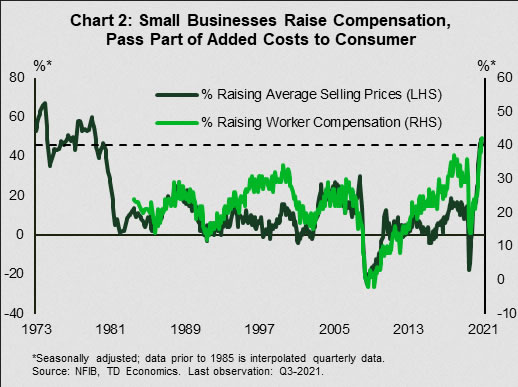
Other indicators corroborate the elevated inflation narrative. NFIB data, for instance, showed that small businesses continued to face difficulty in filling job openings in September – a record 51% of firms had open positions. Businesses are boosting compensation in order to attract and retain talent, and in turn are passing down some of the added costs to consumers (Chart 2). Close to half of all small businesses, 46%, are raising and plan to raise prices further – the highest levels since the 1970s.
The challenging employment backdrop is not unique to small businesses. The JOLTS survey shows that American workers quit their jobs in record numbers (4.3 million) at the end of summer. This trend is especially prevalent in the accommodation and food services industry, where a 6.8% quit rate towers over an already-elevated 2.9% total quit rate, itself the highest in two decades. An elevated quit rate is a sign of growing confidence among workers and supportive of continued solid wage growth.
Constraints on the employment front, together with supply chain disruptions, raise the possibility that ‘transitory’ inflation will last longer than initially anticipated. The Fed has recognized this and is gearing up to remove monetary support. This week’s FOMC minutes, which showed committee members marking up their inflation forecasts, reaffirm this view. The Federal Reserve is likely to announce its plan to taper asset purchases at its next meeting and end the program completely by mid next year. The first hike in the federal funds rate is likely to follow in the second half of 2022.
Canada - Supply Concerns Dampen Positive Vibes
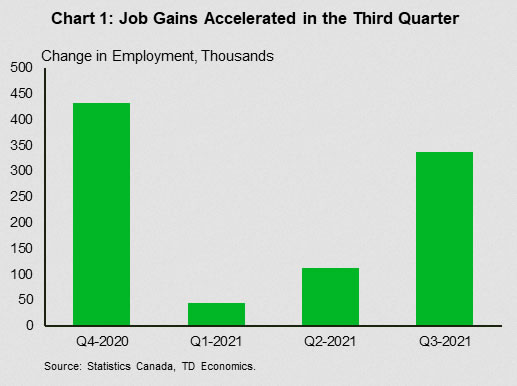
It's hard not to be upbeat on the Canadian economy right now. The latest string of data releases has been outright encouraging, pointing to a solid bounce back in economic activity in the third quarter. For example, manufacturing data released this week had sales picking up by 0.6% in August, as 17 of 21 industries saw an improvement in production. On the consumption side, households continued to ramp up spending through the summer and into early fall. High-frequency credit and debit card data indicate that Canadians have been unleashing pent-up demand for restaurant dining, travel, and other services that had long been restricted to them due to public health protocols. There was also a burst in hiring activity, as 340k jobs were added through the third quarter, returning employment to its pre-pandemic (February 2020) level (Chart 1).
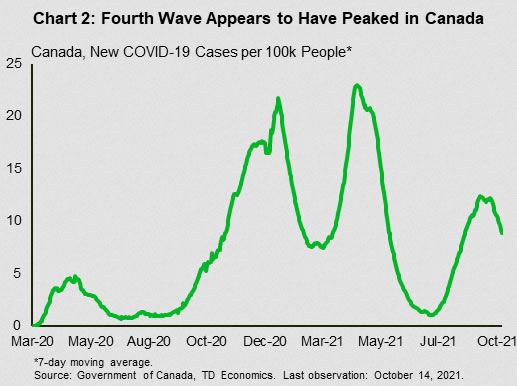
These advances were only possible because Canada has (so far) kept the Delta variant at bay in most parts of the country. While daily cases rose in August, they appear to have peaked in mid-September, and have been trending down over the past few weeks (Chart 2). The country has dealt with the fourth wave far better than it has with prior waves, reflecting the measured approach most provinces have taken in lifting public health restrictions as well as the impressive vaccine take up among Canadians.
With the spread seemingly under control, the Ontario government is getting set to remove capacity limits on a number of businesses including restaurants, bars, and gyms. News outlets report that an official announcement is coming next week. In other good news, U.S. officials said that the land border will reopen to fully vaccinated Canadians on November 8th.
Fewer restrictions should provide a boost to the economy in the fourth quarter. But it could also further exacerbate inflationary pressures that have been sparked by a number of factors including reopening of economies, supply chain disruptions, and recent energy crunches. On supply chain issues, Canada is not facing the same constraints as the U.S. Ports have not been overwhelmed as they have south of the border. Still, given the tight relationship with the U.S. and the interconnected nature of supply chains, Canada is likely to feel the pinch. September consumer price inflation data released next week could reflect some of this shock. Inflation reached 4.1% in August, and likely moved higher last month.
Supply disruptions may not only show up in higher prices, they could also act as a handbrake on the economic recovery. If firms cannot source inputs or retailers' inventory are depleted, GDP growth could weaken.
Concerns are likely rising for the Bank of Canada. Supply problems have presented a formidable challenge, increasing the risk of a policy error that could have steep consequences for the Canadian economy.
Week Ahead: Rising Prices Raise Stakes for Rapid Rate Increases
All about Inflation
Wall Street still remains upbeat despite growing an energy crisis that threatens the economic recovery, widespread price increases, and mixed economic data. It seems that inflation will remain elevated for a lot longer than the Fed imagined, but a rapid rate-hiking cycle will not translate into an immediate ending of negative real yields. If US real yields remain negative throughout next year, that should provide some underlying support for investing in equities. The focus will stay on energy prices, which should show continued pressure on energy producers to ramp up output as the colder months near. If energy costs seem poised to head much higher, the unbalanced global economic recovery could dent risk appetite and lead to some diverging market moves.
Pricing pressures have already made some central banks start tightening cycles and next week’s rate decisions could see large rate hikes from both the Russian and Hungarian central banks, while Turkey’s bank will continue to bow to President Erdogan’s pressure to cut rates. Inflation has gotten worse since the last time we heard from Fed Chair Powell and investors will pay close attention to his comments on Friday’s policy panel. Powell may start to grow more concerned that a lot of the price increases may not be temporary and that could continue to bring forward Fed rate hike expectations to the end of next summer.
Country
US
A busy week on Wall Street will have investors focusing on the second week of earnings season, a wrath of Fed speak, and economic data that should show the recovery is moderating and pricing pressures are not easing. The economy is still on sound footing and any weakness should be modest, but widespread pricing pressure concerns from earnings could rattle some investors.
On Monday, both September industrial production and October NAHB housing market index are expected to soften, while Fed Quarles and Kashkari speak. Tuesday starts with early earnings from Johnson & Johnson, Haliburton, and Procter & Gamble, with housing data that could show permits and starts edge lower. After the close, Netflix and United Airlines report earnings. Fed speak includes Daly, Bostic, and Waller. The focus on Wednesday will primarily be on earnings from IBM, Tesla, and Verizon, with Fed watchers reading the Beige Book release and listening to Fed Quarles speech on the economic outlook. Thursday’s earnings include Dow, Freeport-McMorRan, a speech from Fed’s Waller and economic releases on initial jobless claims, Philly Fed Business Outlook, Leading index, and Existing home sales. Friday is all about Fed Chair Powell’s latest assessment of the economy and pricing pressures and the flash PMI readings that should show manufacturing softens slightly while the service sector ticks higher. Fed’s Daly will also talk about the Fed and climate change risk.
EU
Euro weakness has gained momentum after disappointing economic reading from Germany and the eurozone and as inflation pressures soar to the highest levels since 2008. Next week, all eyes will be on the second inflation reading to see if price pressures are steadying. The eurozone growth outlook is one of the weaker ones in the advanced world and that may remain the case after the flash PMI readings on Friday.
UK
Now that FX markets are quickly pricing in sooner BOE rate bets, all eyes will be on UK inflation. Pricing pressures are expected to ease slightly, but that doesn’t seem like it will dramatically change expectations that the BOE will raise rates before the end of the year.
On Friday, retail sales should see a boost as restrictions have been lifted, while the flash PMIs show the manufacturing and service activity edged lower.
Emerging Markets
Hungary
The Hungarian central bank is expected to raise rates by 15basis points to 1.80%, but don’t be surprised if a larger hike is delivered or more hikes are telegraphed.
Russia
Russia is expected to raise interest rates and show that they will continue to do so until inflation eases.
South Africa
Rand traders will keep a close eye on Wednesday’s inflation report. Intensifying inflation pressures will continue to support the prospect that the SARB will raise rates in November.
Turkey
How low can the lira go? President Erdogan latest round of dismissals guarantees pressure for the CBRT to ease further will not be easing anytime soon. Turkey central bank Governor Sahap Kavcioglu surprised markets at the September 23rd meeting with a 100 basis point rate cut, but this time markets anticipate more rate cuts.
With the lira trading at record lows and inflation continuing to tick higher, a series of rate cuts could keep the pressure on.
Asia Pacific
China
China’s data is front loaded on Monday with Fixed Asset Inv, Q3 GDP and Capacity Utilization, September Industrial Production, Unemployment and Retail Sales. Arguably, Industrial Production and Retail Sales are the most important. Markets will be on edge for signs that the energy crunch, material costs, regulatory measures and weather are dampening economic growth which could send equities sharply lower.
Wednesday sees 1 and 5-year LPR decisions with no change expected. It would be a huge surprise if they cut rates. We could see a RRR cut next week though, which would be a strong positive for the local market in the short-term.
China’s energy shortages are grabbing the headlines with the government instructing state energy companies to secure supplies at any cost. That will keep energy prices supported, but any signs that the situation is worsening will again lead to selling on the main indexes.
The PBOC has subtly signaled via the USD/CNY that it is unhappy with further CNY strengthening. Although with one eye on the imported energy bill, they will not want to weaken the currency, USD/CNY will face upward pressures next week.
Evergrande has slipped from the headlines this past week, but with another China developer defaulting on a foreign debt this week, markets are only one negative headline away from sparking another sell-off in Mainland and Hong Kong equity markets.
India
The INR has recovered this past week, but that is mostly due to a weaker US Dollar. With reports of energy blackouts and rationing in Northern India, the currency will remain under pressure as energy importers chase prices higher for oil, gas and coal.
Markets will be affected next week by major holidays in India with no significant data except the Monetary Policy Minutes on Friday. Investors will be looking for signs that the RBI is about to shift from loose to neutral monetary policy as stagflationary indicators remain robust.
Australia & New Zealand
The AUD and NZD rallied strongly as global risk sentiment shifted to positive at the end of the week. Going forward both will continue to be buffeted by swinging sentiment shifts in overseas markets as investors try to ignore inflation and the Fed taper to keep the bull market alive.
Australia has a quiet data week but New Zealand releases Services PMI and Inflation on Monday. High readings will put another RBNZ hike on the table and could push NZD/USD sharply higher and AUD/NZD sharply lower. New Zealand’s covid situation looks set to deteriorate quickly, and I still do not rule out heightened restrictions. That is being ignored by markets for now.
Japan
Japan releases CPI on Wednesday and Inflation and flash Manufacturing PMI on Friday. Arguably, only the Inflation data will be market moving. Local markets remained tunnel visioned on the end of month election and the scale of the post-election stimulus package.
Japan equities are maintaining a high correlation to Wall Street this week. Fiscal stimulus announcements are also providing support.
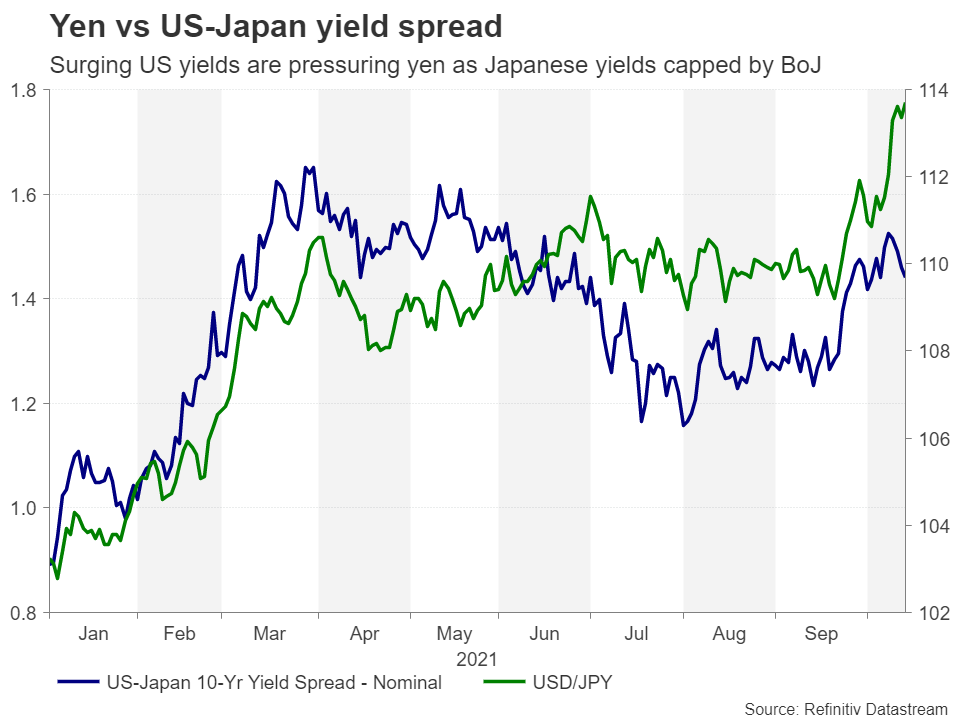
USD/JPY has risen sharply to near 114.00 in the past week and more gains are likely into next week. USD/JPY is a pure US/Japan rate differential play and with rates firming in the US, and Japan low forever, USD/JPY’s path of least resistance continues to be higher. That has also scooped in AUD, NZD and GBP/jpy buying also supporting the USD/JPY higher story.
Markets
Energy
The energy crunch in China, India and Europe continues with coal and natural gas prices remaining at ultrahigh levels. Bad weather in China and India coal producing areas has further disrupted supply. Against that background oil prices will remain well supported and Brent crude could trade above $88.00 next week. Notably, Asian buyers, instead of waiting for dips as usual to buy, have been chasing prices directly higher this week, another bullish indicator.
Both Saudi Arabia and Russia have signaled that OPEC+ remains comfortable with present oil production levels and plans which has further supported prices.
That said, the RSI technical indicators are in heavily overbought territory and speculative long positioning is now very crowded in futures markets. I could easily foresee a shock $5 to $8 a barrel move lower to cull this positioning. Any sudden fall though, will be met with a frenzy of physical buyers sending it back higher just as quickly. Beware the whipsaw.
Gold
A sharp rally in gold this week as the US Dollar fell on Wednesday has sucked in the fast money momentum buyers, pushing gold to just shy of $1800.00. The 100 and 200-day moving averages are here and a weekly close could see gold move to $1830.00 in the week ahead.
A huge caveat is that despite all the noise about haven buying and inflation hedging, gold is purely an inverse correlation play to the US Dollar at the moment. If the US Dollar resumes its rally in the week ahead, the fast money will exit and gold’s gains will evaporate and send it back to $1740.00.
Bitcoin
Bitcoin volatility will remain elevated as the SEC could decide on four bitcoin ETF’s. It is widely expected they will approve the ProShares ETF on Monday and possibly Invesco’s ETF on Tuesday. Bitcoin could see a sell the news reaction, if it seems only one ETF will start trading next week.
Key Economic Events
Saturday, Oct. 16
- ECB President Lagarde delivers the annual Per Jacobsson Foundation lecture.
Sunday, Oct. 17
- BOE Gov Bailey speaks on a panel with PBOC Governor Yi Gang and heads of the IMF and BIS at the Group of 30 International Banking Seminar.
Monday, Oct. 18
- Fed’s George and Kashkari speak at the Forum for Minorities in Banking.
- EU Foreign Affairs Council meets to discuss the bloc’s approach to the Middle East’s Gulf region.
- BOE Deputy Governor Cunliffe speaks on a panel at Banco de España’s Third Conference on Financial Stability on the topic of “Central Bank Digital Currencies and Financial Stability.”
Economic Data/Events:
- China Q3 GDP Q/Q: 0.4%e v 1.3% prior; Y/Y: 5.0%e v 7.9% prior; Sept retail sales Y/Y: 3.5%e v 2.5% prior, industrial production Y/Y: 3.9%e v 5.3% prior
- US cross-border investment, industrial production
- Potential SEC ruling on Bitcoin ETFs
- Canada housing starts
- New Zealand CPI
- Singapore trade
- UK Rightmove house prices
Tuesday, Oct. 19
- China’s NPC Standing Committee starts five-day meeting
- UK Prime Minister Boris Johnson hosts the Global Investment Forum
- ECB Executive Board member Panetta speaks at the 5th annual ECB-CEBRA conference.
- BOE’s Bailey speaks at the BOE and Banca d’Italia joint research conference
- Norges Bank Deputy Governor Wolden Bache to speak at Finance Norway’s housing conference.
- Swedish parliamentary hearing on monetary policy with Riksbank Governor Ingves and Deputy Governor Floden.
Economic Data/Events:
- Australia RBA Minutes
- Hungary Rate decision: To raise benchmark interest rate by 15bps to 1.80%
- Mexico international reserves
- Spain trade
- US housing starts
Wednesday, Oct. 20
- Riksbank Deputy Governor Jansson speaks at SEB’s autumn event
- Norges Bank Governor Olsen speaks at the Centre for Monetary Economics at the Norwegian Business School.
Economic Data/Events:
- Eurozone CPI
- Canada CPI
- UK CPI
- South Africa CPI
- China property prices, loan prime rates
- Japan trade
- Russia CPI (weekly), PPI
- EIA Crude Oil Inventory Report
Thursday, Oct. 21
- US Commerce Secretary Raimondo speaks at The Economic Club of New York webcast.
- EU leaders meet in Brussels
- SEC Chair Gensler speaks at Institute of International Economic Law and The Institute for Financial Markets’s DC Fintech Week.
- Five Power Defense Arrangement Defense Ministers to meet. Representatives from Australia, Malaysia, New Zealand, Singapore, and the UK to speak.
Economic Data/Events:
- US Conf. Board leading index, U.S. existing home sales, initial jobless claims
- Eurozone consumer confidence
- Unemployment: Hong Kong, Sweden
- Turkey central bank (CBRT) rate decision: Expected to cut rates by 50bps to 17.50%
- Russia gold and forex reserves
- Poland retail sales
- UK public sector net borrowing
- Norway sovereign wealth fund quarterly results
Friday, Oct. 22
Economic Data/Events:
- Canada Retail sales
- ECB Survey of Professional Economic Forecasters
- Eurozone Markit services PMI, Markit manufacturing PMI
- Bank of Italy (BOI) Quarterly Economic Bulletin
- UK Preliminary Manufacturing/Service PMIs, Retail Sales
- Germany Preliminary Manufacturing/Service PMIs
- Japan CPI
- Russia rate decision: Expected to raise rates by 25bps to 7.00%
- Singapore home prices
Sovereign Rating Updates:
- Greece (S&P)
- Italy (S&P)
- UK (S&P)
- Austria (Fitch)
- Finland (Fitch)
- Netherlands (Fitch)
- Cyprus (DBRS)
- Turkey (S&P)
Forward Guidance: Inflation in Focus in BoC Surveys and Canadian CPI Data
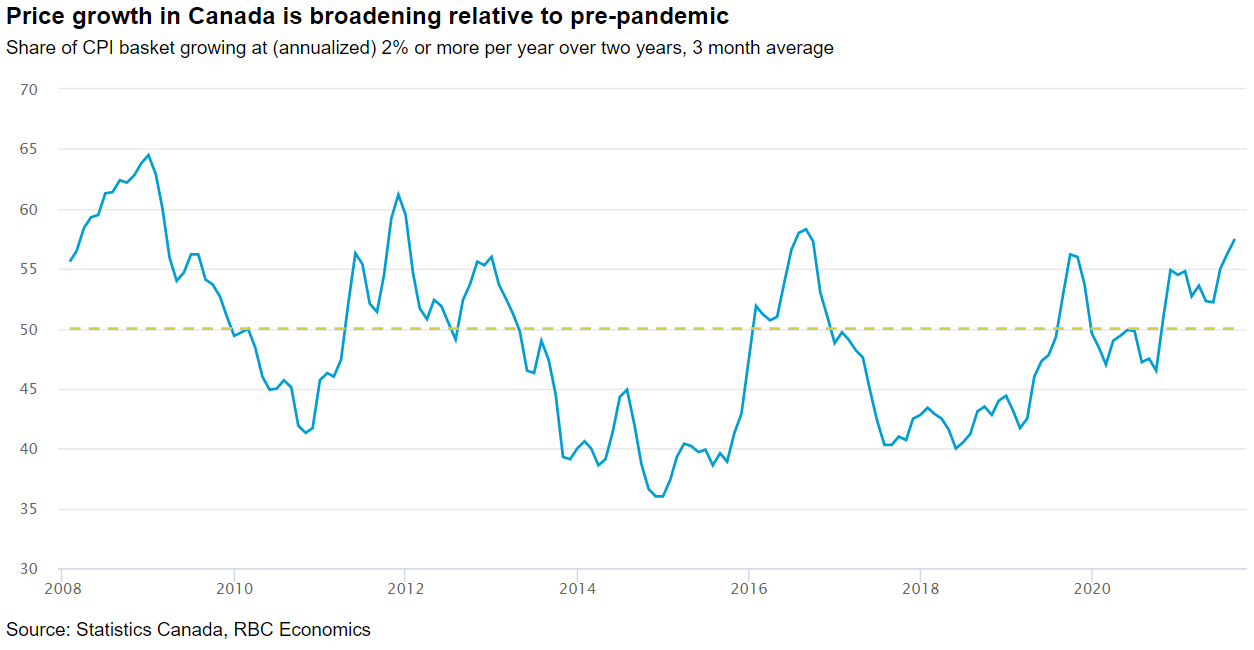
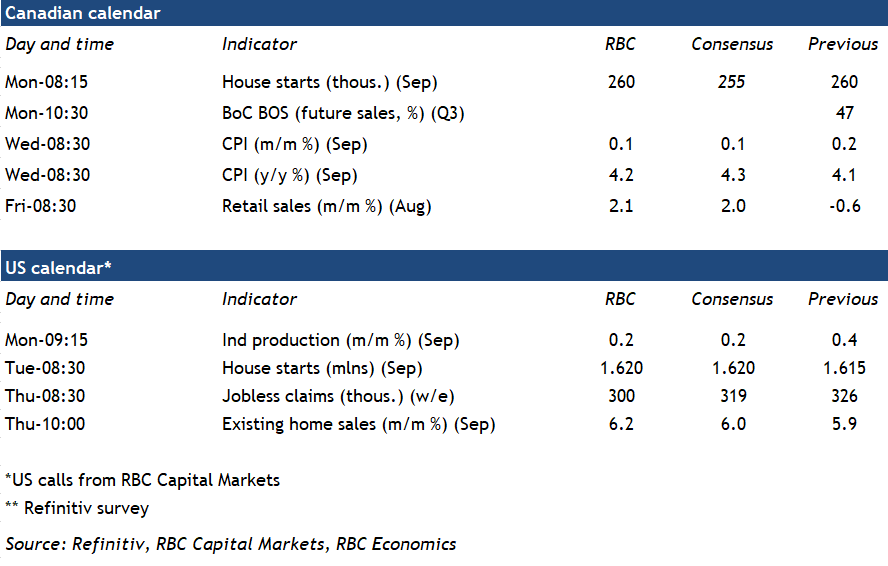
Canada’s headline inflation rate likely rose again in September, to 4.2% year over year—the highest level since 2003. Outside of volatile food and energy products, it probably rose 3.3%. Faster growth in shelter-related expenses likely remained a key driver of price growth alongside higher prices at the pump. Year-over-year rates of increase continue to be influenced by base effects. More worrying though, is the persistence of global supply chain disruptions and elevated business input costs which over time could fuel higher longer-run inflation expectations for households and businesses. The Bank of Canada’s Q3 Business Outlook Survey (BOS) will likely flag improving operating conditions and profitability among businesses between late August to mid-September, as well as higher near-term inflation expectations. Similarly, the Q3 survey of consumer expectations will flag increases in the rate of price growth expected by households.
We expect the BOS survey to focus on the severity of current supply chain issues. These challenges are proving more stubborn than many expected and are likely to continue pushing input costs higher. The BOS is also likely to echo other surveys in flagging labour shortages as a larger issue for businesses than any shortfall in demand. With the economy getting closer to long-run capacity limits (particularly in the industrial sector) and inflation pressures building, the central bank is running out of reasons to keep its foot as firmly on the monetary policy accelerator. We look for policymakers to announce another reduction in asset purchases later this month.
Week ahead data watch:
- We look for a 2.1% increase in August retail sales, in line with StatCan’s preliminary estimate a month ago. While our internal spending tracker pointed to some softening in services purchases in September (likely driven by concerns about the Delta variant), overall spending including goods purchases appear to have held up well.
- We expect a flat reading in September Canadian housing starts from August (260,000 annualized). Building permit issuance has been tracking above that, but difficulties finding workers could limit the number of homes started in the near-term.
Week Ahead – Inflation, Supply Chain Fears to Persist as China GDP, Flash PMIs Eyed
Inflation data will grab the headlines for another week as more countries publish CPI numbers. But concerns about global growth will also preoccupy investors’ minds as China reports its GDP estimate for the third quarter and flash PMI figures for October are released. With the major central banks preparing to pull back their pandemic-era stimulus just as supply constraints are adding to businesses’ pain, there is heightened sensitivity in the markets about the growing threat of persistently high inflation.
Will China’s slowdown jolt markets?
There is little doubt that China’s economy is sailing through a storm right now as policymakers juggle to contain multiple crises erupting at the same time. The country’s property sector is facing a growing number of defaults, triggered by the Evergrande debt fallout. Manufacturers are having to deal with power outages amid a worsening energy crunch, and consumption is being dampened by lockdowns in several regions that have seen fresh outbreaks of the Delta variant.
All this comes on top of broader supply disruptions that have been building up for some time as well as the government’s tightening regulatory grip on tech firms, which likely took their toll on the economy in the third quarter. Some economists are predicting the economy didn’t grow at all between the second and third quarters. But the consensus forecast is for GDP to have expanded by 0.5% on a quarterly basis and by 5.2% year-on-year. This would make it the slowest growth since Q3 2020 when the economy was still recovering from the first Covid shutdown.
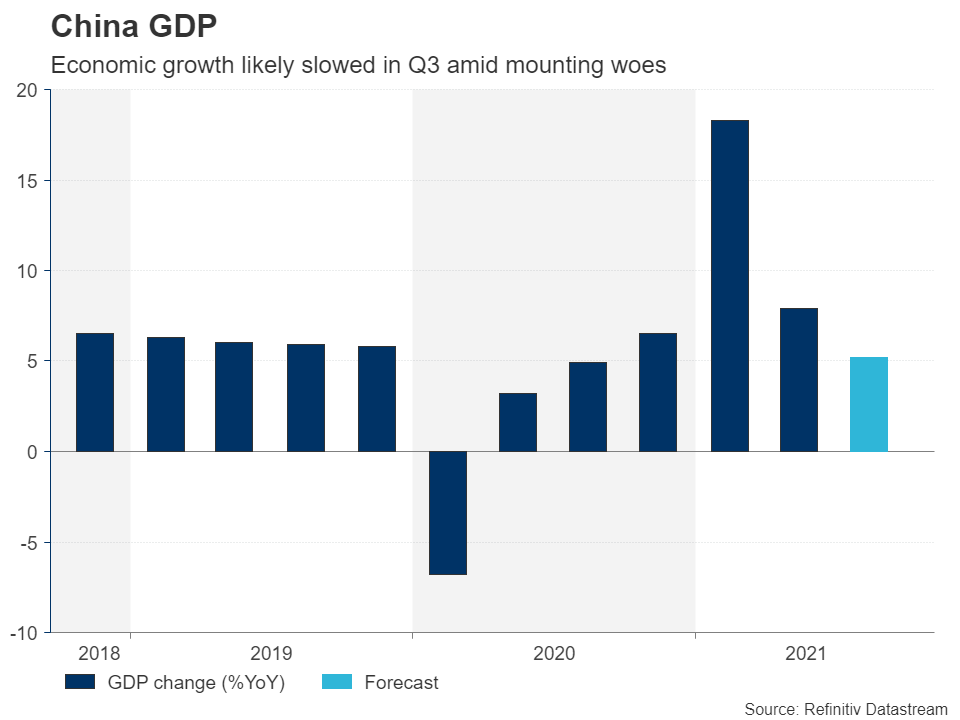
Other data due out of China on Monday are not anticipated to soothe market nerves about a slowdown either. Industrial production is expected to have picked up only marginally to 4.5% y/y in September and growth in retail sales to have quickened slightly to 3.3%.
Disappointing numbers could dent risk appetite, weighing particularly on equities globally and the Australian dollar, which is seen as a liquid proxy for China plays. The aussie has been boosted lately from the surge in commodity prices and strong demand for Australia’s resources exports. But if investors were to get spooked about the outlook for China, the currency could come under selling pressure. Also relevant for aussie traders next week are the minutes of the RBA’s last policy meeting on Tuesday and Australian flash PMIs on Friday.
Inflation in focus in Japan and New Zealand
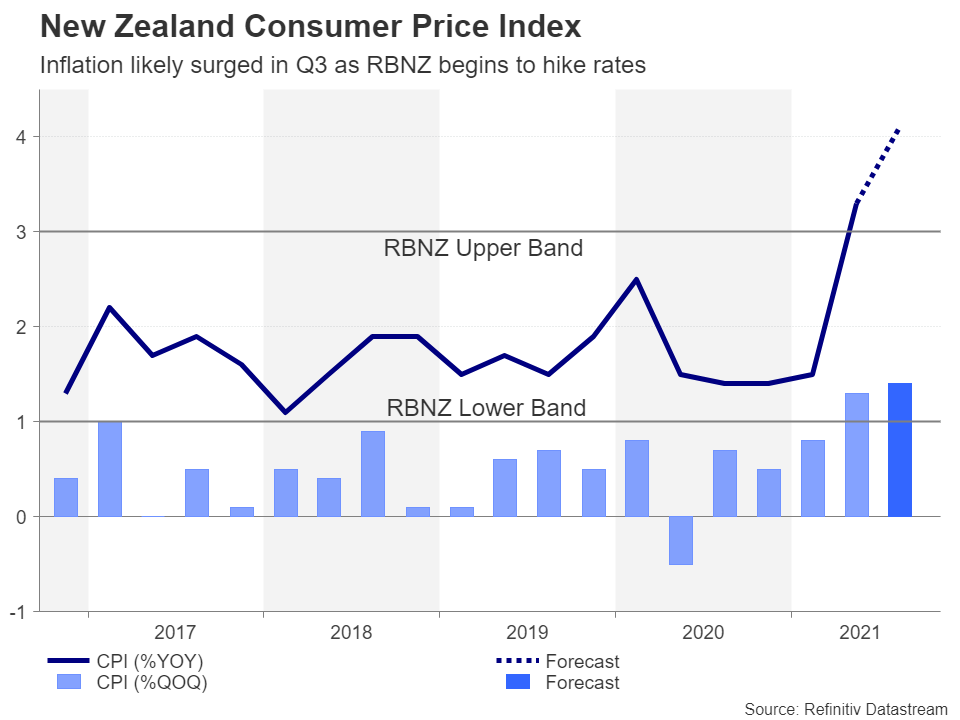
Like its aussie counterpart, the New Zealand dollar is in the process of rebounding from the late September lows against the US dollar and quarterly inflation stats on Monday could add more fuel to the rally. New Zealand’s consumer price index is expected to have accelerated to 4.1% y/y in the three months to September, likely reinforcing bets that the RBNZ will raise rates again in November. However, a stronger-than-forecast CPI print could lead investors to price in a more aggressive rate hike path after expectations were somewhat pared back recently.
Inflation data will be doing the rounds in Japan too. The core CPI rate is projected to have edged up slightly in September. However, Japan has been battling deflation for so long that any price rises would be welcome by policymakers. Even if higher inflation were to start worrying the Bank of Japan, the economy is still reeling from the recent states of emergency that were imposed to contain the Delta variant so there is no immediate prospect of stimulus being scaled back.
The CPI figures are out on Friday alongside the flash manufacturing PMI. Earlier in the week, September trade data will be watched on Wednesday. The yen might find support from any positive surprises in the inflation numbers. However, with Japanese government bond yields unable to join the global rally due to the BoJ’s yield curve control policy, the yen will likely remain on the backfoot against its peers, and even more so against the US dollar.
Euro eyes flash PMIs as energy crisis grips Europe
Energy shortages in Europe appear to have hit the UK the hardest but euro area economies are increasingly feeling the impact of soaring oil and natural gas prices too. However, higher electricity prices are not the region’s only headache. Shortages of key components such as microchips are holding back German automakers and the wider the supply constraints become, the more Europe’s manufacturers will suffer.
IHS Markit’s PMI surveys have already started to show some impact from the supply issues on the manufacturing sector in September and the problems probably got worse in October.
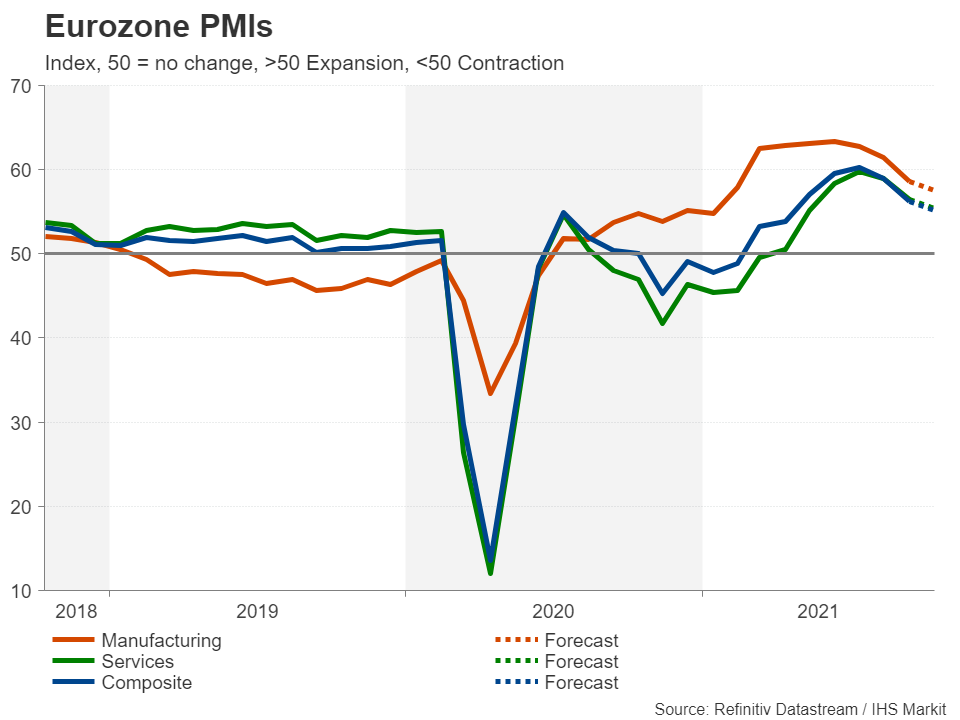
The euro, which is easing from a 15-month trough versus the dollar, could plumb fresh lows if Friday’s flash PMI releases point to a further loss in the Eurozone’s growth momentum in October.
Will UK data scupper pound’s rebound?
Having trended downwards since the beginning of summer, the pound is now attempting a breakout from this negative slope. The latest economic pointers out of the UK next week may help it do that as inflation numbers are due on Wednesday, followed by retail sales and flash PMIs on Friday.
Headline inflation jumped to 3.2% y/y in August, prompting a hawkish shift at the Bank of England and bringing forward rate hike expectations. If CPI moves further north of the BoE’s 2% target in September, a rate increase in November would become more probable. And although there is a risk that retail sales and the flash October PMIs might underwhelm, unless they are shockingly bad, policymakers are likely to put more weight on the potentially hotter inflation readings.
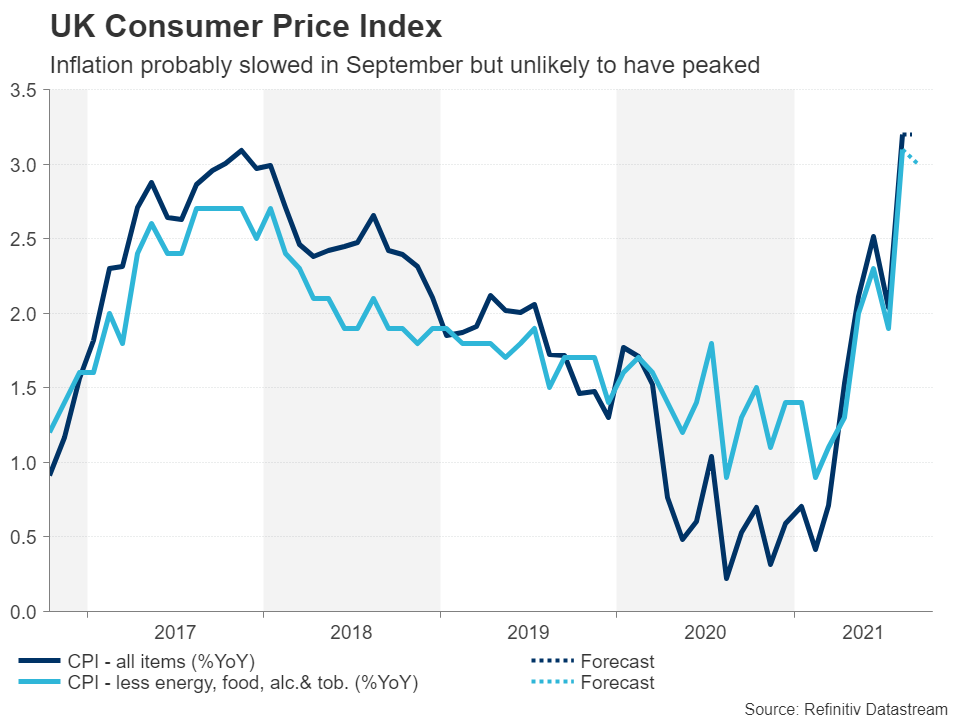
Nonetheless, even if predictions for an early rate hike were to intensify, the pound’s gains could be limited if investors become less optimistic about the UK economy, either from the data or from troubling headlines about deepening supply shortages across Britain.
Quieter week for USD; Canadian CPI could buoy the loonie
The greenback’s latest advance has paused after long-dated Treasury yields stepped back from their recent highs as markets began to price an earlier rate hike but a shallower tightening path by the Fed. With not a lot on the US agenda in the coming days, the dollar might continue to consolidate.
Starting the week on Monday are industrial production figures for September, followed by building permits and housing starts on Tuesday. On Thursday, existing home sales and the Philly Fed manufacturing index will attract some attention. The flash PMI readings will wrap up the week on Friday.
The Canadian dollar has been capitalizing on the greenback’s softness, while higher oil prices have also been lifting the commodity-linked currency. On Wednesday, Canadian CPI data could additionally aid the loonie’s ascent if it shows inflation rising further above 4% in September, which would likely put the Bank of Canada on track to taper again at the next meeting at the end of the month. More Canadian indicators will follow on Friday with retail sales figures for August.
China Closer to ‘Peak Stress’
- While we have argued financial stress in China should get worse before it gets better, we believe we are close to the 'peak stress' level in China.
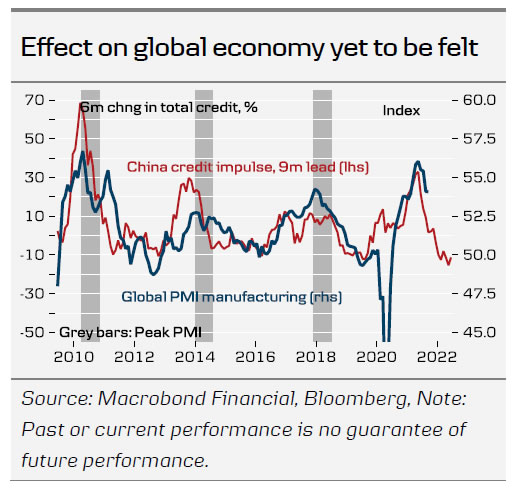
- Peak stress could give a short-term lift to Chinese equities but we don't see a sustained move higher until the credit cycle turns. That is still some time away. For assets indirectly linked to China, the negative spill-over from the Chinese economic slowdown is yet to be felt.
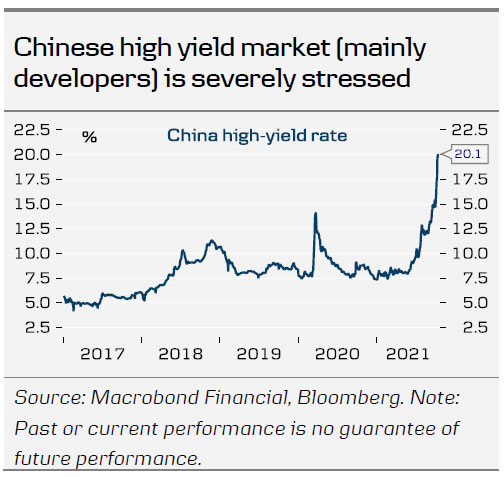
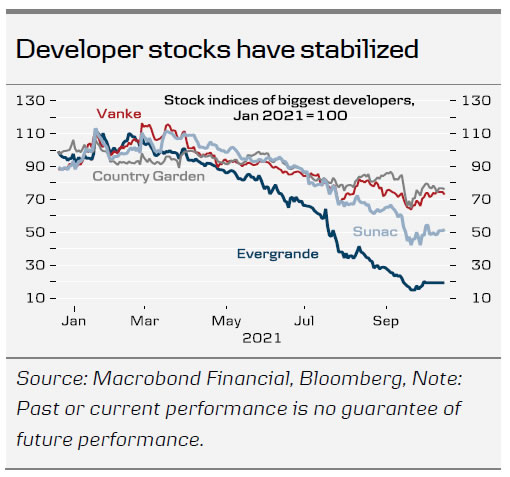
While Chinese equity markets have been more stable lately, the stress in credit markets for developers have continued unabated with rates on high yield credit reaching new highs by the day. As we argued in Research China - No 'Lehman moment' but financial stress is not over, 29 September, things had to get really bad before the government would step in with more force. However, with high yield rates (dominated by developers) moving above 20% this week, we believe Beijing is getting close to the pain threshold, where stronger measures need to be taken. Another sign of severe stress is faltering home sales as home buyers seem more reluctant to buy property from developers as long as they are not sure they are able to fulfil their obligations and deliver the apartment people put down deposit for. During the Golden Week holiday in early October, sales were down 33% y/y and by more than 40% in the big cities like Beijing and Shanghai. Developers cannot survive this kind of stress for long.
We are now seeing some easing measures to underpin home sales as big state banks were told to ease restrictions on mortgage lending and allowed to securitize the loans again. We expect Beijing to take steps soon to unfreeze the credit markets, as very few developers can survive this kind of funding and liquidity squeeze for long. One way to support the market could be cutting the Reserve Requirement Ratio and direct big state banks to start buying high yield bonds. If things calm down, buying bonds at 20% would likely turn out to be a quite favoruable investment for the banks. Private investors would also dare to start buying bonds if the government gets involved. More direct bank lending to developers is also likely to be extended, following a big break on this funding channel after regulation was tightened last year. And regulation could be eased slightly.
Peak stress is likely part of the reason why equities are rallying this week and dollar giving back some gains. However, we emphasize there is still a long way from stabilizing financial stress to re-starting the credit cycle in a similar fashion to what we have seen post-covid, or post-GFC in 09-2010. For Chinese equities, this may simply be a period of time where we see more sideways moves, awaiting the next large cyclical reboot of credit. For assets which are more indirectly linked to Chinese assets and the credit cycle, we suspect this will mean little. E.g. EUR/USD is likely still in a process of moving lower as the effects of historical Chinese tightening is moving through the global manufacturing chains.
Weekly Focus – Energy Price Surge Prompts Early Rate Hike Expectations
The energy crisis continues to worsen, driving up inflation expectations and prompting political reaction. Oil prices continued their surge above USD84 pr barrel, sa gas shortages continued to spill over into oil markets. While, natural gas prices in Europe fell back slightly from last week's peak, they remain four times higher than pre-crisis levels. Although the spike in energy prices has yet to feed broader inflation, inflation markets continue to price in higher inflation in the euro area in 5-10 year's time to its highest levels since 2014. To mitigate the increasing costs to the consumers and companies, the European Commission this week presented a toolbox of relief measures to be applied in member countries, including emergency income support to households, state aid for companies and targeted tax reductions. These measures come on top of the already announced temporary VAT cuts in Spain and Italy, which together with Greece are also providing subsidies for fuel payments. In the US, headline inflation increased faster than expectations in September while core inflation (excluding energy and food) only showed modest increases.
The surge in inflation expectations has also prompted expectations of earlier tightening of global monetary policy. In the US, financial markets are now a 50% chance of an interest rate hike by the Federal Reserve in July next year, while it has almost fully priced in a rate hike by September. We partly agree with this view as we changed our Fed call this week to assume two rate hikes in second half of 2022 (September and December), see Fed Research - Powell likely to remain chair and hike twice next year, 14 October. This week, Fed minutes from the September meeting showed that there is broad consensus in the policy committee to start the tapering in November or December. The surge in inflation expectations have also prompted market expectations of a rate hike by the ECB, where 10bp is priced for January 2023, which we think is far too premature, see discussion in Reading the Markets EUR: Markets are out of sync with ECB guidance, 14 October.
Meanwhile, the global economy is showing signs of abating momentum. This week the ZEW survey for Germany was another print confirming slowing economic activity and outlook in Germany. While the expectations component were still holding up at 22.3 (from 26.5 in Sep), it is nevertheless declining. Not surprisingly the current situation component also declined, but the magnitude of that decline was bigger than expected pointing to headwinds for the German economy in the near future. Despite the higher energy prices and weakening economic momentum global risk sentiment held up relatively well.
Next week, focus turns to Preliminary October PMIs for the UK, the US, Japan and the euro area. In the euro area, focus will be on whether supply constraints and mounting energy crisis are affecting companies' order books and cost situation. We will also get the details from the September HICP release on Wednesday, giving more clues what drove the surge in core inflation to 1.9%. It is also worth keeping an eye on consumer confidence on Thursday for any signs that rising energy prices are denting consumers' willingness to spend in Q4. In the US, it is the last week where the Fed members can guide markets ahead of November meeting before the blackout period kicks in on Saturday 23 October In the UK, the CPI inflation for September on Wednesday will attract attention given Bank of England hawkishness.
Sunset Market Commentary
Markets
There’s a new word in town: “shortflation”. ECB’s Villeroy described the current economic environment like that in a Bloomberg interview, resisting the increasingly popular idea of stagflation. The economy is still strong and robust, he argued, while inflation is mostly transitory. On the ECB’s bond buying, Villeroy said some of PEPP’s flexibility should be kept in the “virtual toolbox”, for example as a contingency option to be used in times of stress. This could be one of the features of the new ECB buying scheme it is due to announce at the December policy meeting. Villeroy’s comments followed ECB Wunsch’s earlier (see below) but were largely overlooked by markets since they came around the timing of US retail sales. Joe Sixpack spent more than expected in September. Headline sales advanced 0.7% m/m (vs -0.2% expected) and came on top of an upwardly revised 0.9% in August. The value of sales in all but two out of 13 categories rose. Core sales aka the control group (ex. car sales, building materials, gas stations, office supply stores, mobile homes and tobacco stores) rose a consensus-beating 0.8% m/m after an already stellar 2.6% last month. While strong on the face of it, some (justly) note that goods categories heavily outweigh services in the US series and say rising coronacases in August/September has shifted spending to the former, possibly distorting the image. Anyway, this nuance didn’t prevent US yields from extending their intraday rise and neither did a disappointing NY Empire Manufacturing (from 34.3 to 19.8). The curve bear steepens with the belly of the curve underperforming wings. Changes vary from 2.5 bps (2y) over 5.4 bps (10y) to 4.4 bps (30y). With today’s move included, the 10y managed to half weekly losses. The same holds (more or less) in Germany. The aggressive two-day bull flattening reversed. The 10y found support near the lower bound of the upward sloping trend channel and rises 3.1 bps. Other changes range from 1.6 bps (2y) to 5.1 bps (30y). Despite having declined more, European swap yields recover a bit less (0.6-3 bps). Equity sentiment is a bit less buoyant compared to yesterday. European stocks add >0.5% and Wall Street opens 0.3-0.7% higher. Solid earnings take investor’s minds off slowing growth and high inflation for the time being, even as commodities including oil do rise further (Brent +1%, nearing $85/barrel).
Three things stand out on FX markets but not all of them are that easy to explain. One: JPY hugely underperforms. This shouldn’t come as a big surprise given the jump in yields today. USD/JPY surpasses the 114 mark for the first time since end 2018. EUR/JPY recovers 132(.73), the highest level since June. EUR/USD is going nowhere near the 1.16 pivot. The Norwegian krone (two) thanks to oil is the G10 top performer (EUR/NOK 9.75) along with the pound (three). This is where it gets trickier: we’ve seen no specific trigger for sterling. Technical considerations definitely played a role though with EUR/GBP (0.844) forfeiting 0.847 and even important 0.845 support at the time of writing. A weekly close is needed for confirmation and would surely improve the technical picture.
News Headlines
German Social Democrats (SPD), the Greens and the liberal Free Democrats (FDP) agreed on the basic principles for a ruling coalition. Joint talks only started a week ago. Formal negotiations to hammer out the details start next week. The SPD and the Greens accepted FDP’s demand to safeguard the country’s constitutional debt limits and to refrain from imposing new taxes. The Greens no longer push for speeds limits on the highway. The coalition wants to unleash Germany’s biggest industrial renewal in a century, including accelerating its exit from coal and modernizing manufacturing, according to the likely next Chancellor, SPD leader Scholz.
National Bank of Belgium governor Wunsh prefers to err on the side of not changing the ECB’s instruments too often. The comments come as the ECB tries to figure out how the post-PEPP world will look like. Other governors already floated the idea of creating a new bond buying programme to coexist next to APP and to absorb the sudden stop of PEPP buying. Another possibility would be to transfer some of the flexibility of PEPP into APP. Overall, Wunsh does remain ally of a very supportive monetary policy.