Sample Category Title
Fed Bullard advocates starting tapering in Nov, finishing it in Q1
St. Louis Federal Reserve President James Bullard told CNBC, "I'd support starting the taper in November." He added, "I've been advocating trying to get finished with the taper process by the end of the first quarter next year because I want to be in a position to react to possible upside risks to inflation next year as we try to move out of this pandemic."
But he also emphasized "there's no reason for us to commit one way or another at this point," regarding interest rate hike. "I just want to be in a position in case we have to move sooner that we're able to do so next year in the spring or summer if we have to do so."
He noted that a supply shock alone cannot cause inflation". But, "a supply shock being accommodated by very easy monetary policy, it's those two things that lead to the inflation." Yet, he's not concerned with the risk of a 1970s-style stagflation since "the probability of recession is exceptionally low at this point."
Elliott Wave View: S&P 500 Should Extend Lower
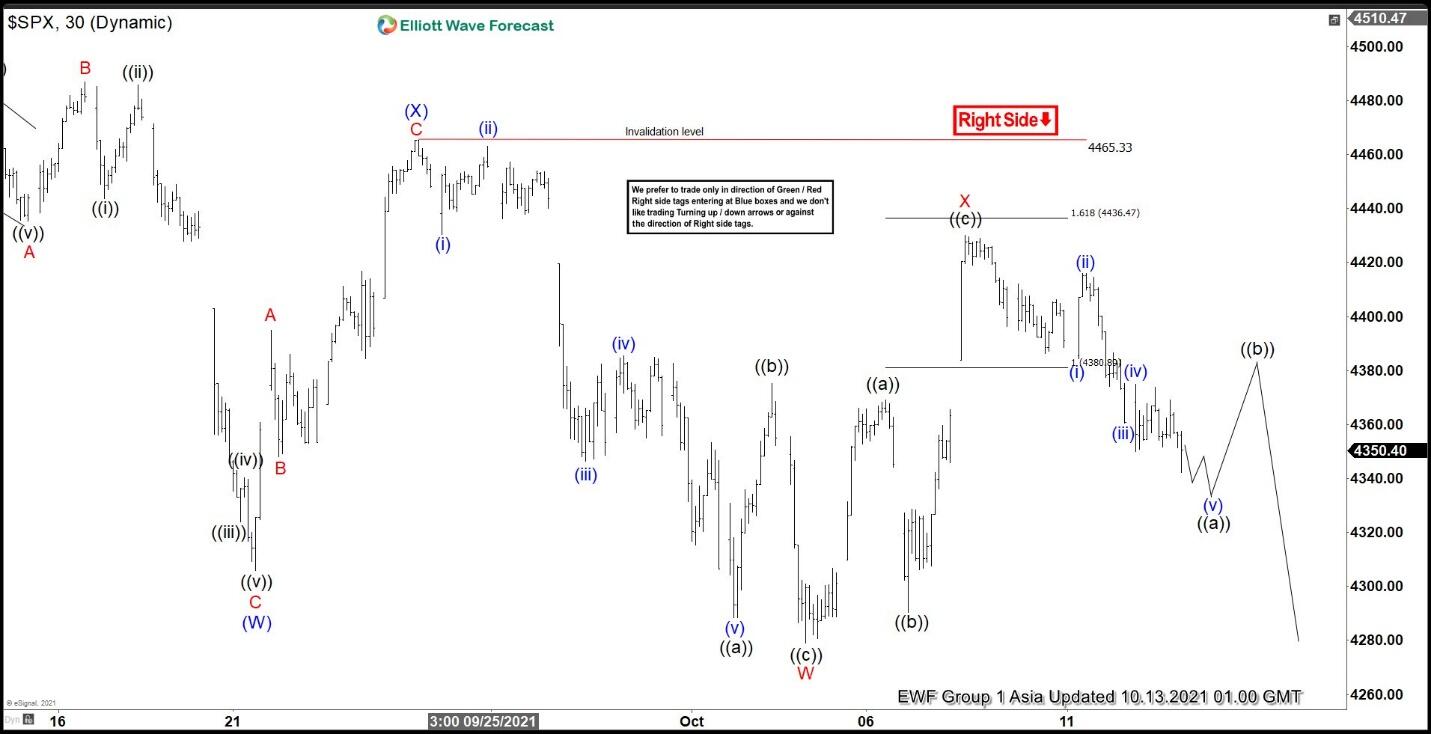
Short Term view in S&P 500 (SPX) suggests the decline from Sept 23, 2021 peak is unfolding as a double three Elliott Wave structure. Down from Sept 23 peak, wave W ended at 4278.94 as a zigzag structure. Wave ((a)) of W ended at 4288.52 and rally in wave ((b)) of W ended at 4375.19. The third leg wave ((c)) of W lower ended at 4278.94. Rally in wave X has ended at 4429.97 also as a zigzag structure. Up from wave W, wave ((a)) ended at 4369.23 and pullback in wave ((b)) ended at 4290.49. Final leg wave ((c)) of X ended at 4429.97.
Index has turned lower within wave Y with internal subdivision as a zigzag structure. Down from wave X, wave (i) ended at 4384.22 and bounce in wave (ii) ended at 4415.88. Wave (iii) lower ended at 4360.59. Rally in wave (iv) ended at 4743.89 and then turn lower to look for finish wave (v) as well as wave ((a)). Afterwards, it should rally in wave ((b)) to correct cycle from October 07 peak before the decline resumes again. Near term, as far as pivot at 4465.33 high remains intact, expect rally to fail in 3, 7, or 11 swing for more downside.
SPX 30 Minutes Elliott Wave Chart
Market Morning Briefing: Pound Is Unable To Rise Above 1.37
STOCKS
Indian equities continue to outperform the others and while above immediate supports at 17800 (Nifty) and 60000 (Sensex), the rally is likely to continue. Dow and Dax have fallen overnight and have scope for a fall to 34000-33750 and 15000-14800 before a bounce back is seen from there. Nikkei is likely to dip back towards 28000-27500 before bouncing back towards 28750. Immediate range of 28750-27500 looks likely. Shanghai needs to hold above 3500 to keep bullish view intact.
Dow (34378.34, -117.72, -0.34%) has strong resistance near 35000-35200 and while that holds, the index could fall towards 34000-33750 again in the near term before attempting to rise again. Immediate view is bearish while below the mentioned resistance.
DAX (15146.87, -52.27, -0.34%) has dipped slightly and is likely to remain within the broad range of 14800-15400/500. Trading in the middle of the mentioned range, there is scope for movement on either side to test 14800 or 15400/500. Only a sustained break on either side of the range will bring in further course of movement.
Nikkei (28184.51, -46.43, -0.14%) has important support at 27500 and while that holds a narrow range trade within 28750-27500 is possible. But note that there is enough room on the upside for a possible rise to 29250/500 which can come into the picture on a rise above 28750.
Shanghai (3527.07, -19.86, -0.55%) has declined below 3550. A bounce from 3500 is necessary to take the index again towards 3600 or higher else a further decline to 3450/25 cannot be negated in the medium term.
Nifty (17991.95, +46 +0.26%) is holding above the support at 17800 and a test of 18250 can be seen in the next few sessions. There is no impact of rising Nifty on Rupee as the latter is more highly correlated with Crude just now.
Sensex (60284.31, +148.53, +0.25%) is sustaining above 60000 which indicates a rise towards 61000 or even higher towards 62000 in the medium term.
COMMODITIES
Crude prices are stable below respective resistances of 84-85 (Brent) and 81-82 (WTI) and while they hold, there could be a short decline to 81-80 and 78-77 respectively. Gold and Silver are stable within the 1740-1780 and 22-23 range. Copper trades below crucial resistance at 4.35/40and while that holds, a decline to 4.20/00 is possible in the near term.
Brent (83.25) trades below immediate trend resistance near 84. While below the 84-85 resistance zone, we may expect a dip towards 81-80 in the near term. WTI (80.50) on the other hand can dip towards 78-77 while below 81. We reiterate that we would be cautious at current levels to go long as upside is likely to be limited.
Gold (1762.40) has risen slightly and has scope to head towards the upper end of the 1740-1780 range. A break on either side is needed to have more clarity on further direction.
Silver (22.59) also continues to remain ranged within 22-23.
Copper (4.3125) is stable just now. Immediate resistance at 4.35 and higher at 4.40 may hold for now and produce a decline towards 4.20/4.00 on the downside. Any break above 4.40 would be crucial and would indicate strong rally ahead. Such a rally looks less likely for now.
FOREX
Dollar Index continues to trade higher while there is scope for Euro to test 1.1525/00-1.1493. EURJPY could test immediate resistance near 131.50 and fall from there along with the fall in USDJPY from resistance at 114. Aussie and Pound are ranged just now but could be gearing up for a sharp move soon. USDCNY may fall to 6.44/42 while below 6.4650. USDINR can be bullish while above 75.30/3250. Note immediate resistance near 75.75.
Dollar Index (94.35) has dipped from 94.56 and could fall towards 94 in the near term. A break above 94.50, if seen and sustained can take the index higher eventually.
Euro (1.1552) has risen after a dip to 1.1524 yesterday. We may continue to see a decline towards 1.1525/00-1.1493 soon.
EURJPY (131.07) has managed to finally rise above 131, pulled up by a weaker Yen. Immediate resistance is seen near 131.50 which can be tested before a corrective dip is seen towards 130.50 or lower.
Dollar-Yen (113.44) has dipped a bit from yesterday’s high of 113.79. while below immediate resistance at 114, a short corrective dip towards 113.40-113 can be possible.
Aussie (0.7342) finds difficulty to rise above 0.74 just now and could trade within 0.74-0.7250 for the near term.
Pound (1.3613) is unable to rise above 1.37 and could trade within 1.37-1.3550/35 in the near term. The sideways consolidation could be building up momentum for a sharp rise soon on the upside.
USDCNY (6.4455) looks stable just now and while resistance near 6.4650 holds, the pair can decline towards 6.44/42 on the downside.
USDINR (75.51/52) closed higher yesterday and while above 75.3250, there is scope for a rise to 75.75 on the upside which can hold for the very near term. Note that there is high correlation with Brent crude just now and a fall in Brent could be in favor of Rupee strength. For today while above 75.30/3250, view is bullish on USDINR.
INTEREST RATES
The US Treasury Yields have come-off well especially at the far-end. The key resistances are holding well for now in line with our expectation, but the yield will have to fall below their near-term supports to confirm a reversal and fall further. The CPI inflation data will need a close watch to see if it pulls down the yields further or takes it up again. The German yields are coming up towards their key resistances from where we expect a fresh fall. The 10Yr GoI remains higher but stable below its important resistance. We expect a pull-back in the coming days. The 5Yr GoI is moving down within the expected sideways range.
The US 2Yr (0.34%), 5Yr (1.07%), 10Yr (1.58%) and the 30Yr (2.09%) %) have dipped well especially at the far-end. 1.65% on the 10Yr and 2.2% on the 30Yr seems to be holding for now. A fall below 1.5% (10Yr) and 2% (30Yr) will be needed to negate the chances of breaking above 1.6% (10Yr) and 2.2% (30Yr). Such a fall will then pave way for a revisit of 1.4%-1.3% (10Yr) and 1.85%-1.8% (30Yr) that we have been expecting.
The German 2Yr (-0.67), 5Yr (-0.47%), 10Yr (-0.09%) and 30Yr (0.37%) yields have inched up further. The 10Yr and 30Yr have entered their -0.1%/-0.05% and 0.35%/0.45% resistance zones respectively. We expect these resistances to hold and the yields to reverse lower in the coming days. The price action in the coming days will need a close watch.
The Indian 10Yr GoI (6.3363%) has dipped slightly. We reiterate that 6.35%-6.36% is a crucial resistance which is likely to cap the upside and trigger a pull-back to 6.25%-6.2% and even lower. In case of a break above 6.36%, an extended rise to 6.4% is possible.
The 5Yr GoI (5.7008%) is falling within our expected 5.66%-5.76% range. We will have to wait for a breakout on either side of the 5.66%-5.76% range to get clarity on whether the yield can move up to 5.8%-5.85% or fall to 5.62%-5.6% going forward.
AUD/USD Eyes Additional Gains Above 0.7400
Key Highlights
- AUD/USD started a fresh increase above the 0.7300 resistance zone.
- A major ascending channel is forming with support near 0.7340 on the 4-hours chart.
- EUR/USD could extend downsides below the 1.1520 support.
- The US Consumer Price Index could rise 5.3% in Sep 2021 (YoY).
AUD/USD Technical Analysis
The Aussie Dollar started a steady increase from the 0.7220 zone against the US Dollar. AUD/USD gained pace after there was a clear break above the 0.7300 resistance zone.
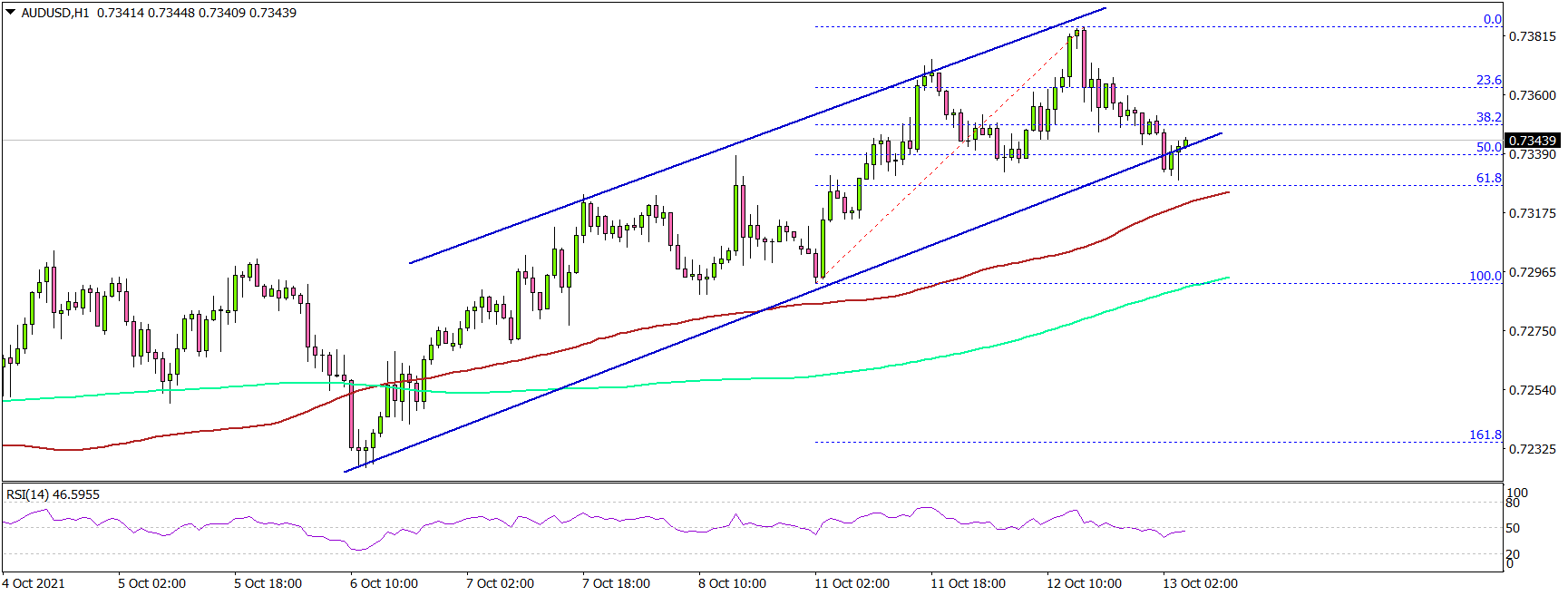
Looking at the 4-hours chart, the pair climbed above the 0.7320 level. There was also a close above the 07350 level, the 100 simple moving average (red, 4-hours), and the 200 simple moving average (green, 4-hours).
The pair traded as high as 0.7385 before starting a downside correction. On the downside, there is a decent support forming near the 0.7350 level.
There is also a major ascending channel forming with support near 0.7340 on the same chart. The channel support is also close to the 50% Fib retracement level of the upward move from the 0.7292 swing low to 0.7384 high.
A downside break below the channel support could open the doors for a move towards the 0.7300 support. The next major support sits near the 0.7250 level.
An immediate resistance on the upside is near the 0.7385 level. The first major resistance is near the 0.7400 level, above which the bulls may possibly aim a larger increase in the near term.
Looking at EUR/USD, the pair is struggling to recover and there is a risk of a break below 1.1500. Besides, GBP/USD is consolidating below the 1.3650 resistance.
Economic Releases
- UK Industrial Production for August 2021 (MoM) - Forecast +0.2%, versus +1.2% previous.
- UK Manufacturing Production for August 2021 (MoM) - Forecast 0%, versus 0% previous.
- UK GDP for August 2021 (MoM) - Forecast +0.5%, versus +0.1% previous.
- German Consumer Price Index for Sep 2021 (YoY) – Forecast +4.1%, versus +4.1% previous.
- German Consumer Price Index for Sep 2021 (MoM) – Forecast 0%, versus 0% previous.
- US Consumer Price Index for Sep 2021 (MoM) – Forecast +0.3%, versus +0.3% previous.
- US Consumer Price Index for Sep 2021 (YoY) – Forecast +5.3%, versus +5.3% previous.
Eco Data 10/13/21
[php_everywhere instance="1"]
Sterling Edges Lower Despite Strong Job Data
The British pound has edged lower in the Tuesday session. GBP/USD is currently trading at 1.3575, down 0.13% on the day.
UK employment numbers looked sharp for September. The number of payroll employees showed another monthly increase and unemployment rolls fell by 51 thousand, not as low as the consensus of -60 thousand, but a very respectable figure. Perhaps the most notable release was wage growth, which came in at 7.2% for the three months June to September.
The solid jobs report has heightened expectations that the BoE is contemplating a rate hike, perhaps as early as November. Investors may be getting a bit ahead of themselves – earlier today, ING projected that the BoE would not raise rates before May 2022. We will hear from MPC members Silvana Tenreyro and Catherine Mann on Thursday, and it will be interesting to see if either of them discusses a timeline for a rate hike. Even if the BoE does raise rates before the end of the year, the markets will be looking for signs of whether the Bank is planning a series of hikes in 2022.
On the weekend, MPC member Michael Saunders said that with inflation running above 4% and that it was “appropriate” for the markets to have priced in a rate hike earlier than previously. Saunder’s comments came just a few days after BoE Governor Andrew Bailey said that inflation needed to be reigned in and brought closer to the BoE’s target of 2.0%. The BoE is known for its caution, and these hawkish statements from senior BoE policy makers could be a trial balloon about its plans to raise rates in the near future.
There are additional key UK events on Wednesday. The monthly GDP report for August and Manufacturing Production should be closely watched, as either release could affect the movement of the pound.
GBP/USD Technical Analysis
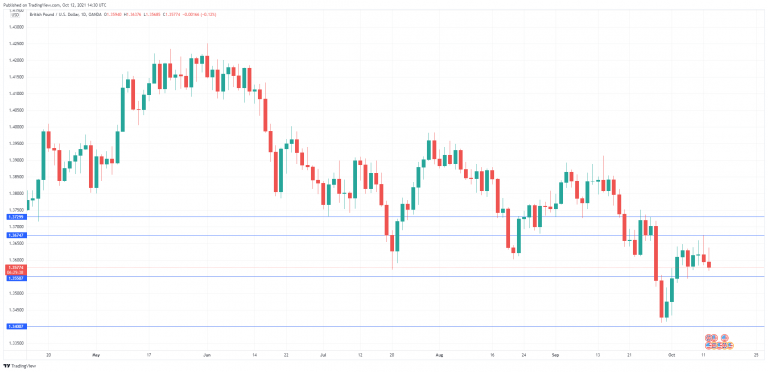
- 1.3674 is the next resistance line. 1.3729 is next.
- GBP is putting pressure on 1.3550, a key support line. Below, there is support at the round number of 1.3400, which has held since December 2020
Fed Bostic comfortable to start tapering in November
Atlanta Fed President Raphael Bostic said the job markets had made "sufficient" gains to allow tapering the USD 120B per month asset purchases. He "would be comfortable starting tapering of asset purchase program in November."
Nevertheless, he noted that "there is significant uncertainty about how long inflationary pressures will last."
Sentiment Hushed as Durable Dollar Climbs with Yields
Markets look for clues in JOLTS data and FOMC speeches
The current market picture is one of stubborn inflation, rising yields, and expectations of a nearing Fed announcement of the taper timeline, specifically in the November FOMC meeting. Global growth has somewhat slowed as the consequences from the energy crisis hamper economies.
That said, markets will try to extract clues from Fed speakers over the week especially after the disappointing NFP payrolls from Friday. Rising yields are aiding the earlier rate lift-off advocates, while providing the greenback with buoyancy. Stronger dollar data may tick the boxes for the Fed and increase the likelihood of a clear taper announcement on the horizon, which markets have already priced in.
The August JOLTS forecast missed the forecast of 10.9 coming in at 10.44 mln, from a revised July number of 11.10 mln. It’s not clear whether the result supports the narrative that faltering employment data is due to supply issues. If this is the issue, this could provide the dollar with more fuel.
Furthermore, the dollar may also receive extra strength from the vote out of the House of Representatives regarding the extension of the debt-ceiling, which is expected to be positive.
The dollar index is around 94.47, while 10-year yield at 1.63% remains buoyant. The euro is looking feeble around $1.1540, while the pound is faring slightly better at $1.3595, despite the UK dealing with a rather full plate.
Should dollar data meet expectations and yields continue to float higher, the greenback is likely to retain its appeal.
The USD/JPY pair traded up to a 34-month high of 113.70 as the dollar’s haven demand increased in an environment of subdued global growth, inflation concerns and rising yields.
Eurozone and UK feel the heat
The eurozone remains dampened by the energy crisis, facing rising transportation costs and supply constraints. Pricing of wholesale goods have risen in Germany with the index rising by 0.8% from August to September 2021. Furthermore, a rise by 13.2% in wholesale trade pricing in September 2021 in contrast to September 2020 due to increased prices of raw materials, signals a gloomy picture around inflation and pricing for consumers.
Moreover, the German October ZEW survey at 22.3 came in slightly weaker than expectations of 23.7. This signalled an optimistic economic picture yet has failed to aid the already lagging euro. The ECB is still emanating a dovish tone and the picture for the euro remains dull in the current domain of persisting inflation, slower global growth, energy issues and the dollar’s haven attractiveness. The softer eurozone data may give ECB doves the playing cards to keep hawks at bay at least until December, regarding QE.
The UK remains worst hit by the energy crisis and supply shortages. Moreover, looming post-Brexit issues of a hard border between Ireland and Britain continue to weigh on the UK, along with a costly trade war with the eurozone adding to the negative pressures on the pound.
On top of that, a weaker decline in the number of people requesting unemployment benefits has not assisted the currency, even on a minor drop in unemployment to 4.5% and an average earnings improvement to 7.2%, as opposed to the forecast of 6.9%.
The energy crisis in the UK, as well as the supply shortages and trucker issues, are more likely to weigh on the pound, resulting in softer volatility or underperformance for a while longer.
FOMC Members Clarida and Bostic are scheduled to speak at 15:15 and 16:30 GMT respectively.
Later at 17:01 GMT US 10-year notes will be auctioned off and it will be interesting to see if foreign buyers will participate with yields on the rise.
Sunset Market Commentary
Markets
The comeback of US investors didn’t bring clear directional dynamics for global trading. Most markets are holding on to a mild risk-off modus. Uncertainty on further Chinese regulation and multiple risks to future growth kept potential ‘dip buyers’ in risk assets on the sidelines. Below consensus German ZEW economic sentiment illustrated the erosion in confidence among investors. (expectations at 22.3 from 26.5; current conditions at 21.6 from 31,9). According to the ZEW President Wambach, ‘The further decline …is mainly due to the persisting supply bottlenecks for raw materials and intermediate products. The financial market experts profits to go down, especially in export-oriented sectors such as vehicle manufacturing and chemicals/pharmaceuticals.” US NFIB small business confidence told a similar story, touching the lowest level since March (991.1 from 100.1). Entrepreneurs expecting business conditions to improve the next 6 months declined to the lowest level since 2012!, ‘as business are unable to hire workers or receive the needed supplies and inventories’. With rising costs perceived as the major obstacle to growth, the risk-off/negative eco narrative again didn’t help core bonds. The US curve flattens with the 2y rising 3 bps and the 30y easing 3 bps. It will be interesting to see investor appetite at this evening’s US 3y and 10y Treasury auctions. German yields are rising up to 2.5 bps (10y) and as such continue to challenge recent peak levels (-0.10% for 10y). Despite overall uncertainty, peripheral bonds show resilience with the Italian 10y spread narrowing 2 bps. European equities mostly show losses of about 0.5%. US indices opened marginally higher. Oil stabilizes ($83.5/b).
The dollar keeps the upper hand with the DXY index testing the 94.50 barrier. USD/JPY extends its recent impressive ascent with the pair surging beyond 113.5 to the highest levels since December 2018. However, contrary to yesterday euro weakness is also again in play. EUR/USD (1.1545) struggles not to fall below the 1.1530 correction low, being last defense ahead of the 1.1495 support. Sterling this morning hesitated despite strong UK labour market data, but EUR/GBP finally returned below the 0.85 barrier currently changing hands near 0.8480. Markets still await the speech of UK’s Frost on the Northern Ireland protocol.
News Headlines
French president Macron presented a €30 billion plan, dubbed France 2030, that foresees investing the funds over a period of five years in the nuclear sector & renewable energy sources (8bn), electric cars (4bn), semiconductors and robotics (6bn). The aim is to create high-tech champions and reverse a years-long decline of the French industrial sector. According to Macron, France 2030 holds three key objectives: building small reactors, becoming the leader of green hydrogen and decarbonize the industry. The investment plan comes only a year after the €100 billion programme, France Relaunch, aimed to go beyond crisis spending and tackle long-lasting issues of low investment, hiring and education. By the end of this year, there’s still about one third yet to be spent, the government expects.
The EU successfully launched an inaugural green bond. The €12bn deal is the largest ESG one on record. Order books closed at a whopping €135bn, allowing the EU to print the 15y bond (Feb2037) at MS – 8 bps compared with guidance in the MS -5 bps area. Under the NextGenerationEU green bond framework, the funds will be used for nine broad categories including energy efficiency, clean energy and climate change adaptation. Today’s deal was the first of an expected €250bn green issuance as part of the EC’s €800bn Covid-19 recovery fund.
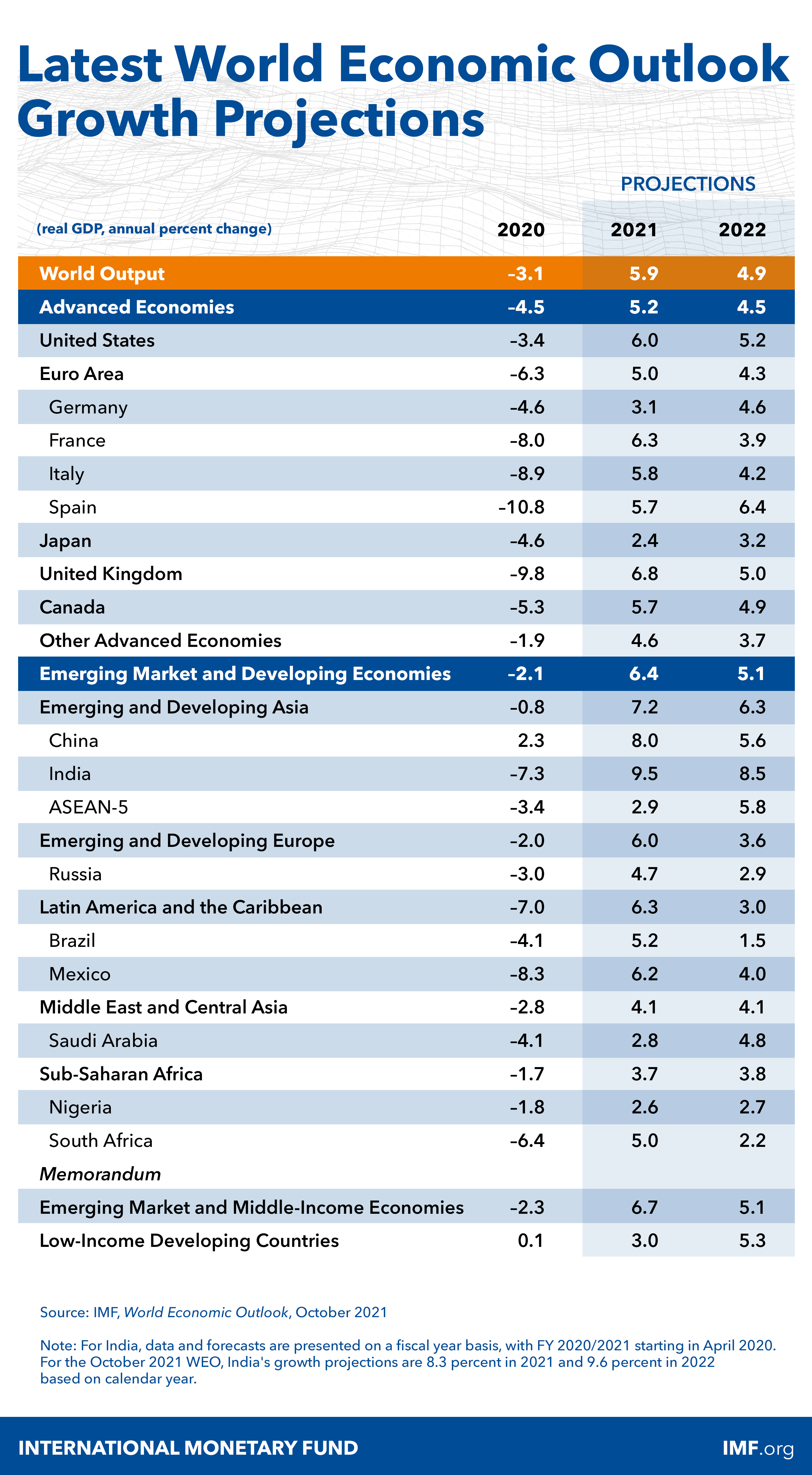
The IMF trimmed world growth for this year with 1 bp to 5.9%. The figure for 2022 remained unchanged at 4.9%. The 2021 figure does mask some impressive downgrades, for example in the US (-1 ppt to 6%). Low-income countries’ growth was shaved with 0.9%. The IMF warned for a “dangerous divergence” with growth in advanced economies (AE) reaching pre-pandemic levels in 2022 while forecasting growth in emerging markets still 5.5% below that level in 2024. Inflation is seen subsiding to 2% by mid-2022 in AE but still at 4.9% for EM. Overall, the Washington-based Fund cautioned inflation risks are tilted to the upside and those for growth to the downside.
IMF lowers 2021 growth forecast slightly to 5.9%
IMF lowered 2021 growth forecast slightly by -0.1% to 5.9% , reflecting "a downgrade for advanced economies—in part due to supply disruptions—and for low-income developing countries, largely due to worsening pandemic dynamics."
That's "partially offset by stronger near-term prospects among some commodity-exporting emerging market and developing economies."
IMF also warned, "rapid spread of Delta and the threat of new variants have increased uncertainty about how quickly the pandemic can be overcome. Policy choices have become more difficult, with limited room to maneuver.".