Sample Category Title
GBPUSD Forms Bullish Flag Pattern Ahead Of UK Data
USDJPY shot to the highest level in three years as the market waited for the upcoming US consumer price index (CPI) data. The numbers, which will come in the afternoon session. The data is expected to show that the country’s inflation rebounded in September as the aviation sector made a comeback. At the same time, prices will likely be boosted by rising energy costs. In the past few weeks, energy prices jumped as supply constraints continued. The Japanese yen also weakened after the country published the relatively strong machinery order numbers earlier today.
The GBPUSD pair held steady as investors wait for the latest UK GDP numbers that will come out during the morning session. Data by the Office of National Statistics (ONS) is expected to show that the economy continued to do well in August as the country reopened. Analysts also expect that manufacturing and industrial production rose by 4.1% and 3.1% in August. These numbers will come a day after the ONS published the relatively strong UK jobs numbers. The numbers showed that the country’s employers added about 207k jobs in September, pushing more analysts to price in a rate hike.
US futures wavered in the overnight session as investors waited for the start of the earnings season. Later today, companies like BlackRock, JP Morgan, and Delta Airlines will publish their earnings in the premarket session. They will be followed by other companies like Walgreens Boots Alliance, Bank of America, Wells Fargo, Morgan Stanley, Citi, and U.S Bancorp that will publish their results on Thursday. Analysts expect that these companies will publish strong results. However, they also expect the numbers to show that costs continued to rise.
GBPUSD
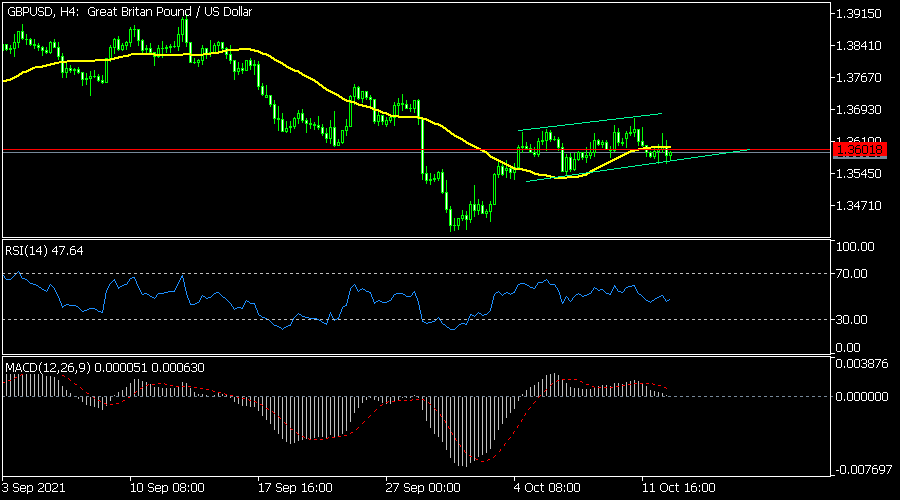
The GBPUSD price was little changed ahead of the upcoming UK GDP data. It is trading at 1.3582, which was slightly above the lower side of the ascending channel. The pair has moved to the 25-day moving average. It has also formed a bullish flag pattern. Meanwhile, the MACD and the Relative Strength Index (RSI) are at the neutral level. Therefore, the pair will likely rebound later today as bulls target the upper side of the channel.
EURUSD
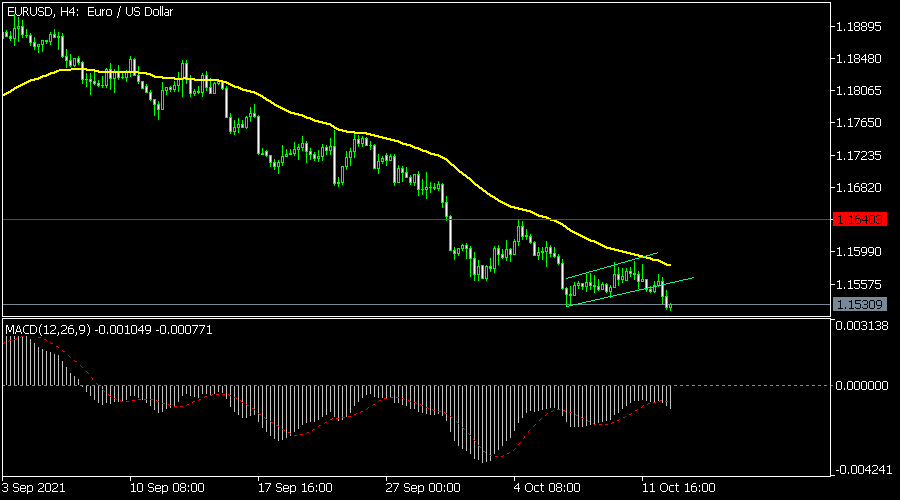
The EURUSD pair has been forming a bearish flag in the past few days. A bearish flag is usually a sign that an asset’s price will break out lower. This bearish breakout happened on Tuesday evening as traders waited for the upcoming inflation data. The pair crashed to the lowest level this year. Along the way, it moved below the short and longer-term moving averages while the MACD has moved below the neutral level. Therefore, the pair will likely keep falling although a break and retest pattern is also likely to happen.
USDJPY
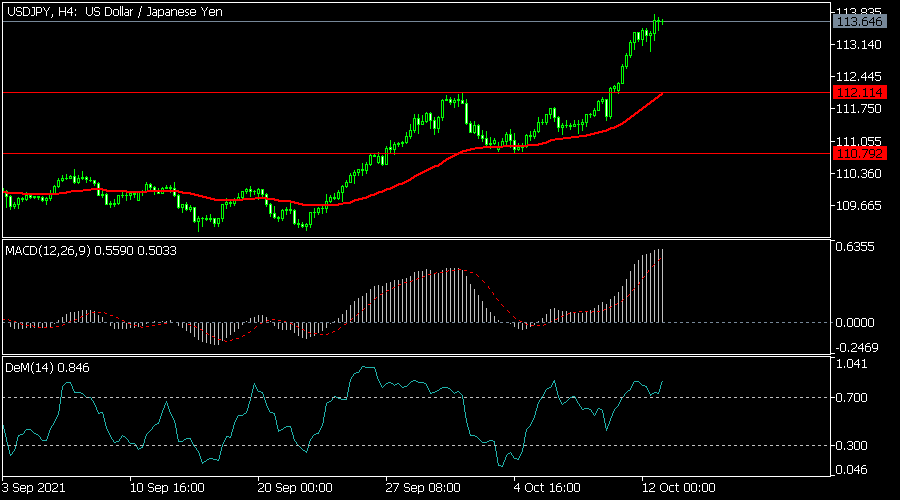
The USDJPY price continued its bullish trend as it rose to the highest level in more than three years. The pair rose to a high of 113.77, which was substantially higher than this month’s low of 110.80. On the four-hour chart, the pair is above the 25-day and 50-day moving averages while most oscillators have moved to the highest level in months. Therefore, the pair will likely keep rising as bulls target the next key resistance at 114.0.
The Focus Will Be On The US CPI Inflation Data
Markets
There was a remarkable disconnect between US and European yields yesterday. The German curve further bear steepened with yields rising between 0.9bp (2y) and 3.8bp/3.5bp for the 5y/10-y sector. The US curve flattened. The US 2-y yield rose 2bp. 10’s and 30’s declined 3.5bp and 6.9bp respectively. The data were not to blame with both ZEW economic confidence and US NFIB small business confidence showing a loss of momentum. The curve moves are telling on markets assessment on the relative positioning of the Fed and the ECB with respect to the risk of more long-lasting inflation. The Fed/individual governors show ever more signs for preparing to front-load both tapering of bond purchases and raising interest rates as illustrated by comments from Bullard and Bostic yesterday. The latter even labeled ‘transitory’ as a ‘dirty word’ as inflation is lasting longer than expected. The combination of early tightening in a context of uncertainty on growth resulted in a flattening move. The 3-y and 10-y US auctions yesterday were solid/strong after recent price concessions. Markets’ attitude toward European bond clearly is different but telling at the same time. In September/October, the rise in European yields was mainly driven by higher inflation expectations, to a large extent inspired by the persistent ‘transitory narrative’ of the likes of ECB’s Lane. However, European real yields recently started a catch up move. The German 10-y real yield returned north of -2.0%. This remains extremely low, but suggests markets sense a modification of the ECB inflation language is on the horizon. US and major European equity indices mainly showed modest losses in a mild risk-off context. Oil stabilized at a high level (brent $83.5 p/b area). The risk-off combined with higher short-term USD yields continued to favour the dollar. DXY tested the 94.50/55 area. EUR/USD touched a minor new correction low (close 1.153). USD/JPY closed at 113.61, the highest level since November 2018.
Asian equities are trading mixed this morning. The dollar is losing a few ticks even US ST yields continue testing recent peaks (2-y 0.35%). Later today, the focus will be on the US CPI inflation data. A mild easing/stabilization near recent peak levels is expected (5.3% Y/Y for the headline, 4.0% core). Even in case of a slight overshoot, the market probably already concluded that the Fed will react anyway. Next question is whether this will translate in a further rise in ST US yields and a further rise of the dollar. The jury is still out. There is no reason to row against the tide, but quite some Fed action is already be discounted. We continue to monitor the DXY 94.50/75 area and the EUR/USD 1.1495 key support. In Belgium, we mention that the Flemish Community intends to launch a euro denominated benchmark fixed rate bond with a maturity of a 10-y.
News headlines
The US has updated a proposal to the EU regarding a Trump-era dispute on steel tariffs. The new proposal still involves tariff-rate quotas (TRQs) but allows for a higher amount of steel quantities to be exported by the EU to the US before higher US duties kick in. Both parties are scrambling to find a solution for the dispute before December 1, when EU retaliatory tariffs to the original 25% steel and 10% aluminum US levies automatically kick in. However, the US starts from the assumption a TRQ-solution is acceptable while the EU says that’s illegal to begin with.
UK’s Brexitminister Frost in a much-anticipated speech yesterday said the Northern Ireland Protocol isn’t working and in fact is harming the region. He called for a replacement of the current version and stuck to his threat of using Article 16 – which suspends parts of the protocol – if necessary. Frost kept room for dialogue and a compromise though. His speech came on the eve of a EU counterproposal which the EU chief Brexit negotiator Sefcovic said is focused on specific adjustments rather than a complete overhaul. According to newspaper reports, those tweaks could result in removing more than half of the checks on goods arriving in NI from mainland UK. But it is believed this will fall well short of what Frost is actually demanding.
US CPI Inflation Is Likely To Remain Very High
Market movers today
- US CPI inflation will be watched carefully for more input on the 'transitory vs. persistent' discussion on the inflation spike this year. The m/m change in the core CPI is the relevant number to watch and it has come down to average 0.2% in July and August after readings around 0.7%-0.9% from March to June. Consensus is for an 0.3% gain, which seems fair in our view.
- We also receive FOMC minutes from the recent Fed meeting, where they turned a bit more hawkish and mentioned beginning of 'tapering soon'.
- In the euro area we get industrial production data, which will likely decline after weak data for Germany last week.
- Sweden releases the quarterly Prospera Inflation expectations report, which include Social Partners' wage expectations (see below).
- Keep an eye on Brexit, as the EU is set to announce its proposal on how to ease border controls between Great Britain and Northern Ireland. Especially look out for how the UK government responses.
The 60 second overview
Macro: The IMF sent out their new World Economic Outlook (Recovery During a Pandemic: Health Concerns, Supply Disruptions, and Price Pressures) yesterday, downgrading very modestly their global growth forecasts for 2021 to 5.9% while keeping 2022 forecast of 4.9% unchanged. In general countries exposed to the global manufacturing sector (such as Germany and Asian countries) or hit by the Delta variant (such as US and some EMs) were downgraded most while commodity producing countries such as Russia and Middle Eastern countries saw healthy growth upgrades. Moreover the IMF still sees the prospects for recouping the loss of economic activity stronger in advanced economies compared with emerging and frontier markets given slower vaccine roll-out and tighter financial conditions in the latter group. While they downgraded the growth outlook for China and US, they are still more optimistic than our forecasts while we share the view on euro area outlook.
Federal Reserve: Atlanta Fed President Raphael Bostic says that inflation is lasting longer than expected adding that "transitory is a dirty word". Bostic is a well-known hawk but it is still a very different language to what Fed policymakers said a year ago. Clarida is more dovish saying that the US is not heading for stagflation like the 70s.
Equities: The sour sentiment continued in stock markets yesterday with broad base declines. We are not see any signs of full-blown risk off but more softness across sectors and styles. Yesterday we even saw small caps outperforming with having any strong drivers behind it. In US, Dow -0.3%, S&P 500 -0.2%, Nasdaq -0.1% while Russell 2000 +0.6%. Risk appetite better in Asia this morning with most markets higher. US and European futures surfing around yesterday's closing level.
FI: Yesterday's main focus in markets was the EU's NGEU 15y inaugural Green bond. EU issued 12bn, no grow, was priced near fair value based on the EU's outstanding bonds. The massive order book in excess of EUR135bn, showed the strong demand for Green bonds.
FX: Commodity currencies, NOK, CAD, AUD and NZD rose vis-à-vis JPY and CHF yesterday. USD also gained yesterday, with USD/JPY making new high approaching 114 level and EUR/USD new low closer to 1.1500 level.
Credit: The sell-off in credit continued yesterday with iTraxx Xover widening 2.5bp while Main closed unchanged. HY bonds widened 5bp and IG 1bp.
Nordic macro
October money market inflation expectations could very well show another leg up on the back of recent energy/commodity crisis. Unless there is a BIG lift this shouldn't upset the market.
Riksbank buys SEK 0.3bn corporate bonds. DO issues SEK 7.5bn 3m T-bills and Kommuninvest (munis) issues in potential 2023-2028 maturities.
Inflation Matters
Major US indices remained slightly offered yesterday, as the IMF cut its global growth estimate from 6% to 5.9% in 2021, while leaving the expectation of a 4.9% growth for 2022. The US growth forecast has been lowered from 7% to 6%, mainly due to supply chain constraints.
The supply chain constraints seem to be getting worse at some places, but better in others. Apple faces important decrease in iPhone production and could cut the production target for its iPhone13 significantly in the last quarter. But on the other hand, Vietnamese assemblies that serve Intel and Samsung may start operating at full speed by next month, coming back to normality after the Covid-led shutdowns, and Toyota plans to resume its car production thanks to a rebound in shipments from its suppliers.
Now coming back to Apple, it is now said that Apple, which came out of the Chinese crackdown measures quite unharmed so far, could now see the pressure increased. Beijing will probably not forbid the iPhone sales or close Apple shops, but the government now allows users to sue Apple. Moreover, the Chinese government which has been slapping its own tech firms for giving their employees excessive work and perhaps not enough money could go after Apple, where the assembly-line workers certainly work longer hours for earning less than their US peers. And that could hurt the 40% profit margin the company makes on products built in China.
The possibility that Beijing could extend crackdown beyond its borders could further dampen the overall market mood, at least for companies that were allowed to do business in China so far.
Elsewhere, the supply chain constraints, and the rising oil prices continue fueling the worries of a longer and stickier inflation in the US and elsewhere.
Due today, the US CPI data will reveal how bad the 13% rally in US crude prices impacted the consumer price inflation in September. The expectation is a steady read at 5.3%, but the chances are we will see a stronger number rather than a softer one at today’s release. And a strong inflation will only reinforce the expectation that the Federal Reserve (Fed) would start tapering its bond purchases by next month, that’s already priced in. Yet, a too strong figure could boost expectations of an earlier rate hike from the Fed, and that’s not necessarily fully priced in.
Also due today, the latest FOMC minutes will likely reiterate the Fed’s willingness to start tapering the bond purchases soon and could give a further insight regarding the need and the possibility of seeing the rate normalization happen before 2023.
We lately started seeing an acceleration in the US 10-year yield, which is now above the 1.60%, and a strong inflation figure could further boost the yields and weigh on equity appetite.
Equity Indices Trade Mixed After US Declines, HK Impacted By Weather Conditions
General trend
- USD index trades slightly lower in Asia ahead of CPI data.
- Equity markets are generally off of the lows.
- US equity FUTS have remained modestly lower amid the Apple news.
- Nikkei has pared decline; Fast Retailing (largest Nikkei component) to report after the market close on Thurs.
- S&P ASX 200 has seen slight losses.
- Hang Seng index closed on session due to weather conditions, Thursday is also a holiday in HK.
- Shanghai Composite ended morning trading slightly lower (-0.4%); Property index dropped >1.5%.
- Chinese coal FUTs erase gain after hitting record high.
- China Sept inflation data is due on Thursday (Oct 14th).
- Monetary Authority of Singapore (MAS) is due to hold policy meeting on Thurs., Q3 advance GDP also due.
- Australia Sept jobs report also due tomorrow.
- Companies due to report during the NY morning include BlackRock, Delta, Infosys, JPMorgan.
Headlines/Economic data
Australia/New Zealand
- ASX 200 opened flat.
- (AU) Australia Oct Westpac Consumer Confidence: 104.6 v 106.2 prior; M/M: -1.5% v +2.0% prior.
- (AU) Australia Sept HIA New Home Sales M/M: 2.3% v 5.8% prior.
- (AU) Australia Treasurer Frydenberg: Expects GDP contraction of 3% of more in Q3; Companies and households have built up A$250M on balance sheets; open to review of RBA, there is a case there for having a review of the RBA.
- (AU) Australia sells A$1.0B v A$1.0B indicated in 1.25% May 2032 bonds, avg yield 1.7305%, bid to cover 5.90x.
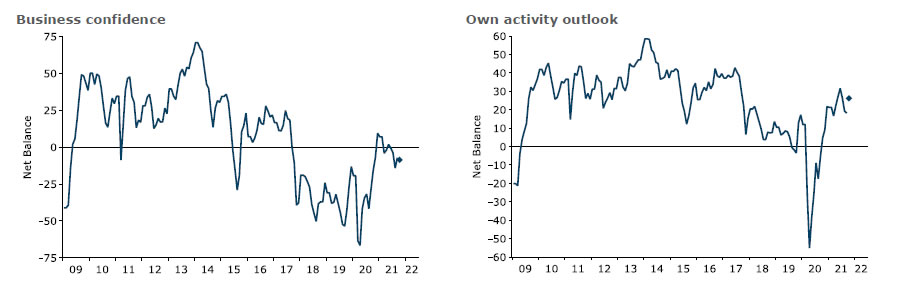
- (NZ) New Zealand Sept ANZ Business Confidence: -8.6 v -3.8 prior; Activity Outlook: 26.2 v 19.2 prior.
- (NZ) Reserve Bank of New Zealand (RBNZ) Bascand: To give speech at Citi conference on Oct 13th; the speech is titled "The contribution of strong balance sheets to NZ's economic resilience and recovery from the pandemic".
- (NZ) New Zealand Sept Food Prices M/M: 0.5% v 0.3% prior.
China/Hong Kong
- Hang Seng closed due to weather conditions, Shanghai Composite opened -0.1%.
- (CN) CHINA SEPT TRADE BALANCE: $66.8B V $46.6BE; Exports Y/Y: 28.1% v 21.5%e; Imports Y/Y: 17.6% v 20.7%e.
- (HK) Hong Kong Typhoon warning Signal 8 to remain in effect until 16:00 local time (end of afternoon trading session) [Earlier today Hong Kong Exchange said: if the typhoon warning is at 8 or above (or extreme weather conditions are announced) and remains issued at 12 noon, all trading sessions today will be cancelled].
- (CN) China Energy Administration: Sept Power Consumption Y/Y: 6.8% v 3.6% prior.
- (CN) China Industry Min (MIIT): Has asked steel mills in certain cities to cut steel production from Nov 15 to Mar 15 2022.
- (CN) China Real Estate Association said to be planning meeting with builders over difficulties and risks; to hold a symposium with property developers in Beijing Friday, Oct 15th to implement property industry policies – press.
- (CN) China Sec Journal: Property Market may cool down further during Q4 due to additional regulations.
- IMF: Cuts China 2021 GDP growth forecast from 8.1% to 8.0%; Cuts China 2022 GDP growth forecast from 5.7% to 4.9%.
- (CN) China PBOC Open Market Operation (OMO): Injects CNY10B in 7-day reverse repos v CNY10B prior; Net drain CNY90B v Net drain CNY90B prior.
- (CN) China PBOC sets Yuan reference rate: 6.4612 v 6.4447 prior.
- (CN) China MOF to sell an additional CNY6.0B worth of Dim Sum bonds in Hong Kong on Oct 20th (Wed).
- (TW) Taiwan Defense Ministry: Warns that will issue tougher response to China if military jet flights get too close.
Japan
- Nikkei 225 opened -0.5%.
- (JP) Japan PM Kishida: Must be cautious on issuing perpetual bonds for Govt funding, need to ensure market trust; No comment on recent FX Development.
- (JP) Japan PM Kishida: Must deploy fiscal stimulus flexibly but does not suggest any problem with raising debt balance indefinitely; Must avoid the possibility of any emerging JGB default risk - parliament comments [from Oct 12th’].
- (JP) Japan Sept M2 Money Supply Y/Y: 4.2% v 4.3%e; M3 Money Supply Y/Y: 3.8% v 3.9%e.
- (JP) JAPAN AUG CORE MACHINE ORDERS M/M: -2.4% V +1.4%E; Y/Y: +17.0% V 13.9%E.
Korea
- Kospi opened -0.1%.
- (KR) South Korea Aug Unemployment Rate: 3.0% v 3.0%e.
- (KR) South Korea sells 2-year bonds: avg yield 1.650% v 1.320% prior.
- (KR) South Korea Sept Total Bank Lending to Households (KRW): 1,053T v 1,046T prior.
North America
- Apple [AAPL]: now said to expect production of new iPhones in the last three months of 2021 to be as much as 10M units lower than its original plan for 90M units – press.
- (US) Fed's Quarles to no longer be chair of Supervision and Regulation committee when term expires tomorrow (Oct 13th), committee to meet on unchaired basis.
- (US) Fed's Barkin (FOMC voter, hawk): Reiterates prices are being pushed higher by shortages.
- (US) Debt limit increase bill through Dec 3rd has passed in the House of Representatives, the final vote was 219-206; White House has previously said that President Biden will sign the bill.
- (US) US to allow vaccinated Canadians and Mexicans to enter county in early Nov - Press.
Europe
- LVMH [MC.FR]: Reports Q3 Rev €15.5B v €15.0Be; Sees continuation of current growth.
- SAP [SAP.DE]: Raises FY21 Cloud Rev €9.4-9.6B, op profit €8.1-8.3B (prior Cloud Rev €9.3-9.5B, op profit €7.95-8.25B).
Levels as of 01:20 ET
- Nikkei 225, -0.1%, ASX 200 -0.1% , Hang Seng closed; Shanghai Composite +0.1% ; Kospi +1%.
- Equity S&P500 Futures: flat; Nasdaq100 -0.1%, Dax +0.2%; FTSE100 flat.
- EUR 1.1555-1.1528 ; JPY 113.62-113.34 ; AUD 0.7353-0.7328 ;NZD 0.6949-0.6921.
- Gold +0.1% at $1,761/oz; Crude Oil -0.1% at $80.56/brl; Copper +0.4% at $4.3405/lb.
UK GDP grew 0.4% mom in Aug, still -0.8% below pre-pandemic level
UK GDP grew 0.4% mom in August, slightly below expectation of 0.5% mom. Services grew 0.3%. Production rose 0.8% mom. Construction contracted by -0.2% mom. In the three months to August, GDP grew 2.9% 3mo3m, mainly due to the performance of services, largely reflects gradual reopening.
Comparing to pre-pandemic levels in February 2020, overall GDP was still down -0.8%. Services was down -0.6%. Production was down -1.3%. Manufacturing was down -2.4%. Construction was down -1.5%.
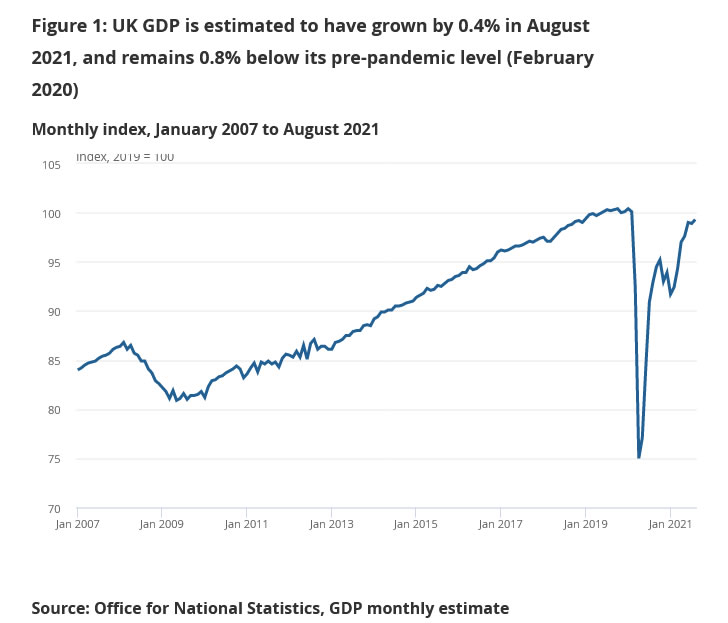
Also from the UK, goods trade deficit widened to GDP -14.9B in August, versus expectation of GBP -11.9B.
EUR/USD Daily Outlook
Daily Pivots: (S1) 1.1514; (P) 1.1542; (R1) 1.1559; More...
Intraday bias in EUR/USD is mildly on the downside with breach of 1.1528 temporary low. Current decline from 1.2265 would target 1.1289 medium term fibonacci level next. On the upside, break of 1.1639 resistance, however, will indicate short term bottoming. intraday bias will be turned back to the upside for stronger rebound.
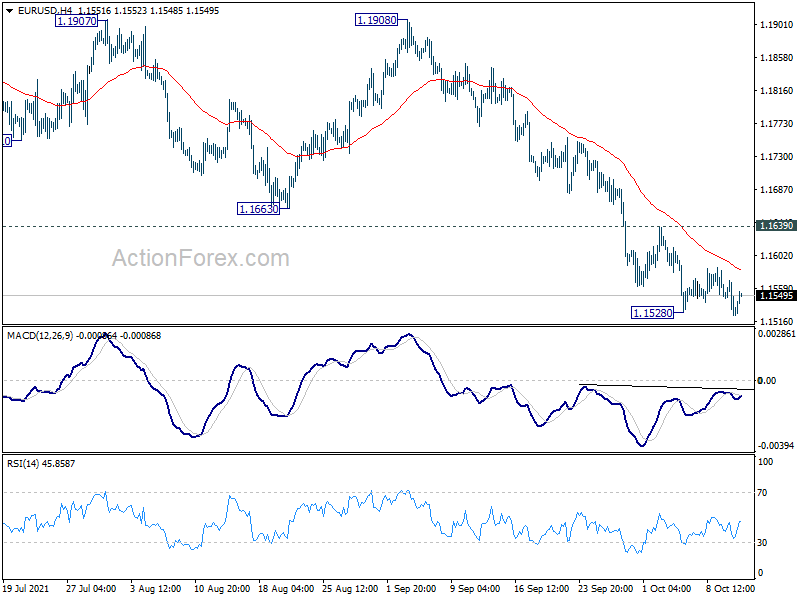
In the bigger picture, sustained break of 1.1602 will argue that rise from 1.0635 (2020 low) has completed at 1.2348. Deeper fall would be seen to 61.8% retracement of 1.0635 to 1.2348 at 1.1289. Note also that rejection by 55 week EMA (1.1830) also carries medium term bearish implication. Firm break of 1.1289 will pave the way to retest 1.0635 low. On the upside, though, break of 1.1908 resistance will revive medium term bullishness and turn focus back to 1.2348 high.
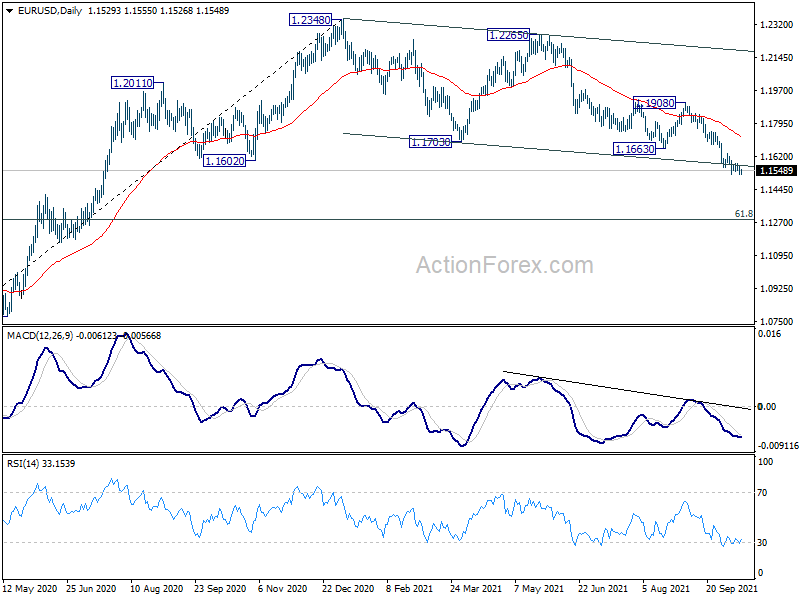
Markets in Consolidation as US CPI and FOMC Minutes Awaited
The markets are trading in consolidative mode in Asia today. Dollar attempted to resume near term rally against Euro overnight, but quickly lost momentum. While Yen remains generally weak, selloff slowed, along with slight retreat in US 10-year yield, and retreat in stocks. Traders will turn their focuses firstly to UK GDP in European session, and then US CPI and FOMC minutes later in the day.
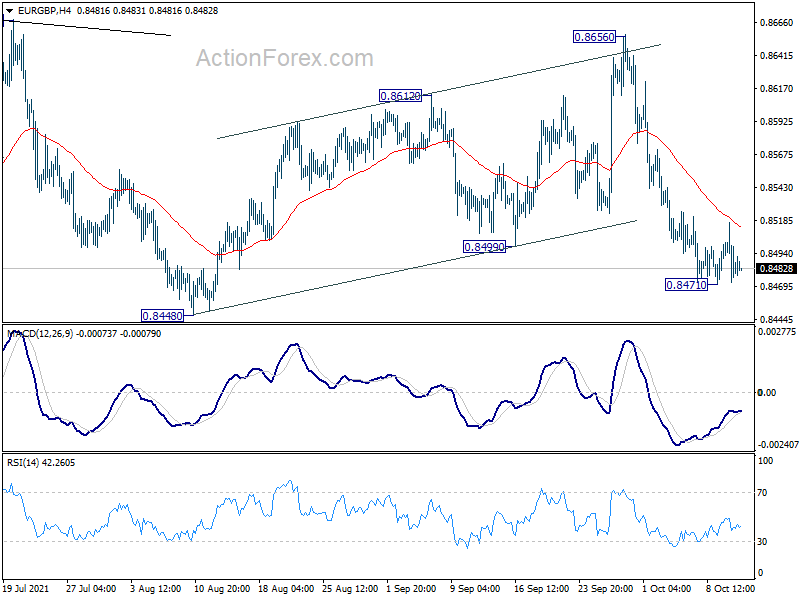
Technically, we'd put some attention to the interplay between Dollar, Euro and Sterling today. EUR/GBP turned sideway after hitting 0.8471 but recovery has been weak and more downside is in favor. Break of 0.8471 will resume the fall from 0.8656 towards 0.8448 low. That might help lift GBP/USD through 1.3672 temporary top to resume the rebound from 1.3410. Also, such development could help cap EUR/USD's recovery below 1.1639 minor resistance. Let's see how it goes.
In Asia, at the time of writing, Nikkei is down -0.24%. China Shanghai SSE is down -0.35%. Singapore Strait Times is up 1.42%. Japan 10-year JGB yield is down -0.0070 at -0.089. Overnight, DOW dropped -0.34%. S&P 500 dropped -0.24%. NASDAQ dropped -0.14%. 10-year yield dropped -0.034 to 1.580.
Fed Bullard advocates starting tapering in Nov, finishing it in Q1
St. Louis Federal Reserve President James Bullard told CNBC, "I'd support starting the taper in November." He added, "I've been advocating trying to get finished with the taper process by the end of the first quarter next year because I want to be in a position to react to possible upside risks to inflation next year as we try to move out of this pandemic."
But he also emphasized "there's no reason for us to commit one way or another at this point," regarding interest rate hike. "I just want to be in a position in case we have to move sooner that we're able to do so next year in the spring or summer if we have to do so."
He noted that a supply shock alone cannot cause inflation". But, "a supply shock being accommodated by very easy monetary policy, it's those two things that lead to the inflation." Yet, he's not concerned with the risk of a 1970s-style stagflation since "the probability of recession is exceptionally low at this point."
Separately, Atlanta Fed President Raphael Bostic said the job markets had made "sufficient" gains to allow tapering the USD 120B per month asset purchases. He "would be comfortable starting tapering of asset purchase programme in November." Nevertheless, he noted that "there is significant uncertainty about how long inflationary pressures will last."
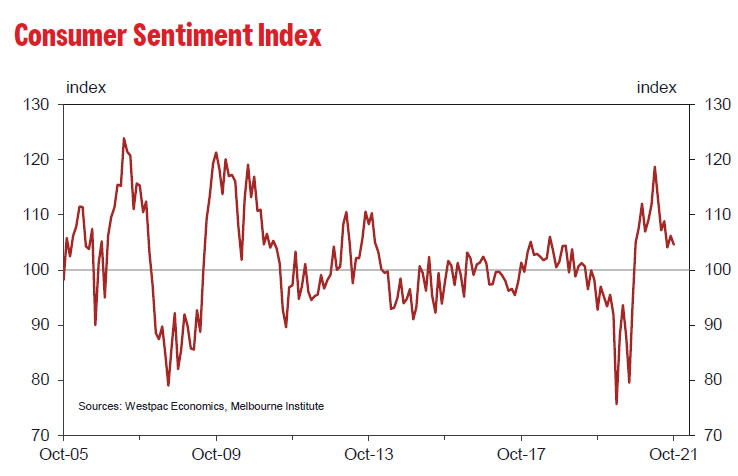
Australia Westpac consumer sentiment dropped to 104.6, still more optimists
Australia Westpac-Melbourne Institute consumer sentiment dropped -1.5% to 104.6 in October, down from September's 106.2. There continued to be a clear majority of optimists nationally, even at state level - NSW (103.4); Victoria (105.4); Queensland (105.3) and Western Australia (105.4).
Westpac expects RBA to "almost certainly maintain its policy settings" at November 2 meeting. Instead, the next change is likely to be another round of tapering in February. Looking forward, Westpac expects a rate hike in Q2 of 2023, while RBA has repeated said the conditions of hike won't be met until 2024.
New Zealand ANZ business confidence dropped slightly to -8.6 in Oct
New Zealand ANZ business confidence dropped slightly to -8.6 in October's preliminary reading, down from September's -7.2. Own activity outlook rose strongly from 18.2 to 26.2. Export intentions rose from 7.4 to 9.2. Investment intentions rose from 9.2 to 14.3. Employment intentions dropped from 14.1 to 12.1. Cost expectations rose form 84.2 to 84.9. Inflation expectations also ticked up from 3.02% to 3.04%.
ANZ said the survey is telling a story of "remarkable resilience", with most forward-looking activity indicators holding up or improving. Inflation pressures remain "intense" and cost pressures are "extreme".
Elsewhere
China's exports, in USD term, rose 28.1% yoy in September, versus expectation of 21.0%. Imports rose 17.6% yoy versus expectation of 20.0% yoy. Trade surplus widened to USD 66.8B, above expectation of USD 47.2B.
Looking ahead, UK GDP, productions and trade balance will be released in European session. Germany will release CPI final. Eurozone will release industrial production. Later in the day, US will release CPI and FOMC minutes.
EUR/USD Daily Outlook
Daily Pivots: (S1) 1.1514; (P) 1.1542; (R1) 1.1559; More...
Intraday bias in EUR/USD is mildly on the downside with breach of 1.1528 temporary low. Current decline from 1.2265 would target 1.1289 medium term fibonacci level next. On the upside, break of 1.1639 resistance, however, will indicate short term bottoming. intraday bias will be turned back to the upside for stronger rebound.
In the bigger picture, sustained break of 1.1602 will argue that rise from 1.0635 (2020 low) has completed at 1.2348. Deeper fall would be seen to 61.8% retracement of 1.0635 to 1.2348 at 1.1289. Note also that rejection by 55 week EMA (1.1830) also carries medium term bearish implication. Firm break of 1.1289 will pave the way to retest 1.0635 low. On the upside, though, break of 1.1908 resistance will revive medium term bullishness and turn focus back to 1.2348 high.
Economic Indicators Update
| GMT | Ccy | Events | Actual | Forecast | Previous | Revised |
|---|---|---|---|---|---|---|
| 23:30 | AUD | Westpac Consumer Confidence Oct | -1.50% | 2.00% | ||
| 23:50 | JPY | Money Supply M2+CD Y/Y Sep | 4.20% | 4.20% | 4.70% | |
| 23:50 | JPY | Machinery Orders M/M Aug | -2.40% | 1.60% | 0.90% | |
| 3:00 | CNY | Trade Balance (USD) Sep | 66.8B | 47.2B | 58.3B | |
| 3:00 | CNY | Exports (USD) Y/Y Sep | 28.10% | 21.50% | 25.60% | |
| 3:00 | CNY | Imports (USD) Y/Y Sep | 17.60% | 19.20% | 33.10% | |
| 3:00 | CNY | Trade Balance (CNY) Sep | 433B | 323B | 376B | |
| 3:00 | CNY | Exports (CNY) Y/Y Sep | 19.90% | 17.10% | 15.70% | |
| 3:00 | CNY | Imports (CNY) Y/Y Sep | 10.10% | 22.30% | 23.10% | |
| 6:00 | EUR | Germany CPI M/M Sep F | 0.00% | 0.00% | ||
| 6:00 | EUR | Germany CPI Y/Y Sep F | 4.10% | 4.10% | ||
| 6:00 | GBP | GDP M/M Aug | 0.50% | 0.10% | ||
| 6:00 | GBP | Industrial Production M/M Aug | 0.40% | 1.20% | ||
| 6:00 | GBP | Industrial Production Y/Y Aug | 3.00% | 3.80% | ||
| 6:00 | GBP | Manufacturing Production M/M Aug | 0.00% | 0.00% | ||
| 6:00 | GBP | Manufacturing Production Y/Y Aug | 6.00% | 6.00% | ||
| 6:00 | GBP | Goods Trade Balance (GBP) Aug | -11.9B | -12.7B | ||
| 9:00 | EUR | Eurozone Industrial Production M/M Aug | -1.60% | 1.50% | ||
| 12:30 | USD | CPI M/M Sep | 0.30% | 0.30% | ||
| 12:30 | USD | CPI Y/Y Sep | 5.30% | 5.30% | ||
| 12:30 | USD | CPI Core M/M Sep | 0.20% | 0.10% | ||
| 12:30 | USD | CPI Core Y/Y Sep | 4.00% | 4.00% | ||
| 18:00 | USD | FOMC Minutes |
New Zealand ANZ business confidence dropped slightly to -8.6 in Oct
New Zealand ANZ business confidence dropped slightly to -8.6 in October's preliminary reading, down from September's -7.2. Own activity outlook rose strongly from 18.2 to 26.2. Export intentions rose from 7.4 to 9.2. Investment intentions rose from 9.2 to 14.3. Employment intentions dropped from 14.1 to 12.1. Cost expectations rose form 84.2 to 84.9. Inflation expectations also ticked up from 3.02% to 3.04%.
ANZ said the survey is telling a story of "remarkable resilience", with most forward-looking activity indicators holding up or improving. Inflation pressures remain "intense" and cost pressures are "extreme".
Australia Westpac consumer sentiment dropped to 104.6, still more optimists
Australia Westpac-Melbourne Institute consumer sentiment dropped -1.5% to 104.6 in October, down from September's 106.2. There continued to be a clear majority of optimists nationally, even at state level - NSW (103.4); Victoria (105.4); Queensland (105.3) and Western Australia (105.4).
Westpac expects RBA to "almost certainly maintain its policy settings" at November 2 meeting. Instead, the next change is likely to be another round of tapering in February. Looking forward, Westpac expects a rate hike in Q2 of 2023, while RBA has repeated said the conditions of hike won't be met until 2024.