

Sample Category Title
Cliff Notes: Confidence Shown to be Resilient
Key insights from the week that was.
This week, we received updates on Australian business and consumer confidence as well as a speech by RBA Governor Lowe.
Beginning with business confidence and conditions, the NAB survey provided tentative evidence that this wave of the virus and the consequent lockdowns are having less of an effect on the economy than in 2020. Confidence in NSW looks to be responding to the vaccination drive, the state’s index rising 8pts to -12 in August. The extension of Victoria’s lockdown however saw confidence deteriorate there to -10. Both outcomes are materially below the national figure of -5, itself a well-below average reading, but up 2pts in the month.
Business conditions meanwhile are well off their June quarter highs (+14pts in August versus Q2’s +30pt average); however, the index did rise 4pts in August and the current level is still above the long-run average of the series. Explaining these outcomes: coming into these lockdowns, the economy was carrying strong momentum; as we speak, restrictions are impacting our largest cities, but not the whole nation; and, thanks to the rapid vaccination drive, there is a clear path out of this lockdown.
While challenged by present circumstances, Australian consumers are optimistic on the outlook, the Westpac-MI consumer sentiment index rising 2% in September to an above-average reading of 106.2. Behind this headline result was material strength in the components related to the economic outlook, the 1-year and 5-year views up almost 5% in the month to respectively be 15% and 25% above their long-run averages. Views on family finances are modestly above average levels currently, supported by strong gains for house prices, equities near all-time highs and labour market resilience (more on this below).
As highlighted by our Chief Economist Bill Evans this week, the recent strength shown by consumer sentiment rests on the rapid vaccination of Australia’s population which is materially reducing health risks related to the virus and should soon allow the nation to re-open. Also discussed in the above video is the structural challenge faced by households with respect to housing affordability, a potential headwind for consumption in the recovery – particularly once the cash rate lifts off the lower bound.
Looking beyond the immediate, critical for consumer spending in coming years will be the strength of our labour market. August’s loss of employment was in line with our expectation at -146k (WBC-150k). While a large fall in jobs, the 3.7% decline in hours worked was more significant, resulting in a percentage point increase in the rate of underemployment to 9.3%, more than twice the published unemployment rate (4.5%). Hours worked were, unsurprisingly, weakest in NSW (-6.5%), but also down sharply in Qld (-5.2%) and Vic (-3.4%).
These outcomes highlight that the benchmark for success in recovery will be hours worked and the rate of underemployment instead of the level of unemployment. To see lasting strength in consumer spending and hence GDP, household incomes must return to their full employment level, not just the headcount of those who seek employment and find it.
This issue is very clearly on the mind of the RBA. Notable in Governor Lowe’s speech on “Delta, the Economy and Monetary Policy” was the belief that to achieve its inflation target in the medium-term, “wages will need to be growing by at least 3 per cent”, almost double the annual growth rate for the Wage Price Index at June 2021. It is worth emphasising that the RBA not only believe the slack present in our labour market must be removed if their wage and inflation goals are to be achieved, but also that the adverse inertia present in wages growth pre-pandemic must abate. This additional headwind stems from several forces including “multi-year employment contracts; [the] strong cost-control mindset of Australian business; and low and stable inflation expectations”. These are challenges entrenched the world over, making them a significant challenge to overcome.
Offshore this week, GDP and house price data for New Zealand confirmed the strength of their economy and justified the RBNZ increasing rates with no delay. Our NZ team have consequently moved forward their first-rate hike from November to October 2021. In the US meanwhile, the August CPI report gave support to the view that the recent surge in inflation is transitory, with the monthly headline gain coming in a touch below the market’s expectation at 0.3%, and core inflation soft at 0.1%. Retail sales then showed resilience, with August’s much stronger-than-expected gain only partly offset by downward revisions to July.
The most significant international data this week however came from China. The chasm between annual retail sales growth to August (2.5%yr) and year-to-date growth (18.1%) highlights how severe the impact of recent restrictions against COVID-19 has been on spending. Although the year-to-date reading also signals the underlying strength of the sector which, as best we can tell from the PMIs, continues to be well supported by the labour market. Fixed asset investment was essentially in line with expectations in the month, despite property investment disappointing again. The troubling situation faced by Evergrande and hit to confidence for the rest of the sector is likely to continue to affect investment in coming months. But the reforms underway and strength of households should lay a strong foundation for robust growth in 2022, 2023 and beyond.
Eco Data 9/17/21
[php_everywhere instance="1"]
Sunset Market Commentary
Markets
The commodity/energy market rally grinded to a halt today while (European) risk sentiment flourished. The euro puts in a miserable performance against an overall strong dollar. The greenback even received an additional push in the back at the start of US trading. Headline August retail sales unexpectedly rose by 0.7% M/M. Excluding the volatile auto-related component, sales even jumped by 1.8% M/M and the control group – often seen as a proxy for consumption in GDP – surged by 2.5% M/M! Households redirected their consumption as covid-infections triggered more restrictive measures, but overall demand held up. Back-to-school sales also added to the positive surprise. The retail sales add to the tug-of-mar between doves and hawks within the FOMC, but also on markets. US Treasuries underperform German Bunds with next week’s key Fed meeting looming. The unexpected first increase in Philly Fed Business Outlook since April (30.7 in September from 19.4) complemented the retail sales release. Details were more mixed with shipments and a lengthening workweek offsetting declining employment and new orders. The forward looking indicator (+6 months) fell from 33.7 to 20. Price indicators show the pass-through from prices paid to prices received with the former extending its topping off process and the latter stable at a multi-month high. US weekly jobless claims bounced from 312k to 332k.
Anyway, returning to mister market. US yields add 1 bp (2-yr) to 4.6 bps (7-yr) in a daily perspective. The German yield curve bear steepens with yields adding 0.1 bp (2-yr) to 1.9 bps (30-yr). 10-yr yield spreads changes vs Germany are broadly unchanged. EUR/USD plummets from 1.1817 to 1.1750 with the trade-weighted dollar approaching 93 for the first time since the end of August. USD/JPY recovers yesterday’s lost ground, changing hands near 109.75. Sterling finally gets to profit from this week’s good labour market report, higher inflation outcome and short-term interest rate support. Risk aversion prevented gains earlier this week. EUR/GBP tested the 0.85 big figure before a small intraday technical bounce occurred.
News Headlines
Czech Vice Governor Marek Mora openly indicated that he is moving closer to the camp of governors that are considering a 50 bps rate hike at the September 30 policy meeting. In an interview with Bloomberg he was quoted: ‘"The odds are now clearly between 25 and 50 basis points, possibly closer to 50," "The urgency has certainly increased, although to vote for 50 basis points I'll need our staff to justify this with more detailed data and we would need to explain it properly." At the same time, he indicated that such a move could be seen as bringing forward necessary policy steps. "It's possible the overall magnitude of tightening will be the same”. Today, the inflationary narrative was further illustrated by a higher than expected rise in August producer price inflation. PPI rose by 1.2% M/M and 9.3% Y/Y, the fastest pace since 1993! EUR/CZK touched a minor new correction low in the 25.25 area but currently again trades near 25.30.
China clearly objected a new Indo-Pacific security alliance that has been put in place between the US, Great Brittan and Australia. It argued that partnership shouldn’t target countries and that it might intensify the arms race in the region. Under the AUKUS agreement, the US and Brittan will give Australia support to deploy nuclear-powered submarines. With the initiative, the US and allies react to Chinese growing military presences in the region. In the UK Parliament, Prime Minster Johnson said that “Now that we have created AUKUS we expect to accelerate the development of other advanced defense systems including in cyber, artificial intelligence, quantum computing and undersea capabilities”. In the recent past, political tensions between Australia and China affected trade relations/flows between the two countries. So, it will be interesting to see whether this will also have consequences in this area.
Between a Rock and a Hard Place
European stocks are making decent gains on Thursday, while US futures look a little flat ahead of the open on Wall Street.
US equities rallied as the session wore on yesterday and we're seeing Europe playing a little catchup this morning. Overall, the mood remains a little downbeat in the markets, with investors torn between the "buy the dip" approach that has fared so well in the past and the growing list of economic and market risks that are increasingly evident.
We may see more of this over the coming months as countries get to grips with winter Covid surges, higher energy prices and higher inflation, among other things. Which makes the positions of central banks all the more uncomfortable, with many seemingly determined to persevere with paring back their pandemic stimulus measures.
Of course, if they are becoming more of the view that inflation is not as transitory as they previously believed, then they're caught between a rock and a hard place and may be forced to act. But that will only pile on the pressure and disrupt the economic recoveries that many have enjoyed.
Next week we should learn a lot more about what the world's most important central bank thinks of recent developments and how it perceives the risks posed by inflation. It may not be surprising therefore if equities err on the side of caution between now and then as an undesirable response could trigger a nasty reaction in the markets.
US data delivers gains for stocks, yields and USD as gold tumbles
Today's data from the US has done little to clear things up, with both retail sales and the Philly Fed manufacturing index smashing expectations while jobless claims popped a little but only just exceeded forecasts. Retail sales have been volatile for a number of months but an August increase of 0.7% was the reverse of the decline that was expected.
Philly Fed has been trending lower since March and that trend was expected to continue but a surprise jump may be cause for optimism. While new orders and employment indicators softened, firms remain optimistic about the next 6 months as current general activity and shipments saw large increases.
US futures got a small lift on the back of the data while the dollar continued to rally as US yields drifted higher once more. Gold, which has been through a rough patch over the last 48 hours, didn't fare well with the data and continued to trend lower on the day.
Oil sees profit taking at summer highs
Oil is pulling back a little on Thursday after enjoying another strong rally in recent days. Hurricanes hitting the Gulf Coast in recent weeks have disrupted production in the region which has given a boost to prices. And with two more months of Hurricane season remaining, more disruption could follow.
Inventory data from EIA gave prices another lift on Wednesday, with WTI and Brent also rallying ahead of the release after API also reported a large drawdown a day earlier. With prices now back around summer highs, we are seeing some profit taking kicking in but the rally continues to look well supported.
WTI fell a little short of its summer highs around $75, stumbling around $73, while Brent saw resistance around $76. A break through these levels could see the rally gather even more momentum. If we do see a small pullback, the first test of support could come around $70 in WTI, where it had previously seen resistance.
Tough times ahead for gold?
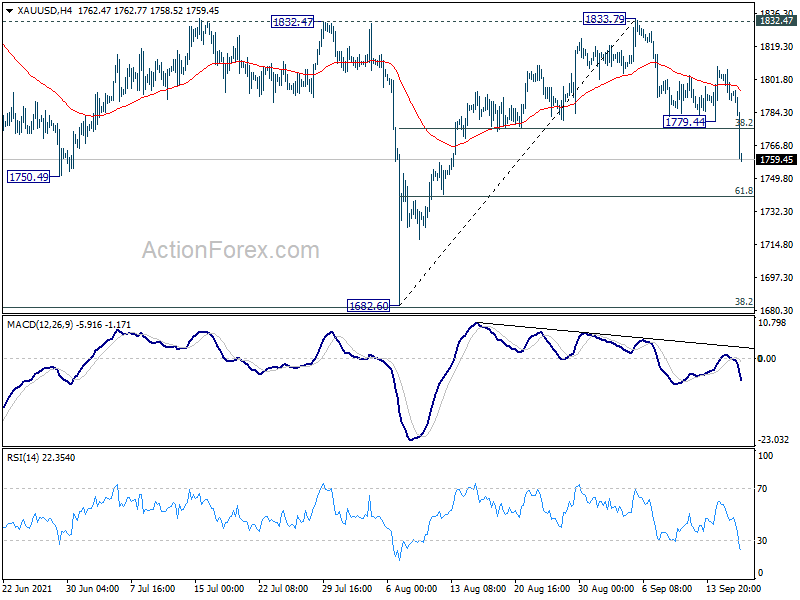
Gold has fallen out of favour and fast, with the yellow metal slipping more than 1.5% today and below a key support level. This comes only a couple of days after it broke back above $1,800 on the back of softer US inflation data but that celebration was short-lived and it's suddenly looking rather vulnerable.
From a technical perspective, $1,780 marked the neckline of a head and shoulders that formed over the last month, peaking at $1,833. The next major test below could come around $1,750 but further downside could be on the cards.
The fact that this has come ahead of the Fed meeting doesn't bode well for the yellow metal. Recent data has given the Fed room to be more patient with tapering but the commentary we had late last week from officials suggested many aren't discouraged. Gold could feel the love once more should policymakers change course next Wednesday but it could be a long week for the yellow metal in the interim.
Bitcoin struggling at $48,000 once again
Bitcoin has steadied once more around $48,000 which remains an interesting technical level. A rotation off here back towards $44,000 could see correction pressure grow. I say this having talked about the prospect of a correction for weeks now and yet, bitcoin has shown remarkable resilience.
It obviously hasn't burst higher in that time either but it's certainly dragging its feet. With that in mind, there isn't much to add at this point. A significant break below $44,000 could make things interesting, while a move above $48,000 will put the focus back on $50,000 and may even trigger a shift in momentum that has been absent in previous rallies.
USD/CHF Mid-Day Outlook
Daily Pivots: (S1) 0.9173; (P) 0.9189; (R1) 0.9215; More....
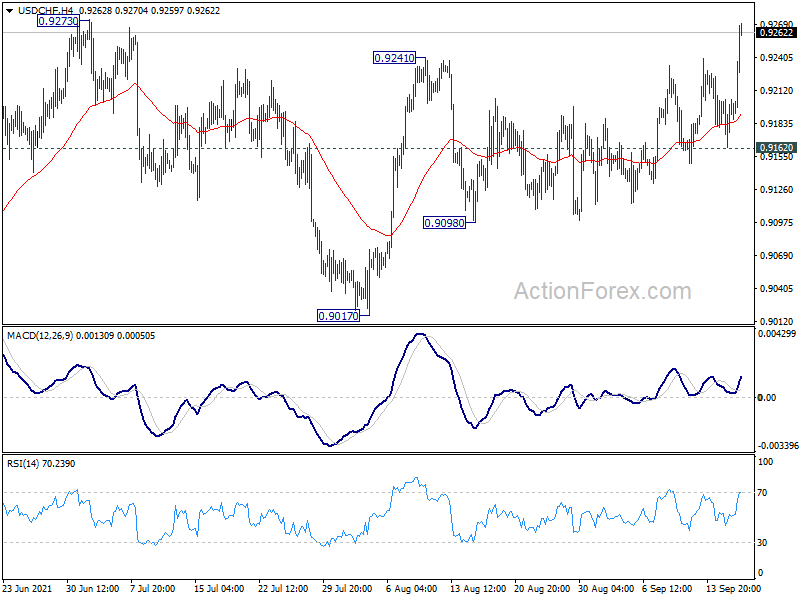
Intraday bias in USD/CHF is back on the upside with break of 0.9241 resistance. Focus is now on 0.9273, and firm break there will resume whole rise from 0.8925 for 0.9471 key resistance next. On the downside, however, break of 0.9162 support will turn bias neutral and mix up the near term outlook again.
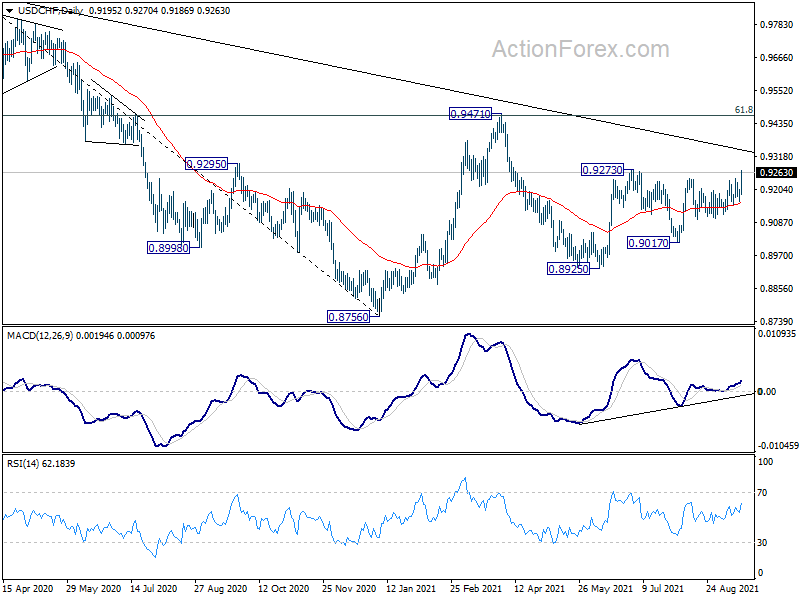
In the bigger picture, USD/CHF is still struggling around 55 week EMA (now at 0.9178) and outlook is mixed for now. Confirmed rejection by the 55 week EMA will retain medium term bearishness. That is, larger fall from 1.0342 would resume through 0.8756 low at a later stage. However, sustained trading above 55 week EMA will tilt favor to the case of bullish reversal. Focus would then be turned to 0.9471 resistance for confirmation.
USD/JPY Mid-Day Outlook
Daily Pivots: (S1) 109.07; (P) 109.41; (R1) 109.70; More...
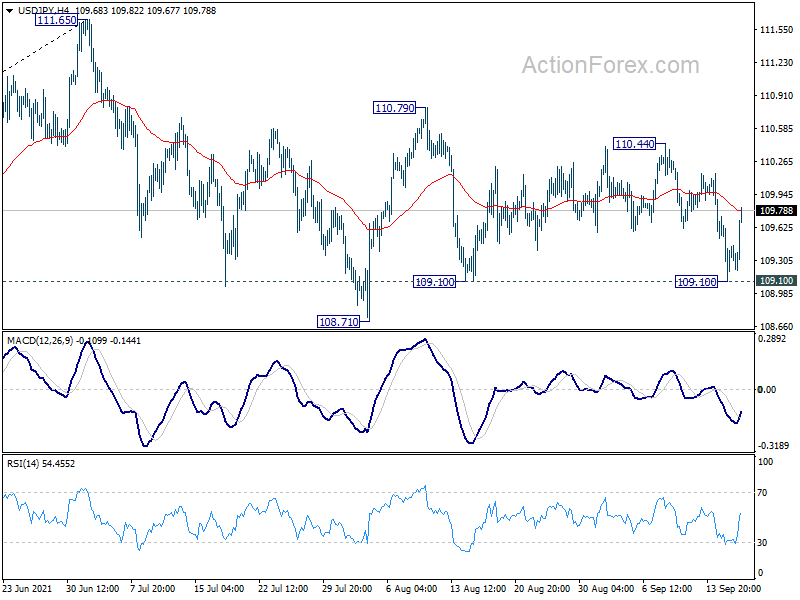
Intraday bias in USD/JPY remains neutral as it defended 109.10 support and rebounded. But upside is held well below 110.44 resistance so far. On the downside, break of 109.10 will argue that larger fall from 111.65 is resuming. Deeper decline should then be seen to 108.71 support first, and then 38.2% retracement of 102.58 to 111.65 at 108.18 next. On the upside, above 110.44 will turn bias back to the upside for 110.79, and then 111.65 high instead.
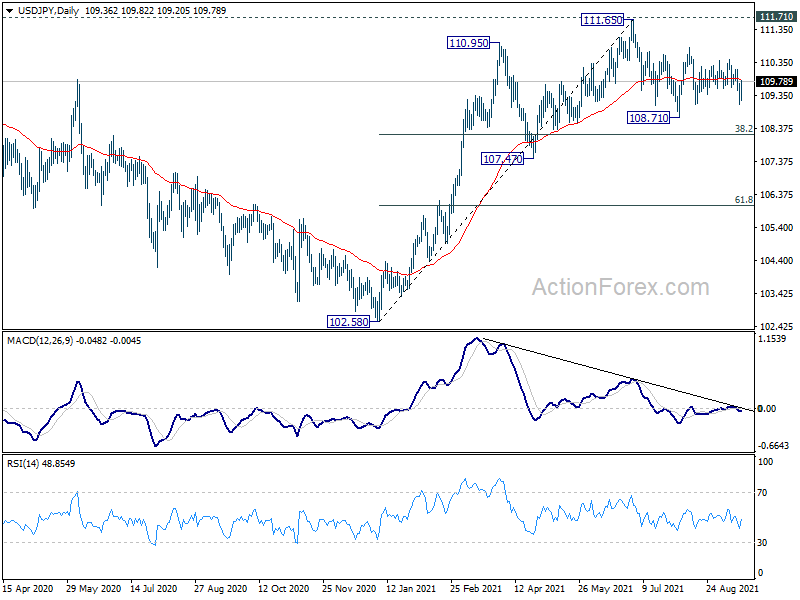
In the bigger picture, medium term outlook is staying neutral with 111.71 resistance intact. The pattern from 101.18 could still extend with another falling leg. Sustained trading below 55 day EMA will bring deeper fall to 107.47 support and below. Nevertheless, strong break of 111.71 resistance will confirm completion of the corrective decline from 118.65 (2016 high). Further rise should then be seen to 114.54 and then 118.65 resistance.
GBP/USD Mid-Day Outlook
Daily Pivots: (S1) 1.3805; (P) 1.3830; (R1) 1.3866; More...
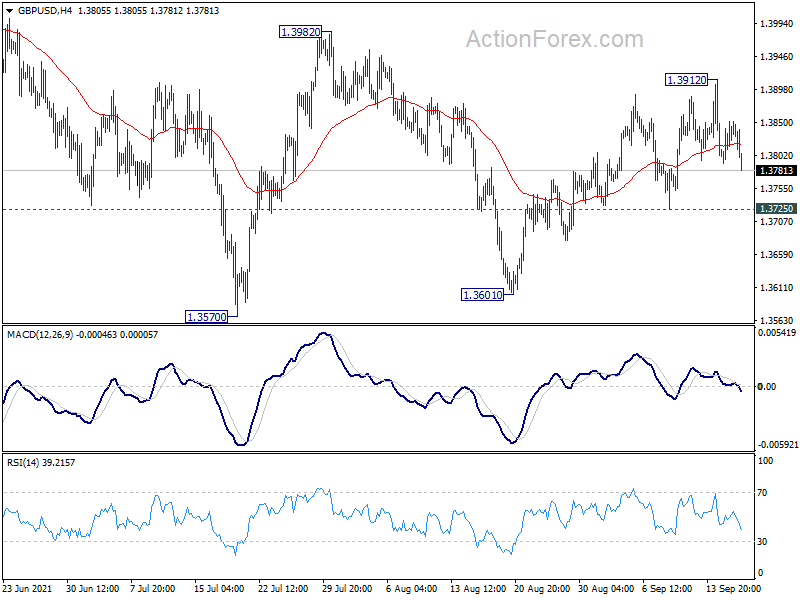
GBP/USD is still staying in range and intraday bias remains neutral first. On the upside, break of 1.3912 will target 1.3982 resistance next. Decisive break there will indicate that fall from 1.4248 has completed. Stronger rally would then be seen back to 1.4248 high. On the downside, however, break of 1.3725 support will turn bias back to the downside for retesting 1.3570/3601 support zone instead.
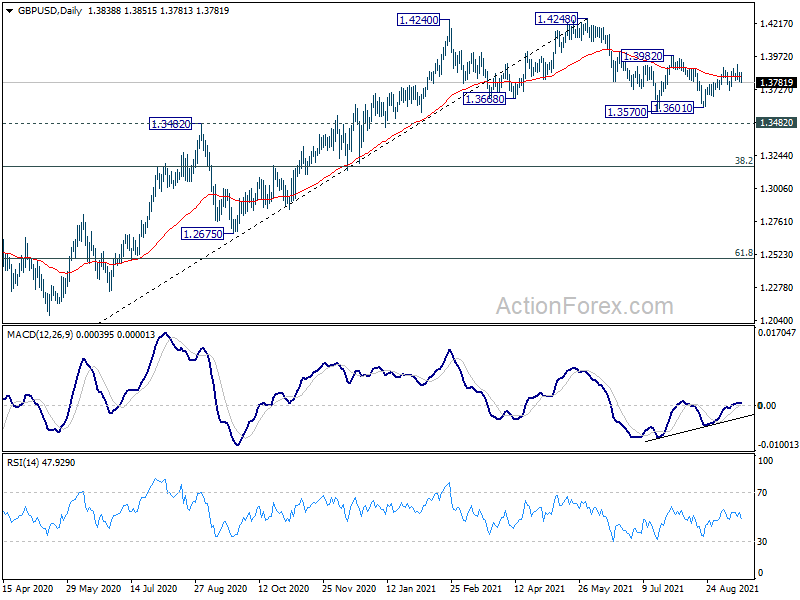
In the bigger picture, as long as 1.3482 resistance turned support holds, we'd still treat price actions from 1.4248 as a corrective move. That is, up trend from 1.1409 (2020 low) is in favor to resume. Decisive break of 1.4376 key resistance (2018 high) would indeed carry long term bullish implications. However, sustained break of 1.3482 will at least bring deeper fall to 38.2% retracement of 1.1409 to 1.4248 at 1.3164, or even further to 61.8% retracement at 1.2493.
US: Retail Sales Surprised with Growth in August
Retail sales surprised today by posting an increase of 0.7% m/m in August, well above the consensus forecast for a decline of -0.7%. July's data was revised down to a weaker -1.8% m/m (from -1.1%), taking some of the bloom off today's rosy gain.
Volatile categories saw mixed fortunes in August. Another month of supply-chain disruptions hurt the motor vehicles and parts category, where sales declined for the fourth month in a row (-3.6% m/m). Growth in gasoline stations (+0.2% m/m) was marginal and reflected higher prices more than volumes. Demand for building materials and garden equipment (+0.9% m/m) picked up again after four months of negative growth.
Food services and drinking places was flat in August. This category has been posting growth since February 2021.
Retail sales in the "control group," which exclude the above categories, increased by a healthy 2.5% m/m. However, July's gain was revised down to -1.9%, from -1.0% in the advance estimate.
Most of the remaining categories were up in August. Non-store retailers – the poster child of the pandemic – contributed the most to today's growth (+5.3% m/m). Sales in clothing & accessory stores gained only 0.1% m/m. Meanwhile, sporting goods, hobby, book & music stores weighed on sales this month, declining 2.7% m/m.
Key Implications
What a nice surprise! No doubt, the Delta variant played an important role in reducing consumers' willingness to go out and spend, as evidenced by the stalling in growth in spending on food services and drinking places (a proxy for high-contact services) and marginal gains in gas stations (a proxy for travel). Still, the spike in Delta cases is not the only culprit. Supply-chain disruptions continue to limit auto inventories, pushing vehicle sales to the lowest level in over a year.
Better-than-expected growth in August dulls some of the anticipated downward adjustment in the forecast for spending in the third quarter. On the plus side, consumers have saved a sizeable nest egg, which should support a healthy level of spending. Looking forward, the impact from the Delta variant appears to be waning as the usage of hospital resources seems to have reached a plateau. This should help lift consumer confidence just in time for the holiday spending season.
EUR/USD Mid-Day Outlook
Daily Pivots: (S1) 1.1799; (P) 1.1816; (R1) 1.1832; More...
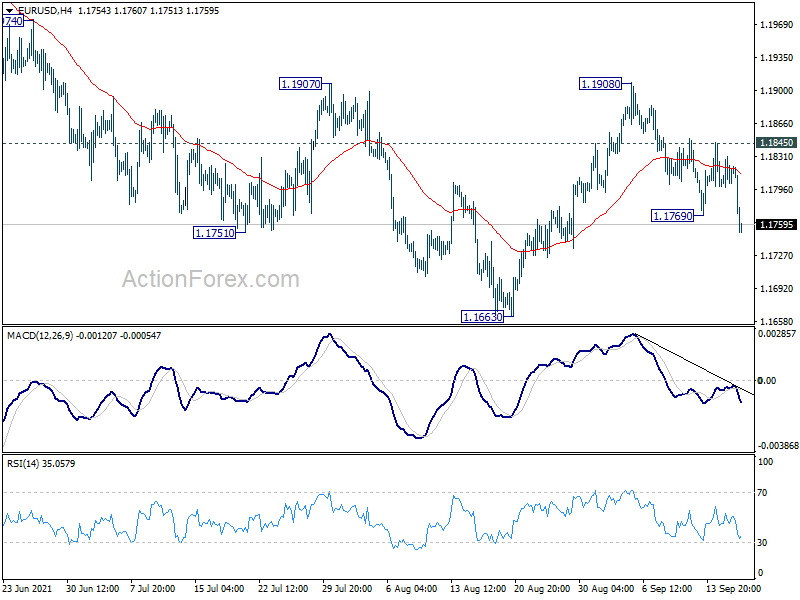
EUR/USD's fall from 1.1908 resumes by breaking 1.1769 and intraday bias is back on the downside for 1.1663 low first. Break there will resume the fall from 1.2265, as well as the pattern from 1.2348. Next target is 1.1602 key support level. On the upside, above 1.1845 minor resistance will turn bias back to the upside for 1.1908 resistance instead.
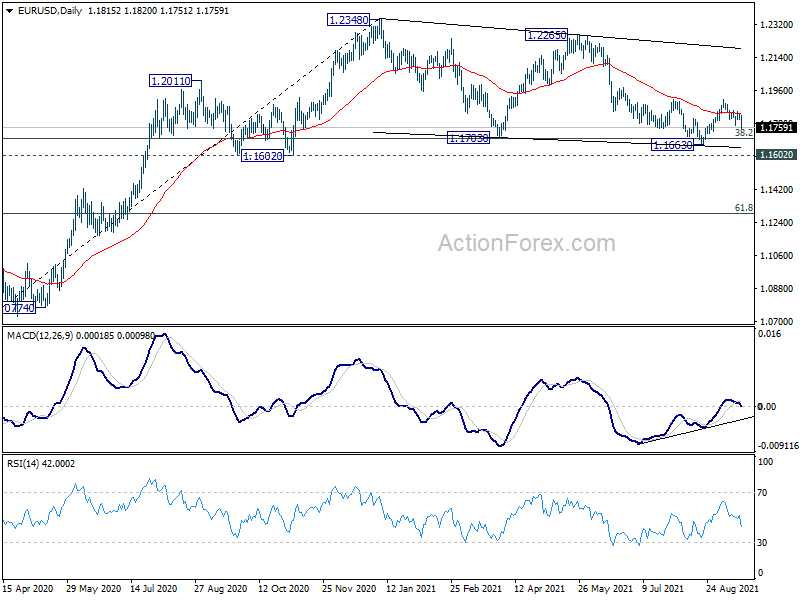
In the bigger picture, rise from 1.0635 is seen as the third leg of the pattern from 1.0339 (2017 low). Further rally remains in favors long as 1.1602 support holds, to cluster resistance at 1.2555 next, (38.2% retracement of 1.6039 to 1.0339 at 1.2516). However sustained break of 1.1602 will argue that the rise from 1.0635 is over, and turn medium term outlook bearish again. Deeper fall would be seen to 61.8% retracement of 1.0635 to 1.2348 at 1.1289 and below.
Dollar Surges on Unexpected Strong Rise in Retail Sales
Dollar jumps sharply in after data shows strong rise in retail sales, versus expectation of a decline. The data also raises optimism that it's just the start of resurgence in consumer demand, as the world is exiting the pandemic with fast vaccinations. Canadian Dollar is following closely as the second strongest for the day. On the other hand Euro and Swiss Franc are suffering steep decline.
Technically, EUR/USD's break of 1.1769 suggests resumption of fall from 1.1908 for retesting 1.1663 low. USD/CHF is pressing 0.9273 resistance and firm break there will resume whole rise from 0.8925. USD/JPY's strong rebound also suggests that 109.10 support is well defended. At the same times, gold drops sharply through 1779.44 today, and it's heading back to 61.8% retracement of 1682.60 to 1833.79 at 1740.35. These developments affirm Dollar's underlying buying together.
In Europe, at the time of writing, FTSE is up 0.48%. DAX is up 0.74%. CAC is up 1.17%. Germany 10-year yield is up 0.0183 at -0.286, above -0.3 handle. Earlier in Asia, Nikkei dropped -0.62%. Hong Kong HSI dropped -1.46%. China Shanghai SSE dropped -1.34%. Singapore Strait Times rose 0.19%. Japan 10-year JGB yield rose 0.0092 to 0.045.
US retail sales rose 0.7% in Aug, ex-auto sales jumped 1.8%
US retail sales rose 0.7% mom to USD 618.7B in August, much better than expectation of -0.7% decline. Ex-auto sales rose 1.80% mom, versus expectation of -0.1% decline. Ex-gasoline sales rose 0.8% mom. Ex-auto, ex-gasoline sales rose 2.0% mom. Total sales for the June 2021 through August 2021 period were up 16.3% from the same period a year ago
US initial jobless claims rose 20k to 332k
US initial jobless claims rose 20k to 332k in the week ending September 11, above expectation of 316k. Four-week moving average of initial claims dropped -4k to 336k, lowest since March 14, 2020.
Continuing claims dropped -187k to 2665k in the week ending September 4, lowest since March 14, 2020. Four-week moving average of initial claims dropped -50k to 2808k, lowest since March 21, 2020.
Also released, Philly Fed manufacturing survey jumped to 30.7 in September, versus expectation of 18.9.
Canada housing starts dropped to 260k in August. Wholesale sales dropped -2.1% mom in July. ADP employment rose 39.4k in August.
ECB Rehn confidence to ensure favorable financing conditions when exiting crisis measures
ECB Governing Council member Olli Rehn said while growth in Eurozone is robust, supported is still needed. The outlook is clouded by bottlenecks as well as coronavirus variants.
The central bank is expected to debate in December on timing and the way to wind down the PEPP purchases. Rehn said he's confident to find a " viable and meaningful way of ensuring favorable financing conditions when we start our very gradual transition from the crisis measures to the next normal."
He also urged governments to prepare for the eventual rise in borrowing cost even though a rate hike is "not yet within sight". "It will nevertheless one day take place," Rehn said. "This should be taken into account in budgetary planning in all the euro area countries."
Eurozone exports rose 11.4% yoy in Jul, imports rose 17.1% yoy
Eurozone exports of goods to the rest of the world rose 11.4% yoy in July to EUR 206.0B. Imports rose 17.1% yoy to EUR 185.3B. As a result, Eurozone recorded a EUR 20.7B surplus in trade, Intra-Eurozone trade rose 16.8% yoy to EUR 179.7B.
In seasonally adjusted term, Eurozone exports rose 1.0% mom while imports rose 0.3%. Trade surplus widened from EUR 119.0B to EUR 13.4B, below expectation of EUR 16.8B. Intra-Eurozone trade rose from EUR 175.5B to EUR 178.0B.
SECO downgrades Swiss 2021 GDP forecast to 3.2%
SECO downgraded Swiss GDP growth forecast to 3.2% in 2021, comparing to June forecast of 3.6%. Growth is projected to further accelerate to 3.4% in 2022. It added that "the economic recovery is set to continue as expected, though growth is initially less dynamic than forecast previously." Nevertheless, "economic activity is likely to have exceeded pre-crisis levels during the summer."
SECO added, "highly exposed sectors such as international tourism are likely to emerge from the crisis more hesitantly". But, "provided that severely restrictive measures such as business lockdowns are not imposed in the coming months, the economic recovery should continue uninterrupted."
Japan: Economy's pace weakened in severe pandemic situation
Japanese Government's Cabinet office maintained that the economy "remains in picking up", but added that "pace has weakened in a severe situation due to the Novel Coronavirus" In particular, "some weakness s seen recently" in industrial production, even though it's still "picking up".
Other assessments are largely unchanged, with private consumption showing weakness further. Business is picking up while exports continue to increase moderately. Corporate profits are also picking up with some weakness in non-manufacturers. Employment situation shows steady movements in some components.
Japan exports grew 26.2% yoy in Aug, imports rose 44.7% yoy
Japan's export grew 26.2% yoy to JPY 6605B in August. That's the sixth straight month of double-digit annual growth, as boosted by strong demand for chip-making equipment. By destination, exports to China, the largest trading partner, grew 12.6% yoy. Exports to Asia as a whole rose 26.1% yoy. Exports to the US rose 22.8% yoy. Exports to EU rose 29.9% yoy.
Imports jumped 44.7% yoy to JPY 7241B, due to stronger demand for fuel and medical goods. Trade balance came in at JPY -635B deficit, the largest shortfall since December 2021.
In seasonally adjusted term, exports rose 0.8% mom to JPY 7104B. Imports rose 4.6% mom to JPY 7276B. Trade deficit came in at JPY -272B versus expectation of JPY 80B surplus.
Australia employment dropped -146.3k in Aug, people also dropping out of labor force
Australia employment dropped -146.3k in August, even worse than expectation of -70.0k. Full-time jobs dropped -68k while part-time jobs dropped -78.2k.
Unemployment rate, on the other hand, dropped -0.1% to 4.6%, versus expectation 4.9%. But that's due to a sharp fall in participation rate by -0.8% to 65.2%. Monthly hours worked dropped -66m hours or -3.7% mom.
Bjorn Jarvis, head of labour statistics at the ABS, said: "The fall in the unemployment rate reflects a large fall in participation during the recent lockdowns, rather than a strengthening in labour market conditions.
"Throughout the pandemic we have seen large falls in participation during lockdowns — a pattern repeated over the past few months. Beyond people losing their jobs, we have seen unemployed people drop out of the labour force, given how difficult it is to actively look for work and be available for work during lockdowns.
New Zealand GDP grew 2.8% qoq in Q2, well above expectation
New Zealand GDP grew 2.8% qoq in Q2, well above expectation of 1.2% qoq. Growth was led by service industries, which rose 2.8% qoq. Primary industries rose 5.0% qoq. Goods producing industries rose 1.3% qoq.
"The June 2021 quarter experienced fewer COVID-19 restrictions than previous quarters affected by COVID-19. Many industries experienced activity at or above pre-COVID-19 levels, while some remained below," national accounts senior manager Paul Pascoe said.
EUR/USD Mid-Day Outlook
Daily Pivots: (S1) 1.1799; (P) 1.1816; (R1) 1.1832; More...
EUR/USD's fall from 1.1908 resumes by breaking 1.1769 and intraday bias is back on the downside for 1.1663 low first. Break there will resume the fall from 1.2265, as well as the pattern from 1.2348. Next target is 1.1602 key support level. On the upside, above 1.1845 minor resistance will turn bias back to the upside for 1.1908 resistance instead.
In the bigger picture, rise from 1.0635 is seen as the third leg of the pattern from 1.0339 (2017 low). Further rally remains in favors long as 1.1602 support holds, to cluster resistance at 1.2555 next, (38.2% retracement of 1.6039 to 1.0339 at 1.2516). However sustained break of 1.1602 will argue that the rise from 1.0635 is over, and turn medium term outlook bearish again. Deeper fall would be seen to 61.8% retracement of 1.0635 to 1.2348 at 1.1289 and below.
Economic Indicators Update
| GMT | Ccy | Events | Actual | Forecast | Previous | Revised |
|---|---|---|---|---|---|---|
| 22:45 | NZD | GDP Q/Q Q2 | 2.80% | 1.20% | 1.60% | 1.40% |
| 23:50 | JPY | Trade Balance (JPY) Aug | -0.27T | 0.08T | 0.05T | -0.01T |
| 01:00 | AUD | Consumer Inflation Expectations Sep | 4.40% | 3.30% | ||
| 01:30 | AUD | Employment Change Aug | -146.3K | -70.0K | 2.2K | 3.1K |
| 01:30 | AUD | Unemployment Rate Aug | 4.50% | 4.90% | 4.60% | |
| 01:30 | AUD | RBA Bulletin Q2 | ||||
| 05:45 | CHF | SECO Economic Forecasts | ||||
| 08:00 | EUR | Italy Trade Balance (EUR) Jul | 8.76B | 6.22B | 5.68B | 5.67B |
| 09:00 | EUR | Eurozone Trade Balance (EUR) Jul | 13.4B | 16.8B | 12.4B | |
| 12:15 | CAD | Housing Starts Y/Y Aug | 260K | 270K | 272K | |
| 12:30 | CAD | ADP Employment Change Aug | 39.4K | 221.3K | ||
| 12:30 | CAD | Wholesale Sales M/M Jul | -2.10% | -2.00% | -0.80% | |
| 12:30 | USD | Retail Sales M/M Aug | 0.70% | -0.70% | -1.10% | -1.80% |
| 12:30 | USD | Retail Sales ex Autos M/M Aug | 1.80% | -0.10% | -0.40% | -1.00% |
| 12:30 | USD | Initial Jobless Claims (Sep 10) | 332K | 316K | 310K | 312K |
| 12:30 | USD | Philadelphia Fed Manufacturing Sep | 30.7 | 18.9 | 19.4 | |
| 14:00 | USD | Business Inventories Jul | 0.50% | 0.80% | ||
| 14:30 | USD | Natural Gas Storage | 76B | 52B |