

Sample Category Title
Japan: Economy’s pace weakened in severe pandemic situation
Japanese Government's Cabinet office maintained that the economy "remains in picking up", but added that "pace has weakened in a severe situation due to the Novel Coronavirus". In particular, "some weakness s seen recently" in industrial production, even though it's still "picking up".
Other assessments are largely unchanged, with private consumption showing weakness further. Business is picking up while exports continue to increase moderately. Corporate profits are also picking up with some weakness in non-manufacturers. Employment situation shows steady movements in some components.
EUR/USD Outlook: Technical Studies Continue To Point Lower
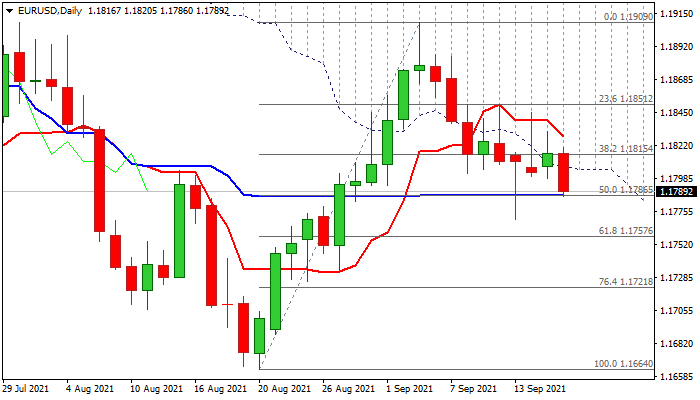
The Euro accelerates lower in early European trading on Thursday, signaling possible break of recent congestion, as long tails and upper shadows on daily candles in past few sessions pointed to indecision.
Near-term action remains bearishly aligned since recent bull-trap above 1.1894 Fibo barrier and weighed by falling thick daily cloud.
Fresh weakness looks for clear break of cracked daily Kijun-sen at 1.1786 (also 50% retracement of 1.1664/1.1909 upleg) to signal a continuation of pullback from 1.1909 (Sep 9 recovery peak).
South-heading 14-d momentum on daily chart is about to break into negative territory and add to bearish stance.
Acceleration through Kijun-sen pivot to expose targets at 1.1757/21 (Fibo 61.8% and 76.4% of 1.1664/1.1909 respectively) and risk full retracement on break of the latter.
Daily cloud base marks solid resistance at 1.1805, followed by broken Fibo 38.2% at 1.1815, with falling daily Tenkan-sen (1.1828) expected to cap upticks and keep bears in play. US retail sales and jobless claims data are key events today and eyed for fresh signals.
Res: 1.1805, 1.1815, 1.1828, 1.1845.
Sup: 1.1786, 1.1769, 1.1757, 1.1721.
AUDUSD Hovers Marginally Above 0.7300, Weak Momentum
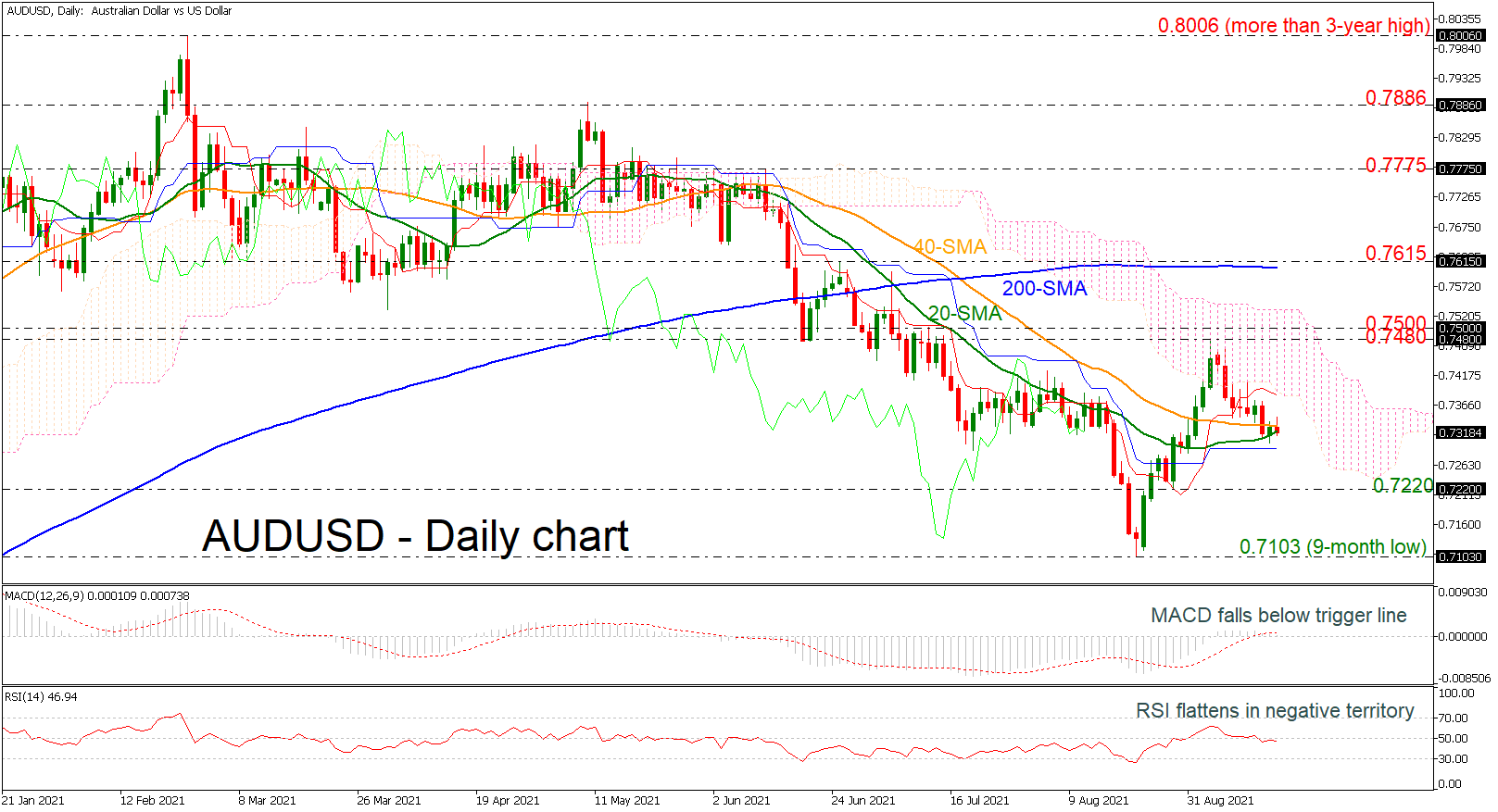
AUDUSD stuck near the 20- and 40-day simple moving averages (SMAs) and above the 0.7300 round number.
The pullback from the 0.7480 high is painting a bearish picture with the technical indicators suggesting a bearish-to-neutral bias. The MACD is marginally standing below its trigger line and near the zero level, while the RSI is slipping in the negative region.
Should selling forces strengthen, the 0.7220 support would come under the spotlight. Moving lower, the nine-month low of 0.7103 could next add some footing, while a break lower would endorse the broader bearish outlook.
Alternatively, a close above the 40-day SMA at 0.7333 could take the market until the 0.7480-0.7500 area, brighten the bigger view, pushing the price towards the 200-day SMA around the 0.7615 resistance.
In brief, AUDUSD is facing a weakening bearish bias, where a drop below 0.7300 is expected to enhance selling interest.
Markets Today: Caution Is An Investor’s Best Friend
US indices were supported last night after the S&P500 touched its 50-day moving average. The S&P500 gained 0.85%, the Nasdaq gained 0.82%, and the Dow Jones gained 0.68%. It must be said that this time the market rose in a broad front (there were 2.6 times as many rising stocks as falling ones), and the VIX fear index lost 6.6%.
However, this positive US momentum is a local and short-term story, tied to the quarterly expiry of options and futures. Less optimistic sentiment prevails in markets outside the USA.
Chinese markets developed declines on Thursday morning on fears of the aftermath of the Evergrande property developer default and the revaluation of the casino sector in Macau. Since last November, the ongoing selloff has dragged the Hang Seng to new lows, bringing the index's loss to 21% from its February peak. Among market participants, this is considered the start of a bear market. Previously in July and August, the bulls had pushed the index out of this territory, but this time the pressure of bad news outweighed the appeal of cheaper stocks.
The Nikkei 225 is pulling back from a 31-year high, losing momentum after rallying 9.5% since the start of the month. An overbought correction and selling on the rise promise to accompany the market in the near term.
The bears are also not losing ground in other markets. The EURUSD is hovering near its 50-day average. Attempts of intraday gains in the pair are stumbling over massive selloffs during active trading in the US, preventing the Euro from steadily gaining above 1.1800.
The New Zealand dollar only briefly enjoyed gains this morning after very strong Q2 GDP data showing the economy growing by 2.8% QoQ and 17.4% YoY against expectations of 1.2% and 16.4%, respectively. The NZDUSD added 50 pips shortly after the publication, but by the start of trading in Europe, it gave back all gains, reversing to 0.7100, around which it has been lingering since early September. The tendency to sell at the high is keeping the pair below its 200 SMA.
The intrinsic strength of the bears is also noticeable in the GBPUSD, which has stuck to 1.3820, near which the 50 and 200-day moving averages are concentrated. At the same time, the UK published impressive wage growth and inflation rate reports that were noticeably stronger than forecasted, often clearly supporting the pound.
Thus, the mood in the financial markets is dominated by profit-taking on the upside. In addition, the currency market is in no hurry to sell off the dollar, keeping it from significant average levels. It is quite possible that stock bears and dollar bulls have taken a wait-and-see approach ahead of the Fed's decision and comments next week. In addition, it is worth keeping an eye on the friction of US lawmakers on the infrastructure package and the government debt ceiling scheduled for next week.
Energy Prices Surge
Market movers today
- We have more data today on the state of the US economy. US retail sales will give more information on how much goods consumption is slowing as the effect of the stimulus checks fade. Very strong US goods consumption has been a key driver behind the global manufacturing overheating and pressure on global freight. Car sales has been weak (partly due to low inventories and bottle necks in production) but it is more interesting how the retail sales 'control group', which excludes autos, gas and food services, is developing. We look for a continued gradual decline in coming months.
- The Philadelphia Fed survey dropped strongly in August and points to weaker activity than what is shown in the ISM manufacturing survey. Consensus is for a small decline, which seems fair. Also keep an eye on initial jobless claims.
The 60 second overview
Energy prices: Surging energy prices remain a theme in markets with both gas and electricity prices through the roof. Lack of wind and rain has been a drag on electricity production in Europe. US gas production is still struggling to get back on its feet following the hurricane Ida, which raged through Louisiana two weeks ago and hurricane Nicholas is hampering production further. Gas supplies from Russia have also slowed as their inventories were depleted from the cold winter and the finished Nord Stream 2 is still not transporting gas to Europe. As the weather is cooling in Europe surging gas prices already now is quite worrying. Oil prices also caught up to the gas rally with Brent oil surging more than USD2 to above USD75 per barrel.
Japan: Exports continued on a strong footing in Japan with volumes up another 1.7% mom in July led by strong shipments of chip manufacturing equipment. That said, car exports are starting to feel the squeeze from lag of Asian supplies.
Inflation & green transition: This morning we have published a paper that explores various channels how climate change and mitigation policies impact euro inflation. Via temperature changes, rising carbon prices as well as higher production costs Europe's green transition will likely have an upward impact on HICP in our view, but falling prices for renewable energy and substitution away from carbon intensive products should mitigate the pro-inflationary impact. Uncertainty about the impact of climate change on the economy and inflation remains considerable. Model simulations suggest that the inflation boost even in a net zero 2050 scenario will remain in the low single digits and we do not think it will trigger aggressive tightening efforts from the ECB. That said, we see upside risks to inflation expectations in the euro area should governments become serious about their net zero 2050 targets. Read more in Research Euro Area: Europe's green transition - the heat is on for euro inflation, 16 September.
Equities: Global equities higher yesterday lifted by US markets alone, while rest of the world was lower. US session more or less a complete reversal of the session Tuesday as market started out flat and ended close to day high. Sector performance naturally also very different across the Atlantic but one thing in common was Energy stocks outperforming. Some of the defensive sectors underperforming like utilities and consumer staples. In the US: Dow +0.7%, S&P 500 +0.9%, Nasdaq +0.8% and Russell 2000 +1.1%.
The positive sentiment has not continued in Asia this morning where most markets are lower led by Hong Kong. European and US futures are close to unchanged, giving up some earlier gains.
FI: Yesterday was packed with plenty of issuance and today will see large issuance as well. The large issuance and also (but smaller) rise in US yields may be the driver behind the 3.5bp rise in German 10Y yields seen in the late afternoon yesterday.
FX: The upwards trend in commodity prices continues and the rise in oil and gas prices has unsurprisingly aided petroleum exporting FX incl. NOK higher. For EUR/USD spot, the effects seem to be mixed.
Credit: While CDS indices saw a small widening, with iTraxx Xover and Main 0.4bp and 0.2bp wider, respectively, cash bonds fared better. HY bonds tightened 2bp and IG tightened slightly.
US Oil Rally Gains Momentum
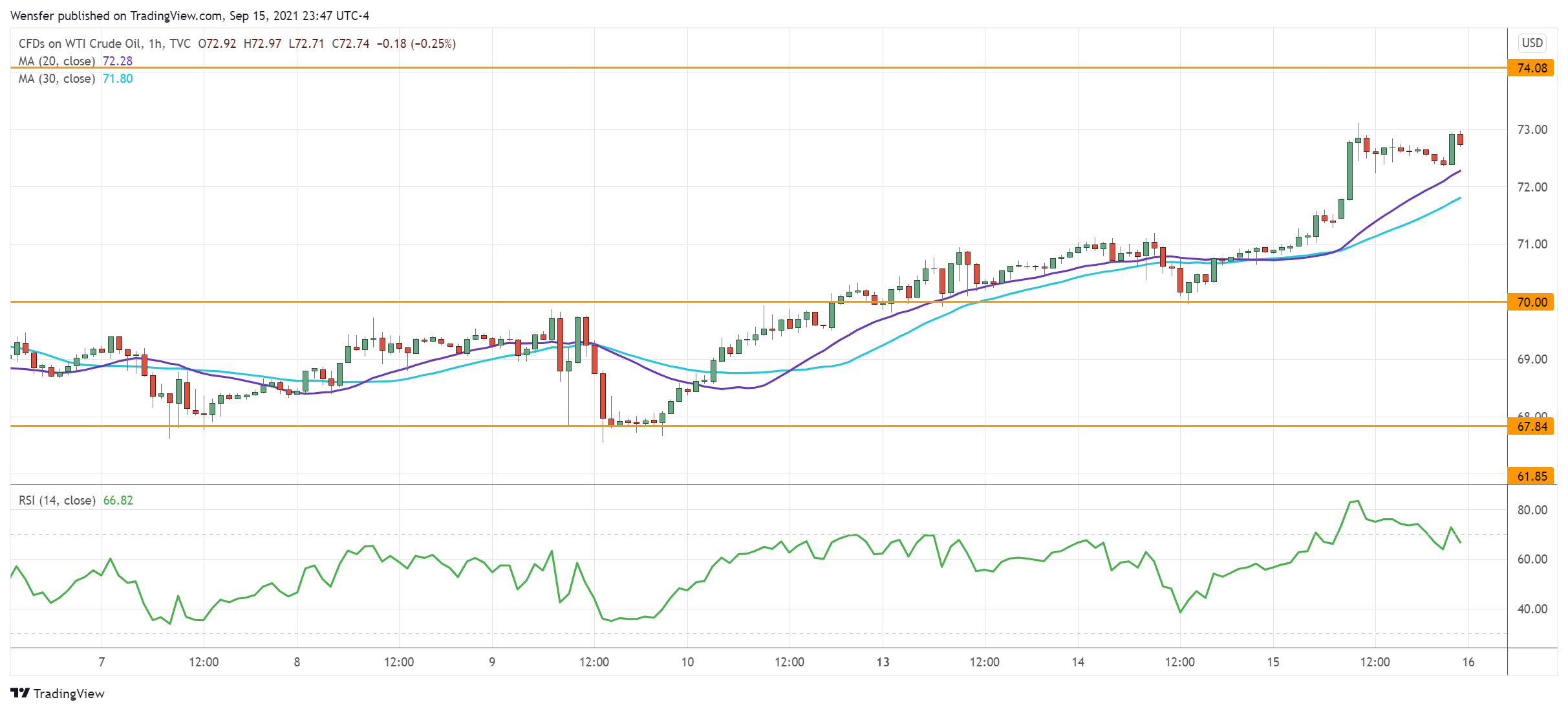
WTI crude shot higher after the EIA reported a large drop in US inventories.
A bullish MA cross on the daily chart suggests that sentiment has turned positive. After a brief consolidation, price action has lifted the psychological level of 70.00, turning it into fresh support.
As the upward momentum picks up speed, the oil price is heading to 74.10. The quick recovery would put the August sell-off behind and resume the 17-month long rally. A limited retracement may occur as the RSI inches into the overbought area.
SECO downgrades Swiss 2021 GDP forecast to 3.2%
SECO downgraded Swiss GDP growth forecast to 3.2% in 2021, comparing to June forecast of 3.6%. Growth is projected to further accelerate to 3.4% in 2022. It added that "the economic recovery is set to continue as expected, though growth is initially less dynamic than forecast previously." Nevertheless, "economic activity is likely to have exceeded pre-crisis levels during the summer."
SECO added, "highly exposed sectors such as international tourism are likely to emerge from the crisis more hesitantly". But, "provided that severely restrictive measures such as business lockdowns are not imposed in the coming months, the economic recovery should continue uninterrupted."
NZD/USD Seeks Support
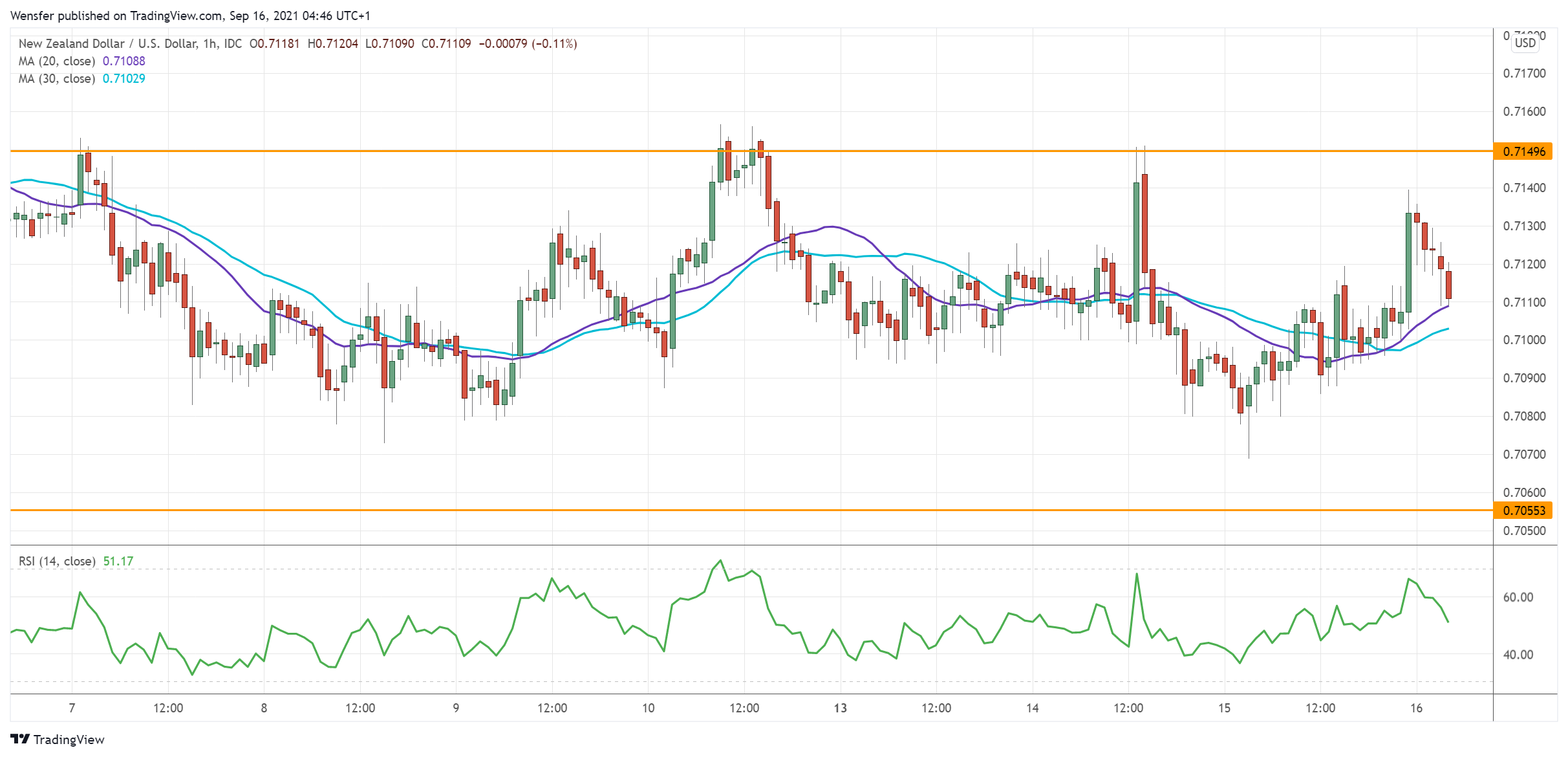
The New Zealand dollar inched higher after the Q2 GDP beat expectations.
The bulls are looking to consolidate their gains after they cleared the daily resistance at 0.7100. A bullish MA cross on the daily chart indicates a bullish bias. However, the kiwi’s struggle to stay above 0.7100 is a sign of overextension in the short term.
A controlled pullback is necessary to gather momentum after a rebound stalled at 0.7150. 0.7055 is the immediate support. Then the psychological level of 0.7000 is a crucial floor.
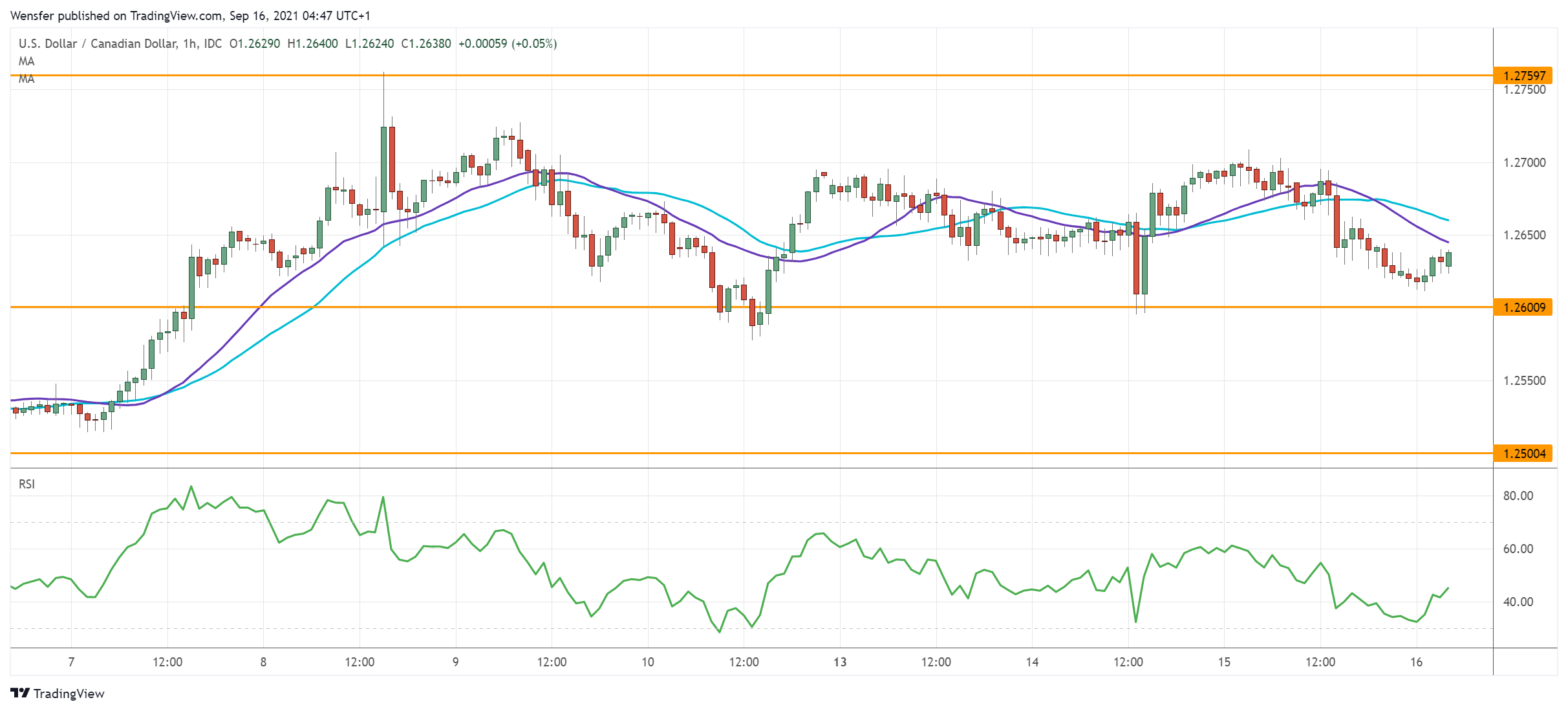
USD/CAD Capped By Key Resistance
The Canadian dollar recovered after a rise in the August CPI.
The previous attempt to break below 1.2500 has put the bulls under pressure. The rebound met offers at 1.2760 when the RSI was in an overbought situation. A bullish breakout would send the price to the peak around 1.2900.
On the downside, 1.2600 is fresh support as buyers try to hold onto recent gains. Its breach could force them to abandon ship and trigger a sell-off to 1.2500, which would be the ultimate test of the bulls’ commitment.
Retail Sales Risks Tilted To The Downside, What Does It Mean For The Dollar?
Markets
There was a lot of fuss about energy prices yesterday. Gas prices along with electricity and oil jumped amid a looming/unfolding European energy crisis. Natural gas (UK futures) eventually finished the day 7.5% higher while a barrel of Brent oil again closed north of $75 for the first time since end-July. Energy-related stocks unsurprisingly outperformed hugely. That didn’t provide a strong enough counterweight for European indices (finished +/- 1% in red) where o.a. utilities fell amid European governments intervening to cap surging market prices. There were less such concerns on WS (+ <1%). Core bond yields initially fell but reversed course after the US joined and judged that rising commodities is still part of a reflationary rather than stagflationary environment. The US yield curve bear steepened with changes ranging from 0.4 bps (2y) to 1.5 bps (10y). German yields inched 3.4 (10y) to 4 bps (30y) higher. The US greenback was sold both on rising commodities and improving sentiment (during US dealings) though ended off intraday lows thanks to a very strong Empire Manufacturing (34.3 from 18.3). EUR/USD closed marginally higher (1.182). The DXY fell to 92.55. Sterling whipsawed on stronger-than-expected August CPI and switching risk appetite. EUR/GBP declined from 0.855 to 0.853. PM Johnson’s cabinet reshuffle came without impact on the pound.
Following the US performance, things could have been more bright on Asian markets this morning. Stocks trade mixed at best with China underperforming. We suspect the looming Evergrande default story and the Chinese government now focusing on (Macau) casino regulation to be dampening the mood. Commodities stabilize for now. Core bonds trade sideways while the USD together with the JPY is among the better-bid on FX markets. The AUD and NZD part ways on diverging economic news (see below). The NOK eases after bursting out yesterday.
We see risks for today’s US August retail sales slightly tilted to the downside as consumer sentiment tanked last month (U. of Michigan, Conference Board) on inflation and Deltavirus worries. The unexpectedly very poor July report provides some counterweight in our assessment as it (statistically) lowers the bar. In case of a disappointing August reading, it may cast more market doubts on the Fed’s tapering intentions ahead of the Sept 22 FOMC meeting. This could weigh on US yields and keep the dollar in a defensive position. We’re also keen to see whether commodities extend their furious rally. That would be an additional dollar negative. EUR/USD 1.1848 is a first resistance area. UK retail sales are due tomorrow. It’ll serve as one of the final inputs to the BoE meeting on Sept 23.
News headlines
New Zealand growth in the second quarter accelerated 2.8% Q/Q, more than double the pace expected. The New Zealand economy grew 1.4% in Q1. Activity in the country was 17.4% higher Y/Y. Primary industries (5.0%), goods-producing industries (1.3%) and services (2.8%) all contributed to the rebound. Amongst others, the rebound in activity was strongly supported by tourism related activities after the reopening of the trans-Tasman bubble with Australia. However, this was suspended again after a new corona outbreak both in New Zealand and Australia in August. This might result in a new setback/contraction of activity in Q3. Even so, given higher Q2 inflation (3.3%) and unemployment falling back to 4%, today’s data reinforce the case of the RNBZ to start raising rates soon. The market already discounts a 25 bps rate hike next month after the Bank delayed a rate hike in August. The kiwi dollar temporarily gained modest ground after the GDP release, but currently trades little changed at NZD/USD 0.7115.
Somewhat of a different message came from the Australian August labour market data. Employment declined 146K, while only a more modest setback (-80K was expected). The unemployment rate dropped to 4.5% from 4.6%. However, the unemployment rate is distorted as many people dropped out of the labour force due to the new lockdowns. The participation rate declined from 66.0% to 65.2%.Current trends might still continue in September. The Aussie dollar is losing modest ground this morning, with AUD/USD near 0.7325. Today’s data probably won’t change the RBA’s wait-and-see bias.