Sample Category Title
GBP/USD Daily Outlook
Daily Pivots: (S1) 1.3805; (P) 1.3830; (R1) 1.3866; More...
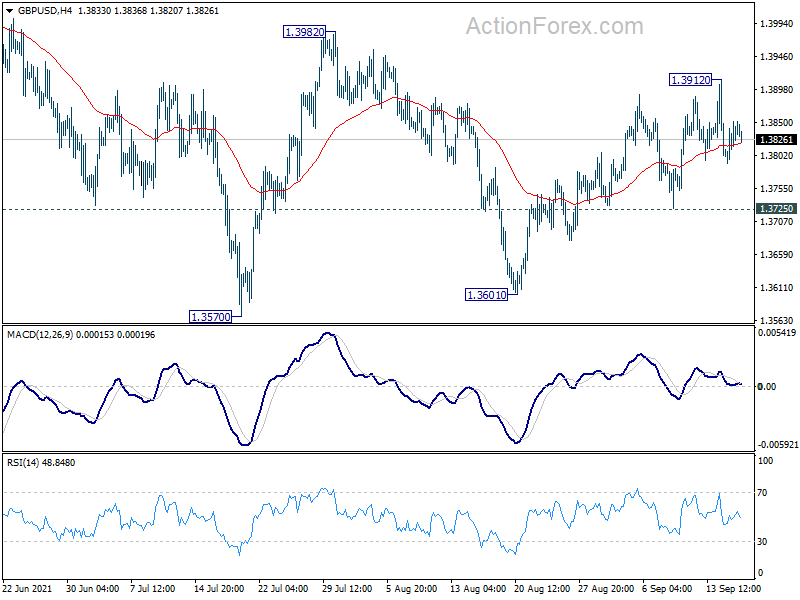
Intraday bias in GBP/USD stays neutral and outlook is unchanged. On the upside, break of 1.3912 will target 1.3982 resistance next. Decisive break there will indicate that fall from 1.4248 has completed. Stronger rally would then be seen back to 1.4248 high. On the downside, however, break of 1.3725 support will turn bias back to the downside for retesting 1.3570/3601 support zone instead.
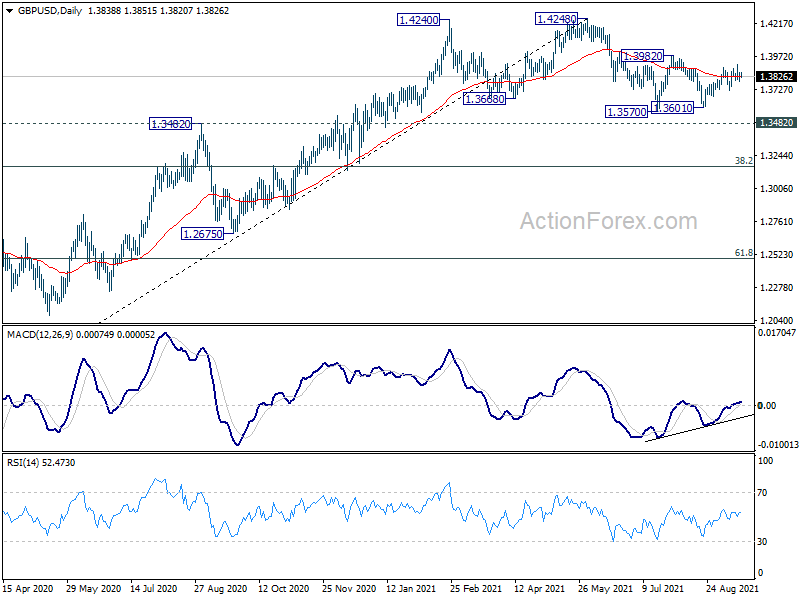
In the bigger picture, as long as 1.3482 resistance turned support holds, we'd still treat price actions from 1.4248 as a corrective move. That is, up trend from 1.1409 (2020 low) is in favor to resume. Decisive break of 1.4376 key resistance (2018 high) would indeed carry long term bullish implications. However, sustained break of 1.3482 will at least bring deeper fall to 38.2% retracement of 1.1409 to 1.4248 at 1.3164, or even further to 61.8% retracement at 1.2493.
Crude Oil Price Spikes As Demand Hopes Rise
American stocks rebounded cautiously on Wednesday as the market tried to assess the strength of the American economy. The Dow Jones added 255 points while the S&P 500 and Nasdaq 100 indices rose by 35 and 70 points, respectively. Stocks have wavered this month as sentiment among Wall Street firms worsened. In the past few weeks, analysts at key banks like Bank of America have lowered their estimates for UK equities. At the same time, investors are worried about the Chinese economy. Data published on Wednesday revealed that home prices and fixed asset investments declined in August as Evergrande woes continued.
The USDCAD pair retreated after strong Canadian inflation data. The numbers showed that the country’s headline inflation rose from 3.7% in July to 4.1% in August. This increase was better than the median estimate of 3.9%. In the same period, core inflation increased from 3.3% to 3.5%, which is above the Bank of Canada target of 2.0%. The Canadian dollar also rose as the price of crude oil rose, with Brent and WTI rising to $75 and $72.47. Higher oil prices are usually positive for the Canadian dollar because Canada is the fourth-biggest producer in the world.
The US dollar index declined slightly as investors waited for the upcoming American retail sales and jobless claims numbers. With consumer prices rising, analysts expect that overall sales declined in August. Specifically, they expect that the overall sales declined by 0.8% while core sales fell by 0.1%. Meanwhile, the Labour Department will publish the latest jobless claims, which are expected to show a slight increase from 310k to 330k. The Philadelphia Federal Reserve will also release the latest manufacturing index data.
USDCAD
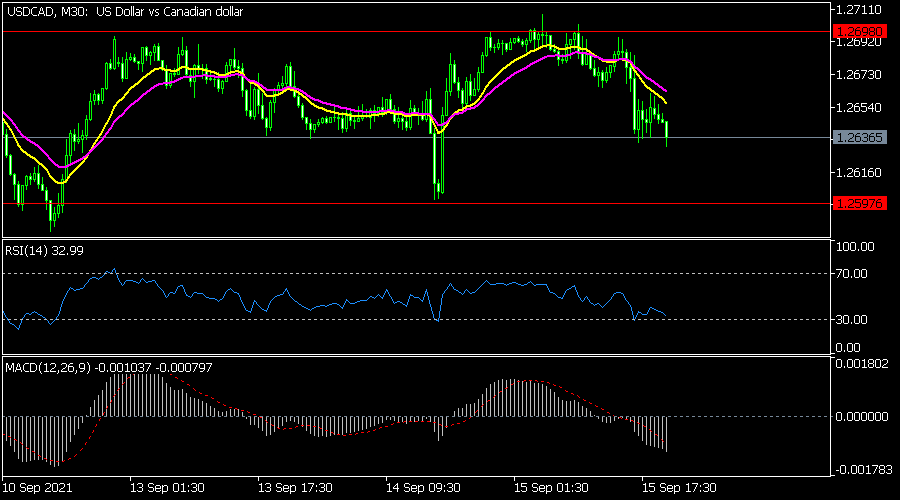
The USDCAD pair declined to a low of 1.2623 after strong Canadian inflation data. On the 30-minute chart, the pair moved below the 25-day moving average. It also declined below this week’s key resistance level at 1.2700. The Relative Strength Index (RSI) has also dropped close to the oversold level of 30 while the MACD moved below the neutral level. Therefore, the pair may keep falling as bears target the key support at 1.2597.
EURUSD
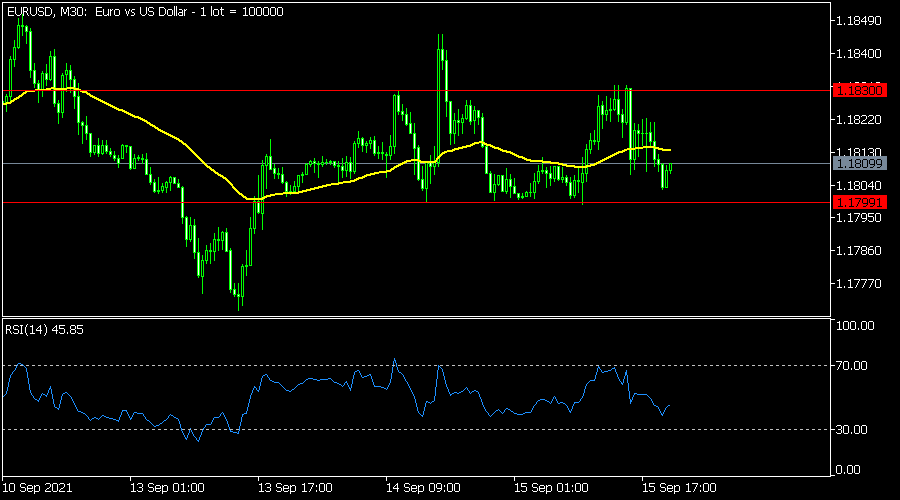
The EURUSD pair remained in a tight range ahead of the US retail sales data. It is trading at 1.1810, which is inside the rectangular channel shown in red. Its support and resistance levels are at 1.1800 and 1.1830. The pair is along with the 25-day moving average while the RSI is at the neutral level. Therefore, the pair will likely remain in this range as investors reflect on this week’s numbers.
XTIUSD
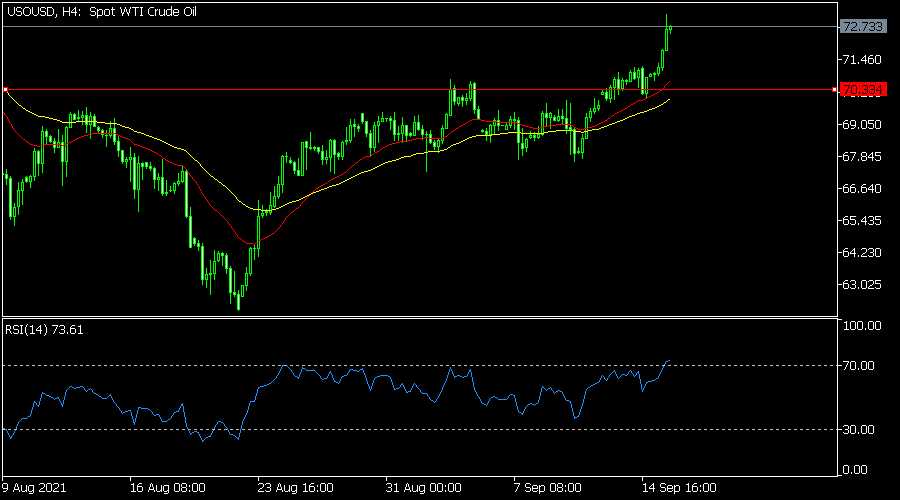
The price of West Texas Intermediate (WTI) rose after bullish reports by OPEC and IEA. The pair rose to 73.20, which was the highest level since early August. It managed to move above the neckline of the inverted head and shoulders pattern. Also, the pair rose above the 25-day and 50-day moving averages while the RSI has moved above the overbought level. Therefore, the pair will likely maintain a bullish trend.
USD/CHF Daily Outlook
Daily Pivots: (S1) 0.9173; (P) 0.9189; (R1) 0.9215; More....
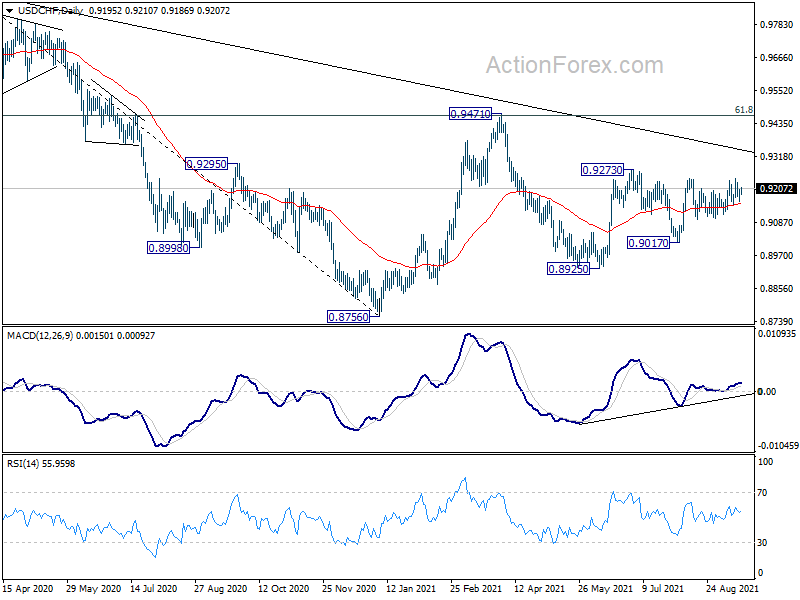
Intraday bias in USD/CHF remains neutral for the moment and outlook is unchanged. On the downside, break of 0.9149 will turn focus to 0.9098 support. Break there will target further decline to 0.9017 support. On the upside, break of 0.9239/41 will target 0.9273 resistance instead.
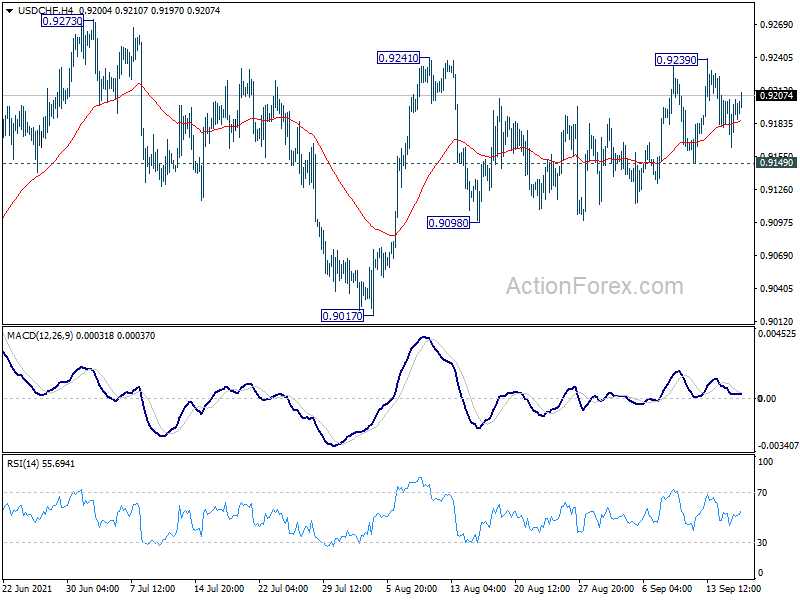
In the bigger picture, USD/CHF is still struggling around 55 week EMA (now at 0.9178) and outlook is mixed for now. Confirmed rejection by the 55 week EMA will retain medium term bearishness. That is, larger fall from 1.0342 would resume through 0.8756 low at a later stage. However, sustained trading above 55 week EMA will tilt favor to the case of bullish reversal. Focus would then be turned to 0.9471 resistance for confirmation.
Chinese Stocks Battered, S&P 500 Rebounds
News are mixed, but the US investors prefer making the most of it. The S&P500 closed Wednesday’s session 0.85% higher; that was the biggest jump since August, meaning that the 50-dma magic operated and gave another good support to the equity bulls.
Nasdaq and Dow Jones gained as well, despite a morose European session, where Eurostoxx lost more than 1%.
The biggest winners were the energy stocks, as the US energy sector jumped more than 3% yesterday on news that the US crude inventories fell 6.4 million last week. The expectation was some 3.5-million-barrel decline. As a result, US crude traded past $73pb, and Exxon broke above its horizontal triangle to the upside and closed the session more than 3% higher. Chevron on the other hand gained 2%. Yet, the 50-dma just slipped below the 200-dma, forming a death cross formation on the daily chart, which could limit the Chevron gains from a technical perspective. And if that’s not enough, fundamental news, apart from the energy prices, are not brilliant for Chevron. The company CEO threw a jaw dropping statement, saying that he would rather pay dividends than invest in wind and solar. My only reaction to that is: investors should rather invest in more smartly managed energy companies to lock in longer run profits as unfortunately for Chevron, the green energy is the future. Or there might be no future.
Else, Chinese stocks were badly battered yesterday, yet again! This time, it was the Chinese casino stocks turn to take the hit as government said it would change casino regulations to tighten restrictions on operators, including appointing government representatives to “supervise” companies in the world’s biggest gaming hub. So begins a 45-day public consultation period for Chinese casinos in Macau, and the consequences could be dramatic as important decisions will be taken. The news, and the worries wiped out $18 billion from the Chinese casino shares.
Alibaba shed another 1.43%, as it has also been hit by news that directly targeted the Ant Group’s Alipay earlier this week, when government said they would split Alipay’s lending business and share the user data with state backed partners. And needless to say that investors hated the idea of sharing the data more than they hated the idea of splitting Alipay’s business.
Now let’s have a look at some more macro news beyond the US. Inflation in Britain and Canada accelerated as well, according to data released yesterday. The British inflation came in above the 3% mark, fueling the expectations that the BoE would be tempted to tighten its own monetary policy sooner rather than later. That idea should keep the pound on track for further gains against the USD toward the 1.40 level. The FTSE will likely continue feeling the pinch of a stronger pound and break the 7000p support despite firming oil and energy prices, because what we observe right now is that the reflation trade isn’t strong enough to boost reflation friendly energy and banking stocks, as even the tighter central bank expectations have no implication on future rate expectations, which remain subdued, regardless of the central banks’ QE taper plans.
Elsewhere, the data is mixed. The Japanese exports slowed more than expected in August, the GDP growth in New Zealand beat expectations with a 2.8% print in the latest quarter versus 1.1% expected by analysts, and the jobless rate in Australia fell from 5% to 4.5%. But that number could hide a more serious headache, as people are not necessarily ready to take any job. High job vacancies seem to be the new post-pandemic norm for the developed economies.
Due today, the US retail sales data could reveal a 0.8% monthly decline in August. But soft data would hardly dampen the mood, after Tuesday’s inflation eased worries of a too tight Federal Reserve (Fed) stance. On the contrary, there is a greater chance that we see the equity bulls benefit from a rebound following the latest S&P500’s latest dip to the 50-dma.
Well, you may have noticed that gold doesn’t necessarily benefit these subdued US yields. The price of an ounce remains below the $1800 mark and should see limited upside appetite as long as the US equity markets remain on track for further gains.
Equities Trade Mixed
General trend
- Energy cos. trade higher after recent rise in oil prices.
- Asian financials trade mixed.
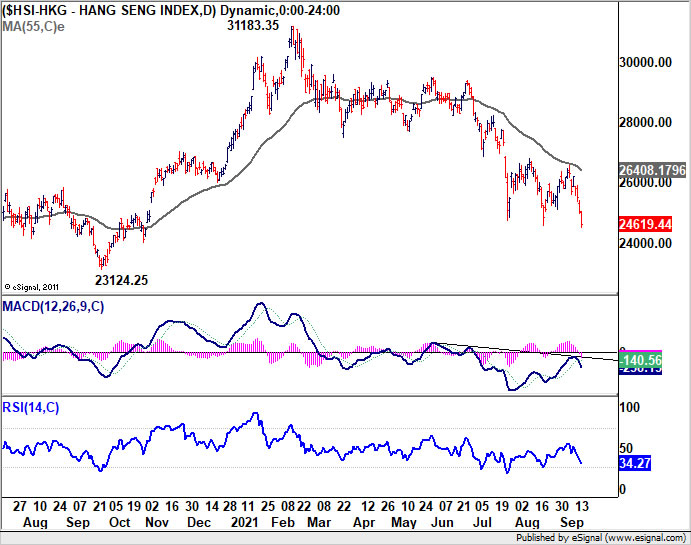
- Hang Seng extended declines following the flat open, trades at lowest level since Nov 2020 [Bond trading halt/credit downgrades related to Evergrande hurt sentiment; Property sector declines amid contagion concerns, Financials also drop; Casino plays generally extend losses; TECH index drops over 1.5%].
- Shanghai Composite declined during morning trading despite the higher open [Property index extends drop; IT, Industrial and Consumer Discretionary indices also decline; Consumer Staples outperform].
- Nikkei has moved lower after the modestly higher open [Softbank Group extends recent declines; Topix Securities index declines by over 1.5%].
- S&P ASX 200 has remained higher [Telecom index rises on guidance from Telstra; Energy, Financial and Resources indices also gain].
- Japan unexpectedly reported trade deficit in Aug [exports to China slowed].
- China’s Commerce Ministry (MOFCOM) sometimes holds weekly news conferences on Thurs.
Headlines/Economic Data
Australia/New Zealand
- ASX 200 opened 0.0%.
- (AU) AUSTRALIA AUG EMPLOYMENT CHANGE: -146.3K V -80.0KE; UNEMPLOYMENT RATE: 4.5% V 5.0%E.
- (NZ) NEW ZEALAND Q2 GDP Q/Q: 2.8% V 1.1%E; Y/Y: 17.4% V 16.1%E.
- (AU) Australia Sept Consumer Inflation Expectations: 4.4% v 3.3% prior.
- TLS.AU To extend 5G coverage to 95% of population; Guides mid single digit EBITDA, High Teens EPS through FY25 - investor meeting slides.
- (AU) US, UK and Australia will establish a security partnership for the Indo-Pacific that will involve helping Australia acquire nuclear-powered submarines, as Chinese influence over the region grows.
- API.AU Received revised offer from Wesfarmers at A$1.55/shr cash (prior A$1.38/shr), to grant due diligence.
- (NZ) New Zealand Fin Min Robertson: To raise COVID fund by NZ$7.0B, able to do so because of greater fiscal headroom.
Japan
- Nikkei 225 opened +0.3%.
- (JP) Japan Chief Cabinet Sec Kato: Considering convening an extraordinary session of Parliament to select new PM on Oct 4th.
- (JP) Japan Aug Trade Balance: -¥635.4B v +¥2.9Be; Adj Trade Balance: -¥271.8B v +¥108.7Be; Exports to China y/y: 12.6% v 18.9% prior.
- (JP) Japan Leadership Candidate Kono said to not plan on replacing or building additional nuclear reactors – Nikkei.
- 8698.JP To start OTC trading services for US companies.
- (JP) Japan Leadership Candidate Kono: Must improve intelligence capabilities regarding North Korea missile launch, must offer tax exemptions to companies that boost distribution of wealth to workers, any new stimulus must first have targets before deciding size of spending.
- (JP) Japan MoF sells ¥1.2T v ¥1.2T indicated in 0.500% 20-year JGBs, avg yield: 0.4120% v 0.4050% prior, bid to cover 3.20x v 3.65x prior.
Korea
- Kospi opened +0.4%.
- (KR) North Korea fired railway based missile yesterday – KCNA.
- (KR) North Korea's Kim Yo Jong (sister of Kim Jong Un): Earlier missiles were not a provocation.
- 042660.KR Developed a technology to store carbon dioxide captured in ship engine emissions.
- 096770.KR Shareholders approve plan to split off battery business.
China/Hong Kong
- Hang Seng opened 0.0%; Shanghai Composite opened +0.2%.
- (CN) China said to be 'slowing' game approvals to enforce the stricter gaming rules - press.
- (CN) China State Planner (NDRC): Approved 11 fixed asset projects in CNY100.6B during Aug; China economy is continuing recovery; Confident China will achieve full year economic [GDP] target of >6.0%.
- 3333.HK China authorities have told lenders to not expect any interest payments due next week to be made and likely miss 1 principal payment - press.
- DIDI Said to have lost 30% of daily users following crackdown measures by China - FT
- (CN) China PBOC sets Yuan reference rate: 6.4330 v 6.4492 prior.
- (CN) China PBOC Open Market Operation (OMO): Injects CNY10B in 7-day reverse repos v CNY10B in 7-day reverse repos prior; Net CNY0B v Net drain CNY0B prior.
- (CN) China Industry Ministry (MIIT): To increase data security in Internet of Vehicles.
- (CN) China President Xi: China is seeking to work with other nations to promote the Beidou navigation satellite system construction - Xinhua.
North America
- (US) President Biden said to be planning meeting with chipmakers on Sept 23rd – press.
- (US) President Biden to remark on economy tomorrow at 13:45 ET.
- AMC CEO Aron: Will accept Bitcoin for online ticket and concession payments by the end of year, expect we will also start to accept Ethereum and Litecoin - tweet.
Europe
- (FR) France Foreign Affairs Min Le Drian: Australia move to halt submarine program is regrettable.
Levels as of 01:15ET
- Hang Seng -1.7%; Shanghai Composite -0.7%; Kospi -0.4%; Nikkei225 -0.6%; ASX 200 +0.8%.
- Equity Futures: S&P500 -0.1%; Nasdaq100 -0.1%, Dax -0.2%; FTSE100 -0.1%.
- EUR 1.1821-1.1809; JPY 109.46-109.22; AUD 0.7344-0.7320; NZD 0.7139-0.7106.
- Commodity Futures: Gold -0.1% at $1,792/oz; Crude Oil +0.3% at $72.80/brl; Copper -0.8% at $4.37/lb.
USD/JPY Daily Outlook
Daily Pivots: (S1) 109.07; (P) 109.41; (R1) 109.70; More...
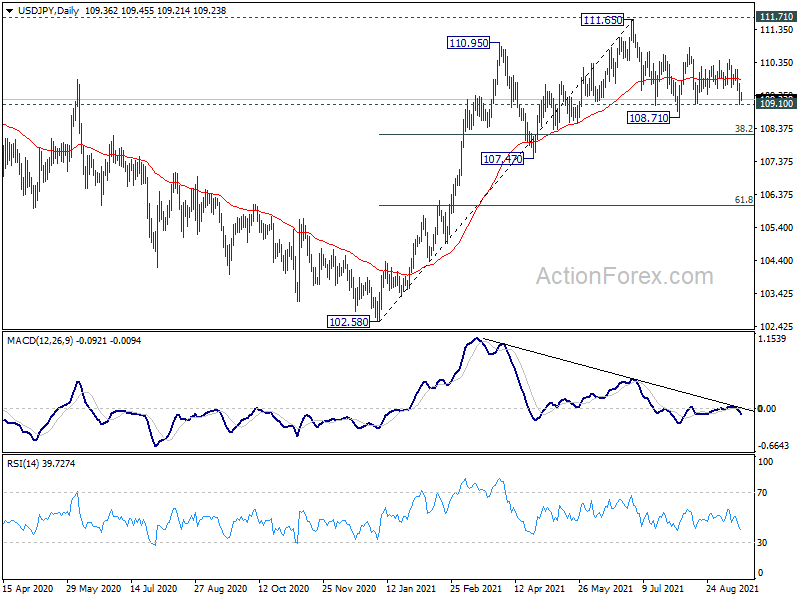
Focus remains on 109.10 support in USD/JPY. Firm break there will argue that larger fall from 111.65 is resuming. Deeper decline should then be seen to 108.71 support first, and then 38.2% retracement of 102.58 to 111.65 at 108.18 next. On the upside, break of 110.44 resistance will turn bias back to the upside for 110.79 instead.
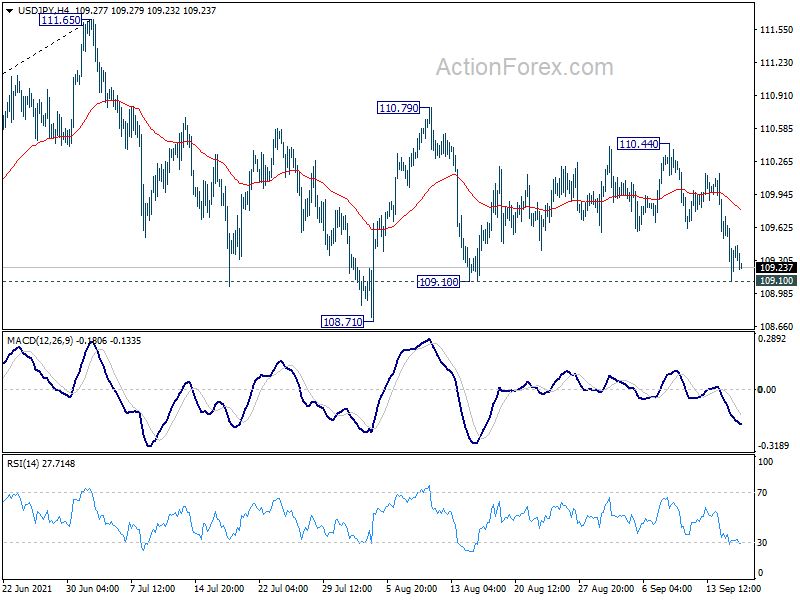
In the bigger picture, medium term outlook is staying neutral with 111.71 resistance intact. The pattern from 101.18 could still extend with another falling leg. Sustained trading below 55 day EMA will bring deeper fall to 107.47 support and below. Nevertheless, strong break of 111.71 resistance will confirm completion of the corrective decline from 118.65 (2016 high). Further rise should then be seen to 114.54 and then 118.65 resistance.
Yen Stays Firm on Risk Aversion in Asia, But Dollar Holding on to Support
Yen is trading generally firm today as risk sentiment in Asia is decoupling from that of the US. Nikkei is so far rather resiliently holding above 30k handle, despite slight retreat. But Hong Kong HSI is having another day of heavy selling, breaking to a new low for the year. The fact that Swiss Franc is not following suggests it's more of a problem of Asia. Meanwhile, Aussie is currently the worst performing after poor job data. Kiwi is only getting very mild support from GDP. Dollar and Euro are mixed.
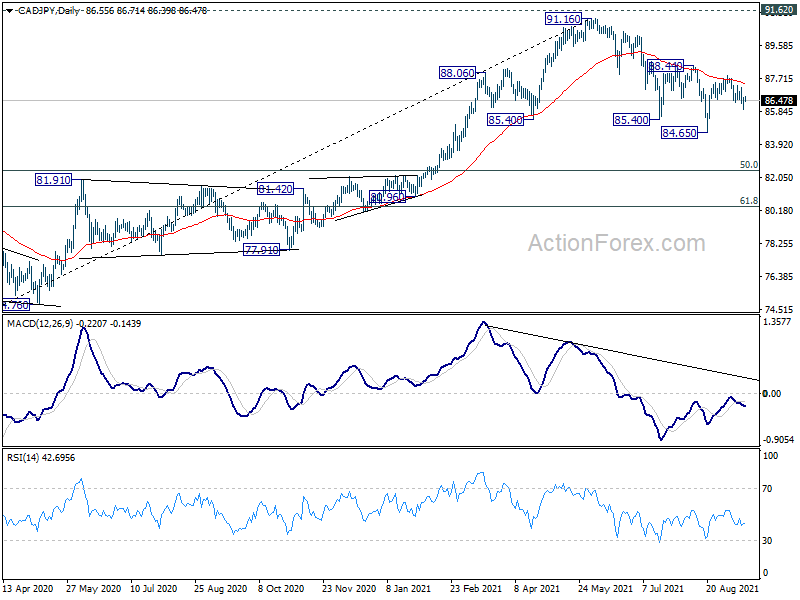
Technically, 109.10 support in USD/JPY remains a major focus, and firm break there will likely resume whole fall from 111.65 through 108.71 support. That could trigger further selloff in Yen crosses elsewhere. For example, CAD/JPY is maintaining near term bearishness after rejection by 55 day EMA. There might be downside re-acceleration ahead to 84.65 support and below, should USD/JPY also take off.
In Asia, at the time of writing, Nikkei is down -0.48%. Hong Kong HSI is down -1.97%. China Shanghai SSE is down -0.68%. Singapore Strait Times is up 0.26%. Japan 10-year JGB yield is up 0.0073 at 0.043. Overnight, DOW rose 0.68%. S&P 500 rose 0.85%. NASDAQ rose 0.82%. 10-year yield rose 0.027 to 1.304.
Japan exports grew 26.2% yoy in Aug, imports rose 44.7% yoy
Japan's export grew 26.2% yoy to JPY 6605B in August. That's the sixth straight month of double-digit annual growth, as boosted by strong demand for chip-making equipment. By destination, exports to China, the largest trading partner, grew 12.6% yoy. Exports to Asia as a whole rose 26.1% yoy. Exports to the US rose 22.8% yoy. Exports to EU rose 29.9% yoy.
Imports jumped 44.7% yoy to JPY 7241B, due to stronger demand for fuel and medical goods. Trade balance came in at JPY -635B deficit, the largest shortfall since December 2021.
In seasonally adjusted term, exports rose 0.8% mom to JPY 7104B. Imports rose 4.6% mom to JPY 7276B. Trade deficit came in at JPY -272B versus expectation of JPY 80B surplus.
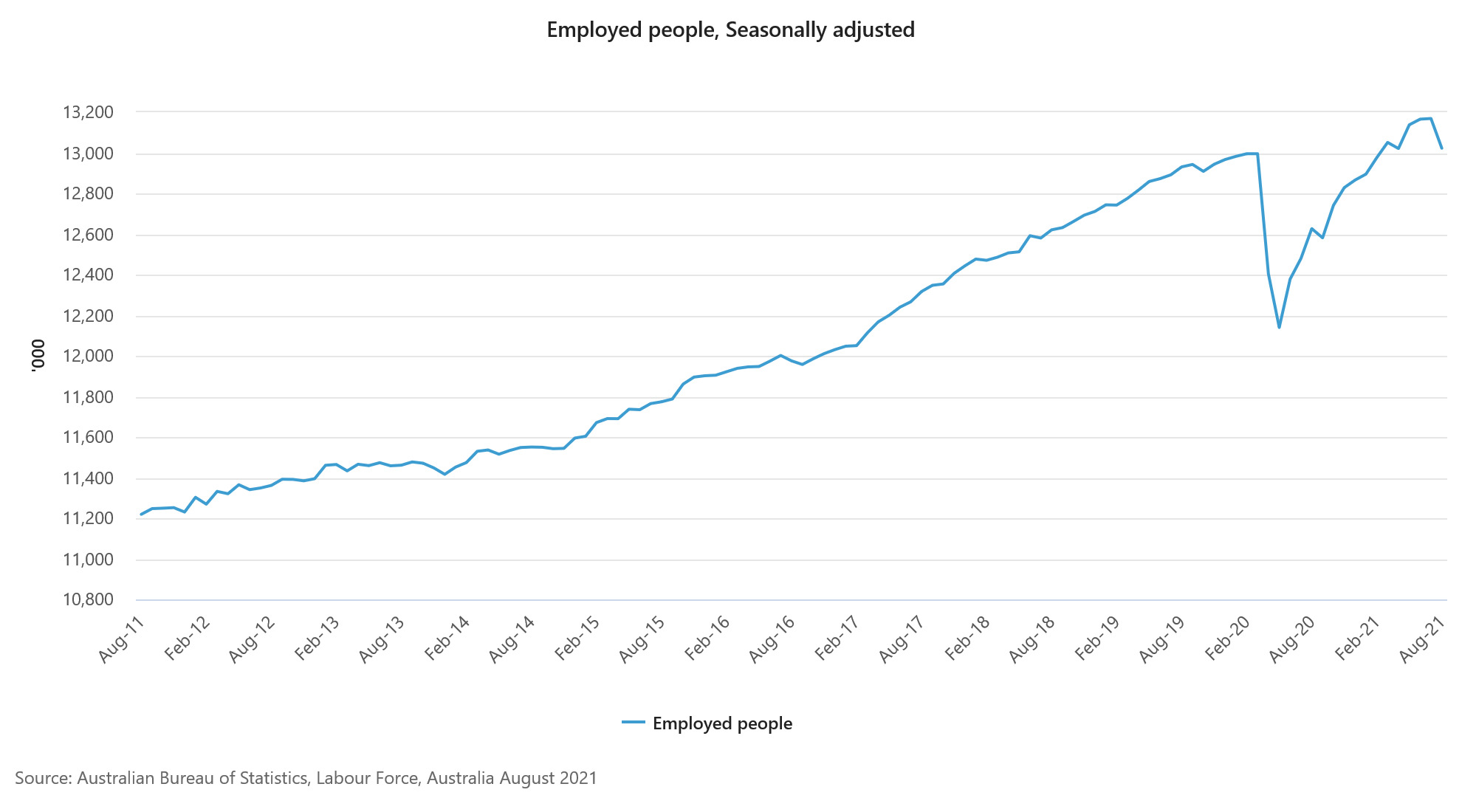
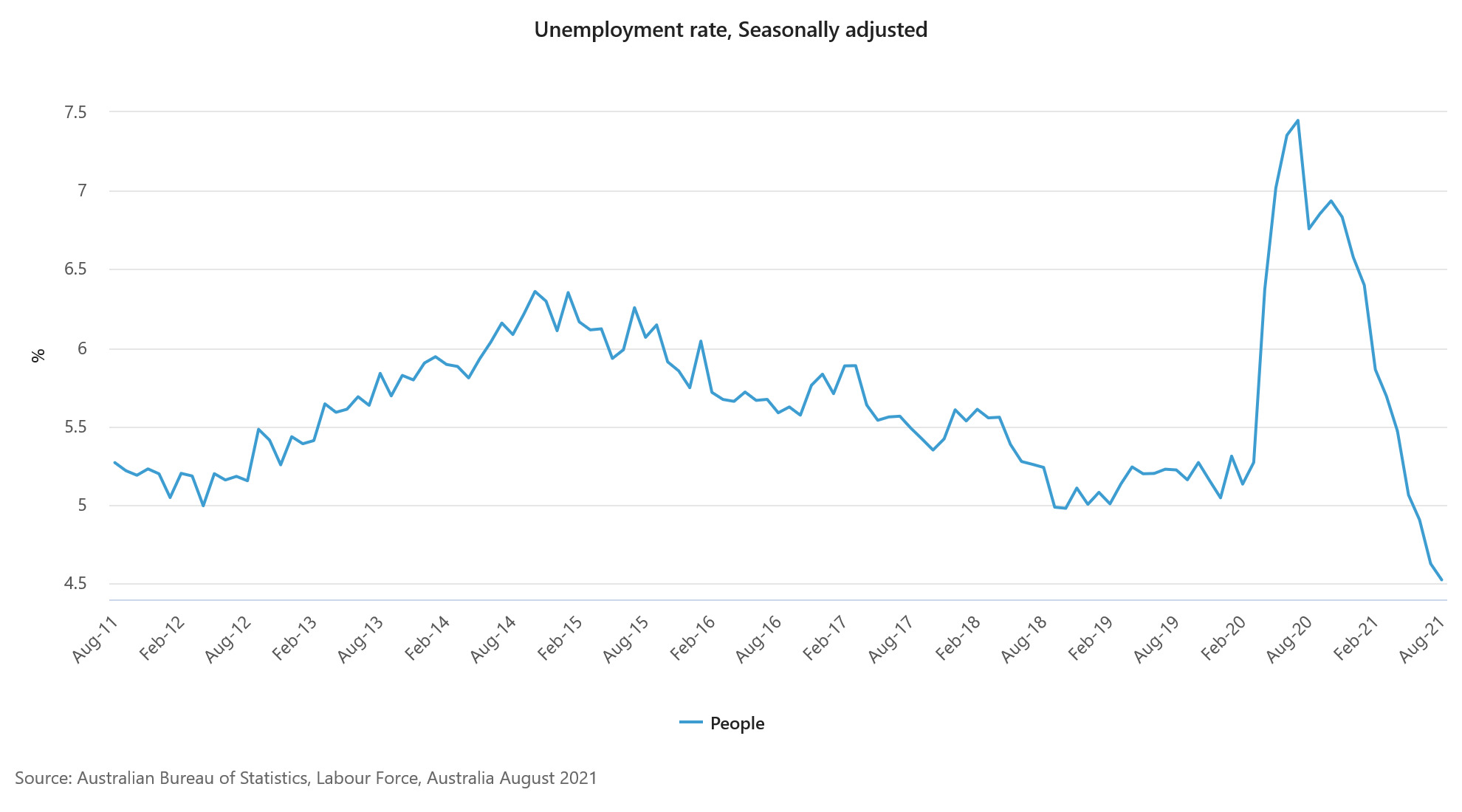
Australia employment dropped -146.3k in Aug, people also dropping out of labor force
Australia employment dropped -146.3k in August, even worse than expectation of -70.0k. Full-time jobs dropped -68k while part-time jobs dropped -78.2k.
Unemployment rate, on the other hand, dropped -0.1% to 4.6%, versus expectation 4.9%. But that's due to a sharp fall in participation rate by -0.8% to 65.2%. Monthly hours worked dropped -66m hours or -3.7% mom.
Bjorn Jarvis, head of labour statistics at the ABS, said: "The fall in the unemployment rate reflects a large fall in participation during the recent lockdowns, rather than a strengthening in labour market conditions.
"Throughout the pandemic we have seen large falls in participation during lockdowns — a pattern repeated over the past few months. Beyond people losing their jobs, we have seen unemployed people drop out of the labour force, given how difficult it is to actively look for work and be available for work during lockdowns.
New Zealand GDP grew 2.8% qoq in Q2, well above expectation
New Zealand GDP grew 2.8% qoq in Q2, well above expectation of 1.2% qoq. Growth was led by service industries, which rose 2.8% qoq. Primary industries rose 5.0% qoq. Goods producing industries rose 1.3% qoq.
"The June 2021 quarter experienced fewer COVID-19 restrictions than previous quarters affected by COVID-19. Many industries experienced activity at or above pre-COVID-19 levels, while some remained below," national accounts senior manager Paul Pascoe said.
ECB Lane: Should emphasize persistence, not volume of asset purchases
ECB Chief Economist Philip Lane said in a webinar, "it's not a good idea to identify the monetary policy stance with the volume of asset purchases." Instead, "the efficient approach is to emphasize persistence."
"We're happy that our monetary accommodation is strengthening the underlying inflation dynamic and over time -- this will continue to build. We have a coherent policy setting," he added.
Looking ahead
Swiss SECO economic forecasts, Italy trade balance, and Eurozone trade balance will be released in European session. US retail sales will be the main feature later in the day, while jobless claims, Philly Fed survey and business inventories will be released. Canada will release housing starts, wholesale sales and ADP employment.
USD/JPY Daily Outlook
Daily Pivots: (S1) 109.07; (P) 109.41; (R1) 109.70; More...
Focus remains on 109.10 support in USD/JPY. Firm break there will argue that larger fall from 111.65 is resuming. Deeper decline should then be seen to 108.71 support first, and then 38.2% retracement of 102.58 to 111.65 at 108.18 next. On the upside, break of 110.44 resistance will turn bias back to the upside for 110.79 instead.
In the bigger picture, medium term outlook is staying neutral with 111.71 resistance intact. The pattern from 101.18 could still extend with another falling leg. Sustained trading below 55 day EMA will bring deeper fall to 107.47 support and below. Nevertheless, strong break of 111.71 resistance will confirm completion of the corrective decline from 118.65 (2016 high). Further rise should then be seen to 114.54 and then 118.65 resistance.
Economic Indicators Update
| GMT | Ccy | Events | Actual | Forecast | Previous | Revised |
|---|---|---|---|---|---|---|
| 22:45 | NZD | GDP Q/Q Q2 | 2.80% | 1.20% | 1.60% | 1.40% |
| 23:50 | JPY | Trade Balance (JPY) Aug | -0.27T | 0.08T | 0.05T | -0.01T |
| 01:00 | AUD | Consumer Inflation Expectations Sep | 4.40% | 3.30% | ||
| 01:30 | AUD | Employment Change Aug | -146.3K | -70.0K | 2.2K | 3.1K |
| 01:30 | AUD | Unemployment Rate Aug | 4.50% | 4.90% | 4.60% | |
| 01:30 | AUD | RBA Bulletin Q2 | ||||
| 05:45 | CHF | SECO Economic Forecasts | ||||
| 08:00 | EUR | Italy Trade Balance (EUR) Jul | 6.22B | 5.68B | ||
| 09:00 | EUR | Eurozone Trade Balance (EUR) Jul | 16.8B | 12.4B | ||
| 12:15 | CAD | Housing Starts Y/Y Aug | 270K | 272K | ||
| 12:30 | CAD | ADP Employment Change Aug | 221.3K | |||
| 12:30 | CAD | Wholesale Sales M/M Jul | -2.00% | -0.80% | ||
| 12:30 | USD | Retail Sales M/M Aug | -0.70% | -1.10% | ||
| 12:30 | USD | Retail Sales ex Autos M/M Aug | -0.10% | -0.40% | ||
| 12:30 | USD | Initial Jobless Claims (Sep 10) | 316K | 310K | ||
| 12:30 | USD | Philadelphia Fed Manufacturing Sep | 18.9 | 19.4 | ||
| 14:00 | USD | Business Inventories Jul | 0.50% | 0.80% | ||
| 14:30 | USD | Natural Gas Storage | 76B | 52B |
Japan exports grew 26.2% yoy in Aug, imports rose 44.7% yoy
Japan's exports grew 26.2% yoy to JPY 6605B in August. That's the sixth straight month of double-digit annual growth, as boosted by strong demand for chip-making equipment. By destination, exports to China, the largest trading partner, grew 12.6% yoy. Exports to Asia as a whole rose 26.1% yoy. Exports to the US rose 22.8% yoy. Exports to EU rose 29.9% yoy.
Imports jumped 44.7% yoy to JPY 7241B, due to stronger demand for fuel and medical goods. Trade balance came in at JPY -635B deficit, the largest shortfall since December 2021.
In seasonally adjusted term, exports rose 0.8% mom to JPY 7104B. Imports rose 4.6% mom to JPY 7276B. Trade deficit came in at JPY -272B versus expectation of JPY 80B surplus.
Australia employment dropped -146.3k in Aug, people also dropping out of labor force
Australia employment dropped -146.3k in August, even worse than expectation of -70.0k. Full-time jobs dropped -68k while part-time jobs dropped -78.2k.
Unemployment rate, on the other hand, dropped -0.1% to 4.6%, versus expectation 4.9%. But that's due to a sharp fall in participation rate by -0.8% to 65.2%. Monthly hours worked dropped -66m hours or -3.7% mom.
Bjorn Jarvis, head of labour statistics at the ABS, said: "The fall in the unemployment rate reflects a large fall in participation during the recent lockdowns, rather than a strengthening in labour market conditions.
"Throughout the pandemic we have seen large falls in participation during lockdowns — a pattern repeated over the past few months. Beyond people losing their jobs, we have seen unemployed people drop out of the labour force, given how difficult it is to actively look for work and be available for work during lockdowns.
NZ GDP June Quarter 2021 Review and RBNZ OCR Forecast Update
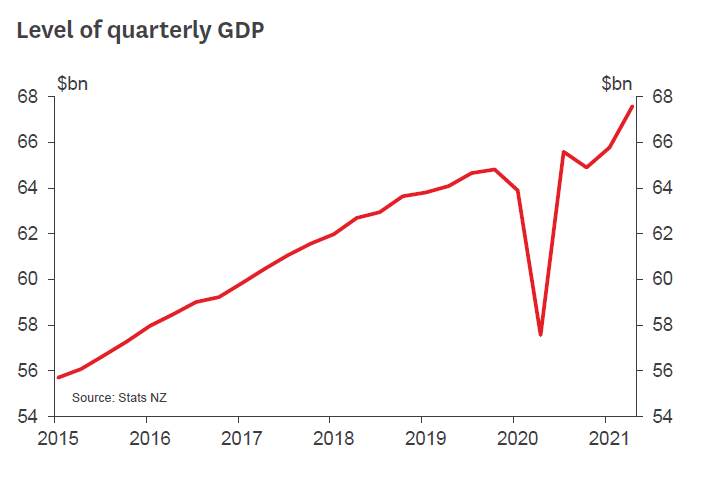
- GDP rose by 2.8% in the June quarter, following a 1.4% rise in March.
- That was above our top-of-the-market forecast and well above the RBNZ’s prediction.
- With the June quarter GDP result pointing to strong momentum in the economy before the current lockdown, a sharp V-shaped recovery now looks even more likely when lockdown conditions are eased.
- We’ve brought forward our expectation of the first OCR hike from November to October
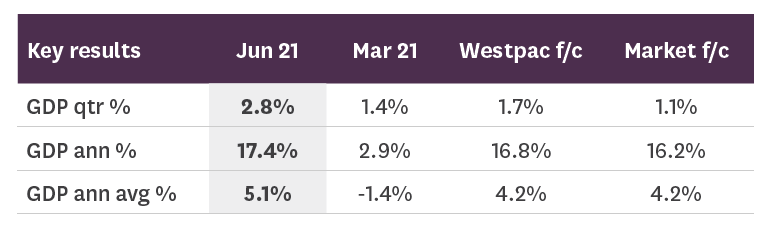
New Zealand's GDP rose by 2.8% in the June quarter. The result was stronger than our forecast of a 1.7% rise, which was already at the top end of market estimates. The Reserve Bank had assumed a 0.7% rise in its August Monetary Policy Statement.
We now expect the Reserve Bank to raise the OCR by 25 basis points at its next review on 6 October. When the current Covid lockdown began we shifted our view to a November rate hike, noting that there were enough uncertainties around how this outbreak would play out that we couldn't be confident about an October move.
As time has passed, the risks of a more prolonged Australianstyle lockdown have reduced, even if not all the way to zero. This, combined with the stronger than expected starting point for GDP and the RBNZ's clear determination to start hiking rates, means that we now see an October move as the most likely. We expect that to be followed by hikes in November, February and May, after which we'll be back on the OCR track that we were previously forecasting.
Details.
The 2.8% rise in the June quarter followed a strong 1.4% rise in the March quarter. In addition, Stats NZ has revised up the level of GDP over the past year, reflecting better data on the impact of Covid and last year's lockdown. Put together, the level of GDP is now 4.3% higher than it was at the end of 2019, before the pandemic.
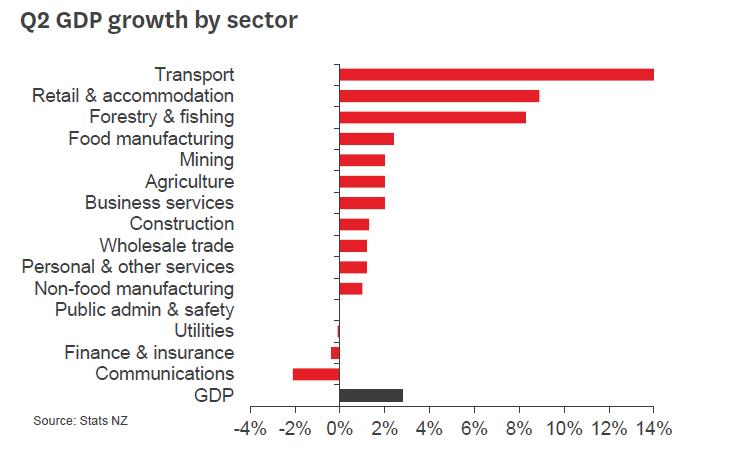
The sources of growth in the June quarter were mostly in line with our forecast. The services sectors, particularly travel-related ones, saw huge increases. Part of this was a continuation of the strong domestic consumption which we saw in the March quarter. The opening of the trans-Tasman travel bubble will have bolstered this further over the June quarter.
Construction related sectors continued to see solid expansion as strong house prices, low interest rates and rising incomes continue to provide support.
What surprised us was the magnitude of the gains rather than the drivers. Some sectors saw even stronger growth than what earlier indicators had suggested. The challenge has been that in some cases Stats NZ has had to move away from the traditional indicators and use new data sources to better capture the disruptive impact of Covid-19. That in turn has introduced an extra degree of uncertainty into the estimates.
Nonetheless, today's results further illustrate that the economy was running hot going into this lockdown. Some of that momentum will be derailed for a while, but a V-shaped rebound looks likely later this year when the current lockdown conditions are eased. And that suggests we'll soon be dealing again with issues of capacity constraints and growing inflation pressures.