

Sample Category Title
Sunset Market Commentary
Markets
Winter’s coming. We don’t want to call the end of the summer this early, but today’s financial media reports leave us no choice. There’s a massive energy crunch going on in Europe and it’s triggering concerns it may not be able to refill gas storage sites ahead of the winter months. At the basis is very strong demand but extremely tight gas supplies. Russia as a key exporter is keeping a lid on European flows for … reasons. It did say that a quick start of the Nord Stream 2 link from Russia to Germany would ease the current crisis *wink*. At the same time, heavily-fought-for US production/export of liquified natural gas (LNG) is severely strained by tropical storm Nicholas. Record gas prices in turn fuels electricity prices. “Surely we have some alternatives or backup capacity?” Well, we could resort to coal production sites, but that’s going to cost. Carbon emission rights have surged in Europe as part of the greenification, making fossil fuels very expensive to use it as an electricity production source. So in the end, upward price pressures would remain. “Thank god we invested in and can rely on this green energy then, right?” About that … wind at the North Sea isn’t particularly blowing lately. And specifically for the UK, it just got even worse after a major power cable bringing electricity from France to the UK was shut down by a fire in a converter station (see below). The energy crisis already prompted several European countries (Spain, Italy, France, Belgium …) to take action by capping prices and/or extending/introducing price discounts. The intention is clear: safeguard consumer’s purchasing power so as to not to thwart the economic recovery. Energy commodities are obviously flying sky-high today, with natural gas leading. Future prices at some point jumped 17% before paring some of the gains to 10%. Oil prices gain 2% with Brent having the $75 target in its crosshairs. This in turn supports the likes of the CAD but especially the NOK. EUR/NOK slips to 10.14, the lowest level since early July. Given the boom on commodity markets, the dollar holds up fairly well. A poor risk appetite (equities ease half a percent in Europe, flat on WS) provides some counterweight. The greenback marginally loses ground vs the likes of the euro (1.1817) or the pound (1.383). It is no match for the JPY though. USD/JPY slips to 109.24. Core bond yields trade volatile. The US curve currently bull flattens with long tenors down 1.6 bps. The German Bund underperforms. Yield changes vary from 1.5 bps (10y) to 2 bps (30y).
News Headlines
UK day-ahead electricity prices jumped today jumped 19% to a near record high as a fire halted a key power link between France and Britain. According to the UK grid operator, the cable might be out for at least a month. The outage also caused a similar 18% jump in UK gas price futures. The incident comes as UK gas and electricity prices were already propelled by different supply bottlenecks, a trend that is also at work in other European countries.
According to a Bloomberg citing sources familiar with the matter, Chinese authorities told lenders of Chinese developer Evergrande Group won’t be able to pay debt obligations due on September 20. As the developer has more than $300bln of liabilities, a default of the group could affect not only banks, but also suppliers, homebuyers and (retail) investors. As such it not only contains risks to financial stability. A disorder default also could cause issues of social unrest which Chinese authorities will probably try to avoid.
Headline inflation in Canada in August rose 0.2% M/M and 4.1% Y/Y (from 3.7%). The rise was faster than expected and marks the highest reading since 2003. In a monthly perspective, the rise was mainly driven by costs related to transportation. Also prices of shelter and consumer durables remain upwardly oriented. At same time indicators of core inflation remained more modest (ex food and energy 3.0% Y/Y, core common 1.8% Y/Y). The Bank of Canada wants to keep inflation in a 1%-3.0% corridor. However, today’s (core) inflation data probably will be seen as supporting the view that at least a big part of the rise in inflation might be temporary. The loonie only gains marginally in the wake of the CPI release with USD/CAD trading 1.2675.
Canadian Inflation Hits a New High of 4.1% in August
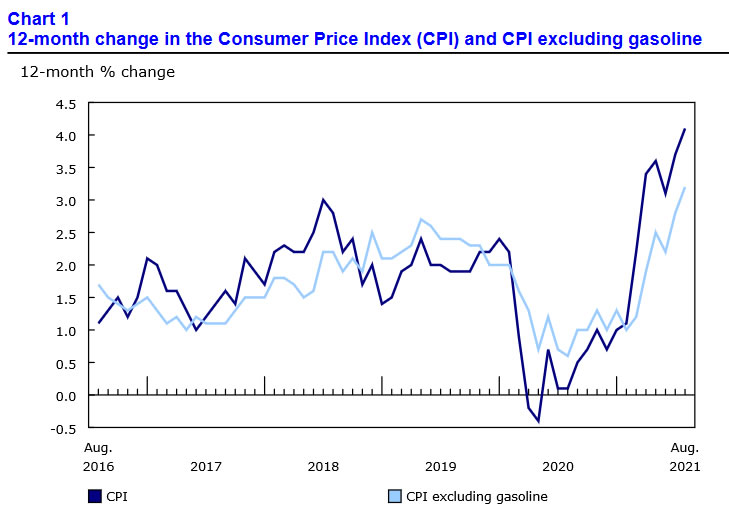
Canadian inflation accelerated to 4.1% year-on-year (y/y) in August from 3.7% in July, above the median analyst estimate for 3.9%. Gasoline prices, up a whopping 32.5% relative to a year ago, added almost a percentage point to the headline number.
Excluding gasoline, prices were up 3.2%, accelerating from 2.8% in July. Durable goods prices were a major contributor to that acceleration, up 5.7% y/y (from 5.0% in July). Services prices also accelerated, rising 2.7% (from 2.6% in July).
Seasonally adjusted, month-on-month price growth edged slightly lower to a still robust 0.4%, down from 0.6% in July. Most major categories saw gains, with only health and personal care (-0.15%) and recreation, reading and education (-0.17%) pulling back.
All three of the Bank of Canada's core inflation metrics moved higher in the month. The CPI-trim rose to 3.3% (from 3.1%) and CPI-Median to 2.6% (from 2.5%), and the CPI-common measure to 1.8% (from 1.7%). Taken together, the three measures averaged 2.6%, the highest level since December 2008.
Key Implications
Canadian inflation isn't quite as high as its American counterpart, but will likely to remain elevated over the remainder of this year. Supply constraints will continue to put upward pressure on usually benign goods prices, while a normalization in categories impacted by the pandemic will also add to the headline.
Downside risks to the economy related to the pandemic may not do as much to slow inflation, as they lead to greater substitution toward goods consumption and prolong supply challenges in tradeable goods around the world.
The recovery has been slowed by third and fourth waves of the virus, but not reversed. As long as growth is only postponed, a forward looking central bank with a firm mandate of price stability will continue to ease off the monetary accelerator. The Bank of Canada will pay attention to inflation pressures and continue to message the gradual withdrawal of monetary support over the next year.
EUR/USD Mid-Day Outlook
Daily Pivots: (S1) 1.1788; (P) 1.1817; (R1) 1.1834; More...
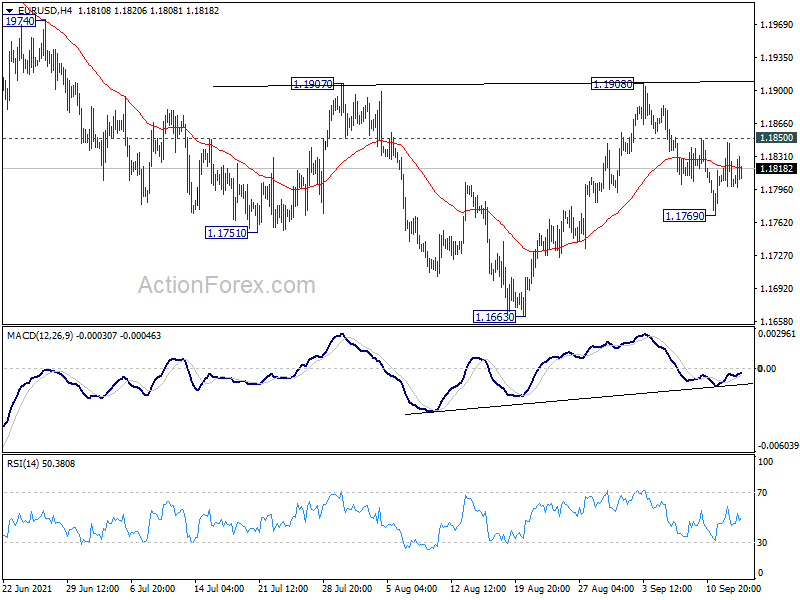
Outlook in EUR/USD is unchanged and intraday bias stays neutral first. On the upside, break of 1.1850 will turn bias back to the upside for 1.1907/1908 key structural resistance zone. Sustained break there will complete a head and shoulder bottom pattern (ls: 1.1751; h: 1.1663; rs: 1.1769). That would also revive the case that consolidation pattern from 1.2348 has completed. Such development will turn near term outlook bullish for retesting 1.2348 high. On the downside, below 1.1769 will resume the fall from 1.1908 to retest 1.1663 low.
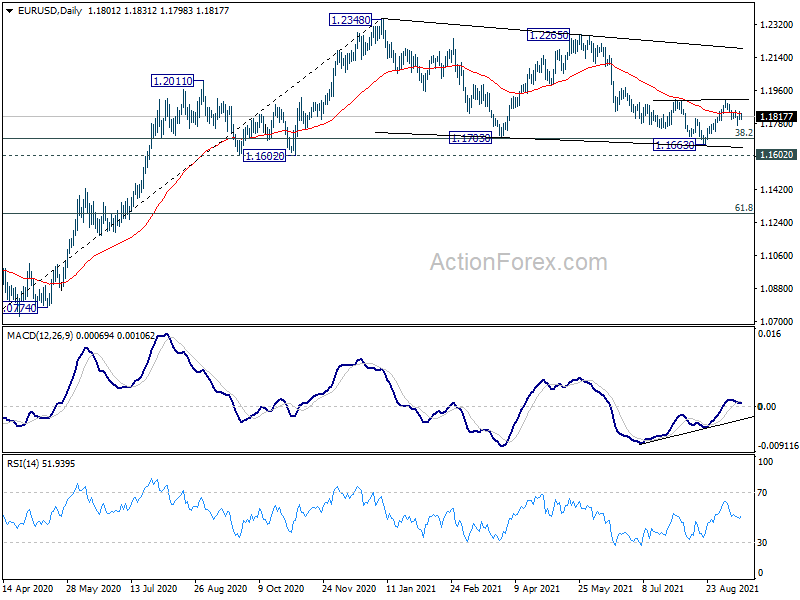
In the bigger picture, rise from 1.0635 is seen as the third leg of the pattern from 1.0339 (2017 low). Further rally remains in favors long as 1.1602 support holds, to cluster resistance at 1.2555 next, (38.2% retracement of 1.6039 to 1.0339 at 1.2516). However sustained break of 1.1602 will argue that the rise from 1.0635 is over, and turn medium term outlook bearish again. Deeper fall would be seen to 61.8% retracement of 1.0635 to 1.2348 at 1.1289 and below.
GBP/USD Mid-Day Outlook
Daily Pivots: (S1) 1.3770; (P) 1.3841; (R1) 1.3879; More...
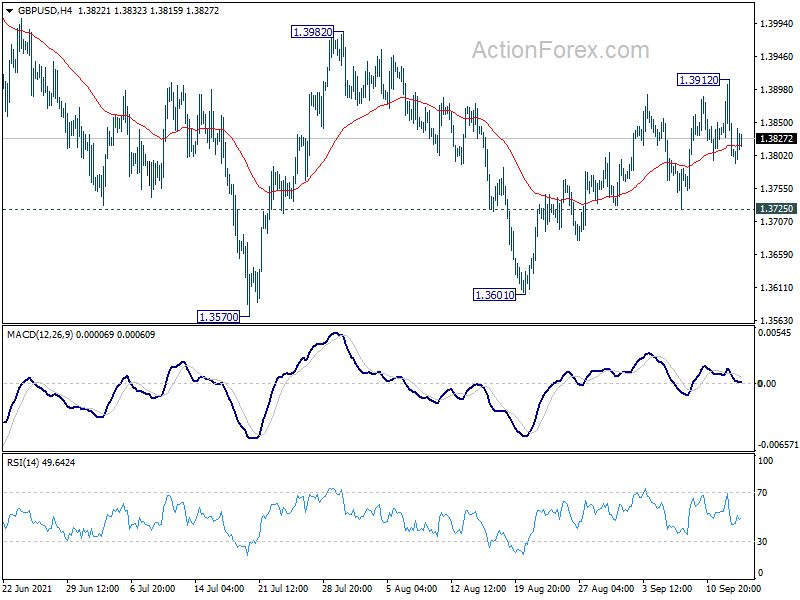
Intraday bias in GBP/USD stays neutral for the moment. On the upside, break of 1.3912 will target 1.3982 resistance next. Decisive break there will indicate that fall from 1.4248 has completed. Stronger rally would then be seen back to 1.4248 high. On the downside, however, break of 1.3725 support will turn bias back to the downside for retesting 1.3570/3601 support zone instead.
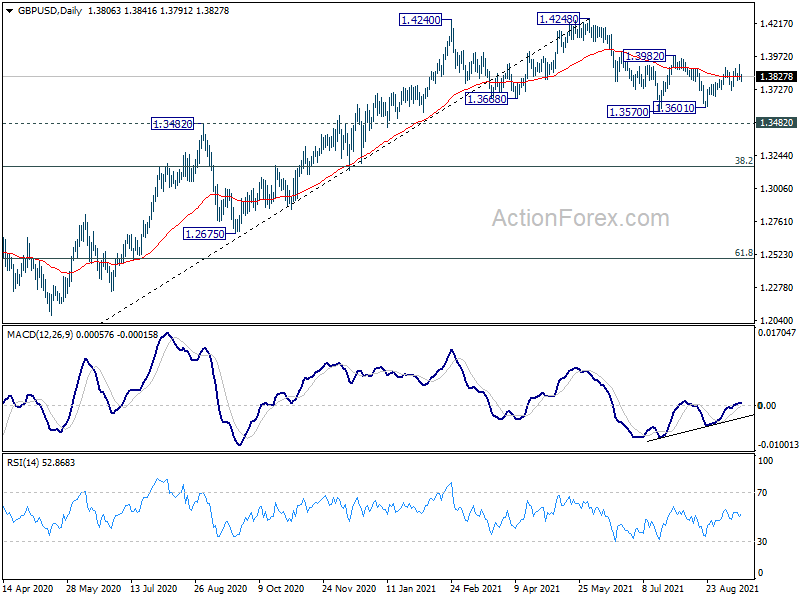
In the bigger picture, as long as 1.3482 resistance turned support holds, we'd still treat price actions from 1.4248 as a corrective move. That is, up trend from 1.1409 (2020 low) is in favor to resume. Decisive break of 1.4376 key resistance (2018 high) would indeed carry long term bullish implications. However, sustained break of 1.3482 will at least bring deeper fall to 38.2% retracement of 1.1409 to 1.4248 at 1.3164, or even further to 61.8% retracement at 1.2493.
USD/CHF Mid-Day Outlook
Daily Pivots: (S1) 0.9179; (P) 0.9203; (R1) 0.9226; More....
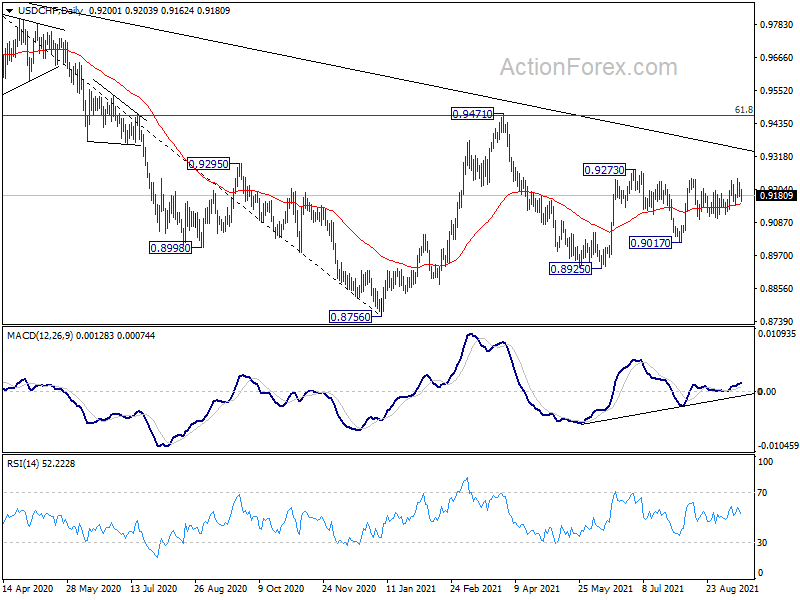
USD/CHF is still staying in familiar range and intraday bias remains neutral for the moment. On the downside, break of 0.9149 will turn focus to 0.9098 support. Break there will target further decline to 0.9017 support. On the upside, break of 0.9239/41 will target 0.9273 resistance instead.
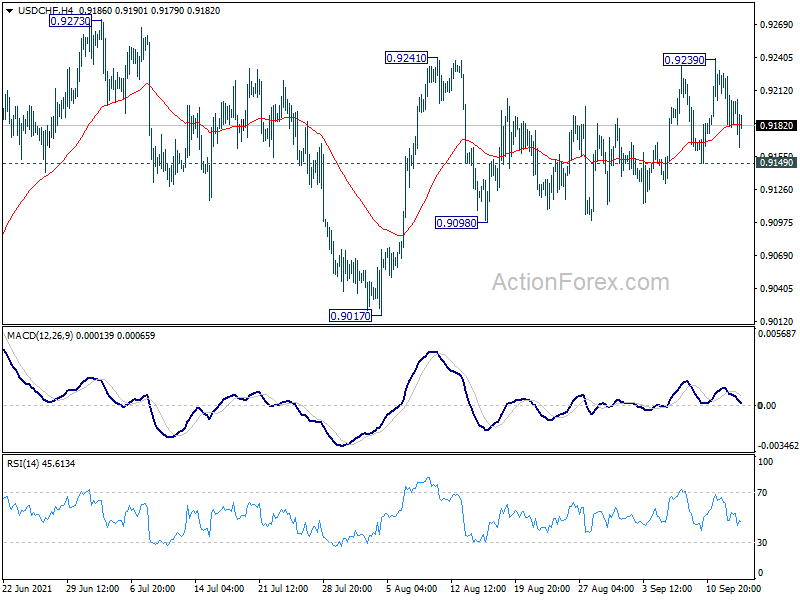
In the bigger picture, USD/CHF is still struggling around 55 week EMA (now at 0.9178) and outlook is mixed for now. Confirmed rejection by the 55 week EMA will retain medium term bearishness. That is, larger fall from 1.0342 would resume through 0.8756 low at a later stage. However, sustained trading above 55 week EMA will tilt favor to the case of bullish reversal. Focus would then be turned to 0.9471 resistance for confirmation.
USD/JPY Presses 109.1 Support as Yen Rally Continues, Strong UK and Canada CPI
Rally in Yen and Swiss Franc dominated trading for most of the day, and it stays firm in early US session. Nevertheless, as sentiment of US traders are not too pessimistic, buying in both slows a little bit. On the other hand, Australia, New Zealand and US Dollars are taking turns to be the worst perform. Sterling is somewhat support by strong consumer inflation reading. But Canada CPI is doing little to help the Loonie.
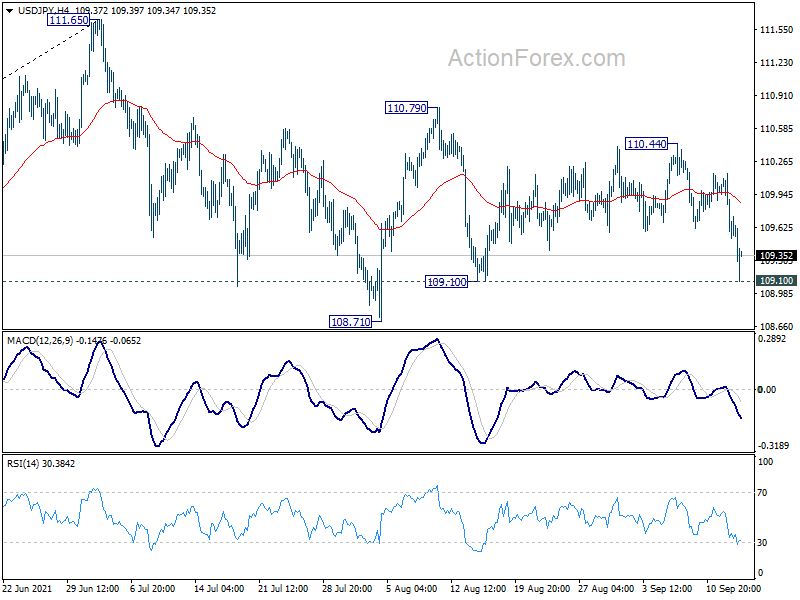
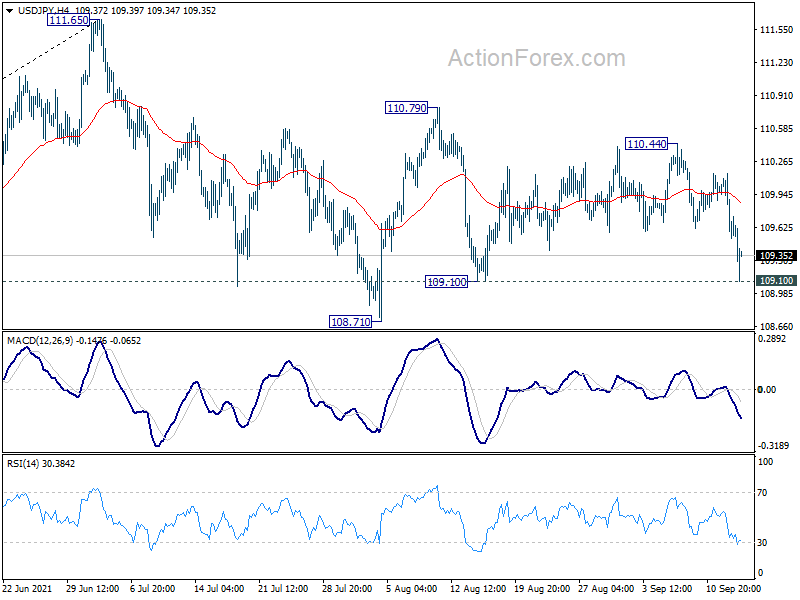
Technically, USD/JPY is now defending 109.10 support. Break there will likely resume whole pattern from 111.65 through 108.71 low. If that happens, we'll see if it's accompanied by a break of 1.1850 minor resistance in EUR/USD to signal Dollar weakness. Or it accompanied by steeper fall in EUR/JPY towards 127.91 to indicate upside acceleration in Yen.
In Europe, at the time of writing, FTSE is flat. DAX is down -0.10%. CAC is down -0.64%. German 10-year yield is up 0.012 at -0.326. Earlier in Asia, Nikkei dropped -0.52%. Hong Kong HSI dropped -1.84%. China Shanghai SSE dropped -0.17%. Singapore Strait Times dropped -0.71%. Japan 10-year JGB yield closed flat at 0.036.
Canada CPI jumped to 4.1% yoy in Aug, highest since 2003
Canada CPI accelerated further from 3.7% yoy to 4.1% yoy in August, above expectation of 3.9% yoy. That's also the fastest pace since March 2003. Statistics Canada said the increase mainly stems from an accumulation of recent price pressures and from lower price levels in 2020.
Looking at some more details, CPI common rose from 1.7% yoy to 1.8% yoy, above expectation of 1.7% yoy. CPI median was unchanged at 2.6% yoy, matched expectations. CPI trimmed rose from 3.1% yoy to 3.3% yoy, above expectation of 3.1% yoy.
Eurozone industrial production rose 1.5% mom in Jul, EU up 1.4% mom
Eurozone industrial production rose 1.5% mom in July, above expectation of 0.5% mom. For the month, production of non-durable consumer goods rose by 3.5%, capital goods by 2.7%, durable consumer goods by 0.6% and intermediate goods by 0.4%, while production of energy fell by 0.6%.
EU industrial production rose 1.4% mom. Among Member States for which data are available, the highest monthly increases were registered in Ireland (+7.8%), Belgium (+5.0%) and Portugal (+3.5%). The largest decreases were observed in Lithuania (-2.0%), Slovenia (-1.8%) and Croatia (-1.6%).
Ifo: Germany inflation to hit 3% this year, fall back to 2-2.5% next
Ifo said inflation in Germany could hit as high as 3% this year. That could be explained by "accelerated increase in prices over the course of 2021" in apparent in energy, food, and some service industries.
Inflation is expected to slow to 2.0-2.5% next year. But Head of Forecasts Timo Wollmershäuser said: "At the beginning of 2022, the special factors that have been driving inflation will peter out: it will be a year since the reduction in VAT was reversed and energy prices reached their pre-crisis levels,"
Separately, ECB Governing Council member Pablo Hernandez de Cos said, "ECB is monitoring the inflation performance closely but we are not seeing any second-round impacts."
UK CPI surged from 2% to 3.2% yoy in Aug, largest monthly leap on record
UK CPI surged to 3.2% yoy in August, up from 2.0% yoy, above expectation of 2.9% yoy. That sharp 1.2% jump in CPI was the highest leap recorded, but ONS said "this is likely to be a temporary change. CPI core rose to 3.1% yoy, up from 1.8% yoy, above expectation of 2.9% yoy. RPI also rose to 4.8% yoy, up from 3.8% yoy, above expectation of 4.6% yoy.
Also released, PPI input came in at 0.4% mom, 11.0% yoy, versus expectation of 0.2% mom, 10.3% yoy. PPI output was at 0.7% mom, 5.9% yoy, versus expectation of 0.4% mom, 5.4% yoy. PPI core output was at 1.0% mom, 5.4% yoy.
China retail sales grew only 2.8% yoy in Aug, way below expectation
China retail sales growth slowed sharply to 2.8% yoy in August , down from July's 8.5% yoy, well below expectation of 7.1% yoy. China industrial production growth slowed further to 5.3% yoy, below expectation of 5.8% yoy. Fixed asset investment rose 8.9% ytd yoy, below expectation of 9.1%.
In a released, the National Bureau of Statistics said, "generally speaking, in August, the national economy maintained the trend of recovery. However, we must be aware that the international environment is still complicated and severe. At home, it has been felt that the sporadic outbreak of COVID-19 and natural disasters such as floods had caused impact on the economy, and the foundation for the economic recovery still needs to be consolidated".
Australia Westpac consumer sentiment rose to 106.2, strong resilient despite lockdown
Australia Westpac-MI consumer sentiment rose 2.0% to 106.2 in September. The index remained comfortably above the levels five years prior to the pandemic. Confidence in New South Wales rose 5.3% while Victoria was steady at 104.1, despite extended lockdown in both states. Queensland jumped 8.4% to 111.6. Overall, the data indicates strong resilience of consumer sentiment and positives reactions to vaccination progresses.
Westpac added that given that RBA has already defer the next review of the asset purchase program to February, it's highly unlikely that there will be any policy changes before that meeting. Nevertheless, it added, "with the US Federal Reserve likely to have begun its tapering program by then and the economy likely to be bouncing back as high vaccination levels see easing restrictions, we expect the Board to further taper its bond purchases in February."
OECD downgrades Australia growth forecast, urge broad RBA review
In the latest Economy Survey of Australia, OECD downgraded the country's GDP growth to 4.0% in 2021 and 3.3% in 2022, from May's forecast of 5.1% and 3.4% respectively. It said the upcoming post-restriction recovery may be "more gradual than in past episodes", as it will "occur in an environment of higher virus transmission". COVID-19 outbreaks in other states than New South Wales and Victoria, could deepen the economic shock. "Any ratcheting up of tensions with China could further weaken trade activity."
OECD also pointed out that underlying inflation has undershot RBA's target band for an extended period of time. It suggested that RBA should "conduct a monetary policy framework review that is broad in scope, transparent and involves consultation with a wide variety of relevant stakeholders."
In response, Treasurer Josh Frydenberg said, "it's something I will give consideration to in terms of looking at the RBA, looking at the monetary policy settings and learning from the experience through the pandemic. The RBA has performed very well through this crisis, its policy response has been in sync and coordinated with the government's fiscal response."
USD/JPY Mid-Day Outlook
Daily Pivots: (S1) 109.42; (P) 109.79; (R1) 110.05; More...
USD/JPY's decline accelerates today and immediate focus is now on 109.10 support. Firm break there will argue that larger fall from 111.65 is resuming. Intraday bias will be turned back to the downside for 108.71 support first, and then 38.2% retracement of 102.58 to 111.65 at 108.18 next. On the upside, break of 110.44 resistance will turn bias back to the upside for 110.79 first.
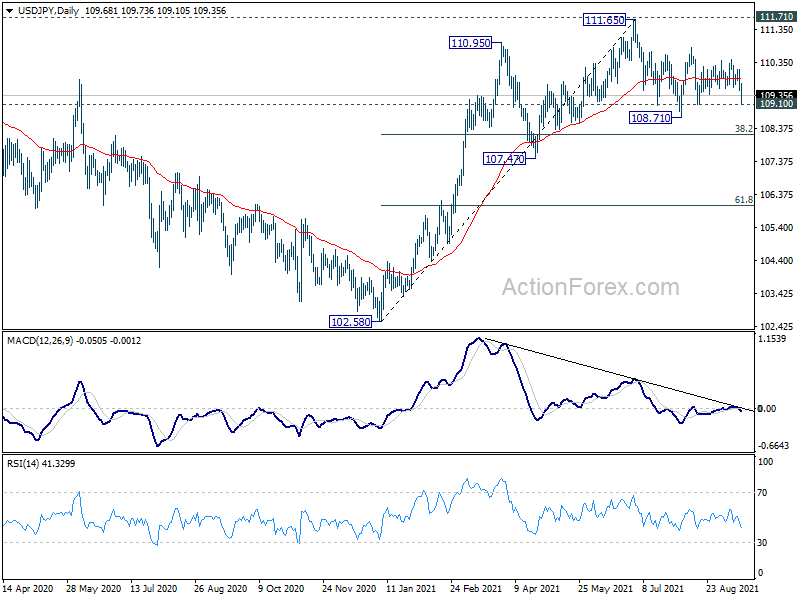
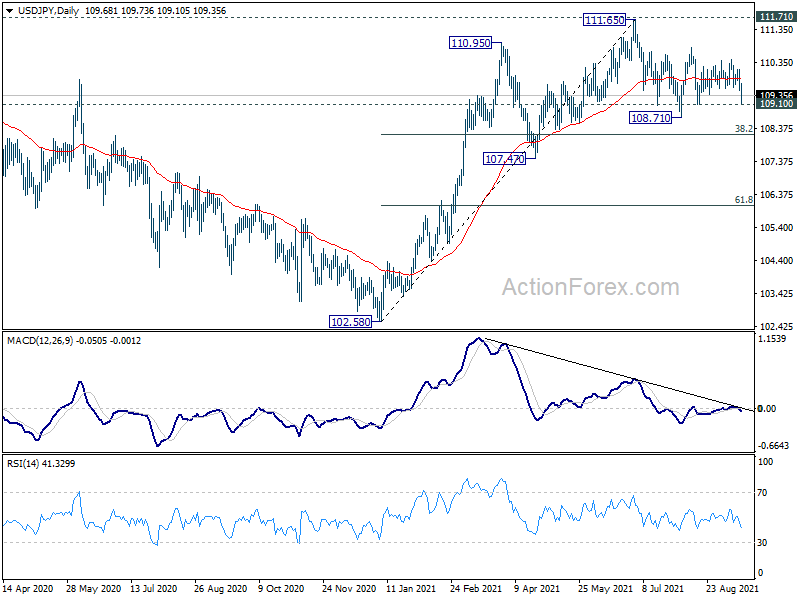
In the bigger picture, medium term outlook is staying neutral with 111.71 resistance intact. The pattern from 101.18 could still extend with another falling leg. Sustained trading below 55 day EMA will bring deeper fall to 107.47 support and below. Nevertheless, strong break of 111.71 resistance will confirm completion of the corrective decline from 118.65 (2016 high). Further rise should then be seen to 114.54 and then 118.65 resistance.
Economic Indicators Update
| GMT | Ccy | Events | Actual | Forecast | Previous | Revised |
|---|---|---|---|---|---|---|
| 22:45 | NZD | Current Account (NZD) Q2 | -1.40B | -2.15B | -2.90B | -3.19B |
| 23:50 | JPY | Machinery Orders M/M Jul | 0.90% | 3.10% | -1.50% | |
| 00:30 | AUD | Westpac Consumer Confidence Sep | 2.00% | -4.40% | ||
| 02:00 | CNY | Retail Sales Y/Y Aug | 2.50% | 7.10% | 8.50% | |
| 02:00 | CNY | Fixed Asset Investment YTD Y/Y Aug | 8.90% | 9.10% | 10.30% | |
| 02:00 | CNY | Industrial Production Y/Y Aug | 5.30% | 5.80% | 6.40% | |
| 06:00 | GBP | CPI M/M Aug | 0.70% | 0.50% | 0.00% | |
| 06:00 | GBP | CPI Y/Y Aug | 3.20% | 2.90% | 2.00% | |
| 06:00 | GBP | Core CPI Y/Y Aug | 3.10% | 2.90% | 1.80% | |
| 06:00 | GBP | RPI M/M Aug | 0.60% | 0.30% | 0.50% | |
| 06:00 | GBP | RPI Y/Y Aug | 4.80% | 4.60% | 3.80% | |
| 06:00 | GBP | PPI Input M/M Aug | 0.40% | 0.20% | 0.80% | 1.30% |
| 06:00 | GBP | PPI Input Y/Y Aug | 11.00% | 10.30% | 9.90% | |
| 06:00 | GBP | PPI Output M/M Aug | 0.70% | 0.40% | 0.60% | 0.80% |
| 06:00 | GBP | PPI Output Y/Y Aug | 5.90% | 5.40% | 4.90% | |
| 06:00 | GBP | PPI Core Output M/M Aug | 1.00% | 0.70% | ||
| 06:00 | GBP | PPI Core Output Y/Y Aug | 5.30% | 3.90% | ||
| 08:30 | GBP | DCLG House Price Index Y/Y Jul | 8.00% | 12.40% | 13.20% | |
| 09:00 | EUR | Eurozone Industrial Production M/M Jul | 1.50% | 0.50% | -0.30% | |
| 12:30 | CAD | CPI M/M Aug | 0.20% | 0.10% | 0.60% | |
| 12:30 | CAD | CPI Y/Y Aug | 4.10% | 3.90% | 3.70% | |
| 12:30 | CAD | CPI Common Y/Y Aug | 1.80% | 1.70% | 1.70% | |
| 12:30 | CAD | CPI Median Y/Y Aug | 2.60% | 2.60% | 2.60% | |
| 12:30 | CAD | CPI Trimmed Y/Y Aug | 3.30% | 3.10% | 3.10% | |
| 12:30 | USD | Empire State Manufacturing Index Sep | 34.3 | 17.1 | 18.3 | |
| 12:30 | USD | Import Price Index M/M Aug | -0.30% | 0.30% | 0.30% | |
| 13:15 | USD | Industrial Production M/M Aug | 0.4% | 0.40% | 0.90% | |
| 13:15 | USD | Capacity Utilization Aug | 76.4% | 76.30% | 76.10% | |
| 14:30 | USD | Crude Oil Inventories | -3.6M | -1.5M |
USD/JPY Mid-Day Outlook
Daily Pivots: (S1) 109.42; (P) 109.79; (R1) 110.05; More...
USD/JPY's decline accelerates today and immediate focus is now on 109.10 support. Firm break there will argue that larger fall from 111.65 is resuming. Intraday bias will be turned back to the downside for 108.71 support first, and then 38.2% retracement of 102.58 to 111.65 at 108.18 next. On the upside, break of 110.44 resistance will turn bias back to the upside for 110.79 first.
In the bigger picture, medium term outlook is staying neutral with 111.71 resistance intact. The pattern from 101.18 could still extend with another falling leg. Sustained trading below 55 day EMA will bring deeper fall to 107.47 support and below. Nevertheless, strong break of 111.71 resistance will confirm completion of the corrective decline from 118.65 (2016 high). Further rise should then be seen to 114.54 and then 118.65 resistance.
Canada CPI jumped to 4.1% yoy in Aug, highest since 2003
Canada CPI accelerated further from 3.7% yoy to 4.1% yoy in August, above expectation of 3.9% yoy. That's also the fastest pace since March 2003. Statistics Canada said the increase mainly stems from an accumulation of recent price pressures and from lower price levels in 2020.
Looking at some more details, CPI common rose from 1.7% yoy to 1.8% yoy, above expectation of 1.7% yoy. CPI median was unchanged at 2.6% yoy, matched expectations. CPI trimmed rose from 3.1% yoy to 3.3% yoy, above expectation of 3.1% yoy.
GBP/USD Pair Started A Fresh Decline From The 1.3912 High
The British Pound spiked above the 1.3900 zone against the US Dollar. However, the GBP/USD pair struggled to extend gains and started a fresh decline from the 1.3912 high.
It traded below the 1.3900 and 1.3880 support levels. There was also a break below a key bullish trend line with support near 1.3855 on the hourly chart. Finally, there was a close below the 1.3820 level and the 50 hourly simple moving average.
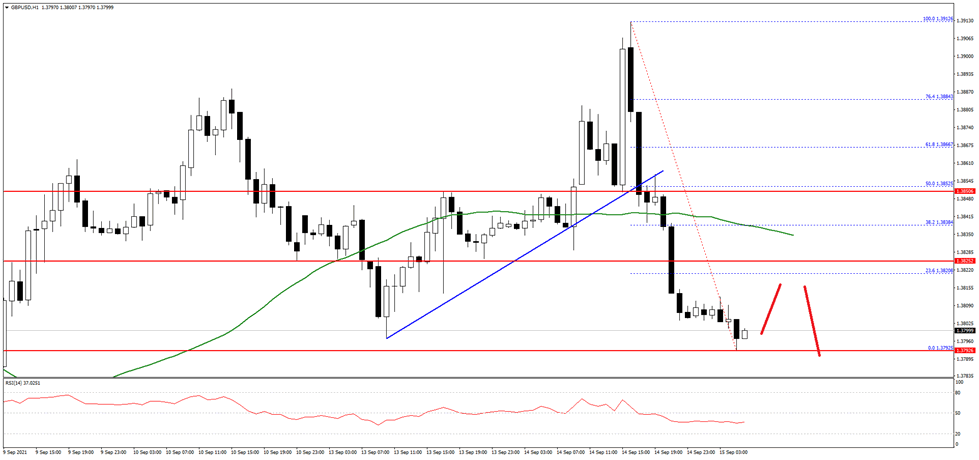
It is now consolidating near 1.3800 and it is facing resistance near 1.3820. The next key resistance is near the 1.3840 level and the 50 hourly simple moving average. If there is a clear break above the 1.3840 and 1.3850 resistance levels, the pair could revisit 1.3900 on FXOpen.
On the downside, an initial support is near the 1.3800 level. A break below the 1.3800 and 1.3785 support levels could lead the pair towards 1.3700.
Pound Steady As UK Inflation Jumps
The British pound has reversed directions and is in positive territory on Wednesday. GBP/USD is currently trading at 1.3823, up 0.15% on the day.
The reopening of the UK economy in July has fuelled a rise in inflation, and August CPI surged 3.2% (YoY), up sharply from 2.0% in July. The BoE has taken a page from the Federal Reserve’s playbook, insisting that higher inflation is temporary. I don’t expect the Bank to change its tune, despite the August numbers. Still,
There was positive news on the UK employment front earlier in the day. The number of payroll employees moved up for a ninth straight month, unemployment rolls continue to fall sharply, and the unemployment rate fell to 4.6%, down from 4.9% beforehand. This is certainly encouraging news, but not to such an extent that Bank of England policymakers will feel much pressure to raise interest rates. If, however, economic activity continues to improve and the Delta variant of Covid is brought under control, the BoE may have to reconsider its wait-and-see policy.
US inflation de-accelerates
Inflation remains high on the radar of the markets, and today’s consumer inflation numbers were highly anticipated. The recent spike in inflation levels, which has been fueled by the reopening of economies and the easing of Covid restrictions, has become an important factor in the Fed’s decision-making process. The Fed has insisted that the spike in inflation is temporary, but the markets have become more sceptical as inflation levels continue to climb.
The August CPI numbers pointed to a slight easing in inflation, and may signal that inflation is finally under control. If inflation continues to ease, the Fed can afford to delay its tapering plans and this could put downward pressure on the US dollar.
GBP/USD Technical Analysis
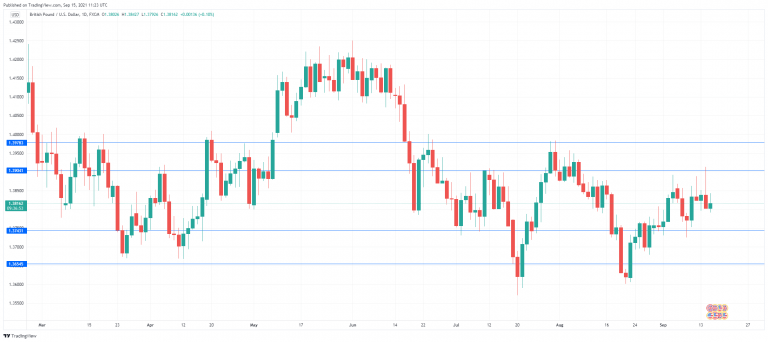
- There is resistance at 1.3904. Above, there is resistance at 1.3978
- On the downside, we have support at 1.3742 and 1.3654