

Sample Category Title
UK’s Better-Than-Expected CPI Lifts Sterling
- UK inflation print highest in nine years.
- Lackluster Chinese data adds to market concerns.
- US inflation outlook little changed despite moderating August data.
The UK's August CPI rose 3.2% year-on-year to print at its highest level since March 2012. The better-than-expected numbers offered a gentle lift to the pound which is gaining against most of its G10 peers at the time of writing.
The latest UK inflation figures underscore the buildup in inflationary pressures that are evident across developed economies, while ramping up expectations that central banks may have to ease their foot off the stimulus pedal sooner rather than later. With markets now pricing in an 82% chance of a BOE rate hike in May 2022, that should help create a supportive environment for sterling. The Old Lady is further down the line compared to other major central banks in its quest to normalise policy settings and all eyes now turn to the MPC meeting next week.
China's cooling recovery could dampen sentiment
Asian stocks are a mixed bag on Wednesday, with disappointing economic data out of China souring risk sentiment in the region. China's moderating recovery is adding to the angst surrounding regional assets, while exposing yet again the risks that the Delta variant poses to the global economy. Considering the world's exposure to the Chinese economy, the slowing momentum in growth might add another headwind to risk appetite.
Still, US equity futures are edging higher, as stock bulls dust themselves off after the S&P 500 fell in six out of the past seven sessions. Meanwhile, the dollar index has erased all its losses incurred during the knee-jerk response to the lower-than-expected August US inflation readings. However, gold prices have managed to hang on to most of their gains since, still clinging to the $1800 handle for the time being.
Dollar outlook supported by expectations for Fed tapering
The latest US CPI data doesn't significantly alter the inflation outlook, though it is showing signs that inflationary pressures are waning, potentially affirming Fed Chair Jerome Powell's ‘transitory' views after all. Yet market participants are holding on to expectations that the Fed's tapering will commence before 2021 is over, while the Fed funds futures still point to a greater-than 70% chance of a US rate hike in December 2022. Such a hawkish narrative should buffer the greenback's resilience, which was brought to the fore once more following the latest US inflation release.
The US Dollar Holds Firm
US dollar recovers losses from soft CPI
Although the US dollar dipped on the US inflation miss, the greenback quickly recovered its losses with the dollar index closing almost unchanged at 91.63, where it remains in Asia. The US dollar’s strength even as bond yields eased is strongly suggesting that risk-aversion flows are in play as sentiment globally sours. That should also benefit the Swiss franc and Japanese yen over the rest of the week.
Elsewhere, EUR/USD’s rally quickly petered out leaving it unchanged at 1.1800 in Asia. The 1.1750 and 1.1850 levels remain the ones to watch for the euro’s next directional move. GBP/USD has risen just 10 pips to 1.3815 on the just-released UK inflation, core inflation and PPI data. The MoM and YoY metrics have all come in much higher with inflation alive and well in Her Majesty’s kingdom. The statistics office, like the BoE, has urged caution about the numbers, saying inflation is temporary. Looking at natural gas prices, I am not so sure. The definition of temporary is increasing differently to different people.
GBP/USD failed ahead of its 100-day moving average (DMA) at 1.3915 overnight, before plummeting to 1.3805 close overnight. Sterling is looking more vulnerable than the euro at the moment, and support at 1.3790 really needs to hold to avoid a retest of 1.3700. Given the reaction to the UK inflation data, that may be false hope for bullish sterling traders.
Perhaps the biggest signal that risk sentiment remains fragile this week is the performance of both the Australian and New Zealand dollars overnight. Both Antipodeans finished lower overnight and did not rally temporarily in the posy-US-inflation dollar sell-off. AUD/USD and NZD/USD have retreated once again in Asia, falling 0.10% to 0.7320 and 0.7095 with the Kiwi looking especially vulnerable if 0.7075 breaks. Until positive momentum returns to AUD and NZD, it will be hard to call a top in the greenback’s rally overall.
Asian currencies have barely reacted to the China data today, being mostly unchanged, having retreated only slightly on US dollar strength overnight. The best I can surmise is that AsiaFX is determined to remain in a holding pattern until next week’s FOMC meeting. The low inflation print from the US overnight should have been bullish for Asian currencies, pushing back as it did, the timeline for the Fed taper. Instead, Asian currencies faded slightly implying that lower AsiaFX is the path of least resistance in the days ahead.
Oil Remains Steady, Gold Under Pressure
Oil remains near its recent highs
Oil prices remained firm overnight, despite the lower than forecast US CPI data. Both Brent crude and WTI recorded small increases leaving them at the top of their September ranges. The energy component of the US CPI basket rose overnight, despite other components dragging the overall number down, with no real sign in physical markets of lower demand leading to softer prices. Additionally, Tropical Storm Nicholas has disrupted oil production and refining recovery in the Gulf of Mexico, coming after the devastation of Hurricane Ida. In the bigger picture, natural gas prices are rocketing in the northern hemisphere ahead of winter, especially in Europe and Asia. I believe that will provide some indirect support to oil prices going forward, given the ominous look to the natural gas rally. It could well be a winter of discontent.
Brent crude rose by 0.40% to USD 73.90 overnight, adding 0.30% to USD 74.15 a barrel in Asia. Having cleared resistance at USD 74.00 a barrel, and with Europe arriving, Brent crude is poised to rally to USD 75.00 and possibly USD 76.00 a barrel in the days ahead. Only a fall through USD 72.75 a barrel invalidates the bullish outlook.
WTI rose by 0.20% to USD 70.75 overnight, before climbing by 0.30% in Asia to USD 71.00 a barrel. WTI should now target USD 72.00 and potentially USD 74.00 a barrel in the days ahead. Only a failure of USD 70.00 a barrel will invalidate the bullish outlook.
Gold, the reverse-inflation hedge
It is ironic that as US inflation underperformed overnight, that gold traced out a 0.60% gain to USD 1804.50 an ounce. Apart from partially confirming that gold only really hedges Latin American style-inflation, much of gold’s rally was due to the intraday spike lower by the US dollar. That said, it held onto all those gains even as the US dollar clawed back all of its losses, hinting that some new buyers had been entered the market.
Gold has faded in the Asia session though, falling to USD 1801.00 as Europe starts its day. With the US Dollar expected to remain firm as risk-sentiment sours, gold may have had its one day in the sun, much like Chinese equities these days. The underwhelming performance of gold of late has not changed.
Gold rose to initial resistance at its 200-DMA at $1809.00 overnight but retreated from there. The 200-DMA resistance remains intact therefore and is followed closely by the 100-DMA at USD 1816.50 an ounce and the formidable series of multi-day tops around USD 1834.00 an ounce. Support remains clearly marked at USD 1780.00 and failure will signal deeper losses to USD 1750.00 an ounce.
Equities Fall Despite Low US CPI
Asian equities lower on Wall Street and China
Asia was always set for a tough day at the office after the lower inflation data darkened the recovery mood in the US and sent Wall Street into a negative close. The poor China data set today has confirmed the risk aversion mood and Asian markets are mostly lower today. Thinking about the low US inflation data overnight, ostensibly receding tapering fears as an aftermath should have been positive for equities at the margins. Instead, Wall Street fell, and the US dollar remained firm. That is probably a warning side that the downside is the path of least resistance for the remainder of the week. One wonders if the talk about impending hikes in US corporate tax rates is also permeating US equities.
The S&P 500 fell by 0.57% overnight, while the curse of the Apple product release struck again, with the Nasdaq closing 0.45% lower. The cyclical-orientated Dow Jones suffered the most, slumping 0.82% and is in serious danger of breaching an upward support line going back to the lows of March 2020 and falling through its 100-day moving average. Futures in Asia have risen on all three by around 0.20% though, as short-covering meets low liquidity in Asia.
The rise in US futures appears to have limited the fallout in Asia of the China data, as has the relatively benign negative reaction by mainland exchanges post-the China data. China’s data dump may have also raised expectations of more fiscal stimulus. The Nikkei 225 is 0.50% lower with the Kospi actually climbing into positive territory, now 0.16% in the green.
In China, the Shanghai Composite has fallen by just 0.22%, although the narrower blue-chip Shanghai 50 is down by 0.90%. The CSI 300 has fallen by 0.35%. China’s latest target, Macau’s casinos, saw the Hang Seng slump initially, the Hang Seng tumbling by 1.50% in a perfect storm of gaming chips and China data today.
Singapore is 0.65% lower with Kuala Lumpur falling by 0.25% and Taipei by 0.35%. Bangkok is flat while Jakarta is bucking the trend after Indonesia’s trade data today showed massive recoveries in exports and imports and a larger trade surplus. That has sent the Jakarta Composite higher by 1.50%. Australian markets are tracking Wall Street and Asia, the ASX 200 falling by 0.35%, while the All Ordinaries is 0.25% lower.
Europe will struggle to shake of the US and China data reactions today and I expect markets there to open slightly lower. Wall Street is likely to get another dosh of growth wobbles tonight after China’s Retail Sales missed so badly today.
China Data Spooks Asia
China numbers send equities lower
China's data dump today contained some unpleasant surprises as each release missed expectations, darkening the mood across Asia, already nervous after a soft close on Wall Street following soft inflation results. China's Fixed Asset Investment fell to 8.90% in August, just below 9.0% expectations but a retreat from last month's 10.0%. Industrial Production for August fell to 5.30% versus 5.80% expected but the worst surprise was Retail Sales. These slumped to just 2.0%, a huge miss on pre-release 7.0 % expectations.
Government officials tried to put a brave face on the data, blaming flooding and lockdowns in August. Admittedly, the Industrial Production data was likely affected by rising input costs, semi-conductor shortages and logistical disruptions, the same issues afflicting the rest of the world. With regards to the Retail Sales data though, one can't divorce the slump in consumer confidence from the ongoing shared prosperity multi-sector government crackdowns, where job losses are an inevitability.
China is unlikely to hit the red button and open the fiscal spigots immediately. Another month of weak data next month may change that narrative though. And we can pencil in a RRR cut by the PBOC sooner rather than later. The expectations of government largesse may be limiting the fallout in China equities today. But with the sectorial clampdowns, the Evergrande sage and withering domestic consumer confidence, the downward repricing of China equities could be far from over, that's certainly what I believe.
Overnight, US inflation data came in below expectations with headline Inflation for August MoM rising by 0.30%, and Core Inflation August MoM printing at 4.0%. That has further reduced Fed tapering nerves for next week's FOMC meeting. However, a look below the bonnet of the data shows that although used car prices and airfares retreated, food, energy and rental prices increased. Notably, housing-related items are 30% of the CPI basket and rents typically lag rises in house prices. Readers can do the maths on that one. A look at natural gas prices globally, and we haven't even got to the Northern Hemisphere winter yet, also makes unnerving reading. US gas price increases are the best of a bad bunch, but you wouldn't bet against energy become a major concern for inflation readings ahead. Stagflation anyone? Sticky inflation may have taken a few punches from transitory inflation overnight, but it is definitely not out for the count.
Apart from US Retail Sales on Thursday evening, the rest of the world's data calendar is second-tier for the remainder of the week. Next week is a central bank policy decision frenzy, with the FOMC as the main event, with more potential for thematic moves. That will leave markets this week trading on sentiment and headlines. At this stage that sentiment is somewhat glum, dominated by growth and recovery concerns. Equities are likely to struggle for the remainder of the week on that basis, and haven-orientated trades such as a higher US dollar enjoying a few days in the sun.
Dollar Unscathed By Soft Inflation, Equities Resume Slide
- Dollar takes little damage despite signs US inflation has peaked
- Wall Street resumes selloff - all eyes on China contagion risks
- Canadian data coming up ahead of elections, gold wakes up
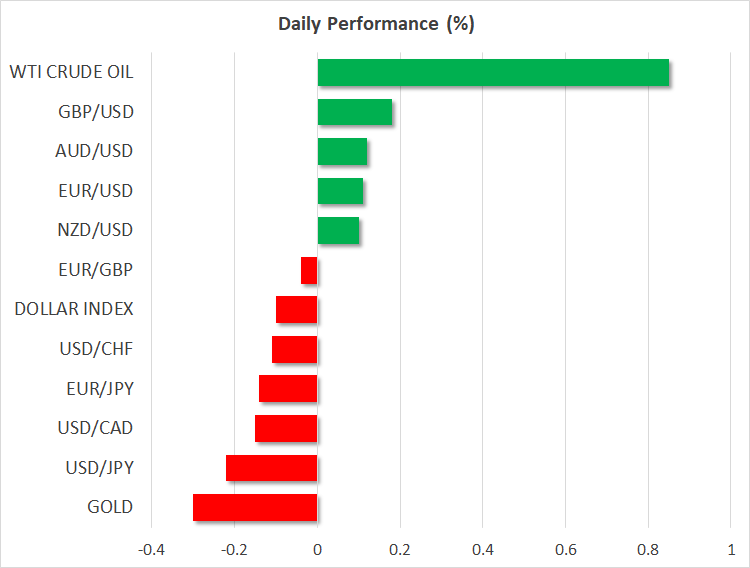
Dollar defies gravity
The US dollar has displayed an uncanny ability to absorb bad news without even a scratch lately, a power that was on full display yesterday after the latest US inflation stats disappointed. The annual core CPI rate fell by more than expected to reach 4%, adding credence to the narrative that inflation has already reached its apex this cycle and eliminating any surviving expectations for a Fed taper move next week.
That initially took a bite out of the greenback, which fell across the board as Treasury yields tanked. However, the reserve currency bounced back before long as stock markets rolled over and traders started playing defense.
Digging under the surface, the inflation report wasn’t quite as dovish as the bond market reaction would suggest. Most of the cooling in prices came down to all the items the Fed says it doesn’t care much about - used cars, hotels, and airfares - while other categories like apparel and sporting goods are starting to heat up.
As for the dollar, the big picture remains bright. Inflation might still be a major theme next year, the labor market has almost recovered, consumption is off the charts, the housing market is booming, and Congress is trying to unleash more spending to juice up the recovery. On top of everything, the greenback also provides a free hedge against any trouble in equity markets.
Wall Street under pressure
Speaking of trouble in stock market paradise, Wall Street resumed its selloff yesterday despite the disappointing inflation figures that essentially extinguished pressure on the Fed to get the normalization process rolling immediately.
The S&P 500 fell another 0.6%, but the index is still only 2% away from its record highs, so it’s difficult to call this a real correction. What’s striking is that the S&P 500 bounced off its 50-day moving average yet again, a technical barrier that has acted like a trampoline for the index throughout this incredible rally.
The catalyst behind this ‘baby selloff’ isn’t entirely clear. It could reflect concerns around higher taxes and less central bank liquidity being on the horizon, or the risk of economic fallout from China as the economy slows while local authorities are busy grinding their regulatory axe. If anything, it’s surprising that global markets have been so resilient until now.
China’s second-largest property developer is on the verge of collapse and the latest data suggests economic momentum is evaporating quickly, with retail sales and industrial production slowing sharply in August. That’s a risky cocktail for a country that already has a spectacularly overleveraged private sector and therefore can’t go all-out with stimulus.
Gold comes alive, loonie in focus
The main beneficiary of the cooldown in inflation has been gold, which took advantage of the slide in Treasury yields yesterday to power higher. While the Fed pushing back its normalization process is good news for bullion, it’s not a game changer either - the endgame is still higher real rates that take the shine off bullion.
Finally, Canada’s inflation stats will be released today, although the main variable for the loonie might be how the upcoming election plays out. Prime Minister Trudeau was looking to capitalize on the nation’s vaccination success when he called a snap election, but that move has backfired as he is now neck-and-neck with his conservative opponent in opinion polls.
China’s Retail Sales Growth Declined Sharply, Slowdown in 2H21 Likely Worse than Previously Anticipated
The latest set of economic data reveals that China’s slowdown worsened. The most disappointing reading comes from retail sales growth which moderated to +2.5% y/y in August, compared with consensus of +7.1% and July’s +8.5%. The slowest growth in 12 months can be attributed to delta variant outbreak and the aftermath of July’s huge flood. Both prohibited the flow of people, affecting travel and consumption. Note in particular the catering sector, of which revenue sank -4.5% y/y last month, following a +14.3% growth in July.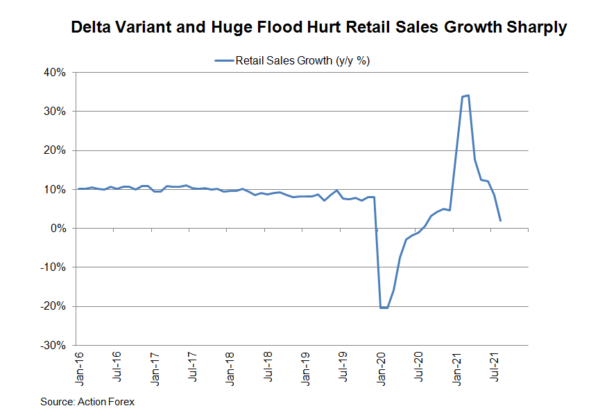 Industrial production (IP) expanded +5.3% y/y, down from +6.4% in July. This also missed market expectations of +5.8%. Fixed asset investment grew +8.9% y/y in the first 8 months of the year, following a +10.3% growth in the first 7 months. The market had anticipated a +9.1% growth.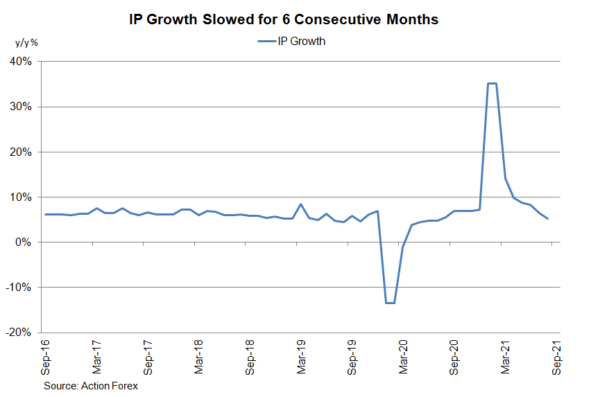
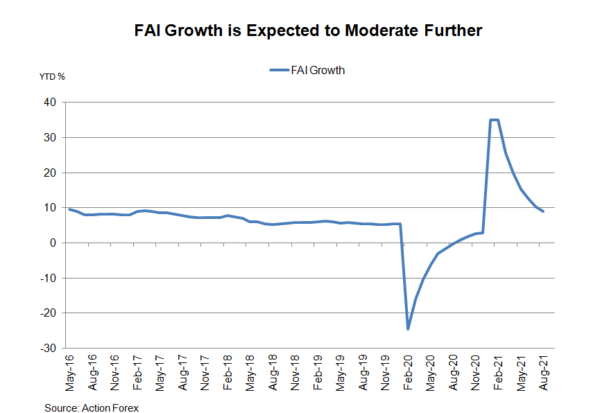 The set of data has exacerbated concerns over China’s growth outlook. The worse-than-expected growth, especially in retail sales, suggests that GDP growth in 3Q21 should be much weaker than the first half of the year.
The worst is yet to come. While many countries have started to adopt a “live with the virus” strategy (i.e. reopening the border despite the risk of upsurge in new coronavirus cases), China sticks with the zero-tolerance approach, imposing lockdown of small towns when there is outbreak and maintaining strict border control and quarantine. The stringent measures should continue to disrupt consumption and the supply chain.
Implications on Monetary Policy and Renminbi
Disappointing economic data indicate that further reduction in the reserve requirement ratio (RRR) is likely. We expect the PBOC to announce the move in coming two or three weeks. Indeed, the central bank signaled in late August that it might reduce the RRR for rural banks. While a rate cut is possible, we expect the government to first accompany RRR cut with some fiscal stimulus policy for the time being. Monetary easing in China should pose further downside risks to renminbi as other major central banks are planning to normalize the stimulus adopted in light of the pandemic.
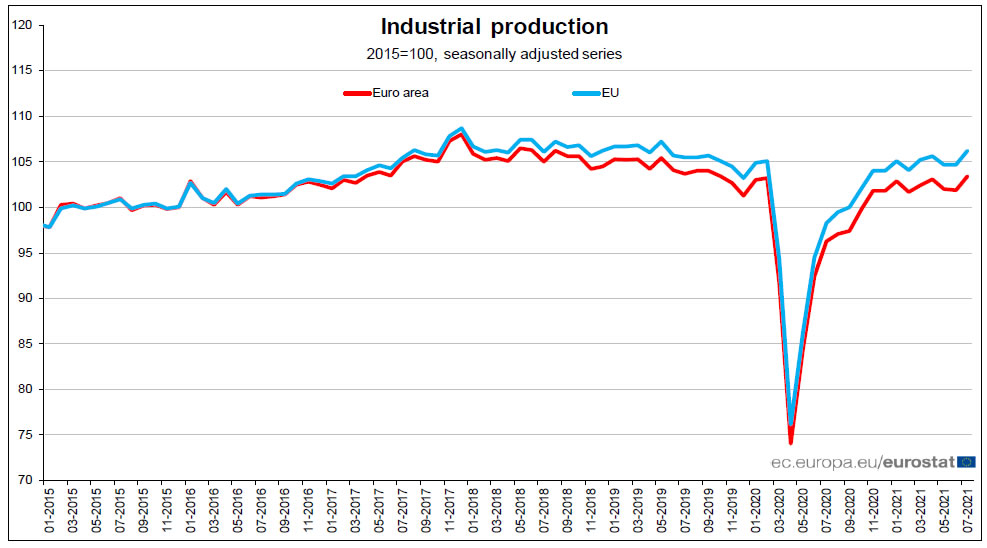
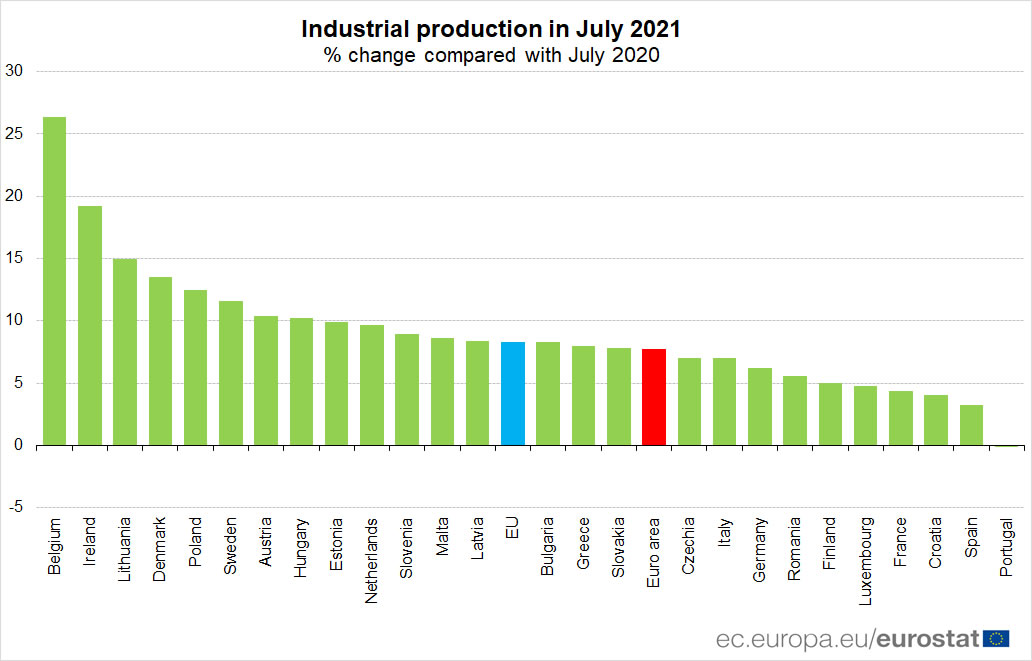
Eurozone industrial production rose 1.5% mom in Jul, EU up 1.4% mom
Eurozone industrial production rose 1.5% mom in July, above expectation of 0.5% mom. For the month, production of non-durable consumer goods rose by 3.5%, capital goods by 2.7%, durable consumer goods by 0.6% and intermediate goods by 0.4%, while production of energy fell by 0.6%.
EU industrial production rose 1.4% mom. Among Member States for which data are available, the highest monthly increases were registered in Ireland (+7.8%), Belgium (+5.0%) and Portugal (+3.5%). The largest decreases were observed in Lithuania (-2.0%), Slovenia (-1.8%) and Croatia (-1.6%).
Inflation In The United States Is Slowing Down, But The US Stock Market Isn’t Growing
On Tuesday, the US Labor Department reported that the consumer price index increased by 0.3% (previous – 0.5%), with the inflation at 5.3% on a year-on-year basis. The core consumer price index, which excludes food and energy prices, increased by only 0.1%. The slowdown in employment and inflation may encourage politicians to postpone any moves to reduce the quantitative easing program. The US stock market is declining. The Dow Jones index decreased by 0.84%, the S&P 500 lost 0.57%, the Nasdaq decreased by 0.45%. The value of the Nasdaq is decreasing for the fifth session in a row. The sharp drop in treasury bond yields signifies that investors are preparing for the worst. At the moment, a continued rotation out of value stocks into high-quality growth stocks is evident. The technology and health care sectors are showing relative strength. Energy, financial and industrial sectors are showing relative weakness.
European stock markets closed Tuesday's trading without a single dynamic. The British FTSE 100 index decreased by 0.5%, the French CAC 40 lost 0.4%, the Spanish IBEX 35 decreased by 0.4%. Meanwhile, the German DAX increased by 0.1%, and the Italian FTSE MIB added 0.4%. The ECB president said that the economy is recovering faster than expected and expects the eurozone to reach pre-pandemic production levels later this year. The Bank of France raised its 2021 GDP growth forecast to 6.3% (previous – 5.75%) on the back of a faster-than-expected recovery at the end of the first half of the year. The UK inflation data will be released today. The Bank of England expects inflation to rise sharply this year and reach a peak of 4%. Strong inflation will strengthen expectations that the Bank of England will tighten monetary policy faster than the European Central Bank or the US Federal Reserve.
After a three-month drop in global oil demand due to the spread of the delta strain and renewed pandemic restrictions, vaccination will boost fuel demand and prices, the International Energy Agency (IEA) reported on Tuesday.
Yesterday, gold sharply increased as the US Treasury yields fell. The situation with precious metals is now mixed. On the one hand, soft monetary policy always contributes to the growth of gold and silver prices. On the other hand, fears concerning the upcoming reduction of the QE program limit growth of prices on precious metals.
Revised data from the Japanese Cabinet of Ministers, released last week, showed that the Japanese economy grew by 1.9% from April to June. This is above the median forecast of economists. Last Friday, Toyota Motor Corp, the world's largest automaker, cut its annual production by 300,000 vehicles due to the supply disruptions at the production factories in Malaysia and Vietnam caused by a global shortage of automotive chips.
Meanwhile, in China, the world's largest auto market and a key sales region for Japanese automakers, the same supply problems contributed to a 17.8% (on a year-on-year basis) drop in auto sales in August.
Shares of China's tech companies decreased as the government's control over Macau casinos strengthened the concerns that Beijing would strengthen regulatory measures. The country's slowdown in retail sales also put pressure on e-commerce stocks.
Chile, the largest copper producing country, decreased its annual price forecast for the metal due to slowing demand in China and the prospect of easing stimulus measures in the United States.
Main market quotes:
- S&P 500 (F) 4,443.05 −25.68 (−0.57%)
- Dow Jones 34,577.57 −292.06 (−0.84%)
- DAX 15,722.99 +21.57 (+0.14%)
- FTSE 100 7,034.06 −34.37 (−0.49%)
- USD Index 92.65 −0.03 (−0.03%)
Important events for today:
- China Industrial Production (m/m) at 05:00 (GMT+3);
- China Retail Sales (m/m) at 05:00 (GMT+3);
- China Unemployment Rate (m/m) at 05:00 (GMT+3);
- UK Consumer Price Index (m/m) at 09:00 (GMT+3);
- Eurozone Industrial Production (m/m) at 12:00 (GMT+3);
- Canada Consumer Price Index (m/m) at 15:30 (GMT+3);
- US Industrial Production (m/m) at 16:15 (GMT+3);
- US Crude Oil Inventories (w/w) at 17:30 (GMT+3).
Ifo: Germany inflation to hit 3% this year, fall back to 2-2.5% next
Ifo said inflation in Germany could hit as high as 3% this year. That could be explained by "accelerated increase in prices over the course of 2021" in apparent in energy, food, and some service industries.
Inflation is expected to slow to 2.0-2.5% next year. But Head of Forecasts Timo Wollmershäuser said: "At the beginning of 2022, the special factors that have been driving inflation will peter out: it will be a year since the reduction in VAT was reversed and energy prices reached their pre-crisis levels,"
Separately, ECB Governing Council member Pablo Hernandez de Cos said, "ECB is monitoring the inflation performance closely but we are not seeing any second-round impacts."