

Sample Category Title
Fed Bullard: We don’t need the asset purchases at this point
St. Louis Federal Reserve president James Bullard repeated his call for tapering to end asset purchase by the early next year, as "we don't need the asset purchases at this point."
"I think a lot depends on whether inflation going to moderate in 2022 or not. I'm a little skeptical that it is. I think we're going to get at least 2.5% inflation in 2022, maybe higher than that and there's some risk to the upside on that," Bullard said.
"We will be able to get to a good consensus on the committee and get to a good wind-down process. It does seem that we are coalescing around a plan," Bullard said
US: Economic Growth Still Strong at 6.6% Annualized in the Second Estimate of Q2
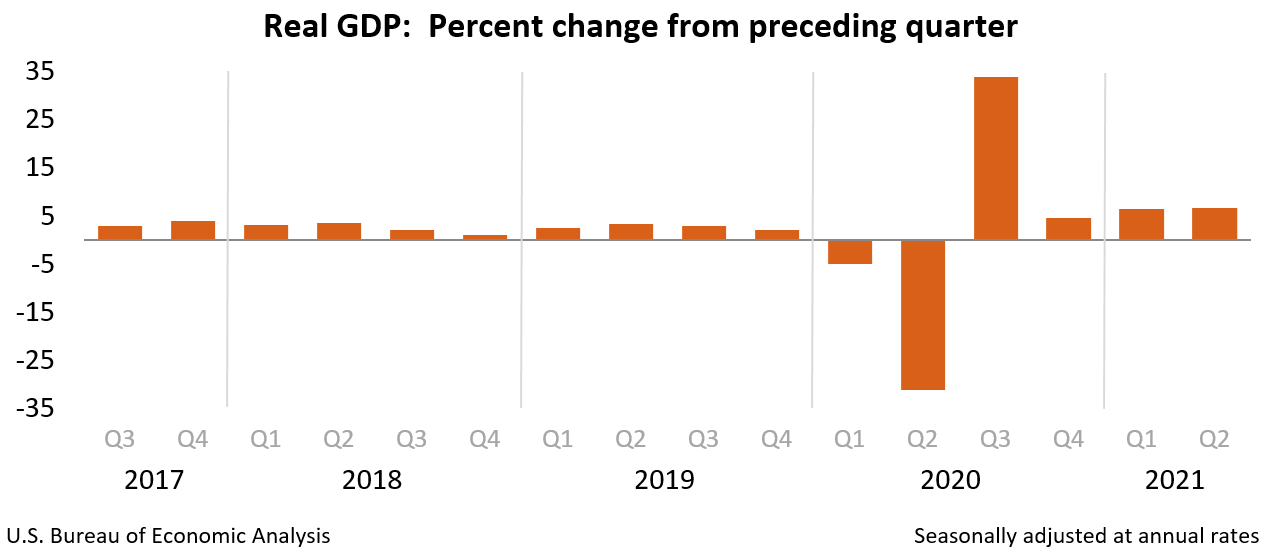
Overall revisions to second quarter real GDP were fairly minor. Real GDP growth was revised up one tick to 6.6%, from 6.5% in the advance estimate.
Upward revisions to nonresidential fixed investment were a key feature, growing at a 9.3% annualized pace, compared to 8.0% in Q1. The decline in structures investment was revised up from -6.9% to -5.4%.
Export growth was also revised up to 6.6%, compared to 6.0% in earlier estimates. Consumer spending was revised up modestly to 11.9%, versus 11.8%.
Partially offsetting these upward revisions was a larger contraction in residential investment (-11.5% versus -9.8% in advance), a larger drawdown in inventories, and lower spending by state and local governments.
Corporate profits were reported with the second estimate and showed profits up $234.5 billion (or 42.2% annualized) compared to an increase of $123.9 bn in the first quarter. Corporate profits hit 12.3% of GDP, the highest share since 2014.
Key Implications
Revised data show that growth in the U.S. economy was very slightly stronger in the second quarter than previously reported. As we sit in the back half of August the real question is how well spending will hold up against the current Delta wave. Growth in the third quarter is still tracking a very healthy 5%+ pace, but some high-frequency indicators are pointing to a loss in momentum in spending as consumer caution creeps in.
Overall, we would expect any slowing in spending to be temporary. In aggregate, U.S. households have amassed over $2.5 trillion in excess savings over the course of the pandemic, providing a substantial cushion against a temporary slowing in momentum, even if it is unevenly distributed. If reports of labor shortages are true, companies might be less likely to lay workers off during a temporary lull in demand. Still, all eyes will be on Chair Powell's Jackson Hole remarks tomorrow at 10 am to see how the Fed is thinking about Delta's impact and whether this has any bearing on its decision on when to taper asset purchases.
EUR/USD Mid-Day Outlook
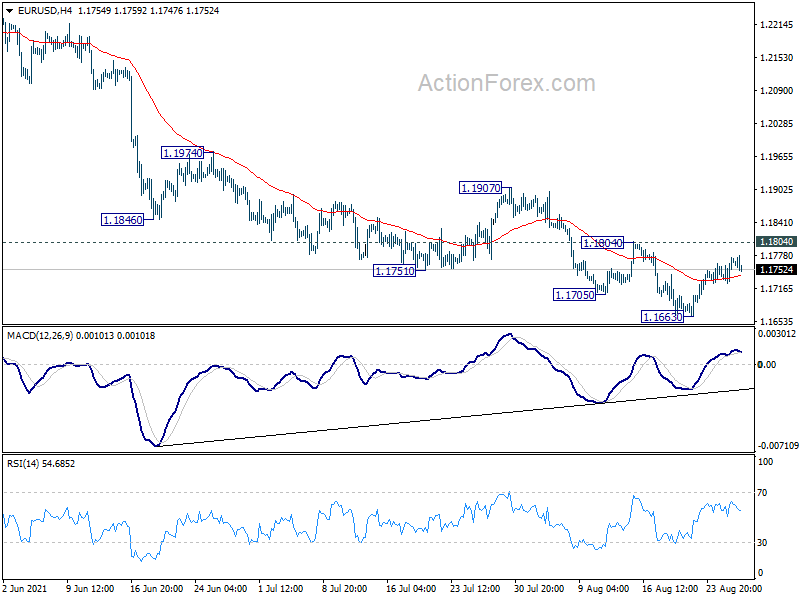
Daily Pivots: (S1) 1.1741; (P) 1.1758; (R1) 1.1790; More...
Intraday bias in EUR/USD remains neutral at this point. With 1.1804 resistance intact, another fall cannot be ruled out yet. But we'd continue to look for strong support from 1.1602/1703 key support zone to bring rebound. On the upside, above 1.1804 resistance will turn bias back to the upside for 1.1907 resistance first. However, sustained break of 1.1602/1703 will carry larger bearish implication and pave the way to 1.1289 fibonacci support.
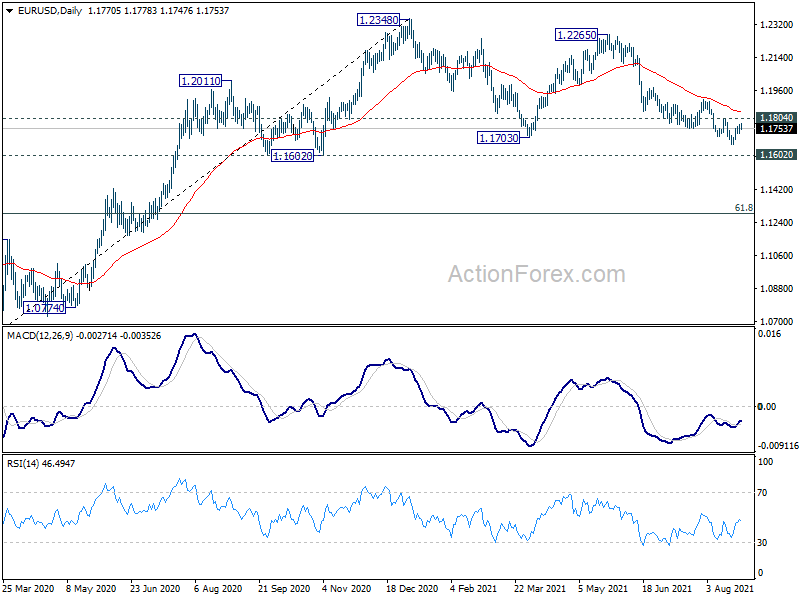
In the bigger picture, rise from 1.0635 is seen as the third leg of the pattern from 1.0339 (2017 low). Further rally remains in favors long as 1.1602 support holds, to cluster resistance at 1.2555 next, (38.2% retracement of 1.6039 to 1.0339 at 1.2516). However sustained break of 1.1602 will argue that the rise from 1.0635 is over, and turn medium term outlook bearish again. Deeper fall would be seen to 61.8% retracement of 1.0635 to 1.2348 at 1.1289 and below.
GBP/USD Mid-Day Outlook
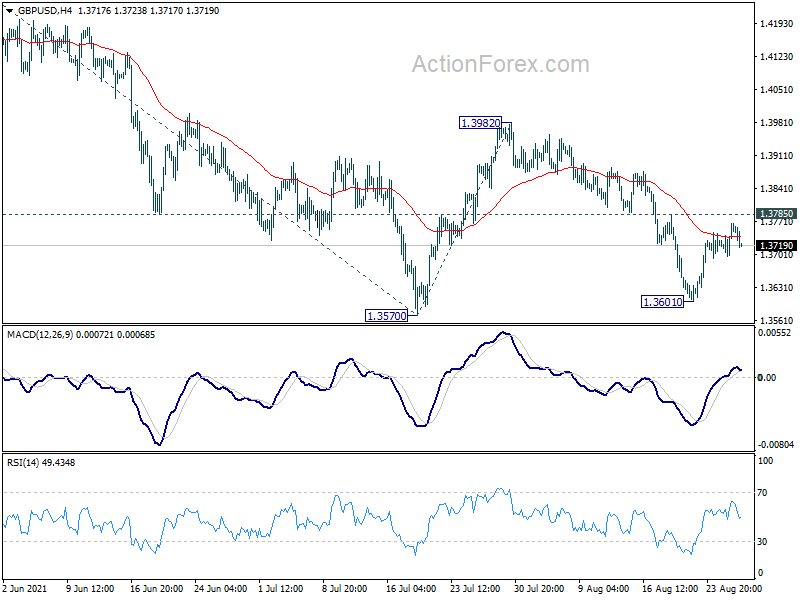
Daily Pivots: (S1) 1.3718; (P) 1.3742; (R1) 1.3788; More...
Intraday bias in GBP/USD remains neutral for the moment. Another fall is in favor with 1.3785 minor resistance intact. On the downside, firm break of 1.3570 will resume larger fall from 1.4248 to 1.3482 resistance turned support next. Break there will target 100% projection of 1.4248 to 1.3570 from 1.3982 at 1.3304. However, on the upside, break of 1.3785 will turn bias back to the upside for 1.3982 resistance intact.
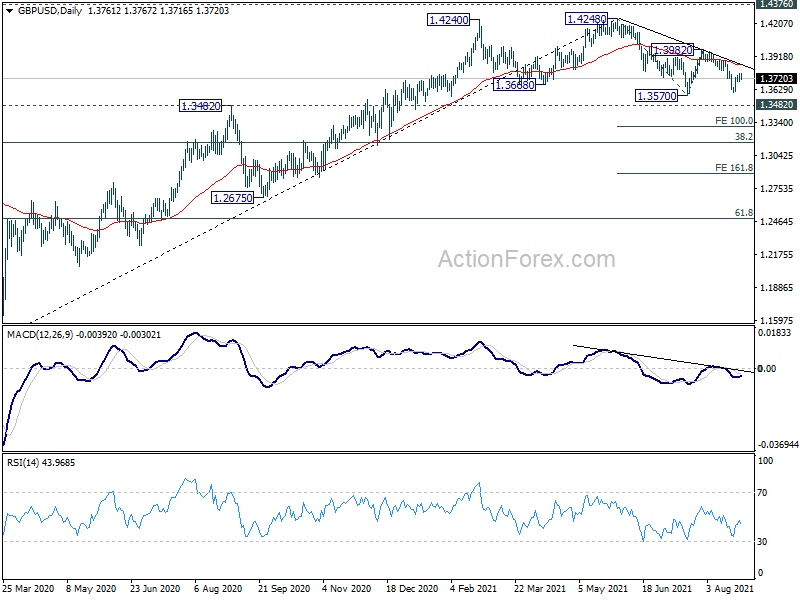
In the bigger picture, current development argues that rise from 1.1409 (2020 low) has completed at 1.4248, after failing 1.4376 resistance. Fall from there could either be correcting the rise form 1.1409, or starting another falling leg inside long term sideway pattern. In either case, sustained break of 1.3482 resistance turned support will target 38.2% retracement of 1.1409 to 1.4248 at 1.3164 first. Break there will pave the way to 61.8% retracement at 1.2493.
USD/JPY Mid-Day Outlook
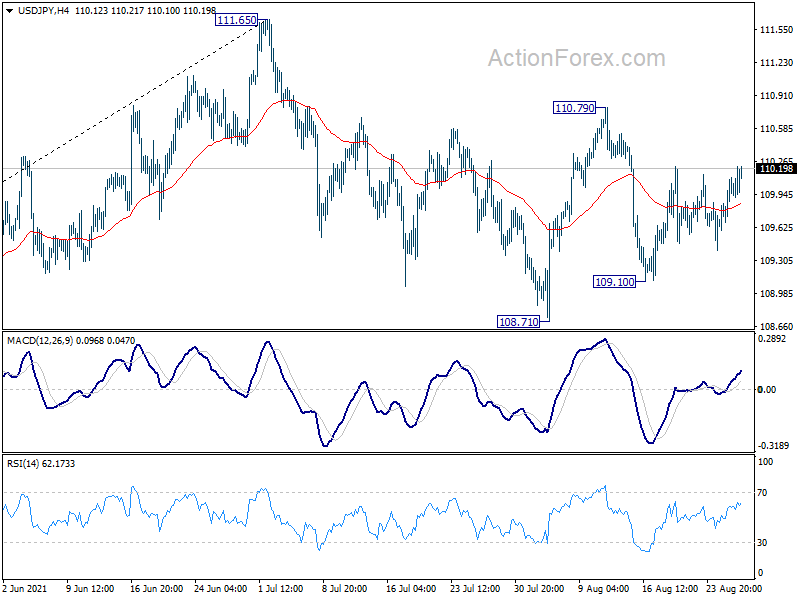
Daily Pivots: (S1) 109.71; (P) 109.92; (R1) 110.20; More...
Intraday bias in USD/JPY remains neutral and outlook is unchanged. On the upside, break of 110.79 will resume the rebound from 108.71 to retest 111.65 high. On the downside, break of 109.10 will target 108.71 support first. Firm break there will resume the decline from 111.65 and target 38.2% retracement of 102.58 to 111.65 at 108.18 next.
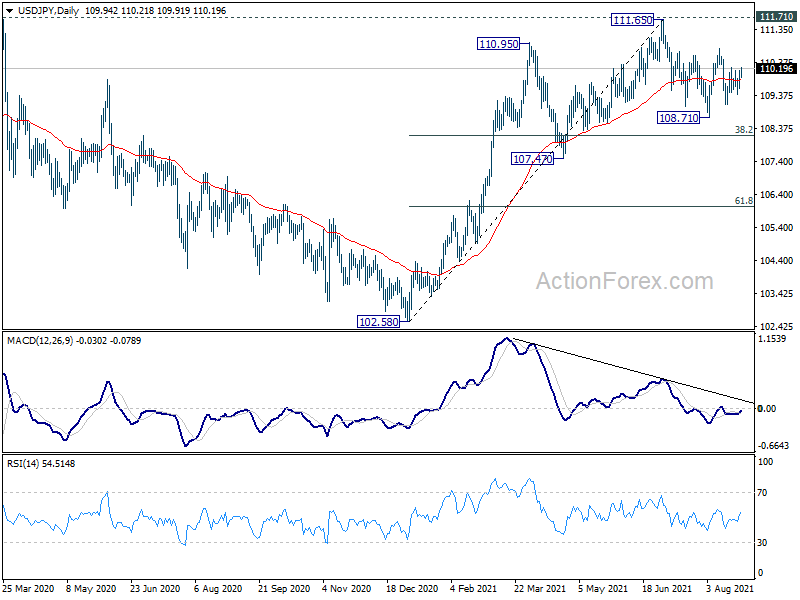
In the bigger picture, medium term outlook is staying neutral with 111.71 resistance intact. The pattern from 101.18 could still extend with another falling leg. Sustained trading below 55 day EMA will bring deeper fall to 107.47 support and below. Nevertheless, strong break of 111.71 resistance will confirm completion of the corrective decline from 118.65 (2016 high). Further rise should then be seen to 114.54 and then 118.65 resistance.
USD/CHF Mid-Day Outlook
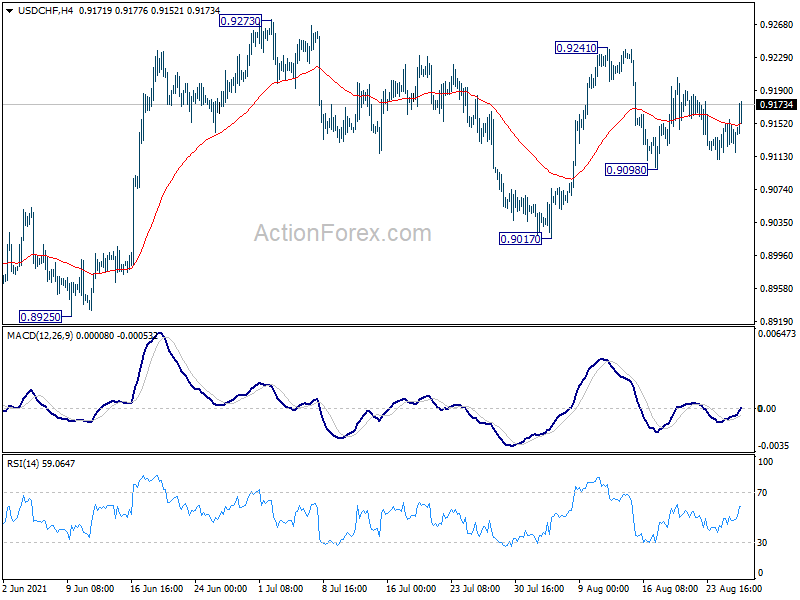
Daily Pivots: (S1) 0.9123; (P) 0.9140; (R1) 0.9156; More....
USD/CHF recovers today but stays well inside range of 0.9098/9241. Intraday bias remains neutral first. On the upside, break of 0.9241 resistance should resume the rise from 0.8925 through 0.9273. On the downside, break of 0.9098 will target 0.9017 support first. Further break there will likely resume the decline from 0.9471 through 0.8925 low.
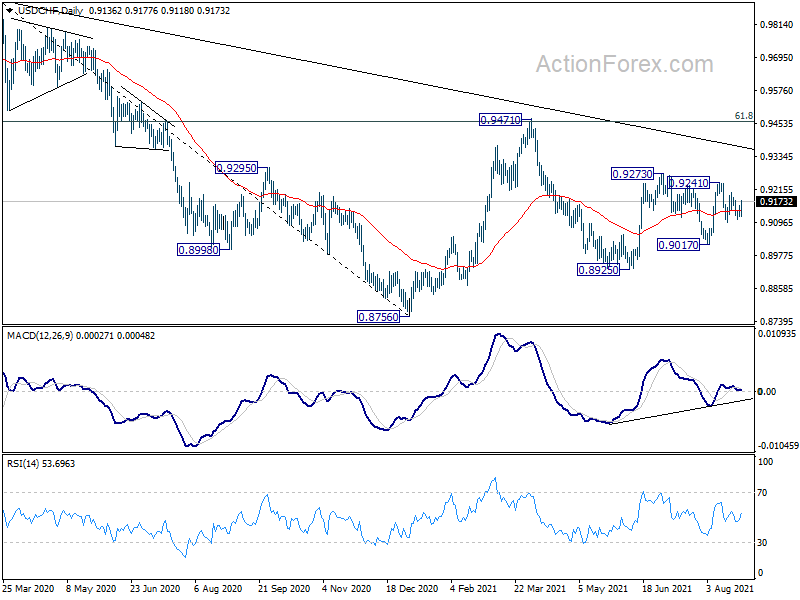
In the bigger picture, the failure to sustain above 55 week EMA (now at 0.9180) retains medium term bearishness in USD/CHF. Break of 0.8925 support should resume the whole decline form 1.0342 (2016 high) through 0.8756 low. However, break of 0.9273 resistance and sustained trading above 55 week EMA will be an early sign of bullish trend reversal. Focus will then turn to 0.9471 resistance for confirmation.
Swiss Franc Falls Broadly While Euro Firms Up, Dollar Cautious
Swiss Franc drops sharply today, as pressured by selling against Euro, and rising treasury yields. Dollar once again tries to recover, but there is no committed buying yet. The greenback traders will carefully scrutinize the comments from Fed officials coming out today and tomorrow, as the annual Jackson Hole Symposium goes along. Meanwhile, commodity currencies will look into stocks' reaction and overall market sentiment.
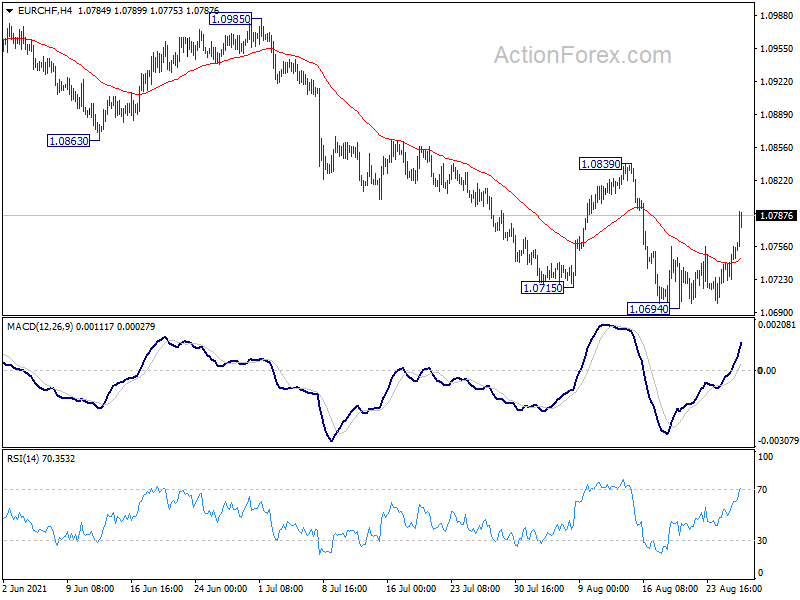
Technically, EUR/CHF's strong rebound today raises the possibility that 1.0694 is already a short term bottom. Focus is now turning to 1.0839 resistance. Break there will bring stronger rally back towards 1.0985 resistance. If that happens, we'll see if EUR/USD would follow and break through 1.1804 resistance. Or, USD/CHF would break through 0.9241 resistance instead.
In Europe, at the time of writing, FTSE is down -0.28%. DAX is down -0.51%. CAC is down -0.25%. Germany 10-year yield is up 0.0179 at -0.402. Earlier in Asia, Nikkei rose 0.06%. Hong Kong HSI dropped -1.08%. China Shanghai SSE dropped -1.09%. Singapore Strait Times rose 0.06%. Japan 10-year JGB yield rose 0.0005 to 0.021.
Fed George maintained it's a point to begin to ease up accommodation
Kansas City Fed President Esther George told Bloomberg that the spike in Covid is a "risk to the outlook", but her contacts in the region said the economy "continues to grow at a strong rate", consumers are "still spending" and labor markets is "continuing to heal". The outlook "remains a positive one". The virus is not expected to derail the economy".
George also maintained that the progress the economy has made suggests "we've come to a point where we can begin to ease up on the amount of accommodation". It's "time to begin to make those adjustments" on asset purchases.
As policymakers are coming into the September meeting, she said, we will continue to talk about how the economy has unfolded and the timing for adjustments to those asset purchases".
US initial jobless claims rose to 353k, slightly below expectation
US initial jobless claims rose 4k to 353k in the week ending August 21, slightly below expectation of 355k. Four-week moving average of initial claims dropped -11.5k to 366.5k, lowest since March 14.
Continuing claims dropped -3k to 2862k in the week ending August 14, lowest since March 14, 2020. Four-week moving average of continuing claims dropped -108.5k to 2901.5k, lowest since March 21, 2020.
US GDP grew 6.6% annualized in Q2, revised slightly up
According to the second estimate, US GDP grew an annual rate of 6.6% in Q2, revised up from 6.5%. The update reflects upward revisions to nonresidential fixed investment and exports that were partly offset by downward revisions to private inventory investment, residential fixed investment, and state and local government spending. Imports, which are a subtraction in the calculation of GDP, were revised down.
ECB accounts: Large majority of members see new forward guidance a fine balance
In the accounts of July 21-22 meeting, ECB said a "large majority" of the council members supported the forward guidance proposal, which was "widely seen as providing a fine balance between greater emphasis on outcome-based elements in the forward guidance and a more flexible, forward-looking perspective."
However, "a few members upheld their reservations, as the amended formulation did not sufficiently address their concerns.". This related in particular to the "implied likelihood and persistence of overshooting, and being seen as promising to keep interest rates at their present or lower levels for a very long time period without an explicit escape clause."
ECB also said, the new forward guidance "underscored the Governing Council's commitment to achieving its new inflation target". It indicated that ECB would "wait until it was confident about the path of inflation before raising the key policy rates." Nevertheless, the guidance is "not a rule" but "an indication to financial markets and the broader public" for aligning their inflation expectations.
Germany Gfk consumer sentiment dropped to -1.2, fear of tightened restrictions again
Germany Gfk consumer sentiment for September dropped from -0.4 to -1.2. In August, economic expectations dropped from 54.6 to 40.8. Income expectations rose from 29.0 to 30.5. Propensity to buy dropped from 14.8 to 10.3.
Rolf Bürkl, a GfK consumer expert, commented on this observation: "Significant higher incidence values, a slowdown in vaccination momentum, and discussions about how to deal with unvaccinated individuals in the future have caused noticeable uncertainty among consumers in Germany. They fear that restrictions could even be tightened again. This is obviously depressing consumer sentiment right now."
Japan corporate services price rose 1.1% yoy in Jul, on transportation fees
Japan corporate services price index rose 1.1% yoy in July, below expectation of 1.3% yoy. The increase was driven by 1.4% rise in transportation fees, and in particular, with international freight costs up 24.6%. Meanwhile, hotel service fees rose 10.8%, highest in six years, reflecting the impact of the Tokyo Olympics.
"The recent increase in infections will weigh on services producer prices, though we could see service demand perk up if progress in vaccinations help re-open the economy," said Shigeru Shimizu, head of the BoJ's price statistics division.
Bank of Korea raises interest rate, embarking normalization process
Bank of Korea raised interest rate by 0.25% to 0.75% today, becoming the first major Asian economy to hike. "The Board will gradually adjust the degree of monetary policy accommodation as the Korean economy is expected to continue its sound growth and inflation to run above 2% for some time, despite ongoing uncertainties over the virus," the BOK said in its monetary policy statement.
Governor Lee Ju-yeol said, "we've decided to put the focus on reducing financial imbalances, and as we raise the rate, we are embarking on a process of normalizing policy in line with economic recovery."
BoK maintained its forecast of 4% GDP growth this year. Consumer inflation forecast was, however, upgraded from 1.8% to 2.1%.
USD/CHF Mid-Day Outlook
Daily Pivots: (S1) 0.9123; (P) 0.9140; (R1) 0.9156; More....
USD/CHF recovers today but stays well inside range of 0.9098/9241. Intraday bias remains neutral first. On the upside, break of 0.9241 resistance should resume the rise from 0.8925 through 0.9273. On the downside, break of 0.9098 will target 0.9017 support first. Further break there will likely resume the decline from 0.9471 through 0.8925 low.
In the bigger picture, the failure to sustain above 55 week EMA (now at 0.9180) retains medium term bearishness in USD/CHF. Break of 0.8925 support should resume the whole decline form 1.0342 (2016 high) through 0.8756 low. However, break of 0.9273 resistance and sustained trading above 55 week EMA will be an early sign of bullish trend reversal. Focus will then turn to 0.9471 resistance for confirmation.
Economic Indicators Update
| GMT | Ccy | Events | Actual | Forecast | Previous | Revised |
|---|---|---|---|---|---|---|
| 23:50 | JPY | Corporate Service Price Index Y/Y Jul | 1.10% | 1.30% | 1.40% | 1.30% |
| 01:30 | AUD | Private Capital Expenditure Q2 | 4.40% | 2.50% | 6.30% | 6.00% |
| 06:00 | EUR | Germany Gfk Consumer Confidence Sep | -1.2 | -1 | -0.3 | |
| 08:00 | EUR | Eurozone M3 Money Supply Y/Y Jul | 7.60% | 7.60% | 8.30% | |
| 11:30 | EUR | ECB Monetary Policy Accounts | ||||
| 12:30 | USD | Initial Jobless Claims (Aug 20) | 353K | 355K | 348K | 349K |
| 12:30 | USD | GDP Annualized Q2 P | 6.60% | 6.70% | 6.50% | |
| 12:30 | USD | GDP Price Index Q2 P | 6.10% | 6.00% | 6.10% | |
| 14:30 | USD | Natural Gas Storage | 40B | 46B |
US GDP grew 6.6% annualized in Q2, revised slightly up
According to the second estimate, US GDP grew an annual rate of 6.6% in Q2, revised up from 6.5%. The update reflects upward revisions to nonresidential fixed investment and exports that were partly offset by downward revisions to private inventory investment, residential fixed investment, and state and local government spending. Imports, which are a subtraction in the calculation of GDP, were revised down.
US initial jobless claims rose to 353k, slightly below expectation
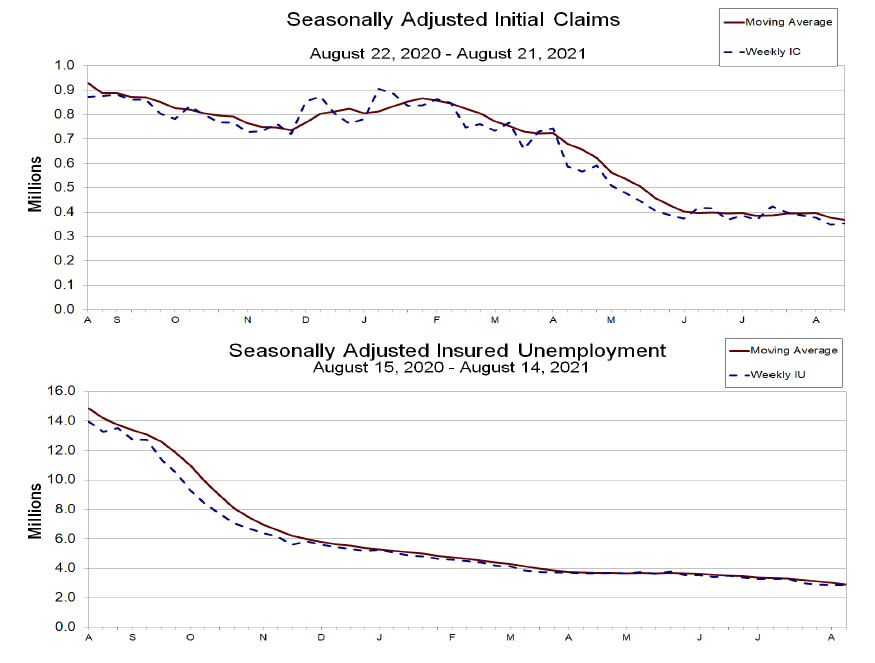
US initial jobless claims rose 4k to 353k in the week ending August 21, slightly below expectation of 355k. Four-week moving average of initial claims dropped -11.5k to 366.5k, lowest since March 14.
Continuing claims dropped -3k to 2862k in the week ending August 14, lowest since March 14, 2020. Four-week moving average of continuing claims dropped -108.5k to 2901.5k, lowest since March 21, 2020.
Fed George maintained it’s a point to begin to ease up accommodation
Kansas City Fed President Esther George told Bloomberg that the spike in Covid is a "risk to the outlook", but her contacts in the region said the economy "continues to grow at a strong rate", consumers are "still spending" and labor markets is "continuing to heal". The outlook "remains a positive one". The virus is not expected to derail the economy".
George also maintained that the progress the economy has made suggests "we've come to a point where we can begin to ease up on the amount of accommodation". It's "time to begin to make those adjustments" on asset purchases.
As policymakers are coming into the September meeting, she said, we will continue to talk about how the economy has unfolded and the timing for adjustments to those asset purchases".