

Sample Category Title
EUR/CHF Daily Outlook
Daily Pivots: (S1) 1.0821; (P) 1.0831; (R1) 1.0844; More....
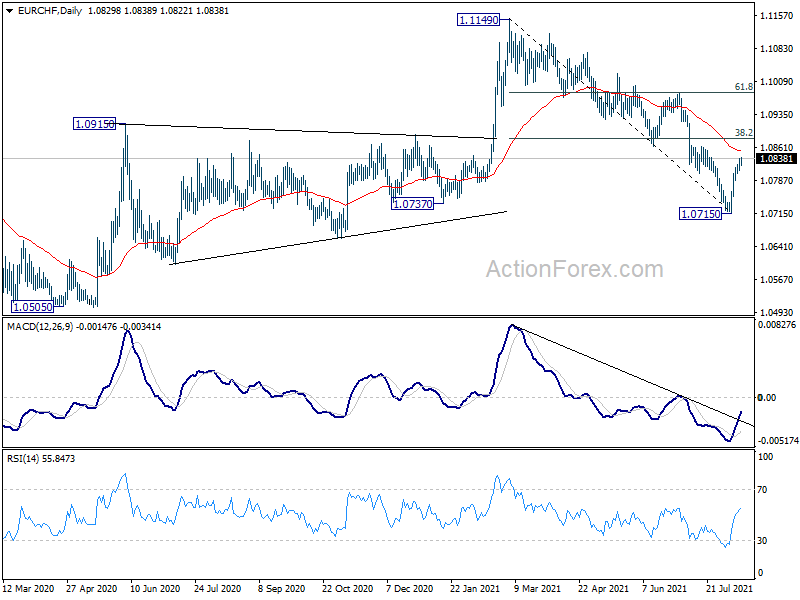
EUR/CHF's rebound from 1.0715 short term bottom is still in progress. Intraday bias remains on the upside for 38.2% retracement of 1.1149 to 1.0715 at 1.0881. We'd monitor the reaction to 1.0881 to assess the chance of bullish reversal. On the downside, break of 1.0788 minor support will turn bias back to the downside for retesting 1.0715 low instead.
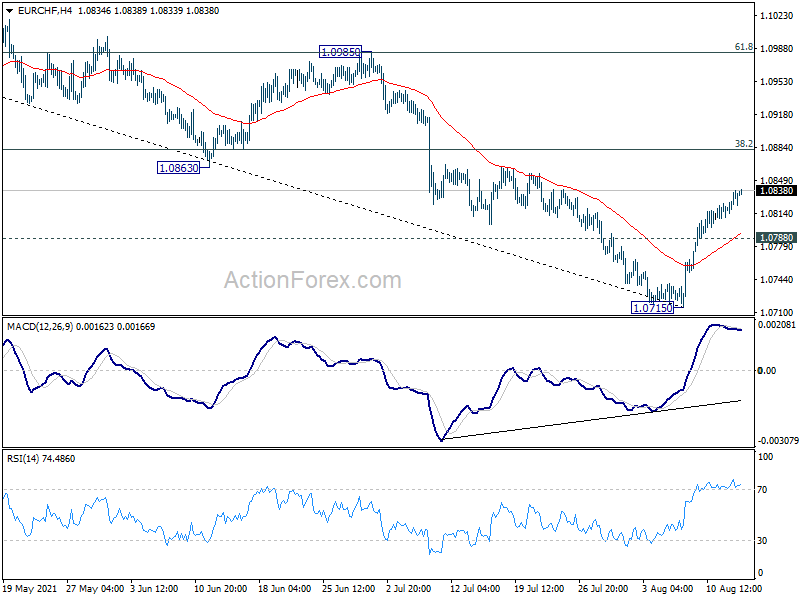
In the bigger picture, rebound from 1.0505 (2020 low) should have completed at 1.1149 already. The three wave corrective structure argues that the downtrend from 1.2004 (2018 high) is not over yet. Medium term outlook will now stay bearish as long as 1.1149 resistance holds. Break of 1.0505 low would be seen at a later stage.
EUR/JPY Daily Outlook
Daily Pivots: (S1) 129.41; (P) 129.56; (R1) 129.73; More....
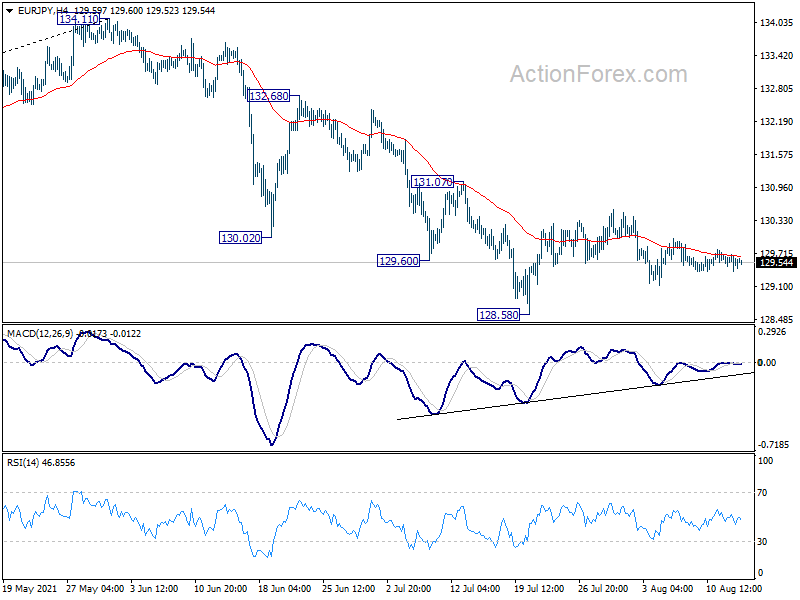
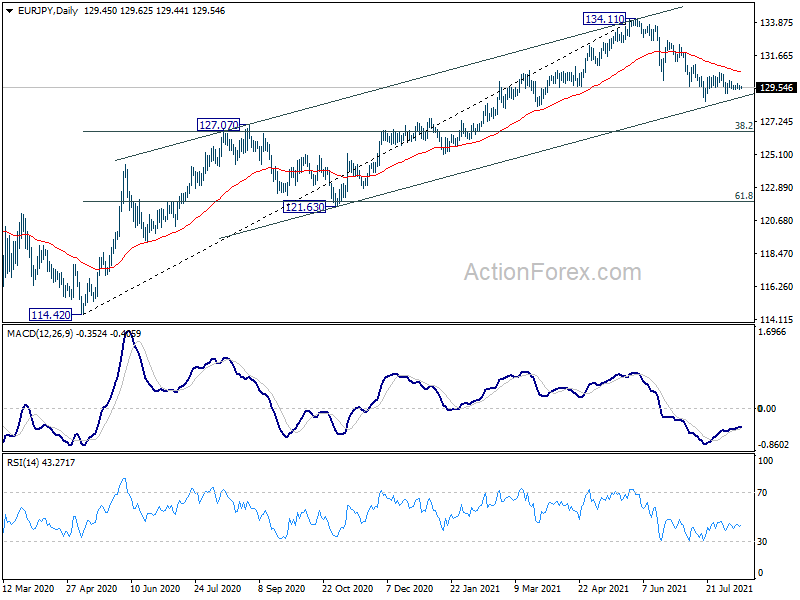
EUR/JPY is staying in consolidation from 128.58 and intraday bias remains neutral for the moment. With 131.07 resistance intact, outlook stays bearish. On the downside, break of 128.85 will resume the fall from 134.11 to 127.07 resistance turned support next. On the upside, break of 131.07 resistance will argue that choppy fall from 134.11 has completed. Intraday bias will be turned back to the upside for 132.68 resistance first.
In the bigger picture, rise from 114.42 is seen as a medium term rising leg inside a long term sideway pattern. As long as 127.07 resistance turned support holds, further rise is still expected to retest 137.49 (2018 high). However, firm break of 127.07 will argue that the medium term trend has reversed, and open up the case for retesting 114.42.
Inflationary Pressure In US
Market movers today
- The key release today is the US Michigan survey of consumer confidence. Although confidence has improved in 2021, the indicator has stalled in recent months as US consumers have grown more wary about their current prospects. Another interesting point in the release will be the inflation expectation gauge given the rise in actual US inflation in recent months.
The 60 second overview
Macro: US PPI inflation significantly beat the consensus expectation yesterday. Hence, the steep rise in US prices continues as Fed has allowed inflation to overshoot 2% amid the recovery of the economy.
Commodities: Commodity markets rebounded further yesterday and have now recovered the lost ground from the start of the week. Hence, Bloomberg's commodities index rose back to level from last week.
Equities: Equity markets grinded mostly higher on Thursday with another set of record closing levels. The last five days of value preference flipped and investors bought into health care and tech. Energy and materials were among the weaker groups. In all, S&P 500 up 0.3%, Nasdaq 0.4%, Russell 2000 -0.2% and Dow unchanged. The week is concluding with mostly muted moves in Asia. US futures are flat.
FI: After an uneventful Wednesday session, we got another uneventful Thursday trading session. With no news on the wires and no supply EGBs and UST were trading in a tight range, favouring positive carry positions. BTPs-Bund spreads are closing in on the 100bp mark.
FX: USD regained some strength yesterday after US PPI inflation beat expectations and triggered a rise in US interest rates. It was a mixed picture for commodity currencies with NOK rising higher and AUD, CAD, and NZD falling back.
Credit: Sentiment took a turn for the better in credit markets yesterday where iTraxx Xover tightened 4bp (to 232bp) and Main 0.6bp (to 46bp). Cash bond moves were more modest, with HY tightening 1bp and IG unchanged.
GBP/JPY Daily Outlook
Daily Pivots: (S1) 152.12; (P) 152.67; (R1) 152.99; More...
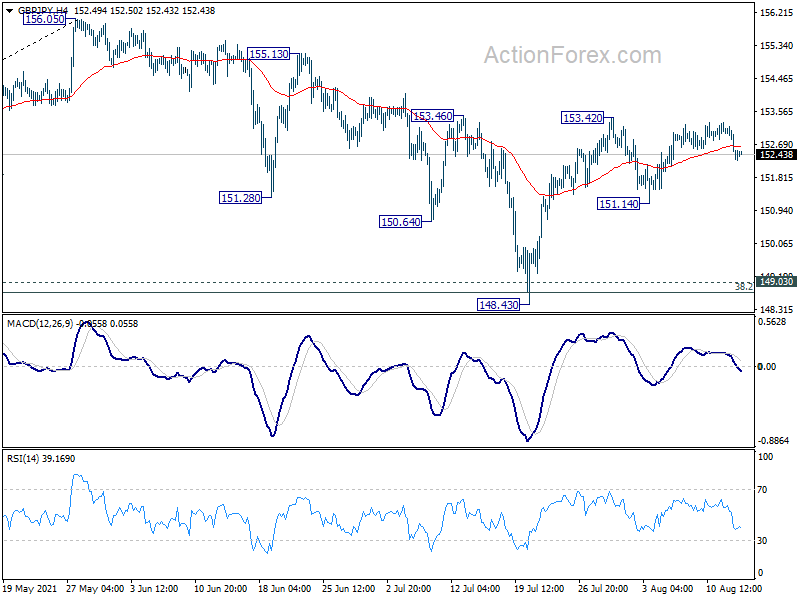
GBP/JPY drops slightly after failing to break through 153.42 resistance. But it stays in range of 151.14/153.42 and intraday bias remains neutral first. On the upside, break of 153.42/46 resistance will reaffirm the case that correction from 156.05 has completed at 148.43. Intraday bias will be back on the upside for retesting 156.05. On the downside, though, below 151.14 will bring deeper fall back to retest 148.43 instead.
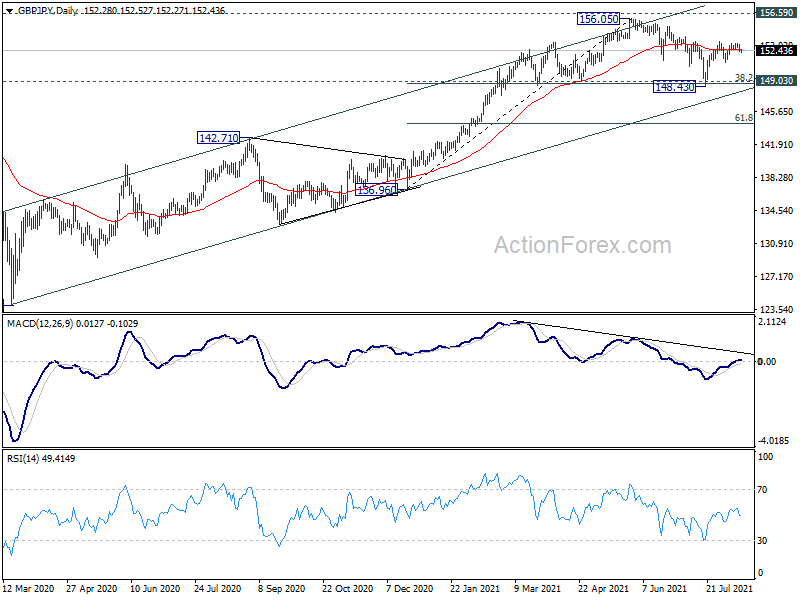
In the bigger picture, rise from 123.94 is seen as the third leg of the pattern from 122.75 (2016 low). Focus remains on 156.59 resistance (2018 high). Sustained break there should confirm long term bullish trend reversal. Next target is 61.8% retracement of 195.86 (2015 high) to 122.75 at 167.93. On the downside, sustained break of 149.03 support, however, will argue that rise from 123.94 has completed. Further break of 142.71 would open up the bearish case for retesting 122.75 low.
Sterling Turning Weaker in Crosses, Dollar Lacks Clear Direction
Trading in the Asian markets is relatively subdued again. Asian stocks are mixed even though DOW and S&P 500 rose to new record highs overnight. Dollar continues to fail to find a committed direction. While the greenback remains firm against Euro, Swiss Franc and Yen, it clearly lacks upside momentum against commodity currencies. With a light calendar today, the markets could need to wait for next week to come back to life.
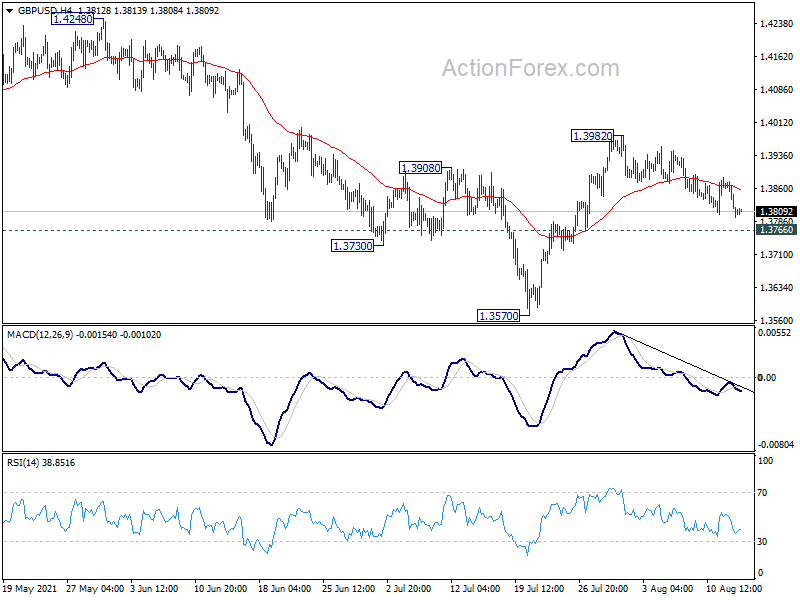
Technically, one development to note is that Sterling is apparently turning weaker against both Euro and Yen. There is prospect of more weakness in the Pound in these two crosses. That, if happens, could trigger deep pull back in GBP/USD through 1.3766 minor support, which in turn feeds back into EUR/GBP and GBP/JPY.
In Asia, at the time of writing, Nikkei is up 0.05%. Hong Kong HSI is down -0.99%. China Shanghai SSE is down -0.37%. Singapore Strait Times is down -0.66%. Japan 10-year JGB Yield is down 0.0006 at 0.025. Overnight, DOW rose 0.04%. S&P 500 rose 0.30%. NASDAQ rose 0.35%. 10-year yield rose 0.028 to 1.367.
New Zealand BusinessNZ manufacturing rose to 62.6, second highest on record
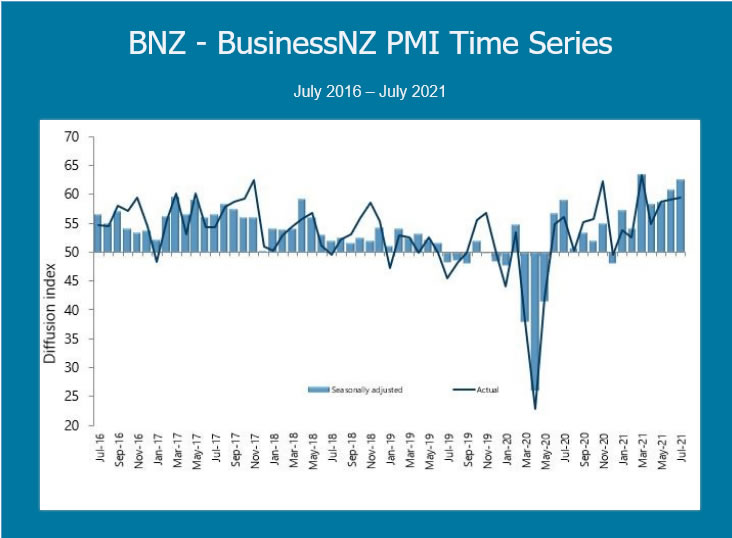
New Zealand BusinessNZ Performance of Manufacturing Index rose from 60.9 to 62.6 in July. That's the second highest reading after March's 63.6. Looking at some details, production rose from 64.4 to 66.0.. Employment rose from 56.7 to 58.3, a new record. New orders rose from 63.6 to 65.0. Finished stocks dropped from 57.4 to 56.9. Deliveries rose from 55.2 to 57.9.
However, the position of negative comments (51.4%) still remained higher than positive ones (48.6%). Increased domestic and overseas orders was the common factor for positive comments. In contrast, tight labor market, supply chain issues and raw material costs were the negatives.
BNZ Senior Economist, Craig Ebert stated that "while New Zealand's PMI is doing exceptionally well, we are also conscious of the headwinds happening for global manufacturing. This is on account of the resurgence of COVID19 in its delta strain."
NZD/USD stuck in range, with mild bearish bias
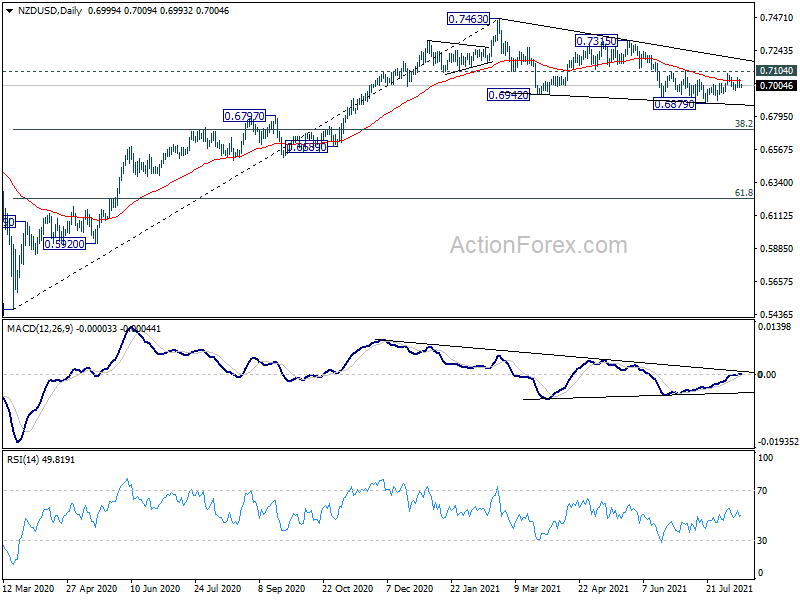
New Zealand Dollar is one of the better performers this week, together with Australian and Canadian. Nevertheless, it's just stuck in range against Dollar for now. NZD/USD is extending the range pattern from 0.6879. The failure to break through 55 day EMA firmly is keeping near term outlook bearish.
Overall, price actions from 0.7463 are seen as correcting the whole up trend from 0.5467. Downside momentum is diminishing as seen in daily MACD. Hence, in case of another fall, strong support would likely be seen from 38.2% retracement of 0.5467 to 0.7463 at 0.6701 to contain downside. On the upside, break of 0.7104 resistance will suggest that the correction has completed and bring stronger rebound back to 0.7315/7463 resistance zone.
Looking ahead
Swiss PPI and Eurozone trade balance will be released in European session. US will release import price and U of Michigan consumer sentiment.
GBP/JPY Daily Outlook
Daily Pivots: (S1) 152.12; (P) 152.67; (R1) 152.99; More...
GBP/JPY drops slightly after failing to break through 153.42 resistance. But it stays in range of 151.14/153.42 and intraday bias remains neutral first. On the upside, break of 153.42/46 resistance will reaffirm the case that correction from 156.05 has completed at 148.43. Intraday bias will be back on the upside for retesting 156.05. On the downside, though, below 151.14 will bring deeper fall back to retest 148.43 instead.
In the bigger picture, rise from 123.94 is seen as the third leg of the pattern from 122.75 (2016 low). Focus remains on 156.59 resistance (2018 high). Sustained break there should confirm long term bullish trend reversal. Next target is 61.8% retracement of 195.86 (2015 high) to 122.75 at 167.93. On the downside, sustained break of 149.03 support, however, will argue that rise from 123.94 has completed. Further break of 142.71 would open up the bearish case for retesting 122.75 low.
Economic Indicators Update
| GMT | Ccy | Events | Actual | Forecast | Previous | Revised |
|---|---|---|---|---|---|---|
| 22:30 | NZD | Business NZ PMI Jul | 62.8 | 60.7 | 60.9 | |
| 6:30 | CHF | Producer and Import Prices M/M Jul | 0.30% | 0.30% | ||
| 6:30 | CHF | Producer and Import Prices Y/Y Jul | 2.80% | 2.90% | ||
| 9:00 | EUR | Eurozone Trade Balance (EUR) Jun | 9.3B | 9.4B | ||
| 12:30 | USD | Import Price Index M/M Jul | 0.60% | 1.00% | ||
| 14:00 | USD | Michigan Consumer Sentiment Index Aug P | 81.3 | 81.2 |
NZD/USD stuck in range, with mild bearish bias
New Zealand Dollar is one of the better performers this week, together with Australian and Canadian. Nevertheless, it's just stuck in range against Dollar for now. NZD/USD is extending the range pattern from 0.6879. The failure to break through 55 day EMA firmly is keeping near term outlook mildly bearish.
Overall, price actions from 0.7463 are seen as correcting the whole up trend from 0.5467. Downside momentum is diminishing as seen in daily MACD. Hence, in case of another fall, strong support would likely be seen from 38.2% retracement of 0.5467 to 0.7463 at 0.6701 to contain downside. On the upside, break of 0.7104 resistance will suggest that the correction has completed and bring stronger rebound back to 0.7315/7463 resistance zone.
New Zealand BusinessNZ manufacturing rose to 62.6, second highest on record
New Zealand BusinessNZ Performance of Manufacturing Index rose from 60.9 to 62.6 in July. That's the second highest reading after March's 63.6. Looking at some details, production rose from 64.4 to 66.0.. Employment rose from 56.7 to 58.3, a new record. New orders rose from 63.6 to 65.0. Finished stocks dropped from 57.4 to 56.9. Deliveries rose from 55.2 to 57.9.
However, the position of negative comments (51.4%) still remained higher than positive ones (48.6%). Increased domestic and overseas orders was the common factor for positive comments. In contrast, tight labor market, supply chain issues and raw material costs were the negatives.
BNZ Senior Economist, Craig Ebert stated that "while New Zealand's PMI is doing exceptionally well, we are also conscious of the headwinds happening for global manufacturing. This is on account of the resurgence of COVID19 in its delta strain."
Cliff Notes: the Foundation for Post-Delta Recovery Remains Strong
Key insights from the week that was.
As Australia’s COVID-19 outbreak continued to challenge authorities this week, we received an update on the consequences for both businesses and households.
NAB’s business survey signalled a sharp decline in both business conditions and confidence, down 14pts and 19pts respectively in July. Given their individual starting points: conditions are at their lowest level since November 2020, but still above the long-run average; while confidence is materially below its historic average, at levels last seen in July/August 2020.
Unsurprisingly, confidence and conditions were weakest in NSW in the month. As the survey was taken 20-30 July, confidence and conditions arguably will have soured further since, with Sydney continuing to record high levels of new cases and most of the other states having experienced an outbreak.
Looking ahead, forward orders point to near-term weakness in activity; but, all considered, the trading conditions, employment and profitability indicators are constructive for recovery. We continue to expect the combined effect of the vaccine drive and restrictions to quell current outbreaks, allowing for a vigorous recovery from the December quarter into 2022.
Australian consumer’s willingness to spend will be key in bringing about this economic rebound. On this front, the August Westpac-MI consumer sentiment survey provides a positive view. While the headline index fell a further 4.4% in August, at 104.1, consumer sentiment is still well above the lows seen during the national lockdown of 2020, circa 76. Indeed, sentiment is stronger now than it was the year prior to the pandemic.
From the detail of the survey, belief in the vaccines looks to be a key source of strength for sentiment, both with respect to health outcomes and the economy. The 1-year and 5-year economic outlook sub-components remain above average despite this month’s developments. And views on family finances also remain near average, although spending intentions have wavered – ‘time to buy a dwelling’ and ‘time to buy a major household item’ are both sub-par.
Of course, the decision on whether to buy a dwelling is not only affected by immediate challenges related to the virus, but also structural affordability concerns. House price expectations signal consumers anticipate a further deterioration on this front.
Globally on the virus, numerous anecdotes of concern over delta’s spread within China and other Asian nations have surfaced this week. Another large outbreak (or outbreaks) in the region cannot be ruled out but, on the data to hand, the US looks to be in a much worse predicament.
Despite having fully vaccinated over 60% of their population aged 18 and over, this week, the US has been reporting over 120,000 new COVID-19 cases a day. This is around half the peak of December/January’s wave prior to the vaccination drive – it should be noted that the number of tests being completed is also about half that seen over the prior period. Worryingly, hospitalisations related to the virus are also rising rapidly, with the new cases occurring amongst the unvaccinated population.
More of a focus for markets this week on the back of last Friday’s impressive million job gain have been additional comments by FOMC members signalling a shift in the stance of US monetary policy over the next month. Chair Powell’s address to the Jackson Hole economic symposium in late-August is expected to lay the foundation for a taper decision at the September FOMC meeting. We expect the taper to subsequently begin in January and run for six months to June 2022.
Despite the market’s focus on US recovery and the next steps for monetary policy, that the US dollar DXY index has again failed to break above the low-93’s signals to us that participants are increasingly coming to the realisation that this period of US exceptionalism is near an end.
While outsized employment gains will persist for a time, this is catch-up growth seeing as the labour market recovery was delayed by supply issues. GDP growth meanwhile has peaked and will now decelerate back to trend on an annualised basis come the end of 2022. In the near-term, monetary policy in the US is set to run broadly in line with that in the UK, Canada and Europe, with all three jurisdictions to partially or fully taper around year end. It is only through 2022 that justification for a more material tightening cycle will build in the US versus the other nations above. As detailed in on page 12 of our August Market Outlook, dissipating US’ outperformance with respect to the virus and economy is therefore set to weigh on the US dollar to March 2022; but thereafter, the monetary policy outlook will drive a rebound.
USD/JPY Turns Green As Dollar Extends Rally
Key Highlights
- USD/JPY started a fresh increase above the 110.00 resistance zone.
- It broke a major bearish trend line with resistance near 109.65 on the 4-hours chart.
- EUR/USD is likely to extend its decline below 1.1700.
- Gold price is recovering higher, but it is facing hurdles near $1,760.
USD/JPY Technical Analysis
The US Dollar formed a support base above the 108.80 level and started a fresh increase against the Japanese Yen. USD/JPY broke the 110.00 resistance to move into a positive zone.
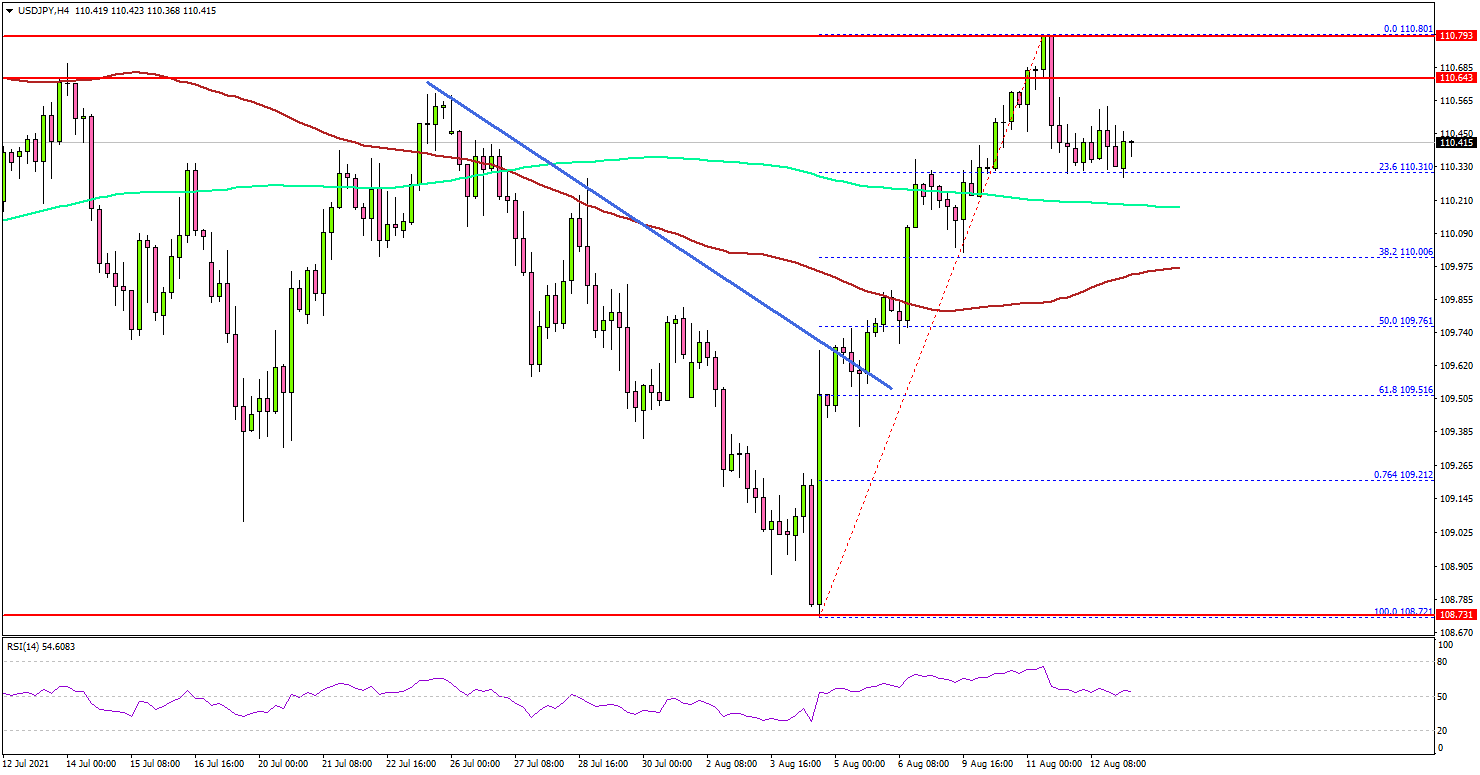
Looking at the 4-hours chart, the pair broke a major bearish trend line with resistance near 109.65. It even settled nicely above the 110.00 level, the 100 simple moving average (red, 4-hours), and the 200 simple moving average (green, 4-hours).
Finally, the pair traded to a new monthly high at 110.80 before starting a downside correction. It corrected below the 110.50 level.
USD/JPY tested the 23.6% Fib retracement level of the upward move from the 108.72 swing low to 110.80 high. The first major support is near the 110.20 level and the 200 simple moving average (green, 4-hours).
The next major support is near 110.00 and the 100 simple moving average (red, 4-hours). The main support could be near 109.75 since is coincides with the 50% Fib retracement level of the upward move from the 108.72 swing low to 110.80 high.
An immediate resistance on the upside is near the 110.65 level. The next key resistance could be 110.80, above which the pair could start a steady increase towards 111.50.
Looking at EUR/USD, the pair struggled to recover and it might resume its decline below the 1.1700 level. Similarly, GBP/USD could extend losses if it fails to stay above 1.3750.
Economic Releases
- US Import Price Index for July 2021 (MoM) – Forecast +0.6%, versus +1.0% previous.
- US Export Price Index for July 2021 (MoM) – Forecast +0.8%, versus +1.2% previous.
Market Morning Briefing: USDCNY Has Fallen From 6.4890
STOCKS
Equities remain positive. Dow sustains well above 35250 and is bullish to test 36000. DAX has broken its 15200-15800 range on the upside as expected and can now test 16000-16200 on the upside. Nikkei remains bullish to rise towards 29000-29500 while above 28000. Shanghai can move up to 3580-3600 while above 3500. Sensex and Nifty have broken their sideways consolidation and keep our bullish view intact. As mentioned earlier, Sensex and Nifty can outperform others.
Dow (35499.85, +14.88, +0.042%) sustained higher and remained stable yesterday. The view is bullish to see a rise to 36000. As mentioned yesterday, 35250-35000 will now act as a good support and limit the downside for now.
DAX (15937.51, +111.42, +0.70%) has surged yesterday, confirming the breakout of the 15200-15800 range. This keeps our bullish view intact of seeing 16000-16200 on the upside in the coming days. 15800 will now be a good resistance-turned-support and can limit the downside.
Nikkei (28057.13, +42.11, +0.15%) has come-off from yesterday’s high of 28278 but is still trading above 28000.While above 28000 the view remains bullish to see a test of 29000 and eventually 29500 in the coming weeks.
The support at 3520-3500 region on Shanghai (3524.63, −0.10, -0.003%) is holding well. The view of seeing a rise to 3560-3580 and 3600 remains intact.As mentioned yesterday, a strong rise past 3600 will be needed to become more bullish to see 3800 and also negate the danger of falling back to 3400-3300.
Sensex (54843.98, +318.05, +0.58%) has risen well above 54500 yesterday. The bullish view is intact to see 56000 on the upside in the coming days. The supports at 53500 and 53000 are likely to hold well in case of any strong pull-back.
Nifty (16364.40, +82.15, +0.50%) rose well to close above 16300 and has also broken the 16150-16350 range on the upside. This keeps our bullish view intact of seeing 16500-16600 on the upside.
COMMODITIES
Crude prices have dipped a bit and if sustains, could head towards $65. Gold needs to sustain above 1750 to head towards 1800 else a fall back to 1700 cannot be ruled out. Silver can test 23 before rising back towards 24.50. Copper needs to break above 4.40 to head higher. Watch price action in the next few sessions.
Brent (70.79) and WTI (68.57) have dipped back and trade lower. Upside is likely to be limited to 72.50-73 and 70/71 respectively as mentioned yesterday and while that holds, a fall looks more likely towards 65 on both. View is bearish while below $73.
Gold (1756.70) broke the resistance level of 1750.If gold sustains above 1750 then we expect a rise towards 1800 in the near term. However if it falls back from current levels, then we can see a fall towards 1700.The price action around 1750 needs a close watch.
Silver (23.25) has fallen in line with our expectations. It can fall to 23.15-23.00 before rising back towards 24.50.
Copper (4.3770) is almost stable. We need to see if Copper can manage to break above 4.40 to head higher towards 4.60/80 eventually. But if 4.40 holds as a resistance, it can produce rejection and push price back towards 4.20. Watch price action near 4.40 just now.
FOREX
Dollar Index continues to remain stable above 93 keeping Euro below 1.1750. We would wait and watch for further movement on both. Aussie, EURJPY and Pound look stable now. Dollar-Yen is below 110.80 and while that holds, it can trade within 110.0-110.80 before attempting to move up again. USDCNY can fall towards 6.46 while below 6.49. USDINR may hold support at 74.20 and bounce back to 74.40/50. Failure to bounce from support can take it down to 74.10/00.
Dollar Index (93.179) is almost stable and needs to see if it remains below 93.30/20 and comes off towards 93 and lower or remains stable above 93 to eventually move up. Any sharp movement on the dollar Index will decide further course of direction for other currency pairs.
Euro (1.1738) did bounce from levels just above 1.17 but has been ranged in the 1.17-.1750 region. We need to see which way the Euro moves once it breaks the mentioned range. Movement on either side cannot be rules out just now. We would wait and watch.
EURJPY (129.70) is trading within very narrow range and is likely to remain stable for some more time within 129-130.50. Unless a break on either side of the range s seen, it can continue to remain ranged.
Dollar-Yen (110.39) is trying to come off while below 110.80 but the fall does not seen to be strong. A small sideways correction looks more likely before the pair can rise again towards 111 and higher. Watch price action while below 110.80. Maximum downside can be seen near 110 within this corrective move.
Aussie (0.7345) tested 0.7329 yesterday before bouncing back from there. We may expect support near 0.7320 to hold and keep Aussie higher in the next few sessions taking it up towards 0.7350-0.74. View is bullish while above 0.73-07320.
Pound (1.3805) has fallen and failure to bounce from 1.38 can drag it lower towards 1.37 in the medium term.
USDCNY (6.4783) has fallen from 6.4890 and while that holds it can remain ranged within 6.49-4.46 in the near term. An eventual rise to 6.50 cannot be negated. Broad range of 6.50-6.45 is likely to hold for the next couple of weeks.
USDINR (74.2850) managed to close above support at 74.20 yesterday but we need to see if it sustains and rises higher towards 74.40/50 or falls below 74.20 to head towards 74.10/00. We would wait and watch as there is equal possibility to move either ways. While support at 74.20 holds, it could likely move up from there.
INTEREST RATES
The US Treasury yields have inched slightly higher. The chances of seeing an extended corrective rally remains alive before the broader downtrend resumes again. A break above the immediate resistances can trigger this rally. The German yields continue to trade stable above their key supports. We expect the yields to see a corrective bounce from here before the broader downtrend resumes. The 5Yr GoI can move up within the expected range in the neart-term and then come-off again to see a fresh fall.
The US 2Yr (0.22%) Treasury yield remains stable while the 5Yr (0.82%), 10Yr (1.35%) and the 30Yr (2%) have inched slightly higher. As mentioned yesterday the 10Yr and 30Yr has to fall below 1.3% and 1.9% respectively to see a fresh fall from here itself. Else, the yields can break 1.35% (10Yr) and 2% (30Yr) and see an extended corrective rally to 1.4%-1.45% (10Yr) and 2.1%-2.2% (30Yr) before a fresh fall is seen to resume the broader downtrend.
The German 2Yr (-0.76%), 5Yr (-0.73%), 10Yr (-0.46%) and 30Yr (-0.01%) yields continues to hover stable above their key supports. Our view remains the same. -0.45%/-0.50% (10Yr) and -0.05% (30Yr) are the key supports which we expect to hold. A corrective rally is likely to be seen in the coming weeks targeting -0.30%/-0.25% (10Yr) and 0.10% (30Yr) on the upside. Thereafter a fresh fall to resume the broader downtrend can be seen.
The 5Yr GOI (5.7435%) remains within the 5.73%-5.78% as mentioned yesterday. Within this range, a rise to 5.78% and even 5.80% looks possible to be seen first before the yield comes down again towards 5.7% eventually.