Sample Category Title
Bitcoin – Retracement Complete or Brief Pause?
Bitcoin seeing temporary resistance
Bitcoin is slightly lower on Thursday, having stalled in the middle of the week following strong rallies this month.
The 50 fib level – April highs to June lows – is putting up a bit of a fight as resistance, although I don’t think it will keep the crypto bulls at bay for much longer. This rally has some real momentum and I think we’re just seeing some brief profit taking.
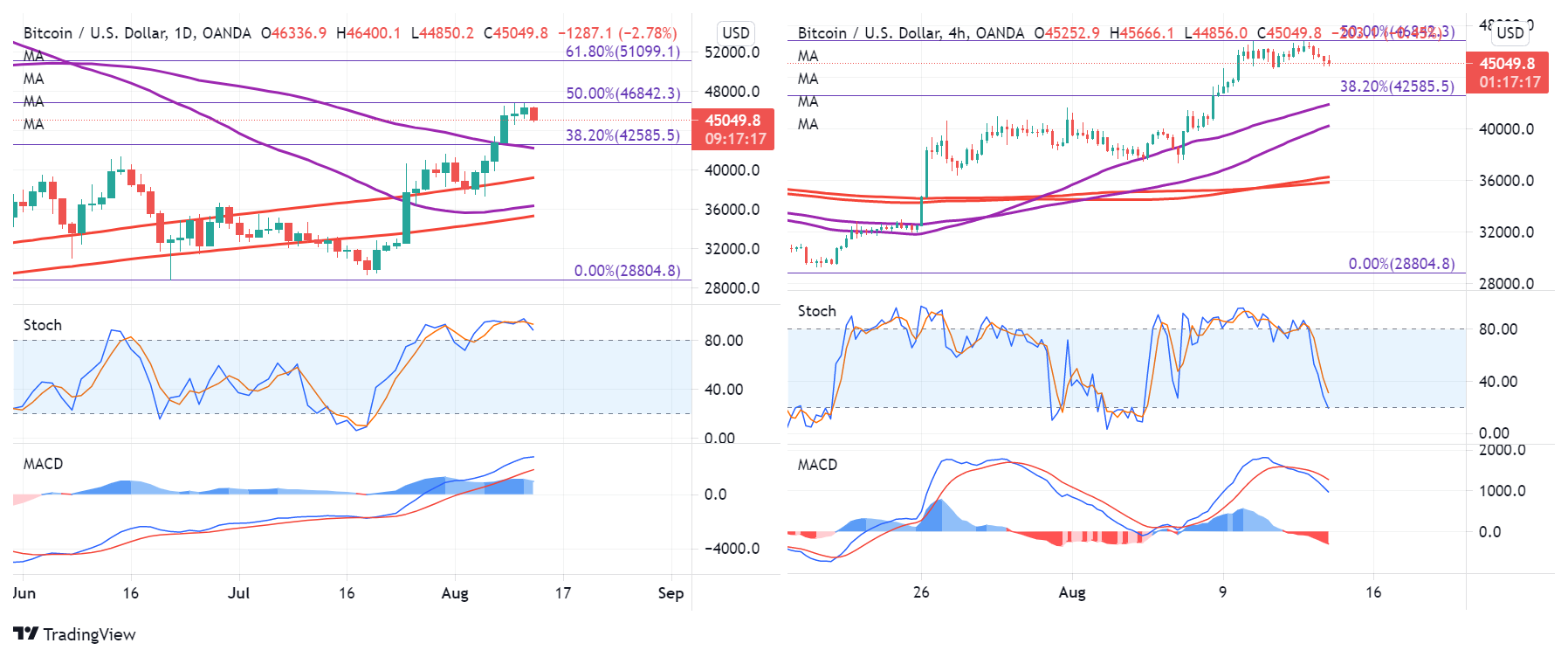
We did see the momentum indicators ease around the 50 fib level on the 4-hour chart but this may just support the profit taking theory and lead to a brief pullback.
We’re not seeing it gather any momentum to the downside although, if it does edge lower, it could see support around $42,500, which is prior support and resistance and the 38.2 fib.
The double top of the 4-hour chart would support this also, with a break of the neckline around $44,640, giving a possible price projection around that 38.2 fib level.
A move through $47,000 will see attention shift to $50,000-51,000 region where past support and resistance combines with the 61.8 fib. The psychological factor could also come into play around these big levels.
European Stocks Rally Gathering Pace
The European stock market rally is continuing and growing in strength. The German DAX and Stoxx 600 hit new record highs yesterday, the UK’s FTSE climbed to a new post-lockdown and yearly high, while the Spanish Ibex, which has been lagging, climbed to its best level since June. At the start of today’s session, there was a bit of hesitation, but the small dip was again bought, causing the markets to turn positive.
Why are the markets so strong?
European stocks have been rising for several reasons, including confidence about the global economy amid ongoing vaccinations, decent corporate earnings and the lack of much sentiment-sapping news, with investors showing not much concerns over the delta variant of coronavirus.
Central bank support
In fact, the delta variant is helping the stock markets in a big way, as it encourages major central banks such as the European Central Bank and US Federal Reserve to maintain their respective emergency stimulus measures in place for an extended period of time. The ECB in particular is in no rush to reduce its asset purchases given the comparatively lower rates of inflation across the Eurozone and a slower economic recovery than the US. The flood of cheap central bank money is driving investors into higher-yielding stock markets, as well as other sorts of risky assets such as cryptocurrencies.
Rotation to European stocks from mature US market?
With the rally on Wall Street slowing in recent times and having led the global markets for years, I wouldn’t be surprised if some investors are actively rotating out of US stocks and into Europe, where the markets have been a lot less buoyant — not just since the height of the pandemic, but also since the financial crisis. But the ECB’s growing balance sheet and steady economic progress in the Europe means investors have been warming towards EU markets more than ever.
Fed won’t apply the brakes too harshly
Meanwhile on Wall Street, valuations are sky-high - an additional reason why some investors are preferring European stocks. But there is a risk that the bubble may get very large before it eventually deflates. So, the US stock market rally may still have a lot more fuel left in the tank. There seems to be acceptance that we are getting very close to the time the Fed will start reducing its asset purchases. But investors know the Fed will not apply the brakes too harshly. Fed Chair Jay Powell is expected to provide the roadmap for tapering either at the Jackson Hole Symposium or at the FOMC’s September meeting, after several Fed officials have all recently talked in favour of reducing the massive QE programme by later this year or in early 2022.
DAX breaks out
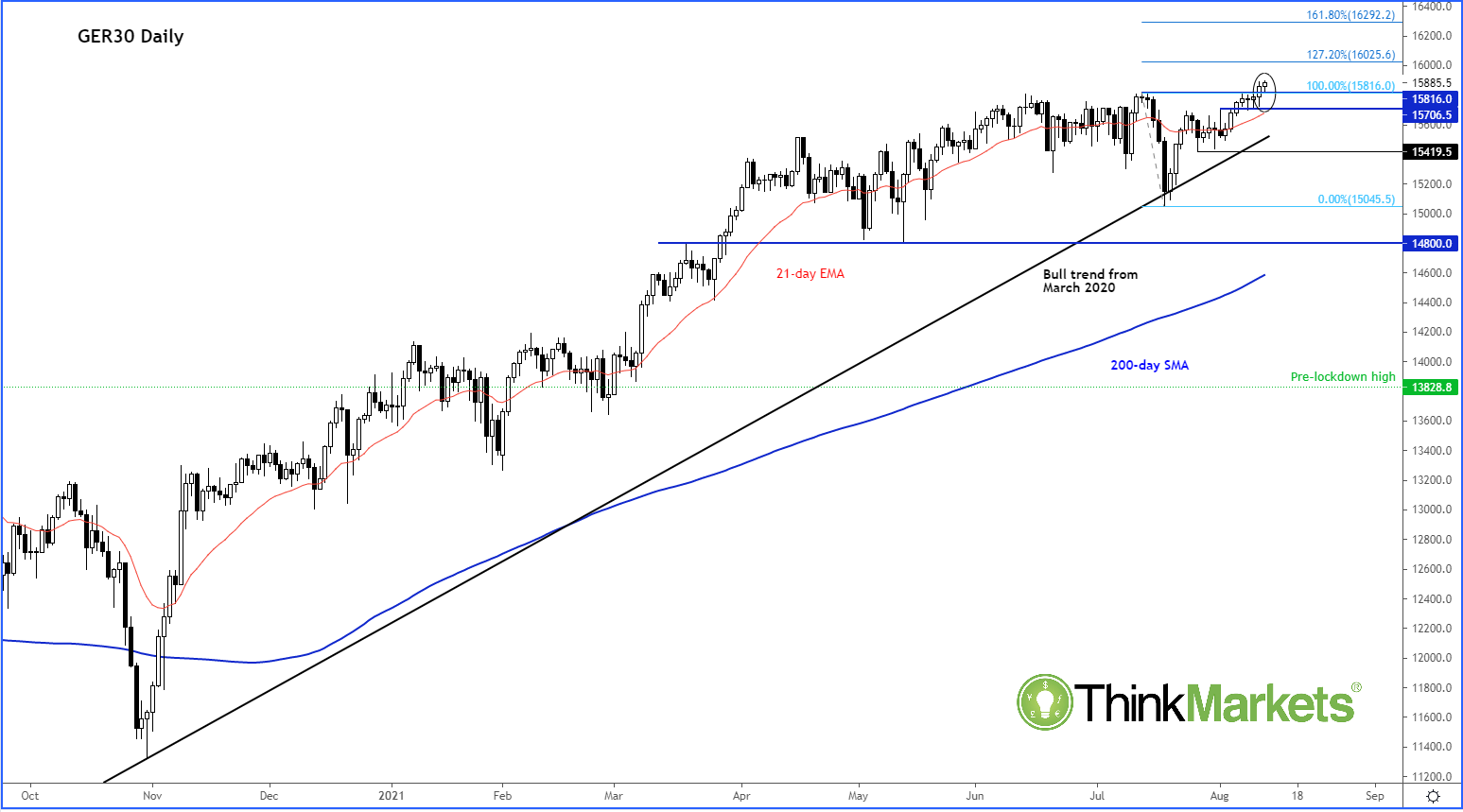
The DAX has broken above key resistance in the 15800 area, which means dips back into this zone could be supported. The trend will remain bullish until there is a break down in the market structure of higher highs and higher lows. The last low prior to the latest breakout comes in at 15045. For as long as the index holds above this level, the bullish bias would remain intact.
 FTSE hits new 2021 high
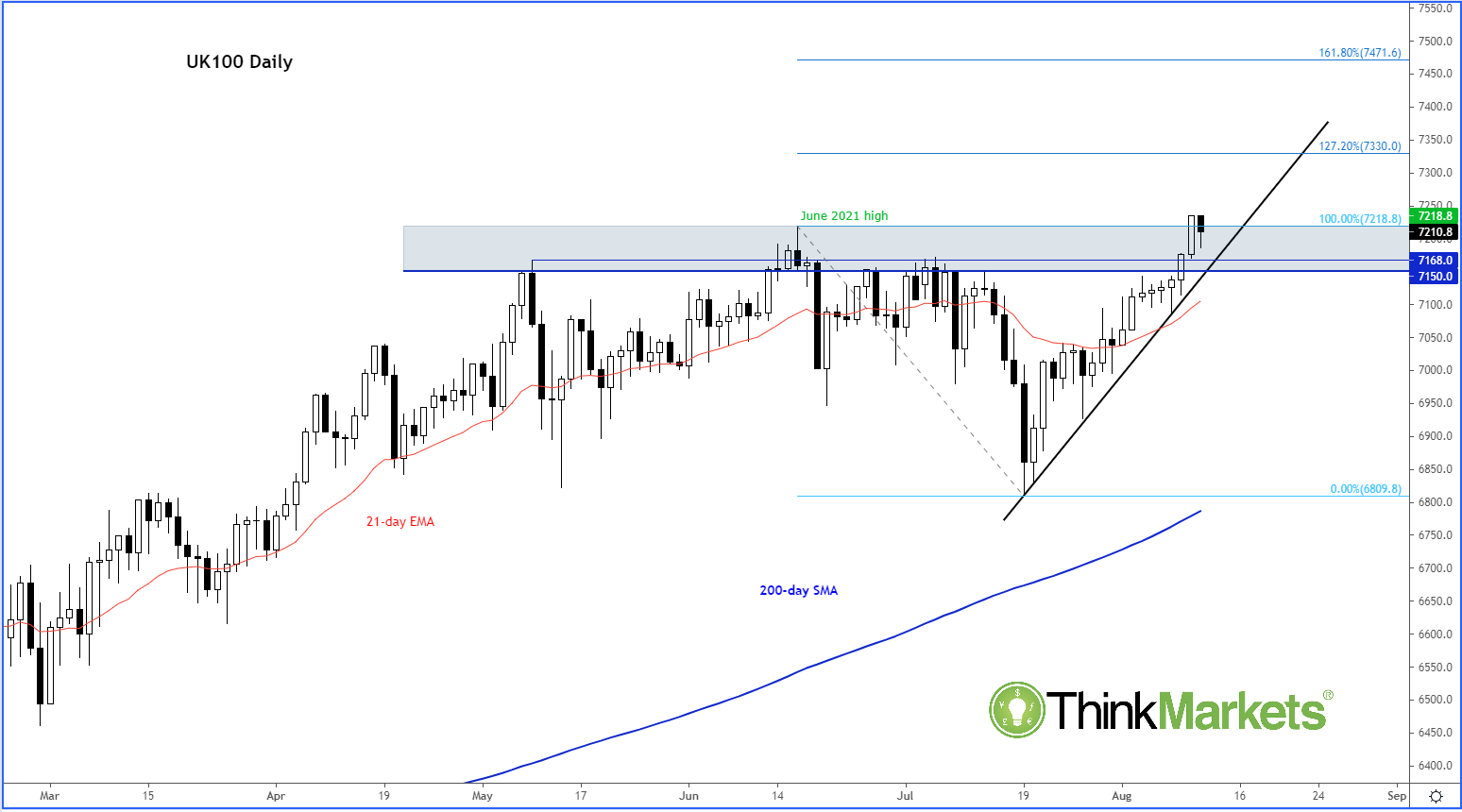
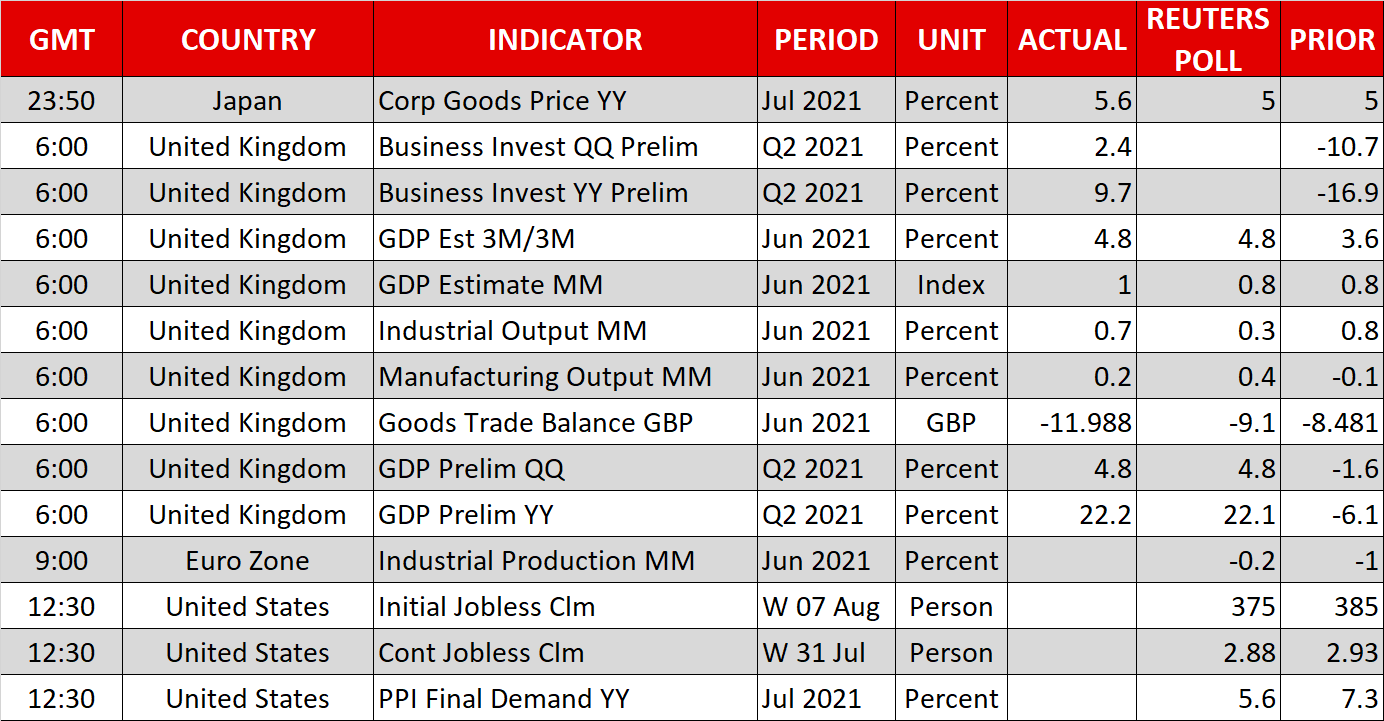
The FTSE has finally broken above its prior high, meaning the bulls are undoubtedly in control. Look for dips to be bought as the UK index plays catch up with US and European peers. Today’s news that the UK economy grew by a robust 4.8% in the second quarter after a 1% month-over-month expansion in June, both measures beating expectations, should help to maintain the positive sentiment.
Markets Flat Ahead Of PPI
Everything is looking a little flat in financial markets on Thursday, with most of Europe seeing small gains and US futures a mixed bag ahead of the open.
The week's big data release gave the markets a small bump on Wednesday as it took some of the pressure off the central bank even if it doesn't change its plans around tapering. Inflation being transitory is crucial to tightening of monetary policy is done in a gradual way and the CPI numbers aligned with the Fed's narrative around price pressures this year.
It's looking a little light on the data front for the rest of the week, with today's PPI number the only remaining release of any real significance. The data yesterday was encouraging but any signs here that it was a blip could unwind all of yesterday's good feeling and replace it with anxiety once more. Should the data offer further comfort on the other hand, equities could catch another bid and take further pressure off US yields and the greenback.
UK sees strong growth during the second quarter reopening
The UK economy is almost back to its pre-pandemic size after growing 4.8% q/q in the second quarter, leaving it only 4.4% below its peak in Q4 2019. While there was a slight downward revision to the Q1 figure and a small miss on industrial and manufacturing production, the data was very encouraging overall.
Strong growth in the second quarter was driven by consumer spending as lockdowns eased, with services output rising strongly in June ahead of the final restrictions being dropped in July. This bodes well going into the third quarter and the July number next month will be very interesting indeed, as the UK moves ever closer to fully closing the gap on lost output during the pandemic.
The country is now in a very strong position going into the end of the year and next. Of course, this is contingent on the removal of restrictions not coming back to bite the government as infections rise. But early signs are promising with the high take-up of vaccines meaning higher caseloads are not leading to nearly the same levels of hospitalizations and fatalities as before. Of course, the Autumn and Winter months bring their own challenges.
The pound initially dropped following the data release, probably as a result of q/q GDP being in line and manufacturing and industrial production missing, but it quickly rebounded to trade back around the pre-release levels. While challenges remain for the UK, the pound could benefit from the continued recovery in the months ahead.
Oil bounces back despite white house plea to OPEC
Oil prices are continuing to recover after a choppy session on Wednesday after the White House attempted to weigh in on OPEC+ output. Reports yesterday that President Biden wants the group to increase the pace at which it pares back production cuts initially sent crude prices lower, having only just rebounded off its lows earlier this week.
Prices did rebound a little later though, with a softer dollar on the back of the US inflation data contributing to the rebound. Despite the initial knee-jerk reaction, traders may also have come to the conclusion that Biden won't hold much sway in the group's decision-making, even if his comments do perhaps embolden some members that would like production to ramp up faster than the 400,000 barrels every month that was previously agreed.
But those discussions would likely have taken place anyway as the recovery gathered speed and prices remained high. The group is used to the White House attempts to pressure the group after four years of dealing with President Trump. This is nothing new and is unlikely to have any considerable impact on their output targets.
The result is that crude prices remain range-bound, with WTI seeing a broad $65-75 range and Brent $67-77. That range may narrow in the coming weeks but it seems rising delta cases around the world has temporarily put a ceiling on the rally.
Gold enjoying brief relief
Gold is enjoying some light relief after events of the last week saw the yellow metal spiral out of control on Monday. It has since bounced back, aided by the softer inflation reading on Wednesday and a slight easing of US yields and the dollar. The result is it finds itself back around $1,750 where it spent some time back in June.
Unfortunately, this time it's the wrong side of that support line that is now providing a barrier of resistance to golds recovery. While the inflation data took the pressure off, it doesn't change much as far as the Fed is concerned. Of course, it could have become much worse if the CPI data had gone the other way, hence the relief rally, but tapering is still coming and I don't think the data changes anything as far as it is concerned.
Today's PPI data may get things moving again as gold tries to push back above that $1,750 resistance. A higher than expected number could see it tumble once more though.
Bitcoin seeing temporary resistance
Bitcoin is slightly lower on Thursday, having stalled in the middle of the week following strong rallies this month. The 50 fib level - April highs to June lows - is putting up a bit of a fight as resistance, although I don't think it will keep the crypto bulls at bay for much longer. This rally has some real momentum and I think we're just seeing some brief profit taking.
We're not seeing it gather any momentum to the downside although, if it does edge lower, it could see support around $42,500, which is prior support and resistance and the 38.2 fib. A move through $47,000 will see attention shift to $50,000-51,000 region where past support and resistance combines with the 61.8 fib. The psychological factor could also come into play around these big levels.
UK Q2 GDP Rebounds As Restrictions Eased
Notes/Observations
- UK Q2 GDP rebounds as virus restrictions were lifted; Q3 outlook may not be as rosy.
- IEA cut its 2021 oil demand forecast citing resurgent pandemic hitting major consumers, and predicted a new inventory surplus in 2022.
Asia
- Fitch affirms Japan sovereign rating at A; outlook negative.
- Increased calls by economists in China for the PBoC to loosen monetary policy.
Coronavirus
- UK Dept of Health stated that self-isolation requirement removed for 'double jabbed close contacts', effective from Aug 16th,. Fully vaccinated individuals will not longer be legally required to isolate themselves even with a positive Covid contact.
Europe
- Upcoming UK three-year spending review said to have ministers planning to cut thousands of civil service jobs.
Americas
- Fed's George (non-voter): Time has come to dial back the settings for monetary policy.
- Fed's Daly (non-voter, dove) reiterated view that Fed could begin asset purchase tapering by end of year.
- Sec of State Deputy Sherman said to meet with the new China Ambassador on Aug 12th
Speakers/Fixed income/FX/Commodities/Erratum
Equities
- Indices [Stoxx600 +0.08% at 474.68, FTSE -0.10% at 7,212.65, DAX -0.14% at 7,210.35, CAC-40 +0.13% at 6,866.83, IBEX-35 +0.17% at 8,991.00, FTSE MIB +0.25% at 26,522.50, SMI +0.28% at 12,423.02, S&P 500 Futures -0.03%].
- Market Focal Points/Key Themes: European indices open mixed but moved to trade slightly higher later in the session; sectors trending to the upside include consumer discretionary and telecom; sectors trending to the downside include financials and materials; travel and leisure subsector supported following results from Accor, TUI; insurance subsector supported by results from Aegon, Zurich Insurance; Stock Spirits recieves takeover offer from CVC; Norway Royal Salmon receives improved offer; focus on upcoming emerging markets rate decisions, FDA covid vaccine third-dose approval; earnings expected during the upcoming US session include Brookfield Asset Management, Baidu.com and Broadridge Financial.
Equities
- Consumer discretionary: Cineworld [CINE.UK] +7% (earnings; outlook), Stock Spirits [STCK.UK] +42% (offer), TUI [TUI1.DE] +2% (earnings), Delivery Hero [DHER.DE] -3% (earnings; raises guidance)
- Financials: Aviva [AV.UK] +2% (earnings).
- Industrials: Henkel [HEN3.DE] -3% (earnings), Orsted [ORSTED.DK] -2% (earnings), Ceconomy [CEC.DE] -3% (earnings).
- Telecom: Deutsche Telekom [DTE.DE] +2% (earnings).
Speakers
- UK Chancellor of the Exchequer (Fin Min) Sunak stated that the domestic economy was recovering very strongly. Would not return to austerity.
- Norway Central Bank (Norges) 2Q Survey of Bank Lending saw little change in credit demand. Banking sector expected little change ahead in credit demand, credit standards and loan conditions.
- Philippines Central Bank Policy Statement reiterated stance to keep accommodative monetary policy for as long as needed. Policy support to stay in order to support economic recovery. Virus restrictions could pose risk to economic recovery. Staff Forecasts raised its 2021 CPI from 4.0% to slightly above 4.0% and raised 2022 CPI from 3.0% to 3.1%.
- IEA Monthly Oil Report cut its 2021 global oil demand growth from 5.4M bpd to 5.3M bpd citing the due to the spread of the COVID-19 Delta variant while rai sing the 2022 global oil demand growth from 3.0M bpd to 3.2M bpd.
Currencies/Fixed income
- USD was steady and just off its recent four-month highs against major peers. Greenback finding some headwinds after Wed’s US CPI reading tempered bets for an earlier tightening of US monetary policy (dealers noted that inflation isn't running away).
- EUR/USD steady in quiet trading with pair stuck around 1.1740 in the session.
- GBP/USD was little phased after a strong Q2 GDP reading. Strong growth was expected after the easing of some coronavirus restrictions, but the outlook for Q3might not be so rosy.
Economic data
- (FI) Finland Jun Final Retail Sales Volume Y/Y: 4.3% v 3.6% prelim.
- (FI) Finland Jun Current Account Balance: €0.7B v €0.1B prior.
- (UK) Q2 Preliminary GDP Q/Q: 4.8% v 4.8%e; Y/Y: 22.2% v 22.1%e.
- (UK) Jun Monthly GDP M/M: 1.0% v 0.8%e.
- (UK) Q2 Preliminary Private Consumption Q/Q: 7.3% v 5.5%e; Government Spending Q/Q: 6.1% v 1.8%e; Gross Fixed Capital Formation Q/Q: -0.5% v +2.5%e; Exports Q/Q: 3.0% v 8.3%e; Imports Q/Q: 6.5% v 8.2%e.
- (UK) Q2 Preliminary Total Business Investment Q/Q: 2.4% v 6.0%e; Y/Y: 9.7% v 20.4%e.
- (UK) Jun Industrial Production M/M: -0.7% v +0.3%e; Y/Y: 8.3% v 9.4%e.
- (UK) Jun Manufacturing Production M/M: 0.2% v 0.4%e; Y/Y: 13.9% v 13.4%e.
- (UK) Jun Construction Output M/M: -1.3% v +1.0%e; Y/Y: 30.0% v 56.5% prior.
- (UK) Jun Visible Trade Balance: -£12.0B v -£9.2Be; Overall Trade Balance: -£2.5B v +£0.4Be; Trade Balance Non EU: -£7.1B v -£4.2B prior.
- (UK) Jun Index of Services M/M: 1.5% v 0.9%e; 3M/3M: 5.7% v 5.7%e.
- (TR) Turkey Jun Industrial Production M/M: 2.3% v 2.1%e; Y/Y: 23.9% v 21.7%e.
- (IT) Italy Jun Total Trade Balance: €5.7B v €5.6B prior; Trade Balance EU: €0.9B v €0.9B prior.
- (PH) Philippines Central Bank (BSP) left the Overnight Borrowing Rate unchanged at 2.00% (as expected).
- (EU) Euro Zone Jun Industrial Production M/M: -0.3% v -0.2%e; Y/Y: 9.7% v 10.4%e.
- (IS) Iceland Q2 Unemployment Rate: 7.9% v 7.7% prior.
- (GR) Greece Jun Unemployment Rate: 15.0% v 15.8% prior.
Fixed income issuance
- None seen.
Looking ahead
- OPEC Monthly Oil Report.
- 05:25 (EU) Daily ECB Liquidity Stats.
- 06:00 (IE) Ireland July CPI M/M: No est v 0.2% prior; Y/Y: No est v 1.6% prior.
- 06:00 (IE) Ireland July CPI EU Harmonized M/M: No est v 0.1% prior; Y/Y: No est v 1.6% prior.
- 06:00 (IE) Ireland Jun Property Prices M/M: No est v 0.9% prior; Y/Y: No est v 5.5% prior.
- 06:00 (IL) Israel July Trade Balance: No est v -$3.4B prior.
- 06:00 (RO) Romania to sell ROM300M in 3.7% 2024 Bonds.
- 06:45 (US) Daily Libor Fixing.
- 07:00 (TR) Turkey Central Bank (CBRT) Interest Rate Decision: Expected to leave One-Week Repo Rate unchanged at 19.00%.
- 08:00 (IN) India Jun Industrial Production Y/Y: 14.2%e v 29.3% prior.
- 08:00 (IN) India July CPI Y/Y: 5.7%e v 6.3% prior.
- 08:00 (BR) Brazil Jun IBGE Services Sector Volume Y/Y: 18.2%e v 23.0% prior.
- 08:00 (UK) Daily Baltic Dry Bulk Index.
- 08:30 (US) July PPI Final Demand M/M: 0.6%e v 1.0% prior; Y/Y: 7.2%e v 7.3% prior.
- 08:30 (US) July PPI (ex-food/energy) M/M: 0.5%e v 1.0% prior; Y/Y: 5.6%e v 5.6% prior.
- 08:30 (US) July PPI (ex-food/energy/trade) M/M: 0.5%e v 0.5% prior; Y/Y: 5.7%e v 5.5% prior.
- 08:30 (US) Initial Jobless Claims: 375Ke v 385K prior; Continuing Claims: 2.90Me v 2.930M prior.
- 08:30 (US) Weekly USDA Net Export Sales.
- 09:00 (RU) Russia Gold and Forex Reserve w/e Aug 6th: No est v $599.6B prior.
- 10:30 (US) Weekly EIA Natural Gas Inventories.
- 11:00 (CO) Colombia Jun Manufacturing Production Y/Y: 16.5%e v 8.6% prior.
- 11:00 (CO) Colombia Jun Retail Sales Y/Y: 20.6%e v 22.8% prior.
- 11:30 (US) Treasury to sell 4-Week and 8-Week Bills.
- 13:00 (MX) Mexico July Total Formal Job Creation: No est v +65.9K prior.
- 13:00 (US) Treasury to sell 30-Year Notes.
- 14:00 (MX) Mexico Central Bank (Banxico) Interest Rate Decision: Expected to raise Overnight Rate by 25bps to 4.50%.
- 15:00 (AR) Argentina July National CPI M/M: 3.0%e v 3.2% prior; Y/Y: 51.7%e v 50.2% prior.
- 15:00 (CO) Colombia Jun Industrial Production Y/Y: No est v 6.4% prior.
- 17:00 (KR) South Korea July Import Price Index M/M: No est v 2.3% prior; Y/Y: No est v 14.0% prior.
- 17:00 (KR) South Korea July Export Price Index M/M: No est v 0.7% prior; Y/Y: No est v 12.7% prior.
- 18:30 (NZ) New Zealand July Manufacturing PMI: No est v 60.7 prior.
- 18:45 (NZ) New Zealand Jun Net Migration: No est v 1.2K prior.
- 19:00 (PE) Peru Central Bank (BCRP) Interest Rate Decision: Expected to leave Reference Rate unchanged at 0.25%.
- 22:30 (KR) South Korea to sell KRW400B in 50-year Bonds.
- 23:00 (CN) China to sell 30-year Upsize Bond.
- 22:30 (JP) Japan to sell 3-Month Bills.
US Inflation May Have Peaked, Dollar Rally Cools
- US CPI unchanged in July as Fed hawks get louder
- Dollar and yields pull back slightly but remain supported by tapering bets
- US stocks extend record streak as Senate opens path for $3.5 trillion budget plan
Inflation fears ease after CPI in line
The rate of inflation in the United States remained at a 13-year high in July according to the consumer price index out yesterday. But there was good news for both consumers and policymakers as price pressures for some of the categories such as used cars and airfares that had surged in recent months appeared to be easing.
CPI rose 0.5% month-on-month and 5.4% annually in July, both broadly in line with expectations. The core rate moderated from 4.5% to 4.3% y/y, in a further sign that price growth may have peaked already as some of the effects from last year’s lockdowns and subsequent reopening, which sparked massive supply-chain issues and unleashed pent-up demand, are subsiding.
However, even if that is the case, there are still plenty of inflationary forces at play that are unlikely to disappear overnight and that raises the question of how quickly inflation will fall back towards the Fed’s 2% objective.
The Fed’s more hawkish policymakers have been getting itchy of late. The Kansas City Fed’s George and Dallas Fed’s Kaplan were the latest to call or repeat the need for the monthly pace of asset purchases to be pared back.
However, others are still cautious, with Richmond Fed President Thomas Barkin joining Evans in suggesting that it may take a few more months for the conditions for tapering to be met. The apparent splits within the FOMC are casting some uncertainty over the likelihood of the Fed being able to send clear tapering signals at the Jackson Hole conference that’s coming up later this month.
Dollar steady, euro fights back, pound unmoved by GDP jump
Nevertheless, there can be no doubt that tapering is on the cards at some point over the coming months, hence why there was only a modest retreat in Treasury yields and the US dollar after the CPI data. The 10-year yield has fallen slightly below 1.35% but is still sharply above where it was a week ago.
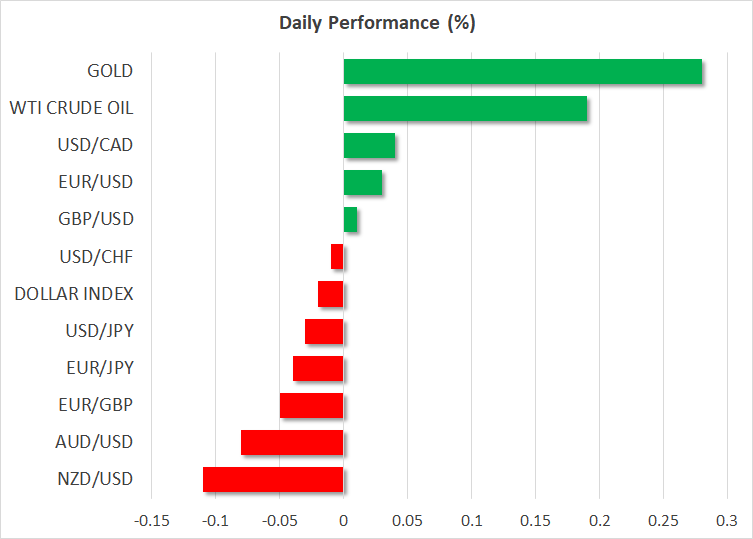
The dollar, meanwhile, remains bullish despite this minor stumble. The pound, aussie and kiwi were all back under pressure on Thursday, though the euro and loonie were attempting to edge up versus the greenback. The euro seems to be attracting some buyers after managing to avoid a drop below its March trough of $1.1702 on Wednesday.
There was little reaction in sterling to UK GDP numbers that showed the British economy expanded by a solid 4.8% in the second quarter, taking the annual growth rate to 22.2%. US producer prices and weekly jobless claims will be watched later in the day. But unless there are any huge surprises, the dollar is unlikely to be spurred much by the data.
In commodities, there was some much needed reprieve for gold as the selloff in Treasuries cooled and yields came off their highs. The precious metal continued to climb today, reaching the $1,755/oz vicinity. But oil prices were struggling a bit after the White House yesterday called on OPEC producers to pump more oil to ease rising fuel costs.
Yet more records for Wall Street
On Wall Street, it was another record session on Wednesday as Congress made more progress towards fulfilling President Biden’s goal of a once-in-a-generation infrastructure spending spree. The Senate approved a budget resolution that would allow the passage of a $3.5 trillion spending plan.
However, there are already signs of divisions among Democrats so the final price tag of the bill will likely be lower. But investors are betting that a sizeable package will get through and the prospect of continued fiscal support for the American economy is offsetting immediate anxieties about reduced monetary stimulus over the next few years.
Once again, tech stocks lagged yesterday, pulling the Nasdaq Composite down by 0.2%. But the Dow Jones and S&P 500 posted yet another record close, with Dow constituents leading the way. In Europe, shares were mostly in the green today, but Delta fears weighed slightly on Asian equities as regional virus numbers and tighter restrictions continued to worry markets.
US stock futures were more or less flat on Thursday, with Disney earnings (due after the market close) in focus for traders.
The Inflation Slowdown In The US Has Eased Investors’ Fears About The Fed’s Reduction Of The QE Program
According to the US Labor Department, the consumer price index (CPI) decreased from 0.9% to 0.5%. The core CPI, which does not include food and fuel prices, fell from 0.9% to 0.3%. On a year-on-year basis, the inflation remained at 5.4%, in line with forecasts. Core annual inflation decreased to 4.3% from 4.5%. The US inflation growth is slowing down, easing investors’ fears that the Federal Reserve will reduce its QE program soon. Considering this news, the dollar index decreased by 0.16%. The Dow Jones Industrial Average and the S&P 500 closed at record highs, while sectors related to economic growth rose following the signing of the infrastructure bill. The Dow Jones index added 0.62%, the S&P 500 index increased by 0.25%, and the Nasdaq index decreased by 0.16% again.
European stock indices also hit new price records. The STOXX 600 composite index increased by 0.4%, hitting an all-time high for the eighth consecutive trading session. The good report results from the EU companies over the past quarter compensate for the concerns about a new wave of COVID-19 and weak European statistics. Famous airline JetBlue started transatlantic flights from the US to London despite the rise of the Delta strain cases in the US.
The White House appealed to OPEC+ countries to increase oil production in order to increase supply in the market. Obviously, the US is against the rising of fuel prices. Meanwhile, last week's US crude oil inventories data showed that Americans themselves are not eager to increase domestic oil production.
Due to the fall of the dollar index and reducing the yields of US government bonds, gold futures added 1.26%. Buy the rumor, sell the fact. For now, rumors on QE program cuts are just rumors, so gold and silver will rise in the coming weeks.
Asia-Pacific stock indices are declining. The region remains concerned about the recent tightening of the control of Chinese regulators over a number of companies, as well as due to the widespread of the Delta strain cases. Low vaccination rates are one of the main reasons for this dramatic outbreak. A review of inflation expectations from the Reserve Bank of New Zealand (RBNZ) predicts a sharp rise in inflation from 1.87% to 3.02% by the end of the year. New Zealand's strong economic recovery, rapidly declining unemployment rate, and rapidly rising house prices triggered RBNZ to open the issue of reducing stimulus.
Main market quotes:
- S&P 500 (F) 4,447.70 +10.95 (+0.25%)
- Dow Jones 35,484.97 +220.30 (+0.62%)
- DAX 15,826.09 +55.38 (+0.35%)
- FTSE 100 7,220.14 +59.10 (+0.83%)
- USD Index 92.90 -0.16 (-0.17%)
Important events for today:
- New Zealand RBNZ Inflation Expectations (q/q) at 06:00 (GMT+3);
- Japan Industrial Production (m/m) at 07:30 (GMT+3);
- UK GDP (q/q) at 09:00 (GMT+3);
- UK Industrial Production (m/m) at 09:00 (GMT+3);
- UK Manufacturing Production (m/m) at 09:00 (GMT+3);
- Eurozone Industrial Production (m/m) at 12:00 (GMT+3);
- US Producer Price Index (m/m) at 15:30 (GMT+3);
- US Initial Jobless Claims (w/w) at 15:30 (GMT+3);
- US Natural Gas Storage (w/w) at 17:30 (GMT+3).
Asian Equities Are Non-Descript
It looks to be a reasonably neutral day in Asia, with US Inflation data coming in on forecasts and failing to provide any directional momentum for Asia. The exception is Mainland China, where markets are lower as Bloomberg reports that the insurance industry may be the next one in Xi Jinping’s crosshairs. They also reported that overnight, China’s State Council and Communist Party Central Committee jointly released a document outlining a five-year plan to increase supervision of key industries.
With China’s regulatory crackdown now seemingly set for years ahead, Mainland equities have retreated, but not markedly so, hinting that investors are being more accepting of the “new normal.” The Shanghai Composite is 0.15% lower, but once again, the CSI 300 has retreated by 0.60%, with Hong Kong unchanged. Although regulatory threats have had a modest impact today, the lesson seems to be that gains in China stock will be limited for some time because of them. I doubt the cheapness of price to governmental risks ratio for China equities has finished its repricing exercise lower yet.
Elsewhere, Wall Street had a mixed night, with rotation into growth evident again after US inflation data passed without incident. The S&P 500 rose 0.25%, while the Nasdaq fell by 0.16%, with the Dow Jones once again outperf0orming, rising by 0.63%. In Asia, US futures are basically unchanged.
That has left Asia drifting with the Nikkei 225 and Kospi unchanged for the session. Taipei has edged 0.15% lower, with Singapore rising by 0.30% and Kuala Lumpur unchanged. Jakarta has risen 0.55%, while Bangkok has retreated by 0.55%, with Manila slumping 1.15% ahead of the BSP policy decision. Australia’s ASX 200 and All Ordinaries are unchanged.
With Asia caught between delta-variant and China regulatory risks on one side and a US economy still on its recovery track on the other, Europe is likely to open neutral to slightly higher. This evening, it would be a huge surprise if the US data stopped the party early for US equities.
The US Dollar Edges Low Post-US Inflation
Currency markets remain in a holding pattern erring toward tapering and US Dollar strength. The US inflation data, which came in precisely on forecasts, gave no new impetus to send currency markets one way or the other. That saw some profit-taking on long US Dollar positioning wash through the market, and the dollar index retreated slightly, falling 0.19% to 92.90. Failure of the index’s resistance at the 93.20 double top and support at 92.60, its previous breakout, will signal the US Dollar’s next directional move.
EUR/USD recovered modestly on US Dollar weakness overnight, rising to 1.1745 this morning. Resistance is nearby at 1.1750, with support at 1.1700. Sterling’s price action is more constructive, GBP/USD rising to 1.3870 in Asia. It has support at 1.3800 and depending on the outcome of the UK data dump. This afternoon, it could challenge resistance at 1.3900, which would signal further gains towards the critical 1.4000 pivot-point. A slight fall in US bond yields overnight sees USD/JPY retreating slightly to 110.40 today, although as long as US yields remain at these levels, USD/JPY will remain limited.
AUD/USD has moved back into its rising wedge, trading at 0.7365 this morning. It looks stuck in a 0.7300 to 0.7400 range for now as the virus situation in the lucky country weighs on the topside. NZD/USD rose impressively by 0.48% to 0.7035 after neutral US inflation data and looks increasingly likely to challenge its 100-day moving average at 0.7100. With the RBNZ set to hike interest rates next week, NZD/USD should find plenty of willing buyers on any dips to 0.7000 now.
Asian currencies had a mixed overnight session, MYR. IDR and KRW were easing despite the neutral inflation data, while the THB rallied by over 1.0% as traders took back short positions. Asian currencies remain vulnerable to worsening delta-variant scenarios and a stronger US Dollar, with another Fed official talking tapering overnight. The US Dollar remains bid despite its modest retreat overnight, and unless the Fed tapering talk dies down, the upside for Asian regional currencies will remain limited.
Oil Rallies And Gold Bugs Seize The Moment
Oil rallies on US Crude Inventories.
The tail-chasing by short-term speculators continued overnight, with oil rallying after the official US Crude Inventory and Gasoline Inventories remained in negative territory. President Biden’s call OPEC to increase oil production so that he doesn’t have to in the US rightfully fell on deaf ears.
Brent crude rose by 1.05% to $71.60 a barrel, edging lower to $71.45 in Asia. WTI rose by 1.25% to $69.30 a barrel, where it remains unchanged in moribund Asian trading. In the near-term, oils direction is being dominated by fast-money short-term speculators, and the prices gains of the past two days do not represent a change in structural sentiment.
Given the above, it is a little hard to predict oil’s short-term direction as the herd could change direction at any moment. Looking at oil on a longer-term basis, the global recovery remains on track, albeit in a now very uneven way dictated by the vaccine haves and the have nots. As such, I believe that oil is a buy on dips, although I acknowledge those dips have been frisky of late. Only mass virus lockdowns in China for an extended period would sharply change that narrative.
In the short term, Brent crude has resistance at $71.75 and $72.50 a barrel, with support at $70.00 and $69.00 a barrel. WTI has resistance at $69.50 and $70.00 a barrel, while support is distant at $66.50 a barrel.
Gold bugs seize the moment
Gold rallied hard overnight following on target US inflation data. The fast-money FOMO crowd were out in force in a show of hope over reality, sending gold 1.30% higher to $51.50 an ounce. That has left gold’s daily chart looking surprisingly like Brent crude and WTI’s over the past few sessions, with volatility probably not too different either.
While it is clear that many of those who were culled out of long positions in the Monday flash-crash rushed to reinstate longs overnight, it would be remiss not to point out some FOMO warning signs:
- The US Dollar has hardly budged post the inflation data, easing only slight.
- US yields have hardly budged either, holding onto most of this week’s increases.
- The rally overnight moved the Relative Strength Index (RSI) out of its oversold territory, the only indicator I believed offered genuine support to gold in the short term.
If the US Dollar resumes its upward climb, the pressure on gold is likely to return, and one can be confident that the herd buying overnight will have zero tolerance for negative mark-to-markets.
Gold has gained one dollar to $1752.50 an ounce in Asia, holding above the critical $1750.00 level, but not convincingly. A fall back through $1745.00 is likely to see a rush for the tail-chasing exit door, with losses potentially extending to $1725.00 an ounce. Gold has resistance at $1765.00 an ounce, followed by $1800.00 an ounce. Some sideways consolidation between $1745.00 and $1765.00 an ounce would raise my bullish confidence levels, but I remain highly suspicious of the overnight rally for now.
EURUSD Is Possibly Bullish
Technical analysis
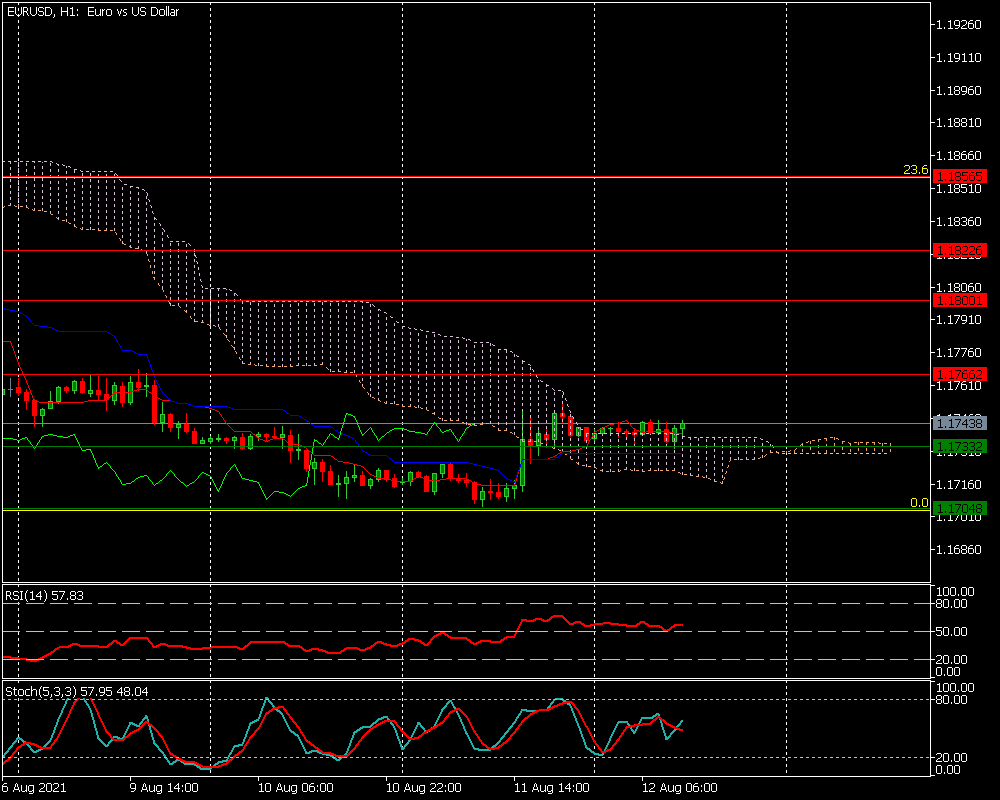
The RSI is above line 50, indicating that an uptrend may prevail
The Ichimoku indicator displays a bullish sentiment
The Stochastic suggests a possible upward correction.
What the possible outcomes are
In our most likely scenario, the EURUSD pair may attempt to recover towards the first resistance level of 1.17662.
If the pair surpasses the first resistance level, we should expect a continued surge towards the second resistance level of 1.18001.
Alternatively, the EURUSD pair may decline to the first support level of 1.17332.
A pass below the first level can move the price up lower toward 1.17048.
Key levels
Support 1.17048 1.7332
Resistance 1.17662 1.18001