Sample Category Title
EUR/USD Potential Target At 1.1806
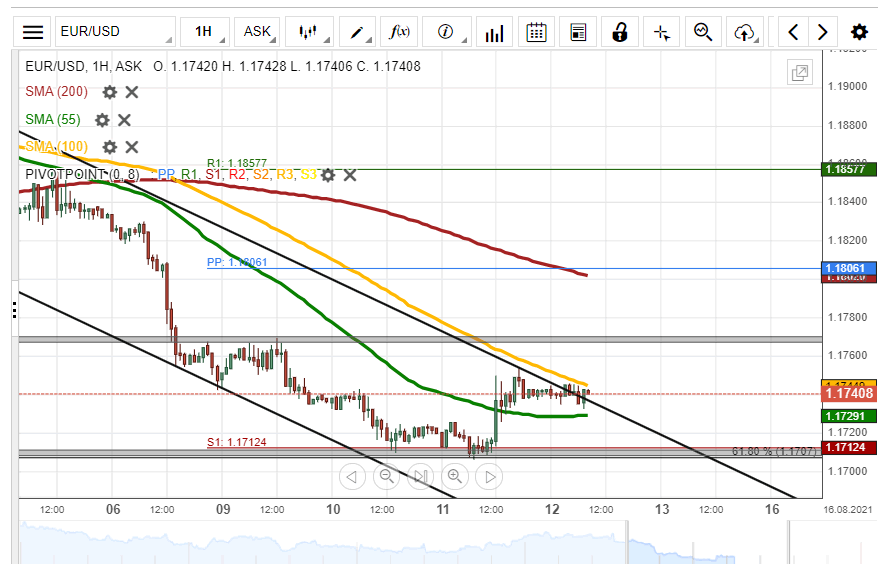
The common European currency surged by 41 pips or 0.35% against the US Dollar on Wednesday. The currency pair tested the upper line of a descending channel pattern during yesterday's trading session.
The exchange rate could continue to edge higher during the following trading session. The potential target for the EUR/USD pair would be near the resistance cluster at 1.1808.
However, the 100– hour simple moving average at 1.1751 could provide resistance for the currency exchange rate in the shorter term.
US Oil Attempts Rebound
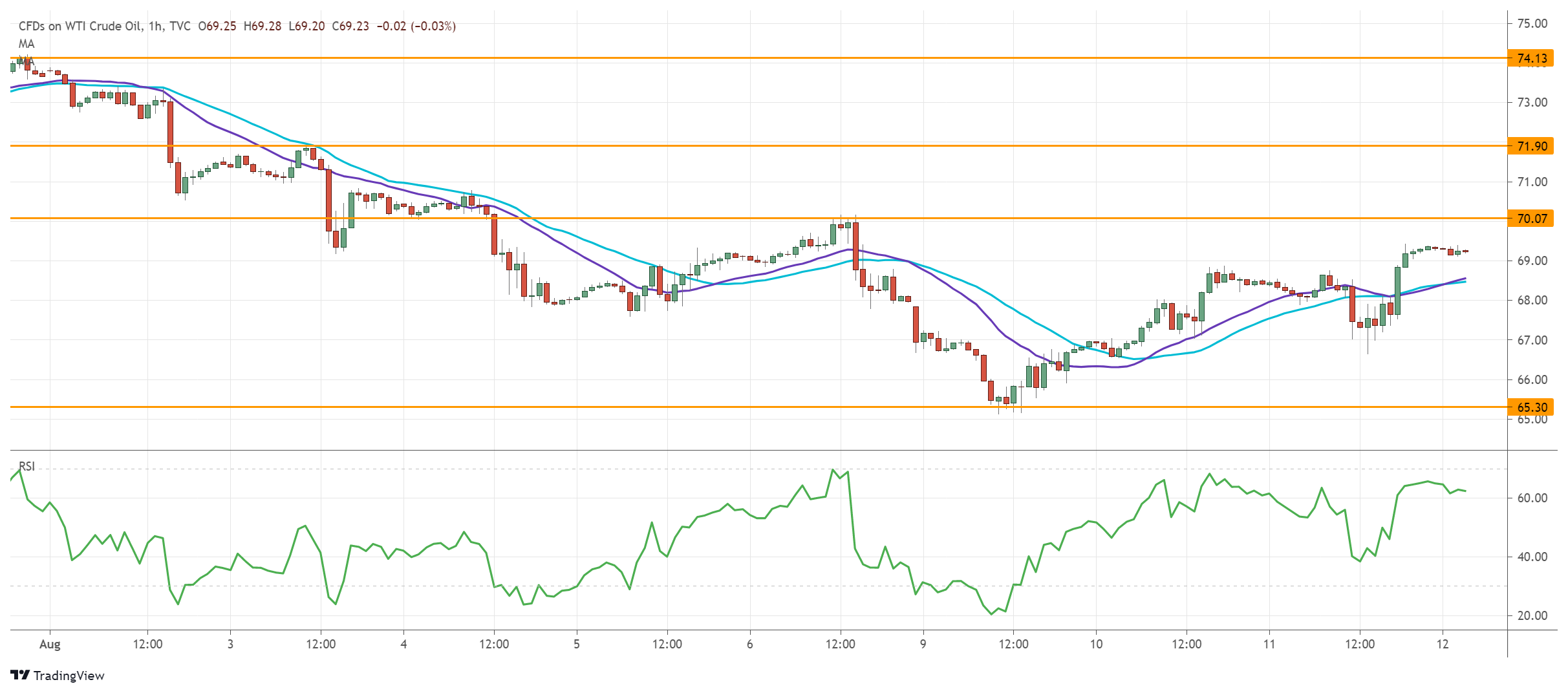
WTI crude recouped losses after the US inventory showed a deficit last week.
Strong buying interest on the daily support line at 65.30 has initiated a rebound. However, a bearish MA cross on the daily chart may have tempered the bullish mood.
The bulls will need to lift the psychological level of 70.00 as a show of strength. Then they may have a chance to grind past 74 and preserve the rally.
Failing that, a break below the said support may trigger a bearish reversal towards last May’s low at 61.50.
AUD/USD Tests Key Resistance
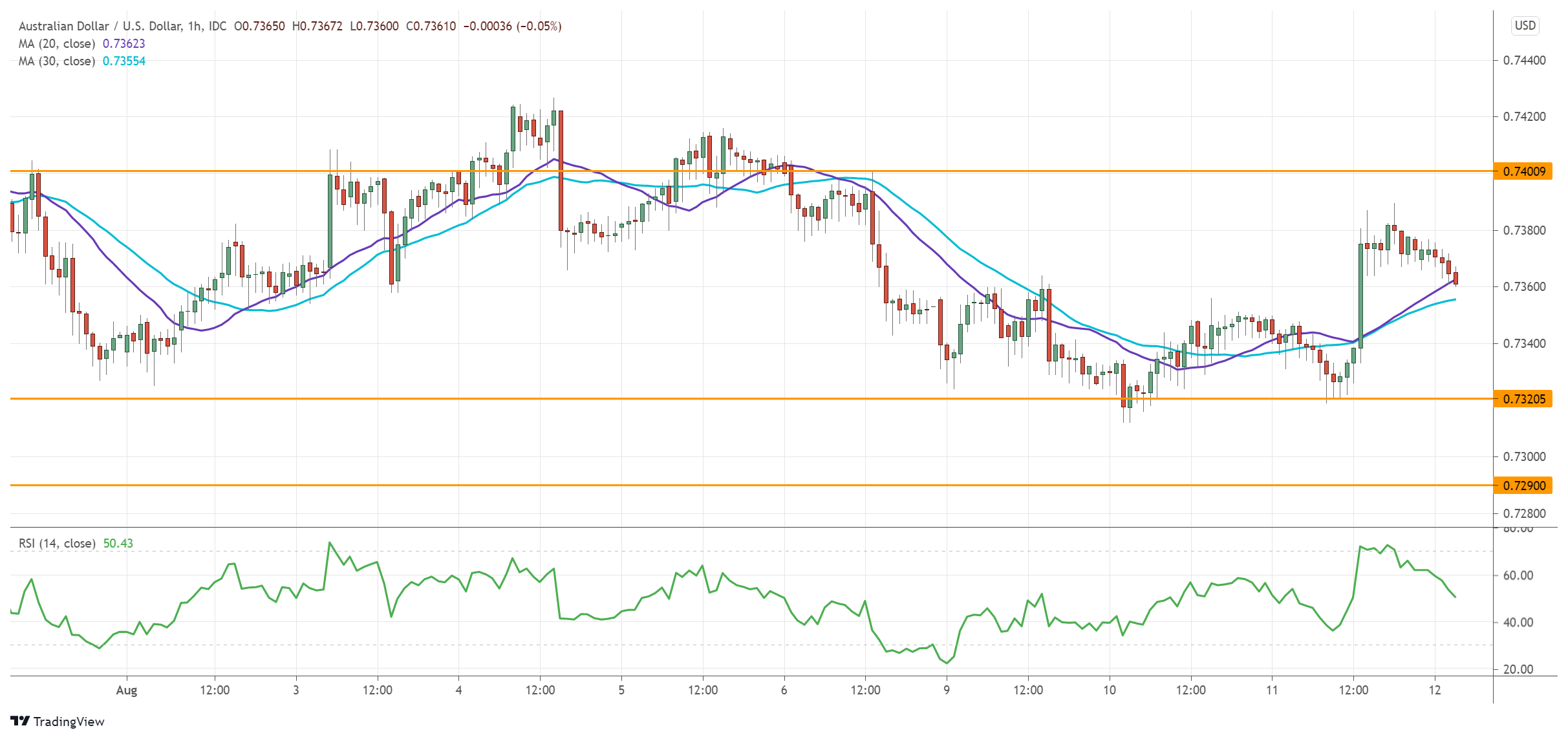
The Australian dollar hit resistance after worse-than-expected consumer inflation expectations.
The pair is still under pressure after it met stiff selling pressure at the 20-day moving average (0.7400).
The drop below the key support at 0.7330 may have threatened the chance of a sustainable rebound. Only a bullish close above 0.7400 would bring back confidence to the bulls.
Otherwise, past 0.7320 the bears would challenge the floor at 0.7290. A breakout could trigger an extended sell-off as those who bought the dip switch side.
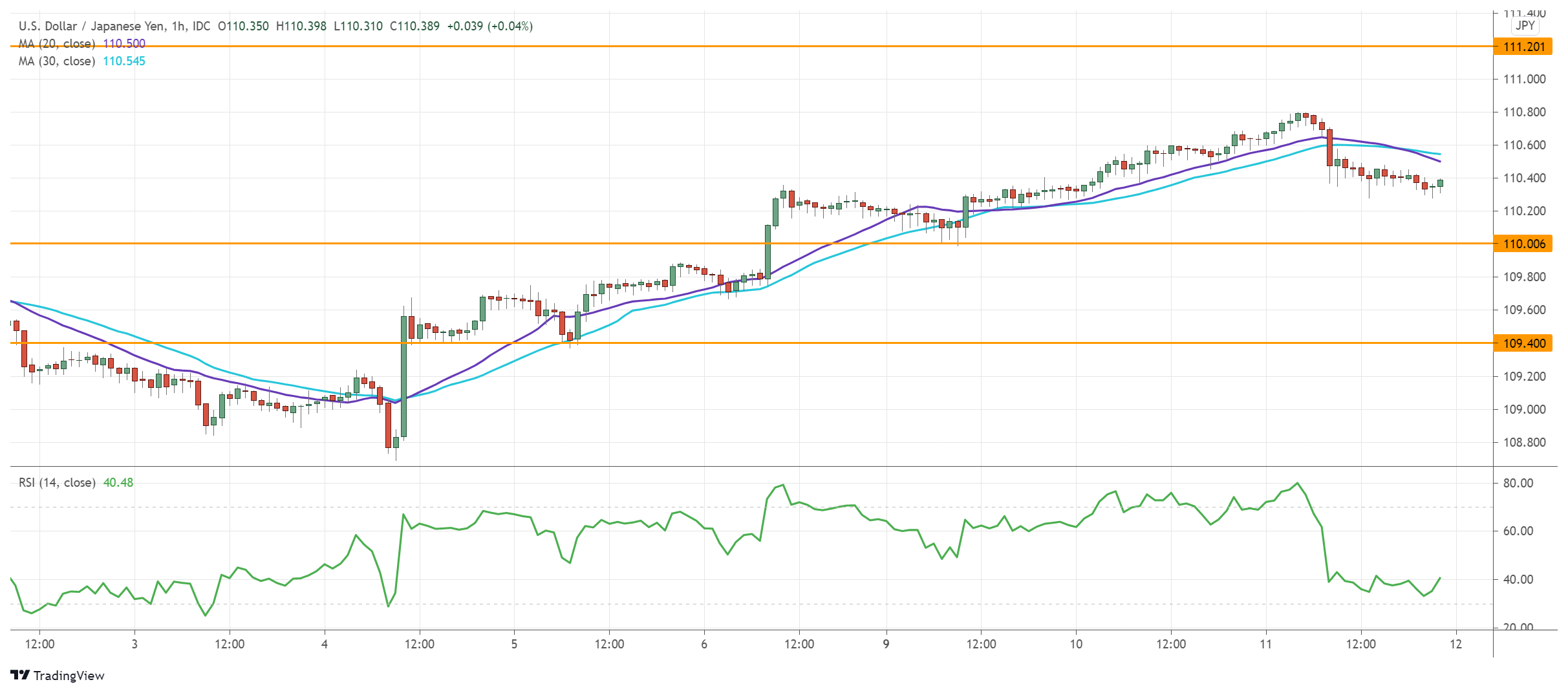
USD/JPY Sees Limited Correction
A drop in July’s core CPI in the US has put the greenback on the defense.
The rebound had gained traction after the pair closed above 110.50, a major resistance on the daily chart. This is a strong sign that the rally may have resumed after a five-week-long consolidation.
Though a repeatedly overbought RSI showed overextension in the short-term, and the current pullback would test the psychological level of 110.00.
Then 111.20 would be the next stop if the bullish momentum picks up again.
Oil Could Sink
Oil has rallied over the past two days to $71.2/bbl Brent, but clouds are gathering above, which under adverse circumstances could turn into a storm that could wash away much of the gains of the recent rally.
Brent gained support earlier in the week, falling below 68 for the second time in the past three weeks. Bulls got help from continued strength in equity indices and the passage of the infrastructure package, which promises to boost energy demand.
Perhaps this is almost the end of the positive news on oil.
The Biden administration has repeated several times in the last 24 hours its call for OPEC+ to increase production to limit the rise in oil prices. The market quickly digested the news, returning to current levels after briefly dipping below $69. However, as is often the case, politicians’ actions are often inert: slow to pick up speed and slow to stop.
US oil production rebounded last week to 11.3M BPD. Production growth has resumed after a slight pullback in recent weeks.
Biden’s calls for OPEC+ to ramp up production will help remove a psychological barrier from the industry in the US, which seemed embarrassed to raise output amid the popularity of alternative energy.
OPEC+ itself has also clearly warmed to the idea of using recovery in demand to boost supply in recent months, content with current price levels. The cartel intends to add 400K BPD to its agreed quotas every month. But overall production rises more strongly as several participants are free to increase their output. On top of this, Saudi Arabia brings back barrels under-supplied to the market as part of the voluntary production cuts earlier this year.
Added to this is the spreading of coronavirus in Asian countries, the primary source of oil consumption growth. This region, especially China and Japan, is adopting far more severe travel restrictions than Europe and the US. The authorities want to suppress the spread as much as possible before the autumn season when conditions will be even more favourable for viruses.
Oil is also threatened by the imminent start of the tapering of Fed balance sheet purchases, which could end the current phase in the markets by triggering an impressive correction.
On the technical analysis side, Brent crude received support at 76.5% Fibonacci retracement line of the November-July rally. A break below the $68 level could see the bulls capitulate and quickly take the price towards $62, where the 200-day moving average and the 61.8% retracement level of the multi-month rally are concentrated.
If the Fed doesn’t rush to taper, surprising us, the markets could turn on their greed to the full, taking the oil price above $80 before the end of the year.
Fed Daly: Talking about tapering later this year or early next year is where I’m at
San Francisco Fed President Mary Daly said in an FT interview that she remained "very optimistic and positive". She added, " it's appropriate to start discussing dialling back the level of accommodation that we're giving the economy on a regular basis
"The starting point for that is of course asset purchases," she said. "Talking about potentially tapering those later this year or early next year is where I'm at."
On the employment markets, she said "we're really adding enough jobs to see that we're making progress towards our full employment goal." While "we're not there yet... we're chipping away at the hole that was dug by Covid."
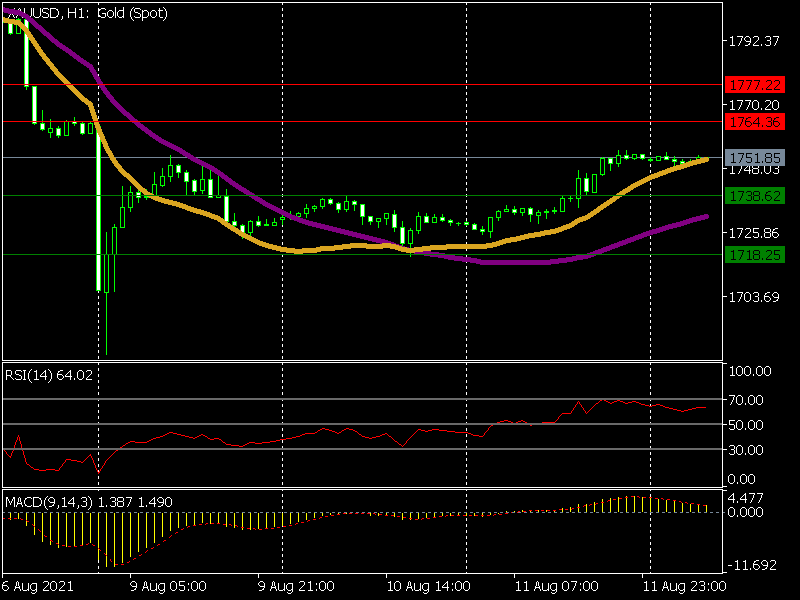
XAUUSD Is Possibly Bullish
Technical analysis
The EMA(50) is above the EMA(100), which can be beneficial for bulls
The MACD indicator line is above 0
The RSI is above 50.
What the possible outcomes are
In addition to yesterday's weakening of the US dollar, the American Senate passed President Biden's infrastructure plan. The Senate expects the plan to add demand on commodities. Therefore XAUUSD rose and is still on its way up.
If the price passes the initial resistance level of 1,1764.36, it could test the next one higher at 1,777.22.
Alternatively, if the price reverses, then it could reach the first support level of 1,1738.62.
A pass below the first level can move the price up lower toward 1,1718.25.
Key levels
Support 1,1738.62 1,1718.25
Resistance 1,1764.36 1,1777.22
Dow Jones Soars To A Record High As Inflation Fears Ease
US stocks soared to record highs after data showed that inflation was cooling down. The Dow Jones rose by more than 200 points while the S&P 500 index rose by more than 10 points. The Nasdaq 100 index, which tracks big tech companies, declined by 20 points. In a report, the Labor Department said that headline inflation remained unchanged at 5.4% while core inflation eased from 4.5% to 4.3%. At the same time, Southwest warned that the number of flight cancellation trends was rising as the Delta variant spread. Therefore, these new developments mean that the Federal Reserve will maintain its easy-money policies for longer.
The price of crude oil continued its recovery path even after the White House urged OPEC to boost production. In a statement, Jake Sullivan, the White House economic advisor, said that the recent supply increases were insufficient to deal with the overall higher prices. In July, OPEC+ members agreed to a gradual phase of oil supply increases as they moved towards the pre-pandemic levels. The price also reacted to the latest EIA inventories numbers. According to the EIA, the number of oil inventories declined by 447k barrels last week after rising by more than 3.66 million in the previous week. Analysts were expecting a drawdown of more than 1.27 million barrels.
The Japanese yen rose slightly after relatively strong producer price index (PPI) data. According to the country’s statistics agency, the headline inflation rose from 5.0% in June to 5.6% in July. This increase was better than the median estimate of 5.0%. On a MoM basis, the PPI rose from 0.6% to 1.1%. These numbers show that the gap between the PPI and CPI is widening. Elsewhere, the Office of National Statistics will publish the latest UK GDP data while the Turkish Central Bank will deliver its interest rate decision. In the US, the statistics agency will release the latest PPI and initial jobless claims numbers.
XBRUSD
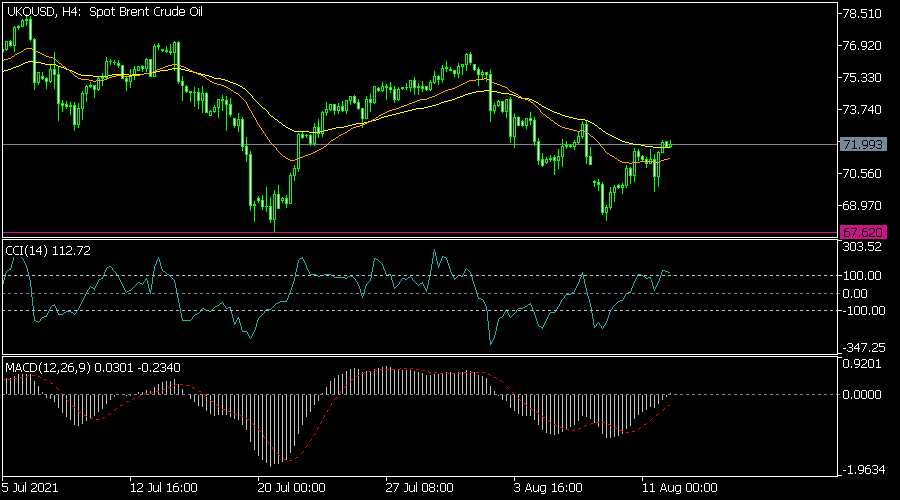
The price of Brent crude rose to 71.98, which was substantially higher than this week’s low of 68.15. The price is still substantially lower than the year-to-date high of more than 76. It has moved above the 25-day and 50-day moving averages while the MACD and the Commodity Channel Index (CCI) have been on an upward trend. It has also formed a double-bottom pattern, meaning that the price will likely keep rising as bulls target the key resistance at 73.50.
EURUSD
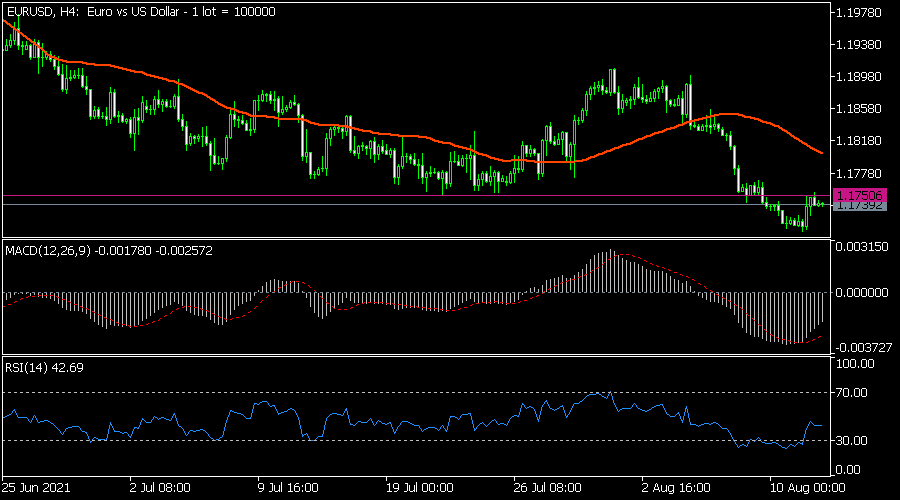
The EURUSD pair rose slightly after the latest US inflation data. The pair rose to a high of 1.1740, which was slightly above this week’s high of 1.1700. On the four-hour chart, the pair is below the important resistance at 1.1750. A closer look shows that it has formed an inverted cup and shoulders pattern. Therefore, the pair will likely resume the downward trend in the next few days.
GBPUSD
The GBPUSD bounced back after US inflation data and ahead of the latest UK GDP data. On the 4 hour chart, the pair has formed a bullish flag pattern. It has also moved above the 25-day moving average and between the 50% and 38.2% Fibonacci retracement level. The RSI has also risen to a high of 51.50. The pair will likely bounce higher as bulls target the key resistance at 1.3980.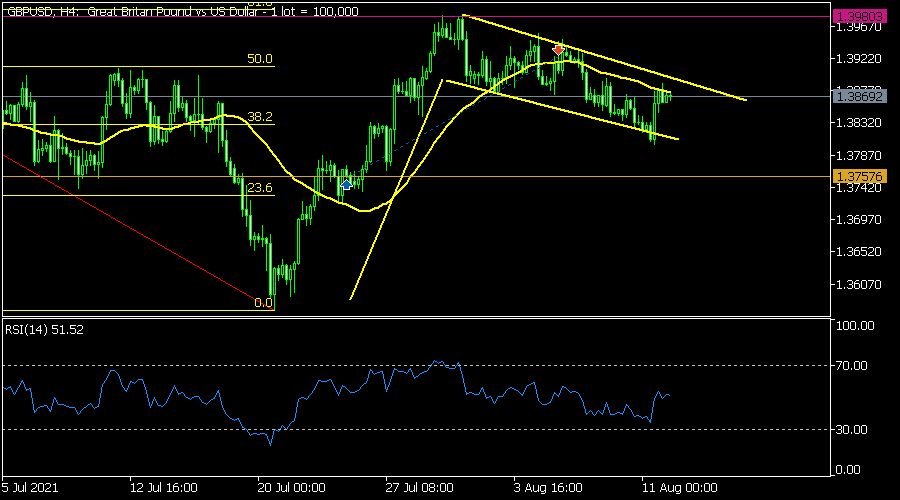
Sterling Is Still Twisting With The 0.8470 Support Area
Markets
US CPI inflation remained at a 13-yr high (5.4% Y/Y) in July after rising by 0.5% on a monthly basis. The data, though still elevated, printed near bang in line with consensus and didn’t provide the longed-for fireworks on financial markets. Meeting the bar proved insufficient to extend the US Treasury sell-off which has been going since the middle of last week and insufficient to push the greenback north of key resistance marks. At least for now that is. More regional Fed governors (Kansas City Fed George & SF Fed Daly) speak out in favor of starting to dial back asset purchases this year. The combination of the August 26-28 Jackson Hole Symposium and the September 22 FOMC meeting might be the perfect platform to launch the blueprint of the normalization scheme. We even see an outside risk that a 2022 rate hike will feature in the Fed’s updated Summary of Economic Projections. In any case, back to yesterday’s market reaction. US Treasuries spiked higher in a muted reaction. The move did gather additional pace after a very strong $41bn 10-yr Note sale by the US Treasury. The auction stopped through the 1:00 PM bid side with an above-average bid cover (2.65) and a huge indirect bid. It might be telling for very short-term momentum that investors are already eager to snap up US T’s after the brief August hick-up in yields. The US yield curve bull steepened in a daily perspective with yields up to 2 bps lower (2-yr). Trading in German Bunds remained lethargic yields shedding 0.2 bps to 0.8 bps in a daily perspective. The belly of the curve marginally outperformed the wings. Today’s eco calendar contains outdated EMU production numbers and US weekly jobless claims. We don’t expect them to leave traces on trading. More of yesterday’s consolidative action might be in the cards. Tonight’s $27bn 30- yr Bond sale which wraps up the US Treasury’s mid-month refinancing operation is a wildcard.
The dollar failed to take out resistance following the CPI print. EUR/USD 1.1704 (YTD low) holds for now with the pair closing at 1.1739 after an intense test. The trade-weighted greenback (DXY) failed to move above the July high (93.19) and eventually ended the day at 92.92. Sterling is still twisting with the 0.8470 support area as last week’s sterling rally (post-BoE) loses dash. This morning’s UK Q2 GDP numbers were in line with consensus (+4.8% Q/Q). Details showed positive contributions from consumption (7.3% Q/Q) and government spending (6.1% Q/Q) while gross fixed capital formation and net exports (exports +3% Q/Q; imports +6.5% Q/Q) declined on a quarterly basis.
News headlines
The Polish government continues its very controversial legislative track record. The lower the house of parliament yesterday passed a bill which prevents companies from outside the European Economic Area from owning a majority in Polish media companies. The bill is directly aimed at broadcaster TVN which is owned by US media conglomerate Discovery. US Secretary of State Blinken said that the US was deeply troubled and that these pieces of legislation run counter to the principles and values for which modern, democratic states stand. He called on the Polish President not to sign the bill into to law or to refer it to the Polish constitutional tribunal. The parliamentary vote itself was controversial as well with opposing junior coalition partner (Agreement party) pulling the plug on their ruling deal with PiS and the latter sidestepping attempts to delay the vote on the media bill.
The Chinese State Council and the Communist Party’s Central Committee in a joint statement vowed to actively work on greater regulation of large parts of the economy with regard to national security, technology, and monopolies.. The document says that “The people’s growing need for a better life has put forward new and higher requirements for the construction of a government under the rule of law. It must be based on the overall situation, take a long-term view, make up for shortcomings, forge ahead, and promote the construction of a government under the rule of law to a new level in the new era.” Specific sectors mentioned for higher law enforcement include food & drugs, big data, and artificial intelligence. Main Chinese equity indices underperform this morning, losing up to 1%.
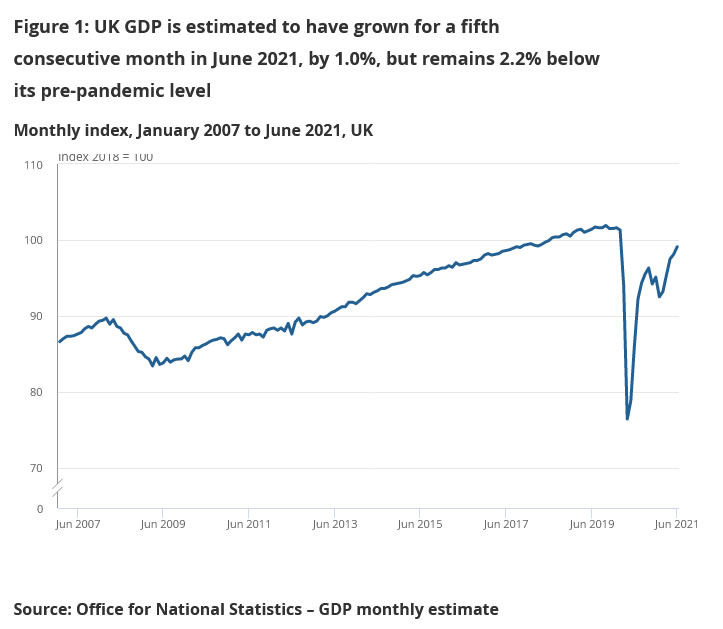
UK GDP grew 1.0% mom in June, 4.8% qoq in Q2
UK GDP grew 1.0% mom in June, matched expectations. That's the fifth consecutive month of growth, GDP remained -2.2% below it's pre-pandemic level in February 2020. Services was the main contributor, growing 1.5% mom. Production, on the other hand, dropped -0.7% mom while contraction also dropped -1.3% mom.
For Q2 as a whole, GDP grew 4.8% qoq, still -4.4% below the pre-pandemic level in Q4, 2019. ONS said, "there were increases in nearly all main components of expenditure apart from "trade", with the largest contribution from household consumption".