Sample Category Title
Eco Data 8/12/21
[php_everywhere instance="1"]
Fed George: Time has come to dial back the settings
Kansas City Fed President Esther George said in a speech, "with the recovery underway, a transition from extraordinary monetary policy accommodation to more neutral settings must follow". She added, "today's tight economy... does signal that the time has come to dial back the settings" of monetary stimulus.
"While recognizing that special factors account for much of the current spike in inflation, the expectation of continued strong demand, a recovering labor market, and firm inflation expectations are consistent, in my view, with the Committee's guidance regarding substantial further progress toward its objectives. I support bringing asset purchases to an end under these conditions," she said.
Will ‘King Dollar’ Reclaim its Throne as the Fed Tapers?
One by one, Fed officials are getting behind the idea that their asset purchases should be dialed back soon. Whether this is announced in September or November doesn’t matter much. What matters is that the Fed is years ahead of the ECB and BoJ in the normalization game. The dollar held its ground recently even as US yields crumbled, so it could really shine once tapering gets rolling and Congress delivers even more fiscal juice.
Falling into line
More and more Fed officials are throwing their weight behind withdrawing some liquidity in the next few months. First it was just Kaplan. Then it was Bullard. Last week it was Vice Chairman Clarida, Waller, and Daly joining this group. This week, their views were echoed by Bostic and Rosengren.
The Fed can afford to take its foot off the accelerator because the US economy is booming. Inflation is scorching hot, consumption is off the charts, and the labor market is healing its wounds quickly. Indeed, America could be back to full employment this year already.
Some 5.7 million jobs are still missing for the labor market to reach its pre-crisis glory. However, around 3 million people decided to retire early once the pandemic hit. As such, another three jobs reports like the last one would essentially bring about a full recovery.
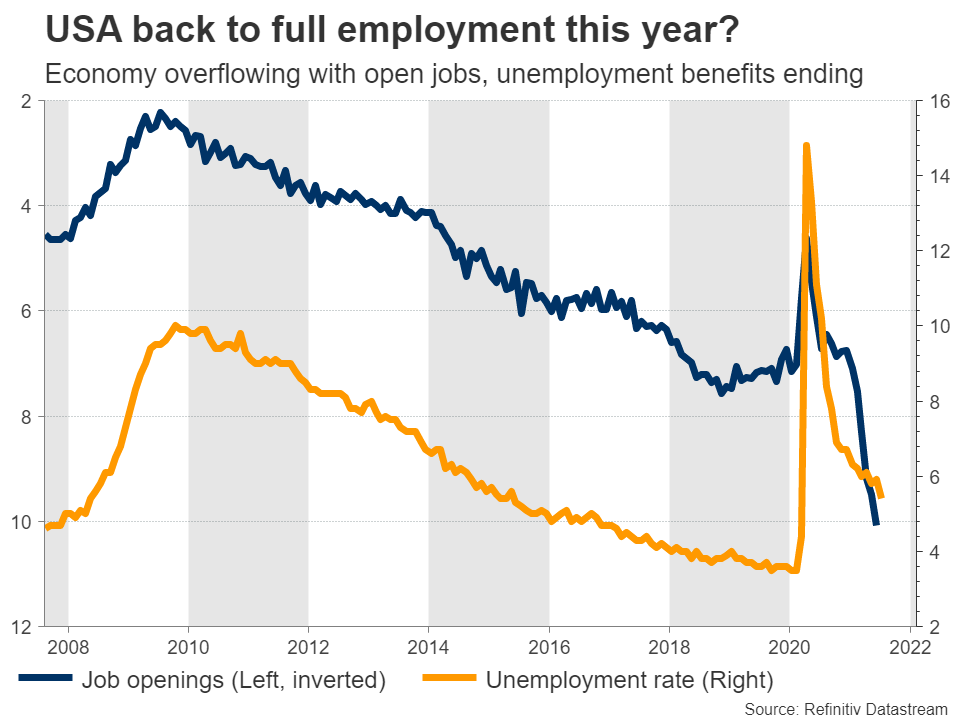
And that is quite likely too. The economy is overflowing with open job positions, which might get filled now that the generous federal unemployment benefits are rolling off and people are returning to the workforce.
The best part is that Congress is about to unleash trillions in new spending to power up the recovery. Senators from both parties are working on a ‘hard’ infrastructure package that includes half a trillion dollars in new spending, while the Democrats are trying to pass a ‘human’ infrastructure bill that would cost $3.5 trillion. The US recovery could be incredible.
So what will the Fed do?
As things stand, the Fed is buying $120 billion per month in bonds and mortgage-backed securities. Policymakers are worried that if they keep this up for too long, it could fuel speculative bubbles in financial markets and ultimately overheat the economy too.
Therefore, they will likely take their foot off the accelerator soon, to avoid having to slam on the brakes later on and risk shocking the system. This means slowing down their asset purchases every month until they reach zero.
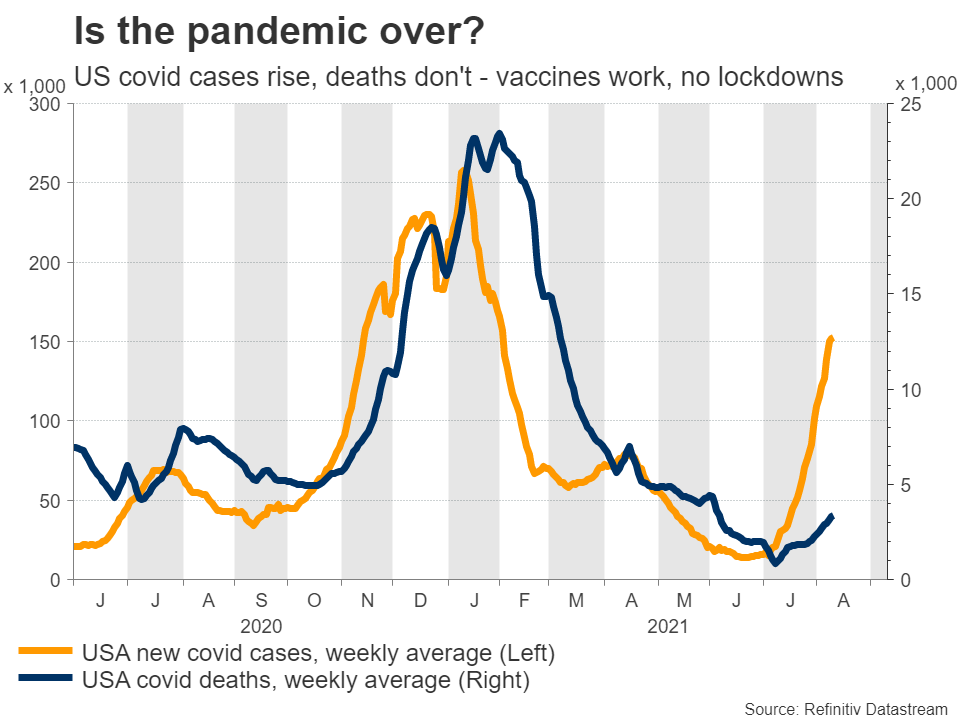
How quickly this tapering process is announced and when it begins will probably depend on the next US employment report. If we get another spectacular nonfarm payrolls print for August, the Fed could announce at its September meeting that tapering will begin in December.
If the next jobs report isn’t stellar, the Fed might wait another month or so. In this case, they could announce in November that the rollback will begin in January. Either way, Chairman Powell will likely prepare the markets for this in two weeks at the Jackson Hole economic symposium, by providing clear signals that tapering is coming.
In the big picture, whether we get a formal taper announcement in September or November doesn’t matter much. It’s only a matter of time. What matters is that the Fed is years ahead of the European Central Bank and the Bank of Japan in this process.
Good news for the dollar
Over time, this central bank divergence should allow US yields to rise faster than their European and Japanese counterparts, making the dollar more attractive versus the euro and yen as interest rate differentials widen to its advantage.
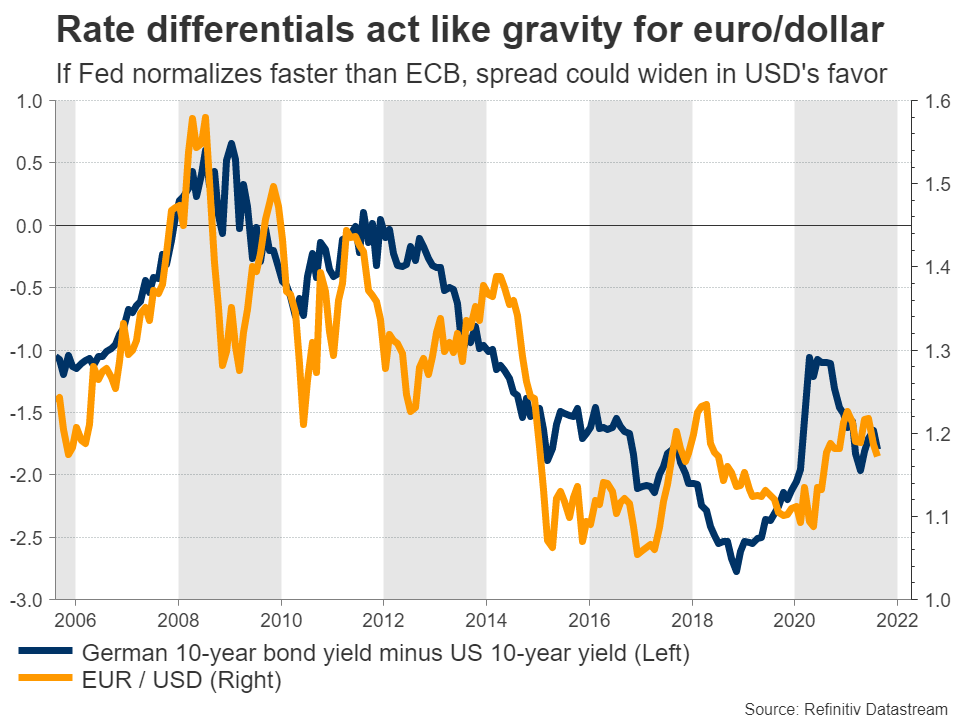
The Fed will stop buying bonds and will ultimately raise interest rates, lifting American bond yields. On the contrary, both the ECB and the BoJ will likely continue buying bonds with force, keeping their own yields under pressure. Neither will raise interest rates over the coming years, as their economies are too fragile.
Overall, the outlook for the dollar looks bright. The catch is that any future dollar gains might not show up against the British pound, nor against the Canadian and New Zealand dollars, as those economies are also moving towards higher rates.
Gold and stocks
Beyond the dollar, all this has implications for gold and stock markets too. Gold is inversely related to bond yields and the dollar. Since gold pays no yield to hold, it becomes less attractive in an environment of rising yields. Likewise, because gold is priced in dollars, it becomes more expensive to buy for foreign investors as the greenback strengthens.
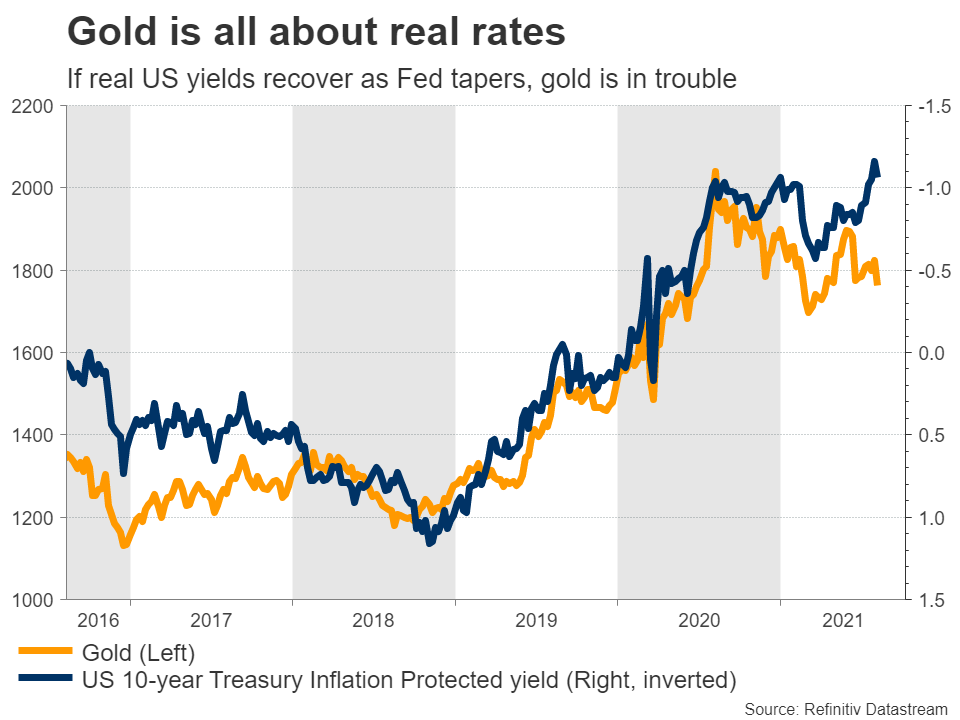
Stock markets are not so straightforward. Less liquidity in the financial system and higher interest rates are theoretically negative for stocks, but then again, stocks tend to perform well when the economy is booming. The example here is the 2015-2019 period, when the Fed was raising rates yet equity markets soared.
It will probably take something much bigger than a Fed tapering announcement for stock markets to bleed, especially with Congress ready to unleash more fiscal firepower.
CPI: A Win for Team Transitory, But Persistent Fans Not Leaving Empty-Handed
Summary
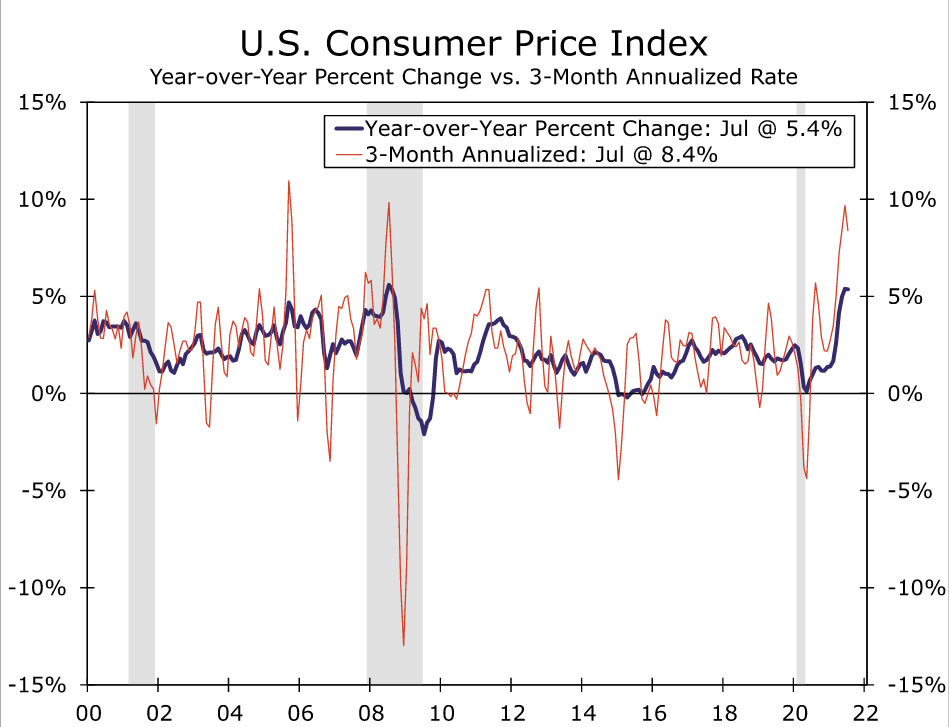
The Consumer Price Index (CPI) rose a more-modest 0.5% in July, which kept the year-ago rate steady at 5.4%. The details of the report favored the view that the recent degree of inflation will not last, as prices in categories most closely associated with the economy's reopening and supply constraints have begun to ease. However, there was also evidence that price pressures continue to broaden out, which should keep the heat turned up on inflation for a while.
More Moderate Gain in Prices as Frictions Begin to Ease
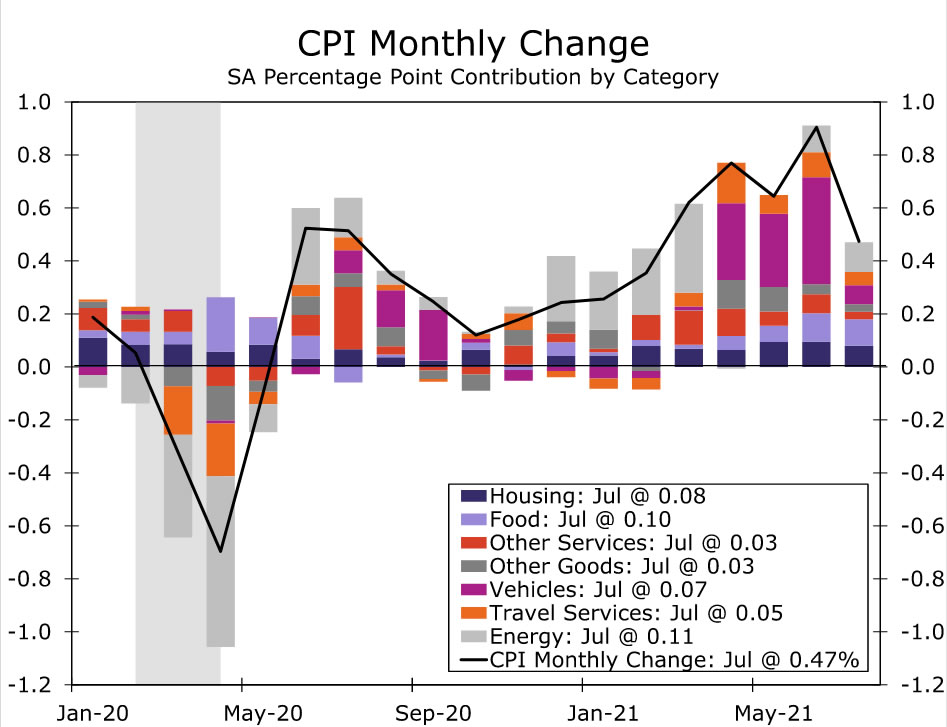
Consumer prices rose 0.5% in July, cooling from June's scorcher of a 0.9% gain. The moderation is a sign that the most acute frictions associated with the economy's reopening are beginning to ease. However, the transition is far from over yet and price pressures have broadened out, which should keep inflation running noticeably above the Fed's target for a while.
The smaller rise in prices in July can be traced in part to a marked slowdown in used car prices. Used car prices were essentially unchanged (+0.2%) after increasing 7% or more and accounting for at least one-third of the headline's gain in each of the prior three months. Prices for new cars, however, got another big lift (+1.7%), as the used car market is not offering the affordable alternatives it once used to and inventories remain exceptionally low.
In another sign of inflation easing a bit as the reopening process moves further along, prices for travel-related services, which have been another out-sized contributor of late, also cooled slightly in July. Most of the break came from a drop in car rental prices (-4.6%), but airfares were virtually flat last month. With prices for hotels back above pre-pandemic levels and renewed concerns around COVID, we expect further moderation in these categories ahead. Dampened expectations for growth due to the Delta wave are already weighing on oil prices. Gasoline prices rose 2.4% in July, but are likely to give back some ground over the next month or two in light of the recent drop in oil prices.
Staying Power
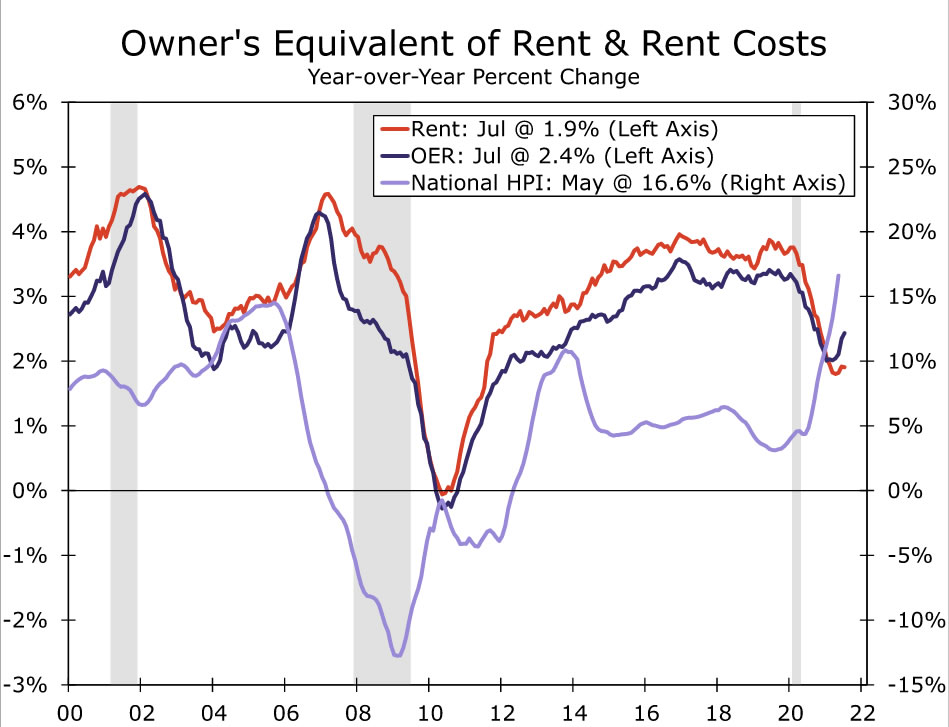
Recent strength in prices is not likely to prove so fleeting elsewhere, however. Owners' equivalent rent (OER), which accounts for 24% of the headline index, rose 0.3% again in July. The series has finally begun to reflect the sharp rise in home prices since the pandemic. With OER lagging sale prices by roughly a year and a half and the inertia in this category, we expect shelter costs to be an increasing source of inflation ahead. Rental costs slowed a bit, increasing 0.16%, but we do not expect the softness to persist given recent market measures of rents and the sharp rise in employment and wages.
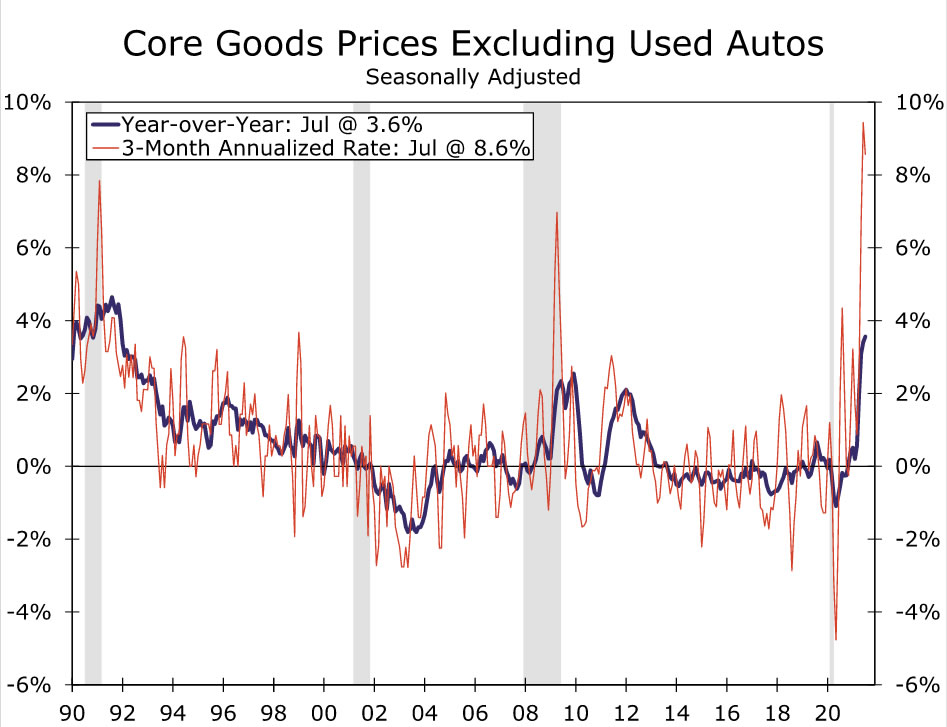
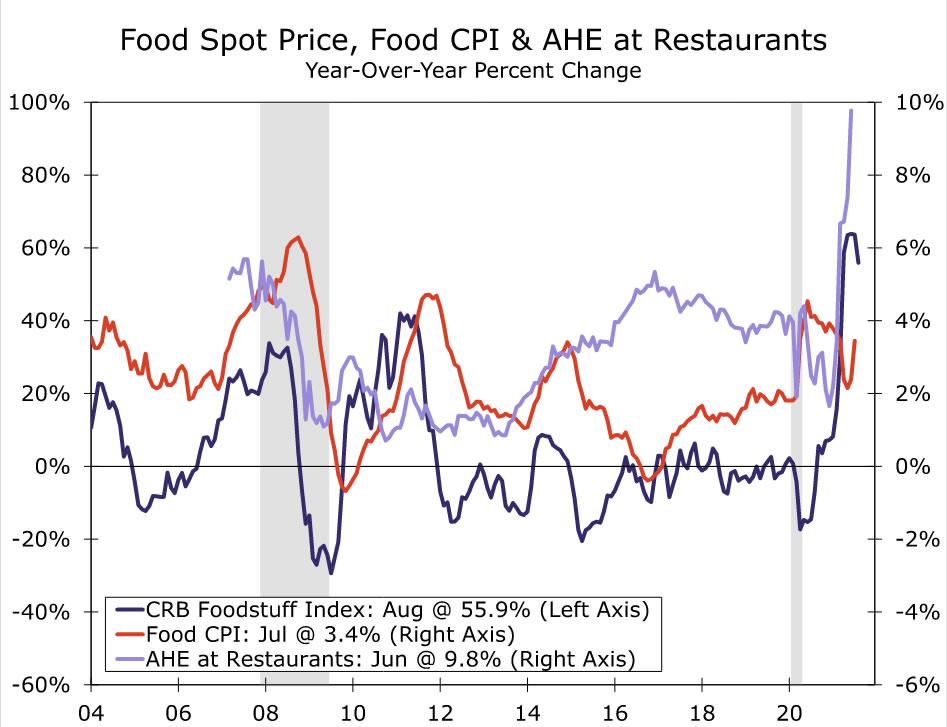
Price pressure continues to broaden beyond categories most acutely associated with the reopening, as businesses are finding it easier to pass costs on today than they typically could this early in an expansion. Core goods prices excluding used autos are up 3.6% over the past year, the fastest pace since the early 1990s. The fact that firms are facing higher costs in the form of physical inputs and labor, suggests even as supply constraints eventually ease wages could keep pressure on consumer prices for some time to come. Wage pressure has been most evident in food prices recently, as restaurant owners contend with the highest prices of food-related commodities in a decade and average hourly earnings over the past three months have surged 23% at an annualized rate, as labor has been hard to come by. Prices of food away from home rose 0.8% in July, accounting for 17% of the gain in the headline index last month.
Edge to Team Transitory, but Something for Everyone
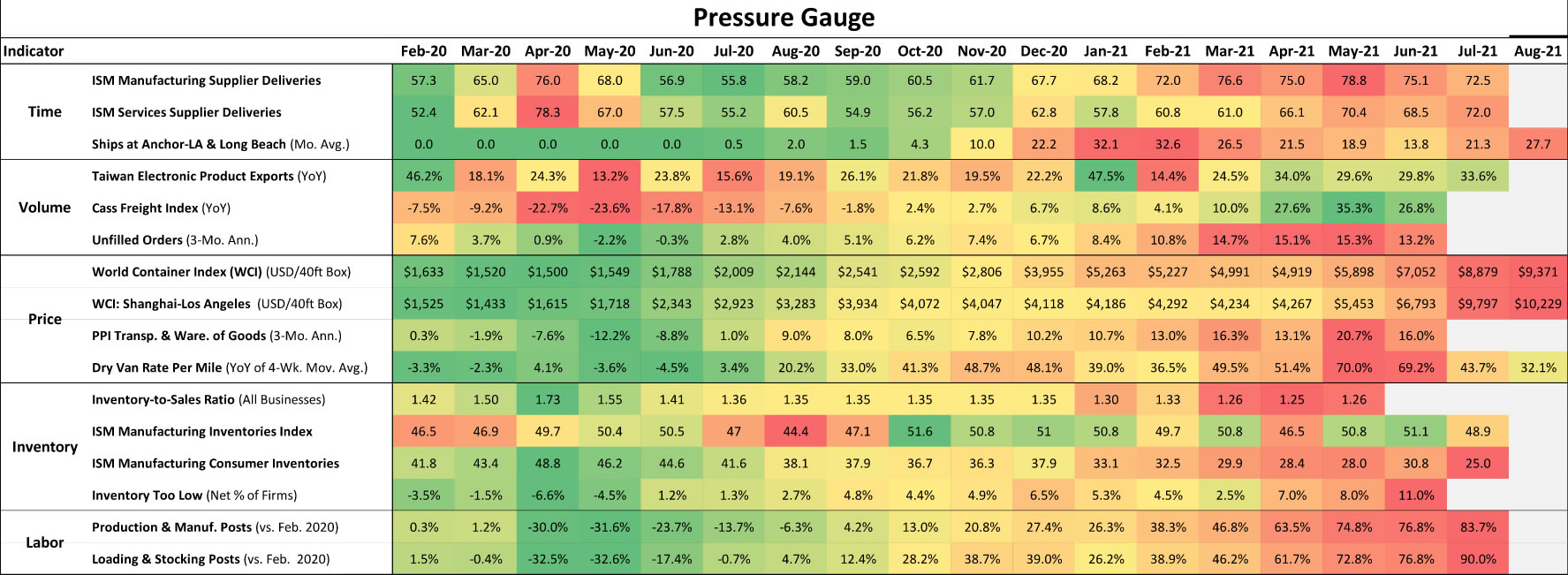
Today's report is a win for Team Transitory, but Team Persistent is not walking away empty-handed. For Transitory fans, the muted change in used cars and weaker gain in travel services illustrates that as supply improves, demand moderates and the reopening matures, price growth will ease up. But the Persistent fans can point to the strong gains among shelter and core goods as an indication that inflation is not about to quietly fade away. As our Pressure Gauge shows, supply logjams are far from clear. Until transportation costs ease up and inventories are replenished, there will be little relief for inflation. Without a marked pickup in productivity, stronger wages will also exert upward pressure on inflation until labor constraints ease. We expect headline CPI to remain around a year-ago pace of 5% through Q1 of next year.
The increasingly long period of above-target inflation no doubt has some Fed officials getting increasingly uncomfortable with the current stance of policy. However, others, including Chair Powell, have not wavered in the view that price growth will eventually cool off. This group will take comfort from today's report in addition to inflation expectations remaining well-within their historic range. While FOMC members seem to agree that the inflation portion of their “substantial further progress” criteria for tapering has been met, the fact that inflation expectations remain fairly well-behaved gives them some time to get on the same page about the labor market.
Sunset Market Commentary
Markets:
July US Consumer Price Inflation took center stage today. The headline index rose by 0.5% M/M to stabilize at 5.4% Y/Y (13-yr high). It’s the third month in a row with a 5%+ inflation print. Food and energy increased by 0.7% M/M and 1.6% M/M respectively, to be up 3.4% Y/Y and 23.8% Y/Y. Underlying core CPI rose by 0.3% M/M and 4.3% Y/Y. The shelter index rose 0.4% in July and accounted for over half of the monthly core increase. New vehicle prices rose by 1.7% M/M (6.4% Y/Y), but there was a moderation in used cars and trucks’ prices (+0.2% M/M; +41.7% Y/Y)). This followed on three consecutive months of 7%-10% monthly price rises. The index for motor vehicle insurance was one of the few major component indexes to decline in July, falling 2.8% after rising in each of the last 6 months. The index for airline fares fell slightly in July, declining 0.1% after rising sharply in recent months.
Enough for the numbers. Over to financial markets. High July inflation readings were near consensus and in first instance triggered some profit taking on the USD rally of the past week and some short covering in the US Treasury market. We add that moves didn’t went that far though. Inflation remains uncomfortably high, stretching the meaning of the word “temporary” and the patience of (US) central bankers. EUR/USD was flirting with the 1.1704 YTD low until the CPI print pushed the pair to an intraday high around 1.1750. The pair is currently changing hands around 1.1725. The trade-weighted dollar tested the July top of 93.19 ahead of the release. We don’t consider the test of the key 1.17 area as over. Pressure will persist in the run-up to the August 26-28 Jackson Hole symposium which could be the theatre for the Fed to pre-announce winding down of net asset purchases. The US Note future ticked slightly higher as well, but moves are extremely muted with tonight’s 10-yr Note sale in mind. The same reasoning goes for US Treasuries, where we also see additional downside. The US yield curve bull steepens currently with yields sliding by 1 bp (2-yr) to 0.1 bp (30-yr). German Bunds marginally underperform today with the curve slightly bear steepening. German yields add up to 0.5 bps (30-yr). News on the European side of the story remains extremely thin. Tomorrow, we get (outdated) industrial production numbers with the next interesting release only scheduled for next week with the EMU Q2 GDP print.
EUR/GBP treads water near key 0.8470 support today. Tomorrow’s Q2 UK GDP release has the potential to break the deadlock though a (big) consensus beat will probably be necessary to trigger a sustained break lower as last week’s post-BoE sterling rally is running out of steam.
News Headlines:
US National Security Adviser Jake Sullivan wants OPEC+ to more rapidly return oil to the market. Current plans to boost output aren’t sufficient. “We are engaging with relevant OPEC+ members on the importance of competitive measures in setting prices. Competitive energy markets will ensure reliable and stable energy supplies, and OPEC+ must do more to support the recovery”. Brent crude prices fell from around $71/barrel to $69 after the publication of the statement.
Minutes of the July 27 Hungarian central bank meeting revealed an unanimous decision to raise benchmark rates a second straight month by 30 bps (base rate: 1.2%). The MNB considered it justified to continue the cycle of interest rate hiking by taking firm steps on a monthly basis to ensure price stability, avoid second-round inflationary effects and to anchor expectations. The tightening cycle will continue until the outlook stabilizes around target and inflation risks become evenly balanced. Hungarian July CPI, published yesterday, slowed to 4.6% Y/Y but remains above the 1% tolerance band around the 3% inflation goal.
EUR/AUD Mid-Day Outlook
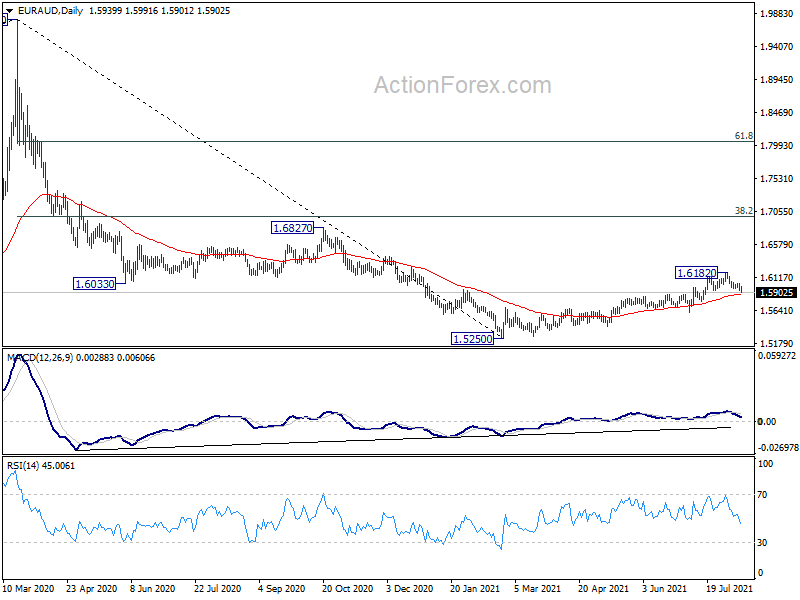
Daily Pivots: (S1) 1.5909; (P) 1.5973; (R1) 1.6015; More...
EUR/AUD's break of 1.5925 support suggests short term topping at 1.6182. Intraday bias is back on the downside for 55 day EMA (now at 1.5901) first. Sustained break there will argue that choppy corrective rebound from 1.5250 has completed. Deeper fall would be seen to 1.5614 structural support for confirmation. On the upside, above 1.6035 minor resistance will turn bias back to the upside for retesting 1.6182 high instead.
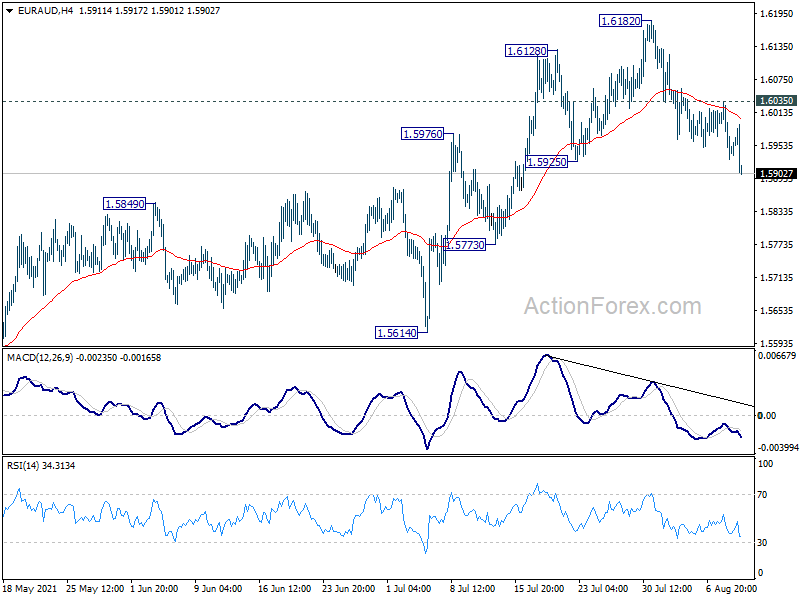
In the bigger picture, a medium term bottom was formed at 1.5250, on bullish convergence condition in daily MACD. Rise from 1.5250 is currently seen as a correction to the down trend from 1.9799 first. Stronger rise would be seen to 38.2% retracement of 1.9799 to 1.5250 at 1.6988 next. We'd tentatively expect strong resistance from there to limit upside, at least on first attempt. Meanwhile, break of 1.5614 support will indicate that the rebound has completed and bring retest of 1.5250 low.
US: Inflation’s Fever Breaks in July, as Price Hikes Ease Up
- The mercury fell slightly on consumer prices in July, as the month-on-month (m/m) increase was 0.5%, down from 0.9% in June. As a result, headline inflation was 5.4% year-on-year (y/y), matching June's pace.
- Core prices (ex. food and energy) also lost some steam, posting their smallest increase in three months. The index rose 0.3% m/m after a 0.9% m/m gain in June. That drove year-on-year core inflation to 4.3% in July, down slightly from 4.5% in June.
- Food and energy prices bucked the broader cooling trend, with food prices up a hearty 0.7% m/m and energy up 1.6% m/m. Food costs are on the rise again, like they were early in the pandemic. Energy costs, on the other hand, which plummeted in the early months of the pandemic, are now up 23.8% versus those low levels of a year ago.
- Many of the travel-related categories that have surged in recent months lost some steam in July. Used vehicle prices were up a modest 0.2% m/m. Prices for car and truck rental and airline fares both fell. As a result, this collection of categories contributed far less to core inflation that it had in the March through June period.
- However, other categories are stepping in, albeit at a less scary pace. Shelter costs were up 0.4% m/m, accounting for over half of July's core basket increase. Part of that are still healthy increases for lodging away from home (+6.0% m/m), as Americans start travelling again. Medical care costs rose 0.3% m/m, after falling in May and June. Recreation prices rose 0.6% m/m, picking up from June's 0.2% m/m pace.
Key Implications
- As expected, many of the re-opening-related price spikes seen through the spring have started to cool. "Travel-related" inflation, which has been a big factor in driving 30-year highs in core inflation in recent months has started to cool.
- However, other key categories are showing that inflation pressures in an economy running at a 6%+ pace in real terms are not gone. Namely shelter, which carries a heavy weight in the CPI, show signs of heat. We expect it to keep inflation near or above 2%for some time. Therefore, once employment has made substantial progress the Federal Reserve is likely to take its foot off the monetary accelerator and start tapering asset purchases by year end
USD/JPY Mid-Day Outlook
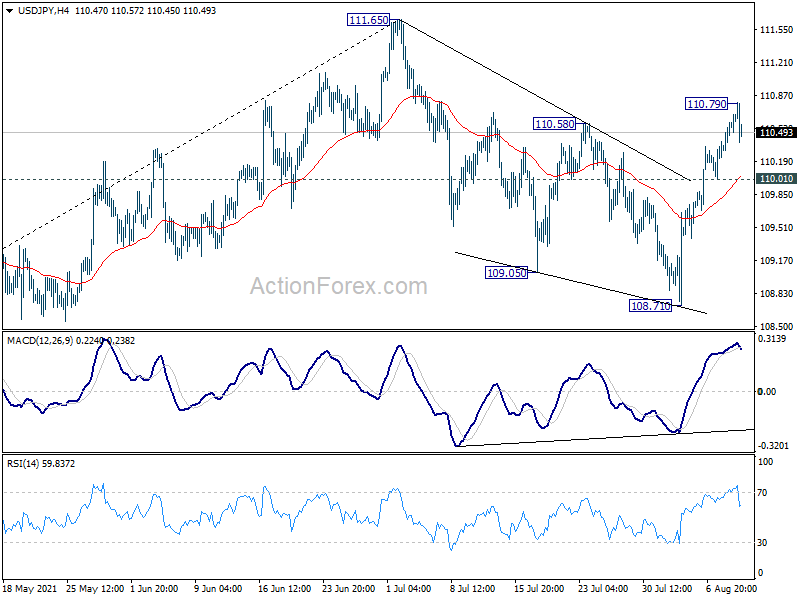
Daily Pivots: (S1) 110.37; (P) 110.49; (R1) 110.69; More...
Intraday bias in USD/JPY is turned neutral with 4 hour MACD crossed below signal line. Corrective fall from 111.65 should have completed with three waves down to 108.71. Another rise is in favor with 110.01 support intact. Break of 110.79 will turn bias to the upside for retesting 111.65 high. However, break of 110.01 will dampen this bullish view, and turn bias to the downside for 108.71 support.
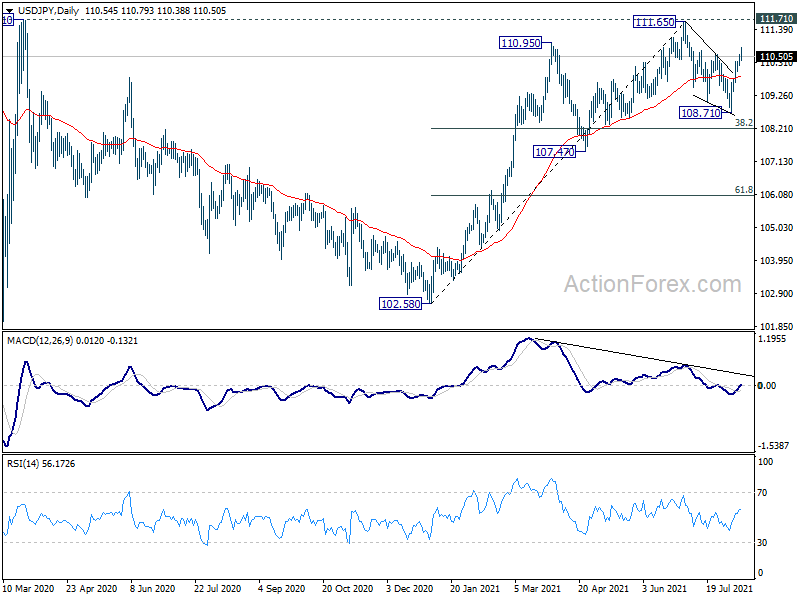
In the bigger picture, medium term outlook is staying neutral with 111.71 resistance intact. The pattern from 101.18 could still extend with another falling leg. Sustained trading below 55 day EMA will bring deeper fall to 107.47 support and below. Nevertheless, strong break of 111.71 resistance will confirm completion of the corrective decline from 118.65 (2016 high). Further rise should then be seen to 114.54 and then 118.65 resistance.
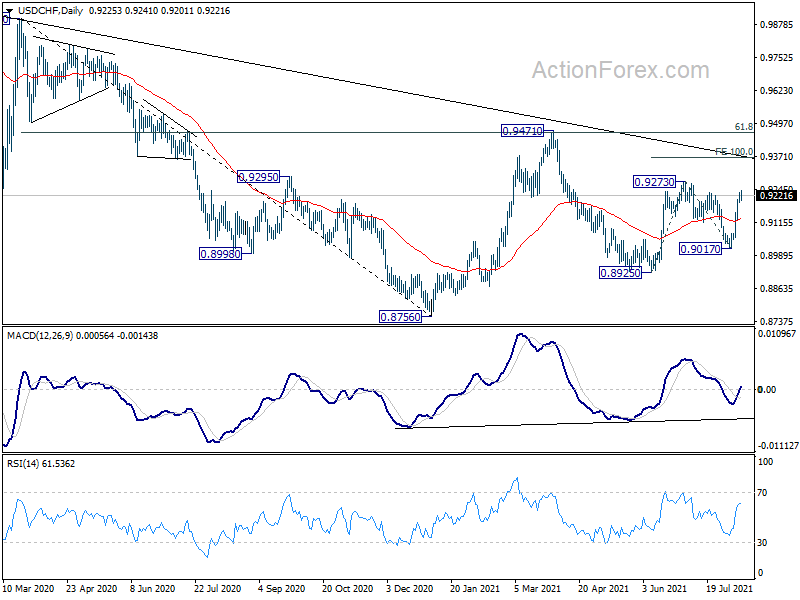
USD/CHF Mid-Day Outlook
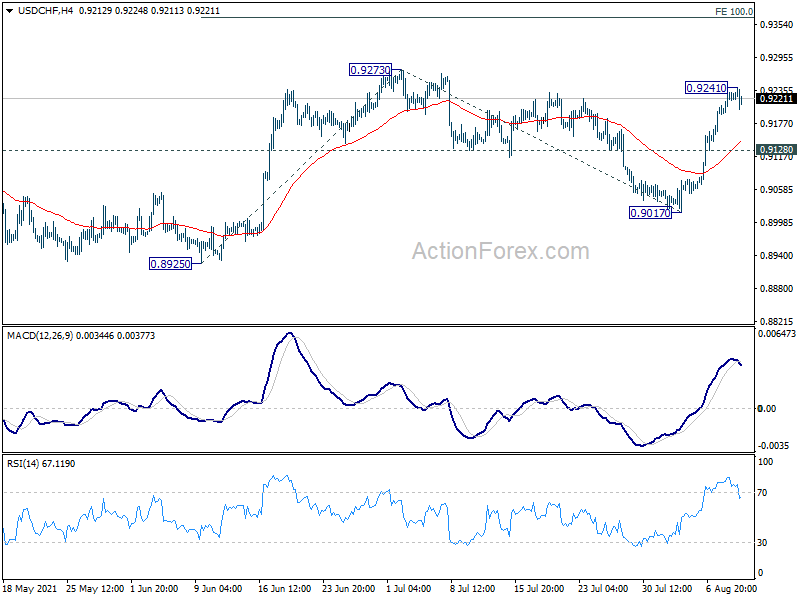
Daily Pivots: (S1) 0.9205; (P) 0.9219; (R1) 0.9244; More....
Intraday bias in USD/CHF is turned neutral with 4 hour MACD crossed below signal line. Some consolidations could be seen first. On the upside, above 0.9241 will target 0.9273 resistance. Firm break there will resume rise from 0.8925 to 100% projection of 0.8925 to 0.9273 from 0.9017 at 0.9365. However, break of 0.9128 will turn bias back to the downside for 0.9017 support.
In the bigger picture, the failure to sustain above 55 week EMA (now at 0.9184) retains medium term bearish in USD/CHF. Break of 0.8925 support should resume the whole decline form 1.0342 (2016 high) through 0.8756 low. However, break of 0.9273 resistance and sustained trading above 55 week EMA will be an early sign of bullish trend reversal. Focus will then turn to 0.9471 resistance for confirmation.
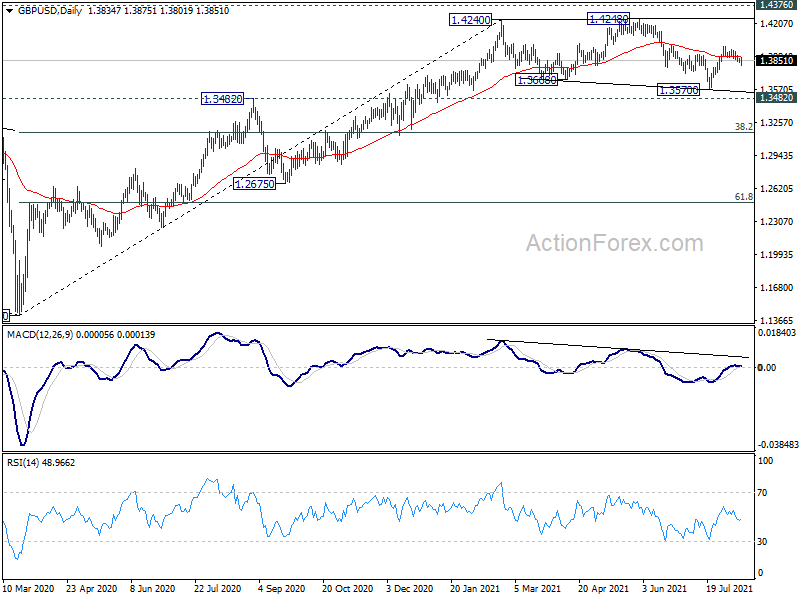
GBP/USD Mid-Day Outlook
Daily Pivots: (S1) 1.3819; (P) 1.3846; (R1) 1.3863; More...
GBP/USD recovers mildly but stays in range of 1.3766/3982. Intraday bias remains neutral at this point. Outlook is unchanged that corrective pattern from 1.4240 could have completed with three waves down to 1.3570. On the upside, break of 1.3982 will resume the rise from 1.3570 to retest 1.4248 high. However, break of 1.3766 support will dampen this bullish view and bring retest of 1.3570.
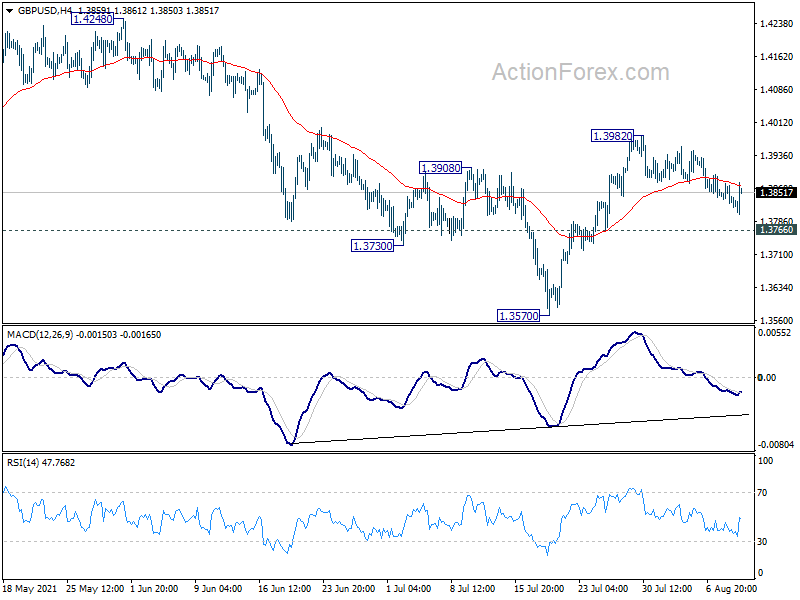
In the bigger picture, as long as 1.3482 resistance turned support holds, up trend from 1.1409 should still continue. Decisive break of 1.4376 resistance will carry larger bullish implications. However, firm break of 1.3482 support will argue that the rise from 1.1409 has completed. GBP/USD would then be seen in another leg of long term range pattern between 1.1409 and 1.4376. Deeper fall could then be seen to 61.8% retracement of 1.1409 to 1.4248 at 1.2493, and even below.