

Sample Category Title
Dollar Eases From Post-NFP Highs, Gold Steadies After Crash
- Dollar off highs but elevated after strong NFP puts September taper back on the table
- Gold plunges below $1,700 before rebounding as yields spike, but oil’s rout deepens
- Stocks undaunted by prospect of earlier Fed tapering as Wall Street sets new records
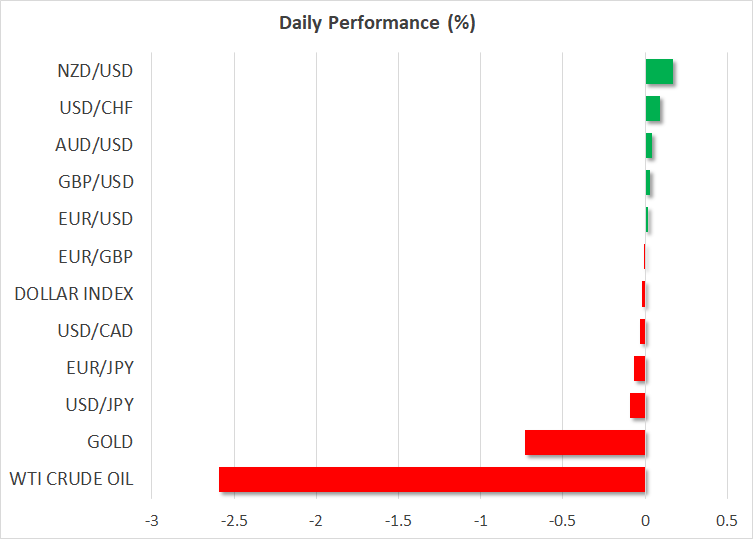
Taper speculation heats up after bumper US jobs report
Markets were left wondering just how much progress is substantial after the US labour market added another 943k jobs in July, while upward revisions to both the May and June numbers further fuelled speculation that the Fed is close to meeting its employment criteria for pulling back some of its stimulus.
The Fed has been adamant that it cannot make a decision on tapering until it has seen “substantial further progress” in the recovery, and in particular, in the jobs market. But after the recent rough patch, Friday’s blowout NFP report has left few doubting that the jobs rebound is on a solid footing again. The question is, will another month of strong jobs data be enough for the Fed to announce its taper plans in September, or will policymakers want to wait until November or December before reaching a decision?
If it wasn’t for the worrying uptick in US Covid infections and hospitalizations, a September announcement preceded by a taper signal in Jackson Hole would probably be seen as a done deal. However, the Delta variant may yet put a spanner in the works if the reopening of the economy is put on hold or even reversed in the coming weeks.
Opinions are clearly divided at the Fed with some FOMC members pushing for earlier tapering but a resurgence in virus cases could bolster the doves. Speeches coming up later today by Bostic and Barkin, and by Evans and George later in the week should shed more light as to which way they’ve been swayed by the July report.
Dollar and yields cool after Friday’s rally
In the immediate aftermath though, markets are leaning towards a September taper move and investors are also more confident about the first post-pandemic rate hike arriving in late 2022. Treasury yields have surged on the back of those shifting expectations. The US 10-year yield topped 1.30% on Friday before falling back slightly.
Nevertheless, long-term Treasury yields remain far below their peaks from earlier in the year, underlining how investors have steadily been unwinding their bets of a swift end to the pandemic. Growing expectations that Covid-19 will hinder economic activity for years to come even with vaccines in the picture have led investors to downgrade their more bullish outlooks. The latest consensus that seems to be emerging is that even if central banks are forced to raise rates sooner than expected because of spiralling inflation, they won’t rise much after that because the growth won’t be there.
This may not necessarily be bad news for the US dollar if the American economy is still outperforming all its peers. But in the short term at least, the greenback’s gains were more pronounced against currencies whose economies are not expected to fare as well.
The euro slumped below $1.18 as the NFP data further widened the monetary policy divergence between the Fed and the ECB. The aussie slid below $0.74 as Australia’s lockdown woes continue to worsen. But the pound and loonie suffered only limited losses, with both the Bank of England and Bank of Canada on track to end their bond purchases in the coming months.
The dollar index climbed to a two-week high of 92.92 earlier today, extending Friday’s advances before settling slightly lower.
Gold and oil on the backfoot
In commodities, gold was desperately trying to halt its freefall after crashing to a 4-month low of $1684.37/oz at the start of Monday trading as the spike in Treasury yields triggered a global jump in sovereign bond yields. But the spot price managed to bounce back to around $1,745/oz when European markets opened. Still, the precious metal’s outlook has been severely dented after the Friday jobs report and there may be further selloffs to come.
It hasn’t been a particularly good start to the week for oil either, whose week-long slide just got worse. WTI and Brent crude futures were both down more than 3.5% amid renewed concerns about oil demand.
Fresh travel restrictions in China have added to oil’s downside as the Delta variant continues to delay the full lifting of virus-related curbs in most countries.
No taper panic in equity markets
However, despite all the volatility, things were pretty calm in equity markets on Monday. Asian stocks ended the session mostly higher, aided by fresh record highs on Wall Street on Friday. The Dow Jones and S&P 500 closed at all-time highs as traditional stocks were boosted by the encouraging jobs data even though higher yields dragged the tech-heavy Nasdaq Composite lower.
But Nasdaq futures were pointing to a slight rebound today, while Dow Jones and S&P 500 futures were marginally in the red. Aside from the upbeat NFP print, a robust earnings season is also supporting US stocks, with signs that Congress is edging closer to passing the $1 trillion bi-partisan infrastructure bill likely buoying sentiment as well.
Gold Falls Rapidly Amid Rumors Of Possible Reduction Of Quantitative Easing Program
Last week, investors were mainly focused on the US Nonfarm Employment Change data. The US economy added 943,000 jobs in July, and the unemployment rate decreased to 5.4% (previous 5.9%). The labor market data were better than expected. S&P 500 and Dow Jones indices hit new all-time highs on Friday. Over the past week, the Dow Jones increased by 0.8%, the S&P 500 added 0.9%, and the Nasdaq jumped by 1.1%. The main event of the week is the US inflation data. The consumer price index is expected to fall slightly after the strongest gain last month. Traders should keep a close eye on the Fed officials' speeches (Raphael Bostic and Thomas Barkin), who are inclined to reduce the QE program. Optimistic labor market data, combined with projected lower inflation, could prompt Fed officials to begin cutting bond purchases as soon as September, which would be the first step toward a possible interest rate hike.
European stock indices closed in the green zone on Friday. Good US labor market data and strong corporate reports from many European companies triggered the growth. British FTSE 100 index increased by 0.04%, German DAX added 0.11%, French CAC 40 added 0.53%, Spanish IBEX 35 increased by 0.48% and Italian FTSE MIB jumped by 1.3%. Over the past week, the Stoxx Europe 600 composite index of the region's largest companies rose by 1.8%, growing for the third week in a row. There are no important events scheduled in Europe (except the UK) until the end of August (vacation season). Hence, the US policy is the only force that can influence the European currency.
A lot of investors' attention is now focused on gold, which collapsed on Friday and continued to fall at the opening of the market on Monday. The reason for the fall is that the gold and silver prices are highly correlated with the dollar index and the US government bond yields (inverse correlation). The strong statistical data on the labor market, as well as the projected lower inflation, made investors fear that the Fed would start cutting the QE program in September. As a result, the US government bond yields sharply increased on Friday, and with the dollar index rising, it led to a sharp drop in gold prices. At the moment, gold is falling on rumors about the possible reduction of QE. Analysts are confident that the price of gold will recover some of its position in the coming days.
Oil prices continue to decline amid fears about the spread of the Delta strain in Asian countries and a possible reduction in demand for fuel. Crude oil imports to China (the world's largest oil importer) continue to decline on a daily basis. The new restrictions introduced in China include the cancellation of flights to 46 cities. The future trend of oil prices will depend on whether countries curb the rise of the Delta strain. If the rise is stopped, oil prices will increase again.
The Asian stock market started declining again at the opening of trading on Monday. China's trade balance data released over the weekend cut growth forecasts for the third quarter, but at the same time, the country's inflation slowed to 1% (previous 1.1%) in July, which does not prevent further stimulus. China reported 125 new cases of COVID-19 on Monday, compared with 96 a day earlier. More than 20,000 infections are registered daily in Malaysia and Thailand.
Main market quotes:
- S&P 500 (F) 4,436.52 +7.42 (+0.17%)
- Dow Jones 35,208.51 +144.26 (+0.41%)
- DAX 15,761.45 +16.78 (+0.11%)
- FTSE 100 7,122.95 +2.52 (+0.04%)
- USD Index 92.28 +0.54 (+0.58%)
Important events for today:
- China Consumer Price Index (m/m) at 04:30 (GMT+3);
- China Producer Price Index (m/m) at 04:30 (GMT+3);
- US FOMC Member Bostic’s Speech at 17:00 (GMT+3);
- JOLTs Job Openings (m/m) at 17:00 (GMT+3);
- US FOMC Member Barkin’s Speech at 19:00 (GMT+3).
Gold Is Bearish After The NFP
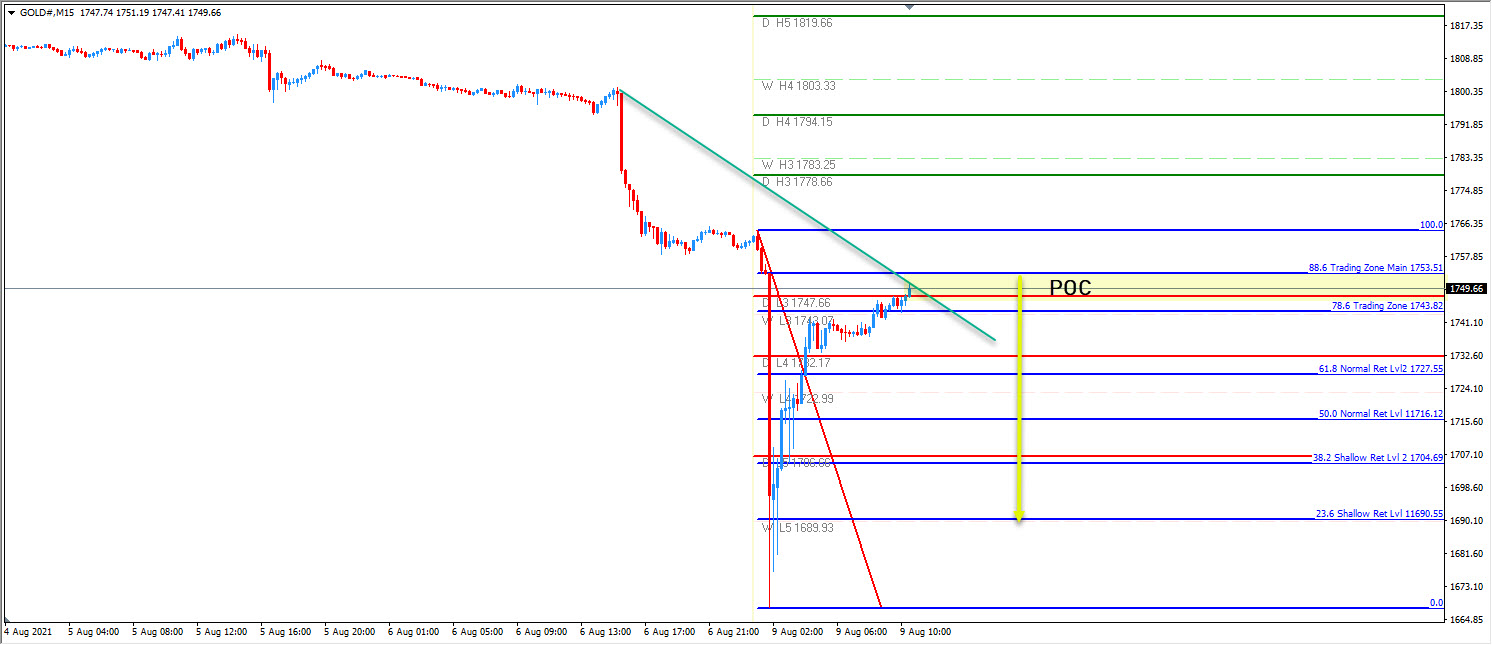
The bearish scenario has played out well for Gold. 1795 broke lower and the price went lower 300 pips.
We should expect a bearish continuation of the GOLD move. If the market doesn’t break 1766, the price should go lower. The 1750 zone is where bears might be waiting and pull the price lower. Watch for 1766 as resistance and 1750 zone for shorting. Targets are 1705, 1667, and 1650. Only a break above 1766 is a temporary bullish.
Gold Crashed, Breaking The Uptrend Of Recent Years
Strong US jobs data continues to weigh on markets, and the impact could stretch into weeks, changing trading strategies for many financial assets. Accelerating employment and wage growth in July and upward revisions to June's data have brought the start date of the unwinding of support programmes from the Fed closer, with broad implications for markets from a 7% collapse in gold and other commodity assets to pressure on equity markets.
Gold lost more than $40 on Friday, falling to $1762, closing the week below uptrend support. An avalanche of stop orders in Asian trading brought the spot price down to $1680, close to the lows of March. The intraday drop exceeded 4%, with a two-day total of losses exceeding 7%.
For the second time this year, a death cross is forming on the chart when the 50-day moving average falls under the 200-day moving average. All this is on top of breaking the long-term uptrend. Most worryingly for gold, the fundamentals are also very bearish.
Robust employment and wage growth are removing the last formal obstacles before the Fed starts cutting back on its asset purchase programme. Expectations have increased that these first cuts in the QE programme could come as soon as September.
The move from asset purchases at 120bn a month to zero will stretch over 6-9 months, but in the Fed rate futures on Friday, the first expectations of a rate hike in January 2022 appeared. It is a tiny 2.4% probability now, but there is only a 1/3 chance that current rates will stay by the end of next year. This is a much faster rate of normalisation than we have seen since the financial crisis.
As a result, nominal US interest rates are rising, returning interest in the dollar and causing pressure on gold. It is moving more dynamically than it has since 2008, so we may be now seeing a reversal as we saw in 2013, when the bear market for gold lasted until late 2015, recouping almost all the gains since the start of the financial crisis. An implication of this pattern to current prices suggests the potential for another 14% drop to the $1500 area.
However, it might be too early to open short positions yet. Gold might get some support from the buyers today and even in the coming days. However, for return to the uptrend, it should go above $1800 and cross its 50 and 200 MAs at $1820 for confirmation. Given the macroeconomic backdrop, this return looks overly optimistic. The chances of gold continuing its slide are much higher.
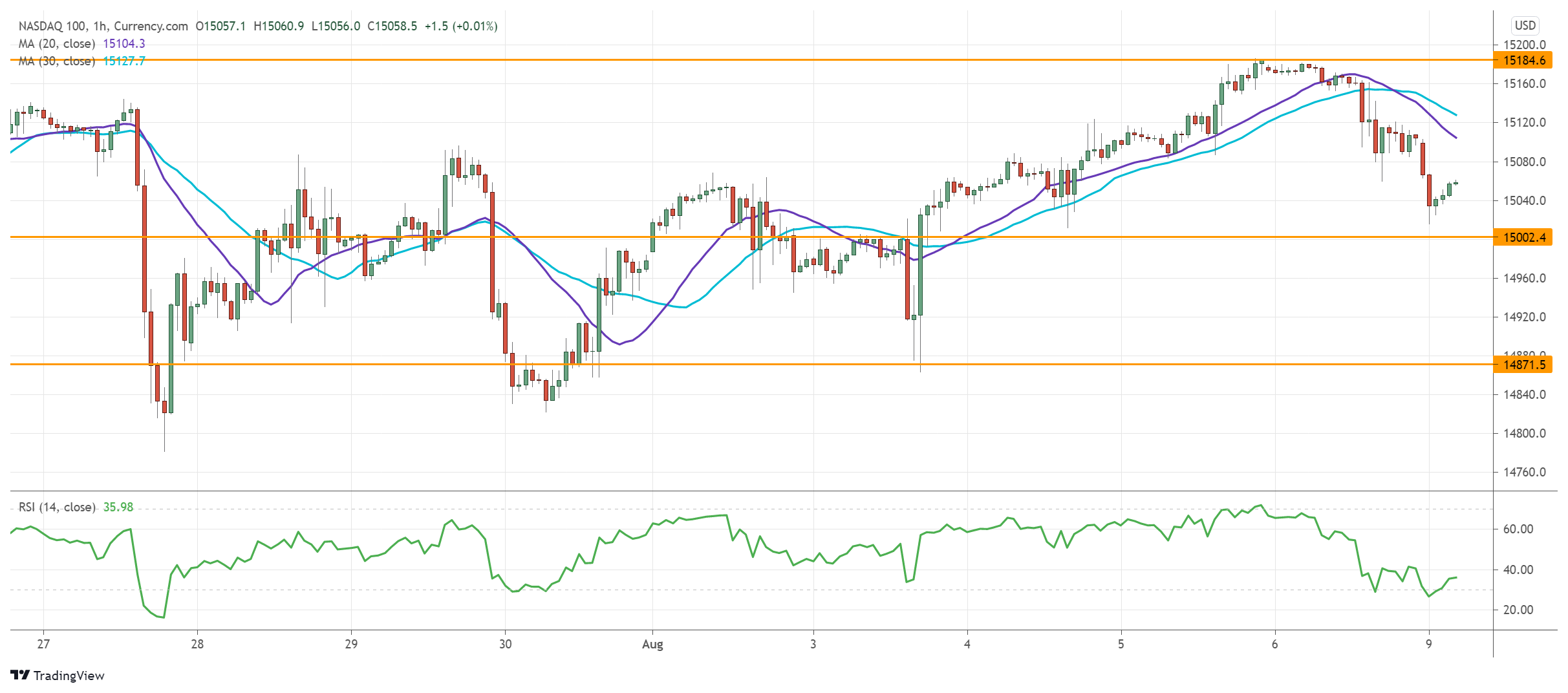
NAS 100 Seeks Support
The Nasdaq 100 retreats as solid economic recovery favors value stocks.
Last week’s bounce off the 20-day moving average has propelled the index to an all- time high at 15185.
An overbought RSI has restrained the bullish fever. Now it has dropped down to the neutral zone, and price action is seeking support.
Buying interest could be found in the demand area between the 30-day moving average (14870) and the psychological level of 15000. A bullish breakout may stir up momentum and send the index to 15300.
XAU/USD Plunges To Important Support
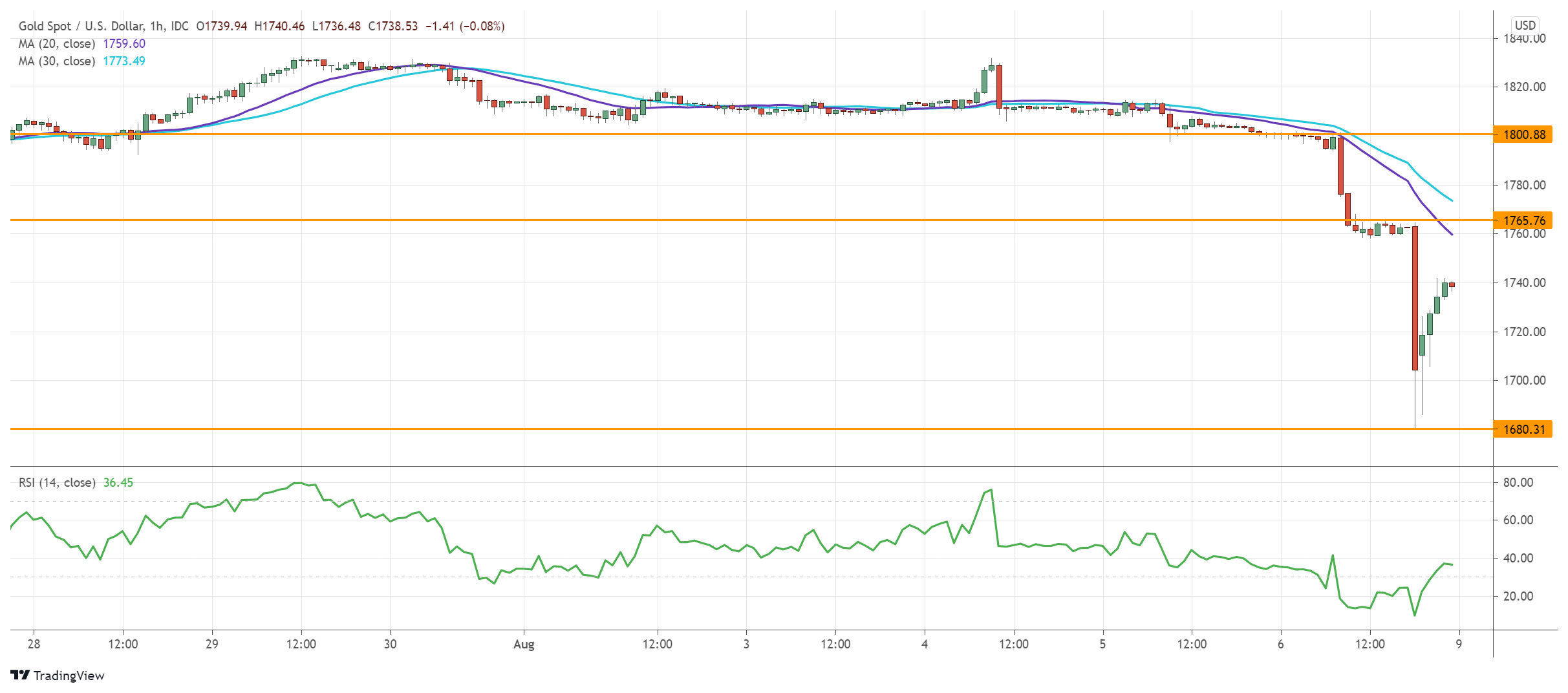
Gold tumbled as the US dollar surged on strong jobs data.
The triple top near 1830 was a sign that buyers had a hard time pushing above the major resistance.
Strong momentum below the floor at 1790 indicates that leveraged buyers have rushed to exit. This is an invalidation of a month-long rebound. 1765 is the new resistance.
The price has bounced off the critical support of 1680 from last March, while an oversold RSI recovers into the neutral area. Its breach could exacerbate the sell-off towards 1600.
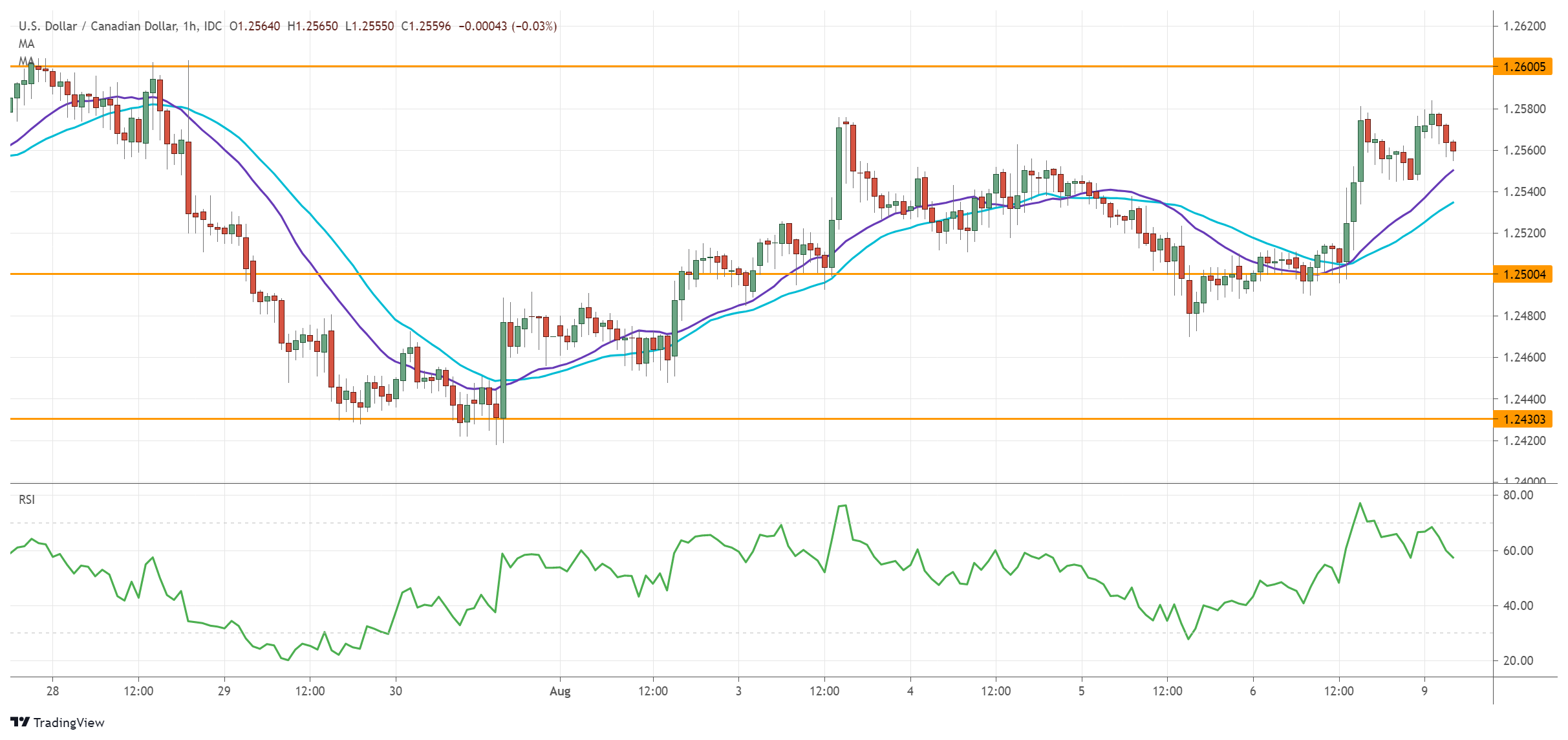
USD/CAD Grinds Key Resistance
The Canadian dollar fell after an uptick in Canada’s unemployment rate in July. The pair has found bids at 1.2430, a key support on the daily chart.
A second test of the demand-turned-supply zone around 1.2575 is a sign of growing buying interest.
An overbought RSI has recovered to the neutral zone and may give the bulls room to double down.
A break above 1.2600 would lift the greenback towards the peak at 1.2800. However, a deeper pullback below 1.2500 may extend the consolidation to around 1.2430.
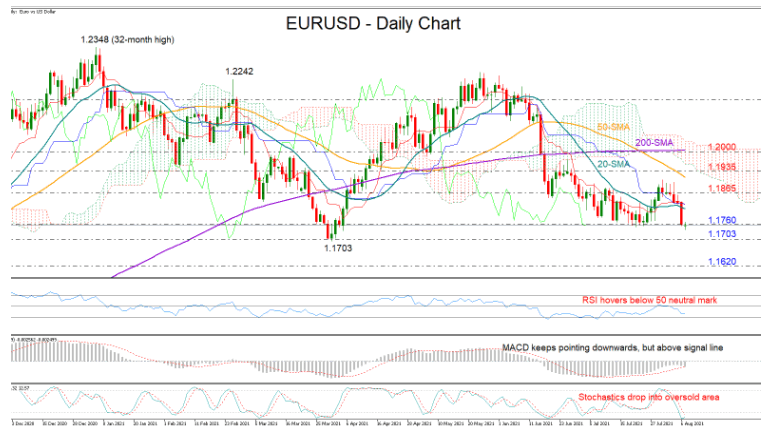
EURUSD Puts Some Breaks On Sell-Off, Bias Still Bearish
EURUSD slumped in the wake of a sturdy nonfarm payrolls report on Friday, sinking back below its 20-day simple moving average (SMA) and under the 1.1800 level.
Encouragingly, though, the selling pressure was not violent enough to close the session below the previous key support of 1.1760, with the price currently trying to set a foothold in the region again.
However, whether the pair will successfully recoup its recent losses is an open question as the RSI is still clearly within the bearish zone, while the MACD, although above its red signal line, is preserving a downward direction below zero. Moreover, the Stochastics have entered the oversold area but have yet to confirm a bullish intersection, flagging that the bears may remain in play for now.
If the 1.1760 floor collapses, the focus will immediately shift to the March low of 1.1703, a break of which would mark a new lower low in the 2021 picture, likely bringing the crucial base of 1.1620 registered during the 2020 fall season next into view. Lower, the pair would face a broader outlook deterioration, and it would be interesting to see if the sell-off can stabilize around the 1.1500 psychological number.
Alternatively, an upside reversal could initially target the 20-day SMA at 1.1811 ahead of last week’s resistance of 1.1865. Crawling higher, the bulls may take a rest somewhere between the 50-day SMA and the nearby 1.1935 barrier from June, where a successful breakout would open the door for the 1.2000 handle and the 200-day SMA.
All in all, EURUSD is still exposed to negative risks in the short-term picture despite today’s consolidation. Failure to hold above 1.1760 could strengthen selling forces towards 1.1700, whereas a bounce higher may face limitations within the 1.1811 – 1.1865 territory.
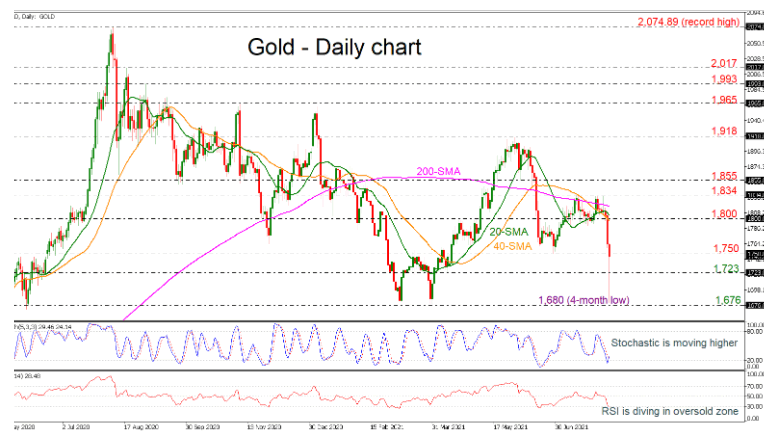
Gold Plunges To New 4-Month Low
Gold is creating a strong negative movement, reaching a fresh four-month low of 1,680 earlier today. The aggressive selling interest started from the pullback off the 20-day simple moving averages (SMA) and the RSI indicator is suggesting further losses, diving into the oversold territory, in the short-term. However, the stochastics are indicating the end of the bearish structure as it posted a bullish crossover within its %K and %D lines.
If the price dips further, immediate support could come from the 1,723 area and the 1,676 low, registered on March 8. Steeper decreases could open the way for a decline towards the 1,451 support, taken from the bottom of March 2020.
On the other hand, a jump above the 1,750 resistance could move the market until the 20- and 40-day SMAs, which overlaps with the 1,800 psychological level. Marginally higher, the 200-day SMA could come next at 1,818 before meeting 1,834 and 1,855.
To sum up, the precious metal is returning to losses after the failed attempt to overcome the 1,834 resistance. More losses beneath 1,676 could shift the long-term outlook back to bearish as well.
US Dollar In Command
The US Dollar rallies powerfully.
Friday's Non-Farm Payrolls data put Fed tapering back in the middle of the dinner table, sending US yields and the US Dollar higher. The dollar index staged an impressive 0.57% rally, carving through resistance at 92.60 on the way to a 92.78 close. In Asia, the dollar index has crept slightly higher to 92.80. Activity in Asia will be much reduced in currency markets due to national holidays in Singapore and Japan.
With a divergence in monetary policy direction seemingly inevitable over the next quarter, the Euro plunged, finishing the session 0.60% lower at 1.1760, where it remains this morning. EUR/USD's nearest resistance is distant at 1.1835, with today's low at 1.1743 initial support. A failure of key support at 1.1700 opens up further losses to 1.1600 initially. Sterling failed at its 100-day moving average (DMA) at 1.3865 once again on Friday, finished the day 0.40% lower at 1.3672. It has eased to 1.3565 today and while the 100-DMA caps rallies, it could extend falls to the 200-DMA at 1.3760. Sterling will likely fare better than the Euro with the ECB solidly anchored in QE forever territory with the Bank of England hinting at tighter policy ahead.
A stronger US Dollar generally and a spike in US bond yields post US data on Friday saw USD/JPY jump 0.43% to 110.22. As I have said recently, USD/JPY has dissolved into a pure yield differential play, and if US bond yields continue to climb, USD/JPY will, by default, also rise. USD/JPY has resistance at 110.65, and failure opens further rallies to 111.50 in the days/weeks ahead. If US yields turn down, USD/JPY should fall to test the 100-DMA at 109.65. A passing of the US infrastructure bills this week should put upward pressure on US yields and, by default, USD/JPY.
On Friday, a stronger US Dollar saw China set a much weaker CNY fix today at 6.4840. USD/CNY has headed South to 6.4770 this morning but remains nestled in its wider 6.4500 to 6.4900 range of the past six weeks, except for two days. That has eased the selling pressure on Asian currencies this morning, although that is only likely to be temporary. Assuming no miraculous change in regional Asia's Covid-19 fight, and if Fed tapering now becomes increasingly expected in Q4, which I believe, the pressure on Asian regional currencies will resume in earnest, sooner rather than later. As outlined above, a divergence in the direction of US monetary policy with most of the rest of the world will pose particular challenges for Asia, leaving central banks here hamstrung on more monetary policy easing if that becomes needed.