Sample Category Title
Fed Rosengren: More substantial job gains would imply tapering this fall
Boston Fed President Eric Rosengren said yesterday if the US continues to have job growth like the last two months, with "very substantial payroll employment gains", then by September meeting, the "substantial further progress" criteria should be met. That would "imply starting to taper sometime this fall".
"If you continue to purchase assets, the reaction primarily is in pricing, not so much in employment," he added. "I don't think asset purchases are having the desired impact on really promoting employment."
Market Morning Briefing: Dollar Index Has Risen To Test 93
STOCKS
Dow has to sustain above 35000 to keep the chances alive of breaking above 35250. Else a fall is possible. DAX seems to lack strength to break above 15800 and can retain its 15200-15800 range for some more time. Nikkei can rise within its 27000-29500 range. Shanghai also looks positive to move up towards 3550-3600 in the near-term. Sensex and Nifty are consolidating at higher levels and continue to look bullish.
Dow (35101.85, −106.66, -0.30%) has come-off yesterday. It has to sustain above 35000 to keep alive the chances of breaking above 35250 and see a rise to 36000 that we have been expecting. A fall below 35000 can drag the Dow down to 34250-34000 and will keep the broader 33000-35250 range intact for some more time.
DAX (15745.41, −16.04, -0.10%) tested 15800 for the second consecutive day but did not break above it. A fall below 15600 will indicate that the 15200-15800 range is still intact and can drag DAX down towards 15400-15200 – the lower end of the range in the coming days. It will then delay the expected break above 15800 and the rise to 16000-16200 that we have been expecting.
Nikkei (27905.73, +85.69, +0.31%) has come-off sharply from the high of 28128.61. The bias is positive to see a rise towards the upper end of its 27000-29500 range. A sustained break above 28000 can trigger this rise. While below 28000, we remain cautious to see if Nikkei can break below 27000 and see a deeper fall to 26000.
Shanghai (3495.09, +0.46, +0.013%) has risen above 3480 and looks bullish in the near-term to test 3560-3580 and even 3600 on the upside. From a bigger picture, Shanghai will have to rise past 3600 to become bullish again. Else a pull-back to 3400-3300 again cannot be ruled out. Price action in the 3580-3600 region will need a close watch.
Sensex (54402.85, +125.13, +0.23%) consolidates above 54000 over the last few days. The view remains bullish to see a rise to 56000. A sustained break above 54500 can accelerate the rally. Support at 53500-53000 can limit the downside.
Nifty (16258.25, +20.05, +0.12%) remains stable above 16200. Outlook is bullish to see a rise to 16500-16600. A decisive break above 16300 will pave way for that rise. Immediate support is at 16150 and then at 15900-15800. Nifty has to fall below 15800 to turn the outlook negative.
COMMODITIES
Commodities trade lower today with Copper, Gold and Silver still looking bearish for the near term while Dollar strengthens. Gold can remain bearish below 1750 while Silver can trade below 25 and Copper can test 4.20 (initial support) or even 4.10/00 (deeper support zone) before bouncing back to higher levels. Crude prices look bearish too towards 65 (Brent) and 60 (WTI).
Brent (69.02) and WTI (66.66) both trade lower today. We may expect a fall towards 65 on Brent and 60 on WTI if the fall continues in the near term. Immediate resistance are seen near 70-72.50/73 on Brent and 69/70 on WTI.
Gold (1735.10) has bounced well from yesterday’s low of 1677. Although the corrective rise is in place, we are bearish on Gold while below 1750/60. A strong Dollar in the near term can prevent any rise in Gold indicating bearishness for this week and possibly the next.
Silver (23.51) tested 22.35 breaking below 23, but has bounced well from there. If the bounce sustains, it can rise towards 24-25 can be possible. But if Dollar Index continues to strengthen, it is bearish for Silver for an eventual fall towards 21-20 in the medium term.
Copper (4.2995) has fallen in line with our expectation yesterday. While the other commodities trade lower, Copper cannot be left out. It is heading towards out mentioned support at 4.20 from where a reversal looks possible. Any fall below support at 4.20, can make it vulnerable to test 4.10-4.00 in the medium term. Watch price action near 4.20.
FOREX
Dollar Index looks strongly bullish but we would wait to watch if it faces any rejection from 93.30/40 region or move up straight towards 94.0-94.50 on the upside. Euro on the other hand has fallen below 1.1750 as it could not sustain the rise seen yesterday. A fall to 1.17-1.16 cannot be negated while the Dollar continues to trade strong. Aussie and Pound look bearish towards 0.73-0.7286 and 1.38-1.37 respectively. USDJPY can rise to 110.50/80 before falling off from there. USDCNY can rise to 6.49/50. Weakness in Chinese Yuan and Euro can drag Rupee lower today taking t beyond 74.40. USDINR offshore rate quotes 74.43 and could indicate a sharp gap up opening today on the onshore markets and eventually take it higher to 74.60/70.
Dollar Index (92.99) has risen to test 93 and could be headed towards initial resistance near 93.30/40 which if manages to break could be strongly bullish towards 94.0-94.50 in the next 1-2 weeks.
Euro (1.1732) rose to 1.1769 yesterday but could not sustain higher as it fell sharply to below 1.1750 and is heading towards 1.17 now. A break below 1.17 would drag Euro further down towards 1.16. View is strongly bearish for the near term.
EURJPY (129.45) has bounced a bit but we cannot negate a fall to support near 128.70 before bouncing back h=sharply from there. On the upside, 130.50 continue to hold as important resistance.
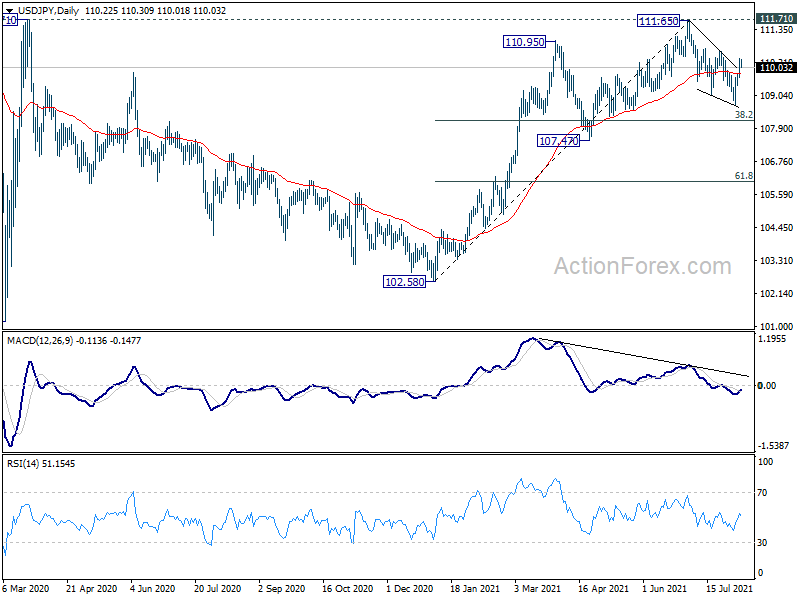
Dollar-Yen (110.30) trades higher and at immediate short term resistance. A break above 110.30 will eventually take the pair higher towards 110.50/80 on the upside before a reversal is seen. Immediate view is bullish while dollar Index heads higher.
Aussie (0.7319) looks weak and could fall towards 0.73-0.7286 initially.
Pound (1.3838) is bearish as it falls towards 1.37. Watch for any interim support near 1.3790-1.3800. Resistance below 1.40 is holding strongly.
USDCNY (6.4795) has dipped after a test of 6.4881 yesterday. We continue to look for a range of 6.45-6.49/50 within which a test of the upper end of the range looks more likely before a fall is seen in the medium term. Watch for a rise to 6.49/50 in the next few sessions.
USDINR (74.27) rose to test 74.2850 on the onshore markets yesterday in line with our expectations of a rise to 74.25/30 that looked like an immediate resistance yesterday. But the weakness in Euro and Chinese Yuan has been significant and can drag Rupee too beyond 74.30 today. USDINR can test 74.50/60/70 on the upside on a sharp upmove that looks most likely today. The offshore rate quotes at 74.43 just now indicating a possibly higher opening on the onshore markets today. Rupee weakness in on the cards for the next few sessions contrary to our expectation of 74.25/30 to hold (mentioned yesterday)
INTEREST RATES
The US Treasury yields sustain higher. Though there is an immediate resistance ahead, the chances of an extended rally breaking above the immediate resistances cannot be ruled out. The US Consumer Price Index (CPI) inflation data release tomorrow will need a close watch to see if it triggers an extended rally or not. The German yields are holding above their supports and can see a corrective rally in the coming days. The 5Yr GoI has come-off sharply and can test 5.7%-5.69% in line with our expectation and then can bounce-back.
The US 2Yr (0.22%), 5Yr (0.79%), 10Yr (1.31%) and the 30Yr (1.96%) Treasury yields remain higher. The 10Yr has immediate resistance at 1.35%. A break above it can see an extended corrective rise to 1.4%-1.45%. Similarly, the 30Yr can move up towards 2.1%-2.15% on a break above 2%. Thereafter the broader downtrend in the Treasury yields can resume with a fresh fall.
The German 2Yr (-0.76%), 5Yr (-0.73%), 10Yr (-0.46%) and 30Yr (-0.02%) yields remain stable after bouncing back sharply on Friday. We retain our view of seeing a corrective rally to -0.30%/-0.25% (10Yr ) and 0.10% (30Yr) in the coming weeks. Supports at -0.45%/-0.40% (10Yr) and -0.05% (30Yr) are holding well as of now.
The Indian 5Yr GoI (5.7290%) has come-off sharply in line with our expectation failing to break above 5.78% yesterday. Our view of seeing a test of 5.7%-5.69% on the downside remains intact. Thereafter a bounce-back move to 5.74% is possible.
GBP/USD Corrects Lower, Why Dips Could Be Limited
Key Highlights
- GBP/USD failed to clear 1.4000 and corrected lower.
- A key declining channel is forming with resistance near 1.3910 on the 4-hours chart.
- EUR/USD could decline heavily if there is a clear break below 1.1740.
- Gold price dropped sharply below the $1,750 support, crude oil price is also struggling below $70.00.
GBP/USD Technical Analysis
The British Pound attempted an upside break above 1.4000 against the US Dollar, but it failed. GBP/USD started a downside correction and it declined below the 1.3920 support zone.
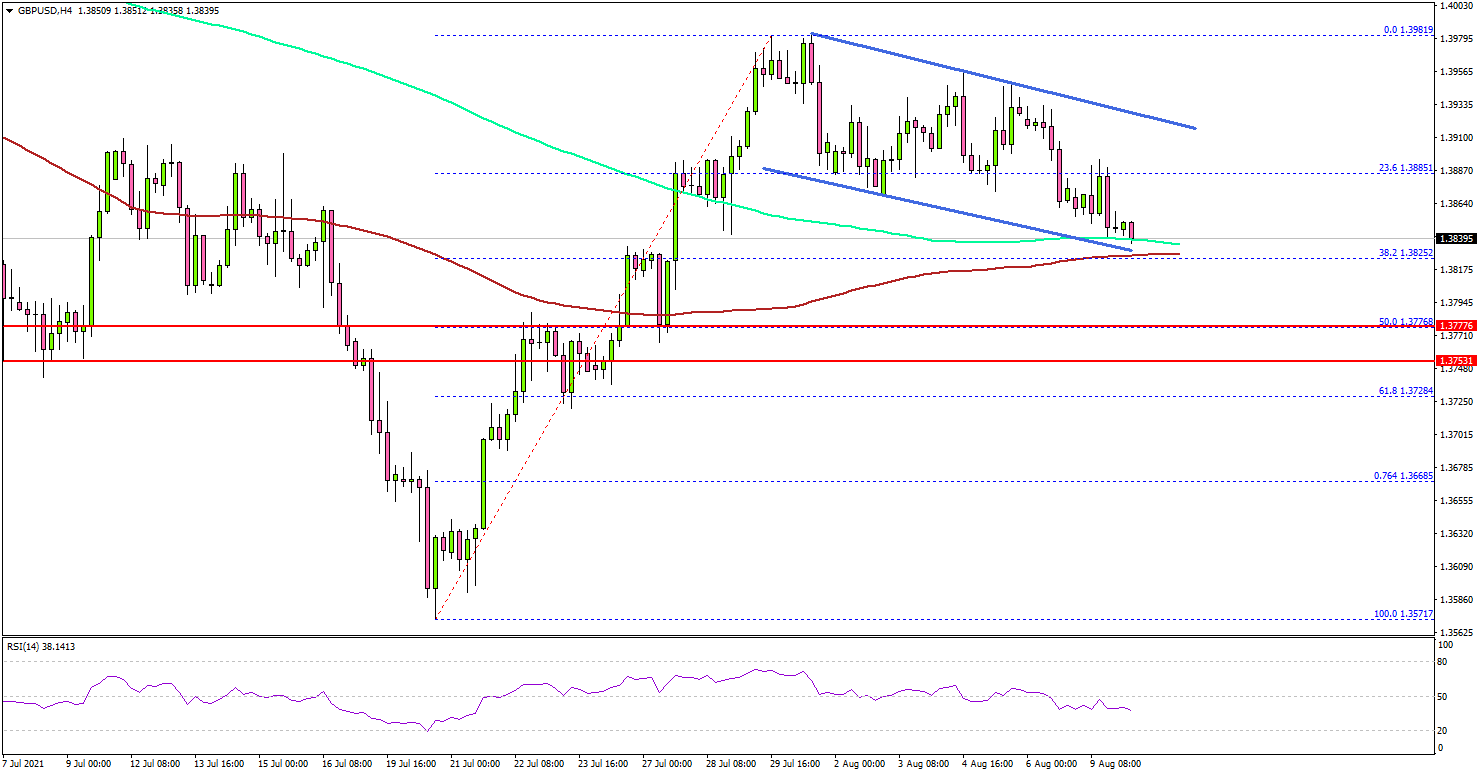
Looking at the 4-hours chart, the pair also traded below the 1.3900 support. There was a break below the 23.6% Fib retracement level of the upward move from the 1.3571 swing low to 1.3981 high.
It seems like there is a key declining channel forming with resistance near 1.3910 on the same chart. If the pair climbs above the channel resistance, there could be a retest of 1.3980. The main resistance is still near the 1.4000 level.
A successful break above 1.4000 may possibly open the doors for a larger increase. On the downside, the first key support is near 1.3825, the 100 simple moving average (red, 4-hours), and the 200 simple moving average (green, 4-hours).
The next major support is near the 1.3775 zone. It is close to the 50% Fib retracement level of the upward move from the 1.3571 swing low to 1.3981 high. Any more downsides might trigger a move towards 1.3620.
Looking at EUR/USD, the pair declined heavily below the 1.1850 support and it might struggle to recover in the near term. The main support on the downside is at 1.1740.
Economic Releases
- German ZEW Business Economic Sentiment Index for August 2021 – Forecast 57.0, versus 63.3 previous.
Eco Data 8/10/21
[php_everywhere instance="1"]
EURUSD – An Uninspiring Breakout
Running out of steam?
What a week it’s been for the dollar. Since last week’s poor ADP we’ve had strong ISM data, hawkish Fed commentary and, finally, a knockout jobs report.
Suddenly, it feels that a tapering announcement is almost upon us and the data is pointing to good times ahead. What a time to be bullish on the dollar.
Which makes me wonder whether so much is now baked into expectations, could the dollar could be primed for a pull back? The longer-term outlook is very promising but corrections do happen along the way.
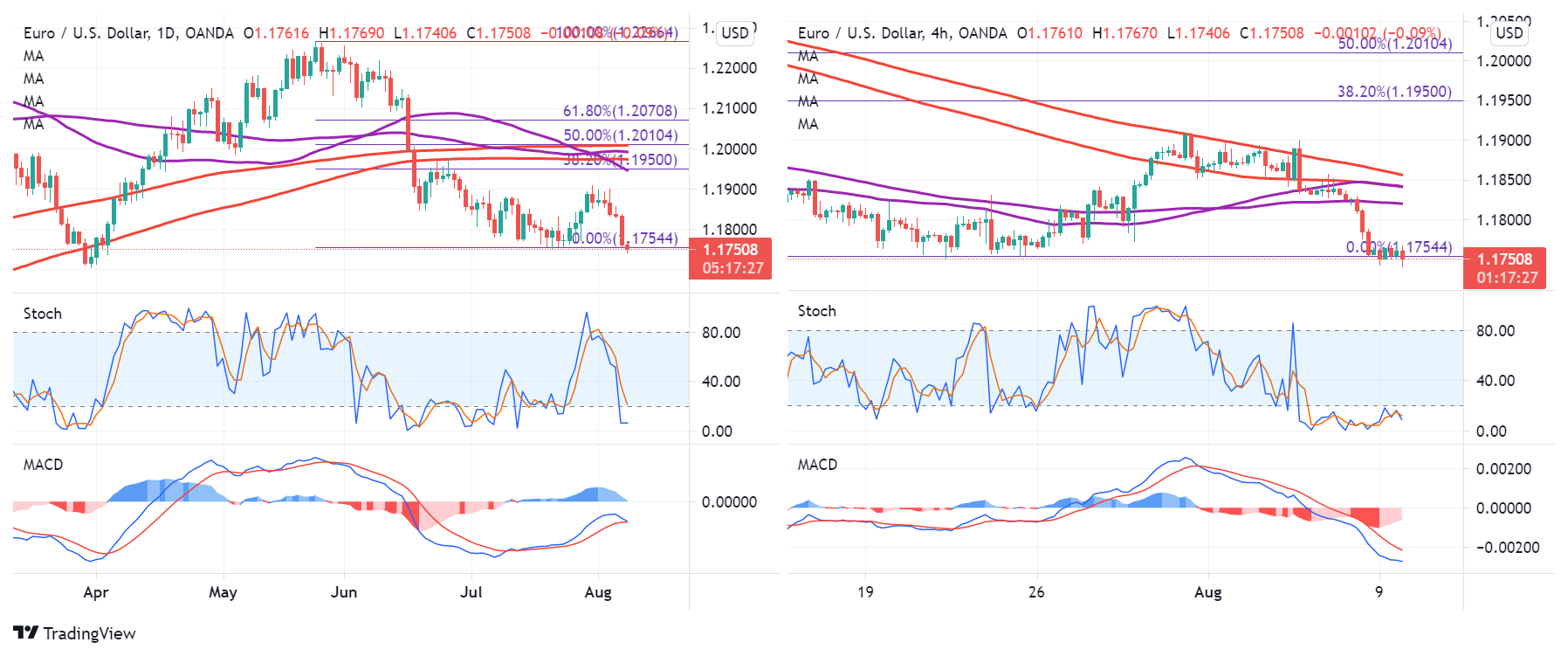
A look at the EURUSD chart makes me even more curious. The pair experienced a very modest correction recently, not even reaching the 38.2 fib in the process, at which point a data and Fed-infused dollar rally sent it tumbling again.
After breaking support, it wouldn’t be a surprise to see it experience another sizeable fall, triggering stops along the way to propel it lower.
But this didn’t happen. It made a new low then pulled back. The momentum indicators are hardly inspiring. Could it be that the rally in the greenback is a little exhausted and we may see a pause ahead of the Jackson Hole later this month, at which many are expecting a deluge of Fed warnings about impending tapering?
Perhaps I’m reading too much into this lacklustre breakout. There’s plenty of things that could launch the dollar once more – two Fed speakers today, CPI Wednesday, etc – but this very much looks like a red flag to me.
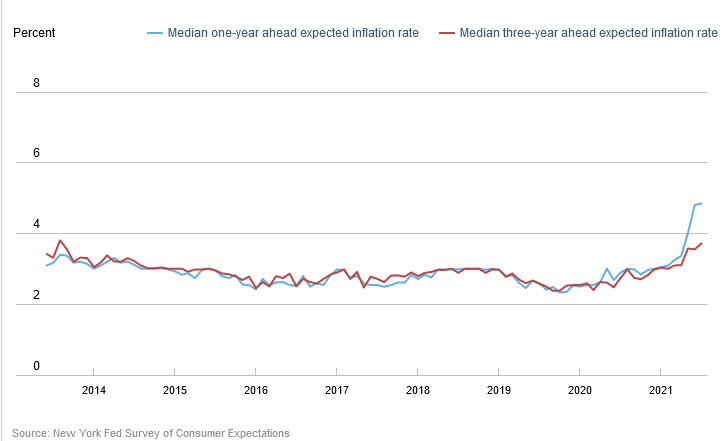
NY Fed: 1-yr inflation expectation unchanged at 4.8%, 3-yr rose to 3.7%
According to the July Survey of Consumer Expectations by the New York Fed, median one-year-ahead inflation expectations were unchanged at record 4.8%. Also, 3-year inflation expectation rose further from 3.6% to 3.7%, hitting the highest level since August 2013.
Sterling Awaits UK Growth Numbers
British economic growth data for Q2 will hit the markets at 06:00 GMT Thursday. Forecasts point to a solid report as widespread vaccinations enabled the reopening of the economy. The Bank of England took another step towards normalization last week and if the economy continues to perform, it will probably exit asset purchases this year. Sterling seems attractive.
Firing up
The British economic engine started revving again in the second quarter as vaccinations went into overdrive, unchaining consumers and businesses. Forecasts suggest the economy grew by 4.8% in the quarter ending in June, bringing the yearly growth rate to 15%.
Beyond the GDP numbers, markets will also pay close attention to business investment. This is the forward-looking element of economic growth. For all this momentum to be sustained moving forward, businesses need to start investing more heavily.
Overall, the outlook for the British economy remains bright. The Delta outbreak has gotten a lot of headlines lately, but it’s not a huge risk. Vaccines have ensured that both hospitalizations and covid deaths remain very low, so the economic impact will be minor.
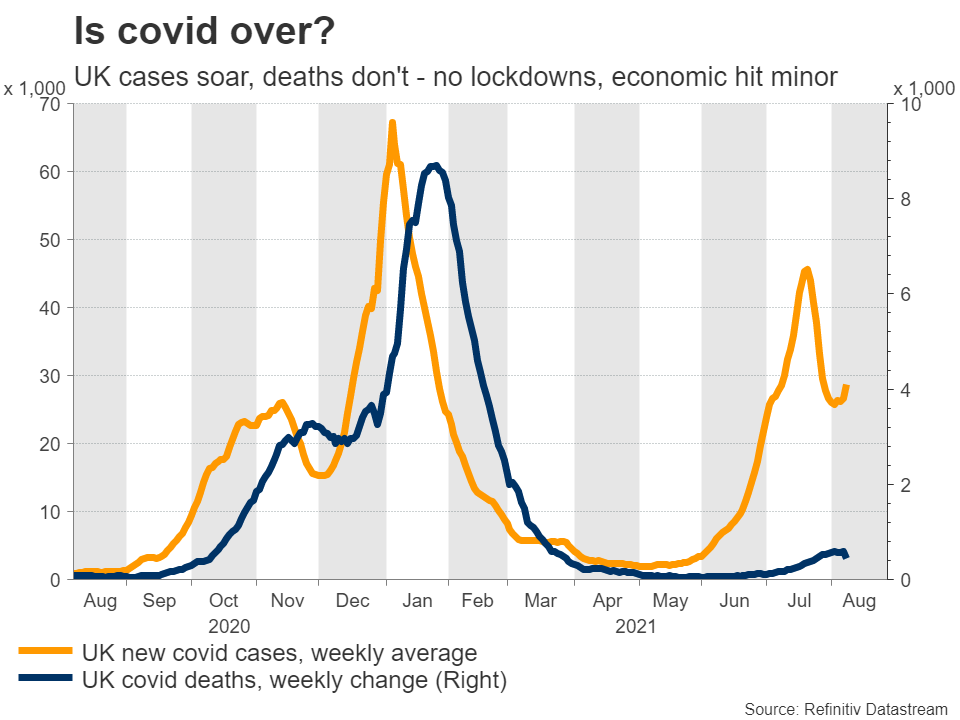
The real risk is what happens to unemployment now that the government’s job-protecting programs are ending. The furlough scheme has already been rolled back and will end completely in late September, risking a spike in unemployment. On the bright side, the Bank of England thinks that won’t happen, amid mounting reports of open job positions and businesses struggling to fill vacancies.
BoE gets the ball rolling
The Bank of England has started to beat the normalization drums. Last week, policymakers signaled that interest rates will likely be raised in late 2022, assuming the economy continues to perform. But the most crucial signal was on asset purchases.
Once the Bank Rate hits 0.5%, the BoE will stop reinvesting those bonds that mature on its balance sheet, essentially draining liquidity out of the sterling market. This means that after two rate increases, the BoE will begin quantitative tightening like the Fed did back in 2017-2019.
It looks like the BoE’s game plan is to end asset purchases this year, raise interest rates next year, and then start quantitative tightening.
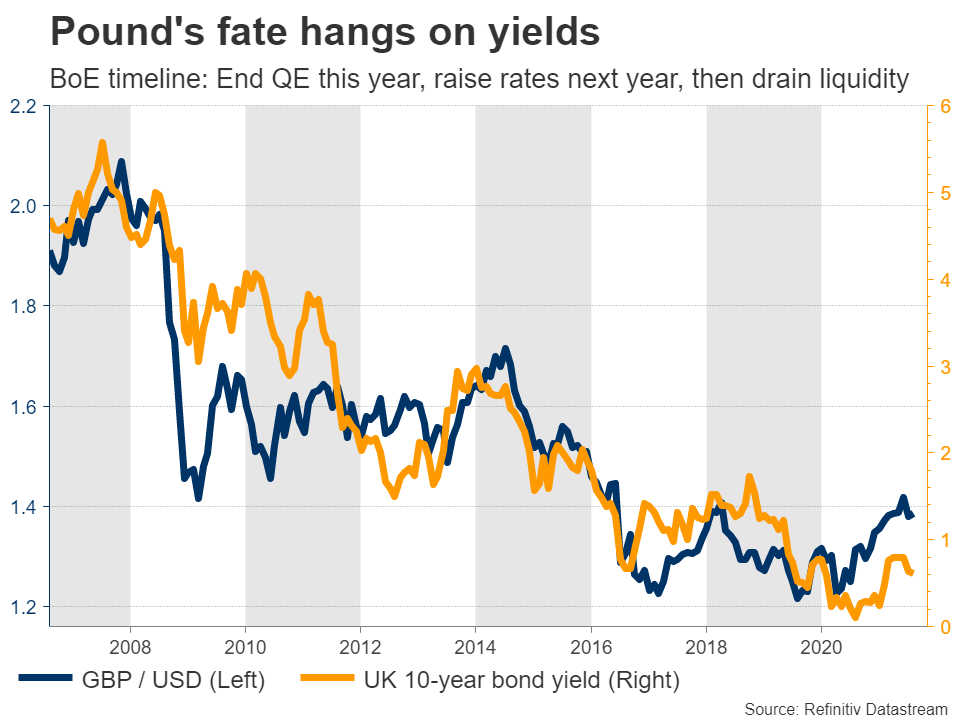
That’s fantastic news for sterling in the longer term. When a central bank drains liquidity from the market, that ultimately pushes bond yields higher, making its currency more attractive from a relative interest rate point of view.
Sterling vs euro and yen
So the outlook for the pound seems promising, but against what? The Fed, the Bank of Canada, and the Reserve Bank of New Zealand are also moving towards higher interest rates, so any future gains in sterling might not show up against those currencies.
Instead, the pound could shine mainly against the euro and the yen. Neither the European Central Bank nor the Bank of Japan will play the normalization game anytime soon, which implies that their currencies will likely struggle in an environment where other central banks are normalizing.
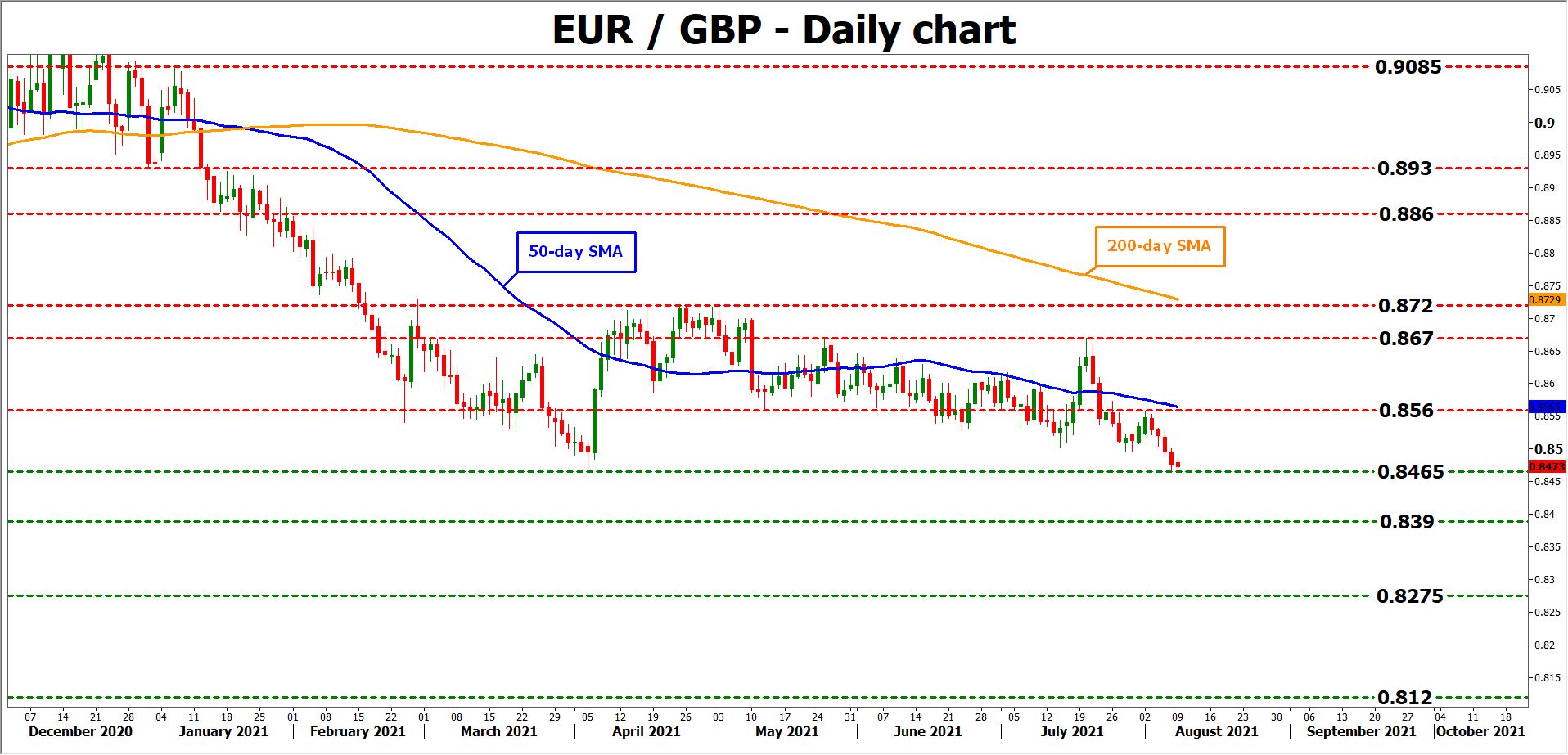
Taking a technical look at euro/sterling, if sellers manage to pierce below the 0.8465 barrier, their next target could be the January 2020 lows at 0.8390.
On the upside, the bulls might encounter initial resistance around 0.8560. If violated, the next crucial zone is around the recent high of 0.8670.
Action Saved for Commodities
A quiet start to the week
Equity markets in Europe are a little flat at the start of the week and US futures are eyeing a similar open on Wall Street.
The action has been saved for the commodities corner of the markets in early trade, with gold and silver seeing a meltdown early in Asia before recouping the bulk of the losses in the following hours as bargain hunters seized on the opportunity to get the week off to a good start.
Meanwhile, oil prices have tumbled again as the spread of delta and restrictions that come with it, particularly in China, is causing real concern. We’re seeing surges in a variety of countries which will likely weigh on the recovery in the coming months, just as it was starting to gather pace.
Yet equity markets are very stable, with focus here remaining on the events of the last couple of weeks. The US jobs report on Friday has solidified expectations for a taper announcement this year, most likely September if the August report is another knockout, so now it’s all about gathering clues as to when it will start and at what pace.
The Jackson Hole event later this month is the one we’ve all got circled in the calendar, with numerous Fed speakers appearing, including Chairman Jerome Powell. This is when we could get the strongest hints to date on the timing and pace. Before that, every data point will be scrutinized, starting with the CPI inflation releases on Wednesday.
Today we’ll hear from Fed voters Raphael Bostic and Thomas Barkin. Commentary from policy makers is getting increasing amounts of attention and I expect that to be the case on a quiet day like today.
Barkin has previously appeared cautious on the labour market with regards to tapering, so his views on Friday’s data will naturally be very interesting given his position as a centrist on the committee. Bostic has previously suggested it’s “getting close to a time” when tapering will be appropriate so we could see him push more in that direction today.
Momentum on bitcoins side
Bitcoin has found its groove once more over the last week, rallying strongly since last Wednesday after it saw plenty of support around $37,500 – the 38.2% retracement of the July lows to highs. Now very much back into bullish territory, the question is how far it can go this time around.
In the near-term, getting back above $50,000 will be the next test, although it could see some resistance around $47,000 – 50% retracement of April highs to June lows. Another interesting level in the March to May period was $51,000 and this time around it’s also the 61.8% retracement of the earlier move. It’s worth saying though that these may only be temporary stumbling blocks as cryptos very much appear to have momentum on their side once more.
Delta weighing heavily on oil
Oil prices are under considerable pressure once again today, with Covid concerns once again being front and centre.
Rising Chinese delta cases and restrictions has cast doubt over the economy in the short-term, with the world’s largest crude importer keen to get to grips early with any outbreak, just as it has done in the past.
With various countries seeing surging case numbers of the delta variant, it’s difficult to gauge the economic impact globally, especially given different successes with the vaccine rollout and different attitudes towards restrictions.
The UK, for example, has among the highest vaccine rates and no restrictions, but other countries may not be so bullish, even with high take up. Many don’t have the luxury.
Obviously China is different than most others though, due to how much oil it imports and consumes which is why outbreaks there have an outsized impact.
The fact that China is already importing lower numbers of crude, as well as other commodities like iron ore and copper, doesn’t help the outlook or prices. Although crude imports did rebound in July as state backed refiners returned from maintanence.
Gold bounces back but remains in bad shape
Where do we start with gold (or silver for that matter)? First thing to say is that they are in bad shape following Friday’s jobs report.
While there’s still plenty of data to come over the next month that could sway the FOMC, it’s looking inevitable that a taper announcement is not far away, probably in September.
That’s naturally bad news for gold prices, with US yields now back on the ascendency and the 10-year pushing 1.3%. The dollar is in good shape once again and this is bad news for the yellow metal and it seems the combination of these factors with major technical support levels and low liquidity, caused the plunge we saw overnight.
Gold smashed through $1,750 support and it seems the stops and illiquid markets did the rest, with the price not finding support then until roughly $1,680, which was key support in March and marks the 61.8% retracement of the 2020 lows and highs.
Price has since rebounded, which will provide no comfort to those caught up in the turmoil, but remains just below $1,750, which now stands out as major potential resistance.
AUDUSD Finds Support but Outlook Still Bearish
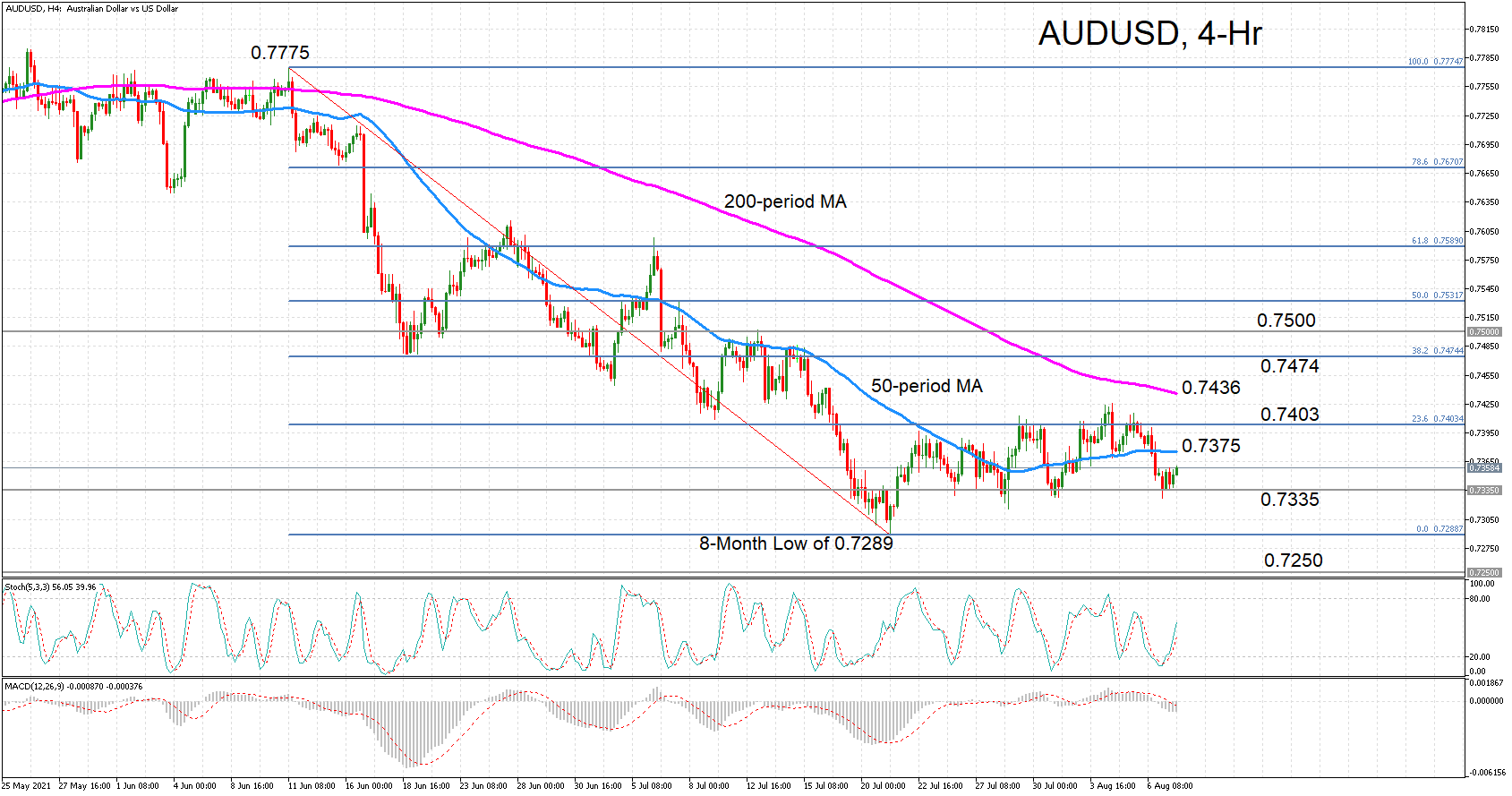
AUDUSD gained some positive traction after steadying in the well-established 0.7335 support region following Friday’s sharp selloff. The price is currently moving higher and the stochastics are also pointing up, suggesting there could be further moderate gains in the coming sessions.
However, the MACD histogram remains below zero and the red signal line continues to slope downwards. Moreover, price action is still far below the 50- and 200-period moving averages (MA) in the 4-hour chart, indicating no change to the negative picture in the short-to-medium term.
Neither is there any shift in the neutral bias in the very near term, with prices roughly hovering between the 0.7335 support and the 23.6% Fibonacci retracement of the June-July downleg after bouncing off the 8-month low of 0.7289 on July 21. The 23.6% Fibo of 0.7403 is proving to be a tough resistance area for AUDUSD as the price has had several unsuccessful attempts to break above it over the last 10 days.
But even before that barrier, the 50-period MA could act as another obstacle at 0.7375. Higher up, the 200-period MA, currently at 0.7436, could slow any advances, and the bulls would additionally have to get past the 38.2% Fibo of 0.7474 and the 0.7500 level to bring about a more sustainable rebound.
To the downside, the July trough of 0.7289 is the next major target for sellers if the support around 0.7335 doesn’t hold. Breaking this as well would reinforce the bearish outlook, turning attention on the 0.7250 level.
To sum up, AUDUSD is gaining some positive momentum but its upside faces several challenges, while there’s not much standing in the way to the south for the downtrend to resume.
USD/JPY Mid-Day Outlook
Daily Pivots: (S1) 109.84; (P) 110.09; (R1) 110.49; More...
Intraday bias in USD/JPY remains mildly on the upside for 110.58 resistance. Decisive break there will confirm that correction from 111.65 has completed with three waves down to 108.71. Stronger rise would then be seen to retest 111.65 high. On the downside, though, below 109.69 minor support will mix up the near term outlook and turn intraday bias neutral first.
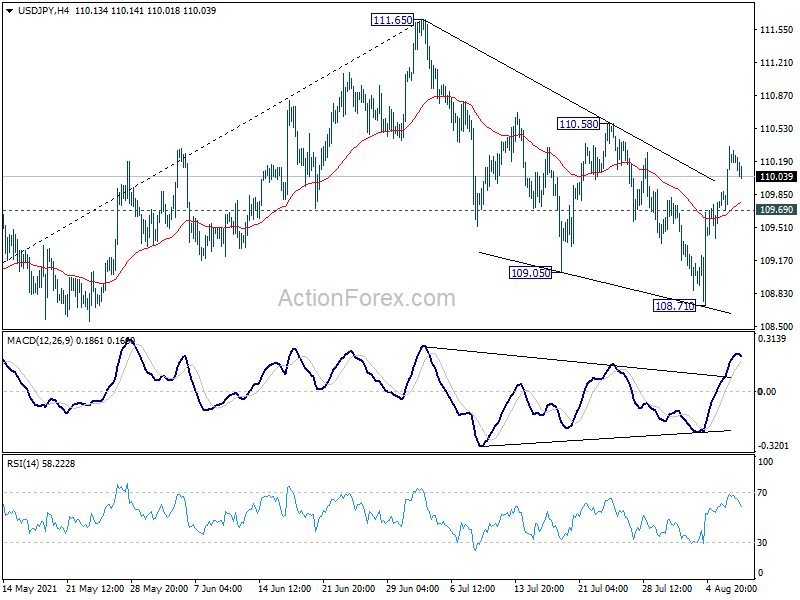
In the bigger picture, medium term outlook is staying neutral with 111.71 resistance intact. The pattern from 101.18 could still extend with another falling leg. Sustained trading below 55 day EMA will bring deeper fall to 107.47 support and below. Nevertheless, strong break of 111.71 resistance will confirm completion of the corrective decline from 118.65 (2016 high). Further rise should then be seen to 114.54 and then 118.65 resistance.