

Sample Category Title
USD/JPY Decline Likely To Continue
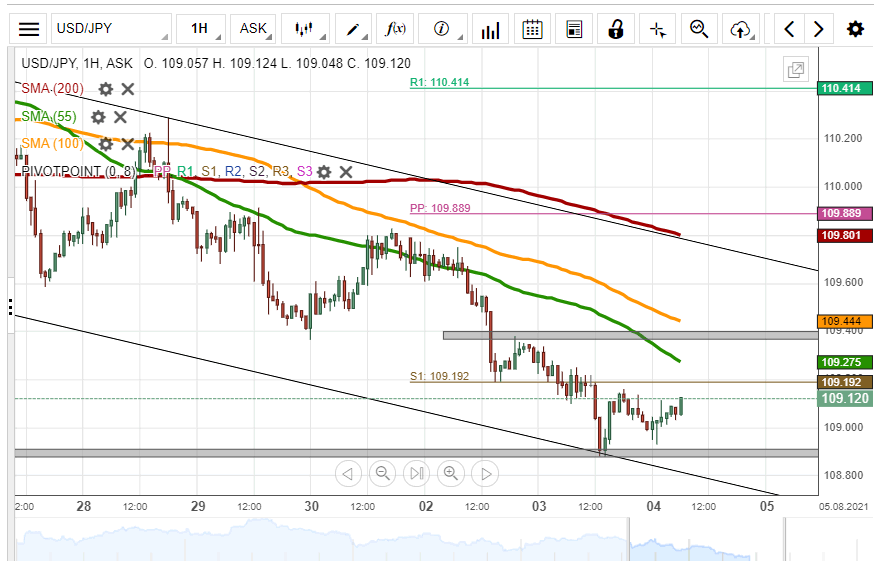
On Tuesday, the US Dollar declined by 41 pips or 0.37% against the Japanese Yen. The currency pair tested the lower boundary of a descending channel pattern during yesterday's trading session.
As for the near future, the exchange rate could continue to edge lower. A breakout through the lower boundary of the descending channel is likely to occur within this session.
However, if the channel pattern holds, a surge towards the 100– hour simple moving average at 109.47 could be expected during the following trading session.
GBP/USD Breached Channel Pattern
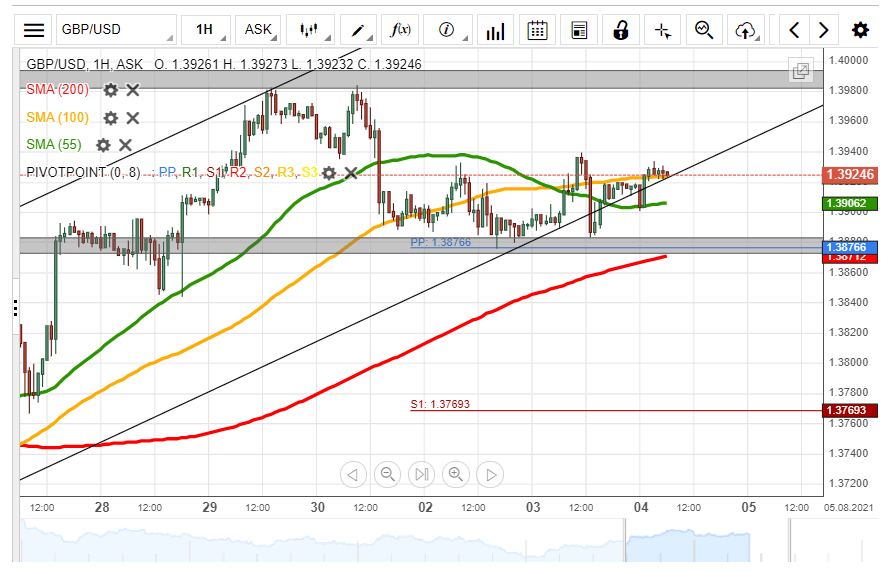
During the first half of Tuesday's trading session, the British Pound rose by 51 pips or 0.37% against the US Dollar. Although, the GBP/USD pair abandoned the earlier gains by the end of yesterday's session.
Everything being equal, the exchange rate could edge higher during the following trading session. The potential target for bullish traders will be near the weekly R1 at 1.4015.
However, given that the currency exchange rate has breached the lower line of an ascending channel pattern, sellers might pressure the currency pair lower within this session.
EUR/USD Could Edge Lower
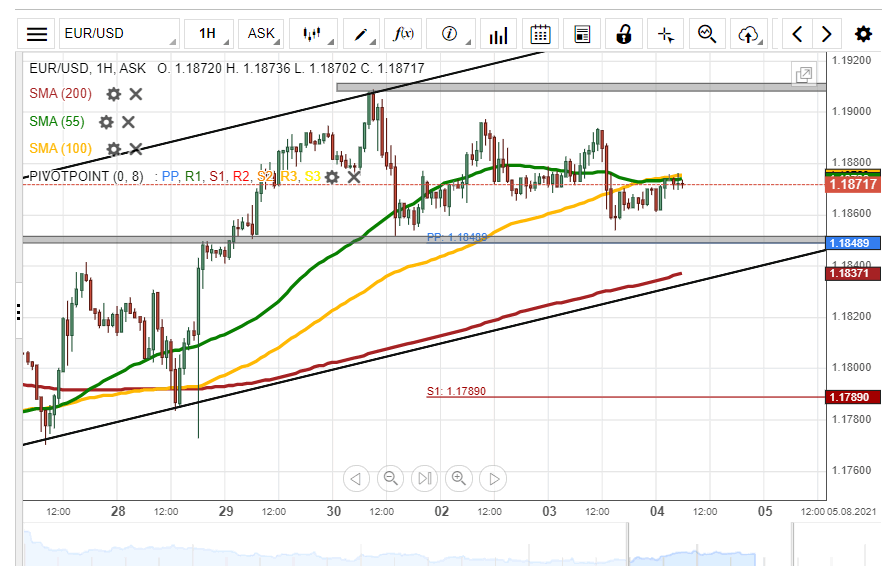
On Tuesday, the common European currency declined by 36 pips or 0.30% against the US Dollar. The currency pair breached the 55– and 100– hour SMAs during yesterday's trading session.
All things being equal, the exchange rate is likely to continue to edge lower during the following trading session. The potential target for the EUR/USD pair will be near the 200– hour simple moving average at 1.1835.
However, the weekly pivot point at 1.1848 could provide support for the currency exchange rate within this session.
US Stocks Up Before ADP Data
Major US indices closed Wednesday’s session in the green, but today’s employment figures could rapidly change the market mood. The latest US jobs data will give an indication of how fast the US labor market is progressing towards the Fed’s policy goal, and how close we are to the ‘substantial’ progress that the Fed pursues to trigger the most-apprehended tapering of its massive bond-buying program.
The US economy is expected to have added close to 700’000 new private jobs during the month of July, near the amount added a month earlier. We know that the actual print could be significantly lower or higher than the estimated figure, but as long as we see a figure above 500-600’000, investors should walk confidently into Friday’s NFP data. A read below 500’000 should throw the mood off the cliff, as there is not much to awaken the Fed doves with inflation hovering above the 5% mark. A strong read, on the other hand, should accelerate the thinking that the Fed will get to the tapering stage quicker than otherwise. That could apply a certain pressure on the US stocks, but it’s always better to walk towards an inevitable policy tightening with a set of strong economic data than the contrary.
Now, the fact that the delta variant of the coronavirus is spreading fast is increasingly worrying, as the latest news alters the prospects of economic recovery, especially if governments decide to move toward stricter lockdown measures to break the transmission chains. The problem is the central banks already deployed all measures to help economies go through the pandemic, and should now deal with overshooting inflation, and not another heatwave.
Therefore, the abnormally low US yields should rebound sooner rather than later. Would strong US jobs data help to mark a turning point is yet to be seen? Yet, gold’s inability to benefit from the low US yields hints that the next direction for the yellow metal is certainly the south.
Equities Trade Generally Higher
General trend
- Hang Seng rebounded from the opening decline [TECH index rebounds]; Sportswear firms rise amid news; Gaming firms drop on Macau news.
- Shanghai Composite also gained as the session progressed; Automakers trade generally higher amid comments from CAAM; Financial and Property indices lag.
- S&P ASX 200 has traded modestly higher [Resources index has outperformed].
- Nikkei 225 has lagged amid the recent weakness in USD/JPY; Nippon Steel rises on higher outlook; Companies due to report later today include Honda, Sony, Softbank Corp, Isuzu, Ricoh.
- Companies due to report during the NY morning include AmerisourceBergen, Apollo Global, BorgWarner, CDW Corp, Clean Harbors, Charles River Labs, CVS, Emerson Electric, Entergy, Exelon, The Geo Group, GM, Kraft Heinz, LL Flooring, Marathon Petroleum, NiSource, New York Times, Royal Caribbean, Scotts Miracle-Gro, Spirit Aerosystems, Triumph Group, Tupperware, Virtu Financial, Vulcan Materials.
- US ADP data due later today.
Headlines/Economic data
Australia/New Zealand
- ASX 200 opened +0.2%.
- (NZ) NEW ZEALAND Q2 UNEMPLOYMENT RATE: 4.0% V 4.4%E; Employment Change Q/Q: 1.0% v 0.6%% prior ; Y/Y: 1.7% v 1.2%e.
- (AU) S&P: Lockdowns in Australia are not likely to slow fiscal repair, Unlikely to weigh heavily on AAA rating.
- (AU) Australia July Final PMI Services: 44.2 v 44.2 prelim (confirms 1st contraction in 11 months; lowest reading since May 2020).
- (AU) Australia July AIG Construction Index: 48.7 v 55.5 prior.
- GMA.AU Reports H1 (A$) Net 59.4M v -90.0M y/y; Rev 208.7M v 237.9M y/y.
- (AU) Australia sells A$800M v A$800M indicated in 1.75% Nov 2032 bonds, avg yield 1.2175%, bid to cover 5.02x.
Japan
- Nikkei 225 opened +0.1%.
- 7203.JP Reports Q1 Net ¥897.8B v ¥158.8B y/y, Op ¥997.5B v ¥13.9B y/y; Rev ¥7.94T v ¥4.60T y/y; Affirms all FY guidance.
- (JP) Japan LDP Party considering leadership election in late September - Japan press.
- 2802.JP AGF unit to raise certain coffee products prices by 20%.
- (JP) Japan July Final PMI Services: 47.4 v 46.4 prelim (confirms 18th month of contraction).
- (JP) Japan Health Adviser Omi: Has been discussing whether state of emergency should be nationwide.
Korea
- Kospi opened +0.3%.
- (KR) South Korea July Foreign Reserves: $458.7B v $454.1B prior (record high).
- 096770.KR Reports Q2 (KRW) Net +415.9B v -345.8B y/y, Op +506.5B v -456.3B y/y; Rev 11.1T v 7.13T y/y, to spin off battery business.
- (KR) South Korea Govt to decided Friday, Aug 6th if they will adjust social distancing rules – Yonhap.
China/Hong Kong
- Hang Seng opened -0.1%; Shanghai Composite opened -0.2%.
- (CN) CHINA JULY CAIXIN PMI SERVICES: 54.9 V 50.5E (15th consecutive expansion).
- (CN) China PBOC Open Market Operation (OMO): Injects CNY10B in 7-day reverse repos v CNY10B in 7-day reverse repos prior; Net CNY0B v Net CNY0B prior.
- (HK) Hong Kong July PMI (Whole Economy): 51.3 v 51.4 prior (6th consecutive expansion).
- (CN) China said to seek to increase sports industry size to CNY5.0T by 2025.
- (CN) China Daily: China Total Trade may hit a record high >$5.4T in H2.
- (CN) Follow Up: Officials in Wuhan (China) have introduced 'housing tickets' in a move to slow increases in property prices – SCMP.
- (CN) China Sec Journal: Domestic demand is a priority in order to stabilize China growth.
- (CN) China July Wholesales Vehicle Sales Expected at 1.82M units, -13.8% y/y – CAAM.
- (CN) China PBOC sets Yuan reference rate: 6.4655 v 6.4610 prior.
- (HK) Macau to shut cinemas, Gyms, Bars, and Karaoke areas beginning August 5th - Press.
Other
- (SG) Singapore July PMI (whole economy): 56.7 v 50.1 prior (8th consecutive expansion)
North America
- TSLA Raises prices in China for longer range Model S by CNY30.0K.
- H Reports Q2 -$1.15 v -$0.89e; Affirmed FY guidance.
- OI Reports Q2 $0.54 v $0.47e, Rev $1.7B v $1.57Be; Raises guidance.
- PRU Reports Q2 $3.79 v $3.04e; To return $11B to shareholders through 2023 (prior $10.5B).
- (US) Weekly API Crude Oil Inventories: -0.9M v -4.7M prior.
Europe
- ROG.CH Softbank said to have built a $5.0B stake, thinks the Greentech unit is undervalued - financial press.
- (UK) Times Shadow Committee reiterates Bank of England (BOE) should cancel the final £50.0B of QE, BOE should deliver clear signal that it is concerned about rising inflation - UK press [BOE is due to meet on Thurs (Aug 5th)].
Levels as of 01:15ET
- Hang Seng +1.3%; Shanghai Composite +0.5%; Kospi +1.2%; Nikkei225 -0.3%; ASX 200 +0.3%.
- Equity Futures: S&P500 -0.1%; Nasdaq100 0.0%, Dax +0.0%; FTSE100 +0.2%.
- EUR 1.1876-1.1861; JPY 109.11-108.93; AUD 0.7412-0.7388; NZD 0.7066-0.7013.
- Commodity Futures: Gold +0.1% at $1,816/oz; Crude Oil -0.3% at $70.34/brl; Copper +0.1% at $4.39/lb.
US ADP Employment Report In Focus
Market movers today
- Final services PMIs for July will be released across a number of European countries and the US. With the end of lockdowns many euro area countries are seeing an accelerating service sector recovery, but with the spreading of the delta variant, some headwind on tourism, travel, and hospitality sectors will likely remain.
- In the US, the ADP employment report will give some early hints about the jobs market situation during July, ahead of Friday's non-farm payroll report. The employment index in the ISM non-manufacturing index will also be worth watching for clues on the prevalence of labour shortages.
- In Norway, we get Real Estate Norway's monthly house price statistics. We are generally looking for a moderate slowdown to the Norwegian housing market. However, Monday's OBOS house price data revealed surprisingly strong price growth both nationally and in Oslo. That leaves some topside risk to our base case of roughly flat (seasonally adjusted) market in July. Either way we still look for Norges Bank to initiate its hiking cycle in September.
The 60 second overview
Risk sentiment: Overall risk sentiment was positive with equities gaining and broad USD declining. Yesterday was quiet in terms of new data releases and little news shook the markets overnight. Tensions between the west and Iran have risen somewhat as US is investigating a possible hijacking of a tanker near Oman. Oil prices fell slightly yesterday with Brent now hovering above USD72/bbl.
Yield outlook: The global bond rally calmed down and US yields stabilized yesterday. The US jobs report on Friday will be an important release to follow as the speed of the labor market recovery will be a key factor determining when Fed will begin its tapering process. We have adjusted our year-end forecast for the US 10Y yield lower to 1.70%, but still expect moderately higher yields on the back of more hawkish Fed. Read more in our latest Yield Outlook: Yields set to tick up later in 2021 as the US labour market improves and the Fed starts tapering, 3 August.
New Zealand: Unemployment rate in New Zealand fell more than expected to 4.0% in Q2 from 4.7% in Q1. The strong figure supported NZD overnight, as markets have now fully priced in the first hike by the Reserve Bank of New Zealand (RBNZ) in the upcoming meeting 18 August. RBNZ also yesterday announced plans to further tighten rules for mortgage lending to help curb the rapidly rising housing prices in the country.
Equities: Equities rose yesterday, sending S&P500, MSCI world and other indices to fresh new all-time highs. Despite equities have risen in July and the first days of August it's a different leadership than we saw earlier in the year when macro momentum was accelerating. Lately, we have seen a defensive led outperformance, which is of course also partly backed by the drop in yields. However, it not the most rate sensitive sectors that have outperformed but instead a sector like health care has done very well. We think this shift towards semi-defensive sectors is a premature and argue we will see the cyclicals outperforming in Q3. This view is being supported by the earnings and earnings revisions we are seeing within cyclical sectors.
FI: The rally in the global bond markets took a pause yesterday with 10Y US Treasuries trading around the 1.17%-level and 10Y German government bond yield still testing -0.5%-level, while we wait for the US labour market report on Friday.
FX: AUD, NZD and NOK held up well yesterday despite commodity prices dropping back. Drop in broad USD likely helped. Noteworthy levels: EUR/USD held steady just below 1.19, USD/JPY traded close to 109 and EUR/GBP fell closer to 0.85.
Credit: Another day with muted movements in credit. iTraxx Xover widened 1bp (to 236bp) and Main was unchanged at 46½bp. HY bonds were unchanged and IG ½-1bp wider.
NZ Labour Market Review, June Quarter 2021
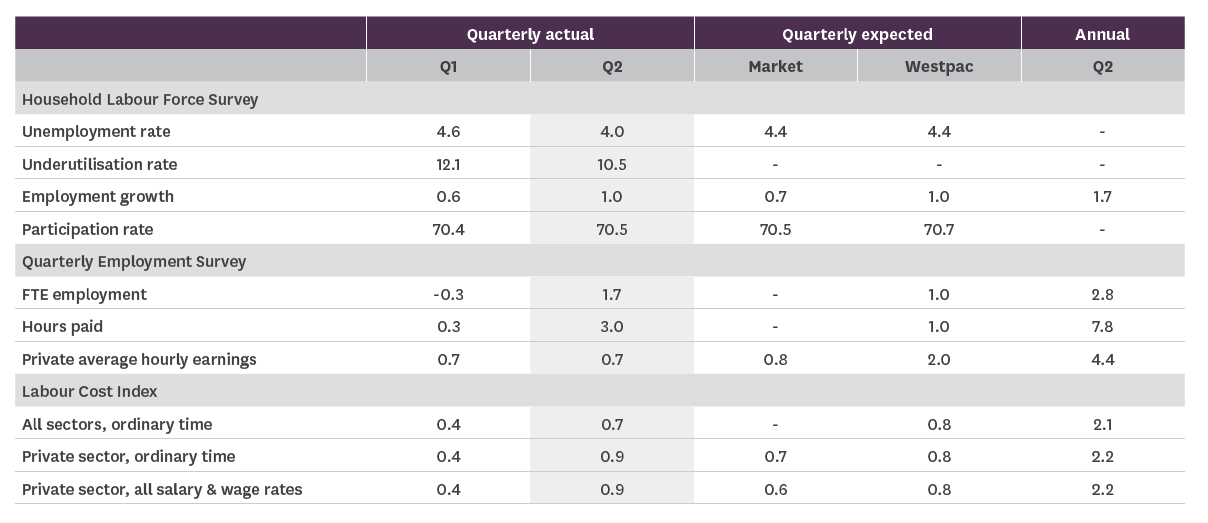
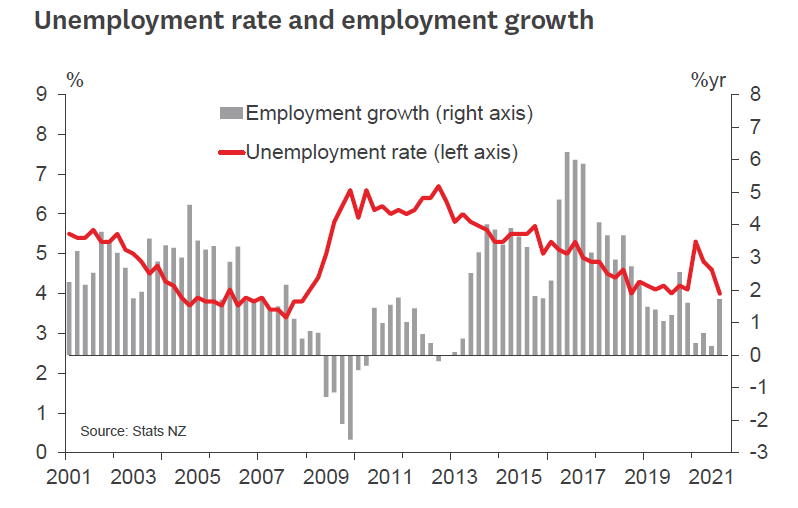
- The unemployment rate fell to 4.0% in the June quarter, returning to its pre-Covid lows.
- The strong lift in employment indicates that a shortage of workers is not the main issue. Rather, demand for workers has been red-hot.
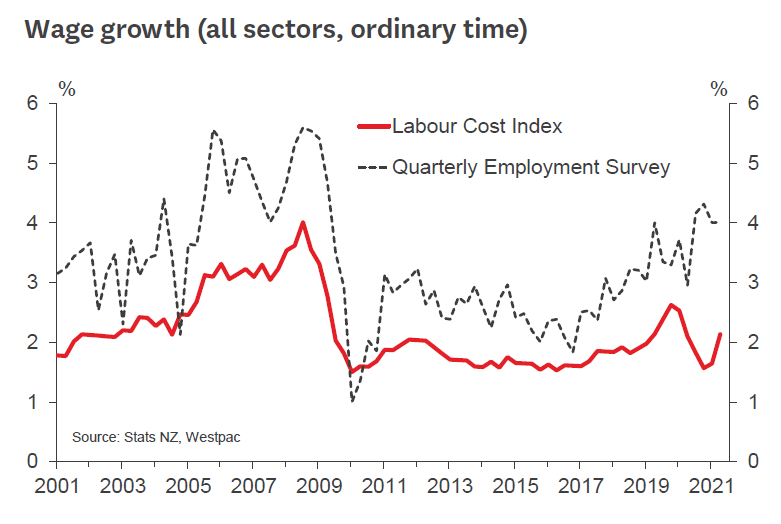
- Wage growth picked up strongly, especially in the private sector, as employers bid up to attract or retain workers.
- We continue to expect the Reserve Bank to start raising the OCR from this month, reaching a rate of 1% by the end of this year
The New Zealand labour market has tightened up even faster than we expected over the last few months. The unemployment rate dropped back to its pre-Covid low of 4.0% in the June quarter, and wage growth accelerated sharply after the subdued gains in previous quarters.
Today’s results highlight the fact that current labour market conditions are as much a product of hot demand as they are of supply-side constraints. The closure of the international border has effectively cut off the flow of migrant workers, and we’ve increasingly been hearing stories about skill shortages and poaching of existing workers. But it hasn’t been a zerosum game – employment is growing strongly on balance, and more and more people are being drawn back into the workforce.
These figures cement our view that the Reserve Bank will start to raise the OCR at this month’s Monetary Policy Statement with a total of three 25 basis point hikes by the end of this year. It’s becoming clearer that the domestic economy is running hot, and that the degree of monetary stimulus that we currently have in place is no longer appropriate.
Financial markets have now more firmly moved in favour of an August OCR hike, and are even pricing some chance of a 50 basis point move. We don’t see that as the most likely outcome, but we wouldn’t rule it out – the Monetary Policy Committee has already shown itself to be an activist one, and if they felt that 50 basis points of tightening was needed in total, they wouldn’t necessarily space it out for the sake of spacing it out.
Details
In the Household Labour Force Survey (HLFS), the unemployment rate fell to 4.0% in the June quarter, compared to a downwardly revised 4.6% in the June quarter. Unemployment peaked at just 5.3% after last year’s Covid lockdown, and is now back to its previous low point.
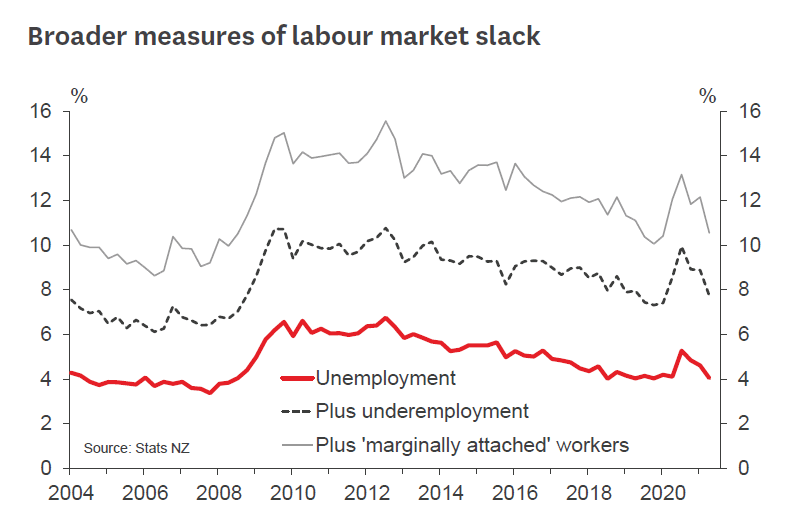
Other measures of labour market capacity told a similar story. The underutilisation rate had lifted to 12.1% in the March quarter – possibly due to the brief period that Auckland had spent at Covid Alert Level 3 – but has since dropped back to 10.5%. This was the lowest rate since March last year.
In the past we’ve estimated that a ‘neutral’ or non-inflationary unemployment rate is somewhere in the low 4’s. Some have suggested that the neutral rate could be temporarily higher right now due to skill mismatches, exacerbated by the loss of access to migrant workers. But either way, we’d argue that the economy is now operating beyond ‘maximum sustainable employment’ as set out in the RBNZ’s mandate.
The 1% rise in employment over the quarter was in line with our forecast. However, there was less of an assist than we expected from labour force participation – most of the rise in employment came out of the ranks of the unemployed. Participation is still a little below its pre-Covid levels, in part due to lower youth participation – more young people have gone into study in the last year, rather than heading overseas.
The Labour Cost Index (LCI) showed a strong increase in salary and wage rates compared to previous quarters. The overall increase of 0.7% was a little below our forecast of 0.8%, but that was due to subdued wage growth in the public sector (probably due to the ongoing wage freeze for higherpaying roles). Private sector wages rose by 0.9% for the quarter, to be up 2.2% on a year ago.
The Quarterly Employment Survey (QES) also showed a strong lift in employment and a pickup in wage growth. (The surprisingly soft readings in the March quarter were also revised away.) We had noted a sharp rise in employee earnings in recent months, based on tax data. The QES explained this as a strong lift in the number of hours worked, rather than a spike in average hourly pay rates.
We’ll review what these results mean for our forecasts over the next few days. We were already forecasting the unemployment rate to drop below 4% next year as the economy continued its post-Covid recovery. Since we’ve approached that point much sooner than expected, we’ll give careful consideration to how low it could go in this cycle.
Wage growth is likely to pick up further from here. Indeed, an annual increase of 2.2% is still below the peak reached in 2019, when the labour market was clearly getting tight. And with inflation higher today than it was back then, it appears that real wage inflation is only just beginning to stir.
Market Morning Briefing: Aussie Has Finally Broken Above 0.74
STOCKS
Sensex and Nifty have broken their sideways consolidation while the other equities still remain inside their range. As such, Sensex and Nifty are likely to outperform others and are bullish to move up further from here. Dow is at the upper end of its 33000-35250 range and needs to be seen if it can break 35250 from here and rise to 36000. DAX continues to remain unclear within its 15200-15800 range. Nikkei is holding on to its 27000-29500 range for now. Shanghai can move up towards 3500-3550 from here which will ease the danger of breaking below 3300.
Dow (35116.40, +278.24, +0.80%) has risen back above 35000 and needs to see if it can rise past 35250 from here which is needed to see 36000 on the upside. A strong break above 35250 from here will reduce the chances of seeing 34250-34000 cautioned yesterday. We will have to wait and watch. For now the 33000-35250 range remains intact and we retain our bullish view to see an upside breakout of this range.
DAX (15555.08, -13.65, -0.09%) continues to trade unclear at the middle of its 15200-15800 range. As mentioned yesterday, we see equal chances of either a rise to 15800 or a fall to 15200 from here. The broader bias is bullish to see an upside breakout above 15800 and a rise to 16000-16200 eventually.
Nikkei (27625.58, −16.25, -0.06%) is managing to hold above 27500 but is not gaining strength to move up strongly. A strong rise past 28000 is needed to gain momentum and move up within the 27000-29500 range. While below 28000, the danger is still alive of breaking below 27000 and see a fall to 26000.
Shanghai (3468.83, +20.84, +0.60%) sustains higher and can move up further to test 3500-3550 from here. As mentioned yesterday a strong rise past 3550 will be needed to negate the danger of seeing 3200 on the downside over the medium-term and bring back the earlier bullish view of seeing 3700-3800 on the upside.
Sensex (53823.36, +872.73, +1.65%) has surged breaking the 52000-53200 range on the upside as expected. This keeps our bullish view intact of testing 54000 immediately and also to see 56000 on the upside eventually going forward.
Nifty (16130.75, +245.60, +1.55%) has broken its 15600-15900 range on the upside as expected and has also risen past 16000. Our bullish view of seeing 16200 remains intact. A break above 16200 can take it further up to 16500 and even higher levels in the coming weeks.
COMMODITIES
Crude prices have fallen and could head lower in the near term while Gold and Silver are headed towards 1820 and 26 respectively which need to break to take prices further up in the near term. Copper has broken below 4.40 and if the fall sustains, it can fall further towards 4.30 soon. Watch price action to see if the price rises above 4.40 today. Overall crude and Copper looks bearish while Silver and Gold can move up slowly.
Brent (72.45) and WTI (70.41) have dipped as expected and could fall towards 70 and 69/68 respectively. Immediate view is bearish.
Gold (1817.50) is slowly inching up and a break above 1820 can take it higher to 1840/60 again in the near to medium term. While above 1800, view is bullish for Gold just now. Watch price action near 1820.
Silver (25.71) has risen well and could test 26 before pausing. Overall broad range of 24.50-26 holds well for now.
Copper (4.3880) dipped to 4.36 and has bounced a bit from there. A sustained trade below 4.40 would be an early indication of further bearishness towards 4.35/30 in the near term. Watch price action to see if it bounces back to levels above 4.40 or continues to trade lower.
FOREX
Dollar Index looks bearish while Euro, Aussie, Pound, Chinese Yuan have strengthened against the Dollar and looks to rise further towards 1.19, 0.75, 1.40+ and 6.45 respectively in the coming sessions. EURJPY tests 129.50 which can extend to 129 and keep the 129-130.50 range intact for sometime. Watch if USDINR breaks below 74.20 as it could then head towards 74.00
Dollar Index (91.99) trades just below 92 and needs to fall and break below 91.75 to gain some bearish momentum. View is bearish while below 92.25.
Euro (1.1874) is poised for a slow rise towards 1.19-1.1950 in the near term. View is bullish while above 1.1850.
EURJPY (129.48) has fallen to the lower end of the 130.50-129.50 range which can extend to 129 on the downside which if holds can then produce a bounce back towards 130-130.50 in the coming sessions.
Dollar-Yen (109.03) has come down to test 109 and if the pair fails to bounce back from here immediately, it could be vulnerable to a deeper fall towards 108.50-108 in the coming sessions. Watch price action near 109. Overall seeing the movement over the past few days, the pair looks strongly bearish. Any bounce from current levels could be short lived.
Aussie (0.7408) has finally broken above 0.74 and while it trades higher, a test of 0.75 would be the next target. View is bullish while above 0.74.
Pound (1.3928) is attempting to bounce and could re-test 1.40 soon on the upside. A break above that if seen would be bullish for the medium term. Watch price action near 1.40 in the coming sessions.
USDCNY (6.4633) fell back from 6.47 instead of rising higher but we do not negate a possible rise to 6.49 while the pair trades above 6.45. Overall a sideways range of 6.45-6.49 may hold for now.
USDINR (74.2850) held well above 74.20 yesterday but we would keep a close watch to see if 74.20 holds or breaks to pave way for 74.00-73.80 on the downside. Preference is to see a fall towards 74, any bounce from 74.20 today also could take it higher to 74.40/50. Watch price action near 74.20 today. Strength in Euro, Chinese Yuan and Nifty should be Rupee positive today.
INTEREST RATES
The US Treasury yields remain lower and are likely to dip further to test their key supports. We expect a corrective bounce from there within their broader downtrend. The German yields are also coming closer to their key supports within their current downtrend. A corrective rise is possible before a fresh fall is seen again. The 10Yr GoI has surged to 6.3% amid muted trading as expected and is likely to reverse lower in the coming days. The 5Yr GoI has little room to move up from here before reversing lower again.
The US 2Yr (0.17%), 5Yr (0.65%), 10Yr (1.18%) and the 30Yr (1.85%) Treasury yields remain lower. We expect the yields to test 1.1% (10Yr) and 1.8% (30Yr) in the near-term now within their overall downtrend. Thereafter a corrective rally to 1.45%-1.5% (10Yr) and 2.1%-2.2% (30Yr) is possible before the broader downtrend resumes again.
The German 2Yr (-0.78%), 5Yr (-0.75%), 10Yr (-0.48%) and 30Yr (-0.01%) yields remain lower and stable. Immediate supports are at -0.5% (10Yr) and-0.05% (30Yr) from where a short-term corrective bounce to -0.30%/-0.25% (10Yr) and 0.10% (30Yr) can be seen. Thereafter the broader downtrend can resume again.
The 10Yr GoI (6.3062%)had surged to test 6.3% as expected. We expect 6.3%-6.32% to be a cap on the upside and the yields to come down towards 6.2%-6.1% again. The 5Yr GoI (5.7336%) has room to test 5.74%-5.76% on the upside and then can fall-back again.
USD/JPY Daily Outlook
Daily Pivots: (S1) 108.83; (P) 109.08; (R1) 109.29; More...
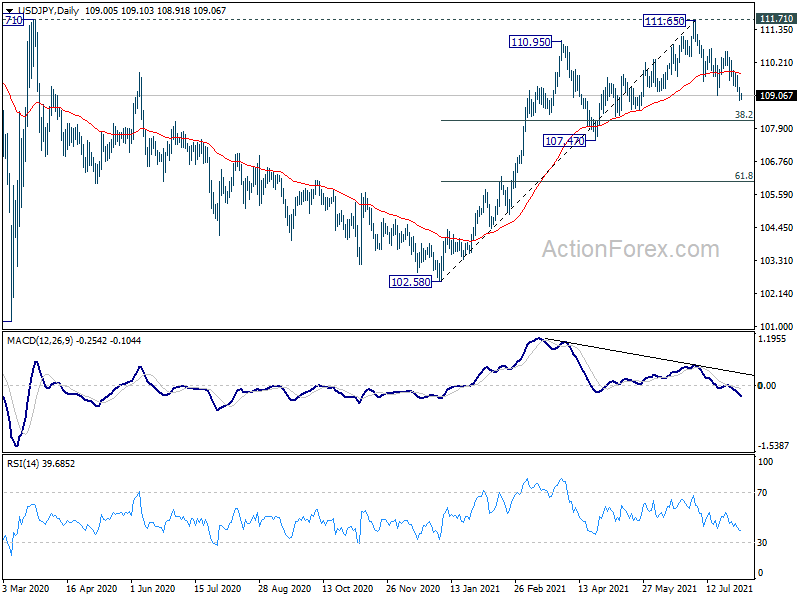
Intraday bias in USD/JPY remains on the downside at this point. Fall from 111.65 is in progress for 38.2% retracement of 102.58 to 111.65 at 108.18. On the upside, above 109.82 minor resistance will turn bias back to the upside for 110.58 resistance instead.
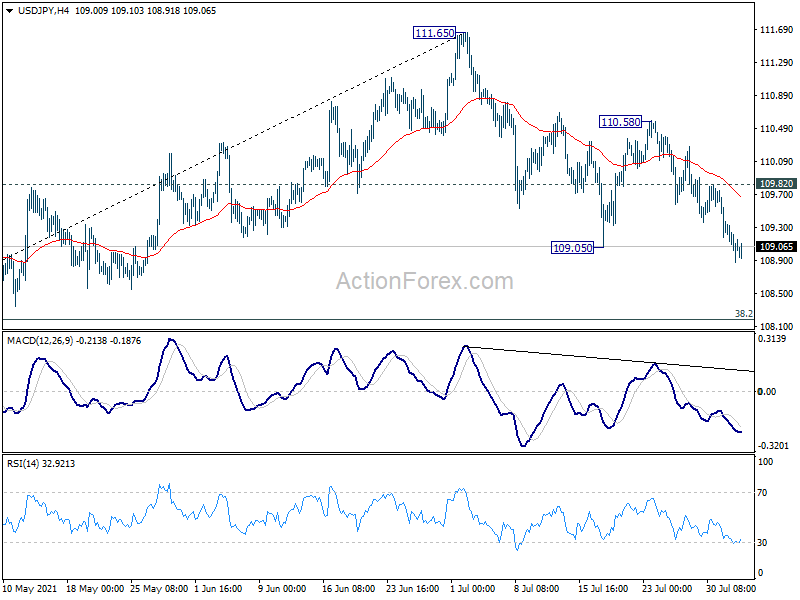
In the bigger picture, medium term outlook is staying neutral with 111.71 resistance intact. The pattern from 101.18 could still extend with another falling leg. Sustained trading below 55 day EMA will bring deeper fall to 107.47 support and below. For now, outlook won't turn bullish as long as 111.71 resistance holds, even in case of strong rebound.
Kiwi Jumps after Strong Employment Data, Dollar Weakness Continues
Following strong closes in US stocks, Asian markets ex-Japan are trading generally higher. The development helps lift commodity currencies generally higher. In particular, New Zealand Dollar is additionally lifted by much stronger than expected job data. Yen is paring some gains but weak treasury yields is keeping it afloat. On the other hand, Dollar continues to trade with an undertone and remains one of the weakest for the week.
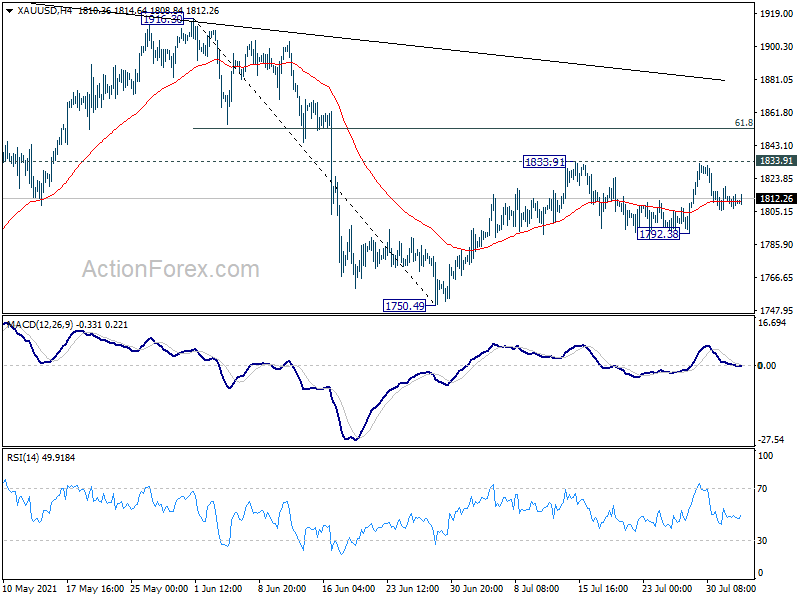
Technically, as we're entering into the second half of the week with job and services data, focuses will be on whether Dollar selling would take over again. In particular, break of 1.1907 resistance in EUR/USD and 1.3982 resistance in GBP/USD should seal the case in European-Dollar pairs. Meanwhile, Gold is holding on well to 4 hour 55 EMA so far, maintaining mild bullish favor. Break of 1833.91 resistance should resume the rebound from 1750.49 and double-confirm Dollar selloff.
In Asia, at the time of writing, Nikkei is down -0.20%. Hong Kong HSI is up 1.53%. China Shanghai SSE is up 0.56%. Singapore Strait Times is up 0.97%. Japan 10-year JGB yield is down -0.0024 at 0.007. Overnight, DOW rose 0.80%. S&P 500 rose 0.82%. NASDAQ rose 0.55%. 10-year yield rose 0.002 to 1.176.
New Zealand unemployment rate dropped to 4.0%
New Zealand employment rose 1.0% in Q2, above expectation of 0.7%. It's also the lowest since Q4 2019. Employment rate rose 0.5% to 67.6%. Unemployment rate dropped from 4.6% to 4.0%, much better than expectation of 4.5%. Labor force participation rate rose 0.1% to 70.5%. Labor cost index rose 0.9% qoq, above expectation of 0.7% qoq.
"The fall in unemployment is largely in line with other labour market indicators, including declining numbers of benefit recipients and increased job vacancies, and recent media reports of labour shortages and skills mismatches," work, wealth, and wellbeing statistics senior manager Sean Broughton said.
Australia AiG construction dropped to 48.7 on outbreaks and restrictions
Australia AiG Performance of Construction Index dropped -6.8 to 48.7 in July, recording the first contraction since September 2020. Looking at some details, activity dropped -14.4 to 40.4. Employment rose 2.5 to 60.8. New orders dropped -6.6 to 49.5. Supplier deliveries dropped -7.6 to 43.3. Input prices dropped -1.1 to 97.2. Selling prices dropped -4.0 to 81.2. Average wages rose 6.7 to 77.1.
Ai Group Head of Policy, Peter Burn, said: "With Australia's two largest states affected by COVID-19 outbreaks and associated restrictions, the construction industry slipped into contraction in July after a robust nine-month expansion. The negative national result masked continued growth outside of NSW and Victoria and further expansions in both house building and commercial construction...
"The outlook over the next couple of months will depend heavily on the paths of the COVID-19 outbreaks and the extent of restrictions."
Australia retail sales dropped -1.8% mom in Jun, led by Victoria and NSW
Australia retail sales dropped -1.8% mom in June, unchanged from preliminary reading. Over the June quarter, sales rose 0.8% qoq.
ABS said: "States under longer periods of restrictions for the month saw a larger fall in their June turnover. The largest falls were in Victoria (-4.0 per cent), New South Wales (-2.0 per cent), and Queensland (-0.9 per cent). Other states and territories that saw stay-at-home orders for a least one day of the month included Western Australia (0.1 per cent), and the Northern Territory (-1.8 per cent)."
China Caixin PMI services rose to 54.9, but still faces enormous downward pressure
China Caixin PMI Services rose from 50.3 to 54.9 in July, well above expectation of 54.9. PMI Composite rose from 50.6 to 53.1.
Wang Zhe, Senior Economist at Caixin Insight Group said: "As the July surveys of Caixin China PMIs were conducted after the epidemic in Guangdong province was brought under control, and before Covid-19 resurged in Jiangsu province, the services sector expanded rapidly, though the manufacturing sector was slightly weaker.
The resurgence of the epidemic in some parts of China at the end of July is expected to hurt August's PMI readings. China's official second-quarter economic figures were in line with expectations, but the Caixin China PMIs in July suggest that the economic recovery is not on sure footing. The economy still faces enormous downward pressure, and we need to ensure business owners remain confident."
Looking ahead
Looking ahead, Eurozone will release retail sales and PMI services final. UK will release PMI services final. Later in the day, Canada will release building permits. But focuses will be on US ADP employment and ISM services.
USD/JPY Daily Outlook
Daily Pivots: (S1) 108.83; (P) 109.08; (R1) 109.29; More...
Intraday bias in USD/JPY remains on the downside at this point. Fall from 111.65 is in progress for 38.2% retracement of 102.58 to 111.65 at 108.18. On the upside, above 109.82 minor resistance will turn bias back to the upside for 110.58 resistance instead.
In the bigger picture, medium term outlook is staying neutral with 111.71 resistance intact. The pattern from 101.18 could still extend with another falling leg. Sustained trading below 55 day EMA will bring deeper fall to 107.47 support and below. For now, outlook won't turn bullish as long as 111.71 resistance holds, even in case of strong rebound.
Economic Indicators Update
| GMT | Ccy | Events | Actual | Forecast | Previous | Revised |
|---|---|---|---|---|---|---|
| 22:30 | AUD | AiG Performance of Construction Index Jul | 48.7 | 55.5 | ||
| 22:45 | NZD | Employment Change Q2 | 1.00% | 0.70% | 0.60% | |
| 22:45 | NZD | Unemployment Rate Q2 | 4.00% | 4.50% | 4.70% | 4.60% |
| 22:45 | NZD | Labour Cost Index Q/Q Q2 | 0.90% | 0.70% | 0.40% | |
| 1:30 | AUD | Retail Sales M/M Jun | -1.80% | -1.80% | -1.80% | |
| 1:45 | CNY | Caixin Services PMI Jul | 54.9 | 50.6 | 50.3 | |
| 7:45 | EUR | Italy Services PMI Jul | 58.2 | 56.7 | ||
| 7:50 | EUR | France Services PMI Jul F | 57 | 57 | ||
| 7:55 | EUR | Germany Services PMI Jul F | 62.2 | 62.2 | ||
| 8:00 | EUR | Eurozone Services PMI Jul F | 60.4 | 60.4 | ||
| 8:00 | EUR | Italy Retail Sales M/M Jun | 0.30% | 0.20% | ||
| 8:30 | GBP | Services PMI Jul F | 57.8 | 57.8 | ||
| 9:00 | EUR | Eurozone Retail Sales M/M Jun | 1.90% | 4.60% | ||
| 12:15 | USD | ADP Employment Change Jul | 680K | 692K | ||
| 12:30 | CAD | Building Permits M/M Jun | -0.30% | -14.80% | ||
| 13:45 | USD | Services PMI Jul F | 59.8 | 59.8 | ||
| 14:00 | USD | ISM Services PMI Jul | 60.4 | 60.1 | ||
| 14:00 | USD | ISM Services Employment Jul | 49.3 | |||
| 14:30 | USD | Crude Oil Inventories | -4.1M |