Sample Category Title
RBNZ Set For Lift-Off
New Zealand Unemployment outperforms
New Zealand Unemployment dropped to 4.0% for Q2 this morning, a stunning result given that market expectations were 4.50%. That should be the green light for the RBNZ to hike by 0.25% on August 18th, with all four major New Zealand banks predicting three rate hikes in total for the rest of the year. New Zealand will join a very small group on the normalising path, and at this stage, only the arrival of the delta-variant Covid-19 in the community would derail that outlook. Predictably, the New Zealand dollar has rallied 0.50% versus the US dollar and is higher versus the yen and Australian dollar, etc. I expect the kiwi to outperform going forward.
Yesterday the Reserve Bank of Australia sprung a surprise, refusing to blink in the face of the delta variant popping up far and wide across Australia (it arrived in Cairns yesterday) and staying on its tapering track. That has limited the fallout in the Australian dollar, although if the lucky country is still in the same place at the end of September, as it is today, those forecasts may have to change.
Today also sees the latest Bank of Thailand policy decision with Thailand in a very different place to the lands down-under. With the economy wilting under the delta-variant onslaught and inflation very near the bottom of the BoT’s 1.0%-3.0% range, rates should remain at the 0.50% record lows. The BoT has precious little wiggle room on the monetary policy front, which is likely to be ineffective anyway, with fiscal policy required for the heavy lifting. The Thai baht remains near 17-month lows and will remain a leading member of my Asian fragile four.
On that note, another member, the Indonesian rupiah, has rallied impressively over the last few days. USD/IDR falling from near 14,600.00 to 14,300.00 this morning as Covid-19 cases fell. But don’t be fooled; cases have moved lower in step with rapidly falling testing, while deaths have remained consistent at around 1500 per day. Cases shot up yesterday as, you guessed it, testing increased. Indonesia has firm commodity prices and a modest recovery in domestic demand to fall back on, making its outlook better than Thailand’s. Any rally by the Indonesia rupiah is one to sell into until Indonesia starts winning its virus battle.
Over in China, the spiritual opium comments regarding online gaming sparked a panic sell-off in the likes of Tencent yesterday. Clearly, the financial markets definition of what it thinks the Chinese government considers targeted clampdowns and the government’s actual definition remain poles apart. China popped in an inquiry into automotive semiconductors into the mix yesterday as well, as the hunt for commodity hoarders goes on. The buy-the-dip herd continues to confuse optimism with reality. The regulatory discount on China equities versus being so cheap now it doesn’t matter still has some way to go.
On the subject of China, readers should monitor the Covid-19 situation there. Today’s Caixin Services PMI outperformed, signalling that domestic demand continues to improve. However, with albeit small numbers of cases popping up in multiple locations, a rapid deterioration in the situation could lead to some repricing of China growth, with the Manufacturing PMIs already signalling a slowing pace. You wouldn’t bet against the Chinese authorities’ ability to nip the outbreaks in the bud, but more than previous versions, the delta-variant has a whack-a-mole look to it, as Australia et al. have found.
Europe and the US release services and composite PMIs today, but the most attention is likely to be on US ADP Employment and ISM Non-Manufacturing Prices. The ADP data has been a poor indicator for the Non-Farm Payrolls of late, but markets will reprice Non-Farm expectations if the ADP deviates in a significant way from the 700,000 jobs expected. Similarly, the ISM Non-Manufacturing Prices will probably have the inflationistas wringing their hands if it prints well north of last month’s 79.5. Will that shake the bond market out of its lethargy? I doubt it. But a low number will almost certainly see US long-dated yields move lower once again, which could see US dollar selling emerge.
Wall Street Sets New Records, Kiwi Storms Higher
- US stocks rally to another record high close, dollar quiet
- Kiwi skyrockets after stellar jobs data fuel RBNZ bets
- Gold lifeless, oil takes another hit amid demand worries
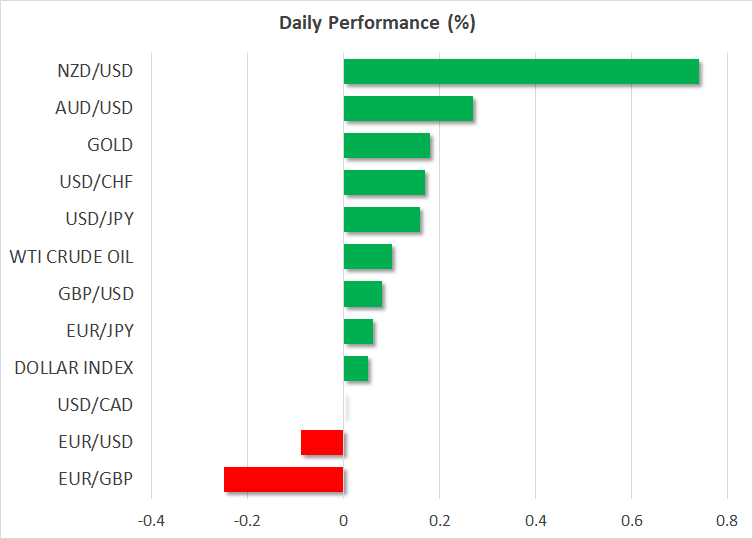
Stocks cheer as earnings season delivers
Wall Street continues to defy gravity. The S&P 500 cruised higher to close at yet another record peak yesterday, telling a much different story than the bond market, which has been feeling the blues lately.
Worries that the Delta outbreak will take the wind out of global growth have been eclipsed by a sensational earnings season and hopes for more federal spending, reigniting the relentless bid in equities. And with global yields sinking - cementing bonds as an asset class with negative real returns - there is simply no alternative to stocks.
Overall, the outlook for equity markets remains promising. Valuations have corrected a touch with earnings going through the roof, the economic recovery is humming along nicely, and a multi-trillion dollar reconciliation package from Congress doesn’t seem to be priced in yet.
The only real risk is the Fed normalizing monetary policy. Markets seem positioned for a tapering announcement around year-end, so if the Fed gets the ball rolling in September already as Waller suggested recently, that could come as a ‘surprise’. Even in this case though, any selloff will likely be short-lived. Stimulus will be dialed back extremely cautiously. The last thing the Fed wants is to shock the market.
Kiwi soars as RBNZ rate bets mount
Speaking of normalization, the Reserve Bank of New Zealand will probably be the first major central bank to raise interest rates this cycle. The nation’s jobs data for Q2 were released overnight and crushed expectations, sealing the deal for a rate increase in two weeks.
In fact, markets are now pricing in a minor probability for a ‘double’ rate increase of 50 basis points this month. Almost three RBNZ rate increases have been baked into the cake by November. The economy is booming, the housing market is on fire, and the island nation remains virtually virus-free.
If the RBNZ is truly as aggressive as markets believe, the kiwi could be the next king of the FX market. The only missing ingredient is a rosier global environment. New Zealand is a small export-heavy economy after all, so its fortunes are ultimately tied to the global economy.
Gold quiet, oil drops, US data coming up
In commodities, gold has been absolutely lifeless this week despite some favorable macro developments. Real US yields have been demolished and the dollar has been a shade softer, and yet bullion has been unable to capitalize.
That’s disappointing. If gold couldn’t stage a powerful rally with real yields falling apart, it could really struggle once the Fed takes its foot off the accelerator, especially if the dollar comes back swinging. As the old adage goes, if something can’t rally on good news, it probably won’t rally at all.
In energy markets, oil prices took another hit yesterday. Investors seem to be repricing the demand outlook as the Delta outbreak threatens to kneecap emerging market economies and perhaps even hamstring China. That’s happening against the backdrop of steady supply increases from OPEC.
As for today, some US events will keep dollar traders busy. The ADP jobs report will set expectations ahead of Friday’s nonfarm payrolls, but even more crucial will be the employment sub-index of the ISM services survey. Meanwhile, a speech by Fed Vice Chairman Richard Clarida at 14:00 GMT will be watched closely for any tapering hints
ECB Kazaks: Current forward guidance not tying out hands too much
ECB Governing Council member Martins Kazaks said, "given the uncertainty, given how much time is left, there is no need to decide on" what to do with the PEPP purchases after next March. He added, "we will discuss it, but at the moment it would still be premature."
"It's quite unlikely that we will come out in late March 2022 and say this is it, we've done our job and we terminate it," Kazaks added. "We would like to warn the markets in advance -- but only as much as it's reasonably possible."
Kazaks defended ECB's new forward guidance, and said, it's "a balanced view on how we may react when we see inflation approaching 2%." "Is this tying our hands too much or too far into the future? I don't think so," He said. "If we find that this is not appropriate for the given economic situation then we can adjust our forward guidance."
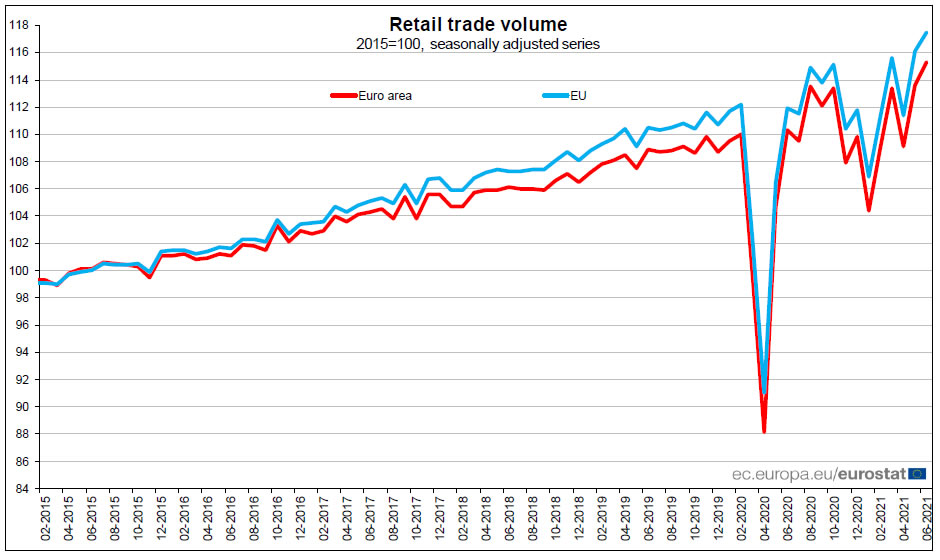
Eurozone retail sales rose 1.5% mom in Jun, EU up 1.2% mom
Eurozone retail sales rose 1.5% mom in June, below expectation of 1.9% mom. The volume of retail trade increased by 3.8% for automotive fuels and by 3.4% for non-food products, while it decreased by 1.5% for food, drinks and tobacco.
EU retail sales rose 1.2% mom. Among Member States for which data are available, the highest monthly increases in total retail trade were registered in Ireland (+9.4%), Germany and Latvia (both +4.2%) and Lithuania (+2.0). The largest decreases were observed in Malta (-3.0%), Austria (-2.7%) and Croatia (-2.6%).
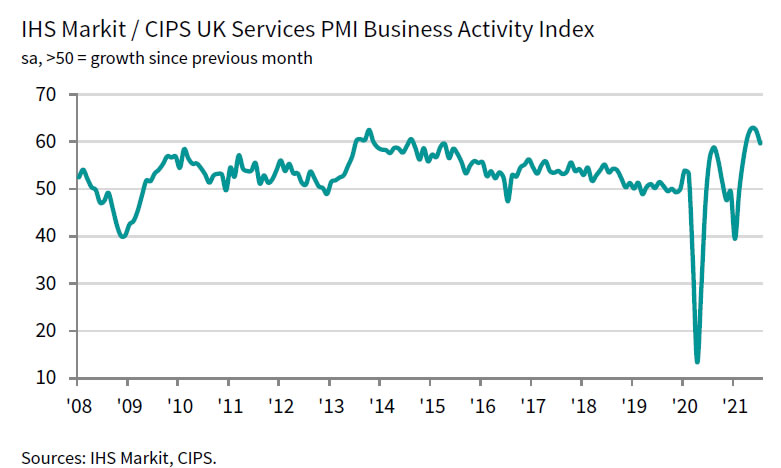
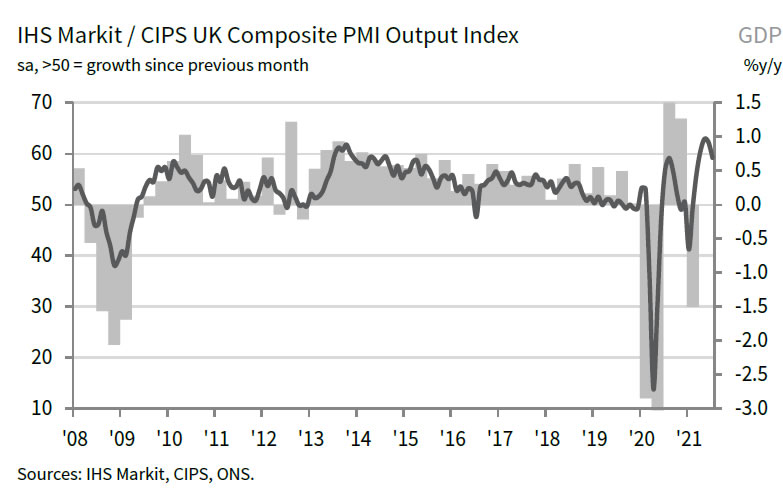
UK PMI composite finalized at 59.2, re-acceleration of growth looks unlikely
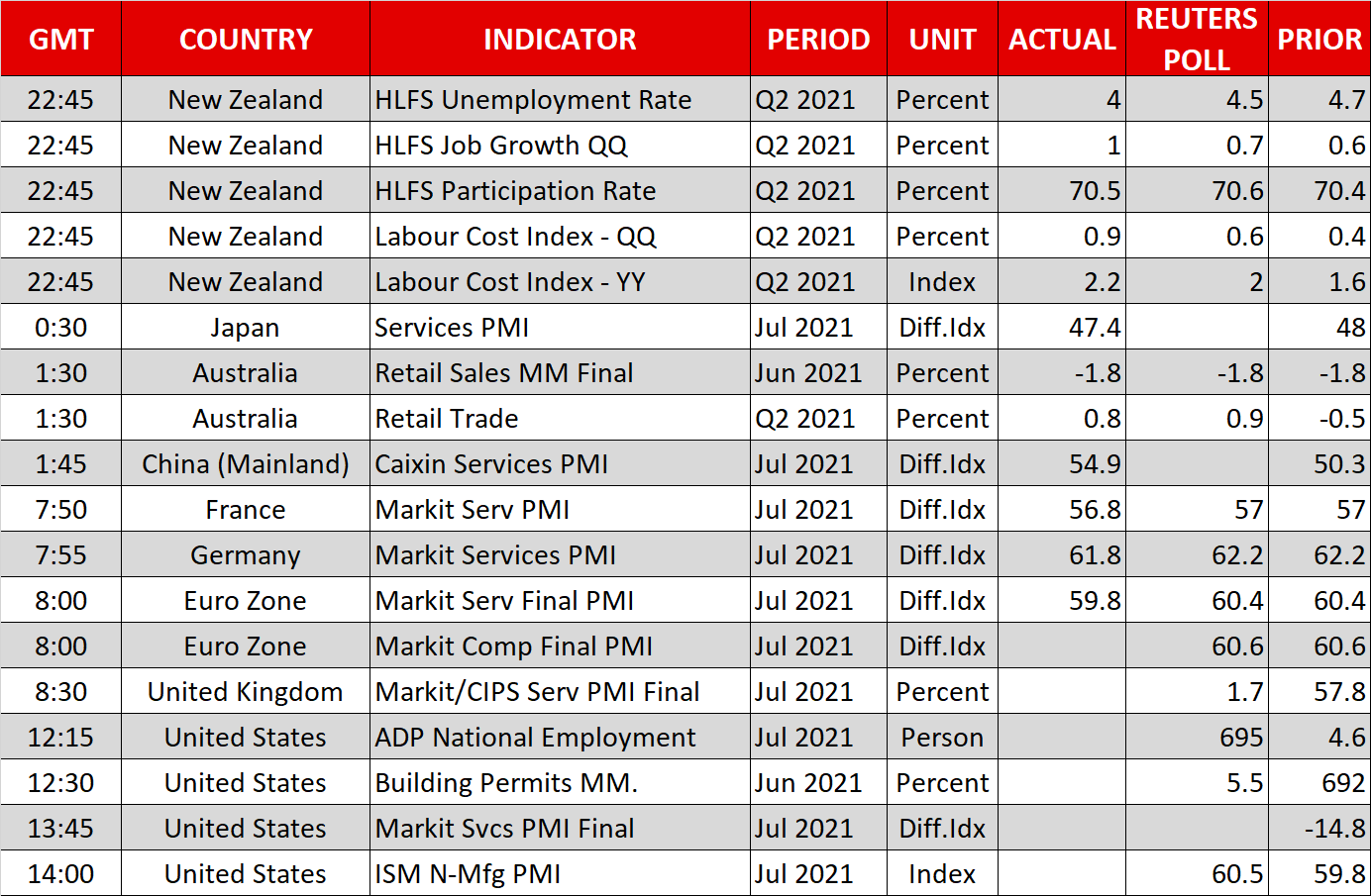
UK PMI Services was finalized at 59.6 in July, down from June's 62.4. PMI Composite dropped to 59.2, down from 62.2. Markit said there was weakest rise in business activity since March, but strongest input cost inflation in 25 years of data collection. Staff shortages constrained business capacity and recruitment.
Tim Moore, Economics Director at IHS Markit: "UK economy has slowed... More businesses are experiencing growth constraints from supply shortages of labour and materials, while on the demand side we've already seen the peak phase of pent up consumer spending... Any re-acceleration of growth in August looks unlikely.. as new orders increased at a much-reduced pace at the start of the third quarter... business expectations softened again.
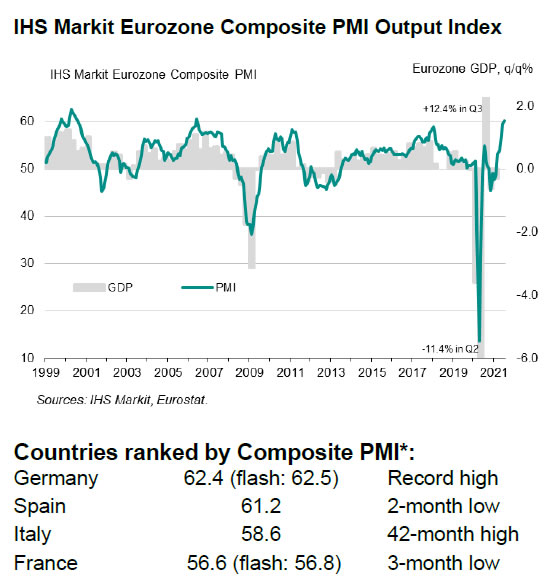
Eurozone PMI composite finalized at record 60.2, GDP growth accelerates in Q3
Eurozone PMI Services was finalized at 59.8 in July, up from 58.3, highest since June 2006. PMI Composite was finalized at 60.2, up from 59.5, a new record high.
Chris Williamson, Chief Business Economist at IHS Markit said: "Europe's service sector is springing back into life. Easing virus restrictions and further vaccination progress are boosting demand for a wide variety of activities....Alongside the sustained elevated growth recorded in the manufacturing sector, the impressive strength of the service sector's expansion in July means the eurozone should see GDP growth accelerate in the third quarter.
"Worries about the Delta variant have become more widespread, however, subduing activity in some instances and raising concerns about the possibility of virus restrictions being tightened again.... Furthermore, up to now companies have generally seen little resistance from customers to higher prices, but this could change after the current rebound from lockdown restrictions has passed."
Germany PMI composite finalized at record 62.4, rising costs look to remain a feature
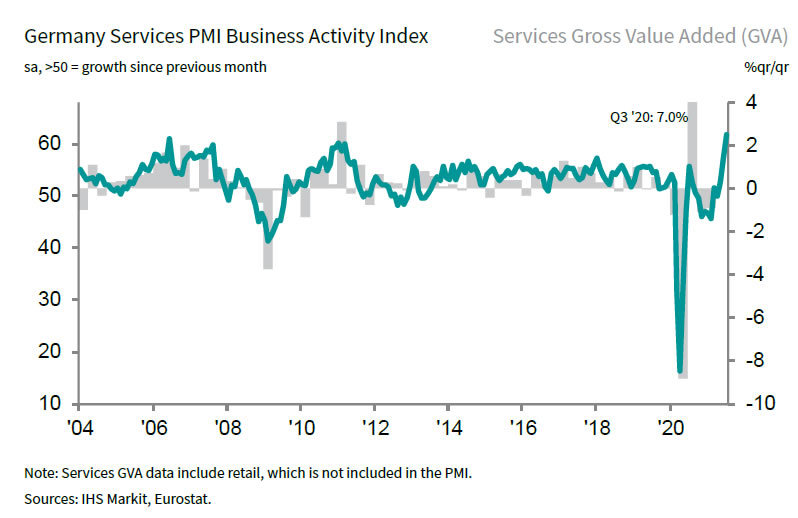
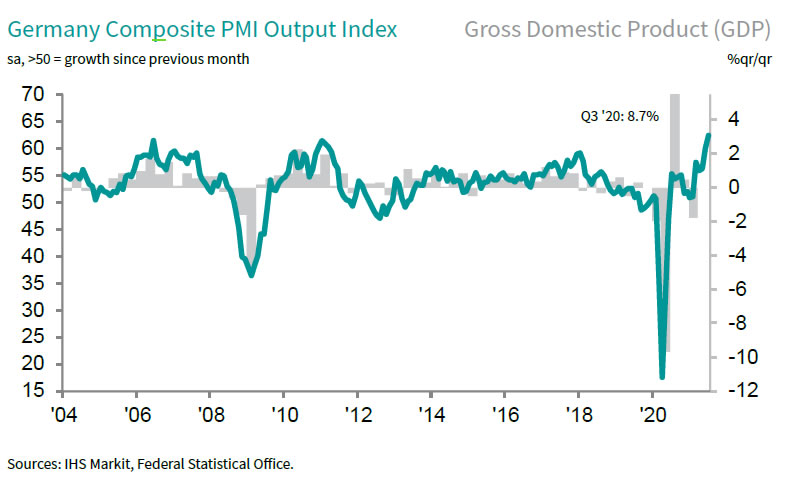
Germany PMI Services was finalized at 61.8, up from June's 57.5, surpassing previous record high set some 15 years ago. PMI Composite rose to record high of 62.4, up from 60.1. Markit said there was record expansion in activity as COVID-19 restrictions eased. Rate of job creation hit new record. Inflationary pressures remained elevated.
Andrew Harker, Economics Director at IHS Markit said: "The recent surge in activity in the German service sector continued in July, with growth hitting the highest in more than 24 years of data collection as companies feel the benefit of the reopening of the economy following the lifting of COVID-19 restrictions. The ramping up of activity is also proving to be good news for workers, with companies taking on extra staff at an unprecedented rate.
"Inflationary pressures remain elevated, however, and companies will take little solace from the fact that costs rose at a slightly weaker pace than in June. With the sector running hot and severe pressure on capacity signalled, rising costs look set to remain a feature in the near-term at least."
France PMI composite finalized at 56.6, economic recovery has legs to continue through Q3
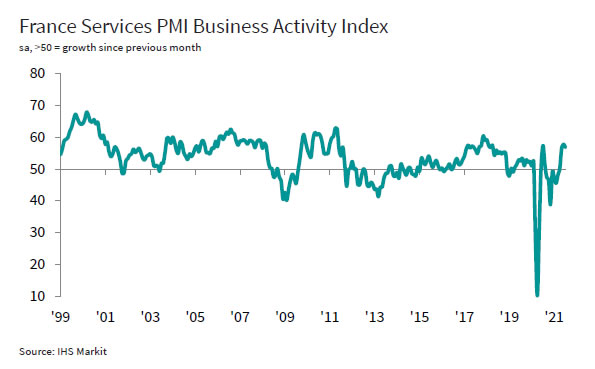
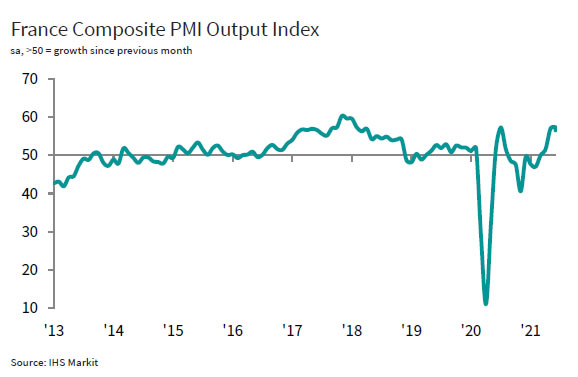
France PMI Services was finalized at 56.8 in July, down from June's 57.8. PMI Composite was finalized at 56.6, down from July's 57.4. Markit said robust demand supported strong activity growth. Backlogs rose at joint-fastest pace since April 2011. Output price inflation hit decade high.
Joe Hayes, Senior Economist at IHS Markit said: "Although the headline PMI dipped slightly, the data is consistent with activity growing at a strong pace, much like we saw in the previous two months since pandemic-related restrictions have been peeled back. Pent-up demand is considerable, and firms are struggling to meet it, as evidenced by one of the strongest increases in backlogs of work for a decade. This is a good thing in the short-term as it means the economic recovery will have legs to continue through the third quarter and hopefully beyond.
"That said, current conditions have handed businesses an incredible amount of pricing power. While inflationary pressures are not quite as alarming as they are in the manufacturing sector, there's clear spillover effects from the severe supply chain disruptions, as firms cited this as a reason behind July's 34-month high in input costs. In response, firms upped their fees to the greatest extent in a decade. If the price rises we're seeing remain sticky, inflation will no longer be transitory."
GER 30 Tests Peak
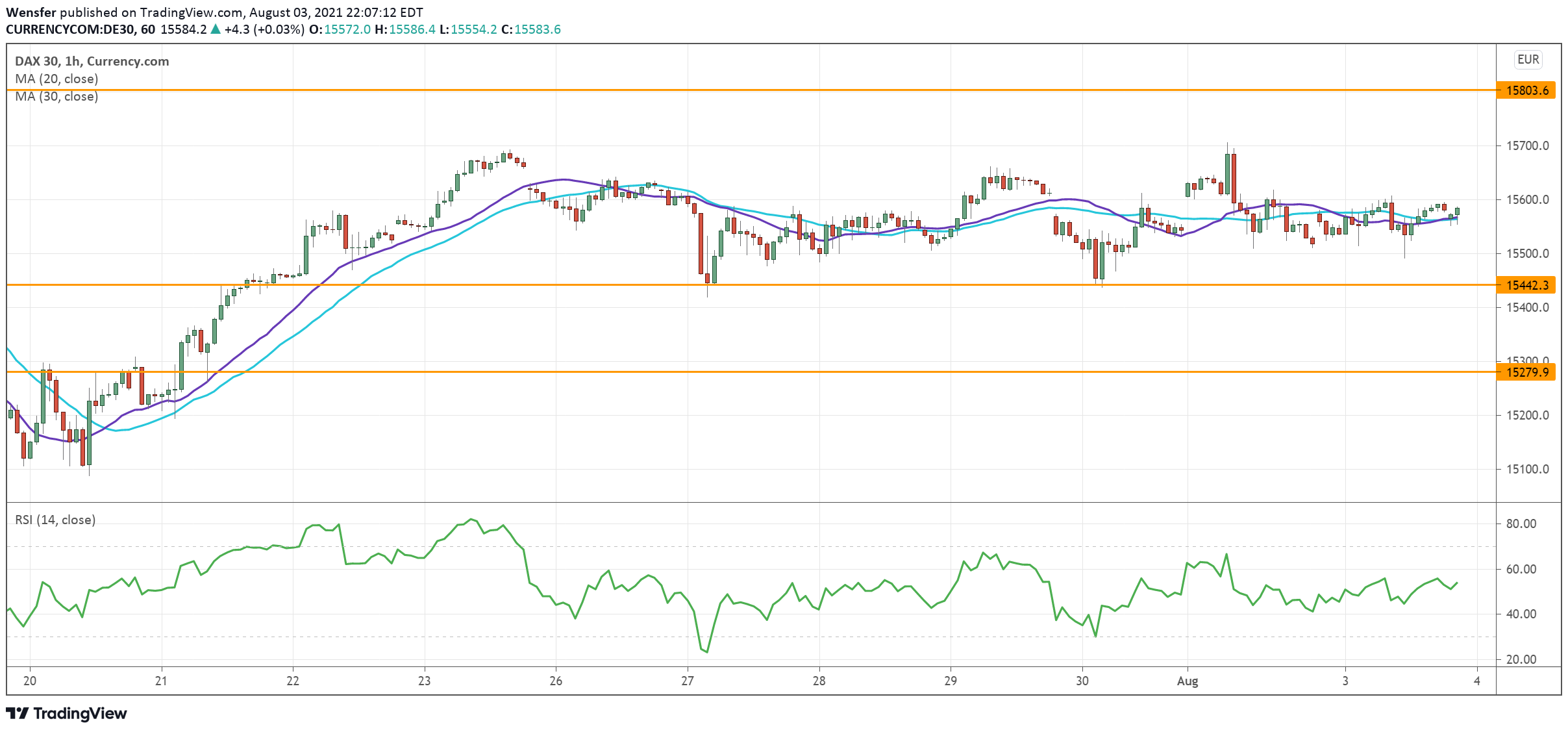
The Dax 30 treads water as mixed technology stocks drag on investor sentiment.
The V-shaped recovery has hit a speed bump as the index extends its consolidation. A tentative breakout above the last leg of the previous sell-off at 15700 suggests that the buying power still outweighs the selling one.
A bullish breakout of the peak at 15800 would be the confirmation and stir up momentum. 15440 has become key support after its second test. A deeper retracement would lead to 15280.
GBP/JPY Daily Outlook
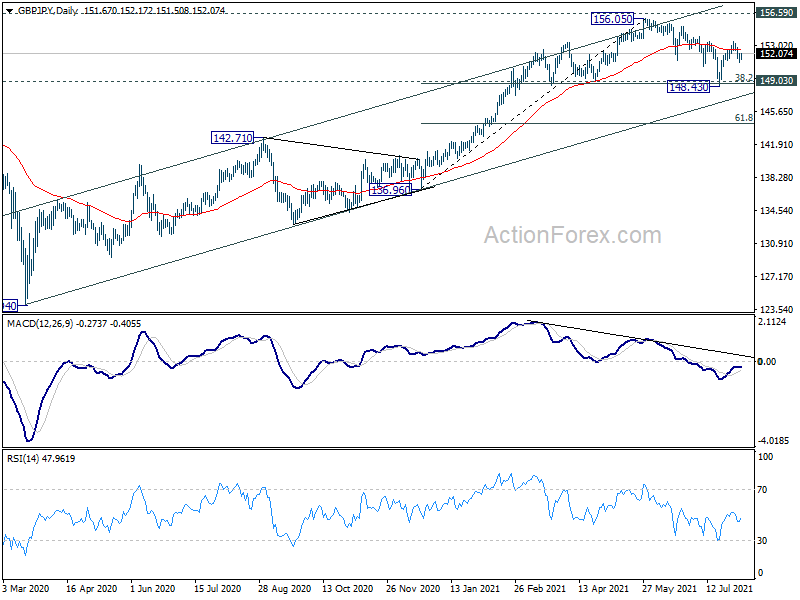
Daily Pivots: (S1) 151.18; (P) 151.69; (R1) 152.21; More...
GBP/JPY recovered after hitting 151.14 and intraday bias is turned neutral again. On the downside, below 151.14 will bring deeper fall back to retest 148.43. On the upside, though, break of 153.42 resistance will resume the rebound from 148.43 to retest 156.05 high.
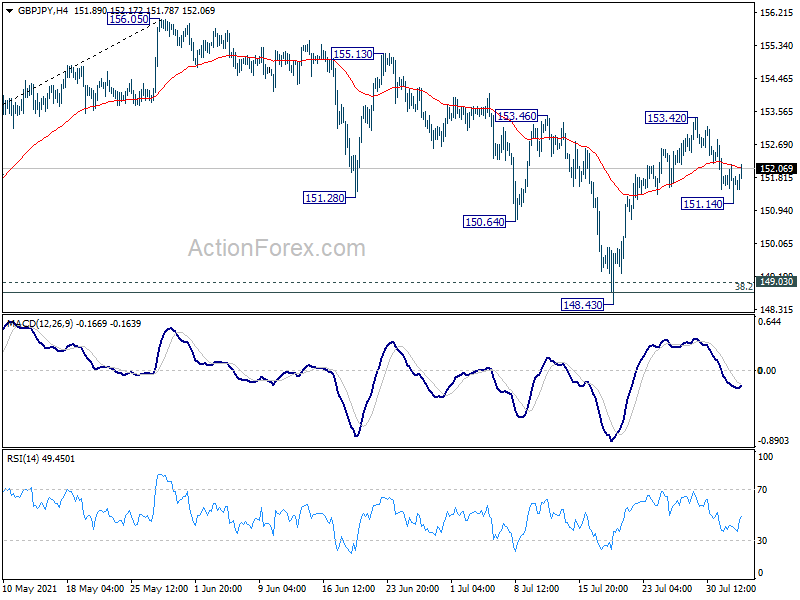
In the bigger picture, rise from 123.94 is seen as the third leg of the pattern from 122.75 (2016 low). Focus remains on 156.59 resistance (2018 high). Sustained break there should confirm long term bullish trend reversal. Next target is 61.8% retracement of 195.86 (2015 high) to 122.75 at 167.93. On the downside, sustained break of 149.03 support, however, will argue that rise from 123.94 has completed. Further break of 142.71 would open up the bearish case for retesting 122.75 low.