

Sample Category Title
Fed Clarida: Will provide advance notice before making any changes to purchases
Fed Vice Chair Richard Clarida said in a speech that "we are clearly a ways away from considering raising interest rates and this is certainly not something on the radar screen right now".
If outlook of inflation and unemployment turn out to be the actual outcomes, the necessary conditions for raising federal funds rate "will have been met by year-end 2022." If inflation remain well anchored at 2%, commencing policy normalization in 2023 would then be "entirely consistent with our new flexible average inflation targeting framework."
As for asset purchases, he said FOMC members expected the economy to continue to move toward the standard of "substantial further progress."
FOMC will asses the progress in coming meetings. He reiterated the pledge that, "we will provide advance notice before making any changes to our purchases."
US ISM services rose to record 64.1, corresponds to 5.2% annualized GDP growth
US ISM Services PMI rose to 64.1 in July, up from 60.1, above expectation of 60.4. That eclipses previous record in May and indicates the 14th straight month of growth.
Looking at some details, business activity/production rose 6.6 to 67.0. new orders rose 1.6 to 63.7. Employment rose 4.5 to 49.3. Prices rose 2.8 to 82.3.
ISM said: "The past relationship between the Services PMI® and the overall economy indicates that the Services PMI® for July (64.1 percent) corresponds to a 5.2-percent increase in real gross domestic product (GDP) on an annualized basis."
EUR/USD Mid-Day Outlook
Daily Pivots: (S1) 1.1848; (P) 1.1870; (R1) 1.1887; More...
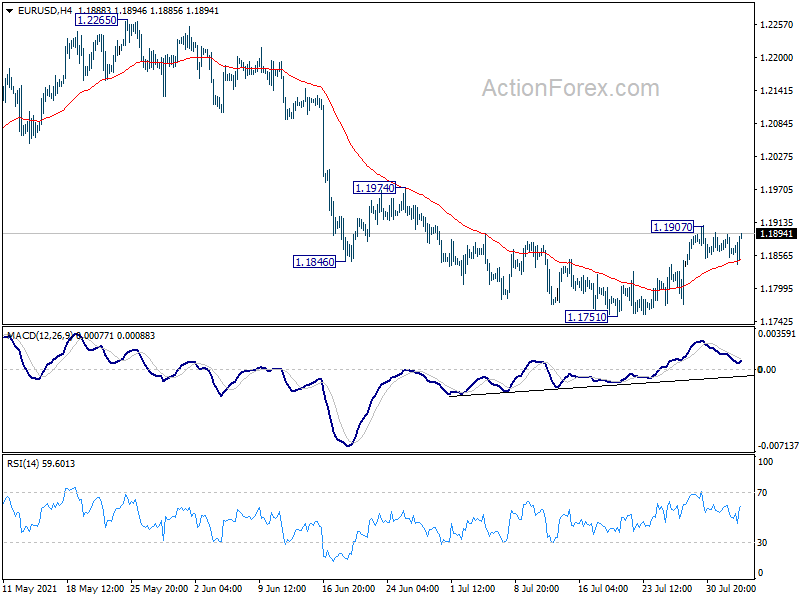
Intraday bias in EUR/USD stays neutral at this point. A short term bottom was formed at 1.1751. On the upside, above 1.1907 will resume the rebound to 1.1974 resistance first. Firm break there should argue that whole corrective pattern from 1.2348 has completed. On the downside, however, break of 1.1751 will resume the fall from 1.2265 to 1.1703 support instead.
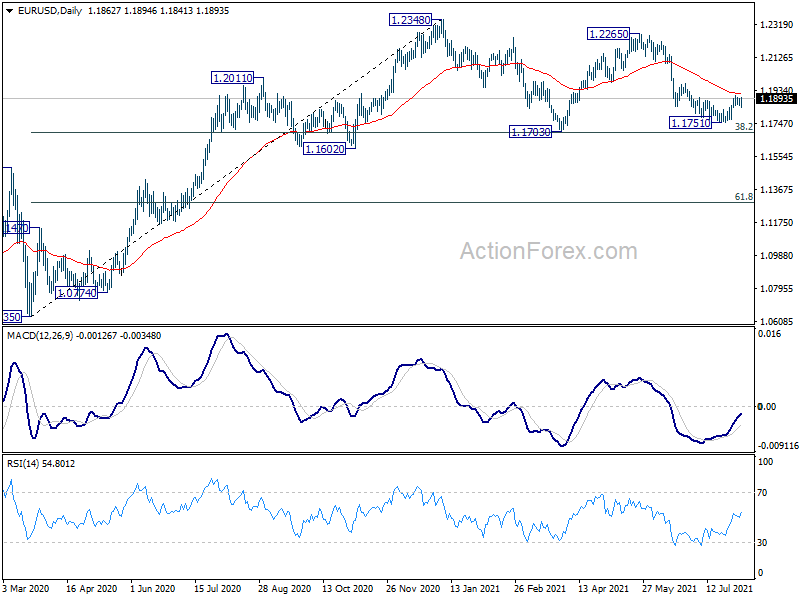
In the bigger picture, rise from 1.0635 is seen as the third leg of the pattern from 1.0339 (2017 low). Further rally could be seen to cluster resistance at 1.2555 next, (38.2% retracement of 1.6039 to 1.0339 at 1.2516). This will remain the favored case as long as 1.1602 support holds. Reaction from 1.2555 should reveal underlying long term momentum in the pair. However sustained break of 1.1602 will argue that the rise from 1.0635 is over, and turn medium term outlook bearish again.
GBP/USD Mid-Day Outlook
Daily Pivots: (S1) 1.3884; (P) 1.3911; (R1) 1.3942; More....
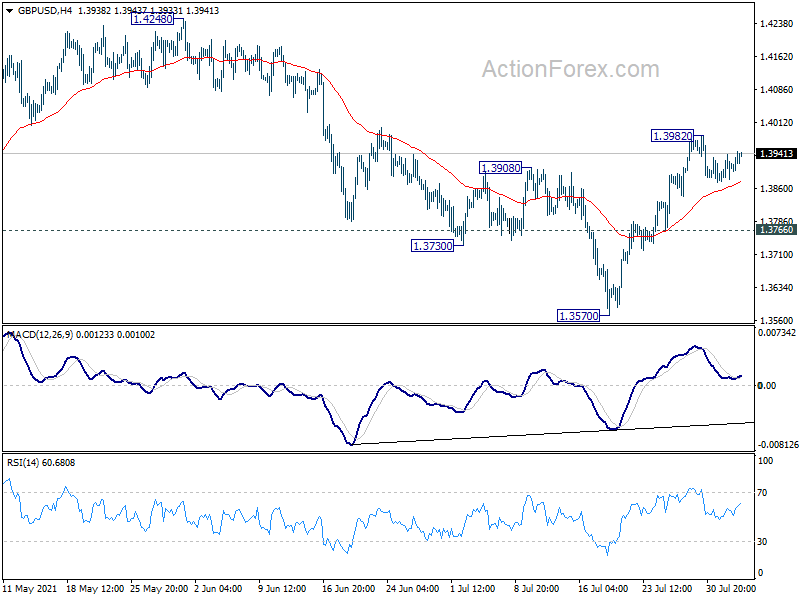
Intraday bias in GBP/USD stays neutral first. Consolidation form 1.3982 could extend further. But outlook is unchanged that corrective pattern from 1.4240 could have completed with three waves down to 1.3570. Further rise is expected as long as 1.3766 support holds. On the upside, break of 1.3982 will resume the rise from 1.3570 to retest 1.4248 high. However, break of 1.3766 support will dampen this bullish view and bring retest of 1.3570.
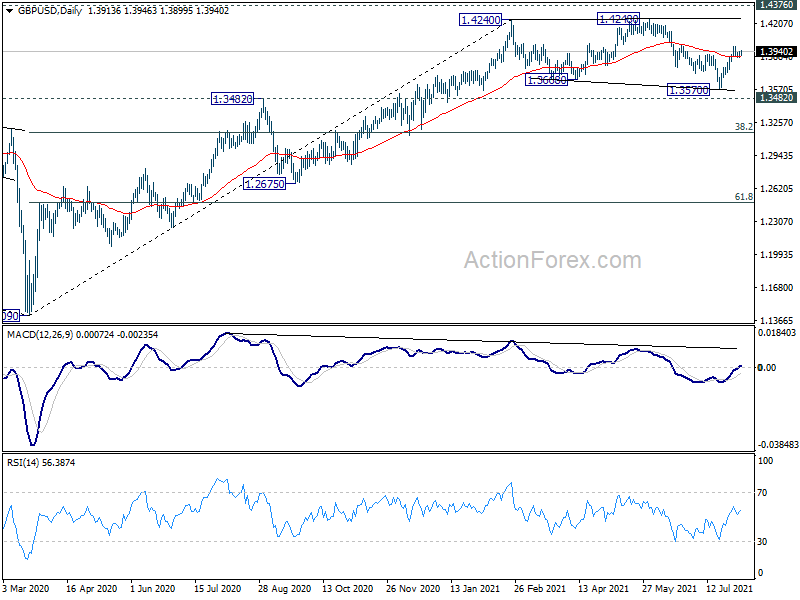
In the bigger picture, as long as 1.3482 resistance turned support holds, up trend from 1.1409 should still continue. Decisive break of 1.4376 resistance will carry larger bullish implications. However, firm break of 1.3482 support will argue that the rise from 1.1409 has completed. GBP/USD would then be seen in another leg of long term range pattern between 1.1409 and 1.4376. Deeper fall could then be seen to 61.8% retracement of 1.1409 to 1.4248 at 1.2493, and even below.
USD/CHF Mid-Day Outlook
Daily Pivots: (S1) 0.9024; (P) 0.9041; (R1) 0.9059; More....
Intraday bias in USD/CHF remains on the downside at this point. Fall from 0.9273 is in progress for retesting 0.8925 low. On the upside, break of 0.9074 minor resistance will turn intraday bias neutral first. But another fall will remain in favor as long as 55 day EMA (now at 0.9126) holds.
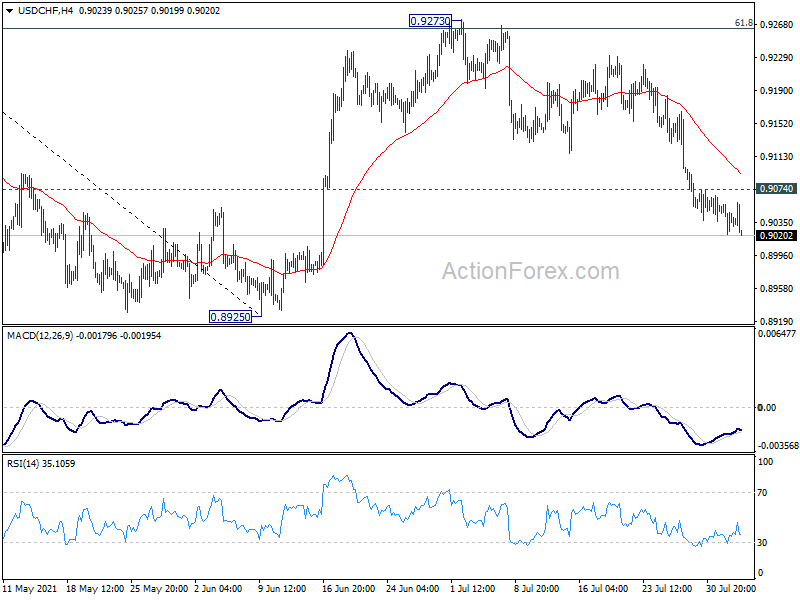
In the bigger picture, failure to sustain above 55 week EMA (now at 0.9183) affirms medium term bearish in USD/CHF. Break of 0.8925 support should resume the whole decline form 1.0342 (2016 high) through 0.8756 low. For now, risk will stay on the downside as long as 0.9273 resistance holds, in case of rebound.
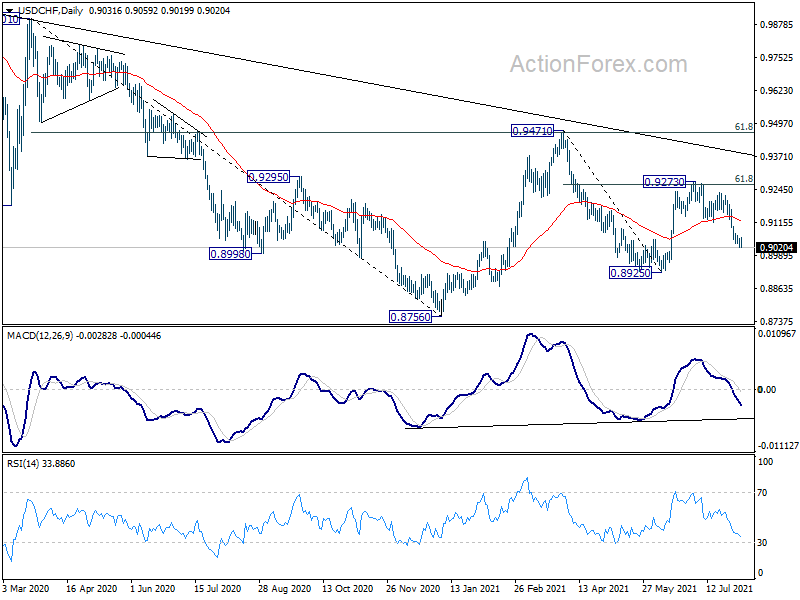
USD/CAD Pair Started a Downside Correction from 1.2575 High
The US Dollar started a decent increase above the 1.2480 resistance zone against the Canadian Dollar. The USD/CAD pair even broke the 1.2500 resistance to move into a positive zone.
The bulls pushed the pair above the 1.2550 level and there was a close above the 50 hourly simple moving average. The pair traded as high as 1.2575 before it started a downside correction.
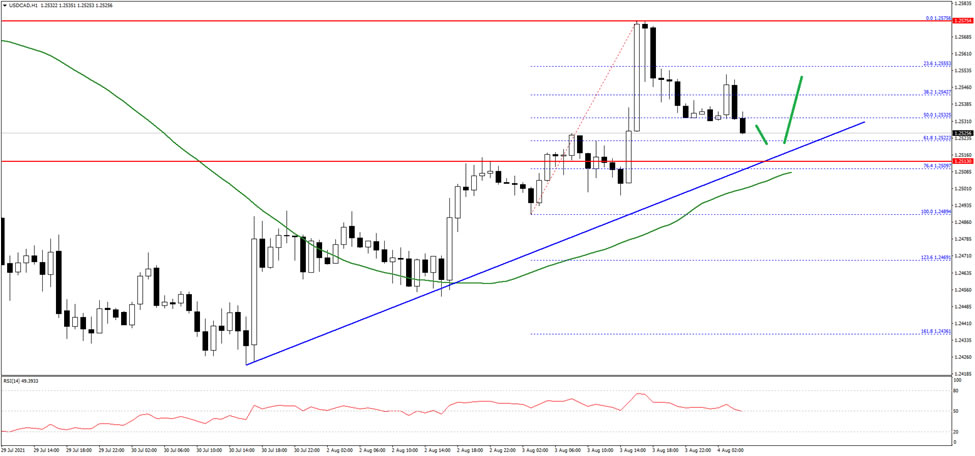
There was a break below the 1.2550 level, but there is a strong support waiting near the 1.2500 zone. There is also a key bullish trend line forming with support near 1.2510 on the hourly chart. Any more losses might lead USD/CAD towards 1.2450 on FXOpen.
On the upside, an initial resistance is near the 1.2550 level. A clear break above the 1.2550 resistance could set the pace for a larger increase towards the 1.2620 level.
USD/JPY Mid-Day Outlook
Daily Pivots: (S1) 108.83; (P) 109.08; (R1) 109.29; More...
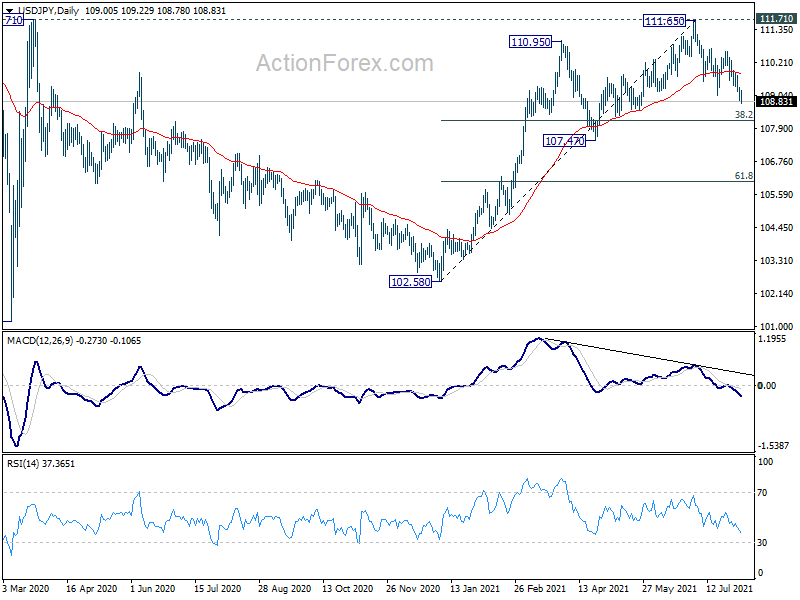
USD/JPY's fall form 111.65 is still in progress and intraday bias stays on the downside for 38.2% retracement of 102.58 to 111.65 at 108.18. Sustained break there will target 61.8% retracement at 107.89 next. On the upside, above 109.35 minor resistance will turn intraday bias neutral first. But risk will remain on the downside as long as 110.58 resistance holds, in case of recovery.
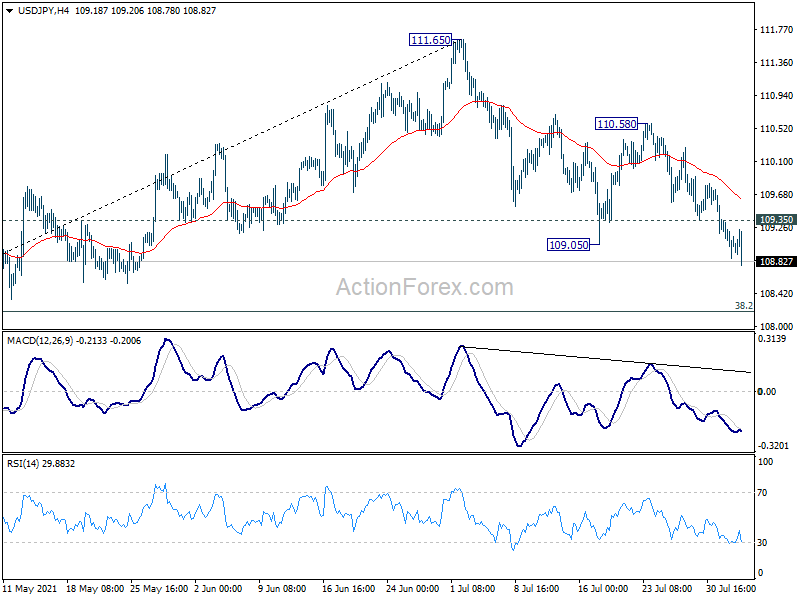
In the bigger picture, medium term outlook is staying neutral with 111.71 resistance intact. Firm break of 107.47 will argue that pattern from 101.18 has started another falling leg already. Deeper decline could be seen back to 101.18/102.58 support zone. For now, outlook won't turn bullish as long as 111.71 resistance holds, even in case of strong rebound.
Dollar Falls on Big ADP Miss, Gold Surges
US futures turn south after much weaker than expected ADP job data. Yen regains much growth as risk sentiment turn cautious again. Though, as for today, Kiwi and Aussie are still the strongest. Canadian Dollar is currently the worst performing as dragged down by weakness in oil price. Dollar is following as the next weakest and looks vulnerable, in particular against European majors and Yen.
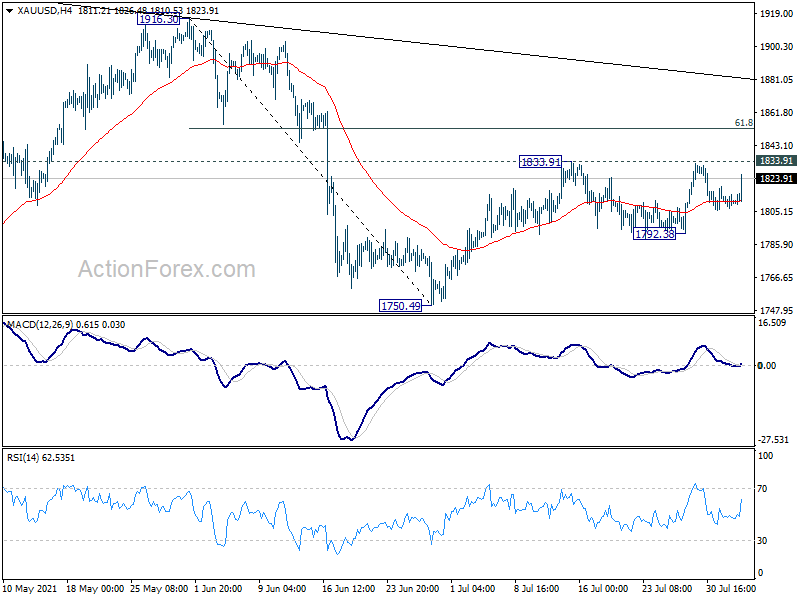
Technically, Gold jumps sharply in early US session. Solid support is seen in 4 hour 55 EMA, which affirms near term bullishness. Focus is now on 1833.91 resistance. Break will resume the rebound from 1750.49 to 61.8% retracement of 1916.30 to 1750.39 at 1852.96. If happens, that should be accompanied by break of 1.1907 resistance in EUR/USD, to resume the rebound from 1.1751.
In Europe, at the time of writing, FTSE is up 0.23%. DAX is up 0.53%. CAC is up 0.31%. Germany 10-year yield is down -0.024 at -0.503. Earlier in Asia, Nikkei dropped -0.21%. Hong Kong HSI rose 0.88%. China Shanghai SSE rose 0.85%. Singapore Strait Times rose 1.07%. 10-year JGB yield dropped -0.0048 to 0.005.
US ADP employment grew just 330k, uneven progress slowed
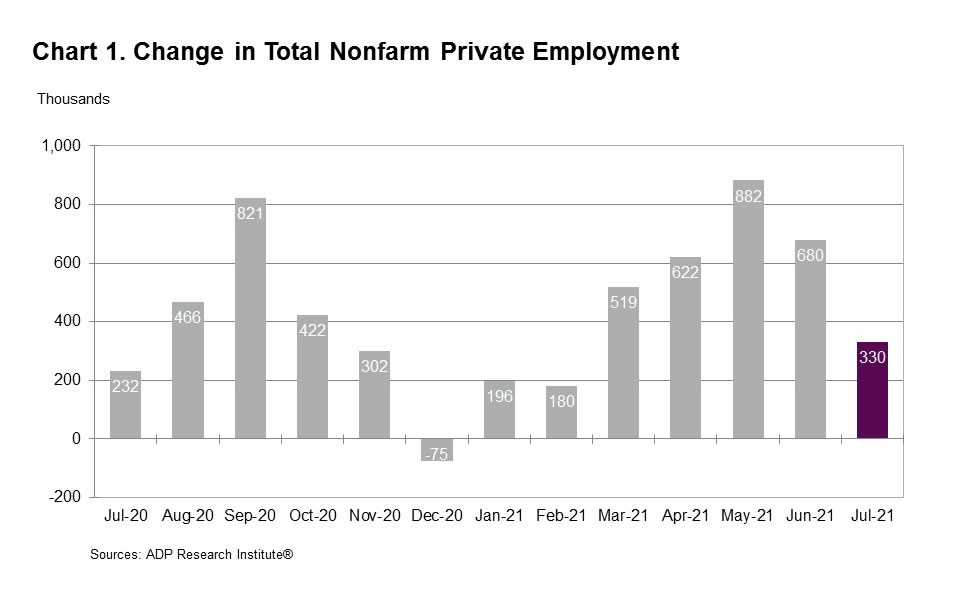
US ADP employment grew just 330k in July, well below expectation of 680k. By company size, small businesses added 91k jobs, medium businesses 132k, large businesses 106k. By sector, goods-producing job grew 12k while service-providing jobs rose 318k.
"The labor market recovery continues to exhibit uneven progress, but progress nonetheless. July payroll data reports a marked slowdown from the second quarter pace in jobs growth," said Nela Richardson, chief economist, ADP.
"For the fifth straight month the leisure and hospitality sector is the fastest growing industry, though gains have softened. The slowdown in the recovery has also impacted companies of all sizes. Bottlenecks in hiring continue to hold back stronger gains, particularly in light of new COVID-19 concerns tied to viral variants. These barriers should ebb in coming months, with stronger monthly gains ahead as a result."
ECB Kazaks: Current forward guidance not tying out hands too much
ECB Governing Council member Martins Kazaks said, "given the uncertainty, given how much time is left, there is no need to decide on" what to do with the PEPP purchases after next March. He added, "we will discuss it, but at the moment it would still be premature."
"It's quite unlikely that we will come out in late March 2022 and say this is it, we've done our job and we terminate it," Kazaks added. "We would like to warn the markets in advance -- but only as much as it's reasonably possible."
Kazaks defended ECB's new forward guidance, and said, it's "a balanced view on how we may react when we see inflation approaching 2%." "Is this tying our hands too much or too far into the future? I don't think so," He said. "If we find that this is not appropriate for the given economic situation then we can adjust our forward guidance."
Eurozone retail sales rose 1.5% mom in Jun, EU up 1.2% mom
Eurozone retail sales rose 1.5% mom in June, below expectation of 1.9% mom. The volume of retail trade increased by 3.8% for automotive fuels and by 3.4% for non-food products, while it decreased by 1.5% for food, drinks and tobacco.
EU retail sales rose 1.2% mom. Among Member States for which data are available, the highest monthly increases in total retail trade were registered in Ireland (+9.4%), Germany and Latvia (both +4.2%) and Lithuania (+2.0). The largest decreases were observed in Malta (-3.0%), Austria (-2.7%) and Croatia (-2.6%).
Eurozone PMI composite finalized at record 60.2, GDP growth accelerates in Q3
Eurozone PMI Services was finalized at 59.8 in July, up from 58.3, highest since June 2006. PMI Composite was finalized at 60.2, up from 59.5, a new record high.
Chris Williamson, Chief Business Economist at IHS Markit said: "Europe's service sector is springing back into life. Easing virus restrictions and further vaccination progress are boosting demand for a wide variety of activities....Alongside the sustained elevated growth recorded in the manufacturing sector, the impressive strength of the service sector's expansion in July means the eurozone should see GDP growth accelerate in the third quarter.
"Worries about the Delta variant have become more widespread, however, subduing activity in some instances and raising concerns about the possibility of virus restrictions being tightened again.... Furthermore, up to now companies have generally seen little resistance from customers to higher prices, but this could change after the current rebound from lockdown restrictions has passed."
Germany PMI Services was finalized at 61.8, up from June's 57.5, surpassing previous record high set some 15 years ago. PMI Composite rose to record high of 62.4, up from 60.1.
France PMI Services was finalized at 56.8 in July, down from June's 57.8. PMI Composite was finalized at 56.6, down from July's 57.4.
UK PMI composite finalized at 59.2, re-acceleration of growth looks unlikely
UK PMI Services was finalized at 59.6 in July, down from June's 62.4. PMI Composite dropped to 59.2, down from 62.2. Markit said there was weakest rise in business activity since March, but strongest input cost inflation in 25 years of data collection. Staff shortages constrained business capacity and recruitment.
Tim Moore, Economics Director at IHS Markit: "UK economy has slowed... More businesses are experiencing growth constraints from supply shortages of labour and materials, while on the demand side we've already seen the peak phase of pent up consumer spending... Any re-acceleration of growth in August looks unlikely.. as new orders increased at a much-reduced pace at the start of the third quarter... business expectations softened again.
Australia AiG construction dropped to 48.7 on outbreaks and restrictions
Australia AiG Performance of Construction Index dropped -6.8 to 48.7 in July, recording the first contraction since September 2020. Looking at some details, activity dropped -14.4 to 40.4. Employment rose 2.5 to 60.8. New orders dropped -6.6 to 49.5. Supplier deliveries dropped -7.6 to 43.3. Input prices dropped -1.1 to 97.2. Selling prices dropped -4.0 to 81.2. Average wages rose 6.7 to 77.1.
Ai Group Head of Policy, Peter Burn, said: "With Australia's two largest states affected by COVID-19 outbreaks and associated restrictions, the construction industry slipped into contraction in July after a robust nine-month expansion. The negative national result masked continued growth outside of NSW and Victoria and further expansions in both house building and commercial construction...
"The outlook over the next couple of months will depend heavily on the paths of the COVID-19 outbreaks and the extent of restrictions."
Australia retail sales dropped -1.8% mom in Jun, led by Victoria and NSW
Australia retail sales dropped -1.8% mom in June, unchanged from preliminary reading. Over the June quarter, sales rose 0.8% qoq.
ABS said: "States under longer periods of restrictions for the month saw a larger fall in their June turnover. The largest falls were in Victoria (-4.0 per cent), New South Wales (-2.0 per cent), and Queensland (-0.9 per cent). Other states and territories that saw stay-at-home orders for a least one day of the month included Western Australia (0.1 per cent), and the Northern Territory (-1.8 per cent)."
New Zealand unemployment rate dropped to 4.0%
New Zealand employment rose 1.0% in Q2, above expectation of 0.7%. It's also the lowest since Q4 2019. Employment rate rose 0.5% to 67.6%. Unemployment rate dropped from 4.6% to 4.0%, much better than expectation of 4.5%. Labor force participation rate rose 0.1% to 70.5%. Labor cost index rose 0.9% qoq, above expectation of 0.7% qoq.
"The fall in unemployment is largely in line with other labour market indicators, including declining numbers of benefit recipients and increased job vacancies, and recent media reports of labour shortages and skills mismatches," work, wealth, and wellbeing statistics senior manager Sean Broughton said.
China Caixin PMI services rose to 54.9, but still faces enormous downward pressure
China Caixin PMI Services rose from 50.3 to 54.9 in July, well above expectation of 54.9. PMI Composite rose from 50.6 to 53.1.
Wang Zhe, Senior Economist at Caixin Insight Group said: "As the July surveys of Caixin China PMIs were conducted after the epidemic in Guangdong province was brought under control, and before Covid-19 resurged in Jiangsu province, the services sector expanded rapidly, though the manufacturing sector was slightly weaker.
The resurgence of the epidemic in some parts of China at the end of July is expected to hurt August's PMI readings. China's official second-quarter economic figures were in line with expectations, but the Caixin China PMIs in July suggest that the economic recovery is not on sure footing. The economy still faces enormous downward pressure, and we need to ensure business owners remain confident."
USD/JPY Mid-Day Outlook
Daily Pivots: (S1) 108.83; (P) 109.08; (R1) 109.29; More...
USD/JPY's fall form 111.65 is still in progress and intraday bias stays on the downside for 38.2% retracement of 102.58 to 111.65 at 108.18. Sustained break there will target 61.8% retracement at 107.89 next. On the upside, above 109.35 minor resistance will turn intraday bias neutral first. But risk will remain on the downside as long as 110.58 resistance holds, in case of recovery.
In the bigger picture, medium term outlook is staying neutral with 111.71 resistance intact. Firm break of 107.47 will argue that pattern from 101.18 has started another falling leg already. Deeper decline could be seen back to 101.18/102.58 support zone. For now, outlook won't turn bullish as long as 111.71 resistance holds, even in case of strong rebound.
Economic Indicators Update
| GMT | Ccy | Events | Actual | Forecast | Previous | Revised |
|---|---|---|---|---|---|---|
| 22:30 | AUD | AiG Performance of Construction Index Jul | 48.7 | 55.5 | ||
| 22:45 | NZD | Employment Change Q2 | 1.00% | 0.70% | 0.60% | |
| 22:45 | NZD | Unemployment Rate Q2 | 4.00% | 4.50% | 4.70% | 4.60% |
| 22:45 | NZD | Labour Cost Index Q/Q Q2 | 0.90% | 0.70% | 0.40% | |
| 01:30 | AUD | Retail Sales M/M Jun | -1.80% | -1.80% | -1.80% | |
| 01:45 | CNY | Caixin Services PMI Jul | 54.9 | 50.6 | 50.3 | |
| 07:45 | EUR | Italy Services PMI Jul | 58 | 58.2 | 56.7 | |
| 07:50 | EUR | France Services PMI Jul F | 56.8 | 57 | 57 | |
| 07:55 | EUR | Germany Services PMI Jul F | 61.8 | 62.2 | 62.2 | |
| 08:00 | EUR | Eurozone Services PMI Jul F | 59.8 | 60.4 | 60.4 | |
| 08:00 | EUR | Italy Retail Sales M/M Jun | 0.70% | 0.30% | 0.20% | -0.10% |
| 08:30 | GBP | Services PMI Jul F | 59.6 | 57.8 | 57.8 | |
| 09:00 | EUR | Eurozone Retail Sales M/M Jun | 1.50% | 1.90% | 4.60% | |
| 12:15 | USD | ADP Employment Change Jul | 330K | 680K | 692K | 680K |
| 12:30 | CAD | Building Permits M/M Jun | 6.90% | 6.00% | -14.80% | |
| 13:45 | USD | Services PMI Jul F | 59.8 | 59.8 | ||
| 14:00 | USD | ISM Services PMI Jul | 60.4 | 60.1 | ||
| 14:00 | USD | ISM Services Employment Jul | 49.3 | |||
| 14:30 | USD | Crude Oil Inventories | -3.2M | -4.1M |
US ADP employment grew just 330k, uneven progress slowed
US ADP employment grew just 330k in July, well below expectation of 680k. By company size, small businesses added 91k jobs, medium businesses 132k, large businesses 106k. By sector, goods-producing job grew 12k while service-providing jobs rose 318k.
"The labor market recovery continues to exhibit uneven progress, but progress nonetheless. July payroll data reports a marked slowdown from the second quarter pace in jobs growth," said Nela Richardson, chief economist, ADP.
"For the fifth straight month the leisure and hospitality sector is the fastest growing industry, though gains have softened. The slowdown in the recovery has also impacted companies of all sizes. Bottlenecks in hiring continue to hold back stronger gains, particularly in light of new COVID-19 concerns tied to viral variants. These barriers should ebb in coming months, with stronger monthly gains ahead as a result."
NZ Dollar Soars on Stellar Job Data
The New Zealand dollar is enjoying a banner day, as the currency is up 0.78% and is closing in on the 0.71 level.
NZ unemployment cements RBNZ hike
New Zealand employment data for the second quarter were hotly anticipated, and given the sizzling numbers, it was certainly worth the wait. The markets had projected that unemployment would fall from 4.6% to 4.5%, but instead, unemployment fell to just 4.0%, a massive drop. Overshadowed by this sharp reading, Employment Change climbed 1.0%, above the consensus of 0.7% and ahead of the Q1 reading of 0.6%.
The news has sent the kiwi soaring by close to 1 percent on Wednesday. This huge gain is not so much a reflection of strong job numbers, rather, it reflects that the markets now believe that a rate hike from the RBNZ is a done deal. The sharp drop in unemployment virtually assures that the RBNZ will raise rates by 25 basis points, to 0.50% at its next meeting on August 18th. The markets are expecting a very hawkish stance from the central bank, with all four major New Zealand banks projecting three rate hikes in total for the remainder of 2021. Very few major central banks have started a path to normalization, and the New Zealand dollar stands to be the big winner from incremental rate hikes over the coming months.
The projection that the RBNZ will keep hiking rates assumes that the Covid pandemic will not cause economic havoc and force the central bank to delay rate hikes. The domestic fundamentals for the New Zealand economy remain strong, as the island nation has done an admirable job of weathering the Covid storm. Still, there is unease over the pandemic, which has shown an upswing in Australia and resulted in the suspension of quarantine-free travel between Australia and New Zealand.
NZD/USD Technical
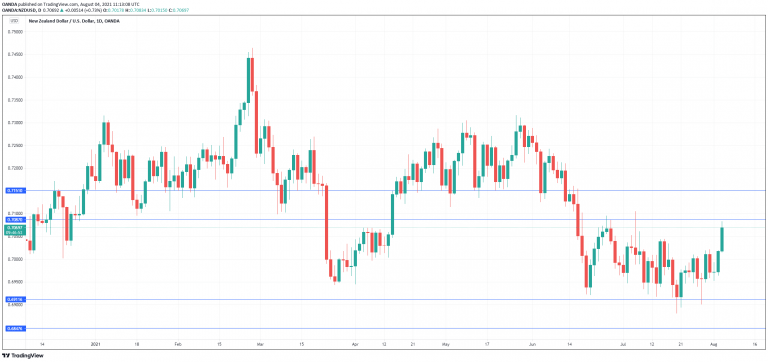
- NZD is putting pressure on resistance at 0.7087. Above, there is resistance at 0.7151
- On the downside, 0.7031 has switched to support. The next support line is at 0.6911