Sample Category Title
China Caixin PMI services rose to 54.9, but still faces enormous downward pressure
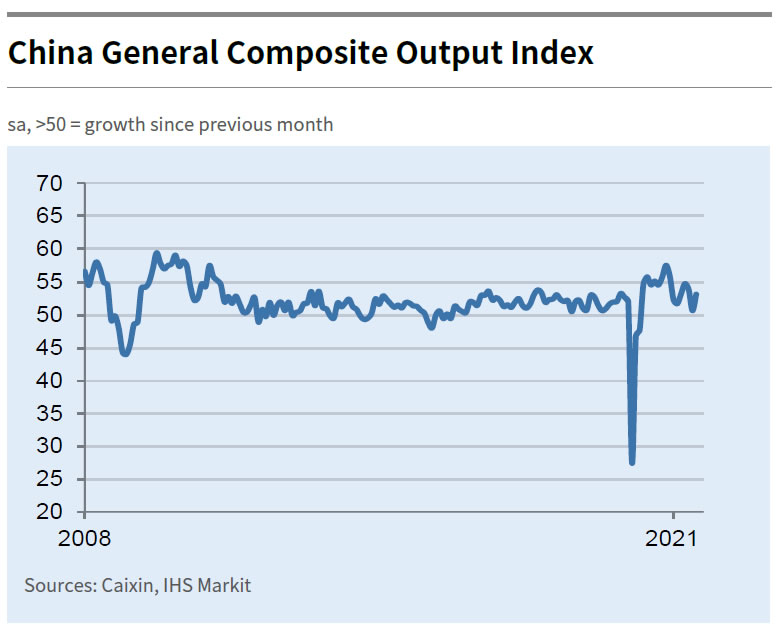
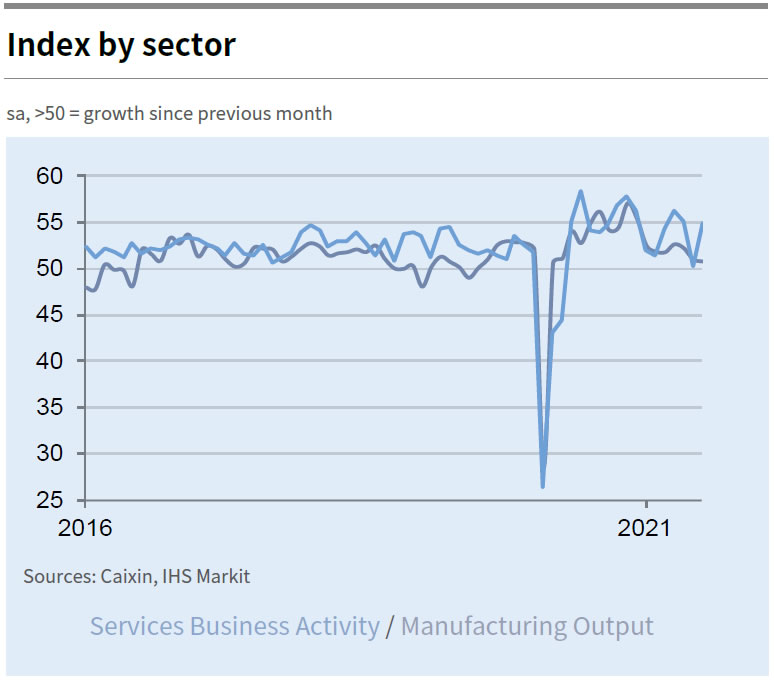
China Caixin PMI Services rose from 50.3 to 54.9 in July, well above expectation of 54.9. PMI Composite rose from 50.6 to 53.1.
Wang Zhe, Senior Economist at Caixin Insight Group said: "As the July surveys of Caixin China PMIs were conducted after the epidemic in Guangdong province was brought under control, and before Covid-19 resurged in Jiangsu province, the services sector expanded rapidly, though the manufacturing sector was slightly weaker.
The resurgence of the epidemic in some parts of China at the end of July is expected to hurt August's PMI readings. China's official second-quarter economic figures were in line with expectations, but the Caixin China PMIs in July suggest that the economic recovery is not on sure footing. The economy still faces enormous downward pressure, and we need to ensure business owners remain confident."
New Zealand unemployment rate dropped to 4.0%
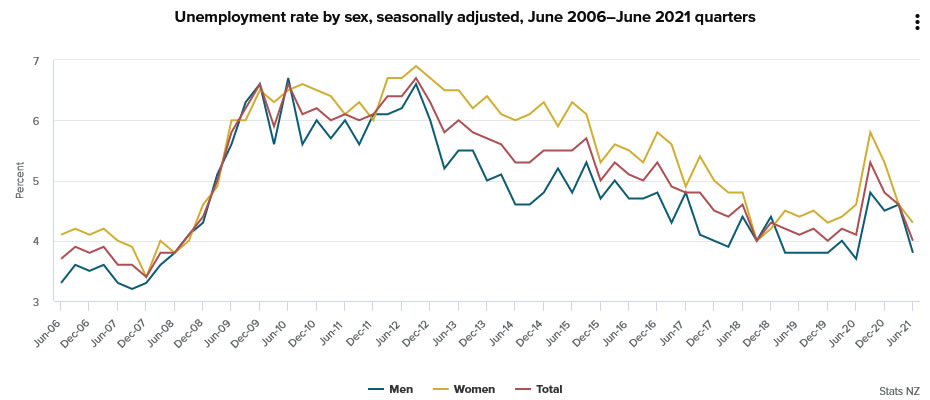
New Zealand employment rose 1.0% in Q2, above expectation of 0.7%. It's also the lowest since Q4 2019. Employment rate rose 0.5% to 67.6%. Unemployment rate dropped from 4.6% to 4.0%, much better than expectation of 4.5%. Labor force participation rate rose 0.1% to 70.5%. Labor cost index rose 0.9% qoq, above expectation of 0.7% qoq.
"The fall in unemployment is largely in line with other labour market indicators, including declining numbers of benefit recipients and increased job vacancies, and recent media reports of labour shortages and skills mismatches," work, wealth, and wellbeing statistics senior manager Sean Broughton said.
Australia retail sales dropped -1.8% mom in Jun, led by Victoria and NSW
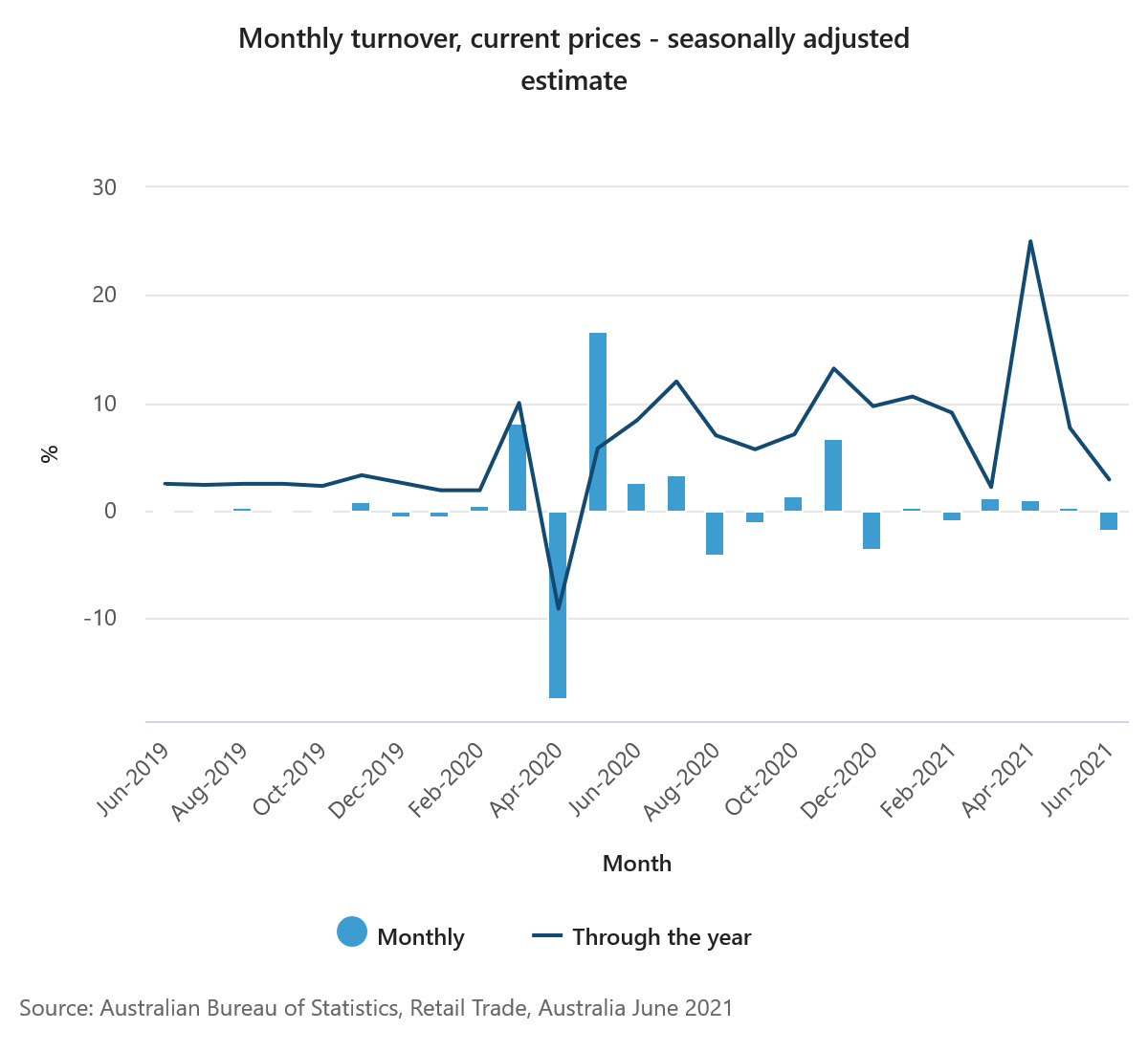
Australia retail sales dropped -1.8% mom in June, unchanged from preliminary reading. Over the June quarter, sales rose 0.8% qoq.
ABS said: "States under longer periods of restrictions for the month saw a larger fall in their June turnover. The largest falls were in Victoria (-4.0 per cent), New South Wales (-2.0 per cent), and Queensland (-0.9 per cent). Other states and territories that saw stay-at-home orders for a least one day of the month included Western Australia (0.1 per cent), and the Northern Territory (-1.8 per cent)."
Australia AiG construction dropped to 48.7 on outbreaks and restrictions
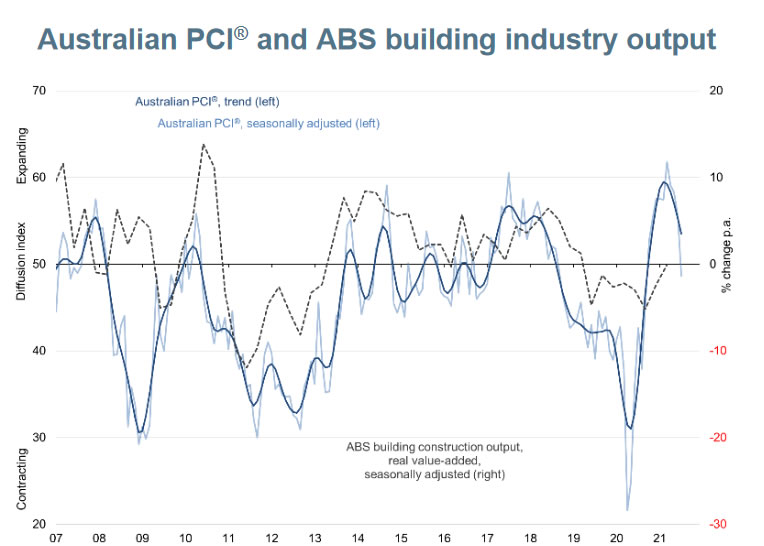
Australia AiG Performance of Construction Index dropped -6.8 to 48.7 in July, recording the first contraction since September 2020. Looking at some details, activity dropped -14.4 to 40.4. Employment rose 2.5 to 60.8. New orders dropped -6.6 to 49.5. Supplier deliveries dropped -7.6 to 43.3. Input prices dropped -1.1 to 97.2. Selling prices dropped -4.0 to 81.2. Average wages rose 6.7 to 77.1.
Ai Group Head of Policy, Peter Burn, said: "With Australia's two largest states affected by COVID-19 outbreaks and associated restrictions, the construction industry slipped into contraction in July after a robust nine-month expansion. The negative national result masked continued growth outside of NSW and Victoria and further expansions in both house building and commercial construction...
"The outlook over the next couple of months will depend heavily on the paths of the COVID-19 outbreaks and the extent of restrictions."
Crude Oil Price Starts Fresh Decline, Gold Consolidates
Key Highlights
- Crude oil price started a fresh decline from well above $72.00.
- There was a break below a key ascending channel with support near $72.40 on the 4-hours chart of XTI/USD.
- EUR/USD is holding gains above 1.1830, GBP/USD might surge if it clears 1.4000.
- The US ADP employment could change 695K in July 2021, up from the last 692K.
Crude Oil Price Technical Analysis
After a decent increase, crude oil price failed to continue above $75.00 against the US Dollar. The price topped near $74.50 and it started a fresh decline.
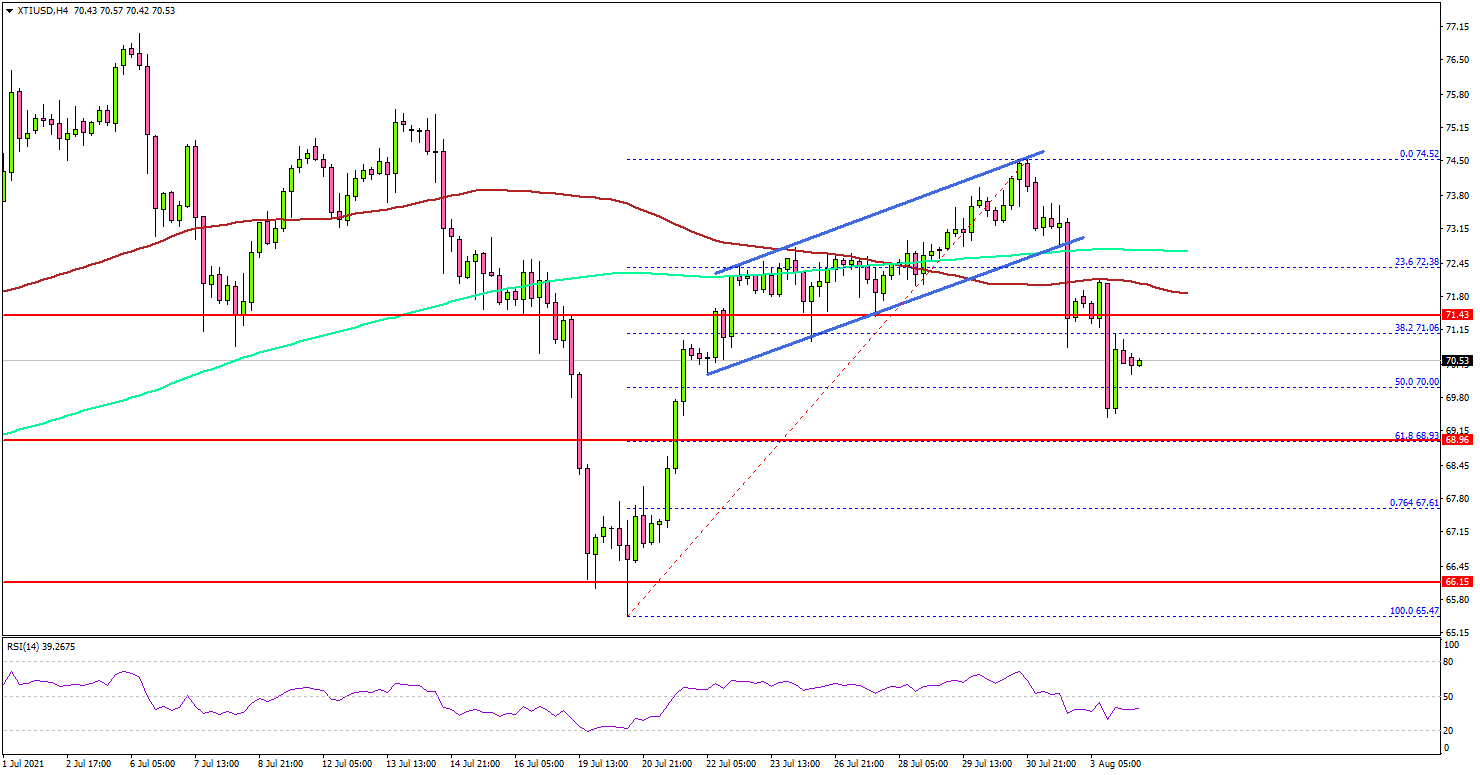
Looking at the 4-hours chart of XTI/USD, the price traded below the key $73.20 support level and the 200 simple moving average (4-hours, green). The price traded below the 50% Fib retracement level of the upward move from the $65.47 swing low to $74.52 high.
The price even broke the $70.00 support level and settled below the 100 simple moving average (4-hours, red). An immediate support is near the $68.90 level.
It is near the 61.8% Fib retracement level of the upward move from the $65.47 swing low to $74.52 high. Any more losses could open the doors for a move towards $66.00 or $65.00.
On the upside, an initial resistance is near the $71.50 level. The first major resistance is near the $72.00 level and the 100 simple moving average (4-hours, red). The next major resistance is near the $73.00 level.
Looking at EUR/USD, the pair is struggling to clear the 1.1900 resistance level. Besides, GBP/USD is still trading well below the 1.4000 resistance. On the other hand, gold price is consolidating above the $1,800 support zone.
Economic Releases to Watch Today
- Germany’s Services PMI for July 2021 - Forecast 62.2, versus 62.2 previous.
- Euro Zone Services PMI for July 2021 – Forecast 60.4, versus 60.4 previous.
- UK Services PMI for July 2021 – Forecast 57.8, versus 57.8 previous.
- US Services PMI for July 2021 – Forecast 59.5, versus 59.8 previous.
- US ISM Services Index for July 2021 – Forecast 60.4, versus 60.1 previous
- US ADP Employment Change for July 2021 - Forecast 695K, versus 692K previous.
Eco Data 8/4/21
[php_everywhere instance="1"]
BoE Meeting: Neutral, With a Touch of Optimism
The Bank of England will announce its policy decision at 11:00 GMT Thursday. This is one of the big meetings, with updated economic forecasts and a press conference. The UK economy is humming along nicely, but the Delta outbreak and the phasing out of government jobs programs could keep policymakers a little cautious for now. As for sterling, the big picture remains positive.
Solid recovery
The Bank of England will be pleased with its progress when it meets this week, as the British economy has performed well lately. Unemployment has been better than expected, consumption is booming, and PMI business surveys suggest this strong spell of growth is likely to continue moving forward.
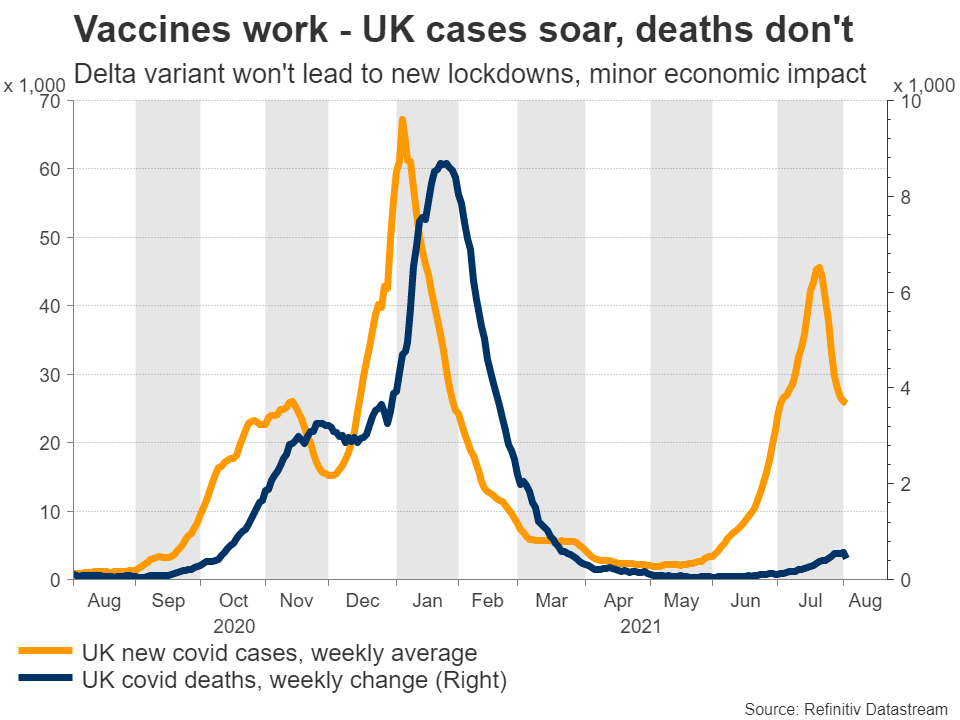
The only real worry is the Delta variant that is currently rampaging the nation. That said, with the UK enjoying one of the highest vaccination rates in the world and cases falling in recent days, this isn’t a huge problem either. It won’t lead to new lockdowns, so the economic impact will probably be mild.
Indeed, things are going so well that a couple of BoE officials called for withdrawing some stimulus lately. Inflation is already running hot and they fear that unless the Bank takes its foot off the accelerator soon, this phenomenon could become more permanent. If people start to expect high inflation, they usually act on that expectation and it can become reality.
However, the rest of the Committee doesn’t share this view. Most members have been adamant that withdrawing stimulus too early would be an even bigger risk, as it could hurt the recovery. That’s especially true now that the government is also phasing out its job programs.
Neutral, with an optimistic flavor
Bearing everything in mind, it is probably too early for the Bank to take the next step in its normalization cycle. Things are moving in the right direction, but withdrawing stimulus right now is a little too aggressive from a risk-management perspective.
As such, the most likely conclusion is a 6-2 split vote, where most members favor keeping their asset purchase program intact but two members vote for an immediate end to quantitative easing. The dissenters will likely be Saunders and Ramsden.
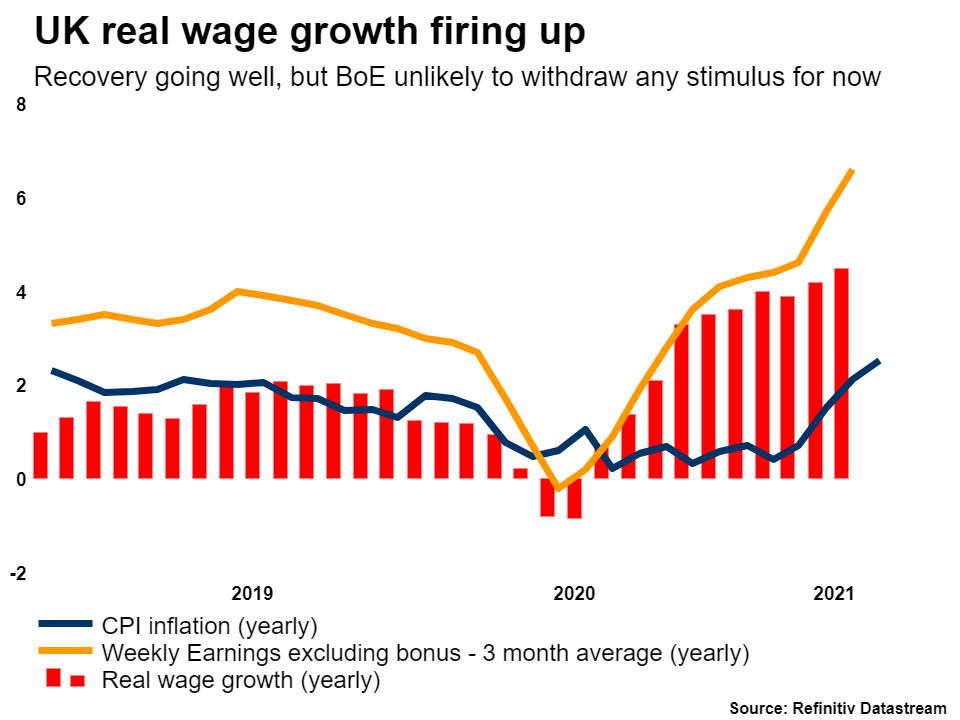
Coupled with some upgraded macroeconomic forecasts, that might be enough to lift the pound. When two members vote for an immediate withdrawal of stimulus, that shows which way the wind is blowing.
The big picture
All told, the outlook for sterling remains favorable. The economy is strong, vaccination rates are high, and the Bank of England will most likely be one of the first central banks to raise interest rates this cycle. Markets are currently pricing in the first BoE rate increase for next summer.
That said, any future gains in the pound might be better reflected against the euro and the yen, not against the US dollar. The Fed will join the BoE in normalizing policy, whereas neither the ECB nor the BoJ will play that game anytime soon. This implies that we might be entering an environment where American and British yields move higher, but European and Japanese ones don’t.
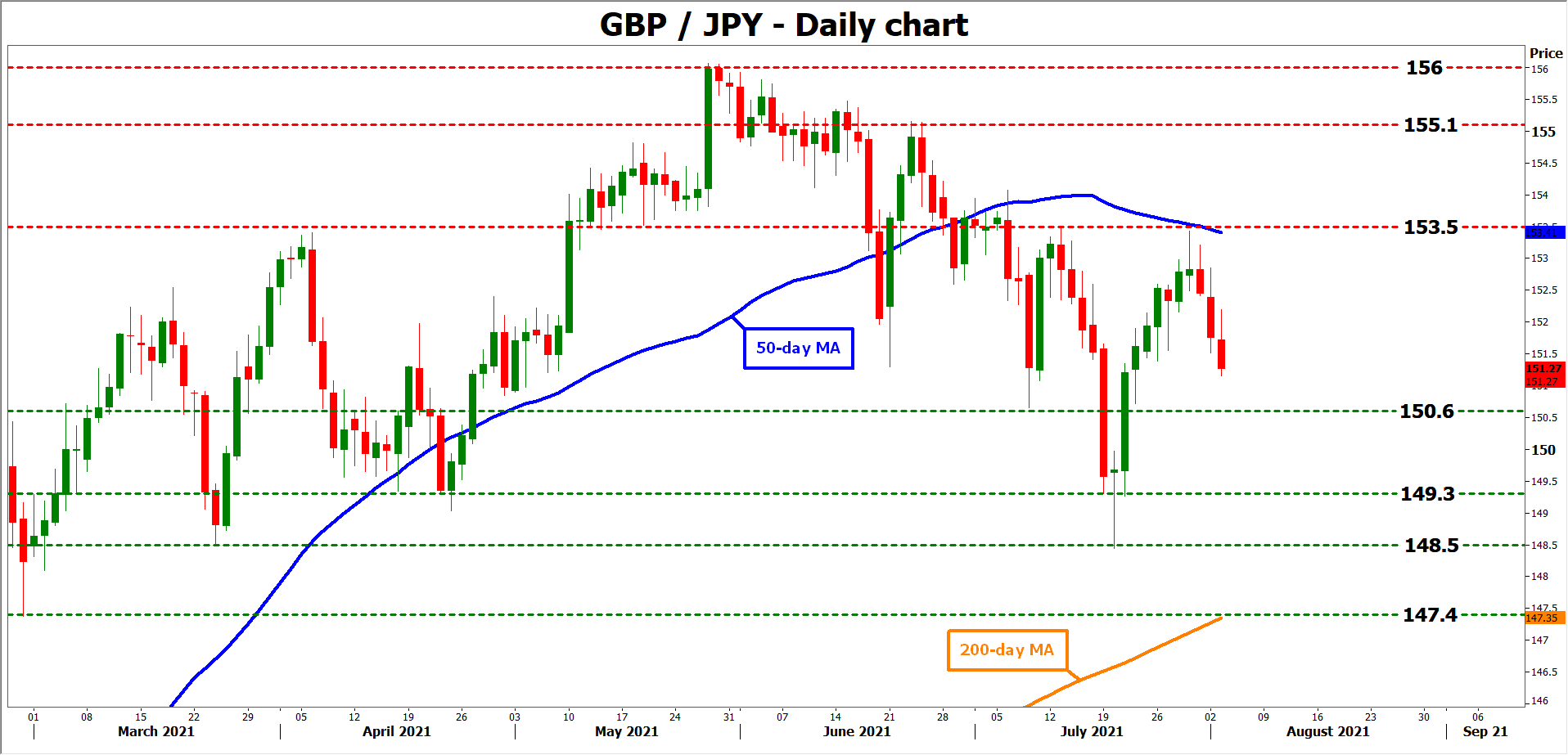
Taking a technical look at pound/yen, if the bulls retake control, their first target might be the recent highs around 153.50. If they pierce above it, the next region to provide resistance could be near 155.10.
On the downside, the first test for the bears would be the 150.60 barrier. Breaking below it, the market could then encounter support around the 149.30 area.
Fed Daly: Americans want to work and it would be a mistake to assume otherwise
San Francisco Fed President Mary Daly said in a blog post that "myriad factors are tempering labor supply at the moment". However, " there is no reason to expect those to be permanent or even highly persistent features of the labor market."
She pointed to the "aftermath of the Great Recession" as the downturn "put millions of prime-age men and women out of work ". And, "many believed that this would never reverse".
"But none of those factors proved to be binding," she said, "As the economy improved, workers came off the sidelines. And year after year, the employment rate rose, eventually surpassing its pre-recession peak".
"The lesson is simple: Americans want to work and it would be a mistake to assume otherwise," She concluded.
GBP/JPY Mid-Day Outlook
Daily Pivots: (S1) 151.27; (P) 152.07; (R1) 152.59; More...
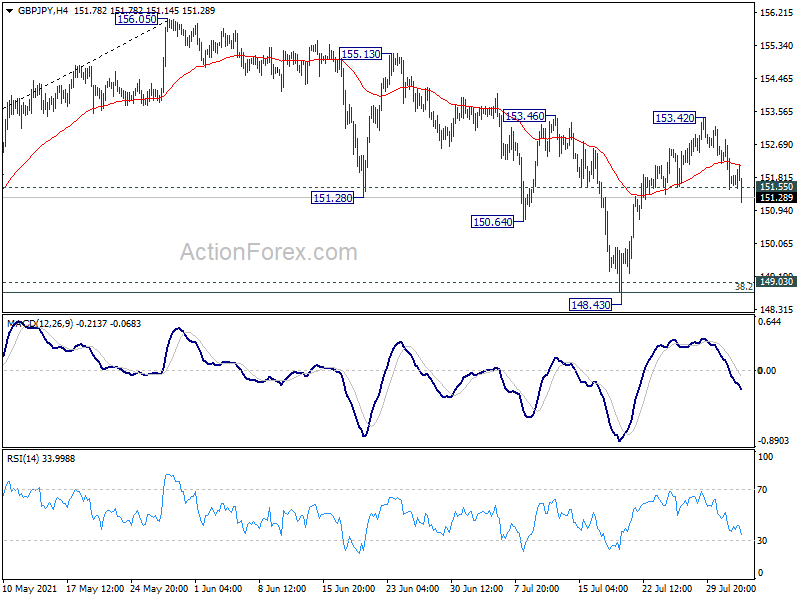
GBP/JPY's break of 151.55 minor support suggests that rebound from 148.43 has completed at 153.42, after rejection by 153.46 resistance. Intraday bias is back on the downside. Deeper fall could be seen back to retest 148.43 support. On the upside, through, break of 153.42 will resume the rebound from 148.43 to retest 156.05 high.
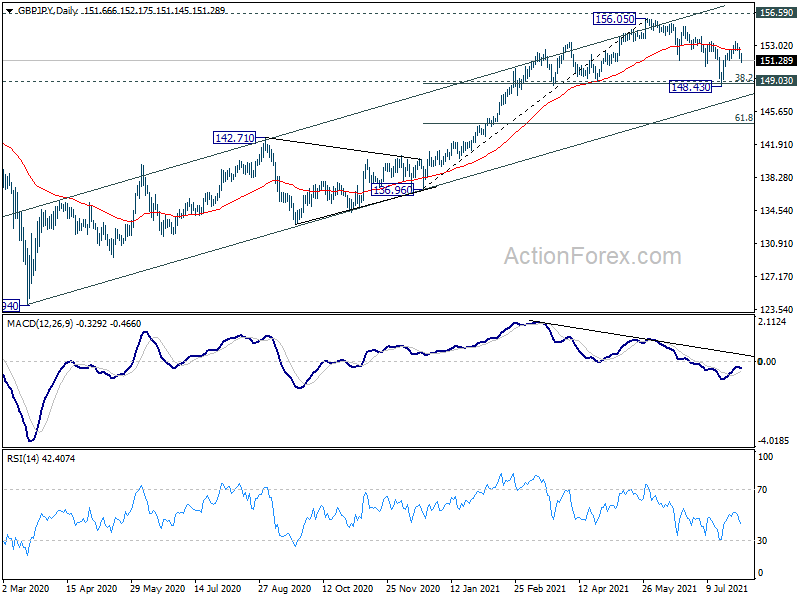
In the bigger picture, rise from 123.94 is seen as the third leg of the pattern from 122.75 (2016 low). Focus remains on 156.59 resistance (2018 high). Sustained break there should confirm long term bullish trend reversal. Next target is 61.8% retracement of 195.86 (2015 high) to 122.75 at 167.93. On the downside, sustained break of 149.03 support, however, will argue that rise from 123.94 has completed. Further break of 142.71 would open up the bearish case for retesting 122.75 low.
EUR/USD Mid-Day Outlook
Daily Pivots: (S1) 1.1855; (P) 1.1876; (R1) 1.1893; More...
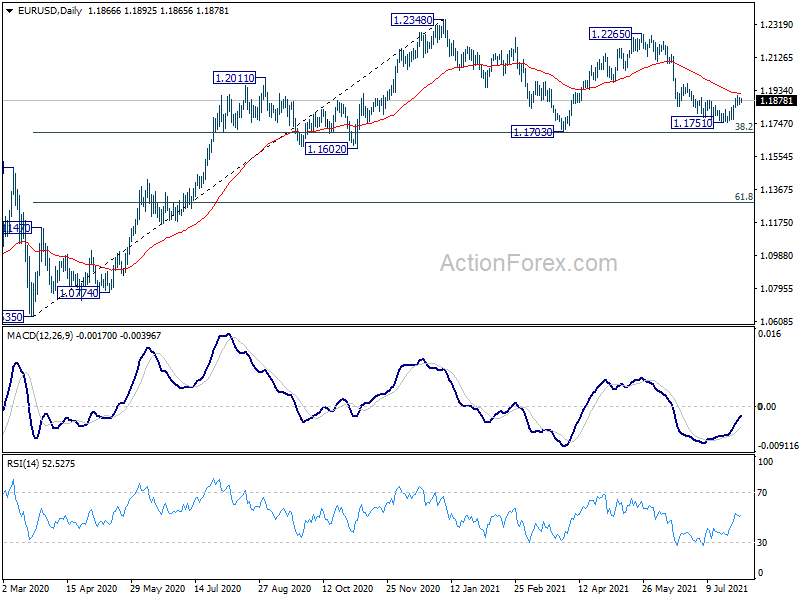
Intraday bias in EUR/USD remains neutral and outlook is unchanged. A short term bottom was formed at 1.1751. On the upside, above 1.1907 will resume the rebound to 1.1974 resistance first. Firm break there should argue that whole corrective pattern from 1.2348 has completed. On the downside, however, break of 1.1751 will resume the fall from 1.2265 to 1.1703 support instead.
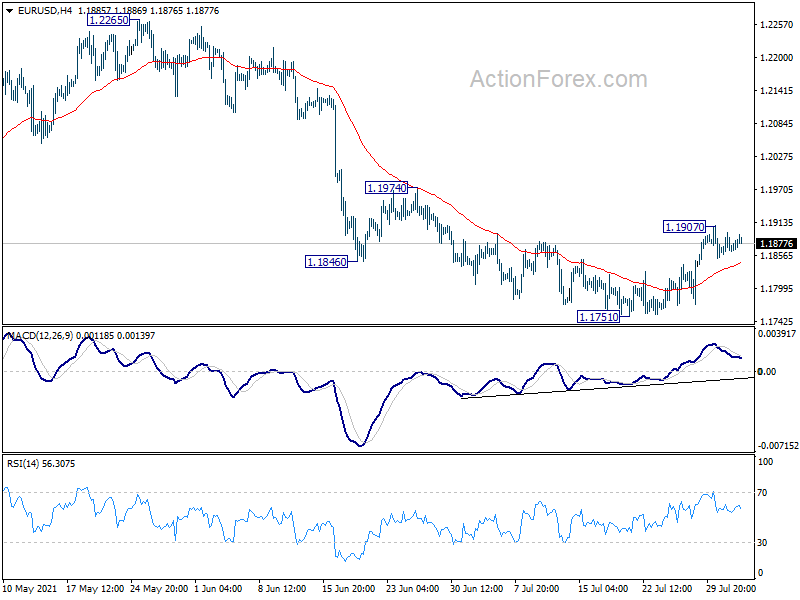
In the bigger picture, rise from 1.0635 is seen as the third leg of the pattern from 1.0339 (2017 low). Further rally could be seen to cluster resistance at 1.2555 next, (38.2% retracement of 1.6039 to 1.0339 at 1.2516). This will remain the favored case as long as 1.1602 support holds. Reaction from 1.2555 should reveal underlying long term momentum in the pair. However sustained break of 1.1602 will argue that the rise from 1.0635 is over, and turn medium term outlook bearish again.