Sample Category Title
Eco Data 7/30/21
[php_everywhere instance="1"]
CAD Improves as US GDP Underperforms
The Canadian dollar has extended its rally on Thursday. USD/CAD has declined by 0.76% this week and is back below the symbolic 1.25 line.
US GDP misses forecast
US data was a disappointment, and the major haves jumped on the greenback and sent it broadly lower. Advanced GDP for the second quarter rose 6.5%. This is certainly a sharp gain, but well short of the consensus of 8.5%. The soft reading can be attributed to a fall in inventories, which is unlikely to be much of a concern. Unemployment claims also missed the consensus, as both initial and continuing claims were slightly higher than anticipated.
A September taper? Maybe. Or maybe not
There were some expectations that the FOMC meeting would shake up the markets with some tapering news, but in the end, the hype wasn’t really warranted. However, Fed Chair Jerome Powell did state that the economy would need to recover millions of jobs and inflation would need to be durable before the Fed would consider a taper in September. This gives the Fed a couple of months of inflation and employment data to determine if they can start scaling back asset purchases.
The FOMC meeting was a masterful balancing act by Jerome Powell, considering that there is a wide array of views at the Fed when it comes to the burning issue of a timeline for tapering. Powell will have to continue to navigate through some choppy waters, but the markets appear willing to show some patience, as the Fed has done a good job of communicating with the markets. Tapering is on its way, but the Fed is counselling patience and the markets appear willing to wait.
USD/CAD Technical
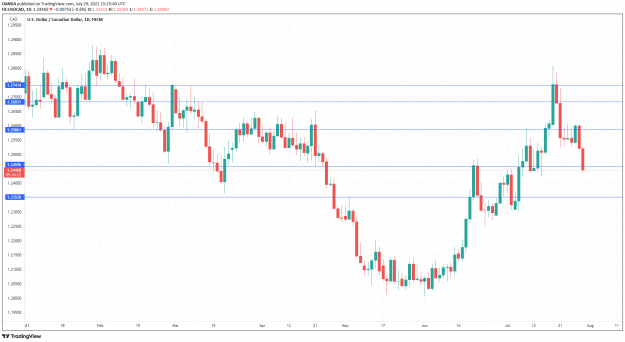
- USD/CAD faces a monthly resistance line at 1.2586. Above, there is resistance at 1.2741
- On the downside, the pair is testing support at 1.2459. Below, there is support at 1.2352
BoJ Noguchi: Commitment has no strong effect in changing inflation expectations
BoJ is clear on its commitment to bring inflation "stably exceeds" 2% target. But board member Asahi Noguchi criticized, "personally, I don't think this commitment has a strong effect in changing inflation expectations"
"It may take some time, but a more realistic policy would be to maintain the current powerful monetary easing to steadily improve the output gap, so that demand increases enough to prop up wages and inflation", he added.
He's also an advocate to push bond yield target to 15- to 20-year bonds. In particular, if a shock event pushes the economy into a serious downturn, BoJ should ease further "without hesitation". "What's important is to look at the basic trend of the economy, "he said. "Unless this trend is broken, it's important to patiently sustain the current very powerful monetary easing."
After Dovish Fed and GDP Miss, Can PCE Inflation Rise Rescue the US Dollar?
The US dollar’s upswing since June has run into trouble as investors are once again questioning how aggressively the Fed will move to scale back its vast monthly asset purchases. Those doubts were heightened after the Fed indicated that a taper decision is still months away and after the US economy grew less than expected in Q2. But the week isn’t over yet and there’s still crucial data coming up on US consumption and PCE inflation for June. Can they rekindle the dollar’s bullish thrust?
Summer taper drama unlikely
It’s official - taper discussions are in full swing at the Fed. Yet, a timeline is nowhere in sight and Fed Chair Jerome Powell isn’t in a hurry to set a firm date either. Clearly, policymakers want to see what effect the end of the enhanced unemployment benefits in September will have on the labour market and whether the surge in inflation will show signs of peaking over the next few months.
If Powell had his way, a decision would probably be put off until early next year. But a growing chorus of FOMC hawks means it will be difficult to delay a move beyond the end of this year. Either way, the odds of the Fed making a call on tapering in September are diminishing and this is creating downside pressure on the dollar as pushing back tapering would also determine how soon the Fed funds rate can start to go up.
Hence, Friday’s numbers on personal income and spending, as well as the all-important PCE inflation print may only have a limited impact in terms of altering the outlook for Fed policy.
PCE inflation to jump again
Personal consumption, which has somewhat disappointed lately, is expected to have increased by 0.7% month-on-month in June. But personal income likely fell by -0.3% m/m as the boost from the stimulus payments and other federal support continued to fade.
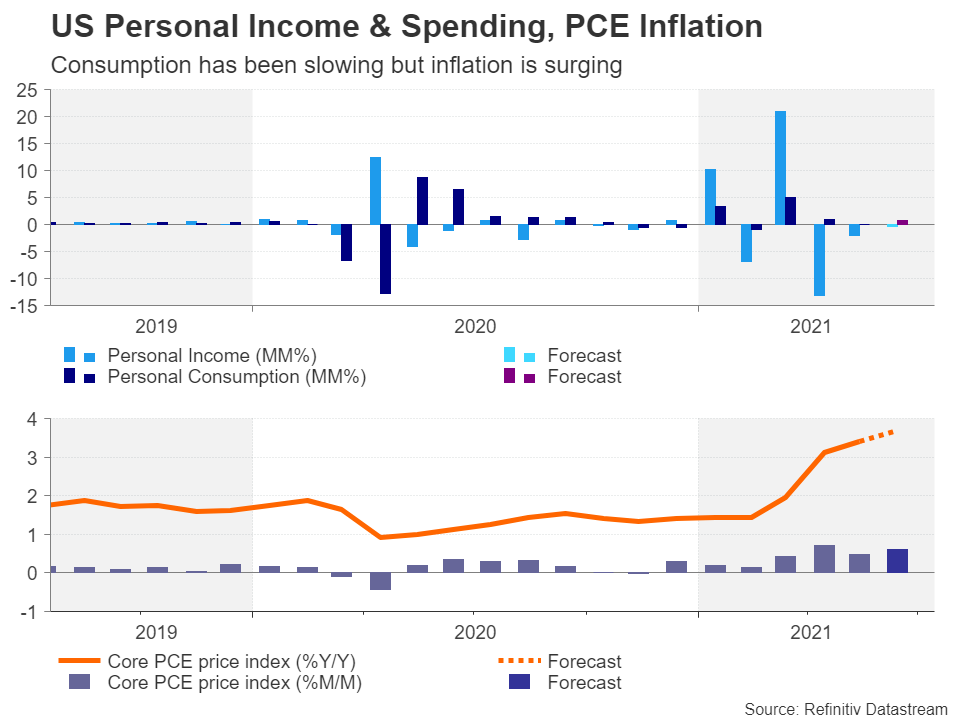
As for the core PCE price index, which is what the Fed pays most attention to for gauging inflation, analysts are predicting a monthly increase of 0.6% and an annual rise of 3.7% - both well above historical averages, well, that is if you exclude the 1970s.
Dollar could do with some support
Should the core PCE price index soar more than expected, it could help put a floor under the dollar’s latest selloff, especially if it’s backed by strong consumption data. The dollar index is currently seeking support at the 61.8% Fibonacci retracement of the May – July upleg at 91.95. If this support fails, the 50% Fibonacci of 91.49 will be critical as the 50-day moving average happens to be in the same area.
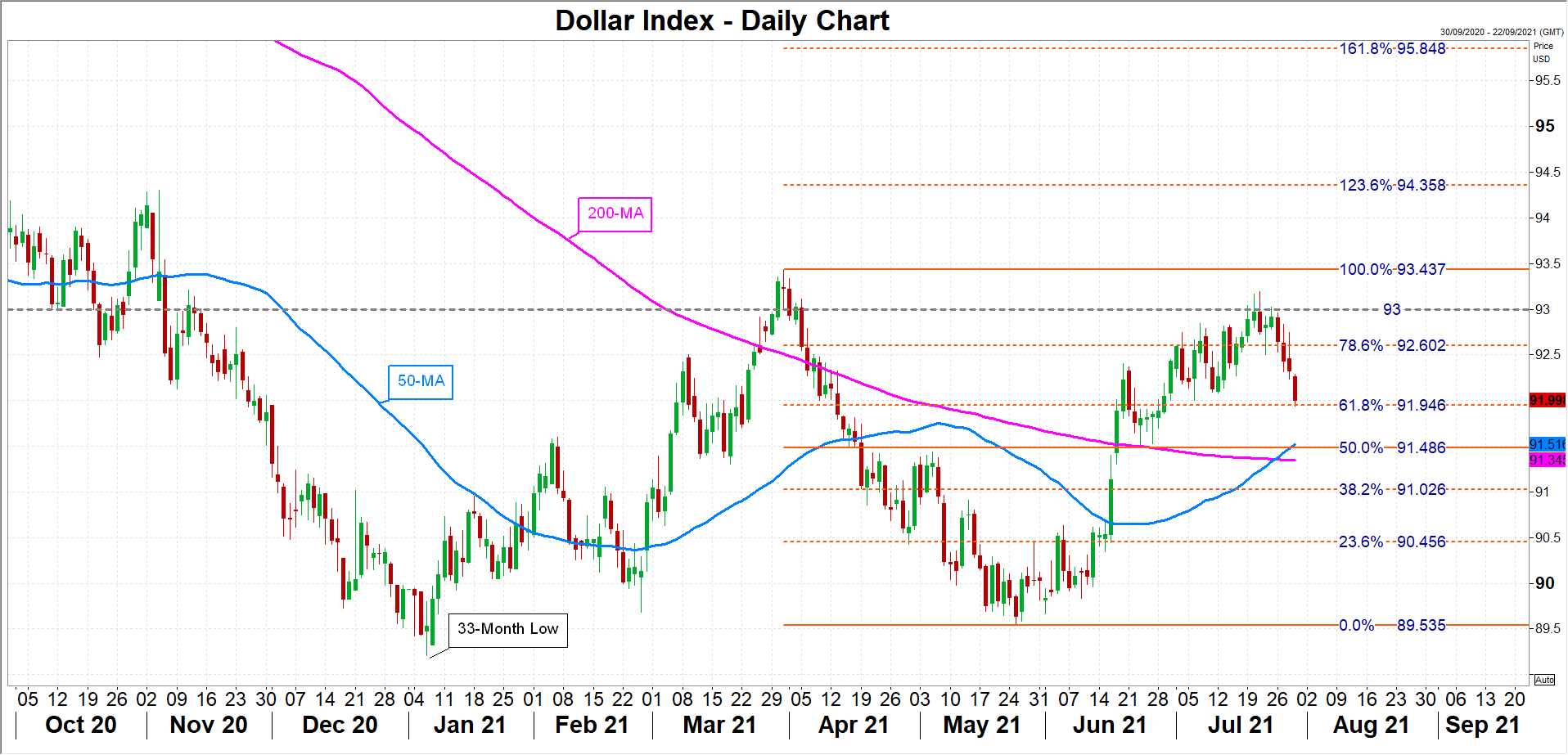
However, should buyers re-enter the market, a rebound towards the 78.6% Fibonacci of 92.60 would not be too farfetched, though sharper gains would be more difficult. The dollar index’s best chance of reclaiming the 93.0 level and challenging the July top of 93.19 in the short term is if risk aversion were to return and draw in some safe-haven demand for the greenback.
Markets Cheer Dovish Fed, US Q2 GDP Expands 6.5%
A sense of positivity is certainly in the air today thanks to dovish comments by the Federal Reserve overnight, the US Senate voting to move ahead on the $1.2 trillion infrastructure plan and robust earnings in Europe.
Stocks on the continent were painted green this afternoon, having hit record highs earlier in the day amid the risk-on sentiment. US equity markets are also positive hitting fresh record highs as bulls take heart from Jerome Powell’s dovish remarks and the prospects of a breakthrough on the infrastructure bill.
Dollar Humbled By Dovish Fed
“One man’s meat is another man’s poison” is a proverb that comes to mind when looking at the dollar’s recent selloff. While equity bulls were doing backflips and cartwheels after Jerome Powell said that rate increases were “a ways away”, this dealt a heavy blow to king dollar. In fact, the greenback has depreciated against every single G10 currency today with the Dollar Index (DXY) wobbling above 92.00 as of writing. With Powell highlighting that the job market still had “some ground to cover” before the Fed begins tapering, investors are likely to keep a very close eye on economic data. Given how this will drive taper discussions and rate hike expectations, we could be in for some bumpy months and increased dollar volatility.
US economy grows at 6.5% in Q2
Speaking of data, the US economy grew at a 6.5% annualised in the second quarter of 2021. This was higher than the revised 6.3% pace seen in the first quarter but well below market expectations of 8.5%. Despite the report falling short of forecasts, this was still the biggest jump in growth since the third quarter of 2020 when the economy sprung back to life. Details also showed that personal consumer spending rose at an annualised rate of 11.8% so the US consumer appears to be very much alive and kicking.
In other data releases, US initial jobless claims dropped by 24,000 to 400,000 last week as the economy continues to recover from the pandemic. With Powell’s recent comments around the job market and tapering, further signs of improving jobless claims add to the list of factors influencing taper expectations.
Currency spotlight – EURUSD eyes 1.19
Some economic data from Europe offered a breath of fresh air today.
Eurozone economic sentiment hit an all-time high in July while the unemployment rate in Germany remained at 5.7% in June, a tick lower than expected. This was the lowest jobless rate witnessed since April 2020. Interestingly, it has been a mixed day for the euro. Although the currency stood tall against the dollar, yen, and swiss franc, it has weakened against other more cyclical G10 majors. Looking at the technical picture, the weaker dollar looks to be propelling EURUSD towards 1.1900. A solid breakout above this level could open the door towards 1.1960 and 1.2000. Alternatively, a decline towards 1.1800 could signal a move back towards 1.1750.
Sunset Market Commentary
Markets
Sentiment on global markets improved further today as Chinese authorities took steps to ease market fears after recent regulatory overhaul. The Fed’s commitment to keep a supportive policy stance, at least for now, also helped to push uncertainty on growth to the background. Aside for the overall sentiment, there were also plenty of interesting economic data today. The German CPI data were a first eye-catcher. HCPI jumped to 0.5% M/M to 3.1% Y/Y, the highest level since August 2008. Base effects due to a corona-induces sales tax reduction last year are in play. However, still the figure was higher than expected. HCPI inflation in Spain was also reported to have risen to 2.9%. Earlier today, German labour data were strong. Unemployment declined much faster than expected (-91 k), lowering the unemployment rate to 5.7% from 5.9%. Economic sentiment the Euro area also rose to the highest level since the start of the series in 1985. Still this combination of higher inflation and good activity data only caused a modest rise in European yields. The German yields curve steepens with the 2-y yield gaining 0.5 bp. Yields for the 10/30-y sector are 1.5 bp higher. In the US, the first estimate of the Q2 GDP failed to meet expectations printing at 6.5% Q/Q annualized while a gain of 8.4% was expected. Consumer spending (11.8%) was stronger than expected, but a negative contribution from inventories and slowdown in housing investment prevented a bigger growth. The core PCE price deflator jumped from 2.7% Q/Q to 6.1%. Weekly jobless claims declined from 424k to 400K. Mixed US data and a constructive risk sentiment also supported a cautious bottoming in US yields. Yields are rising between 0.4% bp and 3.5 bp (10-y) . Even so, the 10-y yield stays well below the 1.30% (1.26%). The 10-y real yield (-1.16%) is holding near the all time low. Later today, the US Treasury will conclude this week’s refinancing operation with the sale of $62 bln of 7-y bonds.
The combination of higher EMU inflation and solid activity data maybe was a slightly supportive for the single currency. However most of the EUR/USD rebound was due to USD weakness in the wake of yesterday’s soft Fed narrative and a further decline in the USD real yield. EUR/USD is testing the 1.1881 resistance. USD/JPY is losing modestly (109.75). The TW DXY index has returned to the 92.00 level. Sterling is holding strong, but the EUR/GBP 0.85 level currently caps further sterling gains against the single currency, with the 0.8472 year low also within reach. Most smaller/more risk sensitive currencies are mostly well bid and this also applies to the CE currencies. The zloty rebounds after recent decline (EUR/PLN 4.5775). Also the forint (EUR/HUF 358) and the Czech Koruna are extending gains. (EUR/CZK 25.53).
News Headlines
According to the flesh estimate as published by the National Bank of Belgium, the Belgian economy in the second quarter grew 1.4% Q/Q to be up 14.5% compared to the same period last year. Value added on a quarterly basis was up 1.1% in industry, 0.5% in construction and 1.4% in services. Even so, activity in the Belgian economy was still 2.5% below the level in the further quarter of 2019. In another release, the Belgian Statistics office reported that inflation in July accelerated to 0.85% M/M and 2.27% y/y (from 1.63% in June), the highest level since March 2019. Core inflation (excluding energy and unprocessed food prices) rose to 1.43% from 1.10%.
The Central Bank of Turkey at the publication of its quarter inflation report upwardly revised the forecast for inflation at the end of this year from 12.2% to 14.1%. At the end of 2022, the CBRT sees at 7.8% from 7.5%. In June CPI inflation was 17.53%. However, CBTR governor Kavcioglu indicated that inflation could fall significantly in the fourth quarter. If so, this might revive the debate on an interest rate cut at that time or at the start of next year. The CBTR policy rate currently stands at 19%. The Turkish Lira today gains modest ground, with EUR/TRY declining to 10.115.
USD/JPY Mid-Day Outlook
Daily Pivots: (S1) 109.68; (P) 109.98; (R1) 110.22; More...
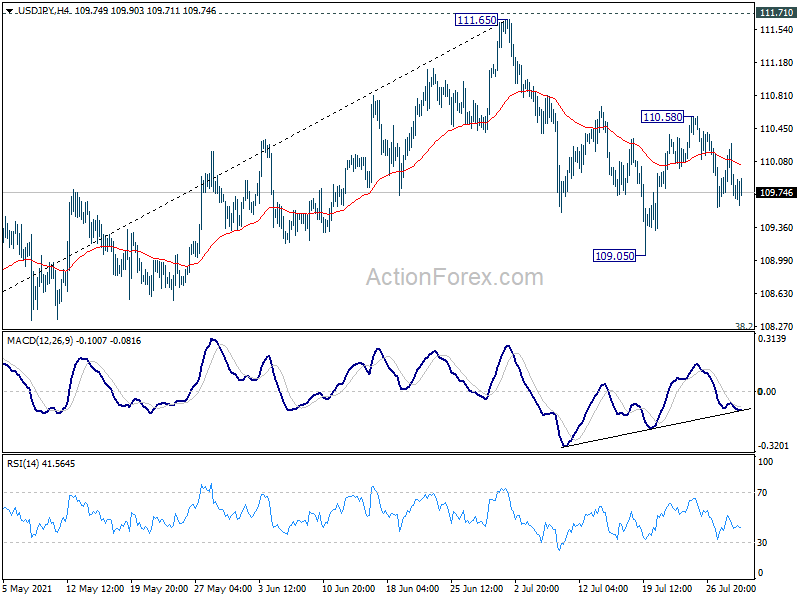
Range trading continues in USD/JPY and intraday bias remains neutral at this point. On the upside, break of 110.58 will resume the rebound from 109.05, for retesting 111.65 high. On the downside, break of 109.05 will resume the fall from 111.65 to 38.2% retracement of 102.58 to 111.65 at 108.18.
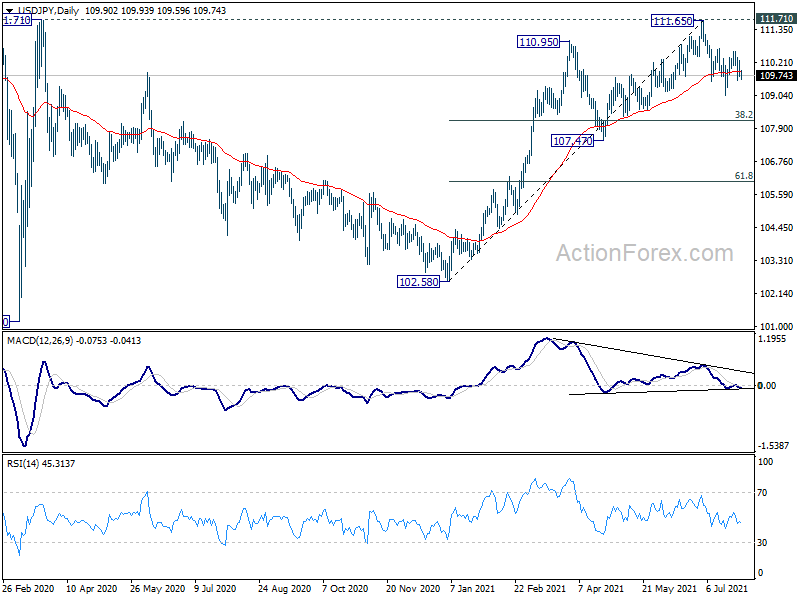
In the bigger picture, medium term outlook is staying neutral with 111.71 resistance intact. The pattern from 101.18 could still extend with another falling leg. Sustained trading below 55 day EMA will bring deeper fall to 107.47 support and below. For now, outlook won't turn bullish as long as 111.71 resistance holds, even in case of strong rebound.
USD/CHF Mid-Day Outlook
Daily Pivots: (S1) 0.9078; (P) 0.9123; (R1) 0.9145; More....
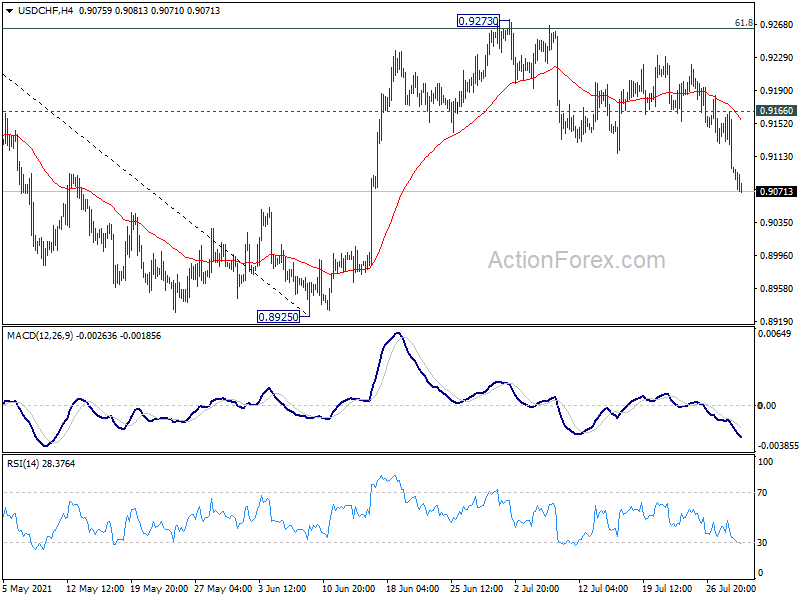
Intraday bias in USD/CHF remains on the downside at this point. Rebound from 0.8925 could have completed at 0.9273 already. Deeper fall would be seen back to retest 0.8925 low. On the upside, above 0.9166 minor resistance will mix up the near term outlook and turn intraday bias neutral first.
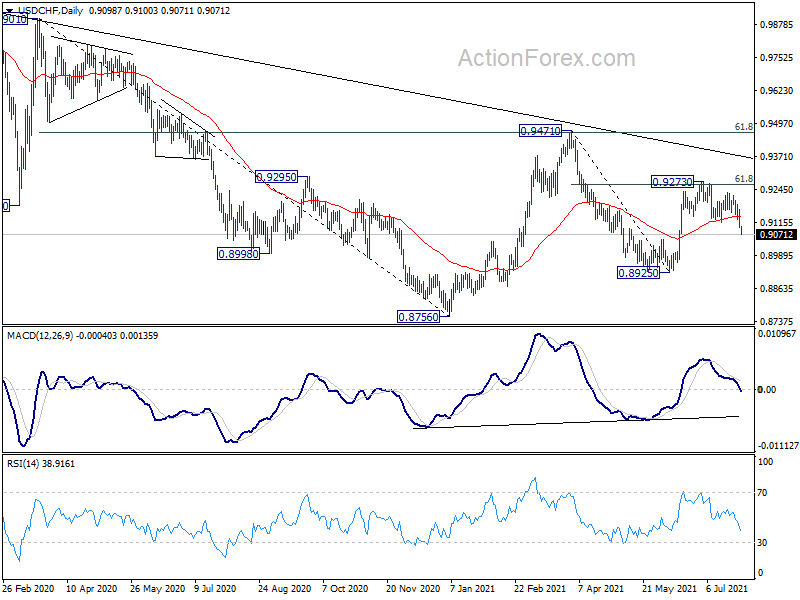
In the bigger picture, medium term outlook is currently neutral with focus on 0.9471 resistance. Sustained break there will indicate completion of whole decline from 1.0342 (2016 high). Medium term outlook will be turned bullish for a test on 1.0342 high. But, rejection by 0.9471 again will revive bearishness for another fall through 0.8756 low.
GBP/USD Mid-Day Outlook
Daily Pivots: (S1) 1.3862; (P) 1.3887; (R1) 1.3929; More....
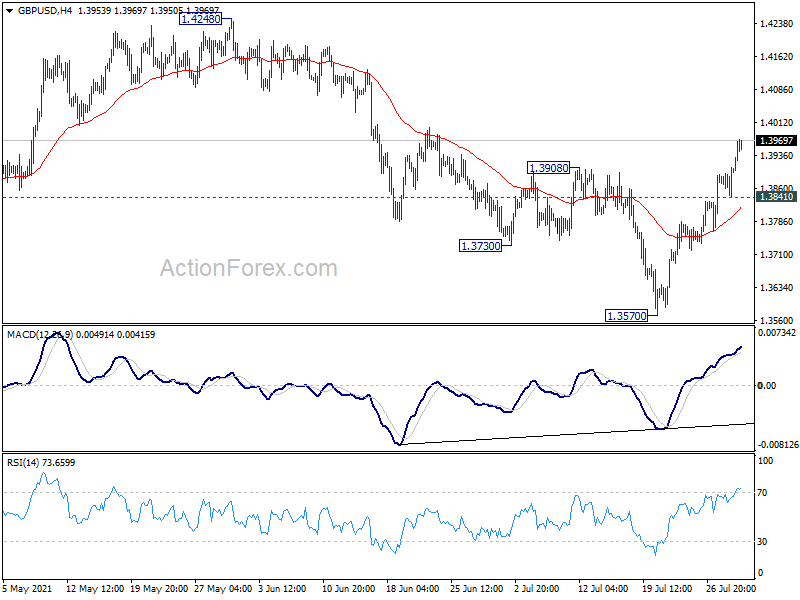
Intraday bias in GBP/USD remains on the upside at this point. Consolidation form 1.4240 could have completed with three waves to 1.3570 already. Further rise should be seen to retest 1.4248 high next. On the downside, below 1.3841 minor support will turn intraday bias neutral and bring retreat first, before staging another rally.
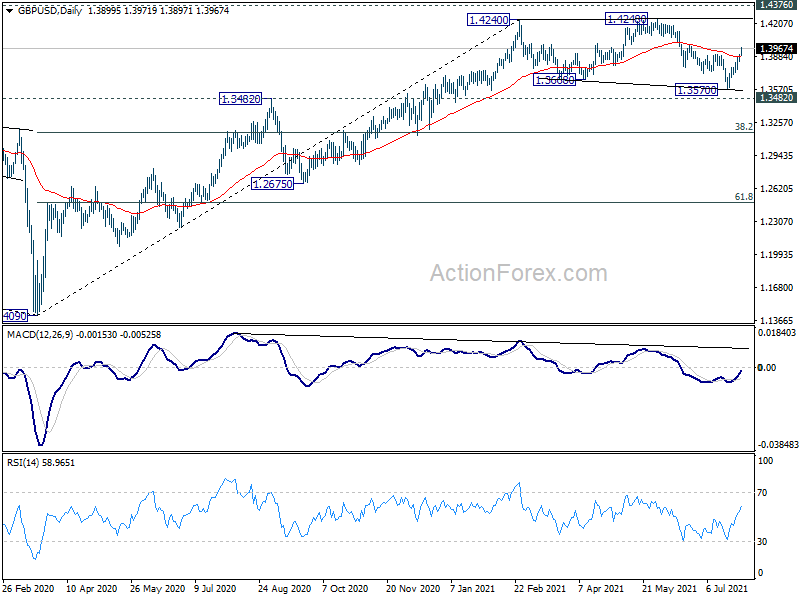
In the bigger picture, as long as 1.3482 resistance turned support holds, up trend from 1.1409 should still continue. Decisive break of 1.4376 resistance will carry larger bullish implications. However, firm break of 1.3482 support will argue that the rise from 1.1409 has completed. GBP/USD would then be seen in another leg of long term range pattern between 1.1409 and 1.4376. Deeper fall could then be seen to 61.8% retracement of 1.1409 to 1.4248 at 1.2493, and even below.
GBPAUD Fiercely Exits Range Area after a Year
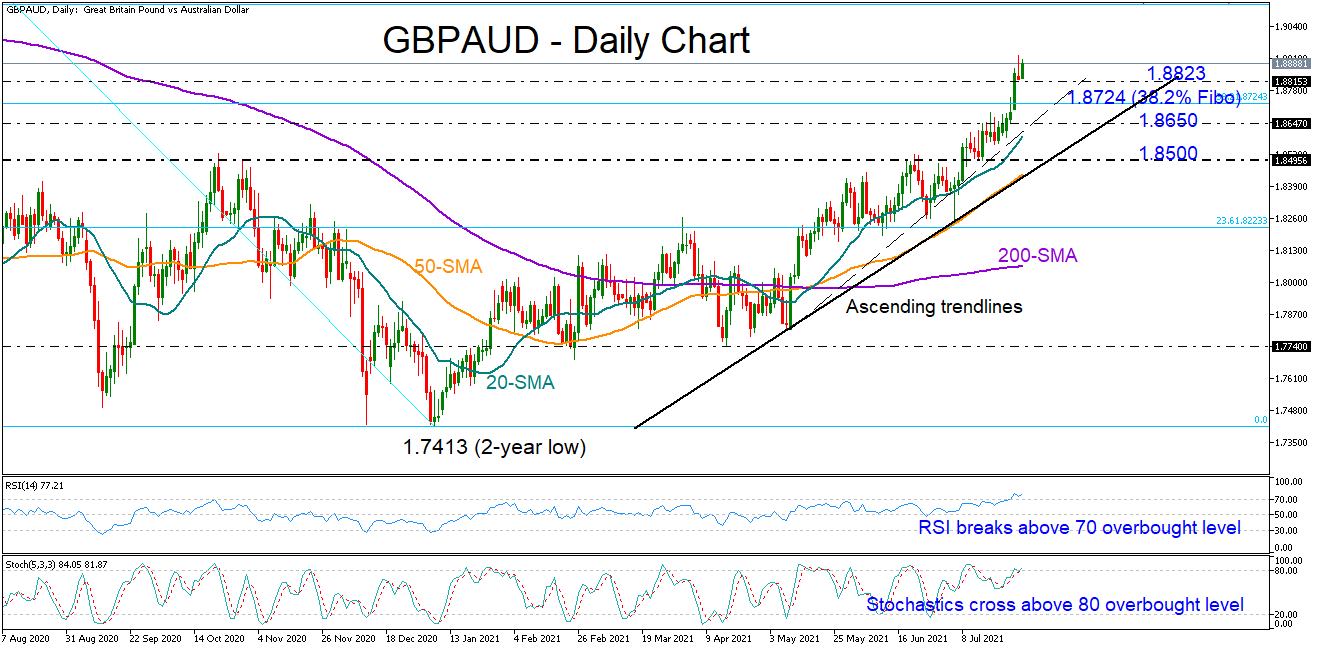
GBPAUD knocked the wall around 1.8525 to fiercely exit the one-year-old range area and peak at a 14-month high of 1.8924 on Wednesday.
Having snapped the 38.2% Fibonacci retracement of the 2020 massive sell-off (2.0845 – 1.7413), the pair could head for the 50% Fibonacci of 1.9125. Yet, some choppy trading would not be surprising in the near term as the RSI and the Stochastics are currently fluctuating in the overbought territory, making any price declines possible.
Beyond the 1.9125 barrier, the rally could take a breather near May’s 2020 high of 1.9520 before stretching towards the 61.8% Fibonacci of 1.9750.
In the bearish scenario, should the nearby 1.8823 support area collapse, the price could seek shelter near the 38.2% Fibonacci of 1.8724. Then, the 20-day simple moving average (SMA) and the dashed ascending trendline, currently around 1.8650, could guarantee sharper declines towards the 50-day SMA and the tentative ascending trendline at 1.8500.
Summarizing, GBPAUD’s risk is expected to remain cautiously tilted to the upside in the short term, with resistance likely coming next around 1.9125.