Sample Category Title
Gold Rises, Oil Drifting After FOMC
Oil trades sideways
Oil prices traded sideways overnight, despite a suitably dovish FOMC, and significant falls in US official crude and gasoline inventories, along with a weaker US dollar. All of those factors should have supported oil prices, and although oil did not retreat, it did not rally materially either. Brent crude was unchanged at USD 74.75 a barrel, and WTI finished just 0.70% higher at USD 72.40 a barrel.
Oil prices have crept higher by 25 cents a barrel in Asia. Still, the lack of upward momentum after crude inventories fell by 2.25 million barrels and gasoline inventories fell by a whopping 4.1 million barrels indicates that both contracts have seen the best of the recovery rally from early last week.
The balance of risks now shifts to the downside slightly, although I emphasise that at these price levels, both Brent and WTI look close to equilibrium right now. Nagging doubts over the impact of the delta-variant on consumption, and the recovery speed, appear to be staying the hands of more bullish price action.
With that in mind, I expect Brent crude to continue trading in a roughly USD 73.00 to USD 75.00 a barrel range into the end of the week, while WTI should be confined to approximately USD 71.00 to USD 73.00 a barrel.
Gold rises on unchanged FOMC
Gold prices rose overnight after the FOMC indicated no change to its monetary policy outlook was imminent. That flattened the US yield curve and sent the US dollar lower, which lifted gold prices from just under USD 1800.00 an ounce. Gold rose 0.44% to USD 1807.00 an ounce, rising another 0.43% in Asian trading to USD 1814.75 an ounce.
With the FOMC removing the upward pressure on the US dollar now, gold has likely weathered the storm that has left glued in a USD 1790.00 to USD 1810.00 range for the past week. Support at USD 1790.00 looks safe for now, and a rise through USD 1810.00 should trigger a test of the 200-DMA at USD 1822.00 an ounce, possibly by the end of the week.
A daily and weekly close above the 200-DMA would be a strong bullish signal indicating further gains to the USD 1840.00 an ounce region. However, we will likely need to see additional US dollar weakness to keep the bullish momentum going. Gold should find plenty of willing buyers now on dips to USD 1800.00 with the FOMC clearly not interested in rocking the tapering boat for now, and US data tonight likely to show inflationary pressure is alive and well.
Dollar Eases After The FOMC Stays Dovish
FOMC, China's soothing words send dollar lower
It looks like a few FOMC taper-hedging positions were taken off last night as the US dollar broadly eased in the overnight session versus DM and EM. The soothing words from China about targeted versus broader clampdowns also helped relieve the pressure on Asian currencies, including the onshore and offshore yuans.
The dollar index fell by 0.22% to 92.22 overnight, easing another 0.10% in Asia to 92.18. Resistance is now distant at the 92.60 break-out point, and the dollar index looks set to retest support at 92.00 later today, which could open up a retest of critical support at 91.50 next week.
EUR/USD rose 0.22% to 11840 overnight, touching 1.1855 in Asia this morning. Only a lowball German inflation print will derail an attempt at 1.1900, with the single currency having traced out impressive support at 1.1750. GBP/USD is testing its 100-day moving average at 1.3924 this morning and continues to target further gains to its medium-term pivot level at 1.4000, with only a failure of 1.3800 now changing the bullish narrative.
The recovery in risk sentiment after the China bankers meeting and a suitably dovish FOMC has seen both the Australian and New Zealand dollars rally overnight and this morning. AUD/USD is creeping towards resistance at 0.7400, which will open up further gains to 0.7500, while NZD/USD, at 0.6965, continues to target resistance at 0.7000.
USD/CNH fell 0.65% overnight to 6.4860, with the onshore USD/CNY retreating 0.30% to 6.4900 before falling to 6.4750 this morning. The China clampdown assurances previously mentioned have driven the rallies and today's retreat by USD/CNY leaves it comfortably nestled in the middle of its previous 6.4500 to 6.4900 range. With risk nerves easing, USD/CNY is likely to remain around these levels until the end of the week. From now on, much will depend on just what the China definition of “targeted” turns out to mean and whether US bond yields finished the week on a soft note once again.
That has taken the pressure of regional Asian currencies, which also rallied on the China news and a steady as she goes FOMC outcome overnight. Notably, the Indian Rupee is outperforming, USD/INR falling to 74.224 this morning. Data suggesting that Indian oil imports continue to slump due to the Covid-19 demand crush may be assisting the INR rally, as oil importers have to buy less US Dollars. In the bigger picture, most of Asia remains gripped in a delta-variant funk, and its impact on the regional recovery is why ASEAN currencies are under pressure. Nothing has materially changed on that front, and I expect any rallies today and tomorrow to quickly run out of steam next week and the downtrend to resume.
Asia Higher On Optimism Over China
Asian stock markets rally on China's soothing words
US stock markets had a mixed result overnight, with the FOMC statement being largely discounted. However, Asia markets are off to a lively start after China officials called a meeting with bankers overnight and assured them that the recent clampdowns were targetted and not part of a broader strategy. Temporary abating of China risk has been enough to greenlight a broad rally across the region.
Overnight, the S&P 500 was unchanged, while the Nasdaq rose by 0.70%, while the Dow Jones fell by 0.37%. That price action continues in Asia with Nasdaq futures flat, but S&P 500 and Dow futures easing. In Asia, the Nikkei 225 has climbed by 0.65%, with the Kospi rising 0.30%. China markets welcomed the governmental words overnight and, after a few torrid sessions, are all higher this morning. The Shanghai Composite has rallied 1.25%, with the CSI 300 jumping by 1.45% and Hong Kong, heavy with China-tech, leaping 2.40% higher.
Regionally, Singapore has risen 0.60% as the MAS greenlights a resumption of full bank dividends. The outlook is bright for the banking sector, which many consider a somewhat boring industry. The major banks in Singapore are well capitalised, the city-state is well run and the vaccination rollout is moving at breakneck speed.
Kuala Lumpur is 0.30% higher, while Taipei has risen 0.70%. Jakarta is flat while Bangkok bucks the trend, falling 0.60% after returning from holiday. Australia is also higher, with the ASX 200 and All Ordinaries rising by 0.40%.
The upbeat mood in Asia, and some relief that the China clampdown may be done, for now, should be enough to lift European markets at the open this afternoon. The US releases Advance GDP and Core PCE, with both expected to show massive gains. Unless Amazon disappoints, it is hard to see the US data derailing the rally on Wall Street either, now that the FOMC is out of the way. dow
Progress, But Not Substantially So
Fed hints at September taper, but no promises
Overnight, the FOMC released its latest policy decision leaving rates unchanged with no change to its quantitative easing programme. Fed Chair Powell reiterated the view that inflation remains transitory and noted that although progress towards its goals had been made, it was not substantial enough as yet to look at material policy changes.
The comments were probably as much to assuage the hawks on the 18-person committee, as for the financial markets. Mr Powell did note that tapering and its timing are being discussed. We may get more signals at the August Jackson Hole Conference, and something firmer from a timetable perspective could emerge at September’s meeting. For now, though, it is business as usual.
Markets had priced in no surprises this time, and the US yield curve flattened once again, with long-dated yields set to continue easing now. The US dollar fell versus the major currency and Asian FX space as taper hedges were taken off. However, with tapering potentially starting as soon as December of this year, moving US monetary policy out of alignment with most Asian currencies, and definitely with Europe, I believe that the medium-term downside for the greenback is limited for the rest of 2021.
In other news, Chinese officials called in representatives of both local and international banks for a fireside chat about the recent education and technology sector clampdowns. From what I can ascertain, the officials went out of their way to assure the participants that the clampdowns were targeted and not part of a broader rollback of market reforms. That has taken some of the pressure off the offshore and onshore yuan’s today, although how long that will last, I am not sure.
The US Senate has made progress on the US infrastructure bill, voting to open debate on its much trimmed down USD 550 billion-odd total. It seems like markets don’t get out of bed for less than a trillion dollars these days, though, and for now, the whole process seems to have faded into the background consciousness of the financial sector.
Equity markets in Singapore received a boost yesterday, with the MAS signalling that local banks can resume full dividends. With the major banks in Singapore well capitalised and well run and sitting in a well-run country with a vaccination programme running at breakneck speed, and sitting in the middle of Asia, which itself will eventually recover, there is a lot to like about this sector going forward, even if banking is considered boring.
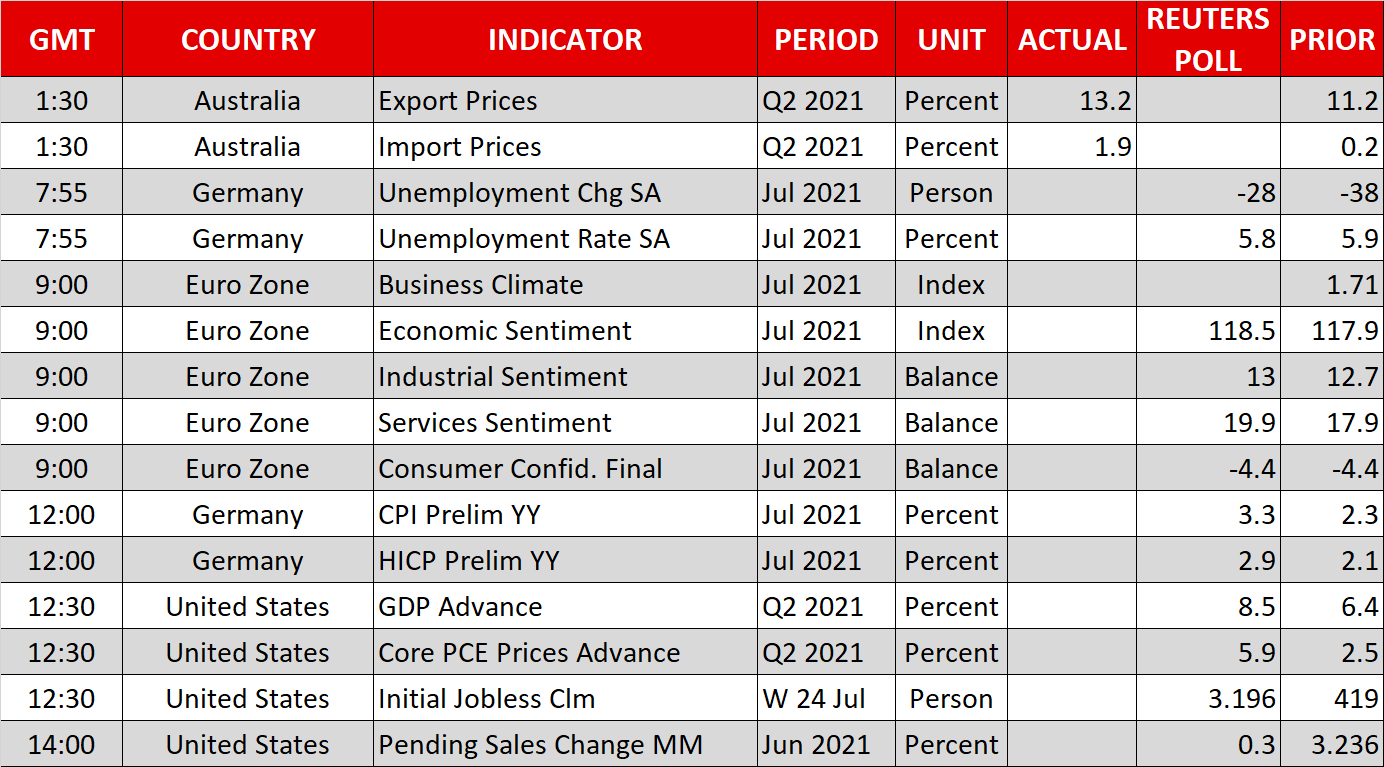
Asia’s data releases today have been second-tier. Japan Stock Investment by Foreigners data covering the last two weeks indicates that plenty of international fast money has joined the Nikkei retail frenzy. Japan may well be picking up some of the flows previously destined for China. Australian Export Prices rose 13.20% QoQ for Q2 as commodity prices rallied aggressively. By contrast, Import Prices rose only 1.90%, suggesting that despite their current Covid-19 travails, the lucky country in the medium term will continue to be very lucky. Both the Australian and New Zealand dollars resumed their recoveries overnight.
Singapore and Malaysia PPI’s will also show very elevated readings later today, reflecting supply-chain bottlenecks and rising input prices. However, Covid-19 continues to hang like a dark cloud over both, particularly Malaysia, and neither data points should be market-moving.
Europe releases a swath of individual and pan-Europe confidence data today, but it will be the German Inflation Preliminary for July that will have the market’s attention. The MoM print for July is expected to rise by 0.50%, with YoY approaching 3.30%. Given the ECB appears to have moved to Japanification QE forever with monetary policy and their 2.0% inflation target, low prints by the German data is likely to have the more significant effect. Expect the euro to come under some selling pressure and for European banking stocks to edge lower in that scenario.
The US releases Advanced GDP Growth Rate QoQ this evening, which is expected to touch 8.50%, mightily impressive. The GDP Price Index is expected at 5.40%, giving transitory inflation food for thought to some. Core PCE Prices QoQ Adv Q2 (say that quickly) will also be watched closely as it is also a favoured indicator for the Fed and is expected to come in at an eye-watering 5.90%.
The data is quite backwards-looking, given it is nearly August and will lose some of its zeal. If anything, given the refusal of the US bond market to react to anything inflationary, low prints could cause a scenario similar to the German inflation outlined above. US long-dated yields could move lower again, and the US dollar may ease. On the earnings front, Amazon releases quarterly results today as well. Expect another blockbuster result but watch the statement. Facebook indicated in results overnight that a revenue plateau was approaching. Although Amazon won’t say that, if they indicate slowing future sales growth, the Nasdaq may be temporarily punished with so much good news is built into big-tech stock prices.
European Inflation Remains Above ECB Target
Notes/Observations
- German July inflation picks up but analysts cite rise mainly due to base effects; Spain YoY steady at 2.7%.
- Focus on US Q2 GDP data.
- Heavy corporate earnings day. Companies due to report during the NY morning include Albertson’s, Alliance Data, AGCO, American Tower, Baxter International, Peabody Energy, Carrier, Carlyle Group, Comcast, Citrix Systems, Flex Ltd, Hilton Worldwide, Hershey, IntercontinentalExchange, International Paper, KBR, Keurig DR Pepper, Laboratory Corp, MasterCard, Altria Group, Merck, Northrop Grumman, NetScout, Oshkosh, Overstock, PG&E, Radware, Sally Beauty, S&P Global, MolsonCoors, Tempur Sealy, LendingTree, Textron, Valero Energy, YUM! Brands.
Asia
- China Securities Regulatory Commission (CSRC) met recently with global financial companies, indicating they would consider impact on markets when making new policies.
- China said to permit China companies to continue to have US IPOs.
Coronavirus
- New data show that efficacy of Pfizer/BioNTech Covid vaccine dropped from 96% to 84% after six months. Data could bolster Pfizer's case that a third booster shot being necessary.
Americas
- FOMC kept its policy steady but stated it made progress towards goals since setting out bar for tapering. Committee would continue to assess progress in coming meetings.
- Senate voted 67-32 to advance the bipartisan $1.2T infrastructure bill with over a dozen Republicans voting yes to move forward with debate. Final passage remained uncertain as Republicans would demand amendment votes and input on the bill and it would once again face a 60-vote hurdle to close debate.
Speakers/Fixed/FX/Commodities/Erratum
Equities
- Indices [Stoxx600 +0.37% at 463.40, FTSE +0.71% at 7,066.55, DAX +0.19% at 15,600.25, CAC-40 +0.75% at 6,658.83, IBEX-35 +0.74% at 8,798.00, FTSE MIB +0.55% at 25,401.50, SMI +0.13% at 12,088.97, S&P 500 Futures +0.12%].
- Market Focal Points/Key Themes: European indices open higher across the board (notable exception BEL20, dragged by Orange, AB InBev), and remained positive as the session progressed; sectors leading to the upside include energy and materials; while sectors trending to the downside include consumer discretionary and real estate; avalanche of results dominates market reaction; Charles Stanley to be acquired by Raymond James; focus on GDP figures from US later today as well as ECB minutes; earnings expected during the upcoming US session include KBR, Cenovus, Leonardo and Xcel.
Equities
- Consumer discretionary: Danone [BN.FR] +6% (earnings), Nestle [NESN.CH] -1% (earnings).
- Consumer staples: AB InBev [ABI.BE] -5% (earnings).
- Energy: Royal Dutch Shell [RDSA.NL] +3% (earnings), TotalEnergies [FP.FR] +2% (earnings).
- Financials: Lloyds Banking Group [LLOY.UK] +1% (earnings), Credit Suisse [CSGN.CH] -3.5% (earnings).
- Healthcare: Astrazeneca [AZN.UK] +1% (earnings), Sanofi [SAN.FR] +1.5% (earnings).
- Industrials: Airbus [AIR.FR] +4% (earnings), Volkswagen [VOW3.DE] +1% (earnings).
- Technology: STMicroelectronics [STM.FR] +3% (earnings).
- Telecom: Nokia [NOKIA.FI] +7% (earnings), Orange [ORA.FR] -3% (earnings).
Speakers
- ECB's Panetta (Italy) reiterated Council stance that would not raise interest rates until convinced inflation could stabilize at the 2% target in the medium term. Reiterated stance that risks of high inflation and overheating were limited. Reiterated that both fiscal and monetary policy needed to support EU's economy.
- ECB's Kazaks (Latvia) stated that if economy surprised to the upside then it could move faster than currently foreseen.
- Turkey Central Bank (CBRT) Gov Kavcioglu stated that it was important to maintain tight monetary policy; not enough on its own to reduce inflation. Current tightening stance to be maintained decisively and reiterated stance that policy rate to be above inflation. Fluctuations in inflation to be temporary. Q2 GDP to be markedly high due to base effects.
- Turkey Central Bank (CBRT) Quarterly Inflation Report (QIR) raised the end-2021 inflation forecast from 9.4% to.12.4% and also raised the 2022 inflation from 7.0% to 7.5%.
- China Finance Ministry (MOF): To remove steel products tax rebates for 23 items, confirmed to raise export tariffs for certain steel products from Aug 1st.
Currencies/ Fixed income
- USD was softer after the Fed did acknowledge progress on taper conditions but added it still had some way to go. Markets now looking to the Aug Jackson Hole symposium meeting for clarity. USD weakness attributed to the Fed cautious stance.
- Greenback also weighed down after some easing of China market fears which damped the demand for safe-haven plays.
- EUR/USD approaching the 1.19 neighborhood as various German State inflation data. Analysts note that Euro Zone headline inflation to rise further than most expect in the second half (in-line with ECB view).
- GBP/USD at 1-month high as the pair approached the 1.3970 level in the session. Optimism over the recent decline in UK coronavirus cases helping sentiment.
Economic data
- (DE) Germany July CPI North Rhine Westphalia M/M: 0.8% v 0.5% prior; Y/Y: 4.1% v 2.5% prior.
- (ZA) South Africa Jun M3 Money Supply Y/Y:0.1 % v 2.0%e; Private Sector Credit Y/Y: -0.5% v +0.4%e.
- (FR) France Jun PPI M/M: 1.1% v 0.4% prior; Y/Y: 7.5% v 7.2% prior.
- (ES) Spain July Preliminary CPI M/M: -0.7% v -0.6%e; Y/Y: 2.9% v 2.7%e.
- (ES) Spain July Preliminary CPI EU Harmonized M/M: -1.2% v -1.2%e; Y/Y: 2.9% v 2.9%e.
- (ES) Spain Q2 Unemployment Rate: 15.3% v 15.1%e.
- (SE) Sweden July Consumer Confidence: 106.5 v 109.3 prior; Manufacturing Confidence: 129.2 v 125.1 prior; Economic Tendency Survey: 122.4 v 119.8 prior.
- (TR) Turkey July Economic Confidence: 100.1 v 97.8 prior.
- (SE) Sweden Q2 GDP Indicator Q/Q: 0.9% v 0.7%e; Y/Y: 10.0% v 0.0% prior.
- (SE) Sweden Jun GDP Indicator M/M: 2.5% v 0.4% prior; Y/Y: 10.5% v 10.2% prior.
- (SE) Sweden Jun Unemployment Rate: 10.3% v 9.8% prior; Unemployment Rate (seasonally adj): 9.5% v 9.1% prior; Trend Unemployment Rate: 9.2% v 9.1% prior.
- (DE) Germany July Net Unemployment Change: -91.0K v -29.0Ke; Unemployment Claims Rate: 5.7% v 5.8%e.
- (DE) Germany July CPI Brandenburg M/M: 1.0% v 0.5% prior; Y/Y: 4.3% v2.4 % prior.
- (DE) Germany July CPI Hesse M/M: 0.8% v 0.3% prior; Y/Y: 3.4% v 2.2% prior.
- (DE) Germany July CPI Bavaria M/M: 0.9% v 0.4% prior; Y/Y: 3.8% v 2.4% prior.
- (DE) Germany July CPI Baden Wuerttemberg M/M: 0.8% v 0.4% prior; Y/Y: 3.4% v 2.4% prior.
- (IT) Italy Jun Hourly Wages M/M: 0.2% v 0.0% prior; Y/Y: 0.6% v 0.6% prior.
- (UK) Jun Net Consumer Credit: £0.3B v £0.5Be; Net Lending: £17.9B v £7.0Be.
- (UK) Jun Mortgage Approvals: 81.3K v 84.5Ke.
- (UK) Jun M4 Money Supply M/M: 0.5% v 0.5% prior; Y/Y: 6.9% v 7.4% prior; M4 (ex-IOFCs Annualized: 5.9% v 4.7% prior.
- (PT) Portugal July Consumer Confidence Index: -14.1 v -14.2 prior; Economic Climate Indicator: 1.8 v 1.6 prior.
- (EU) Euro Zone July Economic Confidence: 119.0 v 118.2e; Industrial Confidence: 14.6v 13.0e; Services Confidence: 19.3 v 19.3e; Consumer Confidence (final): -4.4 v -4.4 advance.
- (DE) Germany July CPI Saxony M/M: 1.0% v 0.3% prior; Y/Y: 3.7% v 2.1% prior.
- (IT) Italy Jun PPI M/M: 1.7% v 1.3% prior; Y/Y: 11.0% v 10.0% prior.
- (BE) Belgium Q2 Preliminary GDP Q/Q: 1.4% v 1.1% prior; Y/Y: 14.5.% v -0.5% prior.
Fixed income issuance
- (DK) Denmark sold total DKK4.0B in 1-month,3-month, 6-month and 9-month bills.
- (IT) Italy Debt Agency (Tesoro) sold total €7.5B vs. €6.5-7.5B indicated range in 5-year and 10-year BTP Bonds.
- Sold €4.5B vs. €4.0-4.5B indicated range in 0.00% Apr 2026 BTP bonds; Avg Yield: 0.02% v 0.12% prior; Bid-to-cover: 1.29x v 1.37x prior (Jun 30th 2021).
- Sold €3.0B vs. €2.5-3.0B indicated range in 0.95% Dec 2031 BTP; Avg Yield: 0.66% v 0.81% prior; bid-to-cover: 1.33x v 1.57x prior.
- (IT) Italy Debt Agency (Tesoro) sold €1.25B vs. €0.75-1.25B indicated range in 0.65% Apr 2029 Floating Rate Note (CCTeu); Avg Yield: 0.05%; bid-to-cover: 1.86x.
Looking ahead
- (BE) Belgium July CPI M/M: No est v 0.2% prior; Y/Y: No est v 1.6% prior.
- 05:25 (EU) Daily ECB Liquidity Stats.
- 05:30 (ZA) South Africa Jun PPI M/M: 0.4%e v 0.4% prior; Y/Y: 7.3%e v 7.4% prior.
- 05:30 (HU) Hungary Debt Agency (AKK) to sell bonds.
- 06:00 (CA) Canada July CFIB Business Barometer: No est v 70.1 prior.
- 06:00 (PT) Portugal Jun Retail Sales M/M: No est v 3.9% prior; Y/Y: No est v 16.1% prior.
- 06:45 (US) Daily Libor Fixing.
- 07:00 (BR) Brazil July FGV Inflation IGPM M/M: 0.9%e v 0.6% prior; Y/Y: 34.0%e v 35.8% prior.
- 07:30 (IS) Iceland to sell 3-month, 6-month and 9-month Bills.
- 08:00 (DE) Germany July Preliminary CPI M/M: 0.6%e v 0.4% prior; Y/Y: 3.2%e v 2.3% prior.
- 08:00 (DE) Germany July Preliminary CPI EU Harmonized M/M: 0.4%e v 0.4% prior; Y/Y: 2.9%e v 2.1% prior.
- 08:30 (US) Q2 Advance GDP Annualized (1st reading) Q/Q: 8.5%e v 6.4% prior; Personal Consumption: 10.5%e v 11.4% prior.
- 08:30 (US) Q2 Advance GDP Price Index: 5.4%e v 4.3% prior; Core PCE Q/Q: 6.1%e v 2.5% prior.
- 08:30 (US) Initial Jobless Claims: 385Ke v 419K prior; Continuing Claims: 3.199Me v 3.236M prior.
- 08:30 (US) Weekly USDA Net Export Sales.
- 09:00 (RU) Russia Gold and Forex Reserve w/e July 23rd: No est v $597.4B prior.
- 10:00 (US) Jun Pending Home Sales M/M: 0.5%e v 8.0% prior; Y/Y: -3.3%e v +13.9% prior.
- 10:30 (US) Weekly EIA Natural Gas Inventories.
- 11:30 (US) Treasury to sell 4-Week and 8-Week Bills.
- 13:00 (US) Treasury to sell 7-Year Notes.
- (AR) Argentina July Consumer Confidence Index: No est v 34.6 prior.
- 17:00 (KR) South Korea Aug Business Manufacturing Survey: No est v 99 prior; Business Non-Manufacturing Survey: No est v 82 prior.
- 18:00 (NZ) New Zealand July Consumer Confidence Index: No est v 114.1 prior.
- 18:45 (NZ) New Zealand Jun Building Permits M/M: No est v -2.8% prior.
- 19:00 (KR) South Korea Jun Industrial Production M/M: +1.5%e v -0.7% prior; Y/Y: 9.6%e v 15.6% prior.
- 19:01 (UK) July Lloyds Business Barometer: No est v 33% prior.
- 19:30 (JP) Japan Jun Jobless Rate: 3.0%e v 3.0% prior; Job-To-Applicant Ratio: 1.10e v 1.09 prior.
- 19:50 (JP) Japan Jun Preliminary Industrial Production M/M: +5.0%e v -6.5% prior; Y/Y: 20.7%e v 21.1% prior.
- 19:50 (JP) Japan Jun Retail Sales M/M: +2.7%e v -0.3% prior (revised from -0.4%; Y/Y: 0.2%e v 8.3% prior (revised from 8.2%).
- 19:50 (JP) Japan Jun Dept. Store, Supermarket Sales Y/Y: 0.5%e v 5.7% prior.
- 21:30 (AU) Australia Jun Private Sector Credit M/M: 0.4%e v 0.4% prior; Y/Y: 2.4%e v 1.9% prior.
- 21:30 (AU) Australia Q2 PPI M/M: No est v 0.4% prior; Y/Y: No est v 0.2% prior.
- 22:00 (SG) Singapore Jun M2 Money Supply Y/Y: No est v 7.0% prior; M1 Money Supply Y/Y: No est v 16.5% prior.
- 22:00 (SG) Singapore Jun Foreign-Currency Deposits (SGD): No est v 770.4B prior.
- 23:30 (JP) Japan to sell 3-Month Bills.
EUR/USD Outlook: Strong German Data And Fed Inflated Euro But Gains Are Unlikely To Last Longer
The Euro extends recovery on Thursday, as better than expected German labor and inflation data added to positive near-term sentiment.
The single currency was also supported by weaker dollar, driven by dovish Fed and month-end selling.
Although the fundamentals are positive, it is unlikely that positive impact would last longer, as daily technical studies warn of recovery stall.
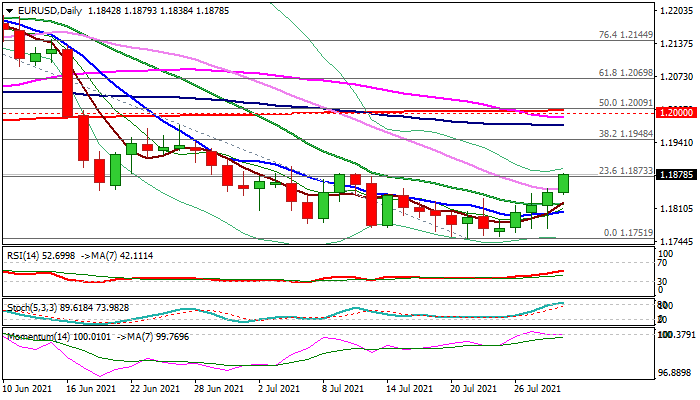
Momentum is heading south and about to enter negative territory and stochastic is overbought, with triple death-cross (30/200, 100/200 and 55/200DMA’s) additionally weighing on recovery.
Bulls cracked initial Fibo resistance at 1.1873 (23.6% of 1.2266/1.1751), but need a clear break of recent tops at 1.1881/95 zone, to allow for further correction, with extended upticks to stall under key barriers at 1.1975/1.2000 to keep larger bears in play.
Res: 1.1881, 1.1895, 1.1929, 1.1975.
Sup: 1.1850, 1.1820, 1.1805, 1.1781.
US Dollar Index Outlook: Dovish Fed Further Soured Dollar’s Near-Term Sentiment
The dollar index extended near-term weakness zone after dovish Fed further soured the sentiment.
Although the US central bank pointed to strong economic recovery, changed rhetoric about the health condition, which is not any more the key obstacle for recovery, and moved expected time for the first rate hike from 2024 to 2023, the tone was still dovish and disappointed investors who expected more aggressive approach.
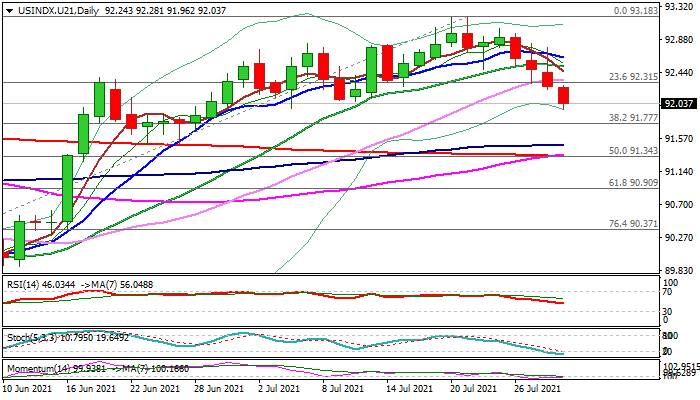
Pullback from new three-month high at 93.18 (July 21 peak) accelerated and cracked initial support at 92.00 zone, which guards more significant levels at 91.77 (Fibo 38.32% of 89.50/91.18).
Close below 92.00 would generate initial bearish signal, but break of 91.77 pivot is needed to confirm reversal.
Daily studies are still mixed as MA’s (10/20/30) turned to bearish setup, momentum is neutral and moving along the centreline, while stochastic is oversold, but stronger bearish signal is developing on weekly chart, as the index is on track for the biggest weekly drop since the first week of May and stochastic and RSI are heading south.
Also, the index is about to end month in red with shooting candle on monthly chart, adding to negative signals.
Res: 92.31, 92.50, 92.64, 92.83.
Sup: 91.96, 91.77, 91.50, 91.36.
The Analytical Overview Of The Main Currency Pairs
The EUR/USD currency pair
Technical indicators of the currency pair:
Prev Open: 1.1816
Prev Close: 1.1842
% chg. over the last day: +0.22%
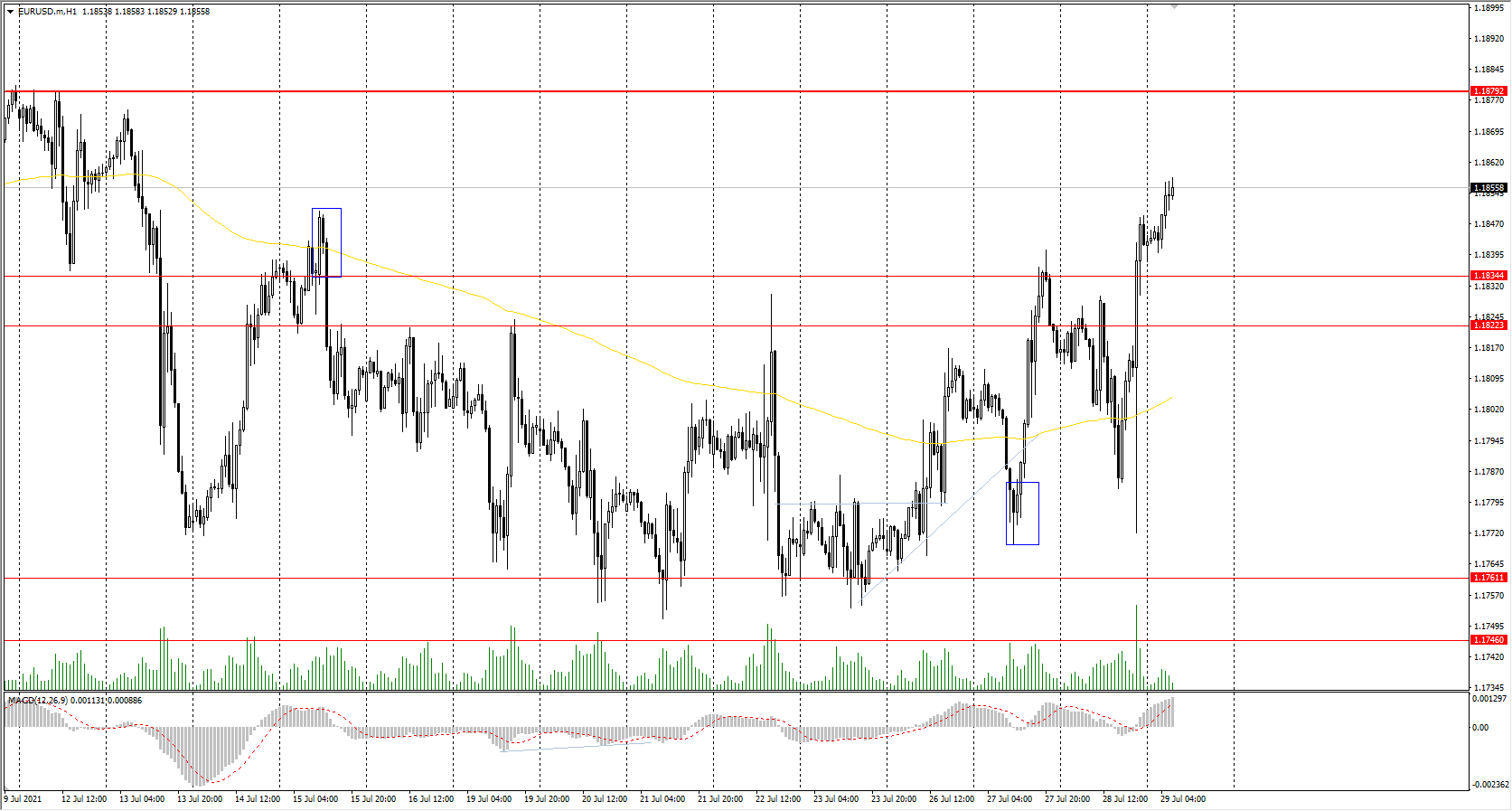
Against the background of the news from the Fed, the dollar index fell sharply, which caused strong movements on currency pairs with the US dollar. The European currency, which moves inversely to the dollar index, sharply strengthened and increased by 0.22%, but, during the news release, there was a false movement down.
Trading recommendations
Support levels: 1.1834, 1.1783, 1.1761, 1.1746, 1.1609
Resistance levels: 1.1879, 1.1934, 1.1969
From the technical point of view, the general trend is still bearish, but the local trend is bullish, and the price is moving to the priority change level. Now the price is trading above the moving average, the MACD indicator is in the positive zone with no signs of divergence. Under such market conditions, it is better for traders to consider intraday trading. Buy positions should be considered only from the support levels. Traders should look for sell deals at the resistance levels.
Alternative scenario: if the price breaks through the 1.1879 resistance level and fixes above, the general uptrend is likely to be resumed.
News feed for 2021.07.29:
- Germany Unemployment Rate (m/m) at 10:55 (GMT+3);
- Germany Consumer Price Index (m/m) at 15:00 (GMT+3);
- US Initial Jobless Claims at 15:30 (GMT+3);
- US GDP (q/q) at 15:30 (GMT+3);
- US Pending Home Sales (m/m) at 17:00 (GMT+3).
The GBP/USD currency pair
Technical indicators of the currency pair:
Prev Open: 1.3879
Prev Close: 1.3899
% chg. over the last day: +0.14%
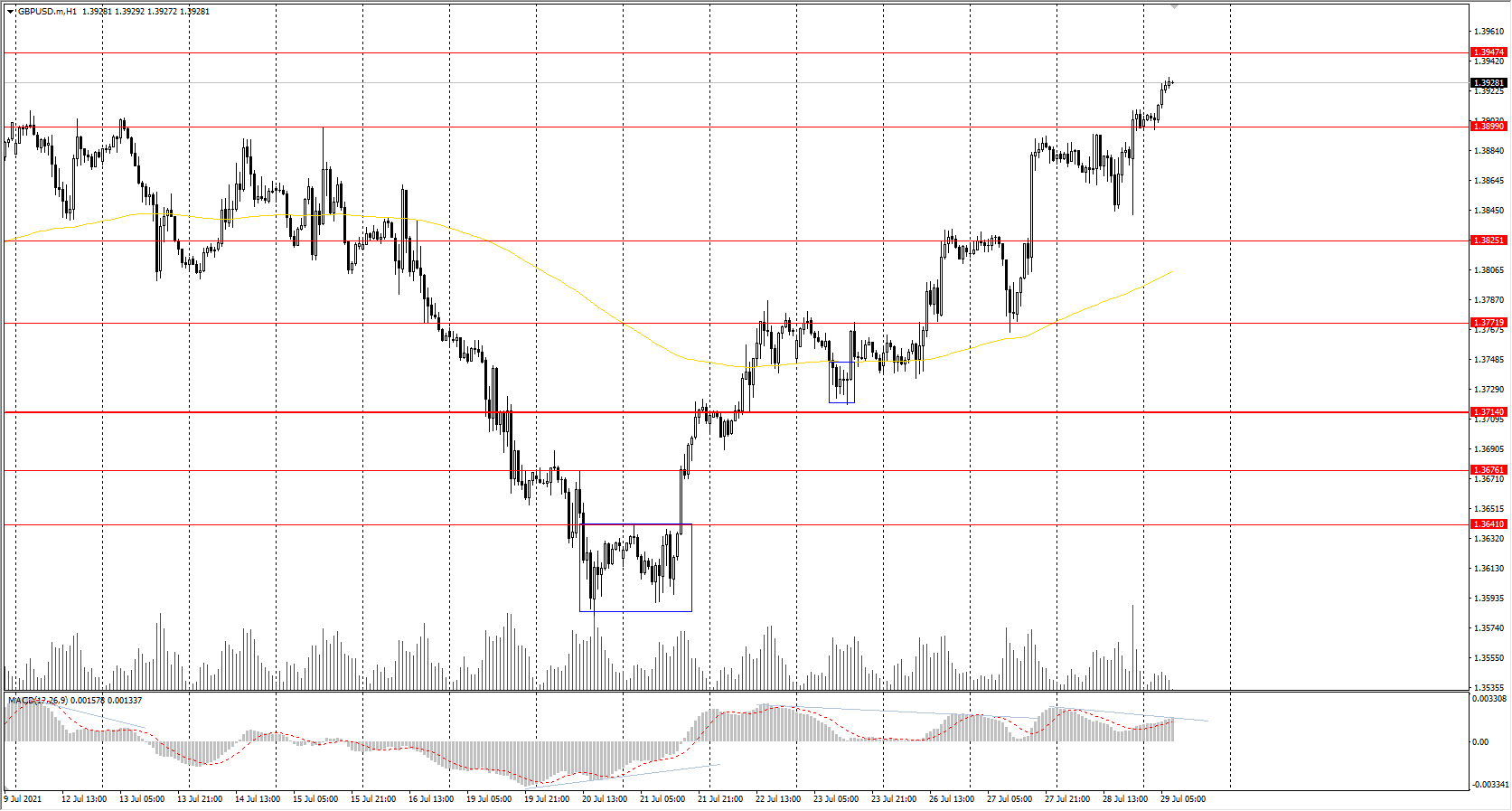
Against the background of the fall of the dollar index, the British pound increased by another 0.14%. The food supply situation in Britain is getting better. Starting next week, England is opening its borders to vaccinated tourists from the EU and US without quarantine, which is a long-awaited stimulus for travel companies and airlines.
Trading recommendations
Support levels: 1.3900, 1.3825, 1.3772, 1.3714, 1.3676 ,1.3641, 1.3614, 1.3525
Resistance levels: 1.3947, 1.4002, 1.4075, 1.4101
The trend on the GBP/USD currency pair is bullish on the H1 timeframe. The MACD indicator is in the positive zone but with signs of divergence. Under such market conditions, traders are better to look for buy positions after the price pulls back to the support level. There are no optimal points for sell positions right now. Traders can search for intraday sales from the resistance level with short targets, but they should understand that it will be trading against the main trend.
Alternative scenario: if the price breaks through the 1.3714 support level and consolidates below, the bearish scenario is likely to resume.
The USD/JPY currency pair
Technical indicators of the currency pair:
Prev Open: 109.74
Prev Close: 109.91
% chg. over the last day: +0.15%
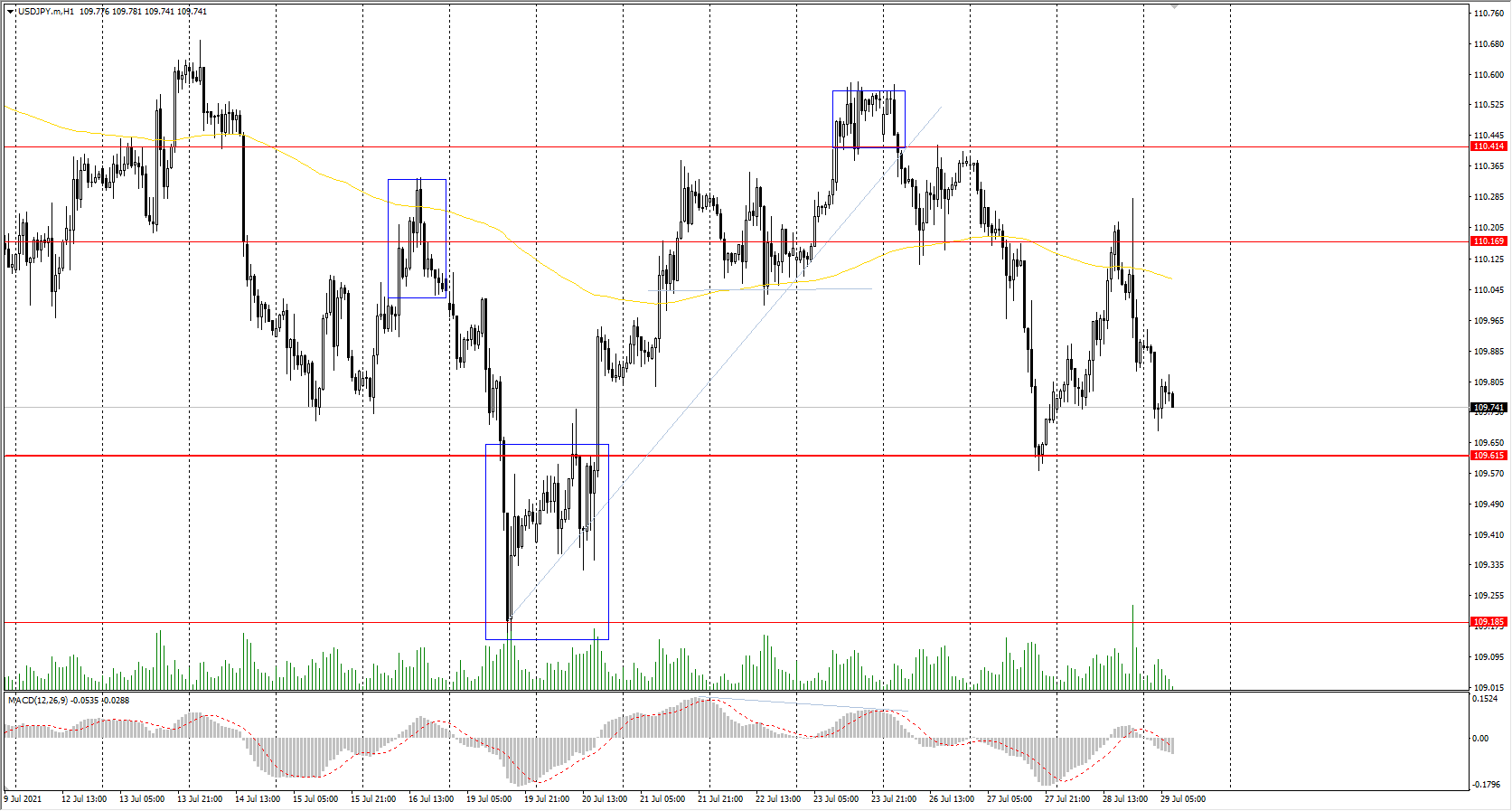
After a significant strengthening of the Japanese yen (fall in the USD/JPY quotes) on Tuesday, the USD/JPY currency pair increased by 0.15% yesterday. The price failed to break through the priority change level, where the buyers managed to defend their positions. But against the background of the dollar index decline, the probability of the breakdown of the 109.62 support level is quite high.
Trading recommendations
Support levels: 109.62, 109.19, 108.65
Resistance levels: 110.16, 110.41, 110.73, 111.06, 111.48, 110.73, 112.18
The main trend on the USD/JPY currency pair is upward, but the local trend is bearish, so traders should look for sell positions from the resistance levels. Buy positions should be searched only on intraday timeframes and with short targets because the pressure of buyers is clearly stronger now.
Alternative scenario: if the price falls below 109.70, the downtrend is likely to be resumed.
The USD/CAD currency pair
Technical indicators of the currency pair:
Prev Open: 1.2601
Prev Close: 1.2521
% chg. over the last day: -0.64%
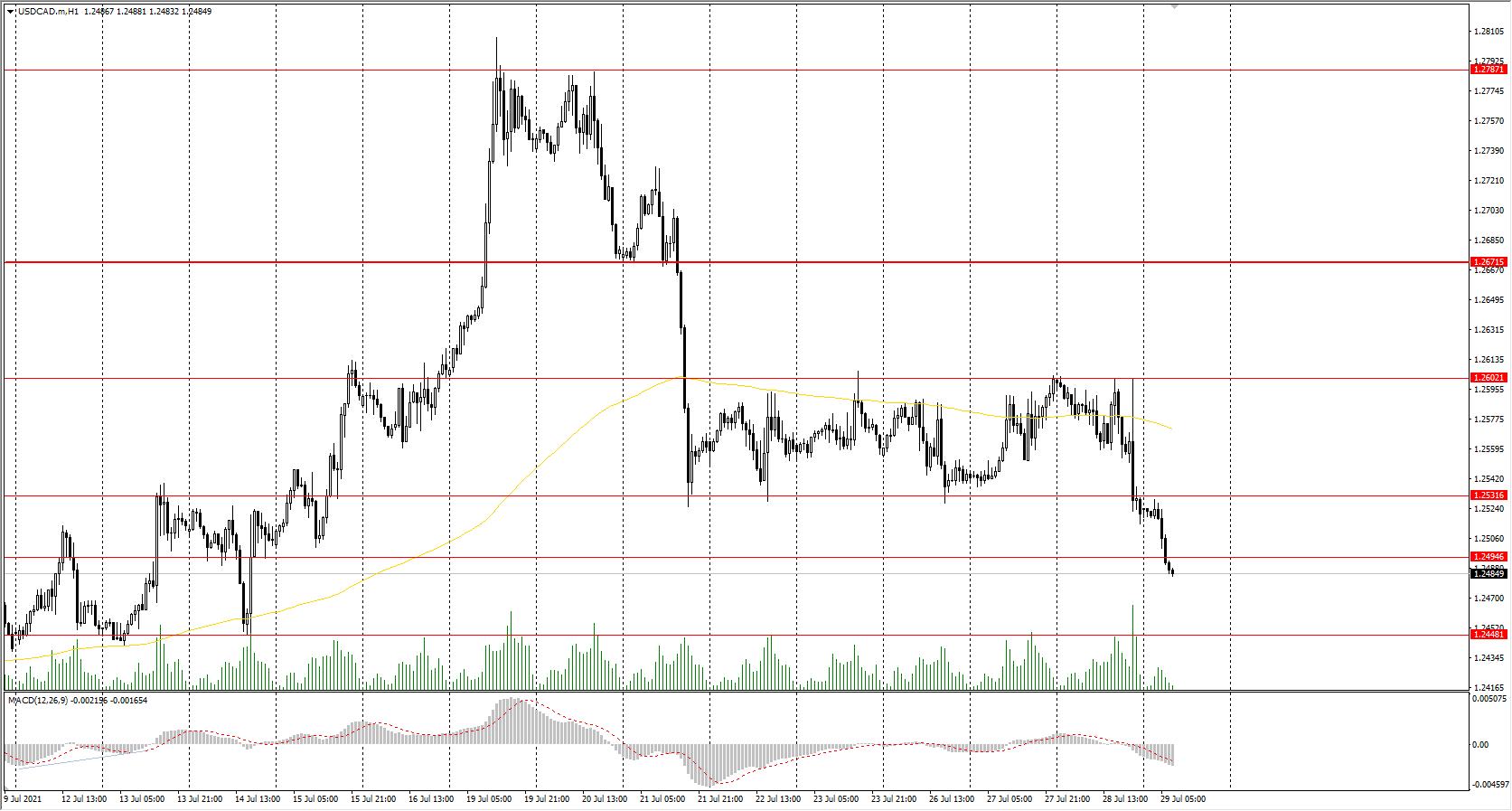
The inflation rate in Canada slowed down, reaching 3.1% (the previous value was 3.6%) in June in annual terms. Excluding gasoline prices, the annual inflation rate is 2.2%. Considering this news and a slight increase in oil prices, the Canadian dollar has strengthened significantly against the US dollar.
Trading recommendations
Support levels: 1.2495, 1.2448, 1.2404, 1.2347, 1.2312
Resistance levels: 1.2531, 1.2602, 1.2671, 1.2787, 1,2951
The price has broken through the priority change level. The medium-term trend has changed to a downtrend. The MACD indicator has gone into the negative zone with no signs of reversal. Under such market conditions, it is best for the trader to look for sell positions from the resistance levels. There is no optimal entry point for buy positions now.
Alternative scenario: if the price breaks through the 1.2671 resistance level and fixes above, the uptrend is likely to be resumed.
The Federal Reserve Leaves Monetary Policy Unchanged
At yesterday’s press conference, Jerome Powell said that the Fed would wait for strong labor market numbers in the coming months before cutting the QE program. Currently, the Fed is not cutting QE. The interest rate remains unchanged. Also, the Fed chair said that the inflation rate could be higher and steady, but it would return to the 2% target in the following year. The situation in the financial markets will remain the same at least until the end of August. Subsequently, the dollar index decreased by 0.19% to a two-week low.
The US stock market finished the day without a single dynamic. The Dow Jones index decreased by 0.36%, the Nasdaq index increased by 0.70%, and the S&P 500 index remained at the same level. Boeing shares were the growth leaders among the Dow Jones index components, adding 4.16% by the end of the day. The company reported its first quarterly profit in almost two years (the previous 6 quarters were unprofitable). This proves the growth of orders for commercial planes, which is a sign of recovery of air transportation after the pandemic. At the same time, the orders of Boeing 737 MAX also increased in recent months, after the regulators gave permission to liner flights, as Boeing made fixes to the flight control system that caused crashes in 2018 and 2019.
European stock indexes closed in the green zone yesterday. Airbus says that it plans to produce a new cargo plane based on its A350 passenger jet version. Also, the world's largest commercial airliner maker sharply raised its delivery and profit forecasts for the next year, which means orders grow. Starting next week, England is opening its borders to vaccinated tourists from the EU and US without quarantine, which is a long-awaited stimulus for travel companies and airlines.
Germany will report on the inflation rate and the status of the labor market today.
US crude oil inventories declined again last week, pushing WTI crude prices slightly higher. The Delta strain is still putting pressure on the oil market, but analysts believe the pressure will ease significantly in a few weeks. However, oil demand in the US and Europe is starting to fall.
Gold prices increased yesterday as the Fed's soft monetary policy remains unchanged. As long as the Fed doesn't start reducing asset purchases, gold and silver prices will grow.
China's securities regulator held a meeting with executives from the world's top investment banks to calm financial markets regarding Chinese companies. Chinese officials say short-term market panic is not a long-term threat, and Beijing remains supportive of domestic companies seeking foreign listings, and regulators will soon present additional measures to further open the capital market to foreign companies. Considering this news, China's blue-chip index increased by 1.4%, Shanghai Composite index increased by 1.1%. Chinese companies, which are traded in the US stock market, also showed growth.
The quarantine is being prolonged again in Sydney. Analysts believe that such isolation measures will undoubtedly have a negative impact on the national economy in the coming months. The Reserve Bank of Australia (RBA) is likely to postpone reducing assets scheduled for September.
Main market quotes:
- S&P 500 (F) 4,400.64 -0.82 (-0.02%)
- Dow Jones 34,930.93 -127.59 (-0.36%)
- DAX 15,570.36 +51.23 (+0.33%)
- FTSE 100 7,016.63 +20.55 (+0.29%)
- USD Index 92.26 -0.17 (-0.19%)
Important events for today:
- Germany Unemployment Rate (m/m) at 10:55 (GMT+3);
- Germany Consumer Price Index (m/m) at 15:00 (GMT+3);
- US Initial Jobless Claims (w/w) at 15:30 (GMT+3);
- US GDP (q/q) at 15:30 (GMT+3);
- US Pending Home Sales (m/m) at 17:00 (GMT+3);
- US Natural Gas Storage (w/w) at 17:30 (GMT+3).
Powell Eases Taper Angst, Dollar Slips, China Stocks Stage Rebound
- Fed cites 'progress' but still a ways to go; September taper decision seen less likely
- Dollar hits 4-week low as easing China panic further adds to downside
- Asian equities bounce back but Facebook earnings warning could upset Wall Street
Powell upbeat but in no rush to curtail QE
The Federal Reserve acknowledged it had made 'progress' towards its goals as it kept policy unchanged on Wednesday. However, in his press conference, Chair Jerome Powell appeared in no rush to scale down the $120 billion in monthly asset purchases anytime soon. Saying 'we’re a ways away from having had substantial further progress toward the maximum employment goal', Powell suggested the Fed needs more data before it can decide about the timing of taper.
On raising interest rates, Powell again stressed this was 'still a ways away' even as he disclosed that the July meeting was the 'first deep dive' on the timing, pace and composition of any tapering. However, despite the reluctance to commit to a timeline, the Delta variant wasn’t high on Powell’s list of concerns and it’s becoming increasingly evident that the Fed is just biding its time until it knows more about whether or not the surge in inflation is transitory and how far it can push the recovery in the labour market in the meantime.
All this implies September is too soon for the Fed to reach a decision on tapering and the focus is fast shifting to December.
Dollar skids as downside pressures intensify
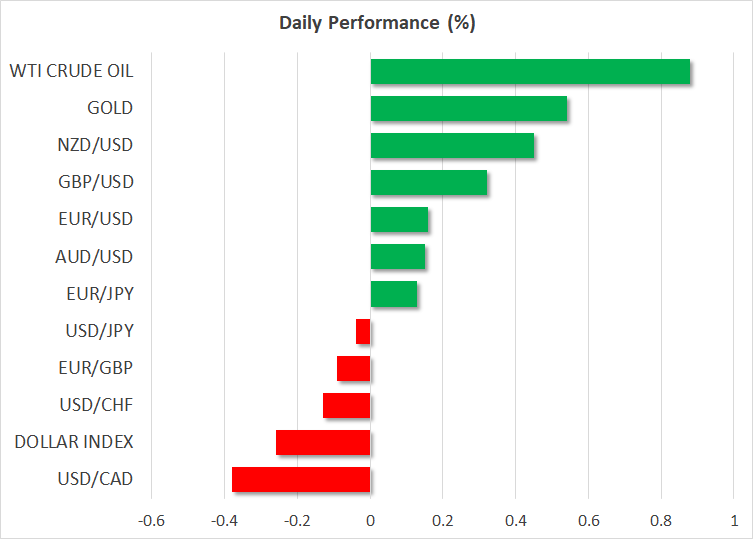
Treasury yields dipped slightly after Powell’s as dovish as ever remarks, erasing the small spike posted on the back of the headlines of 'progress' from the FOMC statement. But the US dollar’s slide post the press conference was more pronounced as investors pushing back their expected timing of a taper move was not the only thing dragging the currency lower. Subsiding jitters about China further weighed on the greenback as the associated risk aversion faded somewhat on Thursday.
The dollar index was in danger of slipping below the 92.0 level as it fell to 4-week lows. The yen also extended its losses as sentiment improved.
The pound was again a notable gainer on Thursday, making its way above $1.39, while the commodity-linked dollars finally managed to generate some positive momentum, with the kiwi leading the way.
China jitters ease but is the earnings boom over in the US?
Chinese authorities stepped in late on Wednesday to calm market nerves after days of crackdowns on local tech companies and private education firms. The blue-chip CSI 300 index lost almost 8% of its value before finally stabilizing on Wednesday. The benchmark index was up nearly 2% today after Chinese regulators held calls with banks and brokerages on Wednesday night to reassure investors that other industries will not come under the firing line and that Chinese companies can still apply to be listed in the US.
Stocks across Asia were in the green today, led by Hong Kong’s Hang Seng index (3.3%). Europe had a strong open too, getting an extra lift from upbeat earnings announcements. However, US stock futures were struggling on Thursday, with Nasdaq futures bucking the trend to stand marginally in negative territory.
A warning by Facebook about slowing revenue growth in the second half of the year has dampened the mood on Wall Street even as the company reported stronger-than-expected results on Wednesday. Amazon.com is the next tech giant to report its earnings after today’s closing bell and there’s a risk its results could further fuel concerns about future earnings growth prospects.
Ahead of that, the advance GDP report out of the US will be in the spotlight as the American economy is expected to have expanded by an annualized 8.5% rate in Q2.