Sample Category Title
US: Robust Consumer Spending Drives GDP growth in Q2
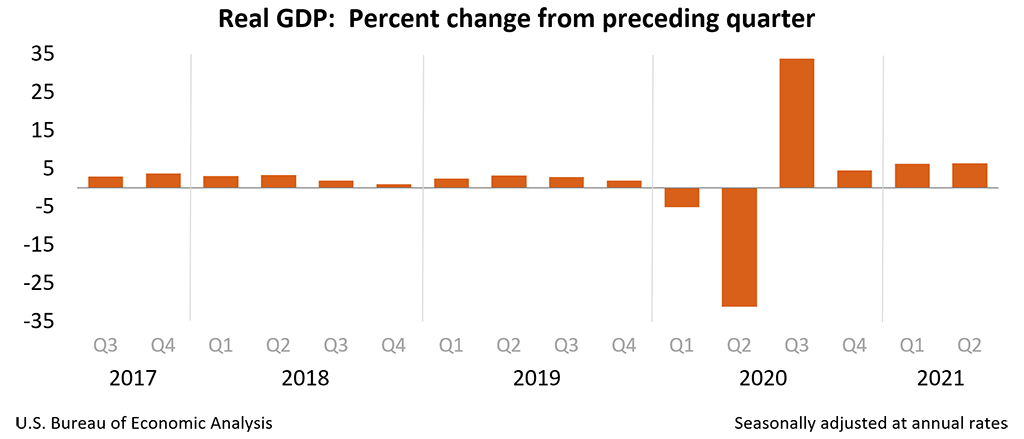
- The U.S. economy expanded at a 6.5% annualized pace in the second quarter, below the median consensus estimate for 8.4%.
- Consumers were the key driver of domestic demand strength. Spending rallied 11.8%, following a 11.4% pace in Q1. Consumer spending was strong across categories, led by a 12.6% jump in nondurable goods, but durables (+9.9%) and services (+12.0%) were also healthy.
- Government spending, by contrast, pulled back in the second quarter, falling 1.5%. The outturn was heavily influenced by a decrease in federal government activity (-5.0%) while the state and local level flipped to expansion (+0.8%) after contracting in the first quarter.
- Nonresidential investment was up (+8.0%). Investment in structures fell further (-6.9%) while spending on equipment continued to come in at a double-digit pace, decelerating only marginally to +13.0% (following a 14.1% increase in Q1). Intellectual property products rose 10.7%, a healthy follow through from a 15.6% gain in Q1.
- Residential investment pulled back in the second quarter falling 9.8% and subtracting 0.5 percentage points (ppts) from growth.
- The drawdown in private inventories shaved 1.1 ppts from growth in the quarter.
- Exports rose less than expected (6.0%) while imports were a bit stronger than anticipated, up 7.8% in Q2, so net exports still subtracted from growth (-0.4%-pts) compounding the drag from Q1.
- Finally, largely as expected, price pressures accelerated in the second quarter, with the core PCE deflator up 6.1% on an annualized quarter-over-quarter basis.
- Relative to the breakneck speed of the expansion, benchmark revisions were relatively minor. The level of GDP was revised down 0.2% in the first quarter compared to the previous release.
Key Implications
- The American economy expanded at a brisk pace in the second quarter, though somewhat below lofty expectations. Growth was powered by the consumer while federal government expenditures, residential real estate investment and a drawdown in inventories acted as headwinds. Total economic activity is now slightly above (+0.8%) its pre-pandemic level as economic reopening and a receding virus has helped bring back a semblance of normalcy.
- The picture here is of an economy where healthy domestic demand is setting the tone for the expansion. However, as noted yesterday by the FOMC, the course of the recovery will be guided by the virus. Vaccination rates have plateaued in the U.S., and, with COVID-19 cases rising again in many states, political resolve against implementing another round of restrictions will be challenged.
- Surging demand coupled with supply chain issues have helped propel core PCE inflation (6.1% q/q annualized, 3.4% year-on-year), well ahead of the Fed's two percent target. Policymakers have reiterated that they will be looking through this temporary bout of price increases, but any indication of permanence (like an upward shift in inflation expectations) could test their commitment.
Euro Higher German CPI Beats Forecast
The euro has gained ground for a fourth straight day and is up one per cent on the week, an impressive gain. EUR/USD has touched a high of 1.1885 on the day and appears poised to punch into 1.19 territory.
German Preliminary CPI for July overshot the consensus. CPI jumped 3.8% YoY, above the forecast of 3.3% and ahead of the June reading of 2.3%. On a monthly basis, CPI rose 0.9%, beating the estimate of 0.5% and up from 0.4%.
As has been the case in the US and UK, the surge in inflation means that central bank policymakers will have to re-evaluate their monetary policy outlook, as the fear of the economy overheating due to inflationary pressures becomes more real. Inflation is running above the ECB’s new inflation target of 2%. Granted, much of the sharp reading can be attributed to base factors, as Germany lowered VAT rates in July 2020, before raising them again this year. Still, investors reading the headlines see the surge in inflation, and this will lead to expectations that the ECB may have to tighten policy sooner rather than later.
Powell says maybe to a September taper
The FOMC policy meeting was hotly anticipated, but in the end the Fed shied away from any tapering. However, Fed Chair Jerome Powell did state that the economy would need to recover millions of jobs and inflation would need to be durable before the Fed would consider a taper in September. This gives the Fed a couple of months of inflation and employment data to determine if they can start scaling back asset purchases. The takeaway from the FOMC meeting is that the Fed remains dovish and the very earliest we would see a taper is the September meeting.
EUR/USD Technical
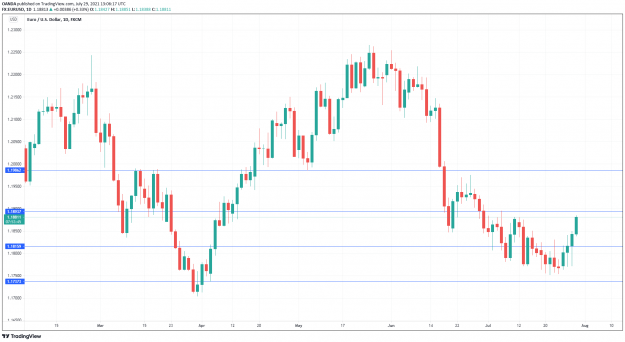
- EUR/USD has broken through resistance levels as it continues to move higher. The pair is putting pressure on resistance at 1.1893. Above, we find resistance at 1.1986, which is protecting the symbolic 1.20 line
- On the downside, there are support lines at 1.1815 and 1.1737
EUR/USD Mid-Day Outlook
Daily Pivots: (S1) 1.1795; (P) 1.1823; (R1) 1.1871; More...
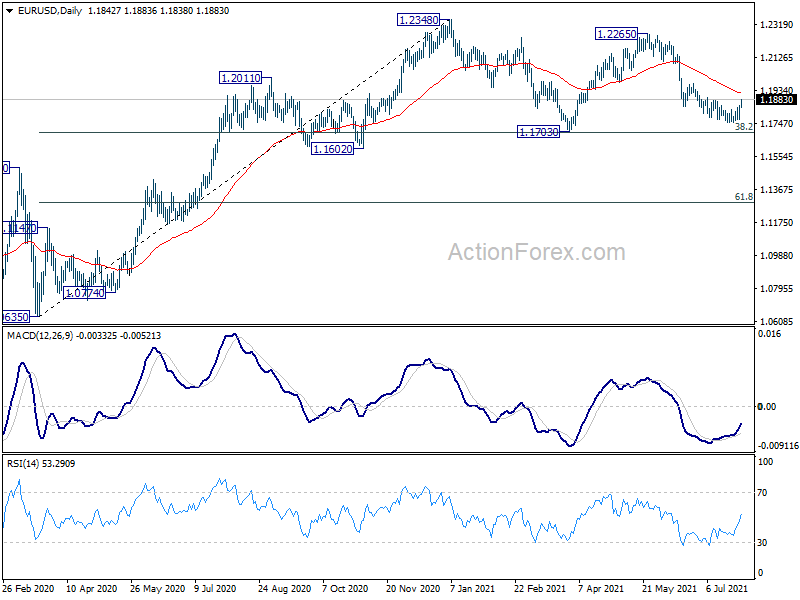
Immediate focus is now on 1.1880 resistance in EUR/USD. Firm break there will firstly indicate short term bottoming at 1.1751, on bullish convergence condition in 4 hour MACD. Intraday bias will be turned back to the upside for 1.1974 resistance first. Sustained break there will argue that whole corrective pattern from 1.2348 has completed, and bring stronger rise back to 1.2265/2348 resistance zone. On the downside, break of 1.1751 will resume the fall from 1.2265, as the third leg of correction from 1.2348, to 1.1703 support.
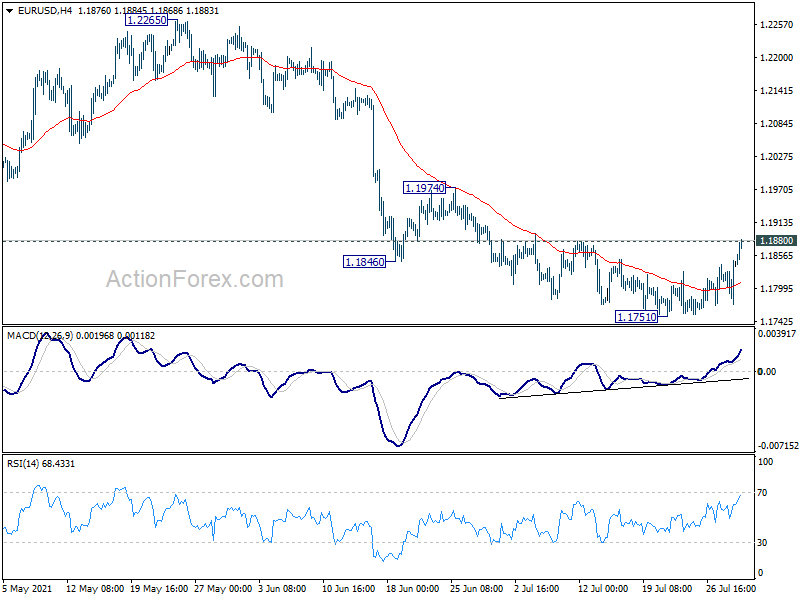
In the bigger picture, rise from 1.0635 is seen as the third leg of the pattern from 1.0339 (2017 low). Further rally could be seen to cluster resistance at 1.2555 next, (38.2% retracement of 1.6039 to 1.0339 at 1.2516). This will remain the favored case as long as 1.1602 support holds. Reaction from 1.2555 should reveal underlying long term momentum in the pair. However sustained break of 1.1602 will argue that the rise from 1.0635 is over, and turn medium term outlook bearish again.
Dollar Drops Further after GDP and Job Misses, Gold Surges
Dollar's decline continues and accelerates a little in early US session after weak economic data. Gold is also accelerating upwards, in tandem with the greenback's movements. Yen is following as second worst for now, following recovery in European stocks and US futures. Commodity currencies and Sterling are currently the stronger ones for today.
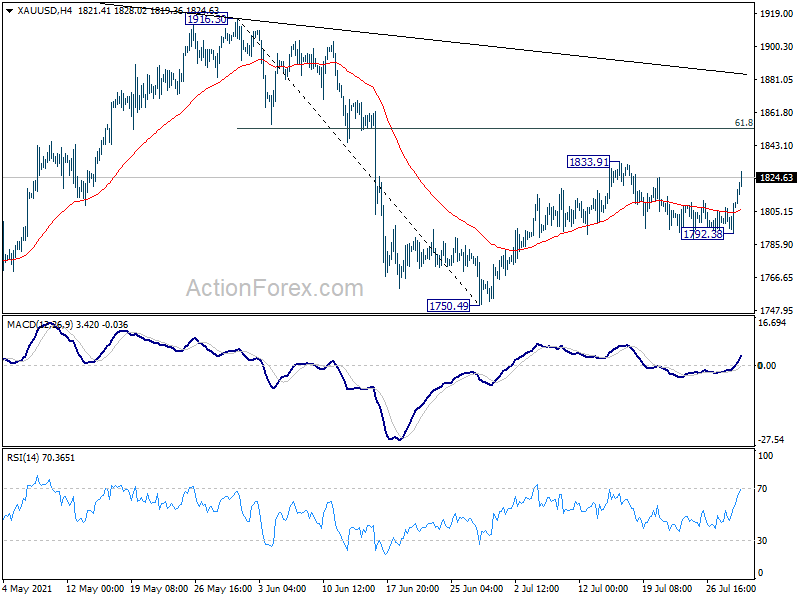
Technically, immediate focus is now on 1.1880 resistance in EUR/USD. Sustained break there should confirm short term bottoming at 1.1751. Further break of 1.1974 resistance will likely pave the way back to retest 1.2265/2348 resistance zone. At the same time, break of 1833.91 resistance in Gold will resume the rise from 1750.49 to 61.8% retracement of 1916.30 to 1750.49 at 1852.96 next. Both developments, if happen, will double confirm Dollar's weakness.
In Europe, at the time of writing, FTSE is up 0.92%. DAX is up 0.43%. CAC is up 0.72%. Germany 10-year yield is up 0.018 at -0.430. Earlier in Asia, Nikkei rose 0.73%. Hong Kong HSI rose 3.30%. China Shanghai SSE rose 1.49%. Singapore Strait Times rose 1.24%. Japan 10-year JGB yield rose 0.0057 to 0.022.
US GDP grew 6.5% annualized in Q2, missed expectations
US GDP grew at annual rate of 6.5% in Q2, well below expectation of 8.2%. BEA said: "The increase in real GDP in the second quarter reflected increases in personal consumption expenditures (PCE), nonresidential fixed investment, exports, and state and local government spending that were partly offset by decreases in private inventory investment, residential fixed investment, and federal government spending. Imports, which are a subtraction in the calculation of GDP, increased".
US initial jobless claims dropped to 400k, worse than expected
US initial jobless claims dropped -24k to 400k in the week ending July 24, above expectation of 365k. Four-week moving average of initial claims rose 8k to 394.5k.
Continuing claims rose 7k to 3269k in the week ending July 17. Four-week moving average of continuing claims dropped -54k to 3291k, lowest since March 21, 2020.
Eurozone economic sentiment rose to record 119.0, strong industrial and services confidence
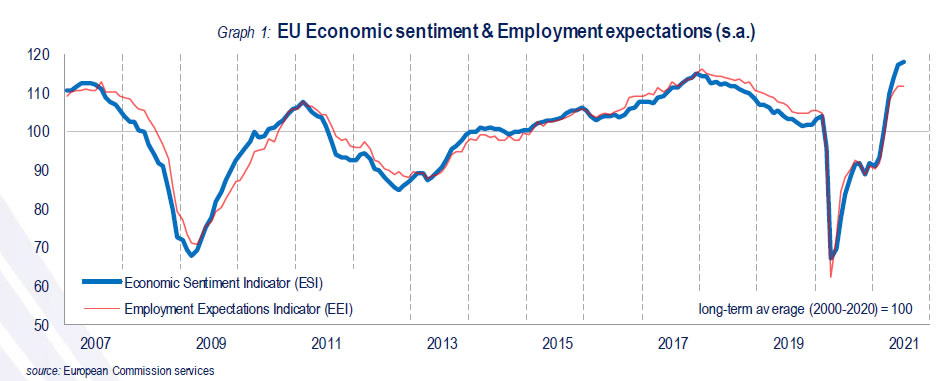
Eurozone Economic Sentiment Indicator rose to 119.0 in July, up from 11.79, above expectation of 118.8. That's the highest level on record since 1985. Employment Expectations Indicator was flat at 111.7, well above pre-pandemic level.
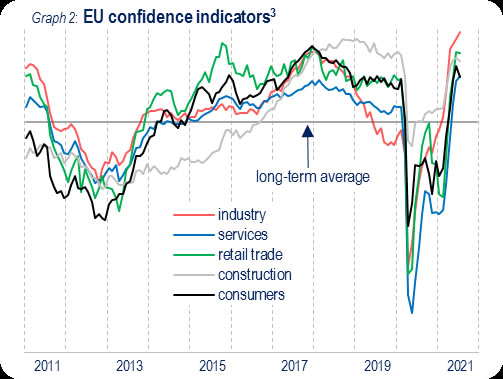
Looking at some more details, Eurozone industrial confidence rose from 12.8 to 14.6, eighth straight month of improvement and an all-time high. Services confidence rose from 17.9 to 19.3, highest since 2007. Consumer confidence dropped from -3.3 to -4.4. Retail trade confidence dropped from 4.7 to 4.6. Construction confidence dropped from 5.2 to 4.0.
EU ESI rose 0.9 pts to 118.0. EEI was unchanged at 111.6. Amongst the largest EU economies, the ESI rose sharply in France (+4.0) and, to a lesser extent, in Italy (+1.7) and Spain (+1.7). Sentiment in Germany (+0.3) and the Netherlands (-0.3) stayed virtually unchanged, while it deteriorated mildly in Poland (-0.7).
New Zealand ANZ business confidence dropped to -3.8, time to start normalizing monetary conditions
New Zealand ANZ business confidence dropped from -0.6 to -3.8 in July. Own activity outlook also dropped from 31.6 to 26.3. Looking at some more details, expect intentions dropped from 13.4 to 7.6. Investment intentions dropped from 25.5 to 17.4. Employment intentions rose from 19.7 to 21.4. Cost expectations rose from 86.2 to 88.2. Pricing intentions dropped slightly from 62.8 to 61.3. Inflation expectations rebounded from 2.41 to 2.70.
ANZ said, "the combination of clear upside for the activity and inflation starting point, but downside risks in the (quite possibly not far off) future, do, on the face of it, present a conundrum for the Reserve Bank... "If they raise rates now, the odds are indeed uncomfortably high that they'll end up reversing course before long... Inflation pressures provide an excellent reason to raise interest rates now, despite downside risks... inaction comes with risks too. It's time to start normalising monetary conditions, even if trouble might lie closer ahead than we hope."
EUR/USD Mid-Day Outlook
Daily Pivots: (S1) 1.1795; (P) 1.1823; (R1) 1.1871; More...
Immediate focus is now on 1.1880 resistance in EUR/USD. Firm break there will firstly indicate short term bottoming at 1.1751, on bullish convergence condition in 4 hour MACD. Intraday bias will be turned back to the upside for 1.1974 resistance first. Sustained break there will argue that whole corrective pattern from 1.2348 has completed, and bring stronger rise back to 1.2265/2348 resistance zone. On the downside, break of 1.1751 will resume the fall from 1.2265, as the third leg of correction from 1.2348, to 1.1703 support.
In the bigger picture, rise from 1.0635 is seen as the third leg of the pattern from 1.0339 (2017 low). Further rally could be seen to cluster resistance at 1.2555 next, (38.2% retracement of 1.6039 to 1.0339 at 1.2516). This will remain the favored case as long as 1.1602 support holds. Reaction from 1.2555 should reveal underlying long term momentum in the pair. However sustained break of 1.1602 will argue that the rise from 1.0635 is over, and turn medium term outlook bearish again.
Economic Indicators Update
| GMT | Ccy | Events | Actual | Forecast | Previous | Revised |
|---|---|---|---|---|---|---|
| 01:00 | NZD | ANZ Business Confidence Jul | -3.8 | -0.6 | ||
| 01:30 | AUD | Import Price Index Q/Q Q2 | 1.90% | 0.20% | 0.20% | |
| 07:55 | EUR | Germany Unemployment Rate Jul | 5.70% | 5.80% | 5.90% | |
| 07:55 | EUR | Germany Unemployment Change Jul | -91K | -25K | -38K | |
| 08:30 | GBP | Net Lending to Individuals (GBP) Jun | 18.2B | 6.8B | 6.9B | 7.2B |
| 08:30 | GBP | Mortgage Approvals Jun | 81K | 85K | 88K | |
| 08:30 | GBP | M4 Money Supply M/M Jun | 0.50% | 0.30% | 0.40% | |
| 09:00 | EUR | Eurozone Economic Sentiment Indicator Jul | 119 | 118.8 | 117.9 | |
| 09:00 | EUR | Eurozone Services Sentiment Jul | 19.3 | 19.5 | 17.9 | |
| 09:00 | EUR | Eurozone Industrial Confidence Jul | 14.6 | 13 | 12.7 | 12.8 |
| 09:00 | EUR | Eurozone Consumer Confidence Jul F | -4.4 | -4.4 | -4.4 | -3.3 |
| 12:00 | EUR | Germany CPI M/M Jul P | 0.90% | 0.50% | 0.40% | |
| 12:00 | EUR | Germany CPI Y/Y Jul P | 3.80% | 3.20% | 2.30% | |
| 12:30 | USD | Initial Jobless Claims (Jul 23) | 400K | 365K | 419K | 424K |
| 12:30 | USD | GDP Annualized Q2 P | 6.50% | 8.20% | 6.40% | |
| 12:30 | USD | GDP Price Index Q2 P | 6.10% | 5.40% | 4.30% | |
| 14:00 | USD | Pending Home Sales M/M Jun | 0.80% | 8.00% | ||
| 14:30 | USD | Natural Gas Storage | 41B | 49B |
US GDP grew 6.5% annualized in Q2, missed expectations
US GDP grew at annual rate of 6.5% in Q2, well below expectation of 8.2%. BEA said: "The increase in real GDP in the second quarter reflected increases in personal consumption expenditures (PCE), nonresidential fixed investment, exports, and state and local government spending that were partly offset by decreases in private inventory investment, residential fixed investment, and federal government spending. Imports, which are a subtraction in the calculation of GDP, increased".
US initial jobless claims dropped to 400k, worse than expected
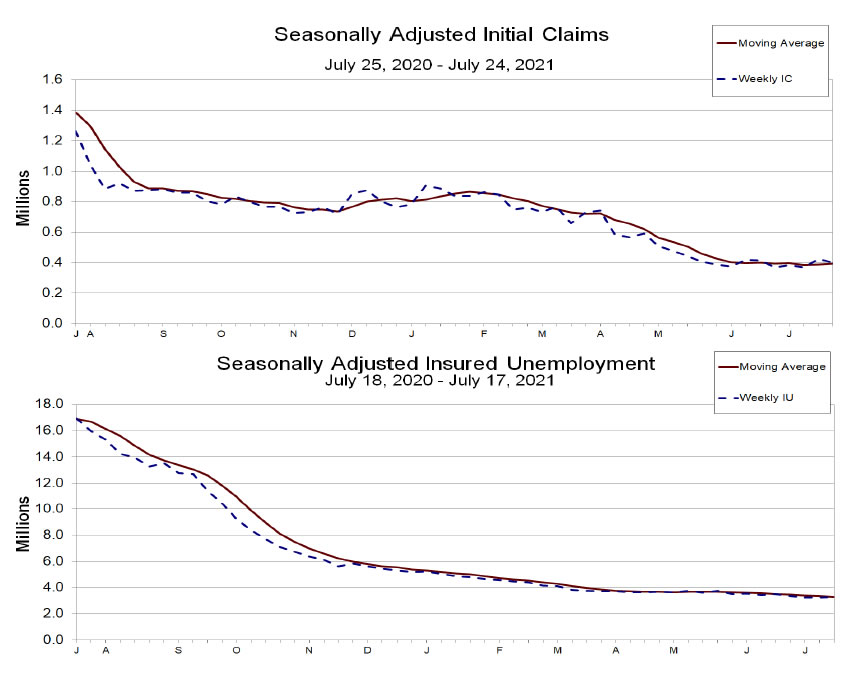
US initial jobless claims dropped -24k to 400k in the week ending July 24, above expectation of 365k. Four-week moving average of initial claims rose 8k to 394.5k.
Continuing claims rose 7k to 3269k in the week ending July 17. Four-week moving average of continuing claims dropped -54k to 3291k, lowest since March 21, 2020.
(ECB) Monetary policy accounts 7 July 2021
Account of the monetary policy meeting of the Governing Council of the European Central Bank held in Frankfurt am Main on Wednesday, 7 July 2021
Conclusion of the ECB's strategy review 2020-21
The President started her introduction by looking back at the strategy review that the Governing Council had been conducting over the previous 18 months, drawing on an immense collective effort by staff at the ECB and the national central banks (NCBs) of the euro area. While taking the ECB's primary mandate of price stability as a given, the review had allowed the Governing Council to challenge its thinking, engage with numerous stakeholders, reflect, discuss and reach common ground on how to adapt its strategy. The new strategy, which would be reflected in the document entitled "The ECB's monetary policy strategy statement" intended for publication on the ECB's website, was a strong foundation that would help guide the Governing Council in the conduct of its monetary policy in the years to come.
The President then reviewed the key elements of the new strategy in more detail. The Governing Council judged that the Harmonised Index of Consumer Prices (HICP) remained the appropriate price measure for assessing the achievement of its price stability objective. At the same time, European citizens had called for a broader coverage of housing costs in the HICP. The Governing Council had therefore recommended a roadmap for the inclusion of owner-occupied housing in the HICP, although it recognised that this was a multi-year project to be led by Eurostat. In the transition period, the main reference index for monetary policy remained the current HICP, but initial estimates of owner-occupied housing costs would play a supplementary role alongside the set of broader inflation measures and would help the Governing Council to assess the contribution of housing costs to inflation.
To improve clarity about the price stability objective, and with the aim of better anchoring inflation expectations, the Governing Council had decided to amend its formulation. The Governing Council considered that price stability was best maintained by aiming for a two per cent inflation target over the medium term. A two per cent inflation target was consistent with standard definitions of price stability and provided a safety margin to protect the effectiveness of monetary policy in responding to disinflationary shocks and to guard against the risk of deflation. The formulation in terms of a specific quantitative target was clear and easy to communicate, and thereby provided a strong anchor for inflation expectations, which was essential for maintaining price stability. It would replace the double-key formulation, which featured a definition of price stability in terms of a range of positive inflation rates below two per cent and, within that range, an inflation aim of below, but close to, two per cent. The previous formulation was widely seen as too complicated and occasionally giving rise to misperceptions about the ECB's aspirations. The new formulation removed possible ambiguities and resolutely conveyed that two per cent was not a ceiling. The Governing Council's commitment to the two per cent target was symmetric. Symmetry meant that the Governing Council considered negative and positive deviations of inflation from the target to be equally undesirable.
To maintain the symmetry of its inflation target, the Governing Council recognised the importance of taking into account the implications of the effective lower bound on nominal interest rates. In particular, when these rates tended to be low throughout the business cycle, like at present, the economy operated not too far from the lower bound. Episodes in which the policy rate was constrained at the lower bound were often associated with disinflationary pressure. Addressing this required especially forceful or persistent monetary policy measures to avoid negative deviations from the inflation target becoming entrenched. In these conditions, in the face of large adverse shocks, the Governing Council's policy response would, appropriately grounded in a careful proportionality analysis, include especially forceful monetary policy measures. In addition, closer to the effective lower bound, it might also call for a more persistent use of the ECB's monetary policy instruments. This might also imply a transitory period in which inflation was moderately above target.
The ECB's new strategy would confirm the medium-term orientation of its monetary policy, which, since the ECB's inception, had been an important principle of the strategy. The Governing Council recognised that monetary policy could not and should not attempt to fine-tune short-term developments in inflation. Monetary policy affected the economy with variable time lags. The medium-term orientation allowed the Governing Council to be forward-looking and respond flexibly to fluctuations in output and inflation. Flexibility was important, since the appropriate policy response depended on the circumstances as well as on the source, magnitude and persistence of the shocks affecting the economy. The medium-term orientation also allowed the Governing Council to cater for other considerations relevant to the pursuit of price stability. Employment, financial stability risks and climate change were some of the areas that had been assessed in great depth during the strategy review.
The Governing Council had also carefully reviewed the appropriateness of the instruments in its monetary policy toolkit. It was clear that the key ECB interest rates – the rate on the main refinancing operations, the deposit facility rate and the marginal lending rate – would remain its primary instruments. But, in a low interest rate environment in which the policy rates were more likely to encounter and remain constrained at the lower bound, the Governing Council would continue to employ other instruments when needed. Forward guidance, asset purchases and longer-term refinancing operations over the past decade had helped mitigate the limitations generated by the lower bound and would remain an integral part of the Governing Council's toolkit, to be used as appropriate.
The Governing Council had also reflected on the ECB's analytical framework and had introduced important changes. The framework provided the foundation for the Governing Council's monetary policy decisions, including the regular proportionality assessment of the effectiveness, efficiency and side effects of its measures. Historically, the ECB had been known for its "two pillars", which identified risks to price stability from two distinct perspectives: the "economic analysis" and the "monetary analysis". These two sources of risks to price stability were cross-checked against each other to form an overall assessment. The new strategy acknowledged the advantages of having two specialised areas of analyses on the economy, but also recognised the value of integrating the analysis, in a world in which there were multiple feedback channels from the monetary and financial spheres to the broader economy, and vice versa. The new integrated assessment built on the evolution that the economic and monetary analyses had undergone over time. The monetary analysis had increasingly focused on assessing the transmission of monetary policy measures, as well as the risks to price stability from financial imbalances. Meanwhile – owing to a weakening of the link between monetary aggregates and inflation – the original focus of the monetary analysis had become less important. At the same time, the global financial crisis had brought to the fore the relevance of macro-financial linkages that further emphasised the need for integrated analyses.
Climate change was an existential challenge for the world, and it was of strategic importance for the ECB's mandate. The Governing Council would therefore account explicitly for the implications of climate change and the carbon transition in its new strategy. Moreover, the Governing Council would commit to an ambitious action plan, as outlined in the dedicated press release. The action plan covered several key areas. First, the ECB would further expand its analytical capacity in macroeconomic modelling and develop statistical indicators and new tools to assess the implications of climate change for monetary policy transmission and price stability. Second, it would introduce environmental sustainability disclosure requirements for eligibility for collateral and asset purchases. Third, it would adapt its risk assessment framework, its corporate sector asset purchases and the collateral framework for climate-related risks.
During its strategy review, the Governing Council had also addressed the communication of the ECB's monetary policy. It had heard directly how its policies affected the lives of European citizens and their desire to better understand those policies. The 2003 review had taken place well before smartphones were around, so there had been a strong case for enhancing the ECB's communication with the outside world. Some changes to be adopted in the following weeks would relate to regular communication. For example, a new, more narrative-based, and more concise monetary policy statement would replace the introductory statement at monetary policy press conferences. But also, the monetary policy communication geared towards the wider public would be adapted through a more visualised and more accessible approach. Reflecting the successful experience with the listening events, the Governing Council would continue to interact on a regular basis with the public via Eurosystem outreach events.
The strategy review 2020-21 had taken place 18 years after the previous one. Looking ahead, the rapidly changing world meant that the Governing Council could not wait for another 18 years before undertaking the next review. A regular review cycle, with the Governing Council periodically reassessing the appropriateness of its monetary policy strategy, would ensure that the strategy remained fit for purpose. It would also further enhance the ECB's transparency and accountability to European citizens. The next assessment was expected to be carried out in 2025.
In their subsequent discussion, members expressed their appreciation for the excellent preparation as well as the background documentation that staff had prepared. The underlying well-balanced and comprehensive work provided a sound basis for implementing the agreed outcome. Gratitude was also expressed to the President for initiating the review and to Mr Lane for guiding and leading the work. The fruitful collaboration between the ECB and NCBs was highlighted and it was suggested that this could serve as a model for further projects or taskforces.
It was stressed that the revised strategy should be seen as an evolution of the original strategy, which had been in place since 1998 and was clarified in 2003. The original strategy had served the ECB well but needed updating to account for the profound structural changes that the euro area economy had undergone in the meantime. It was also to be highlighted that the expansion of the existing strategy had benefited from analysis conducted by ECB and NCB staff that had fed into the strategy review. At the same time, a wealth of research over the past years had helped to synthesise the experiences under the previous strategy and to mould it into the new one, which from now on would guide the Governing Council's decisions, ensuring consistency in the conduct of the ECB's monetary policy.
Members unanimously supported the new formulation of the ECB's price stability objective. An inflation target of 2% was judged to be in line with international practice and to provide an appropriate balance between avoiding the welfare cost of inflation and maintaining enough room for manoeuvre for monetary policy in the face of adverse shocks. The symmetric formulation of the target would confirm and add credibility to the Governing Council's commitment to symmetry as communicated in its previous monetary policy decisions. It was also acknowledged that the existence of an effective lower bound on nominal interest rates required an especially forceful or persistent reaction to large adverse shocks, which might also imply that inflation could moderately exceed 2% for a transitory period. While the set of key ECB interest rates remained the Governing Council's primary instrument, forward guidance, asset purchases and longer-term refinancing operations would remain an integral part of the ECB's toolkit, to be used as appropriate and grounded in careful proportionality assessments, including analysis of the benefits and possible side effects of monetary policy measures. Such proportionality assessments also took into account the uncertainty about the effectiveness and side effects of policy instruments, as well as the risks of the unanchoring of longer-term inflation expectations from the two per cent target.
Regarding the measurement of inflation, the HICP was considered the best available price measure due to its quality and timeliness. However, taking into account the feedback from the Eurosystem's outreach activities, it was felt that further efforts should be made to incorporate the cost of owner-occupied housing into the HICP. The net acquisition approach was seen as the preferred method to do so. Members very much welcomed the European Statistical System's related work and recommended a four-stage roadmap towards full inclusion in the HICP. It was stressed that, during the transition period, the main reference index for monetary policy would remain the current HICP. It was also noted that the consumption component – not the investment component – of owner-occupied housing was key, as the Governing Council was not intending to target asset prices.
Regarding the climate-related action plan, it was highlighted that climate change was impacting the ECB's primary mandate through various channels. Although the main responsibility to address climate change lay with governments, the ECB was obliged to contribute in this domain within its mandate. Members agreed with the proposed action plan and committed to further incorporating climate change considerations into the ECB's monetary policy framework; to expanding its analytical capacity in macroeconomic modelling, statistics and monetary policy with regard to climate change; to including climate change considerations in monetary policy operations in the areas of disclosure, risk assessment, collateral framework and corporate sector asset purchases; and to implementing the action plan in line with progress on the EU policies and initiatives in the field of environmental sustainability disclosure and reporting.
As regards communication, the engagement with the public and the public's interest in the ECB's policy were considered a great asset. The interest citizens expressed in monetary policy was seen as encouraging the Governing Council to continue its efforts to explain its monetary policy decisions in an accessible way to the wider public. While the 8 July press conference would announce the outcome of the review, the implementation of the changes planned would become visible in the communication following the Governing Council's 21-22 July monetary policy meeting.
Taking into account the foregoing, upon a proposal by the President, the Governing Council unanimously approved the ECB's monetary policy strategy statement, the longer explanatory note entitled "Overview of the monetary policy strategy" and the press release entitled "ECB presents action plan to include climate change considerations in its monetary policy strategy". These would be published on the ECB's website ahead of the press conference to be given by the President and Vice-President on the following day.
Eurozone economic sentiment rose to record 119.0, strong industrial and services confidence
Eurozone Economic Sentiment Indicator rose to 119.0 in July, up from 11.79, above expectation of 118.8. That's the highest level on record since 1985. Employment Expectations Indicator was flat at 111.7, well above pre-pandemic level.
Looking at some more details, Eurozone industrial confidence rose from 12.8 to 14.6, eighth straight month of improvement and an all-time high. Services confidence rose from 17.9 to 19.3, highest since 2007. Consumer confidence dropped from -3.3 to -4.4. Retail trade confidence dropped from 4.7 to 4.6. Construction confidence dropped from 5.2 to 4.0.
EU ESI rose 0.9 pts to 118.0. EEI was unchanged at 111.6. Amongst the largest EU economies, the ESI rose sharply in France (+4.0) and, to a lesser extent, in Italy (+1.7) and Spain (+1.7). Sentiment in Germany (+0.3) and the Netherlands (-0.3) stayed virtually unchanged, while it deteriorated mildly in Poland (-0.7).
Sentiment Upbeat On Dovish Fed Ahead Of Key US Data
- European stocks and US futures in positive
- Dollar lower on dovish Fed
- Gold and silver break higher
- Bitcoin holding above $40K
Markets addicted to QE sighed relief on Wednesday after the Fed Chair Jay Powell said more ground was needed to be covered before tapering bond purchases. The Fed's inaction means investor sentiment remained overall positive after earnings results from several big tech giants easily beat expectations. However, concerns over sky-high valuations and rising cases of Covid variants in the US and elsewhere kept the upside limited for stocks, although gold and silver got a boost as the dollar weakened and real yields remained depressed.
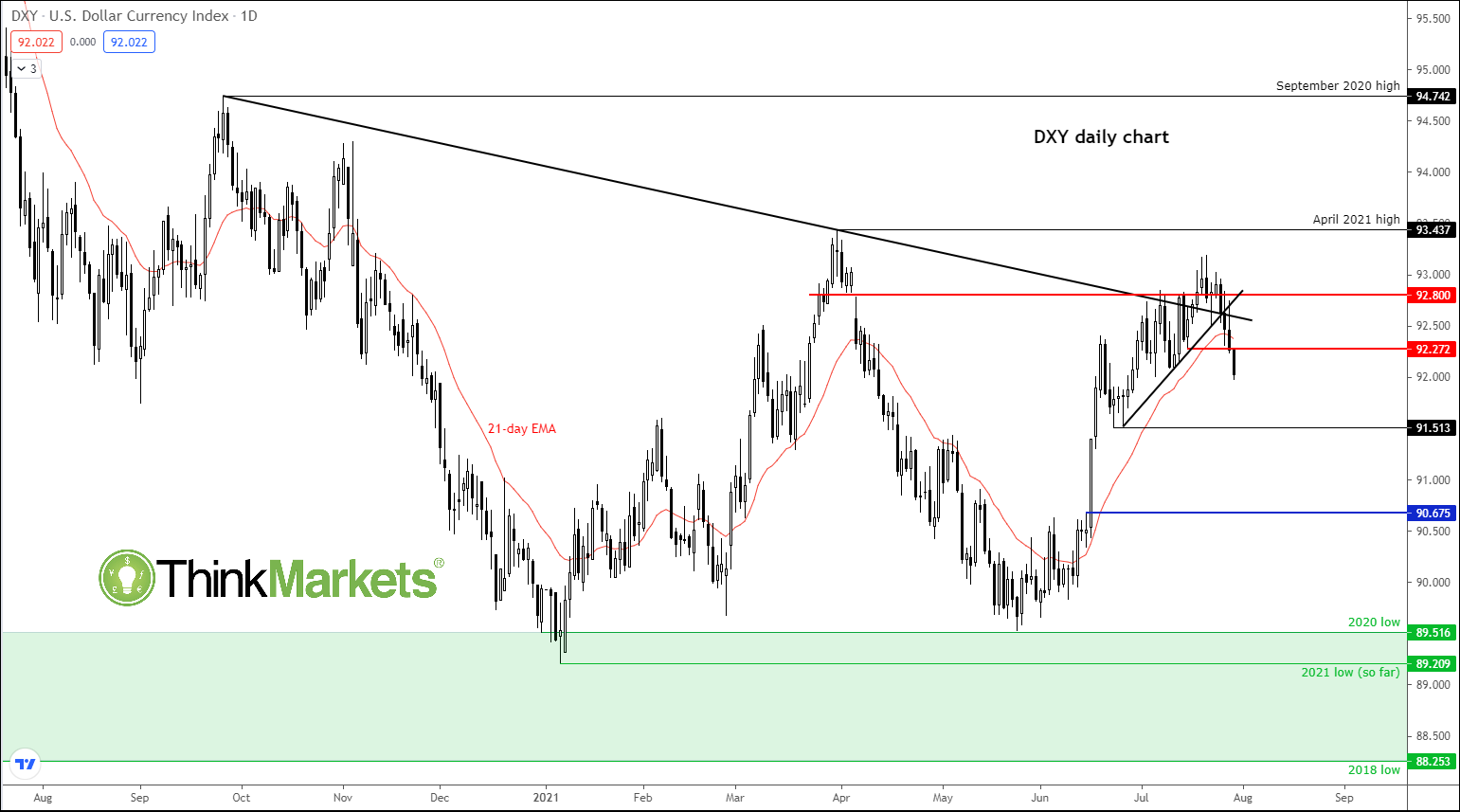
At the FOMC press conference last night, Federal Reserve Chair Jay Powell said: “We're not there [to start tapering QE]. And we see ourselves as having some ground to cover to get there.” The Fed re-iterated that “substantial further progress” was needed to be made on employment and inflation before reducing its asset purchases from the current pace of $120 billion a month.
The Fed's inaction was met with a bit of cheer as some investors had anticipated the Fed to have been a bit more hawkish in light of further improvement in US economic data since their previous meeting in June and given the rapid rise in inflation. What's more, the somewhat hawkish tone of the July policy statement, was not echoed at the FOMC press conference by Powell.
The market's focus will now turn back to the economy to see how much further progress it has made and likely to make in the coming months.
- First up is the US second quarter GDP estimate later today at 13:30 BST. The world's largest economy is expected to have grown 8.5% in an annualised format (quarterly x4), which would be an acceleration from the 6.4% growth recorded in Q1.
- Today we will also have the latest weekly jobless claims data and pending homes sales. Claims area expected to have dropped back to 382K after the previous week's unexpected rise to 419K. Pending home sales are expected to have only edged up by 0.1% m/m after surging 8.0% the previous month.
- Meanwhile, the Fed's favourite measure of inflation will come in on Friday in the form of the PCE core price index.
Next Friday will see the release of the July non-farm jobs report, which is going to be very important considering the fact the Fed is now just waiting to see a bit more improvement in the labour market before starting to reduce the expansion rate of its balance sheet. We will also have the ISM PMIs and ADP payrolls report all to look forward to from the US.
CAD/JPY resumes rally, targeting 55 day EMA
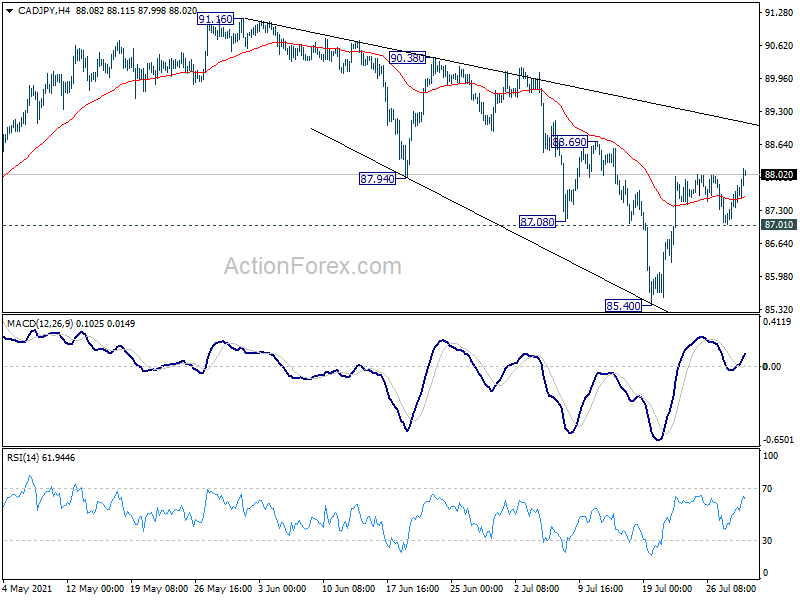
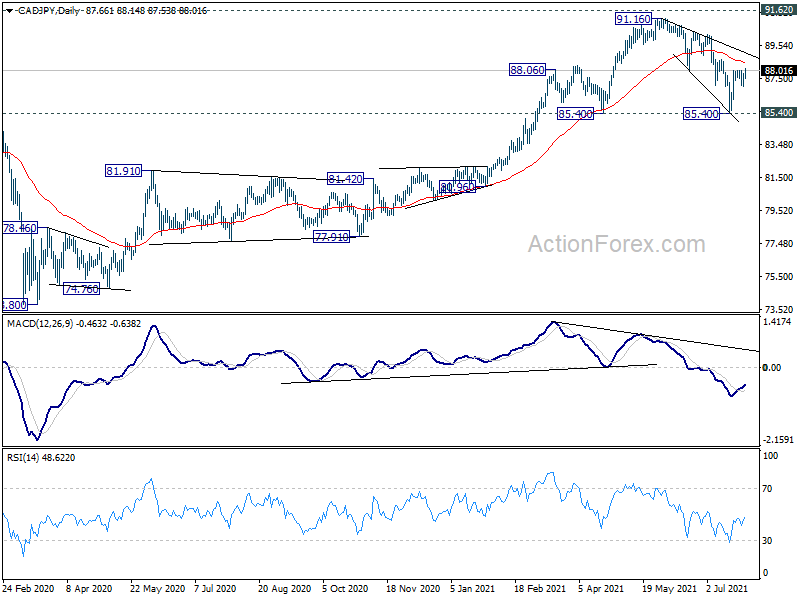
Following broad based selloff in Yen, CAD/JPY resumes the rebound from 85.40. The development affirms the case that correction pattern from 91.16 has completed, after depending 85.40 support. Further rise would be seen to 55 day EMA (now at 88.49). Sustained break there will affirm this bullish view and bring stronger rise back to retest 91.16 high.
CAD/JPY is kept well above 81.91 resistance turned support, and keeps the up trend from 73.80 alive. Such up trend is in favor to resume through 91.16 at a later stage.