

Sample Category Title
ECB Pledges to Continue Front-load QE Purchases until Inflation Reaches 2% Sustainable
The ECB has updated the forward guidance on the policy rate, reflecting the new inflation target concluded in the strategic review. All monetary policy measures stay unchanged as it strives to achieve the symmetric 2% inflation target: The deposit rate stays at -0.5%, the total Pandemic Emergency Purchase Program (PEPP) envelope remains at 1.85 trillion euro, and will run until “at least the end of March 2022” and until the coronavirus crisis phase is over, while the pace of Asset Purchase Program (APP) (traditional QE) stays at 20B euro/ month.
As an update to the forward guidance, the ECB pledged to keep all key interest rates “at their present or lower levels until it sees inflation reaching 2% well ahead of the end of its projection horizon and durably for the rest of the projection horizon”. The central bank “judged that realized progress in underlying inflation is sufficiently advanced to be consistent with inflation stabilizing at 2% over the medium term”. It also tolerates “a transitory period in which inflation is moderately above target”.
On economic developments, President Christine Lagarde reiterated at the press conference that risks to growth are “broadly balanced”. She noted that “the reopening of large parts of the economy is supporting a vigorous bounce-back in the services sector. But the Delta variant of the coronavirus could dampen this recovery in services especially, in tourism and hospitality”. As indicated in the new Monetary Policy Statement, Eurozone’s outlook has remained broadly unchanged since the June meeting with growth on track to be strong in the second and third quarters.
Watering down speculations of tapering, Lagarde suggested that discussions on adjusting the PEPP are "totally premature". This is more dovish than what the marekt had anticipated and explains the decline in the euro and rally in the stock markets after the announcement. Indeed, ECB's inflation forecast of 1.4% in 2023 suggests that the easing measures would have to stay for some time in order to achieve the symmetric 2% inflation target.
ECB Research: Stepping Up on Inflation Ambitions, But Not on Tools
- ECB's first meeting since the new strategy took effect was mostly about aligning the language from the June decision to the review outcome. The bond buying (APP and PEPP) guidance were unchanged.
- The main new element worth highlighting is the forward guidance on rates stating that inflation has to reach 'two per cent well ahead of the end of its projection horizon and durably for the rest of the projection horizon' which compares 'to the end of the forecast horizon' in June.
- This also means that the new strategy is more focused on the duration of the accommodative policy stance and not the size of the support.
- There was 'disagreement at the margin' on the wording.
- Overall, markets showed only limited reactions to the meeting.
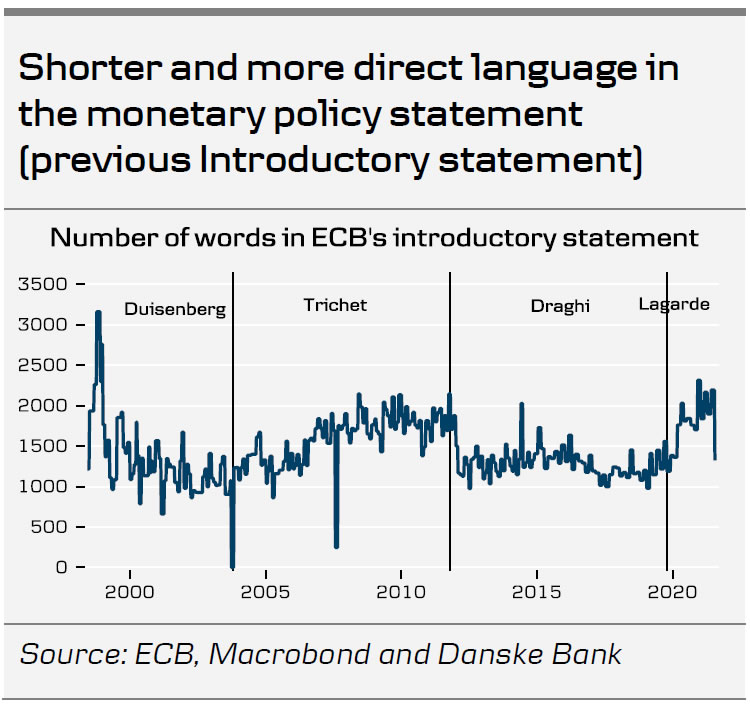
Stepped up inflation ambitions…
The July ECB meeting marked the first time we are seeing the new monetary strategy in action (see also Flash: ECB Research - Strategic Review: Striving for symmetry, 8 July 2021). As policy rates have been close to the lower bound for some time and the mediumterm inflation outlook remains well below target, ECB has adjusted its forward guidance on rates, in an attempt to underline its commitment to maintain a persistently accommodative monetary policy stance. Policy rates are now expected to remain at their present or lower levels until ECB sees inflation reaching 2% well ahead of the end of its projection horizon and durably for the rest of the projection horizon, and that this is also confirmed by underlying inflation. This may also imply a transitory period in which inflation is moderately above target. Further, this also means that ECB wants to observe realised inflation printing closer to / at the target earlier in the forecast horizon (currently until 2023) compared to the earlier medium-term orientation (end of forecast horizon).
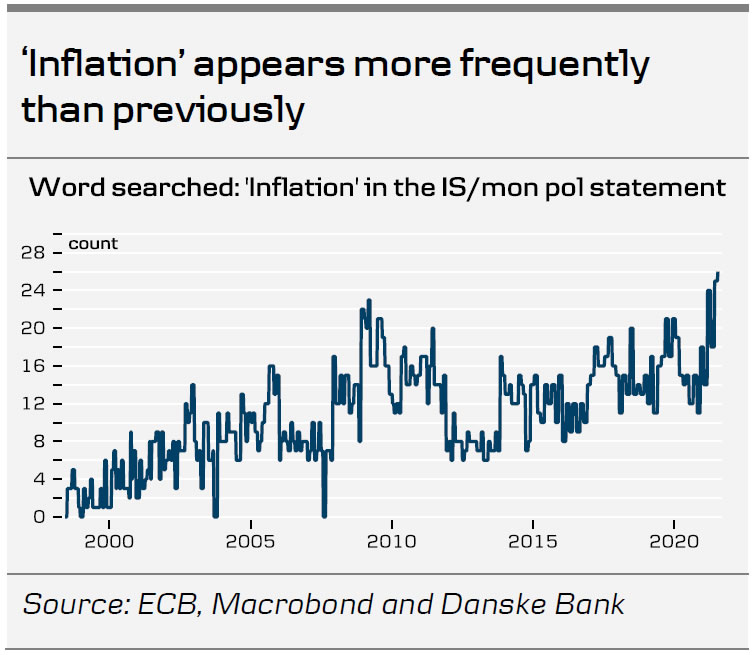
…But without new monetary policy stimulus
Maintaining favourable financing conditions remains key for the recovery to turn into a lasting expansion and hence ECB bond purchase programmes will continue unchanged. The total PEPP envelope continues to amount to EUR 1850bn, with purchases conducted at least until March 22 and at 'significantly' higher pace in Q3 21 than compared to the start of the year, while APP purchases continue at a pace of EUR 20bn/month.
Overall, the new forward guidance on rates is slightly more dovish than previously in our view, as it allows for a more persistent easy monetary policy stance. However, despite the changes in the wording, we do not see it as much of a change in substance: no new monetary policy signals have been sent and the change is more related to the duration of support rather than the size of monetary stimulus.
Economic recovery on track, but inflation remains off target
Comments from President Lagarde suggested a continued constructive view on the economy, while the inflation outlook remains a cause of concern. The euro area recovery was seen on track, as vaccinations have accelerated and lockdown restrictions been eased. However, the pandemic also continues to cast a shadow, especially related to uncertainty from the spreading of the delta variant for service sector activity. Employment is still some 3.3mio below pre-crisis levels and many people remain on job retention schemes. Overall, risks to the economic outlook remain broadly balanced. This is important in our view, as a PEPP extension would likely require downside risks coming to the fore again.
The inflation increase this year was still seen as temporary by the ECB due to energy and German VAT base effects and the outlook for inflation over medium-term remained subdued. Longer-term inflation expectations have increased, but still remain some way off the 2% target. Significant slack in economy and weak wage growth are holding back underlying inflation pressures, despite supply chain cost pressures Overall, Lagarde stressed that there is still some way to go before the fallout from the pandemic on inflation is eliminated. We share the this view, see Research Euro Area - Mind the inflation gap, 8 June 2021.
Market reaction
As expected, the ECB meeting was a non-event for FX markets. The EUR initially found its clue from relative EUR fixed income performance but during the press conference the single currency stabilised at close to unchanged levels for the day. Looking ahead, we strategically favour more EUR/USD downside but emphasise that this is much more a play on USD real rates, global inflation exposure and global cross asset moves than it is a play on ECB monetary policy.
Regarding bond markets, we saw a small amount of volatility during the press conference, with 10y German Bund touching -42bp, but ended virtually unchanged around -40bp, the level also heading into the 13:45 decision. The front of the curve is set to remain anchored for a long time and the front end is now also subject to significant directional risk. Furthermore, this leaves the 10y leg as the determining factor for curve slopes, see more in COTW: Central banks are not the only game in town, 1 July 2021.
Sterling Extends Rally
The British pound has posted considerable gains for a second consecutive day. Currently, GBP/USD is trading at 1.3767, up 0.37% on the day. It has been a volatile week for the pair, which declined by 1% early in the week but has recovered these losses.
Markets eye UK Retail Sales, PMIs
It may not qualify as a data dump, but with three key UK events on Friday, investors will finally have some data to digest in what has been a very light calendar week.
The UK releases retail sales for June (6:00 GMT). The May report was a disappointment, as the headline reading came in at -1.4% and core retail sales at -2.1%. June data should be stronger, with retail sales expected at 0.4% MoM and 9.6% YoY. The consensus for core retail sales is 0.6% (MoM) and 8.2% YoY. The annualized estimates are still at high levels, since they are in comparison to data from July 2020, at the height of the Covid pandemic.
This will be followed by the Manufacturing and Services PMIs (8:30 GMT). The July readings are expected to ease slightly from June, but still point to strong expansion (62.3 for Manufacturing, 62.1 for Services).
Will the pound continue to show volatility on Friday? Investors will be especially attuned to the retail sales release. If the MoM readings fall short of the forecast, this would mark a second straight decline, and investors could give the pound a thumbs down. Conversely, a reading above expectations would likely give the pound a lift and extend the current rally.
It has also been a very light calendar week in the US. On Friday, the US releases PMIs for July, which have shown strong growth as the economy fires on all cylinders. In June Manufacturing PMI came in at 62.1 and Services PMI at 64.6, with little change expected in the upcoming release.
GBP/USD Technical Analysis
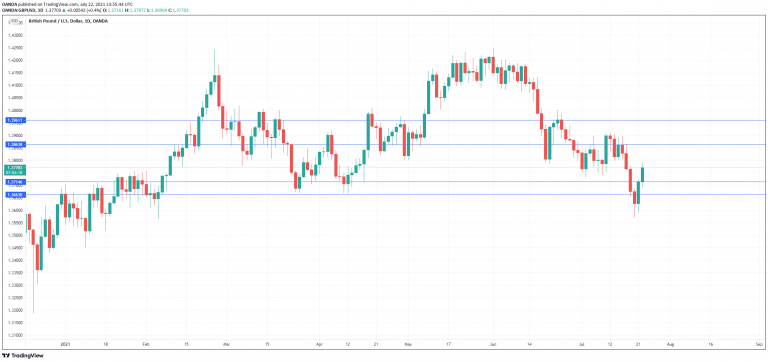
- There is resistance at 1.3863. Above, there is resistance at 1.3961
- On the downside, 1.3714 is the first line of support. This is followed by support at 1.3663
USD/JPY Mid-Day Outlook
Daily Pivots: (S1) 109.93; (P) 110.16; (R1) 110.52; More...
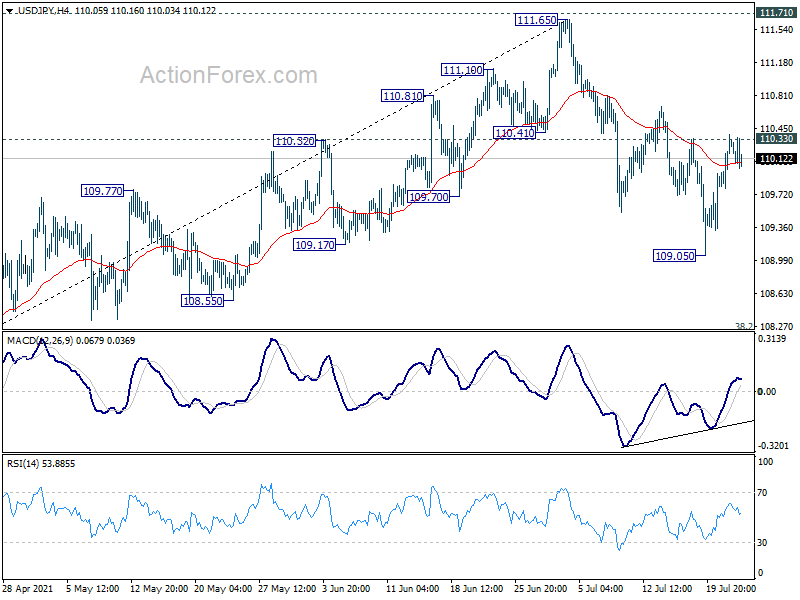
No change in USD/JPY's outlook. Intraday bias remains neutral with focus on 110.133 resistance. Sustained break there will argue that the choppy fall from 111.65 has completed, and turn bias back to the upside for retesting this high. Rejection by 110.33 will maintain near term bearishness. Break of 109.05 will target 38.2% retracement of 102.58 to 111.65 at 108.18.
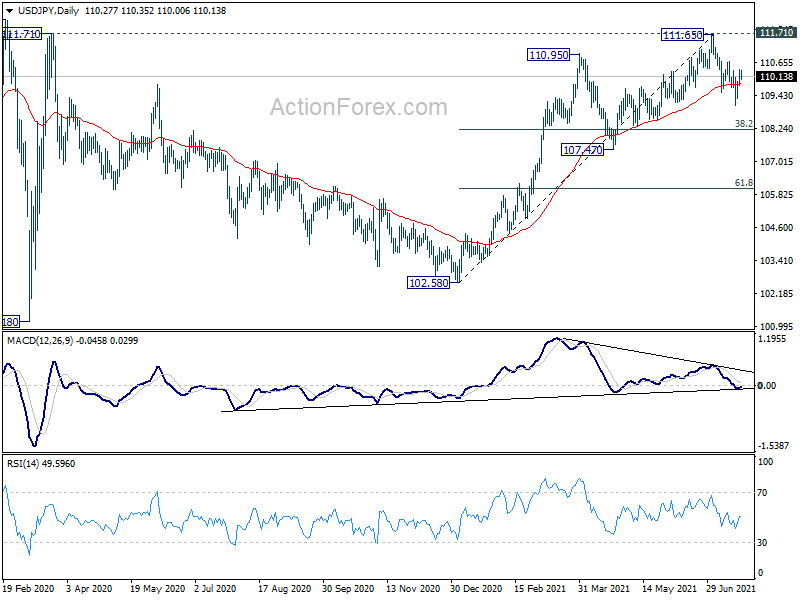
In the bigger picture, medium term outlook is staying neutral with 111.71 resistance intact. Sustained trading below 55 day EMA would argue that the pattern from 101.18 is starting another falling leg, that could head back to 102.58 support and below. For now, outlook won't turn bullish as long as 111.71 resistance holds, even in case of strong rebound.
USD/CHF Mid-Day Outlook
Daily Pivots: (S1) 0.9154; (P) 0.9192; (R1) 0.9215; More....
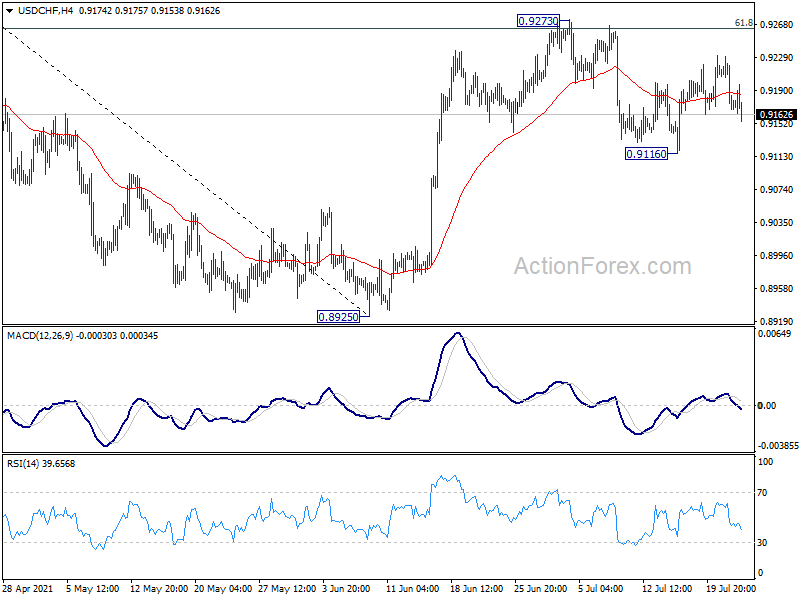
Intraday bias in USD/CHF remains neutral at at this point, as range trading is still in progress. On the downside, break of 0.9116 support will affirm the case that rebound from 0.8925 has completed at 0.9273. Deeper fall would then be seen back to retest 0.8925 low. On the upside, however, break of 0.9273 and sustained trading above 61.8% retracement of 0.9471 to 0.8925 at 0.9262 will target 0.9471 resistance next.
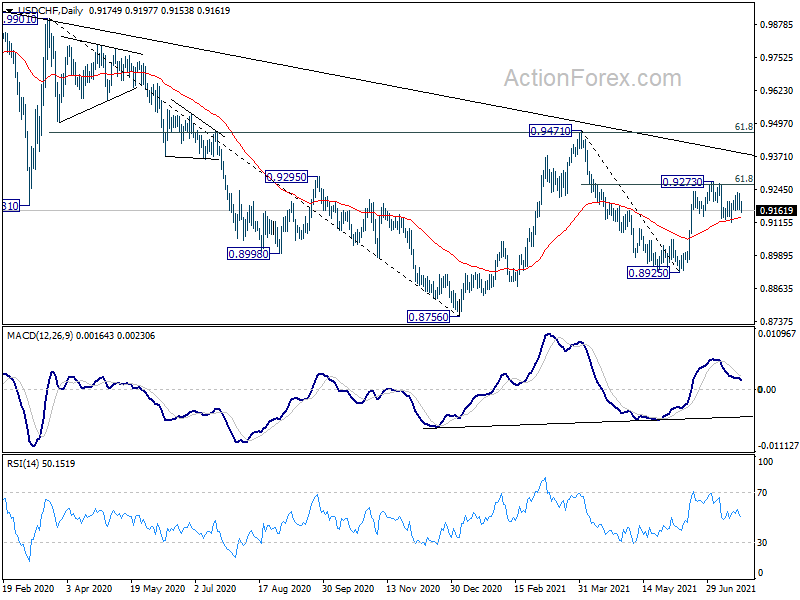
In the bigger picture, medium term outlook is currently neutral with focus on 0.9471 resistance. Sustained break there will indicate completion of whole decline from 1.0342 (2016 high). Medium term outlook will be turned bullish for a test on 1.0342 high. But, rejection by 0.9471 again will revive bearishness for another fall through 0.8756 low.
GBP/USD Mid-Day Outlook
Daily Pivots: (S1) 1.3629; (P) 1.3676; (R1) 1.3761; More....
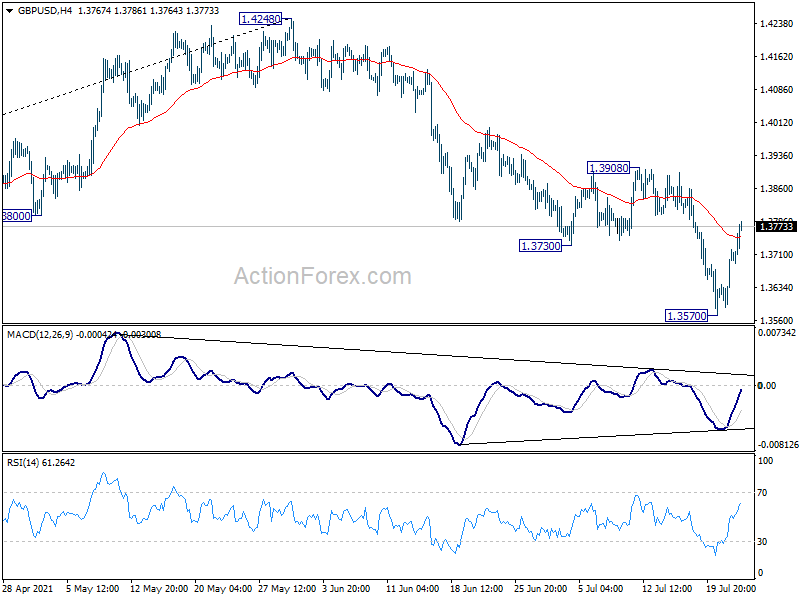
Intraday bias in GBP/USD stays neutral first and some consolidations could be seen. But still, further decline is in favor as long as 1.3908 resistance holds. On the downside, break of 1.3570 will resume the fall from 1.4248 to 1.3482 resistance turned support first. Decisive break there will indicate that it's already correcting whole up trend from 1.1409. Next target will then be 38.2% retracement of 1.1409 to 1.4248 at 1.3164. However, sustained break of 1.3908 will bring stronger rise back to retest 1.4248 high.
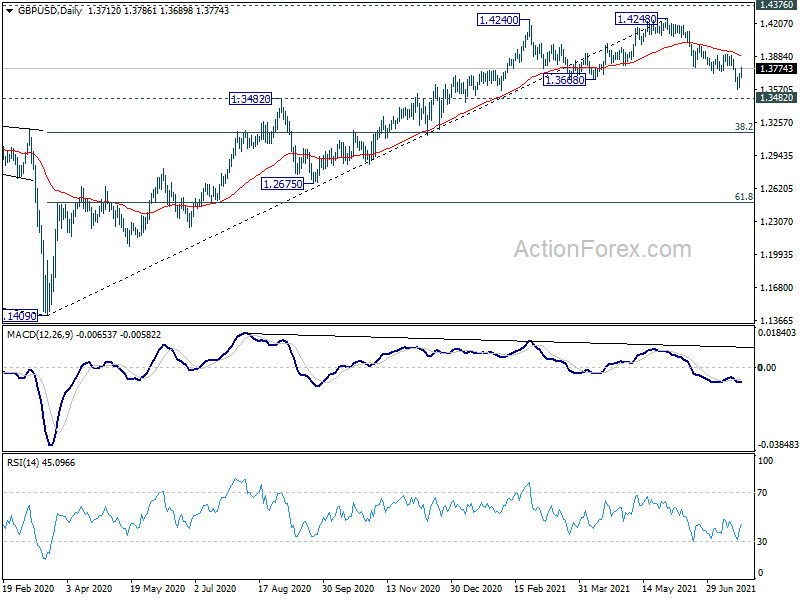
In the bigger picture, as long as 1.3482 resistance turned support holds, up trend from 1.1409 should still continue. Decisive break of 1.4376 resistance will carry larger bullish implications. However, firm break of 1.3482 support will argue that the rise from 1.1409 has completed. GBP/USD would then be seen in another leg of long term range pattern between 1.1409 and 1.4376. Deeper fall could then be seen to 61.8% retracement of 1.1409 to 1.4248 at 1.2493, and even below.
EUR/USD Mid-Day Outlook
Daily Pivots: (S1) 1.1762; (P) 1.1784; (R1) 1.1815; More...
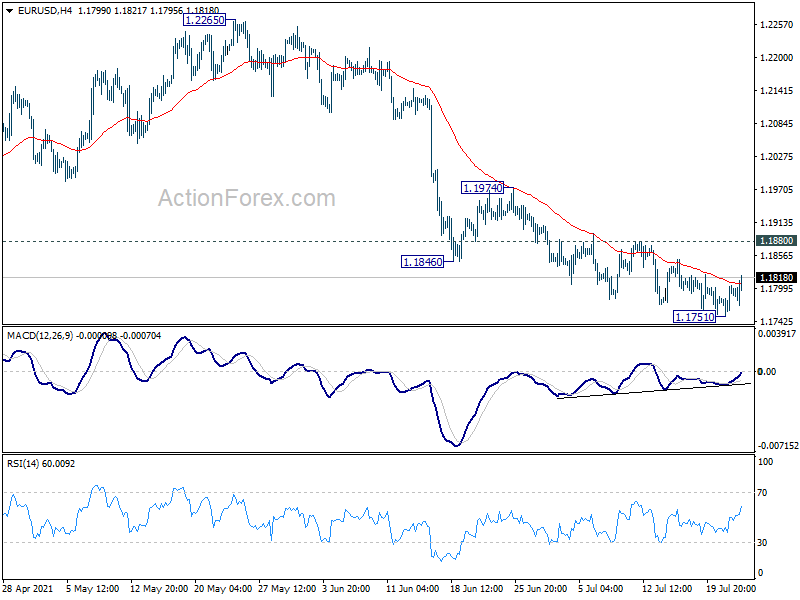
EUR/USD is still losing downside momentum, as displayed in 4 hour MACD. Nevertheless, further decline is expected with 1.1880 resistance intact. Current fall from from 1.2265, as the third leg of correction from 1.2348, would target 1.1703 support. On the upside, though, break of 1.1880 will indicate short term bottoming and turn bias back to the upside for stronger rebound to 1.1974 resistance first.
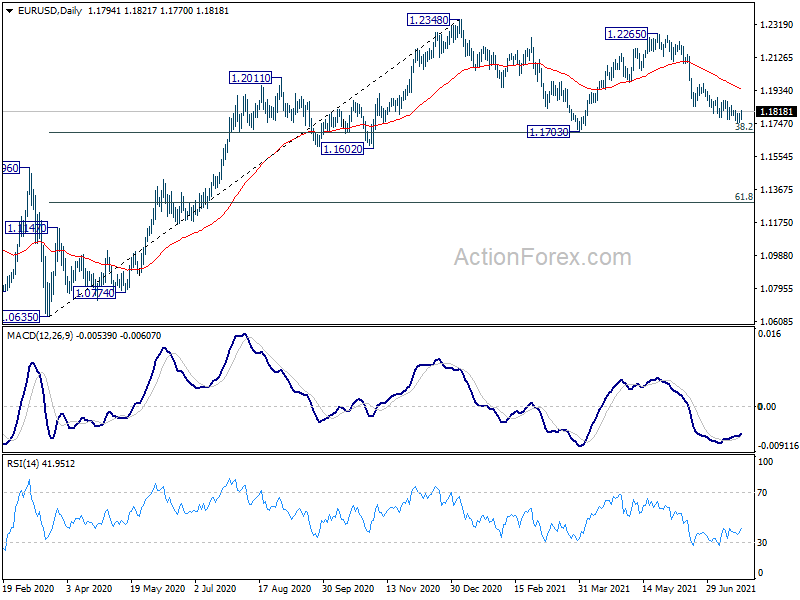
In the bigger picture, rise from 1.0635 is seen as the third leg of the pattern from 1.0339 (2017 low). Further rally could be seen to cluster resistance at 1.2555 next, (38.2% retracement of 1.6039 to 1.0339 at 1.2516). This will remain the favored case as long as 1.1602 support holds. Reaction from 1.2555 should reveal underlying long term momentum in the pair. However sustained break of 1.1602 will argue that the rise from 1.0635 is over, and turn medium term outlook bearish again.
Euro Steady Against Dollar after ECB, Jobless Claims
Euro is trading steadily in US session after ECB finally revealed it's new forward guidance. Though, the common currency is notably weak against Sterling and commodity currencies. Meanwhile, Dollar and Swiss are also weak, together with Yen, as market sentiments are generally stable. We'd now see if US stocks could extend the strong rebounds in the past two days, to retest recently made record highs.
Technically, both EUR/USD and EUR/JPY are pressing 4 hour 55 EMA at this point. We'd see if the two pairs could stand firm above the EMAs to extend current recovery. Or, the would be dragged down by selloff in other crosses for retesting 1.1751 and 128.58 temporary lows.
In Europe, at the time of writing, FTSE is down -0.19%. DAX is up 0.66%. CAC is up 0.40%. Germany 10-year yield is down -0.008 at -0.400. Earlier in Asia, Hong Kong HSI rose 1.83%. China Shanghai SSE rose 0.34%. Singapore Strait Times rose 1.29%. Japan was on holiday.
US initial jobless claims rose to 419k, above expectation
US initial jobless claims rose 51k to 419k in the week ending July 17, worse than expectation of 350k. Four-week moving average of initial claims rose 750 to 385k.
Continuing claims dropped -29k to 3236k in the week ending July 10, lowest since March 21, 2020. Four-week moving average of continuing claims dropped -44k to 3338k, also the lowest since March 21, 2020.
ECB stands pat, issues new forward guidance
ECB keeps interest rate unchanged today, with main refinancing rate, marginal lending facility rate, and deposit facility rate at 0.0)%, 0.25%, and -0.50% respectively. Net purchase under APP will continue at monthly pace of EUR 20B. The EUR 1850PEPP will continue "until at least the end of March 2022". Purchase pace remain at "significantly higher pace" than during first months of the year.
Also, ECB now expects key interest rates to "remain at their present or lower levels until it sees inflation reaching two per cent well ahead of the end of its projection horizon and durably for the rest of the projection horizon, and it judges that realised progress in underlying inflation is sufficiently advanced to be consistent with inflation stabilising at two per cent over the medium term." It added that this may also imply "a transitory period in which inflation is moderately above target."
BoE Broadbent: The appropriate policy response to current inflation is nothing
BoE Deputy Governor Ben Broadbent said in a speech, "most of the overshoot relative to target in the latest CPI numbers... reflects unusually strong inflation in goods prices". That would also be true of the "larger overshoot we're going to see towards the end of this year". "If this was only a story about global goods prices," he added, then the appropriate policy response to the current inflation would be "nothing".
Also, "while we know it's going to go further over the next few months, I'm not convinced that the current inflation in retail goods prices should in and of itself mean higher inflation 18-24 months ahead, the horizon more relevant for monetary policy," he added.
Australia goods exports rose to record 41.3B in Jun
Australia exports of goods rose 8% mom or AUD 2.9B to AUD 41.3B in June. Imports of goods rose 7% mom or AUD 2.1B to AUD 28.0B. Goods trade surplus widened to record AUD 13.3B, up slightly from AUD 12.5B. Exports to top five destinations rose, including China (8%), Japan (21%), South Korea (24%), Taiwan (9%), USA (7%).
Head of International Statistics at the ABS Andrew Tomadini said: "June 2021 recorded a monthly export value above $40 billion. Exports increased 8 per cent to $41.3 billion, with significant increases in metalliferous ores, coal, non-monetary gold, and gas".
Australia NAB business confidence dropped to 17 in Q2, but condition rose sharply to 32
Australia NAB business confidence dropped from 19 to 17 in Q2. Current business condition rose from 20 to 32. Business conditions for the next 3 months rose from 28 to 36. Business conditions for the next 12 months rose from 31 to 33. Capex plans for the next 12 months rose from 34 to 37.
Looking at some more details, trading conditions rose from 26 to 38. Profitability rose from 22 to 32. Employment rose from 13 to 23. Forward orders rose from 14 to 23. Stocks rose from 5 to 11. Exports also improved from -1 to 0.
According to Alan Oster, NAB Group Chief Economist "Business conditions were still in negative territory in Q3 2020, and now, three quarters later, they were at a record high, a testament to how rapid the recovery has been from last year's recession".
"A pleasing aspect of the survey is how broad-based the strength in conditions and confidence was – whether you look by industry or by state they are all above average, and in many cases well above."
EUR/USD Mid-Day Outlook
Daily Pivots: (S1) 1.1762; (P) 1.1784; (R1) 1.1815; More...
EUR/USD is still losing downside momentum, as displayed in 4 hour MACD. Nevertheless, further decline is expected with 1.1880 resistance intact. Current fall from from 1.2265, as the third leg of correction from 1.2348, would target 1.1703 support. On the upside, though, break of 1.1880 will indicate short term bottoming and turn bias back to the upside for stronger rebound to 1.1974 resistance first.
In the bigger picture, rise from 1.0635 is seen as the third leg of the pattern from 1.0339 (2017 low). Further rally could be seen to cluster resistance at 1.2555 next, (38.2% retracement of 1.6039 to 1.0339 at 1.2516). This will remain the favored case as long as 1.1602 support holds. Reaction from 1.2555 should reveal underlying long term momentum in the pair. However sustained break of 1.1602 will argue that the rise from 1.0635 is over, and turn medium term outlook bearish again.
Economic Indicators Update
| GMT | Ccy | Events | Actual | Forecast | Previous | Revised |
|---|---|---|---|---|---|---|
| 01:30 | AUD | NAB Business Confidence Q2 | 17 | 17 | 19 | |
| 11:45 | EUR | Eurozone ECB Interest Rate Decision | 0.00% | 0.00% | 0.00% | |
| 12:30 | EUR | ECB Press Conference | ||||
| 12:30 | USD | Initial Jobless Claims (Jul 16) | 419K | 350K | 360K | 368K |
| 14:00 | USD | Existing Home Sales Jun | 5.95M | 5.80M | ||
| 14:00 | EUR | Eurozone Consumer Confidence Jul P | -3 | -3 | ||
| 14:30 | USD | Natural Gas Storage | 42B | 55B |
(ECB) Introductory Statement to the Press Conference
Christine Lagarde, President of the ECB,
Luis de Guindos, Vice-President of the ECB
Frankfurt am Main, 22 July 2021
Good afternoon, the Vice-President and I welcome you to our press conference.
At today's meeting, the Governing Council focused on two main topics: first, the implications of our strategy review for our forward guidance on the key ECB interest rates; and, second, our assessment of the economy and our pandemic measures.
In our recent strategy review, we agreed a symmetric inflation target of two per cent over the medium term. Our policy rates have been close to their lower bound for some time and the medium-term outlook for inflation is still well below our target. In these conditions, the Governing Council today revised its forward guidance on interest rates. We did so to underline our commitment to maintain a persistently accommodative monetary policy stance to meet our inflation target.
In support of our symmetric two per cent inflation target and in line with our monetary policy strategy, the Governing Council expects the key ECB interest rates to remain at their present or lower levels until we see inflation reaching two per cent well ahead of the end of our projection horizon and durably for the rest of the projection horizon, and we judge that realised progress in underlying inflation is sufficiently advanced to be consistent with inflation stabilising at two per cent over the medium term. This may also imply a transitory period in which inflation is moderately above target.
Let me turn to the assessment of the economic outlook and our pandemic measures.
The recovery in the euro area economy is on track. More and more people are getting vaccinated, and lockdown restrictions have been eased in most euro area countries. But the pandemic continues to cast a shadow, especially as the delta variant constitutes a growing source of uncertainty. Inflation has picked up, although this increase is expected to be mostly temporary. The outlook for inflation over the medium term remains subdued.
We need to preserve favourable financing conditions for all sectors of the economy over the pandemic period. This is essential for the current rebound to turn into a lasting expansion and to offset the negative impact of the pandemic on inflation. Therefore, having confirmed our June assessment of financing conditions and the inflation outlook, we continue to expect purchases under the pandemic emergency purchase programme (PEPP) over the current quarter to be conducted at a significantly higher pace than during the first months of the year.
We also confirmed our other measures to support our price stability mandate, namely the level of the key ECB interest rates, our purchases under the asset purchase programme (APP), our reinvestment policies and our longer-term refinancing operations, as detailed in the press release published at 13:45 today. We stand ready to adjust all of our instruments, as appropriate, to ensure that inflation stabilises at our two per cent target over the medium term.
I will now outline in more detail how we see the economy and inflation developing, and then talk about our assessment of financial and monetary conditions.
Economic activity
The economy rebounded in the second quarter of the year and, as restrictions are eased, is on track for strong growth in the third quarter. We expect manufacturing to perform strongly, even though supply bottlenecks are holding back production in the near term. The reopening of large parts of the economy is supporting a vigorous bounce-back in the services sector. But the delta variant of the coronavirus could dampen this recovery in services, especially in tourism and hospitality.
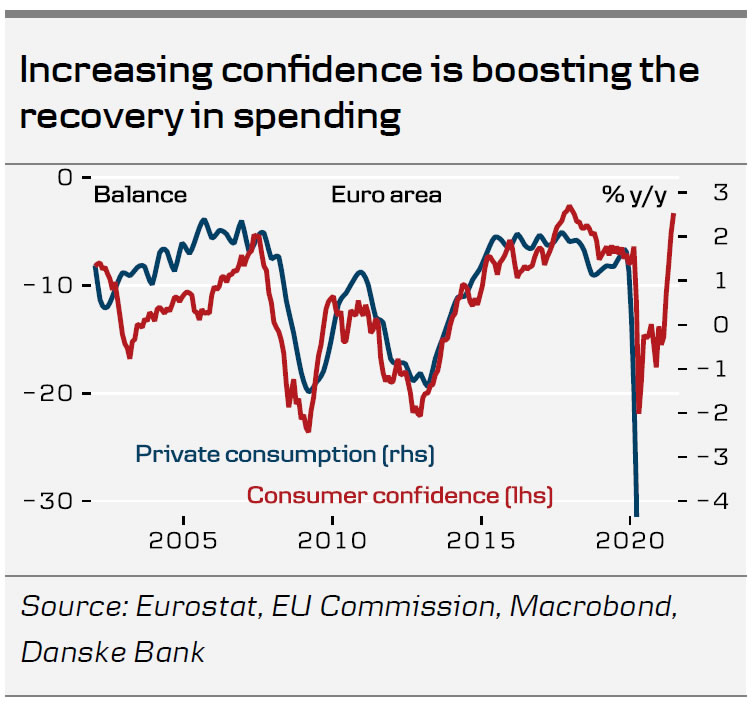
As people return to shops and restaurants and resume travelling, consumer spending is rising. Better job prospects, increasing confidence and continued government support are reinforcing spending. The ongoing recovery in domestic and global demand is boosting optimism among businesses. This supports investment. For the first time since the start of the pandemic, our bank lending survey indicates that funding of fixed investment is an important factor driving the demand for loans to firms.
We expect economic activity to return to its pre-crisis level in the first quarter of next year. But there is still a long way to go before the damage to the economy caused by the pandemic is offset. The number of people in job retention schemes has been declining but remains high. Overall, there are still 3.3 million fewer people employed than before the pandemic, especially among the younger and lower skilled.
Ambitious, targeted and coordinated fiscal policy should continue to complement monetary policy in supporting the recovery. In this context, the Next Generation EU programme has a key role to play. It will contribute to a stronger and uniform recovery across euro area countries. It will also accelerate the green and digital transitions and support necessary structural reforms that lift long-term growth.
Inflation
Inflation was 1.9 per cent in June. We expect inflation to increase further over the coming months and to decline again next year. The current increase is largely being driven by higher energy prices and by base effects from the sharp fall in oil prices at the start of the pandemic and the impact of the temporary VAT reduction in Germany last year. By early 2022, the impact of these factors should fade out as they fall out of the year-on-year inflation calculation.
In the near term, the significant slack in the economy is holding back underlying inflationary pressures. Stronger demand and temporary cost pressures in the supply chain will put some upward pressure on prices. But weak wage growth and the past appreciation of the euro mean that price pressures will likely remain subdued for some time.
There is still some way to go before the fallout from the pandemic on inflation is eliminated. As the economy recovers, supported by our monetary policy measures, we expect inflation to rise over the medium term, although remaining below our target. While measures of longer-term inflation expectations have increased, they remain some distance from our two per cent target.
Risk assessment
We see the risks to the economic outlook as broadly balanced. Economic activity could outperform our expectations if consumers spend more than currently expected and draw more rapidly on the savings they have built up during the pandemic. A faster improvement in the pandemic situation could also lead to a stronger expansion than currently envisaged. But growth could underperform our expectations if the pandemic intensifies or if supply shortages turn out to be more persistent and hold back production.
Financial and monetary conditions
The recovery of growth and inflation still depends on favourable financing conditions. Market interest rates have declined since our last meeting. Financing conditions for most firms and households remain at favourable levels.
Bank lending rates for firms and households remain historically low. Firms are still well funded as a result of their borrowing in the first wave of the pandemic, which in part explains why lending to firms has slowed. By contrast, lending to households is holding up. Our most recent bank lending survey shows that credit conditions for both firms and households have stabilised. Liquidity remains abundant.
At the same time, the cost for firms of issuing equity is still high. Many firms and households have taken on more debt to weather the pandemic. Any worsening of the economy could therefore threaten their financial health, which could trickle through to the quality of banks' balance sheets. It remains essential to prevent balance sheet strains and tightening financing conditions from reinforcing each other.
Conclusion
Summing up, the euro area economy is rebounding strongly. But the outlook continues to depend on the course of the pandemic and progress with vaccinations. The current rise in inflation is expected to be largely temporary. Underlying price pressures will likely increase gradually, although leaving inflation over the medium term still well below our target. Our policy measures, including our revised forward guidance, will help the economy shift to a solid recovery and, ultimately, bring inflation to our two per cent target.
We are now ready to take your questions.
AUD Rises on Sharp Business Confidence
The Australian dollar has posted gains on Thursday. Currently, AUD/USD is trading at 0.7378, up 0.30% on the day.
Australian business conditions jump
Business conditions rose sharply in the second quarter, according to the NAB Business Survey. Conditions jumped to 32 in Q2, up from 20 beforehand. The survey noted that business conditions rose to a record high, although business confidence eased, from 19 to 17 points. Still, business confidence continues to show strong expansion and is above the long-term average.
The survey reflects the upswing in the economy, which continues to be marked by robust growth. However, the NAB cautioned that the report preceded the current lockdowns in effect, which means that the third-quarter could see a drop in business conditions if the lockdowns are prolonged.
The Australian dollar is coming off a nasty slide, which saw it fall over 2 percent in less than a week. The currency has managed to reverse directions, but with the RBA in a dovish mode and much of the country under lockdown, the Aussie’s upswing could prove to be brief.
Australia wraps up the week with the July PMI reports later today (23:00 GMT). The June releases were strong, as PMIs for both manufacturing (58.6) and services (56.8) were well into expansionary territory. The July numbers are also expected to show strong growth. The 50-level separates contraction from expansion.
In the US, it has been a very light calendar week. On Friday, the US releases PMIs for July, which have been at high levels as the economy fires on all cylinders. In June Manufacturing PMI came in at 62.1 and Services PMI at 64.6, with little change expected in the upcoming release.
AUD/USD Technical
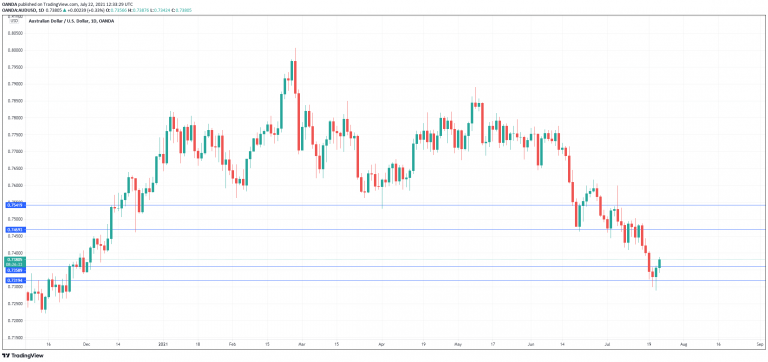
- AUD/USD is testing support 0.7358. Below, there is support at 0.7319
- There is resistance at 0.7469, followed by resistance at 0.7541