Sample Category Title
ECB press conference live stream
https://www.youtube.com/watch?v=hbRjSC32IGM
US initial jobless claims rose to 419k, above expectation
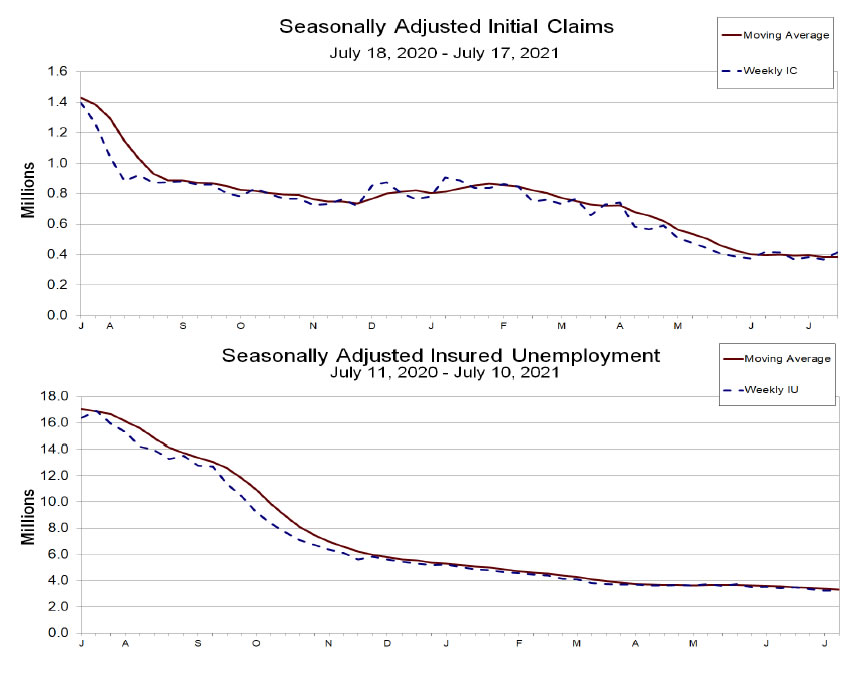
US initial jobless claims rose 51k to 419k in the week ending July 17, worse than expectation of 350k. Four-week moving average of initial claims rose 750 to 385k.
Continuing claims dropped -29k to 3236k in the week ending July 10, lowest since March 21, 2020. Four-week moving average of continuing claims dropped -44k to 3338k, also the lowest since March 21, 2020.
EURJPY Flirts with 130.00 Mark; Falling Trend Line Holds
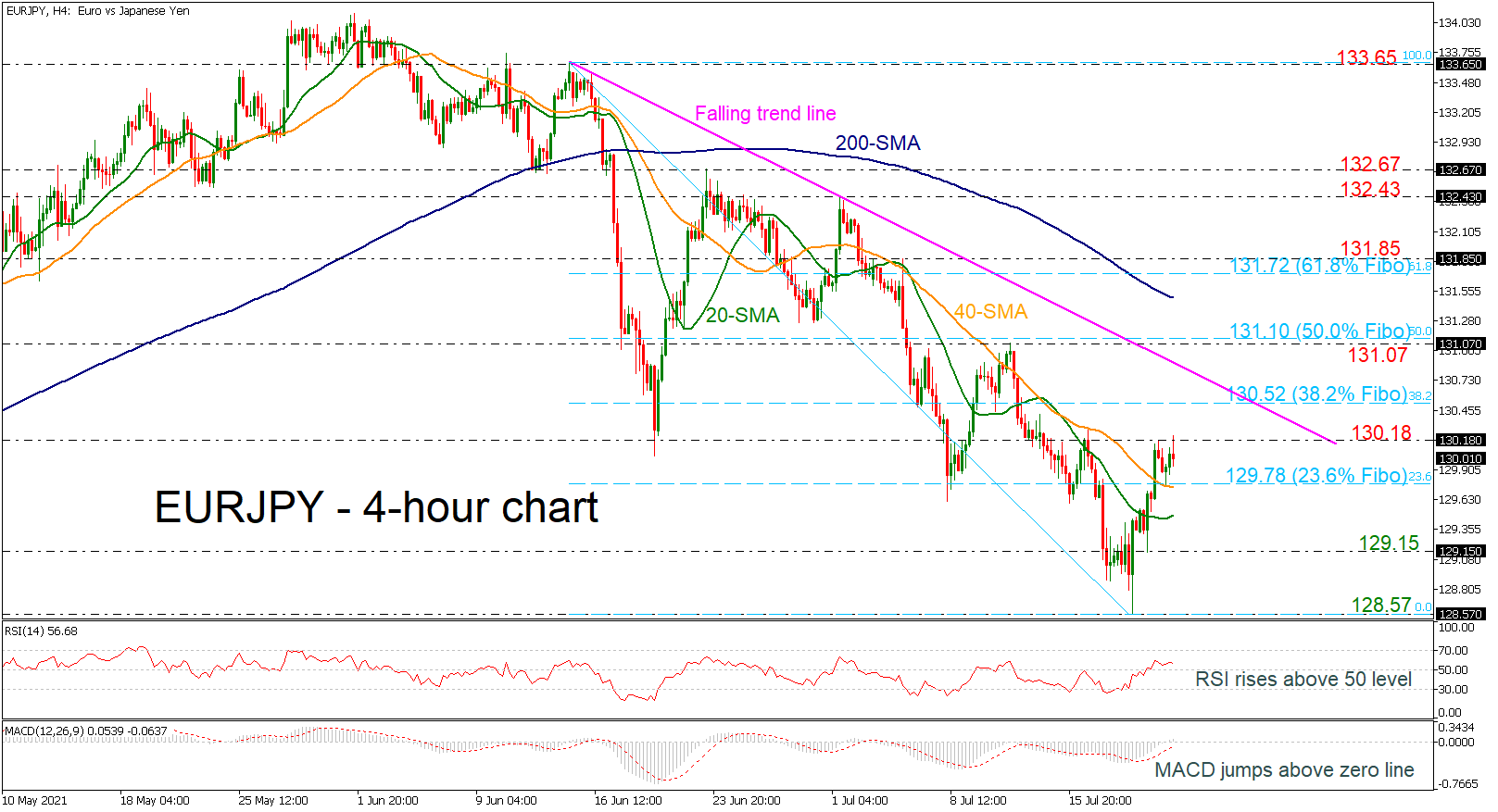
EURJPY has been trading higher over the last couple of days, keeping its footing around the 130.00 level and above the short-term simple moving averages (SMAs). As regards the market momentum, some optimism seems to be building over an upside correction as the RSI has been pointing up above the 50 level and the MACD has entered the positive region.
In the event the bulls hold control, the 130.18 resistance will come first into view. A violation at this point may see another challenging battle around the 38.2% Fibonacci retracement level of the downward wave from 133.65 to 128.57 at 130.52, which stands near the descending line. If buyers claim that zone this time, the 131.07 level and the 50.0% Fibonacci at 131.10 could immediately add some downside pressure, deterring a continuation towards the 200-period SMA at 131.50.
Should the bears dominate, driving the price below the 23.6% Fibonacci of 129.78, the spotlight will shift to the crucial 129.15 barrier, where any step lower will put the pair in a bearish position again, meeting 128.57.
In brief, although EURJPY continues to face unfavorable trend signals, the odds for an upturn seem to be growing, with the confirmation expected to come above the 38.2% Fibonacci at 130.52 and the 200-period SMA at 131.50.
GBP/USD Up Move As Expected
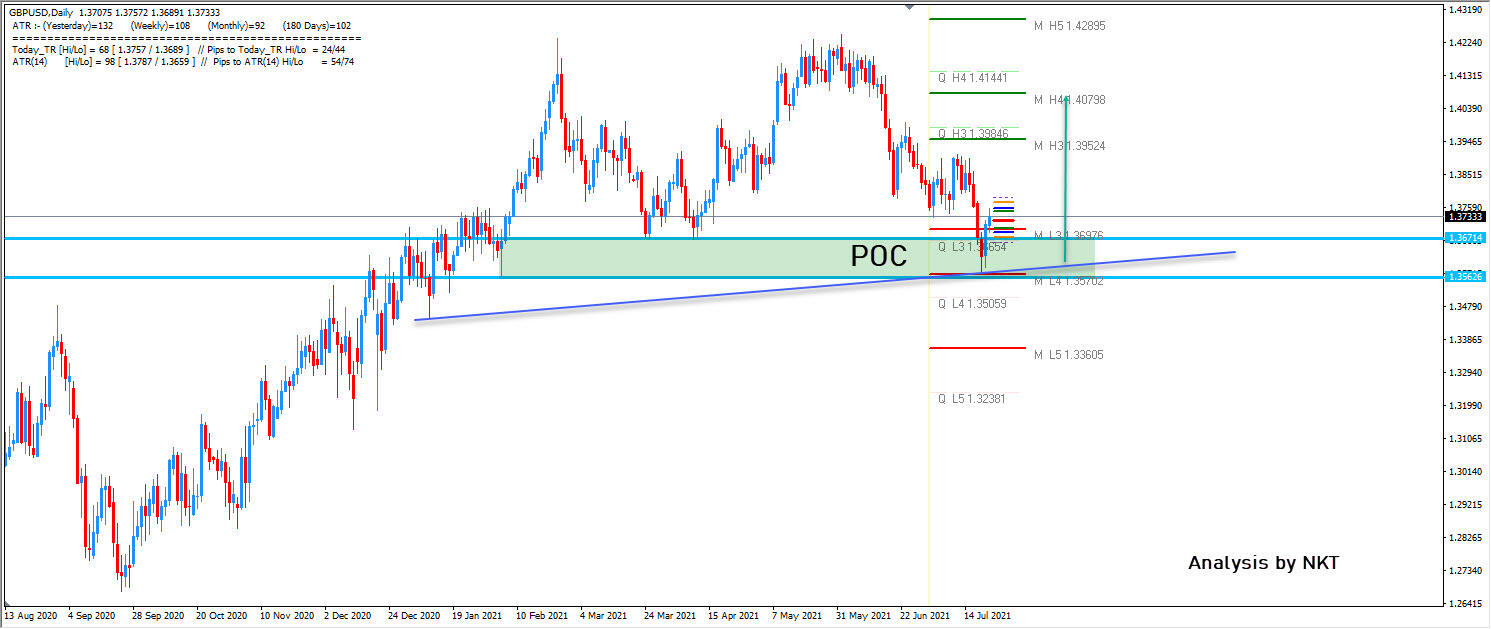
Currently, more than 100 pips of profit has been made from the GBPUSD longs. We can see that the market is bullish.
The POC zone perfectly bounced off the GBPUSD as the essential support has been made. We can see that the upward trend is persisting and I advise protecting profits for everyone who entered long in the POC. Targets are 1.3750 followed by 1.3952 and 1.4080 as a part of a swing trade. Only if the market breaks below 1.3550 it will invalidate the bullish trend.
ECB stands pat, issues new forward guidance
ECB keeps interest rate unchanged today, with main refinancing rate, marginal lending facility rate, and deposit facility rate at 0.0)%, 0.25%, and -0.50% respectively. Net purchase under APP will continue at monthly pace of EUR 20B. The EUR 1850PEPP will continue "until at least the end of March 2022". Purchase pace remain at "significantly higher pace" than during first months of the year.
Also, ECB now expects key interest rates to " remain at their present or lower levels until it sees inflation reaching two per cent well ahead of the end of its projection horizon and durably for the rest of the projection horizon, and it judges that realised progress in underlying inflation is sufficiently advanced to be consistent with inflation stabilising at two per cent over the medium term." It added that this may also imply "a transitory period in which inflation is moderately above target."
(ECB) Monetary policy decisions
In its recent strategy review, the Governing Council agreed a symmetric inflation target of two per cent over the medium term. The key ECB interest rates have been close to their lower bound for some time and the medium-term outlook for inflation is still well below the Governing Council's target. In these conditions, the Governing Council today revised its forward guidance on interest rates. It did so to underline its commitment to maintain a persistently accommodative monetary policy stance to meet its inflation target.
In support of its symmetric two per cent inflation target and in line with its monetary policy strategy, the Governing Council expects the key ECB interest rates to remain at their present or lower levels until it sees inflation reaching two per cent well ahead of the end of its projection horizon and durably for the rest of the projection horizon, and it judges that realised progress in underlying inflation is sufficiently advanced to be consistent with inflation stabilising at two per cent over the medium term. This may also imply a transitory period in which inflation is moderately above target.
Having confirmed its June assessment of financing conditions and the inflation outlook, the Governing Council continues to expect purchases under the pandemic emergency purchase programme (PEPP) over the current quarter to be conducted at a significantly higher pace than during the first months of the year.
The Governing Council also confirmed its other measures to support its price stability mandate, namely the level of the key ECB interest rates, its purchases under the asset purchase programme (APP), its reinvestment policies and its longer-term refinancing operations. Specifically:
Key ECB interest rates
The interest rate on the main refinancing operations and the interest rates on the marginal lending facility and the deposit facility will remain unchanged at 0.00%, 0.25% and -0.50% respectively.
In support of its symmetric two per cent inflation target and in line with its monetary policy strategy, the Governing Council expects the key ECB interest rates to remain at their present or lower levels until it sees inflation reaching two per cent well ahead of the end of its projection horizon and durably for the rest of the projection horizon, and it judges that realised progress in underlying inflation is sufficiently advanced to be consistent with inflation stabilising at two per cent over the medium term. This may also imply a transitory period in which inflation is moderately above target.
Asset purchase programme (APP)
Net purchases under the APP will continue at a monthly pace of €20 billion. The Governing Council continues to expect monthly net asset purchases under the APP to run for as long as necessary to reinforce the accommodative impact of its policy rates, and to end shortly before it starts raising the key ECB interest rates.
The Governing Council also intends to continue reinvesting, in full, the principal payments from maturing securities purchased under the APP for an extended period of time past the date when it starts raising the key ECB interest rates, and in any case for as long as necessary to maintain favourable liquidity conditions and an ample degree of monetary accommodation.
Pandemic emergency purchase programme (PEPP)
The Governing Council will continue to conduct net asset purchases under the PEPP with a total envelope of €1,850 billion until at least the end of March 2022 and, in any case, until it judges that the coronavirus crisis phase is over.
As the incoming information confirmed the joint assessment of financing conditions and the inflation outlook carried out at the June monetary policy meeting, the Governing Council continues to expect purchases under the PEPP over the current quarter to be conducted at a significantly higher pace than during the first months of the year.
The Governing Council will purchase flexibly according to market conditions and with a view to preventing a tightening of financing conditions that is inconsistent with countering the downward impact of the pandemic on the projected path of inflation. In addition, the flexibility of purchases over time, across asset classes and among jurisdictions will continue to support the smooth transmission of monetary policy. If favourable financing conditions can be maintained with asset purchase flows that do not exhaust the envelope over the net purchase horizon of the PEPP, the envelope need not be used in full. Equally, the envelope can be recalibrated if required to maintain favourable financing conditions to help counter the negative pandemic shock to the path of inflation.
The Governing Council will continue to reinvest the principal payments from maturing securities purchased under the PEPP until at least the end of 2023. In any case, the future roll-off of the PEPP portfolio will be managed to avoid interference with the appropriate monetary policy stance.
Refinancing operations
The Governing Council will continue to provide ample liquidity through its refinancing operations. In particular, the third series of targeted longer-term refinancing operations (TLTRO III) remains an attractive source of funding for banks, supporting bank lending to firms and households.
***
The Governing Council stands ready to adjust all of its instruments, as appropriate, to ensure that inflation stabilises at its two per cent target over the medium term.
The President of the ECB will comment on the considerations underlying these decisions at a press conference starting at 14:30 CET today.
EUR/USD: ECB Likely To Maintain Dovish Rhetoric
The European Central Bank's eagerly anticipated policy announcement is coming up at 12:45 BST with ECB President Christine Lagarde's press conference starting at 13:30. Investors are keen to find out what the central bank's decision to raise the inflation target to 2% means for the immediate future of monetary policy in the Eurozone and in turn the financial markets. Lagarde has promised there will be “interesting variations and changes.” Judging by the performance of the euro in recent times, the market is expecting the ECB to maintain a dovish view on monetary policy – but how much of that dovishness is already priced in is the key question. Indeed, the bigger risk is for the euro to potentially spike higher in the event the ECB turns out to be a lot less dovish than the markets expect, although this is not our base case scenario.
A couple of weeks ago, the ECB announced a change in its strategy, allowing the central bank to tolerate inflation higher than its 2% goal when rates are near rock bottom. That is the case right now, but this does not mean the Governing Council will agree on the economic and inflation outlook – and thus on how much more bond buying stimulus is needed. ECB President Christine Lagarde has also said that “forward guidance will certainly be revisited." At the moment, the guidance says the ECB will purchase bonds for as long as necessary and will keep interest rates at current levels until the inflation outlook "robustly” converges to its goal. With the cases of the delta variant of Covid-19 rising sharply across Europe and elsewhere, you can rest assured that the central bank will not even entertain the idea of dialling back stimulus. Indeed, Lagarde has already said that her sense is that the ECB will be “maintaining favourable financing conditions in our economy," and that the ECB's Pandemic Emergency Purchase Programme (PEPP) could "transition into a new format" after March 2022, which is the earliest the programme can end.
In short, expect the ECB to remain dovish, especially if we see further sharp rises in Covid cases until the central bank's meeting. This should keep the euro under pressure.
As far as the euro is concerned, well the single currency has been unable to hold any recovery attempts in recent past. The euro has been repeatedly shot down by dovish rhetoric from the ECB. As a result, the EUR/USD has broken its bullish trend line:
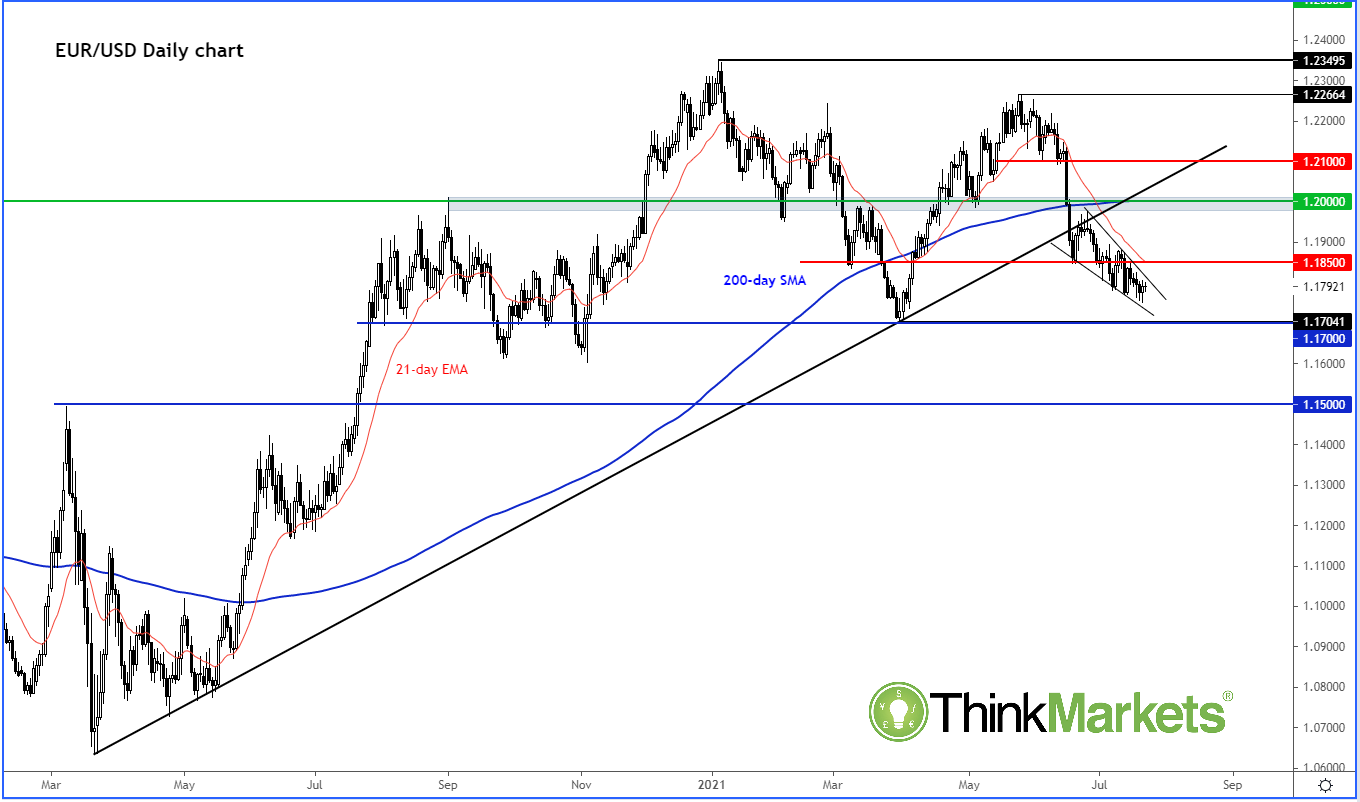
The EUR/USD looked poised to drop to test the 1.1700 support level ahead of the ECB. An idea scenario for the bulls would be a drop to 1.1700 and a quick rejection to create a double bottom-like reversal pattern. For the bears, a continuation lower is what they are looking for, and acceptance below 1.1700 would be rather bearish. The next obvious support below 1.1700 is at 1.1500, a level not visited since last July.
Macro data and earnings highlights
Thursday
ECB policy decision and press conference
US jobless claims and existing home sales
US Earnings: Intel, Twitter, AT&T and Snap
European Earnings: Unilever, SSE
Friday
Retail sales from UK and Canada
Global flash manufacturing and services PMIs, including from Eurozone
Earnings: Honeywell International (US) and Vodafone (UK)
ECB Likely To Disrupt Euro’s Calm
The euro is drifting in Thursday trade. In North American trade, EUR/USD is trading at 1.1786, down 0.07% on the day.
It has been a very quiet week for the euro, which has been hovering close to the 1.18 level. The lack of movement could change later today, as the ECB holds a policy meeting (11:45 GMT).
ECB expected to change forward guidance
Investors are always hungry for clues about a central bank’s future monetary policy. The expectation that the ECB will make changes to its forward guidance at today’s policy meeting has investors swirling around like bees on a honeycomb. ECB President Christine Lagarde has said that the central bank’s forward guidance, which is its tool to communicate policy outlook, will have to be aligned with its new strategy review.
What key changes can we expect from the ECB? The strategy review raised the inflation target to 2%, which is a slight adjustment from the previous “below, but close to 2%” target. As well, the review stated that the Bank would allow inflation to overshoot the target if it was a “transitory period”.
The new fixed inflation target of 2% could have significant implications for the euro. Since core inflation is running well below 2%, the ECB will have to maintain a vigorous easing bias in order to coax inflation up to the target. This dovish policy will likely weigh on the euro. We could see some sharp volatility around EUR/USD during the day.
There has been a lack of economic events this week, as the global calendar has been very light. The markets will get a chance to sink their teeth into some tier-1 data on Friday, with the release of Service and Manufacturing PMIs for June. Both sectors are performing well, with the PMIs expected to show strong expansion across the eurozone.
EUR/USD Technical
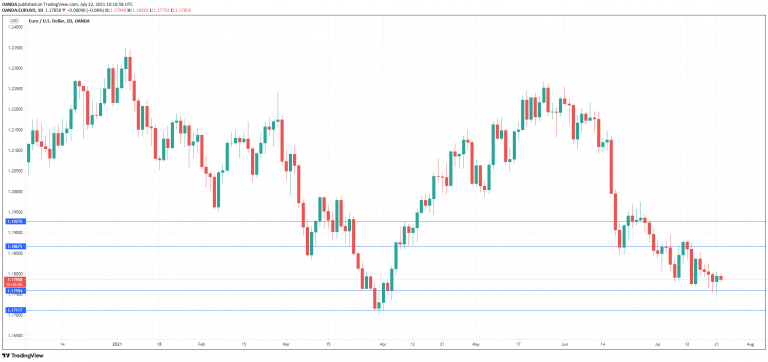
- EUR/USD is putting pressure on support at 1.1759. Below, there is support at 1.1711
- On the downside, we have resistance at 1.1867 and 1.1927
BOE’s Broadbent Plays Down Inflation Concerns, Focus On ECB Rate Decision Under Its New Strategy
Notes/Observations
- Focus on ECB rate decision under its new strategy; poised to promise even longer support to charge inflation.
- BOE member Broadbent plays down the recent rise in inflation, believed that the appropriate response might well be to do nothing.
Asia
- Australia Jun Preliminary Retail Sales M/M: -1.8% v -0.7%e.
- Australia Treasurer Frydenberg stated that e hoped the country to dodge a recession as the Lockdowns cost ~A$300M/day, Expected next GDP figure [Q3] to be negative.
- Fitch affirmed South Korea's sovereign rating at AA-; Outlook stable.
Europe
- UK wanted significant changes to the post-Brexit settlement and considered unilaterally deviating from the deal.
- Germany Finance Ministry Monthly Report noted that the pandemic situation continued to relax in 2021 and giving hope for a swift overall economic recovery. Expected inflationary pressures to remain in the H2 with CPI to rise above 3% at least temporarily.
Americas
- President Biden stated that most experts expected inflation to be near term; Long term inflation would not likely to get out of hand. Expected Senate to vote to start infrastructure debate Monday (July 26th).
- Fed Chair Powell reportedly has wide support among top Biden aides to be renominated for a second term but advisers have not discussed it with Biden yet; decision on reappointment not expected before Sept.
- Congressional Budget Office estimated the Treasury would hit debt ceiling in Oct or Nov.
- Senate blocked opening bipartisan infrastructure proposal for debate by 49-51 tally (needed 60 votes); Maj Leader Schumer switched vote to 'no' so he can bring it up more quickly in the future.
Speakers/Fixed income/FX/Commodities/Erratum
Equities
- Indices [Stoxx600 +0.63% at 456.92, FTSE +0.12% at 7,006.45, DAX +0.80% at 15,546.30, CAC-40 +0.55% at 6,499.79, IBEX-35 +1.16% at 8,666.00, FTSE MIB +0.73% at 24,855.50, SMI -0.22% at 11,995.14, S&P 500 Futures +0.13%].
- Market Focal Points/Key Themes: European indices open generally higher (SMI notable exception starting the say in the red), and stayed generally upbeat through the session; sectors leading to the upside include consumer discretionary and financials; while underperforming sectors include health care and industrials; SMI weighed on by disappointing results from Roche; UK government to sell part of it’s a stake in NatWest; Marlow potentially could acquire Restore; focus on ECB meeting later; earnings expected in the upcoming US session include DR Horton, Fifth Third Bancorp, SouthWest Airlines and Quest Diagnostics.
Equities
- Consumer discretionary: Publicis [PUB.FR] +4% (earnings), WM Morrison [MRW.UK] +1% (special dividend).
- Consumer staples: Unilever [UNA.BL] -4% (earnings).
- Healthcare: Roche [ROG.CH] -2% (earnings).
- Industrials: ABB [ABBN.CH] +2% (earnings; raises outlook).
- Technology: Restore [RST.UK] +1% (rejects offers).
- Materials: BHP Group [BHP.UK] +1% (partnership with Tesla).
Speakers
- BOE’s Broadbent stated that had to pay close attention to rising in inflation; the good cause of inflation was temporary.
- German Chancellor Merkel's summer press conference noted that Covid cases are rising to a concerning level and that vaccinations were the only way to get ahead on outbreaks.
- UK Business Sec Kwarteng reiterated govt stance that EU was inflexible on Northern Ireland Protocol; wanted to renegotiate the agreement.
- Hungary Central Bank Dep Gov Virag: rate hike cycle to continue in monthly steps.
- China Commerce Ministry (MOFCOM) stated that foreign trade growth to slow in H2.
- Indonesia Central Bank (BI) Policy Statement noted that the decision to keep policy steady was consistent to maintain stability in FX and financial markets amid uncertainty. The decision in line with low inflation and need to support economy. Exports and stimulus to support GDP growth. Saw potential for 2021 GDP to be above the 3.9% mid-point. The policy mix for 2022 must take into account the need to maintain market stability. Any decision to reduce liquidity to be made carefully.
- Indonesia Central Bank (BI) Gov Warjiyo pre-rate decision press conference noted that regional growth was seen lower due to virus restrictions and cut its 2021 GDP growth from between 4.1-5.1% range to 3.5-4.3% range. Saw lower domestic growth due to rising coronavirus infections and weaker Q3 GDP due to slower household consumption. It noted that it saw a rebound in Q4 growth. To continue strengthening FX rate stabilization.
- Philippines Central Bank (BSP) Gov Diokno stated that the 2021 average CPI seen near the upper end of the 2.0-4.0% target range.
Currencies/Fixed Income
- USD was softer as the recent rush to safe-havens abated.
- EUR/USD holding below the 1.18 area and holding above recent 3 ½ month lows. Focus on ECB rate decision under its new strategy; poised to promise even longer support to charge inflation.
- GBP/USD moved off its session highs after BOE’s Broadbent was not hawkish on the recent rise in inflation. Markets pushed back its bets on a potential BOE rate hike by a few months until Aug 2022 as a result.
Economic data
- (NL) Netherlands July Consumer Confidence Index: -4 v -3 prior.
- (NL) Netherlands Jun Unemployment Rate: 3.2%v 3.3% prior.
- (NL) Netherlands May Consumer Spending Y/Y: 8.8% v 9.7% prior.
- (DK) Denmark July Consumer Confidence Indicator: 2.6 v 2.3 prior.
- (NO) Norway Q2 Industrial Confidence: 11.3 v 8.6 prior.
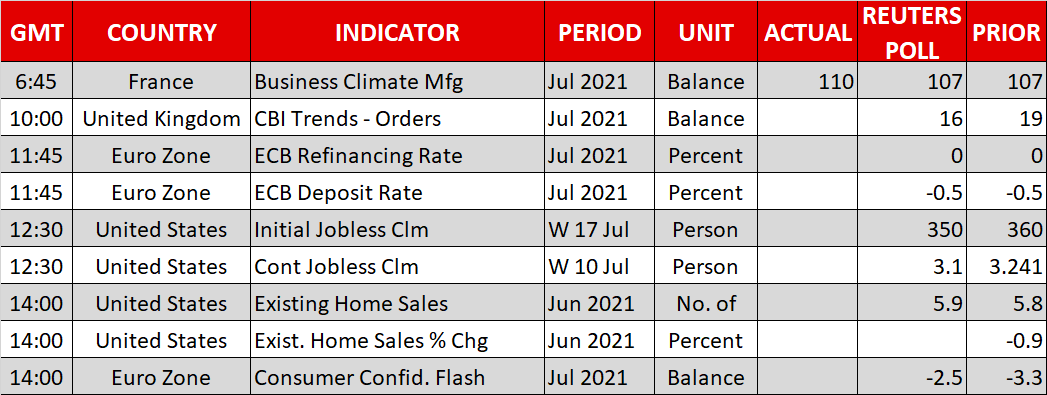
- (FR) France July Business Confidence: 113 v 113e; Manufacturing Confidence: 110 v 107e; Production Outlook Indicator: 20 v 28e; Own-Company Production Outlook: 21 v 18e.
- (FR) France July Overall Business Demand Survey: 19 v 9 prior.
- (ID) Indonesia Central Bank (BI) left its 7-Day Reverse Repo unchanged at 3.50% (as expected).
- (TW) Taiwan Jun Unemployment Rate: 4.8% v 4.3%e.
- (HK) Hong Kong Jun CPI Composite Y/Y: 0.7% v 1.2%e.
- (IS) Iceland Jun Wage Index M/M: 0.4% v 0.4% prior; Y/Y: 7.7% v 7.5% prior.
- (BE) Belgium July Consumer Confidence Index: 8 v 8 prior.
Fixed income Issuance
- None seen.
Looking Ahead
- 05:25 (EU) Daily ECB Liquidity Stats.
- 06:00 (UK) July CBI Industrial Trends Total Orders: 16e v 19 prior; Selling Prices: 44e v 46 prior’ Business Optimism: 34e v 38prior.
- 06:00 (IE) Ireland Jun PPI M/M: No est v -1.5% prior; Y/Y: No est v -7.6% prior.
- 06:00 (IL) Israel May Manufacturing Production M/M: No est v -1.2% prior.
- 06:45 (US) Daily Libor Fixing.
- 07:00 (UR) Ukraine Central Bank (NBU) Interest Rate Decision: Expected to leave Key Rate unchanged at 7.50%.
- 07:45 (EU) ECB Interest Rate Decision: Expected to leave Key rates unchanged; Expected to leave Main Refinancing Rate unchanged at 0.00%; Expected to leave Marginal Lending Facility: No est v 0.25%; Expected to leave Deposit Facility Rate unchanged at -0.50%.
- 08:00 (UK) Daily Baltic Dry Bulk Index.
- 08:30 (US) Jun Chicago Fed National Activity Index: 0.30e v 0.29 prior.
- 08:00 (UK) Daily Baltic Dry Bulk Index.
- 08:30 (US) Initial Jobless Claims: 350Ke v 360K prior; Continuing Claims: 3.10Me v 3.241M prior.
- 08:30 (US) Weekly USDA Net Export Sales.
- 08:30 (EU) ECB chief Lagarde post rate decision press conference.
- 09:00 (RU) Russia Gold and Forex Reserve w/e July 16th: No est v $593.7B prior.
- 09:00 (ZA) South Africa Central Bank (SARB) Interest Rate Decision: Expected to leave Interest Rate unchanged at 3.50%.
- 10:00 (US) Jun Existing Home Sales: 5.90Me v 5.80M prior.
- 10:00 (US) Jun Leading Index: 0.9%e v 1.3% prior.
- 10:00 (EU) Euro Zone July Advance Consumer Confidence: -2.6e v -3.3 prior.
- 10:30 (US) Weekly EIA Natural Gas Inventories.
- 11:00 (US) July Kansas City Fed Manufacturing Activity Index: 25e v 27 prior.
- 11:30 (US) Treasury to sell 4-Week and 8-Week Bills.
- 12:00 (RU) Russia Jun Industrial Production Y/Y: 11.0%e v 11.8% prior.
- 13:00 (US) Treasury to sell 10-Year Tips.
- (CO) Colombia Jun Industrial Confidence: No est v -3.2 prior; Retail Confidence: No est v 32.5 prior.
- 19:00 (AU) Australia July Preliminary PMI Manufacturing: No est v 58.6 prior; PMI Services: No est v 56.8 prior; PMI Composite: No est v 56.7 prior.
- 19:01 (UK) July GfK Consumer Confidence: -8e v -9 prior.
- 20:30 (SG) Singapore Q2 Final Private Home Prices Q/Q: No est v % prelim.
- 23:30 (TH) Thailand Jun Customs Trade Balance: $1.1Be v $0.8B prior; Exports Y/Y: 38.1%e v 41.6% prior; Imports Y/Y: 47.0%e v 63.5% prior.
ECB To Commit To Negative Rates
- ECB meets, likely to lock itself into cheap money for longer
- Wall Street approaches record highs again as Delta scare fades
- Dollar pulls back, commodity FX recovers, gold can't catch a break

ECB to strengthen forward guidance
The main event today will be the European Central Bank meeting, which should be interesting after President Lagarde promised to deliver new policy signals. The central bank recently raised its inflation target and it wants to demonstrate that it is serious about hitting it, after failing to do so for a decade.
This means committing to negative interest rates for longer and perhaps signaling that asset purchases won’t be dialed back anytime soon. The bottom line is that the ECB doesn’t want markets to think it is heading towards the exit, like the Fed or the Bank of England are doing. It wants to stress that it will remain in cheap money policies far longer.
The market reaction today is tricky to call. The ECB will definitely take a step in a more dovish direction, which would normally be negative for the euro, but markets already expect as much. Ergo, the reaction will boil down to whether the ECB’s message is more dovish than what investors anticipate. If not, the euro could even enjoy a relief bounce.
In the bigger picture though, this is bad news for the euro. The ECB is locking itself into negative rates while the Fed and other major central banks are moving towards higher rates, crystalizing the divergence in monetary policy. This could cement euro/dollar at lower levels, as the euro remains the market’s favorite funding currency for carry trades.
Stocks storm higher
The panic that gripped Wall Street earlier in the week has all but vanished, with the major US indices heading back towards their record highs. There’s been no real catalyst behind this sudden change of heart.
The strong earnings and cheerful guidance by several heavyweights might have dispelled some Delta blues, but probably didn’t move the needle much. Instead, investors seem to be falling back to the only trade that keeps on delivering - long stocks.
The only real risk on the horizon is a Fed tapering decision, although even that might prove to be a mere speed bump in this incredible rally. Monetary stimulus will be dialed back extremely slowly and cautiously, with the Fed holding the market’s hand at every step. That could keep the party going, especially if Congress delivers more fiscal juice soon.
Dollar takes a breather, commodity FX recovers
The newfound calmness in stock markets was also evident in the FX sphere. The US dollar took a step back as traders rotated away from defensive plays, allowing risk-sensitive currencies like the aussie, kiwi, and loonie to recover. Oil prices also bounced back powerfully as the mood improved, helping the loonie further.
But gold prices remain under pressure. Bullion has drawn the shortest straw in this latest market rotation, unable to rally during the brief panic as the dollar strengthened, and now getting hammered by rising Treasury yields as the bond market calms down.
The dollar has essentially replaced gold as the market’s favorite defensive instrument since the crisis started. And the future doesn’t seem bright either. The Fed will be phasing out cheap money policies, which ultimately argues for higher real yields and a firmer dollar, spelling trouble for gold.