

Sample Category Title
Japan exports rose 48.6% yoy in Jun, 4th month of double-digit growth
Japan's exports rose 48.6% yoy to JPY 7220B in June. That;s the fourth straight month of double-digit growth, even though it's largely exaggerated by the pandemic plunge last year. By destination, exports to China jumped 27.7% yoy, led by demand for chip-making equipment, raw materials and plastic. Exports to US also rose 85.5% yoy, driven by cars, auto parts and motors. Imports rose 32.7% yoy to JPY 6837B. Trade surplus came in at JPY 383B.
In seasonally adjusted terms, exports rose 2.4% mom to JPY 7040B. Imports rose 4.0% mom to JPY 7130B. Trade balance turned into deficit of JPY 0.09T, versus expectation of JPY 0.02T surplus.
BoJ Masayoshi: Inflation sluggish and powerful easing necessary
BoJ Deputy Governor Amamiya Masayoshi said speech, an uptrend in private consumption is expected to "become evident" as the impact of COVID-19 wanes gradually and employee income increases". The "virtuous cycle" in the "corporate sector" will spread to the "household sector", and "intensifying the cycle in the overall economy." Nevertheless, the baseline scenario entails "high uncertainties" with risks "skewed to the downside" on the spread of variants. But activity could improve more than expected as vaccine rollout accelerates.
Masayoshi also said that it will "take time" to achieve price stability target of 2% inflation. He added, "while the inflation rate has risen clearly of late in the United States and other countries, it has been sluggish in Japan." Giver this, "it is necessary for the Bank to persistently continue to conduct powerful monetary easing with a view to achieving the price stability target."
Elliott Wave View: Nikkei Rally Likely To Fail
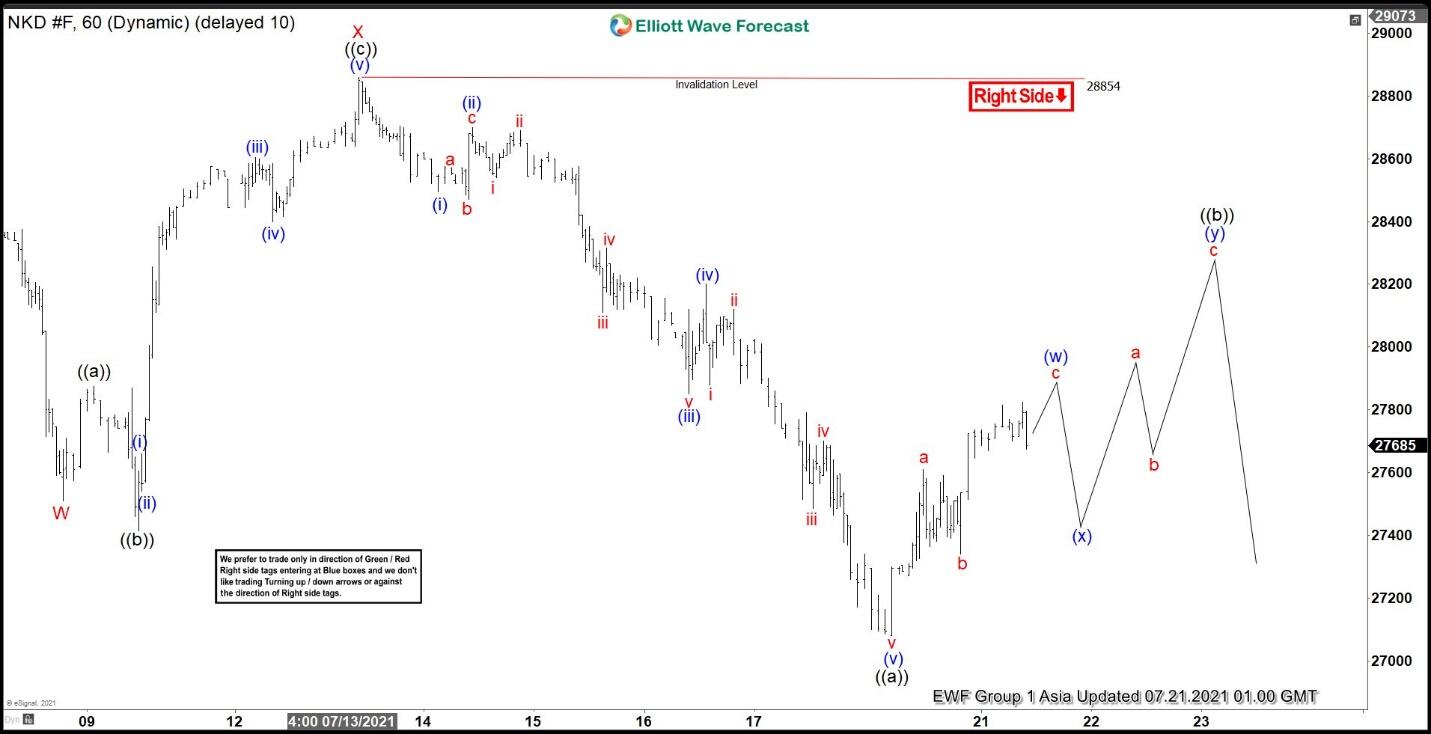
Elliott Wave structure of Nikkei (NKD) shows incomplete sequence from February 16, 2021 high as well as from June 15, 2021 high suggesting further downside is likely. From June 15 peak, the Index shows a 5 swing sequence which is an incomplete sequence that needs further downside. The decline from June 15 is unfolding as a double three Elliott Wave structure. Down from June 15, wave W ended at 27510 and rally in wave X ended at 28860. Internal subdivision of wave X unfolded as an Expanded Flat where wave ((a)) ended at 27875, wave ((b)) ended at 27415, and wave ((c)) ended at 28860.
The Index has resumed lower in wave Y as a zigzag Elliott Wave structure. Down from wave X, wave (i) ended at 28495, and rally in wave (ii) ended at 28700. The Index resumes lower in wave (iii) towards 27850 and bounce in wave (iv) ended at 28200. Final leg lower wave (v) ended at 27080 which should complete wave ((a)) in higher degree. Bounce in wave ((b)) is in progress to correct cycle from July 13 peak before the decline resumes. Near term, as far as July 13 pivot high at 28854 stays intact in the first degree, expect rally to fail in 3, 7, or 11 swing for more downside.
Nikkei 60 Minutes Elliott Wave Chart
AUD/USD Gains Bearish Momentum, 0.7250 Next?
Key Highlights
- AUD/USD is following a bearish path and it broke the 0.7400 support.
- A key bearish trend line is forming with resistance near 0.7410 on the 4-hours chart.
- EUR/USD remains well below 1.1850, GBP/USD accelerated lower below 1.3700.
- Crude oil price declined heavily below the $70.00 support zone.
AUD/USD Technical Analysis
The Aussie Dollar started a steady decline from well above 0.7500 against the US Dollar. AUD/USD broke the 0.7400 support zone to move further into a bearish zone.
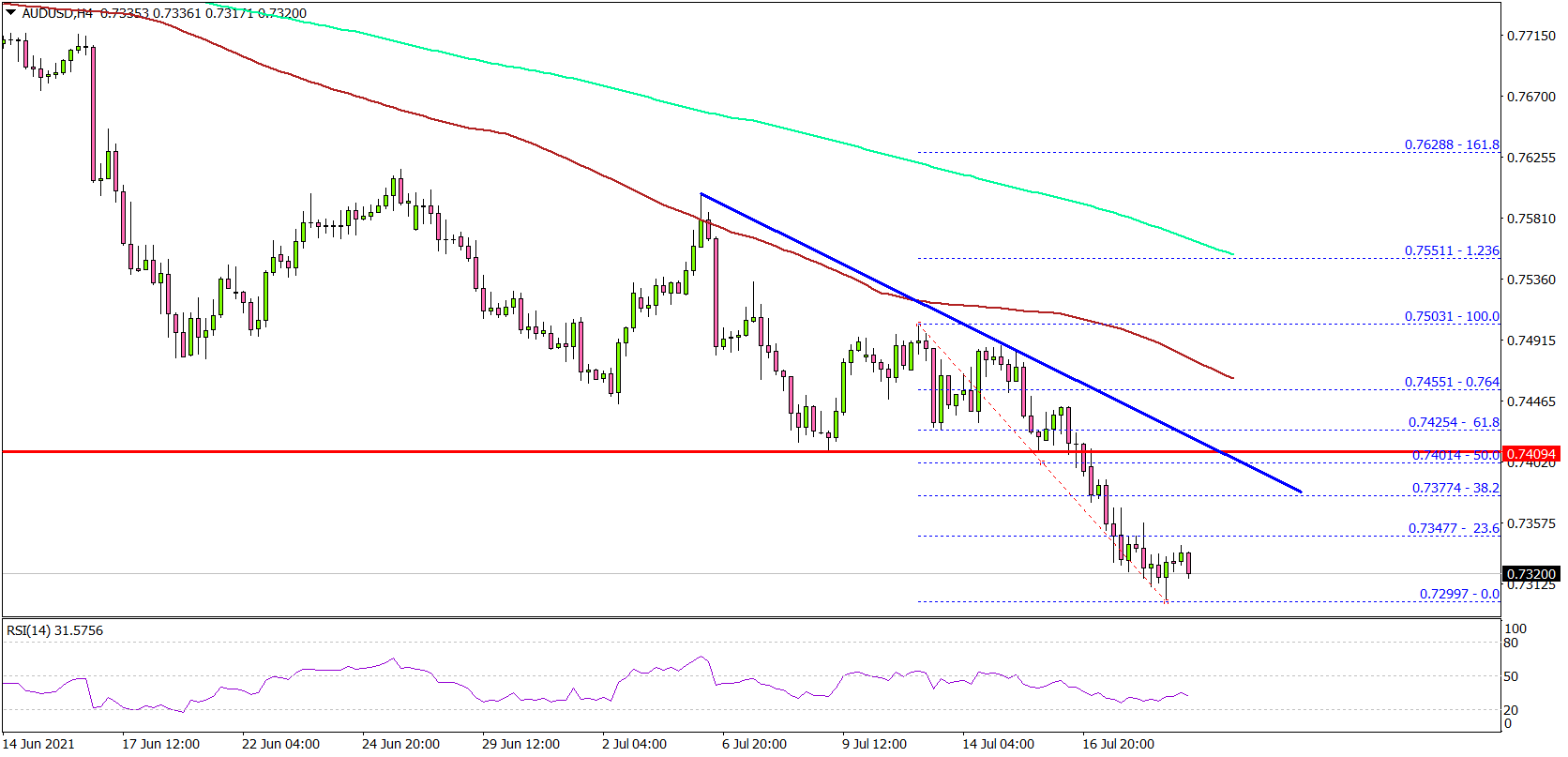
Looking at the 4-hours chart, the pair gained bearish momentum below 0.7400 and 0.7380. The pair even settled well below 0.7400, the 100 simple moving average (red, 4-hours), and the 200 simple moving average (green, 4-hours).
The pair is facing resistance near the 0.7355 level. It is close to the 23.6% Fib retracement level of the recent decline from the 0.7503 swing high to 0.7299 low.
The main resistance is now forming near the 0.7400 level. It is near the 50% Fib retracement level of the recent decline from the 0.7503 swing high to 0.7299 low. There is also a key bearish trend line forming with resistance near 0.7410 on the same chart.
To start a strong recovery, the pair must settle above 0.7400. Conversely, the pair might continue to move down below 0.7300. The next major support is near the 0.7250 level.
Looking at EUR/USD, the pair is still trading in a bearish zone below 1.1850. Besides, GBP/USD accelerated losses below the 1.3700 level.
Economic Releases
Canada’s New Housing Price Index (NHPI) for June 2021 (MoM) - Forecast +1.8%, versus +1.4% previous.
Eco Data 7/21/21
[php_everywhere instance="1"]
ECB Preview: New Forward Guidance to Reflect New Inflation Target
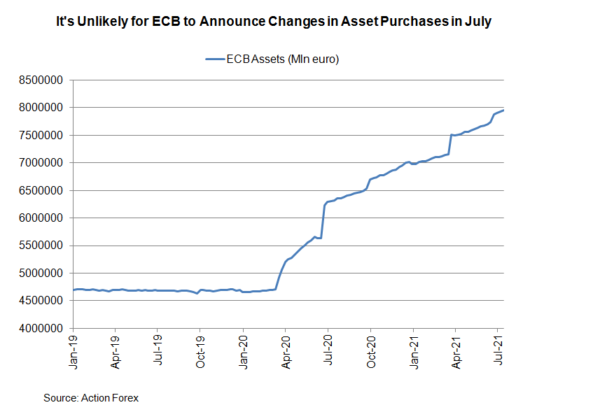
ECB’s conclusion of the strategy review on July 8 has made this week’s meeting very important. Policymakers adjusted the inflation target to a symmetric 2%, allowing a temporary overshoot. Despite the significant change, no monetary policy is expected to change in July. We only expect some changes in the forward guidance, in reflection of the new inflation target. We are not confident that the forward guidance would be huge, given the disagreement among members over the monetary policy outlook.
To the market’s surprise, the ECB published the conclusions of its strategy review on 8 July. The most crucial conclusion of the review is the change in the inflation target. The central bank judged that price stability is best maintained by aiming for “2% inflation over the medium term. The Governing Council’s commitment to this target is symmetric”, meaning that “the Governing Council considers negative and positive deviations from this target as equally undesirable”. This marks a shift from the ambiguous “below, but close to 2%” target previously. The central bank also nodded to a temporary overshoot of inflation. As noted in the statement, the new inflation target “may also imply a transitory period in which inflation is moderately above target”. This signals that policy easing should continue for some time.
While we do not expect any monetary policy to change at the upcoming meeting – changes should be made in September, alongside updates in economic projections, a change in forward guidance would be needed at least. Currently, the forward guidance suggests that policy rates are expected to “remain at their present or lower levels until we have seen the inflation outlook robustly converge to a level sufficiently close to, but below, 2% within our projection horizon, and such convergence has been consistently reflected in underlying inflation dynamics”. At minimum, it would have to be changed to “… close to 2%...”, reflecting the new inflation target.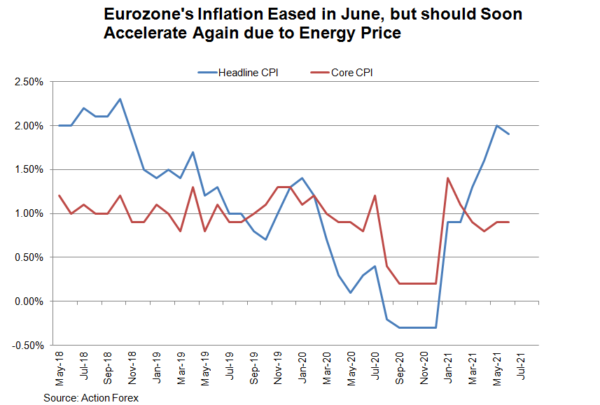
The guidance on PEPP and APP programs will remain intact. That is, the PEPP will last until the end of March 2022 or “until the Governing Council judges that the coronavirus crisis phase is over”. The purchase ceiling would remain 1.85 trillion euro but the central bank might water down the possibility that it would not be used in full, given the resurgence of coronavirus cases in a number of European countries. The APP will continue to run until “shortly before” the first rate hike.
We expect changes to the forward guidance to be mild as the members remained divided over the outlook of the asset purchases programs. As revealed in the June minutes, there was “a broad consensus” in favour of maintaining the current level of purchases delivered by the PEPP. Yet, some hawks insisted in scaling back some of the stimuli. Given the current inflation level, the conclusion of the strategic review has indicated a dovish bias to ECB’s monetary policy outlook. However, a split Governing Council suggests that any change in the monetary policy could hardly come without intense debate.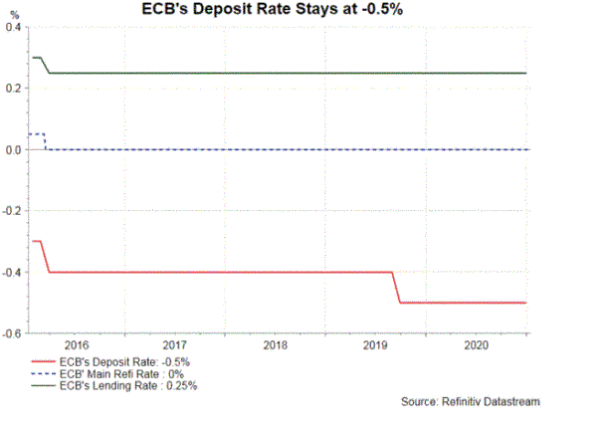
An Unconvincing Rebound, Oil Stabilizes, Gold Supported at 1800
Stock markets are back in the green on Tuesday but already we are seeing frailties in the rebound, with Europe having given back a chunk of its earlier gains. The run into the close may provide some comfort.
These are nervy times for the markets, with surging Covid cases – particularly here in the UK – and inflation concerns dampening the optimism that we’ve seen at times this year. Vaccines should ensure case numbers don’t lead to the level of fatalities and lockdowns we’ve seen over the last 18 months but if that false sense of security also encourages greater risk-taking – like removing all restrictions during a surge, for example – the second half of the year may not be as bright as many hoped.
Inflation makes life a little harder for policymakers as they debate how transitory it is and at what point action might be necessary. This perhaps complicates the belief that central banks will always have the markets back. Should the price pressures persist, policymakers’ hands will be more tied than they’ve been for some time.
That being said, this isn’t the time to panic and I would be surprised if we see too strong a reaction in the markets. We’re only seeing a very minor pullback at this stage and that’s perfectly healthy. Policymakers have plenty of time to determine the risk that inflation poses and what, if any, the response should be.
Bitcoin below USD 30,000 but showing some resilience
Bitcoin has fallen back below USD 30,000 for the first time in almost a month and we’re seeing losses across the crypto space today, perhaps a sign of more expected downside ahead. This has long been viewed as a key psychological level for bitcoin so it could be argued that it’s shown a fair amount of resilience, given the fairly limited sell-off, by its own standards.
As we saw last month, a move below USD 30,000 doesn’t guarantee we’ll see large losses but we may start to see nerves tested. Crypto bulls may even be encouraged by the apparent resilience so far, although the trend over the last couple of months doesn’t look too favourable.
It may not take much for the sell-off to gather momentum and big losses appear and it won’t be long until the importance of USD20,000 is being discussed. It could make for an interesting, albeit nervy, few weeks for crypto fans.
Gold remains well supported
We’re still seeing risk aversion in the markets, despite a rally earlier in the day and some positive moves into the close. Gold found support around USD 1,800 and moved back above USD 1,820, before giving some back. This comes as US yields continue to edge lower and as the dollar squeezes out another day of gains.
The yellow metal has been well supported in recent weeks and that could continue as long as policymakers hold their nerve in the face of higher inflation. The environment remains highly accommodative but challenges remain in the final months of the year which may encourage patience and continue to be supportive for gold prices.
Higher inflation has been making life a little harder for policymakers as they debate how transitory it is and at what point action might be necessary. This perhaps complicates the belief that central banks will always have the markets back. Should the price pressures persist, policymakers hands will be more tied than they’ve been for some time.
Oil steady after rough start to the week
Oil prices are holding steady on Tuesday after taking a hit on Monday on the back of the OPEC+ agreement and nervousness over the growth outlook for the rest of the year, given recent surges. Prices are still elevated compared to what we’ve seen since the pandemic hit but that’s to be expected as countries navigate themselves through the final stages of it.
WTI saw some support around USD 65 again today, around the levels it was peaking at late in the first quarter and well into the second. A move below here may signal some near-term downside momentum but I expect it would be quite limited given the longer-term outlook for many countries and how the exit strategy is being managed by OPEC+.
July Flashlight for the FOMC Blackout Period
Summary
- The July 27-28 FOMC meeting is not expected to bring any changes in policy or even major hints on the timing of an eventual change. Without updated economic projections or a fresh “dot plot,” the July meeting will be about word games.
- Since the June meeting, job growth strengthened more than anticipated and inflation continued to come in much hotter. That will keep eyes and ears keenly attuned to signs that the FOMC may pull forward the eventual tapering of asset purchases, a topic it has already confirmed will be on the table.
- We still expect the FOMC to hold off on a formal announcement of tapering until its December 14-15 meeting, with purchases starting to be reduced in January of next year at a pace of $10B per month for Treasury securities and $5B per month for mortgage-backed securities (MBS).
- Market participants generally appear on board with a late 2021 announcement as well, which is key to avoiding another tantrum. Perhaps most importantly, committee members are split in their views, and it will take time to build a consensus.
- Potential catalysts for an earlier taper stem from inflation continuing to surprise to the upside, which might convince Fed officials that recent price pressures will be longer lasting, and a growing discomfort on the part of some officials about MBS purchases at a time when home prices are soaring.
- Less appreciated is the risk that tapering will not be announced until 2022. The case here rests on the fading fiscal support and concerns over COVID due to variants or the duration of vaccine effectiveness, any of which could lead to a sharper slowdown in activity. After years of undershooting its inflation goal and with an appreciation of how a strong labor market can support marginalized workers, the FOMC might err on the side of supporting the labor market and take a slower approach to adjusting policy.
Stay Tuned for Scenes from the Next Episode
Like any good episodic TV series, the June FOMC meeting was comfortably routine and predictable in some ways and yet just interesting enough to hold your attention with developments that were not entirely expected, and critically, it ended on a cliff-hanger.
Even though the upcoming meeting is in July, we are not expecting any fireworks. Without a Summary of Economic Projections and a new dot plot, the only thing to unpack will be the subtle nuances of language. At some point, we expect the FOMC will finally offer clear guidance on when it will begin to taper its pace of asset purchases, but this meeting is not it. In a nutshell, the July FOMC meeting will mostly be about word games. What policymakers say in the carefully crafted statement and what Chair Powell says in the press conference will be seized upon for every possible indication it might offer about the timing of the eventual tapering of asset purchases.
Although it is increasingly evident that inflation is rising more quickly than the Fed expected, most Fed policymakers are looking past the inflation data for now, convinced of their thesis that the nature of surging prices is transitory and determined to draw tight the slack it still sees in the labor market. Our own forecast suggests that inflation is more enduring than what policymakers currently expect, but decisions about tapering will be made on their forecast, not ours. So even though we have our doubts about just how transitory various inflation factors may be, we maintain our call that the FOMC will not formally announce a plan to reduce asset purchases until its December 15 meeting, with tapering kicking off in January.
In this July FOMC preview, we: (1) Recap where we left off with Fed policy in June, (2) cover what has happened over the inter-meeting with respect to employment and inflation, (3) explain our rationale for a formal taper announcement in December and (4) lay out the risks to tapering being announced either earlier or later than our December call.
At some point, we expect the FOMC will finally offer clear guidance on when it will begin to taper its pace of asset purchases, but this meeting is not it.
Concerns Over Inflation Were Rising Before June's Hot Data
At its June meeting, the FOMC made no policy changes. The fed funds rate was left between 0.00% and 0.25% and the $120B monthly pace of asset purchases was maintained. That was all as expected. The June Summary of Economic Projections, however, brought a notable shift in the dot plot. Of the 18 committee members, seven expected the fed funds rate to be higher at the end of next year, up from four in March, and 11 members penciled in at least two rate hikes by the end of 2023. The expectation for an earlier liftoff for rates was largely a function of the fact that most members raised their inflation forecasts and saw risks to those higher estimates as skewed to the upside.
There were also some technical tweaks, which we had been expecting and had written about in prior versions of this Flashlight publication. Specifically, the FOMC raised the interest rate that the Fed pays to banks on reserves that they hold at the central bank, as well as the rate on the Fed's reverse repurchase agreement facility. These are technical adjustments that are meant to improve functioning in money markets rather than a signal of imminent monetary tightening.
The cliff-hanger ending came in the press conference. When asked about the eventual timing of tapering asset purchases, Chair Powell said, "You can think of this meeting that we had as the 'talking about talking about' meeting, if you like." In other words, the FOMC got the ball rolling on the process of eventually tapering, and according to the meeting minutes, agreed to continue discussions at "coming meetings."
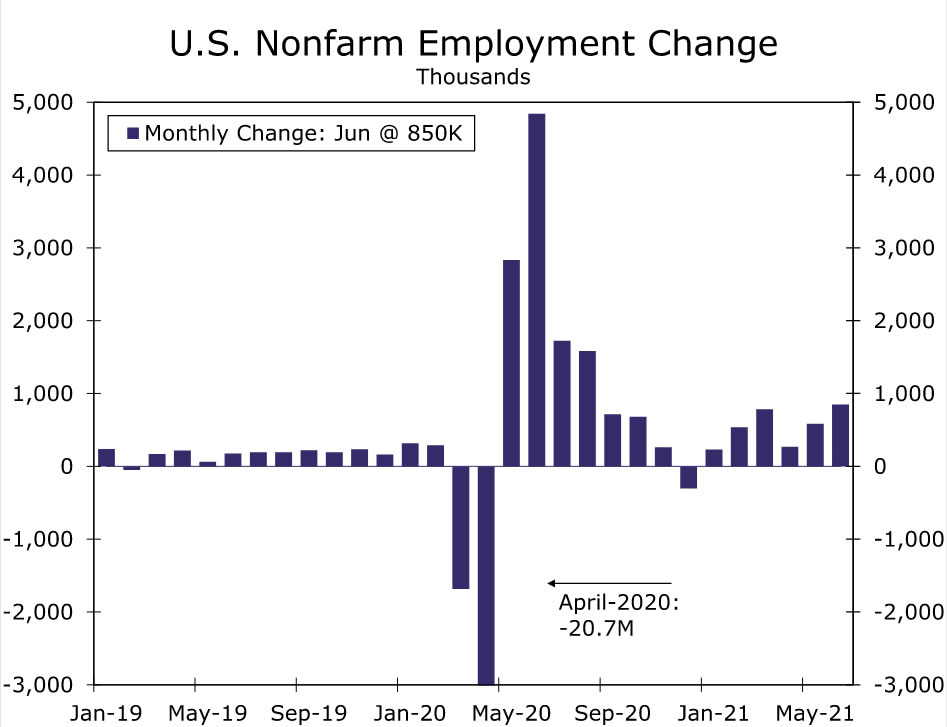
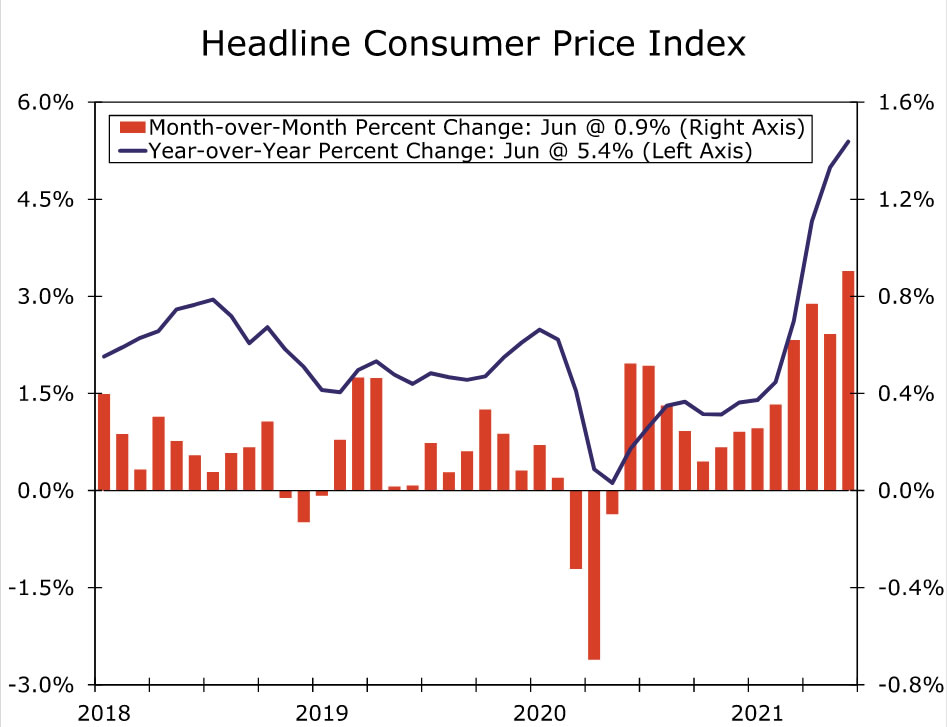
The FOMC has tied its taper timing to when "substantial further progress" is made on the Fed's employment and price stability goals. Since its previous meeting, we have seen notable headway on both those fronts. Job growth strengthened in June with employment up 850K, the most since last August (Figure 1). Workers are also seeing big pay increases, with average hourly earnings rocketing higher in low-pay industries. Notably, inflation continues to surprise to the upside. The Consumer Price Index rose a scorching 0.9% in June, roughly double estimates, while U.S. producer price inflation also jumped and is up more than 7% over the past year (Figure 2).
Eyeing a December Announcement to Reduce Asset Purchases
Between the FOMC stating discussions are starting on asset purchases and progress on employment and inflation picking up, it seems a tapering announcement is drawing nearer. Yet, we still do not anticipate a formal announcement until the December 15 meeting, where purchases begin to decline in January at a pace of $10B per month for Treasury securities and $5B per month for mortgage-backed securities (MBS).
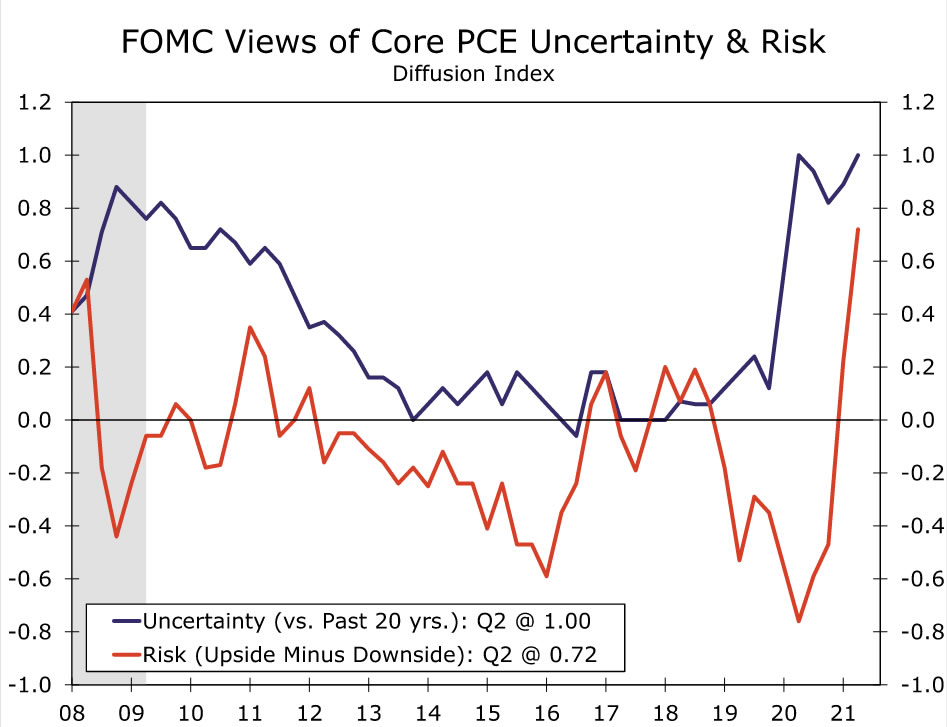
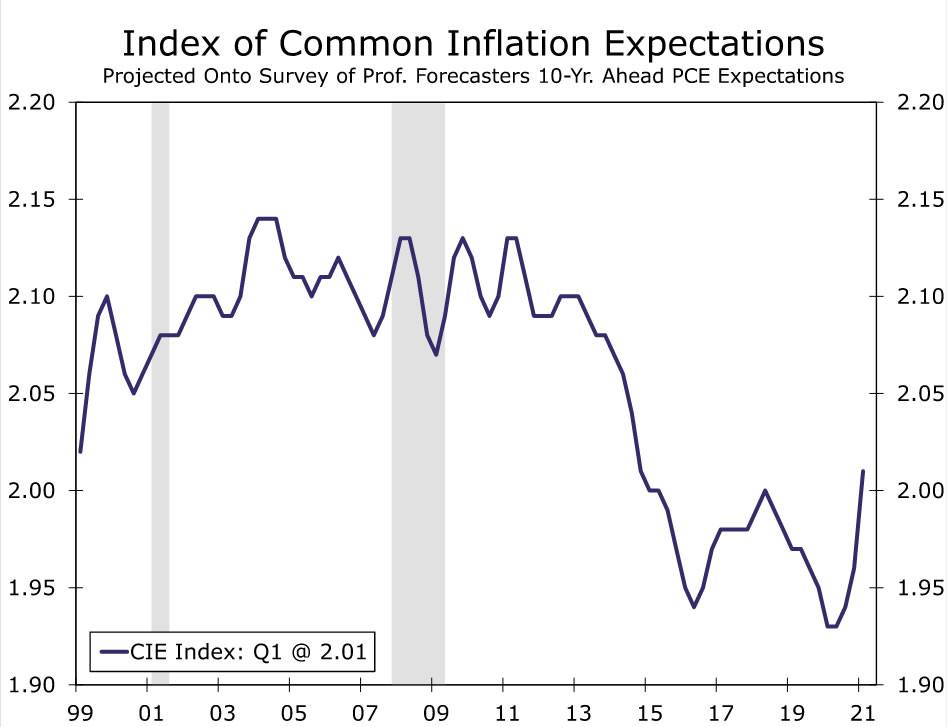
For one, it seems that many FOMC members want a clearer view on how inflation and hiring will unfold beyond the first few months of reopening and amid fading fiscal support. While inflation has come in hotter than expected the past few months, Chair Powell has maintained the view that the spike is temporary. But, uncertainty is historically high, with several FOMC members noting inflation cannot be accurately assessed at this point (Figure 3). The Fed's outcome-based approach therefore seems to warrant a few more months of data, especially since Fed officials have remarked that inflation expectations remain consistent with inflation running at 2% over the long run (Figure 4).
Similarly, Fed officials appear to want more progress on employment and a clearer view of labor market conditions once factors contributing to current labor shortages have time to fade. According to the June minutes, participants expected conditions to improve "throughout the summer and into the fall." Yet, we do not expect to get a decent read on how much childcare issues related to remote learning or the expiration of extra unemployment benefits are affecting the labor market until the October jobs report, which be published on November 5, two days after the November FOMC meeting concludes.
More broadly, there appears to be a split within the FOMC between members wanting to see more progress and more information and those thinking conditions will be met earlier than previously thought. Building a consensus will take time.
An announcement at year-end also makes sense from a market perspective. Avoiding a "taper tantrum" like in 2013 is at the forefront of policymakers' minds. That means getting markets on the same page with regard to timing. Surveys suggest most market participants seem to expect asset purchases to start declining in Q1.1 We suspect the Fed would not risk rocking the boat on that assumption and do not believe it would have enough runway to prepare markets for an earlier kickoff. The December FOMC meeting will include updates to the Summary of Economic Projections and the dot plot, which should also help the Fed communicate its outlook to the market. Continuing asset purchases at their current pace through December would also reduce the risk of any year-end related liquidity issues.
4% Inflation: The Case for Tapering Earlier
An additional reason we have maintained our forecast for a tapering announcement at the December FOMC meeting is that we believe this meeting has the best balance of risks from a timing perspective. Most market participants seem focused on the possibility of a sooner-than-expected taper. In many ways, this makes sense. The Federal Reserve began buying at the current pace of $80 billion of Treasury securities and $40 billion of MBS per month about a year ago. At the time, the U.S. economy was still in dire straits as it emerged from one of the sharpest contractions in output and employment in American history. Fast-forward to today and the U.S. economy is far from a full employment and stable inflation nirvana, but it is clearly no longer on the cusp of collapse either. Accordingly, the case for an emergency setting for monetary policy is much weaker.
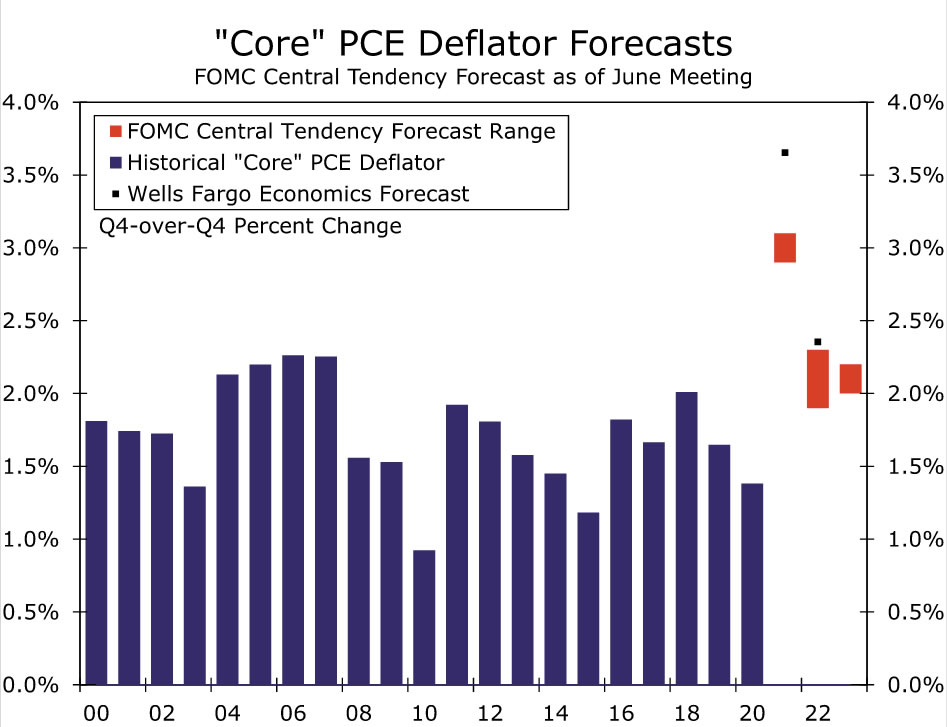
If the FOMC announces a taper before December, we suspect it would occur at the November 3 meeting. Anything earlier than this strikes us as unlikely. By the November meeting, our baseline forecast projects the economy will have recovered half of the jobs that were missing when the committee first stated it would need to see "substantial further progress" toward its maximum employment and price stability goals. Our forecast for inflation as measured by the core PCE deflator is 3.7% year over year in Q4-2021, about 70bps above the FOMC's median projection from the June meeting (Figure 5). If the employment and/or the inflation data are even just a little stronger than we expect over the next few months, one could easily argue the Fed's criteria has been met to start tapering.
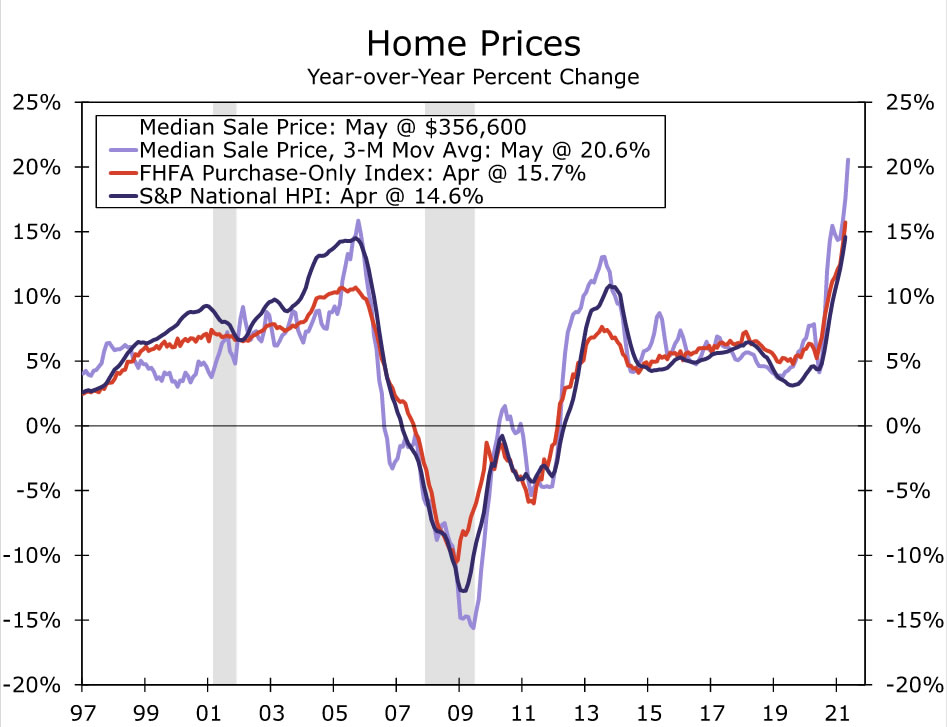
The run up in home prices over the past year could serve as another factor to push the FOMC to start tapering a bit earlier than our baseline forecast (Figure 6). The June FOMC minutes made clear some officials were weary of recent home price gains and suggested scaling back MBS purchases more quickly or earlier than Treasury purchases. We suspect the FOMC would want to avoid the complication of a two-tiered taper, but the discomfort over supporting the housing market could pull forward the kickoff of what we expect to be an evenly paced tapering process between MBS and Treasury purchases.
Not Your Grandfather's Fed: The Case for a Later Taper
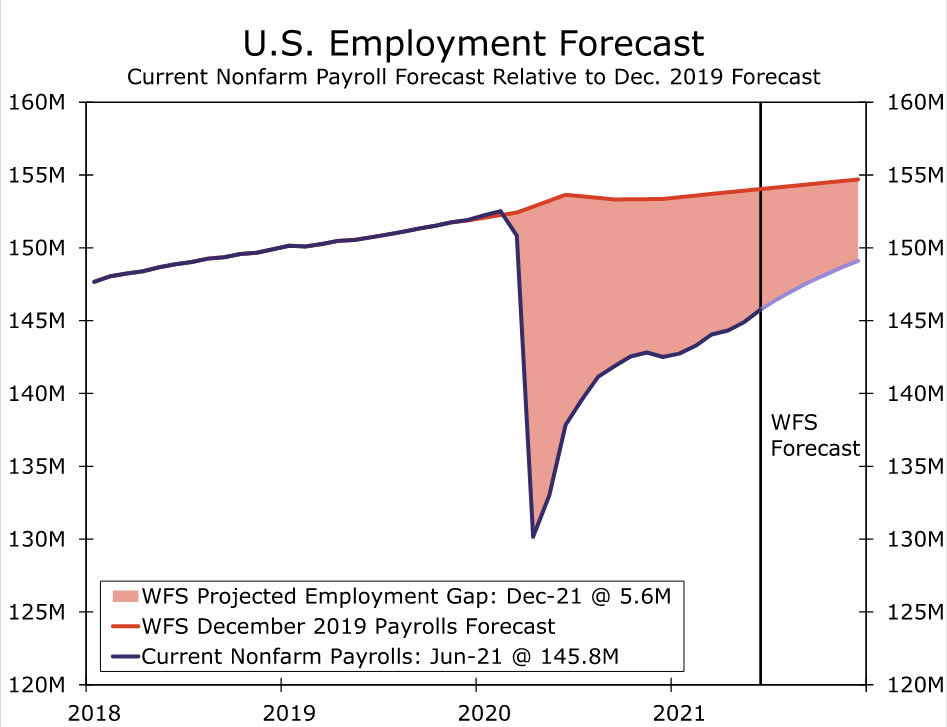
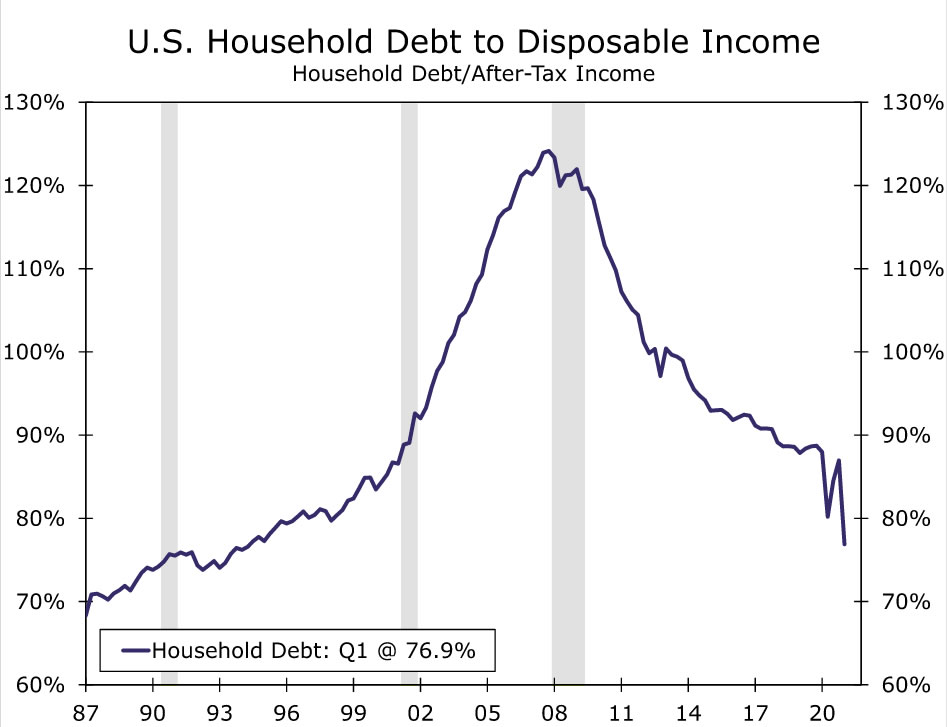
The scenario in which the taper is announced sometime later than the December FOMC meeting is perhaps a bit more difficult to envision during the summer boom of 2021 and recent upside surprises to both job growth and inflation, but we do believe it is a possibility. Even in our above-consensus baseline forecast, at year-end the U.S. economy is still short about 3.5 million jobs compared to the pre-pandemic level of employment, and this rises to roughly 5.5 million when counting the employment gains that likely would have occurred in the absence of the pandemic (Figure 7). On inflation, the recent overshoot of the Fed's target still pales in comparison to the years of below-target inflation that prevailed for most of the 2010s. Although home prices have skyrocketed, the culprit does not appear to be households over leveraging or banks lending to riskier borrowers. Unlike the mid-2000s, the aggregate household debt-to-income ratio is not on an upward ascent (Figure 8), and in Q1-2021 73% of mortgage origination volume went to borrowers with a credit score of 760 or above, much higher than the average of 24% in 2006.
Thus, if job growth disappoints and/or inflation cools sooners than we anticipate, the FOMC may choose to delay its tapering plans a bit longer in order to ensure the coast is clear. It is not especially hard to imagine the conditions in which growth and inflation disappoint later this year. The fiscal impulse from the two major COVID relief bills passed in December 2020 and March 2021 will have largely faded by the fall, and the snapback to more "normal" economic growth rates could occur much sooner than expected if consumers do not lean on their pile of pandemic-induced savings to sustain robust spending growth.
The public health front also looms as a possible downside risk. New variants and the durability of immunity are still being studied, many workers and children are set to return to offices and schools in the fall and colder weather has been a catalyst for higher case counts as people spend more time indoors. Even if economic growth is still solid on an absolute basis, a notable downshift on a relative basis could give Fed policymakers some pause. Under this scenario, perhaps the FOMC waits a few more months to begin the tapering process. By that time, the economy should be through the worst of any winter-related COVID disruptions, and the additional economic data points will provide more information on the true run rate for economic growth and inflation.
Although this is not our base case, it is a possibility we feel is underappreciated, and it makes us more comfortable with our forecast of a tapering announcement in December. Certainly, the FOMC is concerned about inflation that is well above-target at present. That said, its new framework allows greater leeway on inflation overshooting 2%, while at the same time putting greater emphasis on the need to support the labor market. In addition, the past decade is littered with examples of central banks turning off the spigot too soon only to be disappointed later on by anemic growth and inflation. We suspect many members of the FOMC are just as concerned about repeating these past mistakes as they are with the prospects of overheating, and will err on the side of over-weighting the labor market rather than inflation.
Against this backdrop, we think a projection for a taper announcement at the December FOMC announcement still makes sense, but we acknowledge that conditions could evolve such that the announcement comes a bit earlier or later than that forecast.
ECB Meeting: Locking in Negative Rates for Longer
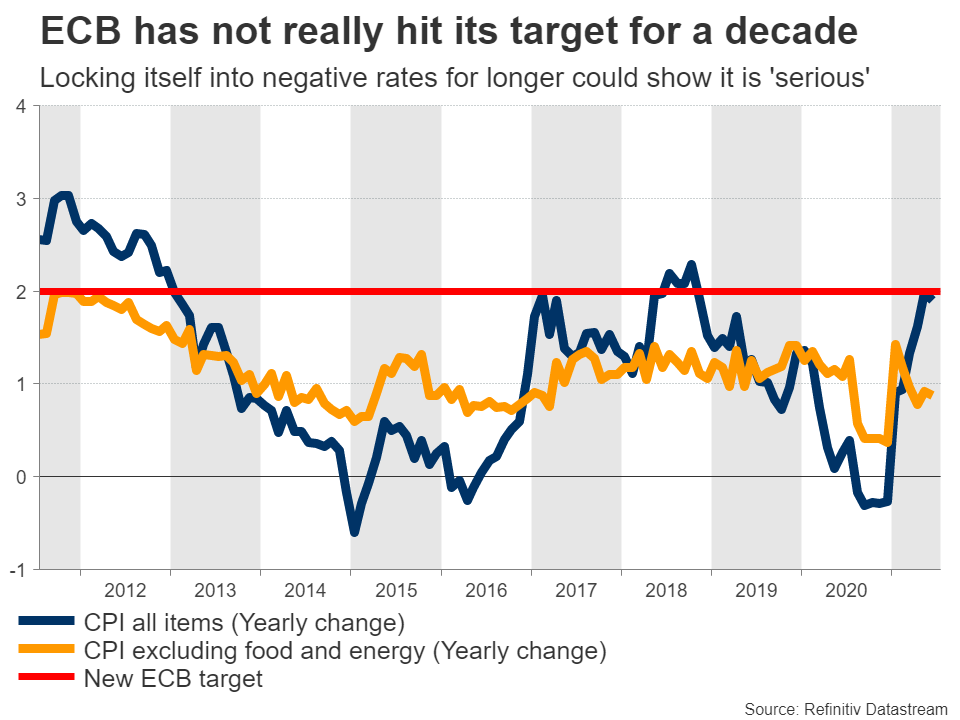
The European Central Bank will try to demonstrate that it is serious about hitting its new inflation target when it concludes its meeting at 11:45 GMT Thursday, probably by locking itself into negative rates for longer. That could solidify the coming divergence with other central banks that will be raising rates, which is bad news for the euro.
Getting serious
ECB President Lagarde promised to deliver new policy signals at this meeting, so it should be interesting. The central bank has been unable to hit its inflation target sustainably for a decade now, and yet it raised that target earlier this month. It now wants to demonstrate that it is committed to hitting this higher target.
This means signaling that negative interest rates are here to stay. If the ECB is really serious, it could also signal more quantitative easing for longer. As things stand, the pandemic asset purchase program will end next year. Policymakers want to stress that stimulus won’t be dialed back automatically just because of that. They could extend that program or replace it with something similar.
Another option is decoupling the forward guidance on interest rates and quantitative easing. Until now, the ECB kept repeating that it will end asset purchases shortly before it raises interest rates, some time in the distant future. Separating the two would imply that asset purchases can continue even after rates rise.
The bottom line is that the ECB doesn’t want markets to think it is heading towards the exit, like the Fed or the Bank of England are doing. It wants to stress that it will remain in cheap money policies far longer. That way it gains credibility on inflation.
Delta blues
The latest developments in the Eurozone support the ECB’s cautious stance. While reopening momentum is still strong, the Delta variant is spreading like wildfire, threatening the economic outlook.
Spain, Portugal, and the Netherlands have seen new covid outbreaks lately, despite widespread vaccinations. While hospitalizations and deaths are still low, mild restrictions to control the spread are plausible. In fact, some regions in Spain have already imposed new curfews.
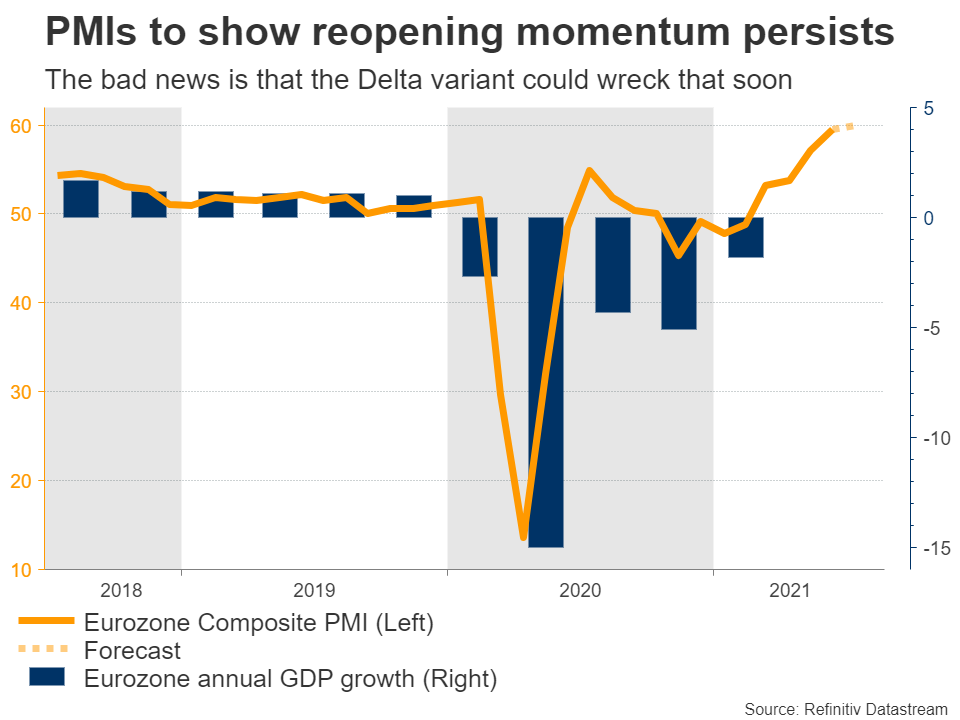
We’ll find out how the economy is doing early on Friday when the PMI surveys for July are released. These tend to be a big event for the euro. Forecasts point to an improvement overall in the PMIs, with a slight slowdown in the manufacturing sector being more than offset by an acceleration in services.
Policy divergence is bad news for euro
All told, with the ECB locking itself into negative rates but the Fed and other major central banks moving towards rate increases over the coming years, the outlook for euro/dollar seems negative. The last time these two central banks drifted in opposite directions was in 2014-2015, a period when euro/dollar was decimated.
What’s the main risk around this view? It’s probably the Delta variant. Not only has it infected several countries in Europe but it is also rampaging Australia and Asia, leading to fresh lockdowns. Emerging market economies are highly vulnerable given their low vaccination rates.
If this impacts global growth, that could slow down the Fed’s normalization plans, potentially lifting euro/dollar. That said, it is unlikely to derail those plans. The Fed will still normalize, it just might take longer until we get there, so the overall trend in euro/dollar still seems negative.
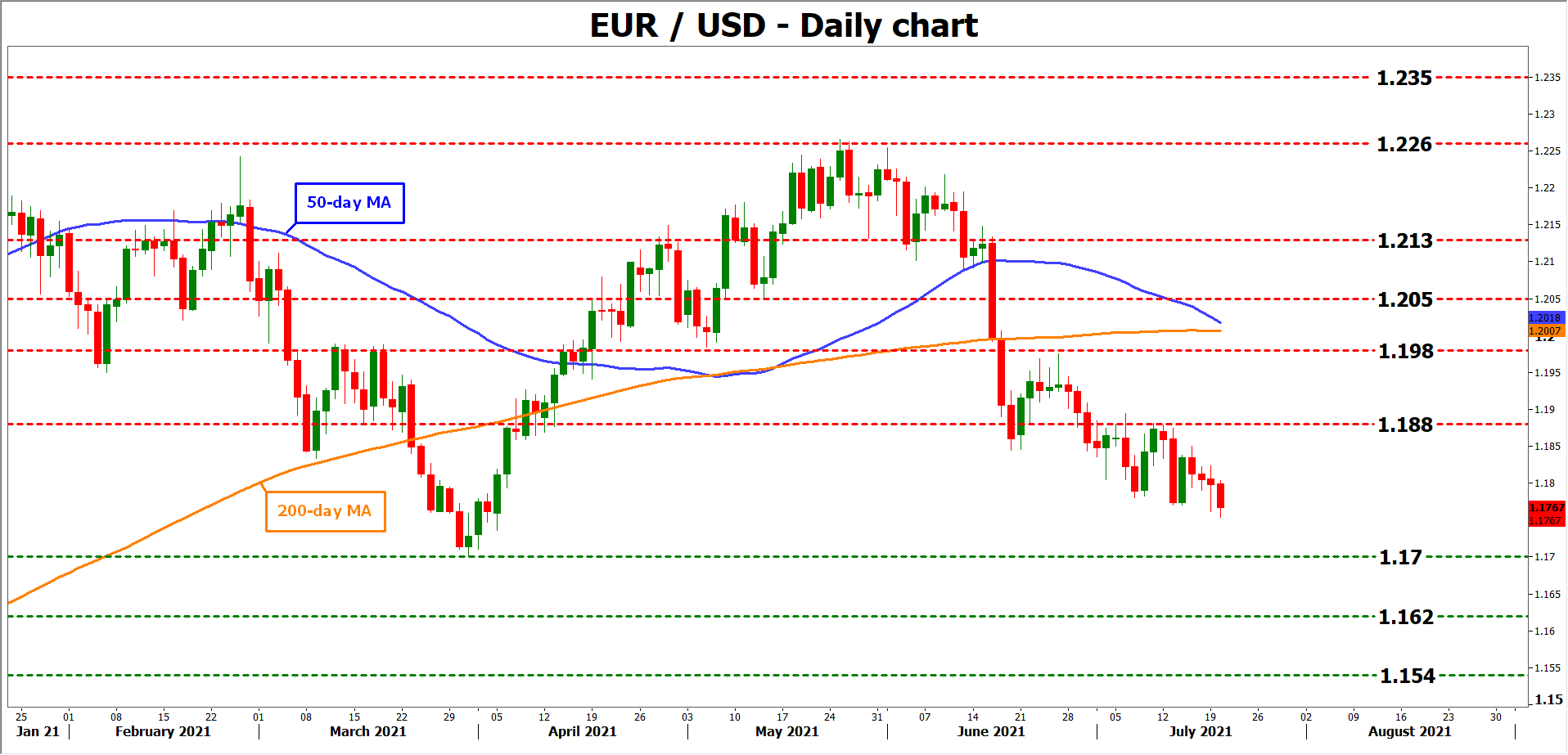
Taking a technical look at the pair, further declines could encounter support near the 1.1700 handle, a potential break of which would turn the focus towards 1.1620.
On the upside, if the ECB doesn’t sound dovish enough or if global growth worries make the Fed hesitant, initial resistance to advances could come from the 1.1880 zone. If the bulls overcome that, their next target may be the 1.1980 region.
Sunset Market Commentary
Markets
Today wasn’t as gloomy as yesterday but that’s basically it. European stocks opened in green with gains of about 0.5-1% but those evaporated as the session evolved and turned more grim. WS opens with minor, unconvincing gains. Testament to the pessimistic global sentiment is the further significant decline in core bond yields. US yields again shed several bps with the belly of the curve outperforming wings. That said, short tenors still decline 2.4 bps (2y) as markets further price out Fed rate hikes. Other declines vary from -6.7 bps (5y) to -3.5 bps (30y). The 10y (-4.6 bps) heads further south after breaking support around 1.20%. Technical charts now suggest a return towards 1%. German Bunds rally as well with the curve bull flattening -3.4 bps in the 2y to -6.7 bps in the 30y yield (now 0.02%) that’s on his way towards 0% again for the first time since February. The -0.40% reference for the 10y variant is being crushed as we speak, bringing the next target of -0.46% on the radar. There might be some additional uncertainty weighing on Bund yields with a potentially pivotal ECB meeting on Thursday approaching. Markets will await more details on the strategy review and are perhaps even more keen on Lagarde’s view on recent market developments. She has always pushed back against any unwarranted yield rise but surely Lagarde can’t feel comfortable with what’s happening currently either. Peripheral spreads widen further with Greece (+4 bps) underperforming. Today’s currency markets are a copy paste of yesterday with the Japanese yen shining as it fulfills its safe haven role. EUR/JPY closes in on support at 128.46. About a week ago, the pair traded around 131. USD/JPY is in a power struggle around 109.45. EUR/USD held up well initially but bowed to the risk-off eventually. The combination slips sub 1.18 below previous intermediate support zones to 1.175/6 currently. From here on out, there’s nothing that prevents the pair from sliding back to the 1.1705 March 2021 low. Sterling saw its momentum undermined yesterday by dovish BoE comments combined with total risk-off and isn’t spared a day off today. EUR/GBP extends its escape from the downward sloping trend channel to 0.866. It has now its eyes set at the 0.87 resistance area. GBP/USD breaches below 1.36 for the first time since February.
News Headlines
Price pressures in the Czech Republic and Poland remain elevated and higher than expected, June producer price data published today showed. Producer prices in the Czech Republic rose 0.8% M/M and 6.1% Y/Y (was 5.1% in May). Polish PPI inflation rose 0.7% M/M to be up 7.0% Y/Y (from 6.6% in May). On a monthly basis, producer prices rose for all subcategories (manufacturing, electricity & gas, water and construction). Mining and quarrying was the exception with a monthly easing (-2.2%). Still, prices in the sector were 19.3% higher compared to the same month last year. At the same time, the Polish Statistics office also report industrial production to have rising by a solid 4.0% M/M and 18.4% Y/Y. This was down from 29.8% Y/Y in May, but y/y data are highly affected by base effects from last year. A rise of 4.7 % M/M in June manufacturing output did catch the eye. In an interview with Polish newspaper Dziennik Gazeta Prowna, National Bank of Poland governor Glapinski reiterated his dovish view that it would not be reasonable to raise interest rates before the situation with respect to the pandemic clears up. The discussion on adjusting policy might start in the coming quarters, but the Glapinski puts the bar high as the bank needs to be sure that the pandemic will no longer disrupt economic activity, with inflation at risk of staying permanently above the tolerance band (2.5% +/- 1.0%) and CPI to be driven by a demand-side factors. On the FX market the zloty is holding near recent weakest levels against the euro (EUR/PLN 4.60 area). The Czech koruna slightly outperforms probably on the further decline in core bond yields, with EUR/CZK easing to 24.65.