

Sample Category Title
USD Remains Supported By Safe Haven Inflows
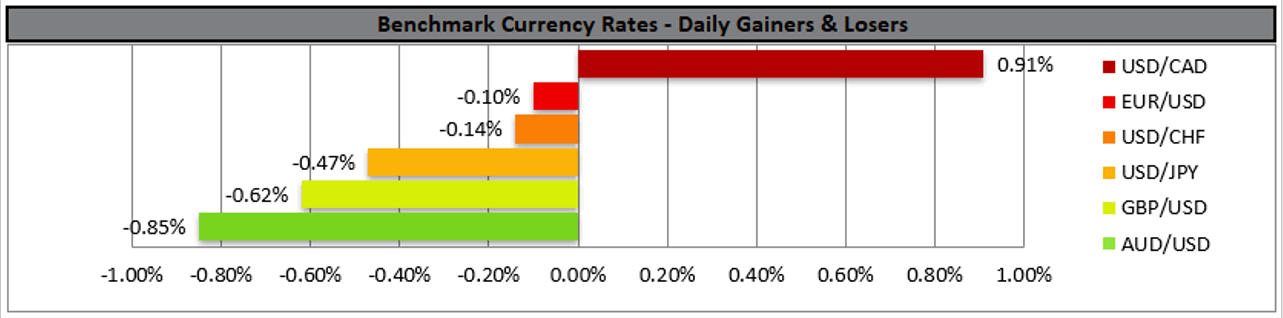
The greenback and the Japanese yen enjoyed further safe haven inflows yesterday and tended to gain against risker currencies such as the pound and the Australian dollar as worries for Covid’s Delta variant intensified. The highly contagious Delta variant of Covid 19 is now considered to be the dominant strain on a global level and its characteristic how the infections are on the rise in the US but also other parts of the world. The overall situation globally seems to suggest that virus restrictions such as lockdown measures may still be necessary for a longer period of time than expected, thus implying that the economic recovery may be delayed. It should be noted that the US stockmarkets tumbled yesterday as also did their European counterparts with all main US indexes, the Dow Jones, S&P 500 and Nasdaq retreating considerably. On the other hand, gold prices tended to be on the rise despite the strengthening of the USD, as US yields continued to drop. We note today’s US financial releases , which may have a bearing on the greenback’s direction, yet the market sentiment seems to remain risk avert.
Dow Jones tumbled breaking all of our support lines, now turned to resistance and landed just above the 33800 (S1) support line yesterday. We tend to maintain a bearish outlook for the index, albeit the RSI indicator below our 4-hour chart has broken below the reading of 30, which on the one hand reflects the dominance of the bears, yet on the other may imply that the index is oversold and a correction higher is possible. Should the bears actually remain in charge we may see the index breaking the 33800 (S1) support line and aim for the 33500 (S2) or even lower. Should the bulls say enough is enough and take over, we may see the index breaking the 34100 (R1) resistance line and aim for the 34400 (R2) level.
AUD continues to weaken
The Aussie retreated against the USD yesterday reaching 8 months low yet tended to gain against its neighbouring Kiwi. The Australian Dollar as a commodity currency is quite volatile to global growth sentiment and its possible impact on commodities prices and a possible delay in global economic recovery tended to weigh on the Aussie. Back home almost half of the Australian population is living under lockdown measures in an effort to suppress the spreading of the disease’s Delta variant and the Aussie has been under pressure in the past few days. The market sentiment seems to be adverse for Aussie bidders, yet we also note the release of Australia’s preliminary retail sales for June.
AUD/USD continued to weaken yesterday yet found some support at the 0.7335 (R1) line before breaking it during today’s Asian session and turning it to a resistance level. We tend to maintain a bearish outlook for the pair currently as a downward trend since the 15h of the month has formed. Also please note that the pair’s RSI indicator below our 4-hour chart runs along the reading of 30 underlining the strength of the bears, yet at the same time may imply that the pair is oversold. Should the selling interest persist, we may see the pair aiming if not breaking the 0.7265 (S1) support line and aim for lower grounds. Should a correction higher take place and Aussie bidders take control of the pair’s direction, we may see the pair breaking the 0.7335 (R1) resistance line and aim for the 0.7400 (R2) resistance level.
Other economic highlights today and the following Asian session:
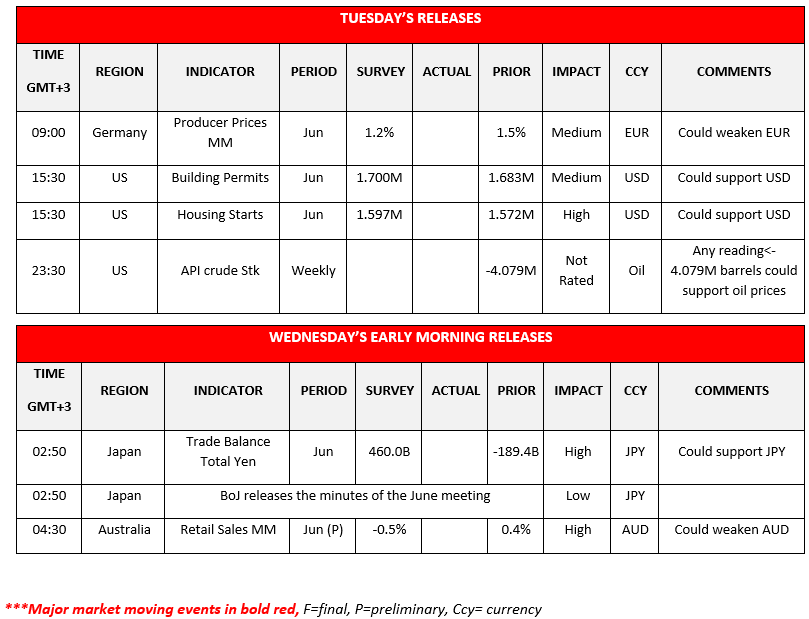
Today during the European session we note the release of Germany’s producer prices for June and in the American session we get from the US the number of building permits and house starts for June, while just before the Asian session starts we get the US weekly API crude oil inventories figure. During Wednesday’s Asian session, we get Japan’s trade data for June and Australia’s preliminary retail sales growth rate for June, while BoJ will be releasing the minutes of its June meeting.
US 30 Cash H4 Chart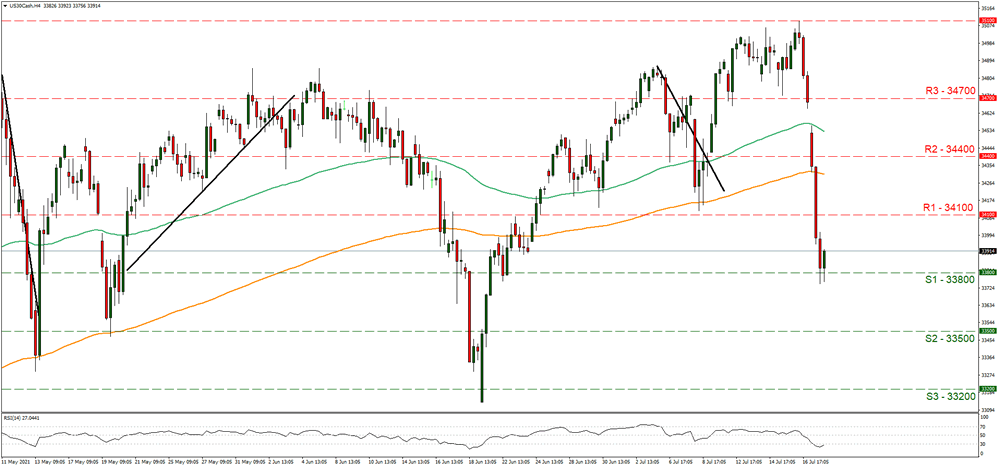
Support: 33800 (S1), 33500 (S2), 33200 (S3)
Resistance: 34100 (R1), 34400 (R2), 34700 (R3)
AUD/USD H4 Chart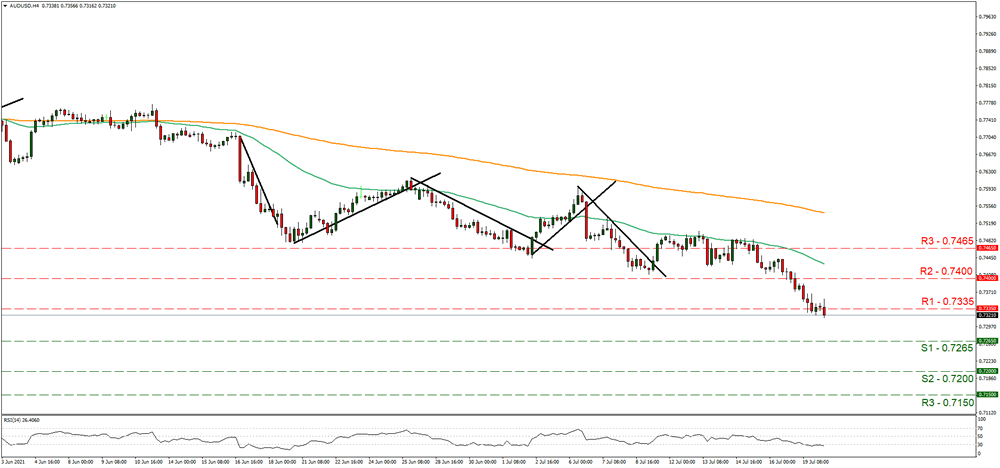
Support: 0.7265 (S1), 0.7200 (S2), 0.7150 (S3)
Resistance: 0.7335 (R1), 0.7400 (R2), 0.7465 (R3)
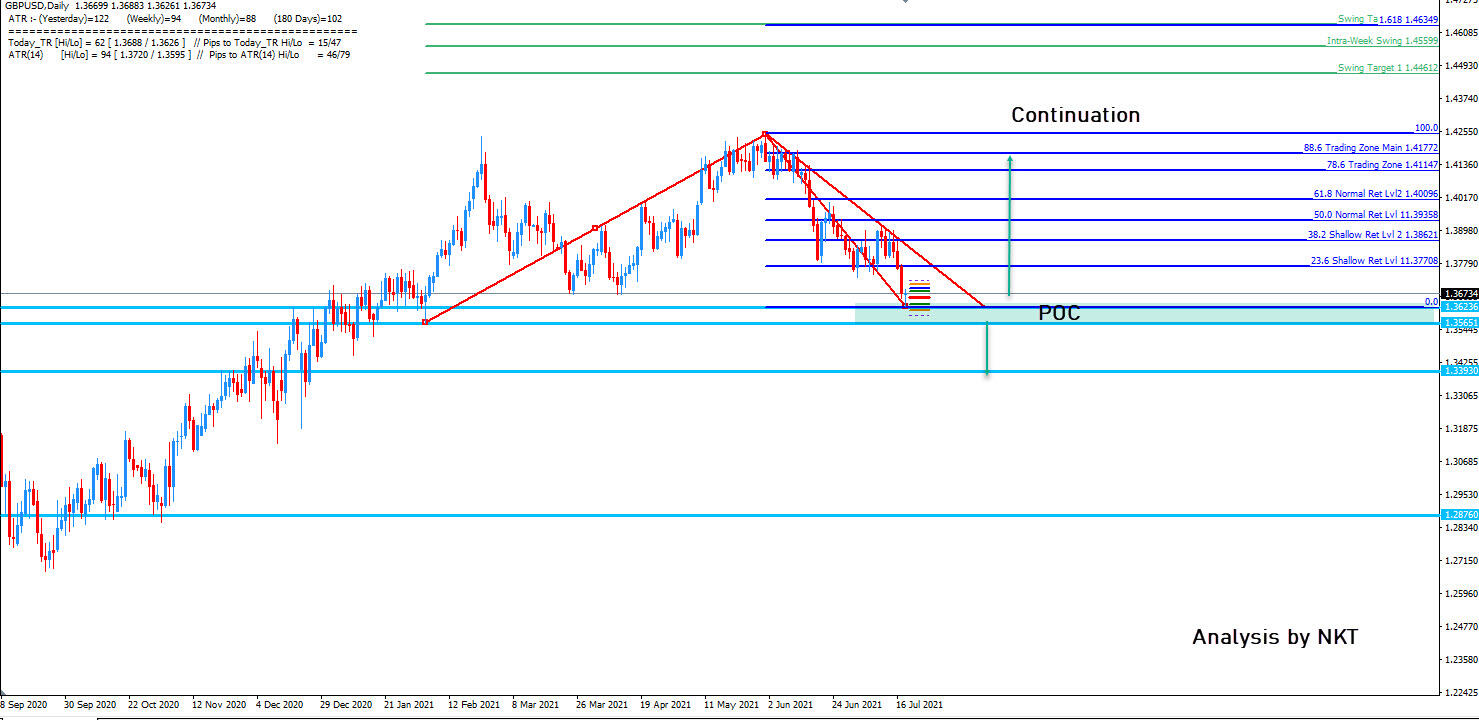
GBP/USD At The Critical Support
The GBP/USD is at critical support. Historical buyers are exactly in the zone 1.3565-1.3623. We should see a continuation to the upside if the price gets a bullish momentum.
1.3600-50 is the POC. Multiple swing points could switch momentum to the upside. Targets are 1.3770 all the way towards 1.4115 if the price stays above 1.3550. However, if the price drops below 1.3550 watch for a move towards 1.3393.
Markets Try To Shake Off Risk Aversion Sentiment
Notes/Observations
- Markets try to rebound from risk aversion sentiment. Delta variant of the coronavirus now the dominant strain worldwide and concerns it could stymie the global recovery.
Asia
- Japan Jun National CPI Y/Y: 0.2% v 0.2%e; CPI Ex-fresh food (core) Y/Y: 0.2% v 0.2%e.
- RBA July Minutes reiterates stance that Board remained committed to maintaining highly supportive monetary conditions and that central scenario was that conditions for a rate hike would not be met before 2024. Needed to have flexibility to adjust weekly bond purchases.
- China PBoC Monthly Loan Prime Rate Setting (LPR) left both the 1-year and 5-year rates unchanged for its 15th straight month of steady LPR settings.
Coronavirus
- Total global cases 191.7M (+0.3% d/d); total deaths: 4.11M (+0.2% d/d).
- Canada to begin allowing fully vaccinated US visitors into the country for non-essential travel beginning Aug 9th.
- U.S. raises travel alert for UK as Covid surge marred ‘Freedom Day’.
- Thailand Cabinet extended its the State of Emergency through September.
Europe
- Incoming BOE MPC member Mann testified that the UK recovery was more fragile than it appeared; Did not see inflation becoming a spiral and should not be premature on tightening.
Americas
- President Biden stated that data showed that most of price increases were expected and were expected to be temporary.
- Sen GOP Leader McConnell comments on Biden’s infrastructure bills that we needed to see the bill before we decide whether or not to vote for it.”.
- US Senate Majority Leader Schumer (D-NY) noted there would be a procedural vote on infrastructure on Tues, July 20th. He stressed that Wednesday was not a deadline.
Speakers/Fixed income/FX/Commodities/Erratum
Equities
- Indices [Stoxx600 +0.55% at 446.76, FTSE +0.66% at 6,889.75, DAX +0.45% at 15,201.80, CAC-40 +0.81% at 6,346.78, IBEX-35 +0.55% at 8,348.00, FTSE MIB +0.22% at 24,018.50 , SMI +0.66% at 11,940.63, S&P 500 Futures +0.50%].
- Market Focal Points/Key Themes: European indices open higher across the board and stayed in the green as the session progressed; better performing sectors include financials and consumer discretionary; while industrials and materials among underperformering sectors; Apollo confirms is in discussion with Fortress to participate int its bid for Morrison’s; Schneider electric to complete acquisition of iGE+XAO; earnings expected in the upcoming US session include KeyCorp, Halliburton, Travelers, and Philip Morris.
Equities
- Consumer discretionary: EasyJet [EZJ.UK} +2% (trading update), Electrolux [ELUXB.SE] -10% (earnings), Remy Cointreau [RCO.FR] -2% (earnings).
- Financials: UBS [UBSG.CH] +4% (earnings).
- Industrials: Alstom [ALO.FR] +3% (earnings), Alfa Laval [ALFA.SE] +6% (earnings), Volvo [VOLVA.SE] -4% (earnings).
- Technology: Wise [WISE.UK] +1% (trading update).
Speakers
- ECB Q2 Lending Survey: Banks reported moderately higher demand for corporate loans. Credit standards broadly unchanged following significant net tightening in 2020.
- Ireland Fin Min Donahoe reiterated stance that country cannot be a part of the current OECD global minimum corporate tax agreement as it lacks clarity.
- Poland Central Bank Gov Glapinski reiterated stance that would be unreasonable to raise interest rates at this time but could begin normalization in future quarters.
- India said to seek Parliamentary approval for INR1.87T in new spending.
- Singapore govt tightened virus restrictions; effective July 22nd through Aug 18th that would ban gatherings of more than two people and stop restaurant dining. To keep supermarkets open and review restrictions in two weeks. Govt to unveil new support package in coming days.
- China Finance Ministry official stated that it would guide local govt to reasonably set pace on special bond issuance in H2. Domestic economic recovery and rising producer prices helped to increase H1 fiscal revenue growth. It cautioned that revenue growth to significantly slowdown in H2.
- Iran govt spokesperson: Pact to revive nuclear deal was incompatible with law.
Currencies/ Fixed income
- Initial safe-haven flows slipped as the EU session progressed as markets try to rebound from risk aversion sentiment.
- EUR/USD remained below the 1.18 level. Focus remained on upcoming ECB meeting on Thursday that to incorporate the ECB's new framework into its policy guidance.
- GBP/USD tested 5-month lows at 1.3630 area after several BOE members waned on premature tightening over the past 24 hours. Dealers’ thus scaled back monetary policy tightening expectations as a results couple with rising virus infections in the country.
- USD/JPY tested 109.40 for 8-week lows as risk-off sentiment continued to percolate amid renewed concerns about the Covid-19 pandemic.
Economic data
- (CH) Swiss Jun Trade Balance (CHF): 5.5B v 4.9B prior; Real Exports M/M: -3.0% v +1.9% prior; Real Imports M/M: -2.7% v -1.4% prior; Watch Exports Y/Y: 71.0% v 174.4% prior.
- (DE) Germany Jun PPI M/M: 1.3% v 1.2%e; Y/Y: 8.5% v 8.6%e.
- (CZ) Czech Jun PPI Industrial M/M: 0.8% v 0.7%e; Y/Y: 6.1% v 5.9%e.
- (ZA) South Africa May Leading Indicator: 128.8 v 125.8 prior.
- (TW) Taiwan Jun Export Orders Y/Y: 31.1% v 30.0%e.
- (EU) Euro Zone May Current Account Balance (seasonally Adj): €11.7B v €22.1B prior.
- (PL) Poland Jun Sold Industrial Output M/M: 4.0% v 4.3%e; Y/Y: 18.4% v 18.0%e.
- (PL) Poland Jun PPI M/M: 0.7% v 0.4%e; Y/Y: 7.0% v 6.7%e.
- (IT) Italy May Current Account Balance: €3.9B v €6.7B prior.
- (GR) Greece May Current Account Balance: -€1.4B v -€2.1B prior.
- (PT) Portugal May Current Account Balance: -€1.0B v -€0.6B prior.
- (HK) Hong Kong Jun Unemployment Rate: 5.5% v 5.8%e.
Fixed income issuance
- (IN) India sold total INR170B vs. INR170B indicated in 3-month, 6-month and 12-month bills.
- (UK) DMO sold £1.25B in 1.625% Oct 2071 Gilts; Avg Yield: 0.861% v 1.153% prior; bid-to-cover: 2.51x v 2.26x prior; Tail: 0.2bps v 0.3bps prior.
Looking Ahead
- 05:15 (CH) Switzerland to sell 3-month Bills.
- 05:25 (EU) Daily ECB Liquidity Stats.
- 05:30 (HU) Hungary Debt Agency (AKK) to sell 3-Month Bills.
- 05:30 (DE) Germany to sell €3.0B in 0.25% Nov 2028 Bunds.
- 05:30 (EU) ECB allotment in 7-Day Main Refinancing Tender (MRO).
- 05:30 (ZA) South Africa to sell combined ZAR3.9B in 2030, 2032 and 2035 bonds.
- 06:30 (EU) ESM to sell €1.5B in 6-month bills.
- 06:45 (US) Daily Libor Fixing.
- 08:00 (UK) Daily Baltic Dry Bulk Index.
- 08:00 (RU) Russia announcement on upcoming OFZ bond issuance (held on Wed).
- 08:30 (US) Jun Housing Starts: 1.590Me v 1.572M prior; Building Permits: 1.700Me v 1.683M prior (revised from 1.681M).
- 08:30 (US) Jun Philadelphia Fed Non-Manufacturing Index: No est v 59.6 prior.
- 08:30 (CA) Canada Jun Teranet House Price Index M/M: No est v 2.8% prior; Y/Y: No est v 13.7% prior; HPI Index: No est v 269.07 prior.
- 08:55 (US) Weekly Redbook LFL Sales data.
- 09:00 (EU) Weekly ECB Forex Reserves.
- 09:45 (UK) BOE to buy £1.147B in APF Gilt purchase operation (20+ years).
- 10:00 (MX) Mexico Weekly International Reserve data.
- 16:30 (US) Weekly API Oil Inventories.
- 17:00 (KR) South Korea Jun PPI Y/Y: No est v 6.4% prior.
- 19:50 (JP) Japan Jun Trade Balance: +¥484.4Be v -¥189.4B prior (revised from -¥187.1B); Adjusted Trade Balance: ¥17.5Be v ¥43.1B prior ; Exports Y/Y: 46.2%e v 49.6% prior; Imports Y/Y: 28.3%e v 27.9% prior.
- 20:00 (KR) South Korea 20-day into July Exports Y/Y: No est v 29.5% prior; Imports Y/Y: No est v 29.1% prior.
- 20:30 (AU) Australia Jun Leading Index M/M: No est v -0.1% prior.
- 21:30 (AU) Australia Jun Preliminary Retail Sales M/M: -0.6%e v +0.4% prior.
- 23:00 (NZ) New Zealand Jun Credit Card Spending M/M: No est v 8.5% prior; Y/Y: No est v 27.2% prior.
- 23:00 (CN) China to sell 1-year and 10-year Bonds.
- 23:30 (TH) Thailand Jun Customs Trade Balance: $0.6Be v $0.8B prior; Exports Y/Y: 38.0%e v 41.6% prior; Imports Y/Y: 50.0%e v 63.5% prior.
- 23:30 (JP) Japan to sell 3-Month Bills.
The Analytical Overview Of The Main Currency Pairs
The EUR/USD currency pair
Technical indicators of the currency pair:
Prev Open: 1.1802
Prev Close: 1.1798
% chg. over the last day: -0.03%
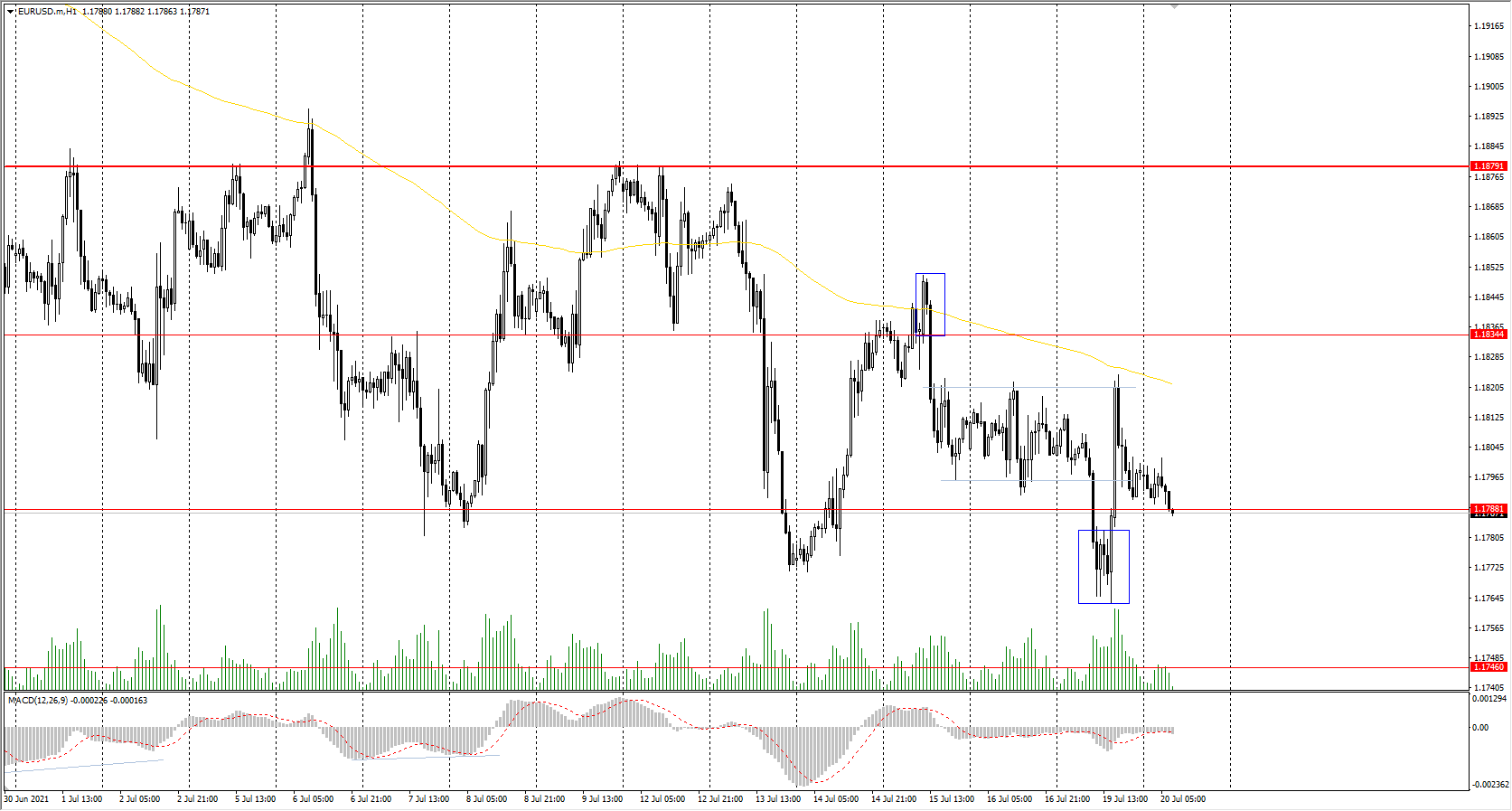
The ECB has slightly reduced the pace of asset purchases, while the US Fed, on the contrary, started buying assets more aggressively, despite talks about possible cuts in the QE program. Taking into account that there is no acceleration in inflation in Europe, this situation plays in favor of a stronger euro.
Trading recommendations
Support levels: 1.1788, 1.1746, 1.1609
Resistance levels: 1.1834, 1.1879, 1.1934, 1.1969
From the technical point of view, the trend is still bearish. Yesterday, the price broke through the lower border of the range and started to decline. But at the American session, there was a return back on the impulsive move. As a result, a false breakdown zone was formed, from which the buyers may look for buy deals, but only with short targets, as it will be trading against the trend. The MACD indicator is inactive. There are no optimal entry points for sell positions now.
Alternative scenario: if the price breaks through the 1.1879 resistance level and fixes above, the general uptrend is likely to be resumed.
The GBP/USD currency pair
Technical indicators of the currency pair:
Prev Open: 1.3767
Prev Close: 1.3675
% chg. over the last day: -0.67%
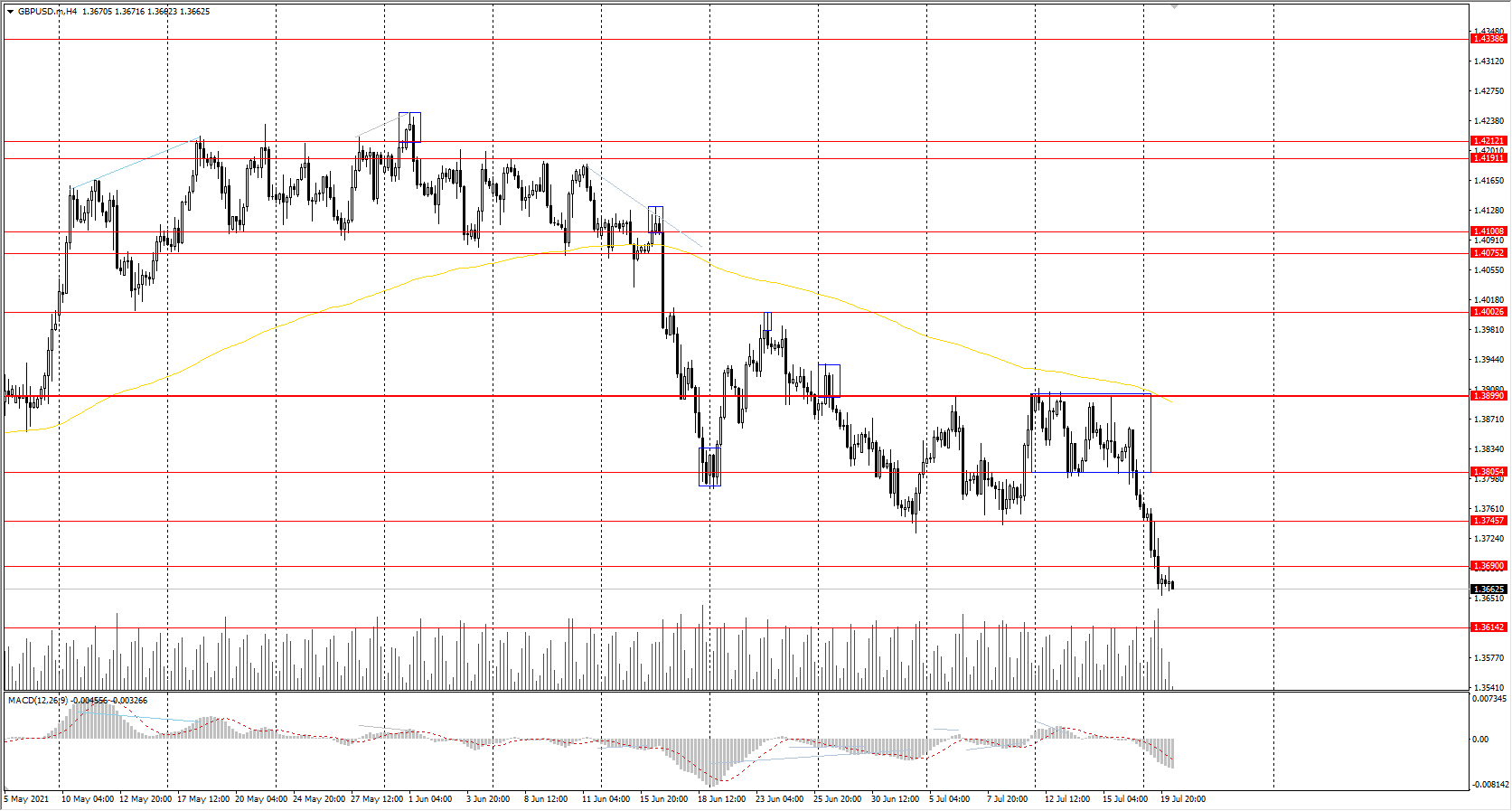
The GBP/USD currency pair decreased sharply yesterday. This situation with the British currency was a surprise for traders, as there are no fundamental reasons for the pound to fall. The monetary policy remains unchanged, the economy is opening after the quarantine restrictions. But there is a slight acceleration in inflation.
Trading recommendations
Support levels: 1.3614
Resistance levels: 1.3690, 1.3756, 1.3805, 1.3899, 1.3923, 1.4002, 1.4075, 1.4101
The trend of the GBP/USD currency pair is bearish on the H1 timeframe. The MACD indicator went into the negative zone with no signs of reversal. Under such market conditions, traders are better to look for sell positions from the resistance levels. There are no optimal entry points for buy positions now, as buyers do not show initiative.
Alternative scenario: if the price breaks through the 1.3899 resistance level and consolidates above, the bearish scenario is likely to be canceled.
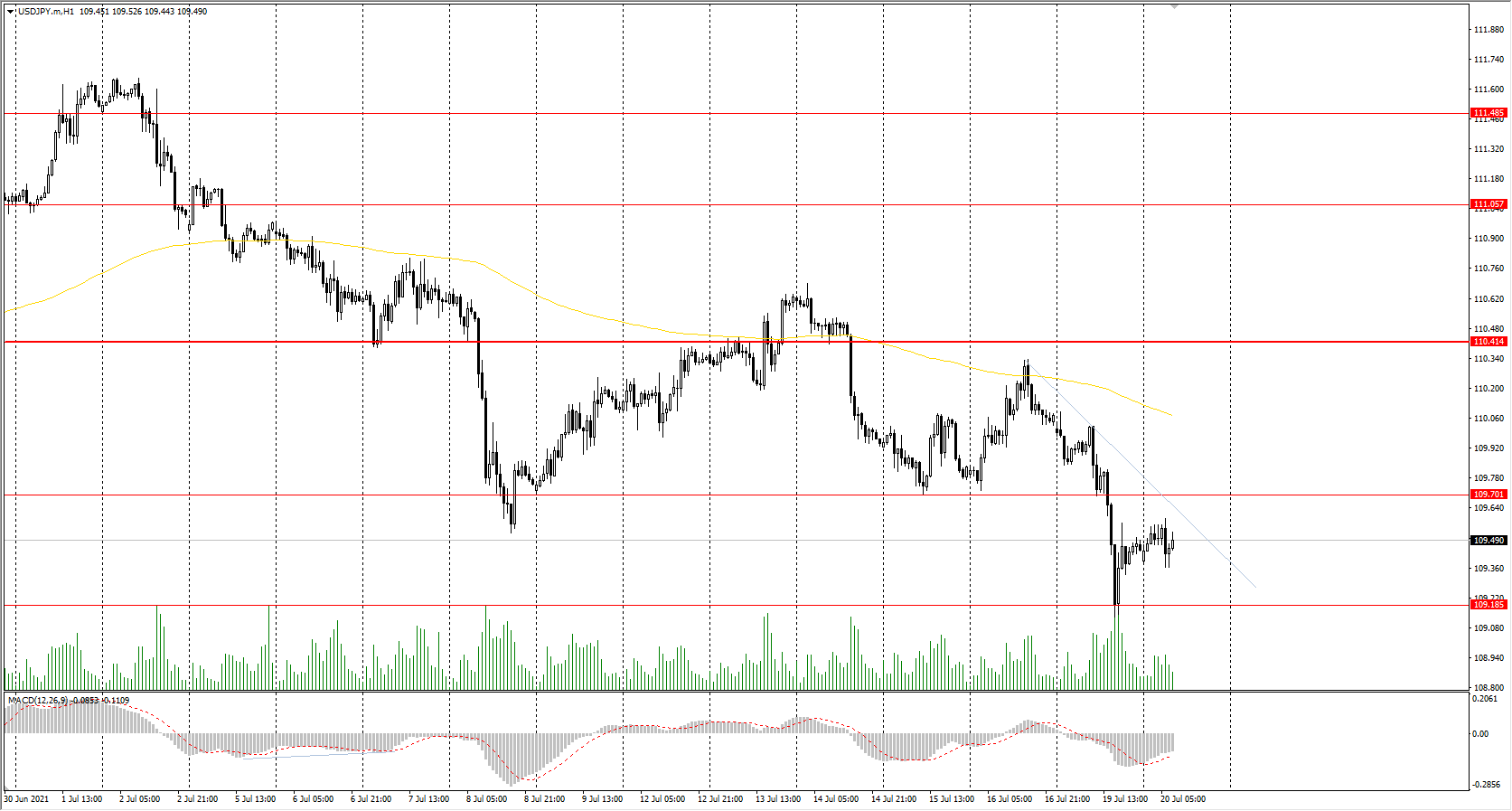
The USD/JPY currency pair
Technical indicators of the currency pair:
Prev Open: 110.01
Prev Close: 109.45
% chg. over the last day: -0.51%
The Japanese yen futures strengthened yesterday, which caused a decline in the USD/JPY currency pair by 0.51% (inverse correlation). Even the rise in the dollar index could not affect the strengthening of the Japanese yen, which suggests that the Japanese economy is recovering. At the same time, the stock indices in Japan declined yesterday. The national consumer price index remained unchanged at 0.3%, but the core CPI increased by 0.2% in annualized terms.
Trading recommendations
Support levels: 109.19, 108.65
Resistance levels: 109.70, 110.41, 110.73, 111.06, 111.48, 110.73, 112.18
From the point of view of technical analysis, the situation has not changed. There is a downward trend on the H1 timeframe, as the price is still trading below the priority change level and the moving average. The MACD indicator is in the negative zone with no signs of reversal. Under such market conditions, traders are better to look for sell positions from the resistance levels on intraday timeframes. Buy positions should be considered from support levels, but only with short targets.
Alternative scenario: if the price rises above 110.41, the uptrend is likely to be resumed.
News feed for 2021.07.20
Japan National Consumer Price Index (m/m) at 02:30 (GMT+3).
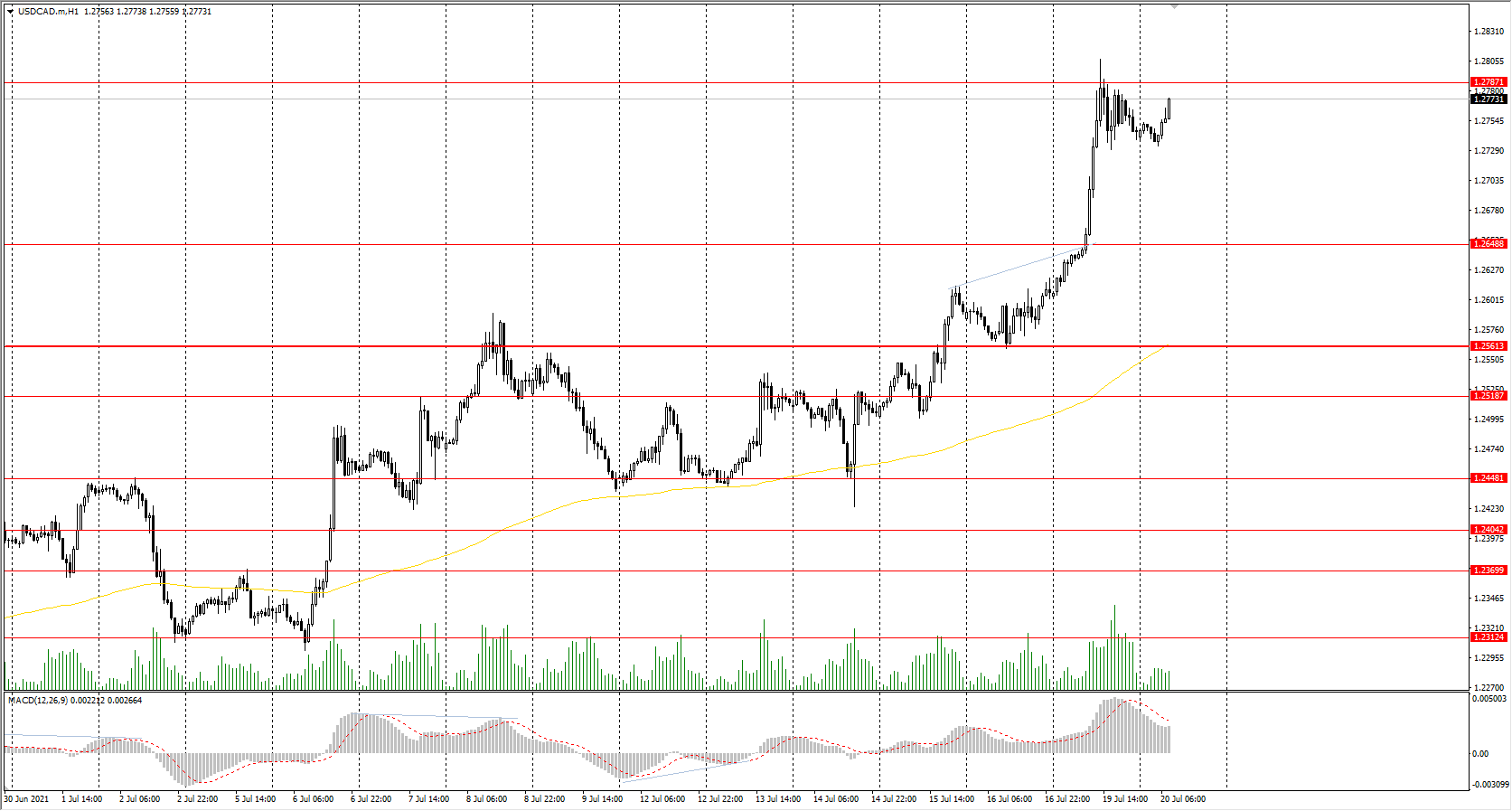
The USD/CAD currency pair
Technical indicators of the currency pair:
Prev Open: 1.2604
Prev Close: 1.2746
% chg. over the last day: +1.12%
The USD/CAD currency pair added another 1.12% yesterday. The growth was caused by two factors: the dollar index and the oil prices. The dollar index is slowly growing, while oil prices just declined yesterday, which negatively affects the CAD.
Trading recommendations
Support levels: 1.26481, 1.2561, 1.2519, 1.2448, 1.2404, 1.2347, 1.2312
Resistance levels: 1.2787, 1,2951
Technically, the trend remains bullish. The price is growing steadily, and there isn’t significant resistance from the sellers. The MACD indicator is in the positive zone with no signs of reversal. Under such market conditions, it is better to consider intraday trading. Traders should look for buy positions from the support levels after a small pullback, as resistance levels are ahead and the price quite strongly deviates from the midline. There are no optimal entry points for sell positions right now.
Alternative scenario: if the price breaks through the 1.2561 support level and fixes below, the downtrend is likely to be resumed.
Virus Outbreaks Raise Fears About Global Economic Recovery
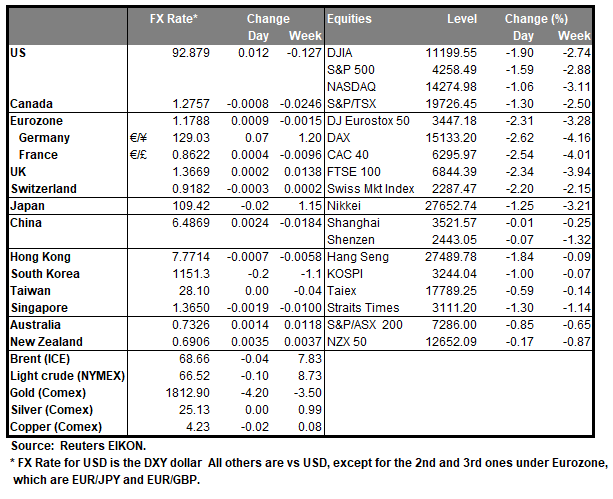
Last week, the number of new cases in the US increased by 70% compared to the previous week and the number of deaths increased by 26%, with outbreaks occurring mostly in those parts of the country where the vaccination rates are the lowest. Such numbers are very negative for both stock indices and commodity markets. All three major US stock indices closed the session with sharp declines, with the S&P 500 and Nasdaq experiencing their biggest one-day percentage drop since mid-May. And for the Dow Jones index, it was the worst day for the last nine months. The US Treasury yields also fell, which caused a decline in the stocks of the banking sector. On the other hand, everybody knew that the stock market was "overheated" and needed a fresh breath in the form of a correction movement. Now it is important to watch whether the positive quarterly reports of the companies will be able to renew the growth of the stock indexes. If this does not happen, the correction can be much stronger.
European stock indices also closed the trading day in the red zone. British FTSE 100 lost 2.34%, German DAX decreased by 2.62%, French CAC 40 lost 2.54%, Italian FTSE MIB decreased by 3.34%, and Spanish IBEX 35 - by 2.4%. The decline was observed in almost all sectors of the economy. The floods in the central part of Europe, which started in the middle of last week due to heavy rains, made the general situation even worse. The number of daily COVID-19 cases in the UK increased sharply after most of the restrictions were lifted on Monday.
Oil prices decreased almost by 8% yesterday. There are two reasons for such a precipitous drop. The first reason is that the OPEC+ countries agreed to increase the daily oil production to the pandemic level (the supply started to catch up with the demand). The second reason is that new outbreaks of COVID-19 also continue to darken fuel demand prospects, as some countries reintroduce isolation measures.
Gold and silver prices jumped amid falling stock indices and the declining US government bond yields. The fundamental picture for precious metals is in favor of higher prices now. But as soon as the Fed starts cutting stimulus, there will be a decrease in the gold and silver market.
Asia-Pacific stock indices also fell sharply yesterday. The Delta strain of COVID-19 is taking a significant toll on the economic recovery of the region. Japan's Nikkei 225 Index hit a six-month low yesterday. In its turn, China's blue-chip index CSI300 remained unchanged. The People's Bank of China kept the benchmark interest rate on loans unchanged. In Australia, about half of the population is living under quarantine to quell an outbreak of the Delta strain. Earlier this month, the Reserve Bank of Australia (RBA) announced that it would cut bond purchases starting from September. But today at the RBA meeting, the issue was raised that the RBA could cancel its decision to reduce QE if Sydney remains in lockdown until August, as seems likely.
Main market quotes:
- S&P 500 (F) 4,258.49 -68.67 (-1.59%)
- Dow Jones 33,962.04 -407.11 (-2.62%)
- DAX 15,133.20 -407.11 (-2.62%)
- FTSE 100 6,844.39 -163.70 (-2.34%)
- USD Index 92.84 +0.15 (+0.16%)
Important events for today:
- Japan National Consumer Price Index (m/m) at 02:30 (GMT+3);
- Australia RBA Meeting Minutes at 04:30 (GMT+3);
- China PBoC Loan Prime Rate at 04:30 (GMT+3);
- US Building Permits (m/m) at 15:30 (GMT+3).
A Lesson From The RBA As Aussie Dips
The Australian dollar continues to lose ground, having declined for a fourth successive day. Currently, AUD/USD is trading at 0.7329, down 0.18% on the day. The pair could fall into 72-territory as early as today and is trading at its lowest levels since November.
It’s been a rough spell for the Aussie. Traditionally, July is one of the strongest months for the currency, but this July has been dismal, with the currency down 2.44%.
The RBA released its minutes from the July meeting. At the meeting, the RBA trimmed its weekly bond purchases from AUD 5 billion per week to 4 billion per week as of September. The minutes noted that there was intense discussion around the taper, with members acknowledging that a strong argument could be made not to trim, given that the Bank’s targets for inflation and employment had not been met. In the end, policymakers opted to go ahead with the taper. The minutes also reiterated that Bank members did not expect that conditions would warrant a rate hike prior to 2024.
Taper yes, dovish no
Investors and traders take note – the RBA is providing an important lesson for those willing to listen and learn. The Bank went ahead with its trim, which made headlines and sent the Australian dollar higher. However, the gains were short-lived, as the Bank retained its dovish stance even as it tightened policy (modestly) by tapering its QE programme. Investors and traders who snapped up Australian dollars after the RBA taper jumped the gun, because the Australian dollar has largely been on a downswing since the RBA meeting earlier this month. Clearly, a taper does mean that a central bank has changed into a hawk; in the case at hand, the RBA said at its meeting that stimulus would be required and rate hikes were a long way off, even while tapering at the same time.
AUD/USD Technical
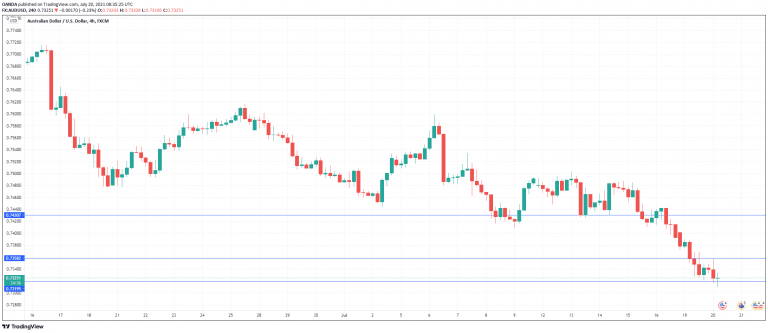
- AUD/USD is testing support 0.7319. Below, there is support at 0.7247
- There is weak resistance at 0.7358, followed by resistance at 0.7541
GBP/USD Outlook: Risk-Off Mode Minimizes Positive Impact From Freedom Day
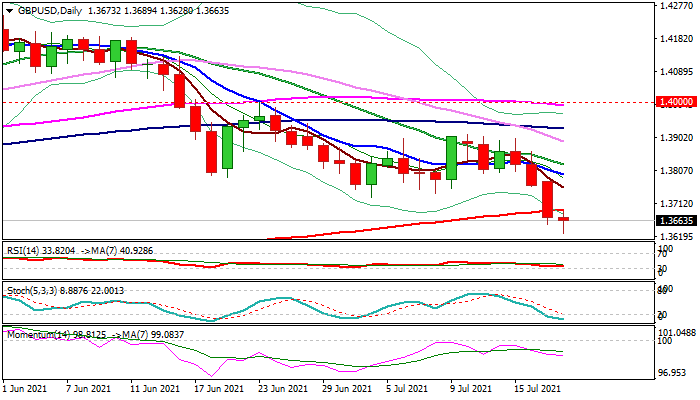
Cable remains offered on Tuesday hit new 4 ½ months low in extension of Monday’s 0.73% fall, driven by risk aversion on growing concerns on the global and local spread of Covid-19 Delta variant.
Investors continue to sell the pound, showing a very cautious reaction on freedom day – removal of most English coronavirus restrictions.
Monday’s close below 200DMA (1.36940 and extension below Apr-May higher base at 1.3670 and Fibo 38.2% of 1.2675/1.4249 at 1.3647, were strong bearish signals which require confirmation on an eventual close below these levels to signal reversal and confirm a double-top (1.4238/49, Feb/May tops).
Oversold daily techs suggest bears may pause after a three-day 1.3% drop and position for a fresh push lower.
Broken 200DMA should ideally cap upticks and keep bears intact.
Res: 1.3694, 1.3731, 1.3777, 1.3796.
Sup: 1.3647, 1.3628, 1.3565, 1.3519.
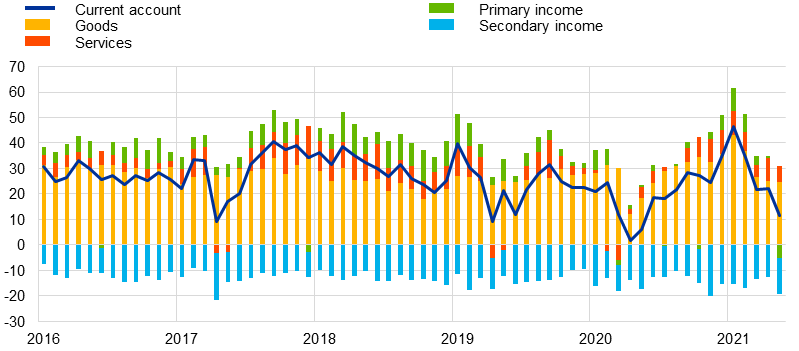
Eurozone current account surplus at EUR 12B in May
Eurozone current account recorded EUR 12B surplus in May, down from April's EUR 22B. In the 12 months to May, current account surplus amounted to EUR 310B (2.7% of Eurozone GDP), up from EUR 228B (2.0%) one year earlier.
In the financial account, Eurozone residents' net acquisition of non-euro area portfolio investment securities totalled EUR 950B, in the 12 months to May. Non-residents' net acquisitions of Eurozone area portfolio investment securities totalled EUR 187B.
Risk Aversion Hits Global Markets
A wave of risk off sentiment engulfed markets yesterday after US and European shares tumbled on growing concerns over the Covid-19 Delta outbreaks threatening the global economic recovery.
The sour mood is likely to dish out more punishment to equity markets today as investors seek refuge in safe haven destinations. Given how the outbreaks are being reported in places ranging from Australia to Indonesia and the United Kingdom, caution is likely to remain the name of the game. Even though US futures are climbing after the S&P 500 collapsed like a house of cards overnight, the selloff could resume if investors look beyond corporate earnings to focus on global growth fears.
'Freedom Day' arrives, what next?
Yesterday was labelled as “Freedom Day” in England where all lockdown restrictions were lifted despite the surging Covid-19 infections. While this development can be seen as a step back into some normality, there are concerns over whether this will lead to a reimposition of lockdown measures across the UK.
It must be kept in mind that the economic recovery remains fragile with the Bank of England expecting unemployment to rise as the furlough scheme winds down in September. Surging infections and the uncertainty it presents are the last things the UK economy needs at such a crucial period.
The British Pound has depreciated against most G10 currencies this week, notably the dollar, swiss franc and yen. Given how GBPUSD closed below the 200-day Simple Moving Average yesterday, the path of least resistance remains south with the next key level of interest found at 1.3600.
Currency spotlight – EUR/USD
The main risk event for the euro this week will be the European Central Bank meeting on Thursday.
Although the ECB is widely expected to leave monetary policy unchanged, this will be their first meeting since the conclusion of the bank’s Strategy Review. This means investors will be looking for any change in the central bank's forward guidance and potentially a more dovish shift in the policy stance.
Looking at the technical picture, EURUSD remains under pressure on the daily charts. A solid break below 1.1770 could inspire a decline towards 1.1700. Alternatively, a move back above 1.1800 could trigger a rebound towards 1.1860.
Commodity spotlight – Gold
Gold remains under the mercy of an appreciating dollar. However, subdued treasury yields in addition to mounting concerns over surging Covid-19 cases across the globe may cushion downside losses.
As the risk-off mood sends investors rushing towards destinations of safety, gold is likely to find some support. Nevertheless, bears are still lingering and may snatch control if prices sink back below the $1800 psychological level.
RBA Board Minutes Explain Taper Decision
It seems that the taper decision at the Board’s July meeting was a close run affair. Respectable arguments are set out for both sides. There is also less confidence about 2024 as the timing for the first rate hike while Covid disruptions are seen as temporary.
The Minutes of the Reserve Bank Board meeting on July 6 highlight that the decision to taper the Bank’s purchases of bonds from $5 billion to $4 billion was subject to a healthy discussion.
The Minutes note that “Members acknowledged that an argument could be made to retain the pace of bond purchases at $5 billion per week, given that economic outcomes were still well short of the Bank’s goals for inflation and employment”….. but “In light of these improvements (economic outcomes) and the agreed decision making framework, members decided to adjust the weekly purchases …”
As with the Governor’s speech the Minutes note that “members agreed that there should be flexibility to increase or reduce weekly bond purchases.”
In a note we have released today revising our forecast for GDP growth in the September quarter to -0.7% we have suggested that an appropriate response from the Board would be to not only delay the decision to taper but to actually temporarily lift purchases from $5 billion to $6 billion over the September to November period to recognise this flexibility and to support the recovery we anticipate for the December quarter.
Such a decision should only be communicated once the Board had sufficient information around the impact of the current lock downs, which would be the September Board meeting.
The minutes go into more detail on the decision not to extend the yield target to the November 2024 bonds. Two key points are emphasised- firstly that the conditions necessary for a rate hike will be “not met until 2024”, excluding the previously used “at the earliest” and secondly “the faster than expected recovery…had widened the range of alternative plausible scenarios.” That latter comment seems to be central bank talk for a much higher degree of uncertainty around the 2024 forecast.
As I have noted in the past, because the Bank is committed to purchasing April 2024 bonds at the current cash rate it will find it very difficult to describe a central scenario that excludes 2024 as the likely timing of the first rate increase.
The Board meeting was held on July 6, following the reopening of the Victorian economy after the snap lockdown in late May/early June and in the early stage of the “lock down lite” NSW developments which were introduced on June 24.
In the Minutes the Board seems relaxed, “Recent COVID 19 outbreaks in many parts of the country, and associated restrictions, were considered to weigh on household consumption through the middle of the year. However, as observed following earlier lock downs spending was expected to rebound when containment measures were eased. “Of course these minutes predate the extensions and tightening, including the closure of building sites, other NSW restrictions and the recent lockdown in Victoria which has just been extended for another week. The comments also do not take into account that the governments’ current relief packages are not as generous or effective as the earlier packages, which included JobKeeper.
The Board also conducted a detailed discussion on wages growth. It was agreed that spare capacity appeared likely to decline and there were some signs that wages growth was picking up from low levels during the pandemic. The Bank’s liaison indicated that firms were not planning to fully compensate for wage freezes; while a flat outlook for public sector wages and new enterprise bargaining agreements pointed to wages growth being stuck at pre pandemic levels.
One area of interest was a lift in bonuses and non wage incentives “to attract and retain labour.”
Conclusion
The flexible use of bond purchases may become a more active tool than has been recognised so far, despite clear statements in the Minutes and by the Governor.
If by the September board meeting, Westpac’s forecasts for a 0.7% contraction in GDP in the September quarter appear to be on track a case can be made for a temporary lift in bond purchases in recognition of this newly flexible policy tool.