Sample Category Title
NZDUSD Still Bearish
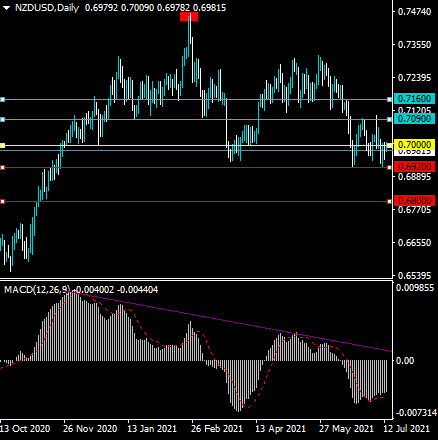
The New Zealand dollar is consolidating around the 0.7000 level against the US dollar ahead of the Reserve Bank of New Zealand rate decision. The NZDUSD pair is vulnerable to further losses due to the fact that a head and shoulders pattern and negative MACD price divergence is present. According to the daily time frame the negative MACD price divergence extends down towards the 0.6800 level.
The NZDUSD pair is only bullish while trading above the 0.7000 level, key resistance is found at the 0.7090 and 0.7160 levels.
The NZDUSD pair is only bearish while trading below the 0.7000 level, key support is found at the 0.6920 and 0.6800 levels.
BTCUSD Turning Bearish Under $33,000
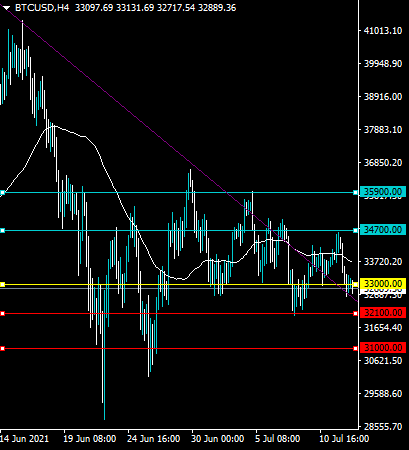
Bitcoin has started to weaken under the $33,000 support level, which means that the top crypto has a clear short-term negative trading bias. The stage is set for more weakness for the BTCUSD pair under the $33,000 level, with the $31,000 level a possible bearish target. Fears about the FED tapering QE and the new Delta COVID-19 variant could be contributing to BTCUSD weakness.
The BTCUSD pair is only bullish while trading above the $33,000 level, key resistance is found at the $34,700 and the $35,900 levels.
If the BTCUSD pair trades below the $33,000 level, sellers may test the $32,100 and $31,000 levels.
Currency Markets Content To Range-Trade
Currency markets wait for cue from CPI
With a comparatively light news flow overnight, currency markets are also in wait-and-see mode ahead of US inflation this evening. The US dollar continues to trade to the lower side of its recent ranges, despite the dollar index rising slightly by 0.13% to 92.22 overnight in directionless trading. Momentum still favours a softer US dollar for now, with US bond yields capped. Only a massive upside surprise by US Core CPI this evening is likely to change that narrative. The dollar index’s key pivot level remains 91.50, with rallies capped above 92.60.
EUR/USD, GBP/USD and USD/JPY spent the overnight session treading water ahead of inflation data today. In Asia, they are barely changed at 1.1870, 1.3900 and 110.40, respectively. The recovery in risk sentiment has seen AUD/USD and NZD/USD recover in recent sessions. AUD/USD sits midrange between 0.7400 and 0.7600, with a break of either side signalling its next directional move. NZD/USD received a short-term boost from FPI data this morning, but its rally has petered out above 0.7000. Ahead of the RBNZ policy meeting, gains are likely to be limited. A break of either 0.6900 or 0.7100 will signal its next directional move.
The super-strong China trade data today has seen the yuan push higher versus the US dollar. USD/CNY has fallen 0.20% to 6.4645, and the fall by the yuan after the PBOC RRR surprise last week has run its course for now. USD/CNY looks set to range between 6.4500 and 6.4900 until we get a directional move by the US dollar in the DM space.
The picture is not so bright across the rest of Asia as Covid-19 concerns continue to weigh on regional investor sentiment. For that reason, I expect the US dollar weakness to be more fully expressed in the major currency space instead of the Asian FX space this week. The Malaysian ringgit, Thai baht, Indonesian rupiah, Philippine peso and to a lesser extent, the Singapore dollar all remain near recent lows versus the greenback. Until virus progress shows concrete gains, I expect regional Asian currency underperformance to continue.
China Data Outperforms
China's trade data has outperformed this morning, showing no evidence of wilting under rising prices, supply disruptions, virus restrictions or any other excuse you wish to insert. The June surplus rose to USD 51.50 billion, with June Exports YoY increasing 32.20%, and June Imports YoY increasing by 36.70%, blowing the consensus forecast out of the water.
That makes last Friday's RRR cut by the PBOC all the odder when taken in this context. It could be that the PBOC and other organs of state believe “peak recovery” is upon China and are trying to get ahead of the game, or that it was simply housekeeping to offset the wave of maturing MLF's to be repaid by the banking sector in the months ahead. Time will tell which is the correct, like so much at the moment, including the transitory/sticky inflation argument, the chips could fall either way.
The robust China data will be a shot in the arm for Asia, though, and a sense of relief across the region will be palpable. Ex-China, Asia and Australia are dealing with varying waves of Covid-19, which, given their stubborn refusal to go away, will inevitably lead to some mollifying of growth prospects for the rest of the year. The Bank of Indonesia head-kicked that process of yesterday by downgrading the country's 2021 growth forecast, suggesting short-term downward pressure on the rupiah, and reaffirming the central bank's dovish stance. It won't be the last.
Inflationary pressures are still circling, though, with New Zealand Food Inflation YoY for June surprising to the upside, printing at 2.80%, well above the 1.8-% expected. That has seen the kiwi rise today as markets pencil in a higher risk that this week's RBNZ meeting could contain a tapering surprise. I do doubt this outcome, though, as the RBNZ will be looking across the Tasman at Sydney and Covid-19 across Asia and quite rightly saying the downside risks internationally are not balanced at all and will maintain their uber-dovish stance.
Markets eye US inflation
French and German Inflation is released this afternoon, but it will be US Headline and Core Inflation that will captivate financial markets' attention. In particular, the YoY Core Inflation for June will be the centre of focus and whether it climbs above 4.0%, and if so, by how much. The US Treasury bond auctions passed without incident overnight, suggesting markets remain unconcerned about an upside surprise.
It is fair to say that markets, generally across asset classes, are circling in a holding pattern awaiting the US CPI data. From my perspective, it will take a print by the Core CPI well North of 4.0% to shake the markets from their present torpor. The weight of cash capping bond yields and flowing into stocks by default is just too heavy right now. If JP Morgan and Goldman Sachs produce blockbuster quarterly results today as expected, the inflationista's job will become harder still.
Oil Directionless, Gold Eyes US CPI
Oil markets tread water nervously
Oil markets had a relatively quiet session overnight as the schizophrenic tail-chasing of previous sessions turned to something approaching patience and normality overnight. Brent crude fell 0.50% t0 USD 75.50 a barrel, while WTI eased by 0.70% to USD 74.15 a barrel. Both contracts have risen by 10 cents a barrel in directionless trading in Asia.
Both Brent and WTI probed the downside overnight before recovering much of those losses. As such, Brent crude appears to have interim support at USD 74.00 a barrel, while WTI’s immediate support now lies around USD 73.00 a barrel.
In the bigger picture, Brent crudes key longer-term levels remain USD 73.00 and USD 78.00 a barrel, while WTI’s are USD 71.00 and USD 77.00 a barrel. Although the US CPI data will be of passing interest to oil markets this evening, investors are really waiting on the Saudi Arabia and UAE dispute within the OPEC+ grouping to resolve itself.
The longer the stand-off continues without a clear resolution, the greater the chances are that we could see another meaningful corrective fall in oil prices, as fears over OPEC+ discipline rise. Another factor weighing on sentiment is Asia’s Covid-19 situation and the rising cases in the northern hemisphere. China’s trade data has alleviated but not eliminated consumption concerns.
Gold awaits US CPI
Gold spiked lower to USD 1791.50 an ounce overnight but held support ahead of its 100-day moving average (DMA) at USD 1791.00. It quickly reversed to finish the day just 0.13% lower at USD 1806.00 an ounce, marking another non-descript day of range trading. Some US dollar weakness has seen gold drift higher to USD 1809.00 in Asia.
Gold remains locked in a relatively narrow USD 1790.00 to USD 1820.00 an ounce range, bounded by the 100-DMA below and the 200-DMA above at USD 1827.50 an ounce. With gold a purely US dollar directional play at the moment from a short-term perspective, I expect gold to trade sideways with currency markets until the US CPI data this evening.
A significant upside surprise by the US Core CPI could put short-term downward pressure on gold, especially if US bond yields and the US dollar climb. However, losses should be limited to support from the USD 1750.00 to USD 1755.00 an ounce region. A daily close above USD 1830.00 an ounce will signal that the next leg of gold’s recovery has resumed.
Asian Equities Continue To Rally
Chinese trade data lifts Asian markets
With the overnight treasury auctions passing without incident, Wall Street equities continued to rise modestly. The street is pricing in no US CPI surprises and anticipating another solid quarterly earnings season kicking off this week. The S&P 500 rose 0.35%, the Nasdaq by 0.21%, and the Dow Jones by 0.37%, with the futures in Asia settling into a pre-CPI waiting game.
That was enough on its own to greenlight a positive start to trading in Asia, which has been boosted by impressive China trade data this morning as well. The June surplus rose to $51.50 billion, with June Exports YoY increasing 32.20%, and June Imports YoY increasing by 36.70%, crushing the consensus forecast. The robust China trade data will be a shot in the arm for Asia, though, and a sense of relief across the region will be palpable, as positive news is certainly needed with the resurgence of Covid.
Japan’s Nikkei 225 and South Korea’s Kospi have both climbed 0.75% higher today. Mainland China’s Shanghai Composite and CSI 300 have edged 0.30% higher, with no signs of clampdown nerves showing today.
Hong Kong’s Hang Seng has leapt by 1.60% after Tencent gained unconditional approval from the Chinese Government to complete an acquisition. Singapore and Taipei have risen 0.75%, with Kuala Lumpur and Bangkok climbing 0.35%, while Jakarta has edged 0.10% lower following the BI growth downgrade.
The prospect of an extended lockdown in Sydney has not dented confidence in Australia, with resources and banks outperforming and a federal support package announcement imminent for NSW. The ASX 200 has risen 0.20%, while the All Ordinaries is 0.40% higher.
European stock markets should follow the default setting from Wall Street and Asia and rise gently at the commencement of trading. Only a surprise jump in German and French inflation data is likely to crack confidence ahead of the US inflation data later this evening. Otherwise, I expect equity markets to market time ahead of that release.
EUR/USD Outlook: Recovery Loses Traction After Dovish Lagarde’s Comments
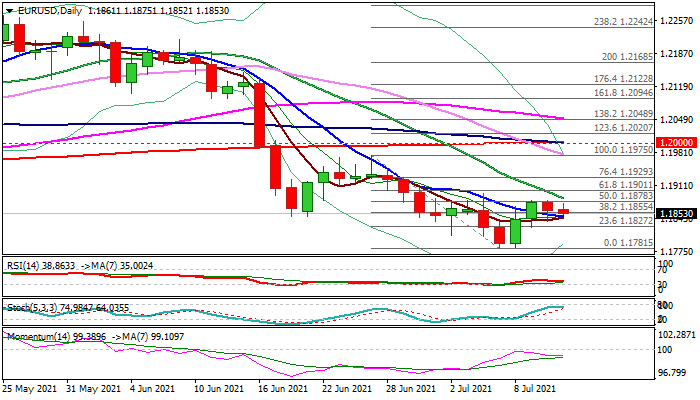
The Euro is consolidating under pivotal barriers at 1.1880/85 (recovery highs / falling 20DMA) after the action in past two days repeated failed at these levels.
Strong China’s trade data, released earlier today, boost the risk sentiment, but prevailing dovish tone in ECB President Lagarde’s interview, published today and weaker German and French CPI figures offset the positive impact.
Traders await US inflation data (due today) for a fresh signal.
Near-term action generated initial positive signal on break and repeated close above 10DMA (1.1848), but confirmation of signal requires lift and close above 20DMA (1.1885) and Fibo 61.8% of 1.1975/1.1781 (1.1901).
Daily studies improved slightly but the lack of positive momentum is evident that keeps the downside vulnerable.
Look for a signal on the break of either pivot (10DMA or 20DMA).
Res: 1.1885, 1.1901, 1.1929, 1.1966.
Sup: 1.1848, 1.1824, 1.1806, 1.1781.
Earnings Season Kicks Off, US CPI In Focus
The next few days promise to be intense and volatile thanks to key economic data from major economies, updated company earnings and speeches from numerous Federal Reserve officials including Jerome Powell.
Asian stocks were green on Tuesday morning after Wall Street’s main indices closed at record highs overnight. The risk-on sentiment across Asian markets was also helped by strong trade data from China which soothed concerns over slowing growth in the world’s second largest economy.
This positive vibe could seep into European shares before earnings kick off later in the day with JPMorgan and Goldman Sachs reporting their numbers. Investors will also be dished a serving of US inflation data this afternoon which could offer clues over the Federal Reserve’s timeline for easing its bond purchases.
On top of this, the market mood is likely to be influenced by growing concerns over the Delta coronavirus variant negatively impacting the global economic recovery. With so much going on across board with various themes and developments, this could be a week to remember.
Dollar holds its breath ahead of CPI data
The dollar seems to be struggling for direction on Tuesday morning ahead of the US inflation data for June.
Headline CPI is expected to print at 4.9% year-over-year while core CPI is forecast to come in at 4.0%. The monthly reading is expected to drop to 0.5% in June from the 0.6% witnessed in May while core CPI is projected to print 0.4%, down from 0.7% in the previous month. An upside surprise to the inflation data may inject dollar bulls with fresh inspiration as expectations mount over the Federal Reserve tapering asset purchases sooner than expected. However, if the data fails to meet expectations, it could reduce the pressure on the Fed to make a move, resulting in a weaker dollar.
There are a couple of Fed members set to speak later in the day which could add some more spice to the forex markets. Atlanta Fed President Raphael Bostic, Fed President Neel Kashkari and Boston Fed President Eric Rosengren will be under the spotlight today.
Taking a quick look at the technical picture, the Dollar Index (DXY) has found itself in a range with support at 92.00 and resistance at 92.75. A solid break below 92.00 may open the doors towards 91.50. Alternatively, should 92.00 prove to be reliable support, a rebound back towards 92.75 and potentially beyond could be on the cards.
Commodity spotlight – Gold
How gold performs this week may be heavily influenced by the pending US inflation data and Fed Chair Jerome Powell’s testimony later in the week. The precious metal remains sensitive to inflation expectations and speeches from Fed officials, so the next few days could be volatile. In the meantime, gold continues to draw support from global growth concerns and fears over the Covid-19 variants.
Despite the weekly close above $1800, bulls are certainly not out of the woods yet. Gold bugs may face resistance around $1825 as this is where 200-day SMA resides. However, if this zone can be overcome, the next key levels of interest can be found at $1842, $1870 and $1900. Alternatively, a breakdown below $1800 could signal a decline back towards $1760.
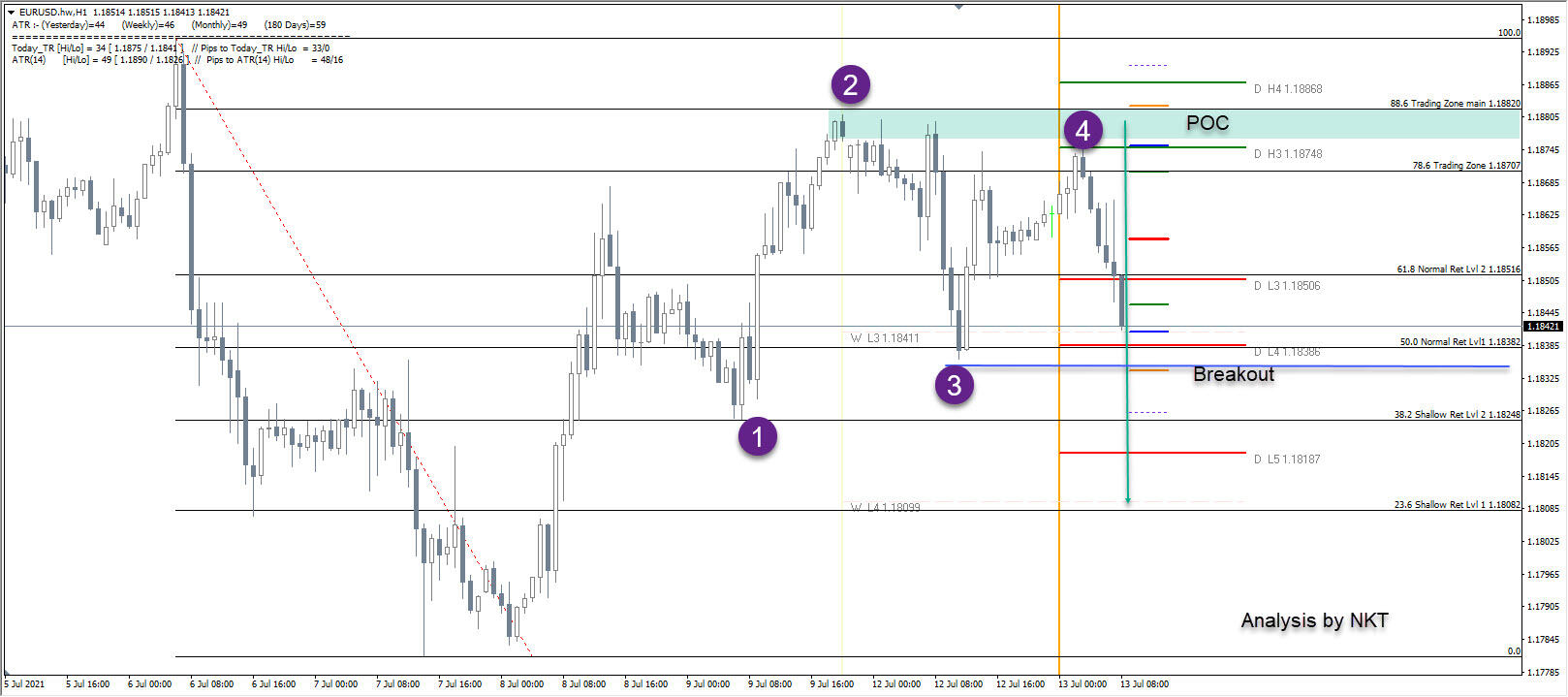
EUR/USD Aiming For Sub 1.1830
The EUR/USD is rejected from the POC zone. We could see a breakout.
The 1.1880 zone is the zone where we see the bearish reaction. Bearish M pattern has almost formed and we might expect a bearish reaction. Bearish move should happen in a form of breakout below the point 3 of the M pattern. In that case the target is 1800 zone. Watch for a possible breakout lower.
The Analytical Overview Of The Main Currency Pairs
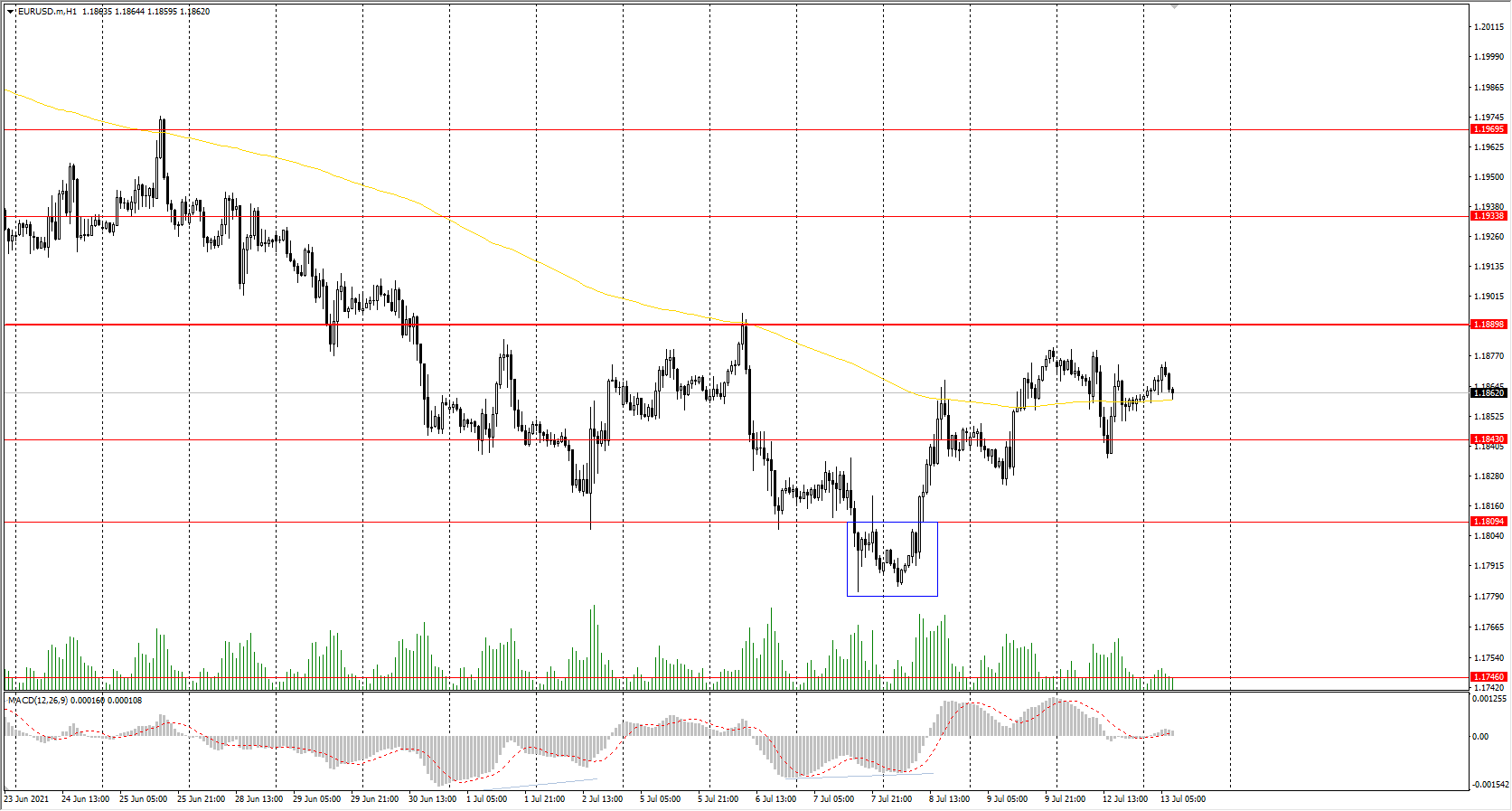
The EUR/USD currency pair
Technical indicators of the currency pair:
Prev Open: 1.1875
Prev Close: 1.1859
% chg. over the last day: -0.13%
The situation with the EUR/USD currency pair remains the same. The price is trading in a narrow range and unlikely to change before the CPI news release.
Trading recommendations
Support levels: 1.1843, 1.1809, 1.1746, 1.1609
Resistance levels: 1.1889, 1.1934, 1.1969
The trend is still bearish. The price is below the change priority level. But the buying pressure is increasing. The price has broken out through 2 resistance levels and is trading above the moving average. The MACD indicator is in the positive zone with slight divergence. Under such market conditions, it is better to trade intraday. For sell positions, traders should wait for a pullback to the priority change level and see the reaction of sellers showing that they are ready to defend the level. Entries for long positions can be searched on support levels.
Alternative scenario: if the price breaks out through the 1.1889 resistance level and fixes above, the general uptrend is likely to be resumed.
The GBP/USD currency pair
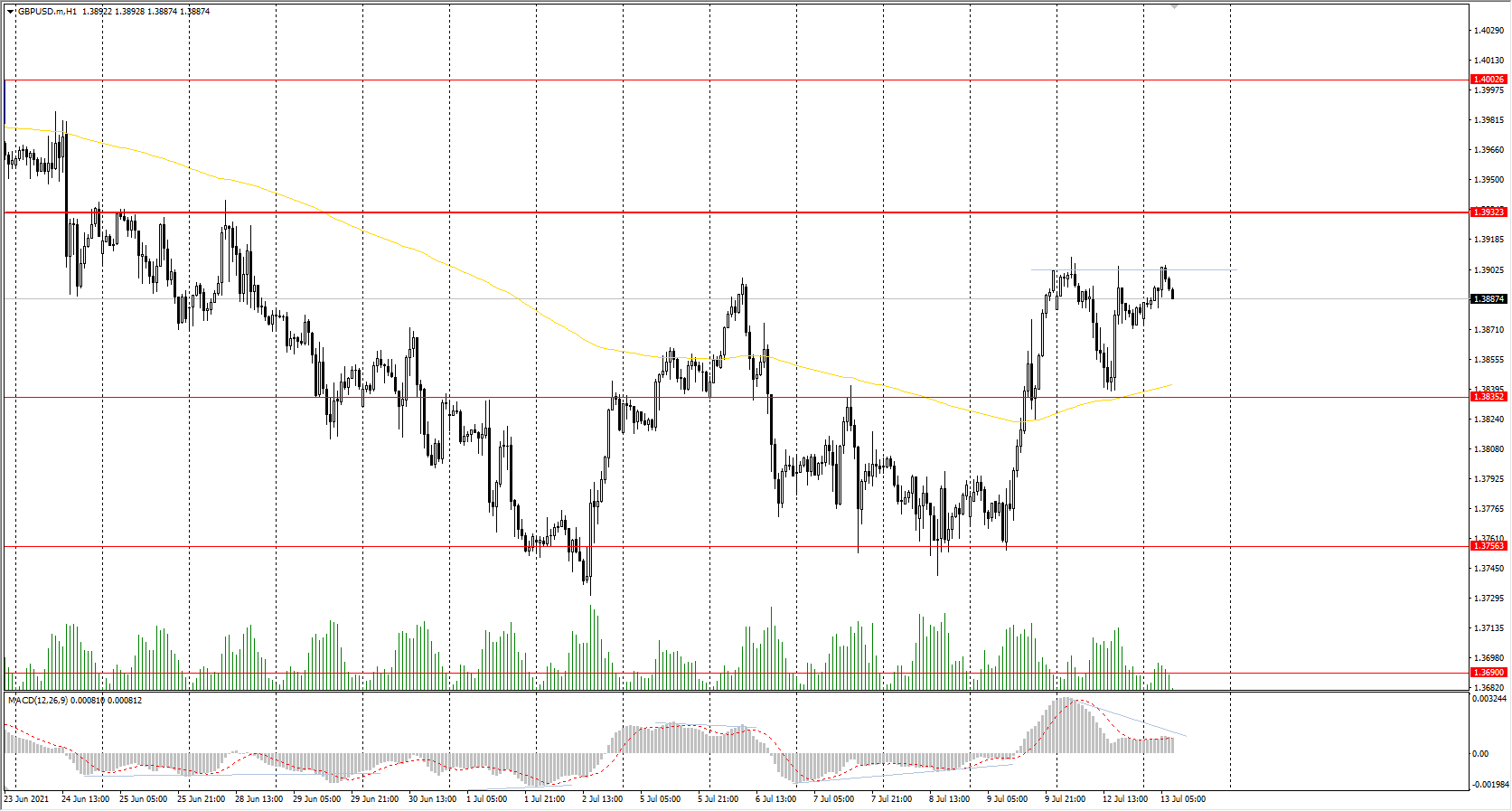
Technical indicators of the currency pair:
Prev Open: 1.3881
Prev Close: 1.3880
% chg. over the last day: -0.01%
The situation with the GBP/USD currency pair is very similar to EUR/USD. But the British pound looks more confident, as it correlates with Brent oil prices, which tend to rise. Moreover, the LIBOR 3-month dollar rate continues to decline slowly, providing support for the British currency.
Trading recommendations
Support levels: 1.3835, 1.3756
Resistance levels: 1.3923, 1.4002, 1.4075, 1.4101, 1.4138, 1.4191
The GBP/USD trend is bearish on the H1 timeframe. But the buyer's pressure is growing. The price is moving to the priority change level. The MACD indicator is in the positive zone, but there are the first signs of divergence. Under such market conditions, it is better to trade intraday. For sell positions, traders should wait for a pullback to the priority change level and see the reaction of sellers showing that they are ready to defend the level. Entries for long positions can be searched on support levels.
Alternative scenario: if the price breaks out through the 1.3922 resistance level and consolidates above, the bearish scenario is likely to be canceled.
The USD/JPY currency pair
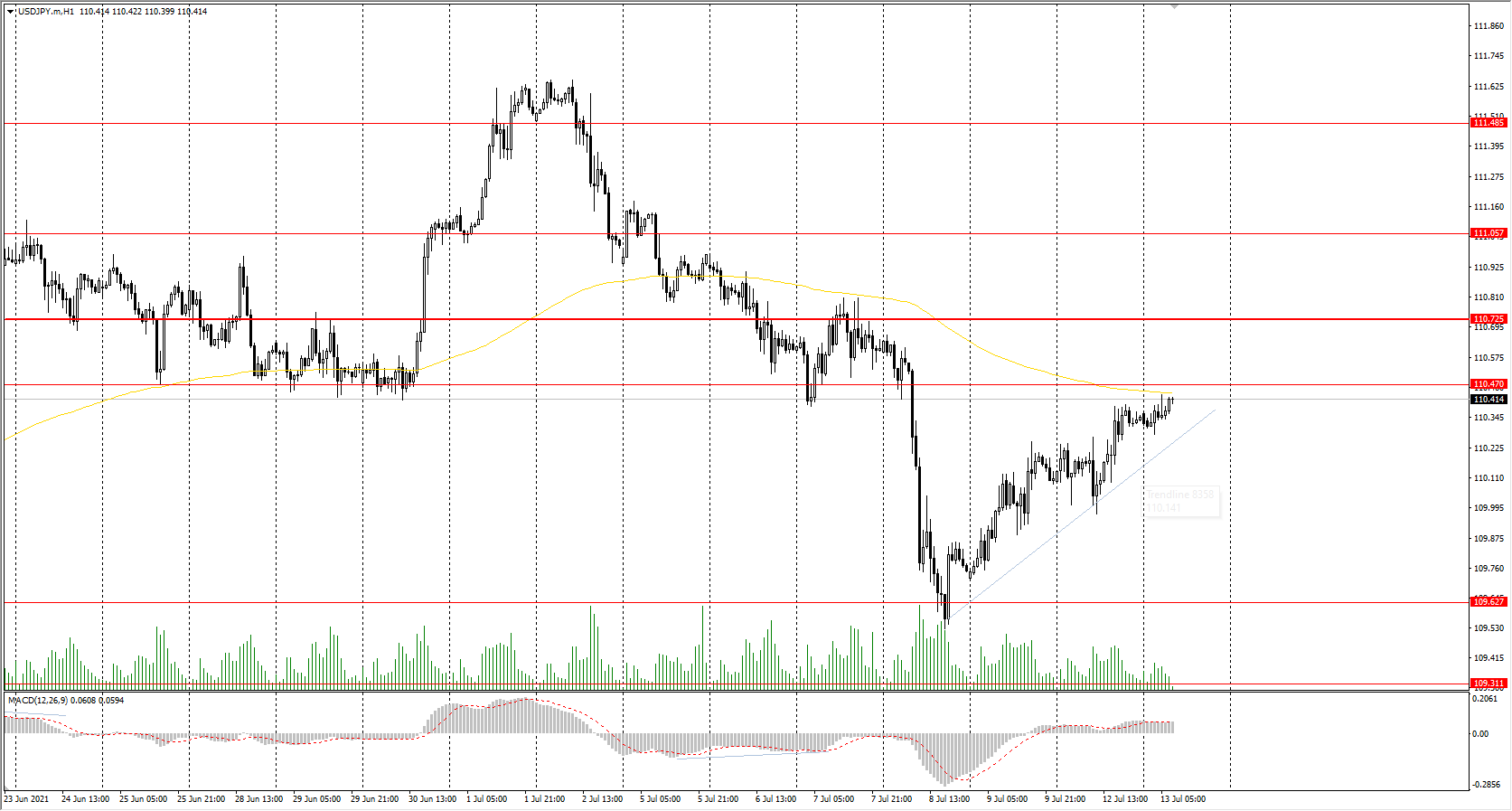
Technical indicators of the currency pair:
Prev Open: 110.10
Prev Close: 110.34
% chg. over the last day: +0.22%
The USD/JPY currency pair is slowly rising and has approached a strong resistance level. The increase in the price is caused by the fact that the dollar index has strengthened a little, and the Japanese yen futures declined due to a temporary increase in US government bonds.
Trading recommendations
Support levels: 109.63, 109.31
Resistance levels: 110.47, 110.73, 111.06, 111.48, 110.73, 112.18
From the point of view of technical analysis, there is a downward trend on the H1 timeframe. After the sharp drop in quotes on Thursday, the price corrected on Friday and Monday. The MACD indicator returned to the positive zone. Under such market conditions, traders can look for short positions from the resistance levels within the day. There are no optimal entry points for long positions now.
Alternative scenario: if the price rises above 111.05, the uptrend is likely to be resumed.
The USD/CAD currency pair
Technical indicators of the currency pair:
Prev Open: 1.2449
Prev Close: 1.2452
% chg. over the last day: +0.02%
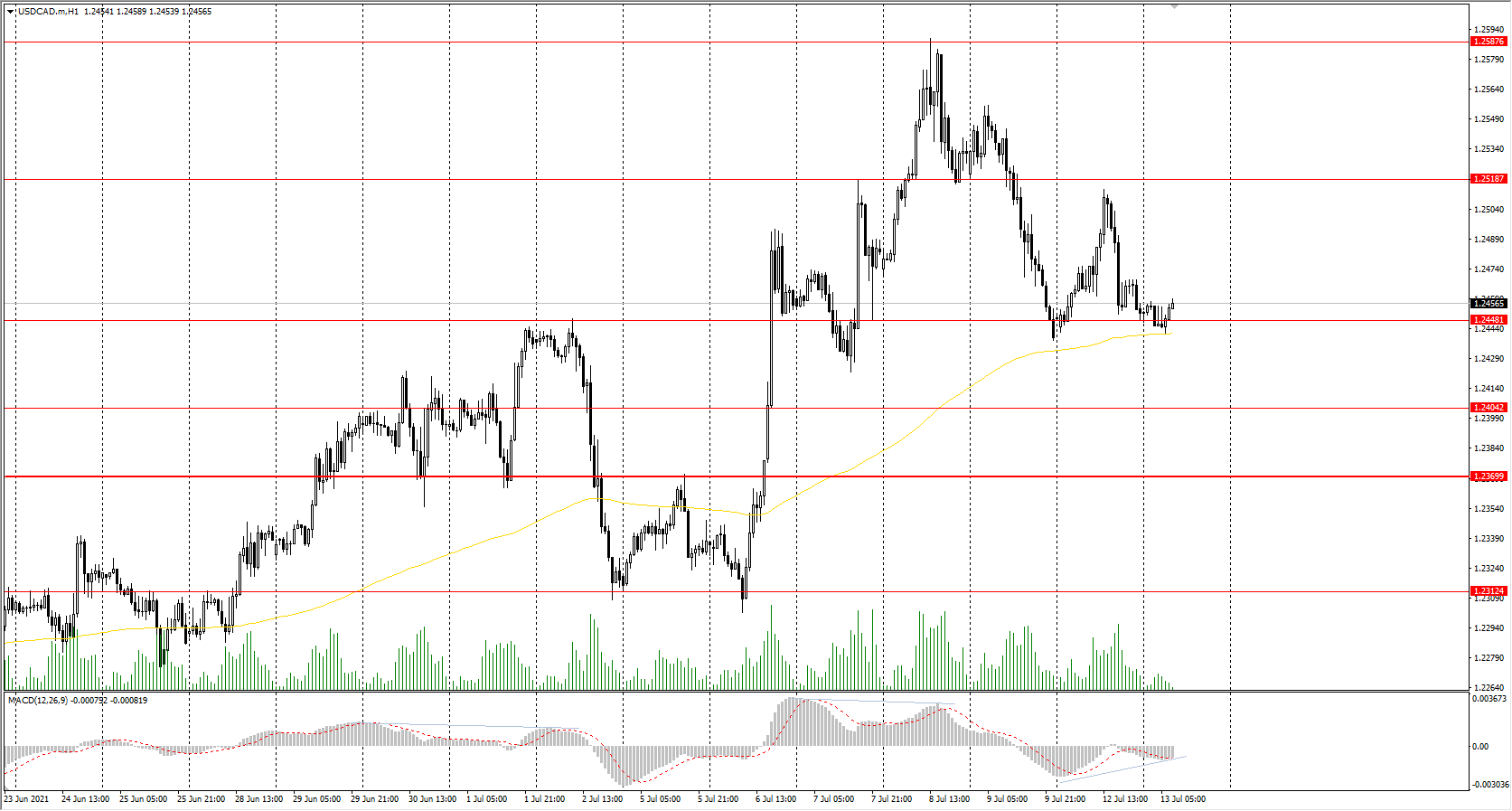
Good statistics on the labor market led to the growth of Canadian dollar futures and the fall of the USD/CAD quotes (reverse correlation) on Friday and Monday. Much will depend on the dollar index and how it reacts to the CPI data today.
Trading recommendations
Support levels: 1.2448, 1.2404, 1.2347, 1.2312, 1.2260, 1.2190
Resistance levels: 1.2519, 1.2587
Technically, the trend remains bullish. The price is still trading above the moving average and above the priority change level. The MACD is in the negative zone. Under such market conditions, it is best to trade on the lower timeframes. Buyers may look for trades from the support levels within the day. There are no optimal entry points to open sell positions now.
Alternative scenario: if the price breaks down through the 1.2370 support level and fixes below, the downtrend is likely to be resumed.