

Sample Category Title
Wall Street Hits Record Before Earnings Kickoff, Dollar Holds Firm
- Earnings optimism drives US equities to fresh record highs ahead of bank results
- Risk appetite still shaky in FX markets, dollar and yen resist deeper selloff
- US inflation data and Powell testimony will be key in directing sentiment
Wall Street rallies as reopening boost eyed
It's the start of the second quarter earnings season and optimism is running high that the reopening of the US economy will power corporate earnings to new peaks. The new season will properly kick off today when JPMorgan Chase and Goldman Sachs report their results before the market open. More big bank earnings will follow in the coming days.
But there's already plenty of buzz on Wall Street that Q2 earnings will beat the consensus estimates on expectations that the vaccine-led recovery boosted companies' bottom lines as the reopening of the world's largest economy gathered pace. The three leading indices – S&P 500, Dow Jones Industrial Average and Nasdaq Composite – all closed at new all-time highs for a second consecutive day on Monday.
Tesla stocks (+4.4%) led the charge as the company rolled out a software update, adding full self-driving capabilities to paid subscribers.
E-mini futures tracking the three indices were trading slightly lower as European shares opened mixed on Tuesday. But Asian stocks had another strong session, lifted by better-than-expected trade figures out of China, which eased concerns about slowing growth.
Dollar, yields brace for US CPI and Powell
Reports that progress is being made in the US Congress on both the partisan and bipartisan bills of Biden's infrastructure plan may also be supporting sentiment in equity markets. But in the currency sphere, traders are mainly focused on this week's US data releases and Fed Chair Powell's congressional hearing on Wednesday.
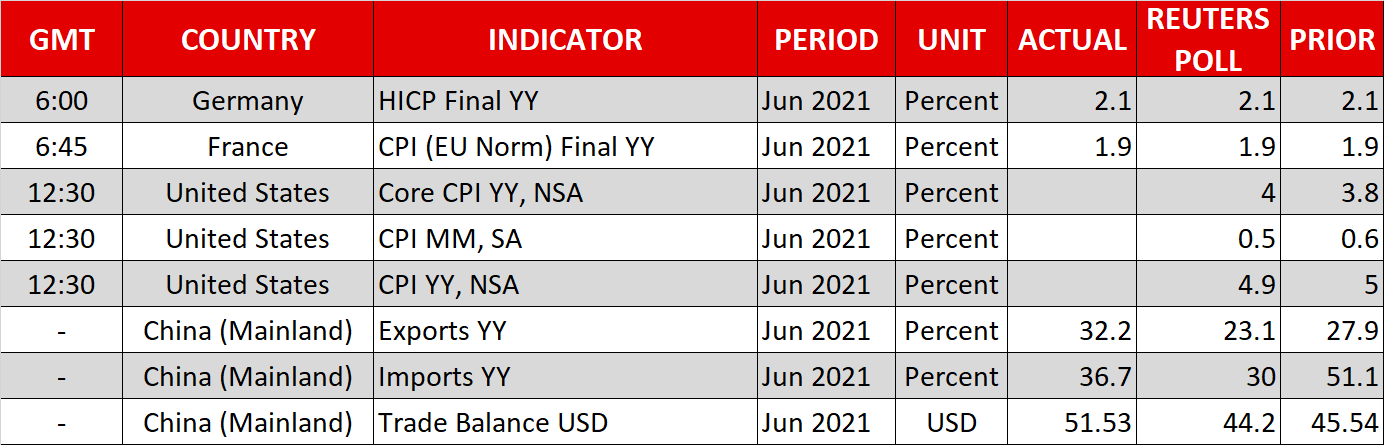
Powell is unlikely to say anything that would rattle investors but nevertheless markets will be hypersensitive to any remarks that suggest tapering could begin soon. Ahead of Powell's appearance tomorrow, all eyes will be on the June consumer price index due today at 12:30 GMT.
Expectations for the headline CPI rate are for a reading of 4.9% y/y. However, there's probably a slightly greater risk of a weaker number this time, which could spark another spending spree into US Treasury bonds, sending yields tumbling again.
The 10-year Treasury yield stabilized late last week and has recovered to around 1.36%, holding steady during yesterday's auctions. But if yields were to dip again, it's unclear which way the US dollar would go following the recent breakdown of their positive correlation.
Kiwi crawls higher ahead of RBNZ
What is evident, however, is that riskier currencies have been struggling to make much headway against the greenback lately during both risk-on and risk-off days. Even the New Zealand dollar has been unable to capitalize on growing expectations that the RBNZ will raise rates as early as November this year.
The RBNZ is due to announce its latest monetary policy decision early on Wednesday and the kiwi could come under pressure if policymakers hint that they disagree with the markets' timetable for rate hikes.
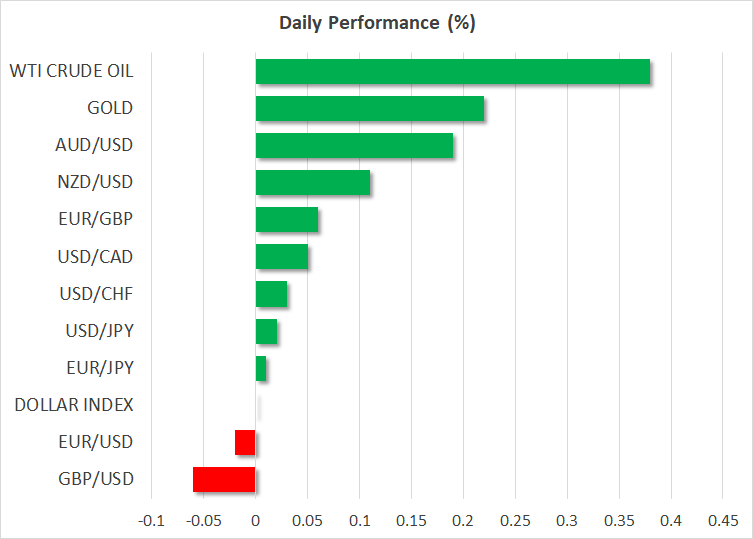
The US dollar was last trading slightly firmer against a basket of currencies but flat versus the safe-haven yen. The aussie and kiwi inched up against both the greenback and yen, while the euro and pound were weaker across the board.
In commodities, oil futures were trading about 0.8% higher despite no sign yet that Saudi Arabia and UAE are close to resolving their differences over how to ease the output restrictions. Gold, meanwhile, held within its recent range, hovering just above $1,800/oz.
NZ Dollar Breaks 70 But Retreats
New Zealand posted positive data on Tuesday, which lifted the New Zealand dollar, albeit briefly. NZD/USD crossed above the symbolic 70 line but was unable to consolidate these gains. Currently, NZD/USD is trading at 0.6987, up 0.15% on the day.
NZ dollar quiet ahead of RBNZ meeting
The New Zealand dollar received a brief boost from the Food Price index for June, which showed a strong gain of 1.4%. This was up sharply from the May reading of 0.4% and marked the strongest gain since February 2020. NZD/USD briefly pushed past the 70 level, which has been relevant throughout July.
The RBNZ holds its policy meeting early on Wednesday (2:00 GMT), and the New Zealand dollar is unlikely to show any significant movement ahead of the meeting. The bank is widely expected to maintain interest rates at 0.25%. At the May meeting, policymakers surprised the markets with a projection of raising rates to 0.49% in September 2022 and at least 1.78% in June 2024. The minutes of the May meeting emphasised that this forecast was conditional on the economy improving as expected, but the stance of the bank has clearly become more hawkish. Some analysts have gone even further, predicting a rate hike this November.
It will be interesting to see if the RBNZ rate statement refers to the resurgence of Covid. New Zealand’s Covid Response Minister Chris Hipkins has expressed his concern over the particularly in Australia, with New South Wales under lockdown due to an increase in Covid cases. The rise in cases of the Delta variant worldwide has hurt risk sentiment and could curb demand for the New Zealand dollar.
Attention will shift from the RBNZ to inflation, with New Zealand releasing Q2 CPI on Thursday. The consensus is a gain of 1.4% YoY, little changed from the first-quarter reading of 1.4%.
NZD/USD Technical
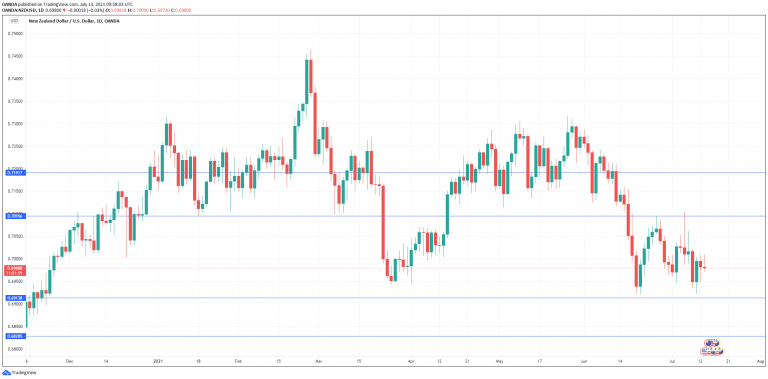
- There is resistance at 0.7095 earlier in the day. Above, we find resistance at 0.7191
- On the downside, the pair has support at 0.6913 which is protecting the round number of 0.6900. Below there is support at 0.6827
GBP/AUD 4H Chart: Bulls Could Prevail
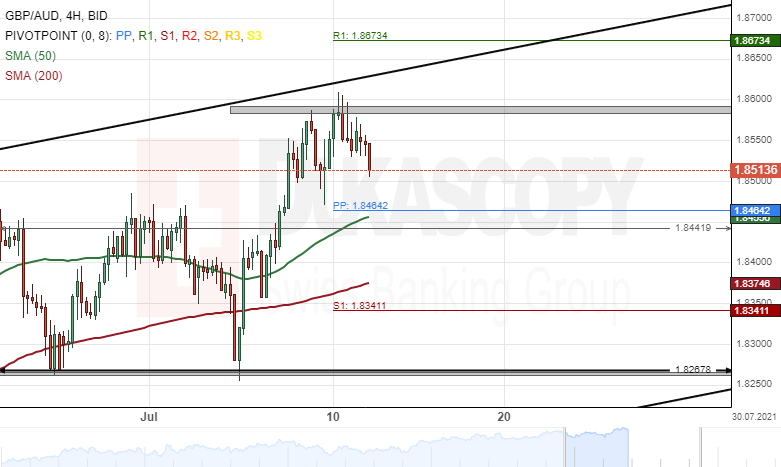
The British Pound has edged higher by 1.67% against the Australian Dollar since last week's trading sessions. The currency pair tested the 1.8600 mark on Monday, July 12.
Technical indicators suggest buying signals on the 4H, daily and weekly time-frame charts. Most likely, long traders could continue to drive the exchange rate higher during the following trading sessions.
However, the upper boundary of an ascending channel pattern could provide resistance for the GBP/AUD currency exchange rate within this week's trading sessions.
GBP/CAD 4H Chart: Breakout Occurs
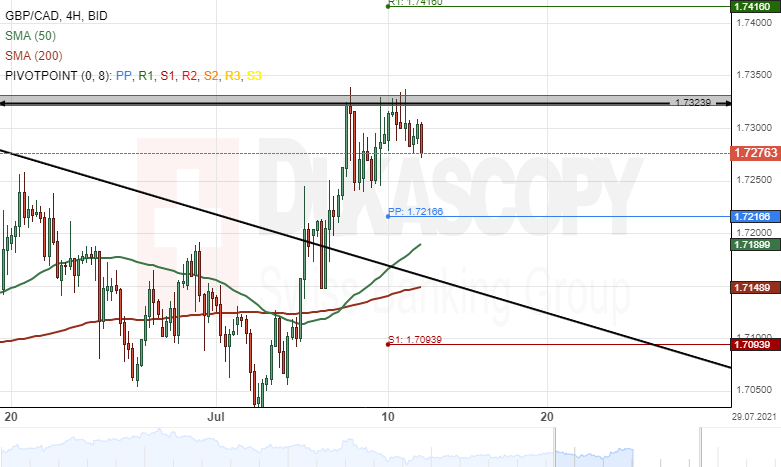
The Pound Sterling has surged by 1.70% against the Canadian Dollar since July 5. A breakout occurred through the upper boundary of a descending channel pattern during last week's trading sessions.
Given that a breakout has occurred, buyers are likely to continue to pressure the exchange rate higher during the following trading sessions. The potential target for the exchange rate will be near the 1.7550 area.
However, the resistance level at 1.7323 could still provide a barrier for the GBP/CAD currency exchange rate during this week's trading sessions.
Gold Analysis: Found Support Below 1,800.00
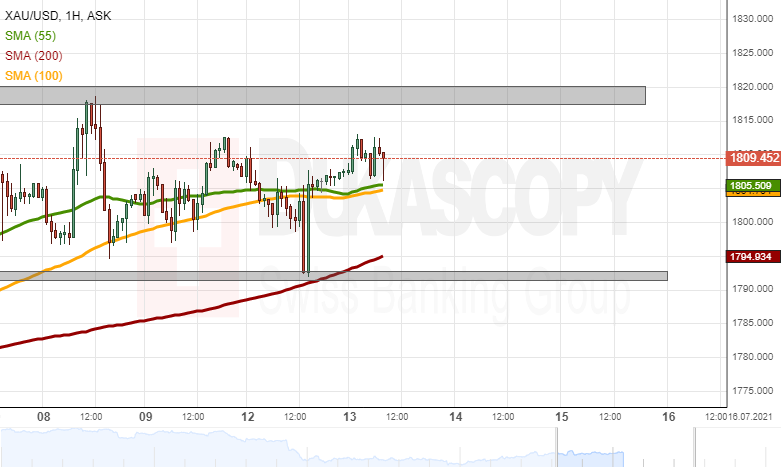
The yellow metal found support in the zone above the 1,790.00 level. Meanwhile, as the price was being approached by the 200-hour simple moving average, a recovery began. By the middle of Tuesday's European trading hours, the bullion had reached above 1,810.00.
A continuation of the surge of the yellow metal's price could encounter resistance in the zone below the 1,820.00 marks. A passing of the resistance zone could result in the price reaching the 1,850.00 marks.
On the other hand, a decline would find support in the 55 and 100-hour simple moving averages near the 1,805.00 level before looking for support in the 1,800.00 level and the 200-hour SMA near 1,795.00.
USD/JPY Analysis: Passes Resistance Levels
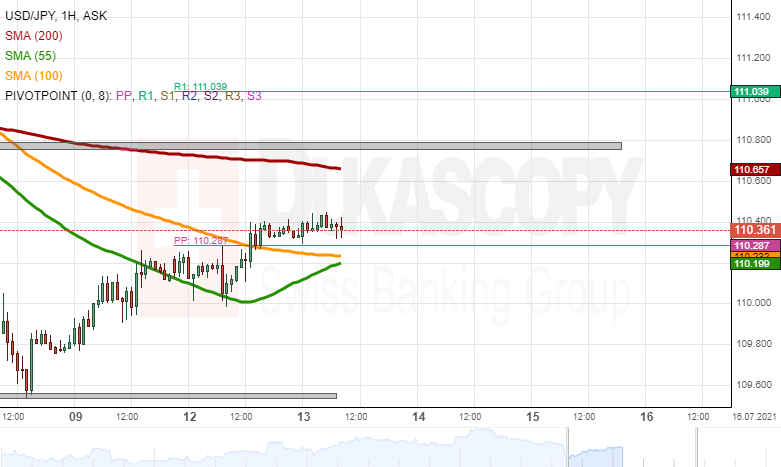
During Monday's trading, the USD/JPY broke the resistance of the 100-hour simple moving average and the weekly simple pivot point near 110.30. However, it did not result in an extended surge, as the currency exchange rate began to fluctuate sideways in the 110.30/110.50 range.
If the rate ends the sideways trading by surging, it would encounter resistance near 110.65 where the 200-hour simple moving average was located at. Above it, a zone below the 110.80 mark could provide resistance, as it had done previously in July.
On the other hand, a potential decline would find immediate support in the weekly simple pivot point at 110.29 and the 55 and 100-hour simple moving averages near 110.20. Below them, the rate could find support in the 110.00 mark.
GBP/USD Analysis: Fails At Surging
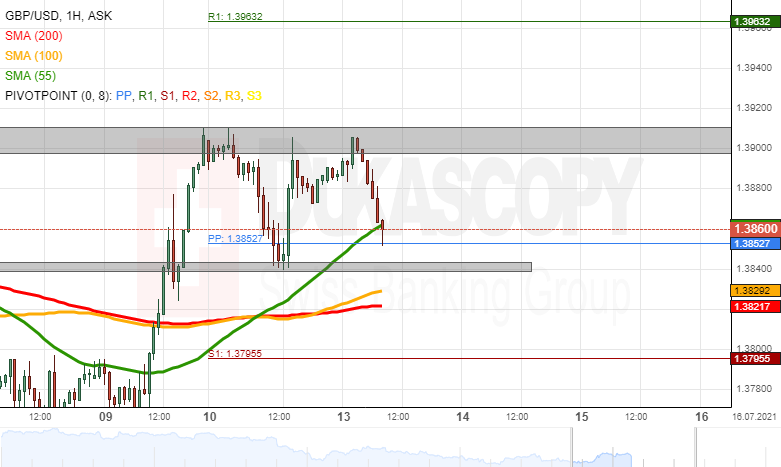
On Tuesday, the GBP/USD made another attempt to pass the zone above the 1.3900 marks. In the meantime, the rate revealed on Monday that the zone near 1.3840 manages to provide support.
In the near term future, the pair could be pushed up by the support of the 55, 100, and 200-hour simple moving averages. A potential surge could once again test the resistance of the 1.3900 zones. A passing of the zone could result in the rate reaching the weekly R1 simple pivot point at 1.3963.
Meanwhile, a decline would look for support in the 1.3840 level, which reversed the pair's Monday decline. A decline below the 1.3840 marks could look first for support in the 100 and 200-hour SMAs. Afterward, the weekly S1 at 1.3796 could provide support.
EUR/USD Analysis: Remains Below 1.1900
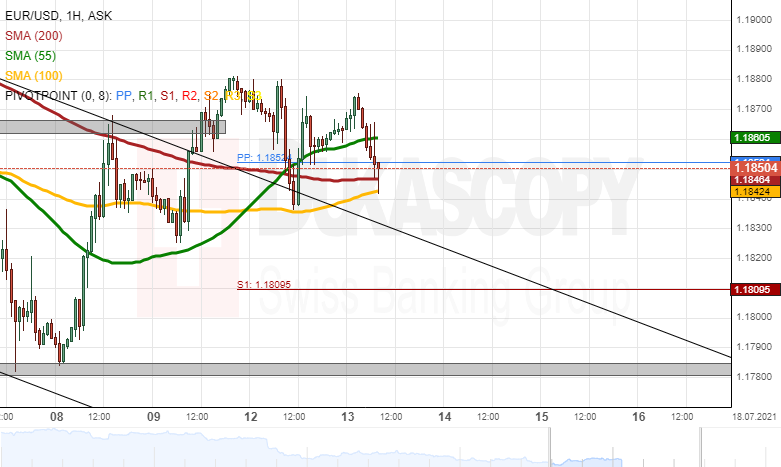
Despite not facing any technical resistance on Monday, the EUR/USD currency exchange rate did not surge. The pair's attempt at moving higher on the chart was stopped by the 1.1880 level. The rate made two attempts to reach above the 1.1880 level before declining and finding support in the 100-hour simple moving average.
On Tuesday, the currency exchange rate fluctuated below the resistance of the 1.1880 level and the support of the weekly simple pivot point at 1.1852.
In the case that the rate passes the resistance of the 1.1880 level, the EUR/USD could reach for the 1.1900 marks and afterward the weekly R1 simple pivot point at 1.1923.
On the other hand, a potential decline would look for support in the weekly simple pivot point at 1.1852 and the 100- and 200-hour simple moving averages.
EURJPY Price Bounce Struggles, Downward Correction Still In Command
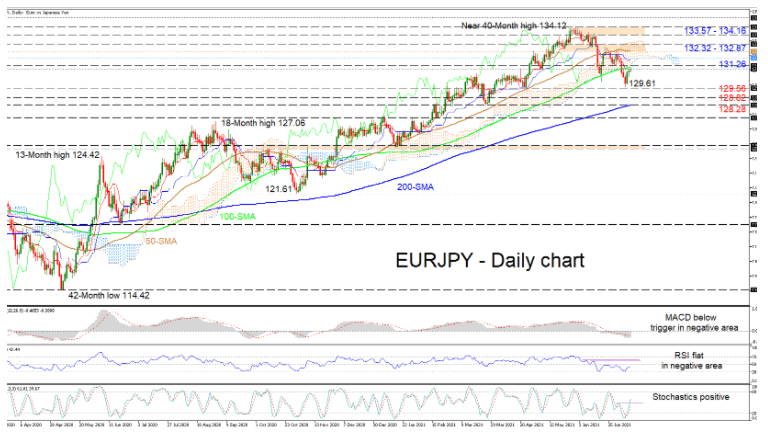
EURJPY is trading in the vicinity of the 131.00 handle and the 100-day simple moving average (SMA) but buyers’ traction off the 129.56 level seems to have run out of steam. The advancing 100- and 200-day SMAs are endorsing the broader positive structure, while the slight dwindling in the 50-day SMA’s incline is signalling that the retraction from the near 40-month high of 134.12 may be securing an edge.
The Ichimoku lines are hinting that negative momentum may soon pick up again, while the short-term oscillators are suggesting bullish forces could attempt to take the lead. The MACD, in the negative region, is improving and is looking set to push above its red trigger line, while the RSI is currently static in the bearish zone after rebounding off the 30 level. Moreover, the stochastic oscillator’s %K line is promoting additional price gains in the pair.
To the upside, buyers may face immediate resistance from the 131.00 hurdle until the 131.26 inside swing low. Prodding over this band of resistance that contains the 100-day SMA, buyers would then need to navigate above the Ichimoku cloud’s lower surface at 131.85 to tackle the resistance section of 132.32-132.87. Recapturing the area above this tough barricade is critical to reinforce positive belief and a test of the 133.57-134.16 limiting zone.
If the 131.00 border together with the 100-day SMA cap an extension of the recent bounce, sellers could encounter preliminary support around the 129.56 low. Should the 1½-month decline from the multi-year peak of 134.12 resume below the aforementioned low, the 128.82 obstacle may come into play before sellers target the 200-day SMA, residing at the March 24 trough of 128.28.
Summarizing, EURJPY’s broader outlook still holds a positive demeanour above the 129.61 low and the 200-day SMA. However, its near-term picture of lower highs and lows is strengthening a negative skewness below the 132.67 high and the cloud.
The US Indices Continue To Rise. Investors Are Waiting For Positive Inflation Statistics
All three major US indices closed in the green zone yesterday as investors expect positive statistics on the consumer price index and that quarterly earnings of major banks will be a catalyst for further growth. The S&P 500 and Nasdaq reached new all-time highs, while the Dow Jones did not have 126 points to reach new all-time highs. The US banking sector is reporting today and tomorrow, so traders are actively buying stocks of banks such as JP Morgan, Goldman Sachs, Bank of America, Wells Fargo, and Citigroup.
In the United States, the struggle against the monopoly of IT giants is around the corner. On Friday, President Joe Biden called on the Federal Trade Commission and Justice Department to set stricter rules on mergers that would make it harder for big tech companies to take over their smaller competitors.
European stock indices also returned to record highs. Britain's FTSE 100 increased by 0.05%, Germany's DAX jumped by 0.65%, and France's CAC 40 added 0.46%. The ECB chairman Christine Lagarde said during an interview with Bloomberg TV that the ECB will outline new guidelines for the future direction of monetary policy at a meeting on July 22. Ms. Lagarde also added that the ECB may introduce new measures to support the economy next year, after the expiration of the Pandemic Emergency Purchase Program (PEPP).
WTI crude futures slightly decreased during the US session. But considering the background of expected further reduction of oil reserves in the US, the fundamental situation is in favor of rising prices. The price is also influenced by growing fears of increased cases of delta strain infection in Asia and the uncertainty of OPEC+ countries' production plans.
Positive inflation data could trigger the rise in prices for the US government bonds, which, in its turn, could reduce gold and silver prices (inverse correlation). Gold and silver are trading inside the price ranges now, which makes it difficult to find good entry points, but today it is better to stay away from trading precious metals.
The Asian market is following the American one. Japanese and Chinese indices increased to their highest levels in the last two weeks. But the growth of indices is constrained by the worsening epidemiological situation in Asian countries. Also, this week the central banks of Japan, New Zealand, and South Korea are expected to announce their interest rates and that makes investors more cautious.
Main market quotes:
- S&P 500 (F) 4,384.75 +15.20 (+0.35%)
- Dow Jones 35,000.39 +130.23 (+0.37%)
- DAX 15,790.51 +102.58 (+0.65%)
- FTSE 100 7,125.42 +3.54 (+0.05%)
- USD Index 92.24 +0.11 (+0.12%)
Important events:
- US Consumer Price Index (m/m) at 15:30 (GMT+3);
- US Core Consumer Price Index (m/m) at 15:30 (GMT+3).