

Sample Category Title
The US And Europe Inflation Data, As Well As Asia’s Internest Rate Decisions, Are In Focus This Week
The prospects for US inflation and future Federal Reserve policy tightening are in the spotlight ahead of Tuesday's consumer price data (the most important inflation indicator) and Fed Chairman Jerome Powell's statements on Wednesday and Thursday. Concerns about the Delta variant of the new coronavirus are also adding to the tension in the financial markets. However, the S&P 500 Index made a new all-time high on Friday, and other indices also increased significantly. This week, the second-quarter reporting season begins in the US stock market.
The G-20 countries agreed to a 15% global digital tax. This is historic across-the-board tax reform. The main purpose is to end the situation where large IT corporations such as Apple, Google, Amazon, and Facebook only pay tax in the countries they are registered, but not in the countries where they generate revenue. Previously, many companies registered their headquarters in countries with lower taxes.
European stock markets closed with confident growth on Friday, despite a rise in cases of the new Delta strain in Great Britain and Portugal. The European automakers became the leaders of growth again. Published on Friday, the UK GDP data showed a slowdown in the economy. This week, consumer price data in Britain, Germany, and the Eurozone will be in the focus of investors.
Oil rebounded slightly from a 3-day decline on Friday. OPEC+ representatives have not reached an agreement about increasing oil production in August. Considering the growing demand for fuel in summer, this factor will play in favor of rising oil prices. But uncertainty in the oil market is increasing.
Gold decreased on Friday due to a slight increase in US government bond yields (inverse correlation). The fundamental picture for the precious metals remains unchanged, in favor of higher prices. Still, ahead of the inflation data and Powell's speech to Congress, gold and silver may behave unpredictably.
Asian markets are rising again with record highs on Wall Street and policy easing in China that have helped overcome recent fears of a slowing global recovery. Interest rate decisions from the central banks of Japan, New Zealand, and South Korea are expected this week. Investors will also watch China's GDP data for the second quarter.
Main market quotes:
- S&P 500 (F) 4,369.55 +48.73 (+1.13%)
- Dow Jones 34,870.16 +448.23 (+1.30%)
- DAX 15,687.93 +267.29 (+1.73%)
- FTSE 100 7,121.88 +91.22 (+1.30%)
- USD Index 92.10 -0.31 (-0.34%)
Gold Consolidates Above 1,800 As Positive Impetus Dies Down
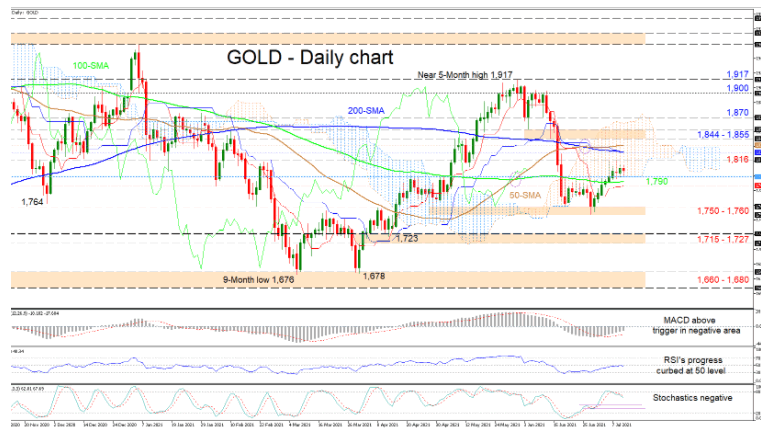
Gold's latest rally that began from the 1,750 level seems to have slowed down just above the 1,800 mark. Directional forces seem to have toned-down, something also being reflected in the overall weakened bearings of the simple moving averages (SMAs), and the horizontal Ichimoku lines.
The short-term oscillators are also transmitting conflicting signals in directional momentum. The MACD, in the bearish region, is improving above its red trigger line, while the RSI appears to be lacking positive drive to push into the bullish zone. The negatively charged stochastic oscillator is signalling growing negative forces.
If buyers manage to thrust above the nearby 1,816 high, early resistance could develop between the 200- and 50-day SMAs of 1,827 and 1,836 respectively. Another leg higher, the barricade of 1,844-1,855 could generate some opposition for the bulls to lift the price to test the 1,870 barrier. However, successfully breaching this too could encourage buyers to revisit the 1,900 border and maybe even shoot for the near 5-month peak of 1,917.
Otherwise, just below the 1800 mark downside limitations may commence from the cloud's lower surface at 1,797 until the red Tenkan-sen line at 1,786, an area, which also contains the 100-day SMA at 1,790. Effectively steering beneath these obstacles, sellers may lead the price to the support section of 1,750-1,760, recently formed between the troughs of June 18 and 29 respectively. Should the yellow metal remain heavy, the support base of 1,660-1,680 could become the bears' next target, shaped from the lows from the end of April up to early June, as well as the 9-month low of 1,676 and the following trough of 1,678.
As things currently stand, gold remains somewhat undecided upward of the 1,800 level, as directional forces have become relatively muted. A climb above the SMAs and the cloud could boost upside confidence, while a close beneath the 1,750-1,760 support may reinforce negative pressures.
Risk Appetite Runs Into Trouble Again As Virus Cases Trend Higher
- Worries that Delta variant is fuelling a new global surge in infections sap sentiment
- Dollar halts decline, edges up, while stocks back under pressure
- Bonds to stay in focus as Treasury auctions, CB meetings, Powell testimony coming up
Subdued start to week as virus woes return
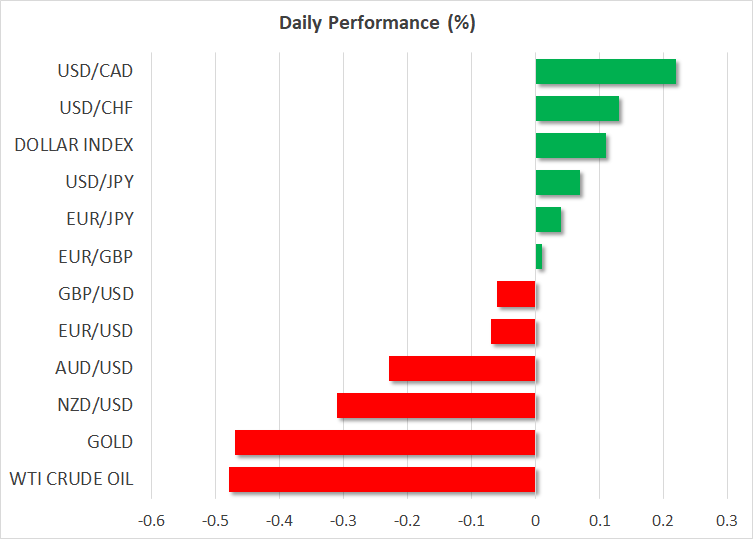
Risk assets were struggling on Monday as signs that virus infections have started to creep higher globally put a dent in the improvement in sentiment that took hold from the middle of last week. The US dollar ended its two-day slide to edge back up even as Treasury yields reversed lower again, underlining the recent breakdown of that relationship. The greenback typically tracks the moves in the benchmark 10-year Treasury yield but the positive correlation has switched into a negative one since late June when growth and virus jitters first resurfaced.
The highly contagious Delta variant of Covid-19 is running rampant in more and more countries, casting doubt on hopes that vaccines will bring about a complete reopening of economies. The worrying trend comes just as many central banks have started to or are thinking about pulling back some of their emergency stimulus.
There was some relief last week, however, when the Federal Reserve toned down some of its more hawkish rhetoric, signalling that a decision on tapering could still be months away. The market mood also got a lift from Chinese policymakers when they cut the reserve requirement ratio for banks, unleashing $154 billion of cash into the economy, alleviating some of the impact from a recent tightening of credit conditions in China.
Dollar and bonds brace for central bank action
The dollar was last trading marginally higher against a basket of currencies, while the 10-year Treasury yield brushed a low of 1.3330%. The bond market will be put to the test later today when the US government auctions $38 billion in 10-year notes. A sale of $24 billion in 30-year notes will follow on Tuesday.
The auctions could help ease the rally in bonds, pushing yields higher. However, it might be difficult for global bond yields to make a meaningful rebound if fears around the Delta variant persist.
Traders will also be closely watching Fed Chair Jerome Powell’s testimony before Congress on Wednesday and Thursday, when he is expected to reiterate that the Fed is in no hurry to wind down the monthly pace of asset purchases. But other central banks might sway in the opposite direction as the Bank of Canada will probably taper again this week, although there’s a little more uncertainty as to how the RBNZ will manage market expectations of a November rate hike when it meets on Wednesday.
In the meantime, risk-sensitive currencies were underperforming on Monday. The Australian dollar slipped by around 0.2%, having failed once again to crack above the $0.75 barrier and after Australian authorities extended Sydney’s lockdown. The Canadian and New Zealand dollars were down by a bigger 0.3%, with sterling not far behind.
Euro unfazed by ECB policy revamps
The euro bucked the trend, however, standing almost flat on the day versus the greenback. It’s hard to pinpoint what could be supporting the euro more than other majors today. Perhaps markets are confident the Eurozone will weather the Delta storm a bit better than other countries, or it’s the disappointment that the ECB didn’t announce a too radical overhaul of its monetary policy strategy last week that would have involved a looser inflation target like the Fed has adopted.
Investors even shrugged off hints from President Lagarde in an interview earlier today that the ECB will significantly modify its forward guidance at the next meeting later this month. The ECB is desperately trying to strike a dovish tone but confusing signals amid a split Governing Council seem to be undermining that message.
Stocks may already be rebounding after sluggish start
It’s looking a like a mixed day for equity markets as European and US stock futures were in negative territory towards the end of Asian trading, despite a positive session. However, some European shares as well as Nasdaq futures have now turned positive, suggesting risk appetite could bounce back later in the day.
Aside from the busy economic and central bank schedule lined up this week, the Q2 earnings season will kick off on Wall Street, starting with JPMorgan Chase and Goldman Sachs tomorrow. Both the S&P 500 and Nasdaq Composite ended Friday in record territory, unhindered by the latest virus scare. Bumper earnings could help stretch the winning streak.
Quiet Start To An Event-Filled Week
Notes/Observations
- Quiet start to week but focus on upcoming US Jun CPI data (Tuesday), Fed Chair Powell’s semi-annual testimony in Congress (Wed); retail sales (Friday).
- Lots of Far East events as well China Q2 GDP (Thursday’s Asian session) and the Bank of Japan (BOJ) policy decision (Asia’s Fri session).
- Concerns that a rapid spread of the Delta variant of coronavirus could potentially undermine the economic rebound.
- Corporate earning season back upon us.
Asia
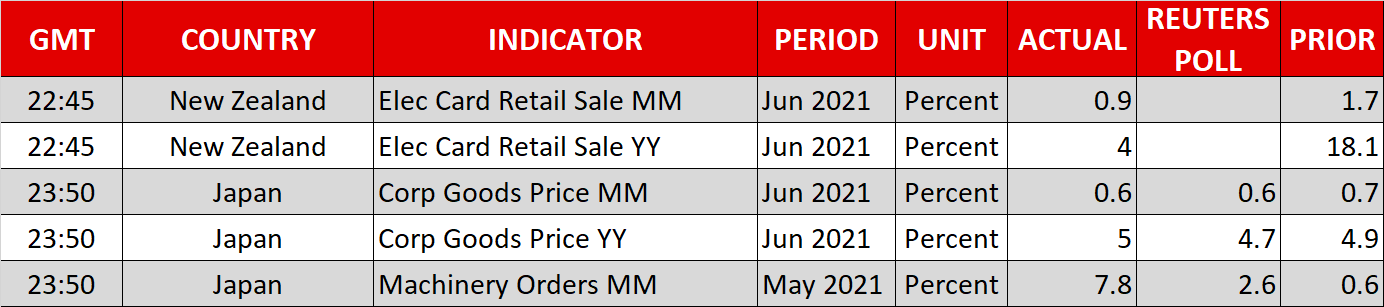
- Japan May Core Machine Orders beat expectations for its largest increase since Oct 2020 (M/M: 7.8% v 2.4%e; YoY: 12.2% v 6.3%e).
- RBNZ Shadow Board (NZIER) called for RBNZ to tighten policy given the pickup in inflation pressures.
Coronavirus
- UK PM Johnson acknowledged that COVID cases would rise as restrictions were lifted, Expected people to work from home and wear masks after July 19th.
- COVID lockdown in Sydney expected to be extended beyond Friday as cases continued to rise.
- South Korea to enforce its strictest social distancing measures starting Monday (July 12th) for 2 weeks to rein in the resurgence of the new COVID cases in the greater Seoul area.
- Tokyo entered its 4th COVID-19 State of Emergency.
Europe
- G20 Finance Ministers agreed on minimum corporate tax of at least 15%.
- ECB chief Lagarde stated that forward guidance to be reviewed during July 22nd meeting, possible measures for 2022. PEPP may be followed by transition into new format; Must not create anticipation emergency tools near end.
- ECB's Schnabel (Germany) reiterated stance that do not expect to see 'excessively high' inflation; current higher inflation is temporary.
Americas
- US Treasury Sec Yellen stated that expected to finalize tax changes for large firms in 2022, needed to be faster distribution of COVID vaccines globally or economic recovery would be impacted.
Speakers/Fixed income/FX/Commodities/Erratum
Equities
- Indices [Stoxx600 -0.04% at 457.48, FTSE -0.57% at 7,081.45, DAX -0.12% at 15,669.70, CAC-40 -0.39% at 6,503.91, IBEX-35 -0.41% at 8,741.00, FTSE MIB -0.01% at 25,050.50, SMI +0.35% at 12,031.80, S&P 500 Futures -0.23%].
- Market Focal Points/Key Themes: European indices open with a modest upward bias (laggards include CAC and FTSE100) but later traded mixed; improvement in risk sentiment attributed to monetary flexibility and positive study on effects of third covid shot; sectors leading to the upside include utilities and real estate; underperforming sectors include materials and consumer discretionary; Daily Mail confirms considering major reorganization; Tate & Lyle to spin off primary product unit; potential IPO play Flipkart raises $3.6B in funding round; Good Energy rejects offer from Ecotricity; no major earnings expected in the upcoming US session.
Equities
- Consumer discretionary: Daily Mail&General TST [DMGT.UK] +4% (restructuring; offer; special dividend), Quiz [QUIZ.UK] +21% (trading update).
- Consumer staples: Tate & Lyle [TATE.UK] +3% (divestment; special dividend).
- Healthcare: Bayer [BAYN.DE] -1% (drug approval).
- Technology: Atos [ATO.FR] -15% (cuts outlook).
Speakers
- ECB's De Guindos (Spain) stated that the economic rebound was underway in Europe. Risks to growth as broadly balanced but support remained essential. Could not be complacent to variants of the coronavirus.
- Sweden Central Bank (Riksbank) July Minutes noted that the economic outlook and inflation prospects looked brighter. Recovery underway but pandemic was not over yet. Several members expected inflation to be slightly above target at end for forecast period but was not an argument to make policy less expansionary. ometime before inflation neared 2% target more persistently.
- Sweden Central Bank (Riksbank) Gov Ingves noted in July minutes that expansionary policy to support recovery; too early to remove stimulus in country. GDP rebound looked slightly stronger than expected. Essential to have measures to manage household debt; high levels made domestic economy vulnerable.
- Austria Central Bank raised its 2021 CPI forecast from 2.0% to 2.2% and set 2022 at 2.0%.
- Hungary Fin Min Varga stated that GDP growth was seen above 6.0% even without EU funds.
- Poland Central Bank's Lon stated that more easing was possible if Delta variant of the virus hit the domestic economy.
- Poland Central Bank (NBP) Quarterly Inflation Report raised its inflation outlook for the horizon period. Raised 2021 CPI from 3.1% to 4.2%, raised 2022 CPI from 2.8% to 3.3% and raised 2023 CPI from 3.2% to 3.4%. It raised the 2021 GDP growth forecast from 4.1% to 5.0% while maintaining the 2022 GDP growth outlook at 5.4%.
- Israel Central Bank Gov Yaron stated that MPC debated whether to stick with inflation target between 1.0-3.0%. Managing pandemic would have been easier if rates and inflation were higher.
Currencies/Fixed Income
- Bond yields were lower in the session as concerns percolated that a rapid spread of the Delta variant of coronavirus could potentially undermine the economic rebound.
- FX markets were quiet but focus on a plethora of events to take place during the week (see above notes/observation section for examples).
- EUR/USD steady at 1.1875.
- GBP/USD at 1.3860 area.
Economic data
- (SE) Sweden July SEB Housing-Price Indicator: 82 v 65 prior.
- (DE) Germany Jun Wholesale Price Index M/M: 1.5% v 1.7% prior; Y/Y: 10.7% v 9.7% prior.
- (DK) Denmark Jun CPI M/M: 0.1% v 0.2% prior; Y/Y: 1.7 v 1.7% prior.
- (DK) Denmark Jun CPI EU Harmonized M/M: 0.1% v 0.3% prior; Y/Y: 1.9% v 1.7% prior.
- (JP) Japan Jun Preliminary Machine Tool Orders Y/Y: 96.6% v 141.9% prior.
- (TR) Turkey May Unemployment Rate: 13.2% v 13.9% prior.
- (IT) Bank of Italy Banks and Money Monthly Statistics: May Gross Non-performing Loans (NPLs): €50.5B v 52.1B prior.
Fixed income Issuance
- None seen.
Looking Ahead
- 05:25 (EU) Daily ECB Liquidity Stats.
- 05:30 Germany to sell €4.0B in 6-month BuBills.
- 05:30 (ZA) South Africa announces details of upcoming I/L bond sale (held on Fridays).
- 06:00 (PT) Portugal Jun Final CPI M/M: No est v 0.1% prelim; Y/Y: No est v 0.5% prelim.
- 06:00 (PT) Portugal Jun Final CPI EU Harmonized M/M: No est v 0.2% prelim; Y/Y: No est v -0.6% prelim.
- 06:00 (IL) Israel Jun Consumer Confidence: No est v 138 prior.
- 06:00 (IL) Israel to sell bonds.
- 06:00 (TR) Turkey to Sell 16.2% 2023 Bonds.
- 06:45 (US) Daily Libor Fixing.
- 07:00 (ZA) South Africa May Manufacturing Production M/M: +1.2%e v -1.2% prior; Y/Y: 46.8%e v 87.9% prior.
- 07:00 (MX) Mexico May Industrial Production M/M: +0.3%e v -0.2% prior; Y/Y: 36.4%e v 36.6% prior; Manufacturing Production Y/Y: 50.2%e v 52.0% prior.
- 07:25 (BR) Brazil Central Bank Weekly Economists Survey.
- 08:00 (IN) India May Industrial Production Y/Y: 32.0%e v 134.4% prior.
- 08:00 (IN) India Jun CPI Y/Y: 6.6%e v 6.3% prior.
- 08:00 (UK) Daily Baltic Dry Bulk Index.
- 08:00 (ES) Spain Debt Agency (Tesoro) announces size details of upcoming issuance.
- 08:00 (IN) India announces details of upcoming bond sale (held on Fridays).
- 08:30 (CL) Chile Central Bank Economist Survey.
- 09:00 (RU) Russia May Trade Balance: $11.3Be v $10.6B prior; Exports: $37.0Be v $36.9B prior; Imports: $26.1Be v $26.3B prior.
- 09:00 (FR) France Debt Agency (AFT) to sell €5.1-6.3B in 3-month, 6-month and 12-month bills.
- 09:45 (EU) ECB weekly QE bond buying update.
- 09:45 (UK) BOE to buy £1.147B in APF Gilt purchase operation (3-7 years).
- 11:30 (US) Treasury to sell 13-Week and 26-Week Bills.
- 13:00 (MX) Mexico Jun Total Formal Job Creation: No est v +39.0K prior.
- 13:00 (US) Treasury to sell 3-Year Notes.
- 13:00 (US) Treasury to sell 10-Year Notes Reopening.
- 16:00 (US) Weekly Crop Progress Report.
- 18:45 (NZ) New Zealand Jun Food Prices M/M: No est v 0.4% prior.
- 19:01 (UK) Jun BRC Sales Like-For-Like Y/Y: No est v 18.5% prior.
- 19:30 (AU) Australia ANZ Roy Morgan Weekly Consumer Confidence Index: No est v 107.8 prior.
- 21:30 (AU) Australia Jun Business Confidence: No est v 20 prior; Business Conditions: No est v 37 prior.
- 23:00 (KR) South Korea May M2 Money Supply M/M: No est v 1.5% prior; “L” Money Supply M/M: No est v 1.8% prior.
- 23:30 (HK) Hong Kong to sell 3-month and 6-month Bills.
- 23:35 (JP) Japan to sell 20-Year JGB Bonds.
GBP/USD Outlook: Bulls Are Taking A Breather After Strong Rally On Friday
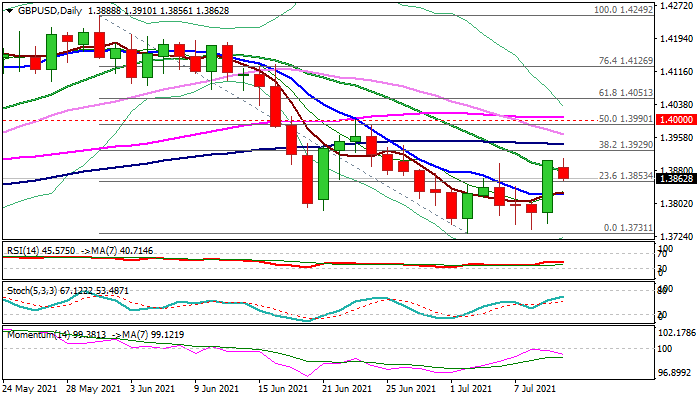
Cable is consolidating under a new two-week high (1.3904), posted after Friday’s 0.9% rally, as sterling accelerated higher on fresh risk mode, inspired by global equity gains.
Pound’s sentiment improves on expectations that the government would remove nearly all coronavirus restrictions on July 19, while weaker dollar adds to a positive near-term outlook.
Fresh bulls need to clear important barriers at 1.3929/59 (Fibo 38.2% of 1.4249/1.3731 fall/daily cloud base) to generate a stronger reversal signal, which would require a break of the key 1.40 resistance zone for confirmation.
Dips need to hold above broken 10DMA (1.3823) to keep bulls in play, but weakening momentum on the daily chart warns that the downside is still vulnerable.
Caution on the loss of 10DMA that would signal an end of recovery and bring bears back to play.
Res: 1.3910, 1.3929, 1.3959, 1.3990.
Sup: 1.3834, 1.3823, 1.3794, 1.3755.
Oil Range Trading, Gold Eyes US Dollar
Oil prices remain firm
Markets can’t seem to decide what the OPEC+ standoff between the UAE and Saudi Arabia means for oil prices. On the one hand, a fracturing of OPEC+ unity could lead to an open the pumps free-for-all, an obvious price negative. On the other hand, OPEC+’s present agreement remains in force with the grouping in compliance. And OPEC+ usually manages to overcome intra-group disagreements, eventually. That expectation has supported prices.
The net result seems to have locked Brent and WTI into range trading mode for now, albeit a relatively wide and volatile one. Brent crude rose 1.65% to USD 75.55 a barrel on Friday, easing to USD 75.25 in Asia, with virus fears eroding recovery confidence. Brent crude looks supported under USD 73.00 a barrel in the bigger picture but capped at USD 78.00 a barrel for now.
WTI spiked 1.95% higher to USD 74.65 a barrel on Friday before easing to USD 74.30 a barrel in Asia this morning. WTI looks supported on dips to USD 71.00 a barrel, while prices looked capped ahead of USD 77.00 a barrel.
Looking at the ranges and volatility in oil markets last week, it is clear that much positioning culling and tail-chasing is going on. Oil’s fundamentals remain positive, albeit perhaps slightly less so than last month, as Covid-19 keeps on giving. That all makes for a great day traders’ market at the moment, but a less appealing one for investors. Until we get OPEC+ clarity, I expect the wide-ranging chop-fest day trading frenzy to continue. Unless one has an appetite for tail-chasing intra-day risk, patiently waiting for the whipsaw dips, or just watching the fun and games from the sidelines might be the most intelligent strategy at the moment.
Gold awaits US dollar developments
Gold has managed to reclaim USD 1800.00 an ounce over the last week, but it looks very much like a function of US Dollar weakness instead of a bright new dawn for gold as an asset class. The fact that gold has spent the last five sessions quietly ranging between USD 1800.00 to USD 1820.00 an ounce after its initial spike suggests that gold is in a holding pattern, waiting for events to transpire elsewhere.
Gold has fallen 0.40% to USD 1801.00 an ounce today, giving up all of its range-trading gains from Friday. Until the US dollar breaks higher or lower emphatically, this status quo is likely to continue. Broadly speaking, I expect gold to remain contained this week, bound by support at its 100-DMA at 1791.00 an ounce, and its 200-DMA above at USD 1828.00 an ounce.
Fed Barkin: Employment-to-population ratio to rise to north of 59% before tapering
Richmond Fed President Thomas Barkin told WSJ that labor market recovery doesn't warrant tapering the asset purchase program yet. He said, "if the labor market can clear relatively quickly, then maybe it can happen sooner, but if it takes longer for the labor market to reopen, it goes a little later."
Specifically, the "employment-to-population" ratio would be important to determine whether Fed could dial back the massive stimulus it's providing to the economy. The ratio tumbled from pre-pandemic 61.1 in February 2020 to as low as 51.3% last April. It then gradually climbed back to 58% this June. Barkin said it should be something just north of 59% before he'd consider tapering.
Also he talked down the threat of inflation as it could "cool more than expected once the economic reopening process is complete."
Gold at a near term juncture after rebound stalls at 55 D EMA
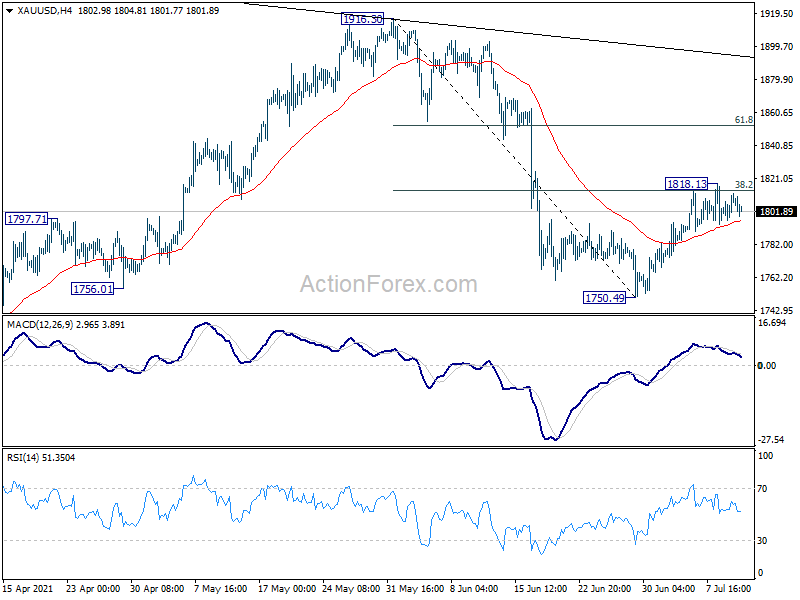
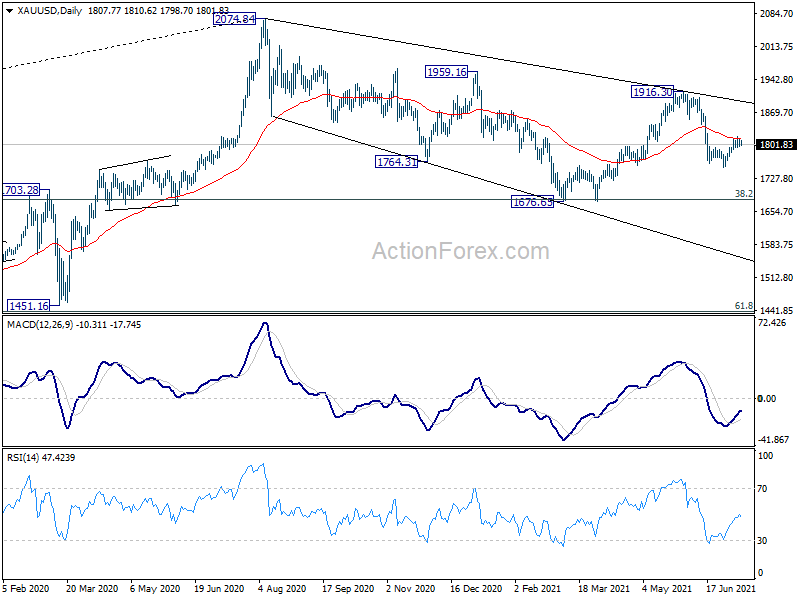
Gold is now at a near term juncture as rebound from 1750.49 halted after hitting 55 day EMA (now at 1813.31). It's unsure whether the fall from 1916.30 has completed yet. But overall, such decline is still as just a falling leg inside the corrective pattern from 2074.84 high.
In case of another fall, we'd continue to expect strong support from 1676.65 to contain downside. The level is close to long term fibonacci support of 1046.27 (2015 low) to 2074.84 at 1681.62. Meanwhile, break of 1818.13 and sustained trading above the 55 day EMA will be an early signal that the correction has completed. Stronger rise should be seen back to 1916.30 structural resistance next.
China Reserve Ratio Cuts Lifts Asia
China RRR cut boosts Asian equities
Asian equities are higher today after a surprise RRR cut by China on Friday and an upbeat Wall Street session lifted sentiment. The Nikkei 225 has raced 2.20% higher, while the Kospi has rallied by 1.0%. Notably, China’s mainland markets and its nearby neighbours are outperforming. China’s Shanghai Composite is 1.0% higher, with the CSI 300 leaping by 1.60%.
US index futures have eased slightly by around 0.20% this morning, but the move looks corrective after a powerful Wall Street session on Friday. The S&P 500, Nasdaq and Dow Jones all hit record highs on Friday. The S&P 500 rose 1.13%, the Nasdaq climbed 0.98%, and the Dow Jones rose 1.30%.
Across regional Asia, stocks are also higher, although less so than in Northern Asia. The expanding China tech-clampdown has muted sentiment in Hong Kong, which is just 0.40% higher. Singapore is 0.25% higher, with Taipei climbing 0.85%. Jakarta has risen 0.80% on commodity prices and IPO fever, but Kuala Lumpur has fallen by 0.40%, with politics and Covid-19 cases weighing on sentiment. Australian markets are shrugging off the Sydney lockdown for now, following US markets and the China RRR rally higher. The ASX 200 has risen 0.80%, while the All Ordinaries has climbed higher by 0.70%.
Northern Asian markets with high beta and geographic location to China are outperforming today. However, that rally may run out of steam as the week progresses if China’s tier-1 data releases suggest the pace of the recovery there is slowing. It would inevitably weigh on sentiment across the rest of the region, with the Asia-Pacific as a whole-ex China, grappling with the cold hard realities of Covid-19. Additionally, a 4.0% plus US Core CPI this week is likely to see EM outflows increase, and DM markets outperform, notably the northern hemisphere heavyweights.
A Busy Week Ahead
There has been a fair bit of catching up to do after the past week spent outside of the financial market’s matrix. The biggest takeaways appear to be that the US dollar rally has run its course for now, and that the US bond market refuses to taper tantrum. In fact, US bond yields have turned about-face and headed south.
The latter appears to be vexing the minds of inflationistas everywhere. As Pantheon Macroeconomics notes, Federal Reserve buying has run ahead of US government issuance in Q2, and the end of the US debt ceiling suspension looms at the end of the month. Throw in a relentless ocean of capital looking for a home in a zero per cent world, and the answer to the bond market rally, and consequent fall of the US dollar and rally in stock markets is likely right in front of our faces.
One thing is for sure, the debt ceiling won’t be resolved by July 31st if past years are anything to go buy, meaning new issuance will be constrained. Given the Fed won’t stop buying Treasuries and mortgage back securities either, the underlying bid in the bond market will remain. One could wring one’s hands at the illogical nature of it all, and let’s face it, what’s been logical since March 2020? A less stressful strategy is to accept the momentum for what it is and run with it. That likely means capped US yields, a lower US dollar, higher stocks (of course), and a solid bid on commodities and precious metals. The momentum will be what it will be, until it isn’t.
That doesn’t mean that everything is well in the state of Denmark, though. The Asia Pacific remains down a Covid-19 rabbit hole and if the situation that I have experienced first-hand in Jakarta last week is anything to go by, some downward revisions of growth are inevitable for the region. Similarly, cases are rising in the US, the UK, and Europe, even as those regions ease restrictions on their freshly mRNA vaccinated populations. Time will tell on how that bet will work out.
It is easy to look at the northern hemisphere big three and their summer holiday Instagram photos and assume the world is saved. However, the rest of the world remains mostly in a very different place. One thing that is noticeable is the waning momentum in the global reflation/recovery trade as the haves have, and the have nots (most of us) have not. China sprung a surprise RRR cut on markets late Friday, which to my mind is a strong signal from Beijing that they are nervous about the fading momentum. I had pencilled in one and five-year loan prime rate hikes for Q4 in China; I am now reassessing that.
Of course, China may have shot itself in the foot with its ever-expanding technology company and foreign IPO clampdown. Restricted lending to the property sector won’t have helped, and its quiet, but relentless, withdrawal of liquidity via the MTF and repo market may have proven premature. Throw in the constant head-butting on trade and geopolitics, a strong yuan, stubbornly high energy, and commodity prices, and perhaps it’s not such a surprise the PBOC has blinked. It should all be wonderful news for Mainland equities though, and those countries in its nearby event horizon.
The world suddenly looks like October 2020 again, pre-Pfizer BioNTech announcing they had saved the world, as long as you were American or European. At this stage, I really can’t tell you if we are temporarily back to the future or a colder reality about the global recovery looms. Either way, though, it should be good for the FOMO gnomes of the stock market.
The picture will muddy further this week if US core inflation YoY climbs above 4.0%. That may increase the taper talk again, and Federal Reserve Chairman Powell also gives semi-annual testimony in Congress this week. Further hints on a tapering schedule could appear during this address, potentially signalling the US could be moving out of monetary policy sync with the rest of the world. Fed QE buying and the debt ceiling expiry mean that the US bond market is unlikely to react, but emerging markets, notably in Asia, may not fare so well. DM is likely to outperform EM this week.
That disquiet may deepen if China’s Trade Balance, Industrial Output, Retail Sales and GDP data releases this week show a slowing down of the pace of the China recovery. Singapore GDP, Malaysian Industrial Output, Indonesia Trade and India Industrial Output and Trade Balance may tell a similar story. Asian FX is likely to fade at the expense of DM currencies, and the post-China RRR cut rally we are seeing in Northern Asian equities today could quickly fade.
We have a few central bank policy decisions in the mix as well this week. The Bank of Canada will buck the trend by further tapering their bond-buying. Along with firm commodity and oil prices, that should see the Canadian dollar outperform this week. The Bank of Japan and Bank of Korea will remain unchanged, especially after the China RRR cut and the ongoing pandemic woes at home and across the region. Those same factors, along with the extended Sydney lockdown, will also stay the Reserve Bank of New Zealand’s hands.