

Sample Category Title
Equities Trade Generally Lower Amid Fed Minutes
General trend
- Energy cos. trade generally weaker.
- Nikkei 225 has remained modestly lower [Heavyweight Fast Retailing drops over 1%; Topix Air Transportation, Electric Appliances, Banks and Iron & Steel indices are among the decliners]; Seven & I is expected to report results later today.
- Hang Seng has extended declines [TECH index drops over 2.5%; Financials also decline].
- Shanghai Composite ended the morning session lower following the higher open [Financial and Property indices drop amid easing talk; Consumer Staples also decline; IT and Industrial indices rise].
- China banking names weaker after China's CBIRC issued a notice regarding Industrial Bank's infringement on consumer rights.
- Risk off sentiment grows as COVID cases continue to rise with the Delta variant and various countries continue with lockdowns in locations with higher cases.
- Olympics expected to announce later it will not have spectators.
- S&P ASX 200 has pared gains [Financial and Energy indices decline; Resources and Consumer Staples indices rise].
- Japan Bank Lending slowed in Jun.
- China Jun inflation figures due on Fri (Jul 9th).
Headlines/Economic data
Australia/New Zealand
- ASX 200 opened 0.0%.
- (AU) Reserve Bank of Australia (RBA) Gov Lowe: Reiterates will take to 2024 to reach conditions to adjust rates (2-3% sustainable inflation), jobless rate in low 4% is full employment.
- (AU) Reserve Bank of Australia (RBA): Excess cash at exchange settlement (ES) accounts at A$328.1B v A$321.9B prior (record high).
Japan
- Nikkei 225 opened -0.1%.
- (JP) Japan Jun Bank Lending Y/Y: 1.4% v 2.8% prior; Bank Lending (ex-trusts) Y/Y: 0.8% v 2.2% prior.
- (JP) Japan May Current Account: ¥1.98T v ¥1.81Te; Adj Current Account: ¥1.87T v ¥1.59Te; Trade Balance (BoP): ¥2.0B v ¥241.5Be.
- (JP) Japan Investors Net Buying of Foreign Bonds: -¥190.9B v -¥1.03T prior; Foreign Net Buying of Japan Stocks: -¥310.1B v -¥147.1B prior.
- (JP) Japan Econ Min Nishimura: Recommends maintaining coronavirus emergency in Okinawa (in line).
- (JP) Japan Chief Cabinet Sec Kato: Subsidy payments to companies affected by state of emergency to 'vastly' speed up.
- (JP) Bank of Japan Inflation Survey: Households expect inflation to reach 2.0% in 5-year.
- (JP) JAPAN JUN ECO WATCHERS CURRENT SURVEY: 47.6 V 41.8E; OUTLOOK SURVEY: 52.4 V 49.5E.
- (JP) Japan MoF sells ¥2.5T v ¥2.5T indicated in 0.00% (prior 0.005%) 5-year JGBs; avg yield -0.1150% v -0.0970% prior, bid to cover 3.53x v 3.79x prior.
Korea
- Kospi opened +0.1%.
- (KR) South Korea extends social distancing in greater Seoul for additional week after spike in COVID cases, warned there could be tougher measures if case numbers don't come down – Yonhap.
- 005380.KR Union workers in Korea vote in favor of potential strike action over higher wages and better working conditions – press.
- (KR) South Korea reports another record daily cases of COVID, 1,275 v 1,212 d/d.
- (KR) South Korea Spy Agency: North Korea Leader Kim has no health problems; has lost 10-20KGs - Yonhap.
China/Hong Kong
- Hang Seng opened -0.3%; Shanghai Composite opened +0.1%.
- (CN) China Sec Journal: June CPI likely to have a slight fall due to lower pork prices.
- (CN) China PBOC Deputy Gov Fan: PBOC to take more antitrust actions in Payments sector; Worried about stablecoin impact on global currency; To keep CNY exchange rate stable to help some loss making exporters.
- (CN) FTSE Russell: After user feedback in US Executive order, will delete additional China stocks from Indices; listed ~20 Chinese companies that will be removed from its indexes on Jul 28th
- (CN) China State Administration for Market Regulation (SAMR) issued administrative penalties on various e-commerce and digital platform operators' M&A cases; the cos. were ordered to pay penalties equal to CNY500K/offense - Press.
- (CN) China PBOC sets Yuan reference rate: 6.4705 v 6.4762 prior.
- (CN) China PBOC Open Market Operation (OMO): Injects CNY10B in 7-day reverse repos v CNY10B in 7-day reverse repos prior; Net CNY0B v Net drain CNY20B prior [first nil injection after 5 consecutive net drain].
- (CN) China State Council Meeting: To use timely RRR cuts to lower financing costs to support the real economy; reiterates stance to avoid flood-like stimulus - financial press (yesterday after the close).
- (CN) CHINA JUN FOREIGN RESERVES: $3.214T V $3.201TE (1st decline in 3 months) (yesterday after the close).
- (TW) China foundries have cut overall capacity support for chipmakers based in Taiwan; Giving priority to local clients - Digitimes.
- (CN) S&P Dow Jones to consider some China military companies to be re-included in indexes in light of Biden administration's order.
North America
- (US) FOMC JUN MINUTES: INDICATORS OF ECONOMIC ACTIVITY AND EMPLOYMENT HAD STRENGTHENED; PARTICIPANTS REMARKED THAT THE ACTUAL RISE IN INFLATION WAS LARGER THAN ANTICIPATED.
- (MX) Mexico Central Bank (BANXICO) Gov Diaz: Economic recovery to speed up in coming quarters, volatility could impact capital flows to emerging markets.
- TSLA Prices China made standard range Model Y at CNY276K - Website.
Europe
- (EU) Reportedly ECB agrees to set new inflation target of 2% (from "below but close to 2%") and to allow for some overshoot of the new inflation goal – press.
- (UK) Jun RICS House Price Balance: 83% v 79%e.
- (EU) European Union and the UK said to be planning closer cooperation in enforcing Antitrust measures - FT.
Levels as of 01:15ET
- Hang Seng -1.8%; Shanghai Composite -0.6%; Kospi -0.7%; Nikkei225 -0.6%; ASX 200 +0.1%.
- Equity Futures: S&P500 -0.2%; Nasdaq100 -0.1%, Dax -0.2%; FTSE100 -0.2%.
- EUR 1.1799-1.1784; JPY 110.70-110.42; AUD 0.7489-0.7455; NZD 0.7023-0.6981.
- Commodity Futures: Gold -0.2% at $1,798/oz; Crude Oil -0.2% at $72.03/brl; Copper -0.1% at $4.30/lb.
ECB Announces Strategic Review Outcomes
Market movers today
- The most important event today will be the announcement of the results of the ECB's monetary strategy review at 13:00 CEST. President Lagarde will comment on the outcome at a press conference at 14:30 CEST. The minutes from the June ECB meeting are also due out for release at 13:30 CEST. Focus will be on any deliberations of Governing Council members on the future of the PEPP programme.
- Besides that we get US jobless claims data and German trade data for May.
The 60 second overview
ECB: Yesterday, comments from ECB 'sources' indicated that ECB will change its inflation goal from "below, but close to 2%" to a symmetric inflation target of 2%. This would be in line with our expectations, see ECB Research Strategy Review - 'leaving no stone unturned', 18 June 2021. President Lagarde will officially present the results of the monetary strategy review later today. Such a new goal where inflation is allowed to overshoot 2% would foster the continuation of expansionary monetary policy and thus we expect a positive reaction in bond markets to the announcement.
Fed minutes: Minutes from the June FOMC meeting showed two camps wrangling over whether the US economy was ready for a speedier reduction of asset purchases. Some officials hinted that tapering of purchases may start earlier than expected given the stronger economic outlook, but some officials also urged caution that incoming information in the coming months would provide a better assessment of the path of the labour market and inflation. Fed officials also discussed how to go about scaling back asset purchases when the time comes and after a growing chorus of officials has publicly voiced preference for ending purchases of agency mortgage-backed securities sooner than Treasury bonds, this view was also again underscored in the minutes. The market reaction to the minutes was positive, with equities up and 10Y US Treasuries testing the 1.3%-level.
Equities: Equities edged higher on Wednesday. Risk appetite returning in the US session, with growth but also cyclicals like industrials and materials among sector leaders. Banks and energy continued to sell off though, as rates and oil volatility pose a headwind. Dow and S&P up 0.3%, Nasdaq unchanged and Russell 2000 underperforming again, down 1%. Asian markets moving lower this morning, burdened by Chinese tech and rising Covid infections. US futures drifting lower as well.
FI: Global bond yields continue to decline after the release of the minutes from the FOMC meeting. The minutes showed FOMC was not ready to scale back QE yet due to the significant uncertainty regarding the economic recovery. However, some members did see that the conditions necessary for the tapering seems to be met earlier than expected. The market reaction was positive as equities rose and bond yields fell and 10Y US Treasuries were testing the 1.3% level.
FX: The key event yesterday was the release of FOMC minutes. In our view, little change was communicated and the dollar was largely unchanged. Looking ahead, the key will be if US jobs rebound as expected in Q3/Q4. If so, EUR/USD will continue moving lower.
Credit: CDS indices were largely stable on Wednesday despite mixed equity market sentiment. iTraxx Xover tightened around 2bp (closed at 230.75bp) and Main was 0.2bp tighter (closed at 46.3bp). HY cash bonds tightened slightly more than CDS (-4.85bp) however IG cash bonds were largely unchanged (-0.22bp).
Hong Kong stocks in free fall on fear of more regulatory crackdown
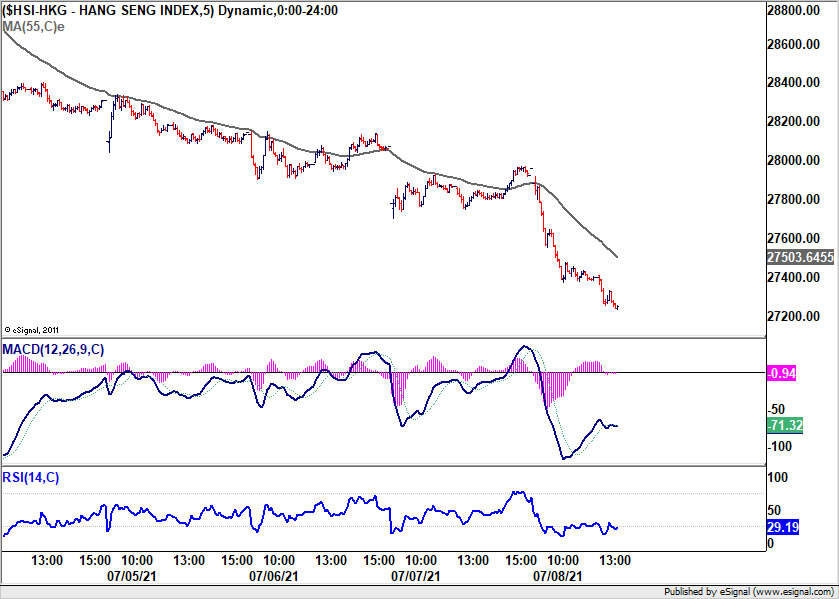
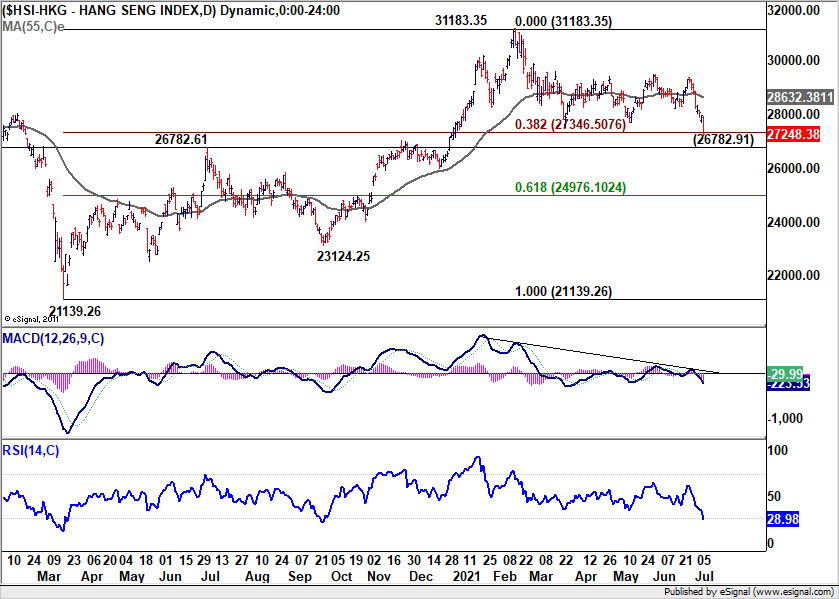
While US stocks were strong, Asian markets are trading notably lower today, as led by the free fall in Hong Kong. Selloff in Chinese tech stocks intensified after the Chinese government announced a step up in oversight on Chinese stocks listing in the US. The announcement came just after the surprised crackdown on ride-hailing giant Didi, days after it's mega IPO last week.
At the time of writing, HSI is down -2.5%. Considering the downside momentum, the break of 38.2.% retracement of 21139.26 to 31183.35 at 27346.50 is starting to make outlook bearish. Focus is now on 26782.61 resistance turned support. Sustained break there will suggest that whole rise from 21139.26 has completed at 31183.35 in a corrective three-wave structure. That would at least open up a bearish case for 61.8% retracement at 24976.10 and below.
RBA Lowe wants to see results, not forecast, for rate hikes
In a speech, RBA Governor Philip Lowe said, it is "not enough" for inflation to be "forecast" in the rate of 2-3% target for the central bank to lift interest rates. He emphasized, "We want to see results before we change interest rates". Also, "the bond purchases will end prior to any increase in the cash rate".
He added that for inflation be sustainably in target rate, it's like that "wage growth will need to exceed 3 per cent". It will take "until 2024" for inflation to be sustainably within the target range.
Lowe also emphasized that "the condition for an increase in the cash rate depends upon the data, not the date; it is based on inflation outcomes, not the calendar." Also, the tapering to AUD 4B purchase in bonds a week "does not represent a withdrawal of support".
S&P 500 hit new records, shrugs off FOMC minutes
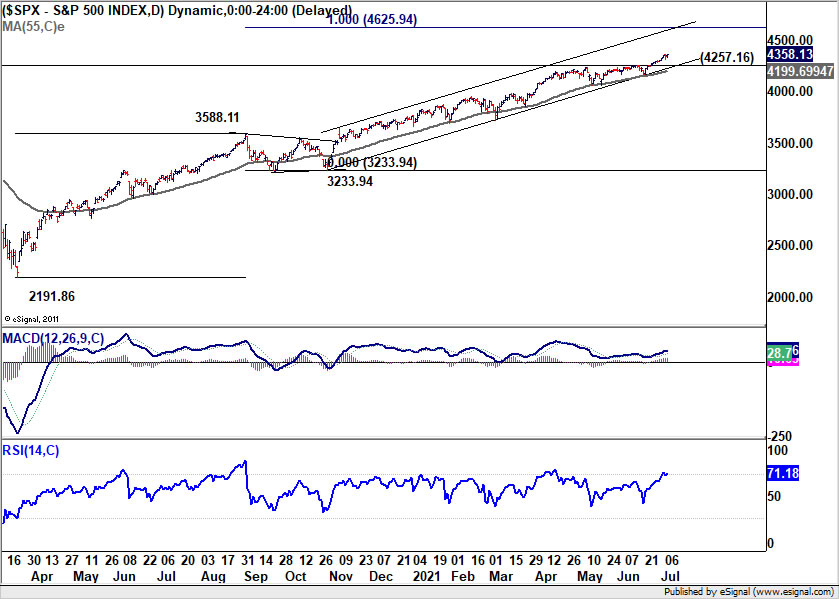
US stocks regained bullishness overnight, with S&P 500 and NASDAQ closing at new record highs. FOMC minutes noted that tapering of asset purchases would happen "somewhat earlier" than expected, after seeing more data over the "coming months". Meanwhile, rate hike could also come "somewhat earlier" than expected. The overall messages were largely consistent with the prior statement and projections.
Suggested readings on FOMC minutes:
- FOMC Minutes Reveals that QE Tapering to Begin Later this Year
- FOMC Minutes: More Details From The Fed, But No More Clarity
- (FED) Minutes of the Federal Open Market Committee
S&P 500 rose 0.34% or 14.59 pts to close at 4358.13. The current medium term up trend is still on track to 100% projection of 2191.86 to 3588.11 from 3233.94 at 4625.94. In any case, near term outlook will stays bullish as long as 4257.16 support holds, in case of retreat.
(FED) Minutes of the Federal Open Market Committee
A joint meeting of the Federal Open Market Committee and the Board of Governors was held by videoconference on Tuesday, April 27, 2021, at 9:30 a.m. and continued on Wednesday, April 28, 2021, at 9:00 a.m.1
PRESENT:
Jerome H. Powell, Chair
John C. Williams, Vice Chair
Thomas I. Barkin
Raphael W. Bostic
Michelle W. Bowman
Lael Brainard
Richard H. Clarida
Mary C. Daly
Charles L. Evans
Randal K. Quarles
Christopher J. Waller
James Bullard, Esther L. George, Naureen Hassan, Loretta J. Mester, and Eric Rosengren, Alternate Members of the Federal Open Market Committee
Patrick Harker, Robert S. Kaplan, and Neel Kashkari, Presidents of the Federal Reserve Banks of Philadelphia, Dallas, and Minneapolis, respectively
James A. Clouse, Secretary
Matthew M. Luecke, Deputy Secretary
Michelle A. Smith, Assistant Secretary
Mark E. Van Der Weide, General Counsel
Michael Held, Deputy General Counsel
Trevor A. Reeve, Economist
Stacey Tevlin, Economist
Beth Anne Wilson, Economist
David Altig, Kartik B. Athreya, Brian M. Doyle, Rochelle M. Edge, Eric M. Engen, Anna Paulson, and William Wascher, Associate Economists
Lorie K. Logan, Manager, System Open Market Account
Patricia Zobel, Deputy Manager, System Open Market Account
Ann E. Misback, Secretary, Office of the Secretary, Board of Governors
Matthew J. Eichner,2 Director, Division of Reserve Bank Operations and Payment Systems, Board of Governors; Michael S. Gibson, Director, Division of Supervision and Regulation, Board of Governors; Andreas Lehnert, Director, Division of Financial Stability, Board of Governors
Sally Davies, Deputy Director, Division of International Finance, Board of Governors
Jon Faust, Senior Special Adviser to the Chair, Division of Board Members, Board of Governors
Joshua Gallin, Special Adviser to the Chair, Division of Board Members, Board of Governors
William F. Bassett, Antulio N. Bomfim, Wendy E. Dunn, Burcu Duygan-Bump, Jane E. Ihrig, Kurt F. Lewis, and Chiara Scotti, Special Advisers to the Board, Division of Board Members, Board of Governors
Carol C. Bertaut, Senior Associate Director, Division of International Finance, Board of Governors; David Bowman, Senior Associate Director, Division of Monetary Affairs, Board of Governors; Diana Hancock, Senior Associate Director, Division of Research and Statistics, Board of Governors; Elizabeth Klee, Senior Associate Director, Division of Financial Stability, Board of Governors
Brett Berger,2 Senior Adviser, Division of International Finance, Board of Governors; Ellen E. Meade, Senior Adviser, Division of Monetary Affairs, Board of Governors; Jeremy B. Rudd, Senior Adviser, Division of Research and Statistics, Board of Governors
Marnie Gillis DeBoer and Min Wei, Associate Directors, Division of Monetary Affairs, Board of Governors; Glenn Follette, Associate Director, Division of Research and Statistics, Board of Governors
Ricardo Correa2 and Stephanie E. Curcuru,2 Deputy Associate Director, Division of International Finance, Board of Governors; Eric C. Engstrom, Deputy Associate Director, Division of Monetary Affairs, Board of Governors; Jeffrey D. Walker,2 Deputy Associate Director, Division of Reserve Bank Operations and Payment Systems, Board of Governors
Jennifer Gallagher, Special Assistant to the Board, Division of Board Members, Board of Governors
Brian J. Bonis, Michiel De Pooter,2 Giovanni Favara, Laura Lipscomb,2 and Zeynep Senyuz, Assistant Directors, Division of Monetary Affairs, Board of Governors; Byron Lutz and Matthias Paustian, Assistant Directors, Division of Research and Statistics, Board of Governors
Penelope A. Beattie,2 Section Chief, Office of the Secretary, Board of Governors
Mark A. Carlson,2 Senior Economic Project Manager, Division of Monetary Affairs, Board of Governors
David H. Small, Project Manager, Division of Monetary Affairs, Board of Governors
Michele Cavallo, Jonathan E. Goldberg, Edward Herbst, and Krista Schwarz, Principal Economists, Division of Monetary Affairs, Board of Governors
Randall A. Williams, Lead Information Manager, Division of Monetary Affairs, Board of Governors
Courtney Demartini,2 Lead Financial Institution Policy Analyst, Division of Monetary Affairs, Board of Governors
Anthony Sarver,2 Senior Financial Institution Policy Analyst, Division of Monetary Affairs, Board of Governors
Kenneth C. Montgomery, First Vice President, Federal Reserve Bank of Boston
Michael Dotsey, Joseph W. Gruber, and Ellis W. Tallman, Executive Vice Presidents, Federal Reserve Banks of Philadelphia, Kansas City, and Cleveland, respectively
Anne Baum, Carlos Garriga, Samuel Schulhofer-Wohl,2 Mark L.J. Wright, and Nathaniel Wuerffel,2 Senior Vice Presidents, Federal Reserve Banks of New York, St. Louis, Chicago, Minneapolis, and New York, respectively
Matthew Nemeth,2 Pia Orrenius, Nicolas Petrosky-Nadeau, and Matthew D. Raskin,2 Vice Presidents, Federal Reserve Bank of New York, Dallas, San Francisco, and New York, respectively
Robert Lerman2 and William E. Riordan,2 Assistant Vice Presidents, Federal Reserve Banks of New York and New York, respectively
Mark Choi2 and Ellen Correia-Golay,2 Markets Officers, Federal Reserve Banks of New York and New York, respectively
Fatih Karahan and Jenny Tang, Senior Economists, Federal Reserve Banks of New York and Boston, respectively
Developments in Financial Markets and Open Market Operations
The System Open Market Account (SOMA) manager first discussed developments in financial markets over the intermeeting period. Financial conditions eased modestly as market participants continued to focus on progress toward economic reopening as well as supportive monetary and fiscal policy. Equity prices rose, with the S&P 500 index reaching a record high, while Treasury yields, the dollar, and credit spreads declined modestly. The equity gains were broad based across sectors, though shares of small caps, as captured by the Russell 2000 index, declined. News regarding losses associated with a highly levered family investment office affected the equity prices of some large financial firms, but the broader financial market effects appeared limited.
After rising sharply in recent months, longer-term Treasury yields declined modestly over the intermeeting period, even as market expectations for U.S. growth continued to be revised higher. Contacts reported that the earlier increases in yields drew in a range of investors, including foreign institutions, pension funds, and insurance companies. Against this backdrop, term premiums as measured by term structure models and based on estimates using the Open Market Desk's surveys of primary dealers and market participants moved slightly lower. Nonetheless, market participants were attentive to the potential for rising yields going forward, and, in recent months, Desk survey respondents had increased the probability they attach to higher yields at the end of 2021.
Regarding expectations for the policy outlook, the market- and survey-implied paths of the federal funds rate were both relatively little changed over the intermeeting period, and the modal survey path in later years continued to imply that the target range would gradually increase to a level just over 2 percent in 2026. Expectations for the path of asset purchases were also stable, and market participants remained focused on the Committee's communications about progress toward its goals. According to the median survey responses, the Federal Reserve's net purchases of Treasury and agency securities were expected to end three quarters after the first reduction in the pace of asset purchases, and the first increase in the target range for the federal funds rate was expected to occur three quarters after that.
Recent financial market developments across advanced economies reflected differing expectations for economic growth and monetary policy. Some countries that were expected to recoup COVID-19-related output losses earlier than others had seen larger yield increases and more appreciation in their currencies in recent months. Over the intermeeting period, the Bank of Canada announced a reduction in the pace of its asset purchases and brought forward its forecast of when conditions would be met for an increase in its policy rate.
The manager turned next to money markets and the Federal Reserve's balance sheet. Reserve balances increased further this intermeeting period to a record level of $3.9 trillion. The effective federal funds rate was steady at 7 basis points. However, amid ongoing strong demand for safe short-term investments and reduced Treasury bill supply, the Secured Overnight Financing Rate (SOFR) stood at 1 basis point throughout the period. The overnight reverse repurchase agreement (ON RRP) facility continued to effectively support policy implementation, and take-up peaked at more than $100 billion. A modest amount of trading in overnight repurchase agreement (repo) markets occurred at negative rates, although this development appeared to largely reflect technical factors. The SOMA manager noted that downward pressure on overnight rates in coming months could result in conditions that warrant consideration of a modest adjustment to administered rates and could ultimately lead to a greater share of Federal Reserve balance sheet expansion being channeled into ON RRP and other Federal Reserve liabilities. Although few survey respondents expected an adjustment to administered rates at the current meeting, more than half expected an adjustment by the end of the June FOMC meeting.
The manager concluded with an update on three operational issues. Following the review of the ON RRP facility discussed at the previous meeting, the Desk planned to relax counterparty eligibility criteria for money funds and government-sponsored enterprises in order to allow smaller counterparties of these types to participate. The Desk also planned to make modest adjustments to the allocation of Treasury outright purchases across maturity ranges to ensure that purchases remain roughly proportional to the outstanding amounts of Treasury securities. These minor technical adjustments would have no implications for the effects of the Federal Reserve's asset purchases on overall financial conditions. Finally, the manager requested that the Committee vote to maintain the standing U.S. dollar and foreign currency liquidity swap arrangements and to renew the reciprocal currency arrangements with Canada and Mexico under the North American Framework Agreement.
The Committee voted unanimously to renew the reciprocal currency arrangements with the Bank of Canada and the Bank of Mexico; these arrangements are associated with the Federal Reserve's participation in the North American Framework Agreement of 1994. In addition, the Committee voted unanimously to renew the dollar and foreign currency liquidity swap arrangements with the Bank of Canada, the Bank of England, the Bank of Japan, the European Central Bank, and the Swiss National Bank. The votes to renew the Federal Reserve's participation in these standing arrangements occur annually at the April or May FOMC meeting.
By unanimous vote, the Committee ratified the Desk's domestic transactions over the intermeeting period. There were no intervention operations in foreign currencies for the System's account during the intermeeting period.
Discussion of Repurchase Agreement Arrangements
The staff briefed participants on the Federal Reserve's experience with the daily repo operations with primary dealers that have been in place since September 2019 and the temporary Foreign and International Monetary Authorities (FIMA) Repo Facility established in March last year. The briefing also reviewed considerations that could be relevant for policymakers' judgments regarding whether these arrangements should become permanent standing facilities. The staff noted that repo operations have been a useful tool in controlling the federal funds rate by adding reserves to ensure that they remain ample and by limiting pressures in repo markets that could spill over into unsecured markets. In March 2020, repo operations worked in concert with other measures to manage shocks to financial markets by stabilizing Treasury market conditions. Since June 2020, when the rate on overnight repo operations was raised relative to the rate of interest on excess reserves, repo operations have served as a backstop and there has been no substantive usage. Regarding considerations concerning a permanent standing repo facility, the briefing noted that standing repo operations could be viewed as useful in forestalling funding strains that could spill over into other overnight markets and limit dealers' intermediation activity in financial markets. However, a standing repo facility could be seen as a form of liquidity support for nonbank financial institutions, and one that could create incentives for firms with access to the facility to take on more liquidity risk against eligible securities than would otherwise be the case. In discussing considerations for the establishment of a standing FIMA repo facility, the staff noted that such a facility could limit the propensity for foreign official institutions to execute large sales of U.S. Treasury securities in a stress environment that, in turn, could exacerbate strains in broader U.S. domestic financial markets. The briefing also noted some potential drawbacks of such a facility, including less transparency regarding its operations relative to other Federal Reserve facilities.
In their discussion of considerations related to the establishment of a standing repo facility as part of the Committee's overall approach to policy implementations in an ample reserves regime, a substantial majority of participants saw the potential benefits of an appropriately calibrated facility as outweighing the potential costs. Nearly all participants commented that a standing repo facility, by acting as a backstop, could help address pressures in the markets for U.S. Treasury securities and Treasury repo that could spill over to other funding markets and impair the implementation and transmission of monetary policy. In this regard, a number of participants noted the potential for pressures in short-term funding markets to arise from time to time, even with monetary policy operating in an ample-reserves regime. Many participants noted that a standing facility could provide a timely and automatic response to incipient market pressures; they remarked that such pressures can be difficult to anticipate and, as a result, might not be as promptly addressed with discretionary operations. A few participants noted that a standing repo facility could provide counterparties with additional flexibility in managing the composition of their holdings of high-quality liquid assets, potentially reducing the demand for reserves. A few participants cautioned that establishing a standing repo facility should not be viewed as a way of implementing monetary policy without an ample supply of reserves. A couple of participants remarked that most of the benefits of a standing repo facility could be realized by the Federal Reserve maintaining readiness to conduct repo operations on short notice as needed, noting that such an arrangement could avoid some of the costs of a standing facility. A few participants mentioned that a standing repo facility could be perceived as a means of supporting the financing of the U.S. Treasury or as a permanent Federal Reserve liquidity backstop for nondepository institutions; a couple of others called out the risk that such a facility could crowd out private market sources of liquidity provision.
Participants noted that it would be important to carefully consider key design elements of a potential standing repo facility, including the pricing structure, counterparties, and range of collateral accepted. A number of participants commented that the counterparties at such a facility should include depository institutions. Several participants noted the facility's design should be targeted specifically to enhance control of the federal funds rate rather than to limit volatility in the repo market.
In their discussion of considerations related to the establishment of a permanent FIMA repo facility, a vast majority of participants saw the potential benefits as outweighing the costs. Participants highlighted a number of benefits of a standing FIMA repo facility, with many noting that it could support smoother functioning in U.S. Treasury securities markets and U.S. financial markets more broadly by providing foreign official holders of U.S. Treasury securities with an alternative to outright sales of these securities in times of market stress. A few participants noted that, had a FIMA repo facility been in place in March 2020, it likely would have significantly damped pressures in these markets caused by the abrupt need for dollar funding abroad. Several participants suggested that a standing FIMA repo facility could be viewed as complementing the existing dollar swap lines by extending access to dollar funding for a broader range of central banks and foreign official institutions. Participants also commented on some potential risks of a standing FIMA repo facility, including less transparency in connection with FIMA repo operations relative to other Federal Reserve facilities.
Staff Review of the Economic Situation
The COVID-19 pandemic and the measures undertaken to contain its spread continued to affect economic activity in the United States and abroad. The information available at the time of the April 27–28 meeting suggested that U.S. real gross domestic product (GDP) had increased in the first quarter of 2021 at a pace that was faster than in the fourth quarter of last year but had not yet returned to its pre-pandemic level. Labor market conditions improved markedly in March, though employment remained well below its level at the start of 2020. Consumer price inflation through February—as measured by the 12-month percentage change in the price index for personal consumption expenditures (PCE)—continued to run well below 2 percent.
Total nonfarm payroll employment surged in March, with a notable gain in the leisure and hospitality sector. As of March, payroll employment had retraced almost two-thirds of the losses seen at the onset of the pandemic. The unemployment rate declined to 6 percent in March, as the number of workers on temporary layoff continued to fall and the number on permanent layoff ticked down. Although the unemployment rates for African Americans and Hispanics fell, both rates remained well above the national average; in addition, the Asian unemployment rate moved up and was equal to the national average in March. The labor force participation rate and employment-to-population ratio increased in March, though both measures remained below their pre-pandemic levels. Initial claims for unemployment insurance had moved down, on net, since mid-March and were at the lowest level since the beginning of the pandemic, though they remained exceptionally high by pre-pandemic standards. Weekly estimates of private-sector payrolls constructed by Federal Reserve Board staff using data provided by the payroll processor ADP, which were available through the first half of April, suggested that the rate of increase in private employment had slowed somewhat relative to its earlier robust pace.
Average hourly earnings for all employees rose 4.2 percent over the 12 months ending in March. The 12‑month change in average hourly earnings continued to be influenced by the effect of the pandemic on the composition of the workforce; in particular, the concentration of job losses among lower-wage workers since early last year had resulted in large increases in this measure that were not indicative of tight labor market conditions. By contrast, a staff measure of the 12‑month change in the median wage derived from the ADP data was 3.1 percent in March and continued to run below its pre-pandemic pace; this measure had likely been less affected by shifts in the composition of the workforce.
Total PCE price inflation was 1.6 percent over the 12 months ending in February and continued to be held down by low rates of resource utilization. Core PCE price inflation, which excludes changes in consumer energy prices and many consumer food prices, was 1.4 percent over the 12 months ending in February, while the trimmed mean measure of 12-month PCE inflation constructed by the Federal Reserve Bank of Dallas was 1.6 percent in February. In March, the 12-month change in the consumer price index (CPI) was 2.6 percent, boosted by increases in consumer energy prices, while core CPI inflation was 1.6 percent over the same period. In the first quarter of 2021, the staff's common inflation expectations index, which combines information from many indicators of inflation expectations and inflation compensation, had returned to the level that prevailed in 2018.
Real PCE declined in February; however, available indicators—including the components of the nominal retail sales data used to estimate PCE—pointed to a large increase in March and for the first quarter as a whole, with federal stimulus payments having likely supported the March increase. Housing starts bounced back in March following a weather-induced decline in February. Although existing home sales fell in February and March, the declines appeared to reflect continued limited availability of homes for sale rather than weakening demand; in addition, February's drop in new home sales was retraced in March.
Available indicators suggested that equipment and intangibles investment had increased in the first quarter of 2021, though at a slower pace than that seen in the fourth quarter of 2020. Likewise, drilling investment appeared to have moved up, boosted in part by higher energy prices. However, investment in nonresidential structures outside of the drilling and mining sector looked as though it had declined further in the first quarter, likely reflecting ongoing uncertainty about the longer-term effects of the pandemic on businesses.
Manufacturing output rebounded strongly in March following weather-related disruptions to production in February. The March rise in factory output occurred despite lingering supply constraints; for example, weather-damaged facilities in Texas used to produce petrochemical and plastic materials had not yet been fully repaired, and semiconductor shortages were still weighing on motor vehicle production.
Total real government purchases appeared to have moved up in the first quarter after having declined over the second half of 2020. Available data suggested that a jump in federal nondefense purchases had offset a decline in defense purchases; in addition, indicators of real state and local purchases pointed to a small first-quarter increase.
Data for February showed a wider nominal U.S. international trade deficit than in January. Both imports and exports fell from their January levels, the first nominal decline in each since last May. Goods imports were held back in February by weakness in imports for automotive products and consumer goods but remained higher than their pre-pandemic level. Nominal goods exports in February were weak in most categories and were still below their pre-pandemic level. Imports and exports of services remained depressed, weighed down by the continued suspension of most international travel.
Incoming data were consistent with a sharp slowdown in foreign economic growth in the first quarter, following a tightening of social-distancing restrictions to contain new waves of COVID-19 infections. Nevertheless, the slowdown appeared less severe than observed declines in mobility would have suggested, underscoring that foreign economies continued to adapt to public health restrictions. The most recent indicators showed that economic activity in many advanced foreign economies (AFEs) resumed expanding toward the end of the first quarter amid a partial easing of restrictions. However, a new surge in infections in several countries in Latin America and South Asia, notably India, underscored the fragility of the global recovery. Foreign headline inflation rose considerably, boosted by temporary factors, such as the fading effects of steep price declines seen early last year and the pass-through of price increases for oil and other commodities. However, underlying inflationary pressures appeared to have remained muted.
Staff Review of the Financial Situation
Investor sentiment improved over the intermeeting period, reflecting a pickup in the pace of vaccinations, prospects for infrastructure spending, and stronger-than-expected labor market and retail sales data. Domestic equity prices increased notably amid declining equity market volatility, and corporate bond spreads narrowed. The nominal Treasury yield curve was little changed, as were measures of inflation compensation. A straight read of overnight index swap quotes suggested that the expected path for the federal funds rate was little changed over the intermeeting period and that the expected policy rate would remain below 25 basis points until the first quarter of 2023. Market-based financing conditions remained accommodative, and bank lending conditions eased markedly. Despite recent improvements, lending standards for commercial and industrial (C&I) and consumer loans remained tighter than pre-pandemic levels.
Broad stock price indexes increased over the intermeeting period, with outperformance by technology stocks and stocks sensitive to consumer discretionary spending. One-month option-implied volatility on the S&P 500—the VIX—declined, approaching the median level observed in the decade before the pandemic. Spreads of yields on investment- and speculative-grade corporate bonds over comparable-maturity Treasury yields narrowed moderately. Spreads on municipal bonds were little changed, with yields on such bonds remaining close to their lowest levels in more than 20 years.
Domestic short-term funding markets remained stable. Funding rates stayed very low against the backdrop of continued paydowns in Treasury bills and substantial increases in reserve balances stemming from Federal Reserve asset purchases as well as the drawdown in balances maintained in the Treasury General Account associated with stimulus payments and other fiscal outlays. Assets under management increased somewhat for government money market funds (MMFs) but declined slightly for prime MMFs. The weighted average maturity of government and prime MMFs remained elevated.
The effective federal funds rate and the SOFR were little changed, averaging 7 basis points and 1 basis point, respectively, over the intermeeting period. There continued to be no participation in the Fed's repo operations. Participation in the Fed's reverse repo facility increased from minimal levels to an average of $47 billion and reached $134 billion on the quarter-end date.
Factors that had stressed foreign financial markets earlier this year—rising U.S. interest rates, resurging COVID-19 cases, and renewed lockdowns in a number of countries—appeared less concerning to global investors over the intermeeting period. Most AFE equity indexes rose modestly, and most AFE sovereign bond yields were little changed. In emerging market economies (EMEs), market optimism was tempered in part by rising COVID-19 cases. The broad EME equity price index was little changed, while credit spreads widened somewhat in the most vulnerable EMEs. After robust inflows earlier this year, flows into EME-dedicated funds continued at a moderate pace. The broad dollar index fell modestly.
Financing conditions for nonfinancial businesses in capital markets remained highly accommodative over the intermeeting period, as reflected in low corporate bond yields and high price-to-earnings ratios in equity markets. Gross corporate bond issuance and gross leveraged loan issuance were robust in February and March. Equity raised through traditional initial public offerings (IPOs) and seasoned equity offerings, as well as through special purpose acquisition companies, continued to be substantial in March.
C&I loans outstanding at banks expanded in February and March after contracting for more than half a year. In the April Senior Loan Officer Opinion Survey on Bank Lending Practices (SLOOS), banks reported easing standards, on net, for C&I loans across firms of all sizes over the first quarter. Banks also reported that demand for C&I loans weakened at large and middle-market firms and was basically unchanged at small firms.
The credit quality of nonfinancial corporations showed further signs of improvement for lower-rated firms. Following a modest uptick in February, the volume of nonfinancial corporate bond downgrades spiked in March, but the spike reflected the downgrades of a few large and highly rated investment-grade firms. In contrast, for speculative-grade issuers, the volume of upgrades modestly exceeded that of downgrades in February and March. Nonfinancial corporate bond defaults remained at low levels in February and March. Market indicators of future default expectations were little changed and stayed low.
Financing conditions in the municipal bond market remained accommodative over the intermeeting period. Issuance of municipal bonds was strong in March, and indicators of the credit quality of municipal debt were little changed in February and March. Financing conditions for small businesses appeared to have improved, with demand for loans remaining subdued. Likely in part because of the Paycheck Protection Program, small business loan originations rose notably in February, the most recent month for which data were available, and were close to pre-pandemic levels. However, even amid improving financing conditions, many small businesses remained under financial stress.
For commercial real estate (CRE) financed through capital markets, financing conditions remained accommodative over the intermeeting period. Although overall delinquency rates in agency commercial mortgage-backed securities (CMBS) declined in the past few months, delinquency rates on hotel and retail mortgages in CMBS pools remained high. CRE loans held by banks were little changed in March. In the April SLOOS, changes in lending standards over the first quarter were mixed across CRE loan categories.
Financing conditions in the residential mortgage market were little changed over the intermeeting period and remained accommodative for stronger borrowers who met standard conforming loan criteria. Credit remained tight for borrowers with lower credit scores. Mortgage rates for most borrowers were little changed on net. In the April SLOOS, banks reported easing standards on most types of mortgages. The share of mortgages in forbearance declined slightly in March.
Financing conditions in consumer credit markets generally remained accommodative for borrowers with strong credit scores but tight for those with subprime scores. Consumer loans grew at a robust pace in February, reflecting the continued expansion of auto loans and a partial rebound in credit card account balances. Banks in the April SLOOS reported easing auto lending standards in the first quarter but generally reported that standards remained tight compared with the end of 2019, especially for nonprime borrowers. Banks also reported that standards on credit cards eased over the first quarter of 2021 but were generally still tighter than before the pandemic. Interest rates offered to nonprime borrowers continued to rise through February, with the fraction of these offers with zero introductory rates continuing to decline.
The staff provided an update on its assessments of the stability of the financial system. The staff noted that corporate bond spreads had declined notably since late last year and were at the lower ends of their historical distributions. In addition, measures of the equity risk premium declined further, and nonprice measures, such as high IPO volume, also indicated elevated investor appetite for risk in the equity market. Valuation pressures for CRE remained high, although information related to CRE continued to be noisier than usual due to pandemic-induced declines in transactions. House price growth increased further, with house prices outpacing rents. In contrast, vulnerabilities from both household and business debt had diminished, reflecting continued government support, a slower pace of business borrowing, and improving business earnings, although many households and businesses continued to struggle. Regarding financial leverage, the staff noted that bank capital ratios remained above pre-pandemic levels in the fourth quarter, but risks remained. Leverage among hedge funds was elevated and increased in the third quarter of last year for the most highly leveraged funds. Leverage in hedge funds' prime brokerage accounts rose notably through the fourth quarter of last year, reflecting elevated hedge fund leverage related to their stock market activities. The staff highlighted recent episodes underlining the opacity of risk exposures among some leveraged entities. With regard to funding risks, the staff noted that MMFs and open-end mutual funds faced significant structural vulnerabilities associated with liquidity transformation. Assets under management at MMFs declined during the second half of 2020, while open-end mutual fund holdings of corporate bonds rose during the second half of last year.
Staff Economic Outlook
The U.S. economic projection prepared by the staff for the April FOMC meeting was slightly stronger than the March forecast. Real GDP growth was projected to post a substantial increase this year, with a correspondingly rapid decline in the unemployment rate, as further reductions in social distancing and favorable financial conditions were expected to support output growth. With the boost to growth from continued reductions in social distancing assumed to fade after 2021, GDP growth was expected to step down in 2022 and 2023. However, with monetary policy assumed to remain highly accommodative, the staff continued to anticipate that real GDP growth would outpace that of potential over much of this period, leading to a decline in the unemployment rate to historically low levels.
The staff's outlook for inflation was broadly unchanged. The 12‑month changes in total and core PCE prices were expected to move above 2 percent in coming months as the unusually low readings from the spring of 2020 dropped out of the calculation window and as a recent jump in consumer energy prices pushed up the total measure. Core inflation was expected to ease some later in the year but to remain above 2 percent at the end of 2021, boosted by large increases in import prices, a recovery in prices that had been especially affected by the pandemic, and the temporary effects of supply bottlenecks. Inflation was then projected to dip slightly below 2 percent in 2022 as the influence of these transitory factors diminished, before returning to 2 percent by the end of 2023, supported by sustained tight levels of resource utilization in labor and product markets.
The staff continued to judge that the risks to the baseline projection for economic activity were skewed to the downside and that the uncertainty around the forecast was elevated. In particular, despite the demonstrated resilience of the economy to surges in the pandemic over the past year, the possibility that COVID-19 variants that were more contagious or more resistant to existing vaccines would spread posed a salient downside risk. The staff continued to view the risks around the inflation projection as balanced. On the upside, bottlenecks, supply disruptions, and historically high rates of resource utilization were seen as potential sources of greater-than-expected inflationary pressures. Alternatively, the possibility that inflation would be held down by low underlying trend inflation and a weaker-than-expected response to resource utilization was seen as an important downside risk.
Participants' Views on Current Conditions and the Economic Outlook
In their discussion of current conditions, participants noted that the COVID-19 pandemic was causing tremendous human and economic hardship across the United States and around the world. Amid progress on vaccinations and strong policy support, indicators of economic activity and employment had strengthened. The sectors most adversely affected by the pandemic remained weak but had shown improvement. Inflation had risen, largely reflecting transitory factors. Overall financial conditions remained accommodative, in part reflecting policy measures to support the economy and the flow of credit to U.S. households and businesses. Participants noted that the path of the economy would depend significantly on the course of the virus, including progress on vaccinations. The ongoing public health crisis continued to weigh on the economy, and risks to the economic outlook remained.
Participants observed that economic activity had picked up sharply this year, with robust gains in consumer spending, housing-sector activity, business equipment investment, and manufacturing production. They noted that the acceleration in economic activity reflected positive developments associated with the rapid pace of vaccinations as well as continued support from fiscal and monetary policies. Nevertheless, participants generally noted that the economy remained far from the Committee's maximum-employment and price-stability goals.
In their discussion of the household sector, participants remarked that indicators of consumer spending surged in March and expected that further gains in spending would contribute significantly to the economic recovery. Many participants commented that fiscal stimulus, accommodative financial conditions, the release of pent-up demand, progress on widespread vaccination, and the ongoing reduction of social-distancing measures were important factors supporting spending. Many participants also noted that consumer spending would continue to be bolstered by these factors as well as by the elevated level of accumulated household savings. Several participants observed that housing market activity continued to be strong, supported in part by low interest rates.
With respect to the business sector, participants noted that business equipment investment continued to rise at a robust pace and manufacturing activity was expanding at a strong clip. That said, many participants discussed reports of shortages of materials and labor as well as supply chain bottlenecks as likely restraints to the pace of recovery in manufacturing and other business sectors. Many participants also noted that their District contacts had reported a pickup in activity in the leisure, travel, and hospitality sectors. Those contacts had grown increasingly optimistic about overall business conditions, given ongoing progress on vaccinations, easing of restrictions on in-person activities, and substantial fiscal support. A couple of participants reported improved conditions in the agricultural sector, with farmers' income supported by higher crop prices and federal aid payments.
Participants commented on the continued improvement in labor market conditions in recent months. Job gains in the March employment report were strong, and the unemployment rate fell to 6.0 percent. Even so, participants judged that the economy was far from achieving the Committee's broad-based and inclusive maximum-employment goal. Payroll employment was 8.4 million jobs below its pre-pandemic level. Some participants noted that the labor market recovery continued to be uneven across demographic and income groups and across sectors. Many participants also remarked that business contacts in their Districts reported having trouble hiring workers, likely reflecting factors such as early retirements, health concerns, childcare responsibilities, and expanded unemployment insurance benefits. Many participants noted as well that these factors were depressing the labor force participation rate, relative to its pre-pandemic level. Some of these factors were seen as likely to remain significant while pandemic-related risks persisted. Based on reports from business contacts, some participants noted that the step-up in demand for labor had started to put some upward pressure on wages. Moreover, over the medium term, participants expected labor market conditions to continue to improve, supported by accommodative fiscal and monetary policies as well as continued progress on vaccinations, unwinding of social distancing, and the associated recovery in economic activity. A couple of participants remarked that businesses in industries severely affected by the pandemic were downsizing or that some businesses were focused on cutting costs or increasing productivity, particularly through automation.
In their comments about inflation, participants anticipated that inflation as measured by the 12-month change of the PCE price index would move above 2 percent in the near term as very low readings from early in the pandemic fall out of the calculation. In addition, increases in oil prices were expected to pass through to consumer energy prices. Participants also noted that the expected surge in demand as the economy reopens further, along with some transitory supply chain bottlenecks, would contribute to PCE price inflation temporarily running somewhat above 2 percent. After the transitory effects of these factors fade, participants generally expected measured inflation to ease. Looking further ahead, participants expected inflation to be at levels consistent with achieving the Committee's objectives over time. A number of participants remarked that supply chain bottlenecks and input shortages may not be resolved quickly and, if so, these factors could put upward pressure on prices beyond this year. They noted that in some industries, supply chain disruptions appeared to be more persistent than originally anticipated and reportedly had led to higher input costs. Despite the expected short-run fluctuations in measured inflation, many participants commented that various measures of longer-term inflation expectations remained well anchored at levels broadly consistent with achieving the Committee's longer-run goals.
Participants judged that uncertainty was elevated and that the outlook was highly dependent on the course of the virus. Amid considerable progress on vaccinations, the unwinding of social distancing, and strong policy support, participants assessed that risks to the outlook were no longer as elevated as in previous months. Nevertheless, some participants remarked that the pandemic continued to pose downside risks to the economic outlook and noted the potential for an uneven recovery in light of new virus strains and potential hesitancy regarding vaccination. As upside risks, some participants mentioned that the release of pent-up demand, accumulated excess household savings, and rapid progress on vaccinations, amid continued fiscal and monetary support, could boost economic activity and bring individuals back into the labor force more quickly than currently expected. Some participants mentioned upside risks around the inflation outlook that could arise if temporary factors influencing inflation turned out to be more persistent than expected.
Participants who commented on financial stability agreed that the financial sector had shown resilience during the pandemic, in large part reflecting strong policy support. Some remarked that the capital positions and loan loss reserves at large banks remained high, and earnings were strong. A few participants noted that vulnerabilities from both business and household debt were at a moderate level. Nevertheless, a couple of participants highlighted that forbearance programs instituted in response to the pandemic could be masking vulnerabilities among households and businesses. Regarding asset valuations, several participants noted that risk appetite in capital markets was elevated, as equity valuations had risen further, IPO activity remained high, and risk spreads on corporate bonds were at the bottom of their historical distribution. A couple of participants remarked that, should investor risk appetite fall, an associated drop in asset prices coupled with high business and financial leverage could have adverse implications for the real economy. A number of participants commented on valuation pressures being somewhat elevated in the housing market. Some participants mentioned the potential risks to the financial system stemming from the activities of hedge funds and other leveraged investors, commenting on the limited visibility into the activities of these entities or on the prudential risk-management practices of dealers' prime-brokerage businesses. Some participants highlighted potential vulnerabilities in other parts of the financial system, including run-prone investment funds in short-term funding and credit markets. Various participants commented on the prolonged period of low interest rates and highly accommodative financial market conditions and the possibility for these conditions to lead to reach-for-yield behavior that could raise financial stability risks.
In their consideration of the stance of monetary policy, participants reaffirmed the Federal Reserve's commitment to using its full range of tools to support the U.S. economy during this challenging time, thereby promoting the Committee's statutory goals of maximum employment and price stability. Participants agreed that the economy was still far from the Committee's longer-run goals. Moreover, the path ahead continued to depend on the course of the virus, and risks to the economic outlook remained. Consequently, participants judged that the current stance of policy and policy guidance remained appropriate to foster further economic recovery as well as to achieve inflation that averages 2 percent over time and longer-term inflation expectations that continue to be well anchored at 2 percent.
Participants judged that the Committee's current guidance for the federal funds rate and asset purchases was serving the economy well. Participants also noted that the existing outcome-based guidance implied that the path of the federal funds rate and the balance sheet would depend on actual progress toward reaching the Committee's maximum-employment and inflation goals. In particular, some participants emphasized that an important feature of the outcome-based guidance was that policy would be set based on observed progress toward the Committee's goals, not on uncertain economic forecasts. However, a couple of participants commented on the risks of inflation pressures building up to unwelcome levels before they become sufficiently evident to induce a policy reaction.
In their discussion of the Federal Reserve's asset purchases, various participants noted that it would likely be some time until the economy had made substantial further progress toward the Committee's maximum-employment and price-stability goals relative to the conditions prevailing in December 2020 when the Committee first provided its guidance for asset purchases. Consistent with the Committee's outcome-based guidance, purchases would continue at least at the current pace until that time. Many participants highlighted the importance of the Committee clearly communicating its assessment of progress toward its longer-run goals well in advance of the time when it could be judged substantial enough to warrant a change in the pace of asset purchases. The timing of such communications would depend on the evolution of the economy and the pace of progress toward the Committee's goals. A number of participants suggested that if the economy continued to make rapid progress toward the Committee's goals, it might be appropriate at some point in upcoming meetings to begin discussing a plan for adjusting the pace of asset purchases.
Committee Policy Action
In their discussion of monetary policy for this meeting, members agreed that the COVID-19 pandemic was causing tremendous human and economic hardship across the United States and around the world. They noted that amid progress on vaccinations and strong policy support, indicators of economic activity and employment had strengthened. Although the sectors most adversely affected by the pandemic remained weak, they had shown improvement. Inflation had risen, largely reflecting transitory factors. Overall financial conditions remained accommodative, in part reflecting policy measures to support the economy and the flow of credit to U.S. households and businesses. Members also remarked that the path of the economy would depend significantly on the course of the virus, including progress on vaccinations. In addition, members agreed that the ongoing public health crisis continued to weigh on the economy and risks to the economic outlook remained.
Members agreed that the Federal Reserve was committed to using its full range of tools to support the U.S. economy in this challenging time, thereby promoting its maximum-employment and price-stability goals. All members reaffirmed that, in accordance with the Committee's goals to achieve maximum employment and inflation at the rate of 2 percent over the longer run and with inflation running persistently below this longer-run goal, they would aim to achieve inflation moderately above 2 percent for some time so that inflation averages 2 percent over time and longer-term inflation expectations remain well anchored at 2 percent. Members expected to maintain an accommodative stance of monetary policy until those outcomes were achieved.
All members agreed to keep the target range for the federal funds rate at 0 to 1/4 percent, and they expected that it would be appropriate to maintain this target range until labor market conditions had reached levels consistent with the Committee's assessments of maximum employment and inflation had risen to 2 percent and was on track to moderately exceed 2 percent for some time. In addition, members agreed that it would be appropriate for the Federal Reserve to continue to increase its holdings of Treasury securities by at least $80 billion per month and agency mortgage-backed securities by at least $40 billion per month until substantial further progress had been made toward the Committee's maximum-employment and price-stability goals. They judged that these asset purchases would help foster smooth market functioning and accommodative financial conditions, thereby supporting the flow of credit to households and businesses.
Members agreed that, in assessing the appropriate stance of monetary policy, they would continue to monitor the implications of incoming information for the economic outlook and that they would be prepared to adjust the stance of monetary policy as appropriate in the event that risks emerged that could impede the attainment of the Committee's goals. Members also concurred that, in assessing the appropriate stance of monetary policy, they would take into account a wide range of information, including readings on public health, labor market conditions, inflation pressures and inflation expectations, and financial and international developments.
Members agreed that the postmeeting statement should acknowledge that indicators of economic activity and employment had strengthened but that, despite showing improvement, the sectors of the economy most affected by the pandemic remained weak. Members also judged that, while risks to the outlook remained, continued progress on vaccinations and accommodative monetary and fiscal policies most likely would underpin further gains in economic activity and employment and would limit risks to the outlook. As a result, they agreed to remove the characterization of risks as "considerable" in the FOMC statement. With regard to the characterization of inflation, members agreed that the statement should note that inflation had risen but that the increase largely reflected transitory factors. They noted that inflation as measured by the 12-month change of the PCE price index was expected to move above 2 percent as the very low readings from early in the pandemic fell out of the calculation and as past increases in oil prices passed through to consumer energy prices. The expected rebound in spending as the economy continued to reopen was also likely to boost inflation temporarily, particularly if supply bottlenecks limited how quickly production could respond to demand in the near term. However, members also viewed these increases in prices as likely to have only transitory effects on inflation.
At the conclusion of the discussion, the Committee voted to authorize and direct the Federal Reserve Bank of New York, until instructed otherwise, to execute transactions in the SOMA in accordance with the following domestic policy directive, for release at 2:00 p.m.:
"Effective April 29, 2021, the Federal Open Market Committee directs the Desk to:
- Undertake open market operations as necessary to maintain the federal funds rate in a target range of 0 to 1/4 percent.
- Increase the System Open Market Account holdings of Treasury securities by $80 billion per month and of agency mortgage-backed securities (MBS) by $40 billion per month.
- Increase holdings of Treasury securities and agency MBS by additional amountsand purchase agency commercial mortgage-backed securities (CMBS) as needed to sustain smooth functioning of markets for these securities.
- Conduct repurchase agreement operations to support effective policy implementation and the smooth functioning of short-term U.S. dollar funding markets.
- Conduct overnight reverse repurchase agreement operations at an offering rate of 0.00 percent and with a per-counterparty limit of $80 billion per day; the per-counterparty limit can be temporarily increased at the discretion of the Chair.
- Roll over at auction all principal payments from the Federal Reserve's holdings of Treasury securities and reinvest all principal payments from the Federal Reserve's holdings of agency debt and agency MBS in agency MBS.
- Allow modest deviations from stated amounts for purchases and reinvestments, if needed for operational reasons.
- Engage in dollar roll and coupon swap transactions as necessary to facilitate settlement of the Federal Reserve's agency MBS transactions."
The vote also encompassed approval of the statement below for release at 2:00 p.m.:
"The Federal Reserve is committed to using its full range of tools to support the U.S. economy in this challenging time, thereby promoting its maximum employment and price stability goals.
The COVID-19 pandemic is causing tremendous human and economic hardship across the United States and around the world. Amid progress on vaccinations and strong policy support, indicators of economic activity and employment have strengthened. The sectors most adversely affected by the pandemic remain weak but have shown improvement. Inflation has risen, largely reflecting transitory factors. Overall financial conditions remain accommodative, in part reflecting policy measures to support the economy and the flow of credit to U.S. households and businesses.
The path of the economy will depend significantly on the course of the virus, including progress on vaccinations. The ongoing public health crisis continues to weigh on the economy, and risks to the economic outlook remain.
The Committee seeks to achieve maximum employment and inflation at the rate of 2 percent over the longer run. With inflation running persistently below this longer-run goal, the Committee will aim to achieve inflation moderately above 2 percent for some time so that inflation averages 2 percent over time and longer‑term inflation expectations remain well anchored at 2 percent. The Committee expects to maintain an accommodative stance of monetary policy until these outcomes are achieved. The Committee decided to keep the target range for the federal funds rate at 0 to 1/4 percent and expects it will be appropriate to maintain this target range until labor market conditions have reached levels consistent with the Committee's assessments of maximum employment and inflation has risen to 2 percent and is on track to moderately exceed 2 percent for some time. In addition, the Federal Reserve will continue to increase its holdings of Treasury securities by at least $80 billion per month and of agency mortgage‑backed securities by at least $40 billion per month until substantial further progress has been made toward the Committee's maximum employment and price stability goals. These asset purchases help foster smooth market functioning and accommodative financial conditions, thereby supporting the flow of credit to households and businesses.
In assessing the appropriate stance of monetary policy, the Committee will continue to monitor the implications of incoming information for the economic outlook. The Committee would be prepared to adjust the stance of monetary policy as appropriate if risks emerge that could impede the attainment of the Committee's goals. The Committee's assessments will take into account a wide range of information, including readings on public health, labor market conditions, inflation pressures and inflation expectations, and financial and international developments."
Voting for this action: Jerome H. Powell, John C. Williams, Thomas I. Barkin, Raphael W. Bostic, Michelle W. Bowman, Lael Brainard, Richard H. Clarida, Mary C. Daly, Charles L. Evans, Randal K. Quarles, and Christopher J. Waller.
Voting against this action: None.
Consistent with the Committee's decision to leave the target range for the federal funds rate unchanged, the Board of Governors voted unanimously to leave the interest rates on required and excess reserve balances at 0.10 percent. The Board of Governors also voted unanimously to approve establishment of the primary credit rate at the existing level of 0.25 percent, effective April 29, 2021.
It was agreed that the next meeting of the Committee would be held on Tuesday–Wednesday, June 15–16, 2021. The meeting adjourned at 10:20 a.m. on April 28, 2021.
Notation Vote
By notation vote completed on April 6, 2021, the Committee unanimously approved the minutes of the Committee meeting held on March 16–17, 2021.
_______________________
James A. Clouse
Secretary
1. The Federal Open Market Committee is referenced as the "FOMC" and the "Committee" in these minutes. Return to text
2. Attended through the discussion of repurchase agreement arrangements. Return to text
Market Morning Briefing: Aussie Has Been Falling Sharply
STOCKS
Dow is holding above 34500 and keeps alive the chances of testing the crucial 35000-35100 resistance zone. A strong rise past 35100 is needed to become more bullish and see further rise. DAX continues to oscillate inside the 15400-15800 range and remains mixed. We will have to wait for a breakout of this range to get clarity. Nikkei is coming down towards the crucial long-term support level of 28000 from where we expect it to bounce back again and keep the long-term uptrend intact. Shanghai retains its 3500-3625 range and can move up within this range in the coming days. Sensex has rise just above its 52000-53000 range and needs to sustain above 53000 to rise further while Nifty is yet to break the range 15600-15900 range on the upside. The price action today will need a close watch.
Dow (34681.79, +104.42, +0.3%) is managing to hold above 34500. This keeps alive the chances of rising past 34700 and test the crucial 35000-35100 resistance zone. A strong break/close below 34500 is needed to bring the Dow under pressure to fall-back towards 34000-33500 again.
DAX (15692.71, +181.33, +1.17%) continues to whipsaw around 15600 and remains mixed within its 15400-15800 range. We reiterate to wait and watch for a breakout of this range to get clarity on whether DAX can move up to 16000-16200 or fall to 15200-15000 from here.
Nikkei (28212.17, −154.78, -0.55%) has been coming down towards the crucial support level of 28000 – the crucial long-term support from where we expect it to bounce back again. While above 28000, the long-term uptrend will remain intact. In case of a break below 28000, Nikkei can see a deeper fall to 27000-26000. The price action at 28000 will need a close watch.
Shanghai (3535.57, −18.15, -0.51%) has risen back sharply yesterday. The support at 3500 is holding well and the 3500-3625 range remains intact. Whioe above 3500, a rise to 3600-3625 can be seen again in the coming days.
Sensex (53054.76, +193.58, +0.37%) has closed above 53000 yesterday. It has to be seen if it sustains above 53000 and gets a strong follow-through rise towards 54000. The price action today will need a close watch.
However, Nifty (15879.65, +61.40, +0.39%) is yet to breach 15900 which is needed to pave way for a fresh rise to 16000-16200 in the coming days. While below 15900, the 15600-15900 range can continue to remain in place.
COMMODITIES
Commodities trade lower today as they face rejection from respective resistances. Copper has fallen from 4.40 and could trade within 4.40-4.20 while Silver faced rejection from 27 and could test 25.80/50 before again bouncing back towards 26 or higher. Crude prices have fallen sharply as the $76-78 region held well on both WTI and Brent. Crude prices now have scope to fall towards $70. Gold can test 1780/60 before again bouncing back towards 1820 on the upside. Overall range of 1760-1820 may hold.
Brent (73.03) and WTI (71.73) fallen sharply in line with our broad expectations of seeing a fall from $75-77/78 on Brent and $75-77 on WTI. Brent has fallen sharply as expected. We had allowed for a possible test of $80 on the upside but the price ahs come down sharply from 78 itself. While below 74, scope of rising back towards 77/78 is reduced and we may look for lower levels in the near term. Brent and WTI both can fall towards $70 if the current dip sustains.
Gold (1797) has dipped yet again and may fall towards 1780/60. We continue to expect 1820-1760 to hold for the near term. In the longer run, a slow and steady rise above 1820 is possible taking the price higher towards 1860-1880.
Silver (25.96) too came off instead of heading higher towards 27-28. Resistance near 27 has held well and produced a fall which could test 25.80/50 before rising back in the medium term.
Copper (4.2850) has fallen sharply from 4.40 and could remain within 4.20-4.40 region for the medium term. Sideways trade within the mentioned range looks likely for now.
FOREX
Dollar trades strong pulling down Euro below 1.18, Aussie below 0.75 and Pound below 1.38. EURJPY is bearish and heading towards 130 while Dollar-Yen can test 110-109.50 before again bouncing back towards 111 or higher. Dollar Index is headed to test 93 from where a reversal looks possible. USDCNY trades higher and could head towards 6.48/50 before reversing. USDINR can attempt to test 74.80-75 while above 74.50. A break below 74.50 if seen can take it lower towards 74.40/20.
Dollar Index (92.74) has risen and is headed towards resistance near 93 which is likely to hold and produce a rejection. Watch price action near 93.
Euro (1.1791) has broken below 1.18 but has immediate support near 1.1770 which is likely to hold and produce a bounce back towards 1.1850 and higher eventually. Break below 1.1770 , if seen would be bearish for Euro towards 1.17 before finally reversing in the longer run. We currently do not expect any fall below 1.17.
EURJPY (130.38) has continued to fall and could test 130 in the near term before rising back towards 131-131.50 again in the next 1-2 weeks. Immediate view is bearish for EURJPY.
Dollar-Yen (110.57) has risen a bit but looks bearish for a test of 110-109.50 in the near term before bouncing back sharply towards 111 or higher in the longer run.
Aussie (0.7462) has been falling sharply and looks bearish for a fall to 0.7445 before any bounce is seen. Below 0.7445, Aussie can test 0.74.
Pound (1.3783) has fallen further and can hold above 1.3750 just now to bounce back towards 1.38. Failure to bounce from 1.3750 can take it lower towards 1.37 in the medium term.
USDCNY (6.4775) has risen well as expected. A rise above 6.48 is needed to turn further bullish on the pair else we may witness a dip back towards 6.46/44. Watch price action near current levels.
USDINR (74.62) came down sharply from 74.7850. If the fall sustains, we may expect a dip to 74.40/20 again today else a possible bounce from 74.50 back towards 74.80-75.00 cannot be negated. Watch price action near 74.50 to see if it manages to remain above it or breaks lower. Very broad range of 74.20-74.80 may hold for the next few sessions.
INTEREST RATES
The US Treasury yields have declined further and are coming to test their key supports at 1.9%-1.85% (30Yr) and 1.25%-1.2% (10Yr) as expected. The yields will have to bounce from these supports in order to avoid a deep fall. The German yields have come down further as expected. The view is bearish now and there is room to fall more from current levels. The 10Yr GoI has to break above 6.2% to move further higher. A sideways move between 6.1% and 6.2% is possible in the near-term.
The US 2Yr (0.21%), 5Yr (0.78%), 10Yr (1.31%) and 30Yr (1.92%) have declined further. The 30Yr has come down close to 1.9% and the 10Yr has broken below 1.35% as expected. 1.9%-1.85% (30Yr) and 1.25%-1.20% (10Yr) are the crucial levels to watch in the coming sessions. The yields will have to bounce from these supports in order to avoid a deeper fall. While these supports hold, a strong bounce back move to 2.1%-2.2% on the 30Yr and 1.4%-1.5% on the 10Yr is a possibility. We will have to wait and watch.
The German 2Yr (-0.69%), 5Yr (-0.60%), 10Yr (-0.30%), 30Yr (0.18%) yields have come down further as expected. The 30Yr is heading down towards 0.10% in line with our expectation. The 10Yr on the other hand can break -0.30% and fall to -0.40%- and -0.45% in the coming days. Our earlier bullish view has been negated.
The 10Yr GoI (6.1637%)has come-off from the high of 6.1839%. A break above 6.20% is needed to move further up towards 6.3%. A consolidation between 6.1% and 6.2% is possible for some time. While above 6.1% the outlook is bullish to see 6.3% on the upside.
Elliott Wave View: USDCAD Further Rally Expected
USDCAD shows an incomplete sequence from June 1, 2021 low favoring further upside. Up from June 1, wave ((A)) ended at 1.2487 and pullback in wave ((B)) ended at 1.2252. Wave ((C)) is currently in progress and subdivides into a 5 waves impulse Elliott Wave structure. The short term 1 hour chart below shows the rally within wave ((C)). Up from wave ((B)) low on June 23, wave 1 ended at 1.231, and pullback in wave 2 ended at 1.226. Pair resumed higher in wave 3 towards 1.2423, pullback in wave 4 ended at 1.2365, and final leg wave 5 ended at 1.245. This completed wave (1) of ((C)) in higher degree.
Pullback in wave (2) of ((C)) ended at 1.2297 and pair has resumed higher again. Up from wave (2), wave 1 ended at 1.2494 and pullback in wave 2 ended at 1.2419. Wave 3 is currently in progress with internal subdivision as a 5 waves in lesser degree. Up from wave 2, wave ((i)) ended at 1.25914 and pullback in wave ((ii)) ended at 1.2444. Near term, as far as pullback stays above 1.2297, expect pair to extend higher.
USDCAD 60 Minutes Elliott Wave Chart
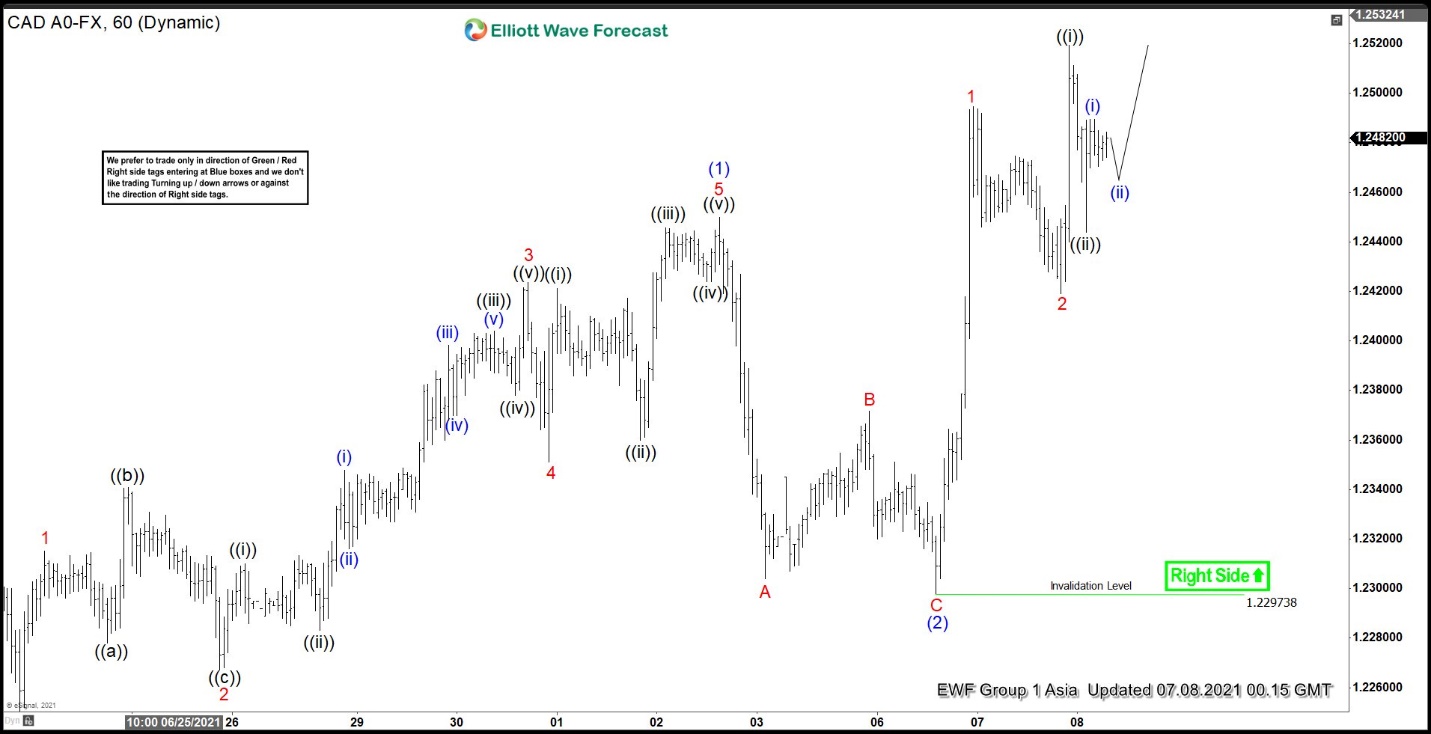
Crude Oil Price Starts Corrective Decrease, Dollar Gains
Key Highlights
- Crude oil price started a downside correction from the $77.02 high.
- There was a break below a major bullish trend line with support near $73.35 on the daily chart of XTI/USD.
- EUR/USD extended its decline below 1.1800, GBP/USD is trading well below 1.3850.
- The US Initial Jobless Claims could decline to 350K from 364K in the week ending July 03, 2021.
Crude Oil Price Technical Analysis
In the past few weeks, crude oil price gained bullish momentum above $70.00 against the US Dollar. The price extended its rise above the $72.00 and $73.50 resistance levels to move further into a positive zone.
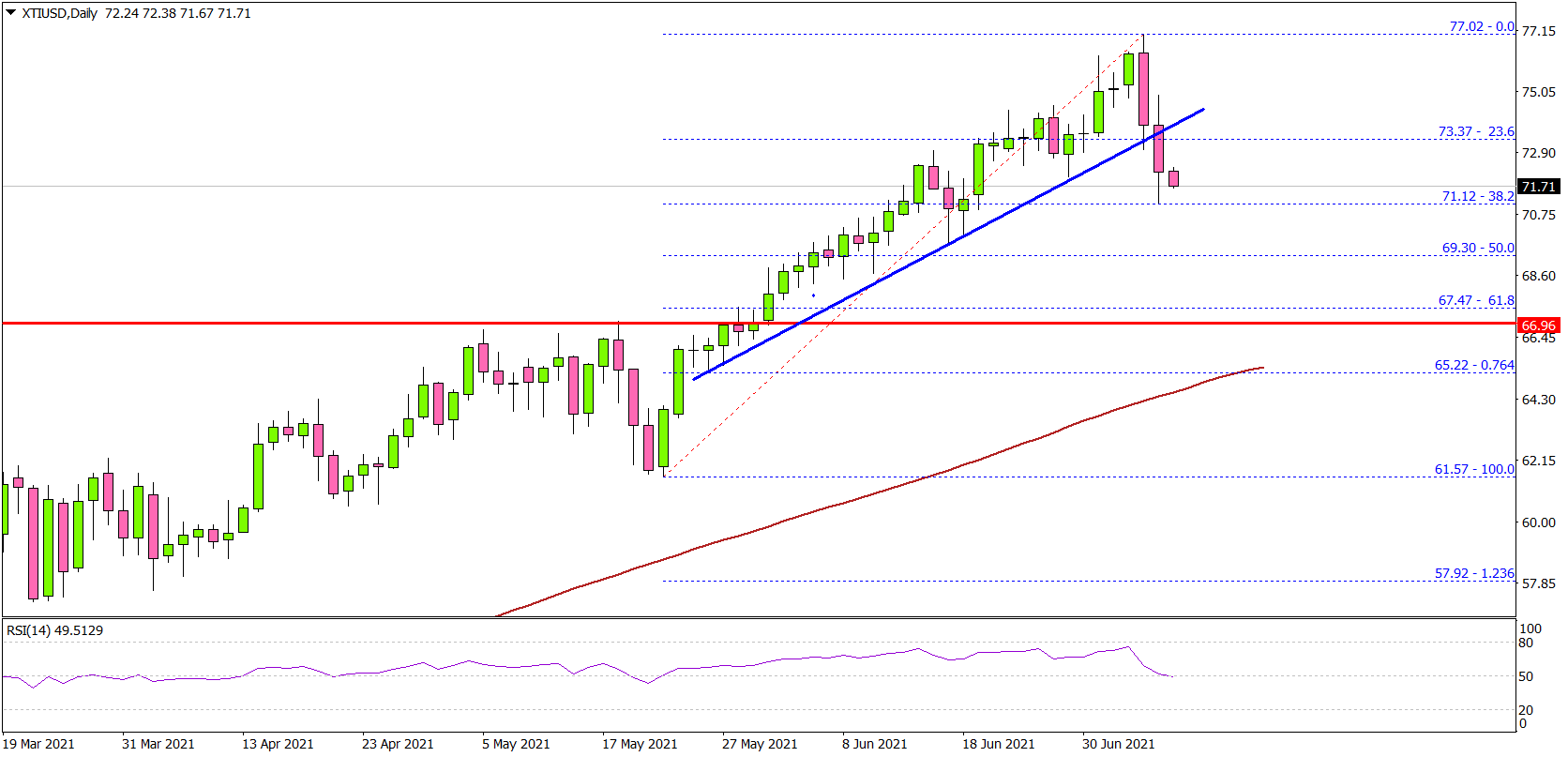
Looking at the daily chart of XTI/USD, the price even settled nicely above the $70.00 zone, the 100-day simple moving average (4-hours), and the 200-day simple moving average (green).
There was also a break above the $75.00 resistance zone. It traded to a new multi-month high near $77.02 before it started a downside correction. There was a break below a major bullish trend line with support near $73.35.
The price traded below the 23.5% Fib retracement level of the upward move from the $61.57 swing low to $77.02 high. The next major support is near the $70.00 level.
The 50% Fib retracement level of the upward move from the $61.57 swing low to $77.02 high is also near the $69.30 level. On the upside, the first major resistance is near the $73.50 level. The next major resistance is near the $75.00 level.
A clear break above the $75.00 level could open the doors for a move towards the $78.00 level. Looking at EUR/USD, the pair extended its decline below the 1.1820 and 1.1800 levels. Besides, GBP/USD remains at a risk of more downsides below 1.3740.
Economic Releases to Watch Today
- Germany’s Trade Balance for May 2021 - Forecast €15.4B, versus €15.9B previous.
- US Initial Jobless Claims - Forecast 350K, versus 364K previous.
FOMC Minutes Reveals that QE Tapering to Begin Later this Year
The FOMC minutes for the June meeting confirmed more optimism over the economic outlook. Unwinding of stimulative monetary policy would likely begin earlier than previously anticipated. As the members would begin tapering discussions in coming months, we expect an announcement would be made by end of the year. Meanwhile, the first rate hike could come in as soon as in 2023, revealed in the median dot plots. All changes in the monetary policy measures are data-dependent.
QE Tapering
Various members noted that economic conditions justifying tapering could be met “somewhat earlier than they had anticipated at previous meetings in light of incoming data”. Yet, some judged that the incoming data have been “providing a less clear signal about the underlying economic momentum”. They preferred to see more data over “coming months”. The minutes suggested that members would “begin to discuss” plans for tapering “in coming meetings”. Several participants proposed to taper MBS purchases “more quickly or earlier” because of elevated housing prices, but no consensus had been made. We expect an announcement regarding tapering by December.
Rate Hike
On the rate hike, a “few participants” noted that they expected it could come “somewhat earlier” than previously expected. This comes in line with the median dot plots which projected two interest rate hikes by 2023.
Upgraded Economic Assessments
Economic projections were upgraded in June. The minutes revealed that “a vast majority of participants” revised up their projections for real GDP growth this year. They also stated that "the sectors most adversely affected by the pandemic remained weak, but had shown improvement”. The members “generally” expected that supply chain bottlenecks and shortages of materials and labor could restrain the pace of the recovery, while “some participants” noted that business contacts in their districts reported having trouble hiring workers.
The upgrade in the inflation forecasts was remarkable. Despite the significant upgrade in near-term inflation, the staff retained the view of the transitory nature of inflation. It was “generally” expected that inflation should ease over the rest of the year as price increases caused by bottlenecks and supply constraints reversed.
The job market remained a key concern. The minutes indicated that the “substantial further progress” hurdle for tapering was “generally” not seen as reached, and “many participants” noted the economy was “far” from its employment goals. We believe that the “elevated” uncertainty over the outlook of the job market and inflation is the barrier for a consensus on the appropriate timing of tapering.