Sample Category Title
GBP/USD Outlook: Near-Term Focus Shifts Lower After Recovery Stalled
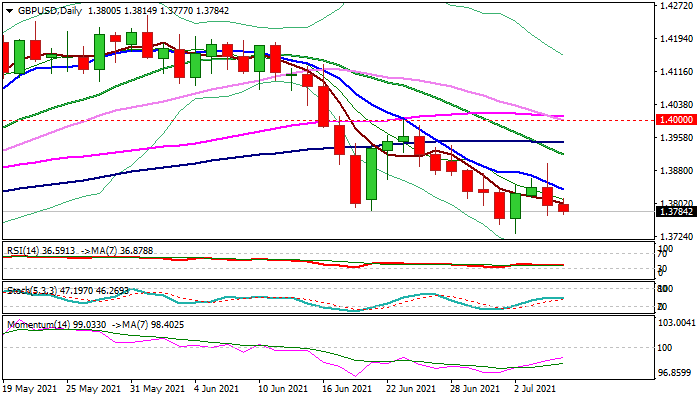
Cable stands at the back foot, weighed by Tuesday’s bearish daily candle with long upper shadow, formed after strong upside rejection on a false break of descending 10DMA and subsequent weakness. The action generated an initial signal of a bearish continuation pattern on a daily chart, which looks for more evidence to be confirmed.
Fresh bears need a daily close below 1.3770 pivots (Tuesday’s low / Fibo 76.4% of 1.3731/1.3897 recovery leg) to signal an end of the corrective phase.
This would confirm a bearish stance for a retest of last Friday’s low at 1.3731, violation of which would risk extension towards 1.3670 (Mar/Apr higher base) and 1.3580 (Fibo 23.6% of 1.1409/1.4249).
Falling 10DMA (1.3834) marks solid resistance which needs to continue capping and keep bears intact.
Res: 1.3803, 1.3834, 1.3897, 1.3919.
Sup: 1.3770, 1.3731, 1.3670, 1.3600.
Focus On FOMC Minutes For More Clues That Brought Forward The Timeline For Interest Rates Rises
Notes/Observations
- UK Halifax data registered its 1st MoM decline in house prices since January.
- German Industrial Production missed expectations and raising some doubts about the strength of the economic recovery.
- Focus on FOMC Jun Minutes.
Asia
- Japan May Preliminary Leading Index: 102.6 v 102.7e; Coincident Index: 92.7 v 92.7e.
Coronavirus
- UK Chief Medical Officer Whitty: Unlikely the UK will be free from further Covid-19 waves until spring 2022.
- Reports circulated that of the UK govt being accused of delaying Freedom Day after they said fully vaccinated people will still have to follow self-isolation rules until Aug 16th.
Europe
- UK Chancellor of the Exchequer Sunak (Fin Min) warned by OBR over threat to national debt from rate rises. Warned that £10B deficit can be fixed only by taxation.
- France Finance Min Le Maire noted his regret EU was not united over corporate tax deal. He added that Ireland's reaction to OECD tax deal was measured.
- German Forsa Poll on Sept elections: Merkel-allied CDU and CSU Parties: 30% (+1); Greens: 19% (-2%).
Americas
- Treasury official noted that several countries were pushing for a global minimum tax rate above 15%, including the US; decision expected in the next phase of OECD negotiations. Sec Yellen was working with tax committees in Congress to implement OECD's international minimum tax agreement via budget reconciliation legislation.
- US Department of Defense canceled the JEDI cloud project valued at up to $10B to Microsoft; to seek a new multi-cloud contract, splitting job between Microsoft and Amazon.
Speakers/Fixed income/FX/Commodities/Erratum
Equities
- Indices [Stoxx50 +0.5% at 4,072, FTSE +0.6% at 7,140, DAX +0.8% at 15.636, CAC-40 +0.3% at 6,529, IBEX-35 -0.1% at 8,850, FTSE MIB +0.4% at 25,320, SMI +0.5% at 12.028, S&P 500 Futures +0.2%].
- Market Focal Points/Key Themes: European indices open higher across the board and stayed up as the session progressed; better performing sectors include materials and industrials; underperforming sectors include telecom and consumer discretionary; reportedly Telefonica looking to sell stake in Tech unit; reportedly Autogrill looking to work with Dufry; Wise starts trading on LSE; focus on release of FOMC minutes later in the day; earnings expected in the upcoming US session include MSC Industrial.
Equities
- Consumer discretionary: Adidas ADS.DE +1.8% (analyst action), Autogrill AGL.IT +2.5% (not looking at further transactions), Bang & Olufsen BO.DK -7.5% (results), Dufry DUFN.CH +2.4% (analyst action), PageGroup PAGE.UK +3.7% (trading update), Robert Walters RWA.UK +4.1% (trading update), Redrow RDW.UK +2.8% (trading update), Steinhoff SHNH.ZA +12.4% (withdrawal of legal proceedings), Wincanton WIN.UK -9.4% (trading update).
- Consumer staples: Clas Ohlson CLAS.B.SE +2.6% (June sales).
- Energy: EDF EDF.FR +1.3% (outlook), Nordex NDX1.DE +3.8% (order), Shell RDSA.NL +2.5% (trading update).
- Financials: 888 Holding 888.UK -4.3% (trading statement), WDP Warehouses de Pauw WPD.BE +1.6% (analyst action).
- Healthcare: Spire Healthcare SPI.UK -2.9% (delays general meeting).
- Industrials: Bossard BOSN.CH +6.0% (analyst action).
- Materials: Johnson Matthey JMAT.UK +1.8% (analyst action).
- Technology: SAP SAP.DE +3.0% (analyst action).
- Telecom: Telefonica TEF.ES -0.6% (potential asset sale).
Speakers
- SNB Vice Chairman Zurbruegg reiterated stance that current policy remained appropriate and the CHF currency (Franc) remained highly valued. Rise in inflation seen as transitory.
- Russia Fin Min Siluanov stated that was still eyeing eurobond issuance in 2021 despite sanctions costs.
- Japan appointed Masato Kanda as new currency policy chief.
- China said to be prepared to release more metal reserves in near future. China National Reserve Administration (SRB completed its more recent sales from reserves on Monday July 5th
- Former China PBOC official Sheng Songcheng stated that China should "reasonably and appropriately" lower interest rate levels in the second half of this year. Believed the pace of economic growth might ease to 5-6% against the backdrop of fading low base effect.
Currencies/ Fixed income
- USD maintained its form tone with focus on the FOMC Jun Minutes due out during the US afternoon. Dealers to look for more clues that brought forward the timeline for interest rates rises.
- EUR/USD remains near 3-month lows in the lower portion of the 1.18 handle.
- GBP/USD moved below the 1.38 level as focus shifted towards how the UK govt would deal with spread of the coronavirus as it eased restrictions later in July.
Economic data
- (DE) Germany May Industrial Production M/M: -0.3% v +0.5%e; Y/Y: 17.3% v 17.7%e.
- (NO) Norway May Industrial Production M/M: -0.3% v -0.1% prior; Y/Y: 2.1% v 0.9% prior.
- (NO) Norway May Manufacturing Production M /M: -0.1% v -1.9% prior; Y/Y: 7.6% v 4.7% prior.
- (NO) Norway May Overall GDP M/M: 1.2% v 0.4% prior; Mainland GDP M/M: 1.8% v 0.9%e.
- (DK) Denmark May Industrial Production M/M: +2.6% v -3.3% prior.
- (ZA) South Africa Jun Gross Reserves: $54.5B v $53.3Be; Net Reserves: $51.4B v $51.4Be.
- (UK) Jun Halifax House Price Index M/M: -0.5 v +1.3% prior; Y/Y: 8.8% v 9.5% prior.
- (AU) Australia Jun Foreign Reserves: A$64.7B v A$62.1B prior.
- (FR) France May Trade Balance: -€6.8B v -€6.1Be; Current Account Balance: -€2.3B v -€2.0B prior.
- (CH) Swiss Jun Foreign Currency Reserves (CHF): 941.1B v 902.5B prior.
- (AT) Austria Jun Wholesale Price Index M/M: 1.4% v 1.7% prior; Y/Y: 11.2% v 10.9% prior.
- (CZ) Czech May National Trade Balance (CZK): 6.3B v 25.3Be.
- (CZ) Czech May Industrial Output Y/Y: 32.3% v 34.9%e; Construction Output Y/Y: +5.8% v -3.9% prior.
- (HU) Hungary May Industrial Production M/M: +3.4% v -3.2% prior; Y/Y: 40.2% v 39.6%e.
- (MY) Malaysia end-Jun Foreign Reserves: $111.1B v $111.0B mid-month reading.
- (SE) Sweden May GDP Indicator M/M: +0.4% v -1.1% prior; Y/Y: 10.2% v 9.2% prior.
- (SE) Sweden May Private Sector Production M/M: -0.2% v -0.1% prior; Y/Y: 9.7% v 11.1% prior.
- (SE) Sweden May Industrial Orders M/M: +6.1% v -3.8% prior; Y/Y: 32.7% v 30.3% prior.
- (SE) Sweden May Industry Production Value Y/Y: 24.2% v 27.1% prior; Service Production Value Y/Y: 8.4% v 9.2% prior.
- (SE) Sweden May Household Consumption M/M: +2.6% v -5.1% prior; Y/Y: 8.8% v 7.5% prior.
- (SE) Sweden Jun Budget Balance (SEK): -34.0B v 36.9B prior.
- (CN) China Jun Foreign Reserves: $3.214T v $3.201Te (1st decline in 3 months).
- (IT) Italy May Retail Sales M/M: 0.2% v 3.0%e; Y/Y: 13.3% v 10.8%e.
- (TW) Taiwan Jun CPI Y/Y: 1.9% v 2.3%e; CPI Core Y/Y: 1.4% v 1.4%e; WPI Y/Y: 10.7% v 10.2%e.
- (TW) Taiwan Jun Trade Balance: $5.2B v $5.7Be; Exports Y/Y: 35.1% v 33.0%e; Imports Y/Y: 42.3% v 34.5%e.
- (UK) Q1 Final Output Per Hour Y/Y: 0.9% v 1.0% prior; Unit Labor Costs Y/Y: 5.0% v 7.2% prior.
- (IS) Iceland Jun Preliminary Trade Balance (ISK): -30.2B v -15.6B prior.
- (GR) Greece Apr Unemployment Rate: 17.0% v 16.8% prior.
- (SG) Singapore Jun Foreign Reserves: $398.4B v $398.1B prior.
Fixed income Issuance
- (IN) India sold total INR vs. INR170B indicated in 3-month, 6-month and 12-month bills.
- (RO) Romania to sell EUR-denominated 9-year and 20-year bonds.
- (DK) Denmark sold total DKK3.84B in 2024, 2031 and 2052 DGB bonds.
- (SE) Sweden sold SEK7.5B vs. SEK7.5B indicated in 3-month bills; Avg Yield: -0.2027% v -0.2013% prior; Bid-to-cover: 2.73x v 2.03x prior.
- (UK) DMO sold £600M in 0.25% Mar 2051Gilts (UKTi); Real Yield: -2.163% v -1.979% prior; bid-to-cover: 2.41x v 2.31x prior.
Looking ahead
- (IT) Bank of Italy Apr Balance-Sheet Aggregates: Target2 Liabilities.
- (RO) Romania Central Bank (NBR) Interest Rate Decision: Expected to leave Interest Rate unchanged at 1.25%.
- 05:25 (EU) Daily ECB Liquidity Stats.
- 05:30 (DE) Germany to sell €5.0B in new 0% Oct 2026 BOBL.
- 05:30 Greece Debt Agency (PDMA) to sell €625M in 13-week bills.
- 05:30 (HU) Hungary Debt Agency (AKK) to sell 12-month Bills.
- 05:30 (ZA) South Africa announces details of next bond auction (held on Tuesdays).
- 06:00 (IE) Ireland May Industrial Production M/M: No est v -0.2% prior; Y/Y: No est v 28.5% prior.
- 06:45 (US) Daily Libor Fixing.
- 07:00 (RU) Russia OFZ Bond auction (if any).
- 07:00 (US) MBA Mortgage Applications w/e July 2nd: No est v -6.9% prior.
- 07:00 (MX) Mexico Jun Vehicle Production: No est v 241.4K prior; Vehicle Exports: No est v 242.0K prior.
- 07:00 (BR) Brazil Jun FGV Inflation IGP-DI M/M: 0.2%e v 3.4% prior; Y/Y: 34.7%e v 36.5% prior.
- 08:00 (UK) Daily Baltic Dry Bulk Index.
- 07:00 (UK) Weekly PM Question time in House.
- 08:00 (PL) Poland Jun Official Reserves: No est v $162.7B prior.
- 08:00 (HU) Hungary Central Bank Jun Minutes.
- 08:00 (BR) Brazil May Retail Sales M/M: 2.1%e v 1.8% prior; Y/Y: 17.3%e v 23.8% prior.
- 08:00 (BR) Brazil May Broad Retail Sales M/M: 4.6%e v 3.8% prior; Y/Y: 34.7%e v 41.0% prior.
- 08:00 (BR) Brazil Jun Vehicle Production: No est v 192.8K prior; Vehicle Sales: No est v 188.7K prior.
- 08:15 (SE) Sweden Central bank (Riksbank) Dep Gov Ohlsson on E-Krona.
- 08:30 (CL) Chile Jun Trade Balance: No est v $1.3B prior; Total Exports: No est v $7.9B prior; Total Imports: No est v $6.6B prior; Copper Exports: No est v $5.0B prior.
- 08:30 (CL) Chile Jun International Reserves: No est v $48.0B prior.
- 08:55 (US) Weekly Redbook LFL Sales data.
- 09:00 (CL) Chile May Nominal Wage M/M: No est v 0.1% prior; Y/Y: No est v 5.8% prior.
- 09:00 (EU) Weekly ECB Forex Reserves (new quarter release).
- 09:45 (UK) BOE to buy £1.147B in APF Gilt purchase operation (7-20 years).
- 10:00 (US) May JOLTS Job Openings: 9.313Me v 9.286M prior.
- 10:00 (CA) Canada Jun Ivey Purchasing Managers Index (seasonally adj): No est v 64.7 prior; PMI (unadj): No est v 59.8 prior.
- 10:30 (TR) Turkey Jun Cash Budget Balance (TRY): No est v -29.0B prior.
- 12:00 (RU) Russia Jun CPI M/M: 0.6%e v 0.7% prior; Y/Y: 6.4%e v 6.0% prior.
- 12:00 (RU) Russia Jun CPI Core M/M: 0.6%e v 0.8% prior; Y/Y: 6.3%e v 6.0% prior.
- 12:00 (CA) Canada to sell 5-year notes.
- 14:00 (US) FOMC Jun Minutes.
- 15:00 (AR) Argentina May Industrial Production Y/Y: No est v 55.9% prior; Construction Activity Y/Y: No est v 321.3% prior.
- 15:30 (US) Fed’s Bostic.
- 16:30 (US) Weekly API Oil Inventories.
- 19:01 (UK) Jun RICS House Price Balance: 79%e v 83% prior.
- 19:50 (JP) Japan Jun Trust Bank Lending Y/Y: No est v 2.9% prior; Bank Lending (ex-trusts) Y/Y: No est v 2.2% prior.
- 19:50 (JP) Japan May Current Account Balance (BOP basis): ¥1.807Te v ¥1.322T prior; Adjusted Current Account: ¥1.587Te v ¥1.553T prior; Trade Balance: ¥241.5Be v ¥289.5B prior.
- 22:00 (SL) Sri Lanka Central Bank (CBSL) Interest Rate Decision: Expected to keep Key rates unchanged; Current Standing Lending Rate at 5.50%; Current Standing Deposit Rate at 4.50%.
- 22:00 (JP) Japan Jun Tokyo Avg Office Vacancies: No est v 5.9 prior.
- 22:30 (AU) RBA Gov Lowe.
- 23:30 (JP) Japan to sell 6-Month Bills.
- 23:30 (JP) Japan to sell 5-year JGB bonds.
EU and Eurozone growth and inflation forecasts upgrade
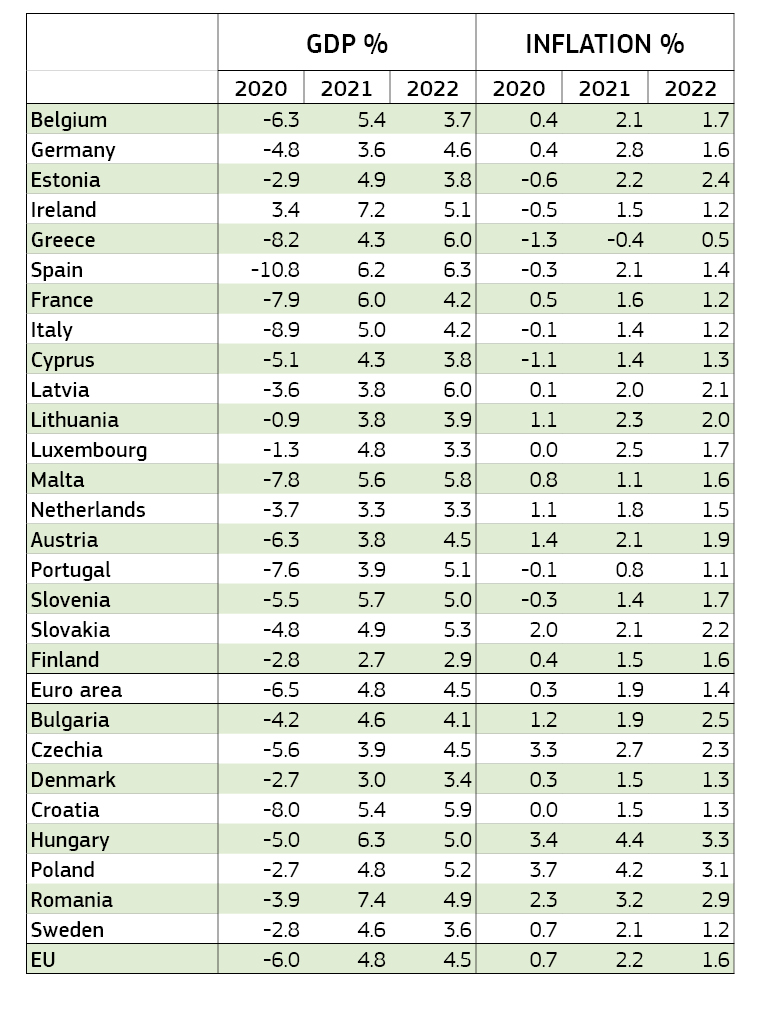
In the Summer 2021 Interim Economic Forecast, European Commission upgraded EU and Eurozone GDP growth forecast for 2021 and 2022 respectively. EU GDP growth is projected to be at 4.8% in 2021 (prior 4.2%) and 4.5% in 2022 (prior 4.4%). Eurozone GDP growth is projected to be at 4.8% in 2022 (prior 4.3%) and 4.5% (prior 4.4%).
EU inflation is projected to be at 2.2% in 2021 (prior 1.9%) and 1.6% in 2022 (prior 1.5%). Eurozone inflation is projected to be at 1.9% in 2021 (prior 1.7%) and 1.4% in 2022 (prior 1.3%).
Valdis Dombrovskis, Executive Vice-President for an Economy that Works for People said: "The European economy is making a strong comeback with all the right pieces falling into place. Our economies have been able to reopen faster than expected thanks to an effective containment strategy and progress with vaccinations"
Paolo Gentiloni, Commissioner for Economy said: "The EU economy is set to see its fastest growth in decades this year, fuelled by strong demand both at home and globally and a swifter-than-expected reopening of services sectors since the spring. Thanks also to restrictions in the first months of the year having hit economic activity less than projected."
The Analytical Overview Of The Main Currency Pairs
The EUR/USD currency pair
Technical indicators of the currency pair:
Prev Open: 1.1859
Prev Close: 1.1823
% chg. over the last day: -0.30%
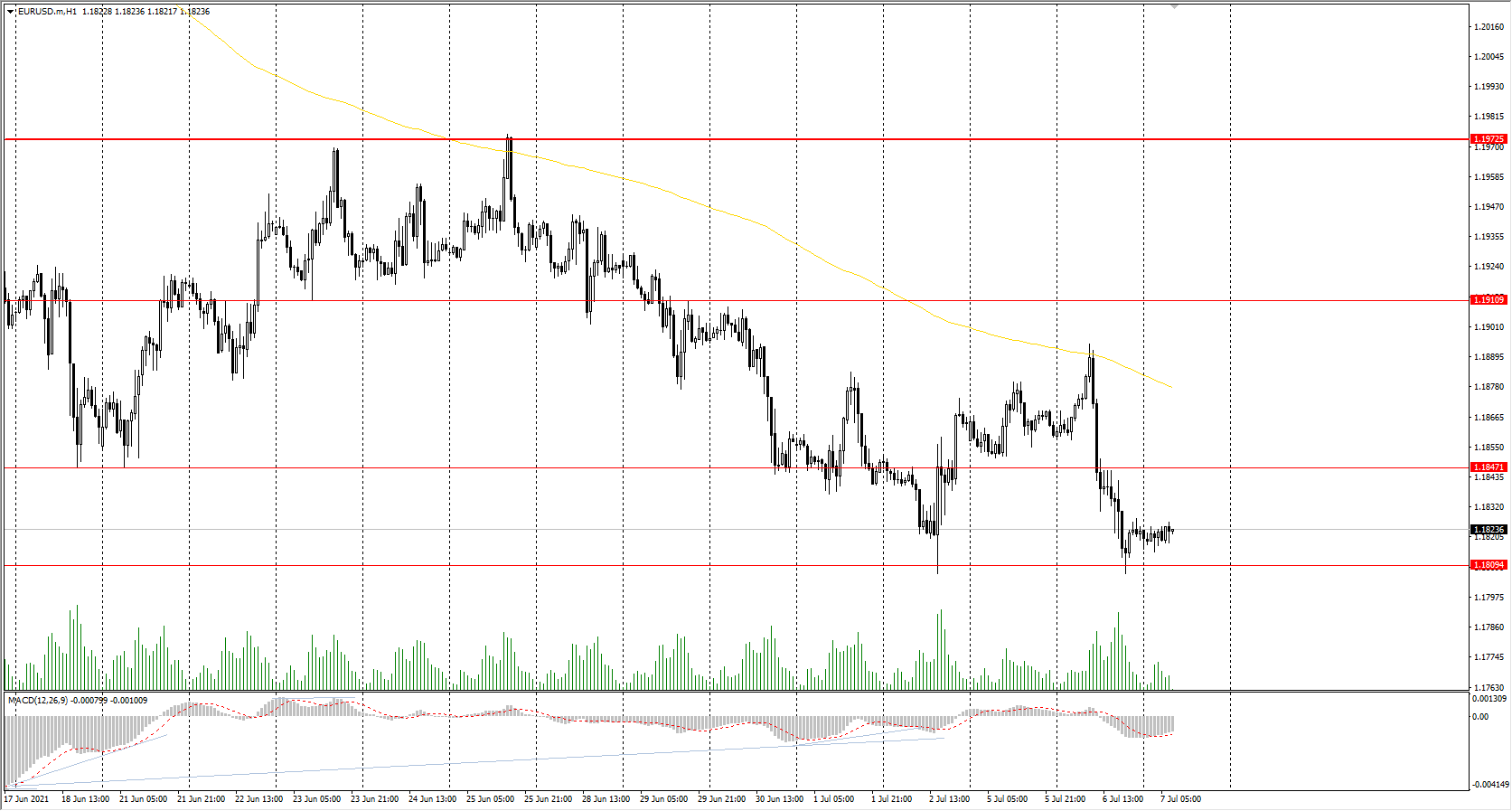
The dollar index increased sharply yesterday, triggering a decline of the major currency pairs against the dollar. Despite positive data from Europe, the EUR/USD currency pair decreased by 0.3%, falling back to the 1.1809 support level.
Trading recommendations
Support levels: 1.1809
Resistance levels: 1.1847, 1.1911, 1.1973, 1.2002, 1.2050, 1.2109, 1.2144, 1.2174, 1.2212
The trend is still bearish. The price returned to the 1.1809 support level, forming a double-bottom pattern. But the initiative from the buyers is very weak. The MACD indicator is in the negative zone, and there are signs of divergence on the higher timeframes. Under such market conditions, it is better to trade intraday and look for buy trades from the support levels now. There is no good entry point for short positions at the moment.
Alternative scenario: if the price breaks out through the 1.1972 resistance level and fixes above, the general uptrend is likely to be resumed.
News feed for 2021.07.07:
- Europe Economic Forecasts (q/q) at 12:00 (GMT+3);
- US JOLTs Job Openings (m/m) at 17:00 (GMT+3);
- US FOMC Meeting Minutes at 21:00 (GMT+3).
The GBP/USD currency pair
Technical indicators of the currency pair:
Prev Open: 1.3835
Prev Close: 1.3794
% chg. over the last day: -0.30%
The United Kingdom is a supplier of Brent crude oil and is ranked 13th among oil-producing countries. Yesterday's sharp drop in oil prices and strengthening of the dollar index caused the fall of GBP/USD quotes. Today's FOMC minutes will be crucial in terms of understanding where the British pound will go next.
Trading recommendations
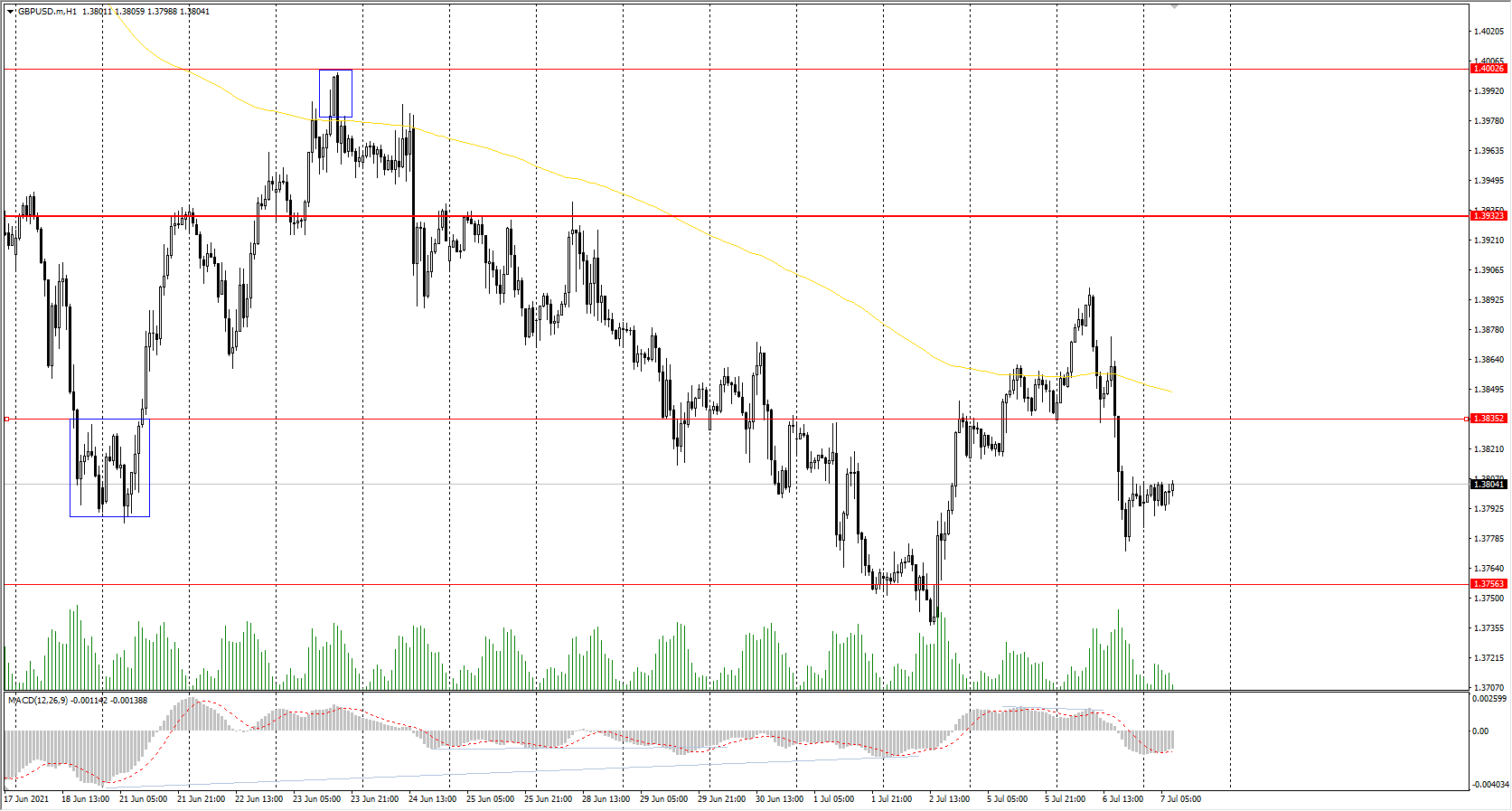
Support levels: 1.3756
Resistance levels: 1.3835, 1.3923, 1.4002, 1.4075, 1.4101, 1.4138, 1.4191
The GBP/USD trend is bearish on the H1 timeframe. Buying pressure has become weak now; the price drops below the moving average. The MACD indicator is in the negative zone, but there are signs of divergence. Under such market conditions, traders are better to look for both sell trades from the resistance levels and buy trades from the support levels on the intraday timeframes.
Alternative scenario: if the price breaks out through the 1.3922 resistance level and consolidates above, the bearish scenario is likely to be canceled.
News feed for 2021.07.07:
- US FOMC Meeting Minutes at 21:00 (GMT+3).
The USD/JPY currency pair
Technical indicators of the currency pair:
Prev Open: 110.93
Prev Close: 110.61
% chg. over the last day: -0.29%
The futures on the Japanese yen, which has an inverse correlation with the USD/JPY currency pair, sharply increased yesterday. The most interesting thing is that the rise in the dollar index did not stop the fall of USD/JPY, which means that the Japanese yen is now strengthening more than the US dollar.
Trading recommendations
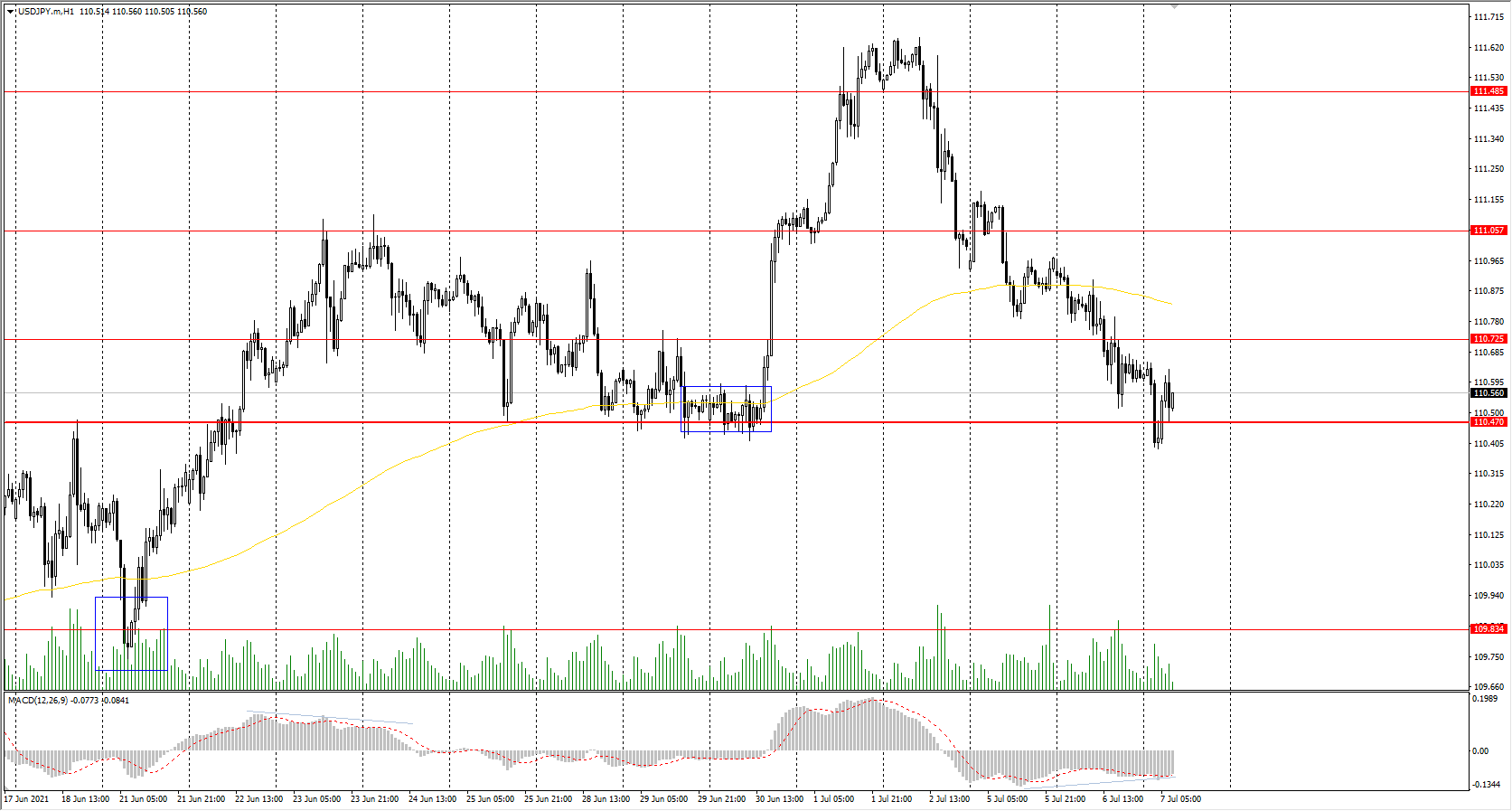
Support levels: 110.47, 109.83, 109.62, 109.31
Resistance levels: 110.73, 111.06, 111.48, 110.73, 112.18
From the point of view of technical analysis, the trend remains bullish. But the price reached the change priority level yesterday and tried to break down through it, but the buyers managed to defend their positions. Taking into account the divergence on the MACD indicator, traders are better to look for buy deals from the support levels. For confident selling, it is better to wait for a breakdown of 110.47 support level.
Alternative scenario: if the price falls below 110.47, the general downtrend is likely to be resumed.
News feed for 2021.07.07:
- US FOMC Meeting Minutes at 21:00 (GMT+3).
The USD/CAD currency pair
Technical indicators of the currency pair:
Prev Open: 1.2337
Prev Close: 1.2456
% chg. over the last day: +0.96%
The USD/CAD currency pair increased by 0.96% by the end of the day. The USD/CAD quotes are highly dependent on two factors now: the dollar index and oil prices. Yesterday, the dollar index sharply increased while oil prices collapsed, which provoked a rapid jump of USD/CAD quotes.
Trading recommendations
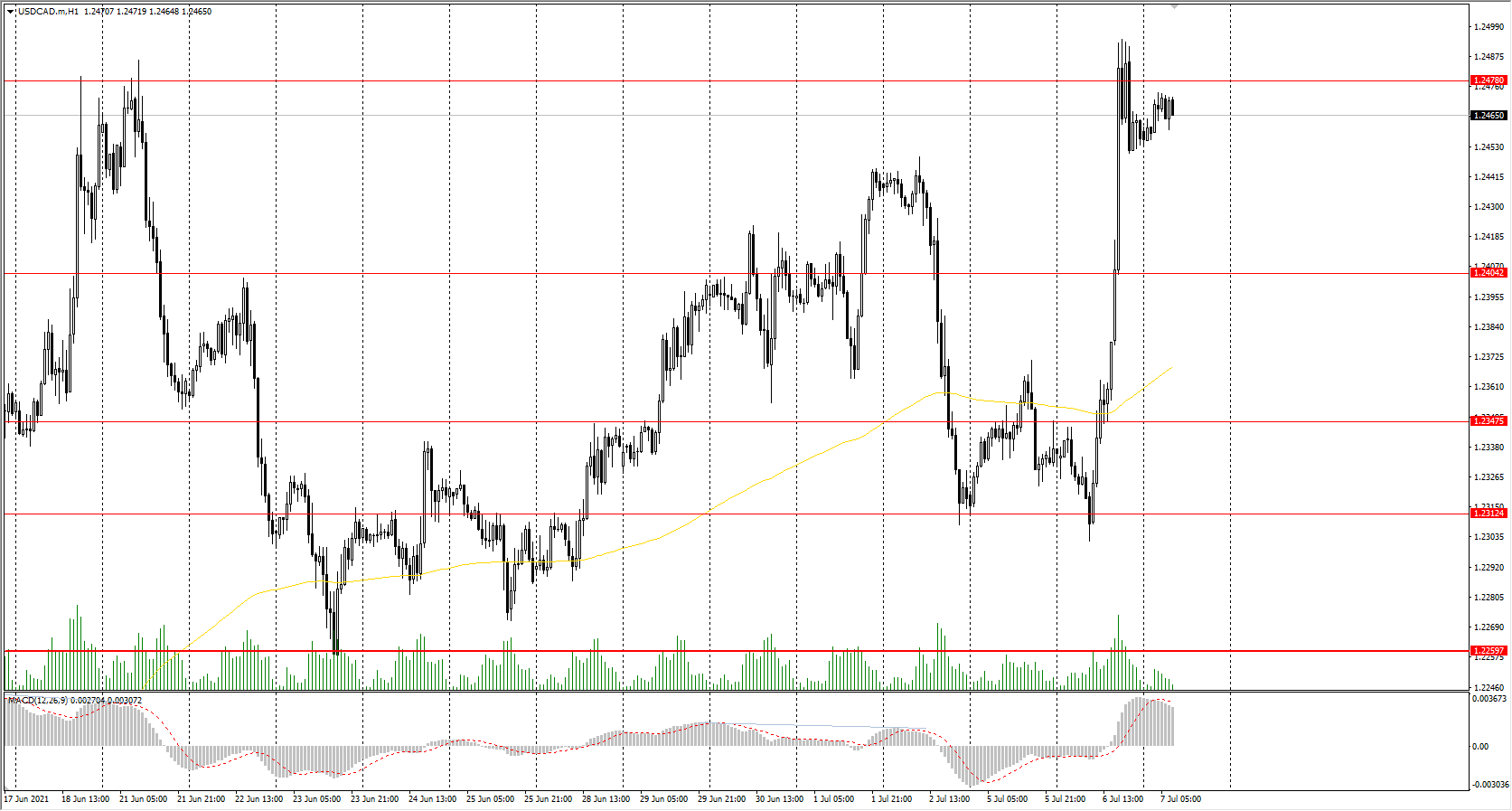
Support levels: 1.2404, 1.2347, 1.2312, 1.2260, 1.2190
Resistance levels: 1.2478, 1.2519
Technically, the trend remains bullish. The price is trading above the moving average, but there is a strong deviation from the midline. The MACD indicator has returned to the positive zone with no signs of divergence. Under such market conditions, it is best to trade on the lower timeframes. Buyers need to wait for a slight pullback to the nearest support levels. Traders can also look for entry points on intraday timeframes for short positions, but only with short targets because it will be trading against the trend.
Alternative scenario: if the price breaks down through the 1.2260 support level and fixes below, the downtrend is likely to be resumed.
News feed for 2021.07.07:
- Canada Ivey PMI (m/m) at 17:00 (GMT+3);
- US FOMC Meeting Minutes at 21:00 (GMT+3).
Investors Are Awaiting Te FOMC Minutes Release To Find Out Whether The Fed WIll Retain Its Soft Monetary Policy...
The Dow Jones and S&P 500 stock indices declined on Tuesday, moving back from last week's record highs, while the Nasdaq increased to a new high. The US ISM Services PMI fell from 64 to 60.1 points, indicating a slight slowdown in the economic recovery. The main problems with the business recovery are caused by inflation, logistical problems, raw materials, and personnel shortages. Investors are also closely watching the situation in the oil market. Oil is usually denominated in the US dollars, and the United States is the largest exporter of fuel. Oil had increased in price for foreign partners, which led to the increased demand for the US currency. The growth of the US currency is reflected in the growth of the dollar index, which in turn affects major stock indices.
At the same time, the US airlines Southwest Airlines Co and American Airlines Group Inc. are forced to delay or cancel flights due to technical problems and staff shortages amid recovering demand for domestic flights. Since the COVID-19 pandemic began, the US airlines have received $54 billion from the government to cover their employee costs. One of the conditions for obtaining financial aid was that the companies would not cut jobs. But the companies did the opposite and convinced tens of thousands of employees to retire earlier or take a leave. Now, the airlines are recruiting staff again.
The pharmaceutical market has its own news. The US biopharmaceutical company Alexion Pharmaceuticals is one step away from buying British company AstraZeneca. At the same time, shares of BionTech and Pfizer fell sharply yesterday due to a decline in the effectiveness of their vaccine. A study in Israel showed that the vaccine began to lose effectiveness in preventing the delta strain of COVID-19 in recent weeks.
The European stock market closed in the red zone yesterday. Statistics published the day before showed an increase in retail sales in Europe to the maximum value for the year. But the volume of orders in the industrial sector in Germany decreased by 3.7%, which was a surprise to analysts. Index of economic sentiment also unexpectedly decreased not only in Germany but throughout Europe too. In its turn, Deutsche Bank announced the launch of a new set of indices for tracking 21 currencies of the developing countries.
Oil prices decreased more than by 2.5% due to OPEC+ disagreements. OPEC+ representatives failed to agree on plans to increase production to meet the rising demand for fuel. The United Arab Emirates did not support a proposed six-month extension of limitations on production. No date for resumption of negotiations has been announced yet. This situation plays in favor of further growth in oil prices, as the supply does not keep up with the growing demand. Now, analysts are sure that the price of $100 per barrel is just a matter of time.
The US Treasury securities significantly increased yesterday, which triggered gold and silver to fall in prices, as these precious metals have an inverse correlation with the government bond yields. The fundamental picture is now in favor of precious metals prices going up, but investors are waiting for the FOMC minutes release to evaluate the Fed's further plans. If the monetary policy remains unchanged, the yields of government bonds will start to fall again, which will lead to an increase in gold prices.
The COVID-19 delta strain outbreak is having a negative impact on Asian economies. Investors are concerned about the rapid spread of the virus. Australia is extending restrictions in major cities and asking people to stay home. Schools are switching to remote learning. This situation is negatively affecting the business climate, in particular, the transportation sector and restaurant companies are struggling the most. Investors are also concerned about China's harsh measures against technology companies.
Main market quotes:
- S&P 500 (F) 4,343.54 -8.8 (-0.20%)
- Dow Jones 34,577.37 -208.98 (-0.60%)
- DAX 15,511.38 -150.59 (-0.96%)
- FTSE 100 7,100.88 -64.03 (-0.89%)
- USD Index 92.54 +0.32 (+0.35%)
Important events:
- Europe Economic Forecasts (q/q) at 12:00 (GMT+3);
- US JOLTs Job Opening (m/m) at 17:00 (GMT+3);
- Canada Ivey PMI (m/m) at 17:00 (GMT+3);
- US FOMC Meeting Minutes at 21:00 (GMT+3).
Risk Aversion Hits Stocks, Revives Dollar
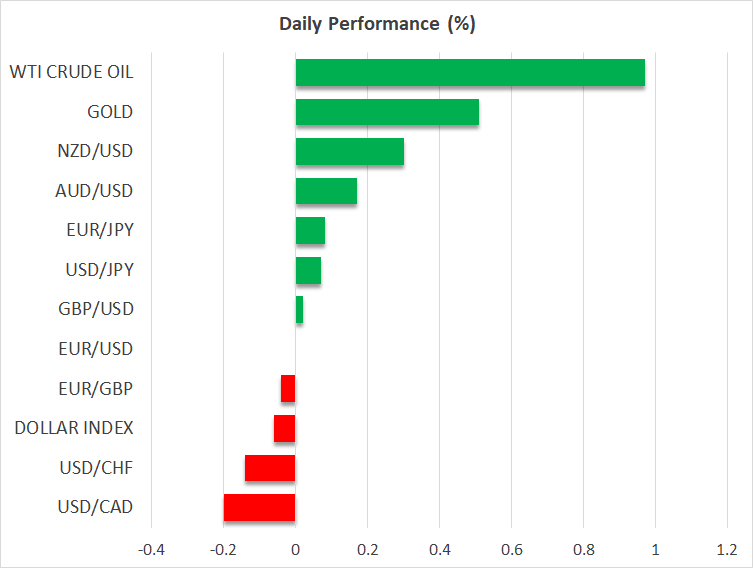
- Risk aversion hits stock markets, breathes life back into dollar
- Yen shines as US yields decline, oil under pressure, gold cools
- Fed minutes today could decide if this volatility episode lasts
Pandemic-style worries haunt markets
It was an explosive session across financial markets on Tuesday as risk aversion made a rare comeback. The underlying theme was fear, but with a pandemic-style flavor. Investors essentially slashed their exposure to assets that are linked to the real economy and looked for shelter in safe havens.
This dichotomy was crystal clear in the equity market, where ‘old economy’ stocks took a hit even as several tech titans managed to power to new record highs, highlighting the defensive nature of tech plays during this crisis. When markets are worried about economic growth, digital stocks usually shine while traditional stocks get hammered.
Across the risk spectrum, the US dollar shined bright alongside the Japanese yen as traders sought protection. But the dash for safety was even clearer in the bond market. Treasury yields fell substantially as money managers bought bonds to hedge their exposure to riskier assets. This is usually a bad sign.
When investors are willing to buy an asset that’s guaranteed to lose them money just for safety, they are typically afraid something big is coming. The catalyst behind all this mayhem wasn’t entirely clear, although the disappointing ISM services survey definitely added fuel to the moves, perhaps by intensifying worries that we’ve already hit ‘peak growth’.
Does the bond market smell something?
There are several potential explanations for what’s happening. The optimistic take is that this was just a weird day of summer trading, where one worrisome piece of data ignited a general flight to safety and a short squeeze in bonds. Everyone was betting on higher yields driven by Fed normalization, which is done by shorting bonds. If several shorts were forced to cover, then bond yields implode and that spills over into everything else.
The more gloomy view is that economic growth will cool soon and inflation isn’t sticking around. Infrastructure spending might not be powerful enough to move the needle, and the long-term deflationary forces of aging populations and technological advancements could ultimately reign supreme, like in the past decade. Lower inflation would imply fewer Fed rate increases.
Admittedly, the short squeeze explanation seems way more realistic. If so, then all the havoc might quiet down soon as position squaring runs its course.
Oil drops, gold fights on, FOMC minutes eyed
In the commodity sphere, oil prices got knocked down as the cautious mood in the broader market joined forces with worries that the divisions within OPEC might lead some producers to stop complying with their supply quotas. The negotiations continue, with the Biden administration also lobbying for a deal that stabilizes energy markets.
Meanwhile, gold prices were trapped between opposing forces. The decline in real yields initially boosted bullion but most of the gains evaporated as the dollar stormed higher. That said, the bulls are still in the driver’s seat as the yellow metal continues to push higher today, capitalizing on another decline in yields but a stable dollar.
As for today, the minutes of the latest FOMC meeting could determine whether this volatility episode continues or fades out. This was the meeting when the Fed shocked markets by signaling it might take its foot off the accelerator soon, so traders will be looking for clues as to what kind of progress the Committee wants to see before taking the next step in the normalization process.
We’ve heard from almost every Fed official lately, so markets have a good sense of where the central bank stands. It wants to see a few more solid jobs reports before getting the ball rolling, likely by sending a strong tapering warning in August. In this sense, the outlook for the dollar remains promising.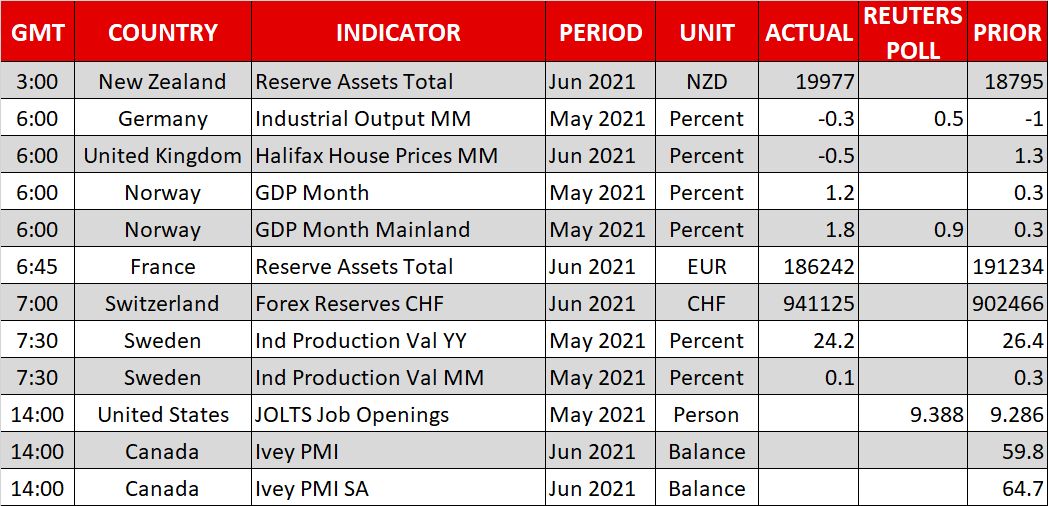
Markets Staggered But Resilient: All Eyes Are On Oil And The Dollar
World markets staggered briefly yesterday. At one point, it looked like we were witnessing the start of a sharp correction. However, by the end of the US trading session, buyers reappeared, predominantly in the sector of high-tech companies. As a result, Nasdaq100 closed with another gain of +0.3%, while S&P500 and Dow Jones lost 0.2% and 0.6%, respectively.
On the sellers' side was a drop in the ISM service sector activity index in the US to 60.1 in June from 64 a month earlier, which followed a series of weak European reports. Service sector growth slowed more than expected. The index was dragged down by cooling in business activity, employment, and export orders.
Nevertheless, markets managed to digest the data, pushing back on the idea that clear signs of cooling would prevent the Fed from moving to actively curtail stimulus, which is most beneficial to growing companies relying on cheap funding.
This time, however, equity investors seem to have acted more mechanically. Currency and commodity markets were indicating increased anxiety.
USD/JPY
USDJPY has been declining since the beginning of the month. The sell-off then could be attributed to the general weakening trend of the dollar against world currencies. But yesterday, the pair fell, along with the general strengthening of the dollar against other competitors. Too often, this has been a worrying signal of declining risk positions.
Furthermore, it resonates well with falling bond yields. A sinking USDJPY, a rising dollar, and falling bond yields are old companions of risk-off and deleverage.
It is worth paying attention to the dynamics of this pair in today's European and US sessions. Further declines should cause alarm in the markets and could quickly turn yesterday's buyers into sellers.
Oil
Oil reversed sharply to an intraday decline after updating near three-year highs. A sharp, more than 3% dip could be the start of a trend reversal, as we have seen more than once in mid-summer. In 2008 and 2014, oil reversed downwards in the first half of July, and both times it ended in an epic sell-off. There have also been several less dramatic, albeit very painful, declines.
NZDUSD Lies Above 0.70 In Horizontal Trajectory
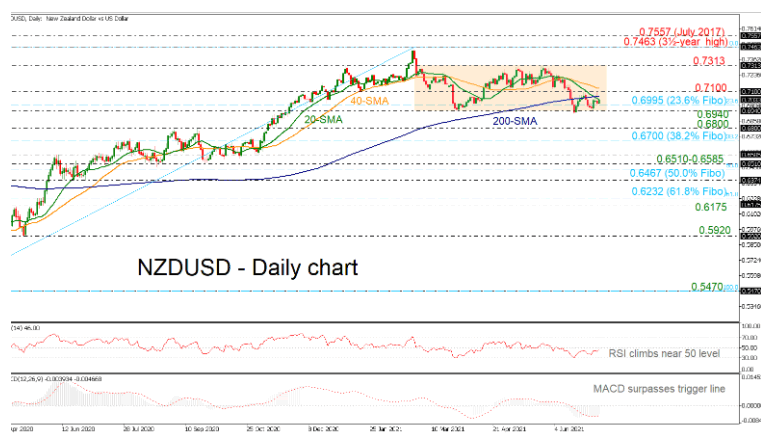
NZDUSD is flirting with the 0.7000 psychological number, after it successfully surpassed the 200-day simple moving average (SMA) yesterday. The Relative Strength Index (RSI) is pointing upwards near the 50 level, while the MACD is jumping above its trigger line in the negative region.
The 40-day SMA could challenge any bullish attempts before touching the 0.7313 resistance, which is the upper surface of a four-month trading range. Hence, any breakout at this point may gather extra interest, with the price likely speeding up to the three-and-a-half-year high of 0.7463. The 0.7557 level, being the high from July 2017 could come next on the radar.
Alternatively, an extension below the 23.6% Fibonacci retracement level of the up leg from 0.5470 to 0.7463 at 0.6995 and the 0.6940 support will strengthen the case for a down-trending market, likely activating a fresh bearish wave towards the 0.6800 level. Failure to hold above that floor could cause another negative extension towards the 38.2% Fibonacci of 0.6700.
In brief, NZDUSD has been in a consolidation area since the end of February and upside corrections may be in progress according to the technical indicators in the near-term.
WTI Oil Outlook: Oil Is Consolidating After Tuesday’s 3.3% Drop
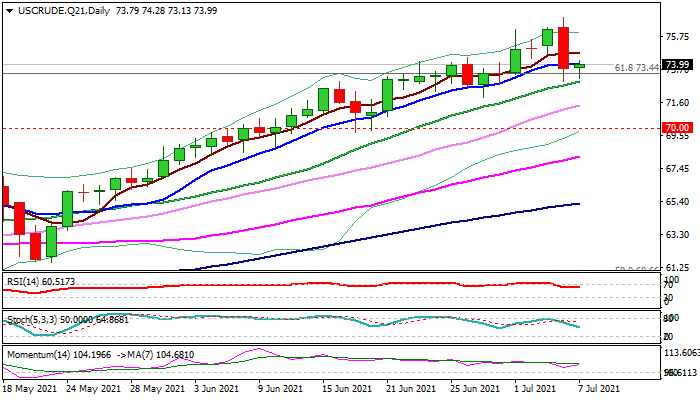
WTI oil is consolidating in early Wednesday after Tuesday’s sharp pullback from new highest level in almost seven years.
Oil price fell 3.3% on Tuesday, registering the biggest one-day drop since Apr 5, mainly hit by the failure of OPEC+ group members to agree on extending existing production cuts to the end of next year, and starting to increase supply from August until December, as accelerating economic recovery boosted global demand.
Lack of agreement between top producers would keep oil prices elevated, although the market is already too tight for consumers, especially in the US, where oil is already uncomfortable for consumers and industry.
Technical studies show that larger uptrend remains intact and the pullback is seen as positioning for a fresh push higher.
Tuesday’s pullback so far found solid ground at $73 zone (broken key Fibo level at $73.44 / rising 20 DMA at $72.92) with the ability to hold above these supports to keep bulls intact.
On the other side, weekly indicators are turning south in overbought territory that warns of deeper pullback.
Loss of $73.00 zone would risk test of psychological $70 level and former top of Mar 8 at $67.95.
Key barriers lay at $74.50/$75.00 zone, with a sustained break higher to sideline immediate downside risk.
Res: 74.46, 75.00, 75.41, 76.00.
Sup: 73.44, 72.92, 71.96, 71.41.
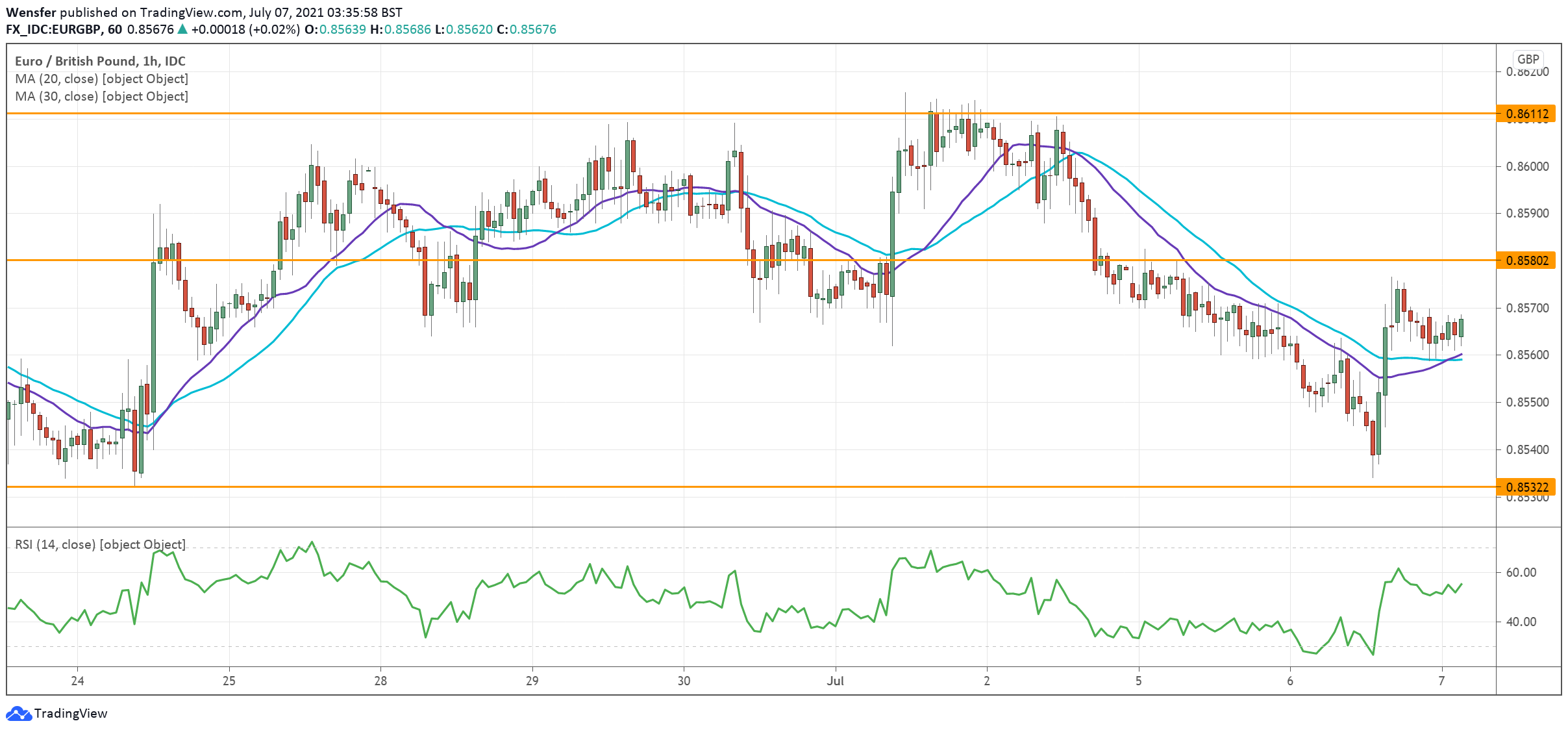
EUR/GBP bounces off key demand zone
The euro whipsawed higher after the eurozone’s better-than-expected retail sales in May. The single currency saw strong buying interest at the key demand zone of 0.8530.
Early bulls have seen an oversold RSI as a buying opportunity. Momentum above 0.8560 indicates that sellers may have rushed to close their positions. The RSI has reemerged back to the neutral area.
0.8580 is the next target, its breach could clear the path for 0.8610, the top of the recent consolidation range.