Sample Category Title
Eco Data 7/8/21
[php_everywhere instance="1"]
EUR/USD Outlook: Bears Crack 1.1800 Support and May Accelerate on Hawkish Tone from Fed Minutes
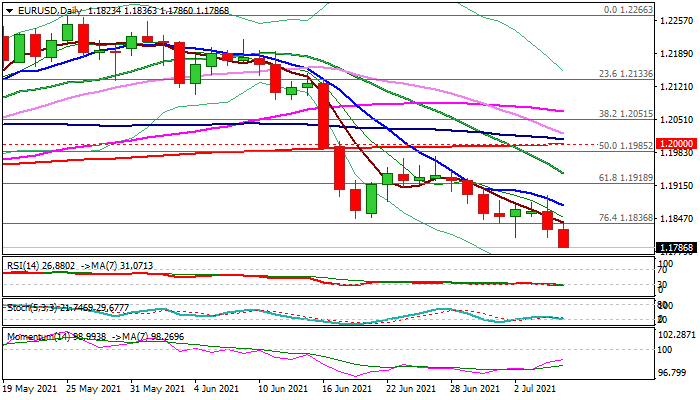
The Euro cracked 1.1800 support as bears attempt to resume downtrend after Tuesday’s upside rejection and close below 1.1836 Fibo support (76.4% of 1.1704/1.2266 ascend) generated bearish signal.
The single currency maintains negative tone on the fact that Fed is well ahead of the ECB on the way towards normalizing monetary policy after coronavirus pandemic, while recent weaker than expected German economic data contributed to the weakness.
Daily technical studies are in bearish setup and favor further weakness, as clear break of 1.1800 handle would likely lead for an extension towards key short-term supports at 1.1704 (Mar 31 low) and 1.1694 (Fibo 38.2 of 1.0635/1.2349 rally, loss of which would signal reversal of med-term 1.0635/1.2349 uptrend.
The minutes of Fed’s June policy meeting is in focus as key event today, with expectations that the central bank would keep its hawkish stance that would further inflate dollar and increase pressure on the single currency.
Broken supports at 1.1836/47 (Fibo 76.4%/former low of June 18) reverted to resistances, followed by falling 10DMA (1.1873) which tracks the downtrend for over one month.
Res: 1.1800; 1.1836; 1.1847; 1.1873.
Sup: 1.1737; 1.1728; 1.1704; 1.1694.
ECB Minutes to be Overshadowed by Looming Strategy Review Outcome
The European Central Bank will publish the minutes of its June 9-10 policy meeting on Thursday (11:30 GMT) as the Eurozone recovery gets into full swing. Policymakers struck a markedly dovish tone at their last gathering and although not all Governing Council members were happy about maintaining a “significantly higher pace” of bond purchases, the minutes will probably confirm that the hawks remain far outnumbered. The euro, which has been pummelled by the resurgent US dollar, could face some downside pressure from the minutes. But a bigger focus for the single currency in the near term is the outcome of the ECB’s strategy review, which could be announced very soon.
Wind blowing in ECB’s direction for once
Altering the course of monetary policy isn’t a priority for the ECB right now. The pandemic emergency purchase programme (PEPP) isn’t due to expire until March 2022 so there is plenty of time to ponder the next move. Furthermore, the bond selloff has eased – in fact, bonds are back in demand and yields are falling. Lastly, the euro has weakened substantially lately as the Federal Reserve looks set to beat the ECB in tapering first. All the above mean the ECB can more than afford to take its time before having to decide if or how the PEPP will be extended.
There is one niggle, however, that will almost certainly be playing on policymakers’ minds in the next meeting or two and that is the current pace of asset purchases. In March, the ECB stepped up its bond buying scheme not only to curb an unduly jump in euro area yields but to also repair the damage after sending the wrong signal to the markets by slowing the pace too much earlier in the year.
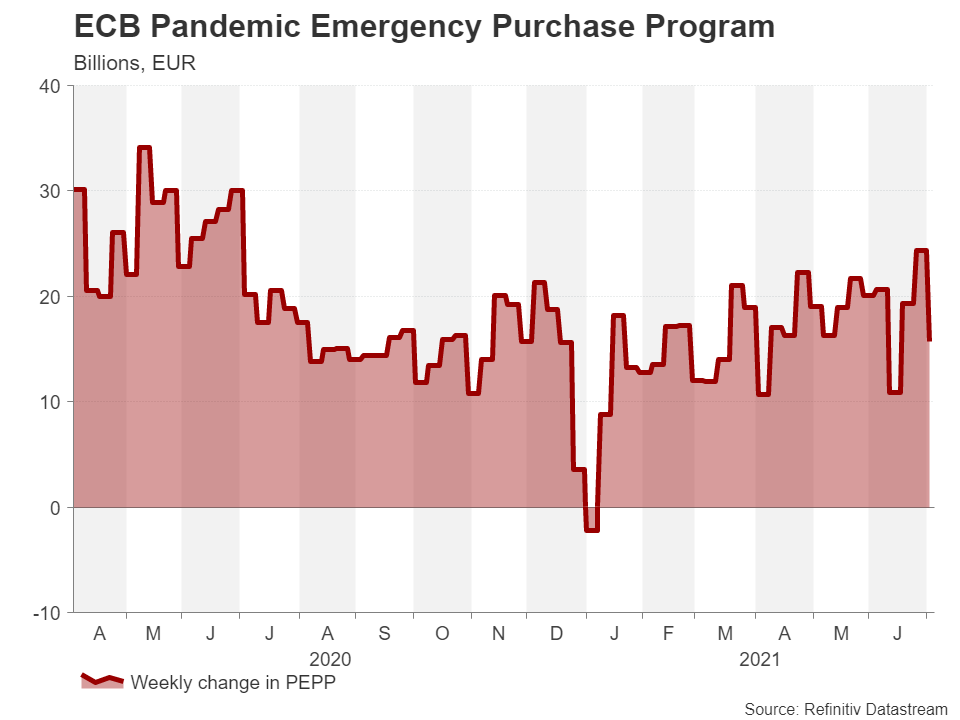
But the accelerated pace of purchases may soon have to be pared back as, apart from the strengthening economic rebound, there seems to be revived demand for government bonds and soaring yields no longer pose a problem for the Eurozone recovery. Besides, the move was meant to be temporary and now that it is almost certain the Fed will begin to wind down its stimulus over the coming months, the ECB is in a position to take its own foot off the pedal slightly.
Hints of slower purchases might support euro
The June minutes might shed some light as to how strongly policymakers feel about dropping the pledge to conduct the PEPP at a “significantly higher pace than during the first months of this year” as early as the July meeting.
Any such hints would be positive for the euro, which is really struggling at the moment to hold above the $1.18 level. If the ECB clearly signals that there may no longer be a need for accelerated bond purchases, euro/dollar could rebound above the 61.8% Fibonacci retracement of the March-May uptrend at $1.1917.
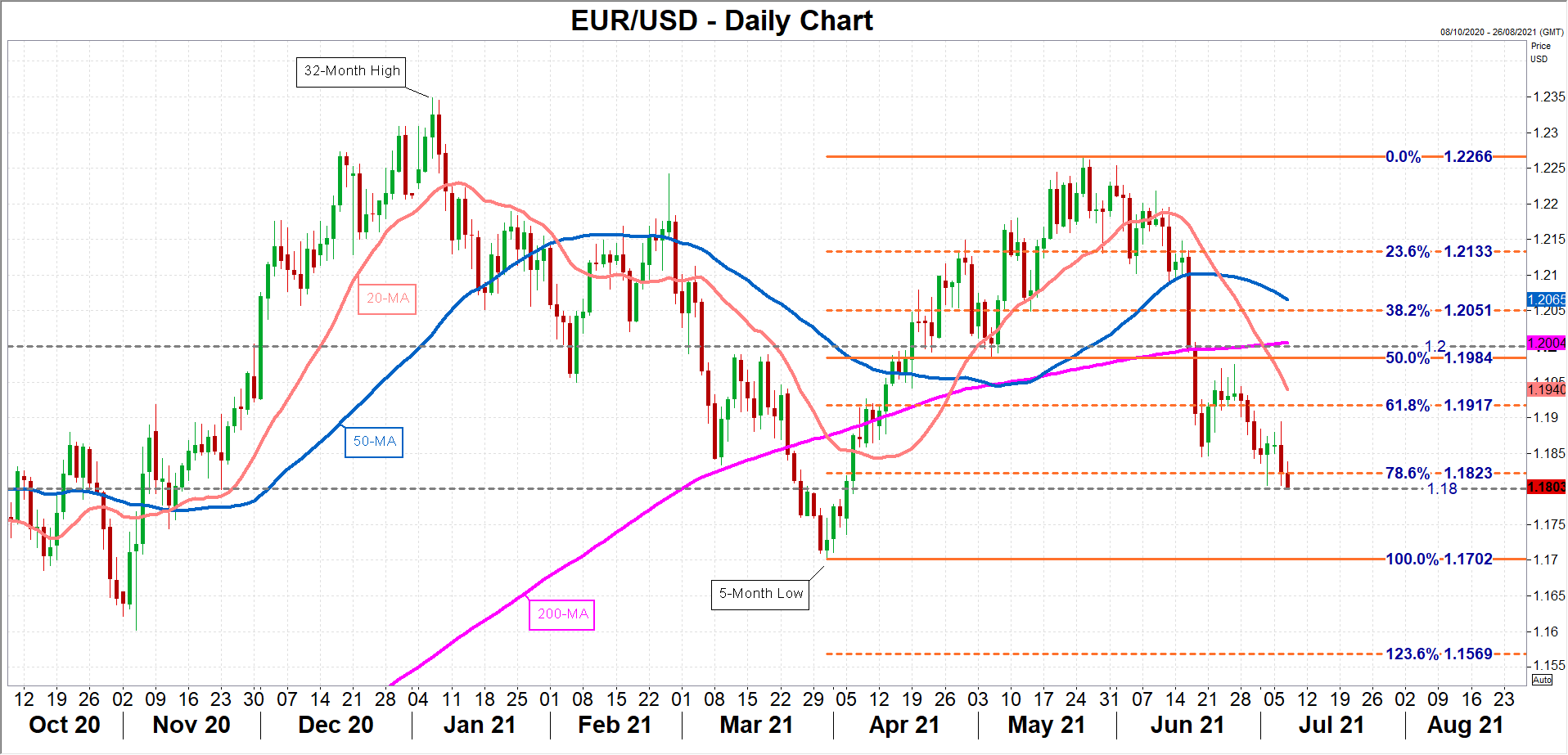
However, should policymakers provide no timeline of when asset purchases might need to be reduced, the pair could slip below the critical $1.18 barrier and head towards the March trough of $1.1702.
Strategy review could be key to exiting pandemic QE
In the bigger scheme of things a change to the PEPP pace is a minor detail and a much more important decision looming is the one about overhauling the ECB’s monetary policy strategy. Some reports indicate an announcement is imminent amid “good progress” at recent discussions held by the Governing Council at a Frankfurt hillside retreat. But whether the outcome is unveiled over the next few days or weeks, the ECB is unlikely to make a major policy change before the strategy review is completed.
The review could see the ECB’s unusual inflation objective of “below, but close to, 2%” being ditched for a more symmetrical target of around 2% used by most other central banks. One other option is to follow the Fed in adopting average inflation targeting, though it’s unlikely hawkish governors such as those of Germany, Austria and the Netherlands would ever approve of this.
Defining inflation overshoot
Either way, President Christine Lagarde will soon have to clarify how much of an inflation overshoot the Bank is willing to tolerate and for how long. Inflation in the euro area – while on the rise – has yet to shoot up to levels such as those in the United States. But it might not be long before it does.
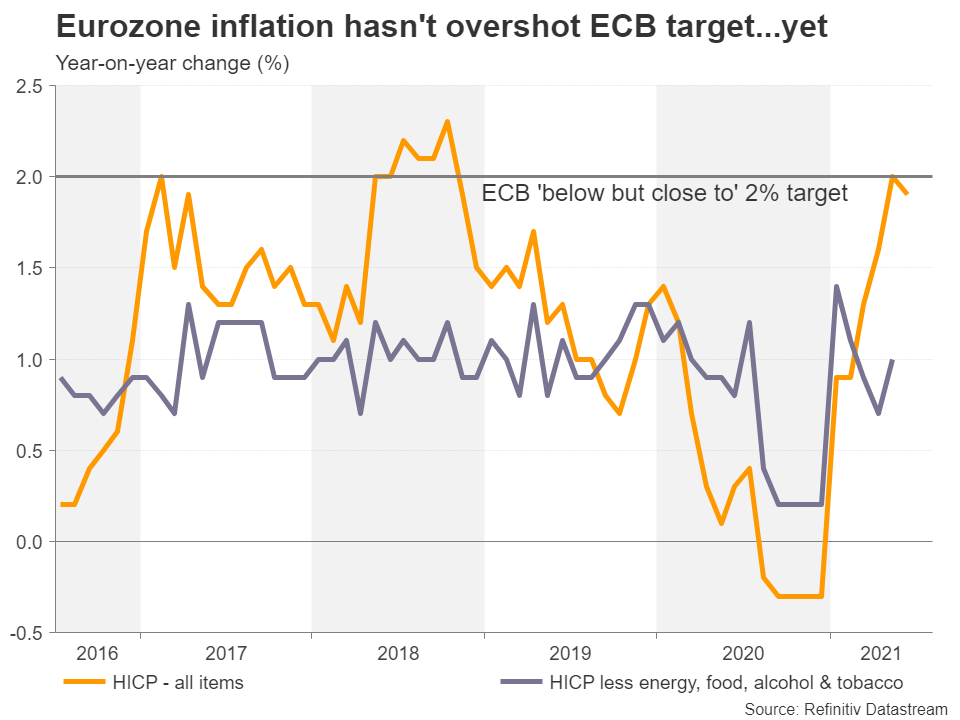
This makes the timing of the strategy review all the more important as it could determine how quickly asset purchases are scaled back. The other potential revamp that could have major repercussions on how policy is set is whether the ECB will decide to look at different measures of inflation, possibly even launching its own price index.
There is a growing debate about the need to include house prices into Eurostat’s Harmonised Indices of Consumer Prices (HICP). But even if the ECB were to push for a new inflation metric that incorporates housing and other costs, it could take several years to develop a new price index so there might not necessarily be any near term policy implications from this.
Can the Eurozone avoid the Delta carnage?
Amidst all the upcoming policy reviews and decisions, there is another thing investors should keep an eye on – the Delta variant. Some Eurozone nations like Spain appear to be headed in the direction of the UK, with new infections surging in recent days, driven mainly by the highly contagious Delta strain. Should the Delta outbreak worsen across Europe in the coming weeks, it could scupper plans to fully reopen shuttered sectors of the economy, which would ultimately delay any tapering plans by the ECB.
Pound Looking for Direction ahead of FOMC
The British pound is drifting in the Wednesday session. In North American trade, GBP/USD is trading at 1.3807, up 0.06% on the day.
FOMC minutes may be hawkish, but does it matter?
All eyes are on the June FOMC minutes, which will be released later today (18:00 GMT). The June meeting was a shocker, as the Fed abruptly moved up its timeline for rate hikes. Up until that point, the Fed insisted that the jump in inflation was transient and that it would not raise rates before 2024. At the meeting, the Fed changed course, raised its expectations for inflation and said that it expected to hike rates twice in 2023.
The minutes could well reflect the hawkish stance we saw at the June meeting, but that doesn’t mean the markets will react, given that the policy meeting took place three weeks ago. In the meantime, the June employment report showed a surge in unemployment, which climbed from 5.6% to 5.9%, as well weak wage growth. Nonfarm payrolls outperformed with strong gain of 850 thousand, but the markets appear more concerned with slack in the job market rather than higher inflation, and a taper in QE does not look likely anytime soon.
The UK economy continues to roll, with key PMIs indicating strong expansion across the economy. The June PMIs all showed strong growth, with Manufacturing PMI at 63.9, Services PMI at 62.4, and Construction PMI accelerating to 66.3 points. These figures are well above the 50-level, which separates contraction from expansion.
So far the good news. The issue which could upset the apple cart is the resurgence of Covid-19 in the UK and the concern that vaccines may not be as effective against the Delta variant. Prime Minister Boris Johnson appears determined to open the economy completely and remove all health restrictions by July 19th, but given all the ups-and-downs that the UK has faced in the Covid battle, Johnson is taking a risk that could backfire badly if Covid spreads.
GBP/USD Technical Analysis
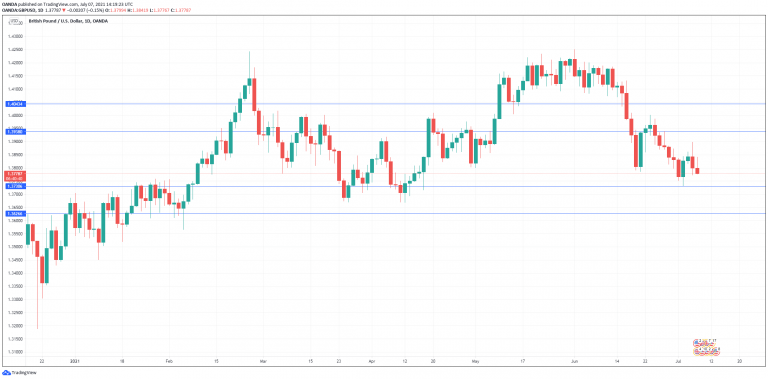
- There is resistance at 1.3938. Above, there is resistance at 1.4043
- On the downside, 1.3730 is the first level of support. This is followed by support at 1.3627
Sunset Market Commentary
Markets
The European Commission published its updated summer forecasts. Euro area growth was boosted from 4.3% to 4.8% for this year and 4.5% (from 4.4%) for the next. This would bring real GDP back to its pre-pandemic level in the final quarter of this year, earlier than expected back in the spring forecasts. The reason for the more upbeat projections is the rapid progress with vaccinations and resulting easing of restrictions, in particular in services. Rising energy and commodity prices and supply-chain bottlenecks are seen pushing inflation higher to 1.9% this year compared to 1.7% previously anticipated. Inflation should slow down again in 2022 but it could be more persistent if second-round effects were to develop. The timing of such an upbeat narrative couldn’t be any more awkward. The mood on (bond) markets is particularly grim with (real) yields declining yesterday more than 7 bps. The jury is still out whether reasons are predominantly technical (systematically short-covering, low UST issuance and high demand by a.o. the Fed via QE, TGA drawdown) or fundamental (growth concerns, lower long-term neutral rate). Fact is that yesterday’s bond moves continued today and therefore deserve being monitored closely. The US yield curve bull flattens once again with losses at the long end mounting to 3.7 bps in the 10y (and 30y), intensively testing support at 1.35% (June 2021 low). If breached sustainably, it would pave the way towards the February gap around 1.21%. The German curve declines in similar fashion, with yields down 2.8 bps (10y, testing support at -0.30%) to 3.4 bps (30y). As was the case yesterday, peripheral yields are happy to join the trend in core bonds with spreads virtually unchanged. The picture for the dollar was a bit more nuanced compared to yesterday. The greenback traded mixed against G10 peers. The trade-weighted DXY inches marginally higher and is aiming to finish at the highest level since early April. USD/JPY stabilizes around 110.7. EUR/USD falls towards intermediate support around 1.181 and looks vulnerable. Sterling advances slightly vs. the euro. EUR/GBP (0.855) fails to release itself from the gravitational pull around 0.853.
News Headlines
At first sight, the economic expansion in the Czech Republic continued at a solid pace. Industrial output rose 25.3% Y/Y. However, strong growth compared to last year is still influenced by a favourable base effect. Production in May eased 3.6% M/M. May production was also lower than expected. The decline, amongst others, was due to a slowdown of production in the key automotive industry (-11% M/M). Production is hampered by component shortages. A deceleration is also visible in electrical and chemical industries. Labour shortages and rising input prices are obstructive factors too. New orders rose 46.5% Y/Y (90.0 Y/Y in April). Orders in the automotive industry remain strong (7.0% M/M and 80% Y/Y) but due to supply chain bottlenecks it remains unsure how this will translate into future production. The Czech krona today continued a gradual decline (EUR/CZK 25.67), but this was mainly due a fragile global sentiment rather than the result of domestic data/events.
In report published today, the OECD said that at the end of 2020 the number of jobs in developed countries was still 22 mln lower than before the pandemic. Worldwide the loss of jobs was estimated at 114 mln. For the OECD countries, there are still over 8 mln more unemployed than before the crisis, and over 14 million more people are not actively looking for a job. OECD expects the employment rate (share of working age people employed) to be still below the pre-pandemic level at the end of 2022. The labour market remains vulnerable to a rapid build-up of long-term unemployment. Many who lost their job in the first phases of the pandemic may find it difficult to compete with those whose jobs have been previously sheltered. In this context, the OECD advocates continued, rgeted fiscal support.
Australian Dollar Rebounds, FOMC Eyed
The Australian dollar has reversed directions on Wednesday. In the North American session, AUD/USD is trading at 0.7518, up 0.32% on the day.
FOMC minutes loom
This week’s key event risk is the June FOMC minutes, which will be released later in the day (18:00 GMT). The June meeting shook up the markets, as the Fed moved up its timeline for rate hikes. Up until that point, the Fed insisted that inflation was transient and that it would not raise rates before 2024. At the meeting, the Fed changed course, raised its expectations for inflation and said that it expected to hike rates twice in 2023.
The minutes could well reflect the hawkishness of the June meeting, but this stance may be stale, given that last week’s jobs report showed that unemployment jumped from 5.6% to 5.9%, as well weak wage growth. Even with NFP outperforming, with a solid gain of 850 thousand, the markets seem less concerned about runaway inflation, and a taper in the bond-buying appears a long ways off.
RBA scales back QE but remains dovish
The RBA sounded somewhat dovish about the economy, but still pressed the QE trigger and lowered bond purchases from AUD5 billion per week to AUD 4 billion per week. Predictably, the markets gave a thumbs-up on the news of a taper and the Australian dollar jumped on the news. However, some caution is warranted before jumping on the Aussie bandwagon in expectations that the upswing will continue. The RBA reminded its listeners that it intends to continues monetary stimulus until conditions improve further. The central bank has said it does not plan to raise rates until inflation rises to 2-3% and wage growth reaches 3%, which the bank has projected will not materialize before 2024.
AUD/USD Technical
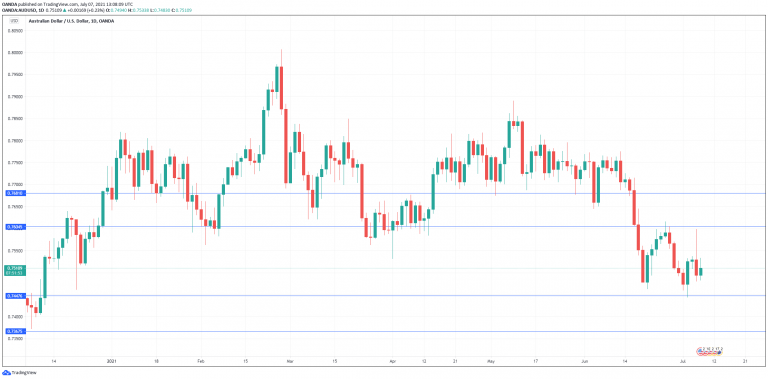
- AUD/USD is facing resistance at 0.7604 and 0.7681
- On the downside, there are support levels at 0.7447 and 0.7367
XAU/USD Outlook: Gold Extends Gains into Sixth Straight Day, Awaits Fed Minutes for Fresh Signals
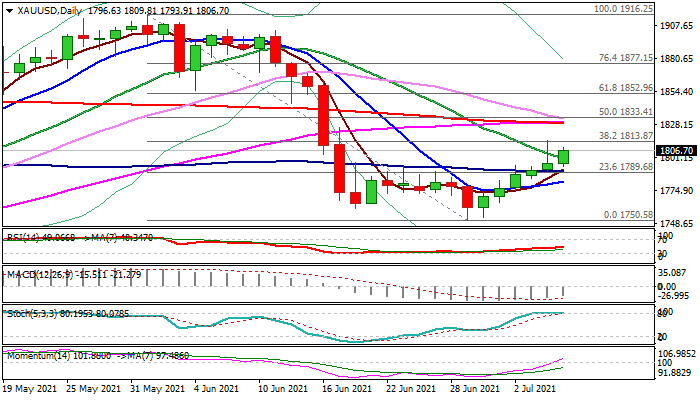
Spot gold maintains a firm tone and is on course for a sixth straight day in green, as Tuesday’s upside rejection at pivotal Fibo barrier at $1813 (38.2% of $1916/$1750) failed to negatively impact bulls, which regained traction and pressure again $1813 level.
The yellow metal was lifted mainly by a drop in US Treasury yields, but all eyes are on release of Fed’s minutes of the June policy meeting, which could provide more clues on the central bank’s policy stance and define metal’s price direction.
Although gold price accelerated higher in July, the recovery is still slow, compared to June’s over 7% monthly fall, sparked by hawkish signal from Fed.
This keeps the downside vulnerable, especially if bulls repeatedly fail to clear $1813 pivot.
Investors look for more details of Fed’s interest rate trajectory and QE tapering, with minutes seen as one of key factors to define gold’s near-term direction.
Hawkish tone from the central bank would hurt demand for the precious metal and push the price back below pivotal supports at $1800/$1790 (psychological/daily cloud base /100DMA) that would signal an end of recovery and shift focus lower.
Conversely, Fed’s dovish stance would increase uncertainty and boost demand for safe-haven gold, which could push the price towards targets at $1828/33 (converged 55/200DMA’s/ Fibo 50% of $1916/$1750).
Res: 1813; 1828; 1833; 1852.
Sup: 1800; 1790; 1782; 1765.
EUR/USD Mid-Day Outlook
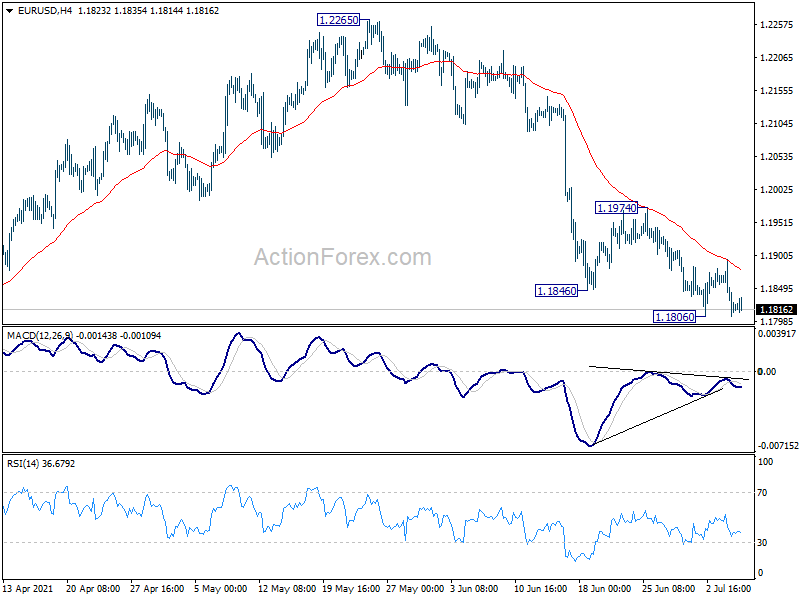
Daily Pivots: (S1) 1.1788; (P) 1.1841; (R1) 1.1876; More...
Intraday bias in EUR/USD remains neutral at this point. Further fall is still in favor as long as 1.1974 resistance holds. Break of 1.1806 will resume the decline from 1.2265, as the third leg of the consolidation pattern from 1.2348, to 1.1703 support. On the upside, break of 1.1974 resistance will turn bias back to the upside for 1.2265 resistance.
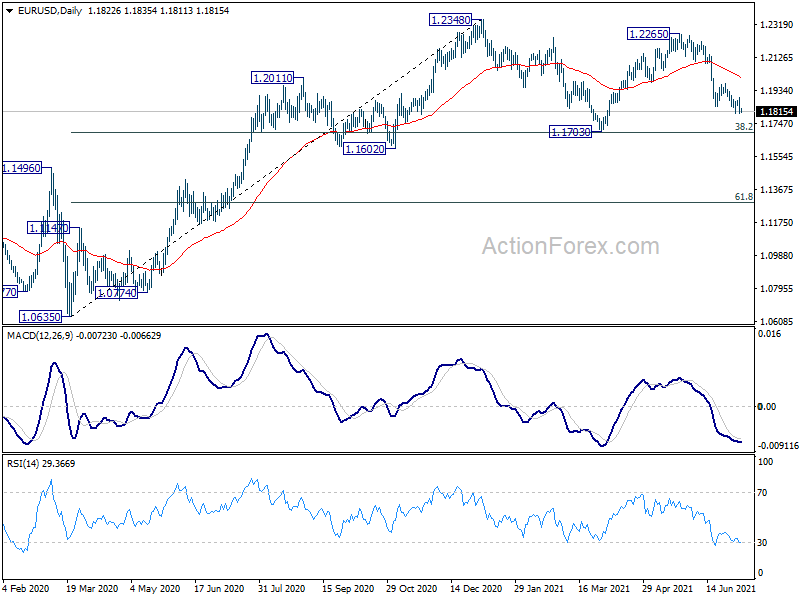
In the bigger picture, rise from 1.0635 is seen as the third leg of the pattern from 1.0339 (2017 low). Further rally could be seen to cluster resistance at 1.2555 next, (38.2% retracement of 1.6039 to 1.0339 at 1.2516). This will remain the favored case as long as 1.1602 support holds. Reaction from 1.2555 should reveal underlying long term momentum in the pair. However sustained break of 1.1602 will argue that the rise from 1.0635 is over, and turn medium term outlook bearish again.
GBP/USD Mid-Day Outlook
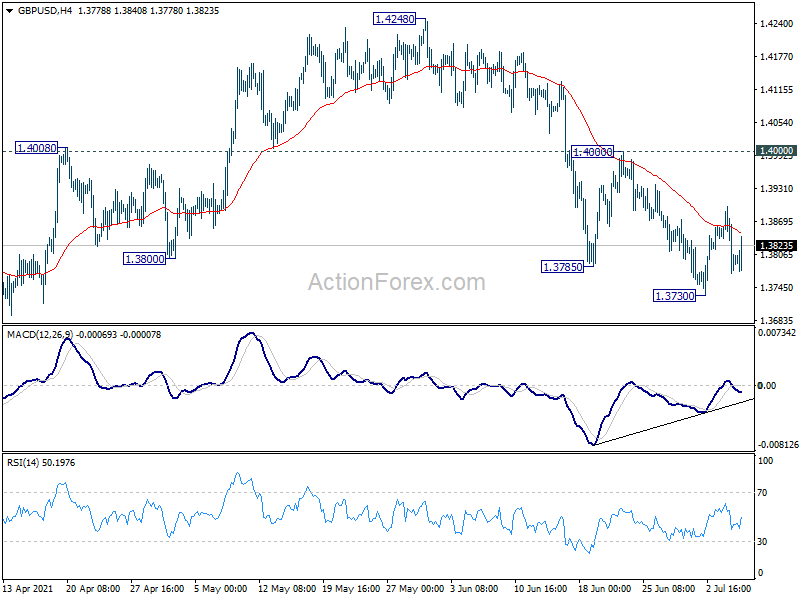
Daily Pivots: (S1) 1.3749; (P) 1.3823; (R1) 1.3874; More....
GBP/USD is staying in range above 1.3730 and intraday bias remains neutral first. On the upside, break of 1.4000 resistance will argue that fall from 1.4248 has completed. Intraday bias will be turned back to the upside for retesting 1.4240/8 resistance zone. On the downside, break of 1.3730 support will resume the fall from 1.4248, as the third leg of the consolidation pattern from 1.4240, to 1.3668 support and possibly below.
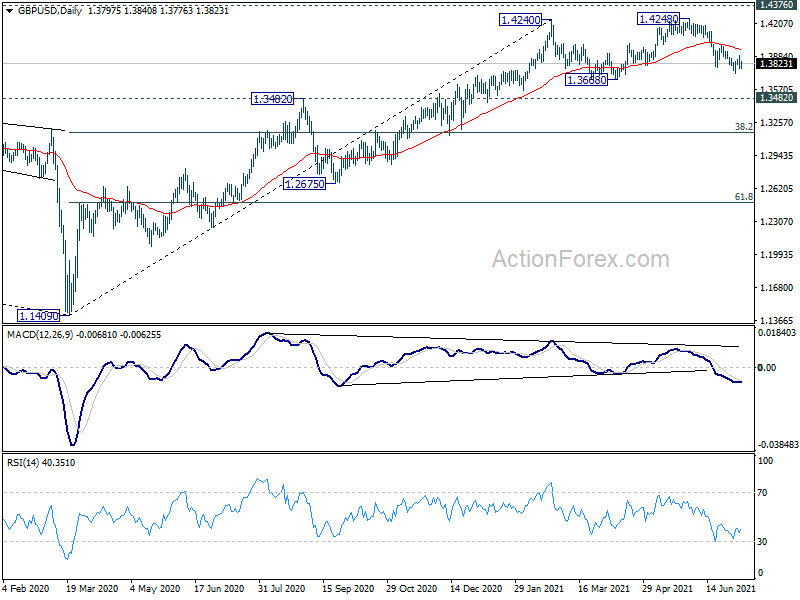
In the bigger picture, as long as 1.3482 resistance turned support holds, up trend from 1.1409 should still continue. Decisive break of 1.4376 resistance will carry larger bullish implications and target 38.2% retracement of 2.1161 (2007 high) to 1.1409 (2020 low) at 1.5134. However, firm break of 1.3482 support will argue that the rise from 1.1409 has completed and bring deeper fall to 1.2675 support and below.
USD/CHF Mid-Day Outlook
Daily Pivots: (S1) 0.9210; (P) 0.9230; (R1) 0.9267; More....
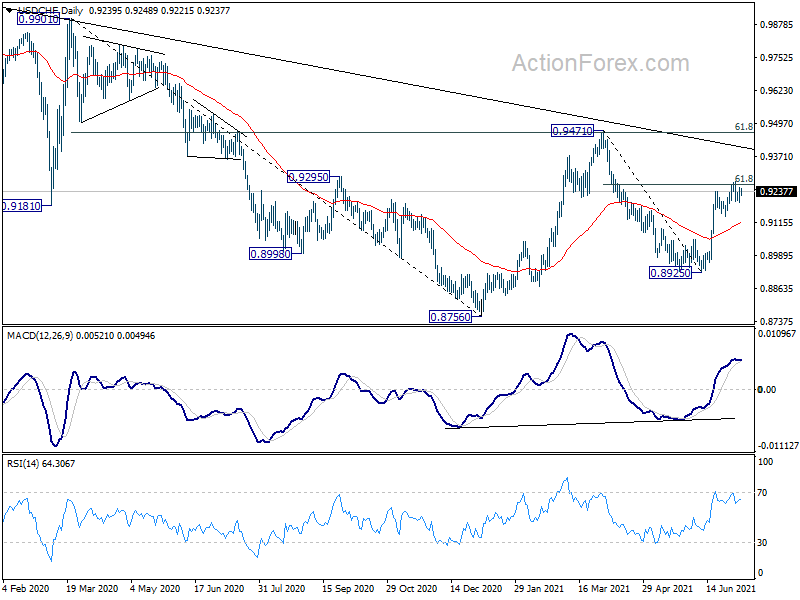
USD/CHF is staying in range of 0.9141/9273 and intraday bias remains neutral first. Another rise could still be seen as long as 0.9141 support holds. Break of 0.9273 would pave the way to 0.9471 key resistance next. On the downside, however, break of 0.9141 support will argue that the rebound from 0.8925 has completed, and turn bias back to the downside for this low.
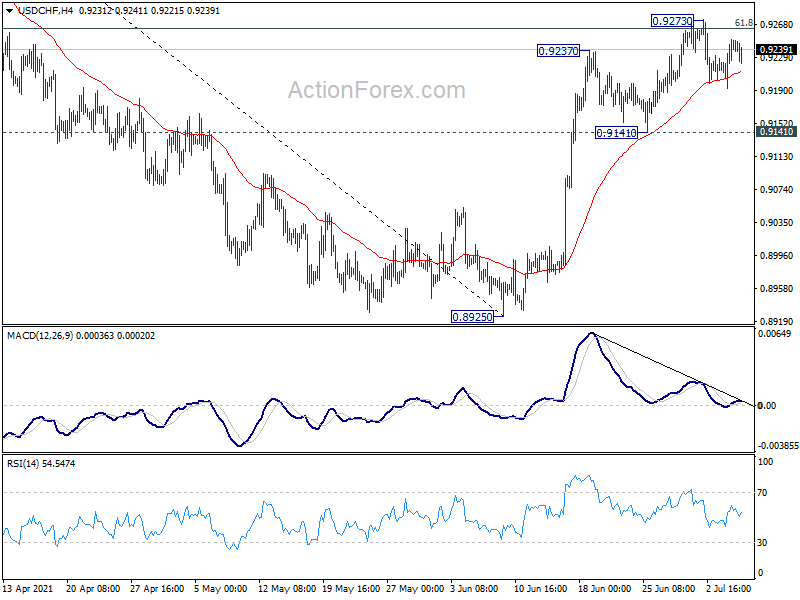
In the bigger picture, medium term outlook is currently neutral with focus on 0.9471 resistance. Sustained break there will indicate completion of whole decline from 1.0342 (2016 high). Medium term outlook will be turned bullish for a test on 1.0342 high. But, rejection by 0.9471 again will revive bearishness for another fall through 0.8756 low.