

Sample Category Title
Pound Calm as UK Services PMI Edges Lower
The British pound has started the week quietly. In the North American session, GBP/USD is trading at 1.3846, down 0.13% on the day.
The pound has pushed back into 1.38 territory, on optimism over the economy’s reopening optimism and PMI data which was better than expected. The UK was forced to delay the end of all Covid restrictions in June until July 19th. Although the Delta variant has resulted in a sharp increase in cases, the death rate has remained low, and the government is hopeful that the new ‘Freedom Day’ of July 19th will not have to be postponed.
UK business activity has been surging and the Services PMI remains well into expansionary territory. In June, the PMI came in at 62.4, down from 62.9 but ahead of the consensus of 61.7. Manufacturing and job creation data have also been robust, indicative of a strong economic recovery.
Nonfarm payrolls rise, but so does unemployment
On Friday, the pound recorded its first daily gain in a week, as the US dollar was broadly lower, despite a positive nonfarm payrolls report. The reading of 850 thousand easily beat the consensus of 700 thousand and was much stronger than the previous reading of 583 thousand. However, investors were concerned about the surge in unemployment, which jumped from 5.6% to 5.9%. This has raised speculation that the labour market is still not strong enough to pressure the Fed to tighten policy.
US companies are having trouble finding workers, and this problem is compounded by the fact that some 15.3 million Americans are receiving unemployment benefits. The shortage in labour supply in the US has led to increased wage and inflation pressures. Wages soared to 3.6% in June YoY, just shy of the estimate of 3.7%, and sharply higher than the May release of 1.9%. Higher wages will mean higher inflation, and that could put pressure on the Fed to tighten monetary policy.
GBP/USD Technical Analysis
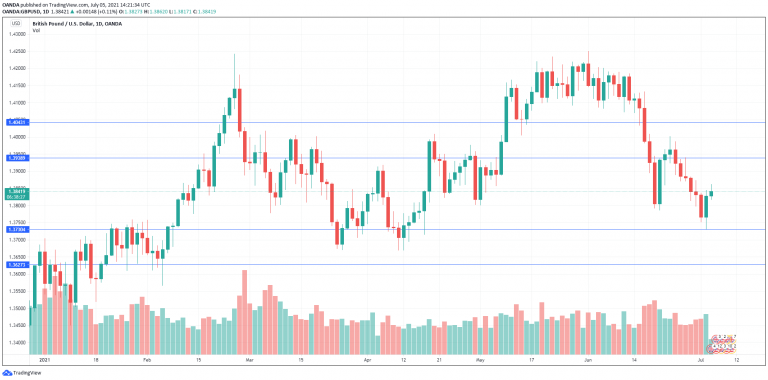
- There is resistance at 1.3938. Above, there is resistance at 1.4043
- On the downside, 1.3730 is the first level of support. This is followed by support at 1.3627
Sunset Market Commentary
Markets
Trading developed according the standard script applying to a day with US markets closed (long weekend for 4th of July Independence Day) and only second tier eco data scheduled for release in Europe. The EMU June final services (58.3) and composite PMI’s (59.5) were upwardly revised, reaching the highest levels since July 2007 and June 2006 respectively. The release confirms the economy is gaining traction as vaccinations are rolled out further and restrictions are eased. Price pressures continue to build. However, markets currently don’t see a tight link from the data toward (monetary) policy. In fact, this was also the case after the US payrolls on Friday. Solid data as such don’t change market expectations on the timing and the pace of monetary policy normalization as at least an important part/majority of Fed and ECB members currently don’t want to take the risk of reducing policy stimulus too soon. In technical trading, German yields are rebounding modestly. The move already started before the publication of the PMI’s and remains modest compared to the flattening move at the end of last week. German yields are rising between 0.6 bp (2-y) and 2.0 bp (10 & 30-y). The German 10-y yield (-0.215%) stays below the -0.20% previous support, but next support near -0.25%/-0.28 stays safe for now. Still, the picture remains unconvincing. This also applies to the global reflationary narrative. European equities initially failed to build on Friday’s record race in the US, but gradually reverted into positive territory (gains mostly between 0.2% and 0.75%). 10-y intra-EMU spreads versus Germany are changing less than one bp. Commodities, including oil, remain well supported, but also with limited direct impact on to other (global) markets. There are no signs of progress to resolve the split in OPEC+ between Saudi Arabia and UAE. Both countries disagree on the path toward reducing production cuts. At least for now, markets apparently are confident that this won’t result in an unexpected rise in production. Brent oil ($76.40 p/b) is keeping the post-corona top within reach.
On the FX market, the dollar lost marginal ground, but no significant support levels have been challenged in major cross rates. The DXY trade-weighted index is holding well north of 92.00 (92.25). EUR/USD (1.1865) failed to regain the 1.1874/84 area (Thursday/Friday highs). USD/JPY is drifting below the 111 big figure. As was the case on Friday, sterling again outperforms the euro. The June UK services PMI was also upwardly revised to 62.4 but stayed marginally below the May post-corona top (62.9). Even so, also the broader picture for EUR/GBP (0.857) hasn’t changed. For that to happen, a break below 0.8530 is needed. We’re not that far yet.
News Headlines
Turkish inflation accelerated in June from 16.59% y/y to 17.53% (1.94% m/m), driven by another surge in food prices of 20%. But even excluding food (and energy prices), the core measure advanced from 16.99% to 17.47%. The figures make a Summer policy rate cut, floated by president Erdogan a few weeks ago, not very likely as the Turkish central bank pledged to keep real rates positive. Doing so, the CBRT hopes to curb inflation and provides some downside protection to the Turkish lira. Other, producer, price gauges still point at very strong underlying inflationary pressures as well though (42.89% y/y). EUR/TRY trades stoic near the 10.28 area.
Sweden’s parliament speaker today proposed Social Democrat leader Lofven as prime minister. A first attempt by the main opposition party leader Ulf Kristersson to form a new government after Lofven’s minority coalition collapsed last month, failed. Sweden’s Center Party said it will accept Lofven as PM and will assume a role in the opposition in return for certain reforms. The Left Party, which pulled the plug over a reform in the rental housing market, said it would vote in favour as well but rejected the demands by the Center Party. The vote, scheduled on Wednesday, thus faces many uncertainties still. EUR/SEK is trading near Friday’s closing of 10.14.
Canadian Dollar Gives Up Some NFP Gains
The Canadian dollar has started the week with losses. In the North American session, USD/CAD is trading at 1.2457, up 0.31% on the day.
The US dollar ended the week on a downturn against most of the majors. The Canadian dollar jumped on the bandwagon, as USD/CAD fell 0.92% on Friday.
The reason for the US dollar’s downturn was the surprising surge in the US unemployment rate, which rose from 5.6% to 5.9. The jump in unemployment made investors uneasy, with growing speculation that the labour market is still not strong enough to push the Fed to tighten policy. Nonfarm payrolls was solid, as the reading of 850 thousand dwarfed the consensus of 700 thousand. Despite the positive NFP report, the US dollar ended the week on a sour note.
With US companies struggling to find workers, some 15.3 million Americans are receiving unemployment benefits. The shortage in labor supply has led to increased wage and inflation pressures. Wages soared to 3.6% in June YoY, just shy of the estimate of 3.7%, and sharply higher than the May release of 1.9%. Higher wages will mean higher inflation, and that could put pressure on the Fed to tighten monetary policy.
Canada’s economy contracted in April, but the drop was not as sharp as anticipated. The decline of -0.3% was smaller than the flash estimate of -0.8%. The country’s vaccine rollout, which has lagged behind most major economies, is accelerating and this should allow for a further reopening of the economy. According to a Scotiabank forecast, growth is expected to recover to pre-Covid levels in the third quarter of 2021 and should continue moving upwards into 2022.
USD/CAD Technical
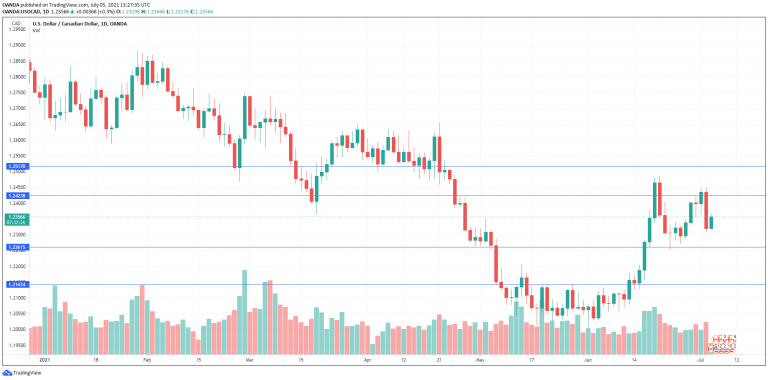
- There is resistance at 1.2423, followed by resistance at 1.2517
- On the downside, there is support at 1.2261. Below, there is support at 1.2143
US 500 Index at Fresh Top of 4,355; Upside Risks Look Sturdy
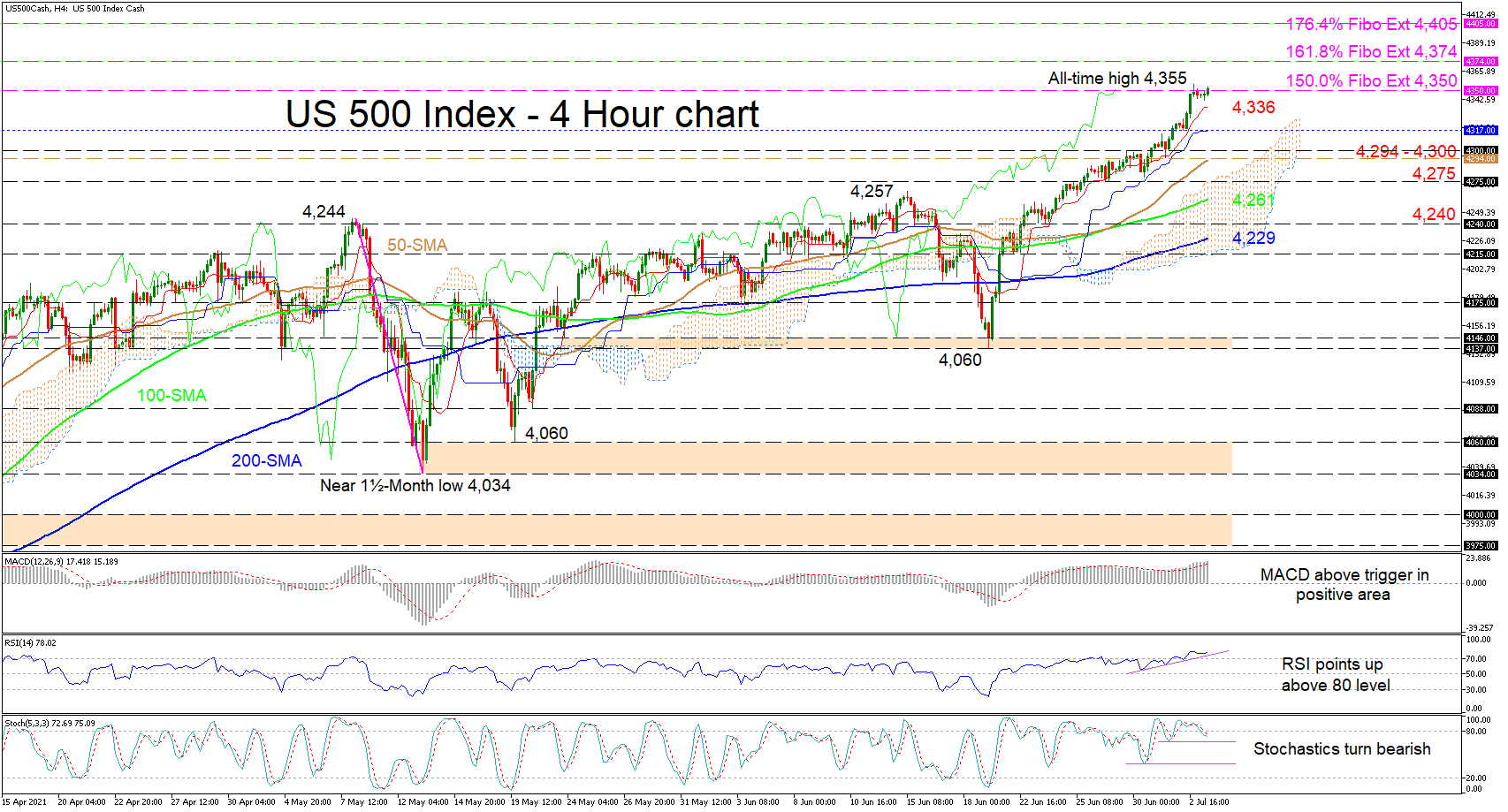
The US 500 stock index (Cash) is consolidating in the vicinity of the 4,350 level, after spiking to a new all-time high of 4,355, the former being the 150.0% Fibonacci extension of the down leg from 4,244 until 4,034. The rising simple moving averages (SMAs) are endorsing the bullish picture, while the Ichimoku lines are mirroring a pause in positive momentum.
The short-term oscillators are currently mixed as the price persists around its highs. The MACD is far above the zero mark and is keeping above its red trigger line, while the RSI is gradually ticking higher in overbought territory. In contrast, the stochastic oscillator has shifted bearish but it remains to be seen whether the negative charge could endure.
If selling interest intensifies, early support could develop at the red Tenkan-sen line at 4,336 and from the 4,317 latest low. If the price retraces below the blue Kijun-sen line, the bears could face a support belt of 4,294-4,300, formed between the 50-period SMA and the 4,300 handle. Should negative pressures gain the upper hand, the price may then be guided to the 4,275 barrier within the Ichimoku cloud. A deeper price pullback may bring the 100-period SMA at 4,261 into play, followed by the June 23 trough of 4,240.
Alternatively, if buyers manage to step above the 150.0% Fibo extension of 4,350 and pilot past the all-time high of 4,355, the 161.8% Fibo extension of 4,374 could become the next resistance target. Should the index remain buoyant, the bulls could be encouraged to navigate towards the 176.4% Fibo extension of 4,405.
In conclusion, the index is sustaining its bullish demeanour above the 4,300 hurdle and the SMAs. As things stand, a break below the June 21 trough of 4,060 would be needed to cause a dent in the positive structure.
New Zealand Dollar Reclaims 70 Level
The New Zealand dollar has started with limited movement. In the North American session, the pair is trading at 0.7020, down 0.10% on the day.
Last week, the New Zealand dollar fell every day until Friday, when the currency rebounded with gains of 0.95%. The sharp upturn was in response to the US unemployment rate, which rose from 5.6% to 5.9%. Nonfarm payrolls came in at 850 thousand, better than the forecast of 700 thousand. Still, the jump in unemployment made the markets uneasy, with growing speculation that the labour market is still not strong enough to push the Fed to tighten policy. This sent the US dollar broadly lower on Friday.
With US companies struggling to find workers, some 15.3 million Americans are receiving unemployment benefits. The shortage in labor supply has led to increased wage and inflation pressures. Wages soared to 3.6% in June YoY, just shy of the estimate of 3.7%, and sharply higher than the May release of 1.9%. Higher wages will mean higher inflation, and that could put pressure on the Fed to tighten monetary policy.
Investors are looking ahead to the FOMC minutes, which will be released on Wednesday. The minutes may provide some guidance as to what steps the Fed may be considering. The jump in US inflation had raised speculation about the Fed tightening policy, but Fed Chair Powell has insisted that the surge in inflation is temporary and will not affect Fed policy. Still, the Fed surprised the markets last month, when it projected raising interest rates twice in 2023. Previously, most Fed members had said that rates would not rise prior to 2024.
New Zealand will release NZIER Business Confidence later on Monday (22:00 GMT). The indicator has posted declines since 2017, but the numbers are getting better. In Q1 of 2020, at the height of Covid, Business Confidence came in at -70. The 2o21 Q1 reading came in -13 and the markets are hoping for a reading closer to zero for the second quarter.
NZD/USD Technical
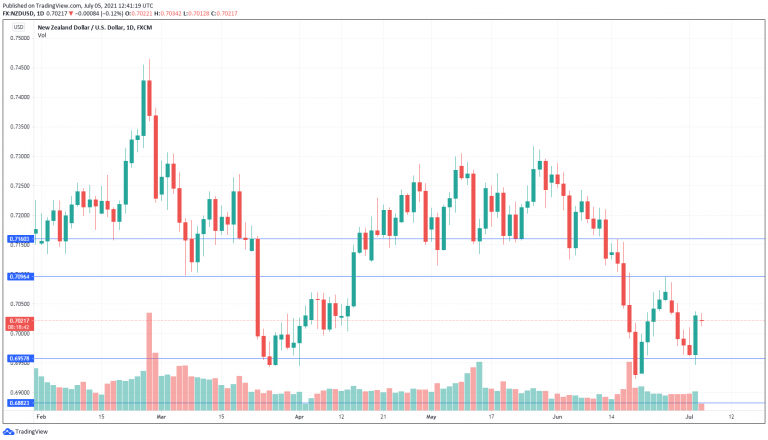
- There is resistance at 0.7096, followed by 0.7160
- On the downside, the pair has support at 0.6957 and 0.6882
USD/JPY Mid-Day Outlook
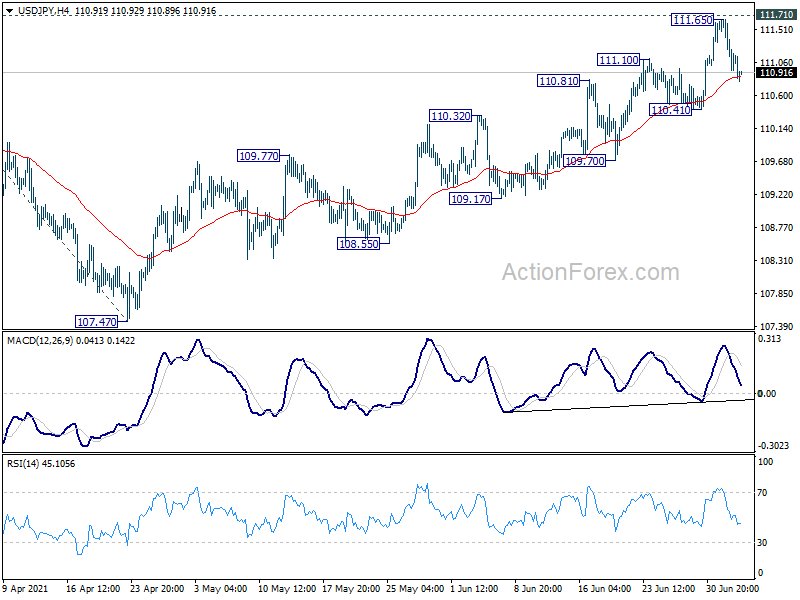
Daily Pivots: (S1) 110.77; (P) 111.21; (R1) 111.48; More...
Outlook in USD/JPY remains unchanged and intraday bias stays neutral first. Another rise is in favor 110.41 support intact. On the upside, sustained break of 111.71 will carry larger implication. Next target is 61.8% projection of 102.58 to 110.95 from 107.47 at 112.64. However, break of 110.41 will indicate short term topping and bring pull back 55 day EMA (now at 109.71).
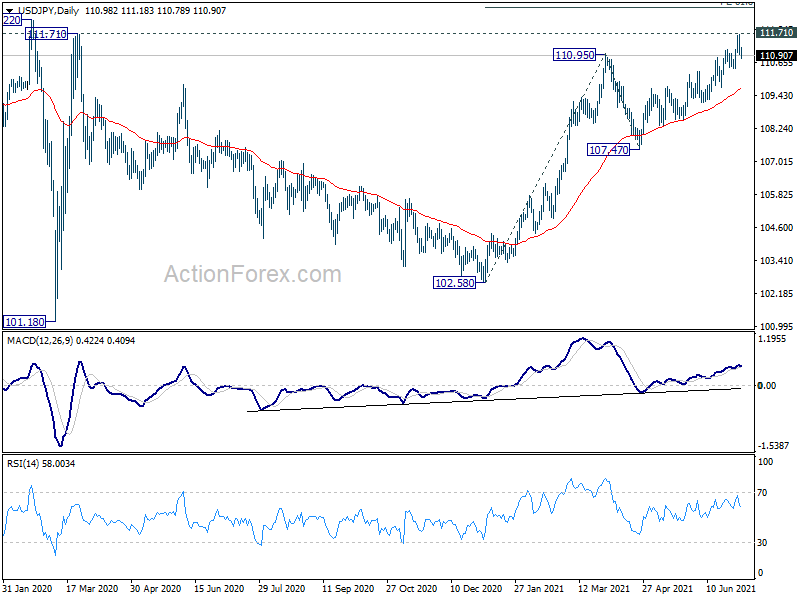
In the bigger picture, medium term outlook is staying neutral with 111.71 resistance intact. Though, as notable support was seen from 55 day EMA, rise from 102.58 is mildly in favor to extend higher. Decisive break of 111.71/112.22 resistance will suggest medium term bullish reversal. Rise from 101.18 could then target 118.65 resistance (Dec 2016) and above. However, sustained break of 55 day EMA would revive some medium term bearishness, and open up deep fall to 61.8% retracement of 102.58 to 110.95 at 105.77 and below.
USD/CHF Mid-Day Outlook
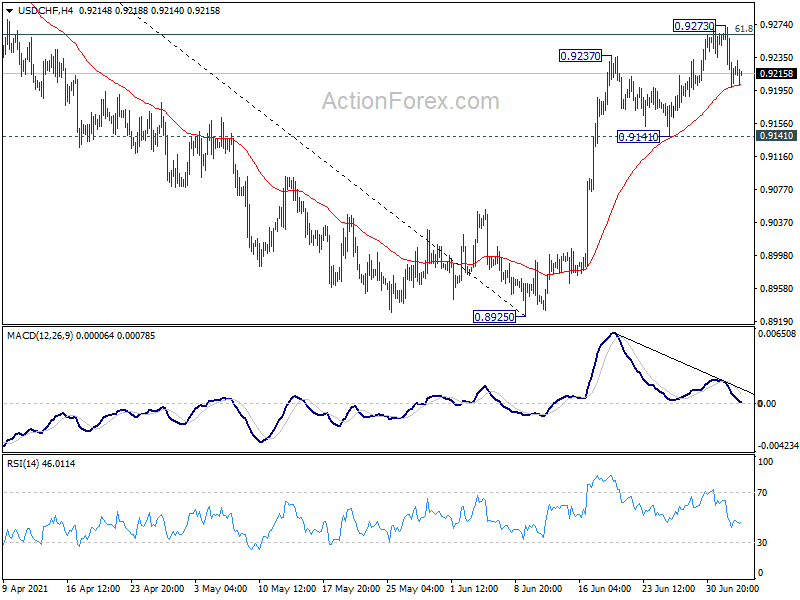
Daily Pivots: (S1) 0.9180; (P) 0.9227; (R1) 0.9255; More....
Outlook in USD/CHF remains neutral at this point and intraday bias stays neutral first. Another rise could still be seen as long as 0.9141 support holds. Break of 0.9273 would pave the way to 0.9471 key resistance next. On the downside, however, break of 0.9141 support will argue that the rebound from 0.8925 has completed, and turn bias back to the downside for this low.
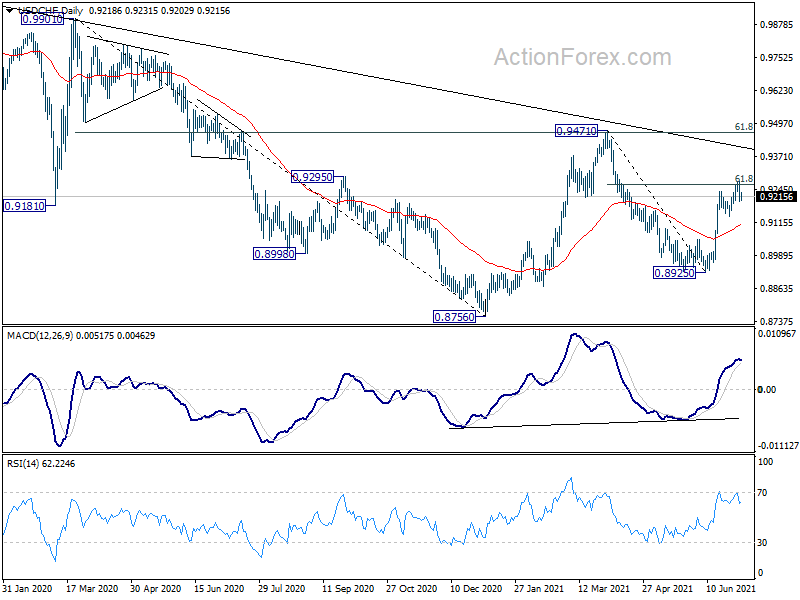
In the bigger picture, medium term outlook is currently neutral with focus on 0.9471 resistance. Sustained break there will indicate completion of whole decline from 1.0342 (2016 high). Medium term outlook will be turned bullish for a test on 1.0342 high. But, rejection by 0.9471 again will revive bearishness for another fall through 0.8756 low.
GBP/USD Mid-Day Outlook
Daily Pivots: (S1) 1.3762; (P) 1.3803; (R1) 1.3874; More....
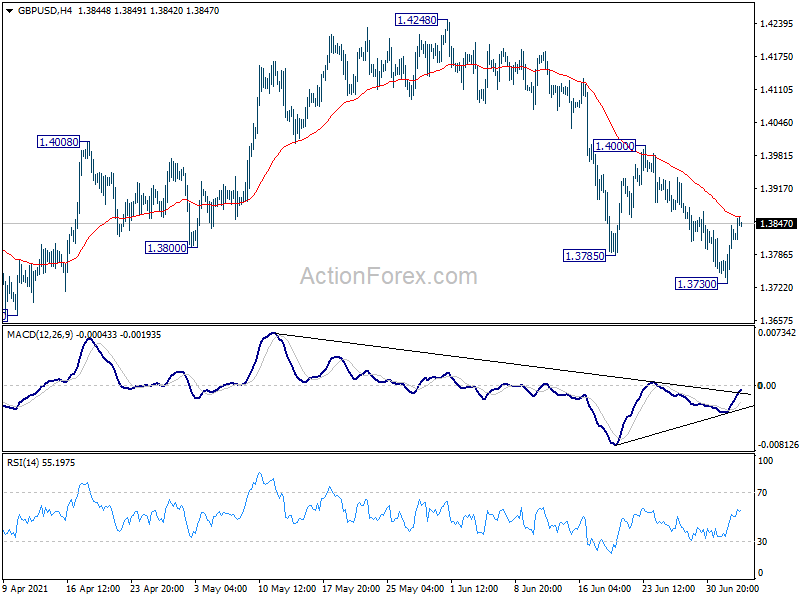
Outlook in GBP/USD remains unchanged and intraday bias stays neutral at this point. Another fall could still be seen with 1.4000 resistance intact. Break of 1.3730 support will resume the fall from 1.4248, as the third leg of the consolidation pattern from 1.4240, to 1.3668 support and possibly below. On the upside, break of 1.4000 will turn bias back to the upside for retesting 1.4240/8 resistance zone instead.
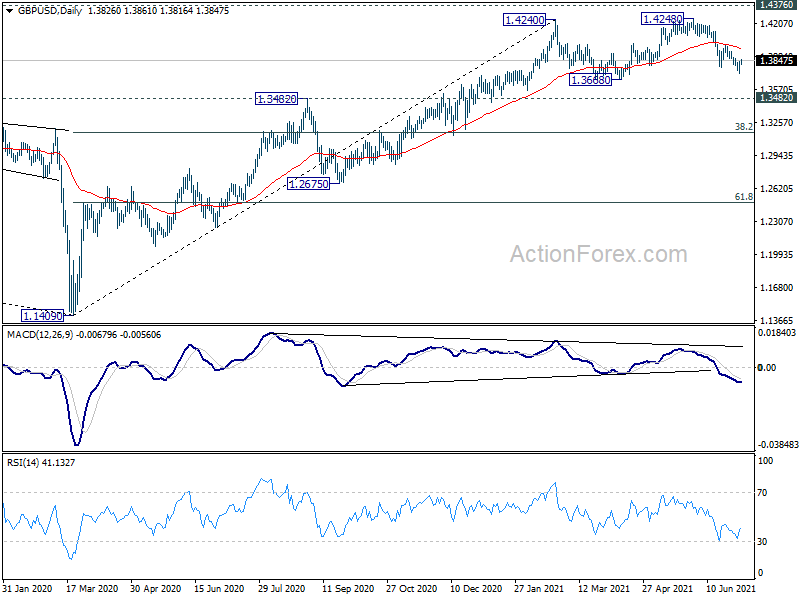
In the bigger picture, as long as 1.3482 resistance turned support holds, up trend from 1.1409 should still continue. Decisive break of 1.4376 resistance will carry larger bullish implications and target 38.2% retracement of 2.1161 (2007 high) to 1.1409 (2020 low) at 1.5134. However, firm break of 1.3482 support will argue that the rise from 1.1409 has completed and bring deeper fall to 1.2675 support and below.
EUR/USD Mid-Day Outlook
Daily Pivots: (S1) 1.1823; (P) 1.1849; (R1) 1.1890; More...
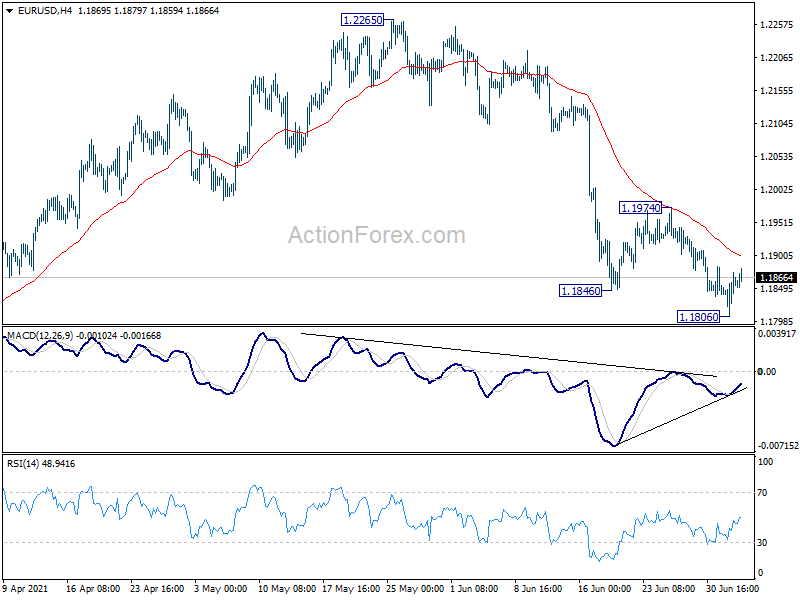
Outlook in EUR/USD remains unchanged and intraday bias stays neutral first. Further fall is expected as long as 1.1974 resistance holds. Break of 1.1806 will resume the decline from 1.2265, as the third leg of the consolidation pattern from 1.2348, to 1.1703 support. On the upside, break of 1.1973 resistance will turn bias back to the upside for 1.2265 resistance.
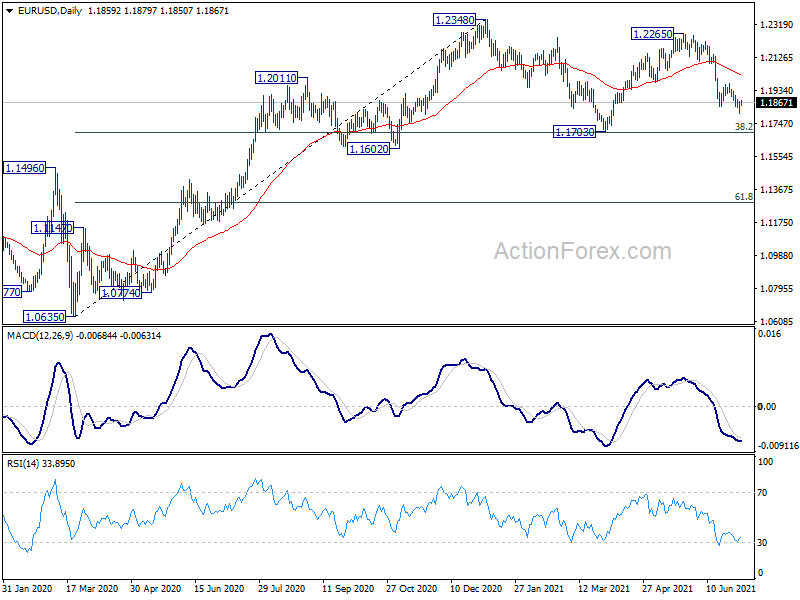
In the bigger picture, rise from 1.0635 is seen as the third leg of the pattern from 1.0339 (2017 low). Further rally could be seen to cluster resistance at 1.2555 next, (38.2% retracement of 1.6039 to 1.0339 at 1.2516). This will remain the favored case as long as 1.1602 support holds. Reaction from 1.2555 should reveal underlying long term momentum in the pair. However sustained break of 1.1602 will argue that the rise from 1.0635 is over, and turn medium term outlook bearish again.
Euro Shrugs Strong Investor Confidence, Markets in Subdued Holiday Trading
Overall, the forex markets are relatively mixed today and trading will probably continue to be subdued with US on holiday. Sterling is currently the stronger one, followed by Yen and Aussie. Canadian is the weakest, followed by Kiwi and then Swiss. Eurozone is mixed despite strong investor sentiment data. But all major pairs and crosses are staying inside Friday's range. Some volatility could finally be seen again, especially in Aussie, with RBA rate decision scheduled in the upcoming Asian session.
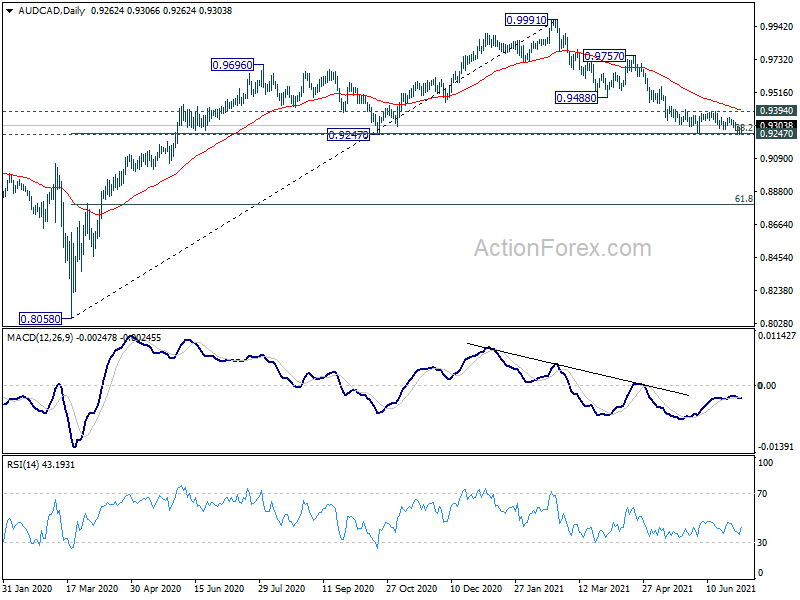
Technically, it looks like AUD/CAD has defended 0.9247 key support again. Further rebound tomorrow, subject to RBA's decision and statement, could pop the cross back towards 0.9394 resistance. Firm break there will complete a double bottoming pattern (0.9258, 0.9245), and turn near term outlook bullish. We'll see if that would happen.
In Europe, at the time of writing, FTSE is up 0.52%. DAX is up 0.05%. CAC is up 0.35%. Germany 10-year yield is up 0.0232 at -0.211. Earlier in Asia, Nikkei dropped -0.64%. Hong Kong HSI dropped -0.59%. China Shanghai SSE rose 0.44%. Singapore Strait Times rose 0.39%. Japan 10-year JGB yield dropped -0.0104 to 0.036.
Eurozone Sentix investor confidence rose to 29.8, but expectations dropped
Eurozone Sentix Investor Confidence rose to 29.8 in July, up from 28.1, but missed expectation of 30.2. Nonetheless, it's still the 5th increase in a row, and highest since February 2018. Current situation index rose from 21.3 to 29.8, 5th increase in a row, and highest since October 2018. Expectations index, however, dropped from 35.3 to 29.8, lowest since December 2020.
Sentix said, "the result is impressive" but, "we are approaching a certain point of maximum momentum in the short term" as expectations dropped. "For the economy as a whole, this is not yet a worrying decline. For the equity markets, on the other hand, which are very much focused on investor expectations, this development could contribute to increased market volatility."
It added, "in this environment, the ECB remains in focus. So far, there is no sign of a turn away from the expansive monetary policy. However, the inflation barometer, which remains clearly in negative territory at -38.25, underscores the danger of further rising inflation rates in a globally increasingly synchronised, strong economic upswing."
Eurozone PMI composite reached 16-yr high, recovery stepped up a gear, but inflationary pressures ratcheted higher
Eurozone PMI Services was finalized at 58.3 in June, up from May's 55.2. PMI Composite was finalized at 59.5, up from May's 57.1. That's also the highest level in 15 years since June 2006. Looking at some member states, Ireland PMI composite dipped to 2 month low at 63.4. Spain hit 256-month high at 62.4. Germany hit 123-month high at 60.1. Italy reached 41-month high at 58.3. France also reached 41-month high at 57.4.
Chris Williamson, Chief Business Economist at IHS Markit said: "Europe's economic recovery stepped up a gear in June, but inflationary pressures have also ratcheted higher… A wave of optimism that the worst of the pandemic is behind us has meanwhile propelled firms' expectations of growth to the highest for 21 years, boding well for the upturn to gain further strength in coming months.
"Firms are increasingly struggling to meet surging demand, however, in part due to labour supply shortages, meaning greater pricing power and underscoring how the recent rise in inflationary pressures is by no means confined to the manufacturing sector. Service sector companies are hiking their prices at the steepest pace for over 20 years as costs spike higher, accompanying a similar jump in manufacturing prices to signal a broad-based increase in inflationary pressures."
UK PMI services finalized at 62.4, composite at 62.2
UK PMI Services was finalized at 62.4 in June, down slightly from May's 62.9. That's still the second-highest reading since October 2013. PMI Composite dropped to 62.2, down from 62.9. That's also the second-highest reading since January 1998.
Tim Moore, Economics Director at IHS Markit: "The service sector recovery remained in full swing during June as looser pandemic restrictions released pent up demand for business and consumer services. Sales growth eased slightly from May's recent peak, but capacity constraints and staff shortages meant that many service providers struggled to keep up with new orders…
"The latest survey data highlighted survey-record rates of input cost and prices charged inflation across the service sector, reflecting higher commodity prices, transport shortages and staff wages. Imbalanced supply and demand was the main driver, while the roll-back of pandemic discounting by some service providers amplified the latest round of price hikes."
BoJ upgraded economic assessment of 2 regions, downgraded 2, kept 5 unchanged
In the Regional Economic Report, BoJ upgraded economic assessment of 2 regions (Hokuriku and Kinki), downgraded 2 regions (Chugoku and Shikoku), and kept 5 regions unchanged (Hokkaido, Tohoku, Kanto-Koshinetse, Tokaiand Kyshu-Okinawa).
It added: "while they reported that their economy had remained in a severe situation due to the impact of the novel coronavirus (COVID-19) — with some reporting that it had seen a slowdown in the pace of its pick-up — many reported that it had picked up as a trend or had started to pick up."
Governor Haruhiko Kuroda told branch managers, "Japan's economy remains in a severe state but is picking up as a trend… As the pandemic's impact gradually eases, the economy will recover thanks to increasing external demand, loose monetary policy and the effect of government stimulus measures."
Australia retail sales rose 0.4% mom in May, impacted by Victorian lockdown
Australia retail sales rose 0.4% mom, 7.7% yoy in May. That's an upward revision to preliminary result of 0.1% mom rise.
Ben James, Director of Quarterly Economy Wide Surveys, said: "The main themes from the Retail Trade Preliminary release remain relevant for the Final release. Retail turnover in May was impacted by the Victorian lockdown from May 28 onwards, as well as those states recovering from restrictions in April."
Australia AiG construction dropped to 55.5, facing capacity constraints
Australia AiG Performance of Construction dropped -2.8 pts to 55.5 in June. Current activity dropped -0.9 to 54.8. Employment dropped -6.1 to 58.3. New orders rose 0.9 to 56.1. Supplier deliveries dropped -8.5 to 50.9. Input prices rose 2.5 to 98.3. Selling prices rose 7.0 to 85.2. Average wages rose 5.4 to 70.4.
Ai Group Head of Policy, Peter Burn, said: "Australia's construction industry continued its run of strong growth in June but the pace of expansion is slipping as it faces capacity constraints and rising input prices."
Also released, building permits dropped -7.1% mom in May, versus expectation of -5.0% mom.
China Caixin PMI services dropped to 50.3, PMI composite dropped to 50.6
China Caixin PMI Services dropped to 50.3 in June, down from 55.1, well below expectation of 55.7. There were the softest increase in activity and new work for 14-months. Staff numbers fell as capacity pressured eased. Rates of input cost and output charge inflation slowed notably. PMI Composite dropped to 50.6, down from 53.8, worst in 14-month.
Wang Zhe, Senior Economist at Caixin Insight Group said: "Overall, activity in both the manufacturing and services sector continued to expand. However, impacted by the resurgence of the virus in some regions in China, the services sector was weaker than the manufacturing sector, both in terms of market supply and demand or employment."
EUR/USD Mid-Day Outlook
Daily Pivots: (S1) 1.1823; (P) 1.1849; (R1) 1.1890; More...
Outlook in EUR/USD remains unchanged and intraday bias stays neutral first. Further fall is expected as long as 1.1974 resistance holds. Break of 1.1806 will resume the decline from 1.2265, as the third leg of the consolidation pattern from 1.2348, to 1.1703 support. On the upside, break of 1.1973 resistance will turn bias back to the upside for 1.2265 resistance.
In the bigger picture, rise from 1.0635 is seen as the third leg of the pattern from 1.0339 (2017 low). Further rally could be seen to cluster resistance at 1.2555 next, (38.2% retracement of 1.6039 to 1.0339 at 1.2516). This will remain the favored case as long as 1.1602 support holds. Reaction from 1.2555 should reveal underlying long term momentum in the pair. However sustained break of 1.1602 will argue that the rise from 1.0635 is over, and turn medium term outlook bearish again.
Economic Indicators Update
| GMT | Ccy | Events | Actual | Forecast | Previous | Revised |
|---|---|---|---|---|---|---|
| 22:30 | AUD | AiG Performance of Construction Index Jun | 55.5 | 58.3 | ||
| 1:30 | AUD | Retail Sales M/M May | 0.40% | 0.10% | 0.10% | |
| 1:30 | AUD | Building Permits M/M May | -7.10% | -5.00% | -8.60% | -5.70% |
| 1:45 | CNY | Caixin Services PMI Jun | 50.3 | 55.7 | 55.1 | |
| 7:45 | EUR | Italy Services PMI Jun | 56.7 | 56 | 53.1 | |
| 7:50 | EUR | France Services PMI Jun F | 57.8 | 57.4 | 57.4 | |
| 7:55 | EUR | Germany Services PMI Jun F | 57.5 | 58.1 | 58.1 | |
| 8:00 | EUR | Eurozone Services PMI Jun F | 58.3 | 58 | 58 | |
| 8:30 | EUR | Eurozone Sentix Investor Confidence Jul | 29.8 | 30.2 | 28.1 | |
| 8:30 | GBP | Services PMI Jun F | 62.4 | 61.7 | 61.7 | |
| 14:30 | CAD | BoC Business Outlook Survey |