

Sample Category Title
GBP/USD Analysis: Potential Target At 1.3940
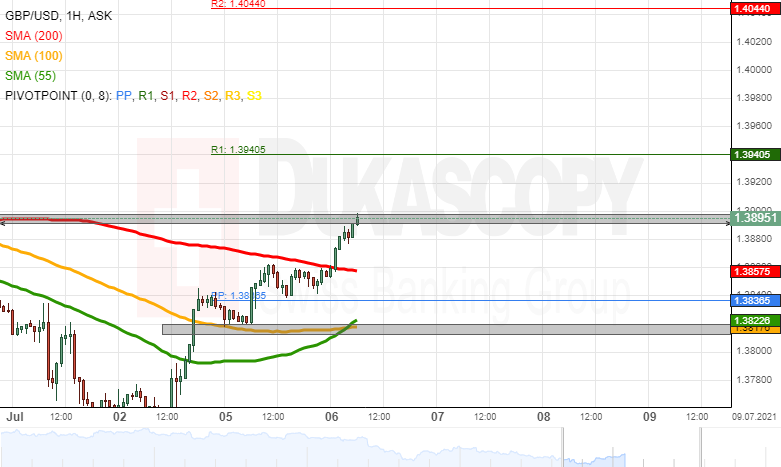
The British Pound edged higher by 43 pips or 0.31% against the US Dollar on Monday. The currency pair breached the 200– hour simple moving average at 1.3859 during Monday's trading session.
Given that the 55-, 100– and 200– hour SMAs are below the current price level, bullish traders are likely to continue to pressure the exchange rate higher during the following trading session. The potential target for the GBP/USD pair will be near the weekly R1 at 1.3940.
However, buyers could encounter resistance at the 1.3900 area within the following trading session.
USD/JPY Analysis: Decline Likely To Continue
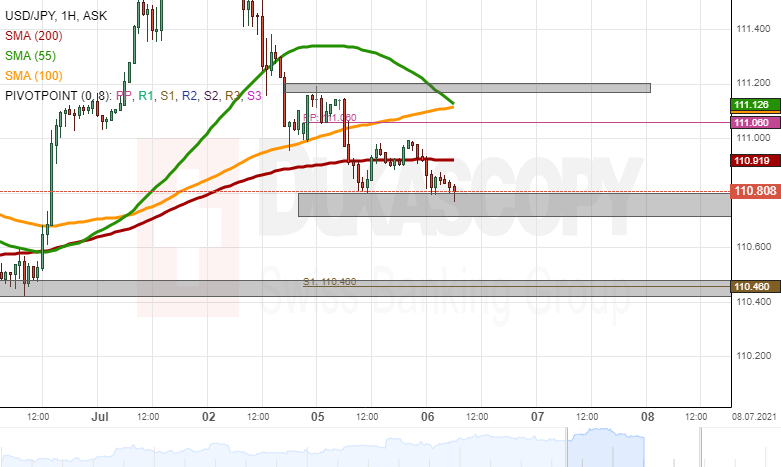
The US Dollar declined by 35 pips or 0.31% against the Japanese Yen on Monday. The currency pair breached the 55-, 100– and 200– hour SMAs during yesterday's trading session.
All things being equal, the exchange rate is likely to continue to edge lower during the following trading session. The potential target for the USD/JPY pair will be near the weekly support level at 110.46.
On the other hand, the currency exchange rate might reverse from the support line at 110.80 and aim at the 55– hour simple moving average at 111.17 within this session.
EUR/AUD Daily Outlook
Daily Pivots: (S1) 1.5742; (P) 1.5764; (R1) 1.5779; More...
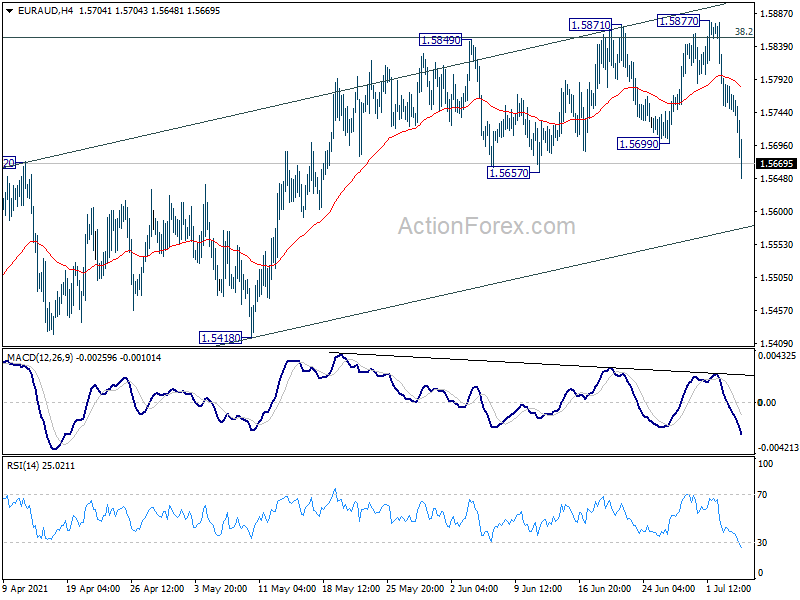
EUR/AUD's break of 1.5699 support suggests rejection by 38.2% retracement of 1.6827 to 1.5250 at 1.5852. Intraday bias is back on the downside for 1.5418 support first. Break there should confirm completion of consolidation pattern from 1.5250, and bring retest of this low. For now, risk will stay on the downside as long as 1.5877 resistance holds, in case of recovery.
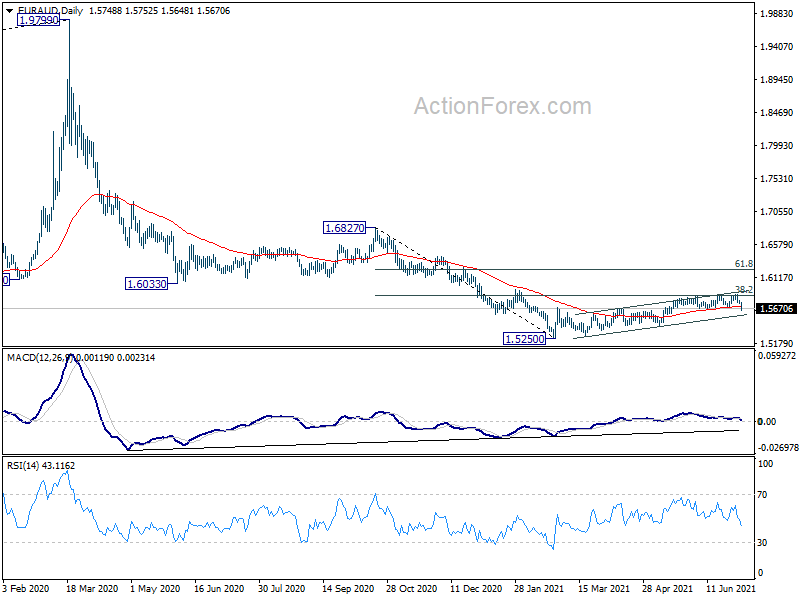
In the bigger picture, price actions from 1.9799 are developing into a deep correction, to long term up trend from 1.1602 (2012 low). Deeper fall would be seen to 61.8% retracement of 1.1602 to 1.9799 at 1.4733. Medium term outlook will remain bearish as long as 1.6033 support turned resistance holds, even in case of strong rebound. However, firm break of 1.6033 will argue that such decline has completed, and turn focus to 1.6827 structural resistance for confirmation.
EUR/CHF Daily Outlook
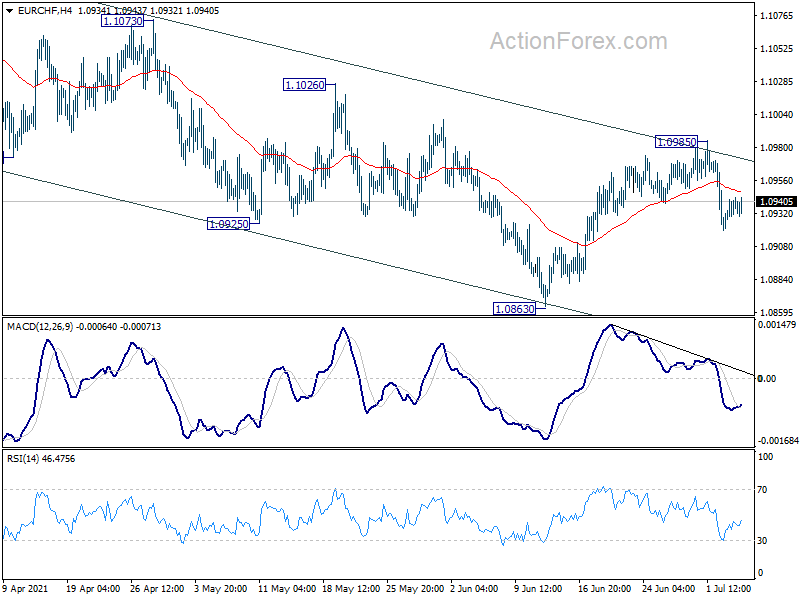
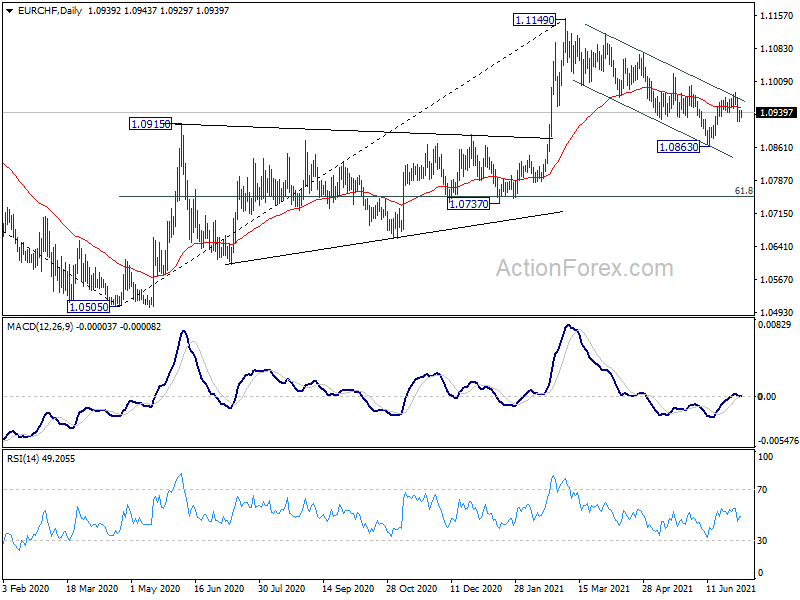
Daily Pivots: (S1) 1.0928; (P) 1.0938; (R1) 1.0951; More....
Intraday bias in EUR/CHF stays mildly on the downside for the moment. Rebound from 1.0863 could have completed at 1.0985, after rejection by medium term channel resistance. Deeper fall would be seen to 1.0863 support first. Break there will resume whole decline from 1.1149 to 1.0737 cluster support zone. For now, risk will be on the downside as long as 1.0985 holds.
In the bigger picture, current development argues that rebound from 1.0505 (2020 low) might be completed at 1.1149 already. Rejection by 55 month EMA (now at 1.1074) at least keeps medium term bearishness open. Sustained break of 1.0737 cluster support (61.8% retracement of 1.0505 to 1.1149 at 1.0751) will argue that the down trend from 2004 (2018 high) is ready to resume through 1.0505 low. Sustained trading below 55 week EMA (now at 1.0885) will affirm this bearish case. Nevertheless, strong support from 55 week EMA will revive the case for resuming the rise from 1.0505 at a later stage.
XAU/USD Analysis: Likely To Maintain Channel
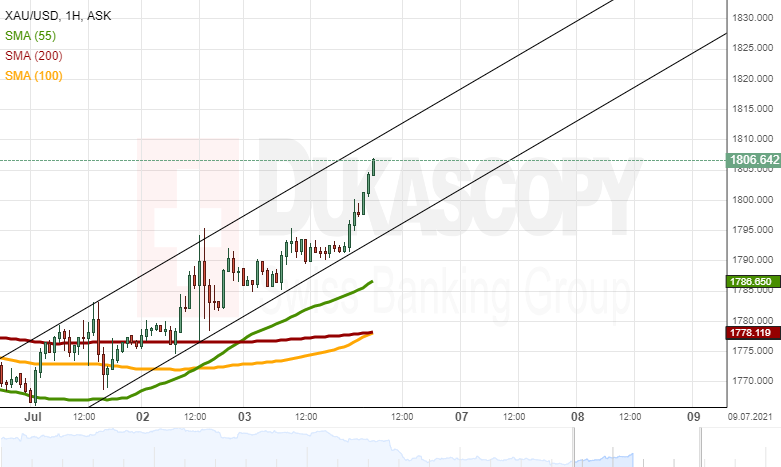
The XAU/USD exchange rate has been trading in a narrow ascending channel pattern since June 30. The yellow metal surged by 100 points during Monday's trading session.
Everything being equal, the commodity is likely to continue to edge higher in the narrow ascending channel pattern within this session. The possible target for buyers will be near the 1810.00 area.
However, technical indicators suggest that gold might edge lower during the following trading session.
EURJPY Rebounds On Uptrend Line, Remains Bullish
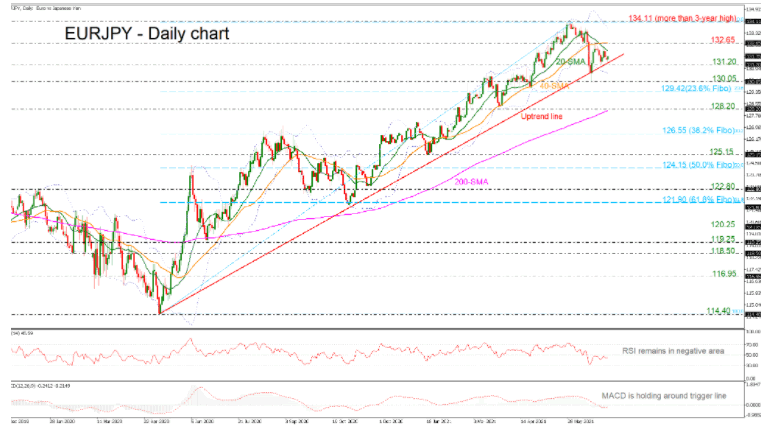
EURJPY has found significant support near the ascending trend line over the last sessions, failing to confirm the negative structure. However, the pair is still developing underneath the bearish cross within the 20- and 40-day simple moving averages (SMAs) and the 132.65 resistance. The RSI indicator is heading marginally up below the 50 level, while the MACD is sliding beneath its trigger and zero lines.
If the price stays above the rising line and breaks through the 132.65 support level, immediate resistance could come from the upper Bollinger band around 133.67, just ahead of the more than three-year high of 134.11. With a push higher, the bulls might reclaim the lead and test the 137.50 level, registered in January 2018.
A drop below the uptrend line and 131.20, might push the market towards the 130.05 support level before falling to 129.42, the 23.6% Fibonacci retracement level of the up leg from 114.40 to 134.11. The 200-day SMA, which coincides with the 128.20 support, may act as a halt to the bearish trend below that level.
Overall, EURJPY has been rising since May 2020, and only a drop below the diagonal line and the 200-day SMA could change the picture to neutral.
The Aussie Dollar Overcame Knee-Jerk Weakness To Trade At AUD/USD 0.757
Markets
We’ll be brief about yesterday since data was scant and the US was closed in observance of Independence Day. European equity markets started the week cautious following a mixed Asian session, slumping about 0.65% in the open (SX5E). Sentiment turned for the better soon though and stocks eventually managed to leave the red behind. European/German yield curves bear steepened, adding 2.5bps at the long end. The German 10y yield still finished sub -0.20% support though. The dollar traded in a tight sideways range. EUR/USD closed unchanged around 1.186. USD/JPY struggled to hold 111. The British pound was better bid against most major peers, perhaps eying the final stage of the economic reopening as announced by Johnson. The British PM said the remaining capacity curbs and social distancing are expected to end July 19. EUR/GBP drifted further south of 0.86 (close 0.857).
Asian stocks lack guidance from the US as well, trading without a clear direction. China underperforms for a second day. The RBA kept the policy and 10y target rate stable at 0.1% and extended its bond buying program (see headline below). The Aussie dollar overcame knee-jerk weakness to trade at AUD/USD 0.757. The kiwi dollar is doing particularly well amid rising bets on a rate hike already this year. NZD/USD takes a leap to 0.709. The USD generally trades a tad weaker, as seen in EUR/USD and USD/JPY too. The former inches higher to 1.879, the latter eases towards 110.82. US yields get a 2 to 2.5bps bump in the first cash trading of the week. The move is partially driven by higher oil prices as OPEC+ failed to smooth things out with the UAE. There’s no deal, meaning the discussed 400k barrels a day production increase from August onwards won’t materialize, triggering fears of squeezing an already tight market. There’s no new round of discussions planned. Brent oil gapped beyond $77 per barrel.
The calendar isn’t particularly well filled today either but we do keep an eye on the (delayed) US services ISM (June). Consensus expects a marginal easing from 64 to 63.5. Risks are slightly tilted to the downside given the historic highs the indicator is at and effects of the reopening maybe starting to fade in the US. At levels still north of 60 (for example), there’s absolutely no reason for worry of course. If anything, a disappointing but very solid reading could be viewed as the perfect Goldilocks scenario with a topping out of the data easing normalization pressure on the Fed but still suggesting nice growth going forward. In a daily perspective, US yields could shed a few bps with the long end of the curve looking most vulnerable. First support in the 10y yield situates around 1.4%. EUR/USD 1.1916 is the first resistance that could get attacked in case of dollar weakening. Sterling enjoys the ST momentum but resistance in EUR/GBP at 8.8472 isn’t easy to take out as long as the BoE sticks to its wait-and-see approach.
News headlines
The Reserve Bank of Australia this morning left its policy rate unchanged. The RBA maintained the April 2024 government as the reference for its 3-y yield target. The bank will continue to buy government bonds after the completion of the current program early September. Purchases will run at a rate of A$ 4 bln per week at least until November when the RBA will make a new assessment. The economy recovers faster than expected and employment improves significantly as more Australians now have a job compared to before the pandemic. Even so, the RBA intends to keep the cash rate at current level until the economy has returned to the full employment and until actual inflation will sustainably return to the 2-3% target. The RBA doesn’t expect that to happen before 2024.
A quarterly survey of the New Zealand Economic Institute of Economic Research (NZIER) indicated a sharp improvement in sentiment among businesses. 10% now expect business conditions to improve while 8% expected a decline at the previous quarterly survey. Firms also reported a further tightening of labour market conditions with difficulties to hire skilled workers. NZIER measured capacity utilization to have risen to 94.9% from 93.9%. It also indicates that capacity constrains point to rising inflation. The 2-y New Zealand government bond yield rose 9 bp to 0.825 this morning as market bring forward expectations for a first RBNZ rate hike. The 10-y rose 4.5 bp to 1.825. The Kiwi dollar jumped form the NZD/USD 0.70.20 area to currently trade near 0.7080.
Daily Tecnical Analysis
EUR/USD
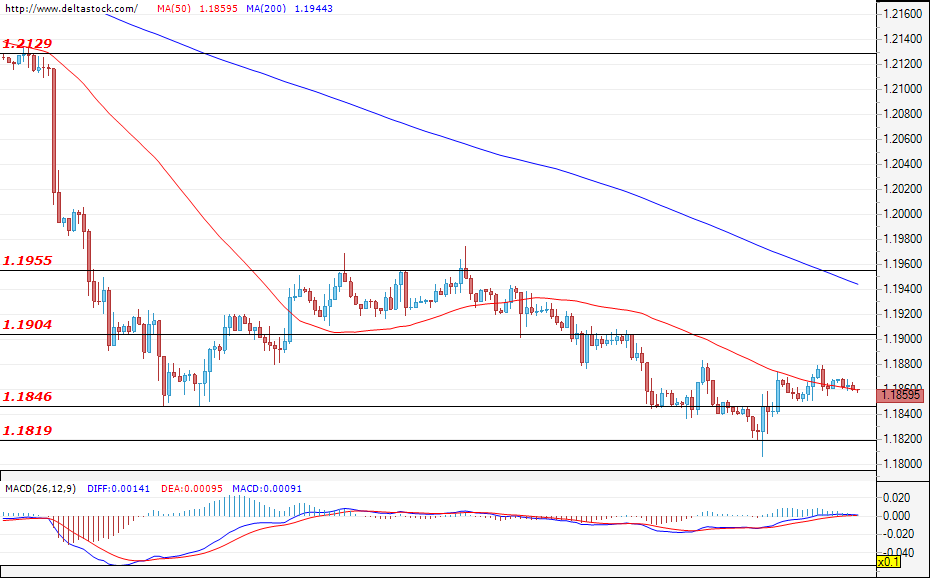
Current level - 1.1859
During yesterday's trading session, the pair managed to stay above the support level of 1.1846, which is a bullish signal and the forecasts are for the EUR/USD to rise and test the resistance level of 1.1904. In the negative direction, the first support is found at the previously mentioned level of 1.1846. Today, investors' attention will be focused on the announcement of the ISM non-manufacturing data for the U.S. (13:45 GMT).
| Resistance | Support | ||
| intraday | intraweek | intraday | intraweek |
| 1.1900 | 1.2130 | 1.1850 | 1.1760 |
| 1.1955 | 1.2237 | 1.1760 | 1.1690 |
USD/JPY
Current level - 110.85
In the first trading session for the week, the currency pair breached the support level of 111.02 and it is expected to enter a consolidation phase, limited by the important support level of 110.43. In the positive direction, the first resistance is found at the level of 111.02.
| Resistance | Support | ||
| intraday | intraweek | intraday | intraweek |
| 111.02 | 112.60 | 110.74 | 110.43 |
| 111.60 | 113.60 | 110.43 | 109.80 |

GBP/USD
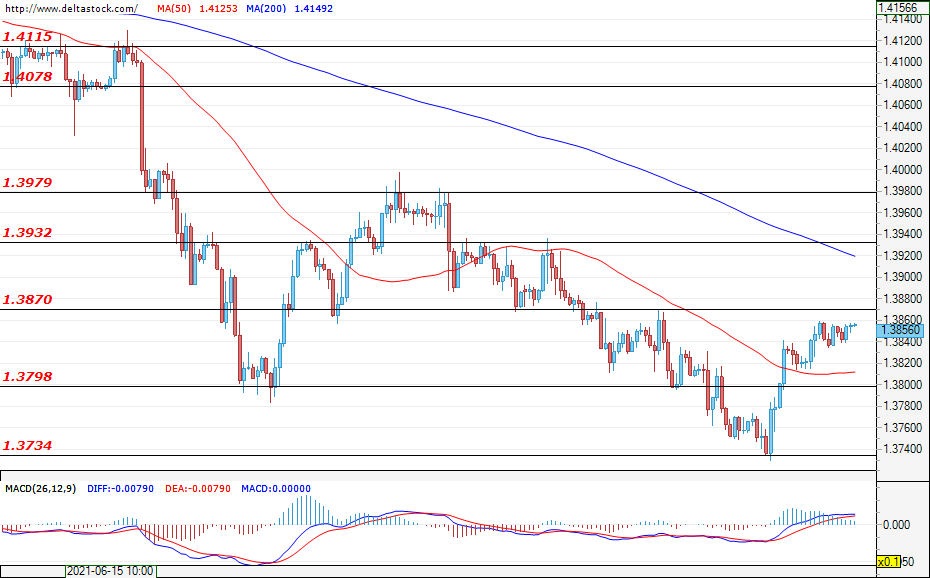
Current level - 1.3856
The sterling continues to appreciate against the dollar and, at the time of writing, the currency pair is confirming the breach of the level at 1.3870, which is the main resistance. If confirmed, the breach would lead the pair towards a test of the next levels of 1.3932 and 1.3979. In the negative direction, the first support lies at the level of 1.3798. Today, the PMI construction data for the UK (07:30 GMT) could lead to a rise in volatility.
| Resistance | Support | ||
| intraday | intraweek | intraday | intraweek |
| 1.3870 | 1.3980 | 1.3800 | 1.3660 |
| 1.3932 | 1.4078 | 1.3730 | 1.3610 |
USDCHF Ready To Drop
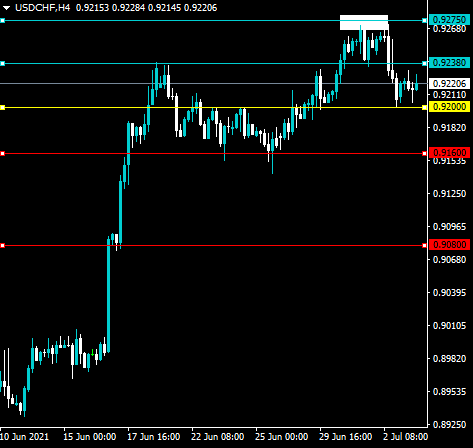
The Swiss franc currency could be preparing to drop against the US dollar as the pair looks to be forming a large bearish price pattern. The four-hour time frame shows that a head and shoulders pattern will form if the USDCHF pair drop towards the 0.9160 area. As long as the price trades under the 0.9275 level this week then a bearish reversal seems the most likely scenario.
The USDCHF pair is only bullish while trading above the 0.9200 level, key resistance is found at the 0.9238 and 0.9275 levels.
The USDCHF pair is only bearish while trading below the 0.9200 level, key support is found at the 0.9160 and 0.9080 levels.
RBA to Begin QE Tapering in September
As widely anticipated, the RBA announced some changes in the monetary policy. The overall tone of the meeting and the policy statement is upbeat about the economic recovery while cautious over the uncertainty and subdued inflation.
Policymakers remain optimistic over economic developments. As noted in the meeting, “the outlook for investment has improved and household and business balance sheets are generally in good shape”. While cautioning that “one near-term uncertainty is the effect of the recent virus outbreaks and the lockdowns”, they noted that “the experience to date has been that once outbreaks are contained and restrictions are eased, the economy bounces back quickly”. The central bank also highlighted the fall in the unemployment and suggested that “job vacancies are high and more firms are reporting shortages of labour, particularly in areas affected by the closure of Australia's international borders”.
Despite the optimism, the members remain concerned about subdued wage outcomes. They expect that any improvement would be "only gradual and modest”. The central bank forecast that core underlying inflation is forecast would be “1.5% over 2021 and 2% by mid- 2023”.
Several tweaks are made in the current monetary policy. Policymakers decided to April 2024’s bonds as the ones for the yield target at the target of 0.1%. Last month, they hinted an extension November 2024’s bonds. The current tranche of QE purchases will continue as scheduled – until early September. After that, purchases will be made at a weekly pace of AUD4B until at least mid November.
Policymakers explained the rationales of the tweaks. As noted in the policy statement, policymakers noted that QE is “playing an important role in supporting the Australian economy” and the RBA would “continue to purchase bonds given that we remain some distance from the inflation and employment objectives”. However, “stronger-than-expected economic recovery and the improved outlook” suggest that a slow pace of asset purchases is warranted. The central bank has also pledged to review the new approach in November, so that “the board to respond to the state of the economy at that time”.
The cash rate stays unchanged at 0.1% and policymakers reiterated the forward guidance that no rate hike is likely until 2024.