

Sample Category Title
GBP/USD Mid-Day Outlook
Daily Pivots: (S1) 1.3822; (P) 1.3842; (R1) 1.3866; More....
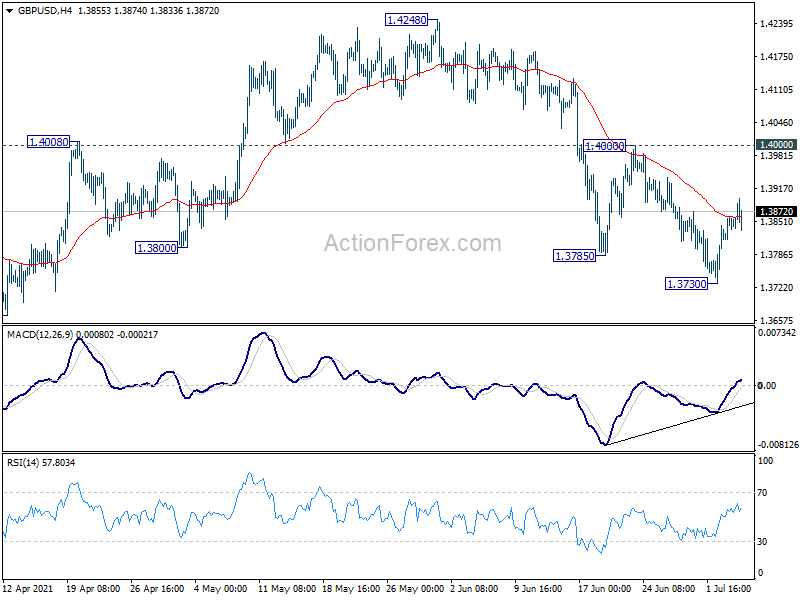
Intraday bias in GBP/USD remains neutral at this point. On the upside, break of 1.4000 resistance will argue that fall from 1.4248 has completed. Intraday bias will be turned back to the upside for retesting 1.4240/8 resistance zone. On the downside, break of 1.3730 support will resume the fall from 1.4248, as the third leg of the consolidation pattern from 1.4240, to 1.3668 support and possibly below.
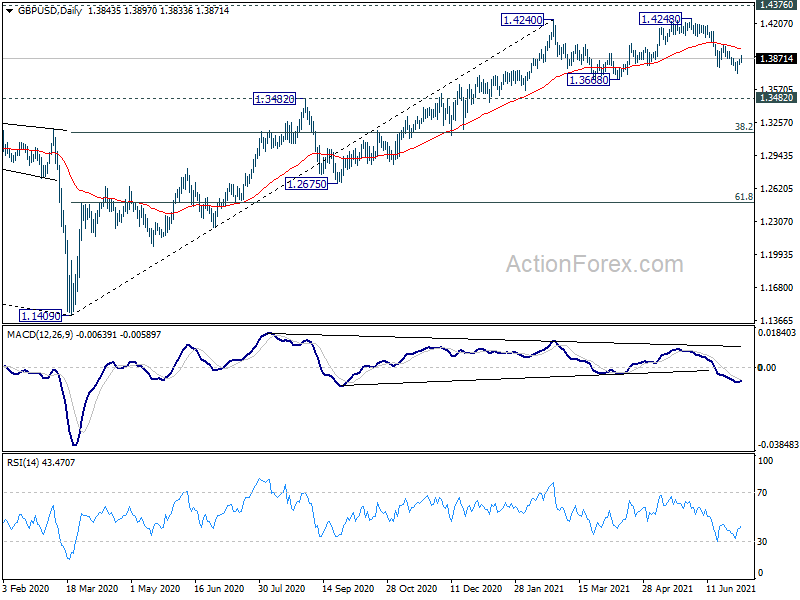
In the bigger picture, as long as 1.3482 resistance turned support holds, up trend from 1.1409 should still continue. Decisive break of 1.4376 resistance will carry larger bullish implications and target 38.2% retracement of 2.1161 (2007 high) to 1.1409 (2020 low) at 1.5134. However, firm break of 1.3482 support will argue that the rise from 1.1409 has completed and bring deeper fall to 1.2675 support and below.
Euro Edges Lower on Weak German Data
The euro is slightly lower in the Tuesday session. In European trade, EUR/USD is trading at 1.1840, down 0.20% on the day.
German numbers disappoint
It has been a rough day for German releases, which have badly underperformed. Factory Orders for May fell -3.7%, down from 1.2% in April, and well below the consensus of 1.0%. The reading was the sharpest decline since the first lockdown last summer and reflects the ongoing issue of global supply chain shortages. Supply bottlenecks have been hampering the manufacturing sector, which has seen demand surge as the recovery gains traction.
This was followed by German ZEW Economic Expectations, which slowed for a second straight month. The July report dropped to 63.3, down sharply from 79.8 and shy of the forecast of 75.3 points. Despite this drop, the ZEW report was very optimistic about economic conditions in the next 6 months, noting that the indicator remains at a high level. Still, the fact remains that this is the lowest level in six months, and another drop could raise concerns about the health of the Eurozone’s largest economy.
On the consumer front, there was positive news in the eurozone. Retail Sales for May MoM rebounded with a strong gain of 4.6%, after a decline of -3.9% in April. The reading was ahead of the consensus of 4.4% and points to pent-up demand being unleashed as economies reopen.
Attention will now shift to the US, which releases ISM non-manufacturing PMI later today (14:00 GMT). The sector continues to show strong growth, with readings above the 60-level for the past three months. The forecast stands at 63.5, slightly below the previous reading of 64.0 points.
EUR/USD Technical
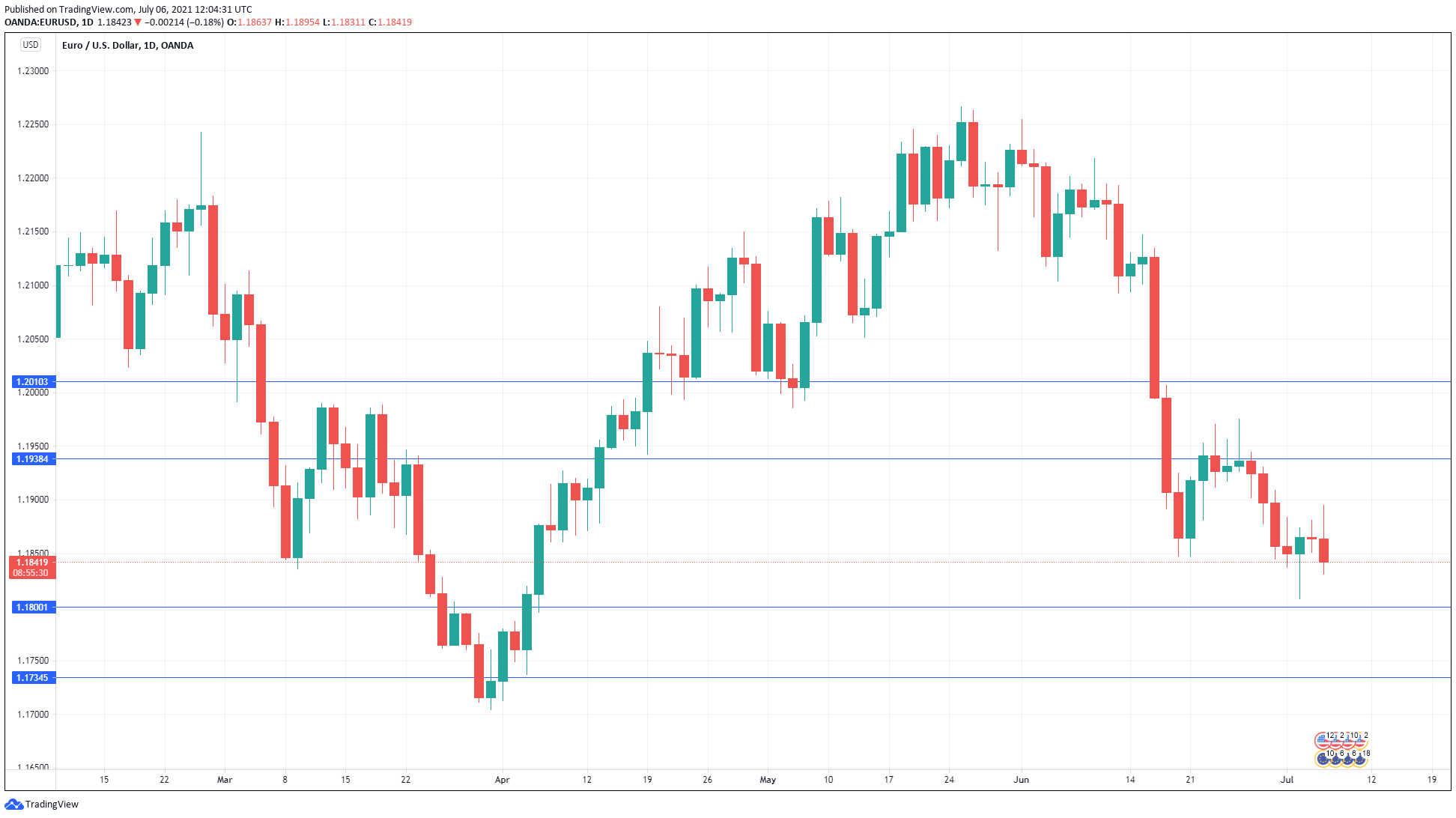
- EUR/USD has support at 1.1800, which has held since April. Below, there is support at 1.1734
- There is resistance at 1.1938 and 1.2010
EUR/USD Mid-Day Outlook
Daily Pivots: (S1) 1.1849; (P) 1.1865; (R1) 1.1878; More...
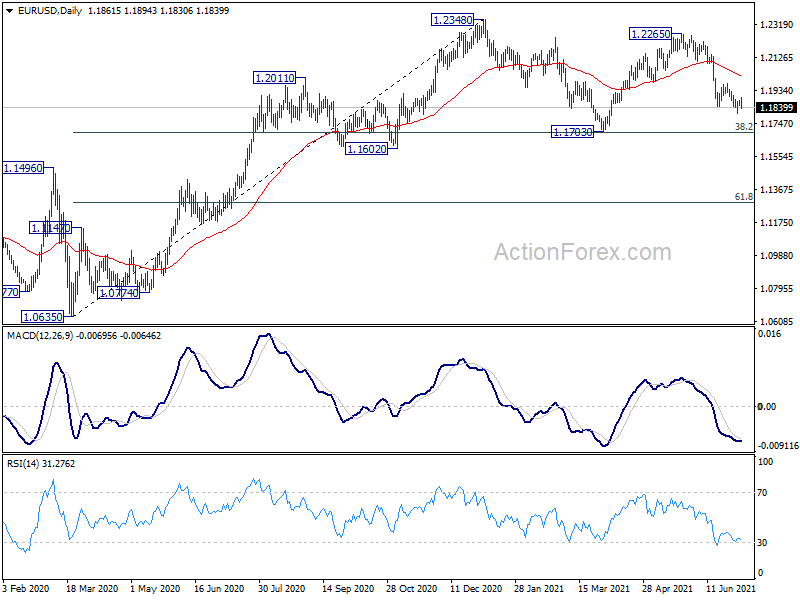
EUR/USD was rejected by 4 hour 55 EMA but stays above 1.1806 temporary low. Intraday bias remains neutral first. Further fall is still in favor as long as 1.1974 resistance holds. Break of 1.1806 will resume the decline from 1.2265, as the third leg of the consolidation pattern from 1.2348, to 1.1703 support. On the upside, break of 1.1974 resistance will turn bias back to the upside for 1.2265 resistance.
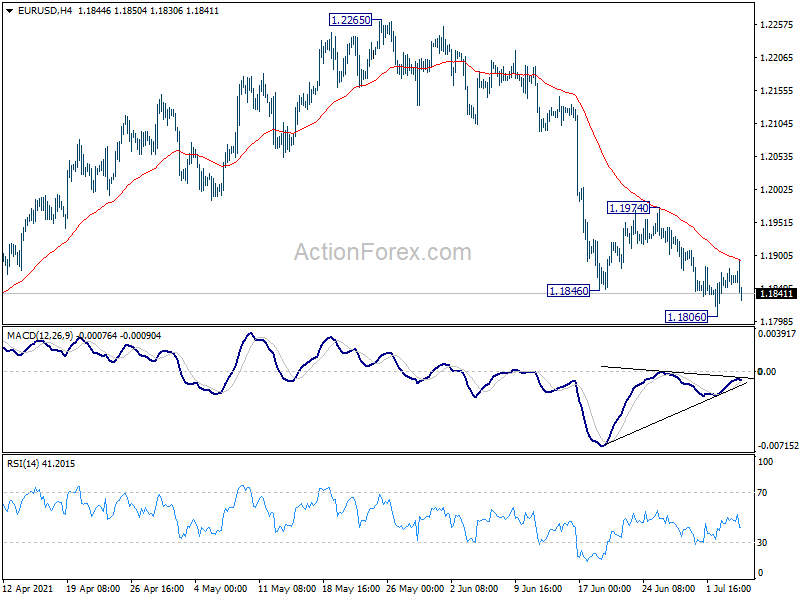
In the bigger picture, rise from 1.0635 is seen as the third leg of the pattern from 1.0339 (2017 low). Further rally could be seen to cluster resistance at 1.2555 next, (38.2% retracement of 1.6039 to 1.0339 at 1.2516). This will remain the favored case as long as 1.1602 support holds. Reaction from 1.2555 should reveal underlying long term momentum in the pair. However sustained break of 1.1602 will argue that the rise from 1.0635 is over, and turn medium term outlook bearish again.
Euro Drops after Germany ZEW, Kiwi and Aussie Maintains Gain
Euro drops broadly today following sharp decline in Germany ZEW economic sentiment. Swiss Franc is following down closely too. On the other hand, New Zealand Dollar remains the strongest on RBNZ rate speculations while Australian Dollar follows as support by RBA tapering. Yen and Dollar are mixed, together with Sterling. European stocks are trading mildly lower while US futures point to mixed open.
Technically, EUR/JPY's break of 131.21 minor support suggests that deeper fall is ongoing towards 130.02 support. The selling follows EUR/AUD's break of 1.5699 support level today. Now, focuses are on 0.8529 support in EUR/GBP and and 1.1806 support in EUR/USD. Break of these levels could further spillover Euro selling to other pairs.
In Europe, at the time of writing, FTSE is down -0.19%. DAX is down -0.31%. CAC is down -0.26%. Germany 10-year yield is down -0.014 at -0.221. Earlier in Asian, Nikkei rose 0.16%. Hong Kong HSI dropped -0.25%. China Shanghai SSE dropped -0.11%. Singapore Strait Times rose 1.58%. Japan 10-year JGB yield rose 0.0104 to 0.046.
Germany ZEW dropped to 63.3, but current situation soared to 21.9
Germany ZEW Economic Sentiment tumbled to 63.3 in July, down from 79.8, below expectation of 75.4. Though, Current Situation index jumped to 21.9, up from -9.1, above expectation of 5.0. Eurozone ZEW Economic Sentiment also dropped to 61.2, down from 81.3, below expectation of 84.4. Eurozone Current Situation rose 30.4 pts to 6.0.
"The economic development continues to normalise. In the meantime, the situation indicator for Germany has clearly overcome the coronavirus-related decline. Although the ZEW Indicator of Economic Sentiment has once again fallen significantly, it is still at a very high level. The financial market experts therefore expect the overall economic situation to be extraordinarily positive in the coming six months," comments ZEW President Professor Achim Wambach on current expectations.
Eurozone retail sales rose 4.6% mom in May, EU also up 4.6% mom
Eurozone retail sales rose 4.6% mom in May, above expectation of 4.1% mom. Volume of retail trade increased by 8.8% for non-food products and by 8.1% for automotive fuels, while it decreased by -0.2% for food, drinks and tobacco.
EU retail sales rose 4.6% mom. Among Member States for which data are available, the highest monthly increases in total retail trade were registered in France (+9.9%), the Netherlands (+9.3%) and Estonia (+8.1%). Decreases were observed in Latvia (-3.9%), Finland (-3.3%) and Luxembourg (-0.7%).
UK PMI construction rose to 24-yr high at 66.3, but positive sentiment eased
UK PMI Construction rose to 66.3 in June, up from 64.2, above expectation of 63.5. That's also the highest level in exactly 24 years. Markit said the recovery was led by house building and commercial work. Supplier delivery times lengthened to the greatest extent on record. Input price inflation also reached the highest since survey began in April 1997.
Tim Moore, Economics Director at IHS Markit: "June data signalled another rapid increase in UK construction output as housing, commercial and civil engineering activity all expanded at a brisk pace.... Supply chains once again struggled to keep up with demand for construction products and materials... Purchasing prices and sub-contractor charges both increased at a survey-record pace in June, fuelled by supply shortages across the construction sector. Escalating cost pressures and concerns about labour availability appear to have constrained business optimism at some building firms. The degree of positive sentiment towards the year ahead growth outlook remained high, but eased to its lowest since the start of 2021."
RBA moves to AUD 4B per week bond purchase, until at least mid-Nov
RBA decided to keep cash rate target at 0.10% as widely expected. The central bank will continue with bond purchase program after the current one ends in September. But the purchase target will be changed to AUD 4B per week, until at least mid-November. April 2024 bond is kept as the bond for yield target at 0.10%. The central bank said the expectation that condition for rate hike "will not be met before 2024". Also, "meeting it will require the labour market to be tight enough to generate wages growth that is materially higher than it is currently."
In a post meeting speech, RBA Governor Philip Lowe said "the situation today is quite different from that in March last year," when the 3-year yield target was introduced. "We are no longer looking over a cliff but instead transitioning from recovery to expansion," he added. "This improvement has widened the range of plausible scenarios for the cash rate." The central scenario is still that condition for rate hike "will not be met until 2024". But he added, " there are alternative plausible scenarios as well".
On extending asset purchases to AUD 4B a week until just November, Lowe said it "strikes the right balance". " It allows the possibility of a timely recalibration of the Bank's bond purchases in either direction..." and, "we are not locked into any particular path and bond purchases could be scaled up again if economic conditions warrant."
Suggested readings on RBA:
- RBA to Begin QE Tapering in September
- RBA Tapers Weekly Purchases of Bonds to $4 Billion from $5 Billion
- RBA Reduces Stimulus And Boosts AUDUSD
- (RBA) Statement by Philip Lowe, Governor: Monetary Policy Decision
NZD jumps as markets now sees Nov RBNZ hike
New Zealand Dollar jumps broadly today as economists pull head their expectation on RBNZ rate hike. The change in forecasts came after strong NZIER Quarterly Survey of Business Opinion, which shows a sharp improvement in both business confidence and demand in firms' own business.
General business confidence jumped to 10.1 in Q2, from Q1's -7.9. Trading activity in the past three months rose to 25.6, from -0.4. Trading activity for the next three months rose to 27.6, from 7.8.
ASB Bank now predicts a rate hike from historical low at 0.25% in November. BNZ quickly followed in expecting a hike this November. Markets are indeed now pricing in 70% chance of that happening.
EUR/USD Mid-Day Outlook
Daily Pivots: (S1) 1.1849; (P) 1.1865; (R1) 1.1878; More...
EUR/USD was rejected by 4 hour 55 EMA but stays above 1.1806 temporary low. Intraday bias remains neutral first. Further fall is still in favor as long as 1.1974 resistance holds. Break of 1.1806 will resume the decline from 1.2265, as the third leg of the consolidation pattern from 1.2348, to 1.1703 support. On the upside, break of 1.1974 resistance will turn bias back to the upside for 1.2265 resistance.
In the bigger picture, rise from 1.0635 is seen as the third leg of the pattern from 1.0339 (2017 low). Further rally could be seen to cluster resistance at 1.2555 next, (38.2% retracement of 1.6039 to 1.0339 at 1.2516). This will remain the favored case as long as 1.1602 support holds. Reaction from 1.2555 should reveal underlying long term momentum in the pair. However sustained break of 1.1602 will argue that the rise from 1.0635 is over, and turn medium term outlook bearish again.
Economic Indicators Update
| GMT | Ccy | Events | Actual | Forecast | Previous | Revised |
|---|---|---|---|---|---|---|
| 23:30 | JPY | Labor Cash Earnings Y/Y May | 1.90% | 2.10% | 1.40% | |
| 23:30 | JPY | Overall Household Spending Y/Y May | 11.60% | 10.90% | 13.00% | |
| 4:30 | AUD | RBA Rate Decision | 0.10% | 0.10% | 0.10% | |
| 6:00 | EUR | Germany Factory Orders M/M May | -3.70% | 1.30% | -0.20% | 1.20% |
| 8:30 | GBP | Construction PMI Jun | 66.3 | 63.5 | 64.2 | |
| 9:00 | EUR | Germany ZEW Economic Sentiment Jul | 63.3 | 75.4 | 79.8 | |
| 9:00 | EUR | Germany ZEW Current Situation Jul | 21.9 | 5 | -9.1 | |
| 9:00 | EUR | Eurozone ZEW Economic Sentiment Jul | 61.2 | 84.4 | 81.3 | |
| 9:00 | EUR | Eurozone Retail Sales M/M May | 4.60% | 4.10% | -3.10% | -3.90% |
| 13:45 | USD | Services PMI Jun F | 64.8 | 64.8 | ||
| 14:00 | USD | ISM Services PMI Jun | 63.5 | 64 |
The Analytical Overview Of The Main Currency Pairs
The EUR/USD currency pair
Technical indicators of the currency pair:
Prev Open: 1.1857
Prev Close: 1.1859
% chg. over the last day: +0.02%
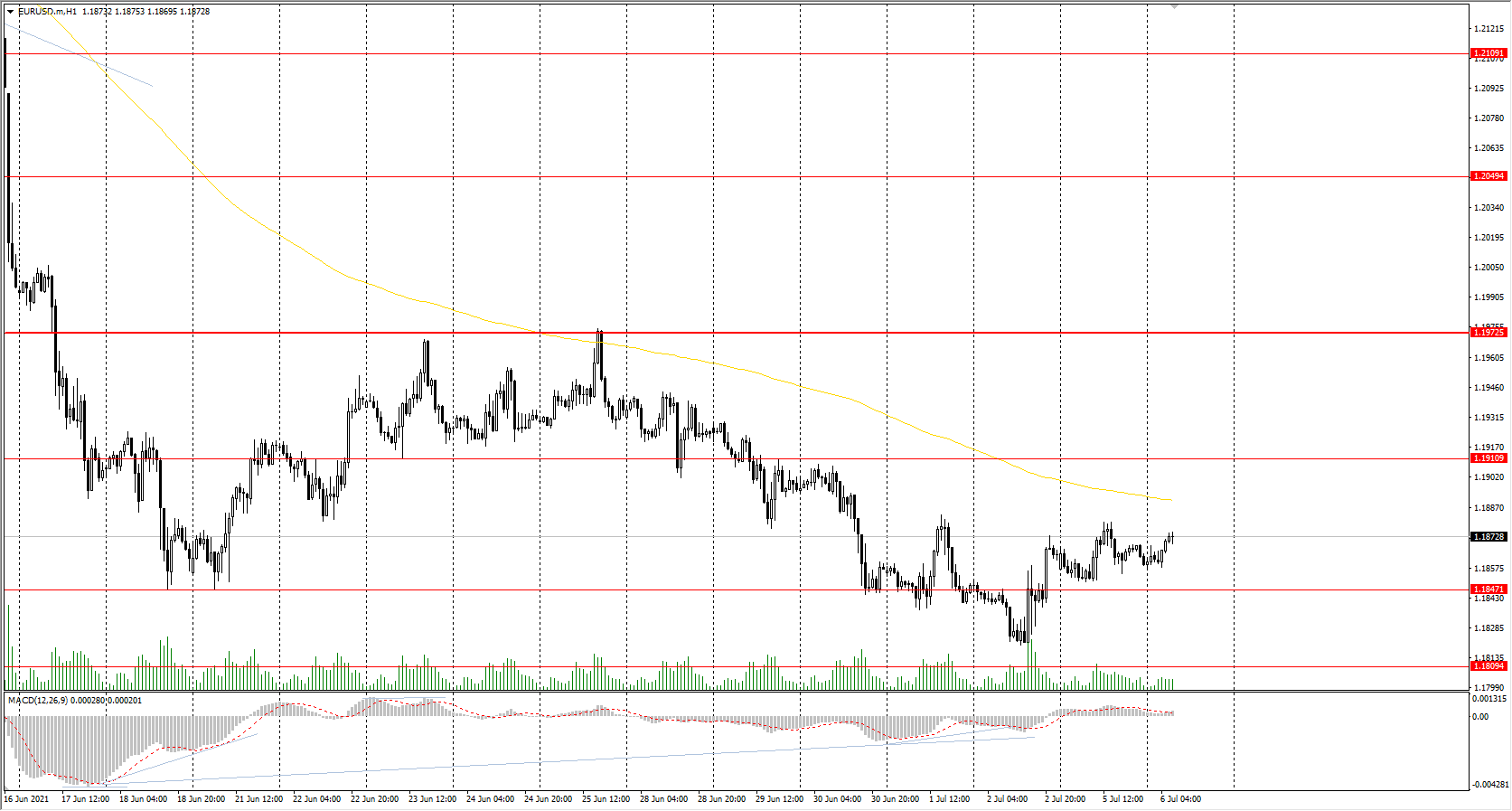
Because of the bank holiday in the US and low volatility on the markets, the EUR/USD currency pair remained at about the same level. Friday's labor market data showed a better-than-expected figure, but the unemployment rate remained high. On this background, the dollar index corrected lower, which played in favor of a slight strengthening of the European currency. The fundamental picture is in favor of EUR/USD quotes growth now.
Trading recommendations
Support levels: 1.1847, 1.1809
Resistance levels: 1.1911, 1.1973, 1.2002, 1.2050, 1.2109, 1.2144, 1.2174, 1.2212
The trend is still bearish. The price is traded near the support level of 1.1847. However, the buyers showed initiative. Given the divergence on the MACD indicator, traders are better to look for buy trades from the support levels, but only on intraday timeframes. There is no optimal entry point for short positions now.
Alternative scenario: if the price breaks out through the 1.1972 resistance level and fixes above, the general uptrend is likely to be resumed.
News feed for 2021.07.06:
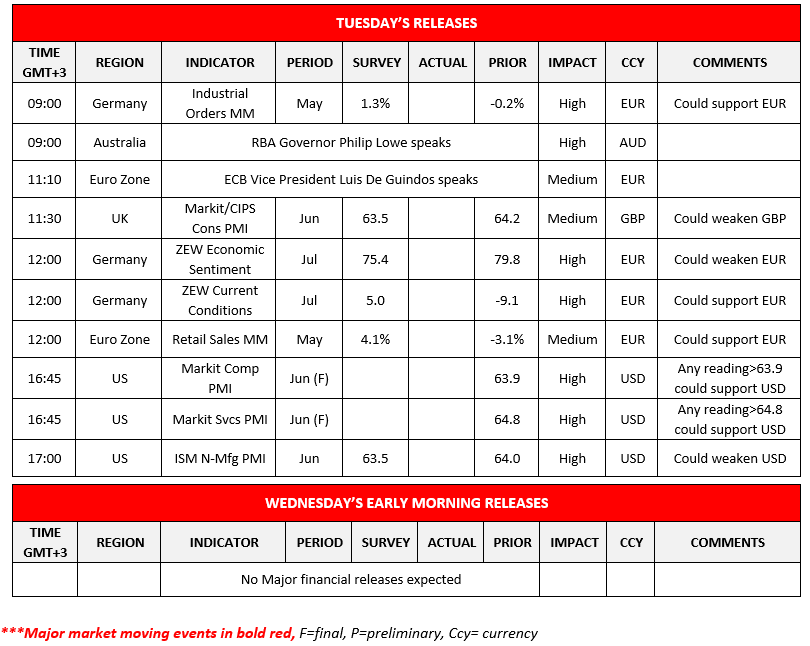
- Germany ZEW Economic Sentiment (m/m) at 12:00 (GMT+3);
- Europe ZEW Economic Sentiment (m/m) at 12:00 (GMT+3);
- Eurozone Retail Sales (m/m) at 12:00 (GMT+3);
- US ISM Services PMI (m/m) at 17:00 (GMT+3).
The GBP/USD currency pair
Technical indicators of the currency pair:
Prev Open: 1.3817
Prev Close: 1.3838
% chg. over the last day: +0.15%
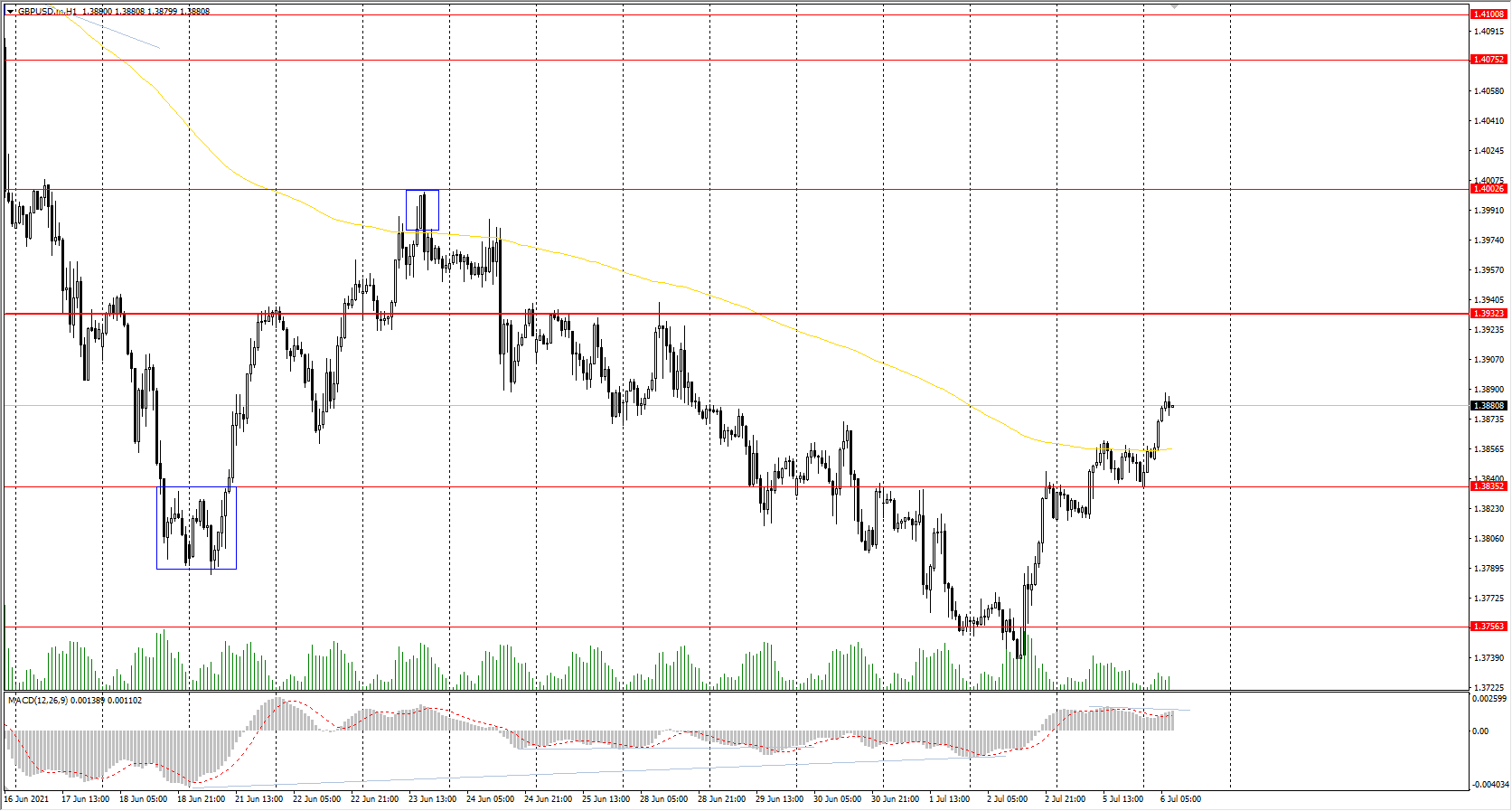
The GBP/USD currency pair increased by 0.15% on Monday. The British currency looks more confident than the euro, even though there are still strict restrictions in the United Kingdom due to the outbreak of the Delta coronavirus. The fundamental picture is in favor of GBP/USD quotes growth now.
Trading recommendations
Support levels: 1.3935, 1.3767
Resistance levels: 1.4002, 1.4075, 1.4101, 1.4138, 1.4191
The GBP/USD trend is bearish on the H1 timeframe. But the price is moving to the priority change level. Buyers' pressure now exceeds sellers' pressure. The MACD indicator is in the positive zone with signs of divergence. Under such market conditions, traders are better to look for both sell trades from the resistance levels and buy trades from the support levels on the intraday timeframes.
Alternative scenario: if the price breaks out through the 1.3922 resistance level and consolidates above, the bearish scenario is likely to be canceled.
News feed for 2021.07.06:
- UK Construction PMI (m/m) at 11:30 (GMT+3).
The USD/JPY currency pair
Technical indicators of the currency pair:
Prev Open: 110.94
Prev Close: 110.97
% chg. over the last day: +0.03%
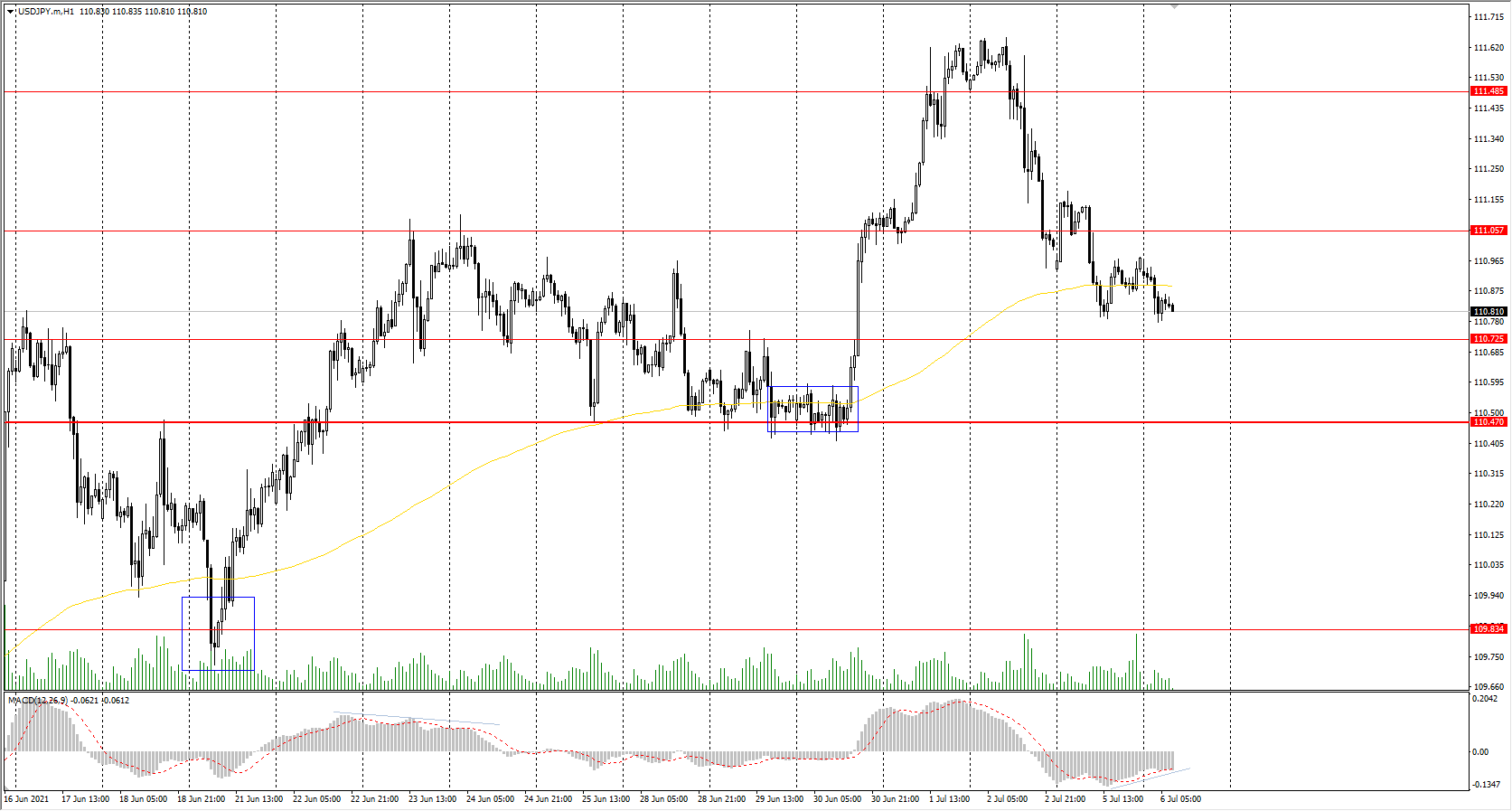
The futures on the Japanese yen began to show signs of growth, while the dollar index is declining. With the continuing soft monetary policy from the Fed, such a fundamental picture plays in favor of a decrease in USD/JPY quotes.
Trading recommendations
Support levels: 111.06, 111.48, 110.73, 110.47, 109.83, 109.62, 109.31
Resistance levels: 112.18
But from the point of view of technical analysis, the trend remains bullish. The price is trading above the priority change level, but sellers' pressure is increasing. Under such market conditions, given the divergence on the MACD indicator, traders are better to look for buy trades from the support levels. It is best to look for entry points on intraday timeframes for sell trades.
Alternative scenario: if the price falls below 110.47, the general downtrend is likely to be resumed.
The USD/CAD currency pair
Technical indicators of the currency pair:
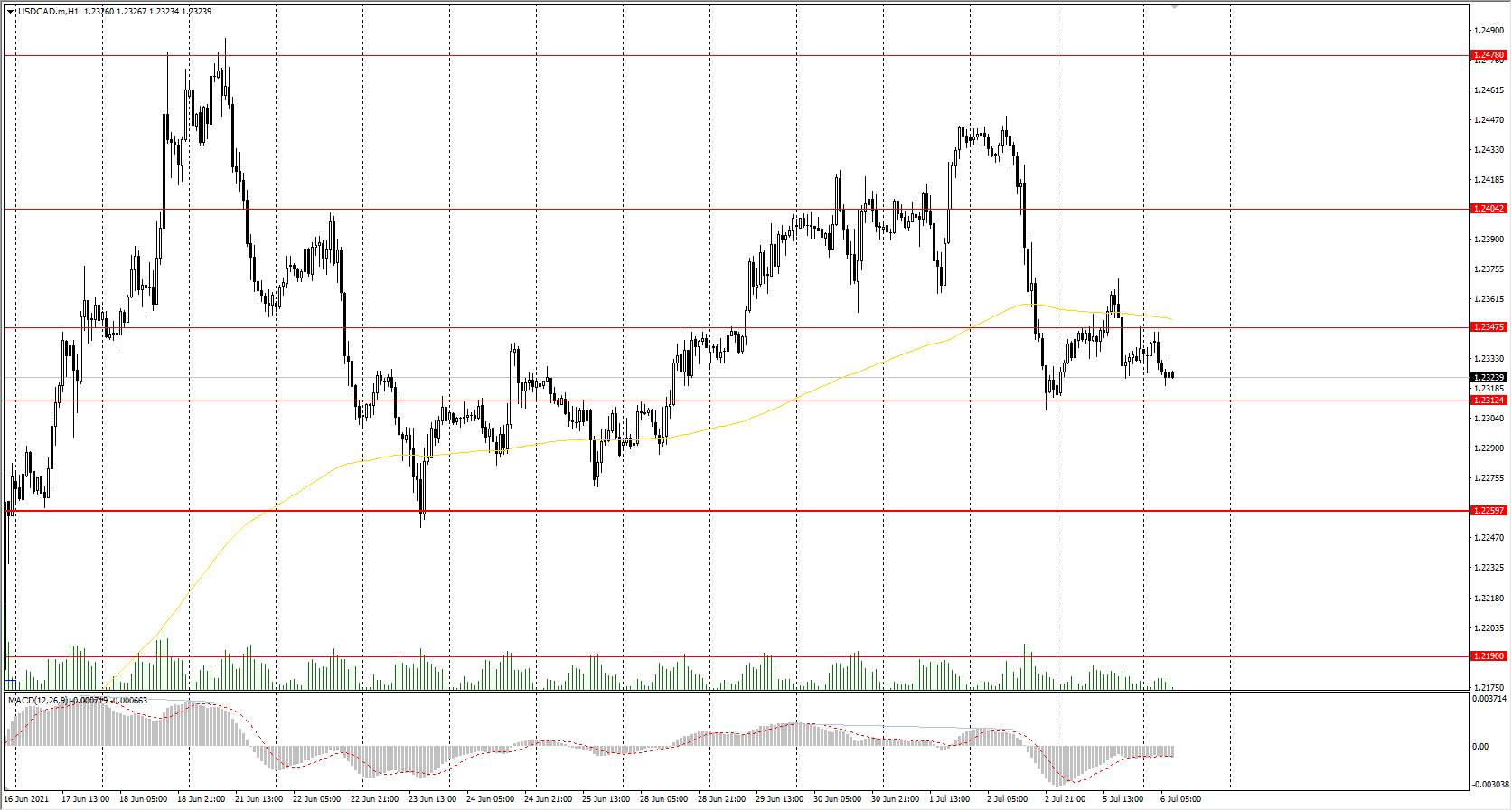
Prev Open: 1.2320
Prev Close: 1.2337
% chg. over the last day: +0.14%
The USD/CAD currency pair increased by 0.14% by the end of the day. The USD/CAD quotes are highly dependent on two factors now: the dollar index and oil prices. On Friday, the dollar index fell sharply, and as a result, the USD/CAD quotes went down against the backdrop of rising oil prices. The overall fundamental picture remains mixed, with a slight advantage in favor of a stronger Canadian dollar.
Trading recommendations
Support levels: 1.2312, 1.2251, 1.2190, 1,2148 1.2121, 1.2096
Resistance levels: 1.2347, 1.2404, 1.2478, 1.2519
Technically, the trend remains bullish, as the price is above the priority change level. But the pair is trading below the moving average now. The MACD indicator is in the negative zone, with no signs of reversal. Under such market conditions, it is best to trade on lower timeframes. Buyers may look for trades from the support levels. Traders can also look for entry points on intraday timeframes for sell positions, but only with short targets.
Alternative scenario: if the price breaks down through the 1.2260 support level and fixes below, the downtrend is likely to be resumed.
Pound Gains As Measures Are To Be Lifted
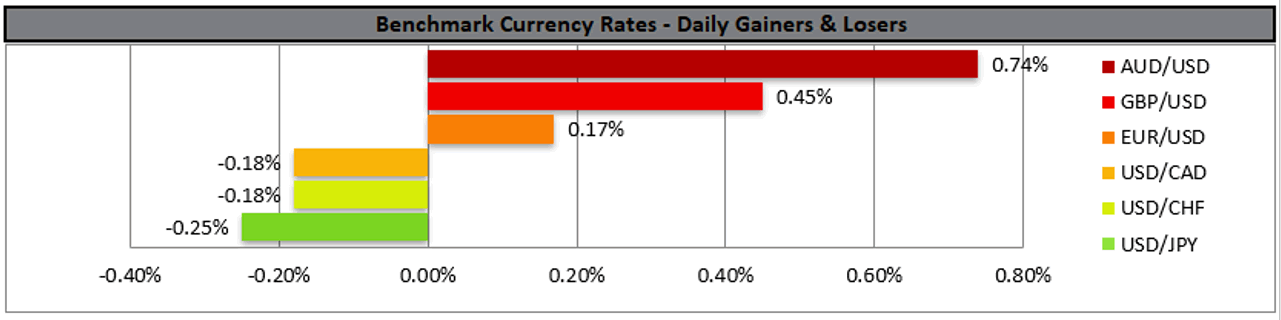
The pound tended to gain against the USD, EUR, JPY and CHF yesterday as the prospect of lifting social distancing measures in the UK, tended to provide support for the sterling yesterday and during today’s Asian session. According to Bloomberg, UK’s Prime Minister Boris Johnson announced the planning to lift social distancing rules and end capacity limits at venues in England from July 19, saying that people must learn to live with coronavirus. Face masks are no longer to be mandatory but be made voluntary in all settings, while working from home instructions are also to be lifted, all businesses are to open, including nightclubs, and no proof of vaccination or testing before entry is to be required. At the same time, it should be noted that the services sector final PMI reading for June was better than the preliminary reading and also tended to improve the outlook for UK’s economy as it would imply that economic activity expanded faster than expected in the crucial services sector. Fundamentals could take the lead for the direction of the pound and if optimism remains the key feature, the pound could strengthen further.
GBP/USD gained somewhat yesterday breaking the 1.3845 (S1) resistance line now turned to support. We tend to maintain a bullish outlook for cable as an upward trendline seems to be forming since the 2nd of June. We note that the RSI indicator below our 4-hour chart is between the reading of 50 and 70 which may imply that the bulls are somewhat in charge. Should the buyers continue to guide GBP/USD, we may see the pair aiming if not breaking the 1.3990 (R1) resistance line. Should a selling interest be displayed by the market, we may see the pair breaking the 1.3845 (S1) support line and aim for the 1.3670 (S2) support level.
AUD rises while RBA Interest rate decision fails to impress
The Aussie was on the rise yesterday against the USD and during today’s Asian session yet gains seemed to be capped as RBA’s interest rate decision failed to impress traders, while its New Zealand counterpart seems to be on the rise as well as an earlier rate hike may be possible. As was widely expected the RBA remained on hold keeping rates at 0.10% while the bank decided to “retain the April 2024 bond as the bond for the yield target and retain the target of 10 basis points”. There is a tone of optimism in Governor Lowe’s statement though as the bank estimates that the economic recovery in Australia is stronger than earlier expected and is forecast to continue. We highlight RBA Governor Lowe’s press conference later on and should he maintain the optimistic tone we may see the Aussie advancing further and vice versa, given also that the bank’s bond buying program is to be reviewed in November.
AUD/USD rose substantially yesterday breaking the 0.7530 (S1) resistance line, now turned to support. We tend to maintain a bullish outlook for the pair as long as the pair’s price action remains above the upward trendline incepted since the 2nd of July. It should be noted that the RSI indicator below our 4-hour chart is between the readings of 50 and 70, which could imply that the bulls have an advantage, while at the same time may also imply that the bulls have room for further advancements. Should the bulls actually maintain control over AUD/USD’s direction as expected, we may see the pair breaking the 0.7595 (R1) resistance line and aim for the 0.7665 (R2) level. Should the bears take over, we may see the pair reversing course, breaking the prementioned downward trendline, the 0.7530 (S1) support line and aim for the 0.7465 (S2) level.
Other economic highlights today and the following Asian session:
Today we note Germany’s industrial orders, UK’s construction PMI reading both for June, Germany’s ZEW indicators for July and from the US we get the ISM non Manufacturing PMI for June. On the monetary front we note RBA Governor Philip Lowe and ECB Vice President Luis De Guindos which are scheduled to speak.
GBP/USD H4 Chart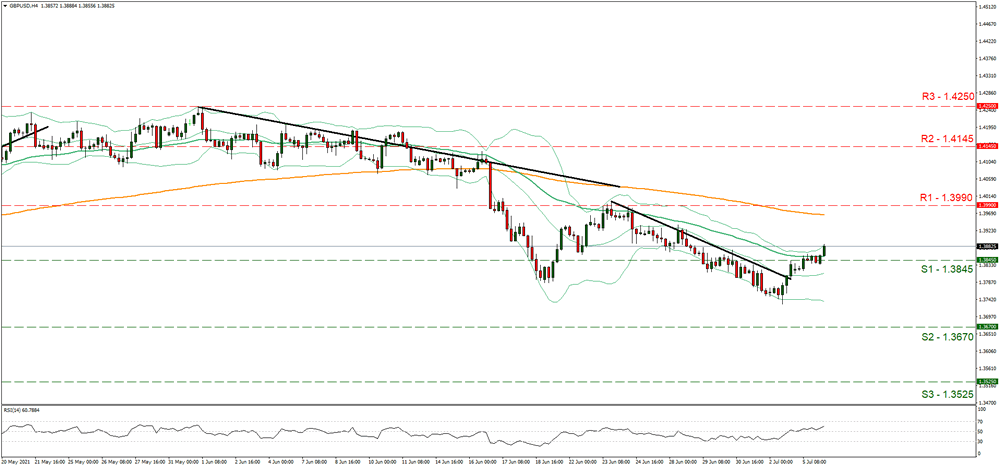
Support: 1.3845 (S1), 1.3670 (S2), 1.3525 (S3)
Resistance: 1.3990 (R1), 1.4145 (R2), 1.4250 (R3)
AUD/USD H4 Chart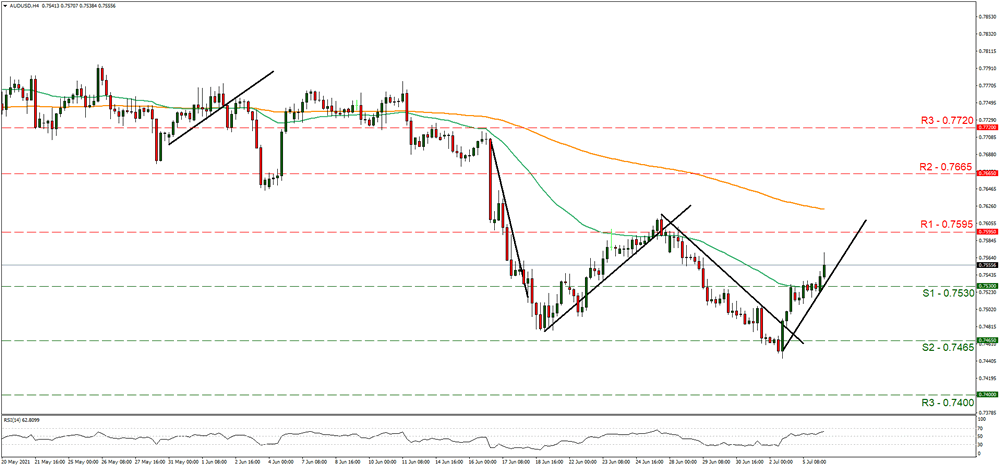
Support: 0.7530 (S1), 0.7465 (S2), 0.7400 (S3)
Resistance: 0.7595 (R1), 0.7665 (R2), 0.7720 (R3)
Gold Prices Are Rising Amid The Weakening Of The Dollar. Investors Are Waiting For The FOMC Minutes Release
There was a bank holiday in the US yesterday, so the major indices were not trading. But the futures market was open in the European session, where futures indices showed mixed dynamics, with the YM futures, which is the equivalent of the Dow Jones, showing a small increase.
Since the beginning of the year, the inflows into European equity funds were the highest in the last 6 years. This means that investors expect the growth of European stocks and Europe's recovery from the crisis. The European economy is lagging behind the US economy in terms of recovery and vaccination, which means that European companies still have perspectives for growth. In addition, almost all macroeconomic indicators of Europe show a positive dynamic. It should also be noted that the European program of economic aid in the amount of 800 billion euros was launched in June.
Oil prices are growing steadily. Several days of OPEC+ negotiations have not yet resulted in an agreement to increase fuel production in August. In terms of the ongoing structural fuel shortages during the summer season, this situation plays in favor of further oil price increases. Many analysts expect a figure of $80 per barrel in the coming weeks.
Gold is strengthening in price amid the decline of the dollar. Some central banks began to increase their gold reserves, so against the background of the remaining monetary policy of the Federal Reserve, this situation plays in favor of rising prices of precious metals.
Most Asian stock markets opened with a slight increase on Tuesday. The New Zealand dollar is rising since a business review has moved expectations for a rate hike to November. The Australian central bank left the interest rate unchanged at the level of 0.1%. Shares of Chinese technology companies remain under close observation after the China Cyber Administration (CAC) ordered an investigation into Didi Global Holdings, which began trading on the New York Stock Exchange a few days ago.
Main market quotes:
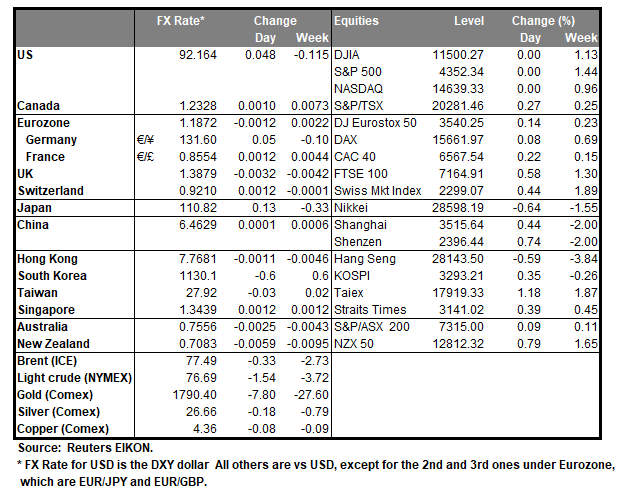
- S&P 500 (F) 4,352.34 0.0 (0.0%)
- Dow Jones 34,786.35 0.0 (0.0%)
- DAX 15,661.97 +11.88 (+0.08%)
- FTSE 100 7,164.91 +41.91 (+0.58%)
- USD Index 92.24 -0.0 (-0.0%)
Important events:
- Australia RBA Interest Rate Decision (m/m) at 07:30 (GMT+3);
- Australia RBA Rate Statement (m/m) at 07:30 (GMT+3);
- Australia RBA Governor Philip Lowe’s Speech at 09:00 (GMT+3);
- UK Construction PMI (m/m) at 11:30 (GMT+3);
- Germany ZEW Economic Sentiment (m/m) at 12:00 (GMT+3);
- Europe ZEW Economic Sentiment (m/m) at 12:00 (GMT+3);
- Eurozone Retail Sales (m/m) at 12:00 (GMT+3);
- US ISM Services PMI (m/m) at 17:00 (GMT+3).
European Indices Fall, RBA Trims QE
European indices under pressure as oil prices hit 2.5-year high, German factory orders dive
Surging oil prices are not good news for the global economic recovery. European bourses are trading under pressure as rising oil prices hit sentiment. The markets are already nervous about rising inflationary pressures. Surging oil prices will only add to these concerns.
The surge in prices is good news for the oil sector, however. The FTSE is outperforming its European peers as heavyweight oil majors lend their support.
Covid headlines are also underpinning the UK index. Prime Minister Boris Johnson outlined plans to end the final Covid restrictions in two weeks, boosting sentiment, even though new daily Covid cases toped 24,000. The more domestically-focused FTSE250 hit an all-time high in the previous session on reopening optimism. Travel stocks are in favour after Germany announced it will allow entry to fully-vaccinated British tourists without quarantine. British Airways owner AIG topped the FTSE leader board.
The Dax is a notable underperformer as data reveals mounting supply problems in German factories. German factory orders unexpectedly fell -3.7% MoM in May, down from -0.2% in April and well below expectations of a 5% rebound. The unexpected decline in factory orders marks the steepest since the first lockdown and highlights the uneven nature of the global economic recovery as supply-chain issues persist.
Looking ahead, the US is pointing to a mixed start as traders come back to their desks after the extended Fourth of July break. Attention will be firmly on ISM non-manufacturing PMI data, which is expected to show a slight easing in activity. That said, the employment sub-component is expected to reveal another firm rise in headcount.
FX – Aussie dollar rallies, euro takes a hi
The Aussie dollar is surging higher after the Reserve Bank of Australia kept interest rates on hold at 0.1%, as expected, but fired the gun on reining in its QE programme. The central bank announced it would reduce QE purchases by AUD5 million per week. Unsurprisingly, the move to tighten policy was met with a cheer from investors, and the Aussie dollar rallied hard, building on already strong gains so far this month. Despite today’s move, the RBA outlook remains dovish, with no rate rise expected until 2024.
At the other end of the spectrum, the euro was trading under pressure, weighed down by disappointing data from Germany. German factory orders unexpectedly tumbled in May as supply bottlenecks continue to hamper the sector. Meanwhile, ZEW economic sentiment in Germany, Europe’s largest economy, declined by more than forecast. Economic sentiment dropped to 63.3 in July, well down from 79.8 in June and significantly lower than the 75.4 forecast.
The EUR/USD continues to struggle below 1.1850 amid a growing divergence in outlook and, more precisely, the central bank monetary policy outlook for the two regions.
Oil Surges On OPEC+, Gold Eyes FOMC
Oil prices are on a tear after OPEC+ talks collapsed on Monday without any agreement. After days of tense discussions and plenty of infighting between Saudi Arabia and the United Arab Emirates, the group failed to agree to ease output curbs, instead abandoning the meeting.
The immediate consequence of the breakdown in talks is that the oil supply increase the market was expecting won’t be happening. The additional 500,000 to one million barrels a day increase in production expected won’t be materialising for now. Given the oil market is so tight, prices are unsurprisingly on the rise.
According to OPEC, the demand outlook remains strong as economies reopen, with demand expected to pick up by around five million barrels a day in the second half of the year. Inventories have been draining for the past six weeks. Given the strong demand and limited supply, this is unlikely to change, highlighting the need for additional supply.
Both benchmarks trade fresh two-and-a-half year highs and have the potential to continue rising. The race to USD80 is expected to be faster than initially expected, and USD100 per barrel doesn’t look so farfetched amid infighting in the OPEC+ group.
Gold retakes USD1800
Gold is extending gains and has managed to clear the key psychological level, hitting a three-week high. The softer tone surrounding the US dollar combined with weakness in the equity markets is boosting the precious metal to levels last seen in mid-June.
Attention will now swing firmly to tomorrow’s FOMC minutes for further clues over the timing of the Fed’s next move. Friday’s US non-farm payroll data appeared to ease expectations of an earlier move by the US central bank. The question remains, will the minutes to the latest Fed meeting quickly reverse that thinking?
Calm Before The Storm In Oil Markets?
Asian shares were mixed on Tuesday as oil prices rallied after OPEC+ abandoned output talks with no new date set for more discussions. European stocks are trading lower, with investors not only keeping an eye on the developments in the oil market but key economic data from the Eurozone and Germany. US futures are mixed with the cautious mood from Europe likely to infect Wall Street later today.
OPEC+ abandons meeting, what next?
Brent crude oil prices punched above $77.50 this morning to the highest levels in three years after yesterday’s talks between OPEC and its allies were postponed indefinitely amid rising tensions between the UAE and Saudi Arabia.
The key question is whether such a move will result in higher or lower oil prices in the medium to long term. If things are left in limbo with no deal reached, this may result in the group keeping output unchanged in August and the rest of 2021. Such a scenario could see higher oil prices.
However, if the infighting means no OPEC+ deal by April 2022, this could result in a “free-for-all” as major oil-producing nations pump at will. If this is anything like what we witnessed in the 2020 price war with Saudi Arabia and Russia, oil prices would experience a steep selloff.
Dollar under pressure
King Dollar has stumbled into Tuesday’s session under pressure, weakening against every single G10 currency. It seems Friday’s mixed US jobs report has triggered some profit-taking around the greenback with the DXY hovering above the 92.00 level as of writing.
Although the US economy created 850,000 jobs in June which was above market expectations, the unemployment rate edged up to 5.9%. These diverging labor market gauges are key elements in the Fed’s assessment and point to a Fed standing on the sidelines and not under pressure to change policy.
While the jobs data has eased rate hike worries, the recent jump in oil prices could revive these concerns. Higher energy costs may fuel inflationary pressures, strengthening the argument for the Federal Reserve to tighten monetary policy down the road – something that could provide a tailwind to the dollar.
On the data front, investors will direct their attention towards the ISM Non-Manufacturing PMI for June which is due later in the day. All eyes will also be on the latest FOMC minutes on Wednesday which could provide clues about the central bank’s hawkish shift at its June meeting.
Looking at the technical picture, the Dollar Index remains bullish on the daily charts despite the recent declines. A pullback could be on the cards with 92.00 and 91.70 acting as levels of interest before prices potentially rebound back above 92.50.
Commodity spotlight – Gold
Gold appreciated above $1800 this morning thanks to the weaker dollar. Easing concerns over the Federal Reserve raising interest rates sooner than expected has also helped gold bugs ahead of the meeting minutes on Wednesday.
Looking at the technical picture, the precious metal has the potential to test $1825 and $1842 if a daily close above $1800 is achieved. Alternatively, a move back below $1800 could result in a decline back towards $1760.