Sample Category Title
Can the Delta Variant Wreck Hopes of an End to Lockdowns?
The highly contagious Delta variant of Covid-19 has fast become the dominant strain around the world, spreading beyond Asia. Countries with low vaccination rates like Australia have had no choice but to reimpose draconian lockdowns, but in other places such as America and Britain where most adults have had at least one vaccine dose, there are no plans yet to pause the full reopening of their economies. Is it sensible to assume so early on that vaccines have broken the link between infections and hospitalizations, or is this just wishful thinking and politicians and investors alike have gotten ahead of themselves?
Delta variant is wreaking havoc
The Delta variant that was first detected in India is spreading rampantly everywhere and is threatening to undo more than a year of progress in getting the virus contained. Countries including Australia, Malaysia, Indonesia and Bangladesh have all announced fresh lockdowns in the last couple of weeks and there are fears more cities and regions will fall victim to stay-at-home orders if the Delta strain continues to rage.
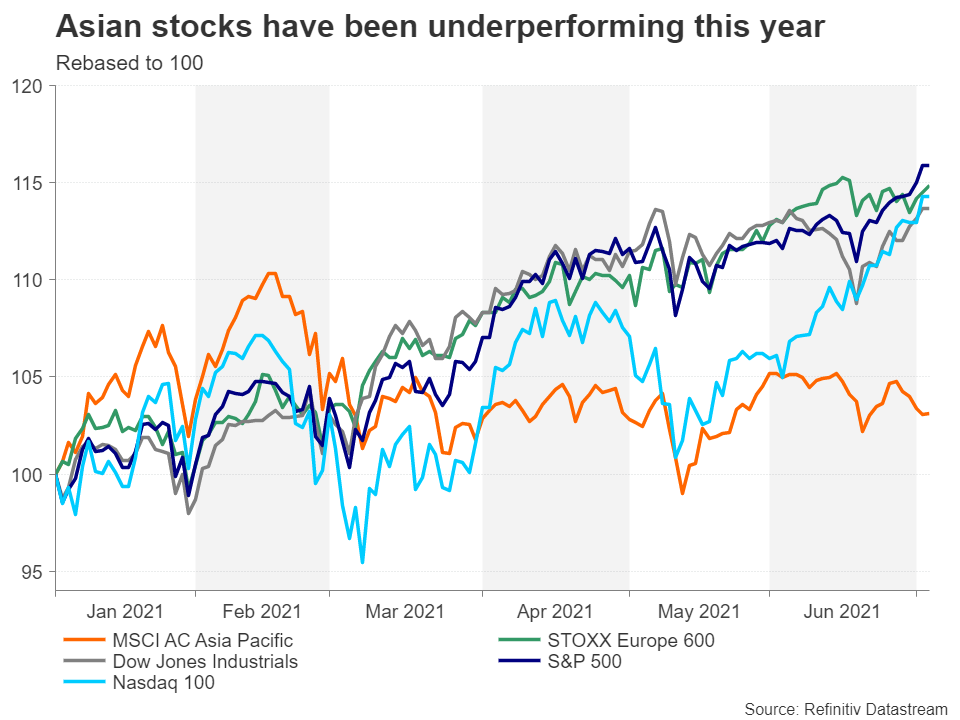
However, apart from a mild dampening of the mood in Asian markets, there is little evidence to indicate that investors are worried about the latest spike in infections in a growing number of countries. Asian stocks have clearly been underperforming over the past month and have had a dreadful start to July. But there are other factors at play here, such as China’s clampdown on tech firms and Chinese leaders’ increasingly hostile rhetoric towards the West, so it’s not just virus concerns that have been weighing on sentiment.
Stocks markets have mostly shrugged off Delta fears
But in Europe and America where new infections are mostly low and Covid curbs are being relaxed, stock investors are still having a heyday, especially on Wall Street where the S&P 500 has notched up seven straight record closes. That could all change should the Delta variant get out of control and force authorities to dial back on reopening plans.
The question is, would the worst-case scenario of renewed lockdowns spell the end of the risk rally, or would expectations that fiscal and monetary policies will stay loose for longer keep the party going? Past market behaviour suggests the latter. Thus, apart from a brief panic episode and some rotation out of reopening stocks into defensive tech stocks, there may not be much turmoil in equity markets.
Is UK’s Johnson playing with fire?
It might be a different story, however, in FX markets where most big central banks are already edging closer towards tapering their massive stimulus measures, so a setback in the fight against Covid could have significant repercussions. The currency that has most to lose from a reversal in the easing of virus restrictions is the pound. The UK government has just announced it will end all social distancing rules in England on July 19 and mask wearing will no longer be mandatory. The only rules that look set to stay are for international travel.
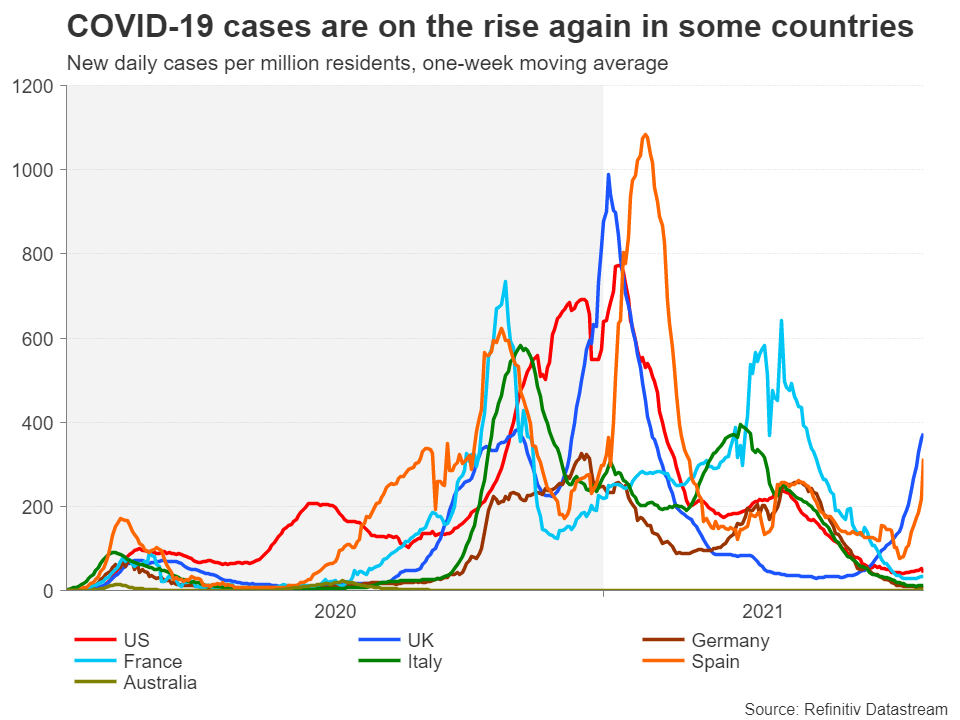
Britain’s daily virus cases have soared to the highest since January and are now the highest in Europe. However, hospital admissions have risen only fractionally and deaths remain very low. The British government seems confident that this proves vaccines do work and protect against serious illnesses, allowing it to lift all restrictions. But what if it’s too soon to be drawing such scientific conclusions and infections, and subsequently deaths, start to increase much more substantially once all social distancing guidelines have ended?
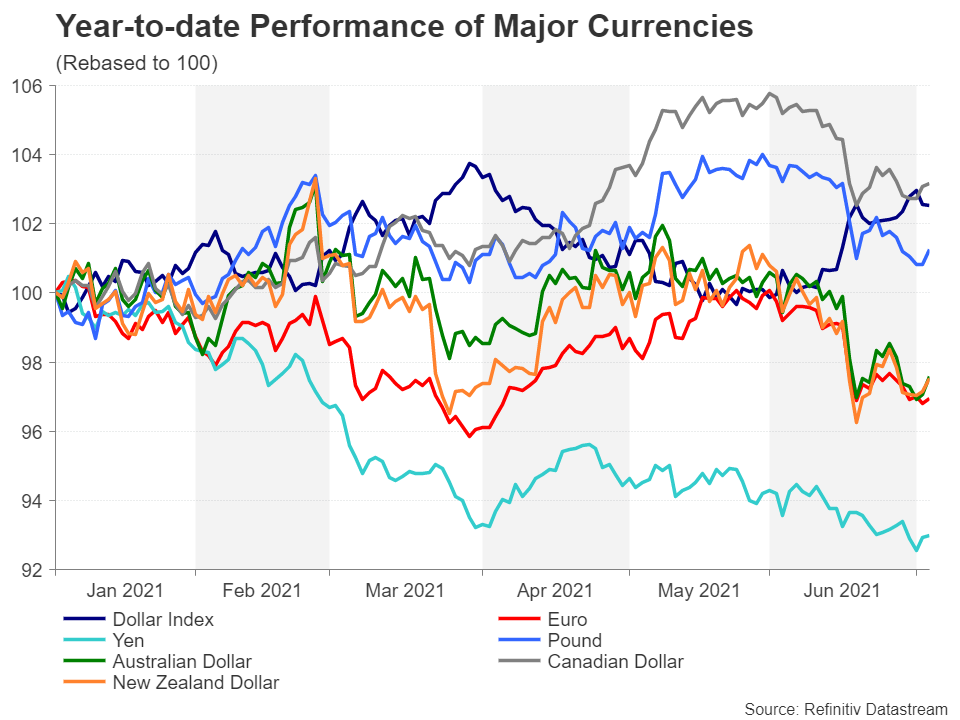
The pound’s impressive year-to-date performance has been built on the back of expectations that the UK’s superfast vaccine rollout will bring about a speedier recovery than most of its peers and that the Bank of England could raise rates as early as 2022. But the emergence of the Delta variant has shown that infections can still explode exponentially in countries with high inoculation rates. So is Boris Johnson taking a gamble by doing away with unpopular restrictions, hoping that jabs will prevent hospitals being overrun by Covid patients? Only time will tell but should that turn out not to be the case, the pound will be in serious trouble.
Aussie may come out unscathed from latest crisis
The euro has also benefited from reopening hopes, driven by the EU’s catchup in the vaccination race. However, Eurozone nations are proceeding much more cautiously with easing their virus curbs, plus, the European Central Bank is already anticipated to be one of the last to hike rates in a post-pandemic world, hence, the euro won’t suffer as badly as sterling.
In Australia, despite the country coming under the spotlight, the situation is not as grave as it might appear. Virus cases have already started to drop in the worst affected states, suggesting that the snap lockdowns are working and extended shutdowns may not be necessary. The Reserve Bank of Australia is not expecting a huge negative impact on growth at this point from the current measures and has already begun to pare back the pace of its weekly bond purchases.
While undoubtedly there is a lot of uncertainty about whether the Delta or any future strain can be as easily kept at bay as previous variants in populations with a low vaccine uptake, investors are not pricing a big economic hit to Australia and yield differentials with the US dollar remain the biggest driving force behind the aussie.
The New Zealand dollar is even more immune to the latest virus scare. New Zealand’s strict border controls should defend it from a major outbreak and like its aussie counterpart, the prime focus for the kiwi right now is how soon interest rates will rise.
US dollar might be saved by its safe-haven status
Canada and the United States are at a slightly higher risk of seeing a fresh jump in infections from either the Delta or another more dangerous strain. Both countries have very high vaccination rates, behind only the UK. But should they remove too many restrictions, they could find themselves in a similar predicament as Britain and have to choose from ‘learning to live with the virus’ or delay the full lifting of all rules.
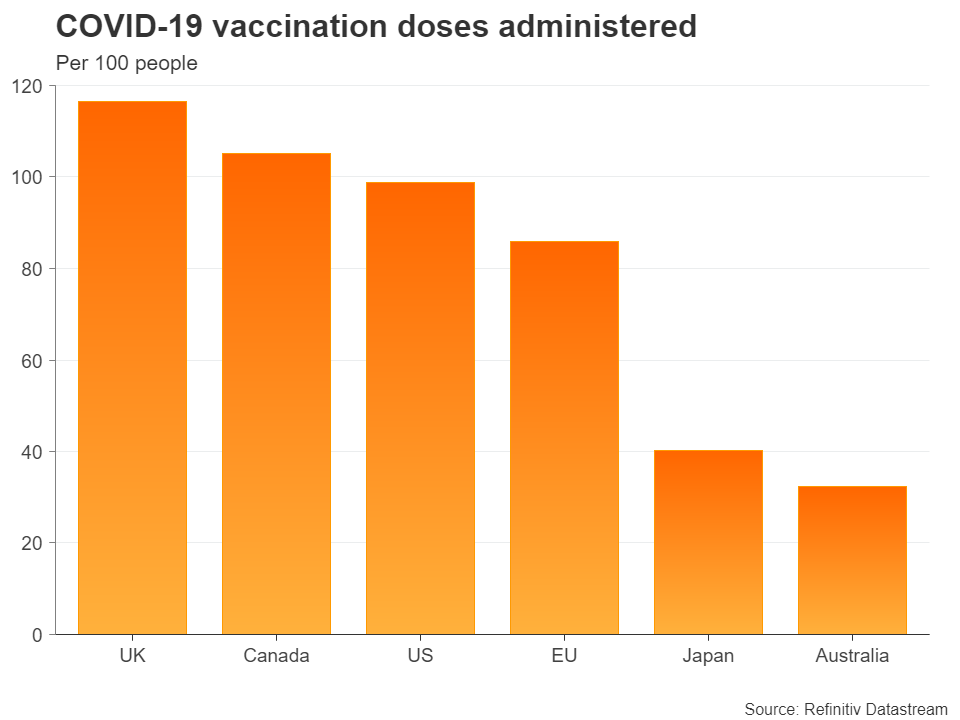
The Canadian dollar is probably the second most vulnerable currency after sterling to a major repricing of tapering plans by its central bank, although the Canadian government is unlikely to follow in the UK’s footsteps. Nevertheless, with the Bank of Canada already firmly on the path of exiting its pandemic stimulus, any significant downgrades to the economic outlook could spark a sharp correction in the loonie.
However, when it comes to the US dollar, a worsening outbreak around the world would likely be positive due to its standing as the global reserve currency. The only scenario where the dollar would face severe selling pressure is if the US outlook were to deteriorate more than its peers and the Fed would have to push back its tapering timeline. Otherwise, the greenback could prosper should investors come to the realization that periodic lockdowns are here to stay in the foreseeable future as the American economy would probably do relatively better under such conditions.
Optimistic narrative not affected yet
For now, though, markets are sticking to the narrative that vaccines will break, or at the very least, weaken the link between infections and hospitalizations. If that assumption is later found to be incorrect and complacency leads to another surge in virus deaths and inevitably to more shutdowns, currencies bolstered by the reopening optimism would no longer be deemed so attractive. On the other hand, risk assets only stand to gain from expectations of prolonged stimulus as has been the case in the past during the pandemic.
NZD Breaks 71 But Beats a Hasty Retreat
The New Zealand dollar climbed to a three-week high on Tuesday, only to reverse directions and surrender those gains. In the North American session, NZD/USD is trading at 0.7021, down 0.06% on the day. Earlier in the day, the pair crossed above the 0.71 level for the first time since June 23.
Business confidence breaks out of slump
New Zealand’s NZIER Business Confidence rebounded in impressive fashion in the second quarter. The survey found that 10% of businesses expected economic conditions to improve in the next six months, a strong turnaround from Q1, when 8% of businesses projected a deterioration in conditions. The business confidence reading was notable in that it broke a streak of 14 straight quarterly declines, dating back to 2017.
Businesses reported an increase in hiring and investment, but also noted labour shortages and disruptions in supply chains, as supply has been unable to keep up with pent-up demand, which has been unleashed after the numerous lockdowns. This has resulted in stronger inflationary pressures, which has raised expectations that the Reserve Bank could respond with rate hikes sooner rather than later.
Investors will now shift their attention to the FOMC minutes, which will be released on Wednesday (18:00 GMT). The minutes may provide some guidance as to the timing of the Fed’s next move. The jump in US inflation had raised speculation about the Fed tightening policy, but Fed Chair Powell has insisted that the surge in inflation is transient and will not affect Fed policy.
Still, the Fed surprised the markets last month, when it projected raising interest rates twice in 2023. Previously, most Fed members had said that rates would not rise prior to 2024. Friday’s US job report appeared to ease expectations of an earlier move. Although nonfarm payrolls beat expectations, the unexpected jump in the unemployment rate signals spare capacity in the labour market.
NZD/USD Technical
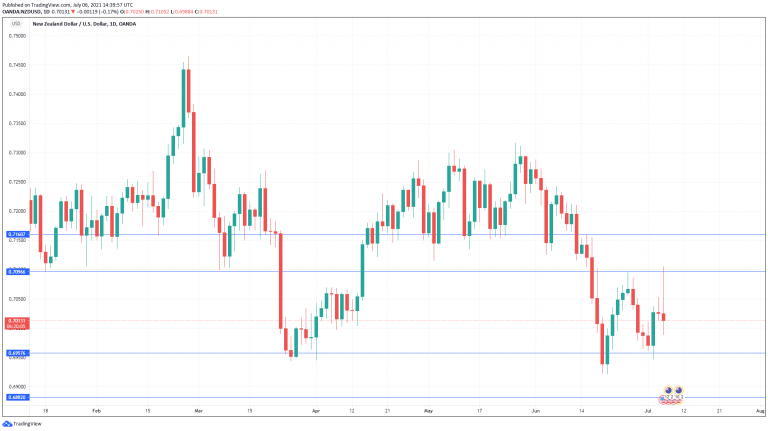
- NZD/USD tested resistance at 0.7096 earlier in the day. This is followed by 0.7160
- On the downside, the pair has support at 0.6957 and 0.6882
US: Services Sector Slows in June, but Remains Firmly in Expansionary Territory
- The June ISM services index dropped to 60.1, well below market expectations for 63.5. This marked a 3.9 percentage point decrease from the historically high reading of 64.0 in May.
- Business activity eased by 5.8 ppts to 60.4, while new orders declined by 1.8 ppts to 62.1 from 63.9 in May. The new export orders sub-index was the biggest driver of the slow-down, dropping by 9.3 ppts to 50.7.
- Supply chain disruptions might be moderating with the supplier deliveries index dropping -1.9 ppts to 68.5. Still, the backlog of orders continued to climb with an increase of 4.7 ppts to 65.8 – the highest on record. Inventories dropped by 1.6 ppts to 49.9 while another month of decline in inventory sentiment suggests that the respondents feel that inventories are too low relative to the level of business activity.
- Employment activity dropped into the contractionary territory in June to 49.3 from 55.3 in May. The deceleration points to labor constraints, rather than slowing demand.
- The price index slowed with a 1.1 ppt decline to 79.5 from 80.6 in May. 17 out of 18 industries reported an increase in prices.
- 16 industries expanded in June. The two industries that reported a decrease in the month of June were Real Estate, Rental & Leasing; and Agriculture, Forestry, Fishing & Hunting.
Key Implications
- Despite a marginal slow-down in business activity, the service sector remains firmly in expansionary territory. The major impediments to faster growth remain capacity constraints and labor shortages as businesses are struggling in an environment of slow lead times and intense competition for qualified workers.
- Lack of improvement in the employment sub-index is worrying as it may force some businesses to turn away prospective customers due to inability to service them. Hiring is constrained as the labor force remains depressed with little progress made in June, according to the recent jobs report. Respondents' comments like "increasingly difficult to find qualified candidates to fill open positions" paint a colorful picture of the current struggles in the job market.
- A moderation in the price index doesn't mean that price pressures are abating, suggesting that consumers may have to pay more for services they craved for during the lockdowns. Elevated prices paid by producers don't always result in higher consumer prices, but with soaring demand businesses are usually less reluctant to make their customers pay for higher input costs. Combined with June's high reading of the manufacturing price sub-index, the CPI reading next Tuesday remains under upward pressure.
Fed Minutes: Talking about Tapering
The minutes of the latest FOMC meeting will hit the markets at 18:00 GMT Wednesday. This was the meeting when the Fed shocked markets by signaling it might take its foot off the accelerator soon, so traders will be looking for clues around that. Overall, the days of asset purchases are probably numbered, which is good news for pairs like dollar/yen.
Bombshell
The Fed sent shockwaves through financial markets back in June, after it projected faster rate increases and signaled that a decision to scale down asset purchases may be just around the corner. This breathed life back into the dollar as investors started to position for an eventual withdrawal of cheap money.
The US economy is firing on all cylinders and policymakers are worried that if they keep their foot on the accelerator for too long, it could overheat. As such, they are trying to step on the brakes gently now, to avoid slamming on them aggressively later.
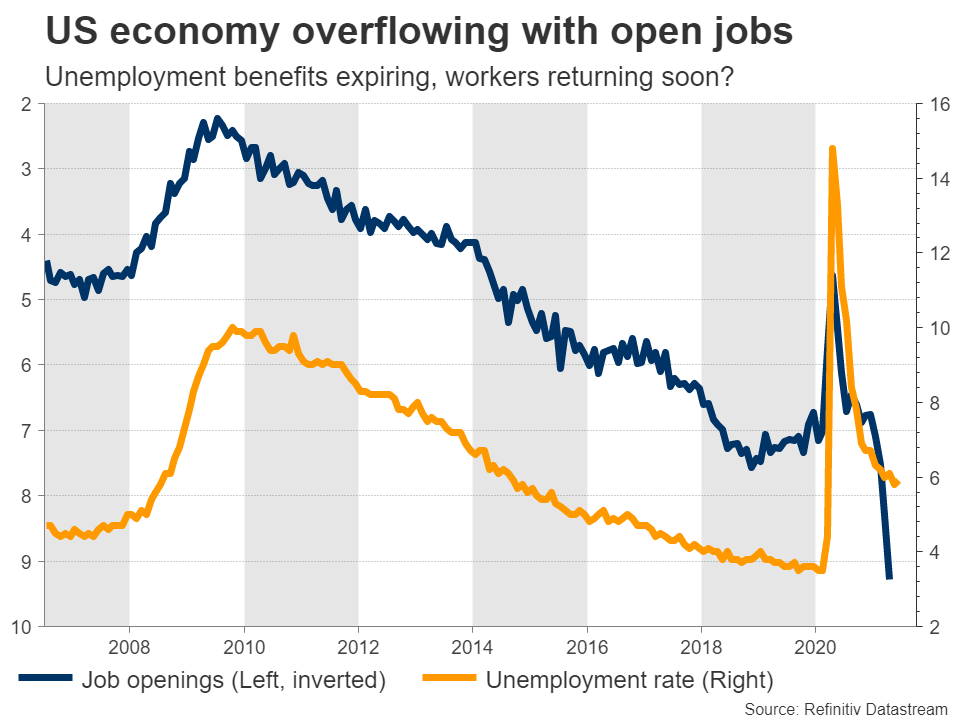
The only element keeping the Fed cautious is the labor market. Consumption is booming and inflation is sizzling hot, but the economy still needs to recover some 6.7 million jobs before reaching its pre-crisis glory. Fed officials think it’s only a matter of time as the economy is overflowing with open jobs. Now that some states have started cutting the beefed-up unemployment benefits, a flood of workers could return.
Minutes
Turning to the upcoming release, traders will look for clues around when the normalization process might begin and what kind of economic progress the Committee wants to see before taking the next step.
Admittedly, the minutes are unlikely to tell us anything new. Almost every official has spoken publicly since that meeting, so markets have a good sense of where the central bank stands. It wants to see a few solid jobs reports and then it might get the ball rolling, sending a strong tapering warning in August before formally announcing it in September.
In fact, asset purchases aren’t even effective anymore. The Fed’s ‘reverse repo facility’ hit a new record of $1 trillion lately, which means liquidity is already being drained from the system. Banks are drowning in cheap money and are giving it back to the Fed for a tiny interest rate.
This is a huge argument in favor of tapering soon. Why would the Fed add so much liquidity through asset purchases only to get that money back a few hours later?
King dollar?
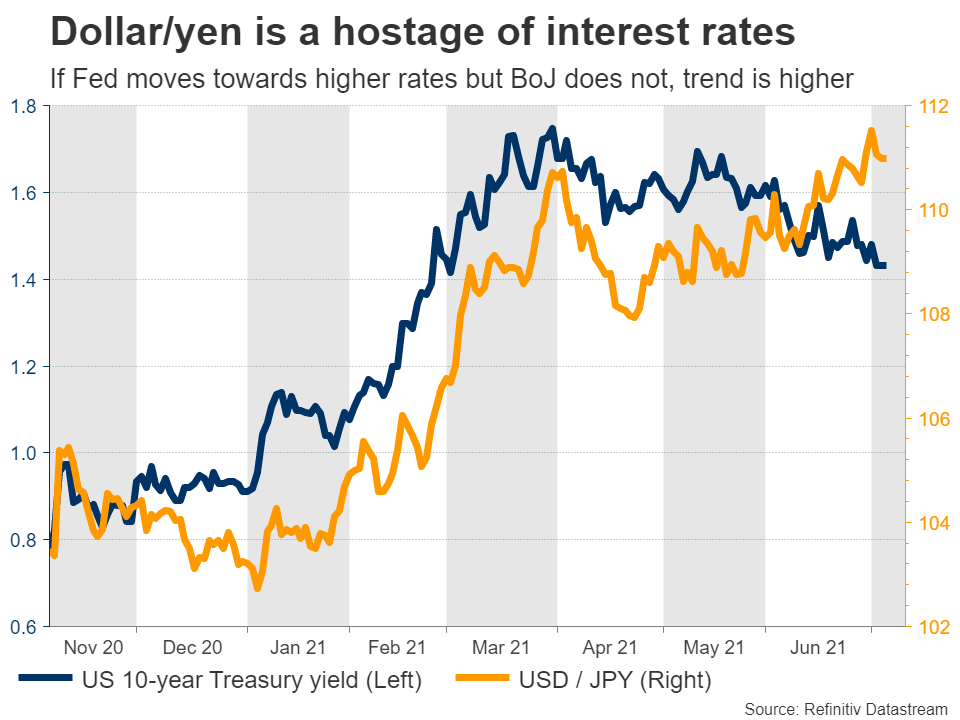
Blending everything together, the days of asset purchases are probably numbered. Ultimately, this argues for a stronger dollar, especially against low-yielding currencies like the Japanese yen and Swiss franc, whose central banks won’t be normalizing anytime soon.
With the Fed withdrawing liquidity and eventually raising interest rates but the Bank of Japan not following suit, rate differentials between America and Japan could widen further, benefiting dollar/yen over time.
This is called a carry trade. Investors looking for returns could borrow at very low Japanese rates and then invest that money in higher-yielding assets in the US, driving demand for the dollar. We might still be in the early stages of this process, which could intensify over the coming years.
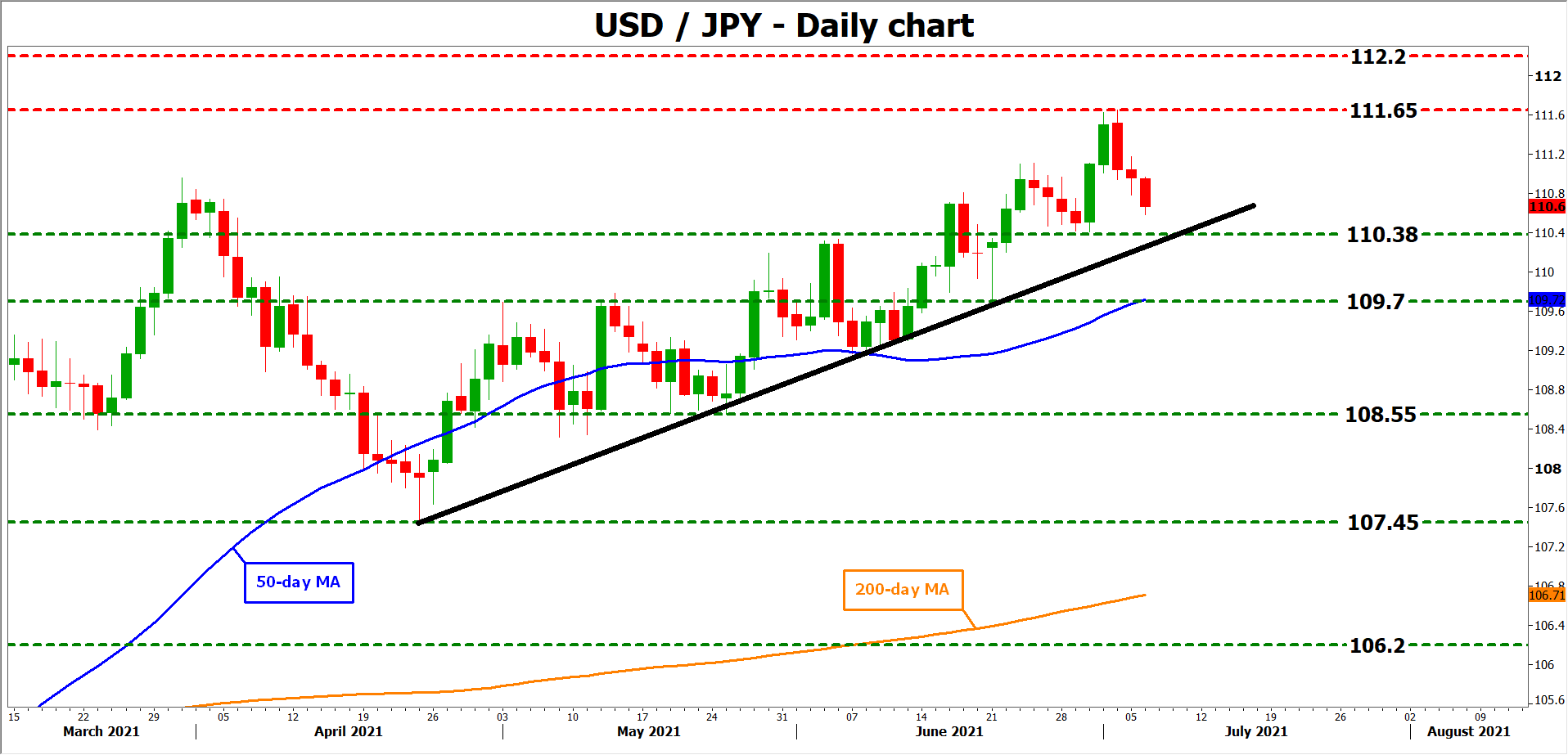
Taking a technical look at dollar/yen, it continues to trade above an uptrend line taken from the April lows. If buyers retake control around this trendline, their first target to the upside might be the recent highs of 111.65.
On the downside, if sellers manage to pierce below this trendline and the 110.40 region, support may be found around the 109.70 zone, where the 50-day moving average also lies.
Sunset Market Commentary
Markets
European markets took a cautious start yesterday but reflationary sentiment to some extent returned later even without guidance from the US. European yields and equities finally closed in in green. The euro didn’t decline further. Early this morning it looked that yesterday’s trends could continue. However, sentiment soon faltered. The trigger wasn’t that obvious. A few, albeit second tier EMU data, obviously didn’t help. German May factory orders declined 3.7% M/M (expected +0.9%) but are still 54.3% higher compared to the same month last year. Later in the session, German ZEW economic sentiment showed a mixed picture as the current conditions subindex jumped from -9.1 to 21.9. A the same time, expectations cooled from 79.8 to 63.3. We don’t give too much weight to the outcome of both series with especially order data being notoriously volatile. Even so, the intra-day price pattern only illustrates a fragile underlying sentiment. The German yield curve again bull flattens with yields easing between 0.1 bp and 3.5 bp (10 & 30 y). The -0.25% support for the 10-y German yield is again at risk. For now, fragile sentiment on the EMU economy/European markets at least didn’t hurt intra-EMU bond markets. If anything, 10-y intra-EMU spreads versus Germany from the likes of Greece, Italy or Spain tentatively narrowed (1 à 2 bp). US investors also started with a cautious bias as they returned from the 4th of July long weekend. The US yield curve also flattens with the 2-y little changed but the 30-y declining 5 bp. The uncertainty caused by the OPEC+ failing to reach a deal a gradually production hike also doesn’t help to give some comfort. Brent crude oil temporarily rose above $77.50 this morning but selling/profit taking kicked in as the trading proceeded. Higher oil prices due to limited supply for doesn’t support the recovery narrative. At same time, profit taking/lower prices in this context are also no vote of confidence for the reflationary narrative. European equities mostly trade with modest losses (0.25%-0.50%). US indices are switching between gains and losses. We look out whether the US non-manufacturing index brings any better news.
Fragile underlying sentiment on Europe was are very much visible in the price action of the single currency. A hesitant attempt to regain the 1.1880/90 area failed miserably. The pair currently is at risk of returning below the 1.1837 support. A similar pattern was also visible in the likes of EUR/JPY (131.05). Sterling initially also outperformed to euro, but the 0.8530 support survives (currently 0.8550). Also interesting, oil related currencies like the Norwegian krone or the Canadian dollar again don’t profit from the recent up-leg in the oil price.
News Headlines
The UK is looking at another surge in its two-trillion pound public debt pile to fulfil its pledge of carbon neutrality by 2050, the country’s Office for Budget Responsibility said in a report on future budget risks. Under a scenario of quick global action, however, the estimated debt increase of £469bn in today’s terms (or 21% of GDP) would be smaller than the addition to net debt as a result of the pandemic, it said. That could be 23% higher in case of a delayed-action scenario (taking action by 2030). If no action is taken at all, debt would surge to 289% of GDP vs. about 100% now.
US bond funds received far more net inflows than comparable equity instruments so far this year, the FT reported based on data from the Investment Company Institute. Bond mutual funds and exchange traded funds added some $372bn as of June 23. This compares to the $160bn for equities. The preference for bonds over equities comes even as the latter outperformed. Total return from govies and investment grade bonds remained negative this year, a legacy from the beating early this year amid expectations the economy and inflation would run very hot.
US ISM services dropped to 60.1 in June, employment dropped to 49.3
US ISM Services PMI dropped to 60.1 in June, down from 64.0, missed expectation of 63.5. Business activity/production dropped -5.8 to 60.4. New orders dropped -1.8 to 62.1. Employment dropped -6.0 to 49.3, back in contraction. Supplier deliveries dropped -1.9 to 68.5. Prices dropped -1.1 to 79.5.
ISM said, "The past relationship between the Services PMI and the overall economy indicates that the Services PMI for June (60.1 percent) corresponds to a 3.8-percent increase in real gross domestic product (GDP) on an annualized basis."
WTI Futures Ease after Surging to 6½-Year Peak Near 77.0
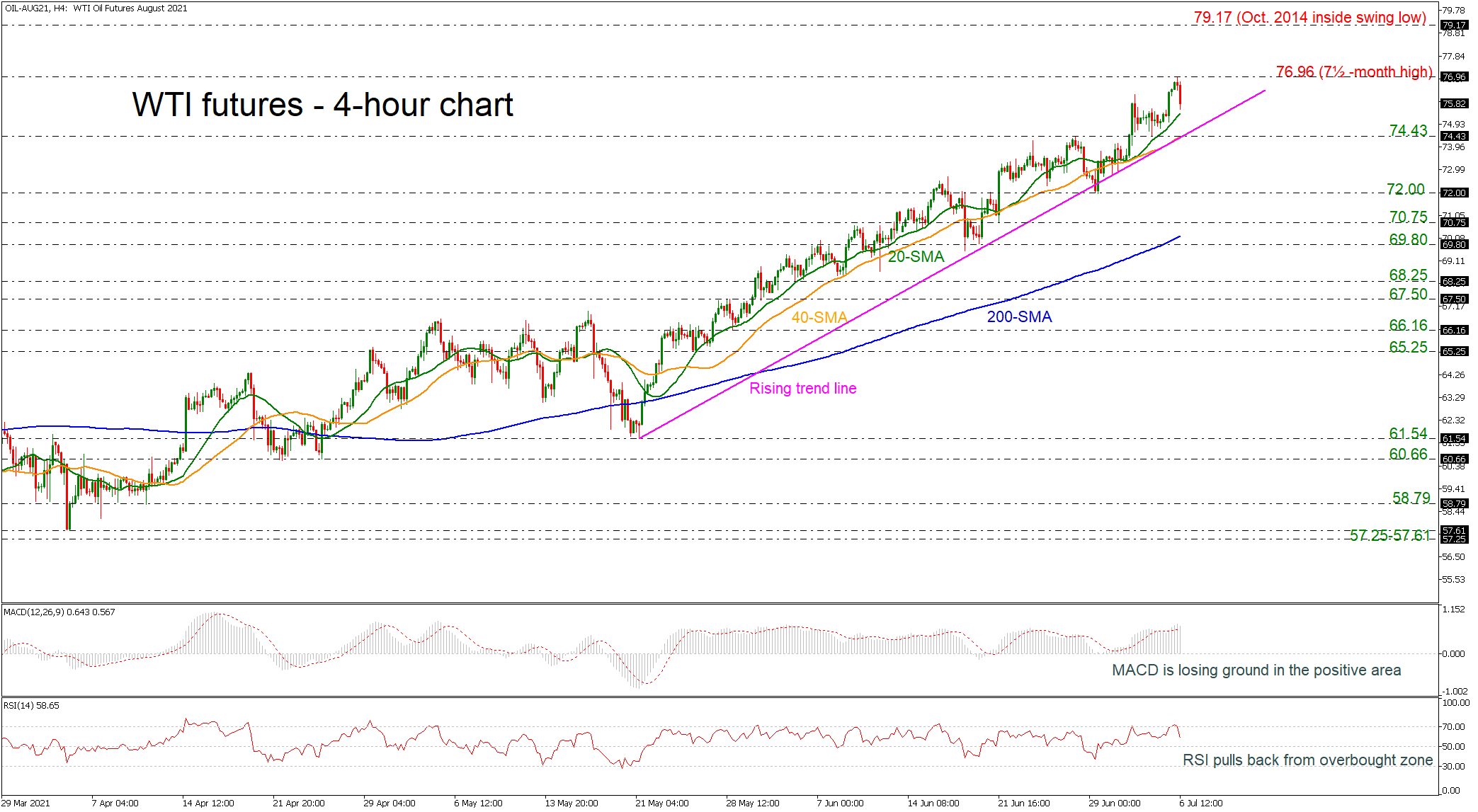
WTI crude oil futures surged to its highest level since November 2014 around 77.00 before returning all of today’s gains. The steep rising trend line is holding well as the price has been continuing the aggressive buying interest since May 21 in the medium-term.
Looking at the technical indicators, the MACD is losing some momentum, crossing below its trigger line in the positive area, while the RSI is edging lower from the overbought territory.
Should selling forces strengthen, the 74.43 support, which overlaps with the 40-period simple moving average (SMA) and the uptrend line may come under the spotlight. The 72.00 handle could initially turn support to keep the bias on the neutral-to-positive bias. Moving lower, the 70.75 support could next add some footing ahead of the 200-period SMA at 70.18.
Alternatively, a close above the more than 6½-year high would brighten the outlook even more, pushing the price towards the inside swing low of 79.17, which was tested in October 2014.
In brief, oil prices are facing a weakening bullish bias, where a drop below 72.00 and the 200-period SMA is expected to enhance selling interest.
EUR/JPY Mid-Day Outlook
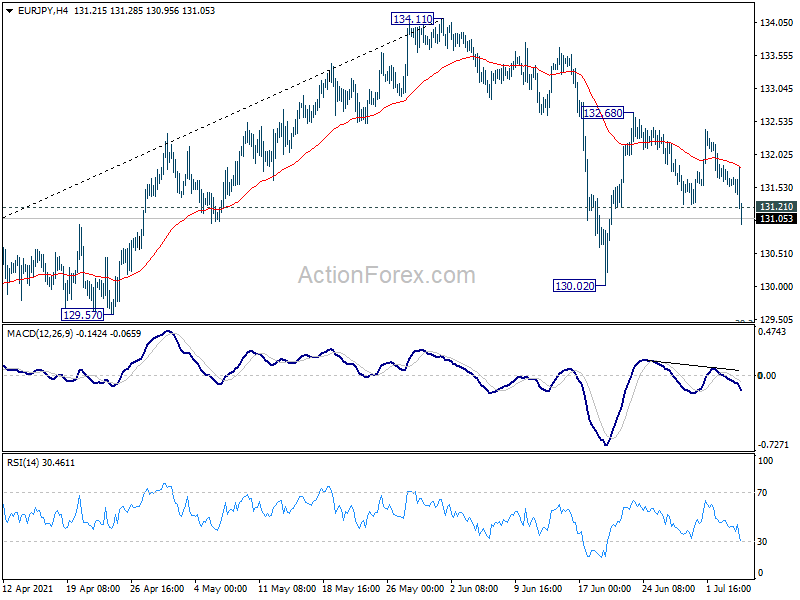
Daily Pivots: (S1) 131.52; (P) 131.69; (R1) 131.84; More....
EUR/JPY's break of 131.21 support suggests that rebound from 130.02 has completed. Intraday bias is back on the downside for 130.02 support and below. Price actions from 134.11 is seen as a correction to rise from 121.63. Downside should be contained by 38.2% retracement of 121.63 to 134.11 at 129.34 to bring rebound. On the upside, break of 132.68 resistance will bring retest of 134.11 high instead.
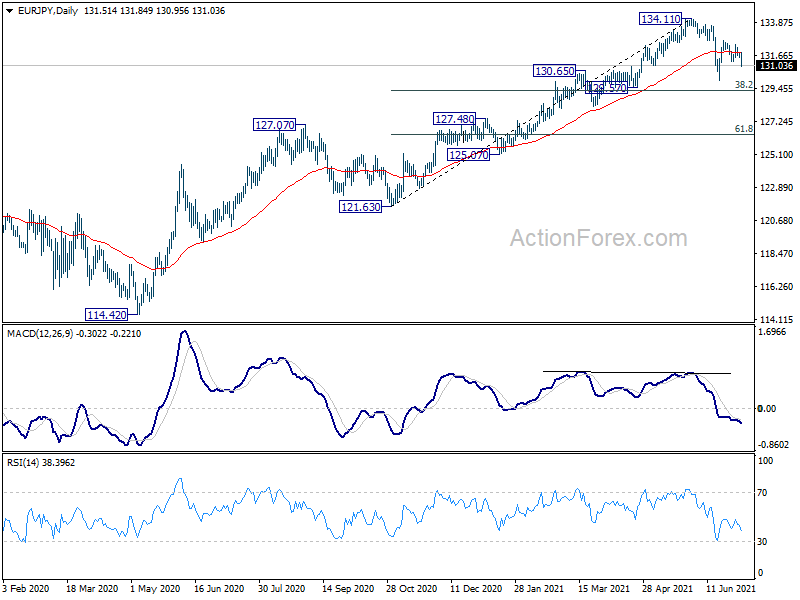
In the bigger picture, rise from 114.42 is seen as a medium term rising leg inside a long term sideway pattern. Next target is 137.49 (2018 high). Decisive break there will open up the possibility that it's indeed resuming the up trend from 94.11 (2012 low). For now, outlook will stay bullish as long as 127.07 resistance turned support holds, in case of pull back.
USD/JPY Mid-Day Outlook
Daily Pivots: (S1) 110.79; (P) 110.99; (R1) 111.18; More...
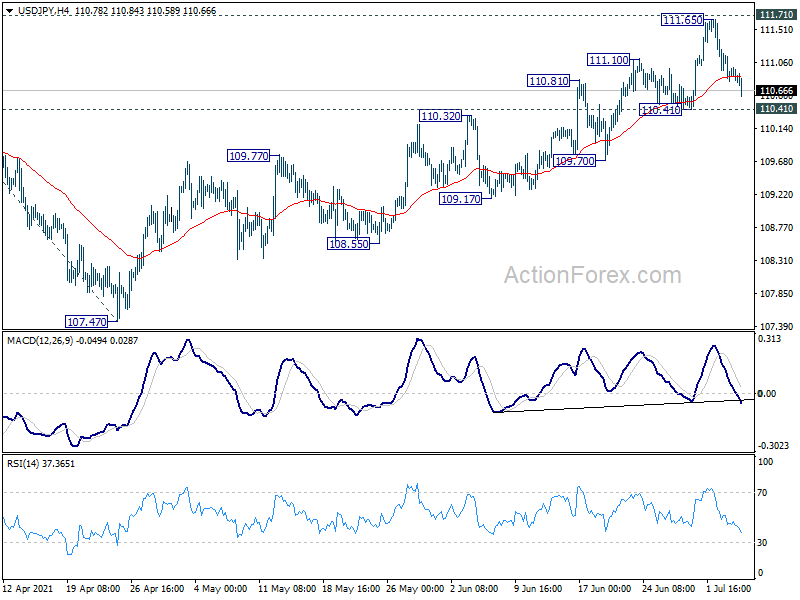
Intraday bias in USD/JPY remains neutral at this point. On the downside, break 110.41 support will indicate short term topping. Intraday bias will be turned back to the downside for 55 day EMA (now at 109.74). On the upside, sustained break of 111.71 will carry larger implication. Next target is 61.8% projection of 102.58 to 110.95 from 107.47 at 112.64.
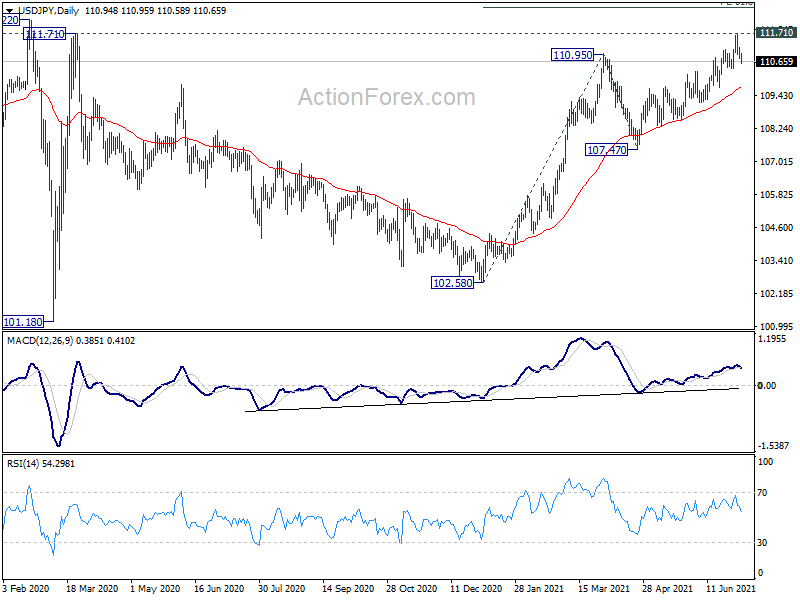
In the bigger picture, medium term outlook is staying neutral with 111.71 resistance intact. Though, as notable support was seen from 55 day EMA, rise from 102.58 is mildly in favor to extend higher. Decisive break of 111.71/112.22 resistance will suggest medium term bullish reversal. Rise from 101.18 could then target 118.65 resistance (Dec 2016) and above. However, sustained break of 55 day EMA would revive some medium term bearishness, and open up deep fall to 61.8% retracement of 102.58 to 110.95 at 105.77 and below.
USD/CHF Mid-Day Outlook
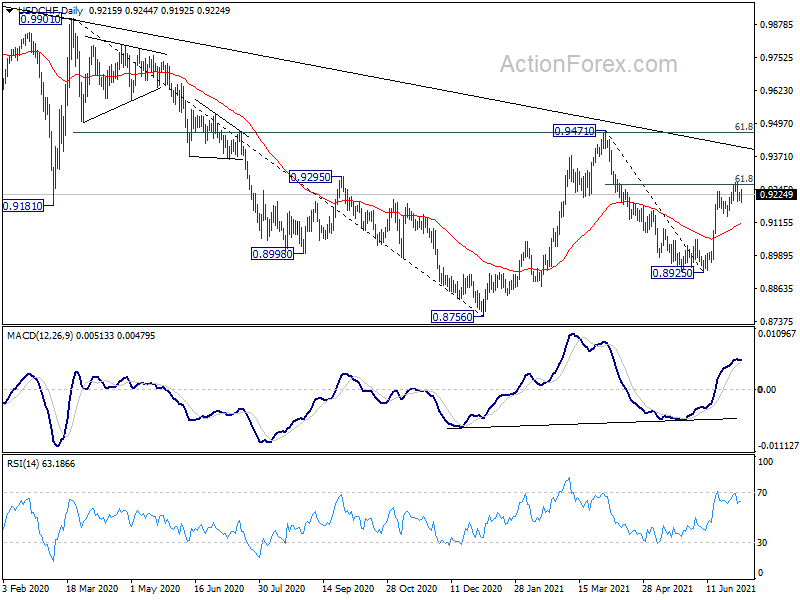
Daily Pivots: (S1) 0.9208; (P) 0.9220; (R1) 0.9237; More....
Intraday bias in USD/CHF remains neutral and outlook is unchanged. Another rise could still be seen as long as 0.9141 support holds. Break of 0.9273 would pave the way to 0.9471 key resistance next. On the downside, however, break of 0.9141 support will argue that the rebound from 0.8925 has completed, and turn bias back to the downside for this low.
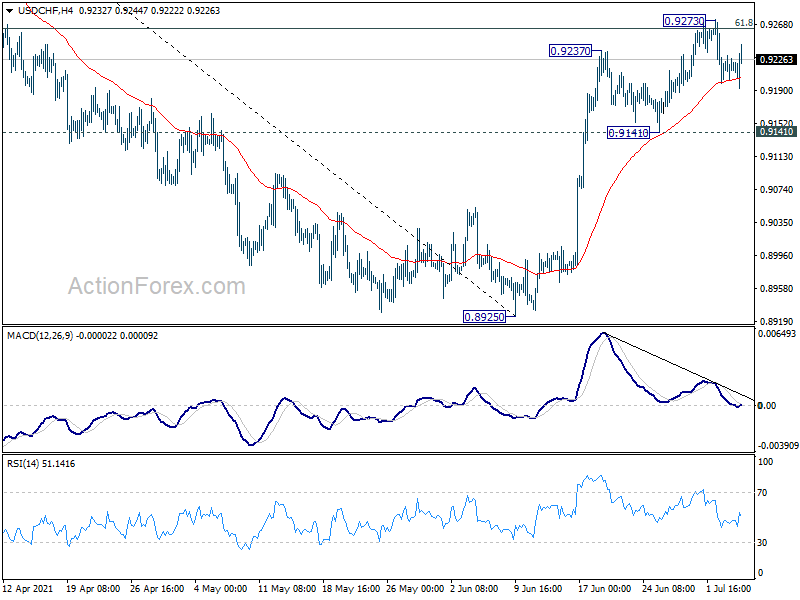
In the bigger picture, medium term outlook is currently neutral with focus on 0.9471 resistance. Sustained break there will indicate completion of whole decline from 1.0342 (2016 high). Medium term outlook will be turned bullish for a test on 1.0342 high. But, rejection by 0.9471 again will revive bearishness for another fall through 0.8756 low.