

Sample Category Title
EU Data Mixed In Session But Govt Officials Remain Optimistic On H2 Outlook
Notes/Observations
- Germany May Factory Orders missed expectations; raises questions on whether supply was hindering output constraints.
- German ZEW survey mixed but quite optimistic on path ahead.
- Focus on FOMC minutes later this week for more clues that brought forward the timeline for interest rates rises.
Asia
- RBA left the Cash Rate Target unchanged at 0.10% and maintained 3-year Yield Target at 0.10% (both as expected). RBA kept the Yield target pegged to Apr 2024 note (elects not to roll forward target bond for yield curve control).
- Japan May Labor Cash Earnings Y/Y: 1.9% v 2.1%e.
- Japan May Household Spending Y/Y: 11.6% v 13.0% prior.
- New Zealand Q2 Business Confidence: +10% v -13% prior.
- Japan Deputy PM Aso stated that Japan and the US would need to defend Taiwan together in the event of a major problem.
Coronavirus
- Total global cases: 184.9M (+0.2% d/d); total deaths: 4.0M (+0.2% d/d).
- Israel said to have seen a sharp fall in the Pfizer Covid-19 vaccine’s efficacy to 64% from 96%; a booster shot might be required; the spread was due to the delta variant and the easing of restrictions.
Energy
- OPEC+ said to abandon its planned oil policy meeting after Saudi-UAE clash. Reports circulated that there would be no oil output increase in August. Others official said a new meeting would take place in the coming days with a production increase in August. (Note: UAE said to seek an increase in the production baseline on whose basis the quotas were determined. UAE said to support an output production increase but no extension without reviewing their baseline).
Speakers/Fixed income/FX/Commodities/Erratum
Equities
- Indices [Stoxx50 -0.4% at 4,072, FTSE -0.1% at 7,157, DAX -0.5% at 15,585, CAC-40 -0.4% at 6,541, IBEX-35 -0.3% at 8,921, FTSE MIB -0.2% at 25,395, SMI +0.1% at 11,982, S&P 500 Futures %].
- Market Focal Points/Key Themes: European indices open modestly lower across the board, but later diverged to trade mixed; health care and energy only two sectors to start in the green; industrials and consumer discretionary leading to the downside; Czechia closed for holiday; Spanish regulator authorizes MasMovil’s takeover of Euskaltel; Ali Group raises offer for Welbilt; Hexagon acquires Ifor’s EAM buisness; no major earnings expected during upcoming US session.
Equities
- Consumer discretionary: Ocado OCDO.UK +2.3% (results, partnership), OVS OVS.IT +2.5% (share issue), Shop Apotheke SAEG.DE -7.8% (Prelim H1 results).
- Energy: EDF EFD.FR -3.7% (nuclear production outlook).
- Healthcare: Innate Pharma IPH.FR -4.4% (suspends study), Virbac VIRP.FR +10.8% (guidance).
- Industrials: Alstom ALO.FR -5.9% (guidance), Daimler DAI.DE -1.4% (EV charging network partnership), HeidelbergCement HEI.DE +1.5% (analyst action), Hexagon HEXAB.SE +0.4% (acquisition), Volkswagen VOW3.DE -0.7% (Porsche and Rimac JV).
- Technology: Sartorius SRT.DE +3.4% (raises outlook).
Speakers
- ECB’s de Cos (Spain) stated that economic growth to be robust in the coming months.
- ECB’s De Guindos (Spain) reiterated Council stance to see an intense economic rebound in second half of the year. Must avoid making the inflation jump permanent.
- ECB's Visco (Italy) saw Italian 2021 GDP growth around 5.0%. Italian bad loans were poised to increase but less compared to prior recessions. Italian banking sector had solid capital reserves and that the ratio of new bad loans to total loans seen steady at 1.1%.
- RBA Gov Lowe post rate decision press conference reiterated stance that remain well short of full employment and inflation targets. He stressed the condition for increase in cash rate related to inflation, not wages and was dependent on data, not dates. Wanted to see CPI above 2% for a number of quarters and wage growth sustainable above 3%. Stressed that cash rate to rise after bond purchases had ended. Reiterated forward guidance that was unlikely cash rate would be raised before 2024.
- EU's Sefcovic noted that the biggest challenge was to rebuild trust and realign the relationship with UK. Ready to move fast but this would not be easy. The closer the EU-UK relationship was then the more ambitious and friction less trade relationship could be.
- Italy Econ Min Franco saw Q2 GDP growth around 2% q/q.
- BOJ said to consider raising its inflation forecast to due enregy gains in its next quarterly economic outlook.
- Japan govt said to likely extend the quasi-State of Emergency by a month.
Currencies/ Fixed income
- USD became the session on soft footing and retracing recent gains. The focus for the current uptrend looking towards FOMC minutes due out later this week for more clues that brought forward the timeline for interest rates rises.
- EUR/USD began the session just under the 1.19 level but saw its strength sapped as the day progressed. Germany May Factory Orders missed expectations which raised questions on whether supply was hindering output constraints and cap growth for the time being.
- AUD was higher after RBA Gov Lowe stressed that the policy rate outlook was dependent on economic factors rather than the central bank’s own forecasts.
Economic data
- (DE) Germany May Factory Orders M/M: -3.7% v +1.1%e; Y/Y: 54.3% v 59.4%e.
- (ES) Spain May Industrial Output M/M: 4.3% v 0.4%e; Y/Y: 26.0% v 22.1%e; Industrial Output NSA (unadj) Y/Y: 28.2% v 50.2% prior.
- (HU) Hungary May Retail Sales Y/Y: 5.8% v 7.0%e.
- (DE) Germany Jun Construction PMI: 47.0 v 44.5 prior.
- (TW) Taiwan May Unemployment Rate: 4.2% v 3.7%e.
- (UR) Ukraine Jun Official Reserve Assets: $28.4B v $27.8B prior.
- (UK) Jun Construction PMI: 66.3 V 64.0E (5th month of expansion and highest since Jun 1997).
- (DE) Germany July ZEW Current Situation Survey: 21.9 v 5.5e; Expectations Survey: 63.3 v 75.2e.
- (EU) Euro Zone May Retail Sales M/M: 4.6% v 4.3%e; Y/Y: 9.0% v 8.2%e.
- (EU) Euro Zone ZEW Expectations Survey: 61.2 v 81.3 prior.
- (RU) Russia Jun Light Vehicle Car Sales Y/Y: 28.7% v 29.2%e.
Fixed income issuance
- (AT) Austria Debt Agency (AFFA) sold total €1.495B vs. €1.495B indicated in 2026 and 2031 RAGB Bonds.
- (UK) DMO sold £2.75B in 0.25% July 2031 Gilts; Avg Yield: 0.819% v 0.941% prior; bid-to-cover: 2.68x v 2.64x prior; Tail: 0.1bps v 0.1bps prior.
- (FR) France Debt Agency (AFT) opened its book to sell EUR-denominated 30-year bond via syndicate; guidance seen +5bps to May 2053 Oat.
- (MX) Mexico opened its book to sell EUR-denominated 15-year bond via syndicate; guidance seen +220bps to mid-swaps.
- (PK) Pakistan to sell USD-denominated 5-year, 10-year and 30-year bonds.
- (ID) Indonesia sold total IDR34.0T vs. IDR33.0T target in bills and bonds.
- (ES) Spain Debt Agency (Tesoro) sold total €5.37B vs. €5.0-6.0B indicated range in 6-month and 12-month bills.
Looking ahead
- (EU) ECB hold special meeting on Strategy Review.
- (MX) Citibanamex Survey of Economists.
- 05:15 (CH) Switzerland to sell 3-month Bills.
- 05:25 (EU) Daily ECB Liquidity Stats.
- 05:30 (HU) Hungary Debt Agency (AKK) to sell 3-Month Bills.
- 05:30 (DE) Germany to sell combined €600M in 2033 and 2046 Inflation-linked Bonds (Bundei).
- 05:30 (BE) Belgium Debt Agency (BDA) to sell 3-month and 12-month bills.
- 05:30 (EU) ECB allotment in 7-Day Main Refinancing Tender (MRO).
- 05:30 (ZA) South Africa to sell combined ZAR3.9B in 2030, 2037 and 2040 bonds.
- 06:30 (UK) DMO to sell £1.5B in 0.50% Oct 2061 Gilts.
- 06:30 (EU) ESM to sell €1.5B in 3-month Bills;
- 07:00 (MX) Mexico Apr Gross Fixed Investment: 42.0%e v 1.4% prior.
- 07:30 (TR) Turkey Jun Real Effective Exchange Rate J(REER): No est v 60.55 prior.
- 08:00 (UK) Daily Baltic Dry Bulk Index.
- 09:00 (RU) Russia announcement on upcoming OFZ bond issuance (held on Wed).
- 09:45 (UK) BOE to buy £1.147B in APF Gilt purchase operation (20+ years).
- 09:45 (US) Jun Markit Final Services PMI: 64.8e v 64.8 prelim; Composite PMI: 63.9e v 63.9 prelim.
- 10:00 (US) Jun ISM Services Index: 63.5e v 64.0 prior.
- 10:00 (MX) Mexico Weekly International Reserve data.
- 11:30 (US) Treasury to sell 13-Week and 26-Week Bills.
- 16:00 (US) Weekly Crop Progress Report.
- 19:00 (KR) South Korea May Current Account Balance: No est v $1.9B prior ; Balance of Goods (BOP): No est v $4.6B prior.
- 21:00 (AU) Australia to sell 2026 and 2031 bonds.
- 23:00 (ID) Indonesia Jun Foreign Reserves: No est v $136.4B prior.
- 23:00 (CN) China to sell 3-year and 7-year Upsize Bond.
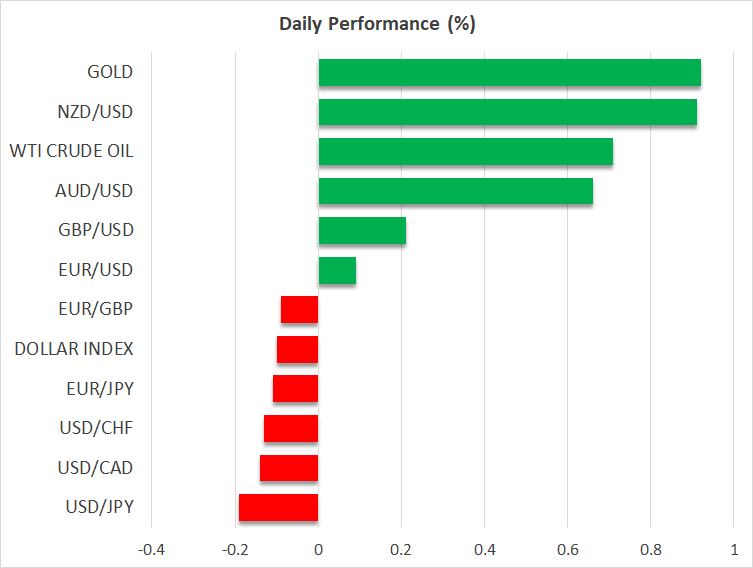
Aussie and Kiwi Capitalize On Softer US Dollar, Oil Roars
- Australian dollar storms higher after RBA slows asset purchases
- Kiwi jumps too, capitalizing on softer US dollar and RBNZ pricing
- Oil prices cheer as OPEC abandons talks, gold pushes higher
RBA takes half measures, aussie still soars
The Reserve Bank of Australia took the first step towards exiting cheap money policies at its meeting today. It signaled that asset purchases will slow down since the economy is much stronger than earlier expected, but tried to neutralize this optimistic message by repeating that interest rates are unlikely to rise before 2024.
Policymakers see a stronger recovery ahead, which allows them to take their foot off the monetary gas a little. Still, the latest shutdown in Australia apparently threw a monkey wrench into their normalization plans, leading them to take ‘half measures’ on rate guidance.
The market reaction was volatile at first given the mixed signals, but traders ultimately decided it is the direction of travel that matters most, with the aussie trading higher once the dust settled. After all, rate guidance can always change if the economy continues to perform well. A minor retreat in the US dollar added fuel to the move.
Kiwi soars as markets reprice RBNZ
But the currency that capitalized most on the dollar’s latest pullback is the kiwi after a quarterly business survey painted an extremely bright picture of New Zealand’s economy. It pointed to booming demand, severe worker shortages by companies, and intensifying inflationary pressures.
Markets reacted swiftly, bringing forward the first rate increase by the RBNZ to November this year, with another one to follow by spring 2022. Hence, New Zealand is expected to be the first major nation to raise interest rates this cycle.
This raises the stakes ahead of next week’s RBNZ meeting. Is the central bank comfortable with market pricing for a rate hike in five months, or does it push back? The answer will determine the kiwi’s short-term fortunes. That said, the big picture seems promising.
New Zealand is the prime example of what happens when you treat a supply shock as a demand crisis and pour endless fiscal fuel on the fire. The supply side can’t cope and you get a booming economy, but at the cost of higher inflation. The RBNZ will likely be one of the most aggressive central banks this cycle, which spells upside risks for the kiwi against low-yielding currencies like the yen and franc.
Oil climbs after OPEC abandons talks, gold heals
The excitement doesn’t stop there as commodity markets are in a great mood too. Oil prices continue to power higher after the OPEC negotiations about raising production broke down yesterday, with the UAE blocking the deal as it seeks to negotiate more production for itself.
Without a new agreement, the current limits on OPEC supply remain in place, which means the market could remain undersupplied in the near term. Hence why oil prices keep rallying. That said, WTI is now testing the $77/barrel zone, which was a fortress in the past. It was both the 2018 high and the 2012 low, so it’s a massive technical barrier.
Gold prices just passed their own technical test with flying colors, punching above the crucial $1795 region with force. The yellow metal seems to be drawing power from the latest retreat in the dollar and real US yields, on top of some real demand from central banks, which according to recent reports have been adding to their gold reserves lately.
Still, it’s difficult to envision a healthy and lasting rally in an environment where several central banks are quietly heading for the exits, especially when the Fed is one of those. Cheap money and a struggling dollar are necessary for gold to flourish, and that era seems to be ending.
As for today, all eyes will be on the ISM services survey for June.
Germany ZEW dropped to 63.3, but current situation soared to 21.9
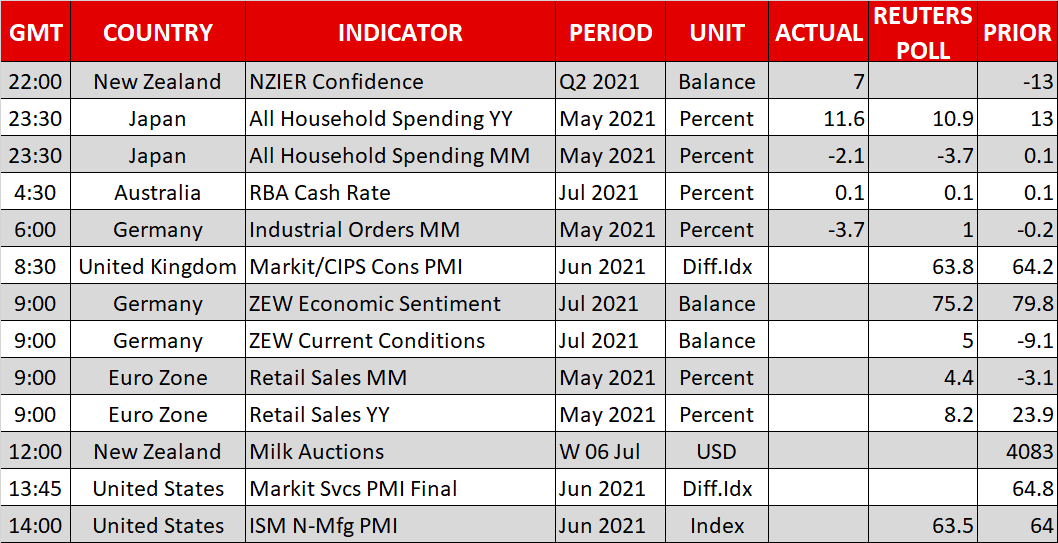
Germany ZEW Economic Sentiment tumbled to 63.3 in July, down from 79.8, below expectation of 75.4. Though, Current Situation index jumped to 21.9, up from -9.1, above expectation of 5.0. Eurozone ZEW Economic Sentiment also dropped to 61.2, down from 81.3, below expectation of 84.4. Eurozone Current Situation rose 30.4 pts to 6.0.
"The economic development continues to normalise. In the meantime, the situation indicator for Germany has clearly overcome the coronavirus-related decline. Although the ZEW Indicator of Economic Sentiment has once again fallen significantly, it is still at a very high level. The financial market experts therefore expect the overall economic situation to be extraordinarily positive in the coming six months," comments ZEW President Professor Achim Wambach on current expectations.
RBA Taper Sends Aussie Higher
The Australian dollar is up sharply on Tuesday. In the European session, AUD/USD is trading at 0.7581, up 0.68% on the day.
RBA scales back QE, Aussie jumps
As expected, the Reserve Bank of Australia (RBA) maintained its monetary policy, including holding interest rates at a record low 0.10% for an eighth straight month. The RBA also decided that the timing was right for a trim to its QE programme, which ends in September. The central bank announced that it would reduce QE purchases from AUD 5 billion per week to 4 billion per week, with this move to be reassessed in November.
Predictably, the markets gave a thumbs-up on the news of a QE taper and the Australian dollar jumped on the news – the currency has risen an impressive 1.0% so far in July. However, some caution is warranted before jumping on the Aussie bandwagon in expectations that the upswing will continue. At today's policy meeting, the RBA's forward guidance remained dovish. Policymakers said that the conditions needed to raise rates, including inflation at 2-3% and wage growth of 3% was unlikely to be met prior to 2024.
RBA Governor Lowe acknowledged that economic data had been better than expected, and this was likely the reason that he gave the green light for a taper, even with a resurgence in Covid which has led to lockdowns in much of the country. Lowe was clear in his commitment to monetary stimulus to support the economy, even with the taper, saying that “the board remains committed to maintaining highly supportive monetary conditions to support a return to full employment in Australia and inflation consistent with the target”.
The RBA's message to the markets is that the economy's performance warrants a slight tightening in policy, but stimulus is still required until inflation and employment targets have been met.
AUD/USD Technical
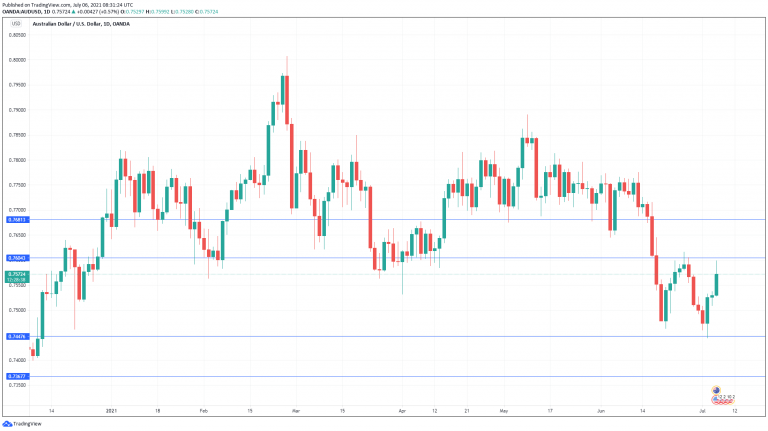
- AUD/USD put strong pressure on 0.7604 in the Asian session before retreating. The next resistance line is 0.7681
- On the downside, 0.7447 has some breathing room in support, with AUD/USD rising sharply. Below, there is support at 0.7367
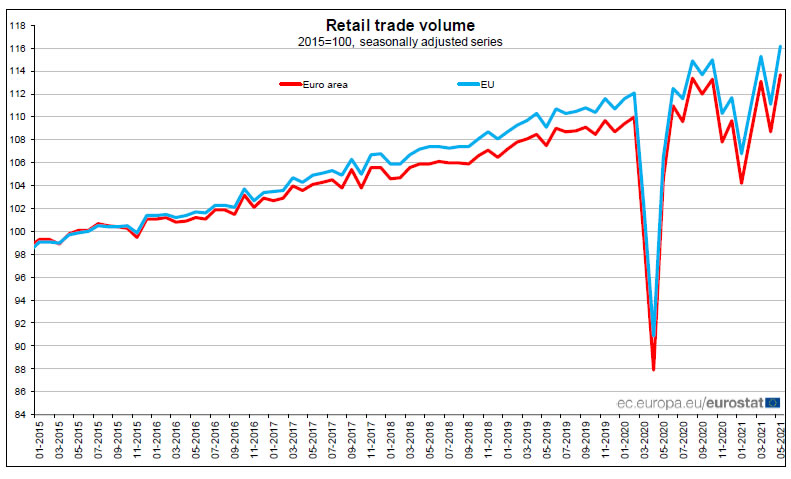
Eurozone retail sales rose 4.6% mom in May, EU also up 4.6% mom
Eurozone retail sales rose 4.6% mom in May, above expectation of 4.1% mom. Volume of retail trade increased by 8.8% for non-food products and by 8.1% for automotive fuels, while it decreased by -0.2% for food, drinks and tobacco.
EU retail sales rose 4.6% mom. Among Member States for which data are available, the highest monthly increases in total retail trade were registered in France (+9.9%), the Netherlands (+9.3%) and Estonia (+8.1%). Decreases were observed in Latvia (-3.9%), Finland (-3.3%) and Luxembourg (-0.7%).
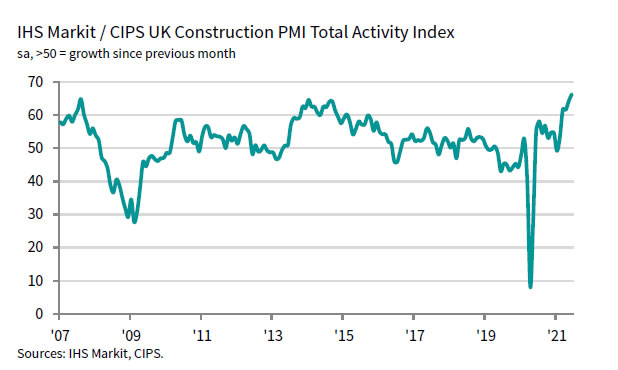
UK PMI construction rose to 24-yr high at 66.3, but positive sentiment eased
UK PMI Construction rose to 66.3 in June, up from 64.2, above expectation of 63.5. That's also the highest level in exactly 24 years. Markit said the recovery was led by house building and commercial work. Supplier delivery times lengthened to the greatest extent on record. Input price inflation also reached the highest since survey began in April 1997.
Tim Moore, Economics Director at IHS Markit: "June data signalled another rapid increase in UK construction output as housing, commercial and civil engineering activity all expanded at a brisk pace.... Supply chains once again struggled to keep up with demand for construction products and materials... Purchasing prices and sub-contractor charges both increased at a survey-record pace in June, fuelled by supply shortages across the construction sector. Escalating cost pressures and concerns about labour availability appear to have constrained business optimism at some building firms. The degree of positive sentiment towards the year ahead growth outlook remained high, but eased to its lowest since the start of 2021."
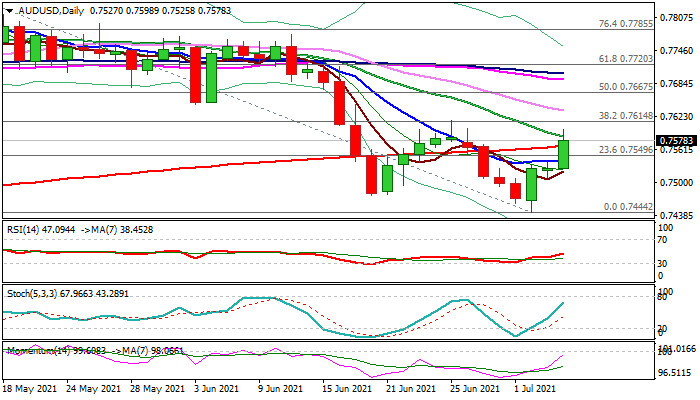
AUD/USD Outlook: Aussie Extends Recovery Despite Dovish Signals From RBA Policy Meeting
The Australian dollar accelerated to a one-week high (0.7599) in early Tuesday, signaling that near-term bulls from a new multi-month low at 0.7444 (July 2) tighten grip despite the RBA’s dovish stance on today’s policy meeting.
The Reserve Bank of Australia kept its cash rate unchanged and reiterated the need for the current setting to remain unchanged until 2024 to help spark inflation and wage pressures.
The central bank will also continue purchasing government bonds after the deadline in September but announced a reduction in weekly purchases from A$5 billion to A$ 4 billion.
The first step in tapering RBA’s massive stimulus on improving situation in Australia’s labor sector is a positive signal, however, any changes in the current policy are unlikely to come to central bank’s agenda until goals in inflation and employment will be reached.
Fresh bullish acceleration broke through pivotal barrier at 0.7570 (200DMA), with a daily close above here to confirm the bullish signal.
Breach of next key level at 0.7616 (June 25 lower top / Fibo 38.2% of 0.7890/0.7444) would add to reversal signal and open way for acceleration towards 0.7700/20 (100DMA/Fibo 61.8%).
Bullish divergence on daily chart momentum studies and north-heading indicators support the notion.
Only return and close below 10DMA (0.7542) would signal recovery stall and sideline fresh bulls.
Res: 0.7598, 0.7616, 0.7634, 0.7667.
Sup: 0.7568, 0.7541, 0.7520, 0.7476.
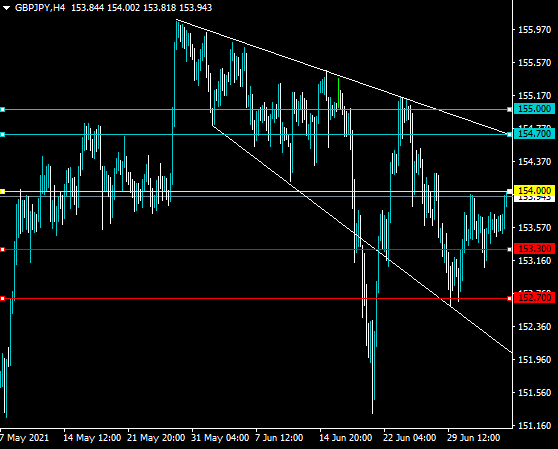
GBPJPY Back To 154.70
The British pound currency is looking more bullish against the Japanese yen after the British Prime Minister confirmed that the UK lockdown will be ending. The GBPJPY pair is trading inside a descending broadening wedge pattern, and looks to be heading to the top of the pattern, around 154.70. The bigger picture shows that a major breakout is likely once the GBPJPY breaks from the wedge.
The GBPJPY pair is only bullish while trading above the 154.00 level, key resistance is found at the 154.70 and the 155.00 levels.
If the GBPJPY pair trades below the 154.00 level, sellers may test the 153.30 and 152.70 support levels.
EURJPY Triangle Watch
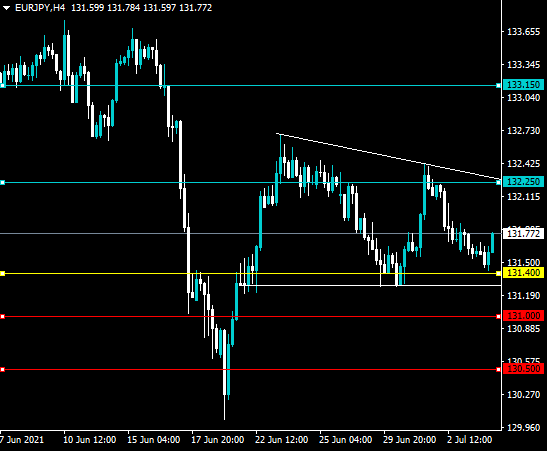
The euro currency is on the rise against the Japanese yen after the pair found strong buying interest from the 131.40 price area. The four-hour time frame shows that the EURJPY pair is currently trapped inside a large descending triangle pattern, between the 131.25 and 132.25 levels. As sellers cannot break under the triangle a coming test towards the top of the triangle seems likely.
If the EURJPY pair trades below the 131.40, sellers may test the 131.25 and 130.50 support levels.
EURJPY pair is only bullish while trading above the 131.40 level, key resistance is found at the 132.25 and the 133.15 levels
RBA Lowe: Outlook improvement widened range of plausible cash rate scenarios
In a post meeting speech, RBA Governor Philip Lowe said "the situation today is quite different from that in March last year," when the 3-year yield target was introduced. "We are no longer looking over a cliff but instead transitioning from recovery to expansion," he added. "This improvement has widened the range of plausible scenarios for the cash rate." The central scenario is still that condition for rate hike "will not be met until 2024". But he added, " there are alternative plausible scenarios as well".
On extending asset purchases to AUD 4B a week until just November, Lowe said it "strikes the right balance". " It allows the possibility of a timely recalibration of the Bank's bond purchases in either direction..." and, "we are not locked into any particular path and bond purchases could be scaled up again if economic conditions warrant."