

Sample Category Title
Dollar Strengthens After Labor Day – DXY Technical Outlook
Traders are getting back to their desks after a prolonged weekend – Both the United States and Canada were celebrating Labor Day yesterday.
The week prior to Labor Day tends to see slower movement and thinner volumes and despite recent volatility, this year was not an exception.
Rangebound conditions have dominated currency markets since Powell's change of tone which shook up rate expectations for the FED – The upcoming Federal Reserve meeting, coming up on September 18, is close to a promised cut (90% of a 25 bps cut priced in).
Volatility is now back on its feet to kick off the month.
With the UK Government bonds opening the week with fresh concerns, a huge selloff in Gilts is leading another rout in the Bond market – With the GBP hurting at the same time.
These concerns combined with a failure from bears to push the Greenback below its prior week range, and rising geopolitical tension around the globe are hurting sentiment.
US Index futures (pre-open for Equities) are in the red and cryptocurrencies attempted a rebound which got rejected – The US Dollar on the other hand is shining.
A past week Dollar Index analysis had emitted the hypothesis that bears had the fundamentals to take control of the action, but their hesitancy paints another picture.
Is a longer-run rebound close?
We'll take a look at that right now.
An overlook at the daily picture in the FX Market
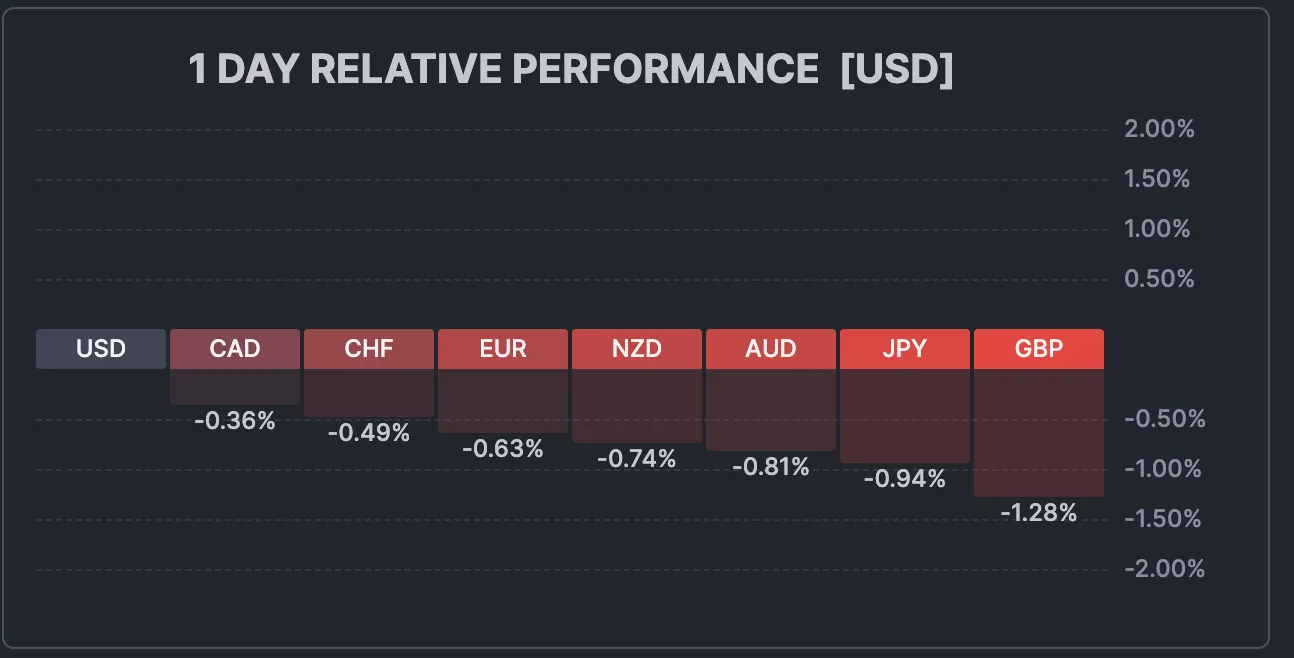
FX Market overview – September 2, 2025 – Source: Finviz
Dollar Index technical outlook
DXY Daily chart
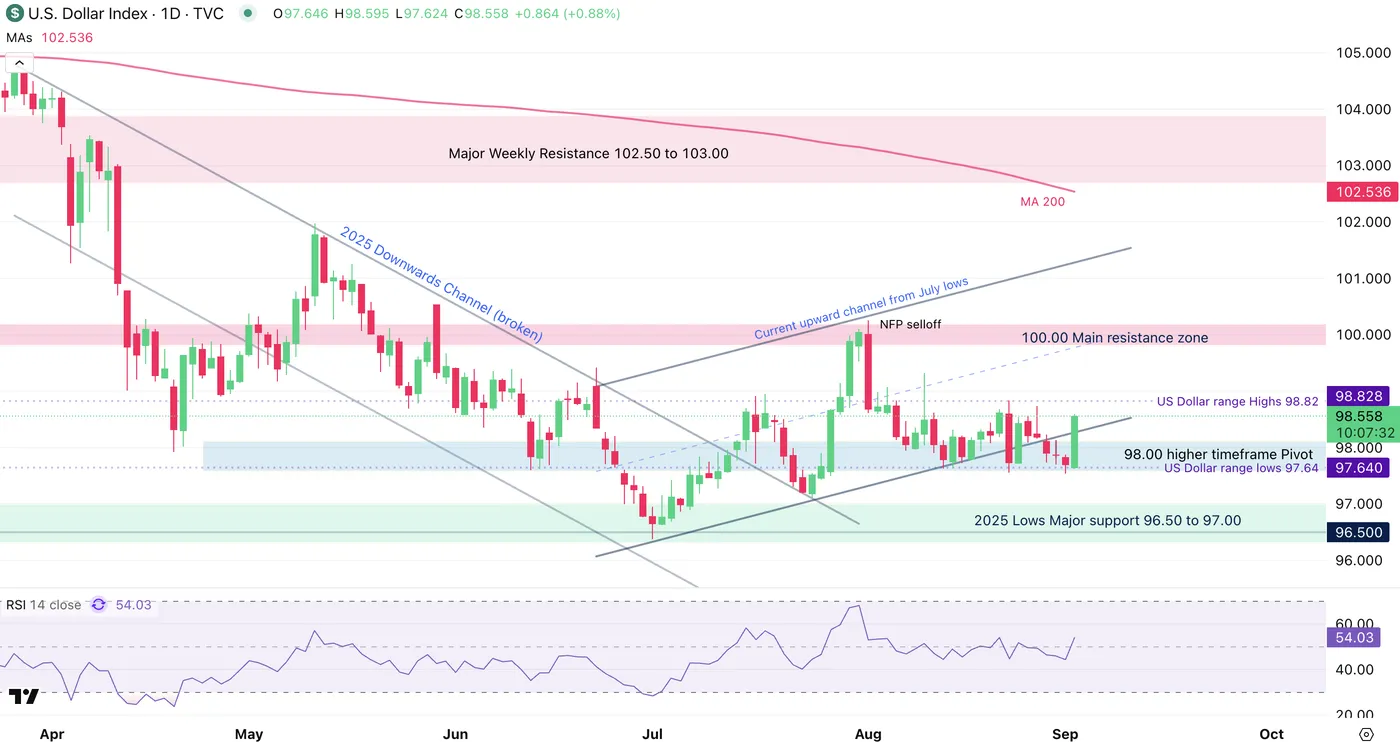
Dollar Index Daily chart, September 2, 2025 – Source: TradingView
The US Dollar is putting up a strong bull candle ahead of today's ISM US Manufacturing report (coming up at 10:00 A.M.)
Despite the current data having the potential to influence the current flows, it seems that currency markets are more looking at US bond yields that are strengthening while Index futures are weakening – this underpins the USD.
Hanging around the higher timeframe 98.00 Pivot zone, the rebound is exacerbated by hesitant USD sellers – with bets on a lower dollar increasing since Jackson Hole, you can expect a failed move to see reversals like the one from today.
RSI is still neutral but rising, however one thing to keep in mind is that the Friday Non-Farm Payrolls report will have the most influence on the future price action for all markets and particularly in the US.
DXY 4H chart
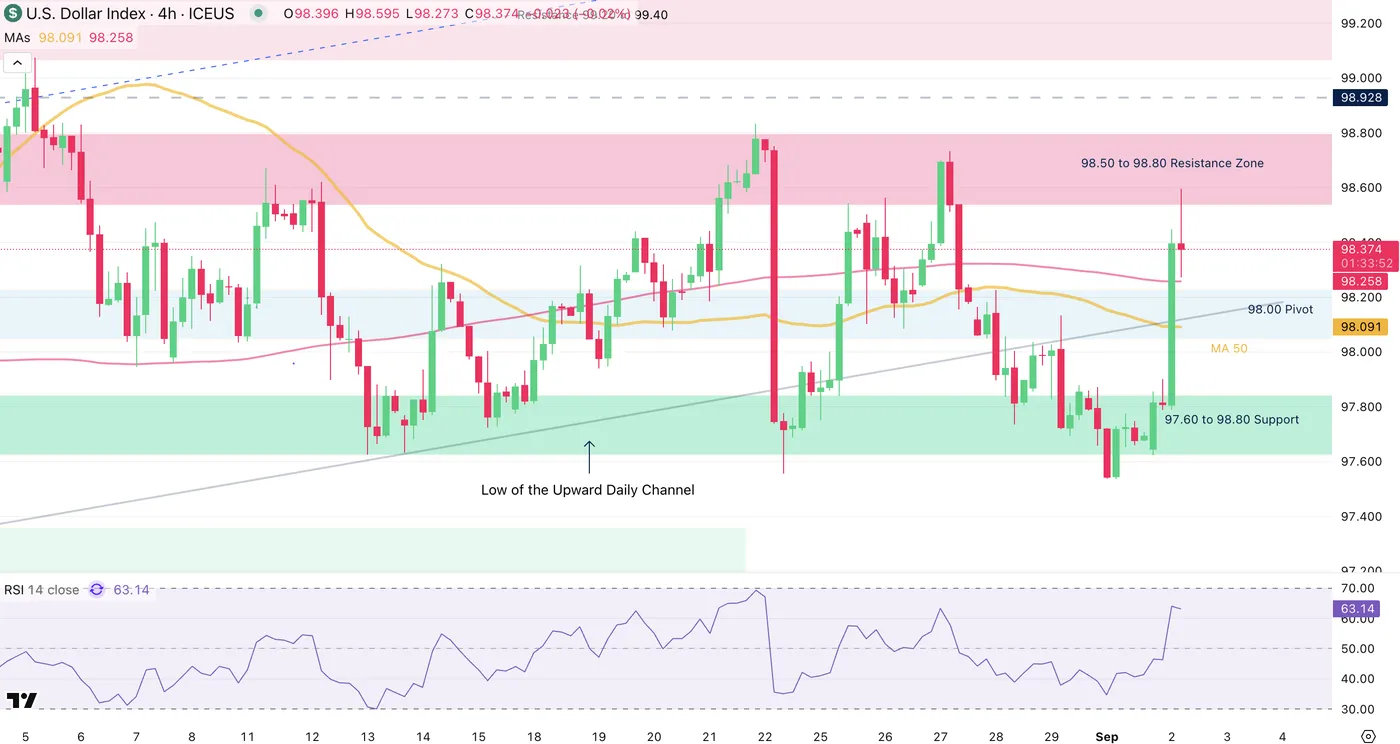
Dollar Index 4H chart, September 2, 2025 – Source: TradingView
Looking closer to the 4H Chart, it seems that rangebound conditions still have a high possibility of holding – As I write this piece, mean-reversion USD sellers have appeared at the upper bound of the prior week range.
Held in a range between 97.60 lows to around 98.80 since the 11th of August, participants have tried without success to provide meaningful direction to the Greenback.
As always, the Non-Farm Payrolls report is making every participants hold their breath.
Levels to watch for the Dollar Index (DXY):
Support Levels:
- 98.00 Pivot (key for immediate momentum, immediate support)
- Lower bound of the upward channel 97.60 to 97.80
- 2025 Lows Major support 96.50 to 97.00
Resistance Levels:
- US Dollar range Highs 98.82
- 98.50 to 98.80 Resistance Zone
- Mid-line of the ascending channel and psychological level 99.50
- 100.00 Main resistance zone
Dollar Index 1H chart
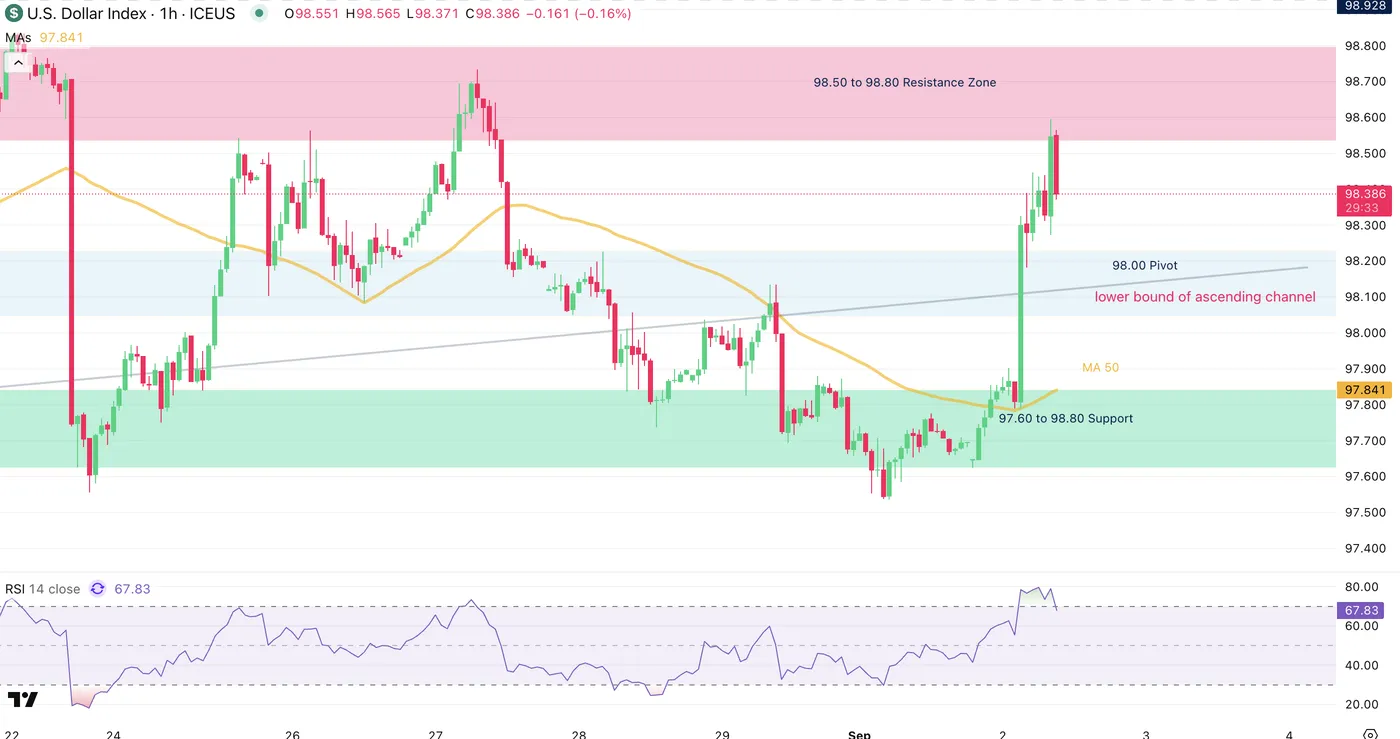
Dollar Index 1H chart, September 2, 2025 – Source: TradingView
It will be interesting to spot if players want to prolong the already extensive moves in FX after the upcoming US ISM Manufacturing report.
Don't forget to log in for our headline piece.
Safe Trades and successful week!
GBP/USD Mid-Day Outlook
Daily Pivots: (S1) 1.3510; (P) 1.3530; (R1) 1.3566; More...
GBP/USD's fall from 1.3594 resumed by diving through 1.3389 support and intraday bias is back on the downside. Corrective pattern from 1.3787 is extending with another falling leg. Deeper decline would be seen back to 1.3140 support. But downside should be contained by 38.2% retracement of 1.2099 to 1.3787 at 1.3142. But still, for now, risk will stay mildly on the downside as long as 1.3459 resistance holds, in case of recovery.

In the bigger picture, up trend from 1.3051 (2022 low) is in progress. Next medium term target is 61.8% projection of 1.0351 to 1.3433 from 1.2099 at 1.4004. Outlook will now stay bullish as long as 55 W EMA (now at 1.3104) holds, even in case of deep pullback.

EUR/USD Mid-Day Outlook
Daily Pivots: (S1) 1.1655; (P) 1.1682; (R1) 1.1713; More...
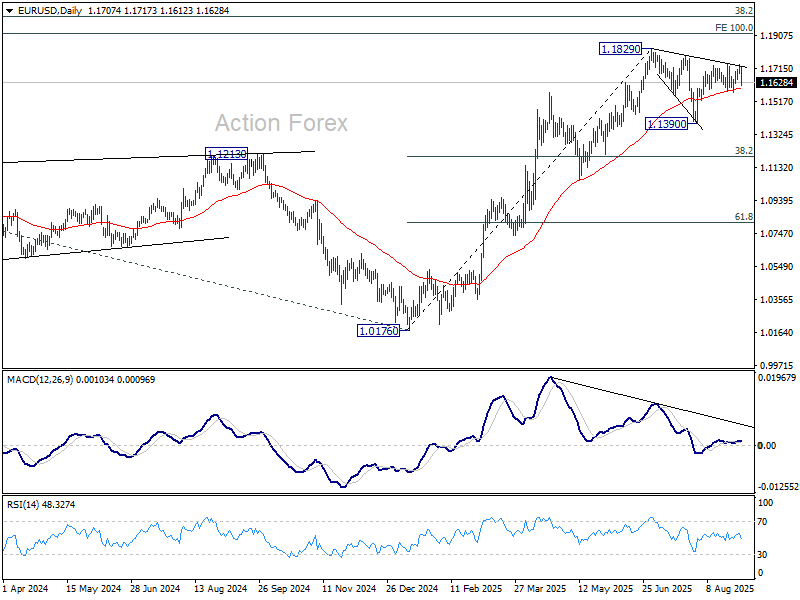
Range trading continues in EUR/USD and intraday bias remains neutral. Overall outlook is unchanged that corrective fall from 1.1829 should have completed with three waves down to 1.1390. On the upside, above 1.1741 will bring retest of 1.1829 high first. Firm break there will resume larger up trend. However, sustained break of 1.1573 will dampen this view, and indicate that corrective pattern from 1.1829 is extending with another falling leg towards 1.1390 again.
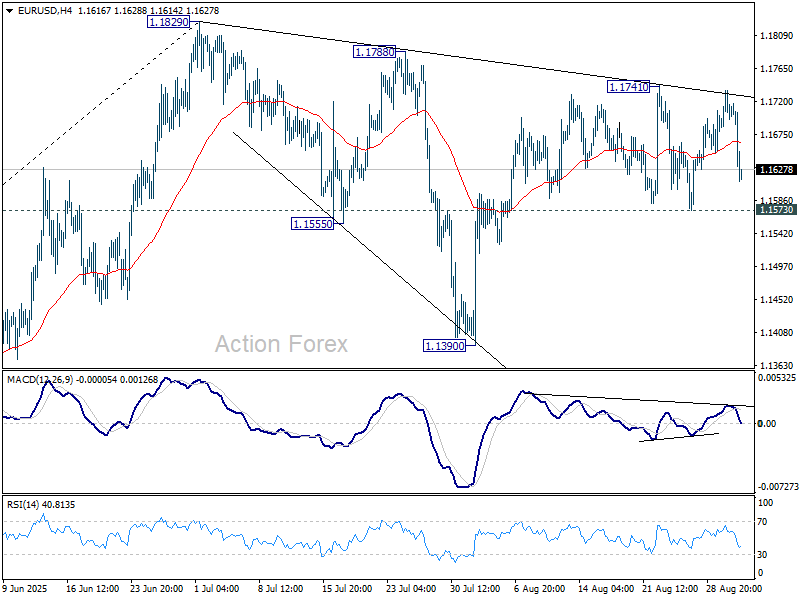
In the bigger picture, rise from 0.9534 (2022 low) long term bottom could be correcting the multi-decade downtrend or the start of a long term up trend. In either case, further rise should be seen to 100% projection of 0.9534 to 1.1274 from 1.0176 at 1.1916. This will remain the favored case as long as 1.1604 support holds.
USD/CHF Mid-Day Outlook
Daily Pivots: (S1) 0.7988; (P) 0.8002; (R1) 0.8019; More….
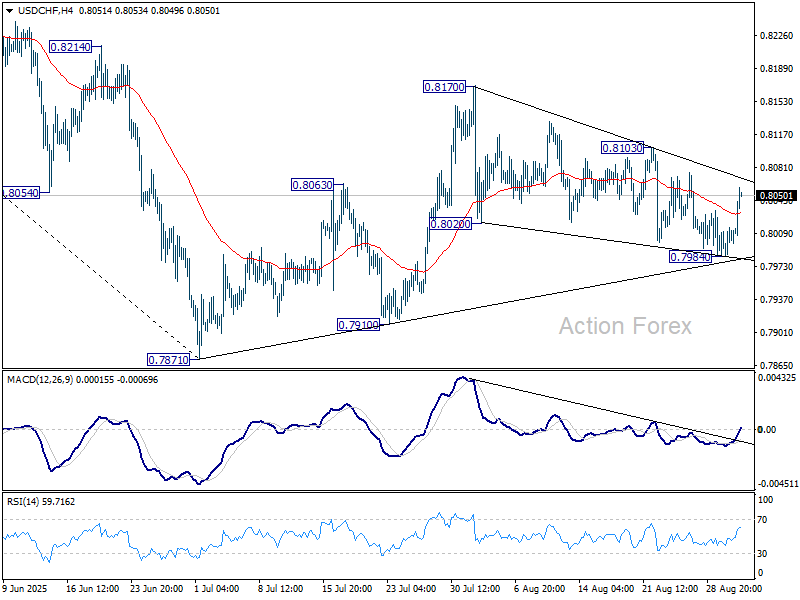
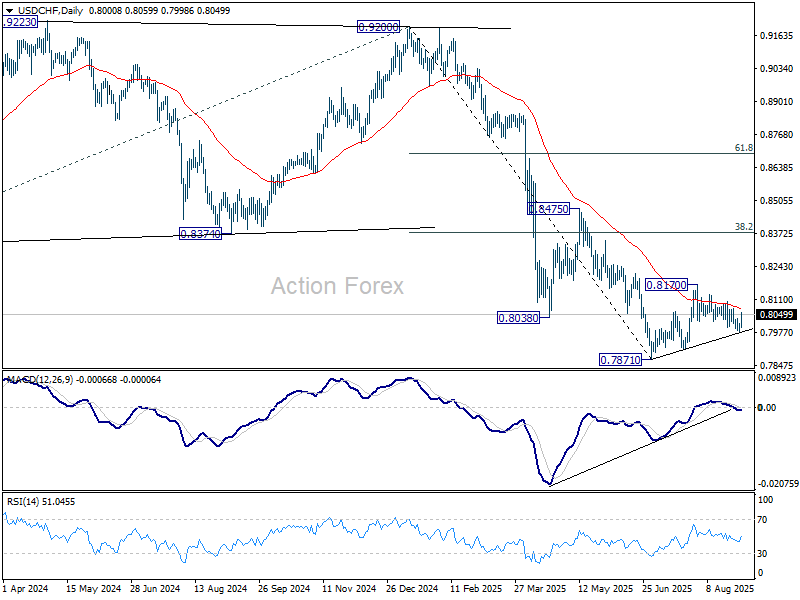
Intraday bias in USD/CHF remains neutral first. On the downside, break of 0.7984 will resume the fall from 0.8170 to 0.7910 support first, and then retest of 0.7871 low. However, break of 0.8103 resistance will turn bias to the upside to resume the rebound from 0.7871 through 0.8170.
In the bigger picture, long term down trend from 1.0342 (2017 high) is still in progress. Next target is 100% projection of 1.0146 (2022 high) to 0.8332 from 0.9200 at 0.7382. In any case, outlook will stay bearish as long as 0.8475 resistance holds.
USD/JPY Mid-Day Outlook
Daily Pivots: (S1) 146.85; (P) 147.12; (R1) 147.44; More...
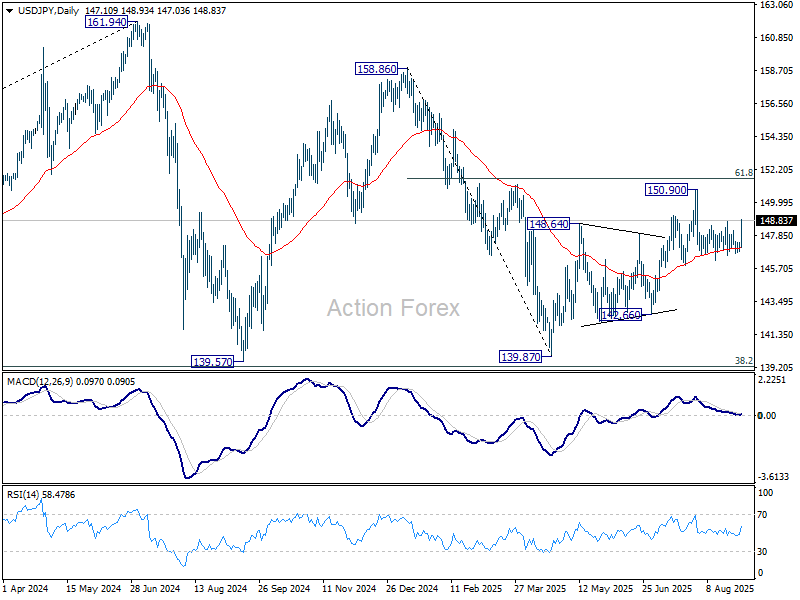
USD/JPY's break of 148.76 resistance suggests that pullback from 150.90 has already completed after drawing support from 55 D EMA (now at 147.06). Intraday bias is back on the upside for 150.90, and then 151.22 fibonacci level. Firm break there will carry larger bullish implication. On the downside, however, break of 146.65 support will resume the decline from 150.90 through 146.20 instead.
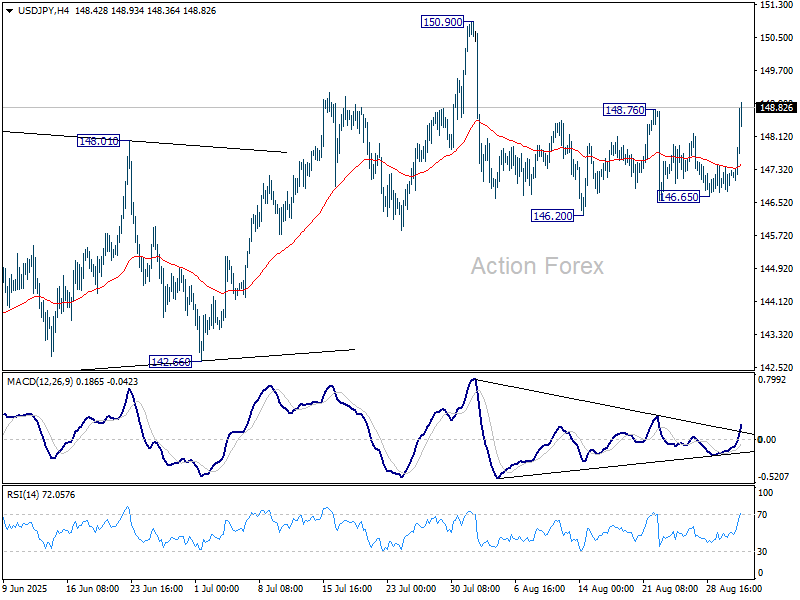
In the bigger picture, price actions from 161.94 (2024 high) are seen as a corrective pattern to rise from 102.58 (2021 low). Decisive break of 61.8% retracement of 158.86 to 139.87 at 151.22 will argue that it has already completed with three waves at 139.87. Larger up trend might then be ready to resume through 161.94 high. In case the corrective pattern extends with another fall, strong support is expected from 38.2% retracement of 102.58 to 161.94 at 139.26 to bring rebound.
EUR/GBP Mid-Day Outlook
Daily Pivots: (S1) 0.8632; (P) 0.8652; (R1) 0.8665; More...
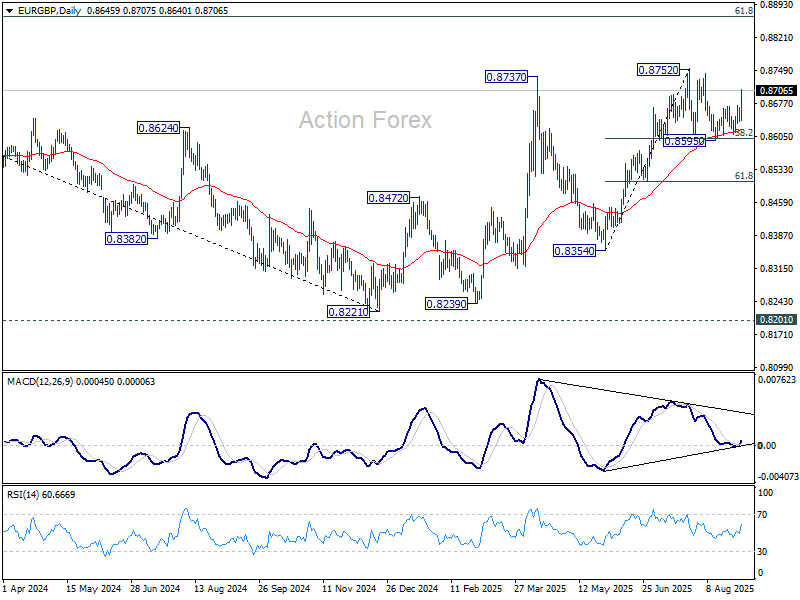
EUR/GBP's strong rally today solidifies the case that corrective pattern from 0.8752 has completed at 0.8595. Intraday bias is back on the upside for retesting 0.8752. Firm break there will resume whole rally from 0.8221. Next target is 0.8867 fibonacci level. For now, further rise is expected as long as 0.8636 support holds, in case of retreat.
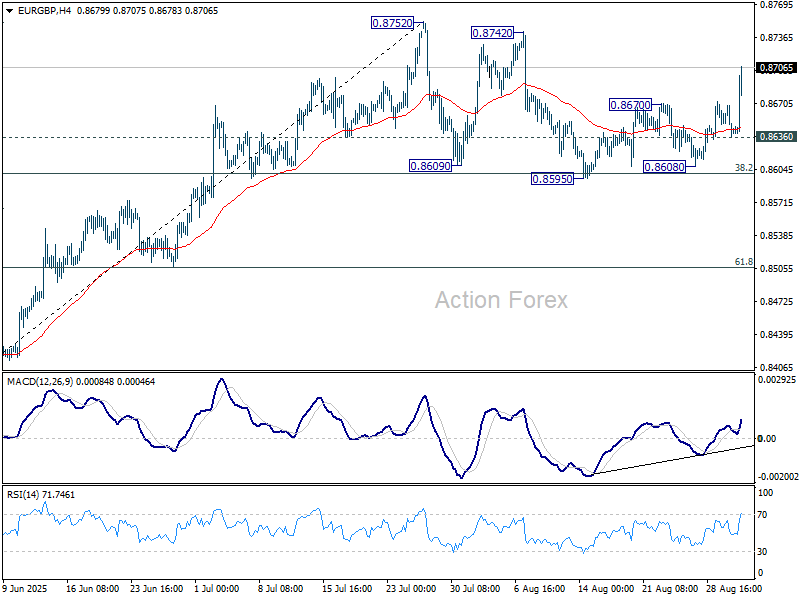
In the bigger picture, the structure from 0.8221 medium term bottom are not impulsive enough to suggest that it's reversing the down trend from 0.9267 (2022 high). But even if it's a correction, further rise could still be seen to 61.8% retracement of 0.9267 to 0.8221 at 0.8867. Nevertheless, sustained trading below 55 W EMA (now at 0.8513) will argue that the pattern has completed and bring retest of 0.8221 low.
UK Long Bonds Lead Global Selloff, Sterling Slumps on Fiscal Worries
Global bond markets came under pressure in European session, led by a sharp selloff in long-dated UK gilts. Yield on UK 30-year surged past 5.65% to its highest in 27 years, breaking above the peak set in April. Investors are increasingly concerned that Prime Minister Keir Starmer’s government may abandon fiscal discipline ahead of the upcoming Budget.
French bonds also came under strain, with the 30-year yield climbing to its highest since 2009 as Prime Minister François Bayrou scrambles to shore up parliamentary support ahead of next week’s confidence vote. U.S. Treasury yields are climbing in tandem, with the 30-year approaching 5%—a level last seen in July.
The catalyst in the UK was Starmer’s reshuffle of his Downing Street team, including the appointment of Darren Jones as chief secretary to the Treasury to manage delivery of priorities. The changes, intended to strengthen economic governance ahead of the Budget, have instead rattled markets, with traders worried about a lack of coherent strategy to revive growth while borrowing continues to swell.
Adding to the unease, speculation has resurfaced that Chancellor Rachel Reeves could be sidelined. Markets have been sensitive to such risks before—when questions arose over Reeves’ position in July, gilt yields spiked on fears she might be replaced by a more left-leaning figure less committed to fiscal prudence. The latest political maneuvering has revived those anxieties.
The immediate market reaction suggests little confidence in the government’s direction. Investors are interpreting the moves as paving the way for more gilt issuance, higher inflation, and weaker commitment to fiscal rules. Expectations are building that the Budget could lean heavily on borrowing to fund spending promises rather than tax hikes, amplifying the pressure on long-dated debt.
In currency markets, Sterling has been the weakest performer of the day, weighed down by fiscal and political concerns. Yen and New Kiwi followed on the downside, while Ddollar rebounded on support from rising Treasury yields. Loonie and Swiss Franc also gained, while Euro and Aussie traded mid-pack.
In Europe at the time of writing, FTSE is down -0.60%. DAX is down -1.57%. CAC is down -0.31%. UK 10-year yield is up 0.077 at 4.831. Germany 10-year yield is up 0.044 at 2.794. Earlier in Asia, Nikkei rose 0.29%. Hong Kong HSI fell -0.47%. China Shanghai SSE fell -0.45%. Singapore Strait Times rose 0.52%. Japan 10-year JBG yield fell -0.019 to 1.606.
ECB’s Schnabel sees no need for more easing, eyes higher inflation risks
ECB Executive Board member Isabel Schnabel pushed back against further monetary easing, telling Reuters that policy maybe already “mildly accommodative” and that she sees no case for another rate cut at present. She noted that the economy has held up better than expected, underpinned by robust domestic demand and bolstered by a "significant fiscal impulse" from Germany’s investment plans in infrastructure and defense.
Schnabel also argued that global tariffs imposed by the Trump administration are likely "on net inflationary", even without EU retaliation. “If you have an increase in input prices globally due to tariffs, and these propagate through global production networks, this will increase inflationary pressures everywhere,” she said.
Schnabel also dismissed concerns that a stronger Euro might weigh heavily on price dynamics. She said currency appreciation tied to improving Eurozone growth prospects would have a more limited pass-through, adding, “I am less concerned about exchange rate developments.” She stressed that she sees little chance of inflation expectations de-anchoring to the downside after years of price overshoots.
Looking forward, Schnabel warned that a more fragmented world with tighter supply chains, higher fiscal spending, and aging populations is structurally inflationary. In such an environment, she argued, "central banks around the world start to hike interest rates again may come earlier than many people currently think."
Eurozone CPI ticks up to 2.1%, core stays 2.3%
Eurozone headline inflation inched higher in August, with the flash CPI rising to 2.1% yoy from 2.0% yoy, in line with expectations. The increase came largely from a slower drag in energy prices, though food and services inflation moderated slightly from July levels.
Core CPI, excluding food, energy, alcohol, and tobacco, remained unchanged at 2.3% yoy, defying expectations of a slight dip to 2.2% yoy. The measure has now held steady since May.
By component, food, alcohol and tobacco continued to drive the highest annual inflation rate at 3.2%, followed by services at 3.1%. Non-energy industrial goods stayed muted at 0.8%, while energy prices fell -1.9% from a year earlier. The data suggest inflation continues to stabilize near the ECB’s 2% target.
BoJ’s Himino: Risk of larger-than-expected tariff impact warrants focus
BoJ Deputy Governor Ryozo Himino warned in a speech today that U.S. trade policies are likely to weigh on Japan’s economy, with overseas slowdowns and weaker corporate profits feeding through domestically. While accommodative financial conditions should cushion the hit, Himino said the baseline scenario is for Japan’s growth to “moderate,” with downside risks from tariffs deserving greater attention.
Looking further ahead, Himino said Japan’s growth should eventually recover as overseas economies return to a more stable expansion path. But in the near term, the tariff shock remains the key uncertainty, with the risk of a “larger-than-expected impact” now seen as more pressing than the chance of a mild outcome.
On inflation, Himino noted that headline prices remain above the BoJ’s 2% target, by a "considerable margin", due in part to surging rice prices and spillovers to other goods. However, he stressed headline inflation is expected to "decline in due course" as food-related effects fade. Underlying inflation, meanwhile, remains below target but is steadily rising, despite some potential "temporary halts", supported by a wage–price feedback loop.
Summing up, Himino said the BoJ’s baseline scenario assumes headline inflation will cool, while core prices continue to edge toward 2%. If that path holds, it would be appropriate for the central bank to keep raising rates gradually, fine-tuning monetary accommodation in line with improving economic activity and stable price gains.
EUR/GBP Mid-Day Outlook
Daily Pivots: (S1) 0.8632; (P) 0.8652; (R1) 0.8665; More...
EUR/GBP's strong rally today solidifies the case that corrective pattern from 0.8752 has completed at 0.8595. Intraday bias is back on the upside for retesting 0.8752. Firm break there will resume whole rally from 0.8221. Next target is 0.8867 fibonacci level. For now, further rise is expected as long as 0.8636 support holds, in case of retreat.
In the bigger picture, the structure from 0.8221 medium term bottom are not impulsive enough to suggest that it's reversing the down trend from 0.9267 (2022 high). But even if it's a correction, further rise could still be seen to 61.8% retracement of 0.9267 to 0.8221 at 0.8867. Nevertheless, sustained trading below 55 W EMA (now at 0.8513) will argue that the pattern has completed and bring retest of 0.8221 low.
ECB’s Schnabel sees no need for more easing, eyes higher inflation risks
ECB Executive Board member Isabel Schnabel pushed back against further monetary easing, telling Reuters that policy maybe already “mildly accommodative” and that she sees no case for another rate cut at present. She noted that the economy has held up better than expected, underpinned by robust domestic demand and bolstered by a "significant fiscal impulse" from Germany’s investment plans in infrastructure and defense.
Schnabel also argued that global tariffs imposed by the Trump administration are likely "on net inflationary", even without EU retaliation. “If you have an increase in input prices globally due to tariffs, and these propagate through global production networks, this will increase inflationary pressures everywhere,” she said.
Schnabel also dismissed concerns that a stronger Euro might weigh heavily on price dynamics. She said currency appreciation tied to improving Eurozone growth prospects would have a more limited pass-through, adding, “I am less concerned about exchange rate developments.” She stressed that she sees little chance of inflation expectations de-anchoring to the downside after years of price overshoots.
Looking forward, Schnabel warned that a more fragmented world with tighter supply chains, higher fiscal spending, and aging populations is structurally inflationary. In such an environment, she argued, "central banks around the world start to hike interest rates again may come earlier than many people currently think."
Gold Near Record Highs Poised for a New Peak
Gold prices extended their rally on Tuesday, reaching 3,490 USD per troy ounce, approaching an all-time high. The metal found support in growing expectations of a Federal Reserve rate cut as soon as September, along with a concurrent weakening of the US dollar.
Last week’s US inflation report bolstered hopes of a shift towards a more accommodative monetary policy. Markets are now pricing in an almost 90% probability of a 25-basis-point rate cut. Officials from the central bank itself reinforced this view after Mary Daly, President of the Federal Reserve Bank of San Francisco, openly expressed her support for such a move.
The key event risk this week will be the US Non-Farm Payrolls (NFP) report, expected to define the scale and pace of the upcoming rate-cutting cycle.
US trade policy is also creating substantial uncertainty. An appeals court ruled that the majority of tariffs imposed by Donald Trump were illegal, but kept them in force until 14 October to allow for an appeal to the Supreme Court. This political uncertainty is further fuelling demand for safe-haven assets.
Technical Analysis: XAU/USD
H4 chart:
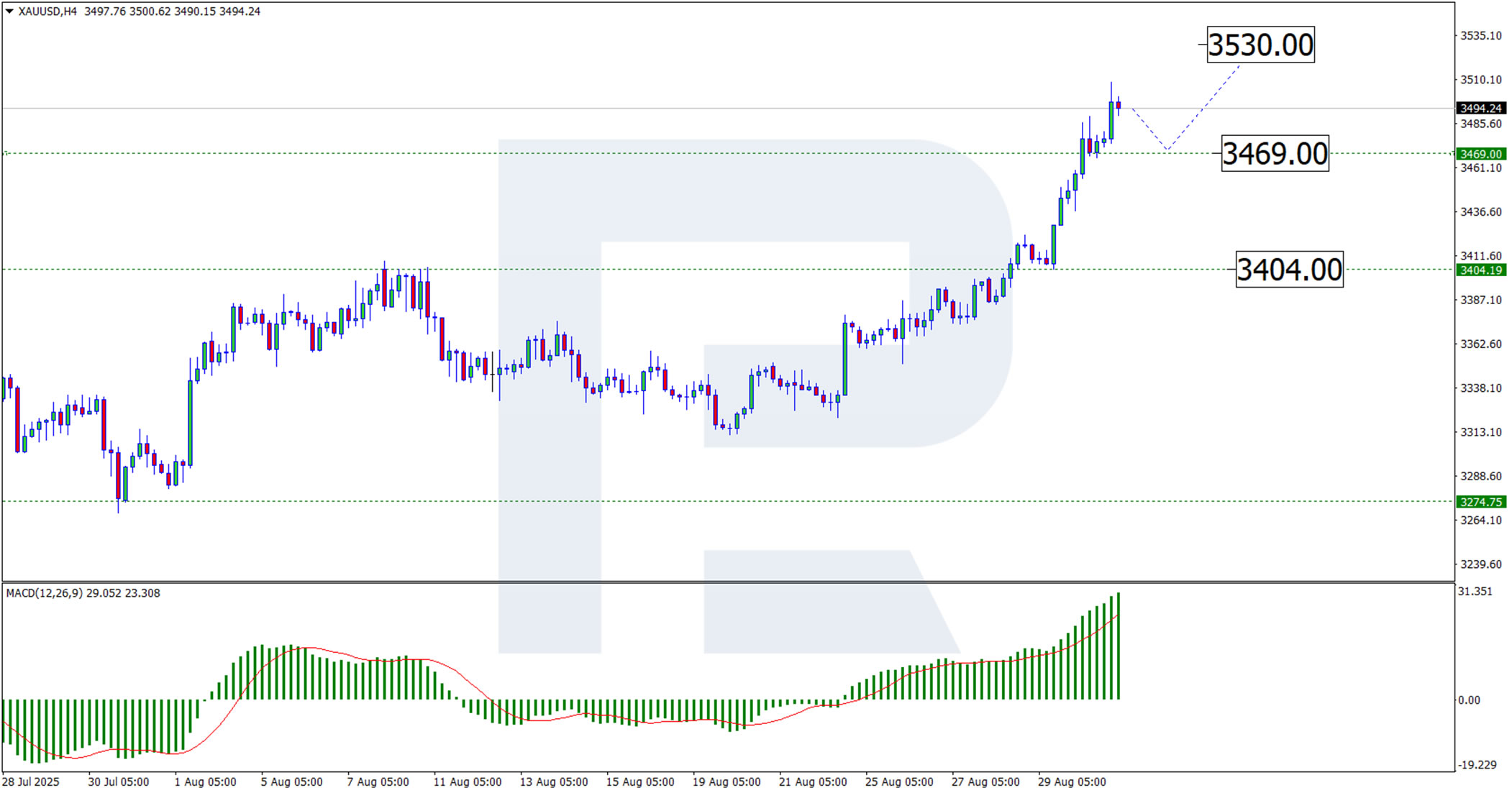
The XAU/USD pair completed an upward wave towards the 3,508.65 USD level. The focus now shifts to a potential corrective wave towards the breached resistance level, which could now function as support. The target for this correction is 3,469 USD. Against the backdrop of the Federal Reserve’s supportive economic outlook, a test of this support could see prices stage another rally, with the first target likely being the 3,530 USD mark. This scenario is technically supported by the MACD indicator, whose histogram and signal line remain above zero and continue to rise, confirming the potential continuation of the upward trend. However, minor corrections cannot be ruled out.
H1 chart:
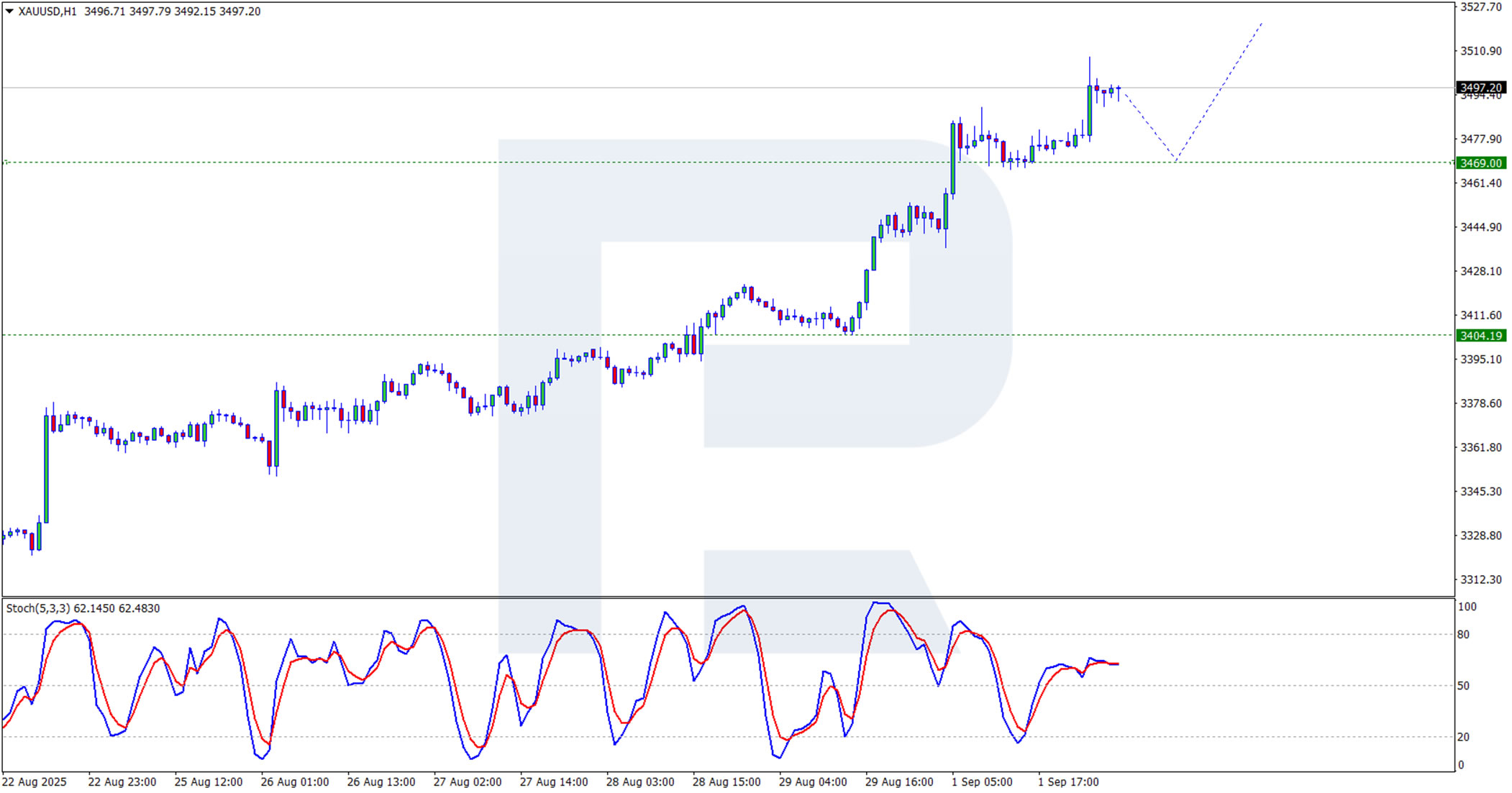
After testing the 3,500 USD level, the price is forming a corrective wave. The target for this pullback could be the support at 3,469 USD. Testing this level could pave the way for the resumption of the upward trend. This outlook is technically supported by the Stochastic oscillator, whose signal lines, after a period of increase, are now declining towards 50.0.
Conclusion
A combination of dovish Fed expectations, a softer dollar, and geopolitical trade uncertainties continues to support gold prices. The technical picture suggests a brief period of consolidation or a shallow pullback is likely before a potential retest of record highs.
GBP/USD Technical: Sterling Torpedoed by Spike in 30-Year Gilt Yield, Watch 1.3315/3280 Key Support
The sterling slumped against the US dollar, losing as much as 1.2% intraday and erasing all gains from Fed Chair Powell’s dovish Jackson Hole speech on 22 August 2025.
Based on a one-day rolling performance basis as of Tuesday, 2 September, the sterling is the weakest major currency against the greenback, where the USD/GBP gained by 1.1% at the time of writing (see Fig. 1).
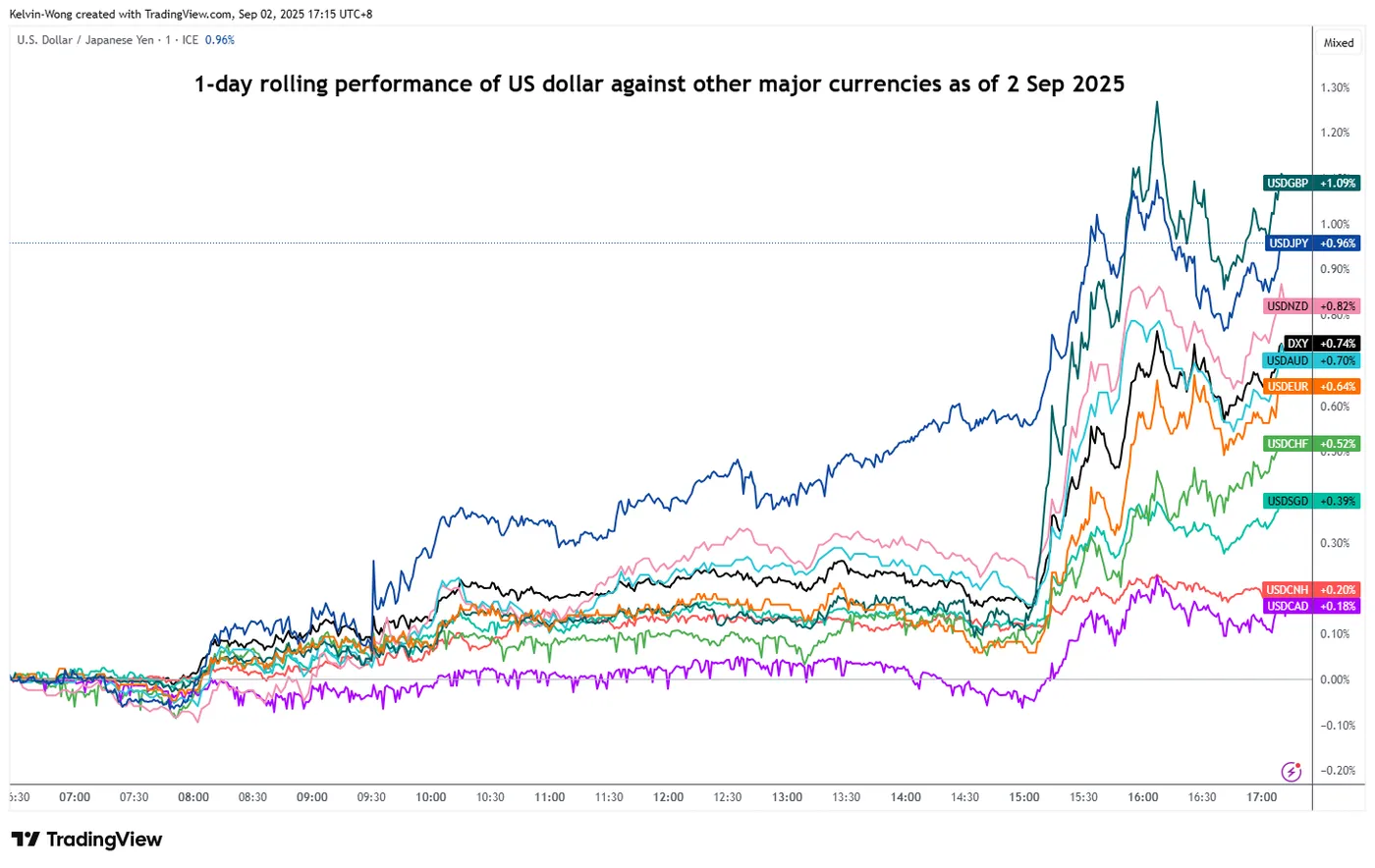
Fig. 1: 1-day rolling performances of the US dollar against major currencies as of 2 Sep 2025 (Source: TradingView)
30-year gilt yield jumped to a 27-year high
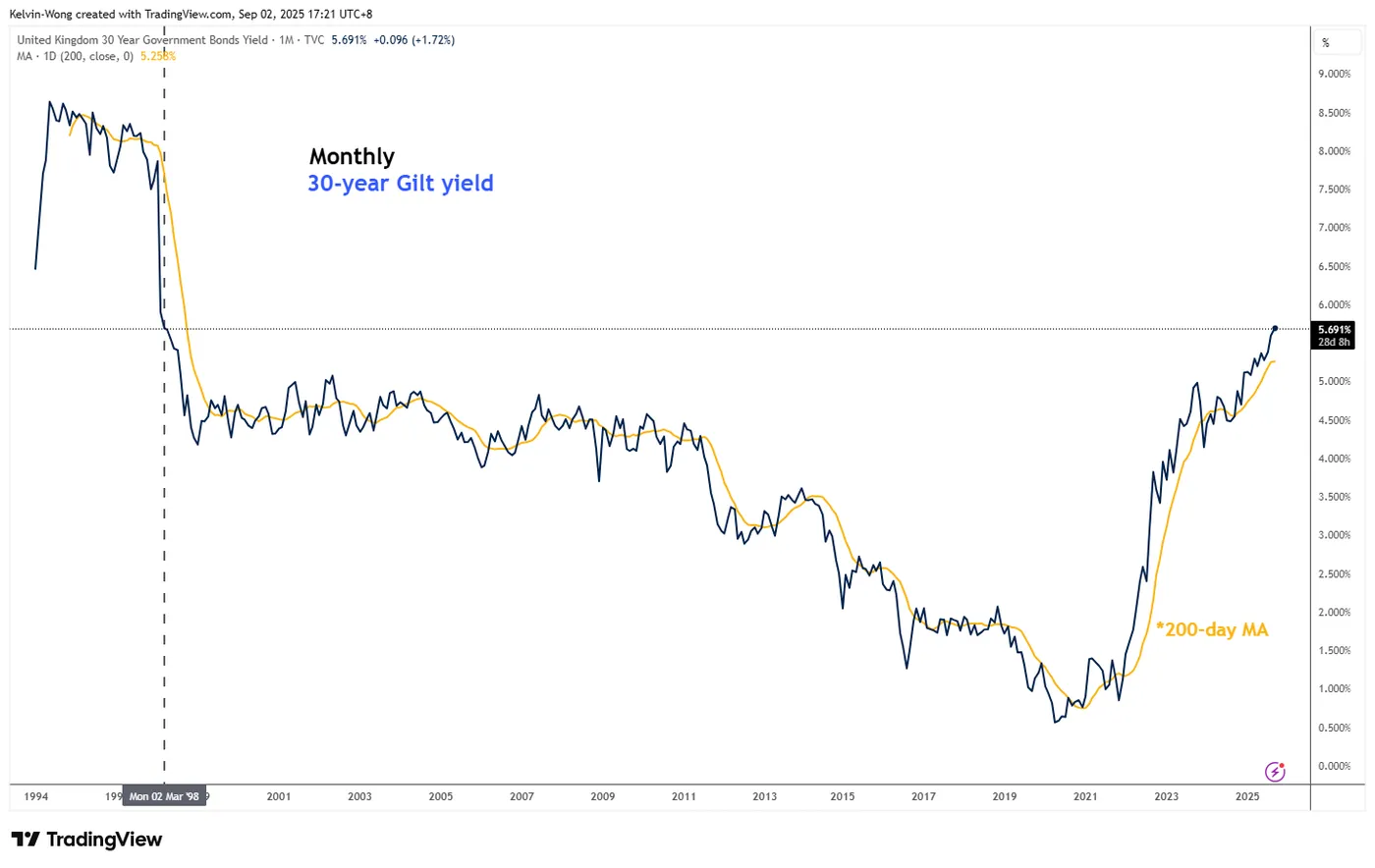
Fig. 2: 30-YR Gilt yield long-term secular trend as of 2 Sep 2025 (Source: TradingView)
The longer-term UK sovereign bond yield extended its gains further today, where the 30-year gilt yield jumped by 6 basis points to hit 5.69%, its highest level since March 1998.
The recent spike in the 30-year gilt yield is over concerns of a widening UK budget deficit due to UK Chancellor Rachel Reeves’ decision to increase borrowing in last year’s budget, in turn increasing the “risk premium” on longer-term gilts because of uncertainty over its rising debts.
Today’s current environment in the UK gilt market draws a parallel to the 2022 gilt crisis triggered by former UK Prime Minister Liz Truss’s “mini” budget that focused on a loose fiscal policy that triggered significant spikes in the 30-year gilt bond yield and a sell-off in sterling.
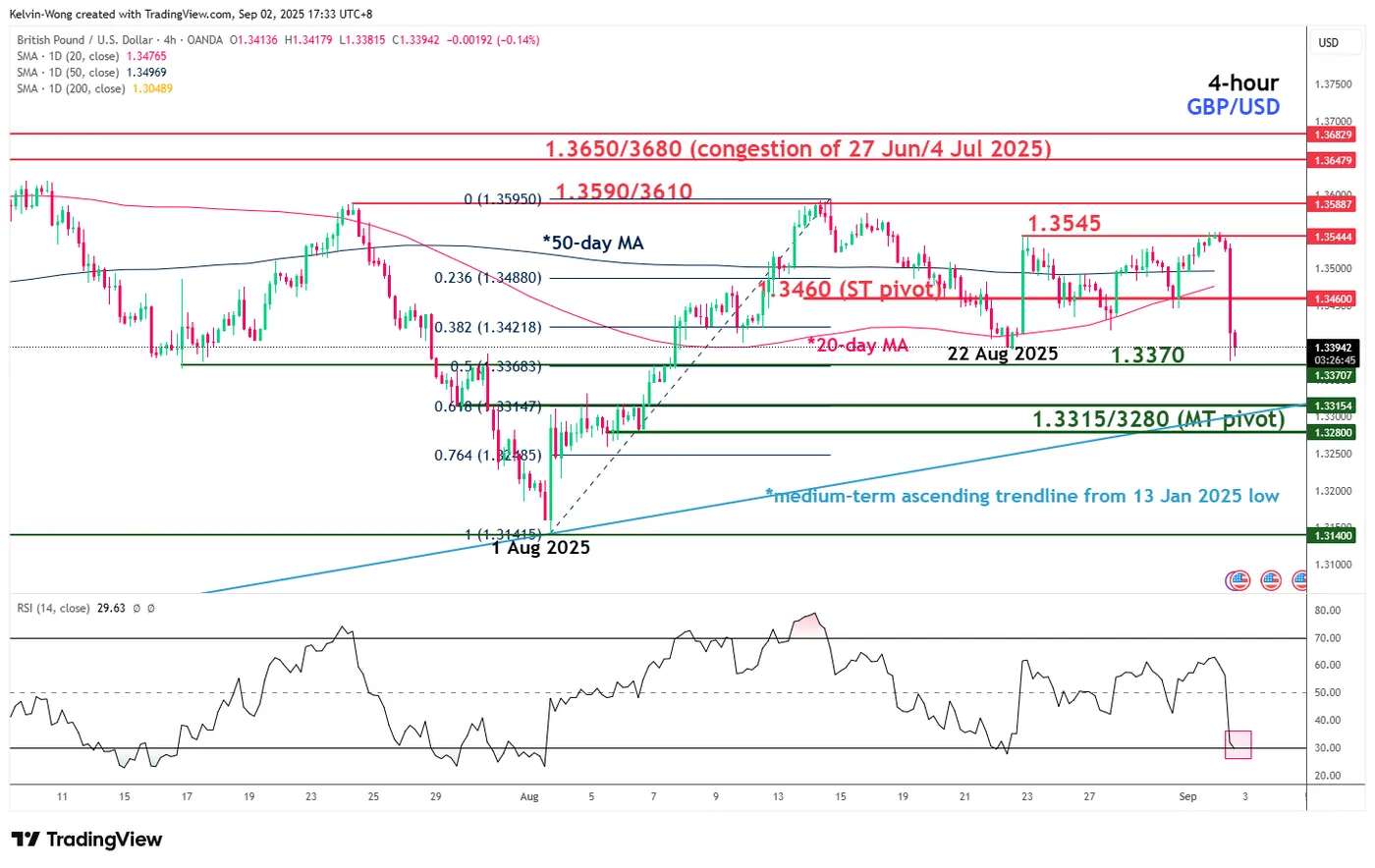
Fig. 3: GBP/USD minor trend as of 2 Sep 2025 (Source: TradingView)
Preferred trend bias (1-3 days)
Bearish bias on the GBP/USD with key short-term pivotal resistance at 1.3460 to expose the next supports at 1.3370 and 1.3315/1.3280 (medium-term pivot) (see Fig. 3).
Key elements
Price actions of the GBP/USD have traded below the 20-day and 50-day moving averages.
The 4-hour RSI oscillator has not reversed up from its oversold region (below 30), which suggests that short-term bearish momentum is likely to persist at this juncture.
The 1.3315/1.3280 medium-term pivotal support zone is defined by the medium-term ascending trendline from the 13 January 2025 low, the former minor congestion area from 4 August 2025 to 6 August 2025, and the 61.8% Fibonacci retracement of the prior minor rally from the 1 August 2025 low to 14 August 2025 high.
Alternative trend bias (1 to 3 days)
A clearance above 1.3460 key resistance on the GBP/USD negates the bearish tone to retest the minor range resistance of 1.3545.