




ECB Holzmann: Rise deposit rate to zero by year end important

    ECB Governing Council member Robert Holzmann said, “an increase to the deposit rate to zero by the end of the year would be important for monetary policy because it increases optionality.”

    “If, towards the end of the year, we were to find that inflation will remain higher for longer, we would have to tighten monetary policy more and raise interest rates more significantly,” he added.

    ECB Lane: There are mixed signals coming through

      ECB Chief Economic Philip Lane said in an interview, “right now, clearly inflation is a huge issue across Europe, absolutely.” But he added, “this essentially is an imported inflation shock, it’s a supply shock… we would still maintain … most of this inflation will fade away”.

      “We do think that inflation will decline later this year and will be a lot lower next year and the year after compared to this year,” he added.

      “There are mixed signals coming through… some indices are showing upside concern for energy prices and other indices are showing downside concern for activity levels through the sentiment channel.”

      “In March we had an inflation outlook which was getting close to 2 per cent. If that outlook is maintained, we will be looking to end net purchases in the third quarter. If it weakens, or if financing conditions deteriorate, that would be inconsistent with delivering that action. Then we would have to think again,” Lane added.
      Full interview here.

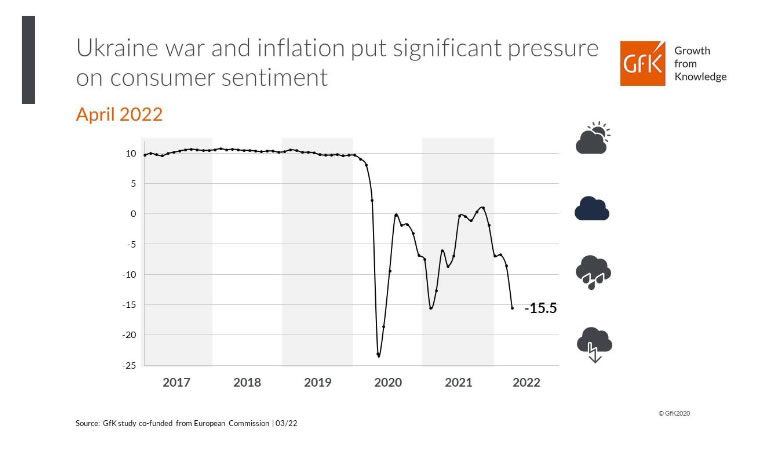
      Germany Gfk consumer sentiment dropped to -15.5, hopes vanished into thin air

        Germany Gfk consumer sentiment for April dropped sharply from -8.5 to -15.5. In March, economic expectations dived from 24.1 to -8.9, lowest since May 2020 during the first lockdown at -10.4. Income expectations tumbled from 3.9 to -22.1, hitting the lowest value since 2009, which was at -22.9. Propensity to buy dropped slightly from 1.4 to -2.1.

        “In February hopes were still high that consumer sentiment would recover significantly with the foreseeable easing of pandemic-related restrictions. However, the start of the war in Ukraine caused these hopes to vanish into thin air. Rising uncertainty and sanctions against Russia have caused energy prices in particular to skyrocket, putting a noticeable strain on general consumer sentiment,” explains Rolf Bürkl, GfK consumer expert.

        Full release here.

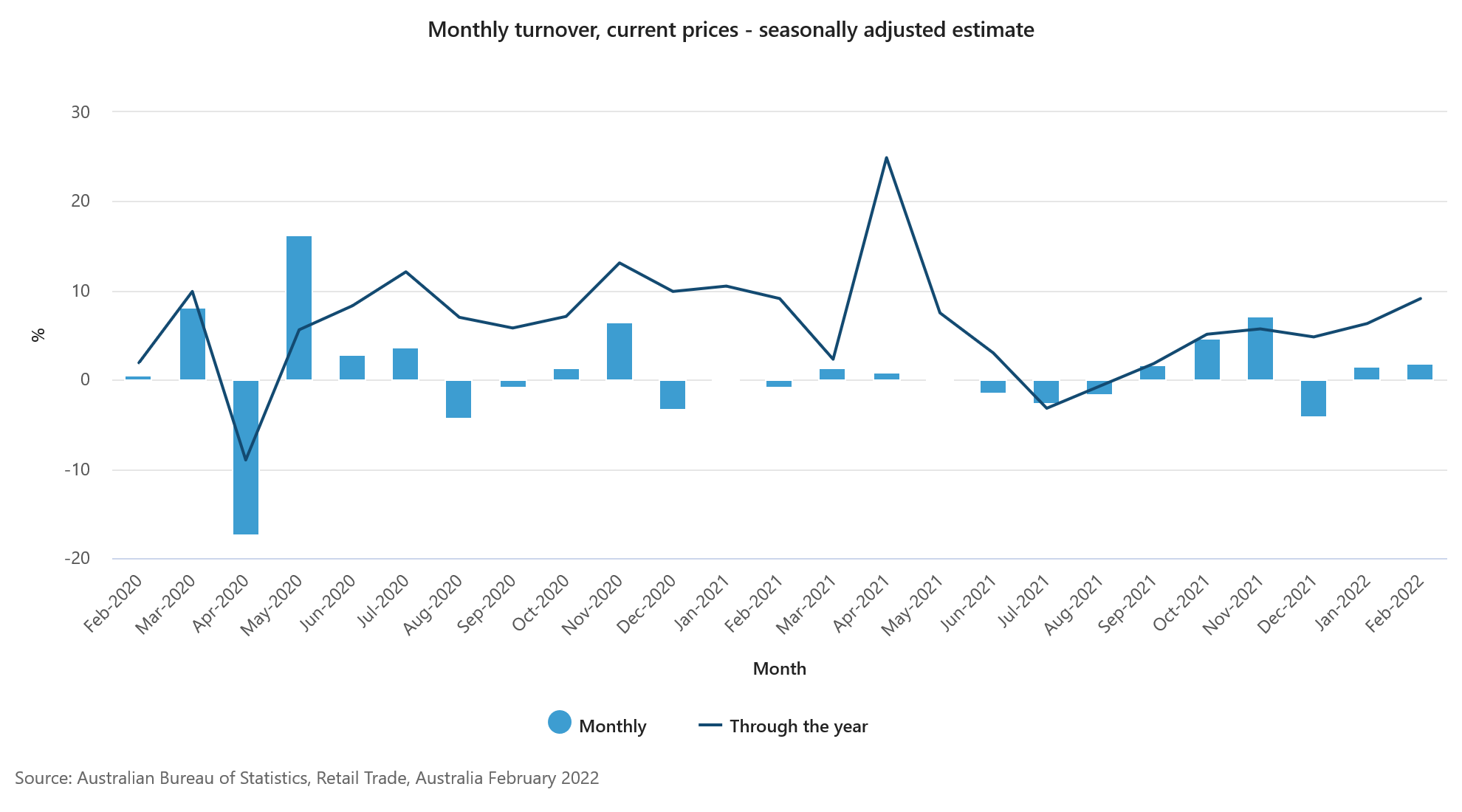
        Australia retail sales rose 1.8% mom in Feb, hitting second highest on record

          Australia retail sales rose 1.8% mom to AUD 33.09B in February, well above expectation of 1.0% mom.

          Director of Quarterly Economy Wide Statistics, Ben James, said February’s result saw retail sales reach their second highest level on record after November 2021 and turnover continuing to regain lost momentum caused by the peak of the Omicron outbreak in January.

          “Lower COVID-19 case numbers in February, alongside the further easing of restrictions over the month, saw consumer spending return to similar behaviour seen previously as states and territories come out of a COVID-19 wave,” James said.

          Full release here.

          BoJ opinions emphasize importance to maintain monetary easing

            In the Summary of Opinions of the March 17-18 meeting, BoJ noted, “unlike the United States and the United Kingdom, Japan is not in a situation where the inflation rate will likely exceed the price stability target of 2 percent in a continuous manner.” Hence, “it is important for the Bank to continue with monetary easing to support the economic recovery from the pandemic.”

            Situations surrounding Ukraine have “caused price rises of energy and other items”, and this will “push down domestic demand while raising the CPI.” Under these circumstances, it is “necessary to improve labor market conditions and provide stronger support for wage increases”.

            One member warned that “if downward pressure on economic activity and prices increases, the economy may instead be in danger of falling into deflation again. If it becomes difficult to achieve the price stability target, the Bank should act nimbly and without hesitation.”

            Full Summary of Opinions here.

            Japan FM Suzuki carefully watching bad yen weakening

              Japan Finance Minister Shunichi Suzuki said the government is carefully watching the foreign exchange market to avoid “bad yen weakening”. He repeated that currency stability was important. While a weak Yen is positive for exporters, it’s negative for household on popping up living costs.

              Yesterday, BoJ started offering four days of unlimited bond purchases to defend the 0.25% cap of 10-year JGB yield. The first offer drew no bid but JPY 64.5B in JGBs were accepted in the second offer. According to the current guidance, BoJ targets to keep 10-year JGB yield at around 0% with 25bps limit up and down.

              US exports rose $1.9B in Feb, imports rose $0.9B

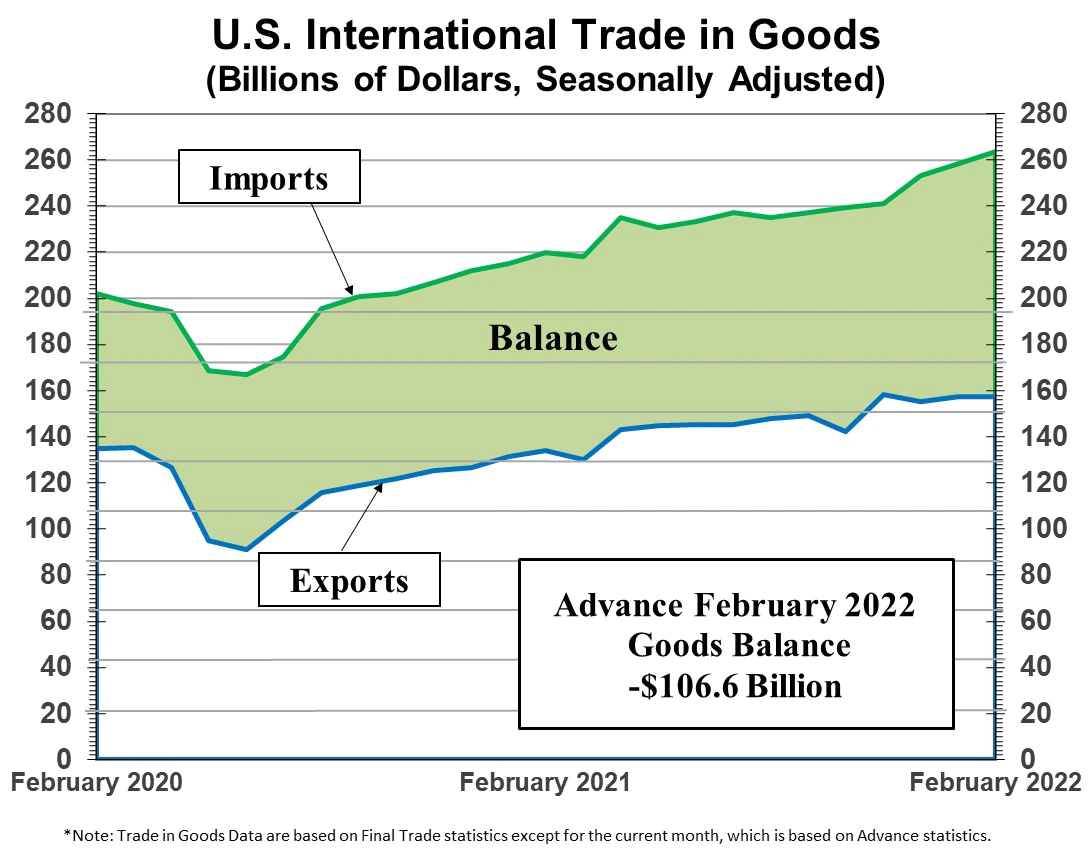
                US exports of goods rose USD 1.9B to USD 157.2B in February. Imports of goods rose USD 0.9B to USD 263.7B. Trade deficit narrowed from USD -107.6B to USD -106.6B, still larger than expectation of USD -106.0B.

                Wholesales inventories rose 2.1% mom to USD 814.7B. Retail inventories rose 1.1% mom to USD 665.6B.

                Full release here.

                BoE Bailey: Takes time to properly assessment join experience of COVID and Ukraine

                  BoE Governor Andrew Bailey said today, the forward guidance language was “very cautious” because of the high uncertainty. And it will take time to properly assessment how the “joint experience of COVID and Ukraine invasion causes world economy to emerge into new steady state.”

                  “Liquidity conditions have deteriorated in many commodity markets, margining costs have risen, which is of course a reflection of much higher volatility and risks in these markets,” he said. “We can’t take resilience, in particular in that part of the market, for granted. There’s a strong need to work together on this,” he said.

                  Bailey added that he’s starting to see evidence of an economic slowdown in business and consumer surveys. “We expect that this pressure on demand will weigh down on domestically generated inflation, other things equal at the moment,” he said.

                  Bitcoin surges and 50k handle is key

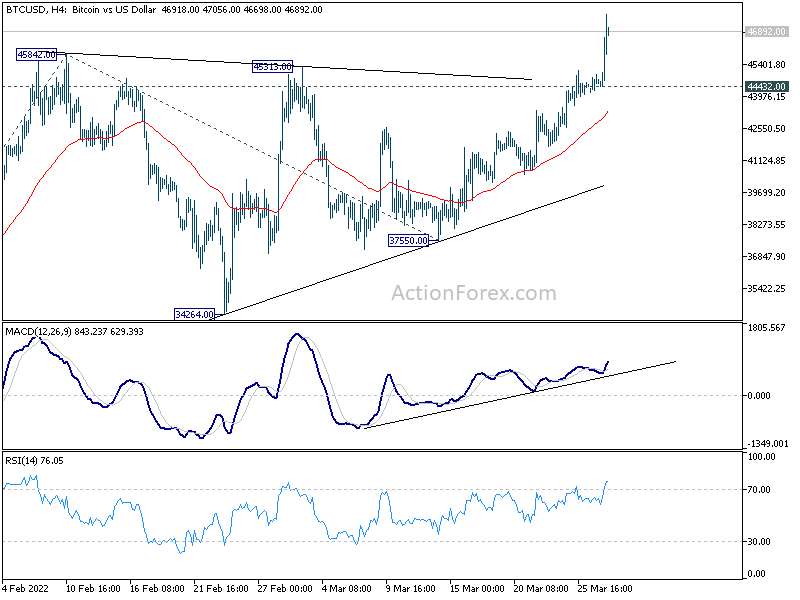
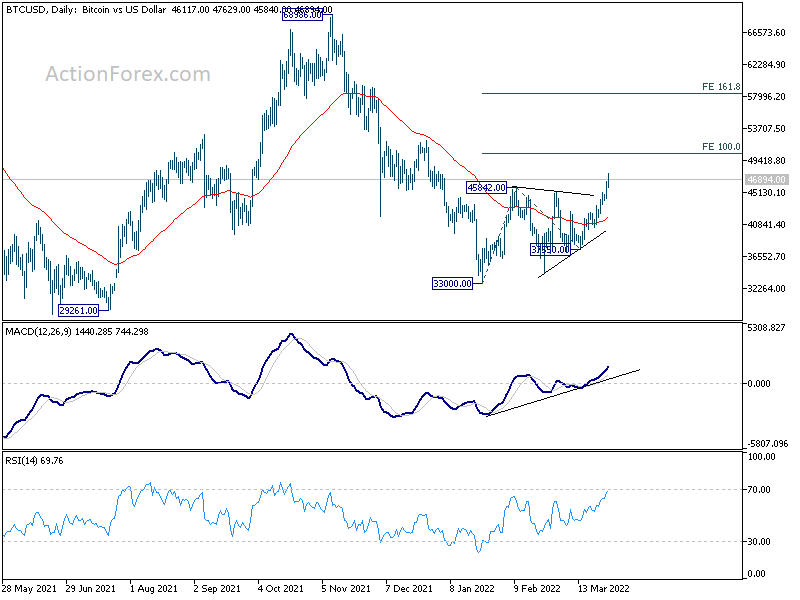
                    Bitcoin surged over the weekend and broke through 45842 near term resistance. The development confirms resumption of whole rebound from 33000. Near term outlook will stay bullish as long as 44432 support holds. Next target is 100% projection of 33000 to 45842 from 37550 at 50392.

                    For now it’s too early to conclude the trend in bitcoin is reversing. Rejection by 50392 will argue that rebound from 33000 is merely a correction, and bring down trend resumption through this low at a later stage. But sustained break of 50392 could trigger upside acceleration and solidify trend reversal. So, the level around 50k handle is key.

                    AUD/NZD extending rally, AUD/CAD to follow

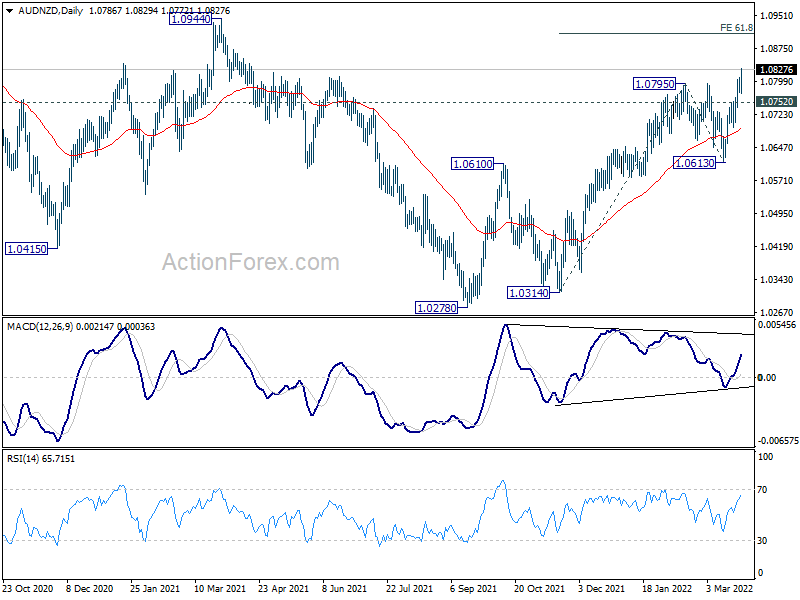
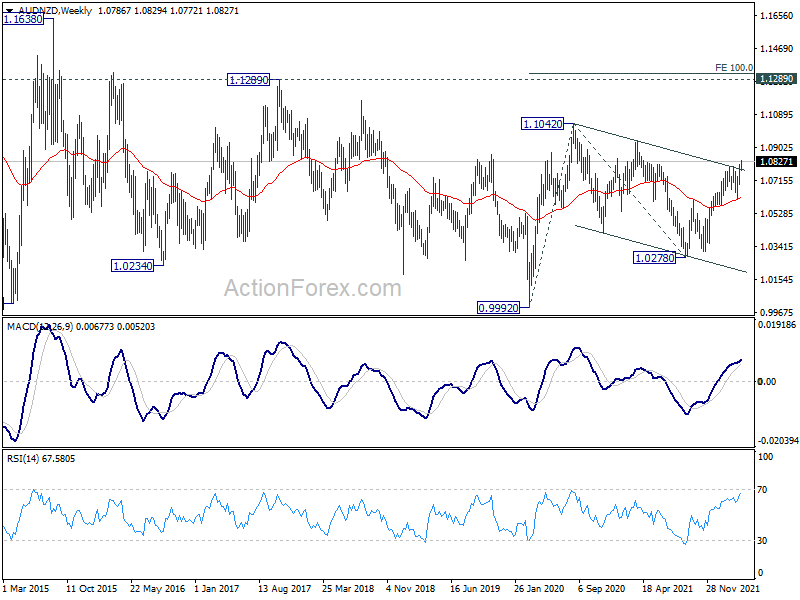
                      Aussie is outperforming other commodity currencies in the past two weeks. AUD/NZD’s rally extends today to as high as 1.0825 so far. The break of 1.0795 resistance confirms resumption of whole rise from 1.0278. Near term outlook will stay bullish as long as 1.0752 support holds, next target is 61.8% projection of 1.0314 to 1.0795 from 1.0613 at 1.0910.

                      More importantly, the strong support from 55 week EMA suggests some underlying medium term bullishness. The break of channel resistance from 1.1042 also argues that the correction from there has completed with three waves down to 1.0278. Rise from 0.9992 (2020 low) is likely resuming through 1.1042 towards 1.1289 long term resistance.

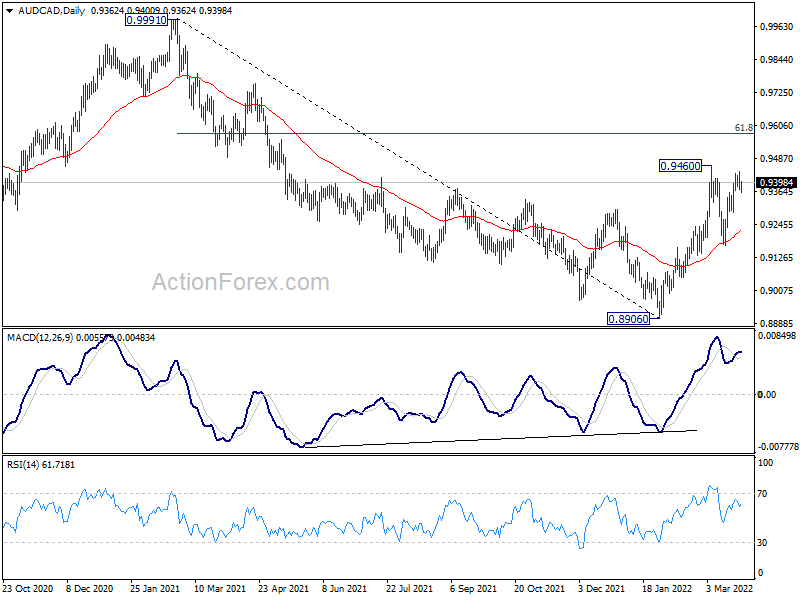
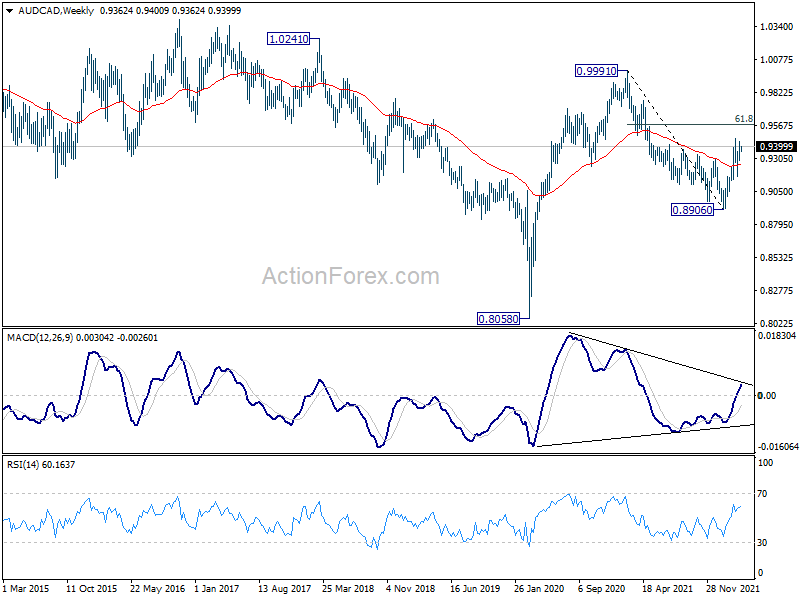
                      Meanwhile, AUD/CAD is still capped below 0.9460 short term top for now. But the strong support from 55 day EMA gives upside breakout a favor. Break of 0.9460 will resume the rebound from 0.8960 to 61.8% retracement of 0.9991 to 0.8906 at 0.9577. Sustained break there will further affirm the case that correction from 0.9991 has completed at 0.8906. Also, in this case, the larger rise from 0.8058 (2020 low) should be ready to resume through 0.9991 at a later stage.

                      Australian NAB quarterly business confidence dropped to 14, still optimistic growth picture

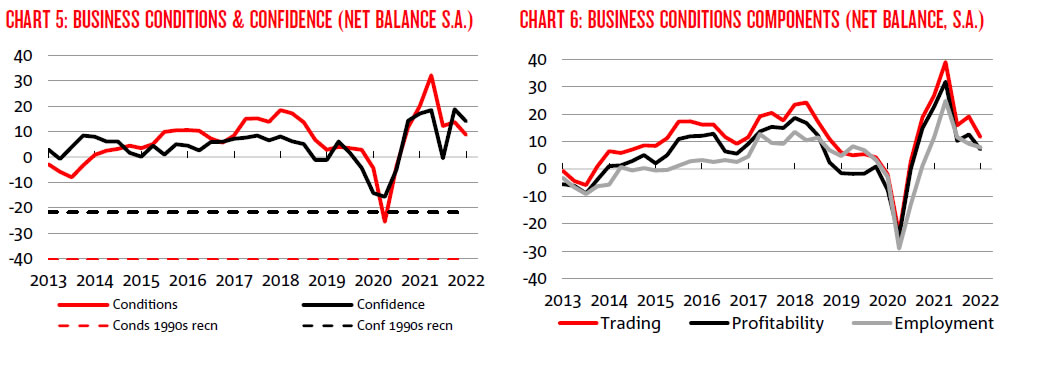
                        Australia NAB Quarterly business confidence dropped from 19 to 14 in Q1. Current business conditions dropped from 14 to 9. Business conditions for the next three months dropped from 29 to 21. Business conditions for the next 12 months dropped from 36 to 34. trading conditions dropped from 19 to 12. Profitability conditions dropped from 13 to 7. Employment conditions dropped from 9 to 8. Capex plans for the next 12 months dropped from 34 to 33.

                        “Overall, the survey continues to paint an optimistic picture on growth – including the potential for a pickup in business investment. This comes despite global events and still some disruption from the virus. That said, the challenges for both business and policy makers remain clear with price pressures continuing to build.”

                        Full release here.

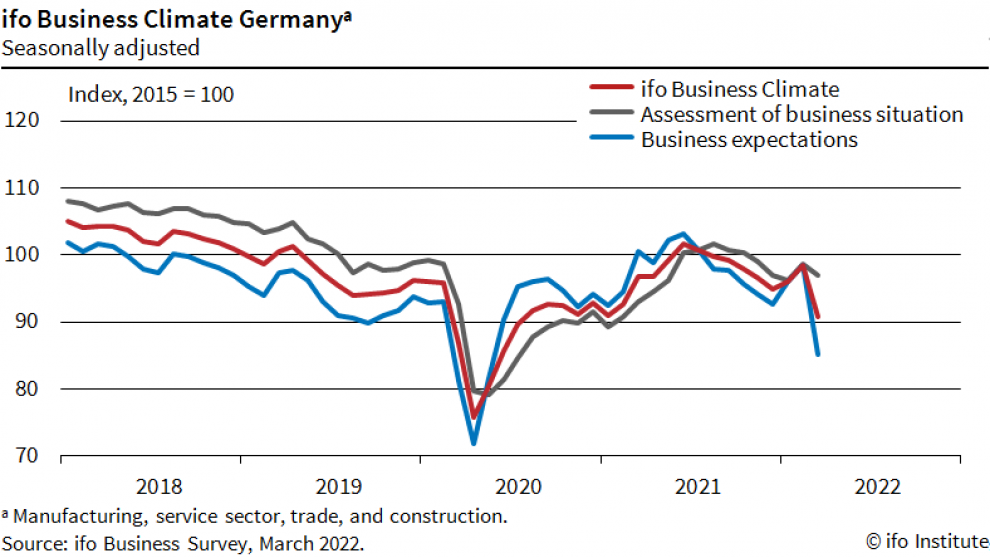
                        Germany Ifo business climate dropped to 90.8, record collapse in expectations

                          Germany Ifo Business Climate dropped from 98.5 to 90.8 in March, below expectation of 94.5. Current Situation index dropped from 98.6 to 97.0, below expectation of 97.3. Expectations index dropped from 98.4 to 85.1, well below expectation of 97.2, and a record collapse.

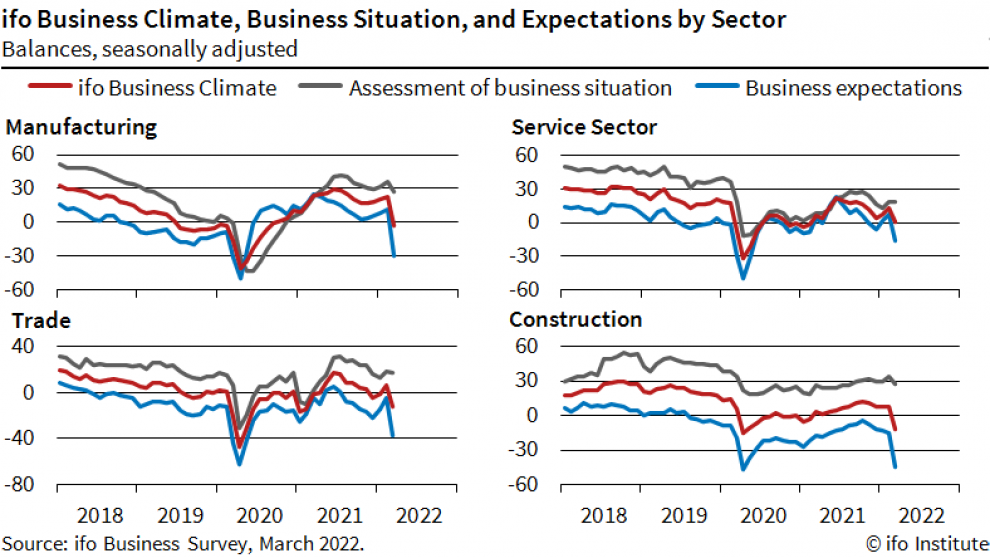
                          By sector, manufacturing dived from 23.1 to -3.3. Services dropped from 13.6 to 0.7. Trade dropped from 6.6 to -12.0. Construction dropped from 8.0 to -12.2.

                          Full release here.

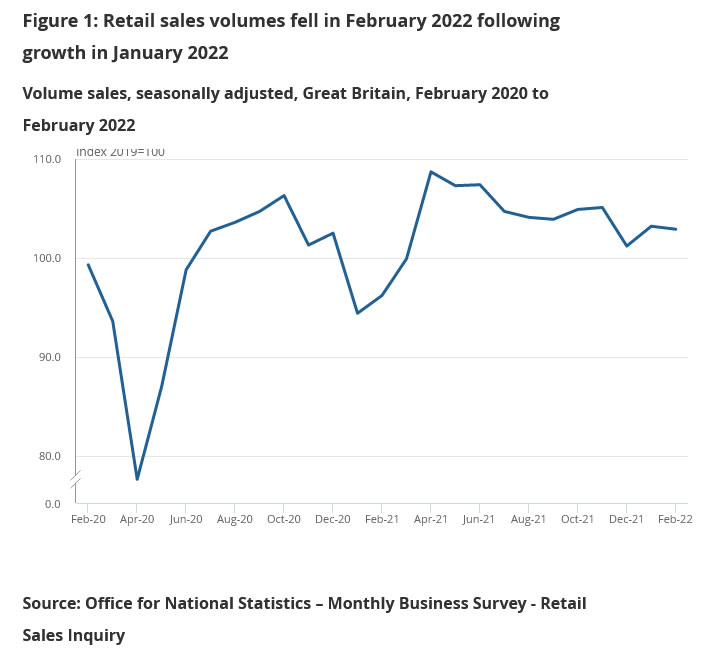
                          UK retail sales dropped -0.3% mom in Feb, ex-fuel sales down -0.7% mom

                            UK retail sales volume dropped -0.3% mom in February, much worse than expectation of 1.0% mom rise. On a 12-month basis, sales rose 7.0% yoy, below expectation of 7.8% yoy. Also, sales volume was 3.7% above pre-pandemic level in February 2020.

                            Ex-fuel sales volume dropped -0.7% mom, below expectation of 0.5% mom. On a 12-month basis, sales rose 4.6% yoy, below expectation of 5.0% yoy. Ex-fuel sales volume was 4.0% above pre-pandemic level in February 2020.

                            Auto fuel sales volume rose 3.6% mom, above pre-pandemic level (by 0.9%) for the first time, on lifting of restrictions and increased travel.

                            Full release here.

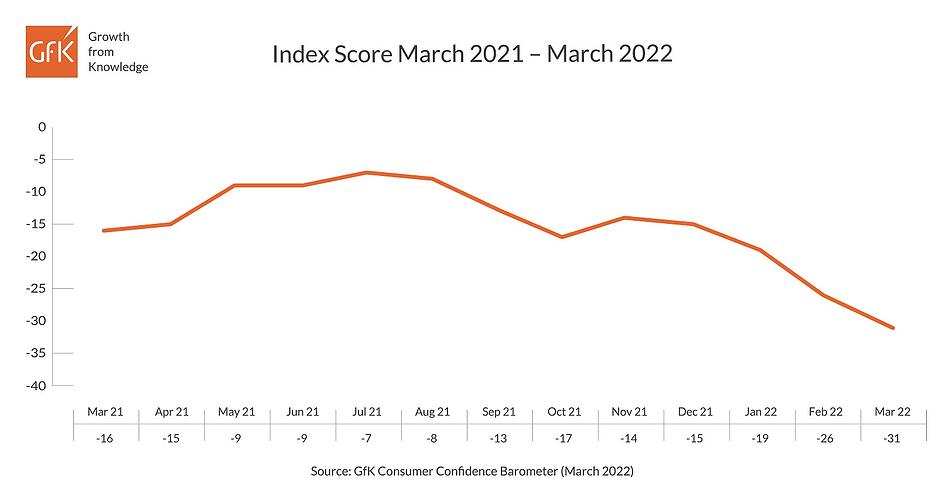
                            UK Gfk consumer confidence dropped to -31, a wall of worry is confronting

                              UK Gfk Consumer Confidence Index dropped from -26 to -31 in March. That’s the lowest level since November 2020. Personal Financial Situation over last 12 months dropped from -11 to -13. Personal Financial Situation over next 12 months dropped from -14 to -18. General Economic Situation over last 12 months dropped slightly from -50 to -51. Genera Economic Situation over next 12 months dropped from -43 to -49.

                              Joe Staton, Client Strategy Director GfK, says: “A wall of worry is confronting consumers this month and there is an unmistakable sense of crisis in our numbers. Consumers across the UK are experiencing the impact of soaring living costs with 30-year-high levels of inflation, record-high fuel and food prices, a recent interest-rate hike and the prospect of more increases to come, and higher taxation too – all against a background of stagnant pay rises that cannot compensate for the financial duress. This is the fourth month in a row that UK consumer confidence has dropped.”

                              Full release here.

                              BoJ Kuroda: Weak yen is generally positive for Japan’s economy

                                BoJ Governor Haruhiko Kuroda told the parliament, “there’s no change now to my view a weak yen is generally positive for Japan’s economy.”

                                He also reiterated the view that “cost-push inflation that is not accompanied by wage hikes will hurt Japan’s economy.” And as such, “it won’t lead to sustained achievement of our price target. That’s why the BOJ will continue to maintain powerful monetary easing.”

                                ECB Schnabel leaves the door ajar on asset purchases

                                  ECB Executive Board member Isabel Schnabel said yesterday that it had “left the door ajar” for more asset purchases if the impact of Russia invasion of Ukraine turn out to be much worse.

                                  “If we now fall into a deep recession due to the Ukraine crisis, we’ll have to rethink that,” she said. “Otherwise, we’ll end the bond purchases in the third quarter and as soon as we’ve done that we can raise rates at any time depending on how inflation develops.”

                                  Separately, Governing Council member Mario Centeno emphasized “normalization of the ECB’s monetary policy will be carried out gradually and proportionally at the end of this year”.

                                  Fed Evans comfortable with 25 bps hike, open to 50bps

                                    Chicago Fed President Charles Evans said he’s “comfortable” with a 25bps hike and “open” to a 50bps move.

                                    “We want to be careful, we want to be humble and nimble, and get to neutral before too long — maybe 50 helps, I’m open to that,” he said in a Q&A session after a speech. “I would be comfortable with each meeting increasing by a quarter point.”

                                    “This is a signal of more general pressure from aggregate demand on today’s impinged supply,” he said in the speech. “If monetary policy did not respond to these broader pressures, we would see higher inflation become embedded in inflation expectations, and we would have even harder work to do to rein it in.”

                                    “Policymakers need to be cautious, humble, and nimble as we navigate the course ahead,” Evans said. “Monetary policy is not on a preset course” but will be decided at each Fed meeting.

                                    Fed Kashkari: There’s a danger to overdoing rate hikes

                                      Minneapolis Fed President Neel Kashkari said he has penciled in seven 25bps rate hike this year as “we need to adjust” monetary policy. “The data just keeps coming in in that direction, and we just have to respond,” referring to skyrocketing inflation.

                                      However, he warned that “there’s a danger to overdoing it”. Supply bottlenecks could be fixed faster than expected, or labors could return in big numbers. He added, “we’re going to get information”.

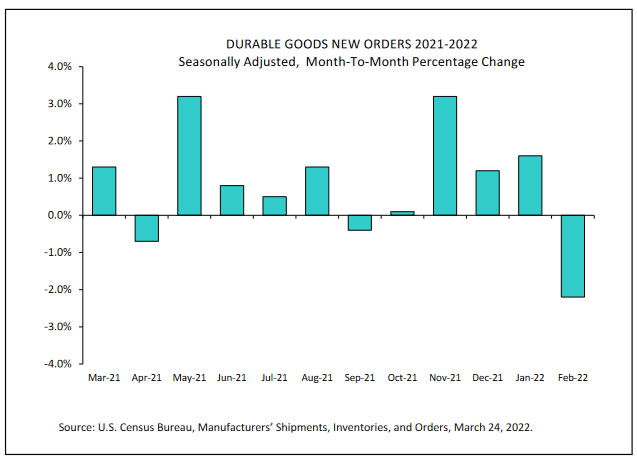
                                      US durable goods orders dropped -2.2% mom in Feb, ex-transport orders dropped -0.6% mom

                                        US durable goods orders dropped -2.2% mom in February to USD 271.5B, worse than expectation of -0.6% mom. Ex-transport orders dropped -0.6% mom, below expectation of 0.6% mom. Ex-defense orders dropped -2.7% mom. Transportation equipment dropped for the third straight month, by -5.6% mom to USD 82.6B.

                                        Full release here.

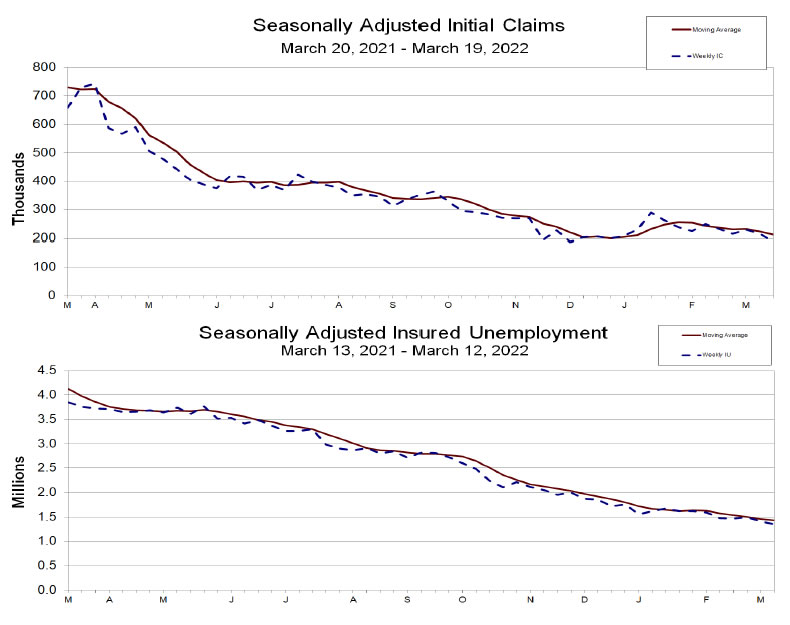
                                        US initial jobless claims dropped to 187k, lowest since 1969

                                          US initial jobless claims dropped -28k to 187k in the week ending March 19, much better than expectation of 210k. That’s also the lowest level since September 6, 1969, when it was 183k. Four-week moving average of initial claims dropped -12k to 212k.

                                          Continuing claims dropped -67k to 1350k in the week ending March 12. That’s the lowest since January 3, 1970, when it was 1332k. Four-week moving average of continuing claims dropped -31k to 1432k, lowest since February 28, 1970, when it was 1421k.

                                          Full release here.