




RBA Lowe outlined four changes on monetary policy front this year

    RBA Governor Philip Lowe outlined four changes on the monetary policy front during 2020. Firstly, the nature of RBA” forward guidance has moved to  place much more weight on actual outcomes, rather than forecast outcomes”. An example is seen in the statement, where RBA said “the Board will not increase the cash rate until actual inflation is sustainably within the 2 to 3 per cent target range.” For this to occur wages growth will have to be “materially higher than it is currently”, which requires “significant gains in employment and a return to a tight labour market.” A second and related change has been a shift in the relative weight given to jobs and inflation.

    The third change is a “strengthening in the gravitational pull of low global interest rates. Ignoring this would have “obvious implications for our exchange rate and our economy.” “Over the medium term, I do expect to see a time when Australia’s strong economic conditions once again justify higher interest rates. But today, during a global pandemic when a lot of people have lost their jobs and many businesses are struggling, is not the time for that.”

    The fourth change was “the return to a world in which quantities, not just prices, matter.”

    Full speech here.

    China industrial production maintained 6.9% growth, fixed investments accelerate

      In China, industrial production grew 6.9% yoy in October, matched expectations. The figure was unchanged from September’s growth. Fixed asset investment grew 1.8% ytd yoy, above expectation of 1.6%. But retail sales rose only 4.3% yoy, below expectation of 5.0% yoy. That’s nevertheless still the strongest rise this year, as led by 12.5% growth in auto sales.

      Overall, the set of data suggested that China’s economy maintained broad-based acceleration in October, which could likely continue through the rest of Q4. Policy stimulus continued to had a positive impact on both investment and industrial output. The consumer sectors were also returning to normal.

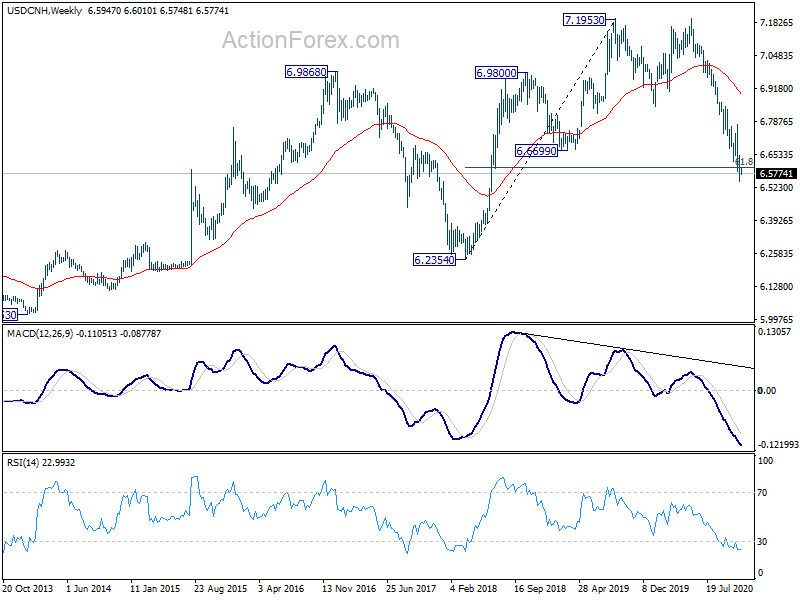
      The Chinese Yuan is also maintaining its strong medium term up trend. USD/CNH has taken out 6.6699 key support level last month. 61.8% retracement of 6.2354 to 7.1953 at 6.6020 was also lost. Further decline could be seen back to 6.2354 low next.
      BoJ Masai cautious on outlook for two reasons

        BoJ board member Takako Masai reiterated in a speech that the baseline scenario is for that the economy is “likely to follow an improving trend with economic activity resuming and the impact of COVID-19 waning gradually”. Still “the pace is expected to be only moderate while vigilance against COVID-19 continues”. Thereafter, as the impact subsides globally, the economy is projected to “keep improving further with overseas economies returning to a steady growth path.”.

        However, she had a cautious view on the outlook for two reasons. Firstly, growth in world trade volume had already been slowing since mid-2018, due to US-China trade friction. Japan’s export and production levels “had already been on a downtrend” prior to the pandemic. Secondly, global services sector had a growth presence in Japan’s labor market in recent years, but it’s projected to “recover at only a moderate pace”.

        Additionally,l she pointed out the risks to outlook, including (1) the impact of COVID-19 on domestic and overseas economies; (2) firms’ and households’ medium- to long-term growth expectations; and (3) developments in the financial system. Additionally, attention should be paid to US-China tensions, Brexit, geopolitical risks and global financial markets developments.

        Full speech here.

        Japan GDP grew 5% qoq in Q3, but still JPY 30T in output gap

          Japan GDP grew 5.0% qoq in Q3, above expectation of 4.4% qoq, a turn around from Q2’s -7.9% qoq contraction. In annualized term, GDP grew 21.4%, above expectation of 18.9%, the first increase in four quarters. It’s also the largest rise since comparable data become available in 1980, following the -28.8% annualized contraction in Q2. The data, while strong, was just seen as a rebound from an extraordinary pandemic contraction only.

          Economy Minister Yasutoshi Nishimura also sounded cautious as he reminded people of the JPY 30T spare capacity. “We can’t make up for all of the output gap just with public works spending. We also need to spur private investment. But the size (of the output gap) is something we’ll look at” in compiling the new spending package, he said.

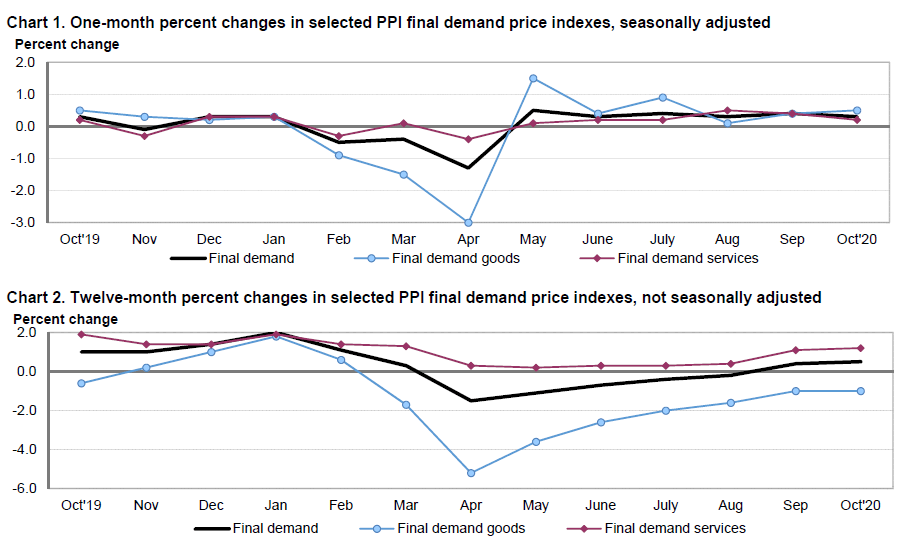
          US PPI at 0.3% mom, 0.5% yoy in Oct

            US PPI came in at 0.3% mom, 0.5% yoy in October, versus expectation of 0.2% mom, 0.3% yoy. PPI core was at 0.1% mom, 1.1% yoy, versus expectation of 0.3% mom, 0.9% yoy.

            Full release here.

            Fed Williams: Growth to slow somewhat in Q4 and early next year

              New York Fed President John Williams warned that “the very large rise in COVID cases recently clearly puts a question market on the ability of the economy to weather this period.” Thus, he’d “expect the growth in the fourth quarter, and maybe into early next year to slow somewhat.”

              Williams also noted that the economy is still in a extraordinary situation that needs fiscal support. “The reason the economy is still going is because we know people still have some of the stimulus checks and unemployment checks,” he said. “Those saved benefits are helping people pay rent and put food on the table.”

              ECB Schnabel: Vaccines puts us back in our baseline scenario

                ECB board member Isabel Schnabel said new restrictions in Europe “dampened substantially, the outlook for the fourth quarter, and then also for the first quarter of next year.” Though, there was “excellent news” regarding coronavirus vaccine”. And that “puts us back in our baseline scenario”, which sees a strong rebound 2021.

                Separately, Governing Council member Pablo Hernandez de Cos also said, “the vaccine is very positive news, regarding investor confidence, consumers confidence and economic activity. But I would like to be cautious. In the short term, restrictions will continue across Europe.”

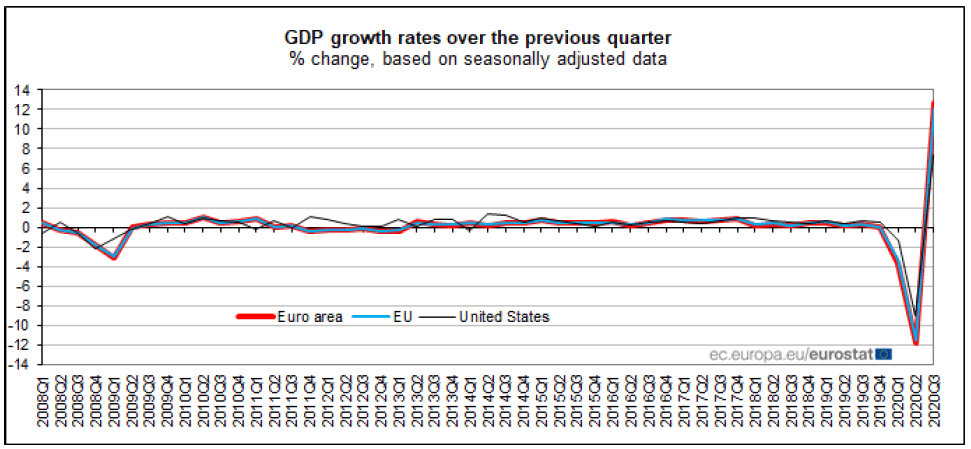
                Eurozone GDP grew 12.6% qoq in Q3, down -4.4% yoy

                  Eurozone GDP grew 12.6% qoq in Q3, the sharpest rise since the times series started in 1995. Over the year, however, GDP dropped -4.4% yoy. Employment grew 0.9% qoq, dropped -2.0% yoy. EU GDP grew 11.6% qoq, dropped -4.3% yoy. Employment grew 2.7% qoq, dropped -1.8% yoy.

                  Full release here.

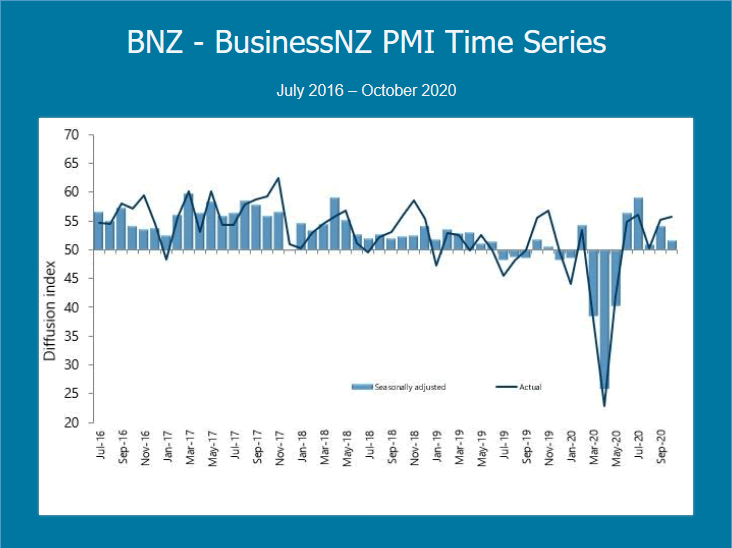
                  New Zealand BusinessNZ PMI dropped to 51.7, not getting too carried away with recovery

                    New Zealand BusinessNZ Performance of Manufacturing Index dropped from 54.0 to 51.7 in October. Production dropped from 56.7 to 51.1. New orders dropped from 58.1 to 52.4. But employment rose from 51.7 to 52.6.

                    BusinessNZ’s executive director for manufacturing Catherine Beard said that the sector remains in a state of flux, although still managing to keep in positive territory.

                    BNZ Senior Economist, Craig Ebert said that “October’s PMI serves as a gentle reminder of not getting too carried away with the sense of recovery, even if the worst of COVID’s impacts can be assumed to be behind us”.

                    Full release here.

                    RBNZ Orr: Be careful, be prepared and don’t run around on predictions

                      RBNZ Governor Adrian Orr said the improved growth and inflation projections in the latest Monetary Policy Statement released this week “is a very bod assumption”. The central bank has been “at pains to explain to people that we are creating scenarios, not projections of certainty,” he said.

                      “If the economy continued to grow and do what it’s doing, well that’s a beautiful world, but that’s a big if,” Orr added. “So today’s news around Covid just puts it back into perspective. Be careful out there, be prepared, don’t run around on predictions.”

                      Orr has the new FLP is “such an invasive way into the banking sector to provide very low cost of funding”. He’ll be on watch to make sure that’s passed on to borrowers and investors.” As for the further easing, Orr said purchases of foreign assets is “not a preferred option” that would not have a signifi cant impact “really in the long term”.

                      “We are very comfortable where we are with the funding for lending and the quantitative easing program we’re doing at present.”

                      ECB Lagarde: We’re not racing to be first on digital currency

                        ECB President Christine Lagarde said her “hunch” was that digital currency” will come”. Nevertheless, “We’re not racing to be first… We are moving ahead diligently, not incautiously. We will be prudent.”

                        “If it’s cheaper, faster, more secure for the users then we should explore it. If it’s going to contribute to a better monetary sovereignty, a better autonomy for the euro area, I think we should explore it,” she added.

                        ECB launched a public consultation on digital currencies last month. Policy makers would decide around mid-2021 on whether to initiate a full-fledged project. Lagarde added that it might take two to four years before digital currency could be launched.

                        Fed Powell: Too soon to assess implications of vaccines to path of economy

                          Fed Chair Jerome Powell said yesterday that recent development in coronavirus vaccine is “certainly good and welcome news for the medium term.” However, “significant challenges and uncertainty remain about timing, production, distribution and the efficacy for different groups” of a vaccine.

                          “From our standpoint it is too soon to assess with any confidence the implications of the news for the path of the economy especially for the near term,” he added. “The next few months could be challenging.”

                          “We’ve got new cases at a record level. We’ve seen a number of states begin to reimpose limited activity restrictions, and people may lose confidence that it’s safe to go out,” Powell acknowledged. “We’ve said from the beginning that the economy will not fully recover until people are confident that it’s safe to resume activities involving crowds and people.”


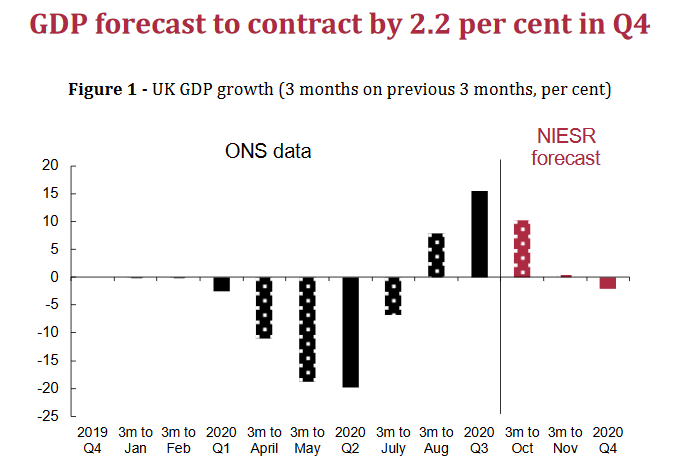
                          NEISR expects -12% GDP contraction in Nov in UK, overall -2.2% in Q4

                            NIESR expected UK GDP to contract -2.2% in Q4, with monthly fall of -12% in November due to second lockdown, followed by a return to October levels of activity in December. The forecast for 2020 stand at -11.3%.

                            Growth in the fourth quarter will be much slower than in the third quarter and is likely to turn negative, due to weaker growth in October and a second lockdown from November. Our expectations for the fourth quarter and beyond will depend on the stringency and duration of ongoing lockdowns; local and national.” Dr Kemar Whyte Senior Economist – Macroeconomic Modelling and Forecasting

                            “We expect the second lockdown to bring a large monthly contraction in November to be followed by a quick rebound in December provided that the lockdown succeeds in getting infection rates under control without the need for a further extension. The UK economy is likely to contract by around 11.5 percent in 2020.” Dr Hande Küçük Deputy Director – Macroeconomic Modelling and Forecasting

                            Full release here.

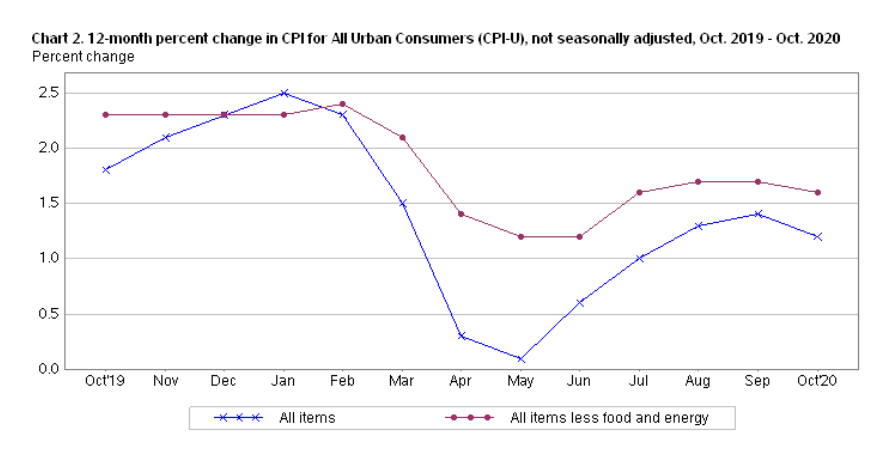
                            US CPI slowed to 1.2% yoy, core CPI down to 1.6% yoy

                              US CPI rose 0.0% mom in October, below expectation of 0.2% mom. CPI core was also flat at 0.0% mom, below expectation of 0.2% mom. Annually, headline CPI slowed to 1.2% yoy, down from 1.4% yoy, missed expectation of 1.3% yoy. CPI core slowed to 1.6% yoy, down form 1.7% yoy, missed expectation of 1.7% yoy.

                              Full release here.

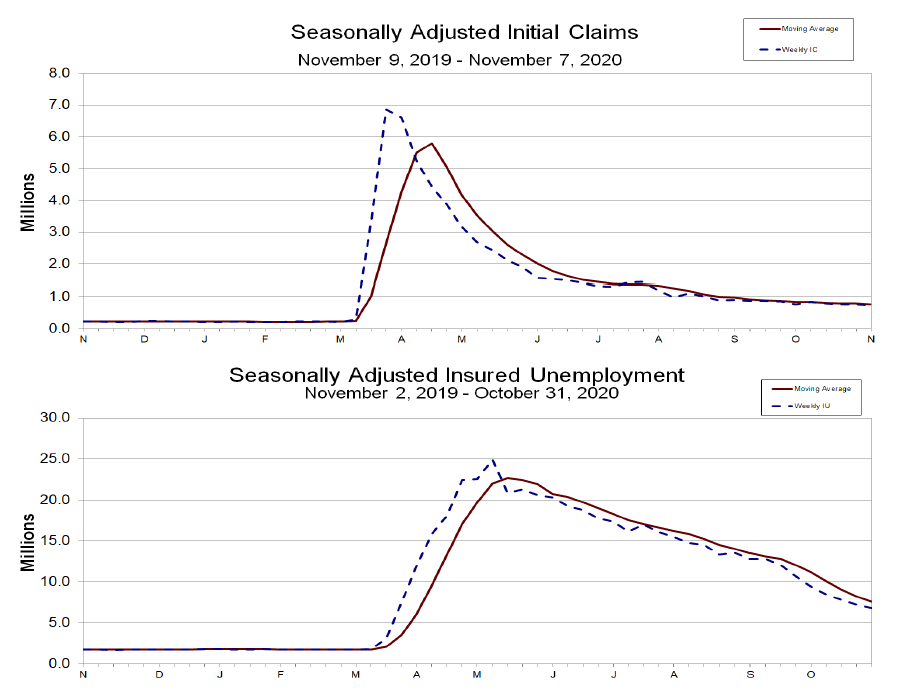
                              US initial jobless claims dropped to 709k, continuing claims dropped to 6.8m

                                US initial jobless claims dropped -48k to 709 in the week ending November 7, better than expectation of 745k. Four-week moving average of initial claims dropped -33k to 755k.

                                Continuing claims dropped -436k to 6786k in the week ending October 31. Four-week moving average of continuing claims dropped -653k to 7576k.

                                Full release here.

                                BoE Bailey: No precise date in mind on finishing negative rates study

                                  BoE Governor Andrew Bailey said he didn’t have a “precise date in mind” regarding when to publish the findings regarding the consultation with banks on interest rates. “There’s a great deal of work we have to do with the banks, particularly to work out what’s doable and what needs to be fixed,” he added.

                                  Also, in the current environment, policymakers were “talking about all the tools that could possibly be in the box”. But for the UK, ” UK, there isn’t a great call, I think at the moment, for doing more yield curve control at the short end… so I don’t think it’s something that I would see frankly a great need for at the moment.”

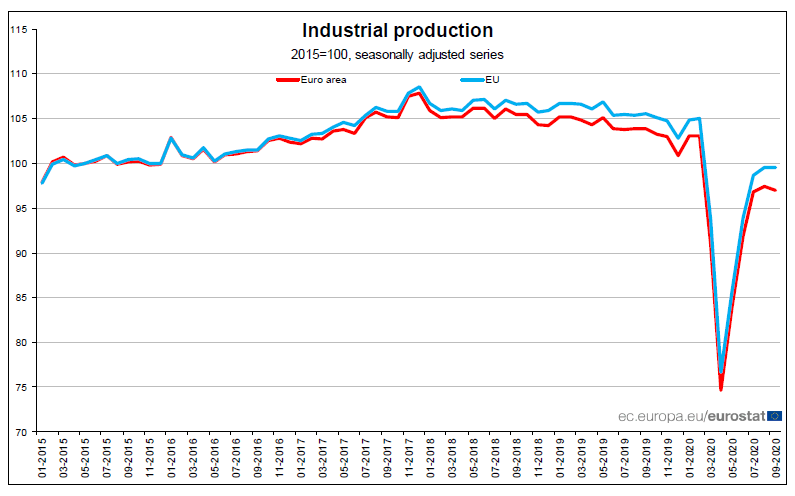
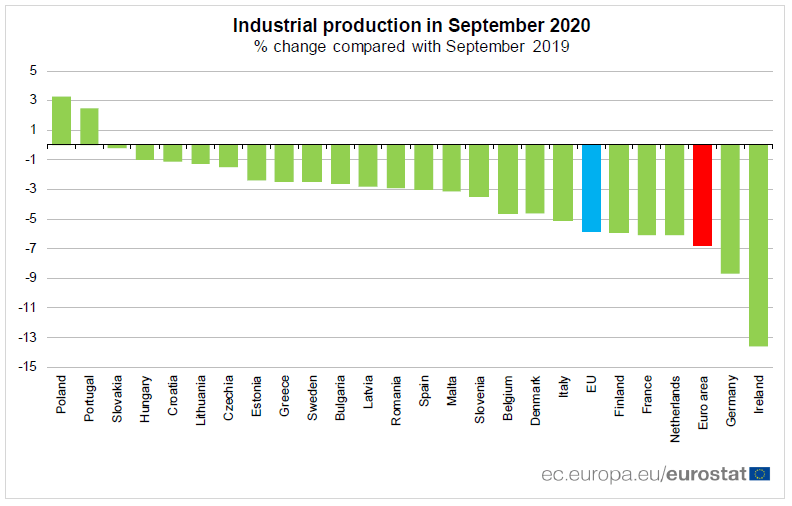
                                  Eurozone industrial production dropped -0.4% in Sep, well below expectations

                                    Eurozone industrial production dropped -0.4% mom in September, much worse than expectation of 0.9% mom. Production of durable consumer goods fell by -5.3% mom, energy by -1.0% mom, while production of intermediate goods rose by 0.5% mom, capital goods by 0.6% mom and non-durable consumer goods by 2.1% mom.

                                    EU industrial production was unchagned in the month. Among Member States, for which data are available, the largest decreases were observed in Italy (-5.6% mom), Ireland (-4.7% mom) and Portugal (-3.8% mom). The highest increases were registered in Czechia (4.1% mom), Slovakia (3.4% mom) and Poland (3.1% mom).

                                    Full release here.

                                    ECB: Forward EONIA curve does not suggest firm expectation of imminent rate cut

                                      In the monthly Economic Bulletin, ECB said ‘the resurgence in coronavirus (COVID-19) infections presents renewed challenges to public health and the growth prospects of the euro area and global economies… the associated intensification of containment measures is weighing on activity, constituting a clear deterioration in the near-term outlook.”

                                      ECB also noted that “forward curve of the euro overnight index average (EONIA) shifted slightly downwards and remained mildly inverted”. The curve “does not suggest firm market expectations of an imminent rate cut”. Though, “long-term sovereign bond spreads declined steadily across euro area countries, amid expectations of further monetary policy and fiscal support.”

                                      It’s also reiterated that new round of macroeconomic projections in December ” will allow a thorough reassessment of the economic outlook and the balance of risks”. On that basis, ECB will “recalibrate its instruments, as appropriate, to respond to the unfolding situation”.

                                      Full release here.


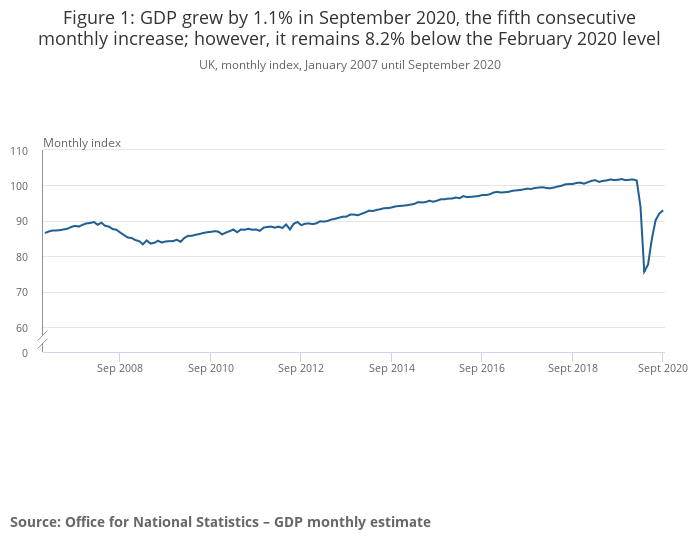
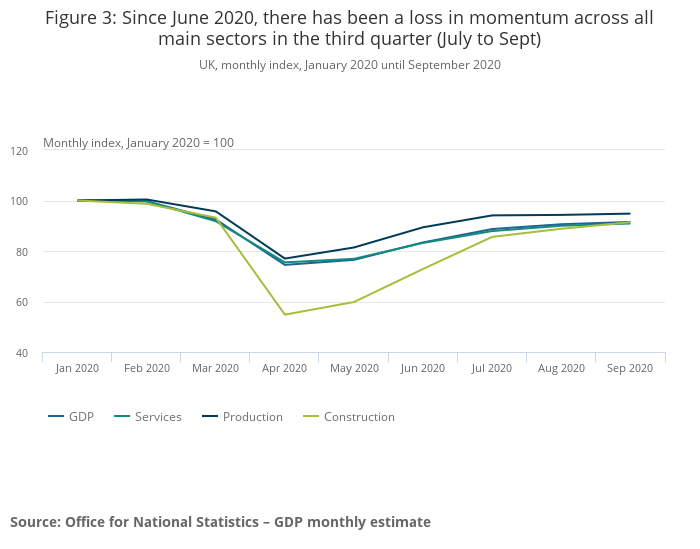
                                      UK GDP grew 1.1% in Sep, still -8.2% below Feb’s level

                                        UK GDP grew 1.1% mom in September, matched market expectations. That’s the fifth consecutive monthly increase. Industrial production rose 0.5% mom, matched expectations. Manufacturing production rose 0.2% mom, below expectation of 0.9% mom. For Q3, GDP grew 15.5% qoq, below expectation of 15.8% qoq.

                                        Still, comparing with February’s pre-pandemic levels, GDP is still down -8.2%. Index of services was down -8.8%. Index of production was down -5.6%. Manufacturing was down -8.1%. Construction was down -7.4%. Agriculture was down -0.7%.

                                        Full release here.

                                        Also from UK, goods trade deficit widened slightly to GBP -9.3B in September versus expectation of GBP -8.8B.

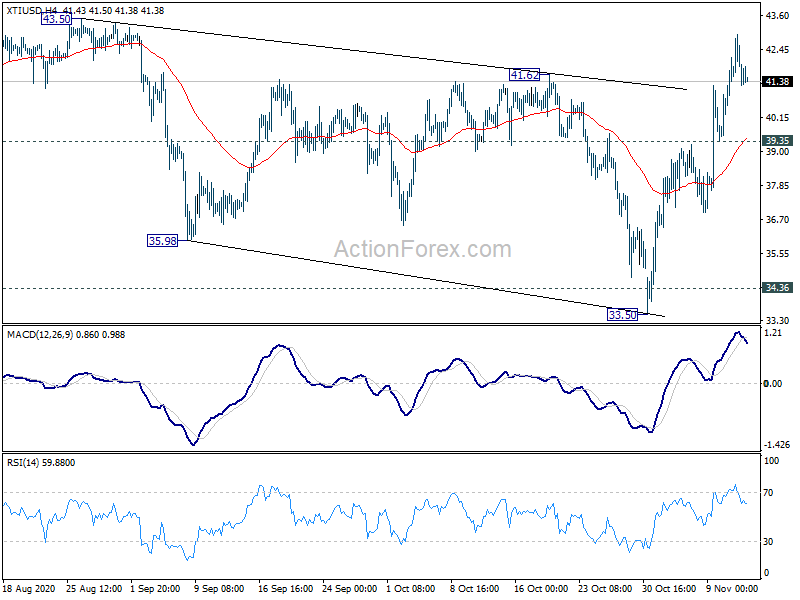
                                        WTI crude oil losses upside momentum ahead of 43.5 near term resistance

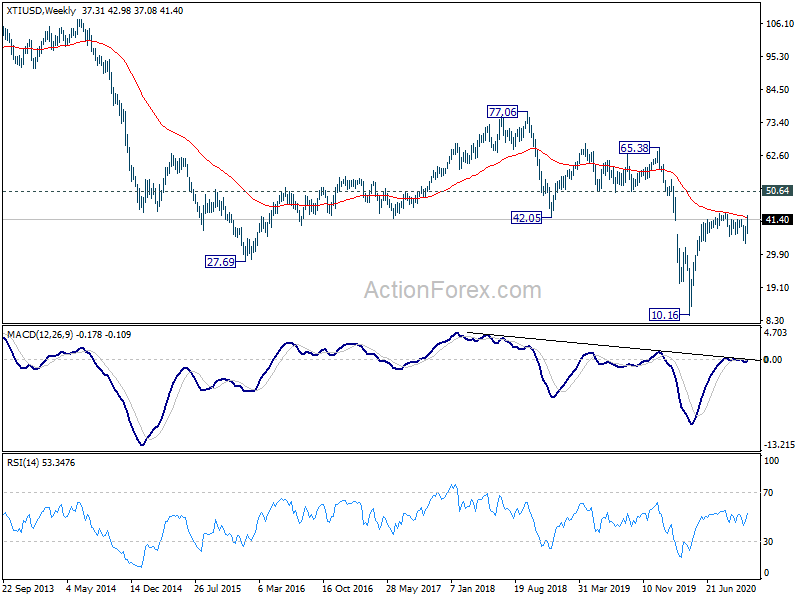
                                          WTI crude oil surges to as high as 42.98 this week as boosted by coronavirus vaccine optimism. Though, it’s starting to lose momentum ahead of 43.50. At this point, we’re not expecting a firm break of 43.50 to resume the medium term rebound yet. At least, that’s not expected until will have a firmer schedule for vaccine deliveries. Break of 39.35 minor support will likely start another falling leg to extend the consolidation pattern from 43.50.

                                          However, decisive break to 43.50 should have 55 week EMA firmly taken out. That would add to medium term bullishness for a take on 50.64 resistance turned support, which is close to 50 psychological level.